Blog Archives
Mission: Impossible – The Final Reckoning (2025)

It’s not just the increasing age of producer and star Tom Cruise, the Mission: Impossible movies have become victims of their own outlandish success, and this might have led to their ultimate end. This franchise has become known for its amazing stunts and placing Cruise in the thick of them. After every gasp-inducing, eyeball-popping stunt, the inevitable question arises, “What could top that?” And so writer/director Christopher McQuarrie, who has steered the franchise for a decade straight, has placed himself in a filmmaking arms race of action set pieces, and these budgets keep getting bigger and bigger, to compensate for the increasing scope and scale. As a result, these movies need to make an even higher amount of money to break even to cover their expanding expenses, and it doesn’t look like the M:I franchise has reached that next level of success (six of the previous seven movies have grossed between $175 million and $220 million domestically). As a result, Final Reckoning is the winding down of the franchise, or at least this incarnation, and it has enough to satisfy long-time fans, yours truly included, but it’s also a reminder of how things have gotten away from the series in the name of chasing spectacle.
Agent Ethan Hunt (Cruise) is tasked once again by the Impossible Mission Force (IMF) to save the world. In a continuation from the 2023 movie, Dead Reckoning, an evil A.I. known as The Entity is taking over the world’s complex computer networks and taking over control of nuclear missiles. It’s only a matter of time before the last four nations fall victim as well, so Ethan and his team (Simon Pegg, Ving Rhames, and now Hayley Atwell as Grace) must work together to get the only code that can kill The Entity.

Final Reckoning is the Scream 6 of the Mission: Impossible franchise. For those who never saw the sixth entry in an irony-drenched, self-reverential slasher series, it was intended to be the final entry in the franchise, and in doing so that made it try to tie back as many elements and moments as possible to the previous five movies. It was meant to feel not just final but full-circle for the fans. Naturally, the problem for Scream 6 is that it wasn’t going to be the final movie, and so a sequel is scheduled in 2026, and all that finality and franchise-reflection seems a bit like misguided internal stargazing. Coincidentally, the Mission: Impossible franchise also began the same year as the first Scream, 1996, and so this movie is intended to (possibly) close the door on the 30-year franchise and on (possibly) Ethan Hunt’s career as the best damn agent the IMF has ever had and yet whom they always doubt his motives in every movie.
M:I 8 takes far, far too much time trying to set up its stakes, which were already set up in M:I 7, which at the time was titled Dead Reckoning Part One before the “Part One” was scrubbed. Seriously, the first 45 minutes or so is awash in M:I clips from the previous seven movies and sloppy attempts to connect everything back together. Now the evil A.I. threatening the world has been revealed to be born from… the “Rabbit’s foot,” the undetermined MacGuffin from the third Mission: Impossible in 2006. Is that better? Does anyone really care about that? How about one of the cops being the son of a previous character? Does that change your opinion of Chasing Cop #2? How about the one guy in the first movie who found Ethan’s knife after he broke into the CIA in that movie’s most memorable sequence? Did you ever wonder what happened to him? Did you ever care about his well-being? I strongly doubt it. These Easter eggs to the older movies would be less egregious if this supposed final movie didn’t squander its first 45 minutes going over its own history as a means of trying to convince the audience This Stuff Really Matters. It’s even more egregious when the running time is 165 minutes long. All of this backward-looking ret-coning and clip show montages feel like an attempt to add weight to a franchise that never needed it. Let the stunts and set pieces stand for themselves. I don’t need all this nostalgic congratulatory back-patting.
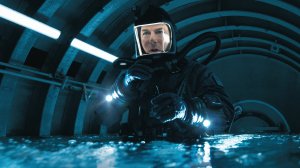
And there is a truly outstanding action set piece that anchors this movie, so much so that it actually comprises a full hour of the film. Set up in the preceding movie’s prologue, we know the only way to kill the evil A.I. is by securing a code located in a Russian submarine at the bottom of the Bering Sea. Just planning to find the location is the first hurdle that Ethan and the team have to surmount. Then there’s getting onto a clandestine U.S. submarine and launching out its tubes to swim to the bottom of the ocean, securing passage inside the fallen sub, and working one’s way through the different chambers, filled with frozen dead bodies, while the sub rolls around, tumbling further and further along the ocean floor. Each smaller sequence has a clearly defined series of mini-goals and organic complications, the kind of exciting escalations that make these set pieces so much better. It’s not enough for the pros to come up with a comprehensive plan, there needs to be unexpected complications that force them to improvise. A foolproof plan that goes perfectly is anathema to action cinema. This sequence has it all, which is why I have no qualms about its length because McQuarrie has justified every link in this set-piece chain. It’s also fantastic visually and really taut, especially as Ethan is tumbling through the innards of the sub with torpedoes falling over and pinning him underneath. This is a prime example of the maximalist virtuoso blockbuster filmmaking excellence that people have come to expect from the franchise.
The problem is that there’s an entire hour after this sequence and, once again, an M:I movie has peaked early. I think only Fallout and Dead Reckoning have their best moments during their actual climaxes. It hurts that Gabriel (Esai Morales) is the weakest villain the franchise may have ever had. I don’t care that the prior film tried to ret-con younger Gabriel into killing Ethan’s love and thus motivating him for vengeance and entering into the IMF. That personal connection and tragedy is a transparent attempt to make this character more important and menacing, and frankly, I am still astounded that this guy… THIS GUY… killed Rebecca Ferguson’s Ilsa. I can confirm, sadly, she is still dead, a reality that astounds me in the realm of a spy thriller where people assume identities. It’s she that Ethan should be fantasizing about in what could be his final moments, not Grace, and I will stand by that (no disrespect to Atwell, who is a genuinely fun and flirty addition to the team as an expert thief).

Regardless, back to Gabriel, who is just an empty suit of a villain, partly because the real villain is the scary A.I. conquering the world’s nuclear arsenals. It’s hard to really vilify a computer code for a movie, so enter this human handler, but he was uninspiring, so they added the secret back-story connection. It doesn’t work. I don’t really care about this guy being defeated, nor do I find him particularly threatening, miraculously killing Ilsa notwithstanding. The ultimate fight atop warring biplanes is visually impressive with its aerial photography, but the conclusion feels anticlimactic and the thrill of the set piece feels even slightly redundant when we remember Cruise has already hung from the side of a plane in M:I 5 and dangled from a helicopter in M:I 6. There’s yet another ominous timer ticking down, yet another deadly device with wires needing to be cut, and yet another side character possibly bleeding out to death. It feels rather par for the series, perhaps a thematic distillation of all those clips. There’s also some extra Fail Safe-style political hand-wringing at the highest levels of the U.S. government whether to give Ethan the benefit of the doubt or resort to some unorthodox methods for added stakes. It just adds up to a final hour of some strong moments in passing and too much of the same for a franchise that chartered new heights.
Placing it through the M:I pecking order, Final Reckoning is probably the weakest of the McQuarrie Era and arguably lesser than Mission: Impossible III, but it is leagues better than the first two Mission: Impossible entries. Realistically, this isn’t the end of the Mission: Impossible franchise, which has grossed close to five billion dollars over the span of its eight movies, but it is the end of Cruise as our star. The franchise was already previously engineered to hand off to Jeremy Renner in 2011’s Ghost Protocol, but then the movie proved too popular to persuasively function as writing off Ethan Hunt (unlike the other franchise also trying to hand off to Renner at the time, 2012’s Bourne Legacy, which proved so unpopular that Matt Damon came out of Bourne retirement). Cruise is now 63 years old and probably aware that these kind of death-defying stunts might be behind him even at his pace. Though I think the three separate shirtless scenes with Cruise are intended to dissuade you about the limits of his age (hey, I hope I look as good as Cruise’s abs when I’m 63). Final Reckoning is another chance to bid goodbye to its seminal action hero, which may be why there’s so much looking back and connecting unnecessary dots. This franchise is a celebration of the highs of big–budget action storytelling with the most game superstar with a death wish Hollywood could provide, so it’s bittersweet to see it reach some form of an end. McQuarrie, the David Yates of the franchise, has been an excellent shepherd with a kinship with Cruise for grand popcorn entertainment. It’s not the best entry but even a lesser M:I movie still rises above just about most studio action cinema. It’s definitely underdeveloped, too long, and structurally questionable with its pacing and climax, but at its best, it still reminds you why this franchise rose above the rest.
Nate’s Grade: B
Share this:

Mission: Impossible – Dead Reckoning Part One (2023)
 I was a nominal fan of the Mission: Impossible series after three movies, and it seemed like the American public was feeling the same. After 15 years, it felt like the franchise was considering a soft reboot/shift with 2011’s Ghost Protocol, setting up Jeremy Renner as the heir apparent to Tom Cruise’s super spy, Ethan Hunt (weirdly, Renner was also set up to be another franchise replacement for Matt Damon’s Jason Bourne in 2012). Except what may have been initially planned as a franchise hand-off became a franchise renewal, with a delightfully twisty plot, fun teamwork as they scramble to adapt, and a show-stopping action set-piece that remains the franchise’s high-point, the scaling of the towering Burj Khalifa skyscraper. It also reminded us that not only does Cruise love to run but the man has a death wish when it comes to performing his own amazing stunts. With Cruise firmly back in place as lead, and Renner jettisoned (which also happened after 2012’s The Bourne Legacy), the franchise was further boosted by two of its best additions: actress Rebecca Ferguson and writer/director Christopher McQuarrie. The Oscar-winning Hollywood screenwriting staple was not known as much for his directing efforts, but he became a Cruise confidant after 2008’s Valkyrie, and he’s worked almost exclusively on Cruise projects ever since. He earned the man’s trust and proved a fantastic action director. 2018’s Mission: Impossible Fallout is just blockbuster filmmaking at its high-stakes finest. I was bouncing in my chair with excitement and simply luxuriating in action thriller nirvana.
This time Ethan Hunt (Cruise) and his select team of trusted friends and colleagues are battling a villain terrifyingly relevant to our modern times, especially in light of the screenwriters’ strike – artificial intelligence. The big bad is an A.I. that can control the world’s security apparatus, and it’s become self-aware and resentful of its human overlords. It exists inside a computer console inside a Russian submarine at the bottom of the Arctic ocean under a wall of ice, and the A.I., known as “The Entity,” doesn’t want to ever be found (must be an introvert). If only it was that easy. The world is racing to be the first to claim this unparalleled prize, and the Impossible Missions team has to ensure they can find the location, which of course involves a MacGuffin, this time two interlocking keys to access the A.I. sub station. Can Ethan get there first and can he even trust his own government to do what’s best with access to this kind of power?
 Mission: Impossible – Dead Reckoning Part One is a mouthful of a title. We got a colon, a dash, and a “part one,” a presumptuous gamble that after 160 minutes the audience is going to be ravenously hungry for a continuation in a series that has never had a two-parter before. In short, the movie is a lot, a lot of the same action and renowned stunt work we expect, and a lot of setup and extension that might have been better trimmed by focusing on one movie rather than setting up two. McQuarrie has done this before and been successful without the need of a direct two-parter. For all intents and purposes, Fallout is a direct sequel to 2015’s Rogue Nation, carrying over the same villain for the first time in the series and the ongoing relationship between Ethan and Ilsa Faust (Ferguson). Both of those movies feel complete and satisfying and well-designed in structure and development without needing one part to complete the other. With Dead Reckoning Part One, henceforth known as M:I 7 to spare me from writing this title every time, it feels like an overlong setup. By the end of the movie, our characters know where the A.I. is located but they still don’t know where the sub is or how to get there, which means the entire movie could have been collapsed into a more streamlined venture. Part of this may be the production troubles where they had to shut down and rejigger the plot multiple times from COVID outbreaks, as M:I 7 is the last of the big Hollywood movies to release that was shutdown in 2020 by the devastating pandemic. It all feels a bit overstretched and absent a satisfying conclusion.
The draw of the franchise, and chiefly its 2010s renewal back into the zeitgeist, is still the eye-popping stunts and set-pieces and Dead Reckoning still delivers. Most viewers will likely find the final action sequence aboard a speeding train to be the high-point, and it’s got some wow moments, my favorite is when the train is hanging over a blown bridge and Ethan has to leap from train car to train car before it plummets, oh and it’s all at an incline. It turns each car into a new obstacle to overcome utilizing its specific dynamics, like a dining car with a falling piano to a kitchen with vats of hot grease to avoid. The standout stunt involves Cruise driving a motorcycle off a mountain in a desperate effort to parachute onto this speeding train. However, this whole train sequence didn’t excite me too much, outside of its beginning stunt and the end. Watching men chase one another atop the speeding train, let alone wrestle and fight with knives, only serves to limit what can be done and it reminds me how fake the moment is for a franchise that has made its mark on its daredevil realism. That extended middle feels a bit too much like other Hollywood thrillers and action movies, and that’s what made it disappointing for a series I consider the current gold standard of franchise action.
 A much less heralded sequence around the forty-five minute mark was my favorite, where Ethan is running around the Abu Dhabi airport while the following takes place: 1) Ethan trying to evade federal agents (the dependable Shea Whigham) looking to arrest him, 2) Ethan is trying to find the owner of one half of the MacGuffin keys who happens to be a pickpocket that keeps giving him the slip, 3) Ethan’s team, Luther (Ving Rhames, the only other actor who has appeared in every M:I film) and Benji (Simon Pegg) trying to find a nuclear bomb in a suitcase through the maze of baggage claim and disarm it, 4) the introduction of our villain Gabriel, well, our primary lackey to The Entity, who also happens to be a former IMF turncoat who killed Ethan’s girlfriend and essentially “made Ethan Hunt who he is” following Batman logic. This entire sequence is pure McQuarrie splendor, where it introduces the different characters, several at cross-purposes, lets them loose and then finds organic complications and specific turns that take advantage of the geography as well as the character’s emotional states. I loved it, and it made me hopeful that after a bit of a slow start that M:I 7 was now cooking and would be the prolonged deluge of near-perfect set-pieces that was Fallout. Not so much, but this sequence was indeed good fun.
Another issue I had was that our villain, again more like chief lackey, is so bland. I like Esai Morales (Ozark) as an actor, but the character of Gabriel is such a non-starter. Even giving him the personal history with Ethan feels like an admission that this bad guy has little to offer on his own. I think it’s part of how the character is written but I think it’s also a reflection that he’s the number two behind the all-powerful, scheming A.I., and then he too has a number two (number three?) played by Pom Klementieff (Guardians of the Galaxy vol. 3), and she is so much more engaging as an antagonistic presence. She’s the one driving through cars and stonework throughout Rome to chase down Ethan. She’s the one who fights him in a narrow alleyway, a nicely claustrophobic change-of-pace action moment for a series that gorges on scale. If the true villain is going to be an A.I., why can’t Pom simply be its number two hench-person? Gabriel is redundant and boring and his fight sequences don’t feel believable against this crew.
 There are a couple other storytelling choices that I wasn’t happy with, but I’ll save delving into those for the sake of spoilers. Suffice to say, I hope Dead Reckoning Part Two in 2024 course corrects and we have some welcomed returns. It’s kind of fun to see Kittridge (Henry Czerny, Ready or Not) make his first reappearance since the 1996 M:I and also get so much screen time. He’s essentially the face of the U.S. government infrastructure for the duration of the movie. His clenched-jaw consternation is a nice foil to the always rogue super spy.
Dead Reckoning – Part One is a good but not great Mission: Impossible movie, conceived as two parts and suffering some of the consequences of its over-extension. The thrills are still there, the sturdy production values, the emphasis on the spectacular stunts and fun action set pieces, so any fan of the franchise will find enough to enjoy over 160 minutes. The addition of Hayley Atwell (Avengers: Endgame) as the wily pickpocket who has stumbled into international espionage is great, though she cannot escape feeling like an Ilsa replacement while Ferguson is off-screen for too long. Cruise is still the movie star who delivers the most from film to film, and his high-wire efforts are appreciated. By the end of the movie, the sub is still at the bottom of the ocean, our characters are still in a race to find it, and I wondered why we couldn’t have ditched “Part One.” The answer, as much in Hollywood, is of course money, but I wish this Part One made me more psyched for Part Two.
Nate’s Grade: B
Share this:

Lightyear (2022)/ Luck (2022)
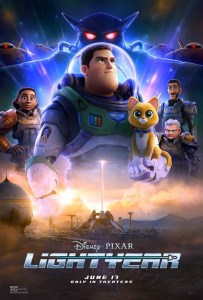 After two years and three movies sent straight to Disney’s burgeoning streaming service, Pixar returns with a theatrical movie that taps back to the very beginnings of this storied storytelling company. We’re told, via opening text, that Lightyear was Andy’s favorite movie and thus the reason he was so excited to bring home a Buzz Lightyear action figure in the first Toy Story. However, if this is Andy’s “favorite movie,” then this kid needs to be exposed to more movies. It’s an acceptable sci-fi story about Buzz (voiced by Chris Evans) learning the value of others and that being vulnerable is not the same as being weak. He’s a space ranger stranded on an alien world. Every time he attempts to restart their fuel system, it jumps him forward in time four years, and soon enough he’s a man out of time and those stranded have built a colony civilization over 100 years. There’s a band of misfits, who aren’t terribly funny, and some laser fights and action sequences, which aren’t terribly exciting, and the third act twist is predictable. The animation is top-notch, but the storytelling is definitely a few notches below infinity and beyond. What astounds me is that Andy could watch this movie and want a Buzz toy instead of the real breakout, the robotic cat Sox (voiced by Peter Sohn) who is wonderfully droll. I cannot fathom anyone watching this movie and desiring owning another character above this delightful supporting character. This movie makes me think a little less of Andy as a discerning arbiter of pop-culture zeitgeist. Lightyear is fine as escapist entertainment but too facile and inessential to the Toy Story universe.
 Luck is the first animated feature from Skydance, a production company that entered the animated realm by hiring former Pixar head John Lasseter as their chief creative executive. In some ways, Luck feels reminiscent of early Pixar movies, exploring the “secret life of” those in charge of dictating the forces of luck. The problem with Luck is that it is overwritten and overburdened with world building that crushes the emotional core. We follow a young woman aging out of the foster system and she’s been besieged with bad luck all her life. She follows a talking cat and discovers a hidden world where workers mine luck crystals and have lucky pennies as portal generators and there’s a dragon, for some reason, as the CEO of Good Luck, and to get back home she needs to team up with the cat to find a thing, but to find that thing they need to go to a place, but to go to that place they need to – and you get it. The plot is overworked with a chain of tasks that explain more of this world’s mechanics without connecting to the emotional journey of the character, like in 2015’s Inside Out. I was amazed that this woman lacks even a shred of bitterness about her own trenchant bad luck. There’s a nice message about accepting the bad with the good in life, and how both are opportunities for growth, but I kept wondering why our hero didn’t once lash out at those responsible. I’m also a little hesitant about using whether a little girl will be stood up by her potential new foster family as the stakes of completing the good luck reset goal. That seems pretty heavy for wackiness. The animation isn’t quite at the level of Pixar, or the best of Dreamworks, but it’s colorful and bright even if lacking more advanced lighting and texture. Luck lacks enough gravitas and development to really appeal to adults but it’s also probably too busy and convoluted to entertain small kids.
Nate’s Grades:
Lightyear: B-
Luck: C+
Share this:

Mission: Impossible – Fallout (2018)
 Coming down from the surging adrenaline rush, I was trying to determine when was the last time an action movie made me feel the immersive, delirious highs that Mission: Impossible – Fallout offers in spades, and what I came up with 2015’s Mad Max: Fury Road. Simply put, this is the best straightforward action movie in three years. It’s the best Mission: Impossible movie in the series, which, if it hadn’t already, has assumed the peak position of the most consistent, most entertaining, and best action franchise in Hollywood. Allow me to explain how returning writer/director Christopher McQuarrie (Jack Reacher) makes an action movie that demolishes the competition.
Ethan Hunt (Tom Cruise) has been pulled back into spy action thanks to the lingering fallout (eh, eh?) of the capture of Solomon Lane (Sean Harris), whose followers, nicknamed The Apostles, have stolen three plutonium cores. It’s Ethan Hunt’s fault the nuclear cores got loose, and so he and his team, Luther (Ving Rhames) and Benji (Simon Pegg), must clean up after their mess. The CIA sends its own asset, the burly August Walker (Henry Cavill), to help oversee the mission and specifically Ethan Hunt, who must pose as a shadowy terrorist broker to maintain appearances with important figures in the criminal underworld. In order to get the nuclear parts, Ethan Hunt has to retrieve Solomon Lane and release him back into the open. Complicating matters further is Ilsa Faust (Rebecca Ferguson) who needs Solomon dead to clear her own spy debts.
 Every action movie lives or dies depending upon its unique set pieces, often the first thing constructed by a studio and then the plot mechanics are ladled on merely as the barest of connecting tissue. They need to have stakes, they need to have purpose, they need to be memorable, and they need to be understood and develop organically. Mission: Impossible – Fallout could be taught in filmmaking schools about how to properly build action set pieces. They are brilliant. McQuarrie finds interesting ways to set them up, complicate them, and just keep the escalation going in a manner that still maintains the believability of the moment. Take for instance a foot chase where Ethan Hunt is trying to nab a bad guy through downtown London. Where McQuarrie pushes into the extraordinary is by having that foot chase on a multi-level terrain. Ethan Hunt has to chase after his target but multiple stories above the ground, and so he’s leaping out windows, jumping over rooftops simply to keep up. It’s a simple twist that takes what we’re familiar with and, literally, elevates it to new heights. Or take for instance the mission in Paris to capture Solomon Lane. At first it’s capture, then it’s flee police, then it’s flee another assassin. There are multiple stages to this sequence, each with a new goal, each with new complications, and each with new eye-popping stunts and escapes. The action finds natural points to progress, making smart use of the geography, and keeping different elements at play to come in and out to add more problems. This is how you do action right. As soon as the half-hour mark settles in with the arrival of Walker, the movie is practically nonstop in its set pieces until the very end. At a steep 147 minutes, this is the longest Mission: Impossible movie yet but it’s breathless in its execution.
Amazing set pieces that are cleverly designed is one aspect of a great action movie, but if you can’t tell what’s going on, what’s the point of all that cleverness? Fortunately, McQuarrie understands this and adheres to a visceral depiction of the action that creates gloriously immersive and pulse-pounding sequences. The set pieces are terrific, so it stands to reason the stuntwork should be terrific, and to make sure you appreciate the stuntwork, McQuarrie makes sure the photography highlights the verisimilitude. It’s a symbiotic (or as the Venom trailer tells me, “sym-BI-oat-ic”) relationship but when done correctly, as evidenced in this film, it’s the key to truly kinetic action sequences. Take for instance a parachute jump that marks the start of the second act. McQuarrie films it as a sustained long take, and as the camera plummets to the ground chasing after the two men, our brains can tell us that there is some special effects trickery to mitigate the dangers, but our senses are overwhelmed with the sustained illusion of tension. The fight choreography is equally up to the challenge. A bathroom brawl with Ethan Hunt and Walker and another man becomes a lesson in how many things can be smashed and what can be used as a weapon. A high-speed motorcycle chase through Parisian streets gets even more frantic when Ethan Hunt drives against traffic, and the scene becomes even more exciting when McQuarrie’s lens allows us to see the danger in all its glory.
 The Mission: Impossible franchise has been notable for its insane stuntwork but also, chiefly after the second installment, its edict to practical effects and maintaining the believability of its reality. It’s still movie spy shenanigans and globetrotting adventures, yes, but the moment-to-moment thrills feel like they’re really happening. The Fast and Furious franchise has gained great acclaim for the bombast of its physics-defying spectacle, and the Mission: Impossible franchise seems to have gone purposely in the opposite direction. It’s real Tom Cruise jumping off that building, it’s real Tom Cruise riding through traffic on a motorcycle, and it’s real Tom Cruise falling and climbing up a speeding helicopter during the thrilling finale. Cruise has had a death wish when it comes to throwing himself into the high-wire stunts of his franchise, but even at 56 years old he’s still at it, essentially trying to commit suicide on film for all of our amusement. Cruise is one of the few remaining movie stars and his commitment is without question.
This is also the first Mission: Impossible film that feels like the characters matter. It’s a direct continuation from the previous film, 2015’s Rogue Nation, bringing back the (somewhat lackluster) villain, the newest spy counterpart/potential love interest, the CIA and IMF brass, and the essential supporting team members from prior engagements. Because of this it feels more like what happened previously was establishment for a new story building upon that foundation. Rather than starting all over, the characters find ways to deepen their relationships, and the film opens up Ethan Hunt as a character and the toll his duty takes on those closest to him. There are some nice quiet moments that examine these characters as actual people. Several complications are as a direct result of personal character decisions, some good and some bad. I was joking with my pal Ben Bailey beforehand about wondering whether they’d find a way for Ving Rhames to matter, since he hasn’t been much more than “a guy in the van” for four movies, and by God they make him matter. They make each team member matter, finding moments to give them, mini-goals they’re entrusted with. During the dizzying helicopter chase in the finale, supporting players are left with their own task. Luther has to defuse a bomb but doesn’t have enough hands. Benji has to find something valuable in a very needle-haystack situation designed to torment and waste precious time. Ilsa is at cross-purposes for most of the film, not wanting to harm her fellow allies but also being given her own orders to prove her loyalty and protect her future. All of this comes to a head and it makes the parts feel as important as the whole. That’s great storytelling.
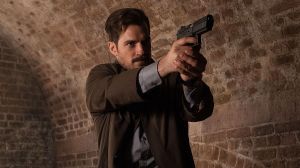 Let’s talk about that million-dollar mustache of Cavill’s. It was a year ago that Justice League re-shoots required Cavill and the Mission: Impossible team refused to allow their actor to shave his mustache, thus leading to that unsettling fake baby lip Superman was sporting in a majority of his scenes in the haphazard Justice League film. I just read an AV Club interview with McQuarrie where he for the first time discusses the whole mustache brouhaha and apparently Paramount estimated that it would have cost them three million for the effects to uphold Cavill’s upper lip continuity. Warner Brothers refused to pay up and so went down that ill-fated CGI mustache-removing route. It was shortly afterwards that Cruise shattered his ankle in a roof-leaping stunt (that is in the finished film and advertisements) and the production had to shut down for a month. If only Warner Brothers had waited, perhaps we all could have avoided this mustache mess.
Mission: Impossible – Fallout is a new highpoint for the best action franchise going in movies today (I’m still waiting for a third Raid film, Gareth Evans). The set pieces are memorable and unique, leading from one into the next with exquisite precision and thought. The action sequences are stunning and shot with stunning photography, highlighting the stunning stuntwork by the best death-defying professionals. It’s the first Mission: Impossible movie that doesn’t climax at its middle; in fact there’s a pretty obvious reveal that feels like it was going to be a late Act Three twist, but McQuarrie recognizes the audience thinking ahead, and there’s like a whole other exciting 45 minutes after. The stakes are better felt because the characters matter and are integrated in meaningful ways. This is the most I’ve enjoyed Henry Cavill in a movie (with possible exception of another spy movie, Man From U.N.C.L.E.), and you know what, his mustache works too. While the vertigo-inducing Burj Khalifa sequence is the best set piece in the franchise, Fallout has everything else beat at every level. Mission: Impossible – Fallout is a reminder that there are few things in the world of cinema better than a properly orchestrated, properly filmed, and properly developed action movie operating at full throttle. This is one of the reasons why we go to the movies, folks. See it in IMAX if possible. Soak it up.
Nate’s Grade: A
Share this:

Star Trek Beyond (2016)
 With J. J. Abrams’ departure from the franchise for the greener space pastures of Star Wars, there was a creative void to fill, and in stepped director Justin Lin (Fast and Furious series) and co-writer/star Simon Pegg, acclimating to the established new movie universe and providing a Trek movie that proves to be the most “recognizably Trek” in the series thus far. The crew of the Enterprise is stranded on an alien world after being attacked by a hive-like armada of ships. It’s a somewhat familiar formula, a distress call that ends up being a trap, from an unknown entity that is harboring vengeance against the Federation. This allows for several dispirit storylines to explore the surroundings but also the enjoyable character dynamics of the crew; the casting department hit the jackpot with this franchise, and it’s just satisfying to watch the actors deliver solid, satisfying character moments. The new character Jaylah (Kingmen’s blade-legged Sofia Boutella) is interesting, kickass, and a source of deadpan comedy conflicts with others. There’s a genuine sense of discovery that’s patiently paced, not so much the set-piece-every-ten-minutes of the Abrams films. Idris Elba (The Jungle Book) makes for an intimidating villain and I’m happy to report he doesn’t get lost under gobs of makeup. He becomes more Elba as it goes, and he’s given a credible motivation and back-story to explain his actions. The action is a bit less exciting than I was hoping for from Lin, whose special blend of crazy has been somewhat dampened as he adopts the house visual style of the franchise. Pegg and co-writer Doug Jung have steered the franchise into safer territory but also put the focus on the crew and their bonds, which is the secret weapon of Trek. You sense that Pegg and Jung are fans, and they even provide greater context and justification for the new Trek elements that drew earlier complaints, like the use of the Beastie Boys song which now becomes a fun moment of fist-pumping triumph. Star Trek Beyond (no colons necessary, apparently) doesn’t quite hit the same highs as the previous two films, but it’s a solid movie overall and might be the best movie for the most ardent fans of classic Trek. My last piece of advice: go into space construction in the future. The way they go through starships, you’ll always have a job.
Nate’s Grade: B
Share this:

Star Wars: The Force Awakens (2015)
 May 19,1999 is a day that lives in infamy for legions of Star Wars fans. The day hoped died. I remember trying to convince myself that The Phantom Menace was good but a second viewing confirmed my earlier fears. These movies were not going to be the same as the original trilogy, and George Lucas confirmed that with each successive release. I’ve had debates with teenagers who swear that the prequels are better films. They aren’t. This isn’t a matter of opinion; this is fact. After Revenge of the Sith was released in 2005, you could sense that Lucas was burned out and had no desire to further awaken the ire of the fandom. Then in 2012 he surprised everyone by selling the Star Wars empire, along with other properties like Indiana Jones, to Disney for four billion dollars. Immediately Disney let it be known that they wanted to get new Star Wars movies into production ASAP. They tapped J.J. Abrams to spearhead the first steps in a new direction. No other movie has felt the weight of hype and expectation like Episode VII: The Force Awakens. Fans don’t want to be hurt once more by someone they loved. For millions of fans that grew up on the original trilogy, The Force Awakens will be the Star Wars movie they have long been waiting for. It erases the bad feelings of the prequels and re-calibrates the franchise. However, it is also flawed and seems too indebted to nostalgia. It’s certainly good but I cannot put away my nagging reservations (far, far less than what I felt with the prequels).
Thirty years after the events of Return of the Jedi, the First Order has risen in place of the evil Empire. The First Order is lead by General Hux (Domhnall Gleeson) and aspiring sith lord Kylo Ren (Adam Driver). They’re searching for the droid BB-8 and its owner, Resistance pilot Poe Dameron (Oscar Isaac). The droid has a map that leads to the whereabouts of the last known Jedi – Luke Skywalker (Mark Hamil). A Stormtrooper who adopts the name of Finn (John Boyega) runs away from his mission and joins forces with Rey (Daisy Ridley), a scavenger waiting for her family to return to her world. The duo finds BB-8 and seeks to return the droid to the Resistance. They run into Han Solo (Harrison Ford) and Chewbacca (Peter Mayhew) and a few other familiar faces on their journey to the Resistance base and to escape the reach of the First Order.
 Abrams has captured the essential magic of what made the original trilogy so enjoyable and timeless. The prequels carried the burden of setting up characters we had come to love, and so as we watched younger versions of them or characters integral to their development, it was hard to ignore just how little we cared. It didn’t feel like Lucas himself cared that much, more content to direct his green screens than his actors. The special effects had improved but for much of the three prequels it felt like watching disinterested actors recite poorly written lines while they run around fake environments with no semblance of reality. The details that Lucas emphasized were ones that were unnecessary, like treaties and trade tariffs and the notorious midichlorians, which made the force into a blood disorder. The prequels harmed the legacy of the franchise. It takes only seconds for you to feel like you’re in better hands when you read the opening text crawl. No trade disputes. No galactic senate. It sets up its central chase and the important players in three brief paragraphs. And then we’re off and the movie rarely lets up.
We pass the torch to a new generation of characters and it’s here that Force Awakens is able to leave the large shadow of the original trilogy. The characters are great. Finn gives the viewer an entry point into a world we’ve never explored onscreen in any real depth, the life of a Stormtrooper, the cannon fodder of the series. He has moral crises and goes AWOL from the duties he has been raised to do. He doesn’t want to be a mindless killing-machine and forges his own destiny. Watching him embrace a sense of individuality is entertaining. He’s charming and excitable but also fearful of what may catch up to him. Then there’s the hero’s journey with Rey, a plucky heroine who comes of age over the course of the movie’s 135 minutes. Ridley has the presence and poise reminiscent of Keira Knightley, and the screen just adores her. It also helps when her character is easy to root for. Boyega (Attack the Block) and Ridley are terrific and even better paired together. They have a great chemistry and much of the humor is born from the characters rather than lame visual gags like in the prequels. It’s fun to hear characters verbally spar with actual good dialogue. Driver was the first actor hired and it’s easy to see why. If you’ve been watching the man on HBO’s Girls, you’ll know that he has a magnetic presence that separates him from the herd. He plays a villain that so badly wants to follow in Vader’s footsteps but the thing that holds him back is the “temptation of the light.” In one moment, a badass and imposing villain with super force powers had now also become an interesting character wrestling with his influences. Isaac (Ex Machina) is suave and cocksure as an ace pilot. His affection for the other characters is touching, particularly the robot BB-8. This little guy is going to be the toy that every child on Earth demands for the holidays. BB-8 is adorable from its first moment on screen and made me forget about R2D2. The big worry with Force Awakens was that its new characters would be compelling on their own. After one movie I’m looking forward to more adventures with the new kids on the block.
 Abrams has restored the sense of fun and awe that resonated from the original trilogy and the biggest compliment is that Episode VII feels like a Star Wars movie (more on which below). The action sequences are quick and filled with great visuals and shot arrangements. For those worried about Abrams’ penchant for lens flairs in the Star Trek reboots, they are completely absent in Force Awakens (Fun fact: for Star Trek Into Darkness, computer effects had to go in and take out lens flairs because Abrams later admitted he had gone a bit overboard). There are some beautifully orchestrated shots and sequences all around here. The first 40-minutes is the best part of the movie, before the older stars come back for their due. The rest of the film is enjoyable, no doubt, but I was more pleased with the original material. The technical expertise has never been higher. Like Mad Max: Fury Road, there’s a joy with watching characters interact with a real world of practical effects. Watching the characters run around real environments and real sets rather than immense green screens just makes it feel more real and vital. I enjoyed how worn and weathered the technology in this world comes across. The special effects are judiciously utilized and are excellent as anticipated. It’s easy to sense the reverence that Abrams and others have for the series as well as their determination to not repeat the mistakes of the prequels. The first mission for Episode VII is to reset the course, to wash away the bad taste of the prequels that haunt many. Abrams has gone back to what works with these movies and recreated the playbook. It’s a movie that will satisfy the hardcore fans and reawaken their love for the series.
And yet it almost feels like Force Awakens is a swing too far in the other direction, an overcorrection to the prequels that turns a reboot into a loving homage that approaches facsimile. I was amazed at just how closely Episode VII follows the plot beats of A New Hope (mild spoilers to follow – for real, if you don’t want to be spoiled in the slightest, and I’m no monster and won’t dare include anything that would substantially deter your viewing, skip to the spoiler safe area). Here goes: once again we start with an escape from an evil starfleet ship, only to land on a desert planet. The hunt is for a droid with valuable information. Our dispirit band of characters collect on the desert planet and flee, only to be eventually pulled back to the evil base of operations, which once again is a giant floating orb that specializes in planet destruction and this orb seems to have the same pesky design flaw that plagued Death Star 1.0 and 2.0. How does this one design flaw still exist? Are there not backups and redundancies? It would be like Titanic 3.0 going down by hitting another iceberg. There are more parallels involving the characters and personal revelations that mirror Episode IV but I won’t go into detail on those (end of spoilers). Suffice to say, it felt like I was watching a cover act remind me how much I enjoyed the first Star Wars release. Perhaps Abrams felt his rabid audience needed to go backwards before going forward, pay homage to what had been built by practically reliving its plot in a galaxy not so long ago as it once was (it still is likely the same distance: far far away). It’s a movie that cannot escape the nostalgia of its predecessors, and so it indulges it instead. In deferring to fan demands, Force Awakens has moments that waver into the dangerous territory of fan service. This will harm its overall staying power once the glow wears off from audiences overcome with relief.
 Thankfully, the new main characters are compelling and I’ll be happy to follow their continuing adventures with Episodes VIII and IX and who knows. Abrams and company have set up the next generation of fan favorites that have the chance to grow out of the sizable shadow of the original cast. However, not all elements are given that same nurturing care. The Force Awakens is so briskly paced that it rarely has time to establish the new history of its universe. We get character relationships and reunions but I couldn’t help but feel that the larger plot they inhabited felt rushed. The First Order seems rather vague and their rise to power needed at least some explanation. Instead we’re dropped right into a timeline with an Empire knockoff. It’s just easy fascism placeholder. Why are the Republic and the Resistance two separate entities? The villains with the exception of Kylo Ren are pretty one-note and also callbacks to the bad guy types from Episode IV. Captain Phasma (Gwendoline Christie) is in the movie for a lousy three minutes. I’m also not a fan of either of the two motion-capture performances courtesy of Oscar-winner Lupita Nyong’o (12 Years a Slave) and mo-cap pioneer Andy Serkis (Rise of the Planet of the Apes). I hated Nyong’o’s character and her performance. The character design for both of these creatures is rather weak and weirdly unimaginative. There’s also a habit of characters being naturals at things that would ordinarily require expertise. The worlds we visit and the creatures we encounter are all a bit too similar to earlier sources and distinctly unmemorable. We don’t learn much via our locations and geography and so it feels a tad interchangeable and meaningless, which is a shame.
The Force Awakens is a mostly exciting return to the rich world of Star Wars with characters we care about, old and new, lively action that feels substantial and real, and a sense of fun that isn’t at the expense of your full brainpower. Abrams had two missions: 1) eliminate the disappointment over the prequels, and 2) set up new characters and stories for future installments. Both have been accomplished. Abrams may have been the perfect candidate to restart the Star Wars series as he has a history of making films as loving homage to his cinematic influences. Super 8 was Abrams’ homage to Spielberg, and Episode VII is very much homage to Episode IV. The well-trod story allows for the series to reset comfortably while setting up its new characters to take a greater storytelling burden from here on out. I hope future installments give us more development to make the worlds and the history matter just as much as Rey, Finn, Kylo, Poe, and BB-8. This may be an unpopular opinion but I feel that Abrams’ rollicking 2009 Star Trek reboot is a better Star Wars movie than The Force Awakens. Abrams and company prove you can make a new and good Star Wars movie. Now my own new hope is that writer/director Rian Johnson (Looper) will be able to steer the franchise into a fresher direction with Episode VIII. In the meantime, fans can sleep well once again.
Nate’s Grade: B+
Share this:

Mission: Impossible — Rogue Nation (2015)
 Not as outlandishly crazy as the Fast and the Furious series, not as beholden to tradition as the Bond series, the Mission: Impossible series doesn’t get the same notoriety but I’d declare it the most consistent and best action franchise going today. Each new film is a distillation of their director’s strengths, keeping things fresh, and the mainstay is Tom Cruise in prime action hero mode and risking his life like a madman. While not as dizzyingly entertaining as 2011’s Ghost Protocol, Rogue Nation is another fun and action-packed spy thriller with terrific and memorable set pieces. The plot involves Ethan Hunt (Cruise) and his team on the run, again, as their agency is shut down for its reckless methods. A rival agency known as The Syndicate is plotting political assassinations, so Hunt and his team (Simon Pegg, Jeremy Renner, Ving Rhames) must work along the fringes to save the day. The newest addition is Swedish actress Rebecca Ferguson as a mysterious ally and antagonist for Hunt. She’s smart, formidable, and not treated as a romantic interest or overly sexualized (progress). After Alicia Vikander’s superb performance in Ex Machina, and now Ferguson’s steely turn, it’s quite a booming year for Swedish imports. The series’ star is still Cruise and his cavalier treatment of his 50-year-old body in the pursuit of the daredevil stunts. The opening with Cruise attached to the outside of an ascending cargo plane is a stunning image jolted by the charge of realism. An underwater vault break-in is wonderfully developed. The snazzy car chases, motorcycle chases, and foot chases all benefit from Cruise being front and center. Say what you will about the man but he’s a movie star. The biggest problem with Rogue Nation is much like Ghost Protocol in that it peaks in the middle. The last act takes place entirely in London and it just can’t compare with what came earlier, which leaves the movie lumbering to a close with its rather substandard villain. Even with a less than stellar conclusion, Rogue Nation is another entertaining, fun, and thrilling action movie that would be the best the summer has to offer if it weren’t for the highs of Mad Max.
Nate’s Grade: B+
Share this:

The World’s End (2013)
 The third in the Cornetto trilogy, the series of loving homages to genre films that end up transforming into those films, written by star Simon Pegg and director Edgar Wright (Scott Pilgrim vs. the World), is so self-assured, so witty, and so stylish, but it’s also the best film Wright has done. While my heart will always bleed for 2004’s Shaun of the Dead, it’s something of a revelation how everything comes together so magically in The World’s End. Every joke, every sight gag, every offhand reference, it somehow is all tied up together or has some greater narrative connection, like the names of the 12 pubs on a pub crawl reunion that discovers an alien invasion. The dialogue is packed with layered humor, with choice bon mots like, “That’s why I drink out of a crazy straw. Not so crazy now, huh?” and, “Or selective memory like that one guy… who? Oh yeah. Me.” Given the previous films, Shaun and 2007’s Hot Fuzz, I knew this would be a funny movie, but I was unprepared for how emotionally adept it is. The characters are given surprising depth and pain and anger, mostly stemming from Pegg’s screw-up alcoholic character desperately trying to relive the good times. The writing is so textured that the characters come across like actual people, and the twists and turns, while entertaining, are far more emotionally grounded than in any previous Wright movie. There is real pain and atonement for these fallible characters, which makes us root for them even more against the robot invaders. Pegg and Nick Frost are terrific again. The action is frenetic and inventive, the laughs are frequent, and the characters are so fully realized that The World’s End isn’t just the best film in a stellar, pop-culture savvy trilogy, it’s also one of the best movies you’ll see this year.
Nate’s Grade: A
Share this:

Star Trek Into Darkness (2013)
J.J. Abrams’ return to the final frontier had me extremely excited for what the sequel to 2009’s smash Star Trek would be. It’s a different sort of Trek, a more rough-and-tumble, popcorn entertainment with the recognizable flavor of that other famous space opera that Abrams is steering into theaters come 2015. Having seen Star Trek Into Darkness twice, certain things became very clear to me. First, this is about everything you could ask for in a summer popcorn action movie. The set pieces are thrilling (my fave may be a human bullet shoot through a field of debris), there’s something new and dangerous going on just about every fifteen minutes, the stakes are constantly changing, and there are a bevy of well plotted character arcs for a deep and well acted ensemble. It’s about everything you’d want in a Star Trek movie… if you were a big fan of the 2009 film. If you’re a lifelong fan, you may have some reservations, notably the inclusion of a famous villain that shouldn’t be too hard to guess. The second half references to Trek cannon, especially Star Trek 2, feel weird for a film that broke away into a parallel universe so that it could chart its own course rather than relive the old stories. There’s homage and then there’s just subservience. Still, there are plenty of resonant themes, like friendship, sacrifice, and family, that are given adequate attention, amidst all the big-budget escapist thrills. There are even some surprisingly poignant moments that the actors ace. Benedict Cumberbatch (TV’s Sherlock) is incredible as the villain, a terrorist with a menacing, velvety voice that I could listen to all day. The vast majority of Into Darkness is tremendously entertaining, with a great pulse and sense of scene construction. The Abrams team knows how to make blockbusters in the old Spielberg variety, spectacle with humanity and humor and sweep. If this is what he can do with the Trek universe, just wait until Episode VII people.
Nate’s Grade: A-
Share this:

Mission: Impossible – Ghost Protocol (2011)
 In the span of three months, two Pixar vets will be making their live-action filmmaking debuts. Andrew Stanton (WALL-E, Finding Nemo) is directing Disney’s big-budget John Carter of Mars adaptation, which will be released this March. But first is the awkwardly punctuated, colon-hoarding Mission: Impossible: Ghost Protocol (henceforth referred to as M:I 4), directed by Brad Bird. Any fan of The Incredibles (and who isn’t) knows that Bird is a terrific visual stylist who can compose remarkably exciting action without overlooking characterization. If anyone was ready for the leap into live-action, surely it was this man. Bird is the real star of the movie, and he aces his debut. I think he’s finally living up to the potential he showed with TV’s Family Dog (please note the tongue firmly planted in cheek here).
Ethan Hunt (Tom Cruise) and his IMF squad are on the run. They’ve been framed for an explosion that took out the Kremlin. The president has invoked “ghost protocol” meaning that the IMF no longer exists, and every member is cut loose. That means Ethan and his newest team, techno wizard Benji (Simon Pegg), feisty Jane (Paula Patton), and the mysterious Brandt (Jeremy Renner), have no backup. They are considered rogue agents and Russian’s own special police force is hunting them down as well. Hunt and his team must track down and stop an international terrorist, Hendricks (Micheal Nyqvist, the Swedish Girl with Dragon Tattoo series), who sees the global benefit of nuclear catastrophe (I suppose surviving would be the catch). Hendricks has gotten hold of Russian nuclear launch codes and now is looking to put the final pieces together to initiate a war between the United States and Russia, plunging the world into disaster. Hunt’s team travels around the globe to stop this bad man and his bad plan.
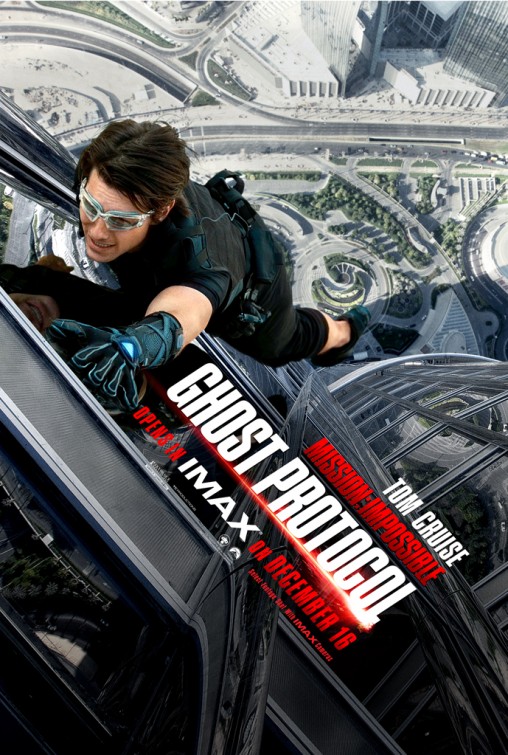
 Bird delivers in a major way in his live-action film debut. The man behind two of the best animated films of all time and Ratatouille, has shown that his keen skills of directing animation have easily translated to real people and real-ish explosions. Bird is a mad genius when it comes to staging elaborate action sequences; he teases out his action with organic consequences and his camera makes adept use of space and geography, and best of all you can easily follow what’s going on in the frame. So when we have an action sequence that takes place in the tallest skyscraper in the world, you know Bird is going to make fine use of this fact to accentuate his action. And the man does so in spades. The Dubai sequence is probably the how-did-they-do-that? standout that people will be most talking about. Hunt has to climb the outside of the aforementioned tallest building in the world using nothing but some special sticky gloves that don’t always work right. He has to climb several stories up, and then there’s the matter of going back down without them. But M:I 4 doesn’t rest on its laurels, because immediately after this sequence we have a feast of thrills. We segue right into a meeting between two parties where Hunt’s team has to pose as each member of this sit-down, orchestrating two separate simultaneous false meetings with the real bad guys. The two meetings dovetail one another as far their needs, making for a blissful parallel of escalating suspense. And then even after this, we get a foot chase into a sandstorm, which then becomes a dangerous car chase into a sand storm. And there are even more great stunts and spectacular action to come, notably a fight in a futuristic car park where the cars tumble from level to level.
Bird has such a firm command of his action, exercising his inspired imagination and all the tools in the special effects paint box. The screenwriters deserve recognition as well, Josh Applebaum and Andre Nemec, both of whom honed their writing chops on J.J. Abram’s sublime spy show, Alias. Their opening sequence, an escape from a Russian prison, sets the stage with Bird’s smart execution; setting up a problem and then letting the situation play out in surprising yet logical and clever ways. It may not have the epic scope of a Michael Bay flick, but Bird’s action is cool without having to be exhausting or noxious. The frenetic pacing rarely lets room for breathing. One of the film’s quiet moments ended in such a jarring fashion that it startled me and I kicked the patron sitting in front of me. I must also credit Applebaum and Nemec for producing the only Mission: Impossible movie that did not involve a turncoat. I was starting to think that IMF’s Human Resources department was in needing of a good housecleaning. Bird, and the screenwriters, has delivered a Mission: Impossible movie so good, with such kinetic and rewarding action sequences, logically utilized gadgets, sexy cars, sexy gals, and exotic locales. They’ve basically made the best Bond movie not to bear 007’s likeness.
Like the previous Mission: Impossible flick, this one emphasizes the team aspect, which makes a more fulfilling and interesting set of missions. M:I 2 became the “Ethan Hunt kicks people in the face for two hours movie,” which Chuck Norris might approve but otherwise was lacking. When J.J. Abrams got on board in 2006, the brand finally got back to its roots. And a team working together with individual strengths makes for a much more satisfying mission that also allows for multiple points of action. Simply out, if you have three people that need to do stuff in synchronicity, it plays out much better than watching Cruise kick people in the face. Choreography is always better when you have more dancing partners. Anyway, with M:I 4 we get some terrific teamwork that can be just as thrilling as the action sequences. Besides the breathless Dubai sequence, there’s a great sequence where the team has to infiltrate a sleazy Indian businessman’s (Anil Kapoor, the TV host from Slumdog Millionaire) cocktail party to get some special satellite codes. Jane is tasked with seducing the sleazy guy, Benji is left to operate a mechanical rover with a powerful magnet that will levitate Brandt, in a metal suit, across the system’s super hot inner mainframe, and Hunt is trying to lose his Russian pursuers. It’s a great sequence where all the pieces come together for maximum effect.
 Cruise has done plenty in the last five years to destroy audience good will, so it’ll be interesting to see if audiences warm back up to the man with the million-dollar smile. Cruise has always been an actor of ebullient energy and charisma, and this has always aided him in action settings and M:I 4 is no different. He’s still a credible action hero and a born movie star, whatever audiences think about his increasingly polarizing personal activities. Lessening Cruise’s load is a smart move, and Pegg (Paul) can provide needed comic relief while Patton (Precious) supplies the sizzle. My goodness can this woman fill out a dress in marvelous ways. Not to be completely sexist, she does a fair amount of ass-kicking too. Her fight with the French femme fatale agent (Lea Seydoux) was all kinds of awesome. Renner (The Town) seems groomed as a potential heir apparent for the franchise. His character is given a small amount of depth to work with, the guilt of a mission gone wrong that has a very personal connection to Hunt. At this point, Renner can do no wrong as an actor in my book. Although there’s only a nine year age difference between Cruise and Renner, so I don’t know how much more mileage that gives you as a franchise. Regardless, Renner is an actor of great conviction and intensity even when he’s silent.
In terms of the franchise, I’d say this fourth installment is just as good as Abrams’ M:I 3, though Abrams had a much better villain and the added emotional urgency of hunt’s wife in distress. Seriously, this is one really boring and completely interchangeable villain. For a movie about the world being on the brink of thermonuclear Armageddon, why do the stakes feel so low? It’s probably because the movie has deliciously orchestrated and eye-popping set pieces but very little urgency. World War III has never felt so ho-hum. Still, it’s hard to fault an action movie when it delivers such high amounts of adrenaline, perfectly packaged in well-developed action beats. This is a high-flying popcorn spectacle of the top order, a grandiose piece of Hollywood escapism. Mission: Impossible 4 is pretty much everything you’d want in a summer blockbuster, only shuttled to winter. I think Bird’s future is limitless, in animation and live-action, and I think the Broccoli family would do us all a favor by tapping Bird to direct a Bond movie. M:I 4 is a pretty good resume for the gig. That would be one mission to die for.
Nate’s Grade: A-


 nathanzoebl
You must be logged in to post a comment.