Blog Archives
Indiana Jones and the Kingdom of the Crystal Skull (2008)
 I lived in New Haven, Connecticut for a year while then-partner was earning her Master’s degree at Yale. We hated it. New Haven is a college town that doesn’t know it’s a college town, so everything closes at 10 PM, there are no student prices for anything, and the people there more or less sucked. We were happy to depart from the Nutmeg State. Then the week after we were going to leave was when Steven Spielberg, Harrison Ford, and the production team for Indiana Jones and the Kingdom of the Crystal Skull were coming to town. They were going to film a motorcycle chase along Chapel Street (where I walked to work every day) and all along the Yale campus. Finally, a reason to stay in New Haven presents itself and it has to happen after we escape. It’s not often one of the most anticipated movies comes to your doorstep.
I could have been an extra in the motorcycle chase, which set in 1957, could have used a long-haired Beatnik type (played by yours truly) for an exaggerated reaction shot. I could have been sipping on an espresso and then Indiana Jones could have zoomed by on the bike snatching by hot beverage, leaving a long-haired Beatnik type (me again) to mug shamelessly for the camera. It would have worked. Alas, it was not to be, though it certainly would have made this ages-in-development sequel more enjoyable on my part.
It’s been a long time since part-time archeology professor and full-time treasure hunter Henry “Indiana” Jones (Ford) beat the Nazis. The world has gotten a lot more complicated thanks to the Cold War, the atomic bomb, and the fact that Jones is now well into his 60s. It’s been 19 years since his last adventure but the man with the bullwhip and the dusty fedora still has a knack for intrigue. Soviet KGB agents have captured Indy and his friend Mac (Ray Winstone) and taken them to the Area 51 warehouse. They’re seeking a recovered artifact of alien origins that can wield tremendous power, as they always do. Irina Spalko (Cate Blanchett) is the head KGB agent and likes to threaten her enemies with a riding crop (perhaps she earns some extra money on the side punishing bad, bad comrades). Indiana Jones manages to escape and is pursued by the Soviets and blacklisted by his government due to his perceived involvement with Russia.
 Mutt Williams (Shia LaBeouf) seeks out the help of Dr. Jones. Mutt is a greaser on a motorcycle that might be a chip off the old block. His parents are in trouble. The stepfather that raised him (John Hurt), an old archeology buddy of Indy’s, has traveled to South America and found a legendary crystal skull. The bizarre artifact would lead the way to the mythical golden city and crazy amounts of Mayan supernatural power. Unfortunately, the skull has also made him as batty as a bat and Spalko is going to kill him. Indy and Mutt fly down to South America to save the crazy old man. Oh, and Mutt’s mother is also in danger, and she would be none other than Marion Ravenwood (Karen Allen), who has plenty of romantic history with a certain swash-buckler afraid of snakes.
Seeing Ford back in action just feels right. His character has grown into a bit of a curmudgeon but he’s working the same territory Bruce Willis did last year in the long gestated Die Hard sequel. He’s an old man serving some justice to all these young punks that won’t get off his lawn. The film acknowledges his age and mostly uses it as a means for comedy (he cracks that a life of adventure isn’t “as easy as it used to be”). Ford looks more alert than he has in years.
Blanchett is one of our finest actresses on the planet but she has serious trouble maintaining her Ruskie accent; she alternates between Russian and British the whole movie. Her dominatrix-styled villainess is certainly interesting, and man does she have great posture, but the film doesn’t really know what to do with the Soviet bad guys. They become more or less Nazi stand-ins and seem to repeat the same ambitions that the Nazis carried out in two or the three previous films. Allen has aged magnificently and is a welcome return. She and Ford have terrific screwball comedy chemistry and pick up right where they left off in 1981’s Raiders of the Lost Ark. LaBeouf does a solid job even though he doesn’t have any meat to his character after his Marlon Brando-like introduction in leather jacket and motorcycle. Instead, Spielberg continuously winks at the audience about Mutt’s obvious familial line. It wouldn’t be a Spielberg movie without some family dynamic.
 I’m pleased to reunite with Indiana Jones, I like the new characters, and I even like Mutt, but the story the characters are saddled with is lousy. This is the script that Ford, Spielberg, and co-creator/producer George Lucas all agreed upon? I’m not one of those people that have an issue with aliens being the primary movers and shakers in the plot (in informal talks with friends, many are upset that little green men are the stars). The first three Indy films dealt with a religious supernatural power and now this new installment covers a space alien supernatural power, so that doesn’t concern me. What bothered me is that Crystal Skull is a murky mash-up of [i]Temple of Doom[/i] and Stargate. Once the primary characters reach their hidden temple the movie takes a nosedive. Spielberg almost crafts an anti-intellectual message, where finding out the reality behind the magic ruins the soul. The exact story behind the Crystal Skull is frustrating in how oblique it is, and Spielberg doesn’t want to offer any clarity. I’m at a loss to explain exactly why anything happened in the concluding 20 minutes, least of all how an alien race must have a very different definition of the word “gift.”
Never before has the action in an Indiana Jones film come across as so campy. This is likely the most disappointing part of Crystal Skull: the action is too tongue-in-cheek. There were moments where I thought the film was one step away from Army of Darkness. Spielberg is enough of a brilliant tactician to know how to setup and build satisfying and stylish action, which normally involves organic complications and letting the audience fully grasp what’s happening. This means no rapid-fire edits and plenty of long, high angle shots to get the big picture. And when he’s in his groove, there are few that can top Spielberg when it comes to an action sequence. There are points in Crystal Skull where the action is rollicking and joyously packed with excitement and wonder. The opening sequence inside Area 51 starts the film off with a bang, the motorcycle chase through Yale is well choreographed, and a car chase in the jungle is fantastic in the amount of back-and-forth scuffles and emerging obstacles. It’s by far the film’s high point and then there was one point where Mutt was swinging from vine to vine like freaking Tarzan and he enlisted the help of monkeys. It took me completely out of what had been a rip-roaring action sequence. Then there’s the moment where Marion drives everyone off a cliff and onto a tree that bends to drop them safely before smacking back like a rubber band. I’m not asking for complete believability in an action caper but I’d prefer it not become an embarrassing Looney Tunes cartoon. Crystal Skull is filled with little moments that will completely yank you out of the movie.
The action sequences feel too pat for the material the film wants to cover. Even that great jungle car chase could have been boosted with some extra ingenuity. The scene opens with the Soviets driving a vehicle that is slicing the forest to splinters and clearing a path for the caravan of cars to follow. Now I know the Spielberg of 1981 would never have introduced such an interesting machine in a unique setting without using it later. The Spielberg of 2008 is different because this nifty blade mobile isn’t even seen again after its initial introduction to establish how a car chase in a jungle could be possible. The action relies too heavily on distracting CGI that takes the action sequences on annoying, over-the-top detours. Just because computers can make it happen doesn’t mean it’s always a good avenue to go down. In short, the CGI is undercooked and over used.
 I also need to speak frankly about the CGI — it is terrible. However, when I watched Crystal Skull my party got a tad lost on the way to the theater so the only seats left were the third row from the screen. I spent the entire movie with my neck craned up. Perhaps if I saw the film in a position it was more intended to be seen the special effects would come across as more professionally polished, but from my neck-cramping position they looked pitifully amateurish for a major summer blockbuster with Spielberg and Lucas’s names attached. The effects work is shockingly shoddy, but the practical production design is amazing. Unfortunately, this does not balance out in the film’s favor.
I’m coming across as harsh but I only get this way when my expectations are raised because of a pattern of quality. The three prior Indiana Jones films were lively, imaginative, and deeply charming and satisfying adventures that leaned toward the exaggerated but still managed to thrill without feeling dumb. Raiders of the Lost Ark is one of the few perfect movies in existence, in my opinion, and set the standard for all action/adventure movies to follow. It’s unfair to expect the same sensation watching a sequel 19 years after its predecessor, but Kingdom of the Crystal Skull does manage to hone in on the same spirit that made the other Indy films such high-flying thrill rides. If you set your brain to a low frequency, enter the theater with lowered expectations, and already know that at one point Mutt will swing from vine to vine like freaking Tarzan, then Crystal Skull will provide the necessary popcorn entertainment you’d seek in a summer blockbuster. It is possible to think Crystal Skull ranks up with its predecessors but that requires so much contortion that I wouldn’t know how to arrive at that opinion. I suppose we should all resort to the consolation that even with E.T. taking over the plot, this thing could have been a lot worse. Just remember that if an alien offers you a “gift” to run in the other direction.
Nate’s Grade: C+
Share this:

Disturbia (2007)
 This Rear Window for the Facebook generation starts off strong with a solid performance by Shia LeBouf, but then quickly unravels once the filmmakers think they’re desperately running out of time. The teasing mystery is set up well and elicits some interest, but then, as if afraid of lulling an audience to sleep with a story that takes its damn time, Disturbia throws everything and the kitchen sink at you in the last 20 minutes. The movie falls on its face (the metaphors are flying today) trying to make up for lost time with jump scares and lame thriller conventions. The end gets a tad absurd as well as Shia discovers his serial killer neighbor isn’t just a murderer, but he’s a home decorator on par with the creature from Jeepers Creepers. By the time Shia falls into an underground water cavern filled with corpses, I wanted to scream myself for such wasted potential to a film that seemed like a formless rip-off on the surface.
Grade: C+
Share this:

Transformers (2007)
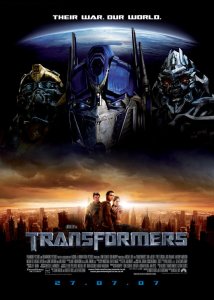 Once again Hollywood is quick to prove that if any television show emits some level of nostalgia, or merchandising potential, it is only a matter of time before it finds itself reconfigured as a big screen blockbuster movie. In all honesty, I was never a huge Transformers fan; I was more into Ghostbusters and then transitioned into Teenage Mutant Ninja Turtles. It may be sacrilegious, but I thought the knockoff cartoon/action figures, The Go Bots, were just as good. Steven Spielberg and critically derided director Michael Bay (Bad Boys II, Armageddon) have teamed up to bring the world a lengthy and noisy Transformers feature film. I can’t wait for the Go Bots to get their own equally pricey close-up.
Sam Witwicky (Shia LaBeouf) is your typical teenager obsessed with getting his own car. He can only afford an old Camaro at a used car lot, and his dreams of impressing the hot girl in school (Megan Fox). But Sam’s car isn’t just any old busted jalopy, no sir, it is really a robot in disguise from another planet. Sam’s car, codenamed Bumblebee, is apart of a robotic race known as the Autobots, led by their leader Optimus Prime (Peter Cullen returning to voice with gravitas). They can transform into vehicles that they scan with their optical sights. The Autobots are trying to save the planet from their evil counterparts, the Decepticons, who have already infiltrated our world in search of their fallen leader, Megatron. It seems Sam holds the key to the survival of Earth. His great grandfather was an Arctic explorer and happened upon the frozen sight of Megatron. He left behind an artifact that reveals the location of the chilled robot as well as a source of unparalleled power known as the Allspark. Needless to say, the military and the Secretary of Defense (John Voight) are a little aghast at how their weapons stack up to big bad robots.
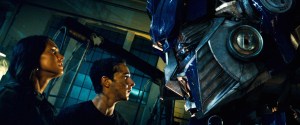 Michael Bay was born to direct a live-action, ultra expensive Transformers movie. The testosterone is through the roof and the film worships everything shiny, fast, and automotive. This is the kind of movie that fits exactly into the artistic parameters of Bay. The film is one gorgeous product placement orgy that is all about the eye candy; the cars are hot and desirable, the car chases are cool, the explosions are a lovely shade of orange, and Megan Fox is quite hot and desirable too (engaged to a 90210 actor? Why oh why, Megan?). The special effects are downright flawless and the action sequences are enormous. The scale of destruction is, like most aspects of Transformers, cranked to such a high degree that summer satisfaction can only ensue. Everything is bigger in Michael Bay world. Transformers is Bay’s best movie so far and it delivers the goods when it comes to hyper-kinetic action and plenty of thrills.
While the movie runs on silliness it also keeps its wits about it and delivers solid and exciting action with a breathless pace. What really surprised me about Transformers is how much humor they squeezed into 143 minutes of loud and hyper bombast. Screenwriters Alex Kurtzman and Roberto Orci (The Island, Mission: Impossible 3) have a great economy to their storytelling. They also have created a wacky teen comedy that just so happens to also be inhabited by giant robots. Much of the first hour is spent with Sam and his attempts to look cool with his new ride and impress the pretty girl. Sam is hocking his family wares on eBay and the Decepticons are on the hunt for… LadiesMan217. There’s a lengthy sequence where five Autobots have to duck and hide outside Sam’s house so he doesn’t get in trouble with his parents. Ma and Pa Witwicky look out the windows, and the robots dodge getting caught, and it’s like a classic bumbling slapstick comedy. A good action movie can become a great one when aided by well-timed humor, and Transformers has so many quips, sight gags, and goofy sidesteps (“Mountain Dew machine must destroy all humans!”) that is could be considered the most expensive comedy of all time (take a seat, Evan Almighty).
 There is, however, a price to be paid for all this comedy and that is that no one acts with any true sense of awe. They are witness to large walking and talking monsters of metal that are out to enslave the planet – there has got to be some wonder there, but the film doesn’t treat anything seriously. Its jokey nature keeps the film from being anything more than disposable, throwaway entertainment. I mean, I find it difficult to take any movie seriously that features a robot “relieve” itself on John Turturro.
Shia LaBeouf (Disturbia) carries the film on his sturdy shoulders. The shape of Transformers has more to do with his horny, smart allecky character than the robots that fight. Normally the only thing required in an effects-heavy action flick are some fast legs and a healthy set of lungs, but LeBeouf has charisma to spare. He has a young Tom Hanks everyman feel to him. The greatest compliment I can give him is that he is the most memorable figure in a movie with big brawling robots. Fox is pretty easy on the eyes. Voight is adept at playing government figures in times of national peril. If you need a guy to stare at something massive, or formative, or formatively massive, and utter, “My God,” then Voight is your man. Kevin Dunn and Julie White provide nice comic additions as Sam’s mother and father.
Transformers may be a perfect slice of summer thrills, but unlike its titular gigantic robots, it’s little more than meets the eye. The movie loses steam whenever it deters from its main story involving Sam. I understand that the filmmakers were trying to widen their story scope, but nothing is gained by the inclusion of such useless characters like the overweight super computer hacker who lives at home with his mom. There’s an elite team of national security analysts and they all happen to be scruffy multi-cultural hippies. We have a blond Aussie (with a nose ring, oh so rebellious) who discovers the Decepticon signal and then, well, she sits in a room for a long while and then mostly sits on her hands during the climax. The opening follows a band of soldiers in the Middle East (which the film reminds us is where Qatar is, because apparently it does not feel that your core Transformers fan has a basic grip on geography) who also must reach the bigwigs in Washington with important info on these killer robots. These dangling storylines could be lost and little momentum would be lost. None of these extra characters are given a lot of attention. Most of them will vanish for long stretches so that when they do reappear you’re reminded how much you did not miss their absence. You’re going to need stock roles, like military men and tech geeks, but Transformers has cast its lot with the simple story of a boy’s first car and his unyielding teenage hormones. Transformers could use a good pruning for balance.
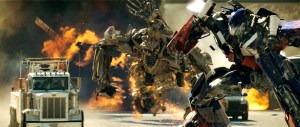 The robust action sequences are somewhat hampered by the typical Michael Bay ADD edits, but what really hurts the action sequences are the robots themselves. The original Transformers were designed smoothly, because in all reality they were animated toys and needed to function for kids. These 21st century Transformers have parts all over the place. There are gears and wheels and who knows what sticking out everywhere. They look far too cluttered, like a little kid’s art project where he keeps slathering on more junk. As a result of this robo design, when it comes to action you may not have a clue what’s actually happening. When the big robots wrestle you’ll be left trying to piece together in your mind which part is the robot mouth, the robot head, the robot fists/claws/drill/whatever. I suppose in a way this kind of demanding user activity is similar to watching scrambled porn; both involve trying to dissect the image into something workable and, thusly, satisfying to the senses. That’s right, I compared Transformers to scrambled porn, which is also quite more than meets the eye.
Obviously, with a film about powerful robots from space, there is going to be a stopgap of logic. If you can accept interstellar robots that arrived from a robotic planet, oh and by the way, they learned English from the Internet (it’s a wonder they speak in full sentences), then you should be able to shrug off any other shortfalls in logic. Transformers was never too deep a subject to being with; every episode of the cartoon revolved around the Autobots and the Decepticons battling over new energon cubes, and that was all the plot needed for a show about robots that fight.
There could be 20 minutes sliced out. Lots of ancillary characters are just dropped. There may be too much humor. The climax is way too long. The dialogue is corny. And yet with all its flaws considered, Transformers is an exhilarating entry into the world of summer smashups and blown eardrums. Michael Bay may never stretch his creative wings with a Victorian costume drama, but the man does what he does well. Transformers is a perfect match for Bay’s noisy and boisterous sense of action and his love of things fast and expensive. There isn’t much below the surface when it comes to Transformers, but it’s such a fun and exciting popcorn movie that it’s hard to argue with the results.
Nate’s Grade: B
Share this:

Constantine (2005)
 I’ll admit it; I’m a sucker for Christian mythology played against thriller and action settings. I may be the only person to have watched all of The Prophecy flicks, and probably the only person that eagerly chows down on the cheesy sequels to The Substitute, yet shy away from seeing the first film. I’m captivated by the imagery, the discussion of Heaven and Hell and its mythical logistics, and just the psychology of supernatural biblical beings. With this in mind, I was strongly anticipating the release of Constantine. What I got wasn’t exactly what I expected but I’d be lying if I said I wasn’t entertained.
John Constantine (Keanu Reeves) is a very troubled man. Since his youth he’s had to live with his gift that allows him to see through earthy disguises and witness angels and monstrous demons walking among us. He’s parlayed this ability into a modest side job of exorcising demons and sending them back to Hell. Constantine figures his loyal service should grant him passage into the pearly gates, but Archangel Gabriel (Tilda Swinton) reminds him that that’s not how it works. Constantine is doomed to go to Hell because he tried taking his own life, and if that’s not enough he also has terminal lung cancer from smoking like a chimney. “In other words, you’re f***ed,” Gabriel confides to Constantine.
 Police detective Angela Dodson (Rachel Weisz) is investigating the suicide of her twin sister (also Weisz). She swears her mentally disturbed sis wouldn’t do such a thing, and she seeks out the help of Constantine. He challenges her beliefs, stating that God and the Devil (Peter Stormare) have a wager over the souls of mankind but cannot directly interfere. But now something is breaking this rule and it looks like demons may be getting closer to entering our plane, and it looks like Angela’s dead sister may have known more than people would have thought.
The plot of Constantine is rife with contrivances, aborted subplots, underwritten and nearly forgotten supporting characters, and sketchy logic (staring at a cat can transport you to Hell? No wonder I’m a dog person). Often the film feels overwhelmed by good special effects, as they seem to be the crux of the film?s purpose of being and not, on the other hand, a theological playground of ideas. Constantine gives veiled glimpses of something smart, but routinely shuts that door to focus more on annoying jump scares.
In fact, Constantine seems rather old-fashioned with its theology, still clinging to the Roman Catholic belief that suicide is a one-way ticket to the fiery abyss. I understand its use as motivation for our lead, but will progressive audiences accept something they may find archaic? I suppose it could be worse. Constantine could have briefly gone to Hell for eating meat on a Friday.
It’s interesting that after spending two years making The Matrix sequels, Reeves would choose to attach himself to another big-budget theological action flick. His acting never really rises beyond morose loner but somehow he does make for a satisfying, brooding hero. Reeves? low-key monotone speaking voice allows him to spout cheesy dialogue with a straight face and mercifully keeps the audience grounded.
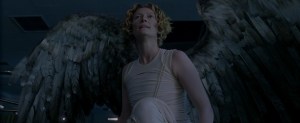 The true stars of Constantine are the memorable supporting players in this celestial smack down. Swinton uses her androgynous looks to forge what David Bowie might be like as an angel: angular, mysterious, waif, and somewhat creepy. Stormare delivers a performance so kooky and tic-heavy, that it could only be compared to the weirder moments of Christopher Walken. Both actors liven up the film and seem to be having the most fun by far with their cheeky roles.
The genius of Constantine is in its one-upsmanship game it holds with the audience. Granted, suspension of disbelief is needed to even go along for the ride, but when we start learning that Hell has its own line of bibles (and they’re longer) we’ve gone beyond suspension of disbelief and into wacky Anne-Heche-speaks-to-aliens land. While sitting through Constantine, we the audience think, “There’s no way this movie could get any sillier.” And then it does! We think, “Alright, that was crazy. Now there’s no way after that this film could get any sillier.” And then it does! Constantine is an amazing ascent into movie madness. After a while, I became drunk from the film’s insanity and wanted it to get even crazier, if possible. It almost seems like there’s a drinking contest between the movie and the audience, and Constantine isn’t afraid to piss its pants to win.
By the time Lucifer shows up, clad in all white like Tom Wolfe, and the Dark Lord appears to have Tourette’s Syndrome and/or a speech impediment, Constantine has hit the bottom of its Kool-Aid cup. Sure the film’s cinematography is slick, and the premise is intriguing, but the real draw of Constantine and the real enjoyment of the flick is how bat-shit crazy it is. I cannot even think of comparable films. I hope David Lynch was taking notes if he saw this.
For a while there, it seems director Francis Lawrence wanted Constantine to be a companion to Wesley Snipe’s Blade character. Maybe the two of them can set up a play date and go destroy otherworldly creatures. There’s a visually striking sequence late in the film involving Constantine in a room full of demons. He’s “contaminated” the water system by placing a giant cross inside, thus holy-fying the water before he can bottle it and sell it to the masses. He holds a lighter to the sprinkler system, demons growling all around him ready for their kill, and then water sprays down across the room. “Holy water?” one female demon says in a stunned voice, watching her flesh sizzle away. Then Constantine marches through the wet room blowing away demons into splashes of ash with his comically unwieldy cross-shotgun. It’s filmed wonderfully with dark hues and is a great idea; however, it’s a bit of a rip-off of the opening sequence in the first Blade.
 This seems to be a repeated sentiment in Lawrence’s direction. He has a sharp visual eye and several camera angles come from odd yet exotic places, but his film is borrowing so heavily from so many other films. What you’re left with is the impression of a stylish if very derivative looking action film. One exception is when Lawrence shows us glimpses of the blistering burnt orange world of Hell. It seems Hell is an exact model resemblance of Earth, only with the fire, brimstone, and crawling demons with their heads sliced open (there is a scary level beneath the surface where we witness a sea of people being tortured). The second or third time we traveled to Hell, I began to wonder what my house would look like and the logistics of upkeep for the homeowner in Hell. Surely the heating bills wouldn’t be the same.
Constantine is funny, frustrating, confusing, gorgeous, and just plain insane in the ole membrane. The film exhibits a rare and engaging form of insanity that may glue audience eyeballs to the screen to see what happens next. I’ve seen Constantine twice (don’t ask why) and even though I knew all the weird plot turns I still found myself getting an enjoyable contact buzz from the film. Who knows how long such a novelty can sustain itself, though. Comic book fans, especially those with a spiritual bent, should get a kick out of Constantine as will anyone else searching for a pristine example of how wonderfully out of control Hollywood moviemaking can be. Sometimes in a good way.
Nate’s Grade: B-
Share this:

I, Robot (2004)
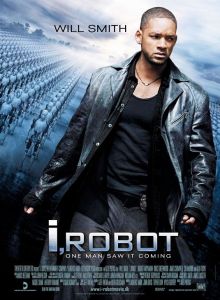 No doubt about it, Will Smith is the best hope our planet has in the face of adversity. He’s taken down aliens three times, foiled one conspiracy, stopped the South from rising again, and the man still finds the time to help Matt Damon with his golf swing. I fear we almost may be taking Smith’s world-saving exploits for granted. Smith’s newest chance to save the world arrives in I, Robot. Can Big Willie save the world yet again, or has he punched his time card one too many times?
In 2035, man has a new class of immigrants to do all the menial tasks no one wants to do – robots that look like crash test dummies. U.S. Robotics (USR) wants to push their new fall line of robots and make sure every happy home has a happy robot. Del Spooner (Will Smith) is a detective wary of our robotic friends. His colleagues laugh at his paranoia, remarking that no robot has ever committed a crime. This is thanks to the three laws hard-wired into every robot: 1) A robot cannot harm a human being, 2) A robot must obey a human beings order as long as it does not conflict with Law #1, and 3) A robot can do whatever to survive as long as this does not conflict with the other laws.
 This sounds great, except the robot creator (James Cromwell, always there if you need an old guy role) has apparently plummeted to his death from his USR office and the circumstances involving his demise are dubious at best. Spooner works alongside a robot technician/shrink (Bridget Moynahan) to find out more about what exactly is going on within USR and its suspicious CEO (the always shady Bruce Greenwood). Spooner discovers that a robot, who wishes to go by the name of Sonny, may have sent his creator to his death and may also be the first step toward uncovering the truth behind a grim conspiracy.
Smith has never really been a great actor but he is likable and charming enough, so that gets him through the day. The problem is that when hes saving the world in summer blockbusters he has a tendency to go into Will Smith Mode, which plays out like hes on auto-pilot. His stares, awkward mannerisms and aw shucks humor seem to be the same in every film. This isn’t to say that Smith cannot be a capable actor, but it seems that when a movies budget goes over a certain amount he resorts to playing Will Smith: World Saver and not so much a character of real value.
The other actors are more so playing vague archetypes than they are anything else. Greenwood is the sneaky, oily executive; Moynahan is the cold scientist learning how to be human once more; the invaluable Chi McBride is the no-nonsense police chief who rolls his eyes at Spooner’s crazy theories; and Shia LeBeof actually shows up for all of three minutes playing some kind of juvenile delinquent that is wholly unnecessary to the film.
The movie’s greatest accomplishment is the character of Sonny, modeled after a physical performance by actor Alan Tudyk. Sonny’s calm line readings, bursts of emotion, and questions on humanity make him a character the audience connects with, especially with the detached nature of Smith and Moynahan’s acting. Bet you never would have guessed this is from the same guy who played Steve the Pirate in Dodgeball.
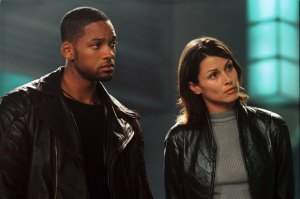 I, Robot isn’t exactly going to establish new ground in the world of science fiction. Its mostly a detective story with some twinges of sci-fi philosophy. As a detective story it adheres to the laws of detective movies, like how NO ONE ever believes the hero on his hypothetical assumptions and paranoia, which will of course always be right, and how the hero can only solve the case after he is thrown off it and gives up his badge. For two thirds of I, Robot we get an amiable, if average, detective story set in the future. Then we get a slightly incoherent final act where robots go all-out crazy.
Director Alex Proyas takes a step back from the grim, noir-ish worlds he worked with so effectively in The Crow and Dark City, and presents a cleaner and more sterilized world. His technical elements, like cinematography and musical score, are still well above par for the summer blockbuster. Proyas is a gifted visual tactician that knows how to wow an audience.
The sleek production design, fancy special effects, and strong visionary directing help lift an average story. Some of the story elements may not all work -like Spooner’s flimsy reason he hates all robots, and Moynahan’s character being very cold because she works around robots (get it? get it?)- but the professionalism of the people behind the scenes help make a rather exciting and occasionally thoughtful movie. Sonny’s questions about life and death as hes near termination are a nice addition to add something more to a summer blockbuster than explosions and car chases. Of course I, Robot also has some exciting car chases and action sequences. Certainly other, better sci-fi movies have dealt with these issues much deeper, and I, Robot seems to only skim the surface of intellectual debate, but at least it’s something (though this sounds really defeatist).
Bearing little resemblance to Asimovs collection of short stories, I, Robot is more a stream-lined sci-fi action flick, but its still a satisfying and stylishly entertaining diversion. Sci-fi fans may grumble at the notion of transforming a complex novel into a watered down action film, but I, Robot is a crowd pleaser that delivers the thrills when it needs to. If Will Smith keeps up this world saving pace he may get a little haggard and start turning into Danny Glover’s Lethal Weapon character: I’m getting too old for this aliens/robots/other aliens/more aliens/giant mechanical spiders shit. Well, at least Smith’s good at it.
Nate’s Grade: B
Share this:

The Battle of Shaker Heights (2003)
 Ben Affleck and Matt Damon, being the egalitarian champions we all know celebrities to be, started a contest called Project Greenlight that allowed aspiring screenwriters to enter for a chance to have the winning script made into a movie by Miramax and the process documented for a behind the scenes reality show to run on HBO. Project Greenlight‘s first winner was the hapless Pete Jones. His winning screenplay gave birth to Stolen Summer, a maudlin coming-of-age story about a Catholic boy trying to get his ailing Jewish friend into heaven. You can feel the grating precociousness already. While Stolen Summer was an artistic yawn the HBO series was a hit as we the viewers saw every stupid mistake, naïve decision, and screaming matches during the production. Pete Jones’ pain was our gain.
Unlike the first contest, this one had a separate entry for directors and the tag-team of Efram Potelle and Kyle Rankin were picked to direct the winning screenplay The Battle of Shaker Heights, by Columbus, Ohio (represent) grad student Erica Beeny. Project Greenlight on HBO showcased the tension created by these butting heads. Beeny seemed ready to meltdown at a moments notice, probably because she let her good nature be taken advantage of by the egotistical, passive-aggressive, non-communicative, hilariously self-absorbed directors. This raises the question; did Affleck and Damon pick the best people or the people most likely to create the best television?
 Once again, the winning screenplay involved a coming-of-age story, this time revolving around the life of Kelly (Shia LeBeouf), a glib teenage war re-enactor. Kelly befriends Bart (Elden Henson) during a battle reenactment. Bart is from a wealthy Wasp-y household where his college is already predetermined. Kelly, on the other hand, must sullenly deal with his father (William Sadler), a former junkie who wasted away his college fund, and his flighty mother (Kathleen Quinlan). Bart and Kelly scheme to teach a schoolyard bully a lesson, and in the process Kelly starts falling for Bart’s attractive older sister Tabby (Amy Smart).
The character of Kelly doesn”t seem to have any deep reflections of life or anything of substance, just wicked one-liners. The fact that Kelly comes off as a sympathetic hero goes fully to the charming LeBeouf, who displays a laid back sense of humor and allure that is reminiscent of a young John Cusack. LeBeouf gives a star-making performance that keeps the audience engaged, even if the story is turning them off.
One of several problems Shaker Heights suffers from is that the finished product is a one-man show. Kelly is such a dominating character, a whirlwind of misplaced rage that everyone that gets in his path suffers. His relationship with Tabby seems like nothing more than unrequited puppy love that doesn’t need so much screen time being spent on a tired will they or wont they diversion. Kelly’s parents come off like theyre invisible. If you blink you may miss their entire time on screen. The father is more an absent force to drive Kellys angst, while his mother doesn’t seem to have any purpose or influence whatsoever.
 Shaker Heights feels like a film made by committee because as Project Greenlight astutely documented it was made by a committee. Miramax executives decided they could sell the film better as a pure comedy so they removed most of the winning screenplays drama. So now, with this new incarnation of Shaker Heights, the comedy never really emerges from more than a handful of superficially cute lines, and whenever a bit of drama does emerge it seems alien and disorienting. The heavy-handed direction by Potelle and Rankin paints in broad strokes, so the dramatic efforts come off as forced and overblown when they sneak up on an audience.
This incarnation of the movie may be entertaining to some, but with these cuts and directorial choices Shaker Heights seems horribly ordinary. Kelly is a disaffected teen with smart-ass comments; he lusts after the older girl who, of course, is with a supposed loser; his parents just don’t know what to do with him. The story is dulled down and all the edges seem polished off, and what an audience is left with is scenes, characters, and a story we’re already well familiar with. Does Project Greenlight seem to have a desire to select coming-of-age stories and then water them down to the point of distilling any original voice? The only interesting diversion in Shaker Heights is the war reenactment section, which is tragically too short.
The Battle of Shaker Heights is another theatrical dud from the Project Greenlight crew. Fans of teen melodrama might get some moderate enjoyment from it, but realistically, the only people who are going to pay any sort of money to see Shaker Heights are the people who avidly followed the Project Greenlight TV series. And in the end, one cant shake the feeling that The Battle of Shaker Heights ultimately feels like a disappointing season finale to Project Greenlight.
Nate’s Grade: C+
Share this:

Charlie’s Angels: Full Throttle (2003)
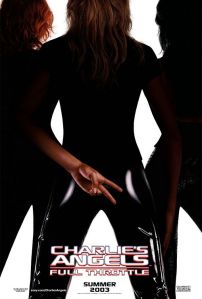 More of the same, except this time all the verve and invention seems stale and reheated. This sequel subscribes to the bigger-better train of thought, so as it continues to get more and more outlandish and the girls become invincible super heroes on par with Neo, the movie tanks hard. Much has been made about Demi Moore’s “comeback” but apparently she wasn’t sharpening her acting muscles during her hiatus. No one said the first Charlie’s Angels movie was within the realm of reality, but in the sequel apparently the Witness Protection Agency has decided to store all their valuable information not in a computer mainframe, a system of files, no, on two magic decoder rings. What the hell? McG returns as director and cranks the style into overkill, set to a radio-friendly soundtrack, but it all seems so ho-hum and excessive at the same time. Quite an accomplishment. No more please.
Nate’s Grade: C


 nathanzoebl
You must be logged in to post a comment.