Blog Archives
The Ring Two (2005)
 I loved The Ring. Loved it. So I had some trepidation when I found out they were making a sequel. Surely it wouldn’t have the punch of the first film. To see Ring Two I went to a theater frequented by somewhat affluent teenagers and pre-teens. Big. Mistake. People were chattering away the entire time, laughing stupidly, and shouting ridiculously lame jokes: (on seeing a damp bed: “Oops, somebody wet the bed”). There were two managers that had to patrol the theater to keep order. Worst of all was a team of easily riled prepubescent girls that sat behind me, shrieking like banshees even during movie trailers. The same thing happened to me when I went to see The Village at the same theater. I must attract the most annoying people in the crowd. The sound quality in my theater was also very poor. Now, I can’t help but think that this was some divine act to warn me how bad Ring Two was going to be.
Rachel (Naomi Watts) has taken her son Aidan (the creepy David Dorfman) to a new town to start a new life. It’s been years since the incident with the videotape, and Rachel feels guilt about her role in spreading the killer tape. She’s got a new job at a small town newspaper but yet she can’t escape her past. A teen has been found with a contorted face, soggy floor, and a certain videotape. Rachel finds the tape and burns it. Samara, the evil young girl who started the evil tape, is none too pleased. Seems the evil tyke wants to be a real girl with a real mommy, and is slowly taking over Aidan. His temperature is dropping, he’s not sleeping, and bad things are happening. Rachel confronts more of Samara’s history to learn what it takes to stop her and get her son back.
 Everything that worked in the first film feels forced and meaningless when rehashed in Ring Two. In the previous film, there was context for the image of a tree on fire and Rachel yanking a fly right out of a TV screen. In Ring Two, these plot points are now reduced to being contrived signs of doom. There’s a scene where we’re supposed to be scared because a single fly comes out of a faucet. Huh? The fly and the tree made sense in The Ring, but in the sequel they are stripped of their context and seem alien. And dumb. After everything fit so tightly together in The Ring, it’s disappointing that little makes sense in the sequel.
Watts is such an enormously appealing actress that even in dreck like this she can come off as luminescent. With the two Ring films and Peter Jackson’s upcoming King Kong, Watts could establish herself as the scream queen of her generation. She’s a gifted actress and melts into whatever role she plays.
Ring Two‘s director, Hideo Nakata, knows a thing or two about the territory. He did direct the original Japanese Ringu films, which the American remakes are based upon. Nakata generates a fun sense of anticipatory dread. He also lucks into the occasional eye-opener like a bathtub whose water flows up and fills the ceiling. Nakata has a confidant touch but I miss the sheen of Gore Verbinsky’s direction.
What’s sorely missing is a killer premise like in The Ring. The premise was razor sharp, presenting a videotape as a virus and human nature’s willingness to taste forbidden fruit as the vehicle for its spreading. There was a sense of urgency because of the looming seven-day death deadline. In Ring Two there is no sense of urgency at all. In fact, the film takes an overly leisurely pace. It’s quite awfully boring. Samara wants a mommy and can?t really be stopped until a late revelation. This leads to a lot of impotent pacing and waiting. Except for a snappy opening, Ring Two completely ditches the videotape virus storyline that made its predecessor so compelling. As a result, it also ditches suspense and most of its intelligence.
 The Ring had a strong central mystery and a sense of urgency, which both blended to create tightly wound tension. Ring Two sputters around and relies on gimmicky jump scares as its main source of spooks. We see a character look into a mirror, look away, and then look back and something else is right there! Does this really work for anyone still? I just assume when a character ducks out of the way of a mirror that something’s coming. It’s these kinds of creaky, transparent tricks that Ring Two goes back to over and over to goose an audience. Because the story isn’t engaging the filmmakers have to resort to gimmicks. Since we’ve seen the results of Samara’s murders (the grotesque facial distortion) is it even scary to see it again when we know exactly what we’re about to see? The essence of horror is the unexpected. Finding the expected is about as scary as looking at leftovers in the fridge.
There’s a great moment early in Ring Two. Rachel and Aidan are driving through a forest and are followed and then attacked by a horde of deer. It’s the lone sequence in this sequel that feels different and exciting. It’s somewhat crazy, somewhat marvelous, and very weird. Too bad Ring Two relapses from there on into a turgid horror flick.
The Ring was a smart, tense, expertly crafted film that rose beyond genre conventions. Ring Two is nothing but genre conventions and repeatedly goes back to the well to drub up scares that aren’t there anymore (unless you’re the prepubescent girls that sat behind me). Watts is still in fine form and there are some visually striking moments. However, Ring Two is bereft of excitement and scares and has become just another tired, languished sequel. When I walk out of a horror moving saying, “I guess the best thing about that film was either Sissy Spaceck’s crazy cameo or deer,” then you are in a world of bad. Ring Two is meek, dumb, and boring. Let this one go straight to video.
Nate’s Grade: C-
Share this:

Elektra (2005)
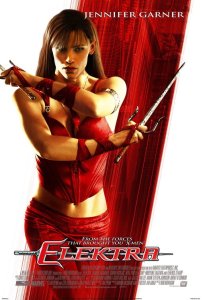 January is typically a cinematic wasteland. It’s the place where films go to die. So imagine my surprise when I heard that Elektra, a comic book movie built around a nimble sai-spinning assassin, was going to be released in January 2005. I remember at one time there were plans for a summer release, which means Elektra had fallen from the very top to the very bottom of expectation. After viewing Elektra for myself I can perfectly understand why anyone would want to dump this clunker.
Elektra (Jennifer Garner) is a feared assassin-for-hire (she even has an agent for her hits). She’s been brought back to life by a powerful sensei, but has ignored a possible higher calling to make her money killing folks. Apparently she is the mythical warrior that will keep the balance between good and evil, or something or other. Her next hit ends up being a nice guy (Goran Visnjic) and his teenage daughter. Elektra doesn’t have the heart to kill them, so she joins them and all three run away from the really bad guys, an ancient group known as The Hand.
Elektra doesn’t really bare comparison to other comic book films because Elektra feels more like a video game. In true video game fashion, I’ll numerically list the likenesses:
1) There is no such thing as characterization, just definition by super power. One assassin is super strong, another can suck the life out of creatures, and a third has the amazing ability to have his tattoos come to poorly rendered life (lucky this guy doesn’t have butterflies and fairies). With a powerful lack of imagination, these assassins are called Stone, Pestilence, and Tattoo (not the Russian girls who make out with each other. That’s Tatu.).
 2) The only sense of a story is pitting Elektra against one bad guy after another. There aren’t character arcs and subplots so much as there are end stage boss battles. It gets really repetitious.
3) The film seems like it’s bending over backwards to get character special moves into the story. With 1995’s Mortal Kombat, the writers, and I use that term in the loosest possible sense, had to work a story that included popular video game moves. Working so hard to include something so trivial and arbitrary really ties the storyteller’s hands. Elektra feels like the film would rather try and include some character’s special move rather than formulate a cogent storyline.
4) Once our assassins are vanquished they burst into clouds of yellow dust. I am not kidding. When they die they explode into clouds of mustard-hued gas. Just like in a video game, once you kill the bad guy they disappear with no necessary cleanup. It’s really thoughtful of them.
5) A second player can jump in at any time! In Elektra, different characters magically appear whenever it’s convenient and I?m not even talking about the super assassins.
6) Just like in a video game, you get an extra life! I don?t know why the producers of Elektra didn’t just make a prequel. With a sequel they have to work around their heroine’s untimely death in 2003’s Daredevil, and so we are introduced to the idea that a warrior of great mind can bring people back from the dead. So if Elektra dies (again) she can just be brought back to life. This whole idea practically eliminates any sense of danger and consequence.
So little of Elektra makes any kind of sense. Characters make rash choices and surprise appearances. The villains are a bland, cliched crop from some back order of ancient kung-fu brotherhoods. The plot is mysteriously oblique and has the frustrating habit of using cheats to get around logical roadblocks. About halfway through Elektra I gave up shrugging my shoulders and rolling my eyes. There is no definition on character limits, so anything can happen, and when it does it’s usually very stupid.
 Even worse is how dreadfully dull Elektra can be. The last two acts are compromised of nothing but a long, boring chase scene. The action sequences are brief and unoriginal, which include the thousandth inclusion of a hedge maze. There’s one moment where Elektra is battling in a room that has sheets flying all around for no good reason. It’s visually reminiscent of a Where’s Waldo? page. Take that for what you will.
The film is brisk, clocking in at just 90 minutes, but you don’t care about the characters because 20 minutes is spent establishing them, and the remaining 70 is spent watching them run.
The only redeeming quality of Elektra is its star. Garner is suited for the running, jumping movies, but she also has great acting chops behind her square jaw and impeccable physique. She casually generates intensity but also has a light, humorous touch. It doesn’t hurt that she looks fabulous in a red bustier. Her character is given OCD but then this plot is dropped entirely. Without the appeal of Garner, Elektra would simply be Catwoman.
Elektra is a flat comic adaptation that plays more like a video game, and just like in real life, watching a video game is no fun at all. Things happen, characters appear, people explode into clouds of yellow dust, and it’s all a bunch of uninteresting, half-baked nonsense. Elektra is frustrating, labored, ridiculous, and empty of thought and enjoyment. Why should I pay to watch Garner kick ass when I can watch Alias on TV and see Garner kick ass for free? And the plots of Alias are brazenly complex, fun, and high-spirited. I care about the people and events on Alias. With Elektra, the only thing I cared about was when the film was going to be over.
Nate’s Grade: D
Share this:

Ocean’s 12 (2004)
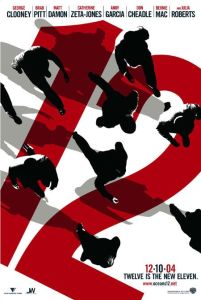 In 2001, Steven Soderbergh’s remake of Ocean’s Eleven was a giant surprise. It was a blast of fun with an impressive collection of Hollywood royalty. It had clever dialogue, fun characters, and a gala of amusing plot twists. It was one of the breeziest, most entertaining movies in years. Now, come late 2004, Ocean’s Twelve is released with the entire cast returning, including the lovely Catherine Zeta-Jones in tow. Expectations are high for another glitzy romp, but what you’re left with in Ocean’s Twelve is all glitz and no romp.
It’s been three years after the gang robbed ruthless casino owner Terry Benedict (Andy Garcia) of 160 million dollars. Benedict tracks down each member of Ocean’s Eleven and gives them the same ultimatum: either pay back what they stole, with interest, in two weeks or they’ll be killed. Danny Ocean (George Clooney) leaves his attempts at normal home life with Tess (Julia Roberts) and reassembles the team, many of whom have burned through their shares of the millions. Danny and his right-hand man Rusty (Brad Pitt) figure they’re too hot stateside so they’ll need to travel overseas if they’re to steal their fortunes. Linus (Matt Damon) also wants to have a greater role in the heist this time around.
In Europe, Ocean is challenged by a French playboy (Vincent Cassel) who moonlights as the notorious thief, the Night Fox. The challenge is to see who can steal a priceless Faberge egg, and if bested the Night Fox promises to pay all of Ocean’s debts to Benedict. Hot on the heels of both thieves is Isabel (Zeta-Jones), an expert police officer that also happens to be the former girlfriend to Rusty.
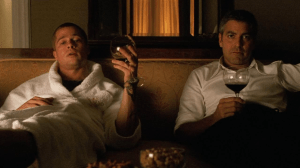 Ocean’s Twelve does not work as a heist picture. For starters, the audience has no idea what’s going on for most of it. A general heist movie bylaw is to explain what the heist will entail, and then we watch the team hit it step by step. Forget that. In Ocean’s Twelve we’re never told how they are going to do their heist, and as they commence with their plan it’s not surprising to an audience, only confusing. I had to wait until the very end for some character to go into a monologue to explain how they accomplished their heist, and let me say, it was not worth two hours of waiting and scratching my head. The result seems to push away an audience instead of involving them in the fun of the scheme.
The story doesn’t utilize the talents of the assembled members. There’s a reason you hire a demolitions expert or a pick pocket, and that’s to let them work their skill. Well in Ocean’s Twelve we get none of that. Most of the cast’s skills are not ever put to use, which further gunks up a heist movie. The movie really errs by putting many of its eleven on ice for long stretches of the film. Around the second act almost everyone gets arrested. Pity poor Bernie Mac, who is in jail for near the whole movie. It seems that Soderbergh doesn’t know what to do with all his characters, and the new additions, so he stashes them away for long stages of time hoping an audience won’t notice.
Soderbergh is in danger of becoming a parody of himself. His usual narrative flourishes are present, including jumps in time and perspective; however, they don’t add up to much except unnecessary showmanship. The nonlinear leaps and shell game of information do not add to the film. Soderbergh keeps his audience in the dark for too long and then cheats us with the ending. Ocean’s Twelve is a good looking film (the vistas look beautiful), but it’s a good looking movie with nowhere to go. What’s even more frustrating is the ending to Ocean’s Twelve. You see, in the end we find out that the last hour plus of the movie was unnecessary. Yes, the movie actually makes a reveal that nullifies over half of the film. It’s cheap and unappreciated. Ocean’s Twelve, there’s a difference between tricking an audience and conning them. Maybe some day you’ll realize this.
 The new storylines never really develop. Zeta-Jones doesn’t add much besides another authority figure to chase after Ocean and the boys. Her subplot involving finding her master thief father is abrupt and easy. The best new addition to Ocean’s Twelve was the prospect of a rival, but again nothing really happens with our French thief. He’s more of a catalyst for the plot than anything else, and it’s a shame, because he could have opened the door for a great film pitting two competitive teams of thieves against each other.
Ocean’s Twelve is too satisfied with itself to be that entertaining. It’s now actually reminiscent of the 1960 original film (my grandmother swears it’s wonderful, take that for what you will), starring the Rat Pack. Plot and logic are secondary to a bunch of cool characters having fun. I really enjoyed Ocean’s Eleven (the 2001 film, not my grandmother’s preferred version), but this new sequel lacks any charm and verve. I can’t even say there were many good scenes, just some good ideas that they didn’t fully actualize, like stowing Yen in baggage and then losing their luggage (nothing comes of this). There’s a fun scene involving Topher Grace spoofing his own micro-celebrity, but beyond that many of the scenes and ideas don’t seem developed. The best moment of Ocean’s Twelve, for me, was when I saw Eddie Izzard, the funniest man on the face of the Earth and then some, chat with Hollywood’s A-list on screen. God bless you Eddie Izzard.
Ocean’s Twelve wilts in comparison to its witty, effervescent predecessor. Ocean’s Eleven was fun and hip but didn’t need to coast on star appeal. It had a believable heist, engaging personalities, and it was fun because we knew what was going on and it mattered! I’m sure the cast of Ocean’s Twelve had a blast making the movie together, and their friendly camaraderie shows, but when I left the theater I felt like I had been stuck with the bill for someone else?s good time.
Nate’s Grade: C
Share this:

Bridget Jones: The Edge of Reason (2004)
 You don’t see too many sequels to romantic comedies, and that?s practically by design. Most romantic comedies consist of keeping the leads apart as long as possible, and then in that final climactic moment they connect, embrace, kiss, usually while a camera pans around them and some up-tempo Top 40 songs swells on the soundtrack. Then we end, our story finished. You see, romantic comedies are essentially modern fairy tales, and they end on the “happily ever after” moment, the most joyous moment. We don?t think about what their lives could be afterwards. I doubt few in the audience are biting their nails to know who does the dishes or if their sex life diminishes.
So for all of these stated reasons, sequels to romantic comedies are rare, unless, of course, they’re based on a book series that’s a cash cow of chick lit. Thus, America, we are given Bridget Jones: The Edge of Reason, the sequel to the smash 2001 film Bridget Jones’s Diary.
 The movie takes place four weeks after Bridget (Renee Zellweger) and Mark Darcy (Colin Firth) cuddling in the falling snow. Their relationship is all lovey-dovey, until Bridget starts reconsidering if she made the right choice of men. Her former boss, Daniel (Hugh Grant) has gone on to fame as a travel correspondent for TV news. He’s a bad boy, for sure, but sparks flew with him. Bridget also suspects Mark of cheating on her with a leggy colleague (whose final plot revelation is quite dumb). Bridget tries her best to fit in with Mark’s upper crust society, but is starting to feel unaccepted. Then she becomes a partner to Daniel on his travel reports, and the two visit exotic locales and sparks begin once more.
Edge of Reason feels like a poor slapdash grab at money. The film lifts entire scenes from the first Bridget Jones movie and tries reworking them for similar effect. Watching Firth and Grant sissy fight each other is amusing … the first time I saw it in 2001. For the most part, it seems like the filmmakers behind Edge of Reason were straining to come up with things after that “happily ever after” moment. What other reason can there be for some of the disastrous plot turns in Edge of Reason? The revolving door of writers (including author Helen Fielding herself) manufacture petty and foolish nitpicks for Bridget that she treats as life or death. It’s hard to feel concern for her. When you strand your main character -in a romantic comedy, no less- in a Thailand prison because she was caught smuggling drugs -in a romantic comedy, remember- then you have some giant plot issues.
The wit and biting commentary from Bridget seem to be stripped away. She only makes two journal entries, which open and close the film, and they were responsible for some of the greatest comedy bits in the original movie. She no longer comes across as a snappy, ordinary girl with a big heart and some big neuroses (did I mention the Thailand prison?). The Bridget of Edge of Reason seems a bit obnoxious at times. The comedy of Edge of Reason doesn’t generally rise above slapstick. Watch Bridget parachute into a dung field (Ha!), watch Bridget ski backwards down a slalom (Hilarious!), watch Bridget get stoned from magic mushrooms (You’re killing me!), and don?t forget to watch her fall down, like, a lot (R.I.P. Nate; cause of death: laughing too hard). The makers of Edge of Reason are just trying too damn hard.
It’s a wonder that Edge of Reason does work at times, and that reason is because of the acting of our romantic trio. Zellweger is still incredibly charming despite some of the things she’s forced to do. She’s never looked better than when she has her Bridget Jones physique; she’s practically glowing. Grant is at his best when he’s a cad, and once again he gets the best lines, especially when he’s undressing Bridget during a work trip. The movie comes alive when he and Zellweger start their flirtatious battle. Firth adds shades of humanity and adoration to his fuddy-duddy role. He’s got a great everyman appeal even when he’s being a twit.
Edge of Reason also seems to flog whatever it feels is funny. If Bridget saying something inappropriate in front of a group of dignitaries and ambassadors is funny, then expect it to happen again five or six times. And it does, sadly. Edge of Reason is almost a wall-to-wall torture chamber of public embarrassment for Bridget, and if the filmmakers thought that would endear her to audiences they were wrong. We were endeared already by her wit and charm, but I guess the people behind Edge of Reason thought we didn’t want more of that. I miss you old Bridget Jones, wherever you are.
 The first Bridget Jones movie was directed by Sharon Maguire, a personal friend of Fielding. Maguire was close enough to know how to adapt the story and retain the elements that made Bridget Jones entertaining. Edge of Reason‘s director Beeban Kidron seems to be assembling a Bridget Jones movie for a focus group. We lose the personality of Bridget and get an accident-prone buffoon. All that’s missing are the banana peels.
Everything about Edge of Reason screams laziness. A great example of this is the film’s choice for music. The songs are so obvious, from “All By Myself” to “I’m Not in Love” to songs that simply have “love” in their title, like “I Believe in a Thing Called Love” to Beyonce’s “Crazy in Love.” Chances are, if your band ever released a song with “love” in the title, the music director of Edge of Reason considered using it.
Bridget Jones: The Edge of Reason will likely entertain its core audience (there were very few men unaccompanied by women in my theater). The cast makes this stilted sequel worth watching. If you really liked Bridget Jones’s Diary, you’ll probably be intermittently amused with Edge of Reason, because it’s the same meal, only reheated with a bit of a chill. Let this be an example of why Hollywood doesn’t make sequels to romantic comedies. We’re happy enough with “happily ever after.”
Nate’s Grade: C+
Share this:

Before Sunset (2004)
 Richard Linklater knows a thing or two about the poetry of language. Few can write conversations better than him, and with Before Sunset, the sequel to 1995’s Before Sunrise, we witness an entire film built around one couple’s conversation. Julie Delpy and Ethan Hawke return as older, wiser versions of their Sunrise characters. They stroll around the avenues of Paris chatting away so casually, so beautifully that it’s like birds chirping. Linklater and his actors have forged a romance through a romance of language, and an audience can’t help but be smitten. Before Sunset will not be for everyone because it is as advertised: 80 minutes of people talking uninterrupted (it put a friend of mine to sleep when we watched it), but for those people that enjoy sumptuous conversation, Before Sunset will cast a spell on you.
Nate’s Grade: A
Share this:

Harry Potter and the Prisoner of Azkaban (2004)
 The first two film adaptations were huge hits, but were derided by some as being too loyal to the books that it stifled the creativity. Now, Harry Potter and the Prisoner of Azkaban is out and its the first film to deviate from the books. How will Potter nation take the news?
Harry Potter (Daniel Radcliffe) is entering his third year at Hogwart’s School of Witchcraft and Wizardry. Harry is also getting older, getting angrier, and learning more and more about his parents. Hes on alert that the murderer, Sirius Black (played the fabulous Gary Oldman), has escaped from Azkaban prison and is out to get Harry. Black had a hand in the deaths of Harrys parents, and now it seems hes looking to finish what he started as a follower of Lord Voldemort. Harry relies on his friends, Ron (Rupert Grint), Hermione (Emma Watson), and a kindly new Defense Against the Dark Arts teacher named Lupin (David Thewlis) to conquer his fears, his burgeoning hormones, and to face Black when the time comes.
The best decision the Harry Potter producers made for this chapter of the series was in getting a new director. Alfonso Cuaron finally infuses the Potter series with a sense of visual life. Instead of Chris Columbus’ stubborn admiration of his fake opulent world, Cuaron keeps things fluid with a constantly roving camera and long takes. For the first time in the series, you can argue that this Harry Potter film looks and feels like its own actual movie. Gone is Columbus annoying penchant for displaying everything in close-ups. The film also benefits from some new realistic exteriors and dressed-down attire, ditching the school uniforms. Theres also a new cinematographer, so instead of Columbus dull amber glow, the series takes a gratifying turn toward the menacing, with an emphasis on dreary blacks and silvers.
 The best improvement of all, however, was in getting away from the apparent slavish loyalty to the books. The third book is the longest of the three but the third film is the shortest; 15 minutes shorter than Sorcerer’s Stone, and 25 minutes shorter than Chamber of Secrets. Thank God. At the rate they were going I thought the next book, Goblet of Fire (700-some pages), was going to be like 9 hours.
So, under Cuaron’s guidance, Prisoner of Azkaban eschews the unnecessary plot elements and details fans will grumble over but moviegoers couldnt care less over (Quidditch?). Cuaron’s film may be heavy with exposition, but it never talks down to its audience. The result is a movie trying to be a movie and not trying to cram in as many details of the world as possible so fans wont have their feathers ruffled.
The young actors of Hogwarts have definitely been struck by puberty, and it has done their acting a world of good. Radcliffe will never be an exceptional actor but here he presents new and interesting dimensions to Harry demonstrating his arrogance and tempestuous anger. Tom Felton, who plays the snarky blonde-haired Draco Malfoy, appears to be maturing into a ganglier Macaulay Culkin. The one actor that truly seems to have a bright future, though, is Emma Watson. You cannot help but love her whenever she’s on screen and she seems to be developing into a fine actress.
The most notable addition to the adult staff in the film is Michael Gambon, replacing the late Richard Harris as Hogwarts headmaster, Dumbledore. Gambon turns the character from a kind-hearted grandfather type to more of an aging hippie but it works. Emma Thomson also appears as some sort of psychic professor, teaching students to read tea leaves; however, her entire role seems superfluous unless it impacts future installments (I have not read a single book). Once again, Alan Rickman rules all and needs to get more time in these movies. I don’t know how, but it needs to happen. Thewlis is the most welcomed addition in his pivotal role as Professor Lupin and delivers some of the more dramatic scenes of the film with radiance and ease. He creates a lovely father-son relationship with Harry that supplies Azkaban with a nice sense of compassion. Oldman is similarly great but unfortunately he shows up so late into the film that he seems terribly underused. There is a scene late into the film, where Thewlis, Oldman, Rickman, and the great character actor Timothy Spall share a scene. I never thought it would be a children’s fantasy series that would finally unite all these talented British stage actors but I’m thankful for it nonetheless.
 Prisoner of Azkaban is the darkest tale yet, and Harry Potter works best when things get scary. The nightmarish element design creates a wonderful sense of dread, and Cuaron deftly handles his young characters dealing with rage and death and, scariest of all, budding hormones. Theres even a sly nod to Cuaron’s steamy coming-of-age film, Y Tu Mama Tambien (it involves a three-way hug between our trio of kids).
he effects of the film are beautiful and greatly add to the entertainment value of the film. The Dementors, cloaked flying guards of Azkaban prison, are terrifying to look at, and their leitmotif of chilling the air when they are near makes for some great visuals and ominous moments. I got actual goosebumps the first time they arrived on-screen, and then when I saw this film a second time, fully knowing the story, my skin still crawled when they arrived. Perhaps the greatest addition to Harry Potter‘s special effects bestiary is the Hippogriff, which resembles a combination between an eagle and a horse. It is a gorgeous creation and worlds better looking than the three-headed dog from the original film. It also provides one of the more breath-taking moments of the film, when Harry goes soaring across a lake on the back of the Hippogriff.
Having said all this, yes Prisoner of Azkaban is the most exciting and visually alluring film of the series, also its darkest, but I couldn’t help feeling disappointed with the central storyline. Most people will love it, especially fans of the books, but after walking out of the theater I could not help but wonder if the film had a climax at all? It really kind of didn’t. There was no sense of real story momentum and the middle had some definite moments of drag. The last act of Prisoner of Azkaban is exactly like Back to the Future Part 2: time-travel, correcting the future, not running into your past selves. This is not a good comparison. So while the characters are getting more interesting as they get older, this plot doesn’t really hold up very well. It almost feels like a preface of whatever events will come in the fourth film.
Prisoner of Azkaban is an interesting watch. I am told it deviates the most from the book and it manages to generate a considerably darker and scarier atmosphere than its predecessors. For my money, any changes are good, as films are about ADAPTATION and not copying, so dispensing with subplots and details is A-Ok with me. But how will the die-hards react? Im sure youll hear plenty of grumbling all over, but Cuaron has injected needed life into this series and presented an idea of what it can grow to be. So, while I think Prisoner of Azkaban has a superior visual sense, pacing, and adaptation; I also feel the story may be the weakest we have been told. I can only imagine what the outcry will be among the fan base when Goblet of Fire is released November 2005 as one film.
Nate’s Grade: B+
Share this:

Spider-Man 2 (2004)
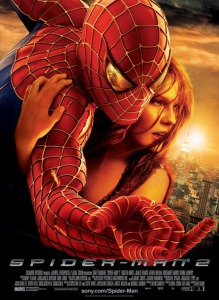 No other movie had higher expectations than Spider-Man 2 and no other movie met and trounced those expectations than director Sam Raimi’s high-flying webslinging sequel. Spider-Man 2 was that rare sequel that excelled in near every way. The action sequences were lively and highly exciting, but what made Spider-Man 2 so thrilling was its success in building strong emotional characters. After all, how many superhero films are written by the writer of Ordinary People? (One wonders what he would have done with Catwoman) Alfred Molina, as Doc Ock, made for a great formidable foe and brought surprising humanity to the dastardly part. Spider-Man 2 was a momentous crowd-pleaser that also dazzled the hardest critics. It reaffirmed exactly what a summer popcorn film can make us feel.
Nate’s Grade: A
Share this:

Kill Bill Vol. 2 (2004)
 When last we left The Bride (Uma Thurman), she had reawakened from years of coma, traveled to Japan to acquire the finest sword ever created, and crossed off two names from her list of those marked for death in the name of bittersweet vengeance. O-Ren Ishii (Lucy Lui) and Vernita Green (Vivica A. Fox) fell under the hand of The Bride in Kill Bill, Vol. 1. Now, the only members left of the Deadly Viper Assassination Squad (DiVAS), the group our heroine was once a part of, are the one-eyed Elle Driver (Daryl Hannah), Budd (Michael Madsen), and the titular ringleader, Bill (David Carradine).
Kill Bill, Vol. 2 takes a very sharp tonal shift from the previous film. Kill Bill, Vol. 1 was a head-spinning orgy of blood and stylized carnage, and it could be argued that its actual plot was wafer-thin. But it seems with Kill Bill, Vol. 2 that Tarantino had answered every critical concern about the first film before they were even brought to his attention as the two films were shot and cut in one grand effort. This film has a much more genial sense of pacing and numerous moments of drawn-out monologues, a far cry from the breakneck pace and terse dialogue of its forerunner. Fans of the relentless hack-and-slash of Kill Bill, Vol. 1 may be disappointed that this film lacks the chopped limbs, geysers of blood, and senseless, yet immeasurably thrilling, slaughter. In fact, whereas the body count for a lone sequence of Kill Bill, Vol. 1 may be in the fifties, Kill Bill, Vol. 2 has three total murders. It is the quieter, more adult half of this revenge opus. Kill Bill, Vol. 1 was an homage to chop-socky grindhouse Japanese films. Kill Bill, Vol. 2 is Tarantinos homage to spaghetti Westerns and their languid pacing and showdowns.
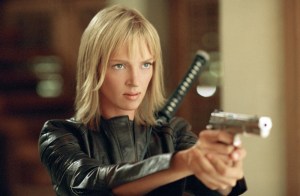 The acting is superior to what you would expect from a revenge movie.
Thurman has always been as good as her director, and under the hands of a master like Tarantino she excels. In Kill Bill, Vol. 1 she was a hurricane of rage and an unstoppable warrior. Here we see the human being inside the warrior’s armor, and she performs with amazing assurance and a ragged, raw delivery. When she’s crying on the floor, face and body red and strained, aching, you believe everything this woman does and is capable of doing.
Carradine, with his gaunt features and face like leather, gives the standout performance of the film. Whereas Bill was an unseen menace in Kill Bill, Vol. 1, with the final installment he becomes fully realized as both a figure of terror but also one of great tenderness. He has a lengthy speech about Superman, masks, and the mythology of comic books that is spellbinding. Madsen gives a fine performance steeped with surprising pathos. He’s the only former DiVAS member who feels remorse for his actions at the Two Pines Wedding Chapel that triggered The Bride’s rampage. A large subplot displays Budd’s current life slumming it as a bouncer at a sleazy strip club and getting verbally berated by people he could easily kill. You come away with the idea that its Budds version of penance.Madsen mixes his remorse with sadistic grit, like when he gives The Bride a choice between a flashlight or a can of mace, and this is before he buries her alive.
Hannah seems to relish every moment as the one-eyed right hand to Bill. There’s a scene where a character is suffering from venomous snakebites thanks to her and she sits down and reads a list of Discovery Channel-esque information she looked up on the Internet about the snake and painstakingly copied onto a notepad. She performs with such gleeful insincerity that it is hard not to start to like her for being so good at being so bad.
 Perhaps the person that steals the movie though is Gordon Lui, who plays the cruel master Pai Mei that teaches Thurman all her moves. He has eyebrows like cotton balls and a long, whispery beard he loves to flick around. Its a shame that this hilarious character is not in the film longer. Kill Bill, Vol. 2 also boasts one of the greatest child performances I have ever seen. The actress that plays the daughter of Bill and The Bride has such a natural quality to her acting that it is amazing she isn’t coming up with her lines, reactions, and movements on the spot.
So does a longer, slower, talkier concluding half mean that Kill Bill, Vol. 2 plays it too safe or loses any of its steam? Hell no. Tarantino fills in all the rough spots and unanswered questions from the first film, and the result is drawing the audience further into the story.
We open the film with another perspective of the events that took place at the Two Pines Wedding Chapel that left a wedding party dead, and a bloodied, pregnant Bride shot in the head. We also discover how The Bride became the deadly warrior she is, why she chose to leave the business of hired killing, why Bill reacted in the extreme manner he did, and we even learn to our delight how Elle Driver lost her eye. The result of knowing the full story are characters, which in Kill Bill, Vol. 1 were more archetypal than living and breathing, that have become fully fleshed out, rounded, and incredibly complex figures full of remorse and vulnerability. The Bride and Bill transcend their descriptions as adversaries, and their relationship becomes more intensely complicated when mommy returns home to find her daughter still alive.
Despite all this fancy talk about character building, Kill Bill, Vol. 2 does not disappoint in action and thrills. A fight between The Bride and Elle inside a cramped trailer may be the most brutal, bone-crushing fight sequence I have ever seen between two women. Every strike that connects breaks something, be it furniture or bones. The final showdown between Bill and The Bride is a fitting and satisfying end for both warriors.
Tarantino’s concluding half of this story long in gestation is a highly entertaining, stylish, thrilling, engrossing, eye-plucking good time. There is so much to talk about. This is the first film since, perhaps, Gladiator that I have seen at the full-price theaters three times. In total, I have seen the Kill Bill saga five times in theaters, and I find something new and rewarding every time. Tarantino has given the masses a masterpiece and everyone should take the opportunity to see it.
Nate’s Grade: A
Share this:

Lord of the Rings: Return of the King (2003)
 To all those hairy-footed Tolkien geeks that chewed me out for having the audacity to call 2002’s Two Towers, of all things, boring, let me say this: while I still find the second entry of The Lord of the Rings to be disappointing and pretty flawed, the final chapter, Return of the King, is a glorious and satisfying conclusion. Instead of doing a usual review (plot synopsis, strengths/weaknesses, etc.), I’m going to bring back the charges I had against Two Towers and explain why Return of the King does not suffer from these ills. Will the defendant please rise as I read aloud the charges.
Charge Number One: Two Towers has nothing going on for its majority except hyping an oncoming battle.
And I still feel this way. Short of the great Helms Deep battle, there was oh so little going on in Two Towers that they could have easily trimmed an hour away from it. And don’t give me this crap about the whole kingdom of man subplot or Aragorn (Viggo Mortensen) realizing his eventual responsibilities. Whatever. Now, in Return of the King, there is so much going on and the pacing is so tight, that despite being the longest film by far (3 hours and 20 minutes), this is the FIRST Lord of the Rings films that has not put me to sleep in the theaters. The nearly hour-long battle involving the 200,000 Orc army with its huge elephant creatures is mesmerizing and visually stunning. But even after the battle and before, unlike Two Towers, there is plenty going on that actually matters, not just three characters running around endlessly.
 Charge Number Two: Despite nothing going on except waiting for a battle, Two Towers has little characterization of any of its characters.
So even though little is going on, Two Towers still doesn’t use all this free space to deepen characters. But in Return of the King, the characters come through and shine. The hobbits are back to the front burner and the film is better for it. Sam (Sean Astin, in the finest performance of the film) and Frodos journey becomes increasingly important and the strain and deception of Gollum puts a wedge between their friendship. When Frodo (Elijah Wood) looks scornfully at Sam and dismisses him from their journey, it’s heartbreaking. Why? Because after two years we as an audience have come attached to these characters and do feel for their struggle. When Sam, toward the climax, says, “I may not be able to carry the ring, Mr. Frodo, but I can carry you!” I dare anyone to try not choking up. We also get deeper moments of character with peripheral characters, like Faramir realizing he can only satisfy his father by a suicidal mission. Even the smaller characters from the second film, like Eowyn (Miranda Otto) and her kingly father Theoden (Bernard Hill), have wonderful moments where the emphasis is on characterization. Return of the King is filled with rich character moments that remind us how much we enjoy and feel for these people … uh, and hobbits.
Charge Number Three: Most of the characters from Fellowship of the Ring have scant appearances in Two Towers.
This still holds true. Gandalf (Ian McKellen, brilliant) returned from the dead but had about three minutes of screen time. The elves (Liv Tyler, Hugo Weaving, Cate Blanchett) were given the amount of screen time most people would consider cameos. And then the hobbits were left alone for the overlong subplot involving Theoden and his clan. What Two Towers really was was the dwarf, elf, and Aragorn movie. And I like each of those characters but this story is not theirs its the hobbits. So the disproportionate amount of time spent with Gimli (John Rhys-Davies), Legolas (Orlando Bloom) and Aragorn felt like what would happen if, in Star Wars, C-3PO and R2D2 had their own film. It wasn’t as interesting and it wasn’t right. But with Return of the King, the attention is back to the hobbits, and all of the characters in the entire film have at least one stirring moment of quality time. Gandalf is back in a big way and its welcomed. What else is welcomed is the increasing attention Merry (Dominic Monaghan) and Pippin (Billy Boyd) have. They started as merrymakers, but by this trilogys end they are desperate to join the ranks and fight. The shared moments between Merry and Eowyn in battle are great. The moments between Pippin and Gandalf are even better. And even though the elves still get the short end of the stick, they make lengthier appearances that are more satisfying. It appears, though, that Cate Blanchett’s longest amount of time in this whole trilogy was narrating the opening prologue.
 Charge Number Four: Excessive dwarf jokes.
Even if you disagree with me on the previous three charges, you must agree with me that Two Towers had about a million dwarf jokes too many. Return of the King, to my knowledge, doesn’t even have ONE dwarf joke. Fabulous. This is not to say I want less Gimli. The subplot involving the Two Towers trio seeking an army of the dead (a tad deus ex machine) is intriguing, and his competitive banter with Legolas is still ripe (Bah! That still counts as one!).
Return of the King is an amazing experience and one that is a fully satisfying conclusion, unlike say, I don’t know, maybe the last two Matrix films. The danger feels more abundant now that the end is near and the tension mounts. The payoffs are rewarding and the climax is fittingly climactic. However, the 20-minute resolution is a bit drawn out. It seems director Peter Jackson can give us three hours of fast-paced action but cant speed through a medley of hugs. You think its over…. and then theres more, then you think its over…. then there’s more. This is a small quibble for such an epic trilogy, and Return of the King proves that it’s really one large triumphant film, with a bit of a sag in the middle. What? Did you think I’d get through all this Lord of the Rings love-fest and not take one last jab at Two Towers? Though I still prefer Fellowship of the Ring out of the three, Return of the King cements the trilogys cinematic greatness in our time. Oh yeah, and the cinematography, special effects, production design, makeup, and score are magnificent too.
The defendant is cleared of all charges.
Nate’s Grade: A
Share this:

The Matrix Revolutions (2003)
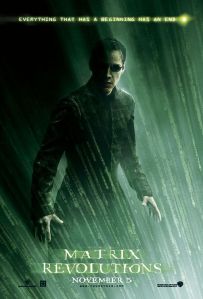 Four years ago the Wachowskis revolutionized the world of cinema, with their surprise sci-fi opus, The Matrix. Their mixture of philosophy, kinetic visuals, and inventive action with style to spare laid waste to all inferior action movies and gave birth to a cult of fan boys. Now six months after the second installment, The Matrix: Reloaded, were left to supposedly close the chapter on Matrix land.
Neo (Keanu Reeves) is caught in a strange limbo between the machine world and the real world. The only passage back to either is through the Merovingians chief hobo, the Trainman (seriously, he’s a hobo with teeth like a jack-o-lantern). Trinity (Carrie-Anne Moss) and Morpheus (Laurence Fishburne) travel to the most spastic fetish club imaginable for negotiations with the Merovingian. He agrees to give them back Neo if they will bring him the eyes of the Oracle, the prophet of the Matrix.
The rest of Revolutions takes place within two storylines. The first involves Morpheus and his former flame Niobe (Jada Pinkett Smith, finally getting a sizeable role she deserves) flying the last remaining ship of the human fleet back to Zion, the last remaining free human city, before the tunneling army of the machines breach the city walls. The other storyline involves Neo and Trinity flying a ship to the heart of Machine Town to have a face-to-face with The Wizard. They want to negotiate a peace between the two factions and put a stop to the increasingly uncontrollable rogue program, Agent Smith (Hugo Weaving), who, left unchecked, could destroy both the human and machine world.
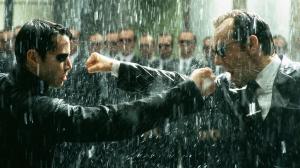 Reeves has never been confused with a serious actor, or even much of an actor for that matter. And sure, he has a penchant for being out-acted by inanimate objects, but his stint in Revolutions is stiff and wooden, like he’s just punching the clock to get through another day. It doesn’t help his case that half of his scenes involve the woefully inept romance between him and Moss.
The only person that seems to be having any fun in this overly serious melodrama with guns is Weaving. His Agent Smith character has morphed into the true star of the Matrix trilogy. Hes charming and even more likable than the dull-witted Neo. Weaving seems to love the drawn out line delivery, so much so he might be accused of abusing anti-depressants. His insidious cackles are a delight.
The plot of The Matrix: Revolutions has several head-scratching moments. Like the kid who yearns to be in the fight but is too young and clumsy. Anyone who’s ever seen any movie ever will know how that plot point turns out. Then there are questions like, why do people far in the future still use wheelbarrows to lug ammo around? Why, during a shoot-out at the fetish clubs gun check room, do people jump on the ceiling? Why would being on the ceiling make you any more difficult to shoot? The whole sequence comes off like a poorly done rip-off of the Wachowskis’ own bank lobby shoot-out from the original Matrix.
Revolutions is the least densely plotted of the three films. Now, one would think this would be a godsend, especially after the pretensions and bloated mess that was The Matrix: Reloaded. But theres nothing at all memorable in this third installment, and perhaps this is because everything but ten minutes of it takes place in the dingy real world. Who cares about a post-apocalyptic universe where the surviving subterranean humans wear rags and pull all-night raves? I’ve seen that stuff in a thousand other movies (maybe not the raves part, though). Everything is better within the virtual reality Matrix world; from the clothes to the gravity-defying cool acrobatics to the cinematography to, God help me for saying it, the acting and dialogue. At least Reloaded gave us the stylish goods when it came to that heart-thumping freeway chase.
Although Revolutions is a slight improvement over the tedious Reloaded, this is only because after seeing the third and final leg of this trilogy, it makes the second film look worse. The intriguing new elements of Reloaded, like the French Merovingian and his wife (the lovely Monica Bellucci), are now seen to be nothing more than dropped subplots. Even the coolest additions to the Matrix universe the ghostly twins- don’t even show up. Sigh. Now that I know where the story ends, the loose ends of Reloaded don’t justify themselves nearly as much as I would have liked.
 The showpieces of Revolutions are two long battles in its final act. The first is a near-20 minute assault by the Sentinels, resembling flying mechanical octopi, against the defenses of Zion. It’s exciting for a while but battle fatigue settles in quickly. You can only watch so many CGI robo-exoskeletons shooting CGI machine guns at CGI flying machines as they explode in CGI explosions and CGI shrapnel. The effects are nice, and seem more polished than Reloaded, but the sense of imagination seems to be entirely absent. The second battle is the final fist-fight between Neo and Agent Smith in the pouring rain. Smith has duplicated himself enough to cover miles upon miles of high rises. The fight sequence is impressive and beautifully filmed, but it amounts to a big shoulder shrug after watching Neo battle 100 Smiths in Reloaded. The final confrontation in Revolutions is adequately satisfying if a bit under whelming and unmemorable.
The need for corporate coffers to ring has turned what was a great stand alone film into a mediocre franchise, one whose diminished hopes and lowered expectations can only be judged on par with the Star Wars prequels. My friend Colin equated watching The Matrix: Revolutions to a wet dream: momentarily satisfying but leaving one with nothing but pangs of emptiness. The Matrix trilogy doesn’t end with any sense of urgency; instead it draws to a close with a half-baked artificial fulfillment. The journey of Neo and Trinity and all the rest has come to a whimpering end.
Nate’s Grade: C


You must be logged in to post a comment.