Blog Archives
Dawn of the Planet of the Apes (2014)
 Anyone else think the titles of these Apes prequels should be retroactively switched? Coming off the heels of the surprisingly excellent flick Rise of the Planet of the Apes, those damn dirty apes are back with another summer blockbuster that’s just as mature, engrossing, emotionally resonant, and visually remarkable. Dawn of the Planet of the Apes takes place ten years after the events of the previous entry, with mankind devastated by the “Simian Flu,” the same bug that has kick-started the evolution of the primates. Caesar (Andy Serkis in motion capture) is leading a fairly conservative life; he has a home, a family, a wife, and a community he’s trying to build. Then a group of humans wander into their territory needing access to the remains of a dam for a power supply. The apes do not trust the humans, but Caesar accepts their terms, looking to avoid war. However, fear, resentment, and hate fester on both sides, and it’s not long before it’s apes vs. humans and you witness one of the greatest things your eyeballs will ever see – an ape firing two machine guns while riding a horse. Plot-wise, this film is more a bridge to a larger conflict between the two factions. The human characters (including Jason Clarke, Keri Russell, and Gary Oldman) are given short shrift. And that’s fine because the movie belongs to the apes; they are the stars rightfully. Half of this movie is in subtitles for ape sign language. Director Matt Reeves (Let Me In, Cloverfield) dwells in the moments other blockbusters don’t have time for. He lingers in the shadows, with silences, and we slowly integrate into the world of the apes and their own power dynamics. The all-out action of the third act doesn’t feel like a natural fit for the thoughtful movie that has played out until that point. The visual effects are again top-notch and the motion capture tech captures a stunning range of human emotions that you can witness play out across the CGI creations. Toby Kebbell (Wrath of the Titans) portrays Koba, the more hawkish member of the ape tribe, and he is just as good as Serkis, which is saying a lot. I’d still call Rise a better overall film, but Dawn is a more than worthy follow-up that reminds audiences what great storytelling can achieve with the right people behind the scenes.
Nate’s Grade: A-
Share this:

22 Jump Street (2014)
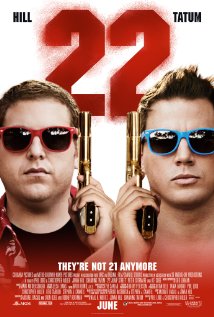 When 21 Jump Street was proposed as a movie, nobody thought it was a good idea. Even its stars and writers. They used that as an opportunity to craft one of the more charming, surprising, and hilarious films of 2012, a movie so good that it was also one of the best films of a relatively great year at the movies. Now that was something nobody expected with a 21 Jump Street movie. As often happens, Hollywood looks to keep the good times going, and 22 Jump Street is knocking at the door. In Hollywood tradition, sequels usually follow the “more of the same” format with a dash of “bigger is better,” a fact that 22 Jump Street takes to heart.
Having successfully busted a high school drug ring, Officers Schmidt (Jonah Hill) and Jenko (Channing Tatum) are the toast of their unit. That is until they let a dangerous criminal (Peter Stormare) get away with a shipment of drugs. It’s back to the Jump Street program, as their police chief (Nick Offerman) laments that everybody just needs to do the exact same thing that worked the last time. Captain Dickson (Ice Cube) has assigned Schmidt and Jenko to go undercover at the state university to sniff out where the student body is getting a powerful and deadly designer drug. Schmidt grows close to Maya (Amber Stevens), an art major who knew a girl who overdosed on the new drug. Likewise, Jenko is falling for team quarterback Zook (Wyatt Russell), or more accurately the bond they share as two athletes with a similar brain. The partnership of Schmidt and Jenko may be in trouble for the long haul if they can’t work together.
 This may be one of the most meta movies of all time, existing outside itself in tandem to always provide a winking dose of commentary about its own silliness, excess, and corporate mentality about replicating success through the least creative means possible. There’s even a character with a literal red herring tattooed on his bicep. There are plenty of in-jokes without breaking down the fourth wall, and the meta cleverness is an entertaining way to pave over the general same-ness that goes along with the limited undercover premise. While cracking wise for its full running time, 22 Jump Street really is “more of the same.” For most, myself included, that is completely acceptable since the first 21 Jump Street was an unexpectedly witty and comically brash outing. Seeing another adventure with this same team is more than justifiable, especially with the kind of comic kinship that Hill (The Wolf of Wall Street) and Tatum (White House Down) share. Once again the guys go undercover to bust a drug operation, and once again they each get close to a different set of students, and once again their relationship takes a personal hit. It’s the same plot beats but with different jokes (like the R-rated version of Anchorman 2). The entire “going undercover as a school student” concept is so dated to begin with, and neither Hill nor Tatum can credibly pass at this point, so the entire enterprise feels like they’re squeezing the most they can while they can, enjoying the good times, the good chemistry, being silly on the studio dime, and counting their luck.
The end credits for 22 Jump Street deserve special praise just for the appearance of burning down its franchise. Throughout the film the guys are mocking the very notion of a sequel. By the end, they mock, without abandon, the idea of a franchise. We flash through an absurd array of new assignments, new sequels, and new school-setting undercover gigs, and it’s almost like a flash-forward into the timeline of the movie, like the finale of Six Feet Under. There are some amusing cameos and business satire to mock with as well as the general ludicrous nature of repeating this plot/formula (Magician school?). The end credits leave the audience feeling buzzy and giggly, a perfect comic high, and it’s the best end credit high since the original Hangover.
The real enjoyment is watching Hill and Tatum continue to mine what has become one of film’s best onscreen bromances of all time. I never would have pictured these two fitting together so smoothly, or Tatum being such an unexpectedly natural comedic talent. Thank goodness for the 21 Jump Street movies for offering us these untold comic gifts and for knowing what the main attraction is and how to properly develop it. The relationship between friends/colleagues/bros Schmidt and Jenko is the most consistently interesting, surprisingly emotional, and comically ripe subject in the film. We have two great actors and watching them butt heads is just as fun as watching them get along. In the sequel, the guys go through what serves as an analogue for a separation, wanting to see other partners. We know in our hearts these two are meant to be together, and so much of the fun is watching just how this odd coupling now seems so indispensable to one another, with Tatum’s zigs blending ever so delightfully with Hill’s zags. I could watch another movie of just these guys doing paperwork.
In the first film, Jenko and Schmidt were set up to fall back into stereotypical roles before the movie found a better solution. Jenko was going to be the jock with sports classes, and Schmidt the nerd with AP classes and drama. Then a mix-up, and they have each other’s identities, and the movie is that much better, forcing each out of their comfort zone and finding the better comic scenario. With 22 Jump Street, the movie falls back to the old social order. Jenko hangs with the football jocks and the frat brothers and gets to be the super popular student-athlete, while Schmidt is left to investigate the art majors who knew the dead coed. It has them falling back into their high school roles (popular vs. outsider) and it’s not nearly as interesting, especially after seemingly growing beyond these moments. The side characters aren’t as interesting either, many lacking material to develop beyond one-note joke machines, like Zook. I was mildly intrigued by H. Jon Benjamin (TV’s Archer, Bob’s Burgers) as a football coach obsessed with protecting the goalpost, but I wanted more. Twin stoners who talk at the same time are not enough.
 There is one supporting actor given enough material to shine and that is Workaholics’ actress Jillian Bell. She plays such a deadpan, biting, sarcastic, no-nonsense roommate who won’t entertain for one second that Schmidt is who he says he is, and she is wonderfully brutal with her insults. There’s a later scene where she keeps wrongly misinterpreting a fight with Schmidt into something else. It’s a highlight of the movie, a great example of her physical comedy skills and sense of timing, and it’s a plumb example of taking a topic that a situation that could be uncomfortable and finding the right balance to guide an audience along for the best laugh.
Like before, once the movie adapts to its action-filled climax, the jokes start taking a backseat to the action theatrics. Returning directors Phil Lord and Christopher Miller (The LEGO Movie) have kept their same brand of rambunctious spirited comedy alive and well, which keeps the movie’s pace brisk and always open to fresh weirdness. While some jokes don’t work as well the second time (Vietnamese Jesus, the drug freak-out fantasy sequence, though its use of Creed music almost makes up for that), this is still more sequel than retread. This is not an Austen Powers that repeats the exact same jokes with slightly different settings. Lord and Miller understand how to satiate an audience without overt pandering. They know how to build payoffs that are small and payoffs that are big, ones directly linked to character goals. There are strong comedic set pieces unrelated to any sort of meta commentary, Schmidt’s impromptu slam poem being one of them. It’s a manner of giving people what they want while still finding new ways to surprise, because otherwise comedy is dead without the subversion of expectations.
“More of the same” is the best and worst summary for 22 Jump Street, and despite 1500 words of film criticism, all you really need to ask yourself. Is more of the same good enough for you when it comes to another 21 Jump Street movie? Sure, we’d all wish for the same sort of unexpected cheeky revelation that was the first film, but then again no one had any expectations that a 21 Jump Street movie would be anything worth watching, let alone one of the best films of that year. 22 Jump Street is hilarious, witty, aggressive, irreverent, and even when it has to take on the role of action-comedy, it does so with a consistent wink, pointing toward all the sequel tropes and absurdity without rubbing your nose in every single reference and gag. The second time around Jump Street is, by definition, never going to be as fresh, but the company is still top-notch, the jokes are still layered and cracking, and the determination is high. It’s a sequel that delivers what it promises. I’m ready to take this franchise as far as it can conceivably go for two men well into their 30s-posing-as-high-schoolers. Magician school, here we come.
Nate’s Grade: B+
Share this:

X-Men: Days of Future Past (2014)
 Ever since Marvel’s Avengers destroyed the box-office in 2012, every studio with super hero franchises has been looking to follow suit. It’s not just about comic book franchises; it’s about building a comic book universe. It’s been a long dark period for the X-Men ever since the regrettable 2006 debacle The Last Stand, which callously killed characters, butchered others, and botched the most famous storyline in the history of the comic. In 2011, Matthew Vaughn proved there was still life to be found in the franchise with his terrific 60s-era prequel, X-Men: First Class. Now, post-Avengers, Fox is salivating at combining the past X-Men and the present X-Men into one colossal movie with a colossal budget. Back on board is director Bryan Singer, the director of the first two X-Men films and the man who helped kickstart the modern superhero era. If that wasn’t enough riding on the film, X-Men: Days of Future Past also follows the second most famous storyline in the history of the comic.
In the horrible future, killer robots known as Sentinels hunt down mutants. These are the invention of Dr. Boliver Trask (Peter Dinklage), a military scientist who was killed back in 1973 by the vengeful shape-shifting mutant, Mystique (Jennifer Lawrence). The murder convinced humans to subsidize Trask’s killer robot plan of defense. Thanks to experiments replicating Mystique’s mutant ability, the Sentinels have the ability to adapt to any power, turning them practically indestructible. In the future, the Sentinels are eradicating all mutants, mutant sympathizers, and eventually human beings. Magneto (Ian McKellen) and Professor Xavier (Patrick Stewart) have teamed up with a small band of surviving mutants, including Wolverine (Hugh Jackman). Thanks to the phasing powers of Kitty Pryde (Ellen Page), they can send Wolverine’s consciousness back to 1973 so that he can prevent the Trask assassination. The only ones who can help Wolverine is the younger Xavier (James McAvoy) and Magneto (Michael Fassbender), former mentors to Mystique. Except Xavier is a recluse and strung-out on drugs to dull his powers and Magneto is locked away underneath the Pentagon.
 The X-Men films have always had a topical advantage to them that provided a weightier sense of drama than your typical story about a reluctant soul blessed with amazing powers. The mutant allegory automatically applies to any sub-group facing oppression mostly through fear and ignorance. What other superhero franchise has two opening scenes in a German concentration camp? The stakes are even larger with this movie because of the Horrible Nightmare Future that must be prevented. Now we all assume said Nightmare Future will be avoided by film’s end, so the movie provides a proverbial reset button that the filmmakers can have fun with, and they do (look out future mutants). Excluding the Nightmare Future framing device that becomes an unnecessary parallel storyline, the majority of the film takes place in 1973. If X-Men: First Class tapped into the groovy optimism and “take me for what I am” sense of social justice of the time, then this film certainly taps into the disillusionment of the 1970s, where the promise of reform and hope morphed into anger and cynicism (hey, that’s like us today!). This loss of innocence is typified in Mystique, who becomes the central figure of the movie in many ways. Her seething desire for vengeance is what animates her, as well as the pain of betrayal from the men closest in her life, as well as the world who once held such promise. Also, Jennifer Lawrence (The Hunger Games) has become one of the biggest female stars on the planet, so it makes sense to bolster her role. The central conflict is stopping an assassination, one domino that leads to many others, but it’s emotionally about Mystique having to confront her feelings of hate. It’s another platform for the ongoing conflict of perspectives between Xavier (restraint, tolerance) and Magneto (strong defense, eye for an eye). But as I found in First Class, it’s hard not to agree with Magneto as human overreaction leads to rash and thoughtless actions, like Horrible Nightmare Future.
That’s not to say that X-Men: Days of Future Past fails to deliver when it comes to the popcorn thrills and action highs we crave in our finest summer blockbusters. The action set pieces are large without dwarfing the characters, playful and imaginative without losing a sense of edge and danger. I loved how the character Blink (Bingbing Fan) would utilize her mutant power of opening portals as a fighting strategy. It makes action sequences so much more inventive and visually exciting to throw a series of portals. The pacing is swift short of the second half of Act Two, gearing up for the climactic showdown in D.C. that dominates Act Three. The time travel story starts with a lot of exposition but it gets smoothed out as it goes, the rules of the story fall into place. Every action sequence hits, some admittedly better than others, but it’s the small touches that Singer injects that made me smile most. I enjoyed Magneto pointing a gun, being toppled, but still using his power to have the gun fire in midair. I enjoyed the animalistic nature of the Beast/Wolverine brawl. Jackman is looking even veinier than usual in his bulked out form. Thankfully the fish-out of-water timeline jokes are kept to a minimum. Wolverine is the perfect glue to hold both timelines together. And then there’s that standout Pentagon prison break sequence (more on that later). Singer might not have the most natural instincts developing and staging action, but the man is a surefire talent when it comes to staging eye-catching visuals (I would say the same about Christopher Nolan). Even his unfairly maligned Superman Returns is proof of the man’s cinematic gifts. As far as entertainment value, this is right up there with X-Men 2. I still view Vaughn’s savvy First Class as the best X-film of the bunch, which has only gotten better the more I’ve watched it.
 And if that wasn’t enough, Singer’s new film does what every fan has been hoping for: (spoilers) it erases all the crummy X-Men movies, namely 2006’s Last Stand and the first Wolverine solo effort, from the official timeline. It’s time to start anew, toss out the old stuff nobody liked, and forge ahead with a new unified timeline. There can be two parallel X-Men franchises, one present/future and one with the prequel casts, and they can go on forever as desired, or until the prequel cast prices itself out. In one fell swoop, Singer and company have reset the mother franchise and given fans new hope about the possibilities. Make sure to stick around to the very end of the credits for a scene that indicates directly who the next major villain will be in the 2016 sequel.
Let me take time to single out just how expertly Evan Peters (TV’s American Horror Story) steals the entire mutant-heavy movie. First, he’s the most comically attuned character, which is a nice break from how serious, and rightly so, every character is so often. Quicksilver provides a whole new jolt of entertainment, and when he checks out after the prison break sequence you’ll dearly miss him. The character is a rapscallion (as my late grandmother might have termed) that enjoys using his super speed powers to mess with people, to test his limits, to see what he can get away with, and a Pentagon jailbreak is right up his alley. Ignore the silly yet period appropriate outfit and ignore what initially seems like Peters’ smirking self-involvement from trailers and ads. When this character is onscreen the movie has a joyful sense of irreverence. He is instrumental to freeing Magneto and the onscreen depiction of his super speed is the best illustration of the power ever conceived in film and TV. There is a segment sent to Jim Croce’s “Time in a Bottle,” and some wonderful special effects, which is just so playful, so giddy, and so cool that it very well might be my favorite moment in any superhero movie… ever. It is definitely an applause-worthy moment and my audience responded in kind. Quicksilver is a perfectly utilized supporting player in a movie stuffed to the gills with characters.
The time travel geek in me has a few quibbles with the parallel lines of action from past and present. Wolverine’s consciousness is sent back in time but he film plays out like it’s happening simultaneously to the events of the future. So if Wolverine is pulled out in the middle of the movie, he’ll have failed his mission to change the future, even though by going back in time he’s already, blah blah blah butterfly effect. Anyway, I understand how they want to make the future story have a sense of urgency but it’s not like waking Wolverine from a dream; the times are not happening concurrently. He’s in the past, meaning that the moment he goes back there, the future will already be altered due to the consequences of his actions, for better or worse. There is no race against time to keep his consciousness back in time until he complete his mission. I can see why they went this route for a summer blockbuster, but that doesn’t quell the quibbles.
 X-Men: Days of Future Past is a time-hopping, unabashedly fun time at the movies; well as fun as preventing nightmarish futures built from the consequences of oppression and prejudice can be. With Singer back in the saddle and the bridging of the two X-Men universes, the series is back on track and once again the promising font of stories and characters. The newest X-film is one of the most entertaining, funny while still being dramatic, and while burdened with the largest cast of any super franchise, finds notable moments for its characters big and small to remind us that these people matter. While less philosophical and funky than First Class, this is one of the best films in the franchise, on par with X2. The action sequences and visual eye-candy are great fun with some inventive and memorable touches. It’s also nerdy fun getting to watch the past and present interact, and for many this is their first return since 2006’s crappy Last Stand. It’s not a perfect movie; I wish there was more early Sentinel action, I wish Dinklage had much more to do, and I wish that the plot didn’t so transparently hinge on Xavier not having his powers. The slate is clean and all X-Men fans can breathe a sigh of relief. The future is once again rosy. The X-Men, and not just Wolverine, are relevant once again.
Nate’s Grade: B+
Share this:

The Raid 2 (2014)
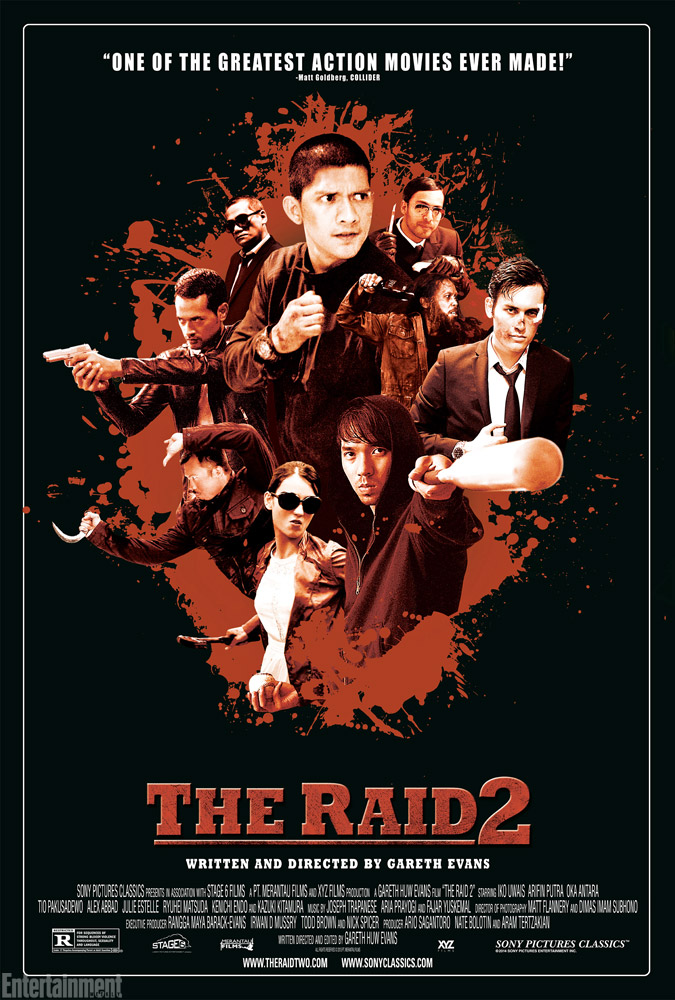 Rare is the movie that I feel I don’t even need to go into great detail rather than just scream, in a fashion suiting madness, “See this! See it!” Such is the case for The Raid 2, the sequel to the 2012 Indonesian action film that melted faces with its inventive and brutal action. The original movie had a confined location, a gang-run tenement building, and a simple premise of reaching the top and nabbing the bad guy. When people weren’t punching or shooting each other, the original Raid lagged, but director/writer Gareth Evans has solved the problem with his action-packed sequel. The world expands greatly, establishing the uneasy peace kept by powerful and warring criminal organizations. The plot ends up becoming something akin to The Departed meets A Prophet, following our hero cop from the first movie now placed undercover to gain the trust of the criminal overlords and work his way up the food chain. When the action isn’t cooking, you’re still engaged with the story and the suspense simmers in clever ways. But getting back to the film’s calling card, the action sequences are impeccably choreographed and edited, have a wide variety of locations for fun, and are bloody intoxicating. This is a movie soaked in adrenaline, and the action sequences will be hard to beat for the rest of the year. Evans finds ways to provide flair for his supporting characters, including a family duo that involves a deaf woman whose weapon of choice is hammers and a guy who prefers a baseball and a bat. The Raid 2 fires on all cylinders so well, so brilliantly filmed, that it puts just about every American action thriller to shame. It doesn’t need to be as long as it is (pushing two and a half hours), and it takes a little while to set up the players, but this is even more of an entertaining rush than the original, because now we get a sense of what Evans and his team can do with fewer restrictions. When Evans gets to Hollywood, and he will, just make sure you give him all the money to do whatever he wants.
Nate’s Grade: A-
Share this:

Captain America: The Winter Soldier (2014)
 A welcome addition to the Marvel Cinematic Universe, the second Captain America film brings the square superhero to our modern-day and presents a complicated national setting where the enemy is the U.S government. The challenge with a Captain America (played by Chris Evans) movie is just how outdated his whole sensibility seems, an irony-free nationalistic hero. Smartly, the filmmakers have pushed his loyalties to the test, and the movie transforms into something along the lines of a Jason Bourne thriller, where the government is hunting down a rogue fugitive. It’s certainly the most timely superhero film since 2008’s The Dark Knight, and the political commentary on the NSA spying and drones is a welcome big screen subversion. But the action is still what people come for and in that the Winter Soldier is quite an entertaining movie. Directed by the Russo brothers, known mostly for their comedy work in TV like Community, the movie packs quite a punch with a variety of action/thriller sequences, each well staged and well developed. My favorite might be Nick Fury under assault and desperate to escape in his car from overwhelming enemy forces. An opening sequence rescuing hostages on a boat serves as a great reminder why Captain America is indeed so super. The movie does have some issues but nothing so large as to derail the enjoyment. First off the villain is way too obvious, but also the movie lets the U.S. government off the hook, falling back on a select evil group that has been undercover perverting the government. Secondly, the Winter Soldier of the title is one plotline that doesn’t feel needed or well integrated. It’s another super soldier for Cap to combat and this guy has a mysterious link to our hero. It feels like one plotline too many, a story that deserves better attention on its own. Still, Captain America: The Winter Soldier is an engaging, thrilling, intelligent, and altogether entertaining addition into Marvel’s sprawling cinematic canvas.
Nate’s Grade: B+
Share this:

300: Rise of an Empire (2014)
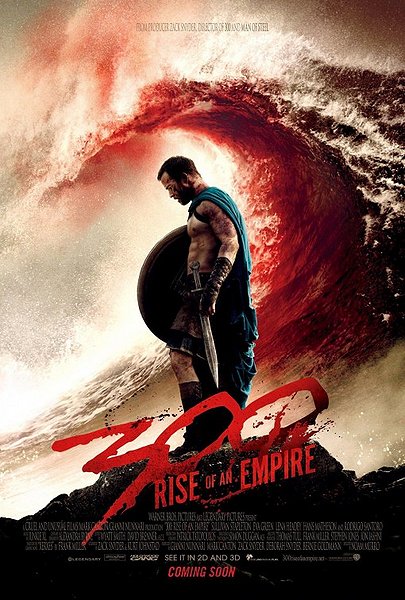 In 2007, the gory, shouty, beefcake-y action flick 300 came out of relative nowhere and took the world by storm, earning over $400 million worldwide and launching the careers of Gerard Butler and director Zack Snyder (Man of Steel, Watchmen). The movie burrowed itself into pop culture, readily mocked and parodied along with its highly stylized action. So where to go next? Also based on a Frank Miller graphic novel, though one that is incomplete as of release, 300: Rise of an Empire is a return to the same stylized excess that made careers. Except now seven years later, what once dazzled seems empty; visually alluring but hollow by all accounts.
Following the brave stand of King Leonidas and his 300 Spartans, Xerxes (Rodrigo Santoro) is pushing forward with his plans to subjugate the city-states of Greece. Long ago, Themistokles (Sullivan Stepleton) killed King Darius during Persia’s first invasion attempt. Xerxes has sworn vengeance since, goaded into action by his second-in-command, general Artemisia (Eva Green). She commands Xerxes’ mighty naval fleet, and she looks to “dance across the backs of dead Greeks.” The many city-states of Greece are squabbling over an appropriate response; Themistokles argues they should unite, while others contend for surrender to Xerxes. Themistokles rallies what armies and ships he can to meet the Persians on the sea and prevent the overpowering invasion.
 The difficulty with a follow-up to 300 is that Snyder’s highly stylized original has been copied and pasted so many times by cheap imitators, so what’s new? The film’s visual style follows the original closely, all those gauzy panoramas and human bodies lovingly showcasing in slow-mo the ugly beauty of bloodshed and violence. The rippling muscles, the glistening sweat, the geysers of blood; it’s all here and in displayed in fawning 3D detail. I didn’t see the film in 3D, but I noticed that every campfire scene was littered with annoying floating embers. However, Rise of an Empire manages some pleasant surprises because a majority of its action takes place at sea. This is a movie devoted to ancient maritime combat, and that’s pretty interesting. The scope of the action is much larger this time, with far more than 300 soldiers in play. The naval battles are brought to life with Hollywood excess but they’re still fairly exciting and fun to watch. The action is well orchestrated, usually easy enough to follow, and suitably thrilling, with each sequence differing from the last. The pumping score by Junkie XL works as a strong driving force with pounding percussion and horns (check out “History of Artemisia”). There are also less nutty monstrous evil henchmen this go-round as well, which helps bring a needed sense of internal reality to all the fantastical action. There are no goat people and blade-handed executioners this time. I don’t think anybody is going to take the movie to task for historical accuracy, but it’s appreciated all the same. Though who’s going to hire Blade Hands now? The guy has a very limited skill set for a workplace.
Plot-wise, the first 300 film was an underdog tale, a group of proud warriors fighting against overwhelming odds eventually giving their lives for the cause. It’s an early chapter in the Noble Lost Cause storytelling playbook, meant to inspire. It’s a Greek Alamo. The problem is when you pick up the story after the Noble Lost Cause. Now the Greeks have to fight the whole of Xerxes’ mighty forces with their own, and while it’s still an underdog story at its core, watching one huge army fight a huger army doesn’t have the same entertainment value. That may be why the film also works as a prequel. There are three flashbacks to fill out the first act’s worth of table setting: the initial war with Persia, Xerxes, and Artemisia. We get storylines happening concurrently with Leonidas and his men, though Gerard Butler declined to reappear in the film. You definitely miss his animalistic fire and screen presence. Ultimately, I don’t know if there’s much of a story here besides a big-screen version of Stratego, where the Greeks move, then the Persians, now everyone is dead or defeated. That’s a glib oversimplification, yes, but the plot boils down to an increasing series of episodes on how the Greeks repel the Persian invaders. Without greater characters and storylines to populate the downtime, it all becomes soulless exercises in CGI bloodshed chasing after whatever is cool looking.
The big problem with 300: Rise of an Empire, despite the ever-present sameness of it all, is that the heroes are bland and the villains are charismatic, which makes it easier to root for the bad guys, which I heartily did. The heroes are chiseled from the blandest of hunks of one-note characterization, with only three real characters being formed. There’s Leader Guy a.k.a. Themistokles, who wants to unite Greece into one power. There’s Father, a.k.a Scyllias, who has a slight scar on his jaw to better identify him, and then there’s his Son, a.k.a. Calisto, who wants to fight. Ladies and gentlemen, that is it, which is all you get when it comes to your heroes. What a shameful pittance. There aren’t even flamboyant supporting characters in their ranks. The heroes are boring, and the father/son storyline plays out exactly as you’d expect, which is a reverse from the original 300. These are not characters you’d follow into uncertain danger. These are characters leftover after all the good ones have been prematurely slain. These are some lackluster leftovers.
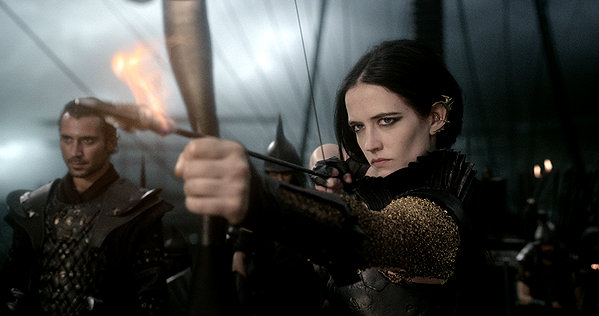 Now, let’s take a look at the enemy camp, namely with chief antagonist, Artemisia. It helps leaps and bounds that she is played by Eva Green (Casino Royale, Dark Shadows), and it’s even more helpful that Green gives it her all, sinking her teeth into the campy villainy. Artemisia is a fierce sword fighter, no-nonsense general, and overall badass supreme. She kisses decapitated heads, is not above fighting topless, and wears wicked outfits with spikes and all sorts of goodies. Every time she departs a scene, you’re left counting down the minutes until you see her again. She’s so delightfully entertaining, chomping at the bit for vengeance and Greek blood. She’s also a woman commanding warships in 500 BC, not exactly a time that recognized women as equals. Another wrong move on the filmmakers’ part was illuminating Artemisia’s back-story. We learn via flashback that Artemisia watched her family get raped and slaughtered by the Greeks. She was sold into sexual slavery at a young age, imprisoned in the bowels of a Greek ship, repeatedly raped for years. Then when these horrible men had had their fill, she was dumped onto an anonymous road and left to die. After seeing this sequence, what person isn’t going to welcome Artemisia? Does she not deserve her vengeance? I was emotionally engaged with her from that moment onward, and so I rooted for her to burn Greece down and vanquish our lame heroes.
The rest of the actors on screen are rather bad. The beefy men on screen could have used some extra work on their underutilized acting muscles. Stapleton (Gangster Squad, TV’s Strike Back) is absent any notable charisma to distinguish him from the stubbly-bearded pack of screaming male heroes. Santoro (The Last Stand) has a certain dour intensity to him, though he spends much of the film watching from a distance. The rest of the cast doesn’t even merit mentioning because the film treats them like featured extras rather than genuine characters. Only Lena Headey’s (TV’s Game of Thrones, The Purge) handful of scenes will grab your attention. It’s ironic that a film that glorifies the heroics of male soldiers, as well as the their chiseled physiques, and the only two women in the entire film are easily the most memorable and entertaining people. Dump the dudes.
While it offers enough thrills and visual power to satisfy a trial viewing, 300: Rise of an Empire is just too empty a spectacle to warrant anything beyond a cursory glance. Director Noam Murro follows Snyder’s blueprint to the best of his abilities, soaking the screen in blood, rippling flesh, and visual grandeur, but the movie goes into convulsions when somebody is forced to talk without kicking people in the face. The plot amounts to little more than a series of attacks played out like stages in a video game. While the original is no masterwork, at least it had characters that we could gravitate toward. Absent any hero worth rooting for, it’s no wonder that Green and her memorable villain reign supreme. She is excellent and has a reasonable motivation for her vengeance. If it had been her movie, 300: Rise of an Empire might have developed into a worthy spectacle anchored by its fiery heroine. Alas, the actual movie is just a Saved by the Bell: The New Class of half-naked men going off to CGI battle, and that’s just not enough.
Nate’s Grade: C+
Share this:

The Hobbit: The Desolation of Smaug (2013)
 Back to another three-hour trip to Middle Earth. While the second Hobbit film is an improvement in just about every way, it’s still a clear example of a franchise stretching to the breaking point. Peter Jackson gets the second installment moving a lot quicker, and there are several standout action sequences that are glorious on the big screen. Unfortunately it still takes almost two full hours to get to the dragon of the title, but when it does, oh does the movie become that much grander. Benedict Cumberbatch gives frightful life to Smaug (pronounced, for whatever reason, as “Smaa-oog”), and the special effects are top-notch. The last forty minutes of the movie are solid gold, as Bilbo and the dwarves work together to battle Smaug in a virtuoso development of imaginative action; it’s wonderful how many moving parts are involved in this action set piece. However, Hobbit 2 still feels needlessly padded to meet out a trilogy. Does Gandalf (Ian McKellen) need to just disappear on his own mission that accomplishes what? Do I care at all about the people of Lake Town let alone their populist revolts? Do I need a parallel storyline about an injured dwarf? And for that matter, do I need a budding lady elf-dwarf romance? J.R.R. Tolkien fans will be in heaven (though maybe just purgatory with all the changes) to gawk at the realm of Middle Earth, but I always feel antsy (“Get on with it already”). Still, The Desolation of Smaug is an entertaining and at times majestic fantasy epic, I just wish Jackson and company didn’t take so many pit stops. Well at least we won’t have to wait so long for the dragon in Hobbit 3.
Nate’s Grade: B
Share this:

Anchorman 2: The Legend Continues (2013)
 A lot has changed in the nine years since the raucous, instantly quotable, and deeply silly hit comedy, Anchorman. Steve Carell, Will Ferrell, and Paul Rudd have all become big stars (sorry Dave Koechner), producer Judd Apatow has become a comedy empire unto himself, and director Adam McKay has gone on to helm several other hit Ferrell collaborations. As much as I loved Anchorman, and I unabashedly do, I was nervous about a sequel capturing the same magic. While Anchorman 2: The Legend Continues cannot be as good as its predecessor; my worries were mainly unfounded because this is still the funniest movie of the year. Simply put, if you’re a fan of the original, you’ll find enough to enjoy, possibly even love, with this latest chapter. The laughs-to-minute ratio is pretty high, as long as you don’t mind some scenic detours. The plot is much looser this time with several competing storylines that come in and out of focus. There are segments that could have been cut completely, like Ron’s bout with blindness, but I laughed enough that I never minded. But that ending 15 minutes is where the filmmakers drop any pretension of reality and double down on absurdity. It’s no surprise that those last crazy 15 minutes were my favorite. The cast is universally strong together, working off one another’s comedic styles so effortlessly, but the plot is very much a kitchen sink approach. I’m happy that Ferrell and McKay, co-writers again (though it’s hard to credit a collaborative improv), didn’t feel the need to recycle many jokes from the first film, reliving their old hits for fans hungry for instant nostalgia. Anchorman 2 is the same brilliantly broad comedy and absurdist dada experiment every loyal fan was hoping for. Give the gift of Ron Burgandy this holiday season and stay classy, America.
Nate’s Grade: B+
Share this:

The Hunger Games: Catching Fire (2013)
 It’s been a year and a half since The Hunger Games broke box-office expectations, gifting Lionsgate studio with a formidable franchise. Based upon Suzanne Collins’ series of young adult novels, the first film was an agreeable adaptation that was occasionally hobbled by poor direction, rushed plotting, and budget limitations. Catching Fire, the second film, improves upon the established groundwork in almost everyway with the chief drawback being a terminal sense of dystopian déjà vu.
In the months after the events of the 74th Hunger Games, the two victors from District 12, Katniss Everdeen (Jennifer Lawrence) and Peeta Mellark (Josh Hutcherson), are traveling across the other districts of Panem as part of their victory tour. What better way to endear yourself than visiting other districts to remind people that their children are dead and you survived? On the tour, there is growing unrest throughout, and the people have turned Katniss as their symbol of defiance against the tyrannical Capitol. President Snow (Donald Sutherland) threatens Katniss to control her media image, to convince the people that she’s madly in love with Peeta and not a fledgling revolutionary. In order to check the power of the victors, Snow introduces a rule change for the 75th games, the Quarter Quell. This year the participants will be culled entirely from previous past victors, meaning that Katniss and Peeta will be plunged back into the deadly games and this time their competition aren’t children.
 What a difference a director with a sense of cinematic visual command can make. Early into pre-production, the original director Gary Ross (Seabiscuit, Pleasantville) decided to bow out for sequels, and so Francis Lawrence (Constantine, I Am Legend) was hired, and goodness does the movie benefit from this change at the helm. Lawrence has a much stronger visual authority, having cut his teeth in commercials and music videos (remember those, kids?) before feature films. The man couldn’t frame a lousy shot if he tried. With a stronger visual lens, the world of the Hunger Games is able to stretch, given a proper budget, and the visual grandeur unfolds around you, especially the largess of the Capitol. The movie doesn’t feel like they had to cut corners with their budget or special effects, and part of that is credited to the skill of Lawrence. And with this new visual stylist comes the demise of shaky cam. Dance and celebrate that Ross’ misapplied docu-drama approach has been abandoned; this time, when there is onscreen action, you can comprehend what is happening. I read the book years ago but even I was feeling twists of tension, notably the start of the Quarter Quell. The action isn’t terribly developed but it’s sufficient, though again the kill-or-be-killed extremity kept to PG-13 safety is starting to chafe. My only visual complaint is that much of the action within the games takes place at dawn/dusk and thus low-light environments. It feels like someone threw on a muddy filter, though perhaps this was just my theater’s light bulb-saving projection setting.
Now that the world of Panem is established, Catching Fire does a nice job of showing the various social conflicts coming to a head, bubbling into uprising. The pre-games victory tour opens up the world, allowing us into other districts and viewing the different strife befalling them. It’s jolting to watch the public defiance met with summary executions and yet the people will not be stopped. Now the class conflicts of the haves and have-nots get pushed to their breaking point. There’s a great contrast provided with a Capitol party so lavish, with food so sumptuous and plenty that the Capitol denizens have cocktails on hand to induce vomiting. That way you can continue eating (historical fact: vomitorium is actually not what you think but instead a passage below a tier of seats for easy exit, like in modern stadiums). The themes and the points aren’t subtle, that’s for sure, but they are effective and intriguing. Katniss, who only wanted to survive, has been thrust as the face of revolt, and now she has to walk a delicate line to again save her loved ones. The fascist politics and media manipulation hinted at in the first film are given more examination, providing a richer narrative. What works in the first Hunger Games is generally expanded upon and what faults the first film had have been, generally, nipped and tucked. There’s nothing as eye-rollingly awful as Peeta’s human rock sculpture camouflage. The burgeoning love story elements again are abbreviated the harshest, but when the world is coming apart, you have to spend more time on revolution than love triangles.
The film also benefits from a slew of new characters that have strong personalities. We’re introduced to other formers winners of Hunger Games past, and they make the most with their limited exposure. Joanna Mason (Jena Malone) is an axe-wielding woman given to speaking her mind with devil-may-care attitude. Her first scene in the film involves her stripping naked in an elevator with Peeta and Katniss. Malone (Sucker Punch) really has fun with the blithe approach of the character and manages to come across as comical while still being a credible badass. She’s a terrific character and you’ll be seeing more of her in the sequels to come. The other famous victor is Finnick (Sam Claflin) who bathes in the celebrity limelight, luxuriating in his media image as a suave playboy. Except there’s more under the surface and you’ll be given peaks throughout the film. I’m not as sold on Claflin (Snow White and the Huntsman) as I am on Malone; he’s got the requisite chiseled physique, but I don’t feel the charismatic pull the character demands. Also, when I close my eyes and listen to him speak I hear James Franco, and I don’t know what to make of that. Then there’s the new head game maker, Plutarch Heavensbee (Philip Seymour Hoffman), who is presented as an enigma. He leans on President Snow to spare Katniss rather than turning her into a martyr for the cause. However his alternatives are sinister and media savvy. Hoffman is one of our best working actors today but he seems to sleepwalk through the role, perhaps because he’s meant to be vague. However it’s played, it’s hard to get a read on Plutarch until the very end.
Strong as ever, Lawrence (Silver Linings Playbook) is the rock of this franchise. The Oscar-winning actress has been on a tear as of late and her acting and overall presence elevates the material. They struck gold when they hired her. There’s more fire to her and more devastation, as she’s going through the PTSD, plagued by nightmares. She’s haunted by the horror she’s escaped but also by the continuation of the threat from Snow, the ongoing charade that she will have to keep up for the rest of her life. There is no time out of the spotlight as a victor let alone a national celebrity like Katniss. Lawrence can convey so much wordlessly and she can convincingly play the different dimensions of her wounded warrior.
 Many of the criticisms one can hurl at Catching Fire are the same from Collins’ book. There is a repetitive plot structure, where the games themselves feel like too much of a retread. It feels forced to serve up what worked the first time. The problem with throwing Katniss and crew back into the Hunger Games is that all the real consequential action is taking place outside of them. We’ve been watching the stirrings of revolt all movie, watching the cracks take shape, and then the movie returns to its deadly TV competition when the audience just wants to leave to see if the revolution will be televised. Breaking free of Katniss’ first-person perspective from the book allows the filmmakers to add scenes fleshing out the world and the characters, with some nicely malevolent conversations between Snow and Plutarch. But that also means we don’t have to be locked into watching Katniss’ every move (I know this sounds like sacrilege). It’s not like the creatively torturous games are boring, but it’s hard to ignore an increasing sense of been-there-done-that. When there are so many larger, wider-reaching consequences happening outside throughout the various districts, you can’t help but feel a bit antsy. Another reason the film doesn’t break free from the games repeat is that it purposely keeps Katniss, and in turn the audience, in the dark about the larger outside machinations. The collective ignorance has a purpose but it also makes the plot frustrating.
Really, Catching Fire is more a setup for the series greater conflict rather than a complete film/story. Things are unraveling in the country of Panem, but if you want resolution you’ll have to wait until 2014 for the next movie, or more likely 2015 for its concluding half. What Catching Fire does is tease out the plot change and then transition to it, but only in the final minute. As my pal and colleague Ben Bailey notes, it ends in similar fashion to 2003’s Matrix Reloaded, and you’re left on a cliffhanger that doesn’t seem like a natural resting point for the story. Again, these critiques can be waged at the book as well as the film is a fairly close adaptation that will satisfy the die-hard fans.
From here on out, the Hunger Games movies are going to get more interesting. With two remaining films to cover the ground in one book, it should allow for greater development of characters, conflicts, dramatic themes, social commentary, or just larger kickass action sequences now that we’re in a larger arena, so to speak. Under the screenwriting expertise of Danny Strong (HBO’s Recount and Game Change) I’m anticipating a more politically astute and intellectual dystopian drama. Francis Lawrence has brought visual dynamism and stability to the franchise, just in time for when things are poised to get really interesting. As a film, Catching Fire is a step above the previous entry, ironing out some of the shortcomings and presenting more subtext when it comes to its social unrest. It introduces a bevy of intriguing new characters, escalates tensions throughout the realm, and promises greater suffering and strife ahead. However, the repetitive plot structure of throwing Katniss back into the games for an hour eats away at time that could be better spent watching the revolution ferment. It’s still a reliably entertaining film with a sharper visual gloss, so fans should go home happy and audiences should be suitably thrilled. The alterations from Collins’ book are all for the better. Catching Fire will slay the box-office with little trouble but I’m most thankful that we’ll be leaving the games behind for good.
Nate’s Grade: B
Share this:

Thor: The Dark World (2013)
 Loosely based off the Norse mythology, Marvel’s hammer-wielding hero isn’t exactly the easiest character to relate to even as a superhero. Thor is a god after all. Not to be outdone, the man is also royalty, next in line to be king, so he’s in a special class of privilege. And yet 2011’s Thor was a pleasant surprise, a superhero movie that didn’t take itself too seriously, had modest aims, and embraced its sci-fi fantasy mélange. It was a movie where the sillier it got the better it worked. Now Thor: The Dark World, a.k.a. Thor 2, is ready to dominate the fall box-office and prove that Joe and Jane Popcorn can cheer for a pagan god.
Following the events of The Avengers, Loki (Tom Hiddleston) is taken back to his home world of Asgard and put in prison. Loki’s brother, Thor (Chris Hemsworth), is trying to get back to Earth to reunite with his love, scientist Jane Foster (Natalie Portman). Thor is being groomed for the throne of Asgard by his father, Odin (Anthony Hopkins). Meanwhile, the nine worlds are nearing a convergence and dimensional gateways are opening, including one that infects Jane with an ancient biological weapon, the aether. The aether was used as a weapon by the dark elves, a race of creatures that was long ago defeated but its general, Malekith (Christopher Eccleston), has been dormant and in hiding. Alterted, he assembles his surviving army to attack Asgard, kidnap Jane Foster, retrieve the aether, and destroy all life in the universe.
 Thor is still a second tier character when it comes to Marvel superheroes (the guy just isn’t that interesting) but his franchise has, in only two starring films, become the most interesting. The scope of the Thor movies seems infinite. Whereas the other Marvel heroes are Earthbound and straightforward, Thor transports an audience to all sorts of alien worlds/cultures/conflicts, all of which open up more tantalizing storytelling avenues. Nothing seems out of place in a setting such as this, and so the surprises are more satisfying. I thought the best parts of 2011’s Thor were the Asgard moments, less the strained fish-out-of-water comedy of Thor assimilating on Earth. Thankfully, almost all of Thor 2 takes place off Earth save for a rousing, creative, inter-dimensional hopscotch of a climax. The realm of Asgard is given suitable scope thanks to the screenwriters and first-time feature film director Alan Taylor, who worked in TV for years. Taylor’s notable work on HBO’s Game of Thrones is probably what got him this gig, and his vision with fantasy is given significant breadth here. The Thor universe is an interesting mix of fantasy and sci-fi, reminiscent of Star Wars, and Taylor provides the necessary sweeping visuals, exciting action, and glorious shirtless close-ups we come to expect from our fantasy vistas. I was consistently impressed with Taylor’s command of visuals and shot selection, particularly how the man was able to juggle the various tones and needs of the script while still keeping an exposition-heavy film fun and light.
With rainbow bridges, dark elves, and enchanted hammers, thank goodness that Thor 2 keeps a steady and welcome sense of humor, never getting too serious even with the end of existence on the line. This jovial tone is refreshing when properly executed and contributes to the overall fun of the picture. We’ve had such sturm und drang when it comes to our superhero movies, particularly last summer’s Man of Steel misfire. I appreciate a dark and gloomy superhero tale like Nolan’s Batman films, or a satirical swipe like the original Kick-Ass, but we need stories that fit with their tone. When it comes to Thor, he’s still saving the world, rescuing his damsel, but the attitude, while on its face regal and serious, is anything but. The Thor movies accept the absurdities of its setting and just shrugs, plowing along. And now with Jane on Asgard, the fish-out-of-water comedy gets a different perspective. She gets to meet Thor’s parents (awkward) and an Asgardian who has a thing for the hunky Norseman (double awkward… I’ll stop the 90s catch phrases now). Thor 2 also gives Jane Foster much more to do, placing her front and center as a person integral to the stability of the universe. During the snazzy climax, she gets to run around and contribute in a meaningful manner. The there’s the plucky Kat Dennings (TV’s 2 Broke Girls) who gets to rattle off one-liners like a pro, many of them grounding the elevated levels of silliness. Much of the humor comes from the cocksure characters and their quips, particularly Loki.
And that’s as good as any place to interject my notion that Thor isn’t truly the main character in this film, despite what the title preceding the colon may lead you to believe. That honor goes to Loki, the greatest villain in any modern Marvel movie by far. He’s got the clearest arc in the movie, going through arguably the most personal pain, coming to a crossroads, and his conclusion certainly sets up sizable ramifications down the road for the presumptive Thor 3. Played by Hiddleston (War Horse), the character draws you in, even when he’s throwing his self-aggrandized temper tantrums you want to spend more time with him. He’s far and away the most developed and interesting character onscreen, and Hiddleston has such a gleeful malevolence to him that makes the character all the more electric and unpredictable. Thor 2 is really the story of Loki coming to terms with his life’s choices, the choices his adopted parents made, his sense of self and birthright, and moving forward, becoming his own man again. This is why Thor 2 ascends another entertainment rung by tying Loki into the main story, forcing him and Thor to work together against a common enemy.
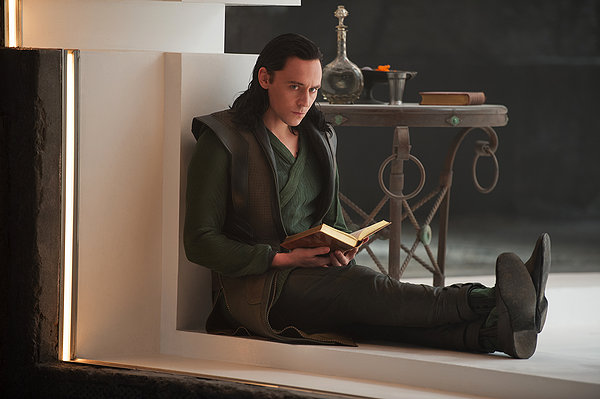 In a film dominated by a charismatic Loki, it’s no wonder that Thor 2’s real bad guy falls woefully short. Malekith is a confusing and altogether lackluster antagonist in every conceivable way. He has no personality to him; he’s simple-minded with the goal of eradicating the universe. I don’t know about you, but my bad guys better have a pretty good reason for destroying the universe since they kinda live there too. This is one of the lazier villain plot devices because it has no nuance, no shading. Apparently before there was a universe there were dark elves. I don’t want to get caught in a chicken-egg paradox here, but was there a universe before the universe, cause I look at the universe like existence’s garage. The cars inside may change but the garage was standing before it all. Anyway, Malekith wants to destroy all life because he wants to, because certainly you’d think there would be enough space in space. He’s not even that threatening or given any particular advantage beyond some firepower. It’s no wonder that Loki runs circles around this chump in the villain department. Eccleston (Unfinished Song) is not at fault. The heavy makeup he’s under smothers the actor’s ability to polish this terrible character.
The rest of the acting fares better. At this point, we know what we’re getting with Hemsworth (Snow White and the Huntsman) as the title character. He’s a sturdy leading man with just enough appeal to satisfy, though part of it is that Thor is just dull as a hero. He was more entertaining when he was cocky and irresponsible. Portman (Black Swan) holds her own though the romance between her and Thor feels more forced. Hopkins (Red 2) strikes the right mix between regal and camp. While their roles aren’t exactly integral, it’s nice having a superhero movie stuffed with great actors like Idris Elba, Ray Stevenson, Adewale Akinnuoye-Agbaje, Clive Russell, and there’s even an amusing appearance by Chris O’Dowd, who effortlessly oozes charm (take note, Thor).
This a superhero movie that separates itself by its sheer sense of fun. Thor: The Dark World takes what worked in the previous movie and provides more of it. The campy, silly Asgard stuff is given even more time, the mischievous sense of humor is renewed, the fantasy worlds given more depth and better action/effects, and fan favorite Loki gets a big starring role this time with extra brotherly bickering. It’s not the best superhero movie, nor is it the best Marvel film of recent years, but Thor 2 knows what kind of movie it wishes to be and how to best achieve this. It’s a loopy, droll, and rather imaginative big-budget superhero film, while still finding ways to be somewhat generic with its overall plotting and character turns. While the action is suitably epic, it’s the character interactions that are the most enjoyable aspect. It seems excessively lazy to say that if you enjoyed the first Thor, you’ll probably enjoy the second one as well, but there it is. Perhaps next time the storyline won’t be as convoluted and we can get even more Loki. Barring that, I’ll accept additional Chris O’Dowd screen time.
Nate’s Grade: B


You must be logged in to post a comment.