Blog Archives
Lightyear (2022)/ Luck (2022)
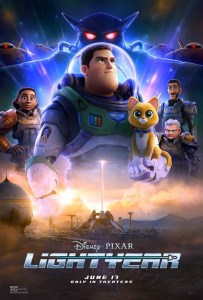 After two years and three movies sent straight to Disney’s burgeoning streaming service, Pixar returns with a theatrical movie that taps back to the very beginnings of this storied storytelling company. We’re told, via opening text, that Lightyear was Andy’s favorite movie and thus the reason he was so excited to bring home a Buzz Lightyear action figure in the first Toy Story. However, if this is Andy’s “favorite movie,” then this kid needs to be exposed to more movies. It’s an acceptable sci-fi story about Buzz (voiced by Chris Evans) learning the value of others and that being vulnerable is not the same as being weak. He’s a space ranger stranded on an alien world. Every time he attempts to restart their fuel system, it jumps him forward in time four years, and soon enough he’s a man out of time and those stranded have built a colony civilization over 100 years. There’s a band of misfits, who aren’t terribly funny, and some laser fights and action sequences, which aren’t terribly exciting, and the third act twist is predictable. The animation is top-notch, but the storytelling is definitely a few notches below infinity and beyond. What astounds me is that Andy could watch this movie and want a Buzz toy instead of the real breakout, the robotic cat Sox (voiced by Peter Sohn) who is wonderfully droll. I cannot fathom anyone watching this movie and desiring owning another character above this delightful supporting character. This movie makes me think a little less of Andy as a discerning arbiter of pop-culture zeitgeist. Lightyear is fine as escapist entertainment but too facile and inessential to the Toy Story universe.
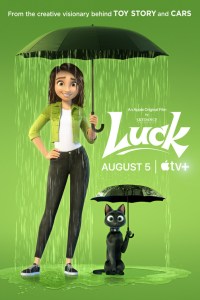 Luck is the first animated feature from Skydance, a production company that entered the animated realm by hiring former Pixar head John Lasseter as their chief creative executive. In some ways, Luck feels reminiscent of early Pixar movies, exploring the “secret life of” those in charge of dictating the forces of luck. The problem with Luck is that it is overwritten and overburdened with world building that crushes the emotional core. We follow a young woman aging out of the foster system and she’s been besieged with bad luck all her life. She follows a talking cat and discovers a hidden world where workers mine luck crystals and have lucky pennies as portal generators and there’s a dragon, for some reason, as the CEO of Good Luck, and to get back home she needs to team up with the cat to find a thing, but to find that thing they need to go to a place, but to go to that place they need to – and you get it. The plot is overworked with a chain of tasks that explain more of this world’s mechanics without connecting to the emotional journey of the character, like in 2015’s Inside Out. I was amazed that this woman lacks even a shred of bitterness about her own trenchant bad luck. There’s a nice message about accepting the bad with the good in life, and how both are opportunities for growth, but I kept wondering why our hero didn’t once lash out at those responsible. I’m also a little hesitant about using whether a little girl will be stood up by her potential new foster family as the stakes of completing the good luck reset goal. That seems pretty heavy for wackiness. The animation isn’t quite at the level of Pixar, or the best of Dreamworks, but it’s colorful and bright even if lacking more advanced lighting and texture. Luck lacks enough gravitas and development to really appeal to adults but it’s also probably too busy and convoluted to entertain small kids.
Nate’s Grades:
Lightyear: B-
Luck: C+
Share this:

Thor: Love and Thunder (2022)
 Thor: Love and Thunder reminds me a lot of Guardians of the Galaxy vol. 2, admittedly a film I’ve come more around on since my initial viewing in 2017. When Ragnarok was released later that same year, it was an irreverent blast, a breath of fresh air for a franchise that didn’t really know what to do with its hero, and under director Taika Waititi’s sensibility, the character had new, witty life. A similar response occurred with the original Guardians of the Galaxy as the world fell in love with the offbeat characters and storytelling and style from writer/director James Gunn. Before 2014, we didn’t know what to expect with a Guardians movie. When the sequel was released, we had a template of expectations, and the follow-up didn’t feel quite so fresh, quite so lively, and falling back on repeating too many of the same moments or jokes because it’s what was expected. It felt a bit burdened with the creative shackles of upholding these expectations. The same feeling of same-ness permeates Love and Thunder, and to be fair that’s also because the success of Ragnarok raised our expectations for a Waititi MCU movie.
Thor (Chris Hemsworth) is trying to find his way after the events of 2019’s Endgame. He’s gotten in shape, spent some time palling around with the Guardians of the Galaxy (returning in 2023!), and reconnected with the love of his life, Jane Foster (Natalie Portman). She’s been chosen by Thor’s old broken hammer to be its new wielder, granting her superhero status. Except in her human status, she’s dying from stage four cancer. Just as Jane comes back into his life, Thor might have to come to terms with losing her all over again.
 This movie just doesn’t feel like it has the same natural prankish energy of Ragnarok, though part of this again might be myself acclimating to Waititi as a filmmaker and storyteller. Prior to Ragnarok I had only known him for the delightful vampire mockumentary What We Do in the Shadows, and since Ragnarok Waititi has become his own industry, winning a screenwriting Oscar, lending his name and acting to hit TV shows, including a version of What We Do in the Shadows, and even Disney wants his mark on Star Wars. In short, the man is everywhere. In 2022, we now have a much better idea of what to expect from a typical Waititi project. Love and Thunder is recognizable to the man’s omnipresent brand, and still a fun movie with some solid gags, but it also feels a bit sloppy and repetitive.
I kept thinking about all the powerful dramatic potential in the different storylines that are barely explored because the driving plot is a universe-hopping caper to save a bunch of kidnapped children (yes, the children represent something, the next generation, renewal, legacy, but let’s carry on). Tackle the pathos of Jane Foster, who in her normal human state has her body betraying her. She feels weak and incapable of the greatness she feels burdened to still accomplish with her declining time. With the power of Thor, she becomes a superhero, and with super swole arms. However, this power trip also has its own ironic downside. Every time she powers up, the magic hammer is actually draining more of her life force, meaning she’s actually speeding up her terminal illness. Here is a character given a dire situation and an escape and yet that escape only worsens the illness. There’s such powerful drama there to explore as she comes to terms with how to spend her final moments, among them reconnecting with her super ex-boyfriend. This could have sufficed as the entire movie and told from her perspective.
Then there’s Gorr the God Butcher, gloriously played by Christian Bale like he’s in a James Wan horror movie. Here is another example where the villain doesn’t just have a sympathetic back-story but where they are correct in their aims, though maybe not in their methods (think Killmonger arguing Wakanda should do more). Gorr is tired of the gods crushing the little guy with their general entitlement, indifference, and selfishness. These fancy deities aren’t worthy of worship. The power structure needs upending. It’s easy to get behind Gorr’s plight and see connections to our own imbalanced world. This too could have sufficed as the entire movie and told from his perspective. Now, things could have gotten even more interesting and complicated for Jane, because she’s not officially a god unless she’s yielding Thor’s hammer and joins those rarefied ranks. It would pose another question of whether wielding this power would be worth her remaining time, especially with a heat-seeking missile coming for her on a righteous quest of vengeance that is slowly eating him alive. Both are dying but can they fulfill their goals?
 If these storylines had been given careful development and the necessary time to breathe, Love and Thunder could have been one of the most interesting movies in the ever-expanding MCU cannon. Instead, it’s galloping to work so hard to stick to the Waititi brand expectations, to reignite our feelings of Ragnarok, and so these promising elements ultimately get shortchanged by hit-or-miss comedy bits. I liked several of them even despite myself. The set piece where Thor and Jane and friends travel to Omnipotence City has such imaginative heights. Russell Crowe is having a grand time as a hilarious Greek caricature of Zeus that is more concerned about the upcoming company orgy and brushing feta crumbles from his beard. I loved the almost Lego Movie-esque zany sight gags of the cohabitation of gods from different religions (Korg’s god sits on an iron throne of scissors, its own visual joke). It’s such a fascinating concept that I wish we could have spent even more time here. Let’s see the Egyptian gods mingling with the Sumerian gods while pranking some weird alien deity. The set piece serves two narrative purposes: gathering a powerful magic weapon, and learning the gods are sitting out the battle with Gorr for their own short-sighted self-preservation. It’s mostly a pit stop. Again, there was more pathos that could have been explored here as people meet gods, but this is my cross to bear. The general banter is amusing and has more hits than misses even if the hit percentage is lower. I laughed every time the magic axe would silently pop onscreen in jealous judgement. I even enjoyed the screaming goats even though from their first moment they are the exact same joke. Regardless, whenever Thor and company would travel to a new place and I heard that familiar goat scream, it would make me giggle despite my reservations.
I also had my qualms with the concept of Eternity, a magical place located at the center of the universe but destined to grant a wish to whomever gets there first. It’s too transparent as a plot device and its very existence this far into the MCU creates too many nagging questions. In the history of the universe, no other creature successfully reached this wish-granting locale? And if this existed at least to Thor’s understanding, then why didn’t the characters think about this as an option to thwart Thanos and his universe-halving finger snap? I know the answer, because it wasn’t written into a movie until now, but this is the drawback of throwing ultimate power plot devices without more careful context. Eternity could have been a secret just to the inner circle of the famous gods, unknown to all but a few, but even that strains some credulity. If Zeus is such a carousing hedonist of legendary status, I’m sure he would have either blabber-mouthed its existence or sought it ought for his own gain. I genuinely liked the set piece at Eternity, a small planet that sucks all color from existence, making the imagery even more striking like the inky panels of a comic. The same question happens when Thor shares his power late in the movie. Couldn’t the Avengers have used this too?
I fully acknowledge that my criticisms are butting against the movie Waititi wanted to tell. I’m pushing for its inherent dramatic potential while it wants to be a more comic and romantic adventure about the power of love. I think by the end it gets there, and the dramatic confrontations have some emotional weight to them, especially about the idea of what we leave behind for others after we’re gone. Although, even this is mitigated by the general stakes-lowering reality that death never seems so permanent in the world of comics and monetarily useful IP. It’s a joke how many times Loki has been brought back from the dead and Thor doesn’t even know that his trickster brother has been brought back from the dead again (again again). We’ve now established time travel and an emphasis on the multiverse of alternate universes, which means at a moment’s notice, any meaningful death or sacrifice has the possibility of being undone. This is also the reality of a moneymaking machine that has dominated the movies and pop-culture landscape for 14 years. No death is ever going to be for real in this environment so why should I put so much emphasis on the dramatic potential of what losing a loved one, or your sense of self, can have? I can sit back and enjoy the lesser, but still enjoyable, Waititi quirk on display for two hours of silly.
 Hemsworth (Spiderhead) is so sharply skilled at comedy that I feign to remember his previous existence as a dramatic actor. He’s still on the same sublime, charismatic yet blithely self-effacing vibe he was with Ragnarok. Portman (Annihilation) comes back after close to a decade for a clear reason to leave her mark on what had been an otherwise forgettable character and giving her a renewed sense of power and direction and agency. Bale (Ford v. Ferrari), as mentioned, is fantastic. I appreciate that his character isn’t physically huge and bulky. He looks quite the opposite, like he’s wasting away, like somebody slathered an ashy coat of paint from living-skeleton Bale after The Machinist (yes, also the obvious Voldermort comparison). He is relishing every teeth-stained syllable as a nightmare creature living from the shadows. The prologue with his character is heartbreaking and yet understated (and truth be told, having young children in my household, it hit me more personally), and I turned to my fiancé and said, “I’m supposed to not like this guy?” I wish the opening credits were then a montage of Gorr seeking and slaying wicked gods. Bale is playing his role like he’s definitely not in a Waititi movie about goofy screaming goats; he’s playing Gorr like a tragic hero of myth. This is why I would have been happy had the whole movie been told from his perspective. The new characters from Ragnarok suffer the most and become sidelined as “Others Along on the Quest.” For Korg, this is fine, but for Tessa Thompson’s Valkyrie, I mourn her absence. Also, both characters are definitively queer now, though Korg might be more a question, making Love and Thunder the gayest movie in the MCU, and just after Pride Month, so take that for what you will, folks.
As a fun matinee, Love and Thunder will amuse and brighten, even if its comedy highs don’t quite hit as high this time under the burden of franchise expectations. Love and Thunder is a movie that will be best known for Portman and Bale, both of whom elevate the scattershot material with their dedication and professionalism. It might even be known for Crowe’s hammy scene-stealing, or the super-powered cadre of cute kiddos, or even the screaming goats. It’s a movie more of moments and ideas, too many underdeveloped or lacking the gravitas they deserve, especially concerning Jane and Gorr. I feel like a grump bemoaning that the big superhero movie should have more time spent on a woman contemplating her own existential demise as well as man’s relationship and fealty to our gods. Still, it’s Waititi doing his signature brand of quirk with $200 million of house money from Disney. Thor: Love and Thunder is a lesson in diminished returns but when you have Ragnarok as your starting point, it’s at least guaranteed to still be worth your two hours once and deliver some chuckles and smiles.
Nate’s Grade: B-
Share this:

Jurassic World: Dominion (2022)
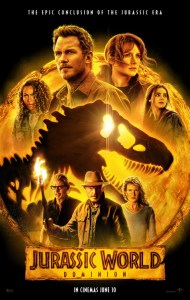 Jurassic World: Dominion has received, by far, the worst reviews and reception of the six-film franchise that has taught us the valuable life lesson that dinosaurs will eat people. Director Colin Trevorrow (Jurassic World) is back though he remained a screenwriter for the entire World trilogy along with Derek Connolly (Safety Not Guaranteed). It’s also bringing the band back together by including Sam Neill, Laura Dern, and Jeff Goldblum as their beloved original trilogy characters (there’s also B.D. Wong, again, if that does anything for ya). I’ve delayed seeing the movie because of my own sense of caution and resignation. Is it as bad as feared?
It’s years after dinosaurs have become reintegrated into the human world. Owen (Chris Pratt) and Claire (Bryce Dallas Howard) are living out West together with the clone girl from 2018’s Fallen Kingdom. He’s lassoing wild dinos and she’s breaking them out of illegal testing sites. The BioSyn CEO (modeled after Apple’s Tim Cook, here played by Campbell Scott) has big plans for… world domination? It’s actually unclear besides general profit. The evil businessman hires kidnappers to abscond with the little clone girl, the baby dinosaur to Blue, America’s favorite family-friendly raptor, and for good measure, he’s also unleashing swarms of killer locusts. Owen and Claire are hopping the world to find their missing family (Owen promises the raptor he will return her baby) and uncover yet another evil scheme from an evil rich person.
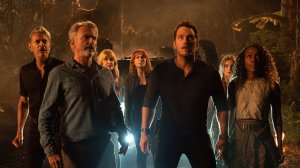 There is a lot going on with Jurassic World: Dominion and yet so little is happening, at least from an intellectual standpoint. This feels like three different movies inartly slammed together and it is overstuffed with subplots all competing for screen time, so every few minutes feels like a possible off-ramp for another episode of what the opening concept portends. The concept of a world where humans are forced to co-exist with dinosaurs is a genuinely exciting starting point, and it’s a Jurassic movie I would want to see, and I do… for a montage to open and close the movie. It’s a shame that the most interesting part of this movie, the global acclimation of creatures of an older millennium rejoining our ecosystem, is kept as literal background. I suppose by the end nature just took care of itself. Instead, the majority of the movie is split between two less engaging stories: giant locusts and a rich guy’s private dino enclosure. Yes, dear reader, you read that correctly. After five movies of dinosaurs in parks, where we begin with dinosaurs in the real world, it’s back to spending time in another glorified dino park, and would you believe that something goes wrong at this park too? Why even bother setting up an exciting premise if it’s abandoned so completely? The movie we do get is a lesson in diminished returns and accepting disappointment. This feels more like a giant locust movie for half, about a villainous corporation weaponizing genetically modified plagues to kill their competitors’ stock. It’s certainly something that seems plausible for a massive corporation, but what is this doing in my Jurassic World movie? Why did we need another blankly evil CEO, this time the guy who appeared in one scene in Jurassic Park, as if that mattered? Why do we need more extraneous characters taking away oxygen from the legacy characters returning especially when they seem too similar to the already established characters? Why should I care about three dinosaurs fighting at the end like I’m personally invested in any of these creatures? My sadness manifested watching this franchise descend into even more farcical dumb blockbuster nonsense.
The best part of this movie might actually be its most ridiculous. There’s a mid-movie set piece where our heroes infiltrate an underground dinosaur fighting ring in Malta. That’s cool, and we’re introduced into new secondary villains we can enjoy get their just desserts once the dinosaurs inevitably get set loose. The lead trafficking lady says the raptors have been trained to kill anything that she shines a laser pointer on, which was also introduced in the last film. She targets Claire and then it becomes a foot chase between Claire and a determined raptor. It’s a silly excuse for a chase but it has an extra sense of urgency. It’s also completely ridiculous and ridiculously fun. Claire transforms immediately into Jason Bourne and is leaping from rooftop to rooftop and crashing through windows. Owen is riding a motorcycle through the narrow streets while being chased himself. It’s all action movie pablum and it works for what it is in the moment. Treverrow’s action set pieces have some moments that pop, especially Claire cautiously slipping into a pond to escape a supposedly blind dinosaur. There are even dinosaurs with feathers now. Alas, the movie can only work as dumb fun for so long before it just becomes infinitely more of the latter.
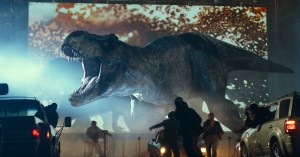 There are so many moments on repeat here that Dominion feels like it’s stitched together like another genetically modified dinosaur clumsily patched with parts of the franchise’s past. Oh, and you better believe we’re going three movies in a row with a new genetically-modified super monster to better sell toys (at least this one isn’t stated as being part raptor). The appeal of this movie, besides the concept abandoned above that I mentioned, is the old characters coming back together, even though Goldblum and Neill each headlined a Jurassic sequel. This action is also a tacit condemnation of the investment in the new trilogy’s main characters. I doubt anyone is going to say, “Wait, Owen Grady and Claire Dearing are back for another movie? Count me in.” I bet most people didn’t even remember either of their names. But if we’re bringing back important characters of franchise past, let’s give them something important to do. They get into danger and scrapes but it’s also always with a wink and a nod that is grating. Goldblum gets to wave his arms around to distract like he did in Jurassic Park. Dern gets to cuddle a triceratops like she did in Jurassic Park. Even Neill features in a dangerous teetering automobile like he did in Jurassic Park. The contrivances to get them all in the movie were already there, but then you give them little to do other than go through the motions of their past (I will always demand more Goldblum time). There are certain dinosaurs reappearing to hit that nostalgia button. It’s the poison-spewing dinos, the ones that blinded and killed Nedry (Wayne Knight), and they’re back, except they can also have their mouth grabbed shut in the most unintentionally hilarious moment. Why even bring back an evil CEO barely mentioned in 1993? Do we need that strained connection for a role recast because the original actor is in jail for assaulting a minor? It’s an excellent example of losing track of the appeal of nostalgia by metric volume.
As far as I’m concerned, that little clone girl, a.k.a. Maisie (Isabella Sermon), is responsible for all the pain and suffering in the world because of deadly dinosaurs. At the end of Fallen Kingdom, this little kid single-handedly rescues the dinosaurs from extinction because, as she said, “They’re alive, like me.” I guess her reasoning is they weren’t supposed to exist, but they do, so we should value life. The problem with that occurs when that creature also happens to be a predator. I would have loved Dominion to explain why Maisie is living in an isolated cabin is because she’s the world’s most wanted person, as mobs of victims blame her for their loved ones dying at the hands, feet, and claws of dinosaur mayhem. The world is in chaos because of this little kid’s rash decision. This cloned girl storyline was the worst part of Fallen Kingdom and now she gets to be the worst part of Dominion as well. Her entire presence is once again as a plot device. I guess she served a purpose as her realization over her identity lead to her decision to save the poor dinosaurs, but here she’s a literal savior cure with legs. Apparently, the reason why the big bad corporation kidnaps her, along with baby Blue, is because her DNA is the key to eradicating genetic disorders. Fortunately, you only need some blood or saliva for a DNA sample and kidnapping seems like overkill. You could have just asked her nicely for a sample, fellas.

Why would this gesture work on other dinosaurs?
However, the dumbest aspect of this requires some sticky spoilers discussion, so you have been warned. Maisie was the grandchild of Benjamin Lockwood (James Cromwell), a retcon character to elbow in another rich co-founder of Jurassic Park that we just never heard about until the fifth movie. Except she was really his daughter but as a clone. Well now we get even more retconning because Maisie’s mom, herself, gave birth to her… self. The adult Maisie impregnated herself with her own clone (because this was the easiest way to have a child?) but she’s also genetically modified her DNA to exclude a terminal disorder killing the adult Maisie. If adult Maisie wanted to save others from having her genetic disorder, why not publicize this valuable information? Why not tell her colleagues? Why leave her clone as the lone evidence? This new info makes me kind of hate the adult Maisie. She brought her clone into the world and made her a target. This seems cruel and unnecessary. It also doesn’t make sense for a person supposedly valuing life or the larger scientific community or even her own child. I’ll say it: she’s a bad mom.
The wild swings and retcons reminded me of what happened with the newer Star Wars trilogy. In 2015, both The Force Awakens and Jurassic World are released to massive success and kickoff reboots of their respective franchises. Both of the movies purposely leaned onto nostalgia for their originals, even repeating similar plot beats and reminders to trigger positive association. Then both directors, J.J. Abrams and Treverrow, left the franchise and the second movies, 2017’s The Last Jedi and Fallen Kingdom, took big swings, tried to be something different from the mold, and were met with divisive responses from the larger fanbase. I appreciate both of these movies attempting to do something different with something so entrenched in formula. Then for the concluding movie, both franchises had the original director return to essentially retcon the retcons, to bring the movies back to what was familiar and ultimately dull. It’s even more interesting when you take into account that Treverrow left the Jurassic series to spend a year of his life developing Episode 9 before being fired and hastily replaced with Abrams.
 I remember the meta-commentary in Jurassic World about modern audiences becoming jaded and complacent to scientific wonders mirroring movie audiences becoming blasé to what used to marvel us in the realm of special effects extravaganzas. As it leaned into its considerable nostalgia, it was doing so in a thinly veiled satirical criticism of, “Is this what you want?” Now all the meta-commentary and irony have been stripped clean and it’s simply a big, dumb, lumbering beast awaiting its own creative extinction as it meets an end. The franchise is still a colossal moneymaker and Dominion has a chance of topping one billion in box-office, so there will be more adventures cannibalizing the past for inevitably diminished returns, and then we’ll get the special reappearances of, like, Jake Johnson’s character or Guy at Computer #4 to the celebration of few if any. None of the Jurassic movies have ever come close to capturing that certain magic from the first movie but they have all been, in some way, serviceably entertaining even at their worst. Dominion is the worst of the franchise and feels devoid of passion and awe and curiosity. To paraphrase a clever man, the studio execs were too busy thinking about whether they could and less busy worrying about whether they should. I guess you could shut off your brain and possibly enjoy it but that’s admitting defeat. Jurassic World: Dominion makes dinosaurs dull and that’s a disservice of imagination.
Nate’s Grade: D+
Share this:

Spiderhead (2022)
 Before writing this film review I sat down and read George Sanders’ short story “Escape from Spiderhead,” published by The New Yorker in 2010 and available to be read here. It would probably a better use of your time than watching the Netflix movie adaptation, and it surely won’t take 90 minutes, though that’s an assumption on my part. The story follows Jeff (Miles Teller), a prisoner who is undergoing experimental drug trials for a lighter sentence. Chris Hemsworth is miscast as the sunny, smarmy head of the drug trials, mostly featuring a drug that induces extreme feelings of desire and love and attachment. The movie is simply too predictable once you acknowledge the plot elements of secret drug trials and tests of loyalty and emotions. You’ll likely foresee the movie’s big reveals far before the screenplay by Rhett Reese and Paul Wernick (Deadpool, 6 Underground) reaches the obvious ploys for twists to turn Sanders’ more introspective, nuanced, and psychological story into a rah-rah formula sci-fi action movie. The first act is relatively promising and close to its source material, but the intriguing and philosophical questions about human connections, guilt, compliance, free will, and corporate hegemony are brushed aside for a silly series of action scenes, brawls, and big escapes. Mostly, I found Spiderhead to be dull because it was too predictable and because it didn’t have much more to say than any over-extended Black Mirror episode. It’s a passable sci-fi allegory that’s light on allegory and settles for being another anesthetizing streaming byproduct.
Nate’s Grade: C
Share this:

Crimes of the Future (2022)
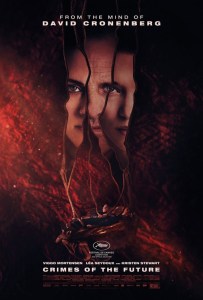 David Cronenberg returns to the thing David Cronenberg is best known for. It’s been twenty-plus years since the director has gone back to his body horror roots, and Crimes of the Future is certainly a gross gross movie. If that’s what you’re hoping for, then the discomfort and bizarre sexual analogies might be a selling point for you. For me, I just felt nauseated without an interesting core to keep my mind from drifting away. In the future, people have evolved (?) pain tolerance and infection rates, so our protagonist Saul (Viggo Mortsensen) turns surgery into public performance as his assistant/lover (Lea Seydoux) removes the vestigial organs his body produces. Kirsten Stewart’s antsy, horny character states that “surgery is the new sex,” and you’ll get plenty of parallels as we watch person after person get all squirmy while being cut open. My problem with the movie is that there isn’t anything beyond the shock value. The commentarry about body experimentation as a form of sensuality feels trite and more an opening for weird moments, like when Saul gets a zipper installed across his pelvis and his assistant decides to open it and somehow pleasure this… pouch? There’s a hint of an interesting movie here. Saul is being asked to serve as a confidential informant for the government hunting down an extremist group trying to kick-start evolution so that children will be able to consume plastics. That would have put our main character into a discovery role for this world that would have provided more than shock value. The movie begins, literally, with a child being suffocated by his mother, so that sets the tone as to where Cronenberg is headed. Crimes of the Future is essentially a geek show of a movie absent meaningful social/sexual commentary and interesting characters. It’s more a movie of pliable body parts.
Nate’s Grade: C
Share this:

Terror Trips (2022)/ Isolated (2022)
 Two new Ohio-made indie films have just become available for rental or purchase both on DVD and digital streaming, and I’m here with reviews of both. Terror Trips is written and directed by Jeff Seeman (Elly) and even won the award for Best Ohio Film at the prestigious genre fest, the 2021 Nightmares Film Festival. Then there’s Isolated, directed by Tyler Lee Allen and written by Michael Ferree (Poor Baby), a single-location contained thriller mystery. Both movies have their merits and both movies have their faults when it comes to developing a satisfying story.
I genuinely like the initial premise of Terror Trips. Six friends from Cincinnati start a business where they host tours and overnight stays at various famous horror locations for horror fans. They talk about Camp Crystal Lake, the Burkittsville, Maryland woods, and Monroeville, Pennsylvania mall as some possible destinations. Granted, plenty of horror movies take place in fictional locales (Haddonfield, Illinois) but this seems like a fun business idea. Go to the site, mingle with other horror diehards, and then watch the movie at the famous location. We get a taste of this with a somewhat meta montage, and then the movie transitions to its own fictional movie, a 1970s Polish flick (Black Volga) about a child abductor terrorizing a small town. The gang is disturbed by the realistic quality of the grindhouse film but also eager to travel to Poland (still only scenic Ohio) to scout it as a possible travel destination for their clientele. While there, they become victims of a KGB organ harvesting plot, which was not the direction I was anticipating with the first act. However, there was still possibility here. There are three places that can be emphasized with this direction: 1) characterization, 2) suspense, and 3) commentary. Let’s go route by route and see how Terror Trips performs.
 It should be of little surprise that the characters in Terror Trips are inherently disposable. Horror is a genre that can get away with stock characterizations more than most, especially if there’s an added subversion or commentary to those stock roles. We have about six main characters, which is a good number to lead to plenty of death sequences. We know going into most horror movies that the character count is higher because it provides more people to then bump off. However, the group of six friends are so unremarkable from one another that you could rename them, consolidate them, or even remove them, and you would have little bearing on the plot. They’re six versions of the same character. They’re all horror nerds and that’s about it. I’ll credit the filmmakers for making them all very visually distinctive to tell apart, but the same kind of effort wasn’t given to what they were saying or how they were acting. For horror nerds, they don’t seem to recognize too many of the tropes to avoid. I wish at least one of the characters resembled the hyper-literate teens from the Scream franchise and could diagnose threats and options with encyclopedic vigor. What is the point of making them experts if they don’t use this expertise? I did like one character note; there’s a couple who engage in arguments, and before they walk away, or walk into what seems like certain danger, they say, “I love you” as a call and response. It’s funny that even under extreme circumstances, or moments of aggravation, they will utter their “love you”’s. I got to thinking about a deeper rationale for this, like characters who know they’re about to enter a definite horror no-no, and they don’t know if they’ll ever have the chance to say one final “I love you,” so they make a point to do so before any risky action. Perhaps I’ve imbued more depth in my analysis than these characters justify. I wish these characters were more interesting to remotely care whether they lived or died (more on that later).
So, if the characters aren’t going to entertain us or make us emotionally invested, then one other viable option is to essentially view them as sacrificial offerings and come up with some well and truly deranged manners of demise. This is another area where Terror Trips lacks development. Even abandoning the horror movie iconography and running with the organ trafficking goons, there is still plenty that could have been done. I wasn’t expecting the movie to so definitively go the Hostel route, but I was more surprised to get more scenes of Russian characters conversing about the dull details of their evil schemes than from the survival scenarios. If you want to be Hostel, with our characters placed on a slab to be carved up, then you better differentiate the killing. There’s one character who is running down the middle of an empty road (these people don’t really value stealth) and this character is pounced upon. They have their Achille’s tendons purposely sliced (Hostel nod?) and are dragged away still alive. Now, if you included this development, you’d want to also include a sequence where this character tries to escape, hampered by their injury cutting down on mobility, which would nicely build further suspense. Alas, none of that happens. This character might as well have been tackled and that’s it. A heavy torture angle is pretty budget conscious for a production, allowing devious creativity and twisted suspense, while possibly leaving much to the viewer’s imagination. I know we’ve moved away from the torture porn era of the mid 2000s, but if that’s your chosen playing field, you might as well make use of what it has to offer as far as discomfort. I’m shocked that there isn’t even one drawn out sequence of torture in Terror Trips at all. Maybe that’s a sign of restraint but I see it as more of failure to capitalize on its suspense possibility. There are no memorable dispatches or shocking deaths or well-developed suspense sequences. If you’re going to stick the audience with boring, interchangeable characters, at least make their troubles and terror entertaining.
 So, that brings us to the third and final area for creative nourishment, the hardest one of them all, and Terror Trips doesn’t seem that interested in any form of social commentary. There was potential on a few storytelling fronts. The movie could have satirized the ugly American attitudes and general ignorance of its main characters as they travel to rural Poland. You could turn their general ignorance into dark comedy and it would also provide welcomed characterization. You could also have opened up the world of these locals more, showing the great economic hardships and pressures they are under to do what they have to do to survive. At least 2005’s otherwise forgettable Turistas (remember? It had Josh Duhamel and Olivia Wilde) had an organ harvesting plot where they made some stab at social commentary. In that film, they were taking the rich gringo organs and providing them to the poor and needy in Brazil, those who would never rise to the top of a transplant list in their lifetime. With Terror Trips, it falls into the xenophobic tropes that drew similar critiques from Hostel but without attempted commentary to smooth the portrayals over for added meaning. Once the movie reveals that every person in this town is in on the conspiracy, it makes every non-American seem duplicitous and untrustworthy. Again, if that’s the direction you want to go, then own it and really embrace it, but Terror Trips feels so indifferent to its villains. They could just as easily be any group doing any nefarious scheme. The scheme is just KGB goons doing bad things because they’re bad. There’s an exciting possibility here about “underground horror” blending fact and fiction, exploiting real people’s pain, turning sites of trauma into tourist destinations, whether it’s critiquing an audience or capitalism. Unfortunately, there’s not a whole lot intellectually going on with Terror Trips.
 I wanted to highlight the ending, and in doing so will deal with spoilers, so you have been warned, dear reader. We spend the last 15 minutes or so following Ginny (Hannah Fierman) as she successfully calls for the police. Too bad that they too are in on it, and she apparently goes to sleep in the back of their car and allows the officer to carry her, like a child, into the creepy car from the horror movie-within-a-movie. There she’s also with one of her friends, the one who had their Achille’s tendons sliced. They commiserate and try to escape from the backseat (there’s a wall dividing the front and back seat like a cab). Then Ginny’s friend implores her to basically mercy kill them, and Ginny must go through her arguments of survival before realizing after everything they’ve been through that this might be a choice not presented later. Through tears, she slices her friend’s wrist, holds their hand, and watches as the life ebbs away – AND THEN THE MOVIE ENDS! “What?!” I spat at my screen. You have the Final Girl, or at least the supposed Final Girl, and you end things like this? It’s like the filmmakers ran out of time to make a climax. This is where the underwritten characters become an anchor. The movie cannot pull off this drama, especially as shaped as the film’s climax, because we haven’t invested in these people and their personal relationship. The work wasn’t set up for this as a big emotional payoff.
From a technical standpoint, Terror Trips is ably filmed. The visual compositions and acting are competent to good. I liked Abigail Esmena (They/Them/Us) as George and Fierman (V/H/S). They were both able to make positive impressions over the blandness of their characters. The Russian actors were authentic. Kate Kiddo (great name) was also memorable as the Polish intermediary for the tourists. The editing is a little overly jumpy for the first thirty minutes, like it needs to cut to a new shot for every sentence spoken, but it eventually settles down. The gore effects are few but serviceable and bloody. My biggest compliment is the sound design. For a movie spending a far majority outside, the sound quality here is shockingly good. I’m so used to sound being one of the most flagrant issues in low-budget indies, but here it’s an asset.
 With Isolated (formerly titled O9en Up), we have a contained thriller, which means much will hinge upon the chain of discovery for survival or enlightenment. There’s no shortage of people-stuck-in-mysterious-room movies. It makes sense from a production standpoint. It’s cheap. I remember one movie I saw on Netflix where it was like 50 people standing at game show podiums and they had to vote one person to die every so many minutes or else one person would randomly die. There’s two dozen Twilight Zone episodes about characters trying to make sense of a mysterious place they’re stuck in. It’s also featured in just about any Saw movie. It’s an immediate mystery that can work wonders. The trick is to either string the cause-effect plot elements so that we are learning and building off that knowledge along with the protagonist or connect the clues as to what or why their encasement means for them. I enjoy survival thrillers. I included Buried on my Top Ten for 2010 and that movie is one hundred percent Ryan Reynolds inside one cramped coffin. The problem with Isolated is that the mystery doesn’t feel that intriguing after about 30 minutes. The room itself looks like it should have more mystery to it, with a countdown and a giant nine painted on the wall. There’s a skylight with a latch just out of reach. Our main character, Nell (KateLynn Newberry), is even given her phone, which plays a song on the regular that seems too specific to be of little insight. But what does the movie actually do with its time and mystery?
At 99 minutes, you might find yourself getting a little antsy for the next reveal or clue to maintain an interest. I’m surprised the movie keeps its protagonist as such a blank. Nell seems resourceful, determined, and nursing some kind of personal pain or regret, but why is she here? Because we’re not given anything direct, your mind may likely anticipate that a major twist is in store by the end, and lo it happens (I don’t think the end explains the many hoops). I think the location just isn’t that intriguing enough to sustain the central mystery, and because we’re given few insights into this character we’re sharing a cell with for a whole movie, it made me feel restless. After Act One, Nell is given a cellmate, so to speak, on the other side of her wall, Travis (Lanny Joon), and the movie becomes a two-hander, though the perfunctory dialogue exchanges sound like the screenplay is filling time. It reminded me of 12 Monkeys when Bruce Willis’ character, a convict from the future sent back in time and doubting his sanity, hears a raspy voice on the other side of his wall who seems to know his dilemma. It becomes a playful and antagonistic exchange, and Willis doesn’t know if there is someone on the other side of the wall or if it’s all in his deteriorating mind. With Isolated, if Travis is meant to be our lifeline, it’s not enough. Now in a confounding location we have a confounding character, and rather than add layers to the mystery and our understanding, it just feels like vague on top of vague in service of stretching out a running time to feature length. I don’t think the twist earns the time spent, nor are the implications handled in a manner that feels satisfying or worthy. The ending reminded me of Old where for the final ten minutes M. Night Shyamalan basically says, “Okay, I’m just going to tell you everything explicitly now. Hope it’s been worth it. It hasn’t? Oh. Oh, okay then. Well, anyway…”
 As a low-budget thriller, Isolated has some nice technical merits to praise. The cinematography by Greg Kraus (The Curse of Lilith Ratchet) is very good with more than a few shots that made me nod in appreciation, like an attached camera angle to Nell running in a panic. The editing, also by Kraus, is solid and nicely integrated with the visuals. I liked the quick cut montages of awful flashbacks forcing their way inside Nell’s mind. There are some neat visual tricks here for a low-budget film. The brooding musical score by TJ Wilkins (Knifecorp) does a lot of heavy lifting for the story.
For both films, there is a difficulty in following through with the story direction each chooses. With Terror Trips, it’s a horror movie that abandons its premise early to become a bland organ harvesting thriller with characters that are too indistinct and personality-free to care and with suspense sequences that are brief or underdeveloped. With Isolated, I went a little stir crazy from waiting for enough vital components to keep my attention and intrigue. The main character is simply not that interesting of a character to share 90 minutes with. Each movie feels padded out and undernourished where it counts with its storytelling, failing to capitalize on the promise of its plot elements. Horror and mystery fans might find enough to satiate their genre needs. Both of the movies have technical merits and agreeable acting, but it’s the story and, even more specifically, the development of its characters and suspense or mystery scenarios, where they do eventually stumble.
Grades:
Terror Trips: C-
Isolated: C
Share this:

Dual (2022)
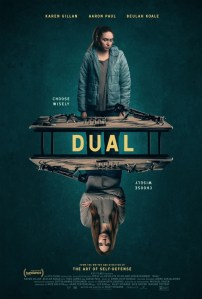 Imagine a world where anyone can create a clone, a perfect, or almost perfect, copy of yourself so that after you’re gone your family will never have to theoretically lose you? That’s the premise of Dual, an indie that played at the 2022 Sundance film festival and is now available online. Sarah (Karen Gillan) is generally miserable with her life. She doesn’t return her needy mother’s phone calls and texts. She’d rather watch porn than talk with her distant boyfriend. She’s also leaving disconcerting blood stains on her bed sheets. Turns out Sarah has a rare and incurable illness, and so she is eligible for the Replacement Program, an opportunity to get her own clone. She is gifted a clone (also Gillan), a reported exact replica except for eye color (the company offers a five percent discount for the defect). Sarah takes her doppelganger home and attempts to teach her about her life and how best to fit in. It’s not long that the Sarah clone has her own ideas about what her life could be. However, when Sarah’s terminal diagnosis improves, she intends to abort her clone. The clone triggers a legal clause that says that the ultimate decision over who gets to live as the only Sarah will be a televised duel to the death in exactly one year’s time.
Dual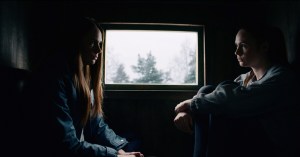 is a puzzling movie. I haven’t watched writer/director Riley Stearn’s other movies, notably 2019’s The Art of Self Defense, though I’ve read Dual is in keeping with his exaggerated, deadpan style, but to me it feels very much like an attempt to recreate a Yorgos Lanthimos world. Lanthimos is most famous for films like The Lobster and was even nominated for Best Director for 2018’s The Favourite. Lanthimos is excellent as creating these worlds that are reflections of our own but detached, deadpan, aloof, and irregular. The world of The Lobster is bizarre as a means of satirizing our social values when it comes to romantic relationships. In that world, if you cannot find a suitable mate within a period of probation, you will be transformed into an animal of your choosing. That world is bizarre in its very inception but there’s a reason that Lanthimos makes use of his stilted, stylized dialogue, to better reflect the absurdities of our culture. With Dual, the world never feels that wholly separate from our own and actually a little under-explored. The fact that society has cloning is woefully underutilized. What else does this mean about our concept of self, identity, legacy? What about clones that abandon their intended families? What about clones that murder their originals before their court-arranged duels? What about people that cheat the system and get more than one clone? What about a clone getting a clone? As the movie progressed, I kept feeling the unmistakable pull of wanting this story to be told straight and without the hip ironic posturing (I suppose that’s Swan Song, a 2021 movie I have yet to watch on Apple Plus). It just felt like there was so much more intriguing dramatic potential to be had here playing things straight, a woman facing her impending mortality, getting a “replacement you” and finding her not sticking to the script, endangering her fragile sense of preservation, and then the crisis of your friends and family preferring the clone over her. That’s some juicy stuff, but it all gets downplayed thanks to Stearn’s selected tone.
It would be one thing if Dual was hilarious with its cracked mirror approach but I just found little to actually laugh about. There are a few moments that I did chuckle, like Sarah and Trent (Aaron Paul) providing a play-by-play of their slow-motion brawl and the consequences of their amassed injuries, and the doctor that informs Sarah about her tragic diagnosis are the most well realized moments with tone (“This is why most doctors are depressed”). The bone dry, matter-of-fact style of speaking is too often the only joke. Just because characters are speaking in a detached manner does not mean you can skip over the same tenets of comedy construction. Lanthimos doesn’t just rest on his characters talking in a manner that is unexpected. There’s genuine work to make them seem of their weird world. The characters in Dual just seem like hyperactive, overly literal irritants. Often, they’ll just keep speaking about a subject and the joke is the length of the details. The Sarah duplicate doesn’t know how to drive, and as she watches her original, she remarks, “Oh, and I suppose you turn the big wheel left and the car goes left. Turn the big wheel right and the car goes right. Easy enough.” I suppose the joke is that she describes two pointless examples? Even the scenes with the doctor, which I laughed at, suffer from Stearns overwriting his dialogue exchanges. It’s not enough for the doctor to make an absurd, Kafkaesque remark, but the character must circle back and underline this over and over. The overall feeling is tiresome. There’s one example of what Dual could have been, where Trent suggests to Sarah during her money problems that she might provide “other means of payment.” The movie then cuts to them both dancing and Trent remarks, “Thank you for the hip-hop dance instruction. I’ve always wanted to learn but was too nervous.” That joke works. It’s a subversion that doesn’t overstay. I wish Stearns had pulled back and trusted his audience to get the joke without his incessant redirection of comic emphasis.
 The real reason to watch Dual is for the dueling Gillan performances. She gets to play two same-but-different versions of a character, and she really shines in the subtle differences she takes advantage of. I enjoyed the passive aggression of the clone re-examining the faults of her original, and I enjoyed how quickly she was interrogating her original while making casual, catty judgements. Paul (Breaking Bad) is also enjoyable but only appears in the second half of the movie and is underutilized. Stearns seems drawn to the mentor-pupil relationship dynamic (The Art of Self Defense) and the interaction between Paul and Gillan is a regular highlight of the movie. The actors generally elevate the material even as Stearns restricts the acting tools they can rely upon.
I’m sure there will be viewers that will genuinely enjoy the distaff comedy and pathos of Dual. There’s a clear artistic vision here by Stearns, it just didn’t fully gel for me because I felt the choices of tone and plot limited what could have been a far more emotionally engaging and intellectually fascinating story. The comedy too often settled on being quirky and too often it reminded you of this by circling and re-circling the same joke for diminished returns. Dual is not a bad movie, more a frustrating experience, one with big ideas and talent in front of the camera and behind, but it could have used more shaping and tone calibration to be its best version of itself. As it stands, it’s a fittingly amusing dark comedy with two solid performances from Gillan, and that could be enough for many to justify a 90-minute investment. For me, it felt too much like Lanthimos lite.
Nate’s Grade: C+
Share this:

Star Wars: Attack of the Clones (2002) [Review Re-View]

Originally released May 16, 2002:
Yes, it’s easy to say that Attack of the Clones is better than Phantom Menace, but hey, most anything was better than watching that movie about trade and taxes. The truth of the matter is that for a long while Clones is just as boring as Menace, especially anything involving Anakin onscreen. It’s slow moving, dull, and remarkably poorly written. Lucas cannot write dialogue and someone needs to take away his yellow writing notebooks before he strikes again. The movie only shows life during the last 45 minutes when it finally cooks with a non-stop rush of action. Before then though I would recommend resting up for this period.
Can anyone ever say “no” to the Jedi master in plaid? What Lucas needs desperately is collaboration, writing and directing. Lucas needs to loosen up the reign of his empire before the three Star Wars prequels undermine the original set. He may have the technology to create any manner of CGI creature but he has no power to get his actors to show any of the realistic and animated life. It seems all Lucas cares about is directing blue screens and leaving his actors out to dry.

And that much ballyhooed romance between Anakin and Amidala? Oh ye God, what romance? You could find something more alive in a monastery. Portman and Christensen have as absolutely no chemistry (unlike the romantic pairs in another, huge Hollywood movie out now). Portman has perfected the staring ahead method. I don’t know if that’s supposed to be romantic. Now I like Natalie Portman, I really do. Her performance in The Professional gets me every time, but her acting is stiff and overly serious here.
I thought Anakin could not get any more annoying than Jake Lloyd’s awful “yippee”-filled run in Menace, but I’m starting to reconsider this begrudgingly. It’s easy to see why Christensen was chosen, he looks like the lost N’SYNC member. His acting on the other hand is not with the force. The Clones Anakin mopes around and when he gets upset he whines in a falsetto voice. It’s actually quite funny to see the future Darth Vader, evil master of the Dark Side and much feared, whining like a six year old throwing a tantrum. This Anakin needs a time out and a lolly.
When Anakin returns to become a protector for the senator, upon their first meet in ten years he shoots her the puppy eyes and says, “I see you have grown as well — grown more beautiful.” Subtlety, thy name is not Anakin Skywalker. The very next scene where they’re alone he’s trying to put the moves on her, though he does not try and use the force to undo her bra. Then somewhere along the line his dogged persistence just wears Amidala down and she relents. She says, “I’ve been dying a little bit day by day, ever since you re-entered my life.” Ugh. You’re likely to find more romantic passages in a Harlequin bodice ripper at 7-11.

The romance in Clones is like spontaneous romance. There is no beginning, the nurturing of it is not shown, we don’t see the eventual progress. All that happens is he shows up and then instant romance. It just happens. I don’t think so. It’s like a kid went to a girl’s third grade birthday party, then they meet in high school for the first time since that day and are instantly in love. Do you buy that? Well I certainly don’t.
The scenes revolving around Obi-Wan are the only ones worth opening your eyes for. Ewan McGregor has got the Alec Guiness voice down and proves to be a capable leading hero. His voyage to see the clone army and Jango Fett is the subplot that we want, but the movie keeps skipping back and forth between this and the inept romance. By this time everyone knows that Yoda shows off his fighting mettle with a light saber. This is a great idea and the audience I saw it with was having the time of their life during this moment. It’s the only part of the movie that taps into the feeling of whimsical fun of the original trilogy.
Lucas curtailed the criticism of Menace saying it was the setup for all five other movies. I imagine he’ll say the same thing with this one, except that it was setup for four movies. Yes it’ll make a huge amount of bank. Yes it’s a technical achievement but what good are all the bells and whistles if we as an audience are bored? You’ve got one more Star Wars left George, please do it right.
Nate’s Grade: C+
——————————————————
WRITER REFLECTIONS 20 YEARS LATER

Something unexpected has happened in the ensuring twenty years since the Star Wars prequels were first released to a generally muted response from the rabid fandom. A generation has grown up with these movies as “their Star Wars.” In my own anecdotal experiences, many teenagers do not just view Episodes I-III as entertaining movies, they even view them as their preferable Star Wars trilogy. After the latest Star Wars movies, Episodes VII-IX, some fans have even been looking back on George Lucas’ much maligned prequels with revised appreciation. “At least there was a cohesive vision,” they’ll say, in comparison to the wild pendulum swings between directors J.J. Abrams (Force Awakens, Rise of Skywalker) and Rian Johnson (Last Jedi). Have we all been too harsh on Lucas and his moribund attempts to inject life into his three-movie arc charting the fall from grace from legendary villain, Darth Vader a.k.a. Anakin Skywalker? The short answer is… no. While I agree that children who grew up with the likes of Jar Jar Binks and CGI overkill will consider Episodes I-III more their style, the flaws of these films are undeniable when compared to the superior storytelling and characterization of the others. Even in comparison to the new Star Wars, these movies still suffer. So please remove your rose-colored glasses, fandom, and accept that even with time, Attack of the Clones is still a lousy adventure.
I think a majority of Star Wars fans experienced the five stages of grief upon the 1999 release of The Phantom Menace, the first new Star Wars movie in 16 years. I remember a classmate who wore Star Wars T-shirts every day for weeks in fevered anticipation of the new movie, including T-shirts relating to the new characters and merchandizing opportunities (what the “new characters” were, even Darth Maul). After the movie came out, I remember charting over the last weeks of school his response, going from claiming that, “Of course it was great,” to a more measured, “Well, it wasn’t what the originals were, but it’s still good,” to, “It has its problems but…” and finally the acceptance that it just wasn’t a very good Star Wars movie or even a good movie. He stopped wearing T-shirts emblazoned with Phantom Menace characters.

This was the backdrop for the production of 2002’s Attack of the Clones, a realization that must have spurred Lucas to do better. During the many years of pre-production for Phantom Menace, Lucas was cloistered by yes men agreeing that every new addition was going to be sensational. Lucas was astonished to learn about the volume of hatred against Jar Jar Binks, a character he thought would transcend and become the most popular character in all of Star Wars. The intense negative feedback threw the old Jedi Master in plaid for a loop. Maybe residing in a creative bubble that only reinforces everything you say isn’t the best environment. We were told that Lucas had learned from his mistakes from Phantom Menace. He even brought on another screenwriter to help him, Jonathan Hale (The Young Indiana Jones TV series), something he didn’t do for the concluding Episode III: Revenge of the Sith. At the time, I was among the throng of fandom that wanted to cling to hope, that maybe The Phantom Menace was an aberration, that maybe that same feeling of elation could return of the Star Wars of old. And then I watched Attack of the Clones and it confirmed what I and many feared: Phantom Menace was no fluke; it was merely the way things were going to be from here onward.
The prequels had two major storytelling goals: 1) to explain the transformation of Anakin Skyler into the mighty Darth Vader, and 2) to explain the rise of the evil Empire and its Emperor. To offer some compliments before the onslaught of criticisms is unleashed, I think Lucas does an agreeable job with developing the latter goal. This movie came out around the time of Bush’s War on Terror where the threat of attack was enough to call pre-emptive strikes and where the president was given special war powers that, to this day, and the formal conclusion of the wars in Iraq and Afghanistan, haven’t been fully relinquished. There are several obvious and eerie parallels to the political instability of its initial release but also for today in 2022. We are witnessing one political party lurching toward rampant authoritarianism, a repudiation of democratic norms and ideals, and celebrating personality over principles and winning at any cost. Watching the different alien races of the Republic champion the need for a strong, decisive ruler to cut through the bureaucratic red tape of representative democracy, someone who seems above politics, someone who will protect the people, and someone who sees opponents as enemies of the state, well it’s not hard to make the connections. This is the path of fascism, the rise of dictators, and it was the same brew of nationalism, grievance, fear-mongering, bigotry, scape-goating, and information distortion during the 1930s as it is during the 2020s. For those angry Star Wars fans upset by the diversity of the newer movies, screaming, “Keep politics out of my Star Wars,” you do understand the entire thing has been a metaphor for fighting fascism, right? It’s not even subtle.

However, where the movie pitifully fails is by linking Anakin’s downfall with his romantic relationship with Padme (Natalie Portman). There was potential here with a forbidden romance where Anakin fights against the oath of chastity to the Jedi and both must try their best to subsume their out-of-control feelings. I’m sure that’s what Lucas thought he was making. It didn’t quite work out that way. The romance in Attack of the Clones is laughably bad. The dialogue is cringe-worthy and deeply inauthentic. Every character speaks like a robot. When Anakin starts to finally court Padme, he shares his infamous “I don’t like sand” observation, but he directly pivots toward liking his current location because it’s “soft and smooth,” and it is WITHIN SECONDS of saying this that he stares weirdly at Padme and they share their first kiss. That line worked! Upon meeting Anakin, almost every character remarks how much he’s grown up, as if Lucas is trying to say, “He’s no longer a kid, so it’s okay for him to try and get some.” Padme repeats this observation at several points, and I started to question what exactly was the age difference between these two. Nothing about this romance feels genuine. At one point, they literally roll down a hill like two children rough housing. The romance is so hilarious juvenile and poorly developed. In my original review in 2002, I referred to it as a “spontaneous romance,” and that’s exactly what it feels like. Anakin’s yearning looks more like a child having a temper tantrum. Also, Padme ignores a host of red flags including when Anakin confesses to killing “men, women, and children” in a blind rage upon his mother dying. She also tells him to stop looking at her because it makes her uncomfortable, and does he stop? No.
The other problem is that the actors are clearly bored with one another. Natalie Portman has since become of my favorite actors, but she’s always been an actress that has trouble hiding her boredom with a role she doesn’t connect with. You can feel her eagerness to be done with the franchise in every green screen scene (just keep chanting, “Only one more movie, Natalie”). Her destiny is to be a mother and to be the catalyst for Darth Vader becoming Darth Vader, and she’s never been looked as anything more. Sure, you can argue she’s headstrong and resourceful in a general sense, but then she has to be scraped by an arena monster so she can bare her midriff during the climactic action scuffle. I don’t think any actress can make this clunky dialogue work, like, “I’ve been dying a little every day since you came back into my life.” Is that supposed to be complimentary? Another quick dialogue criticism: EVERYONE is always addressing everyone all the time with titles. “My old friend,” and, “Master,” and, “My Padewan,” and, “Master Jedi,” in case anyone forgets for a moment what the character relationships are.
This was Hayden Christenson’s first movie as Anakin and it’s worth noting that for a time being he was regarded as a hot up and coming actor. He was nominated for a Screen Actor’s Guild Award for 2001’s My Life as a House, and he’s genuinely fantastic in 2003’s genuinely fantastic Shattered Glass, a film role that takes full advantage of the actor’s whiny, pubescent acting tendencies. Christenson was widely lambasted for his performances in Episodes II and III. His performance is definitely weak, especially compared to the heft of James Earl Jones’ voice. He’s not good as Anakin Skywalker but nobody would have survived this role. It was one thing to find out big bad Darth Vader used to be an annoying little twerp of a kid, and it’s not that much better to also discover that annoying kid matured into an annoying, moody teenager. It’s demystifying one of cinema’s greatest villains and providing so very little in return. Patton Oswalt had a comedy bit about not caring where the stuff you love actually comes from. There was a rash of villain back-stories in 2000s cinema, with Vader and Hannibal Lector and Michael Myers, and none of these stories lived up to providing a satisfying explanation. Christensen has been unable to exit the shadow of the Star Wars series. He has a brief stint as a leading man, most notably in 2008’s Jumper, but has receded into the world of direct-to-DVD offerings, appearing in five movies since 2010. He’ll be reprising Darth Vader in Disney’s upcoming Star Wars TV series, so it will be interesting to see if the brunt of fandom that once rejected him now accepts him.

The other sad aspect of the prequel trilogy is just how meaningless so much of the action feels. I was watching the extended climax on Genosis, which feels clearly inspired by 2000’s Gladiator, and just shrugging at all the onscreen CGI carnage. I just didn’t care. While the prequels have more action and special effects wizardry, and the lightsaber battles are more intense and acrobatic, the emotional stakes are still so absent. Watching a dozen CGI characters kill a different dozen CGI characters is no more exciting than watching dominoes fall unless there is an emotional connection to what is happening. Any emotional connection with the prequels is strictly imported from the prior movies. I find it hard to believe that people can watch Episodes I-III and genuinely care about the conflicts of these characters. The prequels also reveal that Lucas was at his best not just with collaboration but also with restraints. With all the money in the world, the man doubles down on his worst directing and writing impulses, and everything onscreen feels weightless and vapid and intended to sell a new line of toys. The movie takes so long to get going because it divides its time between a romance that does not work and an investigation into a clone army that can only go so far. It’s memorable and a little fun to watch Yoda (voiced by Frank Oz) as a mighty Jedi lightsaber warrior, but that’s about all that I found Attack of the Clones had for me as far as intentional entertainment value.
I also want to note that the movie really clears any doubt about the aura and competency of the Jedi. These guys suck at everything. They get killed pretty easily. They are terrible at sensing the encroaching Sith and Dark Side. They are terrible at upholding rules, order, galactic safety. They just suck at everything they do. They carry a cool laser sword and can play mind tricks and that’s about it. Maybe Lucas was intentionally laying a critique at the guardrails of democracy, saying we cannot trust the guardians to stand alone to protect against the rise of fascism, but I think I’m projecting too much thematic clarity onto a man that thought Jar Jar Binks was destined for greatness. Another side note: it’s hilarious to me that Lucas has Jar Jar as the Senator that proposes giving Palpatine the emergency war powers. It’s like Lucas said, “Oh, you don’t like my silly Jamaican rabbit alien? Well, what if I made him an essential footnote to the end of the Republic? You can’t erase him now, unless you’re me, and I’ll tinker however I want!”
My 2002 movie review was right on, which has been something of a rarity for the early part of this re-review. I enjoyed the line about this Anakin needing a “timeout and a lolly.” I would probably lower my rating down to a C. I’d rather watch this or any of the prequels before 2019’s Rise of Skywalker, but that’s because I was more invested in those characters and their stories and thus far more disappointed in how Abrams handled his finale. Maybe that’s to its benefit, that the characters are so poorly written, and poorly acted, and the CGI action is so blandly imagined, that I’d rather watch Attack of the Clones and let my eyes glaze over.
Re-View Grade: C
Share this:

Firestarter (2022)
 I have never seen the 1984 original movie starring Drew Barrymore but I have to assume it’s got to be better than the 2022 Blumhouse remake. Stephen King adaptations have a very wide range in quality, and from other reports Firestarter is one of King’s most straightforward novels. The most interesting aspect of this movie is that the score is provided by legendary horror director John Carpenter, as well as Cody Carpenter and Daniel A. Davies, and Carpenter was going to be the director of the 1984 Firestarter before the studio replaced him after the poor box-office performance of 1982’s The Thing, widely regarded now as a classic of its genre. Otherwise this is a pretty generic chase movie where people with superpowers are trying to stay hidden from evil government agencies looking to capture them and use them as weapons. I was reminded of that X-Men TV series The Gifted that lasted one season in 2017 for much of the movie. The dialogue is quite bad, including one climactic line that had me howling: “Liar, liar, pants on fire,” and she doesn’t even set the person’s pants on fire. The parenting miscues for Zac Efron’s psychic dad character are manifest, and it’s still strange to see the High School Musical star enter the dad part of his career. Efron’s character and his onscreen wife bicker about how best to protect and support their powerful little daughter who could go nuclear and has, in anger, set her mom on fire. Apparently, ignoring a problem isn’t the best solution. Regardless, the father-daughter moments are weakly written and you won’t care about any characters. There’s also a really extended and disturbing sequence of an animal in misery after being burned by out little firestarter, so that’s great at creating empathy. Even at just 90 minutes, this movie is a boring slog. By the end, I didn’t care who was being set on fire because the big thing that went up in smoke was my patience and my time.
Nate’s Grade: C-
Share this:

Morbius (2022)
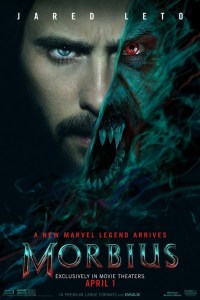 Not the train wreck the advertising made it seem, Morbius is merely a bland superhero retread that reminded me of the early 2000s superhero output like Daredevil and the Tim Story Fantastic Four. Having been delayed almost two years thanks to COVID-19, the film was released on April 1 for full unintended irony, and it’s a silly mess but also nothing worth getting too worked up over. Method actor extraordinaire Jared Leto (Suicide Squad) plays Dr. Michael Morbius who is suffering from a rare disease and finds a solution via a serum mixing vampire bat DNA but it has some consequences. He has super powers but needs to feast on blood every six hours and is dreading the point where he may not be able to resist the allure of feeding on humans. It’s a very Jekyll/Hyde concept, man trying to control his inner demons made literal, and once again we have a villain that essentially has the same powers as the hero. Matt Smith (Doctor Who) play’s Morbius’ childhood friend who also suffers from the same rare blood disease, but Dr. Morbius refused to share the cure because he explains it’s a “curse,” although maybe let the man suffering make that personal health choice. Bless you, Matt Smith, because you’re the only one having any fun with this movie, and that includes in the audience. Leto is actually fine though not much about the Morbius character is really imparted. The action sequences are erratic and the stylistic flourishes, like the “look at me” slow-mo ramps and the inexplicable wispy colorful smoke clouds trailing Morbius in action, hamper the ability to even discern what is happening onscreen. Maybe that’s on purpose after two years delay. The movie establishes a basic structure, series of goals, antagonist, and problems efficiently enough to make it to the end credits after 90 minutes. It’s just that we’ve come to expect better from our super hero cinema by now. As a disposable monster B-movie, Morbius is okay. It’s not recognizably campy, it’s not so-bad-it’s-good, it’s just a generic origin story/Dr. Jekyll and Mr. Hyde territory with a lot of dropped subplots and subpar CGI. I have my serious doubts about Sony’s plan to hatch solo movies for all these different Spider-Man villains, and the creakiness of this plan is even more evident with their contrived post-credit scenes trying to awkwardly establish their retinue of villains to confront Spider-Man. Does Morbius know who Spider-Man even is? Morbius the movie and character just feels too half-hearted for anyone to care.
Nate’s Grade: C


 nathanzoebl
You must be logged in to post a comment.