Blog Archives
Bulletproof Monk (2003) [Review Re-View]
 Originally released April 16, 2003:
This is one of the dumbest movies you will ever see. I don’t mean to sound overly sensational or alarmist, but this is the honest truth if you sit and watch all of Bulletproof Monk. Item #1: The bad guys in the film are –get this– the grandchildren of Nazis. Yes, that’s right, Nazis. We had to have Nazis as the bad guys. There’s actually a scene where a blonde-haired blue-eyed granddaughter wheels her decrepit Nazi grandpa around. Oh yeah, and one of the Nazis runs the –get this– Museum of Tolerance. Oh stop it, you’re killing me. Item #2: The titular monk (Chow-Yun Fat, pray for him) recruits pick-pocket Kar (Seann William Scott) to be his apprentice. Kar is an idiot. The Monk doesn’t help. His big mystery is –get this– why hot dogs and hot dog buns come in different numbers? Man, haven’t heard that one since the third grade. That would heartily explain why a character is called “Mr. Funktastic.” Item 3#: The monk teaches in stupid opposite talk (“You cannot be free until you have been taken. You cannot be cold until you are hot. You cannot die until you have lived,” you try some). One of the monk’s lessons is that the laws of physics, mind you the LAWS of physics, can be bent just by putting your mind to it. He says gravity can be overcome if you just don’t believe in it. This is insane. At least in The Matrix it had some plausibility. Item #4: The movie is a complete rip-off of The Matrix. I’m not just talking style, no, I’m talking everything. There is a scene where the monk and Kar run through a street and building, defying gravity, being chased by men in suits and sunglasses, and they get to a roof where they must combat a helicopter. What movie does this sound like, hmmm? Item #5: The visual effects are done by –get this– Burt Ward’s effects house. Yes, that’s right, the guy who played Robin on the campy 60s Batman show has an effects company. And they did the horrible work on Bulletproof Monk. This movie is so terrible at every level of filmmaking that it becomes enjoyable to watch, in the same vein as 2001’s stinker Dungeons and Dragons. I defy anyone to find merit in any of it. Sometimes you have to wonder what Hollywood was thinking.
Nate’s Grade: F
——————————————————
WRITER REFLECTIONS 20 YEARS LATER
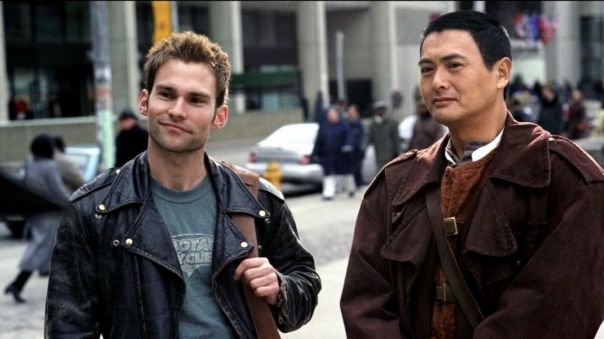
This is, without a doubt, one of the worst movies I have ever seen, and I was entertained for every bizarre, outlandish, and awful second of it. Bulletproof Monk is based on a comic book series but it’s really an incompetently designed and executed $50-million mock version of The Matrix. Within seconds of the movie, I was already laughing out loud, and I need to go into detail just for the first ten minutes, which I highly recommend to everyone as a taste setter. We open with two monks battling atop a rope bridge and, even accounting for the poor aging of special effects two decades later, it is some of the hokiest green screen I’ve ever seen. The way both characters leap, the way the movie haphazardly edits around the fight, the speedy levitating like a video game glitch, the duel spinning that goes on and on without orienting the audience, and then it all concludes with the apprentice grabbing the elder monk’s incongruous rubber sneaker before he falls. In just a short couple of minutes, we already have a clear indication what a mess this will be. Then the Nazis show up and kill the Tibetan monks and search for a mystical scroll that has the power to destroy all life on the planet, which is a good enough reason not to leave it easily accessible to Nazis. The lead Nazi massacres the monks with the exception of Chow Yun-Fat’s nameless monk who has just recently been dubbed the supreme monk in charge of scroll security. The main Nazi shoots him and the monk falls off a cliff, but not before the Nazi says “monk” a dozen times, including screaming it to the heavens to conclude the scene when he cannot find the fallen body. I defy anyone to watch and appreciate the opening on an intentional level.

The action goes from incomprehensible to boring. It’s the kind of movie where the bad guys will just show up with a helicopter with attached Gatling guns and fire into a warehouse even though there’s been no established reason they know our characters are inside or where inside they should start firing. It doesn’t matter because all the movie wants is a sudden burst of action with a vroom-vroom going pew-pew-pew until there’s a big boom. These same goons are also perhaps the dumbest hired goons in memory, as they’ll miraculously get the jump on our heroes, complete with helicopter action, but not check behind doors when coming onto a roof. There’s a moment where Sean William Scott is overpowering a man six inches taller than him and clearly with a hundred more pounds on him. This isn’t through some ingenious example of outsmarting the competition or using torque to your advantage, it’s just Scott out-pulling this guy, and this is before he even adopts the fantasy-blurring superpowers the monk will teach him.
The action scenes are all chopped up with jumbled edits. The choreography can be passable at points but seems to emphasize the exact wrong moments, like the duel spinning monks that twirl needlessly forever in the opening or Fat leaning forward and spinning around the floor while casually eating a bowl of noodles to clown Scott. It’s badly composed and badly edited. The action scenes are so silly and stupid and then you throw in the willful distortion of gravity because, as we’re told, physics are only real if you believe in them. The world of bending reality worked in The Matrix because reality was an illusion (or, as the Merovingian would say, “an eloooschean”) and a virtual reality setting where rules could be bent. What we’re entering here is a realm closer to 2008’s Wanted, where the tried-and-true laws of nature are merely suggestions, and all the cool kids can curve bullets if they really put their mind to it. It’s not like action movies don’t already exist in a heightened world of expectations and genre pyrotechnics, and then you add martial arts mysticism on top of it with wire-fu and we’re already stretching the bounds. I think what rubs me the wrong way thoroughly with Bulletproof Monk is how lazy it is. It’s not like this monk has some special power that allows him to overcome physics, some master knowledge that will educate his protégé. He just tells him that belief is stronger than physics, like this was a sentimental children’s movie about Santa Claus. If that’s the level of explanation that’s acceptable, it’s a bad sign how much more effort will be put into any storytelling or entertainment factor in this ridiculous mess.
Let’s also zero in on the apprentice character played by Scott, an actor I’ve generally enjoyed and who was hitting his commercial heights circa 2003. He plays Kar, though when the monk informs him that he is mispronouncing the Cantonese word for “family,” the American pickpocket brushes away the cultural correction from the native speaker. Here is a man who lives and works in an old Chinese movie theater with a crotchety old Japanese owner (Mako) and where he watches classic kung-fu movies and teaches himself martial arts. I suppose Kar could be a self-taught genius but he displays little dedication or skill beyond pickpocketing, which has always been a nagging movie cheat to me where people can just barely bump into you and magically gone inside your coat pocket and lifted a wallet all without your awareness. He’s the wise-cracking sidekick-slash-protégé learning about the wider world and breaking the rules, like Neo. Except he’s mostly obnoxious and useless, that is, whenever he isn’t inexplicably taking out professionally trained mercenaries with moves he learned from Bruce Lee marathons. Kar is not even an enjoyable annoying role for Scott like in 2003’s The Rundown.
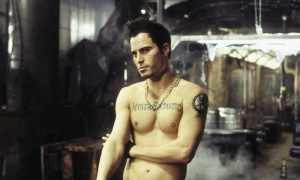
Another ridiculous character and storyline involves the leader of the underground street gang and his name is Mr. Funktastic. I know this because Marcus Jean Pirae (Girl Next) literally has “Mister Funktastic” tattooed on his bare chest (though it looks like he might be missing a well-placed “N” as well). He’s British and the leader of a gang of would-be street toughs and orphans, and it’s like the movie has dipped into something downright Dickensian, or maybe the 1991 Teenage Mutant Ninja Turtles movie. These guys are upset that Kar is stealing on their turf and challenge him to prove his mettle. I don’t know what this idiot character adds to this universe besides further making it incredulous. He and “his girl” even party in the underground raves in old subway cars, and all of this just makes me wonder what adults think goes on in subway systems. Oh, and that’s right, the female love interest is named Jade, played by Jaimie King (Sin City, Pearl Harbor), and this plays into one of the most stupid yet hyper specific ancient prophecies that tips off the monk to Kar’s potential. All you need to know about the supporting characters in this movie is that there are multiple generations of Nazis and they are running a Holocaust museum secretly to hold onto their trophies under the cover of enlightening the world about anti-Semitism and white supremacy.
Bulletproof Monk is the only movie directed by Paul Hunter, a respected music video director who has worked for decades and is responsible for Aaliyah’s “One in a Million,” Mariah Carey’s “Honey,” the “Lady Marmalade” remake from Moulin Rouge, and the unfortunately titled duet by Jay-Z and convicted rapist R. Kelly, “Guilty Until Proven Innocent.” This experience must have been so bad that Hunter swore off ever helming another feature-length movie again. The nature of music video direction attracts stylists, but this movie is so overburdened with trying to ape The Matrix on a scaled-down budget, with janky bullet-time effects and wire work (our heroes are even on the run from men in suits and sunglasses). The wire work doesn’t add grandeur and majesty to the movie because it doesn’t have the understanding of how to present it so that it looks cool; it always just seems goofy and inferior to better references. I think Hunter’s personal vision and style were just swallowed whole by the demands of making this silly movie, encroaching studio pressure, and it feels like he just gave up and the movie was benignly born by committee. I don’t blame Hunter for giving up on this movie and I guess on all movies.
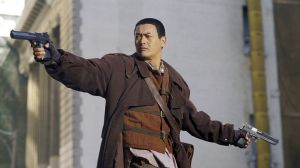
Can you enjoy Bulletproof Monk on a so-bad-it’s-good level? Do hotdogs come in packages of ten and hotdog buns come in packages of eight? The answer is an enthusiastic yes. This movie is ridiculous in every moment, only forming a somehow more ridiculous whole that defies not just the laws of physics but conventional storytelling and good taste. It’s a movie that has no idea what to do with Chow Yun-Fat and his abilities, instead coasting on the idea of the man’s involvement like the geezer teasers of recent memory that don’t so much challenge their famous stars as advertise they could afford them for a weekend or two of un-taxing demands. It’s a movie that begs to exist on a dumbed-down level of action movie junk science but doesn’t understand how to, properly, have fun within that setting. It’s so transparently indifferent or lazy or ripping off its many action/sci-fi inspirations, chiefly The Matrix. John Woo is a producer on the movie and it’s not hard to see how a Woo-directed Monk would have played to its outlandish peaks. Instead, everything is an inferior version of the better reference point. It’s silly and worthy of a night with friends, adult beverages, and lots of boorish and increasingly incoherent commentary.
Looking back at my initial review from 2003, I think my criticisms still hold but I would elevate the grade simply from its unintentional entertainment value. This is pure unintended camp, and as such Bulletproof Monk might be one of the worst movies I’ve watched and still undeserving of a failing grade, and so I will charitably raise it a letter to a D grade (on a curve, a bullet curve).
Nate’s Grade: D
Share this:

65 (2023)
 It’s a movie about Adam Driver as a spaceman fighting dinosaurs. What could go wrong? 65 (as in 65 million Years Ago) is a sci-fi action thriller with a ripe concept overworked by blockheaded studio notes that mitigate its potential and engagement. I was initially intrigued because it was the directorial debut of the writers of A Quiet Place, Scott Beck and Bryan Woods. That 2018 movie was a masterful genre exercise, though director John Krasinski was also a key contributor and rewrote their initial script. First off, I don’t know why this movie makes the decision to have Driver from an advanced alien species that crash lands on a prehistoric Earth unless it was related to the eventual development of humans on this planet. The opening segment explains in text and then a “Dad, don’t go” flashback before jumping into the action of the crashing spaceship. Even the dramatically protracted title reveal (65…………. MILLION YEARS AGO!) makes little sense considering the timeline was conveyed earlier. It makes me think about studio execs questioning whether audiences would get it, so what follows is mostly a survivor story of surrogate father and surrogate daughter (Arianna Greenblatt). A lot of our emotional involvement hinges on this relationship and I don’t think it carries the film. There’s a language barrier with the little kid, which is an interesting complication for their cooperation, but it also means Driver’s absent father is projecting a whole lot onto this little kid as if she were his daughter. The central relationship is serviceable but unremarkable, which could also suffice for discussing 65 as a whole. Driver trying to escape from a dinosaur territory dispute could have been plenty for survivor thrills, plus with little Predator-style advanced weapons to even the playing field of man and beast. What I didn’t need was a literal apocalyptic final act where Driver and the kid must not only survive dinosaurs but get off-planet before the big dinosaur-killing meteor strikes. It’s excessive bombast that feels tacked-on, like studio execs worried that dinosaurs by themselves would be boring. 65 is loud and obvious and only 90 minutes, and that can be enough for escapist entertainment, but it squanders its bigger concept.
Nate’s Grade: C+
Share this:

Shazam! Fury of the Gods (2023)
 I enjoyed 2019’s Shazam! because it felt like a breath of fresh air, a lighter story compared to the relentless gloom and doom of the DCU. It was more a silly Big-style body swap movie than a super hero romp, tapping into childhood wish fulfillment of getting to transform not just as an adult but as a super-powered adult on a whim. It was funny, sweet, and different. The 2023 sequel, Shazam! Fury of the Gods, feels like the definition of a sequel for the sake of a sequel. It is thoroughly mediocre and lacking the charm and heart of the original. I’ll try and deduce why this super-charged sequel feels so lacking and why the fun feels so forced.
Billy Batson (Asher Angel) can turn into Shazam (Zachary Levi) by uttering the magic name, and now his foster family share his same super abilities. They’re trying to adjust back to “normal life” when the Daughters of Atlas, Hespera (Helen Mirren) and Kalypso (Luicy Lui), arrive with a vengeance. Turns out Shazam’s powers were stolen from the Greek gods, and now they want them back, and if they don’t reclaim their power, the gods will destroy the world of man.
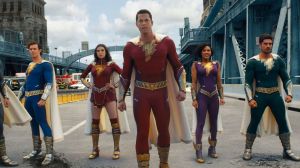 I think one of the most lacking elements of Fury of the Gods is that it loses its core appeal. The first movie was about a child fulfilling their adult dreams and leaping into maturity before their time. Levi (Apollo 10 1/2) was goofy and enjoyable in his broadly comical fish-out-of-water portrayal as a kid in an adult’s body. Now, the growing pains of being an adult, and a superhero, have been eclipsed. In fact, the amount of time we spend with Billy is pretty sparing. It’s all Shazam all the time, and this hurts presenting a worthwhile contrast between the mythic and the recognizably human. You forget the initial dynamic of this kid pretending to be an adult and what advantages this affords. At this point, being an adult is the same as being Billy Batson, who is approaching 18 and will age out of the foster system. This reality creates an existential crisis for Billy, as he’s afraid his family will move on so he’s eager to keep them together all the time, trying to maintain control. It’s about fear of change; however, I never fully understood why Billy was so worried. He’s already found a home with a loving mother, father, and extended clan of siblings, so why does aging out matter? He’s not going to be removed from his home. His siblings also aren’t talking about shipping out to the different corners of the world to begin careers or higher education. It’s a forced conflict to make the character uneasy about growing up. If the first movie was about a kid coming to terms with himself and letting others in, then this movie is all about a kid worrying his relationships will arbitrarily evaporate. This anxiety over losing something meaningful could have been an interesting storyline, but it’s all so contrived, and the whole body swap dynamic, the selling point of the first film, feels strangely absent.
Likewise, the villains have questionable motivation and character development. The movie begins with cloaked and masked figures wreaking havoc in a museum, and then it makes a big deal that these figures happen to be… women (also middle-aged and older at that). The opening is meant to be surprising in a way that feels out of date (what… g-g-girls can be powerful too?). It’s a strange point considering we’ve already had Wonder Woman. This same easily-satisfied, lowest common denominator plotting is disappointingly prevalent. These powerful gods want their father’s powers back but they already seem pretty powerful, so the movie lacks a fitting explanation of why these extra powers are worth all this effort. I suppose there’s a general revenge and righting of wrongs but the characters don’t play their parts too scorned. They’re more annoyed and tired, which doesn’t make for the most compelling villains. Another Daughter of Atlas has the power to mix and match the world like a volatile Rubix cube, but what is this power? It’s virtual obstacle-making but it feels arbitrary too in the world of superpowers. The ultimate scheme to conquer the world is as flimsy as the reasons it’s ultimately defeated.
 Let me dissect that part for a few words, the solutions to overcoming our vengeful gods. They raise an army of mythical creatures to destroy Philadelphia and it’s Ray Harryhausen character designs with cyclops and unicorns and the like. The way to reach through to the monsters and bring them on your side is to offer them a gift of “ambrosia,” some tasteful bounty that they can’t help but fall in love with. So what is the solution to this? One of the kids literally drops a handful of Skittles onto the street and the unicorn happily snarfs them down. Yes, through the power of Skittles-brand candy the heroes are able to save the day. There’s even a moment where the kid is riding the unicorns into battle and screams, “Taste the rainbow,” before the movie cheekily cuts her off before she can unleash an added “MF-er.” What is this? I’m usually agnostic on product placement in movies; characters have to eat and drink, etc. But when it’s egregiously transparent and played as the key to victory against all odds, that’s a bit much. If the joke is that contemporary food is a blast of flavor that nobody would have been prepared for thousands of years ago with their palettes, then any modern food could have worked. It didn’t have to be a brand-name candy with its brand-name slogan screamed in battle. This is but the first of several contrived and unsatisfying deus ex machina solutions that erase consequences.
Even with returning director David F. Sandberg (Lights Out), the enterprise feels like an empty retread relying too much on rote spectacle and missing the heart and perspective of its predecessor. There is an action sequence atop a collapsing suspension bridge and the song “Holding Out for a Hero” plays, and then we have a character comment on it, and it all seems like a desperate attempt to add some energy or style or fun to the sequence that is absent. The action relies on a lot of watching characters zip pedestrians to safety, but it’s the end result we see, not the whoosh and flurry of the arduous mission. The whole sequence feels like it’s going through the motions, as much of the movie does, falling back on a formula of superhero blockbuster autopilot. The CGI army of villains, the face-offs between characters shooting magic beams at one another, the overly quippy and tiresome dialogue and mugging cranked up to overdrive, the world-saving stakes feeling so minor. I was longing for some of the ’80s Amblin tone of the original, which got surprisingly dark. With Fury of the Gods, everything feels so safe and settled, with the stakes feeling inauthentic and the action reinforcing this with effects sequences that feel like Saturday morning cartoon filler.
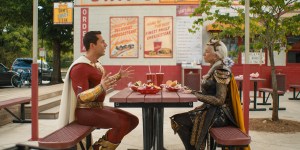 There’s a strange question with the family powers. The extended brothers and sisters can utter “Shazam” and turn into adult alter egos, but the character of Mary (Grace Caroline Currey, Fall) now transforms into a super suited version of herself with slightly different hair. In 2019, she transformed into actress Michelle Borth (Hawaii 5-0). Mary is the oldest sibling, and we’ve undergone a time jump of years to account for the ages of the kid actors, so does this mean that as the kids get older they will just turn into versions of themselves? Does this mean that the Zachary Levi-persona is set to expire once Billy turns legally an adult at 18? The implications of this casting choice made me question the very reality of the Shazam universe’s mechanics.
I can see certain audiences enjoying the slapstick and gee-whiz goofiness of Shazam! Fury of the Gods, and I have no doubt that the people making the movie wanted to tap into that childlike wonder of magic and myth. The problem is that this feels like the most inessential of the dozen DCU movies, going through the motions rather than exploring cogent and potent drama. Just take the character of Pedro (Jovan Armand) who is unhappy with his larger body and transforms into a handsome, slim, musclebound version of himself as a fantasy. That’s an interesting psychological exploration for the character, on top of his own self acceptance on a whole other front. Or take the sidekick from the first movie, Freddy (Jack Dylan Grazer), and his Romeo and Juliet-esque romance of a super-powered being from the other side of the conflict. There’s some drama there as well as his understanding of who the good and bad guys can be. Or simply take the perspectives of the parents trying to raise a household of kids who can transform at whim and what worries and joys this can offer. There’s material here to be finely explored, fun dynamics going beyond just repeating the Big-style body swap hi-jinks. Unfortunately, this is a sequel that feels like what made the original special has been replaced by blockbuster status quo.
Nate’s Grade: C
Share this:

The Core (2003) [Review Re-View]
 Originally released March 28, 2003:
I knew about 15 minutes in that The Core was not going to take its science too seriously. Aaron Eckhart, as a hunky science professor, is addressing military generals and essentially says, “We broke the Earth.” He tells them that because the Earth no longer spins (don’t think about it, you’ll only hurt yourself) the electromagnetic shield will dissipate and the sun will cook our planet. And just to make sure people understand the term “cook” he sets a peach on fire as an example. At this point I knew The Core was going to be a ridiculous disaster flick with its tongue firmly planted in its cheek.
Earth’s core has stopped spinning and horrific disasters are starting to be unleashed with anything from drunken bird attacks to lightening strikes in Rome. I always love how in disaster films Mother Nature always instinctively goes after the monuments, the landmarks, the things of cultural importance. The United States government hires a ragtag group of scientists and NASA pilots to journey to the center of the Earth and jump-start our planet. Of course everything that can go wrong on this fantastic journey will eventually go wrong.
The Core is so improbable, so silly, that it ends up being guilty fun. If you let go, ignore the incredible amounts of birth imagery (the sperm-like ship tunneling through to get to the egg-like core), then the very game cast will take you for a fun ride.
There’s a scene where the government approaches kooky scientist Delroy Lindo to build the super-ship that will take them to said core. When asked how much he thinks it’ll cost Lindo laughs and says, ”Try fifty billion dollars.” The government responds, ”Can you take a check?” I was pleasantly reminded of an episode of Futurama where the space-time continuum is disrupted and time keeps skipping forward. The old scientist and a Harlem Globetrotter (it was a very funny episode) theorize that to create a machine to stop this problem they would need all the money on the Earth. Flash immediately to the two of them being handed a check that says, “All the money of the Earth.” Richard Nixon’s head, in its glass jar, then says, “Get going, you know we cant spend All the Money on the Earth every day.”
 The assembled cast is quite nice. Hilary Swank assumes a leadership role quite nicely. Eckhart is suitably hunky and dashing. Stanley Tucci is very funny as an arrogant science snob. Tcheky Karyo (the poor man’s Jean Reno) is … uh, French. I don’t think anyone would believe that these people were the best in their fields (only in movies are scientists not old white men but hunky and sexy fun-lovin folk).
Director Jon Amiel (Entrapment) seems to know the preposterous nature of his films proceedings and amps up the campy thrills. An impromptu landing of the space shuttle in an L.A. reservoir is a fantastic action set piece, yet is likely the reason the film was delayed after the Columbia crash. The cornball science and steady pacing make The Core an enjoyable if goofy ride. The film does run out of steam and goes on for 20 minutes longer than it should.
The Core is pure escapist entertainment without a thought in its head. And in dire times of war and harsh realism blaring at us every evening, there’s nothing wrong with a little juicy escapist fair. Buy a big tub of popcorn and enjoy. Does anyone else wonder if we broke the Earth just after its 5 billion-year warranty was up?
Nate’s Grade: C+
——————————————————
WRITER REFLECTIONS 20 YEARS LATER

I never knew just how influential the 2003 disaster movie The Core has been. It’s a schlocky Hollywood sci-fi thriller built upon junk science but still enjoyable junk food entertainment. However, the science was so unrepentantly bad, that the science community as a whole decided to do something about it, and in 2008 the Science & Entertainment Exchange was launched. Founded by the National Academy of Sciences (NAS), its director Rick Loverd told Salon magazine how influential pop culture can be in its depiction of science, citing Star Trek inspiring scientists, Top Gun inspiring pilots, and CSI inspiring young forensic students. He also cites the power of seeing positive representation, like 2016’s Hidden Figures. The Science & Entertainment Exchange is an organization that is intended to consult on the application and depictions of science in cinema, hoping to make things more realistic. Apparently, The Core’s director, Jon Amiel (Entrapment), was so taken back when a science advisor was bad-mouthing the movie to Scientific American because he was under the impression that his movie, including restarting the Earth’s iron core with atomic bombs, had been scientifically accurate. Among the scientific community, they regard The Core as the nadir of big screen accuracy (as an example of a movie that got the science fairly accurate, they cite 2014’s Interstellar). I bet you never knew how truly influential and world-changing The Core was, albeit for being a junk movie. However, as it was in 2003, and even twenty years later, this is exactly my kind of junk.
I recognized the campy appeal of The Core right away. It’s a goofy movie from the premise to the science to the action set pieces but it’s all played one hundred percent straight, which makes it that much more entertaining and amusing. The opening sequence involves people with pacemakers dropping dead (approximately 1.5 million people worldwide). Then the birds start acting funny and crashing into buildings and cars and panicked outdoor crowds. For a disaster movie literally about the possible demise of the planet, this is such a strange and minimalist start to the looming threat at hand. The movie feels like it’s a throwback to the science fiction mission movies of the 1950s with a touch of the worldwide disaster movies of the 1970s. Even with the modern special effects, which are as delightfully cheesy as the rest of the movie, it doesn’t feel akin to the disaster epics of Roman Emmerich. The movie feels cornier and more dated and less interested in large-scale disaster spectacle. The surface-level disaster carnage is marginal, mostly an out-of-control lightening storm in Rome that knows to always steer for the monuments and cultural artifacts. The Core, at its core, is about the fantastic journey of its brave scientists. Take for instance a scene where the Serge is locked behind and being crushed to death by extreme pressure. I don’t know how anyone could keep a straight face while Aaron Eckhart, our handsome lead scientist, shouts, “Serge!” over and over while Tcheky Karyo (The Patriot) pretends he’s being squished to death while the walls get closer and closer to his face. That’s the kind of stuff I want, not CGI waves killing thousands in large-scale yet antiseptic spectacle.
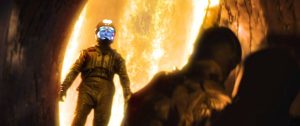 The movie takes about an hour before it really gets going, which is also admirably silly. Why devote so much time to setting up the reality of this dilemma for the complications and solutions to seem so throwaway? Seriously, the government uses one hacker (DJ Qualls) to control the entire Internet so that they can cover up the news about the possible impending apocalypse. It reminds me of an episode of The X-Files from the early 1990s where the government sends out an “all-Internet alert.” Perhaps the screenwriters felt we needed more time to accept the outlandish premise, which is strange because most disaster movies get a significant benefit of the doubt from audiences. Just having a person in glasses, and maybe a lab coat, or sweater if you want it to be more casual, explaining in a grave tone while removing their glasses dramatically, is likely all we need to accept the craziness to come. However, we do spend more time with our characters so that, when they depart one-by-one through sacrifice and accident, I actually cared enough because I was enjoying their comradery. I enjoyed Stanley Tucci being a blowhard who would even record his own narration as they travel through the Earth. I enjoyed Bruce Greenwood as the stern father figure that of course has to die first. I enjoyed Delroy Lindo as our excited but exasperated drill scientist. I enjoyed Hilary Swank as, essentially, the “best damn pilot I’ve ever seen.” I liked simply watching them all banter and bond together. It had enough development that their losses actually felt like losses and/or the accumulation of a character arc.
The question arises how do you keep things interesting when you’re burrowing through layer after layer of rock, and the answer is to just make things up. How about a layer of air? Could the Earth, compact as it is through billions of years of gravitational forces, have a layer of air like it was an English muffin? I did enjoy how the team had to restart their vessel before the magma poured into the vacant and awaiting space from their entry point. Of course, that raises the question now that magma is filling this vacant layer, have these scientists unintentionally ruined this unknown layer of the Earth? How about a layer with diamonds the size of states? These internal layers might as well be alien planets for as little they connect to reality.
 The movie is overlong and too uneven, but for fans of schlocky science fiction, it’s a delicious combination of campy entertainment. The silliness, played completely straight, even down to the part where Richard Jenkins explains man’ hubris is at fault for destroying the rotation of the Earth, is the grand appeal. I’m not going to call The Core a good movie but it sure feels like it knows exactly what kind of movie it is, and boy does it lean into that. My original review in 2003 caught on right away and I still recognized that same knowing vibe (why do we need a visual demonstration for the obvious concept of the sun cooking the Earth?). There really is a lot of birthing imagery too with the shape of the vessel burrowing to that egg at the center, so there’s that as well. The special effects are pretty murky and hokey for this kind of budget, but in 2023, that even works to the bountiful charms of the movie. I won’t pretend that most people will watch The Core with derision regardless of whether or not you’re an actual scientist. It inspired a generation of movies to be more scientifically sound, and it also inspired one of the biggest filmmakers on the planet. The metal that encases the spaceship? Unobtanium. You cannot tell me James Cameron wasn’t watching and taking notes.
Re-View Grade: B
Share this:

Black Panther: Wakanda Forever (2022)
 It’s hard to talk about Black Panther: Wakanda Forever without first discussing its missing whole, namely Chadwick Boseman. It was a shock when Boseman died during the summer of 2020 of terminal cancer, which he had kept hidden except for a small number of close confidants. I remember hearing the news and being in disbelief, figuring this must be another celebrity death hoax, but then the terrible news was confirmed. It’s one of those celebrity deaths that you remember when you found out, mostly I think because here was an actor in his prime and headlining Oscar-nominated movies and precedent-setting blockbusters. It felt too soon to be gone. It felt wrong. It’s that grief that the characters of Wakanda Forever are also wrestling over. Reflecting real life, the sequel to 2018’s hit Marvel Cinematic Universe (MCU) entry elects to have T’Challa (Boseman) pass away in the movie as well, off screen, and from a cause more human than super, dying from a disease. The movie is knowingly channeling our grief for the loss of Boseman into a story about characters also mourning the loss of this good man. This loss hangs over the entire movie and provides it more gravitas and emotional depth it would have had otherwise. Wakanda Forever is a suitably exciting and expansive sequel, especially following the empowering cultural model writer/director Ryan Coogler followed with the first film, but it’s hard not to feel the loss of Boseman, both in presence and in storytelling.
We open with Shuri (Letitia Wright) diligently trying to save her brother’s life only to be out of time. The nation of Wakanda is in full mourning, losing their champion and king. In the wake of this loss, the outside world sees opportunity. Having come out of hiding, Wakanda is being pressured to share its valuable vibranium mineral resources with other nations, and some are eager to take them by force if necessary. This has inadvertently created a gold rush for vibranium, and the C.I.A. has discovered traces of the rare mineral on the ocean floor. This undersea incursion has provoked a heretofore unknown underwater community into action. Namor (Tenoch Huerta) is a super-powered mere mutant, able to fly with tiny wings on his heels, and able to breathe under the sea just like the inhabitants of Talochan. Namor has declared war on the surface world and seeks Wakanda to be an ally, and if not that, then their first conquest.
This is a movie dominated by the women of Wakanda, and they bring the fury. Everyone is processing the loss of T’Challa in different ways. Shuri is rededicating herself to her scientific research, as she blames her brother’s death on her inability to solve his ailment in time. T’Challa’s mother, Ramonda (Angela Bassett), has been appointed leader of Wakanda and must represent her nation’s interests while still grieving for her son. Nakia (Lupita Nyong’o) has retreated from the larger world of spycraft to open a school in Haiti. Okoye (Danai Gurira) is supposed to be the chief security officer for Wakanda, and she busies herself with new threats and armor rather than dwell on being unable to save her king. Each character feels the weight of the loss and opens up reflections of grief, as each knew T’Challa on a different level: mother, sister, lover, protector. The attention that Coogler allows for their and our grief allows the movie to work on a communal cathartic level (I teared up a few times myself). Wright (Death on the Nile) has some heavyweight emotional moments, and the movie is structured around her path of healing as well as the wayward detour of vengeance and hate. It’s a conclusion that hits upon the expected spectacle of superhero action but hinges upon, foremost, an emotional arc.
Coogler is two-for-two when it comes to creating dynamic, engaging villains who have strong perspectives that cause the heroes to better reflect upon their own roles. Killmonger (Michael B. Jordan) is one of the MCU’s best villains, and I think it’s interesting that the first Black Panther ends with the hero realizing the villain’s perspective is right and adjusts from there. With Wakanda Forever, we get Namor protecting his people, and his reasoning sounds a lot like the Wakandan leaders who wished to remain separate from the larger world in the earlier film. The background for Namor is completely rewritten by Coogler and co-writer Joe Robert Cole and for the better. They’ve invigorated the character by attaching a rich Mesoamerican culture to Namor’s people and history. We have another hidden world of minorities that are super-powered and developed beyond the reach of colonialism. The flashback for Namor, dating back to the sixteenth century, is startlingly effective, establishing his strange origins, the great change for his tribe to being sea-dwelling, and what happens when he returns to the surface world to honor his late mother’s funeral wish. When he returns, the Spanish have built plantations and have captured the indigenous into being their chattel. Namor sees this exploitation in the name of a foreign God and swears off the surface world. This cultural angle imbues the character’s focal point but it’s also just plain neat to watch an ancient Mesoamerican culture given the big screen superhero treatment with reverence and awe. By providing a compelling villain, it also makes the emotional stakes more compelling. We’ll likely side with the women of Wakanda, but you might also be rooting for Namor too. I also think it’s fun that the underwater Atlantean prince character for DC and Marvel is portrayed by a Mexican-American actor and a Polynesian actor. 
Where the movie doesn’t work as well is with its introduction of Riri Williams (Dominique Thorn, Judas and the Black Messiah) who is the human McGuffin. She’s a brilliant engineer who accidentally discovers a vibranium detection device, but why does nabbing her matter to Namor? With the device already created, the proverbial horse has left the barn. Kidnapping the inventor after her technology has already been utilized seems too late. There’s no real reason she could not be replaced with an inanimate flash drive except that this establishes the character up for her 2023 Disney Plus TV series. It’s this larger corporate portfolio push that I’ve always worried about with each new MCU edition, now 39 in total, that they will be forced to set up future movies and shows at the detriment of telling a focused and satisfying movie. The MCU movies I’ve generally liked the least are the ones that fall under this pressure the most, like Age of Ultron, Iron Man 2, and Multiverse of Madness. I found the character of Riri Williams to be fun, but her inclusion always seemed like a distraction to the larger story. I’m sure you can make thematic connections, a young brilliant black woman finding solace in Wakanda, but if you were looking to trim down an already overlong movie, I think Riri is the easiest to eliminate.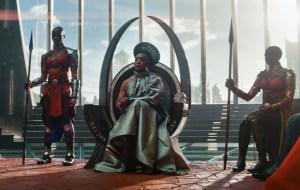
With Black Panther: Wakanda Forever, Phase Four of the MCU has officially closed and Phase Five will begin shortly with Ant-Man 3 in February, 2023. In the wake of the conclusion of the multi-phase Infinity series and 2019’s Endgame, this phase felt dominated by closure and exploration. The Disney Plus series provided little conclusive offshoots for many of the original Avengers characters. It’s also been a period of experimentation, with Marvel broadening its tone and scope from martial arts movies, spy thrillers, romantic epics, and familiarizing audiences to the concept of the multiverse with good movies (Spider-Man: No Way Home) and not-so good movies (Doctor Strange 2). And of course Wakanda Forever is the biggest edition yet on fulfilling a sense of closure, though it had never been intended to be before Boseman’s passing. It’s a sturdy sequel with a palpable emotional undercurrent and an engaging villain to boot. I called 2018’s Black Panther as agreeable, mid-tier Marvel entertainment, and I’d say the same for its sequel. However, with Boseman’s passing, it’s naturally elevated. Wakanda Forever is long and overstuffed but also emotional and engrossing and satisfying.
Nate’s Grade: B+
Share this:

Solaris (2002) [Review Re-View]
 Originally released November 27, 2002:
A most amazing thing occurred when I sat down in my theater to watch Steven Soderbergh’s sci-fi remake, Solaris. The majority of the theater was women, no small part I’m sure to George Clooney and the promise to see his posterior not once but twice. As the film progressed I kept hearing the rattling of seats and the exit doors. When the lights came back on more than half my theater had walked out on Solaris. I have never seen this many walk outs for any film before, and if one has to hold this title Solaris certainly does not deserve this dubious honor.
Clooney plays Chris Kelvin, super future psychologist who is struggling to overcome the grief over the suicide of his wife, Rheya (Natascha McElhone). Clooney is dispatched to a space station orbiting the mysterious glowing planet Solaris. Seems strange goings on, are, well, going on. When he arrives he finds that the station head has taken his own life and the two remaining crew members on board could use more than a few hugs. Clooney goes to sleep (in a bed resembling bubble-wrap) and is startled awake when his dead wife is suddenly lying right beside him. But is it his wife? Is it merely his memories being recounted? Is it Solaris messing with his gray matter? Does Rheya have consciousness of the past or of her self? What are her thoughts on her new materialization? Good luck Steven Soderbergh, existentialist party of one.
It’s not that Solaris is necessarily a bad film, it’s just that it’s plodding, mechanical and overly ambitious. There are long periods of staring, followed by brief exposition, then more staring, sometimes earnestly but mostly slack-jawed. Solaris is attempting to be an existential meditation on identity and self, but what really occurs is a lot of nothingness. For a movie that was over three hours in its original 1971 Russian conception, and a mere 93 minutes in its slimmer Soderbergh size, I could likely get this movie done in 6 minutes. It could be argued that its arduous pacing amplifies its methodical subject matter but whatever.
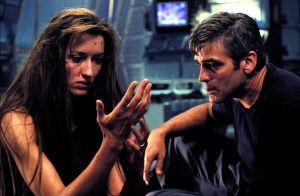 Clooney has said in interviews how Solaris was the most challenging role of his career. To this I make a collective noise of disagreement. Clooney turns from grief-stricken to confusion, then back to grief-stricken with nary a line of dialogue. The effect is more dampening than emotional. Clooney’s conscience gets even worse when he banishes New Rheya into the cold vacuum of space then Another Rheya appears the next night. He just can’’t escape this dead woman.
I’m very pleased to see the glassy-eyed, apple-cheeked actress McElhone in movies again. She seemed to be on the cusp of mainstream acceptance after prominent roles in 1998’s Truman Show and Ronin, yet she just disappeared. McElhone is a wonderfully expressive actress and deserves to be a leading lady.
Soderbergh’s take on existential dread could be described as a noble failure. Solaris is the type of overreaching, underachieving film only really talented people could make. And for anyone wanting to leave after the double dose of Clooney’s derriere, they both happen in the first 30 minutes. You can go after that if you so choose.
Nate’s Grade: C+
——————————————————
WRITER REFLECTIONS 20 YEARS LATER

I think Steven Soderbergh is the perfect film artist to discuss the topic of the “noble failure.” That’s what I dubbed his remake of Solaris in 2002, and having re-watched it twenty years later I would still concur. Soderbergh is the ultimate idiosyncratic indie auteur who, miraculously, found himself Hollywood success and power. Soderbergh is probably best known for the Ocean’s Eleven trilogy of slick, star-powered heist movies, or his Oscar-winning 2000 movies Traffic and Erin Brockovich. The last time a person scored two Best Director nominations in the same year was 1938 (Michael Curtiz for Angels with Dirty Faces and Four Daughters, if you are dying to know). Soderbergh has never rested on his many laurels, and every new mainstream success inevitably saw the man flirt with new narrative and technical experimentation. It seems like Soderbergh gets restless every so often and needs to find a different reason to excite him about a filmmaking challenge. He made a small indie about workers in a decaying doll factory that was released same day on DVD as it was in theaters. He made a two-movie political epic on the rise and fall of revolutionary Che Guevara to showcase the amazing capabilities RED high-definition digital camera. He created an action vehicle for MMA fighter Gina Carano because he saw a future star-in the-making in her bouts. He filmed a movie entirely on an iPhone camera because he could. He made a movie about male strippers based upon Channing Tatum’s past experiences and it became one of the most successful movies of his career.
 In short, Soderbergh is a restless artist who always seems to be trying to challenge himself. However, many of those experiments don’t always work. 2018’s Unsane would have been forgettable minus its iPhone gimmick. 2006’s The Good German would have been forgettable without its pastiche to older Hollywood style. Even when his movies do not fully work, you feel Soderbergh’s passion to experiment and push his boundaries. It’s with this context that I re-watched 2002’s Solaris, based upon the 1972 meditative and melancholic sci-fi movie by Russian filmmaker Andrei Tarkovsky. It’s amazing to me that Soderbergh, right after his twin Oscar noms and the box-office success of 2001’s Ocean’s Eleven gave him artistic cache, said, “I want to remake a three-hour Russian movie from thirty years ago.” And the studio said, “Oh, well, keep it under 50 million and half as long and we don’t care.” In 2002, Solaris was one of my more memorable theatergoing experiences, as I detailed in my original review. I’ve had walkouts during other divisive movies but nothing like what happened for Solaris. I’m fairly certain it was a matter of the crowd being sold a sci-fi movie with Clooney’s handsome mug, “from the director of Ocean’s Eleven,” and the promise of catching some Clooney rear nudity (12 days prior, the movie had received an R-rating before successfully appealing to a PG-13). They weren’t expecting a very minimalist, cerebral, and slow movie about grief and identity (it got a rare F grade from opening weekend Cinemascore audiences). By the end of the movie, the majority of patrons in my theater had left early. I thought maybe revisiting this movie twenty years later would perhaps allow me to find new artistic merit into this box-office dud. I have not.
There are ideas here worth exploring and unpacking, especially once the main conflict is fully established, namely Clooney’s dead wife Rheya (Natascha McElhone). Why is she coming back is less an interesting question, and thankfully the screenplay by Soderbergh ignores answering. It’s all about the effect it’s having on her husband and whether or not she is who she is. There’s an existential question of whether or not she constitutes living and what aspects do we hold onto to prove we are who we are? Is this the real Rheya, has she been plucked back from an afterlife? Is this a Rheya who has access to her earlier memories? Or is this Rheya merely a composite of her husband’s memories and personal and flawed interpretations? The mind boggles.
It’s that final question that presents the most intriguing exploration, as it presents Rheya less a fully-dimensional character and more a prisoner to her husband’s perspective. His view of Rheya can be biased, flawed, filling in gaps with assumptions and speculations, like his speculation that the real Rheya was so remorseful about aborting her child that she took her own life after being confronted by her husband. This leads the Solaris-rebooted version of Rheya to be more undone by depression and suicidal impulses. I enjoyed this portion because it shifted the criticism onto Clooney who refused to let her be gone. He even plans on taking Rheya back to Earth, even though that might not be possible. Will she evaporate if she gets too far away from the orbit of Solaris? We’ve gone beyond whether or not Rheya is a hallucination because the other crew mates (Jeremy Davies, Viola Davis) see her too. The movie flirts with the confrontation of Clooney’s character’s implicit control, that he’s literally dreaming a version of her for his emotional needs and he doesn’t care whether or not it’s the real Rheya. It begs the question of how well anyone can truly know another person. There will always be some observer distance, unable to fully delve into every hidden quarter of another person’s mind and heart. Clooney accepting his loss would have been a fine ending point, or refusing to, and Solaris does end on a similar downer ending, though with more radiant ambiguity. It’s interesting but it doesn’t really open up thematically or character-wise, keeping Clooney’s mournful space psychologist at a unsatisfying clinical distance. Just because we see moments of characters longing and looking emotionally bereft does not mean we know them. Maybe, in the end, that was Soderbergh’s meta-textual in-movie criticism.
 At 93 minutes, there’s not much to Solaris beyond its intriguing questions that feel only fitfully toyed with. There is a lot of empty space here for diving deeper into the characters and the relationships and big questions, but the movie feels too weighed down with its overwrought import. Scenes don’t play out so much as escape from the ponderous atmosphere. There are intriguing questions here but there isn’t enough story material to keep me connected. As a result, I became restless myself, zoning out while I watched a person stare off into the distance for the eleventh time, this time knowing that their internal thinking had to be different, somehow, from the ten other times. It’s a sci-fi movie without big special effects or action sequences. It’s starring George Clooney in, possibly, his most insular, minimalist role of his career. It was never going to be a jaunty crowd-pleaser. I haven’t seen the 1972 Russian movie but given its lengthy running time and the fact that it’s reflective of a Russian cultural experience, I have to assume there is more substance there and an adequate foundation to tease out these questions, but I’m free to admit my assumptions, much like Clooney’s character, could be all wrong.
As for my original review in 2002, I got to hand it to my twenty-year-old self. This is a solid analysis and with some snappy wordplay to boot. I’m impressed by this review. Solaris is another of Soderbergh’s “noble failures,” a project that cannot quite grasp its reach, but I’d rather artists like Soderbergh keep trying and litter the cinema with noble failures than inundate us with the same-old same-old.
Re-View Grade: C+
Share this:

Don’t Worry Darling (2022)
 By now, you’ve likely heard all about the gossip-churning headlines from behind the scenes of Don’t Worry Darling, which eclipsed everything else about the movie and is, sadly, the most interesting thing about an otherwise flawed Stepford Wives retread. There were scandalous rumors of affairs, rumors of actors uncomfortable with affairs, rumors of actors refusing to take part in publicity for the movie, which motivated legions of online super sleuths to analyze every social media missive to the finest point to discover hidden messages and meaning. There was even a point where the Internet debated for a week whether or not Harry Styles actually and actively spit upon Chris Pine at the Venice Film Festival (both actors deny this happening). Looking back, it was a wild time, a bit silly, and far out of proportion for the actual movie we eventually get with Don’t Worry Darling.
Alice (Florence Pugh) is living the perfect 1950s life – OR SO SHE THINKS. Her husband, Jack (Harry Styles), leaves with the other men for work in the desert facility owned by Frank (Chris Pine). The wives of the community diligently tend to the household chores, gossip poolside, and have a full-cooked meal and drink in hand for their returning breadwinners. Alice begins seeing disturbing visions she cannot explain, and another wife (Kiki Layne) starts acting up, trying to warn her, and men in red suits seem to pounce whenever someone steps out of line. It’s a lush suburban community designed by Frank, meant to be the sparkling, hopeful epitome of the American Dream, but it might be a nightmare instead as Alice investigates.
 Don’t Worry Darling is a fleetingly entertaining movie with big ideas but it doesn’t know how to handle them and what to say beyond its obvious points. Immediately in the movie, you’ll know something is wrong with this idyllic community. The Stepford Wives is an obvious comparison point, so I kept waiting for the movie to pivot from this predicted influence, to go a separate route or go deeper, making its commentary meaningful for today’s world. Unfortunately, the movie never does move beyond this influence, nor does the movie go deeper than to easily castigate its men for wanting to control their women and remodel them as dutiful, cheerful, robotic housewife throwbacks to the halcyon age of 1950s Boomer nostalgia. It’s all too surface-level for a movie about superficial men wanting to unburden themselves of having to live up to the expectations of women. There’s plenty that could have been said about the pernicious forms of toxic masculinity festering around the darker corners of society and the Internet, the rise of fragile men in the alt-right and incels and trolls, and their angry, entitled, self-loathing feelings toward women projected into harassment. This movie only merely glances at its touchy subject. The commentary is too basic, leveling men want to dominate women and erase their agency and identity for their own satisfaction, the same points from The Stepford Wives in the 1970s, which was a direct response to the feminist movement challenging traditional gender roles in the home. I won’t spoil the exact means of what this false reality is for Alice and the others, but suffice to say, it leaves a lot more questions for me than answers (Has nobody reported any of these women missing? Their friends and family? Why have such potentially deadly stakes? Why would modern men fantasize about six-decade-old Boomer nostalgia?).
In short, this reality is false, and the screenplay by Katie Silberman (Booksmart) and Carey and Shane Van Dyke (The Silence) makes it known immediately, so the story is structured with our foreknowledge in place. It becomes a game of how long before Alice puts together her conclusion and which strings she chooses to pull and what blowback from the established order that demands ignorance and obedience. There just isn’t enough intrigue here. In The Truman Show, the protagonist gradually began to doubt his reality but each suspicious peculiarity added to a better sense of the larger picture, and since it wasn’t until halfway through that we saw “the other side” of Truman’s manufactured world, the audience too was learning about this facade and all the effort to keep it hidden. Don’t Worry Darling has a repeated motif of Alice seeing confusing images of her and the other wives in a stark Bubsy Burkeley-esque musical number, but why? What does this reveal about the inner workings of the reality behind the reality? It’s not even made clear what it relates to literally, so it must be a metaphor, but it’s again too obvious and heavy-handed. I understand all the women are learning and practicing dance, but to what end does this serve? I needed further rules established about this secret society so I had more of an understanding of what was at stake as Alice begins to test her boundaries and put others in danger. The conclusion is also ludicrously short-sighted, just a matter of crossing a magical line, like a kid touching base in tag, and that’s before a segment of self-awakening that made me wonder if Alice had miraculously become Neo. It’s the kind of conclusion that feels way too easy and unfulfilling, attempting a note of “what happens next?” ambiguity but really feeling more unsatisfyingly incomplete and empty.
 Even though Don’t Worry Darling is flawed, Wilde’s directing is still an asset. She’s clearly having fun playing in a much different genre than 2019’s Booksmart, and the thriller elements are achieved by the eerie contrasts that Wilde finds to highlight of this hidden prison. The sunny cinematography and retro production design are sharp, and the musical score by John Powell (How to Train Your Dragon) has an off-kilter but electric charge to it, often working in hums and stutters to better accentuate the horror atmosphere creeping into this would-be paradise. Wilde even captures the speeding cars in the desert with a certain thrilling aplomb. Much publicity was made about the portrayal of the sex scenes within Don’t Worry Darling, namely, with a woman behind the camera, that they focus on feminine pleasure, a feature often lacking in a male-dominated field built upon the sizzle of the male gaze. I’ll agree that both scenes put more focus on Alice, also our main character so perhaps there’s that, but knowing the full context of the story, it seems more than a little misguided to purposely emphasize feminine pleasure. Also, it’s hard for me to actually believe these kinds of self-involved, parochial men would prioritize giving pleasure to their partner. This detail seems in conflict with the larger thesis.
Thank goodness for Florence Pugh, a refrain every viewer repeats with every movie co-starring the Oscar-nominated actress. Pugh (Black Widow) ably carries this movie on her back. Her performance has more nuance than the character writing provides, and it’s enjoyable to see her challenge the imposition of authority and push back. It’s yet another emotionally heavy role with several scenes of sobbing and screaming, and Pugh is one of the best actors when it comes to expressing the heights of emotional distress without overdoing it into histrionics. As my wife said by the end of the movie, Pugh deserves to star in a feel-good, chippy rom-com after all the grueling emotional work she’s endured in many of her more prominent roles.
 Harry Styles (Dunkirk) doesn’t fare as well, dwarfed by his scene partner. There is one moment where he has an emotional breakdown in his car that is nicely portrayed, a mixture of pity and guilt and pure cowardice, and Styles really nails it. However, his smooth hunky husband persona works well enough, enough so that it’s hard for me to see someone like Shia LeBeouf, who Wilde originally had cast in the role, working as intended considering his more intense presence would make you doubt the man’s intentions almost immediately. I wish somebody gave Chris Pine more to do in this other than smugly smirk in the background (admittedly his “being in the background” of one scene was an uncomfortable oddity that demanded further exploration).
There are things that genuinely work with Don’t Worry Darling, moments that dazzle and excite, technical elements that elevate the material, and performances that stick, but it all comes down to a disappointing and underdeveloped script that cannot figure out what to do with its messy themes. It’s too obvious where the movie is headed given its heavy thematic similarities to The Stepford Wives, but it could have taken that familiarity and reapplied it to today’s Internet-age misogyny preying upon female autonomy, but it doesn’t. It could have also fleshed out the particulars of its fraying world-within-a-world to better feel complete and intriguing and meaningful, but it doesn’t. It could have presented a compelling hero’s journey of Alice pushing back against formidable opponents, but it doesn’t do that. It could dress down these bad men and make them account for their misdeeds, but it doesn’t really. It’s a mystery with an all-too obvious answer, with the exception of the exact circumstances behind the pretty facade, and not enough substance and commentary that pushes beyond simple social moralizing. I guess ultimately the movie is much like its own gilded reality: pretty to look at but lacking much below the surface.
Nate’s Grade: C
Share this:

Nope (2022)
 Within two movies, and most likely just with his first in 2017, Jordan Peele catapulted himself as a brand name in the world of horror. At this point, you’ll see a Peele horror movie sight unseen because you know what you’re getting is going to be a unique experience. There are plenty of modern horror directors that have built a rabid fandom, like Ari Aster or James Wan, but nobody seems to be given the same platform as Peele has earned at this juncture. The writer/director has become what M. Night Shyamalan used to exhibit, the director whose creative visions were each highly anticipated event movies. Nope is Peele’s first foray into science fiction territory and the results are messy, disturbing, and, at points, astounding.
The Haywood family ranch has been involved in the motion picture industry since its very beginning. One of the first film images, a black man astride a horse, was the great-great-great grandfather of Emerald (Keke Palmer) and Otis Jr. (Daniel Kaluuya). The brother and sister are trying to save the family ranch after the untimely and strange passing of their father (Keith David) who was felled by debris falling from the sky. Their neighbor, Ricky “Jupe” Park (Steven Yeun), is spinning his notoriety as a child actor into a Western theme park attraction. Ricky’s claim to fame was being one of two survivors of a 1990s sitcom where the trained chimpanzee, who in the context of the show was his adopted sibling, snapped and went on a killing spree. Emerald and Otis Jr. begin to suspect that there is a real unidentified flying object hanging over their land, so they set out to capture living proof and become rich and famous. The alien, hiding in an unmoving cloud over the course of six months, has other plans and intends to assert its claim on the Haywood territory.
 Peele is proving himself more and more as a major director of genre spectacle and vision. Each of his three directorial efforts will hit people differently; I think they’ve incrementally gotten a little sloppier in the writing department, but Peele is only growing stronger as a visual stylist and orchestrator of big screen spookery. There is a grandeur to the visual arrangements, owing as much to the expansive language of Westerns and the awe of early Steven Spielberg. I wish I had seen the movie in IMAX as Peele intended, since he went to all the trouble of planning specific sequences for the grand IMAX cameras. There are several moments that are jaw-dropping and stirring in horror and wonder. A literal rain of blood and viscera and expelled non-organic items is a striking image. Even the unnatural way that helpless people are thrown off the ground can be jolting and primal. There’s a claustrophobic interior sequence of desperate people that really conveys the terror of the doomed. A big addition to the eerie atmosphere is the brilliant sound design. The otherworldly-ness of the alien encounters is heightened by a really in-depth sound design that can make the hairs on the back of your neck stand at attention. Even the sound of rain, and its distance, can be an indicator of the proximity of danger. There are also the distant sounds of horrible screams circling through the clouds high above, and it’s a deeply unsettling design trick that works every time. Even when the movie wasn’t quite as engaging from a narrative or thematic standpoint, Nope is always engaging on a simple delivery system of spectacle. The way Peele distributes his visual clues and keys, sometimes literally, always provides something for an audience to anticipate.
I was also starting to grow impatient from Peele’s coy narrative games. The plot moves in frustrating starts and stops, teasing an intriguing development or proffering a question and then skipping backwards, denying the viewer a sense of gathering momentum. There’s a toying sense of teasing out how far he can go before an audience gets too impatient and quits. Much of the first half also takes place during night or sequences of sustained darkness, which can definitely play into the the fear of what could be in those shadows, but it makes for a fitfully frustrating experience when you’re trying to unravel a science fiction mystery. I kept wondering how all these pieces were going to come together, especially the ongoing subplot about this killer chimpanzee, but I had faith in Peele (mostly). That faith was rewarded but I’ll admit for the first hour I was wondering if Peele was too evasive for his own good.
 Nope begins as Close Encounters of the Third Kind and then transitions into Jaws and stays there, and it was during the second half that my interest magnified exponentially. It’s around the hour mark that the movie finally puts all its cards on the table and declares what it is and what the remaining movie is going to be about. All the stutter steps and vagaries are cast aside, and the movie finally shifts into its grand entertainment of a group of humans learning about an overwhelming and unusual threat and plotting their unorthodox plan of attack. I’ll still try and play around spoilers without getting too deep into specifics. It’s a great relief when Peele no longer has to tease his threads and mysteries and can at last be open and let the conflicting components come together. The annoyances I felt in the first half melted away, and I was satisfied as the movie picked up a genuine momentum and smartly tied in many prior plot elements for the bigger picture, like the inflatable tube men, old timey picture-taking souvenir machines, and even the very vague almost carwash-esque imagery from the opening credits. The second half of the movie is more fun because it’s a big hunt and it allows our characters to make use of what they have learned to form conclusions and strategic moves and adjustments. It’s characters making smart decisions. It’s a scenario that finally allows Peele to finally play with all the setups he’s spent an hour cheekily hiding around.
While the climax is great, and the movie gets consistently better, I don’t feel like all of its many thematic ties come together. Being a Jordan Peele horror movie, we’re now expecting there to be extra layers of social-political commentary and allegories. The back-story for Ricky as a child actor is given a lot of attention and screen time for a two-hour movie, and I don’t know if what it adds up to is equal to the time it was given. Thematically, you can make some speculative reaching about the exploitation of animals for spectacle, about underestimating and not respecting nature, and even setting up for later tragedy, but it all seems less meaningfully integrated than any other Peele movies’ elevated subplots. With the Ricky back-story, there is even a literal anticipation of a literal shoe to drop, which seems so obvious as a visual metaphor but I cannot link it directly with what follows. I can keep digging and find connections but it requires far more effort than Peele’s other works of horror. The family history of working for Hollywood as horse wranglers feels underdeveloped. There are also rules that it establishes that Peele isn’t fully consistent (just don’t look?) that left me questioning. I figured that colonialism would be an obvious parallel with invading aliens (H.G. Welles even made use of the analogy 120 years ago), but maybe that was too obvious territory for someone like Peele. My friend Ben had a crazy early theory that the aliens themselves would resemble horses and thus they were returning to free their equine brothers and sisters from human exploitation. I guess I’ll go ahead and spoil you, dear reader, that this does not happen in any shape with Nope.
 I’d rank Nope the third best Jordan Peele horror venture, and while it clearly makes use of science fiction concepts and its rich iconography, it’s still very firmly a movie rooted in horror, the horror of the unknown, the horror of being small and helpless, the horror of being left behind. Not all of Nope’s many ambitions quite land, and the themes feel a bit more jumbled or underdeveloped, but I want Jordan Peele to continue making the movies he wants on his terms. Not every one is going to hit exactly the same for me, or for any viewer, but we’re all better when unique artists like Peele are given the latitude and support to bring their personal visions to the big screen. As long as he’s still achieving a baseline of quality, something that befell the middle Shyamalan period, then I say swing away and let’s see where you’ll take us all next, Jordan Peele.
Nate’s Grade: B
Share this:

S1mone (2002) [Review Re-View]
 Originally released August 23, 2002:
Director Viktor Taransky (Al Pacino) needs a hit. His new movie is in the can but his temperamental star (Wynona Ryder in a juicy cameo) pulls out and demands all footage of her be left on the cutting room floor. The studio is close to dropping Taransky’s film deal, and the studio head just happens to be Taransky’s ex-wife (Catherine Keener).
Under this intense pressure Taransky retreats to mourn his failed potential, until an eccentric one-eyed computer engineer gives him the key to his solution. It seems that instead of interacting with actors and their egos and trailer demands, Taransky has found a new movie star — one completely made up of ones and zeroes named Simone. Taransky edits Simone into his film and soon after the nation is in love with the digital blonde. Simone mania sweeps the nation and soon her smiling image graces all sorts of memorabilia. The public can’t get enough of the mysterious Simone who never goes to public functions and only seems to speak or appear for Taransky.
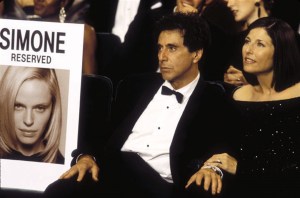 Writer/director Andrew Niccol (Gattaca) has some fun with the premise but tries to have his cake and eat it too when it comes to his satire. S1mone starts out satirizing egotistical stars, then the Hollywood system, then the press, then the public as star worshipers. The movie is all over the map trying to have something witty to say about all these different topics but is too busy to settle down on any one for a while. The satire S1mone embodies feels deflated from all the work it’s trying to do.
Pacino has always been able to do comedy but seems wearier than ever. He indulges in his comic like over-the-top aggression he’s been doing since Dick Tracy. Keener plays another of her icy businesswomen roles although she thaws quite easily and quickly in the film.
There’s a rather funny subplot involving Pruitt Taylor Vince and Jason Schwartzman as tabloid reporters on the prowl of the elusive Simone that deserves much more attention than it gets. The bulk of the movie could have been these two entertaining characters.
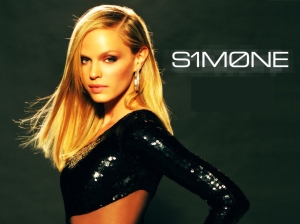 When Taransky finds that his creation has become more than he can handle he tries to discredit her through a series of funny public appearances and avante garde film choices. But then S1mone sadly goes back to its more mediocre roots. Taransky tries to get rid of Simone but it all horribly backfires.
As the film progresses you start to realize all the gaping holes that come up – like how can Taransky, a self-described computer illiterate, handle the most technical computer program of all time? How come no one would find out that Simone lacks a birth certificate, social security number or even tax records for her studio work? And why does the audience have to sit through the disgustingly cute daughter of Taransky and Keener, who just happens to be a computer whiz-kid, besides the fact she’ll have a late fourth quarter save of dad?
It’s not that S1mone is necessarily a bad film; it just has this missing piece to it when you watch it. Some scenes are funny, many drag, and the whole thing needed to be tighter and punchier. And to clear up any confusion, it is indeed an ACTRESS who plays Simone. Her name is Rachel Roberts.
Nate’s Grade: C+
——————————————————
WRITER REFLECTIONS 20 YEARS LATER
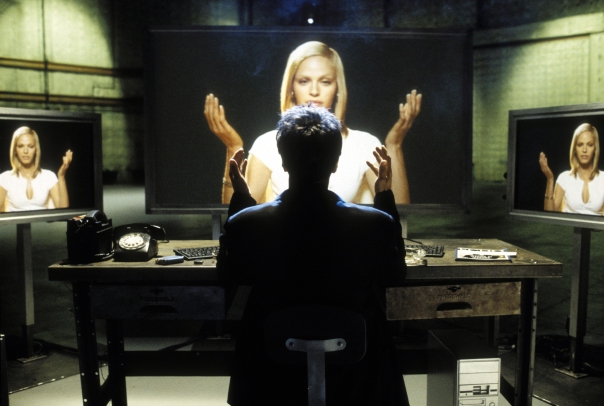
I cannot stand movie titles that try and force numbers into the place of letters. Don’t be Fant4stick, be Fantastic Four. Don’t be Thir13en Ghosts, be Thirteen Ghosts. Don’t be L4yer Cak3, be Layer Cake. Even one of my favorite movies of all time, Se7en, is guilty of this. I hate the implication of how you’re intended to say the new forced titled (Examples: Fant-Four-Stick, L-Four-Yer Cak-Three, Se-Seven-En). I find this all to be annoying, and I refuse to type S1mone as it was originally entitled, with a one replacing the “I” and a zero replacing the “O.” You get one number, that’s it, because it’s all my power to only do that much. End of re-view preface.
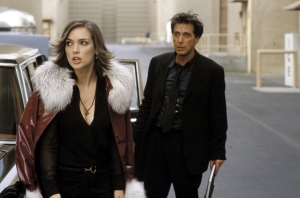 I thought going back to 2002’s S1mone could be interesting considering it was about cutting-edge technology possibly replacing actors and revolutionizing the film industry. Around 2001, with advancing special effects starting to touch the possibility of photo realism, this seemed like a possible turning point. Writer/director Andrew Niccol even considered using an all-digital actress for the title role of his industry satire after viewing footage of 2001’s Final Fantasy movie. He eventually decided against it, and we’re all the better for it because imagine re-watching this movie with twenty-year-old technology that fools the entire world into thinking Simone is real (cue teenage snickering). The character was played by model-turned-actress Rachel Roberts and her identity was kept a big secret around the time of the movie to keep the illusion that S1mone was cutting-edge technology. It’s ultimately proof that the real thing, whether that’s practical in-camera effects or even live actors, will always age better and have a place in moviemaking. As I said revisiting Final Fantasy: “Beyond the complexity that real actors can bring to performances, there’s the ease and cost that cannot be beat by a computer. Maybe in time this will change but for now rest easy Tom Hanks. You’re not going anywhere.” But hey, Roberts and Niccol have been married since 2002 and have two children together, so at least something came out of S1mone besides a title that causes me pain to type.
The big problem I have with S1mone, besides its title spelling, is that its satire with no bite, and its chosen point of view is actually the villain. First, this movie just isn’t funny. I was more charitable when I originally reviewed it back in 2002 but I didn’t laugh once throughout the near two hours. It weirdly feels absent much in the way of social commentary. Simone is an instant star and everyone falls in love with her. There’s a beginning entry into commentary when her creator, Viktor Taransky (Al Pacino), attempts to sully her image but only proves to make her more popular, but then that’s it. There’s a goofy, near-farcical quality to Taransky trying to hide the pretend nature of the world’s most desired actor. He even drives a car while operating a mannequin to provide cover. If Niccol wanted to really push this angle, there would be considerably more challenges for Taransky to maintain his illusion, getting more and more outrageous like steam building to a blowup. It’s not that this doesn’t happen but that Niccol’s screenplay makes it so absurdly easy for Taransky. He dictates that Simone wishes for her privacy and occasionally leaves behind some detritus of human life and that’s all it takes to establish a convincing existence. Nobody challenges him, at least not in a serious manner, which negates the conflicts and possible comedy of keeping the farce. Everything comes so easily and it makes the ensuring comedy barely explored if evident.
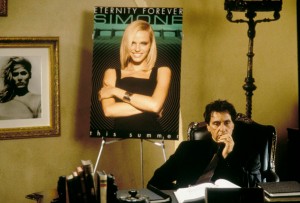 Another major drawback is that Taransky is the villain but the movie thinks otherwise. He’s sick and tired of the demands of actors. He has his complaints about working within the contradictory Hollywood studio system, but his major gripe is with working with actors. When the possibility of a photo-realistic replacement that will do whatever he says is offered, he snatches it. It’s because Viktor doesn’t view actors as people, and he feels the need to control and not to collaborate. He’s an artist with a capital-A but it’s the actors with their unwieldy egos, of course. It’s even more nefarious when you add an icky layer of misogyny to his actions. He wants a young woman who will do anything and everything he demands for his pictures. When the studio boss questions the extensive level of nudity for his next movie, Taransky says Simone will do it without hesitation because that’s what the role requires to accomplish his true vision. All he wants is a living doll to respond to his button-pushing without reserve or complaint. He wants an actor, and especially a woman of conventional attraction, to do his every selfish bidding.
At no point does the movie present our hero’s actions as being questionable or possessive. For him, all actors should just be replaced with ones and zeroes that will do whatever he wants, even nudity, and his perspective is strangely rewarded given Simone’s instant success within the industry. She literally ties with herself for the Best Actress Oscar. There may be a satirical commentary available about how quickly the public falls in love with their oblivious perception of celebrity, and how little they actually know the person behind the headlines, much like all celebrities of old and new, but the thematic work isn’t there. I kept waiting for Viktor to earn his delayed comeuppance, humility, or at least learn something of value, but through this misadventure he’s able to relaunch his career and even get his ex-wife back, so hooray?
This is also a peculiar outlier for Niccol as both a screenwriter and a director. He favors high-concept sci-fi scenarios, like 1997’s genetic have/have nots allegory, Gattaca, or 1998’s reality TV gone to its extremes drama, The Truman Show. 2005’s Lord of War is a powerful and slickly stylish condemnation on the global impact of arms dealers and gun trafficking and the bloody footprint of capitalism. S1mone is the lightest movie of the man’s career. Maybe he wanted a break from working on high-concept studio releases. 2011’s disappointing In Time likely lead him to a safer studio territory of adapting and directing 2013’s The Host based upon the YA novel by Twilight author Stephenie Meyer. I didn’t even know that Niccol has made two other movies since, 2014’s Good Kill and 2018’s Anon on Netflix. He’s listed as being the screenwriter for a 2027 Monopoly adaptation, so that could be a thing. Niccol is the kind of storyteller I want more often, a man with clear visions and ideas, but S1mone proves that he’s best suited for headier realms. Comedy is not the best fit for this man’s talents (I think we’re supposed to laugh at the very image of Pacino applying lipstick to kiss autograph photos).
 Is there anything of entertainment value here? There are ideas that could work with more attention and development. I liked the team of Pruitt Taylor Vince and Jason Schwartzman as investigators tracking down the pieces that don’t quite add up about Simone. I think there was a real opportunity to deconstruct the star-system of Hollywood and have Taransky finally able to launch his true artistic pursuits that had previously been denied without Simone’s attachment. Perhaps the movie just narrows completely to the window of Taransky making his dream project while maintaining his deep secret. Perhaps even make the movie a mockumentary, like the documentary camera crew has discovered this amazing fact and are promised continued access as long as they can help keep the secret for like two years, enough for the director to see his vision through and then use this as his swan song. Then the movie becomes focused on the mishaps and chaotic complications of getting one project off the ground while having asides that can tweak the egos of actors and producers and studio suits eager to work with the next big thing. I think that would have been an improvement over a movie where an aging director gets his groove back by fooling the world and suffers next to nothing in the process. The climax is low stakes just like the rest of the movie because the protagonist gets everything he desires with minimal effort. S1mone is an intriguing idea of movie that suffers from misapplication, under development, and a bad protagonist to celebrate and reward.
My initial review in 2002 was too kind. There’s too little below these ones and zeroes to count.
Re-View Grade: C-
Share this:

Prey (2022)
 Prey is the kind of Predator movie I have been clamoring for years to make. The franchise was in some major need of a mojo rejuvenation, and instead of constantly repeating the same stories to lesser and lesser effect (see: 2018’s sloppy release), the filmmakers finally saw the obvious and exciting answer. By placing the Predator into different points and places in world history, the producers have finally tapped into the creative potential of the equation of [cultural warriors] vs. alien bounty hunter. Each new movie allows a new selling point jumping from famous warrior to famous warrior. Imagine samurai versus the Predator, or Crusaders versus the Predator, or Vikings versus the Predator, or a Wild West showdown against the Predator. It would be like an intergalactic Deadliest Warrior franchise. It’s a super advanced alien species, so why can’t we establish that they’ve been flying to Earth for centuries for their recreational sport? Each movie can establish a larger mythology, but it also just supplies the fun of seeing history’s greatest warriors and different settings and cultures versus a powerful alien monster. Prey is the best Predator sequel, by far, and arguably as entertaining and engaging as the 1987 original.
In 1719, we follow a tribe of Comanche in the Northern Great Plains. Naru (Amber Midthunder) wants to be a respected warrior like her big brother, Taabe (Dakota Beavers), who cautions her about the weight of responsibility. She discovers strange tracks and is convinced that their tribe is not safe from a new predator. How little does she know how right she is.
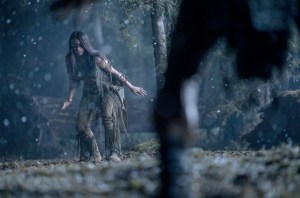 Within minutes, Prey had me. I’ve seen complaints that the first half is slow, but I think people are discounting the time needed to establish the ordinary baseline life of this community, their relationships and conflicts and goals and hopes, before introducing the change agent. That takes time if you want to be able to understand this different life but also if you want to really connect with the characters. The first half provides the foundation for the second half to run with and have bloody mayhem that counts as more than surface-level entertainment. The best compliment I could provide for screenwriter Patrick Aison (plus director Dan Trachtenberg) is that had the Predator never beamed down, I still would have found the story to be interesting. The details are rich and build an authentic picture of life 300 years ago before European colonists would completely upend indigenous life. The Predator series, at its core, has been a nativist underdog tale, where the primitive people of Earth have battled against the technologically superior alien warrior. The dynamic makes it easy to root for the Earthly heroes, but it’s even easier when you have a protagonist like Naru, fighting for respect as a woman already. The character is shown as headstrong but capable, and her mistakes provide opportunities for her to learn and better strategize later. I genuinely gasped when certain indigenous characters died. I’ve never had an emotional response to any Predator film.
The reveal of the Predator is cautiously handled, with the big guy taking time to explore his own surroundings. I enjoyed that this Predator also isn’t as advanced as his more modern ilk. He wears an intimidating alien skull mask and has more limited, though still high-tech, weaponry. I also enjoyed that this Predator feels like he has more of a personality. It’s not just a mirthless tall guy in a thick suit. The actor, Dane DiLiegro, is still providing a tactile, physical performance, and he has moments that reveal the cruelty of this alien but also its volatile temper, which is kind of hilarious. He encounters the wildlife and goes from snake to bear to man, right up the food chain, but some of his more violent kills demonstrate an almost petulant attitude. This is a Predator that doesn’t quite have it all together, and it makes the eventual battle with the Comanche feel like a conflict that has two sides that are worthy but also with their vulnerabilities. It makes the final showdown more interesting. It also allows us to take perverse pleasure in the big guy mowing down a team of predatory French fur trappers that imprison Naru and use her as bait. Oh boy, the gory comeuppance is fun.
 The action sequences are smoothly handled by Trachtenberg (10 Cloverfield Lane) who favors verisimilitude without sacrificing the visual artifice. The photography is gorgeous, and the emphasis on natural light and environments add so much the overall authenticity. Trachtenberg also knows what visual style will work best with which moments. There’s one scene where Naru sneaks back into the trapper camp and her vengeful fury is portrayed in a breathless long take to make the moment even more intense and enjoyable to appreciate the beat-by-beat fight choreography. The scenes with the Predator stalking in the fog play with claustrophobic suspense. The action has a very pleasing sense of construction that clearly presents the pieces that are needed for the scene-to-scene goals, and then the characters will adapt as necessary through organic complications. This is just good action construction, and Trachtenberg fields each like an expert.
Another fun addition with Prey is that they filmed it with two audio tracks, an English-language track and one fully in the Comanche language. It’s not the most necessary option since most viewers will likely simply watch it in English, or not know about the alternative until after watching, such as myself, but it’s an impressive addition that can make the movie even more immersive and authentic and generally considerate of another culture and language.
 Now, with all my points of praise for Prey, why oh why did Disney shunt this movie straight to its secondary streaming arm with Hulu? After the Fox merger, I understand that the Mouse House doesn’t quite see the same level of value in every Fox property not named X-Men or Avatar. This was restarting a franchise that still has some life in it, but even more than that, this is a good movie with plenty of artistic acumen that would have played splendidly on a big screen and an excellent sound system to really sell every fleshy slice and alien gurgle. It seems preposterous to me that a new Predator movie, let alone an actually great one, is denied theatrical release. I know the domestic box-office is still not what it was before the COVID-19 pandemic. I understand that Fox’s leftovers don’t have the same sexy appeal to the new bosses. It just puzzles me that nobody thought that they would make money off of Prey, which has proven to be a big hit on Hulu with critics and fans (ignoring cranky misogynists questioning the physical ability of women). Prey is a great action movie built upon solid characters and patient, clear plot and action development. When it comes to gore, I wish it wasn’t as heavily CGI and a more memorably gruesome, but that’s my only real criticism of what is fundamentally a fun and exciting movie. Give me more like Prey.
Nate’s Grade: B+


 nathanzoebl
You must be logged in to post a comment.