Blog Archives
Knowing (2009)
 Knowing is a movie about the consequences of seeing the Eternal Plan. If you could know the exact day of your death, would you want to know? How would that impact your life? Would you feel motivated to live every other day to its fullest, or would it cast a pall over the rest of your time? One character in Knowing is told the day of her death and it destroys the rest of her life. I think this topic is interesting but perhaps I’m in the minority. Knowing has been savaged by film critics, and I can certainly see the validity of some of their complaints. It’s not a flawless movie by any means, but I found Knowing to be an effective and suspenseful B-movie.
In 1959, a Massachusetts school buried a time capsule with drawn predictions of what students though the world would be like in 2009 (lots of robots and rockets, how we’ve let them down). One girl, Lucinda Embry, wrote a series of numbers. Flash forward 50 years. MIT professor John Koestler (Nicolas Cage) is a widower raising his eight-year-old son, Caleb (Chandler Canterbury). When the school reopens the time capsule, the schoolteachers pass out the individual letters to students. Naturally Caleb is given the envelope with the number code. He brings it home to show his father, who becomes intrigued and looks for patterns. John reasons that the string of numbers is an eerie predictor for major disasters around the world. They predict the date, the number that die, and the location via longitude and latitude. All of the numbered disasters have already taken place (including the hotel fire that killed John’s wife), but there are three more numbered disasters that have yet to happen. It?s about this time that Caleb is visited by mysterious thin men in long black trench coats. John seeks out assistance from Lucinda’s daughter (Rose Byrne), whose daughter also hears the same voices that Caleb does about an impending doom.
 Count me genuinely surprised at how taut I found Knowing. This movie builds a good head of steam and I dreaded what was to follow (in the good sense). When John figures out the exact design of the numbers, pinpointing date and location of disasters, he feels compelled to try and prevent the loss of life. Would you do the same? I think if I had been given a secret celestial code that predicted cataclysmic disasters that I would make sure to steer clear from those locales, rather than running to them. Director Alex Proyas (Dark City, I, Robot) expertly stages the carnage, to the point that I was grimacing and wincing. The plane crash, all shown in one unending shot, is a realistic nightmare that gets more and more disturbing. John hops through the wreckage to attempt to save people and encounters one burning victims after another, all screaming in terror. There are subsequent explosions amongst the wreckage that engulf more people in flames. The scene is spellbinding and unflinchingly horrific. The same can be said about the second disaster sequence in New York City, indelicately evoking some 9/11 memories. After these sequences I was dreading every moment leading up to the next, yet I was also perversely interested to see what would happen next.
I?m glad that the screenwriters tackled the fallacy of numerology early. One of John’s MIT colleagues says that people see what they want to see in the numbers, and surprise then they find them. This was completely the case with the ridiculous 2007 thriller, The Number 23. Jim Carrey went crazy deducing everything to one number, but it was the human mind projecting what it desired to see. The same thing goes for psychics who express vague statements so that the poor saps paying can fill in the details and make it personally relevant (“I’m thinking of a grandfather who died… He was a man?”). I had less of a logic gap with the numbers in Knowing. Granted, I have no idea which set of numbers the code is going with. For example, it lists a set number of deaths for the 2004 tsunami that killed over 250,000 people. But with such a massive event, how do we calculate the dead? There could be loads of people missing and presumed killed by the tsunami. Do people that die as a result of injuries count as direct victims, or are they victims of infection? My point is either the number code is going by the reported estimate on the news or has the exact number, which would be different than what the estimate was in the press. Either way, it presents a mild discrepancy for John.
The movie paints itself into a corner and the astute viewer will realize that it?s only a matter of time before one of the two supernatural A-words gets dropped as the force behind the strange occurrences (or a hybrid of both options). While the movie gets somewhat silly toward the end with its apocalyptic resolution, Knowing refrains from getting stupid. Yes it’s weird that John somehow lives in a giant house decorated to look like some peeling haunted mansion. Yes it’s weird that some supernatural force could predict every man-made disaster yet decide not to intervene in the biggest one. Yes it’s weird when Cage screams, “We have to go where the numbers want us to go.” But here’s the thing, Knowing is packed with ideas, some of them derivative (the ending borrows liberally from Arthur C. Clarke’s novel, Childhood’s End), but there is an ongoing discussion over the nature of science, religion, destiny and free will, and this discussion does not pander. I would have expected a conventional movie to transform John back into a man of faith over the amazing course of events, but it never fully happens. The movie never deduces that religious faith is the right prescription for our ailing times, and it even questions the ideas of divine intervention, namely that we live in a universe of determination rather than randomness, though it won’t specify what that determination is. The movie adheres to its pessimistic viewpoint right down to the end, which result in some ballsy choices for a mainstream Hollywood thriller. The heavy-handed ending didn’t break the enjoyment of the movie for me, though I expect it will for many.
 Not that it was needed but Knowing offers some nice little moments of characterization. I really enjoyed John’s monologue about his wife’s passing. He laments what he was doing at the time of her death, mainly blowing leaves off the lawn. He thought you were supposed to know, to feel something when your loved ones are in peril. He was just tending to the leaves, unaware of his wife’s fiery death. I really appreciated this insight into John and also how realistic the scenario felt: the depressing realization that the universe let you down. This seems like a much more believable reason for John’s scientific atheism than anything Mel Gibson went through in Signs.
The acting is cranked up to an exaggerated level of screaming. Cage spends a good portion of the movie with his mouth agape. The rest of the time he’s frantically screaming, which could account for most of the acting. It alternates between catatonic and hysterical. Cage is rather decent as his life is consumed by mysteries. I must say though that the acting only made me raise my eyebrow a few times and never pulled me out of the movie. This is no Wicker Man embarrassment of monumental proportions.
[Knowing is a solid B-movie with some super special effects to go along with its haunting scenes of disaster. It?s a step above your average sci-fi flick thanks to a lack of pandering to easy answers. I’m somewhat amazed that a movie this fatalistic and bleak would be greenlighted and given the budget it has. Proyas make sure the movie doesn’t succumb to numerology hokum, though the movie does tilt a bit toward the silly by its conclusion. I went into Knowing knowing little beyond the fact that the movie was ripped apart by other critics. Perhaps my positive reaction is born completely out of low expectations, but I found Knowing to be a juicy bit of sci-fi escapism that diverted the time nicely
Nate’s Grade: B
Share this:

Watchmen (2009)
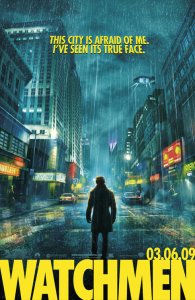 In the realm of comics, Watchmen is tantamount to the Bible. It consisted of 12 issues released between 1986-1987 but it arguable changed the medium forever afterward. TIME magazine listed the book, by author Alan Moore and artist Dave Gibbons, as one of the 100 greatest 20th century novels. Therefore, there has always been heavy trepidation within the geek community when Hollywood came courting the Watchmen property. Different directors have tried tackling the material, going back to the late 1980s when Terry Gilliam was hired to direct and producer Joel Silver was adamant about getting Arnold Schwarzenegger to portray Dr. Manhattan (back then, they totally just would have painted him blue — like they did when he was Mr. Freeze). The movie would seem like a tantalizing possibility and then the production would collapse, most recently in 2004 with director Paul Greengrass attached. Director Zack Snyder (300) understood all of the concerns from the notoriously vocal geek community and attempted to make the most faithful Watchmen film possible. He accomplished that goal. But was it the right goal?
In this alternative account of history, masked crime fighters exist and were even bankrolled by the U.S. government. President Nixon is re-elected to a third term, thanks in part to superheroes winning the Vietnam War, and then he outlaws all masked vigilantes. Flash forward to 1985, and Nixon is on his fifth term and staring down Soviet aggression into Afghanistan. It appears that the world on is on the brink of nuclear annihilation by the dueling super powers engaged in a staring contest. Edward Blake, a.k.a. the Comedian (Jeffrey Dean Morgan), is thrown from his apartment window and killed. Blake used to belong to a second-generation superhero team in the 1970s called the Watchmen. The other members consisted of Dan Dreiberg, a.k.a. Night Owl (Patrick Wilson), Rorschach (Jackie Earle Haley), Adrian Veidt (Matthew Goode), a.k.a. Ozymandias, the glowing blue man Dr. Manhattan (Billy Crudup), who was transformed into a god-like figure of power after a laboratory accident, and then there’s Laurie Jupiter, a.k.a. The Silk Spectre (Malin Akerman), who was following in her mother’s (Carla Gugino) footsteps, the first Silk Spectre. The death of the Comedian brings the old team back together and rekindles some interest in putting on the super suits and fighting crime one more time. It seems someone out there is trying to knock off the retired superheroes, and Rorschach is convinced that a bigger conspiracy is unwinding.
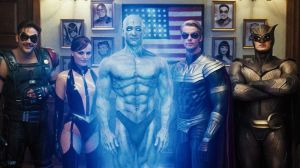 It’s difficult for me to formally express my feelings and reactions to the Watchmen film adaptation. Count me among the throng of fans that feels that Moore’s source material is a remarkably dense and witty deconstruction of the superhero mythos. Imagine a Superman that can’t be bothered to help out humanity because he feels life is overrated, or a group of super heroes that don’t necessarily do anything heroic; when they beat up the bad guys it’s because they get a sexual thrill from the rush of violence. My voice was among the cacophonous crowd screaming, “Don’t you dare butcher this great work! Keep it as close to the comic as possible!” And that’s pretty much what Snyder delivers. But now I’m left to wonder if a literal-minded interpretation is truly what I wanted all along. Watchmen is not like Sin City, a comic that was already a movie in panels. Frank Miller’s ode to film noir was ready and waiting to be a splashy action movie with style to spare. Watchmen is not a ready-made action vehicle, as it really only has about two extended pieces of action. Moore’s story examined what kind of people would become vigilante crime fighters if the government approved the practice. Surprise, it’s a bunch of sociopaths that are now getting checks from Uncle Sam! Watchmen is a nihilistic account of human behavior and far more cerebral than any superhero film that has ever graced the screen. Seriously, what other superhero movie opens with a fictitious episode of PBS’ political yak fest, The McLaughlin Group? So I suppose this paragraph is a sheepish way of admitting that perhaps Watchmen should have stayed place on the page unless, gulp, it was advantageously adapted for the medium of film.
It’s not that Snyder does a bad job or that the film itself is poor. While Snyder isn’t the best man to handle actors, he is certainly a skilled visual tactician and knows how to make some immensely pleasing imagery. He breathes great life into the images of the comic book and filled in the blanks nicely, and his one big artistic addition is one of the film’s best moments. In the opening credits we get a series of shots that perfectly establish this alternative universe, where JFK shakes Dr. Manhattan’s hand on the White House lawn only to be later gunned down by none other than the Comedian in Dallas. The segment is cleverly set to Bob Dylan’s “The Times They Are A Changin'” and is a terrific intro into a re-imagined America. I wanted to spend more time exploring the differences, like watching a giant Dr. Manhattan win the Vietnam War in one week’s time. In many ways, Watchmen is Snyder’s epic pop commentary on the history of the United States. Dr. Manhattan takes the first pictures of the astronauts on the moon. It is a female crime fighter that swoops a woman off her feet for that iconic celebratory kiss marking the end of World War II. The flick even has a period appropriate, synth-aided score, which is fine, though the use of period pop songs can be distracting. Watching Laurie and Dan make love to the raspy tunes of Leonard Cohen’s already overused tune “Hallelujah” is a deeply uncomfortable moment. Also, the aging makeup is horrendously bad. Gugino looks like she has a turkey waddle and the older Nixon looks like a freaking Halloween mask.
 At what cost did Watchmen make it to the screen? Wacthmen plays as an adaptation like the first two Harry Potter movies, like there was an assigned checklist rather than a fully developed script. I achieved a brief understanding with the characters and each central figure provides a glimpse of the trouble beneath the surface. Laurie is a girl with daddy issues who’s been pressured to follow her mother, a rape victim who still loves her rapist. Dan is a self-pitying putz who has never felt more alive than when he puts on a costume. Rorschach has the same pessimistic view of mankind that Travis Bickle did, viewing many people as vermin clogging the gutter. Yet Rorschach also is the most single-minded of all the characters and abides by an innate moral code and sense of duty, never mind the fact that he may have lost his mind. Dr. Manhattan has been turned into a supreme being and has lost his connection to humanity. The Comedian is a man of wanton desire who declares himself to be the epitome of the American dream: giving in completely to the id. Watchmen has been deemed as an unfilmable book, and perhaps they were right. It feels like Watchmen and looks like Watchmen, but the movie never seems to become anything grander than the sum of its parts. The Dr. Manhattan back-story, where we see him live life in the past, present, and future simultaneously may be one of the best moments in the movie, but it doesn’t add up to much more than an interesting aside. The trips to Mars and Antarctica provide nice visual landscapes but do little else. The other quandary is that everything Snyder cut from the comic (the side characters, the pirate comic, the alien squid) is something that ultimately was unimportant. All of the important and memorable moments from the comic are here, though abbreviated and truncated. Even a 2-hour and 40-minute movie feels like too much of a sprint through such rich material probably better suited to the more accommodating narrative confines of a glossy HBO miniseries. The movie ends up becoming a handsomely mounted and reverent homage to the source material, but I question if the movie serves any other purpose than as an advertisement to go read the book. Will people unfamiliar with the book enjoy a movie practically tailor-made to appeal to fans of the book? Who will watch the Watchmen?
Make no mistake, Watchmen is a hard R-rated movie and if any parent takes their child to this flick because it has men in capes, then that parent should have their child removed. Snyder has ramped up the book’s adult elements, which were originally a commentary on how comics flirt with sex and violence but never get their hands too dirty. Snyder has gotten his hands dirty all right. Instead of zapping others into poofs of smoke, Dr. Manhattan turns them into explosions of human goo that stick to the ceiling. Instead of the Comedian being thrown from the window, we see an extended fight sequence that seems to indicate that the Comedian’s apartment is full of nothing but breakable glass tables. When Dan and Laurie get into a street brawl where bones pop through skin. The sex scenes now involve an almost-agonizing level of thrusting. This is an adult tale in a very simple sense: there are boobs and blood. But the movie is also adult in the fact that it trades in complex political, psychological, and philosophic ideologies, asking hard questions that do not come with easy answers. Do the ends ever justify the means or is mankind destined to always destroy itself? Is humanity worth saving and at what cost? This is probably the most subversive studio-backed movie to come out of Hollywood since 1997’s pro-fascism melodrama, Starship Troopers.
 The three best performances in the movie all come from the three weirdest and most messed up characters. Haley (Little Children) fully inhabits the grisly character of Rorschach and growls his way through the movie. You can tell just by the man’s face how much he has weathered. Crudup (Big Fish) and his gentle voice make Dr. Manhattan an intriguing yet beleaguered super being. Morgan (TV’s Grey’s Anatomy) makes the Comedian one consummate bastard but a bastard that you cannot stop watching, nonetheless. The rest of the cast does suitable jobs and I don’t feel that Goode (The Lookout) or Akerman (27 Dresses) deserve the drubbings they’re getting through the critical community. I actually liked Goode’s portrayal of Ozmanydias, though he fails to express the heavy crown the smartest man in the world must bear. Gugino (Sin City) is terrific when she’s the young, spunky Silk Specter and the opposite of terrific when she’s the troubled, alcoholic older version on screen.
Snyder has served up the Watchmen that fans have been demanding for years, but is this really what everyone truly wanted? Snyder made an adaptation for the fans but what do the fans know except for lavish loyalty? The book utilized the medium of comic books to accentuated its story while commenting on the history of comics and superheroes, and when translated to the big screen as is Watchmen can feel like an artistic stillborn. I’m now more curious than ever to read the previous drafts out there, the ones that directors like Darren Aronofsky and Greengrass were going to film until the financing got pulled. One of the drafts transplants the world of Watchmen to modern day and replaces the nuclear brinksmanship with the Russians to the ongoing War on Terror. It may not be faithful to the fabulous source material, and it quite possibly would have made a terrible movie, but it would have been more interesting as a film project because it would have been an adaptation. Snyder’s Watchmen is reverent to a fault but I cannot complain too much. This is likely the most faithful recreation of a complex book that fans could hope for. I feel satisfied and yet unsatisfied with the finished product. It was everything I was looking for in a Watchmen movie and maybe, in the end, that was the problem. I think instead of buying the DVD I may just read the book again.
Editor’s Note: I have warmed up to this film much, much more on Blu-Ray, especially the 3-hour director’s cut. It’s Snyder’s best work to date.
Nate’s Grade: B
Share this:

The Incredible Hulk (2008)
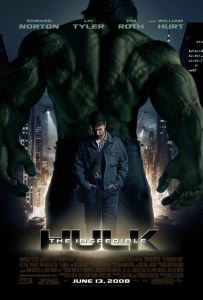 Maybe the American public just doesn’t care for the jolly green giant. The second incarnation of a big screen Hulk flick is better paced, with more action sequences and better special effects, but I just kept shrugging my shoulders the whole time. I was never truly engaged by the movie at any point. Edward Norton fills the role of Bruce Banner for the second go-round and does an admirable job. The climax involving one giant CGI monster battling another giant CGI monster gets tiresome. This is a fairly middle of the road movie that might pass the time but does little else with style.
Nate’s Grade: C+
Share this:

The Day the Earth Stood Still (2008)
 The 1951 original The Day the Earth Stood Still is considered a sci-fi classic for a reason. Versatile director Robert Wise (West Side Story, The Sound of Music) used a robot and an alien invader to help hold a mirror up to the world, asking how humanity was treating its brethren. The technology is easily dated and the tone a bit stately, but the movie is a complex, thoughtful, and relevant tale that begs for caution and kindness. It still holds up much better than most sci-fi chestnuts from yesteryear. And of course anything that film audiences have warm feelings for will be repackaged by Hollywood into a new more mass-appealing product. That means that big-budget Day the Earth Stood Still remake is likely to have no real improvement over the original. Well, it is in color. That’s an improvement for some.
A giant glowing spaceship lands in New York City’s Central Park. A glowing figure exits the craft and enters our world. This figure is Klaatu (Keanu Reeves) who is an alien creature in the guide of a human body. He has been sent by a community of planets to judge the inhabitants of the Earth. You see, the universe is an awfully large expanse of space but it has a limited number of habitable planets. The rest of the universe is taking note of how human beings have treated their home, and they may just decide that the planet is better off without us. Klaatu is helped out by a sympathetic scientist, Helen Benson (Jennifer Connelly). Eventually the alien escapes and the entire U.S. government is on high alert. Helen is trying to convince Klaatu to not rush to judgment. She’s also trying to connect with her angry step-son Jacob (Jaden Smith) after his father died in war. He’s not very trustful of Klaatu and, like plenty of other people, wants the alien dead.
 Whereas the original was a cautionary tale about the Cold War and mutual destruction, and Klaatu was a peaceful Christ-like figure, the new version skips all this. It would rather recycle a message that human beings need to be nicer to Mother Nature. Now, this is an important concern but it’s harder to take seriously when the movie pretends it’s all about doom and gloom and then basically wimps out on an ending. The film is ready to wipe humanity off the globe and even gets a head start with what looks like swarms of microscopic metallic locusts. But then Klaatu looks out at mother and child, embracing as the world they know may come to an end, and concludes that human beings deserve yet another chance because they have the ability to “change.” That’s all it takes? This kind of cop-out ending reminds me of The Happening, another eco-horror movie that wanted to kill off all those pesky humans but then decided they could walk the Earth a tad longer and hopefully wiser. I’m sorry but this is weak. Profess an environmental message but do something with it, don’t thump your chest about taking personal responsibility and then skimp on repercussions. Remember filmmakers that this is fiction. You have the ability, nay the right, to destroy mankind on screen while I safely watch and consume popcorn.
You know what else keeps hurting the weight of the environmental message? The lousy relationship between Helen and her step-son Jason. This entire storyline needs to not exist. I recognize that the original movie had a substantial storyline where a single mom and her precocious son befriend Klaatu, but that doesn’t mean this remake has to reignite old storylines if they just simply won’t work in this retelling. Every time the movie spends significant time with Helen and Jason I felt like the Earth was standing still. This storyline just does not fit. The kid comes across as bratty and dumb and I actually wanted him to be micro-locust food at some points. He’s angry because his father died and that makes him argue that “Kill them all” is a serviceable foreign policy position. Whatever. This storyline is handled so terribly that every moment of drama it is intended to evoke hits with a resounding thud. When the little kid suddenly turns on a dime and helps his alien fugitive, there’s no explanation. He says he’s afraid of being alone. Well what did you think would happen when you called the U.S. government to come and abduct you? I swear that I do not have a heart of stone, and I love children, but every moment of this character felt false and annoyingly so. That’s why The Day the Earth Stood Still grinds to a halt whenever it switches back to this kid. It makes the whole alien threat a lot less menacing when we spend more time with this kid. Don’t we have far more significant things going on in this story than one kid working through his grief and learning to be less bratty?
 Director Scott Derickson (The Exorcism of Emily Rose) doesn’t have a firm handle on how to establish an exciting action set piece, and he also makes his points very bluntly, though that’s also due to the script by David Scarpa. The beginning is the best part of the film, as scientists are whisked away by government authorities who can only say that the threat to the planet is grave. Interest is piqued at this point, as we, like the scientists, try and discover with a mixture of curiosity and anxiety what exactly the Earth is facing. It doesn’t much improve after the 15-minute mark. The movie just looks so drab. There is a discerning lack of action or excitement in a movie that threatens to eliminate the human race. The movie has long boring stretches that almost kill all momentum, and then the movie tries to compensate with an avalanche of special effects.
There are plenty of intriguing concepts and conflicts that fall by the wayside. In the original Klaatu hid among human beings and came to understand people, but in this new version he’s on the run from the start. I don’t necessarily need some tired fish-out-of-water comedy with Keanu, but seeing him learn about humanity before making a judgment is vital to his character. The remake opens in 1928 with aliens taking a DNA sample from a mountain climber (also Keanu Reeves) and then they use his blood to create a human host. What if that guy is still alive and sees his face on the news? What about his family going through and wondering what connection they might all have to the fate of mankind? Wouldn’t it have been easy just to swap Connelly’s character into this role and thus she is the descendant of that mountain climber and has to look in her grandfather’s face as he proclaims humanity’s end? That storyline would be more interesting and playful than anything with the step-kid.
Occasionally sci-fi movies can be partially redeemed by superior special effects. The Day the Earth Stood Still has some pretty shoddy effects that didn’t look much better when I watched the film in IMAX. The aliens have scrapped the older model flying saucers and decide to travel in giant glowing spheres, which may be awe-inspiring to see in person but it’s mostly lame to watch on screen. It’s not even that hard of a CGI effect to perform. The new likeness is completely wrong for Gort, one of the most famous movie robots of all time. In the 1951 original, Gort was a teen foot tall robotic guardian for Klaatu. Derickson has made Gort 40 feet tall and he looks weirdly like an Oscar statuette. The awesome robot is ridiculously captured by the U.S. military so that they can try and drill into it, which makes no sense at all. Then the robot transforms into that swarm of robo-locusts and that’s the last we see Gort in action. That’s just dumb. I would much rather see a giant robot wrecking havoc than a swarm tear apart Giants Stadium. The filmmakers decided that a hazy cloud would be more visually interesting than a giant robot. Give me more Gort!
 I must say that hiring Reeves was the smartest move that the movie made. Reeves’ naturally stiff and aloof line delivery works nicely as an alien trying to some to grips with his new flesh and blood body. Reeves consistently entertains and adds a dash of fun that is mostly missing in this humorless and stubborn remake. Connelly works with what little she’s given, and man can she make her eyes glisten in the most beautiful manner, tearing up at a moment’s notice. Most of the other actors are wasted in stock roles, including Kathy Bates as the Secretary of Defense and Mad Men‘s Jon Hamm as a man who only serves to spout exposition. That’s the dashing Don Drapier, and you give him exposition? I won’t belittle Smith’s performance because in all honesty the kid is a fairly good actor. It’s not his fault he got stuck playing a dumb character that routinely hijacks the movie.
The newest Day the Earth Stood Still does little to justify its existence. This remake would have been better served either cribbing more of the superior original film or just cut off all ties. The remake tries to incorporate plot points that don’t work while also trying to tell its own environmental tale with bigger effects, which also doesn’t fully work. The Day the Earth Stood Still is a plodding and unnecessary remake that fails to stumble into an exciting scenario despite the fact that it involves aliens threatening the planet. But hey, it is in color.
Nate’s Grade: C
Share this:

Hellboy II: The Golden Army (2008)
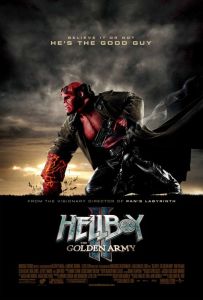 I disliked the first Hellboy, dubbing it the second worst film of 2004. The fact that I enjoyed the sequel is nothing short of shocking. Honestly, I think this mumbo jumbo is easier to swallow when it’s more fantasy based than science fiction based. I can accept an alternative magical world filled with elf princes, troll markets, and tiny “tooth fairy” creatures that act like piranhas with wings. Nazis and Zombie Rasputin trying to open a portal to giant squids? Hellboy II is even more imaginative and far more enjoyable. Writer/director Guilermo del Toro has refined the world and makes sure his story follows the rules it sets, which means that while the plot gets crazy it doesn’t feel cheap. I actually had some fun with Hellboy II and del Toro knocks out some pretty crafty action sequences. As expected, the makeup and creature designs are impeccable, which may explain why I had more fun watching the various magical creatures than following Nazis and slime wolves in the first flick. The lithe Angel of Death is particularly startling, with a head like a fried calzone and eyeballs dotted along expansive bird wings. This is a film that feels much more confident about its identity, thanks in part to getting rid of the rookie main character from the first film and focusing on the big red guy. If del Toro ever makes a third Hellboy film, I can honestly say I’ll be highly intrigued to see what weird wonders he cooks up. This statement is astounding considering I felt that there was only one 2004 film worse than the original Hellboy.
Nate’s Grade: B
Share this:

WALL-E (2008)
 At this point, is there anything Pixar can’t do? They’ve explored the secret life of toys, what’s under the sea, the pains of rearing a family of super heroes, and of course a rat that dreams of becoming a chef. Seriously, anyone that can make that last one not only work but one of the most sparkling, imaginative, enchanting, and poignant films of the year deserves every accolade in the book. Pixar’s newest film, WALL-E, is certainly its most ambitious and potentially its most rewarding yet.
The year is 2700 and the planet Earth has long been left behind by mankind. Humans have exhausted their resources and left behind a planet that looks like one never-ending landfill. Skyscrapers are being built out of garbage cubes. The Waste Allocation Load Lifter – Earth class (WALL-E) robots have been left to toil away and clean up mankind’s mess. There is but one WALL-E robot left and it leads a solitary life of routine. It gets up, it compacts trash into cubes, and it assembles those cubes into eventual giant structures. Then one day a probe lands called EVE. This floating capsule-like robot is easily frustrated and quick on the trigger and WALL-E falls completely in love with his unexpected new companion. The two become close and then EVE is taken away unexpectedly. WALL-E hitches a ride on the ship that collects his beloved and journeys through space to save her.
 I was having reservations citing certain words of praise but this film deserves every ounce of praise; WALL-E is a masterpiece. This is a beautiful story told in a beautiful way in a beautiful looking movie. I imagine kids will be tickled by the funny robots but I really believe that this film will play much better for adults, and when was the last time a mainstream, American family film did that? Most “family” films are an excuse to do something lowbrow and cynical to make a quick buck, like the atrociously cringe-worthy trailer I saw for Beverly Hills Chihuahua (seriously, a civilization of singing/rapping Taco Bell dogs?). Pixar, and God bless them, are proving with each new release that family films need not be brain-killing hours. That reliable Pixar quality touch is never more present than with WALL-E. If you told me that a film that takes place on a trash-filled Earth, with minimal dialogue, and a romance between two robots would be the most thrilling, moving, and wonderful film of 2008, I would have scoffed.
Writer/director Andrew Stanton (Finding Nemo) relies on a universal visual storytelling language to tell the bulk of his tale. WALL-E plays like a gloriously enjoyable silent movie where body language and physicality advance the storyline and provide surprising depth; ignoring brief TV clips of Fred Willard and Hello Dolly, the movie doesn’t have actual dialogue until the 45-minute mark. And it is fantastic. The character of WALL-E is immediately empathetic and the audience will see slivers of themselves inside this independent robot that finds another reason for being. It’s a simple love story told in simple strokes, but it just so happens that Stanton has provided great emotional heft to those strokes. The film has such a huge and vibrant heart. More is said in indecipherable robot bleeps than in much of the tripe Hollywood calls dialogue. Watching WALL-E court EVE, a bit unsuccessfully at first, begins as cute, moves into being adorable, and ends up being greatly touching and flirting with the profound. How many other movies, let alone romances, end with the long-desired climax of two characters merely holding hands? This movie is a delight from beginning to end and a classic example of the power of expert storytelling.
When the film transitions into space is when the potent environmental message, and subversive satire, emerge. Beforehand we have witnessed the awe-inspiring landscape of Earth littered with garbage and empty shopping centers. Humans left the Earth to wait for the robots to do all the work and make the planet hospitable for life once again. For the last 700 years humans have been living in a heavy-duty luxury spaceship. Humans have grown to be fat, lazy, and completely self-involved; people only communicate with others through video screens, even when the other person is inches away. The movie also manages to satirize consumer culture, and in the future one corporate behemoth essentially dictates life’s choices; I found it highly amusing that the former president of the future (a live-action Willard) is also the CEO of the super corporate conglomerate. Business and government have merged completely. The social commentary isn’t as merciless as Mike Judge’s Idiocracy, nor is the environmental message subtle in the slightest, but the satire is sharp enough and blunt that some viewers might be offended, and I think that is genius.
Being a Pixar film, naturally WALL-E is resplendent to look at. The animation is superb and the imagination on display seems limitless. This is one of those films I’m certain I could watch again and again and find something new every time. I don’t really need to say much more about the visuals because they are breathtaking to behold (Roger Deakins, by the far the greatest living cinematographer, was even consulted to help with the look of the film. How awesome is that?).
 And yet even though WALL-E is primarily a love story the film also manages to be greatly exciting and equally funny. Stanton’s screenplay nimbly assembles characters and reintroduces them at key points to push his story onward. I loved that WALL-E is introduced to all sorts of unique robots on the mankind’s space ship and that he even stumbles into, more or less, a group of malfunctioning robots that come to his aid (think the Island of Misfit toys). Stanton manages to reconnect his storytelling threads so that every moment in this movie matters. The last third of the film is a back and forth cat-and-mouse struggle that manages to pump up suspense in smart ways. Stanton lays out his scenario for action and then builds organic complications. I am deeply satisfied when a filmmaker has a firm command of action that they can setup a situation, establish the rules, and then naturally construct obstacles and surprises that feel natural and germane to the story. Pixar has always been able to craft exciting action scenes that felt fully realized and WALL-E is no different.
If there is but one minor quibble I have with this near-perfect film, it is the missed opportunity to explore the mortality of robots. While WALL-E is going through his day-to-day duties he passes by older versions of other WALL-E models. The movie could have pushed just a little harder with the concept that this tiny robot is going to live to collect trash and then die like all the rest, becoming another piece of forgotten garbage. I think if Stanton had only explored this idea a little more it would have made his robo-love story even richer considering that both robots are going against their programming because they have found something that completely changed their world — love. The idea of mortality was explored to excellent effect in 1999’s Toy Story 2, so perhaps the Pixar folk didn’t want to fall into a philosophical repeat.
WALL-E is a wonderful love story, a heartfelt and immensely charming character piece, and a thrilling sci-fi tale that soars to broad heights of imagination. It’s timeless while still being rather timely thanks to its environmental message. Moments after the movie was over I wanted to see it again. I think I’ll feel the same way after the second viewing and the third. This is a phenomenal movie that will stand the test of time as one of the greats.
Nate’s Grade: A
Share this:

Indiana Jones and the Kingdom of the Crystal Skull (2008)
 I lived in New Haven, Connecticut for a year while then-partner was earning her Master’s degree at Yale. We hated it. New Haven is a college town that doesn’t know it’s a college town, so everything closes at 10 PM, there are no student prices for anything, and the people there more or less sucked. We were happy to depart from the Nutmeg State. Then the week after we were going to leave was when Steven Spielberg, Harrison Ford, and the production team for Indiana Jones and the Kingdom of the Crystal Skull were coming to town. They were going to film a motorcycle chase along Chapel Street (where I walked to work every day) and all along the Yale campus. Finally, a reason to stay in New Haven presents itself and it has to happen after we escape. It’s not often one of the most anticipated movies comes to your doorstep.
I could have been an extra in the motorcycle chase, which set in 1957, could have used a long-haired Beatnik type (played by yours truly) for an exaggerated reaction shot. I could have been sipping on an espresso and then Indiana Jones could have zoomed by on the bike snatching by hot beverage, leaving a long-haired Beatnik type (me again) to mug shamelessly for the camera. It would have worked. Alas, it was not to be, though it certainly would have made this ages-in-development sequel more enjoyable on my part.
It’s been a long time since part-time archeology professor and full-time treasure hunter Henry “Indiana” Jones (Ford) beat the Nazis. The world has gotten a lot more complicated thanks to the Cold War, the atomic bomb, and the fact that Jones is now well into his 60s. It’s been 19 years since his last adventure but the man with the bullwhip and the dusty fedora still has a knack for intrigue. Soviet KGB agents have captured Indy and his friend Mac (Ray Winstone) and taken them to the Area 51 warehouse. They’re seeking a recovered artifact of alien origins that can wield tremendous power, as they always do. Irina Spalko (Cate Blanchett) is the head KGB agent and likes to threaten her enemies with a riding crop (perhaps she earns some extra money on the side punishing bad, bad comrades). Indiana Jones manages to escape and is pursued by the Soviets and blacklisted by his government due to his perceived involvement with Russia.
 Mutt Williams (Shia LaBeouf) seeks out the help of Dr. Jones. Mutt is a greaser on a motorcycle that might be a chip off the old block. His parents are in trouble. The stepfather that raised him (John Hurt), an old archeology buddy of Indy’s, has traveled to South America and found a legendary crystal skull. The bizarre artifact would lead the way to the mythical golden city and crazy amounts of Mayan supernatural power. Unfortunately, the skull has also made him as batty as a bat and Spalko is going to kill him. Indy and Mutt fly down to South America to save the crazy old man. Oh, and Mutt’s mother is also in danger, and she would be none other than Marion Ravenwood (Karen Allen), who has plenty of romantic history with a certain swash-buckler afraid of snakes.
Seeing Ford back in action just feels right. His character has grown into a bit of a curmudgeon but he’s working the same territory Bruce Willis did last year in the long gestated Die Hard sequel. He’s an old man serving some justice to all these young punks that won’t get off his lawn. The film acknowledges his age and mostly uses it as a means for comedy (he cracks that a life of adventure isn’t “as easy as it used to be”). Ford looks more alert than he has in years.
Blanchett is one of our finest actresses on the planet but she has serious trouble maintaining her Ruskie accent; she alternates between Russian and British the whole movie. Her dominatrix-styled villainess is certainly interesting, and man does she have great posture, but the film doesn’t really know what to do with the Soviet bad guys. They become more or less Nazi stand-ins and seem to repeat the same ambitions that the Nazis carried out in two or the three previous films. Allen has aged magnificently and is a welcome return. She and Ford have terrific screwball comedy chemistry and pick up right where they left off in 1981’s Raiders of the Lost Ark. LaBeouf does a solid job even though he doesn’t have any meat to his character after his Marlon Brando-like introduction in leather jacket and motorcycle. Instead, Spielberg continuously winks at the audience about Mutt’s obvious familial line. It wouldn’t be a Spielberg movie without some family dynamic.
 I’m pleased to reunite with Indiana Jones, I like the new characters, and I even like Mutt, but the story the characters are saddled with is lousy. This is the script that Ford, Spielberg, and co-creator/producer George Lucas all agreed upon? I’m not one of those people that have an issue with aliens being the primary movers and shakers in the plot (in informal talks with friends, many are upset that little green men are the stars). The first three Indy films dealt with a religious supernatural power and now this new installment covers a space alien supernatural power, so that doesn’t concern me. What bothered me is that Crystal Skull is a murky mash-up of [i]Temple of Doom[/i] and Stargate. Once the primary characters reach their hidden temple the movie takes a nosedive. Spielberg almost crafts an anti-intellectual message, where finding out the reality behind the magic ruins the soul. The exact story behind the Crystal Skull is frustrating in how oblique it is, and Spielberg doesn’t want to offer any clarity. I’m at a loss to explain exactly why anything happened in the concluding 20 minutes, least of all how an alien race must have a very different definition of the word “gift.”
Never before has the action in an Indiana Jones film come across as so campy. This is likely the most disappointing part of Crystal Skull: the action is too tongue-in-cheek. There were moments where I thought the film was one step away from Army of Darkness. Spielberg is enough of a brilliant tactician to know how to setup and build satisfying and stylish action, which normally involves organic complications and letting the audience fully grasp what’s happening. This means no rapid-fire edits and plenty of long, high angle shots to get the big picture. And when he’s in his groove, there are few that can top Spielberg when it comes to an action sequence. There are points in Crystal Skull where the action is rollicking and joyously packed with excitement and wonder. The opening sequence inside Area 51 starts the film off with a bang, the motorcycle chase through Yale is well choreographed, and a car chase in the jungle is fantastic in the amount of back-and-forth scuffles and emerging obstacles. It’s by far the film’s high point and then there was one point where Mutt was swinging from vine to vine like freaking Tarzan and he enlisted the help of monkeys. It took me completely out of what had been a rip-roaring action sequence. Then there’s the moment where Marion drives everyone off a cliff and onto a tree that bends to drop them safely before smacking back like a rubber band. I’m not asking for complete believability in an action caper but I’d prefer it not become an embarrassing Looney Tunes cartoon. Crystal Skull is filled with little moments that will completely yank you out of the movie.
The action sequences feel too pat for the material the film wants to cover. Even that great jungle car chase could have been boosted with some extra ingenuity. The scene opens with the Soviets driving a vehicle that is slicing the forest to splinters and clearing a path for the caravan of cars to follow. Now I know the Spielberg of 1981 would never have introduced such an interesting machine in a unique setting without using it later. The Spielberg of 2008 is different because this nifty blade mobile isn’t even seen again after its initial introduction to establish how a car chase in a jungle could be possible. The action relies too heavily on distracting CGI that takes the action sequences on annoying, over-the-top detours. Just because computers can make it happen doesn’t mean it’s always a good avenue to go down. In short, the CGI is undercooked and over used.
 I also need to speak frankly about the CGI — it is terrible. However, when I watched Crystal Skull my party got a tad lost on the way to the theater so the only seats left were the third row from the screen. I spent the entire movie with my neck craned up. Perhaps if I saw the film in a position it was more intended to be seen the special effects would come across as more professionally polished, but from my neck-cramping position they looked pitifully amateurish for a major summer blockbuster with Spielberg and Lucas’s names attached. The effects work is shockingly shoddy, but the practical production design is amazing. Unfortunately, this does not balance out in the film’s favor.
I’m coming across as harsh but I only get this way when my expectations are raised because of a pattern of quality. The three prior Indiana Jones films were lively, imaginative, and deeply charming and satisfying adventures that leaned toward the exaggerated but still managed to thrill without feeling dumb. Raiders of the Lost Ark is one of the few perfect movies in existence, in my opinion, and set the standard for all action/adventure movies to follow. It’s unfair to expect the same sensation watching a sequel 19 years after its predecessor, but Kingdom of the Crystal Skull does manage to hone in on the same spirit that made the other Indy films such high-flying thrill rides. If you set your brain to a low frequency, enter the theater with lowered expectations, and already know that at one point Mutt will swing from vine to vine like freaking Tarzan, then Crystal Skull will provide the necessary popcorn entertainment you’d seek in a summer blockbuster. It is possible to think Crystal Skull ranks up with its predecessors but that requires so much contortion that I wouldn’t know how to arrive at that opinion. I suppose we should all resort to the consolation that even with E.T. taking over the plot, this thing could have been a lot worse. Just remember that if an alien offers you a “gift” to run in the other direction.
Nate’s Grade: C+
Share this:

Jumper (2008)
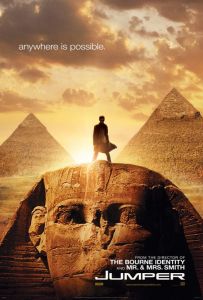 The premise for Jumper seems like adolescent wish fulfillment. Who wouldn’t want the ability to instantly get away? Plus, being able to instantly vanish would unleash an inner Lothario in some men, causing them to love the ladies one night and leave them high and dry the next morning. Having the ability to be anywhere at a moment’s notice is quite a powerful gift but could it lead to tremendous vanity? Director Doug Liman doesn’t seem too interested in all the interesting possibilities afford by teleporting teenagers and instead unleashes what feels like an empty prequel to a hopeful sci-fi franchise.
David (Hayden Christensen) is a shy kid at school when he discovers one day that he has the ability to instantly transport himself to another location simply through the power of his mind. David uses this teleporting ability to, naturally, rob banks and build a cushy lifestyle for himself. He can snack on top of the Sphinx’s head, surf along Australian waves, hang off the clock face of Big Ben, and best of all, he never needs to reach for the TV remote again (seriously, David teleports from one couch cushion to another just to snag the not-too-distant remote). David is a jumper and he discovers he is not alone. Griffin (Jamie Bell, the true star of the movie) has the ability as well and enlightens David on the perils of the jumper lifestyle. Paladins have been hunting and killing jumpers for hundreds of years. The Paladins carry staffs that shoot electrified tethers out, hoping to wrap up the jumpers. The electric bolts stop the jumper from being able to concentrate and escape. Roland (Samuel L. Jackson), a head Paladin, explains that “only God should be able to be all places at all times.”
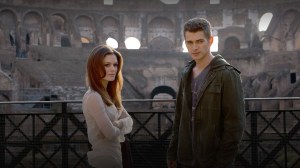 Complicating matters is that David has reconnected with his high school crush Millie (Rachel Bilson). He whisks her off to Rome and they break into the Coliseum together like crazy kids do. He’s vague about where he’s been for 8 years and says he can afford such expensive getaways thanks to his “banking” job. But Roland is circling and plans on getting to him by any means, even if poor Millie gets gutted in the process.
Jumper has some flashes of excitement and a halfway decent premise, but this film is completely hollow on the inside. Liman must have been too entranced with his premise to ask for anything substantive from his slew of screenwriters. The movie has a handful of great images and moments that surely make for a crackerjack trailer, however, there is hardly any attention paid to plot or character or even enticing action. There is one good chase scene between two jumpers going through many stops around the globe; one second they’re running on a beach, the next through downtown Tokyo, and another falling off the Empire State building to landing safely inside a community swimming pool. The pace is a little too break-neck for my taste but the sequence is high on imagination and finally plays with the fun possibilities of teleporters otherwise ignored by the film. That’s the highlight of the movie, right there, and yet even it feels mildly derivative of the sequence in Being John Malkovich where Cameron Diaz chases Catherine Keener through the subconscious bowels of John Malkovich’s memory. This is a movie that asks little of its audience because the filmmakers barely scratched the surface with their material. The execution is a wash and the movie feels like a scattered sightseeing tour told by someone high on crystal meth.
The characters are pretty shallow and powerfully bland, and the romance between David and Millie is entirely contrived and unbelievable. In fact, Millie isn’t a character but a plot contrivance. In the beginning she’s established as the caring girl next door for adoration, then flash ahead years later and upon her first reunion with David she has sex with him because, well, I don’t know, because the plot demands some impromptu sex. Then her purpose is to serve as a broken record of morality; a good hour of Millie’s dialogue is reiterations of the lines “What’s wrong?” “Are you okay?” and “What aren’t you telling me?” It gets really annoying and all she does is keep repeating these queries while David drags her by the hand through Rome. It also hurts that Christensen and Bilson have zero chemistry together. But expectantly, Millie’s final purpose is to be the damsel in distress that requires rescuing. Millie’s lax characterization is emblematic of the film as whole. She and the other characters serve a strict, utilitarian purpose to move the plot forward when it’s called for, but the plot isn’t even that good!
The audience is willing to accept the unbelievable as long as it makes some for of logic on its own terms. People have the ability to teleport, got it. But then the movie throws in the Paladins and gives us little explanation. These grey-coated hunters are some religious order or something and have hunted jumpers since the Middle Ages, though their grasp of technology must have improved. I wanted to know more about these hunters, and “religious fundamentalism” seems like a lazy excuse for motivation. Why do these people go to such great ends to kill jumpers? What is their history? Why do they use tazers instead of guns? If a jumper can’t dodge an electric cord then surely they wouldn’t be able to dodge a bullet. How come the jumpers don’t use guns to easily knock off the Paladins? If this is an ongoing war then how come no one else has caught on to the massive collateral damage of the battles? The jumpers leave trace damage to wherever they appear, so how come no one else seems to have caught on? Just like all the other plot elements, the Paladins are established and then ignored by the filmmakers. I kept finding my mind wandering and I created my own intriguing back-story for the Paladins, one where the insurance companies of the world are sick of losing money to the self-serving jumpers, so they subcontract the Paladins to kill these financial fiends. Right there I just spent more time thinking about how to make this movie interesting than the people responsible for making this movie interesting. The corporate avenging angle is more fun than simply making the villains an age-old religious sect like they were plot leftovers from The Da Vinci Code. This movie needed a whole heaping helping of exposition to provide some minute level of clarity to all the flash and noise.
 There are so many plot holes and loose storylines that it seems like the filmmakers had the delusional thought that this movie was the first step in a franchise. Because of this belief, we are treated to every single character being left hanging and there is no resolution or sense of finality. The subplot with David’s mother (Diane Lane) is tacked on with promise of addressing it in the future. Jumper doesn’t so much end as put everyone on hold, including the audience.
Liman delivered on his Hollywood potential with 2002’s Bourne Identity and 2005’s Mr. and Mrs. Smith, so Jumper is a pretty crushing letdown for a man with such a great mind for inventive action sequences. Liman is sunk by such a terrible script, but it almost seems like the plot was dictated by Liman’s handful of visual cues he had in his brain. There are some nifty images and a couple of cool moments, but cool moments do not make a 90-minute movie, and Jumper lurches from plot point to plot point with depressing routine. There’s so little imagination with the brief, lackluster action sequences given the sheer possibilities with teleporting.
The acting seems on autopilot. Christensen is too bland for words. I repeat my earlier prediction that Christensen will likely be nothing more than the human equivalent of a vacant, pretty mannequin for his acting career; though I must suggest that everyone see his one piece of acting greatness in 2003’s Shattered Glass. His character in Jumper is pretty much a cipher for the audience to have some vicarious, globe-trotting fun, but David is pretty hard to like and doesn’t give an audience much insight into his character. His monotone delivery buries the cheesy dialogue. And, as a die-hard Ohio State fan, it made it even harder for me to root for an Ann Arbor kid. Bilson is pretty but relies on looks of anxiety and sensuous lip biting to display the depths of her one-note character. Jackson delivers a performance suitably in the Samuel L. Jackson canon of screaming and scowling, this time with a white buzz cut hairdo.
If I were being charitable, I’d say that the absence of a succinct story and sufficient characters is because Jumper feels like the pilot to a franchise. But I’m not being charitable. I expected much better from Doug Liman than 20 minutes of setup and another hour of shiny, flashy diversions with little context. The premise isn’t capitalized at all and for a film about the thrilling possibilities of having the world at your fingertips, this movie sure lacks any sense of whimsy and fun. Jumper tells the audience that it has the power to go anywhere, but all I wanted to do was transport myself into a different theater.
Nate’s Grade: C
Share this:

Cloverfield (2008)
 I can think of no movie that has come out of virtually nowhere to build tremendous hype like Cloverfield. Before the summer of 2007 this movie didn’t appear on anyone’s radar whatsoever, and then came a teaser trailer before Transformers. The tease was nothing but party footage of well-wishers when, all of a sudden, explosions are in the distance, people are fleeing, and the Statue of Liberty’s severed head rolls to a stop in a street. Bam. Release date. Nothing else, not even a title. All of a sudden the world had an insatiable appetite for everything Cloverfield. Mega-producer J.J. Abrams had done it again. In one fell swoop he took control of geek nation. I never expected Cloverfield to live up to the massive hype, but this modern monster movie delivers more bangs than whimpers.
The first twenty minutes of the film introduce us to our cadre of yuppy characters. Rob Hawkins (Michael Stahl-David) is leaving for Japan to take a business promotion. His friends throw him a surprise going away party to celebrate and wish him the best. Rob’s brother Jason (Mike Vogel) and his girlfriend, Lily (Jessica Lucas), start videotaping the party. Jason hands off the taping duties to Hud (T.J. Miller) who, thankfully, has a much steadier hand. Hud walks around the party gathering interviews and he zeroes in on Marlena (Lizzy Caplan), a gal he’s been nursing a crush on. Rob is nervous to see if Beth (Odette Yustman) will come to the party. Beth and Rob are long-standing friends that took the plunge and had sex a couple weeks prior. Now Rob is hoping for something more but Beth isn’t on the same page; she brings a date to the party. Interrupting all this twenty-something relationship drama is a giant monster attacking New York City and dropping little baby monsters to scurry the streets and feed.
 While not entirely unique, Cloverfield is certainly a reinvention of the dormant monster movie. By seeing its gimmick through to the very end, the film gives a perspective rarely seen in movies that involve cataclysmic disasters. Usually films that involve space aliens, monsters, or some form of incredible destruction follow the people in power, the Army generals, the politicians, the President of the United States as he solemnly looks out his office window and says “God help us,” under his presidential breath. Cloverfield, however, eschews all of that. This movie is all about people caught on the peripheral of a disaster and just trying to survive. They have no idea what’s happening, they have no idea when they will be in danger, they have no idea where to go, they have no idea how long they have, and they definitely have no idea what it is that’s obliterating the city. The film dares to place us in the shoes of ordinary civilians as they document the fantastic. The “found footage” concept and the ordinary perspective are interesting though some will quibble that staying inside one point of view is too limiting for the scale of Cloverfield. This film is more than The Blair Witch Project meets Godzilla; this movie is a collective manifestation of the nation’s 9/11 anxieties. Cloverfield is the first 9/11 disaster movie. The shock and confusion of the situation take on even more resonance by triggering some of the same emotions many experienced on that fateful day in 2001. And yet Cloverfield doesn’t feel exploitative or disrespectful as it draws upon our 9/11 memories and fears, which is saying something substantial about the filmmakers’ skill and the remarkable healing power of time. Some images are unmistakable, like a white cloud of dust that blows through the city and also helps to shroud the monster. People scamper around the city yelling for some kind of explanation when some character, offhandedly, says, “Do you think it’s another terrorist attack?”
The film is also got some fabulously frightening moments that are not related to 9/11 anxiety. Cloverfield is a great, old school horror movie on top of a subversive social experiment. Talented writer Drew Goddard has had experience building tension on some of TV’s finest shows, like Buffy, Angel, and Lost. Now with his debut screenplay, Goddard cranks up the suspense and creepiness to maximum effect. Part of the horror is trying to find meaning in the madness but another equally enjoyable part is walking into perfectly executed classic horror moments. You will be on edge about what could possibly be around a corner. Our band of survivors decide to walk through the subway tunnels and discover that Hud’s camcorder has night vision; sure enough, you are waiting with baited breath for the second that night vision is shifted on and something pops out in view. There’s a distinct difference between cheap jump scares and spooks that, as I say, earn their boo. This tunnel scare is catapulted to frightening from the ominous buildup that comes from seeing hundreds of rats running away. When I saw the fleeing rats, I knew something very bad was coming from behind. The structure is clever as Goddard gives us back-story on Beth and Rob via the original footage of them canoodling that cuts in here and there. Goddard earns his stripes with a script swiftly paced, filled with genuine scares, and smart enough to keep an audience laughing with gallows humor at key moments (“Okay, so our options are… die here, die in the tunnels, or die in the streets.”).
 You the viewer are in the middle of the action with this film and there’s no getting out, no distancing yourself from the chaos, no watching men in lab coats and military uniforms dissect the situation over large boards. The gimmick of Cloverfield is flawlessly executed thanks to director Matt Reeves, who spectacularly resurfaces from movie jail after writing duds like The Pallbearer and Under Siege 2: Dark Territory. Reeves explores some dark territory of his own but never breaks the tenuous tone needed for the movie to succeed. The movie is constructed with many long takes and it never exposes its secrets. I watched spellbound by the artistry of maintaining the illusion from beginning to end. Watching the Brooklyn bridge collapse from the inside is exciting and terrifyingly real. Reeves and Goddard smartly decide not to show their monster for as long as possible. Catching glimpses of a shadow or the flash of a tentacle-like appendage are enough to register goose bumps; the human imagination will always be more capable of engineering horror. Eventually the film does give its monster the proverbial close-up and the giant, skyscraper-sized beast looks a little familiar in design (think Vin Diesel sci-fi movie).
Cloverfield is a well-executed genre movie with a clever concept that is fully realized. The constantly bouncing and roving handheld camera might make an audience queasy, but the perspective of the end of New York City as brought to you via YouTube is stimulating and a comment on our self-absorbed culture. The film works as a finely tuned fright film elevated by its stylistic concept and the filmmaking skill to pull it off. Cloverfield being “found footage” and evidence from the Department of Defense doesn’t exactly bode well for the characters onscreen, and the film dispatches them with cool malice. No one is safe and no one can stop what’s coming. If that doesn’t sound like the perfect summation of 9/11 fears, then I don’t know what else is.
Nate’s Grade: B+
Share this:

I Am Legend (2007)
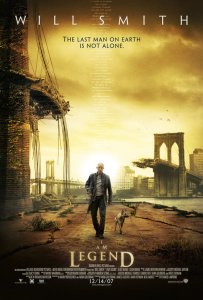 Ever wanted true and ever-lasting quiet? Be careful what you wish for. Super buff scientist Robert Neville (Will Smith) is the last known survivor of a virus that swept throughout the world in 2009. The U.S. government quarantined Manhattan and military jets blew up the bridges leading out from the island. Now in 2012, he and his lone companion, a German Shepard, must seek out supplies by day, because at night is when the “dark seekers” come out. These mutated creatures are what are left of those that fell prey to the virus; they can only come out at night and feed on blood. Smith has been capturing the creatures to run tests to see if he can crack the virus and offer a cure, except that the emerging creature hierarchy doesn’t exactly like having their members captured for scientific experiments.
Deeply unsettling, I Am Legend comes across like a post-apocalyptic Cast Away? but with vampires. I think they’re vampires, they kind of unhook their jaw like from The Mummy and have goopy gelatinous skin like from The X-Files Movie; they’re attracted to blood and burn in sunlight, therefore through my non-scientific analysis of fictional creatures, they’re vampires. Case closed. The movie shrouds the details of the end of the world in mystery that it doles out via flashbacks, and it works very well at keeping an audience intrigued without opening the door for distracting nit-picky questions. Being the last man to walk the planet presents all kinds of interesting scenarios, and simply watching Robert Neville go through his daily routine is entertaining. He picks up DVDs to watch, many of which he has seen so often he can recite line by line. He drives through the empty streets of New York trying to hunt stray deer. He tests his newest serums on infected rats. He sends out a radio message looking for survivors. The man even pumps his own gas. And then night comes and he barricades his home and sleeps in a bathtub listening to the voluminous howls of the creatures he now shares this world with. There’s a pleasing rhythm for an audience with routine, but it also helps answer the biggest question of adaptability. How would someone go about his or her daily life without another human (key word there) soul? The adjustment is part of the enjoyment. Many films and TV shows have walked this path before, hell half of the Twilight Zone episodes cover this scenario, but I Am Legend presents an awe-inspiring sight of desolation. Seeing birds-eye view angles of deserted Manhattan streets, overcome with encroaching grass and plants, is chilling and morbidly effective. The eerie quiet of the day may be even scarier than the dangers that lurk by nightfall.
 This is pretty heavy stuff for a Hollywood movie. After a taped TV interview that sets up how the virus began it immediately cuts to three years later and complete desolation. While there aren’t bodies strewn about, the lasting remnants of humanity are visible be it lines of empty automobiles or houses stockpiled with food and decorated for a new baby to arrive that never will. Death permeates every frame, and Neville dismisses the idea of “God’s plan” by declaring 90 percent of the population died immediately, 12 million proved immune and healthy, and 588 million turned into the “dark seekers.” Understandably, I Am Legend may be a bit too intense for younger kids and there are some late plot turns that will make animal lovers cringe.
Besides being an interesting what-if scenario, the movie is also a skillful, tense, and occasionally harrowing thriller filled with scares. The aforementioned moments of quiet are definitely eerie when presented on such a mass scale, and for a place as naturally noisy as New York City, but I Am Legend still has some classic spook moments that can still tingle a spine. When Neville’s dog runs into a dark building he follows, and every step becomes a great addition in terror. It’s your classic afraid-of-what-you-can’t-see scenario that horror milks, but I Am Legend invests the audience in Neville, and yes his furry companion, so that there’s genuine apprehension as we plunge into darkness. The CGI vampires won’t quicken the pulse alone, but add in the idea that every human being on the planet, your friends and family, has turned into a predatory creature and then the situation becomes more disturbing. When the vampires trick Neville and wait for the trickle of daylight to expire, the movie is downright nerve-wracking in the best way. The scene plays out at an agonizingly slow length that pins the viewer to the chair.
Smith gives a fabulous unnerved performance as, seemingly, the last man on Earth. Smith is an actor known for his wide grin and intense charisma, so plopping him down in a post-apocalyptic world doesn’t seem naturally ideal. There are long stretches where he is only acting alongside a German shepherd for companionship. Neville is dramatically lonely and befriending mannequins, including one female mannequin that he is working up the nerve to talk to in the video store. Smith is slowly breaking down from the void of human contact and he showcases how weary extreme loneliness can become. When he sees “Fred” the mannequin in an unexpected place, Smith just loses it. After such isolation, he has forgotten how to act around human beings and he is very much a casualty even as he survives. His strong relationship with his dog is occasionally touching and very reminiscent of Cast Away with Wilson the volleyball; I was more emotionally attached to this dog than I have been for entire slates of movie characters. Smith and the dog carry this movie and they both do outstanding work.
 I Am Legend is about 3/4 of an awesome movie, and then it takes a step into a more conventional direction with some new additions. The ending is satisfying and a ray of hope amongst a thoroughly bleak tale. I Am Legend flirts with the profound perspective shift of Richard Matheson’s original work but then opts for something a tad more redemptive and familiar to anyone that watched 2002’s Signs, and yet the ending still relatively works for the material. I didn’t feel cheated and I suppose that’s what counts the most when it comes to a big budget blockbuster action thriller.
I wasn’t expecting a sturdy survivalist parable mixed in with some semi-smart sci-fi and chills, so I Am Legend is a futuristic thrill ride that satisfies on different levels. Sure the last act change-up causes the movie to lose focus, and it’s not nearly as entertaining as watching Smith just go about his post-apocalyptic business. Director Francis Lawrence (Constantine) steers the movie away from camp and ramps up eerie set pieces and a strong visual command even if the CGI zombie-vampire-people look a little cheesy. The movie becomes a one-man-show and Smith, in all his quiet rage and mounting despair, is the key that holds this entire entertaining enterprise together. I Am Legend is short of legendary but it’s most certainly worth your time.
Nate’s Grade: B+


 nathanzoebl
You must be logged in to post a comment.