Blog Archives
Jupiter Ascending (2015)
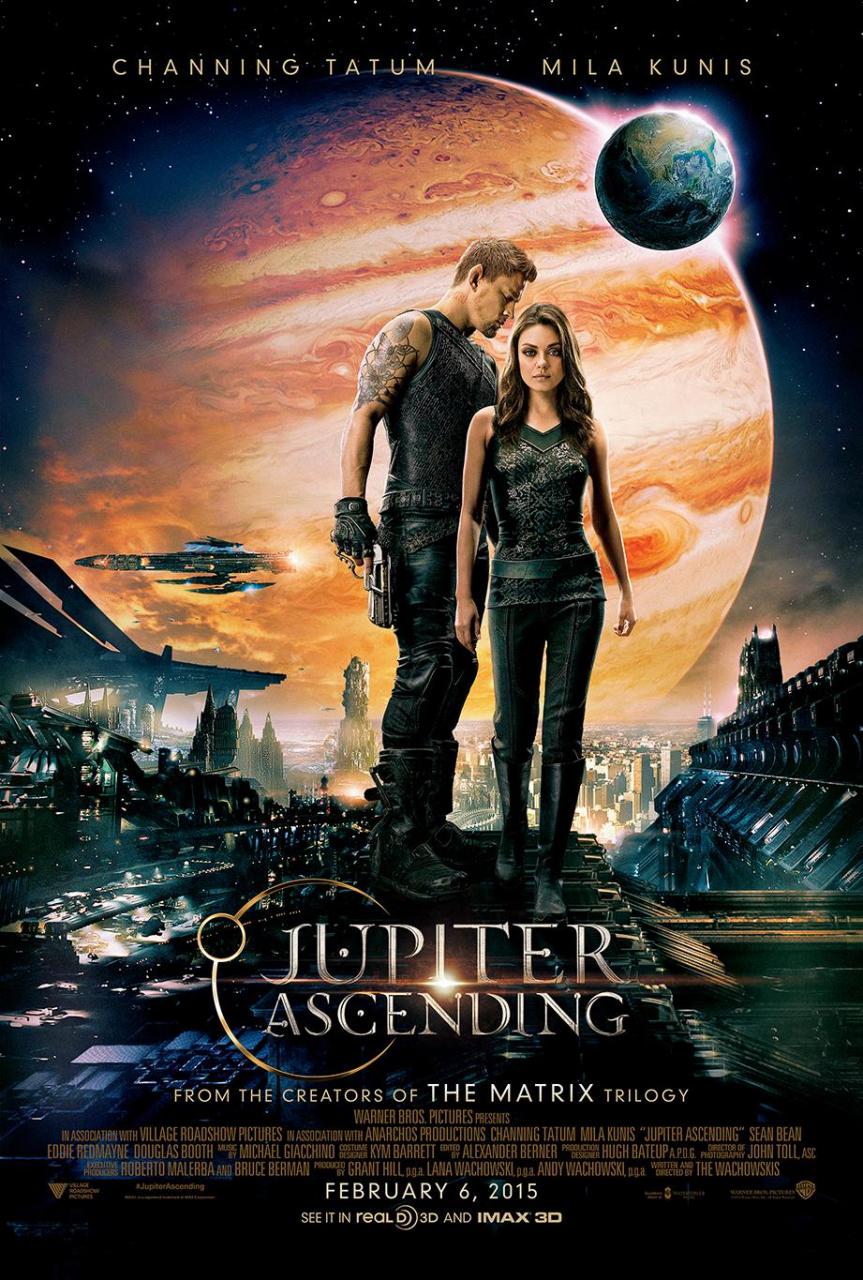 Few would dispute the imaginative powers of Andy and Lana Wachowski. They probably got a free pass from Warner Brothers after creating The Matrix, one of those culture-changing movies that come along so rarely. I was leery of Jupiter Ascending, their newest original science-fiction opus, when Warner Brothers delayed its summer release by nine months. The trailers and commercials were also doing a dandy job of hiding what exactly the movie was about besides cool visuals. I was holding out hope, thinking that maybe Jupiter would be silly but fun in a Fifth Element way, but instead ladies and gentlemen, we have an heir to 1980’s campy Flash Gordon.
Jupiter Jones (Mila Kunis) is an unhappy maid who cleans toilets for a living. Then one day she becomes the most important person in the universe. She discovers she is the reincarnation of the matriarch of House Abrasax, whose three children, Titus (Douglas Booth), Kalique (Tuppance Middleto), and Balem (Eddie Redmayne), are fighting over their inheritance. The biggest prize of them all is Earth, and now the appearance of Jupiter complicates ownership. Various alien species are sent to kill her, but Jupiter has a savior in disgraced galactic solider Caine Wise (Channing Tatum). He’s a “splice,” a result of gene splicing people with animals. He rescues Jupiter and they head off world to explore the much larger, much stranger universe.

Oh look, she’s falling again.
Right away, mere moments after leaving the theater, I knew the first step to make Jupiter Ascending a significantly better movie: completely remove the title character. First off, her name is awful and makes me think she’d be a character in the Jetsons universe. Mostly, she’s a terrible protagonist because she is merely a fairy tale wish fulfillment masquerading as a person. Her normal life is miserable but secretly she’s a space princess who is the reincarnation of a space queen. Allow me to momentarily pause and question this line of monarchy and inheritance law. Apparently Jupiter shares some genes with the deceased Lady Abrasax, but she has no direct bloodline. Does that automatically thrust her into another family’s inheritance squabbles? Why should they even consider her claim valid? Why does that place her at the top of the pecking order? When did we start recognizing reincarnation with inheritance law?
Back to the matter at hand, Jupiter is an annoyingly weak character that’s supposed to follow the arc of weak to strong, inactive to active. Except she doesn’t. Beyond accepting her incredible new position, there’s really not much that changes for her. She remains, from start to finish, weak-willed, gullible, always in need of saving, and so wretchedly annoying and without merit. Her cousin arranges her with a doctor for Jupiter to donate her eggs, but he expects a majority of the money. Why does she need this middleman in this arrangement? It’s another reminder how dim the character is and devoid of agency. And then all of a sudden a romance materializes between her and Caine because of course it does. I use “materializes” because there is no actual setup of any kind beyond the fact that Kunis and Tatum are attractive specimens. Their romantic dialogue will produce dangerously violent eye rolls.
The Wachoswkis are certainly imaginative filmmakers but their ambitious world-building impulses get the better of them and their story. The imagination is on full display when it comes to the visuals, the production design, costumes, and alien designs. There’s a grand mixture of creatures big and small, and even an elephant pilot because why not? However, the storytelling meant to house these cool things is notably deficient. Jupiter Ascending feels less like a story that naturally develops and whose complications arise in a semi-logistical fashion. It feels like somebody guiding you on a tour of Weird Stuff. It’s not so much a story as a collection of Weird Stuff, Weird Incidents, Weird Places, and Weird Creatures. You feel like you’re being skipped off from one exhibit to another, especially when Jupiter is kidnapped and threatened by each of the three Abrasax children in a row. Seriously, the entire scenario is on repeat, so when Jupiter continues making naïve choices, you can slap yourself extra hard having been through this purgatory just moments before. It’s only a matter of time before she gives in to whatever Abrasax demands again. There’s a general sense of repetition to the plot compounded by Jupiter’s incessant need to be saved (she seems to be falling a lot, out of spaceships, buildings, vehicles, etc., which also gets tiresome). The scheming Abrasax children seem to just slide in and out as the plot requires, with little in the way of resolution.
 It’s impossible to discuss the film without acknowledging how damn goofy the whole enterprise comes across. Caine is part wolf, part albino, part human, and apparently part angel since he got his wings removed as a punishment. Does that seem like a good combination of elements or like the aftermath of a drunken writing session? Let’s just run down some of these names: Jupiter Jones, Balem, Kalique, Stinger, Gemma Chatterjee, Phylo Percadium, Chicanery Night (!). To be fair, it’s not like Luke Skywalker or Darth Vader are less preposterous names. Caine has a pair of anti-gravity boots but they’re really just hovering rollerblades. There’s just something silly about watching a guy rollerblade, even if you attach a futuristic spin to it. There’s a hidden factory beneath the stormy Eye of Jupiter, and yet this same important factory seems ready made to fall apart if the slightest projectile pierces its exterior (it’s the Death Star all over again). There are weird small aliens, weird alien bounty hunters who can turn invisible but don’t, weird space police that are really bad at their jobs, weird robots with human faces, and there’s also weird stereotypical Russian immigrants for Jupiter’s obnoxious family. Perhaps all the goofy camp will enchant you but I never got onboard mostly because the story and central characters left me so thoroughly unengaged.
Another ongoing problem is that the Wachowskis are constantly telling you things rather than showing you and allowing the story to organically develop. There are no less than three times when Character A looks at Character B and literally verbalizes what they are thinking or feeling in this moment. It’s lazy screenwriting, beholden to constantly having to explain everything to an audience because either you think they are dumb or your plot is far too convoluted; either way, a problem. Such sample pieces of dialogue include these informational asides: “Bees are genetically programmed to recognize royalty,” and, mere seconds later, “Bees don’t lie.” There you have it; bees don’t lie. Now you know.
The most frustrating part of Jupiter Ascending is that there is a genuinely interesting movie buried under so much of this silly nonsense and ear-clanging noise. The starting premise that Earth is nothing more than a stock portfolio for an alien species, that’s good. The idea that a trio of siblings is squabbling over who gets their galactic inheritance, which includes the deed to Earth, that’s good. The idea that human life is seeded on planets merely to be harvested into an eternal youth elixir for the rich and powerful, that’s even better. It’s not exactly a nuanced critique of capitalism but it’ll do. I’m disappointed that we don’t find out more about a larger market for this rejuvenation technique. There has to be more customers for such a miracle product than one rich family. If this were an intergalactic King Lear or even a space version of Margin Call, it would be far more exciting and creative. Instead, the bigger ideas are grounded into pulp so that we can have more CGI-drenched action sequences. There’s one segment that tonally breaks away from the film, diving headlong into Douglas Adams-style satire on bureaucracy. Like most of the film, it has its moments of entertainment, but it comes from nowhere and has trouble fitting with everything else. I’ll give credit where it’s due and praise the special effects, as well as the overall production design. It’s too bad that the action too often feels like a bunch of pixels exploding, failing to provide a sense of immersion. It’s hard to get a feel for most of the action and its use of space, save for portions of the finale. There is one very fun and well-choreographed fight between Caine and a… dragon… sentry guy (I don’t really know what to call these winged henchmen). That fight is exciting. It’s a shame there aren’t more of them. Bring on more dragon sentry guys.
Kunis is certainly miscast on the part, though I doubt any actress could pull off such a lackluster heroine who is always needing to be rescued. Kunis is more adept in the realm of comedy (Ted) or seduction (Black Swan), neither of which is featured with Jupiter. Let me say one more reason this Jupiter Jones character is awful; part of her struggle concerns whether or not to marry a playboy space prince. I don’t know if the Wachowskis believed that Jupiter was supposed to be a “strong” figure, but reducing feminine value to her being married feels rather reductive for sci-fi (not that there isn’t a storied history of women being treated as objects of fantasy in the genre). Tatum’s (22 Jump Street) remarkable charms are dulled by his silly albino beard and general guard dog characterization. He’s less a character than a protector who inexplicably instantly falls in love with his charge. Both actors will no doubt rebound in short order.
 Reserve some pity for poor Eddie Redmayne, a man who will be experiencing the highs and lows of acting this month. He’s the frontrunner to win Best Actor for his stirring work as Stephen Hawking in The Theory of Everything, which is what makes his performance here even more astonishingly awful. He speaks in this effete whisper for the entire movie, one that is hardly audible at all, except for the occasional line where he screams and spasms, making the contrast all the more funny. He constantly holds his head back like he’s in danger of nosebleeds. This is a performance of such startling misdirection that I physically felt bad for Redmayne. He seemed to be reaching out to me, pleading through his glassy eyes, communicating, “Help me, help me.” Even if his character’s vocal range wasn’t so nonthreatening, Balem makes for a terrible main villain. As a rich lord with power at his disposal, he works, but late in the movie all of that is removed, and he has to be a physical threat. After 90 minutes of watching him on screen, you will never be able to see him as a credible physical threat, and even the movie doesn’t fully treat him this way, and yet the plot still places him in this role. He’s not a heavy. Balem is laughable but he’s another component of a generally laughable movie.
Jupiter Ascending is a rarity in Hollywood, a big-budget epic that overpowers you with a singular sense of style and imagination; it just so happens that so much of the creative fireworks are laughably terrible. The Wachowskis don’t do anything in half-measure, and the film is put in overdrive. There’s a mess of characters and peculiar details to make this world feel larger than life and tethered to the idea of fun. Then why oh why did we have to be saddled with such boring, one-dimensional characters and a secret princess storyline lifted from countless sources? In the past, the Wachoswkis have found ways to turn pop philosophy and pop-culture into an entertaining alchemy that separated them from the sci-fi pack of imitators, which were legion. I still have great fondness for the original Matrix (you can keep the sequels), V for Vendetta, and especially Cloud Atlas of late. The Wachowskis are ambitious filmmakers and they have the imagination and narrative sensibilities to achieve great things. It’s just that with Jupiter Ascending it feels like their real passion was in all the background artifacts, the minutia of the worlds, the alien costumes and makeup, the histories of worlds. It certainly wasn’t on a story or characters or a credible romance. And yet even after all of these words, I have to admit that Jupiter Ascending is entertaining, just not in the way its creators may have intended. It reminds me of 2014’s disastrous Winter’s Tale, a passion project that was so baffling and bafflingly terrible. If you’re curious and willing to part with some money, gather some friends and check out Jupiter Ascending. Just make sure you’ll have suitable time planned afterwards to discuss its particular brand of big screen lunacy.
Nate’s Grade: C
Share this:

Project Almanac (2015)
 I’m going to take a stand right now and declare that Hollywood should simply stop making found footage movies. I don’t hate the subgenre itself, and in fact a found footage approach can be rather interesting if given proper attention and care, but that is just not happening nearly enough. Too often Hollywood execs view found footage as a hook and slap it onto a story that does not need to be told in this limited style. There’s no reason that a perfectly fine buddy cop movie like End of Watch needed a found footage angle, except that’s probably how it was sold. If you’re going to do found footage you better have a god reason why your characters are recording every moment, and most do not. You better stick to the principle that the only viewpoint is from the camera, and most do not. And you better stick to the limitations of this viewpoint, meaning who is editing these things after the fact and adding popular music to make montages? Found footage is too often underdeveloped in approach, a lazy selling point because “the kids” today like documenting themselves doing everything. But really, can you name the last found footage hit? The Paranormal Activity franchise is on the downturn and the last critically lauded one was 2012’s Chronicle. Don’t just stop making found footage movies because they’re too often lackluster; stop making them because the public has grown indifferent. Now, with all that being said, the time travel flick Project Almanac proves once again to be a film that never needed to be found footage to work. As far as January releases go (usually a dumping ground for studio bombs) it’s better than most, but the poorly titled sci-fi drama wastes its premise on the myopic doldrums of youth.
 David Raskin (Johnny Weston) wants to get into M.I.T. but his hard-working mother doesn’t have the money to make this happen. He discovers an old video of his seventh birthday party and is shocked to see an image in the background that resembles him as a teenager. He and his friends, Quinn and Adam, investigate the video. They enter the basement lab that used to belong to David’s father, until he died in a car accident shortly after that birthday recording. There they find plans for a time machine and the boys busily go to work assembling it, perfecting it, and charging it. Jessie (Sophia Black-D’Elia), a popular girl at school, stumbles into their first experiment and becomes part of the group. They have to keep this a secret and they must only travel back as a group. The freedom and possibilities are exhilarating, but soon enough David discovers a spiral of consequences that are difficult to correct without scrapping everything.
From a structural standpoint, this movie gets pretty lopsided and completely misuses the possibilities it established even as it arbitrarily throws its own rules out the window. Project Almanac takes far too long to get the time machine working. The teens discover the manual but it takes almost the complete first act before they successfully travel in time. Why do we have to wait a full 30 minutes and watch trial after trial? It’s not exactly like the audience demands a sense of scientific accuracy. Once the teens do travel through time, they set their sights very low: pass a test, get revenge on a bully, win the local lottery, and go to Lolapalooza. There is the limitation of only going back three weeks into the past, which eventually disappears, but could these kids not aim higher in their goals? When they do go to Lolapalooza, the movie drags and drags, and it’s here where I started to theorize what became of this film (more on that below). Once we come back from the festival, David decides to jump back alone to stop himself from blowing his opening with his crush, Jessie. However, there are disastrous consequences stemming from this and he has to debate whether to undo his good fortune with Jessie. Want to know what those consequences include? Seventy-seven people dying in a plane crash. Our main character seriously agonizes about keeping his new girl or the lives of seventy-seven people. And what would he lose? It’s not like he can’t be suave around Jessie ANY OTHER TIME. All he has to do is say something and kiss her. The hesitation and struggle over this is comically absurd, but the struggle illuminates where Almanac could have gone. These teens could have used time travel to save lives, but I guess that’s not as fun as seeing Imagine Dragons backstage and dancing.
Another problem is that, from a time travel standpoint, this stuff doesn’t really follow its own rules. The gang goes back at several points to repeat the same goal, but at no point do they run into different iterations of themselves. If they keep going back to fix things, and fail, and then go back again, that’s a continuation of one ongoing timeline, not a do-over. Time doesn’t reset. With every time travel story there’s the nagging nature of paradoxes but Project Almanac just ignores them, hence the lack of doppelgangers. At one point, Quinn even seeks out his past self to pull a prank, which sounds really stupidly dangerous from a space-time continuum standpoint to me. The movie ignores paradoxes… until it doesn’t. The entire third act is about the consequences of paradoxes, and now all of a sudden it matters. That doesn’t work. The main third act conflict is David not wanting to lose his girlfriend. He keeps jumping back to fix this and fix that but it’s all to save his girlfriend, which is pretty dumb, as I‘ve pointed out already that Jessie could still decide on her own at any point in the future to be his gal. Then there’s the conclusion, as we all know that we have to get back to that birthday party at some point. I consider myself a smart man but the end doesn’t make any sense because (spoilers to follow) it invalidates the timeline that we witnessed. David makes it so the events will not happen and the machine will not be constructed. But why is there evidence? Why is there still a tape detailing this whole process? It should be wiped.
Requisite found footage griping: why do they record every damn thing in this movie? The gang even breaks into their high school to steal hydrogen canisters from a locked science lab. Why would you record your crime spree? Why would you record people just driving in cars or walking up to school? Why would you record any of this? How do you clearly pick up audio from two people at a distance, mind you, at a freaking outdoor concert with lots of noise to cancel out any discernible dialogue?
 There are moments that I really liked, flashes that show how much fun or even clever Almanac could have been under other circumstances. One of these moments involves Quinn going back to save his grade. Originally he failed his chemistry presentation, so he thinks he’ll easily pass thanks to the foreknowledge that time travel offers. He goes back, lists the first ten elements on the periodic table, and then his teacher asks him another question he wasn’t prepared for. He goes back, prepared for the two, and then the teacher asks another he wasn’t prepared for. Over the course of going back, he is actually forced to study to prepare for this presentation, and so even though he thought he would use time travel to be lazy, it forced him into doing what he should have done in the first place. When they go back to win the lottery, they accidentally write down one wrong number, so their first jackpot prize isn’t the full amount. They bicker about going back, whose fault it was, and then the film cuts immediately to them holding the full amount in a novelty check. All the characters are devoid of excitement, because that excited moment of revelry already happened, and now this is just an exercise to get over. The photographer chides them to be more excited. That is a fun moment. The characters are rather likeable. There’s another moment where Jessie realizes that David went back to fix a slip-up so they would end up together. And she reacts exactly how she should, wounded and mistrusting. How can she trust what he says now? How can she not doubt every moment being carefully pre-programmed for a desired result? She was manipulated. This confrontation was missing from About Time where Rachel McAdams would have learned that her charming husband traveled back in time dozens of times to perfect his courtship, thus manipulating her own sense of choice. Poor Rachel McAdams never finds out, which seems like a completely blown dramatic development, and lives in cherished ignorance instead. At least Jessie gets to know the truth and behaves naturally. There are other little moments that are fun but they are distractions from what could have been.
Allow me to do some serious speculation about Project Almanac’s own past. This film was originally supposed to come out a year prior hence why every date is referenced as 2014. MTV Films expressed some interest in the movie and it was shelved and likely retooled. Except with time travel films, retooling can be pretty monstrous with its carefully placed plot beats. Here’s what I think happened. Originally, the third act was all about David going back to save his father from dying in that car crash. He likely does but there are dire consequences, and so he keeps going back to try and mitigate the negative repercussions while still keeping his father. Doesn’t that sound like a much more emotionally involving storyline? He’s got far more personal stakes in this scenario than simply losing his girlfriend who he can regain. He can’t regain dear old dead dad. It seems preposterous to me from a screenwriting standpoint that they would introduce a deceased parent and not use time travel to save said parent. It’s the ultimate setup. Instead, with MTV attached, we got to keep things lighter and more appealing to the carefree fun of youth, and so the gang goes to Lolapalooza instead where they can watch rock bands. I think MTV came in and jettisoned the third act and the direction of the script, imposing the festival, and reminding people how music is essential to being young and free and alive. I can’t say whether it’s MTV’s influence or producer Michael Bay, but there’s a slew of product placement from start to finish as well. I have no proof of any of this but I think there’s something to my conspiracy theory.
If you needed any other example of how close Project Almanac would uphold to its own sci-fi rule system, a character asks a good question about how they can understand something, and David says, “I’ll tell you later.” Hey, you want to know something important, just wait, where it won’t be answered. The found footage aspect brings nothing to the film, is poorly integrated throughout, and just plain unnecessary. The plot is too underdeveloped and lacking ambition, using the miracle of time travel to party in such limited ways. The concluding half feels too low in stakes and obvious in conclusion. Time travel is all about the untold possibilities, and Project Almanac will ultimately fall in that territory, a somewhat amusing but mostly unfulfilled sci-fi film that should have gone back to the writing stage a few more times.
Nate’s Grade: C+
Share this:

Transformers: Age of Extinction (2014)
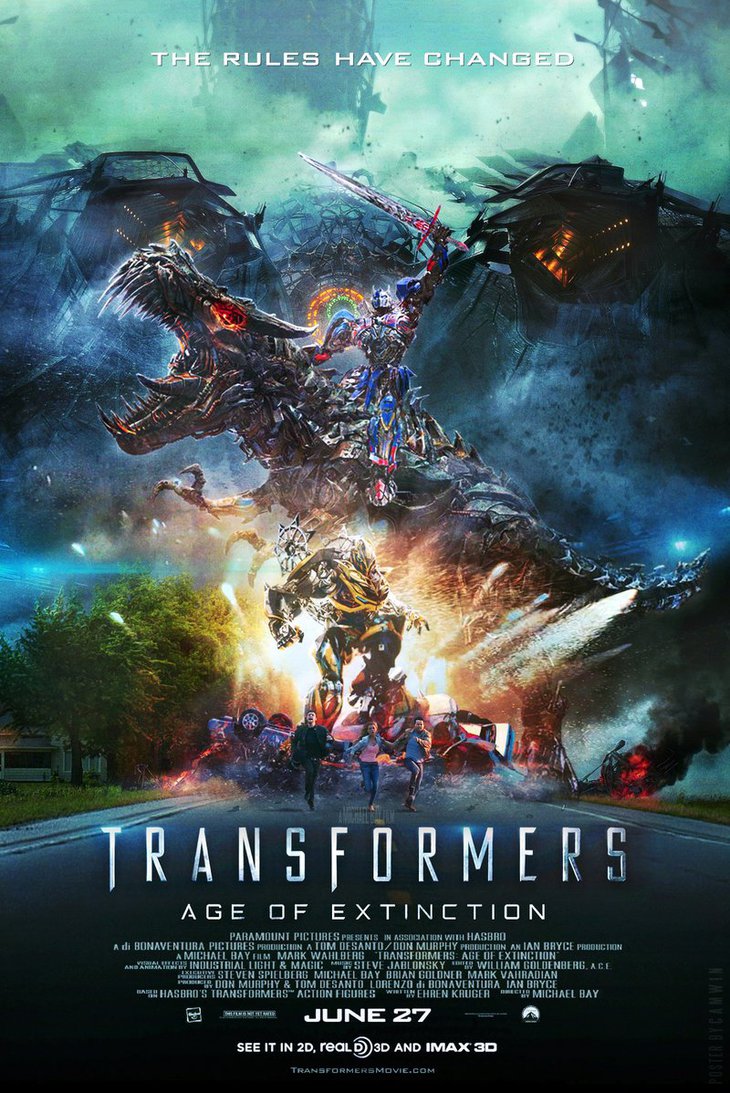 Four movies in, at this point you can either fall back on the old criticisms of Michael Bay as a filmmaker or simply let down your guard and look for any simple pleasures offered by the Transformers franchise, a series mostly known for chaotic plotting and action. Age of Extinction is probably the best Transformers film since the first one (take that for what you will) but it still has all the hallmarks of the obtuse and convoluted plotting, absurd and obnoxious characters, juvenile humor, intense product placement, and often incoherent action. Gone are the characters from the first three films and in their stead is Mark Wahlberg (upgrade) as a Texan inventor named, get this, Cade Yeager. He and his teen daughter come into contact with Optimus Prime and are on the run from multiple forces. Apparently a bounty hunter is looking to target Prime. The U.S. has a black ops team tracking down Transformers in hiding. And Stanley Tucci plays a business tycoon who wants to make his own Transformers via their magic substance “Transformium.” Reading all of that, you realize the pieces still don’t really make sense, and that’s before the robot dinosaurs come into play. And yet Bay and his team have fine-tuned the entertaining aspects of the franchise and better consolidated them in the fourth film. A badass alien bounty hunter/collector is a great addition, adding the government as an adversary, Titus Welliver (TV’s Lost) as a cocksure special agent, Tucci as a corporate blowhard, and robot dinosaurs, it all sort of works on its own terms. Again, if you try and logically connect the pieces, it won’t happen. By this point, if you’re not a fan of the series, there’s no real reason to continue watching, but if you’ve found any semblance of enjoyment then there should be enough to keep your attention with the fourth film, robot dinosaurs and all.
Nate’s Grade: C+
Share this:

The One I Love (2014)
 A simple yet high-concept sci-fi hook that’s nicely examined and developed for its duration, The One I Love is a relationship drama with a twist, one I won’t feel bad about spoiling considering it happens in the first 15 minutes. Mark Duplass and Elizabeth Moss play a married couple going through counseling to work out their trust issues. They head out to a resort home to spend a weekend getaway; however, whenever one of them enters the guesthouse, their spouse is magically there. Not just them but an idealized version of them, the best representation. The two explore what this means, establishing a series of rules of intimacy that of course will start to be ignored. The mystery of why this doppelganger honeymoon suite is happening is inconsequential. What matters is how our couple responds to it and the film thankfully allows this conflict to stew, maximizing its potential to explore the jealousies and insecurities of relationships. Duplass and Moss are terrific and have fun with their many iterations. The One I Love finds ways to continually surprise while still feeling grounded by its real-world application of its science fiction premise. The ending is a tad predictable but still satisfying, likely inspiring many conversations afterwards with would-be couples who watch the film. At its core, it’s an intriguing story that’s very well developed while never losing sight of its characters and their relatable nature. It’s smart, funny, and always interesting, and well worth exploring on your own when given the chance.
Nate’s Grade: B+
Share this:

Big Hero 6 (2014)
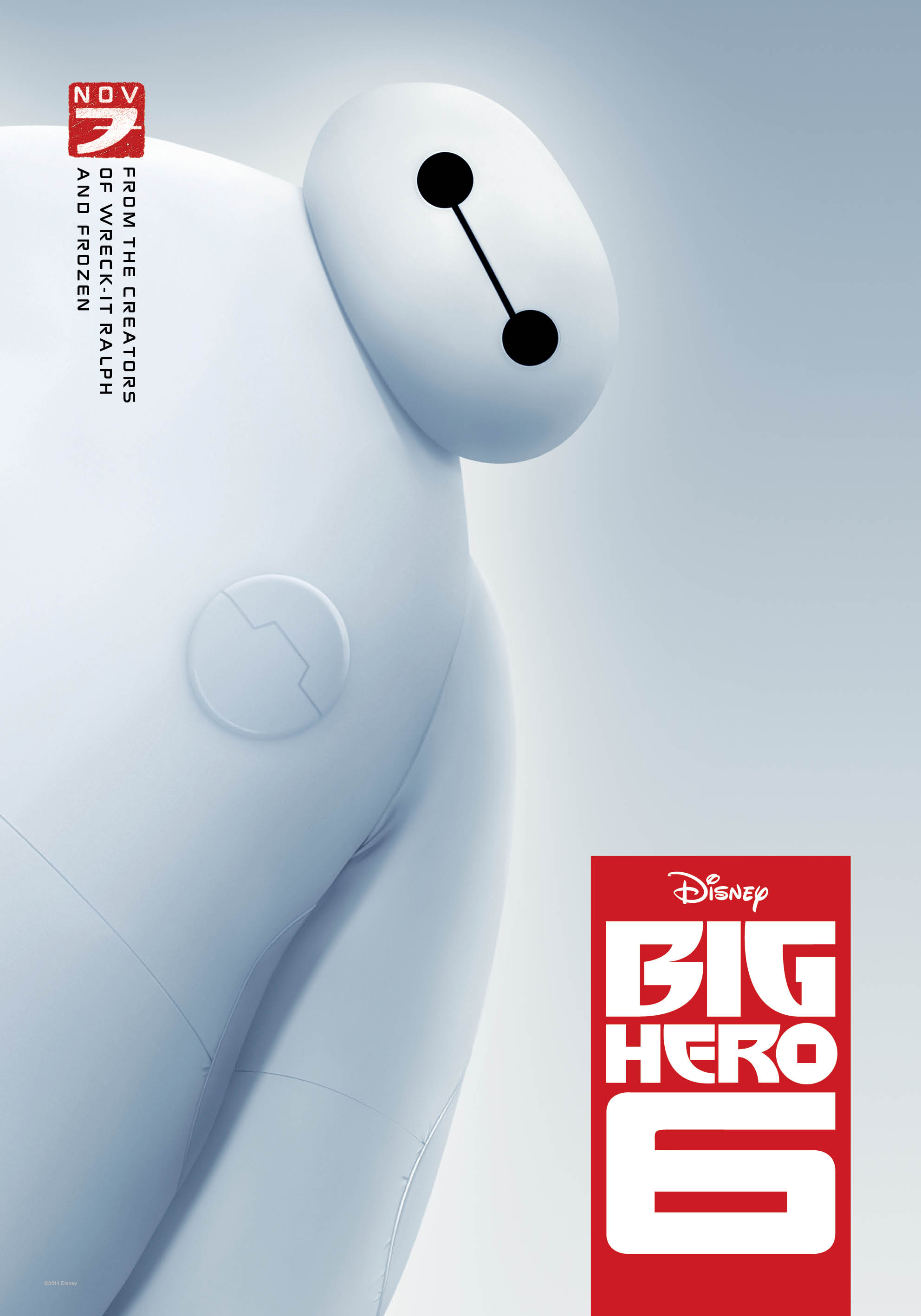 Disney’s first adaptation of a Marvel property, it’s essentially a superhero origin tale mixed in with the “boy and his robot” formula borrowed from The Iron Giant. The story is fairly predictable but charming and unafraid to deal with loss and grief. The real star, though, is the inflatable robot Betamax (voiced by Scott Adsit), whose unfailingly optimistic and helpful nature is a loveable addition to a genre plagued with doom and brooding. The action sequences are colorful and well developed and paced. It’s an agreeable pilot film for a new animated franchise, and the characters are likeable and fun while still having enough emotional resonance to make the hard choices of sacrifice hit you in the gut. It’s a welcome change of pace to have a character interested, first and foremost, in the mental health of others. You just want to hug Betamax (parents, your children will be begging for the toys). The plot does follow many similar plot beats of the superior Iron Giant but this film is still enjoyable enough on its own terms.
Nate’s Grade: B
Share this:

The Hunger Games: Mockingjay Part 1 (2014)
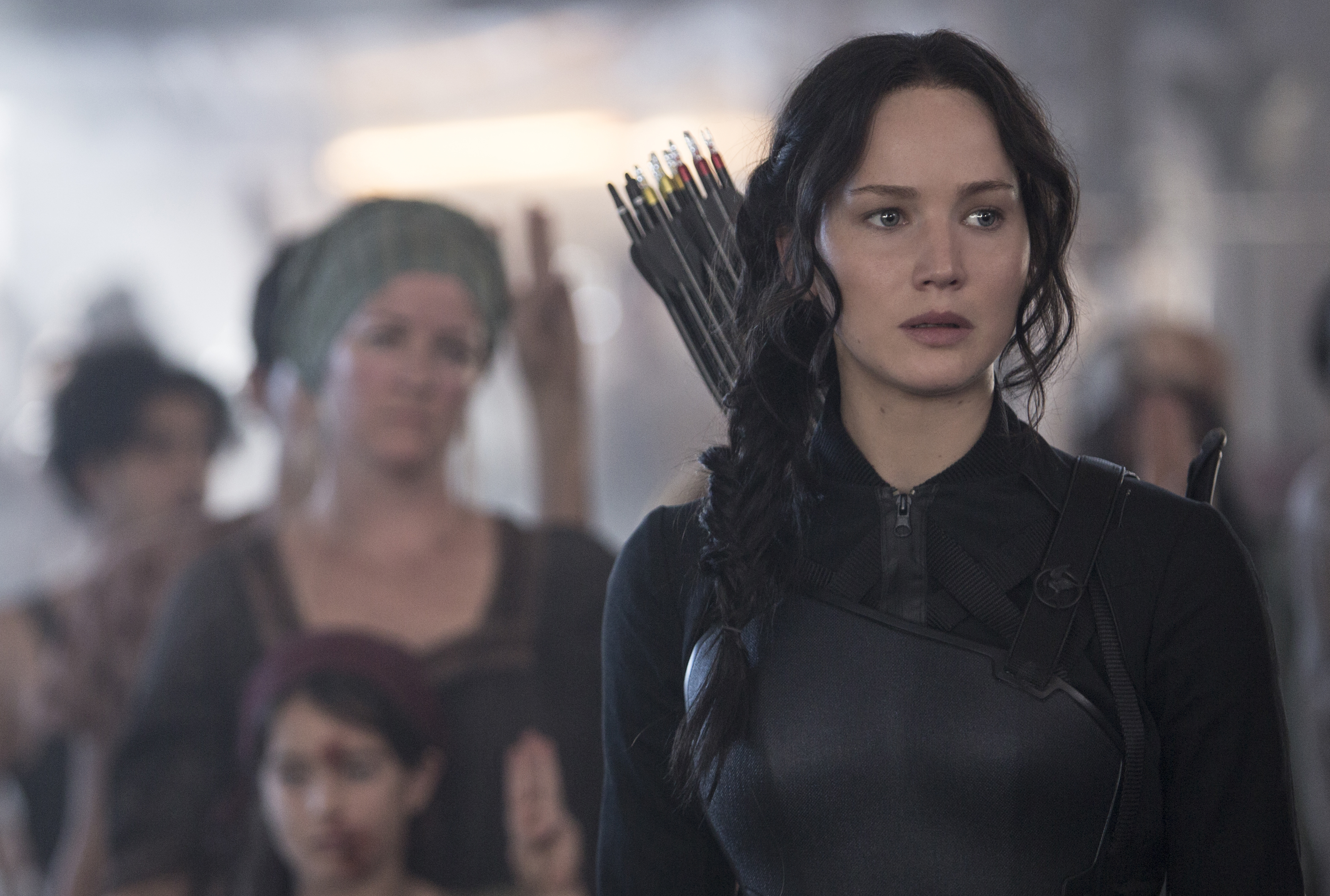
 Taking place immediately after Katniss (Jennifer Lawrence) was rescued from the events of Catching Fire, we find ourselves locked away underground with the residents of District 13. Long believed annihilated by the Capital, and its tyrannical leader President Snow (Donald Sutherland), the people rebuilt their society as one large series of underground bunkers, preparing for a day of revolt. The leader of District 13, Coin (Julianne Moore, under a thick grey wig), is wary of Katniss as the symbol of the revolution. She would rather fight the Captiol without her, but the people love her, and it is the common people that Coin and her team must struggle to unite and inspire. Katniss is not exactly in the inspirational mood. Her family was saved from District 12 before it was bombed but the Capital holds Peeta (Josh Hutcherson) as a high-profile captive, ready to denounce the latest aggressive acts of the rebels as foolish and dangerous. Katniss desperately wants to rescue Peeta but before she can she has to accept her fate and become the Mockingjay, the figure to rally the districts in war.
 The very title The Hunger Games: Mockingjay Part 1 both tells you everything and nothing. Firstly, there are no Hunger Games anymore. This is a full-on war film, and we’re finally getting to all the good stuff, the revolutions stirring all throughout Panem we heard about and caught glimpses of before the plot required a redo of the games, repeating the structure of the first film. It felt overly redundant, especially when the stuff outside of the games was far more interesting. That structure has been cast aside and Mockingjay is a completely different film than the ones before it, focusing much more on character and the politics of propaganda. In many ways, this is a quieter film that allows the characters to deal with the trauma of their experience in the deadly arena. Even though war is fermenting and people are being bombed into oblivion, there is considerably less urgency, especially less contrived urgency. This allows the characters and the plot to breathe, the calm before the storm. Much has changed and a measured amount of time to process this is a good move. This is no longer the Hunger Games. This is war. The subterranean District 13 is the major setting of our film, which gives Katniss time to reflect on how damaged she is and her guilt over what exactly the Capitol is doing to their promotional lapdog, Peeta. The movie opens with her muttering to herself, hiding from others due to a disturbing nightmare. The psychological well being of our heroine is a ripe topic. While the world is on fire, much is once again expected of Katniss, and we get to watch her transform, awkwardly, into the revolutionary figure others require of her. The political and media critiques add another level of entertainment, as each side spins and contorts to position themselves for the news cycle. This expose of media manipulation makes Mockingjay feel in part like a post-apocalyptic Wag the Dog. Credit co-screenwriter Danny Strong, he of HBO’s Recount and Game Change fame. This welcomed change of pace and structure allows the film to finally feel like the story we want to watch. And while I’m tip-toeing around spoilers, I’ll just say that the split occurs exactly where you think, book readers.
And secondly, the “Part 1” of the title is also what defines this 125-minute prelude to the concluding movie, a fact that becomes inescapable as it seems all the good stuff is being reserved for later. While the reflective plotting allows more space to breathe, it also becomes abundantly clear that this wasn’t exactly a story that needed to be told in two parts. From a financial standpoint, I can’t argue with the decision from Lionsgate. This is their once-in-a-lifetime franchise and elongating the final film in YA franchises has become de rigueur and a box-office no-brainer. Still, the overwhelming feeling is that this is all setup and the best stuff is just ahead, a tease that the franchise also toyed with during Catching Fire, as we were stuck in the games instead of the revolution. Mockingjay Part 1 is mostly buildup; it’s entertaining and more politically adroit than expected, but in the end it’s still a story stretched out. The intriguing supporting characters from Catching Fire are still mostly put on hold. The inclusion of Gale (Liam Hemsworth) still feels relatively pointless in the scheme of things, except for prolonging the love triangle, the weakest element of the story by far, and one that even author Suzanne Collins seems half-hearted about. When the world is falling apart, who cares which boy Katniss decides to kiss? Old favorites like Haymitch (Woody Harrelson) and Effie (Elizabeth Banks) get brief appearances but little else. There is a stark decrease in action with this movie, only two real sequences of suspense, and one of them proves to be false. Strangely enough, there’s a high-stakes nighttime raid that plays out unironically like a dystopian Zero Dark Thirty finale. I await others to make a similar comparison. It’s no surprise that Mockingjay becomes more suspenseful, engaging, and meaningful just as it’s ending, leaving less on a cliffhanger and more on a latent promise. Instead, this particular movie features a lot of speeches and hushed discussions in dank quarters (the photography is rather dimly lit and hard to decipher at times). It’s not exactly rollicking.
 Being a war film, atrocities are commonplace and examined openly, especially when Katniss visits the ruins of her home in District 12. Not once but twice does the camera slowly zoom out to allow the graveyard of charred skeletons to gets its thematic due. There’s only so far a mandated PG-13 rating can take you when it comes to illustrating the horrors of war, but I give Mockingjay credit for neither glossing over the loss of innocent life or glorify the leaders of this revolution, namely District 13. President Coin is shown to be a calculating and pragmatic leader who is concerned more about the big picture. She’s thankful for Katniss but just as ready to move onward and forget her. By the end of the movie, you don’t exactly have warm feelings for the people of District 13, who laid in wait, sowing seeds of rebellion with the other districts, all the while relying on their bunker for ultimate safety. The other districts are more vulnerable and more likely to feel the Capital’s wrath. Just ask the smoldering citizens of District 12.
Director Francis Lawrence (I Am Legend, Constantine) is the Hunger Games’ version of David Yates, the director who steered the concluding four Harry Potter films. Chris Columbus put that world together, but a better, more visually adept director saw Potter through to its end. Likewise, Lawrence has taken the world that the original Games director Gary Ross cultivated and given it the mood and visual heft needed for the franchise to feel properly and triumphantly cinematic. If it weren’t for this man’s visual talents, the many conversations in the dark would be even harder to watch. Lawrence has been a helpful addition to the franchise, especially as the world was starting to get more fleshed out. While I bemoan the overly gloomy cinematography (which was also an issue with Catching Fire), Lawrence has brought a necessary sense of gravitas to the series. The emotional pain and psychological torment registers, and his handling of his actors will often be overlooked thanks to the natural talent of his lead actress, but Lawrence has found a way to strike the right tone to make us care.
Speaking of the woman in question, Jennifer Lawrence (American Hustle) is already an Oscar-winning Hollywood star in her mid twenties, and she elevates these films even more. Her character is a reluctant figurehead, never having asked for such prominence, nor having asked to trigger a revolution with countless casualties. Without as much physical activity and arrow slinging, Lawrence gets greater opportunities to emote and show the fractured, conflicted feelings of the woman in the middle of the revolt. She’s not a natural when it comes to being on-camera, she cannot fake sincerity (even though she played up the whole “star-crossed lovers” angle in the first film as a means of survival, but whatever), and it’s somewhat funny watching skilled actors pretend to be bad actors. The emotions are on a hair trigger here, as rage boils over to fear and shock. Lawrence anchors the series with another surefooted, strong performance.
The real standout is Sutherland (The Italian Job). This is as much President Snow’s movie as it is Katniss Everdeen’s. Rather than plotting from the shadows, Snow gets to become the worthy villain the franchise has been waiting for. Sutherland relishes his retorts with Katniss and preying upon her. His broadcasting of an ever-increasingly frail Peeta is more meant as a crushing psychological blow, a reminder that his prized hostage will be punished for Katniss’s and the rebellion’s mounting successes. When they’re finally face-to-face once more, it’s the film’s most invigorating moment.
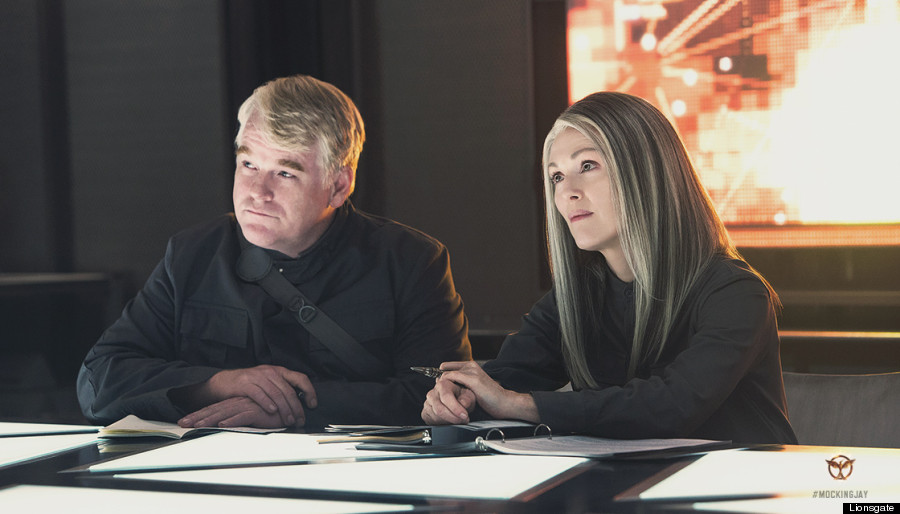 It’s also hard to watch the movie and not feel grief over the loss of actor Phillip Seymour Hoffman. Mockingjay Part 2 will officially be the actor’s last onscreen appearance. He’s good, though the part isn’t exactly challenging, but the real pang is the realization that we’ll never get another Hoffman performance. Once the final minute of Plutrarch Heavensbee is gone onscreen, so is the cinematic ghost of a ridiculously talented man who was taken from the world far too soon. In a nice gesture, Mockingjay Part 1 is dedicated to his memory.
Once more into the breach, dear friends, as Mockingjay Part 1 lays the way for the promise of an exciting and action-packed finale. The extra pause, the last breath before the melee, is both a blessing and a curse. It allows the film to break away from the plotting of the previous two entries and it provides a refreshingly reflective opportunity peppered with intelligent conversations about the political process and propaganda. It also stretches out a story that proves it did not have enough plot points to justify the expansion. No matter, the cash registers will ring loudly as the world’s hunger for the Hunger Games knows no limit. Lawrence and a team of great supporting actors help provide reasons to keep watching, as well as the increasingly dire circumstances of the war against the districts. This intermediary film serves as a bridge to the exciting conclusion, the assault on the Capitol. Let’s just hope that audiences don’t feel too stingy about paying to watch a two-hour trailer for another movie.
Nate’s Grade: B-
Share this:

Interstellar (2014)
 While arguably the industry’s most ambitious blockbuster filmmaker, Christopher Nolan hasn’t released a film to his name that I would call a misstep; even the weaker but still altogether thrilling Dark Knight Rises. Until now.
In the twenty-first century, food shortages and climate change will render Earth inhabitable. The planet is dying and the only hope is to find a new home in the stars. Conveniently, a wormhole near Saturn has opened and a secret NASA mission sent 12 brave astronauts through to send back information on the 12 potential worlds. Cooper (Matthew McConaughey) is the best pilot in the world, a former NASA employee, and trusted by the project’s leader (Michael Caine) to lead a team (Anne Hathaway, Wes Bentley, David Gyasi) to the other side of the universe. Cooper is hesitant to leave his children behind, particularly his ten-year-old daughter Murph (Mackenzie Foy), who says a peculiar ghost is haunting her in her room. The greater good wins out, and Cooper reluctantly blasts off into space to save his children and all Earth’s children.
Interstellar is clearly a personal film for Nolan. It’s about nobility, exploration, sacrifice, but really it’s about a father trying to get home to his daughter (the son doesn’t really seem to matter as much in the story). Nolan’s catalogue of films has been able to straddle the line between blockbuster and art, providing mass appeal with uncommon intelligence and nuance. However, I don’t think Interstellar is going to work for most audiences.
 Maybe I’m just too savvy for my own good having seen plenty of movies, but I could accurately predict every single plot turn and Nolan and his co-screenwriter brother Jonathan made it easy. When we’re told about a ghost within minutes and it’s a movie about space travel, you shouldn’t need any help. And then the ghost ends up speaking in Morse code and communicating, “stay,” that’s Nolan hitting you over the head with what to expect by the end (a conversation how parents are ghosts for their children is too much). You should also be able to figure out who Ellen Burstyn is going to be, and it’s not going to be Talking Head #3 in a television interview. Likewise, the illustrious astronaut Dr. Mann is referred to but purposely never shown, so you can assume it’s going to be a familiar face, which it is. Then once that A-list actor is onscreen you know there has to be more to this character because why would a movie star agree to play a part that amounts to merely, “Yeah, this planet is good. We’re done here”? Because of the slow nature of the film it makes the easily telegraphed plot turns more frustrating. The supporting characters are presented so incidentally, as if they didn’t merit extra time. Amelia (Hathaway) has one mushy monologue about the power of love, tipping the film’s philosophy, but that’s all there is to her character. The rest of the cast amounts to stuff like Black Guy on Ship and Bearded Wes Bentley. Nolan’s past work has been very generous to the characterization of his supporting players, especially with the Dark Knight trilogy. These people mattered. With Interstellar, their impact is purely in the name of plot and serving the father/daughter relationship.
And yet, the movie also precariously dips into the danger zone of boredom. Quantum physics isn’t going to be a popular conversation topic for your average moviegoer. There’s a reason that Back to the Future has a wider audience than Primer. By no means am I advocating for a lobotomized science-fiction experience, but Nolan seems to only have two modes when it comes to his characters and their dialogue here: treacle or science jargon exposition. I paid attention but it’s easy to zone out or just have your eyes glaze over as characters talk about the ins and outs of time travel, black holes, relativity, and gravity. The equally frustrating part is that all of the emphasis on science is thrown out the window for the film’s protracted resolution, offering a climax that intends to close a time loop but really only opens further questions when you know the identity of the “they” in question making all the plot mechanics happen. It all just ends up as a simple message to spend more time with your kids. The plot is dense without being particularly complex. The pre-space sequences take up far too much time and in general the Earth plots just don’t compare with the alien planet space exploration. When Cooper is venturing into a rocky alien world, I don’t want the film cutting back and forth between that struggle and his daughter on a dusty Earth. I wish all of the Earth sequences post-liftoff were jettisoned from the screenplay.
For a solid chunk in the middle, Interstellar becomes the exact film I wanted it to be. The crew has traveled through the wormhole to another galaxy and now has to deliberate. Which planets will be visited? What are the risks? Is data more important than human messages? Is returning home more important than fully exploring the worlds? What happened to the explorers? I could have dealt with the entire movie playing out this intriguing and conflict-driven scenario. You feel the immense magnitude of every one of their decisions. The future of humanity depends on them. Every planet provides a new mystery; what’s it like and what happened to the explorer? When you’re dealing with a finite supply of fuel and time dilation, there are debatable options as to what is best for the numbers. There’s always Operation Repopulate as well. If you have to start somewhere, McConaughey and Hathaway are not bad genetic pools. For this stretch, Interstellar is fabulous. It’s a shame then that the film then engineers a plot conflict that dominates the direction of the third act.
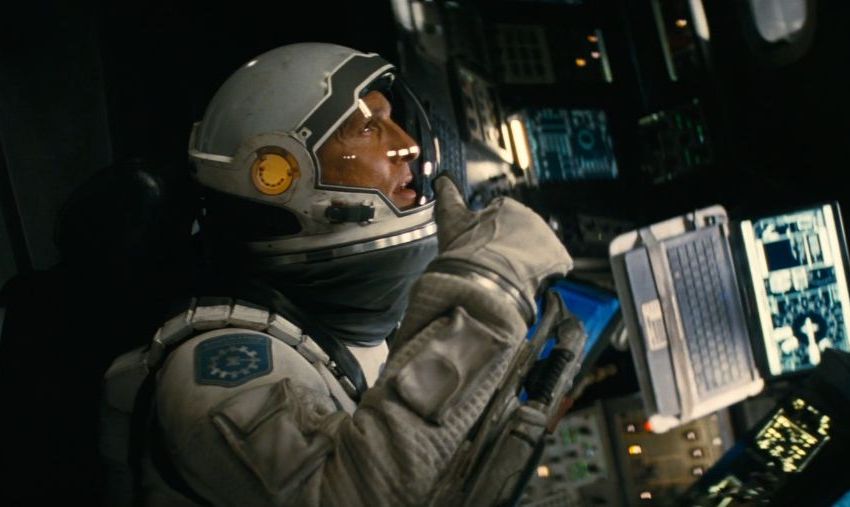 Nolan hasn’t lost his gift for crafting eye-popping visuals and bringing a rousing sense of scale to his movies. Interstellar is blessed with spectacular images of our universe, alien worlds, and mankind’s place in the whole realm of the cosmos. Nolan’s usual DP, Wally Phister, was unavailable, taking time to direct his own debut, Transcendence (probably the last film he directs as well, like Janusz Kaminski’s little-seen, little-remembered Lost Souls). The change of DP does Nolan good, giving the film a different, Earthier feel under Hoyte Van Hoytema (Her, Let the Right One In). Nolan isn’t the greatest stager of action but he is remarkable about putting together memorable set-pieces, and Interstellar has some standouts from the hostile alien environments to a thrilling space-station docking that is not for those susceptible to motion sickness. The special effects are terrific and the retro cubist robots are a fun addition. The only technical element I found lacking is the score by Nolan’s usual accompanist, Hans Zimmer. It’s bleating organ music intended to add a spiritual sense to the cosmic awe but it mostly becomes annoying. It sounds like a church organist died atop their instrument.
There is one great moment of acting in the film. Not to say there is an overabundance of bad acting, more like over emoting with a script and dialogue that do not deserve the waterworks. It involves Cooper after a mission, catching up on video messages sent from his children on Earth. In this very efficient scene, the magnitude of the consequences of Cooper’s decision is emotionally raw and he is overpowered with regret. McConaughey has been on a record-breaking tear of supreme acting performances, especially if you count his mesmerizing turn in HBO’s True Detective. Nolan allows the moment to play out, to sink in, without overdoing it, and it succeeds wildly. The other times Interstellar tries to wring out emotion feel too facile and maudlin to be effective.
This is my first real Nolan disappointment, a bloated film struggling to be important and say Important Things about the Human Condition but coming up short. It has its moments of excitement and awe but more so those moments are surrounded by too much dead space. The story is dense while still being undercooked, with too many listless supporting characters that amount to nothing, and easily telegraphed plot turns that are frustrating. Interstellar snuffs out all the intriguing possibilities it has to come back to its sappy father/daughter relationship that never truly feels earned. By no means is Interstellar, Nolan’s space travel opus/ode to Stanley Kubrick, a bad film. Unless you’re a sucker for easy sentiment, it will likely be a disappointment in some way, whether it’s too long, too boring with its science, too cloying with its emotional tugging, or just underdeveloped and overcooked at the same time. Interstellar is ambitious with its vision but seriously flawed and ultimately an obtusely personal sci-fi snoozer.
Nate’s Grade: C+
Share this:

The Maze Runner (2014)
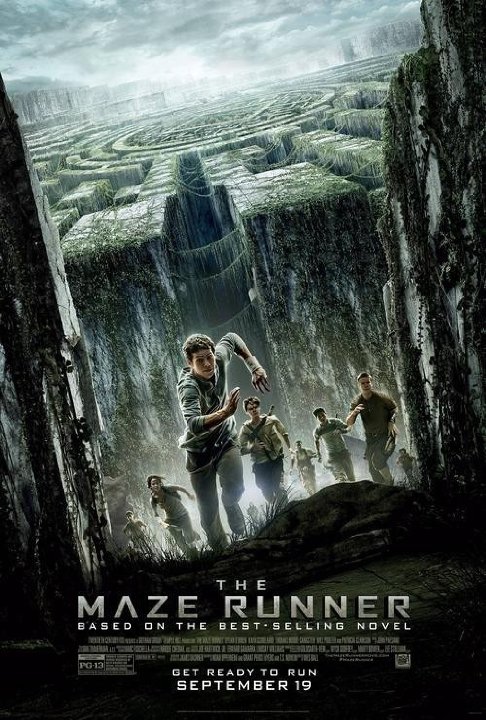 If anyone can reasonably explain to me the end of The Maze Runner in a way that makes some tangible amount of sense, I will give you money. The latest YA-franchise-in-the-making starts off with a storyline that reminded me of Rod Serling. We follow a group of teen boys, memories wiped, as they wake up in the center of a giant mechanical maze. Who put them there? Why? What’s on the other side? As long as the maze and the mystery of it are front and center, the film works, twisting in intrigue. However, when the story veers away to the characters, mostly flat archetypes, and their new society, that’s when I started getting sleepy. You got this awesome huge maze to explore, kids. The film ends up being an exercise in less-is-more restraint when it comes to sustaining a mystery and knowing what points to emphasize and which to skip over. There’s a girl brought into their camp, the first, which they say should be a big idea and change the social dynamics of a group of boys, but it doesn’t. There are silly mechanical spider monsters that scamper through the maze, as if the filmmakers felt a giant maze wasn’t a sufficient enough obstacle and selling point. Scattered flashbacks early on spoil who is responsible for the maze, but when we get to the actual ending, the rationale for who built this large contraption and for what purpose doesn’t add up, like, at all. An explanation wasn’t necessary, but if they needed a quick one I would have accepted, “Aliens did it because.” There’s already a planned sequel in the works. My idea: the kids escape the maze only to discover… they’ve just entered a larger maze. Then they escape that maze only to discover… you get the idea. The Maze Runner is moderately enjoyable. Just don’t expect to enjoy, understand, or even accept the ending and its implications.
Nate’s Grade: B-
Share this:

Lucy (2014)
 If you’re looking for one of the more fun summer movies that have no intention of taking itself seriously at all, might I suggest Lucy, which is one part superhero origin tale and one part wonky French existential drama. It starts off quickly, with the titular character being forced into a being a drug mule. The substance breaks in her bloodstream and the concoction transforms her from meek to a kickass vigilante of science. Lucy can now access far more of her brain’s potential, not just that meager 10 percent we plebs utilize, and who knew that we could all be superheroes if we really put our minds to it? Despite the presence of Morgan Freeman as really a talking head to let us know about the potential of the human brain, none of this really makes any sense, and thankfully the movie doesn’t pretend that it should. Lucy literally gains a new superpower every time we see her, from telekinesis to manipulating radio waves to eventual manipulation of matter and time travel. Yeah, it gets weird, but thankfully it’s also relatively entertaining, funny, fun, and short and sweet at a briskly efficient 90 minutes. The plot doesn’t exactly feel fully developed, more a gallop between events as we charge up the percentages from 10 to 20 to 30 percent, and so on. The criminals don’t seem like much of a threat despite their numbers. I’m shocked nobody assessed what happened to Lucy and said, “Hey, maybe I should ingest this drug into my bloodstream and become a super powerful being too.” While the action is well orchestrated, there is less of it than advertised, as Lucy spends a good amount of time adjusting to her new self-actualized human superiority, played by a detached yet amusing Johansson. I can’t even explain the bonkers ending except to note that maybe there’s a very good reason why human beings were not capable of using a maximum percentage of their brain’s capacity. It doesn’t make much sense but it’s pretty, entertaining with its messiness, and short enough not to waste your precious time.
Nate’s Grade: B
Share this:

Guardians of the Galaxy (2014)
 Who would have guessed that a movie that featured a talking tree and an anthropomorphic raccoon would be one of the best films of the year and one of the top grossing films of the summer? At this point for audiences, the Marvel name can do no wrong, but really it’s the degree of latitude given to Guardians of the Galaxy, an admittedly weird movie with strange characters, that allows this unique film to shine. Attaching offbeat director James Gunn (Super, Slither) to be writer and director was a risk that paid off tremendously, as Guardians is the Marvel film most entrenched with the particular personality of its creative director. This is a gleefully imaginative film that enjoys wading deep into weirdness, dancing to its adventurous Star Wars throwback beat, always with its focus set on comedy but not at the expense of quality drama or character development. Really, the characters are the focus of this entry into the franchise, and Gunn and his actors do a bang-up job of gathering the team and getting you to care about each and every one of them. Each one of these characters has a goal, several payoffs, and each is given their proper attention. In an ordinary superhero film, the archetypes would be ironclad. With Guardians, the tough guy made of muscle can also be a source of unexpected comedy with his literal-minded speech patterns. With Guardians, the talking raccoon can also be an emotionally disturbed victim of genetic experimentation who doesn’t know how to play well with others. These are damaged characters and their formation of an unconventional family unit is deeply satisfying and rather touching. I have seen the film twice and gotten teary-eyed both times. The real star of the film is Chris Pratt (TV’s Parks and Recreation), and what a breakout role he is afforded; he’s like Han Solo’s more juvenile nephew. But like the others, the part is surprising in its depth, with a well of sadness and displacement he still hasn’t processed while he scavenges the galaxy. The plot can be a bit unwieldy at times but pays off better for repeat viewings. This is a world I want to spend far more time exploring and with these characters as my merry prankster guides. With a movie this action-packed, thoroughly entertaining, and gratifying, why come back to Earth?
Nate’s Grade: A


 nathanzoebl
You must be logged in to post a comment.