Blog Archives
Layer Cake (2005) [Review Re-View]
 Originally released June 10, 2005:
Layer Cake may be the least intimidating name ever for a crime movie. It conjures images of bridal showers, cooking shows, and birthday parties. It does not necessarily bring to mind thoughts of gangsters, assassins, drug trafficking, and the seamy underbelly of London’s criminal underground. Unless you’re watching some really awesome cooking show I don’t know about. The “layer cake” in question refers to the hierarchy of criminals. This isn’t unfamiliar territory for Matthew Vaughn, who produced Guy Ritchie’s Lock, Stock, and Two Smoking Barrels and Snatch. This time it’s Vaughn sitting in the director’s chair and the results are exceptionally entertaining. Layer Cake is a cinematic treat.
Daniel Craig (Road to Perdition) plays our untitled lead, referred to in the end credits as “XXXX.” He’s a cocaine dealer but not a gangster by any means. He wants to make his money, not step on any important toes, and then walk away on top and without any gaping holes in his body. Craig is summoned by his boss Jimmy (Kenneth Cranham) and given two missions, whether he wants to accept them or not. The first is to relocate the missing daughter of a very powerful friend of Jimmy’s. The second, and far more dangerous job, is to secure a package of millions of stolen ecstasy pills and make a profit. Complicating matters is the angry Serbian mob that the pills were stolen from. They’ve dispatched a deadly assassin known as Dragan to track down their stolen drugs and kill anyone involved. Craig is left to juggle the investigation, find a buyer, stay ahead of Serbian hitmen, get some time in with a hot new girl, and all the while keeping his higher-ups content enough not to kill him themselves.
 Layer Cake should be the film that makes Craig the star he so rightfully deserves to be. This man is a modern day Steve McQueen with those piercing blue eyes, cheekbones that could cut glass, and the casual swagger of coolness. Craig grabs the audience from his opening narration as he explains the ins and outs of his business. We may never see Craig sweat but he still expresses a remarkable slow burn of fear so effectively through those baby blues. He’s in over his head and the audience feels his frustrations. In an interesting character twist, when Craig does resort to killing, he’s actually tormented and haunted by his actions.
As with most British gangster flicks, there are a batch of colorful characters that leave their mark. Dragan (Dragan Micanovic) is a wonderfully enigmatic ghost of an assassin always one step ahead of Craig and the audience. Morty (George Harris) and Gene (Colm Meaney) add heart and bluster as Craig’s trusted right hand men. But the actor who steals the whole film with a malevolent glee is Michael Gambon (Harry Potter and the Prisoner of Azkaban). He plays Eddie Temple, the man behind the men behind the scenes. Gambon delivers the harshest of speeches with a velvety pragmatic calm. We don’t know what runs deeper with Eddie, his tan or his scheming.
Sienna Miller plays the thankless love interest to Craig. She’s pretty, sure, but there isn’t much acting ability on display in Layer Cake beside some smoldering glances. We never really know what Craig sees in her besides being another cute blonde to choose over. Miller isn’t alone in the “underwritten character department.” Layer Cake is crammed with secondary characters that pop in and out when it’s necessary. It’s not too annoying but it does mess around with an audience?s ability to follow along coherently.
Layer Cake is not one of the slick, whack-a-mole ventures Ritchie has given us (pre-Madonna). No sir, this is a brooding, serious and nearly terrifying look at the old adage “crime doesn’t pay.” Very few crime centered films express the day-to-day anxiety of just being a criminal. Jimmy reminds Craig that he’ll never be able to walk away because he’s too good an earner for his higher-ups. In Layer Cake, you can get killed for being too greedy, being too careless, being too good at your job, and even just being in the wrong place. Eddie sums it up best whilst describing Faust: “Man sells his soul to the devil. It all ends in tears. These things always do.”
 Vaughn has a polished visual sensibility that doesn’t overwhelm the viewer. He keeps the camera fluid and steady with a minimal amount of cuts. A nifty opening scene involves an imaginary drug store (stocked with pot, cocaine, and the like) melting into a real drug store (one hour photo, impulse items at the register). When the tension does mount Vaughn knows just how to turn the screws. A late sequence involving a chase between the SWAT team and our batch of criminals had me on the edge of my seat. For a first time director, Vaughn also has great patience. He doesn’t rush his storyline and he doesn’t suffocate his movie with visual flourishes. He also has a great deal of faith in his audience’s intelligence. This isn’t as lively as Snatch or Lock, Stock, but that’s because Vaughn’s film is also much more serious and dangerous.
This is an intricate and gripping film but it might be a little too complex for its own good. Twists and double-crosses are expected in this genre, but writer J.J. Connolly has so many characters running around and so many hidden agendas that it’s nearly impossible to keep track. Some of the subplots and back stories add very little like the inexplicable “Crazy Larry” flashbacks. I left the theater still confused about plot points but refreshingly satisfied nonetheless.
Layer Cake is the most thoroughly exhilarating time I’ve had at a theater this year. This pulpy daylight-noir caper is full of memorable hoods, plenty of twists and turns, and a star making performance by the steely-eyed wonder that is Daniel Craig (rumored to be the next 007, though in my heart I’ll always root for Clive Owen). Fans of Ritchie’s frenetic gangster flicks should be entertained. Anyone looking for a clever and exciting potboiler that treats violence and crime seriously should start lining up immediately. If you’re suffering from the cinematic wasteland that 2005 has shaped up to be so far, then have yourself a generous helping of Layer Cake and thank the Brits.
Nate’s Grade: A
——————————————————
WRITER REFLECTIONS 20 YEARS LATER

Back in 2005, Layer Cake was really a proof of concept movie for many items. It was proof that someone could take a Guy Ritchie-style crime pot boiler with colorful Cockney criminals and plenty of twists and unexpected violence and play it straight and serious. It was proof of Matthew Vaughn as a director, who had previously served as a producer of those early Ritchie films. It was proof of Sienna Miller as the next It Girl, a proclamation that carried her for years despite mixed results with the movies. Most of all, it was proof of its lead, Daniel Craig, as being so suave he should be considered the next possible 007. James Bond producer Barbara Broccoli has gone on the record saying this movie is what officially put Craig on their radar and got him the gig that has defined his career trajectory. Twenty years later, Layer Cake is still a potent and smooth little thriller that glides right by on its intelligence, sex appeal, and Craig’s charisma
I find myself agreeing with so many of my original points from 2005 so I don’t want this re-examination to be merely a “ditto” without some additional critical analysis. Even though it’s based on a book by J.J. Connolly, who adapted his own novel, the movie feels very much in the company of those early Guy Ritchie movies that Vaughn began producing. Ritchie burst onto the international scene with 1998’s Lock, Stock, and Two Smoking Barrels, a brash and stylish crime comedy with outlandish characters, violence that alternated between visceral and slapstick, and twisty plots that often left your head spinning. It was like a mixture of Tarantino and a more lewd Looney Tunes cartoon. While the early Ritchie films, including my favorite, 2001’s Snatch, have their share of characters with grounded stakes, the reality is exaggerated, with the appeal being these grandiose personalities butting against one another. No one would confuse one of these Ritchie movies with a realistic portrayal of London criminals. They’re fun. What Layer Cake does so well is take a Ritchie-esque premise with plenty of low-life screw-ups and hardasses and plays it straight. It takes this middle-level drug distributor and makes his life less a comedy of errors and more a never-ending anxiety attack about how he can become undone from any angle. The movie sure doesn’t make a life of crime look appealing.
 Craig’s character, named XXXX, is a smart guy just trying to keep his head down and do his job. The problem for him is that he’s too good at earning money for bad men who like money. In this life, you can get killed for any number of reasons, some of them logical and pragmatic, and others rash and illogical: not being a good enough criminal, being too good of a criminal, thinking he’s too good of a criminal, someone else wanting to make a name for themself and establish cred by going after you, dumb luck, etc. XXXX has his rules and standards to live by to ensure he limits his risk, but when your profession is literally dealing with money and unscrupulous types, there is no absolute zero in that risk. He may be smart and measured but he’s also working with plenty of stupid people who don’t know they’re stupid, and then you mix in vice and avarice with that, and it can be a combustible cocktail of dangerous idiots intruding on whatever peace and distance XXXX has cultivated for himself. In the movie, XXXX is burdened with competing tasks. He’s been offered a stash of stolen ecstasy pills, and his slimy boss wants them sold no matter what, but the assassin hired to retrieve them definitely wants them back too. Either way, our lead character is endangering himself by making someone unhappy. He’s dropped into the sticky morass of power plays and competing interests that will challenge his intended neutrality.
I think the ending for Layer Cake is brilliant and very fitting. For almost two hours, we’ve followed XXXX through hell and back and it looks like he’s found a way out, siding with the right hoodlums and eliminating different risky angles needing to be resolved. He’s kept to his stated retirement of not going out on top and instead going out while comfortable and capable. He’ll leave the business to his associates because he’s tired of looking over his shoulder. And as he walks out with his pretty lady (Sienna Miller) around his arm, that’s when he abruptly gets shot by Sidney (Ben Whishaw – yes, the future James Bond is killed by his future Q). This isn’t some tough or some hotshot; he’s a lanky nephew to another gangster, and he hasn’t exactly shown anything close to a killer instinct. In his brief appearances beforehand, he’s seemed out of place, like a latchkey kid who wandered into a criminal enterprise and everyone has been humoring him for good measure. The only thing he has is… was… the blonde girlfriend (Miller) who’s clearly not interested in him. After playing it so cool and calculated, he’s taken out by this twerpy nobody because he had the audacity to try and steal “his girl.” Even if you are the smartest guy in the room and you’ve made all the right moves, all it takes is one twitchy trigger finger and one grumbling grievance to take you from living to dead. Our hero is denied his happy ending driving off into the sunset with his modest sums of money and his newly acquired pretty woman. Try as he might, XXXX, gunned down mid-sentence as he reveals his real name, becomes just another unfortunate corpse.
 Vaughn’s skilled direction immediately made him an attractive target for bigger studio fare. He was originally attached to direct 2006’s X-Men: The Last Stand but left weeks before filming for stated “family reasons.” In 2023, Vaughn revealed that he left because of the tight production timeline, going from pre-production to a complete movie in under a year, but it was really the shady behavior of Fox execs that pushed him out the door. Apparently one exec put together a fake script to lure Halle Berry back, including scenes of her character Storm saving vulnerable children in Africa to appease Berry, scenes that were never intended to ever be filmed. It was a ploy to trick her into signing onto the film. After two more geek-friendly adaptations, 2007’s Stardust and 2010’s Kick-Ass, Vaughn was courted yet again back to the X-Men franchise. Once again there was a tight one-year turnaround deadline but Vaughn stayed on board and delivered what I consider to be the best X-Men movie, 2011’s First Class. It revitalized the declining franchise, enough so to lure Bryan Singer back. Singer had departed in 2005 to make his Superman movie, opening the door for Vaughn’s first foray with the world of mutants. Now that Vaughn had reinvigorated the franchise with a new cast of younger actors, Singer was ready to take it back to helm 2014’s Days of Future Past. Vaughn was rumored as one of the potential names to make the first new Star Wars movie in ten years. Instead, he made his own action franchise with 2015’s Kingsman. Granted it was based upon the comic by Mark Millar, the same author behind Kick-Ass and Wanted, but it was Vaughn’s signature all over this new spy franchise. Vaughn had constructed a new Bond for a new age. At this point, I was dubbing Vaughn the best working director to use studio money. Each movie was different but made with style and panache with great structure and payoffs. And then…
I think he got so enraptured with the world of Kingsman that he’s now trapped himself creatively. In the ensuing years, he’s made one Kingsman sequel and one prequel, both of them varying degrees of underwhelming, and another action spy-thriller that might as well be called Kingsman-lite, 2024’s Argyle. For an artist that was dabbling with so many genres beforehand and finding sure footing and a way to make his stamp within each, he now feels stuck, finding diminished returns with each iteration of yet another swanky spy action movie with snark. I’m not even an Argyle hater, a movie that appeared on numerous Worst of the Year roundups but one I consider perfectly fine as a TNT Sunday-afternoon kind of chill entertainment. I loved Kingsman when it was originally released in 2015, but looking back, it appears like this was Vaughn building his own prison brick by brick. Maybe he was too preoccupied with turning it into a franchise with many tendrils stretching all over. I truly wish Vaughn would hop genres once again and leave the realm of spy action to others at this point. Maybe he needs a return to something straight akin to Layer Cake without its tongue already so firmly implanted in-cheek.
 But this movie will forever be known as the movie that secured Craig as the next James Bond. He had been working in movies for a while with some high-profile supporting roles like 1998’s Elizabeth and 2001’s Tomb Raider and 2002’s Road to Perdition, but this was a platform that showcased the suave presence of this actor like nothing before. He was so magnetic and a perfect choice for this character, and just listening to him try and talk his way out of jams with so many loose canons was as impressive and entertaining as any high-stakes chase or shootout. These sort of star-making roles are rare and even more rare when they do indeed prove to be star-making. It becomes an artifact to analyze what qualities people with money and influence were won over by. It’s interesting that Craig’s character is so anti-guns and wanting nothing to do with the more unsavory and violent aspects of his profession. When he does hold a gun for the first time, one he compliments as being “really pretty,” he holds it out and strikes a pose, dashing through a hallway like he was James Bond, and it’s just especially funny with hindsight.
The movie is also filled with familiar faces that would become even more familiar over the years, including Tom Hardy, Sally Hawkins, Whishaw, Burn Gorman, and some Vaughn regulars, alums from Snatch and Lock, Stock, Jason Flemyng and Dexter Fletcher. Flemyng became Vaughn’s lucky charm, appearing in his first four movies in some capacity, much like Greg Grumberg does for J.J. Abrams. There you go, an SAT-style relationship sentence I never thought I’d write: Jason Flemyng is to Matthew Vaughn as Greg Grumberg is to J.J. Abrams. My original review in 2005 highlighted Michael Gambon as the biggest honcho, the top tier of this criminal layer cake. I wrote: “He plays Eddie Temple, the man behind the men behind the scenes. Gambon delivers the harshest of speeches with a velvety pragmatic calm. We don’t know what runs deeper with Eddie, his tan or his scheming.” He’s so good at being so malevolent without ever having to raise his voice or anything outwardly hostile.
 This movie has a personal factor for me because I was so highly anticipating it that, during a trip through the British Isles with my father in May 2005, I bought it on VHS overseas. I naively thought that while DVDs had different regions to thwart piracy, that VHS tapes would be rather universal considering it’s just tape being read. I got home, popped it into my American machine, and the thing wouldn’t work. This was one of the biggest souvenirs I got for myself during that trip, which my father wanted to embark as something memorable we could share together, and now that he’s recently passed, I do think back on those experiences and part of me wishes my 23-year-old self would have been more actively appreciative. So now with Layer Cake, part of me will always think about that VHS tape, and that trip, and my father, and it will make me miss him more, but I am glad we got to share that experience.
Ever since I’ve been doing this re-review project, now going on five years, it’s a relief to see my twenty-year-younger self having written a smart and articulate review, especially when I mostly agree with it even so many years later. Again, I find myself nodding along to just about everything I had written with my past critique, from singing the praises of Craig and the general examination of day-to-day anxiety, to shaking my head at the underdeveloped Sienna Miller character served as little more than a trophy for our hero to take with him into retirement. It still is a movie overstuffed with characters and storylines and antics that probably could have been trimmed around the edges, but that same burdensome feeling connects with the emotional state of our lead, the anxious feeling of having too much to do and not enough time to achieve it, so in a way, it’s excusable. I don’t know if I think the movie is quite at the same level, calling it “thoroughly exhilarating” seems a bit much, but Layer Cake is still a movie that proves fresh even twenty years later, and one worth a second helping.
Re-View Grade: A-
Share this:

Wonka (2023)
 Was there anyone out there wondering how a young Willy Wonka could have gotten his start as a cutting-edge candy maven? It’s an unnecessary back-story for a kooky character that most will just accept as is. The invented story of Wonka is one of an upstart entrepreneur (Timothee Chalamet) proving a danger to the established corporate oligarchy’s vice-grip on the local confectionery industry. They use the levels of corrupt power to scheme and block Wonka from getting started, but his charms and optimism are just too much, and he wins over the town with his candied delights that provide revelry to the people’s humdrum lives. As a candy-colored musical following an underdog triumphing from the power of friendship and integrity and imagination and good will, it mostly works on a fizzy cloud of its own manufactured whimsy. It’s all highly silly stuff and working very hard to be light-footed and whimsical. There are moments that made me smile and tohers that made me chuckle, like one rich man who gags whenever somebody ever says the word “poor.” The new songs are fairly forgettable except when they’re making you remember the dreamy 1971 numbers. I also think Chalamet (Bones and All) is painfully miscast as our young Wonka. I don’t think his broody-moody acting style works shifting over to manufactured quirk. His performance is just so off from the beginning. Wonka would have been exceedingly better as an original musical without trying to retrofit into the world of Willy Wonka, although that would mean losing Hugh Grant as our first specimen of Oompa Loompa, and he is a droll delight. It’s just weird for a movie to work this hard to tell us how Wonka got his start and to end on uplift when we know in the future he grows up to be a sad middle-aged loner who has to resort to a scam to find a successor, as well as the town becoming an impoverished slum to Wonka’s oppressive factory. My pal Ben Bailey reasoned it would be like a prequel to Death of a Salesman where a younger Willy Loman starts his career as a door-to-door salesman, so chipper and eager to make a name for himself. Wonka is a sugar rush designed as an origin story.
Nate’s Grade: B-
Share this:

Godzilla: King of the Monsters (2019)
 Godzilla: King of the Monsters is the sequel to 2014’s American re-launch, and the biggest complaint I had with that other film was how frustratingly coy it was with showing Godzilla. I wanted more Godzilla in my Godzilla movie, and King of the Monsters at least understands this need and supplies many of the most famous kaiju in the franchise, like Mothra, Rodan, and the three-headed King Ghidorah. The human drama is just as boring with characters I have a hard time caring about. Vera Farmiga plays a scientist who lost a child during the 2014 monster brawl in San Francisco. She develops a sonar device to communicate and domesticate the giant monsters (now totaling 17 plus). She and her teen daughter (Millie Bobby Brown) are kidnapped by eco terrorists that want to… destroy the world and leave it back to the ancient monsters? It’s a bit jumbled. I felt more for a monster than I did any living person. The plot does just enough to fill in time between the monster battles, which can be fun but are also lacking a few key items. Firstly, the sense of scale is lost. That’s one thing the 2014 film had in spades, the human-sized perspective of how enormous these beasts are. Also the fight scenes are shot in pretty dark environments that can make things harder to watch. There is a simple pleasure watching two giant monsters duke it out on screen, and King of the Monsters has enough of these to satisfy. It’s still a flawed monster mash but at least it sheathes the itch it was designed for, and if you’re a Godzilla fan and feeling generous, that might be enough to justify a matinee with a few of your favorite fifty-story pals.
Nate’s Grade: B-
Share this:

The Shape of Water (2017)
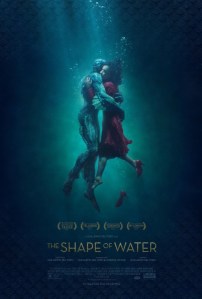 You haven’t seen a romance like director Guillermo del Toro’s latest monster mash (monster smash?), The Shape of Water. del Toro, an aficionado of cinematic creepy crawlies, has swerved from big-budget studio fare into a smaller, stranger period romance between a woman and an amphibious creature who already arrives pre-lubricated (I apologize already for that joke). I was compelled to watch The Shape of Water twice to better formulate my thoughts, mostly because I was not expecting the movie to be so enthusiastically whimsical, adult, and romantic, and the best beauty and the beast tale of this year.
Elisa (Sally Hawkins) is a lonely mute woman working on the cleaning staff at a classified government laboratory. Her neighbor, Giles (Richard Jenkins), is a hopeless romantic trying to find his place in the world as a gay man. Her best friend, Zelda (Octavia Spencer), is supportive but thinks they should mind their own business. An Amphibian Man (Doug Jones) from the Amazon is confined to a cell and repeatedly beaten by Richard Strickland (Michael Shannon), the vile head of security at the station. They believe the creature’s ability to breathe underwater and on land will be the key to winning the space race. The scientist in charge, Dr. Hoffstetler (Michael Stuhlbarg), is secretly a Russian spy, though his allegiances are more to the fragile creature than any country. Elisa teaches the creature sign language, the joys of hard boiled eggs, and lots of cheery music. She also falls in love with the creature and grows determined to save the Amphibian Man by breaking him loose.
 From the get go, del Toro drops us into a world that is not our own, as he’s so skilled at doing. This version of 1960s Baltimore feels as though it’s the twentieth century equivalent of a fairy tale village, and our monster is also the princess in need of rescue. Our heroine has a strange scar that foreshadows her place of belonging. The entire film bristles with a sense of expertly curated magic realism even though there isn’t anything explicitly magical. The supernatural and fantastical are met with a casual acceptance, as they would be in any storybook legend of old. When Elisa discovers the Amphibian Man in his tank, it’s literally at the ten-minute mark or even earlier, and she is unfazed. She immediately accepts the existence of this scaly mere-man, establishes a line of communication, and befriends the creature. It’s as if del Toro is trying to prime the audience for what’s to come and hoping to skip over the intermediate waiting period of incredulity. For del Toro, the real fun is once the characters connect, and belaboring that necessary connection is not in the audience’s best interests or time.
The movie glides by on effusive outpouring of charm, given such vibrant, sweeping life thanks to del Toro’s repertoire of pop-culture influences and his passionate love of cinema. The Shape of Water feels like del Toro and co-writer Vanessa Taylor (Hope Springs) took one of the old Universal horror B-movies and decided to make it into one of the most personal, delightful, and curious filmgoing experiences of the year. It’s film as escape for society’s outsiders. The sense of whimsy is ever-present without being overpowering or diluting the drama. It never feels quirky for its own sake of satisfaction. You’ll recognize several of del Toro’s artistic references, the re-purposing of cultural artifacts, but the magic suffused within every frame is thanks to del Toro and his team of filmmaking artists. If Amelie was going to fall in love with a sea creature, it might look something like this The Shape of Water.
The movie is also surprisingly, refreshingly adult in its depiction of human beings. Again the opening minutes set a standard of what to expect. We get a sense of Elisa’s daily routine before leaving for work, and one crucial component involves furious masturbation in her bathtub (set to an egg timer for sport?). This is a far more sensual movie than I was ever anticipating. There are multiple sequences of Hawkins disrobed and offering herself to the Amphibian Man. We never see any underwater action but we do hear about some of the mechanics of how the coupling is even remotely possible physically (“Never trust a man,” Zelda chuckles upon hearing those dirty details). It’s not all sexy time indulgences. There’s a sharp undercurrent of very real and very upsetting violence, typified by Strickland’s ruthless determination to break the creature. He’s a Bible-thumping sadist generally dismissive of those he finds different and lesser and yet he’s drawn to Elisa. Why is that? Because she’s a diminutive woman who cannot talk, and this sexually excites him like nothing else. He even comes on to her, thinking his interest is a form of masculine charity. There are some shocking moments of very real violence and its lingering effects. Strickland’s on-the-job injury becomes a metaphorical moral gauge for the putrid character’s state of being. The Shape of Water is a movie that does not blunt anything, whether it’s the sexuality or violence of its story (beware pet lovers: this is the second 2017 entry where an amphibian being hidden from the government eats somebody’s house cat). This is a fable for adults, a grimy Grimm’s tale with a sprinkle of Old Hollywood sparkle.
 The Shape of Water is also a deeply romantic and earnest love story about two outsiders finding a connection in the most unlikely of places. Engineering a story that pushes two oddball characters together, each finally finding a kindred spirit, is an easy recipe for a satisfying conclusion; however, their romantic connection has to feel rightly earned. If we don’t believe the characters have fallen for one another, that this potential relationship elevates their existence, that the colors of the world seem brighter when around this person, then it doesn’t work. You have to buy the love story and it must be earned. Amazingly, del Toro is able to craft a love story with a mute woman and an Amphibian Man that checks most of the boxes of Hollywood romantic escapism. Elisa has an openhearted way of looking at the world, and her acceptance provides her with a bravery few others have. The creature presents somebody who views her not as a woman with a disability, as something lesser, but as something whole and wholly fulfilling. Everyone wants to be truly seen by someone for who they are rather than what they’re not.
While del Toro is supremely skillful at making Elisa’s romantic yearnings felt, there is one inherent weakness in this girl-meets-fish dude tale of love. The Amphibian Man isn’t really much of a character and far more of a symbol to the other characters. To Elisa, he’s her hope. To Giles, he’s a wild animal. To Strickland, he’s a defiant challenge to be tamed. To Zelda, he’s the questionable new boyfriend for her pal. To Hoffstetler, he’s a beautiful creature. To the U.S. government, he’s a potential scientific breakthrough. To the Soviets, he’s a liability and a potential future weapon. We’re told the indigenous people of the Amazon worshiped the Amphibian Man as a god but ultimately he remains a cipher others project onto. The love story feels a little too one-sided from an audience investment perspective. Still, the romance works and that fact alone is incredible considering the unique pairing.
 Hawkins (Maudie) is the beating heart of the movie and delivers a wonderfully expressive portrait of a woman finding her voice, so to speak. She’s relatively upbeat and that fits the whimsical tone of the picture. Hawkins plays a woman excited by the possibilities of the world. She reminded me of Bjork’s tragic heroine from 2000’s Dancer in the Dark, a woman who saw the extraordinary in ordinary life, who could perceive a symphony of music just on the outer edges of everyone else’s hearing. Going completely wordless for the movie, save for one very memorable fantasy sequence, requires a lot of daunting physical acting from Hawkins, and she’s more than up to the task. I guarantee a scene where she tearfully forces Giles to say out loud her signing will be her Oscar nomination clip.
When we talk about the weird and wild promise of cinema, it takes a controlled, assured vision and precise execution to bring together the dispirit elements and allow them to coalesce into something that feels like a satisfying, mesmerizing whole. The Shape of Water is del Toro’s gooey love letter to monster movies while stepping outside of homage and into the realm of something daring and different. I could talk about the Busby Berkley musical number as declaration of love, or that the story is told from socially marginalized voices finding an affinity together, or the small character moments that give generous life to supporting figures like Zelda and Hoffstetler, or that it leaves implied stories to be chewed over for extra richness like Giles likely being outed at his work to the dismay of his closeted superior, or the perfect casting for secondary antagonists, or the exquisite cinematography that seems to utilize every shade of green the human eye is capable of seeing, or the stunning production design, or the sweetly eccentric whistling musical score by Alexadre Desplat, or the grace of Doug Jones’ performance in the amphibian suit, or just how funny this movie can be, even the sadistic villain. I could talk about all that stuff but I’ll simply condense it all to a plea to give The Shape of Water a chance. It’s rare to see a storytelling vision this precise that’s also executed at such a high degree of difficulty. In other hands, this could have been an unholy mess. With del Toro, it’s a lovely mess.
Nate’s Grade: A-
Share this:

Blue Jasmine (2013)
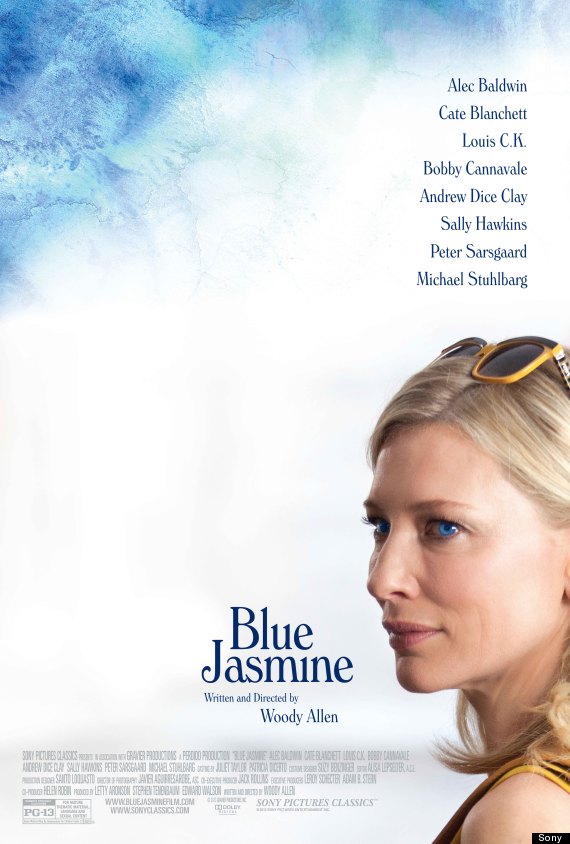 With writer/director Woody Allen’s proliferate output, cranking out a movie every year, it’s all too easy to take the man for granted. Critics will argue his halcyon days are long gone, that the man is coasting on his past laurels. Of course when you’re comparing everything to Manhattan, Annie Hall, or Crimes and Misdemeanors, well sure most movies will be found lacking, even Allen’s. And there’s no real forgiving of 2001’s Curse of the Jade Scorpion. But when Allen hits a rich topic with a capable cast, he can still produce knockout cinema, as is exactly the case with the engrossing Blue Jasmine.
Jasmine (Cate Blanchett) is experiencing a tumultuous change of living. Her wealthy husband Hal (Alec Baldwin) has been indicted for a Ponzi scheme that fleeced millions. Her posh New York lifestyle has vanished, Uncle Sam has frozen the assets that haven’t been repossessed, and she’s forced to move in with her working class sister, Ginger (Sally Hawkins), in San Francisco. Jasmine immediately has her complaints, mostly about the men that Ginger seems to date. She also tries adapting to a life she has been ill prepared for. Much like a domesticated animal, Jasmine’s social skills and pricy tastes do not have real-world transitions into her getting a job and supporting herself. She’s looking for a way to re-enter the shrine of privilege, and that it through a man of means.
 Blue Jasmine is a fascinating character study of a life of self-delusion, denial, greed, and guilt, and it is a marvelous film. Allen hasn’t done something this cutting, this precise in several years and it’s a reminder at just how skilled the man can be at building magnetic, fully realized characters, especially women. This is a rich, complex, and juicy character for an actress of the caliber of Blanchett (Hanna) to go wild with. Jasmine is something of a modern-day Blanch DuBois with a sprinkling of Jay Gatsby; she’s a woman who’s become accustomed to a luxurious fantasy world that she’s still striving to recreate, but she also is a woman who reinvented herself. As we learn in the opening scene, Jasmine left school without finishing her degree when Hal whisked her off her feet, to a world of privilege. She even changed her name from Jeanette to Jasmine at her husband’s whim. She also became particularly adept at looking the other way when it concerned her husband’s shady dealings. Surely she must have known what was happening (in the end, it’s pretty clear) but as long as her illusion of wealth was maintained then it was easy to not ask questions. Why ruin a good thing, even if that good thing is built upon ruining the lives of ordinary people? Two of those people bilked of their money were Ginger and Augie (Andrew Dice Clay), which make Jasmine’s complicity all the more troubling. Every line of dialogue from Jasmine needs to be studied and dissected, analyzing how buried is the real Jasmine.
Jasmine’s declining mental state is also given much attention and curiosity. We are watching in full view a woman go through various stages of a nervous breakdown. She’s medicating herself via booze and a cocktail of prescription drugs, but there are hints that point to something other than substances at play. She hints at undergoing electric chock therapy (does this still exist?) and she may have a touch of mental illness as well, though it’s unclear. Jasmine is given to talking to herself, reciting anecdotes and patter from previous parties with the rich and fabulous. It could be a sign of madness or it could be a desperate attempt by Jasmine to zone out, to return to that former life, to relive her former glory. Personally, I’ve done something similar, recited old conversations out loud to myself, though usually a line or so, not to the degree of recitation that Jasmine engages in. In the opening, it’s revealed that the lady she’s sitting next to on the plane, who we assume she’s talking with, is really just a bystander. She tells her husband she was confused because Jasmine was really just talking to herself. As Jasmine tries to get back on her feet, with delusions of grandeur about reinventing herself again, her world seems to be collapsing around her as she struggles to adapt to the real working world. A receptionist job for a dentist is beneath her as well as far too much for her to handle. She has one real sincere heart-to-heart where she lays out her true feelings, and it’s to her nephews in a pizza shop with no other adult present: “There’s only so many traumas a person can withstand until they take to the streets and start screaming.
An enthralling character study, but Blue Jasmine also benefits from Allen’s precise plotting, folding back into flashbacks to create contrast and revelations. There is an economical finesse to Allen’s writing and directing. Every scene is short and sweet and imparts key knowledge, keeping the plot moving and fresh. It also provides back-story in a manner that feels unobtrusive. Jasmine’s more modest living conditions with her sister are contrasted with apartment shopping in New York City’s Upper West side. The class differences between Jasmine and her sister are put on full display when Ginger and Augie visit New York. However, Allen isn’t only lambasting the out-of-touch rich elite here. Few characters escape analysis. In this story, everyone is pretending to be someone else, putting on fronts, personas, to try and puff themselves up. Once living with her sophisticated sister, Ginger starts seeing her world with new eyes, mainly finding dissatisfaction and a yearning that she could do better. She meets Al (Louis C.K.) at a fancy party and gets smitten, though he’s not what he seems. She dumps her current boyfriend, buying into Jasmine’s theory that she “dates losers because that’s what she thinks she deserves.” She tries to remodel herself into a posh, inaccurate version of herself, a knockoff on Jeanette to Jasmine. It’s a bad fit. The person with the most integrity in the entire film appears to be, surprise, Andrew Dice Clay’s character. Augie is a straightforward blue-collar guy but he has a clear sense of right and wrong, one that comes in handy when he’s able to bust people.
 This is much more a dramatic character study than a typical Allen comedy of neurosis, but I want to add that there are a number of laughs to be had, mostly derisive. There is comedy but it’s of a tragicomedy vibe, one where we laugh at the social absurdities of self-deluded characters and the irony of chance encounters. It’s far less bubbly than Midnight in Paris, Allen’s last hit, but that serves the more serious, critical tone. The class conflicts made me chuckle, as well as Jasmine’s hysterical antics and self-aggrandizing, but I was so thoroughly engaged with the characters and stories to complain about a lack of sufficient yuks. Confession: I generally enjoy Allen’s dramas more than his straight-up comedies.
Naturally, the movie hinges on Blanchett’s performance and the Oscar-winning actress is remarkable. I expect her to be a lock for another Oscar nomination if not the front-runner until later. She fully inhabits the character and lays out every tic, every neurosis, every anxiety, and every glimmer of doubt, of delusion, of humanity. She is a fully developed character given center stage, and it’s a sheer pleasure to watch Blanchett give her such life. You’ll feel a mixture of emotions with the character, from intrigue, to derision, to perhaps some fraying sense of sympathy, especially as the movie comes to an end. Blanchett balances the different faces of Jasmine with startling ease; she can slip into glamorous hostess to self-pitying victim to naiveté like turning a dial. I never tired of the character and I certainly never tired of watching Blanchett on screen.
Woody Allen has been a hit-or-miss filmmaker for over a decade, and you’ll have that when the man has the perseverance to write and direct a movie every freaking year. I had a pet theory that, as of late, every three years was when we really got a great Allen movie: 2005’s Match Point, 2008’s Vicky Cristina Barcelona, 2011’s Midnight in Paris. Well now my theory has been put to rest, thank you very much, all because Allen couldn’t wait one more year to deliver Blue Jasmine, a truly great film. It’s a tragicomedy of entertainment, an exacting character study of a flawed, complex, deeply deluded woman as her carefully calculated world breaks down. Anchored by Blanchett’s supreme performance, the movie glides along with swift acumen, doling out revelations at a steady pace and consistently giving something dishy for the actors and audience to think about. It’s funny, it’s sad, but more than anything Blue Jasmine is compelling as hell. This is one of Allen’s best films and one I’d recommend even to non-fans of the Woodman. Give Blue Jasmine a chance and you may be surprised what you feel, for the film and the woman, both complex, engaging, and memorable.
Nate’s Grade: A
Share this:

Never Let Me Go (2010)
 You’ll be excused for mistaking Never Let Me Go as one of those austere boardinghouse dramas the English are fond of cranking out. I mean it even has Keira Knightley in the thing for goodness sakes. Pretty lily-white British actors trying to find their place in a reserved society spanning the 1970s to the mid 1990s. You’d be forgiven for stifling a yawn. But then Never Let Me Go takes a sudden left turn into a realm of science fiction morality play. It becomes something much deeper and menacing. I am about to go into some major spoilers concerning the sinister premise of the movie, so if you’d prefer to stay pure then politely excuse yourself from the remainder of this review and come back at a later time. I won’t think less of you but only if you promise to come back.
Kathy (Carey Mulligan) and her pals Tommy (Andrew Garfield) and Ruth (Knightley) all grew up in the remote countryside school of Hailsham. It’s like any other school in most regards, except at Hailsham the children all wear monitoring bracelets, are afraid to leave the boundaries of school for fear of being murdered by outside forces, and are told that her physical fitness and internal health are of “paramount importance.” Figured it out yet? My then-partner leaned over and whispered, “Are these kids organ slaves?” Kathy and her friends find out their true identity when an outside third-grade teacher (Sally Hawkins) takes pity on them. She reveals that the students of Hailsham are clones whose sole purpose is to be raised into healthy adults who will then give “donations” to the ailing public at large. Most clones will go through one to four “donations” before “completing,” unless they so desire. You see Never Let Me Go exists in a realm where medical science has made momentous breakthroughs and now people can live to 100 years of age on average. Kathy and her friends are the dirty details.
 The rest of the movie flashes through our trio’s teen years. Kathy has always been kind and affectionate to Tommy, but before she could seal the deal Ruth swooped in and took Tommy for her own. Kathy has waited in vain for the two to break up, but that day just never comes. The trio ventures out to a small farmhouse in their teens to do some work and see the outside world. They’re living with a few other Hailsham alums that show them the knack for social interaction with outsiders. There are two rumors at play. One is that the Hailsham alums think they’ve found Ruth’s “original,” the person she’s been cloned from. The second rumor has greater significance: if two Hailsham students can prove that they’re in love, deep, honest love, then they can defer their donations for a few years. This idea takes hold of Tommy and consumes him. Except, we don’t really know whether Ruth or Kathy will be his partner in love.
So why don’t these people run away, or fight back, or do anything of defiance once they discover the horrible truth that will befall them? I have read several critics taking the film to task for being so painfully prosaic and passive, and Never Let Me Go can admittedly fall prey to those detractions at times. However, this is not the Hollywood version where the abused (clones) fight back for their survival and regain independence in a hostile world. That movie was called The Island, plus the several other films that Michael Bay sort of ripped off and then added extra loud explosions. Never Let Me Go has nary an explosion or moment of triumphant revolution. There is no revolt coming because the film doesn’t want to let anyone off the hook; these people are society’s collective collateral damage. They have been bred to be walking, talking, mostly demure, fleshy warehouses for spare parts. It’s only a matter of time before they leave everything on the operating room table, and these people benignly accept their doomed fate (“We all complete”). They march forward, trying to find some level of dignity and beauty before they get the call for “donations.” These people don’t know what it means to rebel; they have no real concept of liberty. They’ve been conditioned since childhood to obey, and that’s the whole point of the film. They have no self-preservation instincts. Likely any cloned child that was expressing strong feelings of boldness was removed, and destroyed, so as not to taint the rest of group. These people are like gown-up versions of veal. They’ve been cultivated since birth for the purpose of destruction, and their knowledge of the world is limited and cruelly self-serving. Watching innocent characters march off to a merciless fate can be very emotionally draining. It should also make you angry.
 These people are hopeless so that the movie’s full impact is absorbed. This isn’t some far off nightmarish scenario, because we as a society are already reaping the rewards of a lifestyle, a lifestyle that we’re loath to think about the mechanics of how we got so fat and happy. I can go to a Walmart and buy a T-shirt for a dollar. I am a happy consumer, but what did it take for me to get that product at such a discounted rate? Sure there are variables up the wazoo, but there are many negative factors that go into why that price stays low, invisible hand of the market be damned. Workers clock long hours in unsafe conditions in order to meet supply, earning a penance just enough to keep them alive and moving product. Environmental concerns are overlooked because that would mess with production. Long-term generational poverty can develop. The worker has ceased to be a person and is merely a dispenser of product, much like our clones in the film. This is not a definitive example of what goes on in the world, mind you. Never Let Me Go isn’t some far off scenario; we’re already there, albeit less explicitly. If the price of gas rose a dollar a gallon but it meant that people in other countries could have safe, uncontaminated water and enough food to stay healthy, what do you think would happen?
With all of that said, Never Let Me Go can’t fully fight the trappings of inert drama. For two hours we are watching somewhat nice, somewhat bland British kids gawk and smile their way toward the inevitable. The conceit calls for the breeding of rather milquetoast personalities. It simultaneously makes the characters more innocent and less emotionally involving. The screenplay relies on our sense of outrage and injustice to fill in the gaps of emotional connection. There are little molehills of characterization at best. You’re supposed to be choked up on indignation and sadness so as to not notice that the threesome of character are all rather good-natured but boring. That even may be an aim of the screenplay to accentuate the terrible fate that awaits, or maybe I’m just being overly analytical. Never Let Me Go reveals its awful truth fairly early at about the 40-minute mark, making sure that the audience is fully aware that we are definitely not headed for a happy ending. As it is, the actors are all lovely and talented but there’s only so much silent emoting and teary eyes can conjure.
 It’s credit to the talents of the actors that you do feel a storm of emotions from such otherwise frail characters. Mulligan (An Education) showcases her great gifts for communicating sadness. Her face just crinkles up, her eyes get glassy, and you want to hug her. She’s our dramatic linchpin. Her looks of conflict and yearning do well to communicate the inner struggle of her character’s abbreviated life. There’s a lot left to the imagination and Mulligan once again crushes it. Garfield (The Social Network) is stuck playing a wishy-washy character, which makes him seem a bit thick at times. He’s the most naïve and hopeful of the three, so when those hopes get crushed again and again his breakdowns have the most emotional heft. Knightley (Pride and Prejudice) has been in six period films since 2005, so she’s got this thing down pat. Ruth is a bit more assertive and angry than her friends, and it’s a pleasure seeing a more calculating side from the actress. It seems like the filmmakers had a troublesome time trying to downplay the attractive features of their cast. So it seems that they relied on the actors eating less. Knightley, and particularly Garfield, look rather gaunt and puckish, even before they begin “donations.”
I’ve gone this far without even mentioning director Mark Romanek’s (One Hour Photo) contributions, or the fact that the film is based off the 2005 novel by author Kazuo Ishiguru (Remains of the Day) and is adapted by Alex Garland (28 Days Later). Great artists that shaped the vision of this film. It’s a shame then that the impact of Never Let Me Go is blunted. It’s an intelligent, poetic, haunting, and emotionally wrenching film experience, and yet it could have been far more penetrating and devastating. The passive nature of the characters accentuates their doom and our sense of outrage. But that same passive nature makes them less than engaging characters. It’s been days since I saw the film and it still lingers in my memory, a testament to the moral quandaries and acting prowess. The existential drama of the film is better suited for the page where the questions of identity and morality can be given more careful and rewarding examination. The movie has an oddly detached feel to so much suffering. Never Let Me Go is a hard film to let go but also a hard film to truly embrace.
Nate’s Grade: B
Share this:

Happy-Go-Lucky (2008)
 I wanted to turn this movie off for the first 30 minutes or so and that’s because of Poppy (Sally Hawkins), the deranged optimist that the movie follows. Writer/director Mike Leigh’s latest semi-improvised tale following the English working class centers on a primary school teacher who makes the conscious choice to be happy in life, no matter what life throws her way. Her presence is somewhat exhausting, like a customer who doesn’t know when making jokes has gone from fun to downright annoying. But you know what? Poppy eventually won me over, and I’m all but positive it was the scenes of her and her raging, pessimistic, tightly wound driving instructor (Eddie Marsan) that did it. Before their first driving lesson, I felt like the movie was giving me a slice-of-life that I was hesitant about; Poppy, like anyone who is insanely happy, can be grating. The humor is extremely dry and most of the clever dialogue exchanges will likely go by unnoticed because the actors aren’t delivering big punch lines. Hawkins goes all-out as the unflappable Poppy and she will make you smile through sheer force of will. This was a film I liked more by the time it was winding down, perhaps because Poppy might be easier to take knowing that time is coming to a close much like spending time with a distant relative during the holidays.
Nate’s Grade: B


 nathanzoebl
You must be logged in to post a comment.