Blog Archives
Decision to Leave (2022)
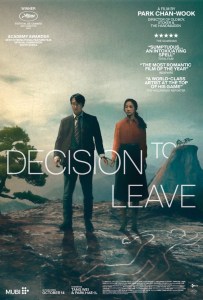 Imagine crossing a classic film noir detective story with some unrequited romance heavy with yearning, like In the Mood for Love, and that’s the combo you get with director Park Chan-wook’s newest, Decision to Leave. In Busan, a straight-laced detective (Park Hae-il, The Host) is investigating an older government official who fell to death from a mountain peak. He suspects that the man’s wife, Song Seo-rae (Tang Wei, Lust, Caution), a much younger Chinese immigrant, might have something to do with the death, and so the detective gets closer and closer to his suspect, blurring the lines of the investigation and his own personal desires. It sounds like familiar genre territory, and it can be, but director Park Chan-wook (The Handmaiden, Oldboy) is the X-factor, and quite simply, he shoots the hell out of this movie. There are some jaw-dropping shot selections and camera arrangements here to cherish. The movie is less interested in its sordid murder mystery details and more the possible relationship between its two magnetic poles, made even more complicated by the detective already being married, though only spending the weekends at home. There is a stormy swell of will-they-won’t-they sexual tension in constant churn, and it adds a dour sense of melancholy to the entire movie. There’s a time jump two-thirds of the way through the movie that is slightly aggravating, because it’s like starting over and repeating the mystery catch-up but with less time, making the details of this new case even less meaningful than earlier. Decision to Leave ends on a strong downbeat that feels appropriate given the mood of the preceding two-plus hours. I don’t think the characters are as textured as they could be, part of this is being jostled around by the non-linear storytelling and artistic tricks of Chan-wook. I think the movie generally favors mood and flirts with wanting to be seen a tragic romance worthy of Hitchcock, though I don’t think it fully gets there. So much of the movie is about probing whether or not the feelings are real between these two, whether she’s toying with him or he just wants to complete the unfinished assignment (the dynamic reminded me of Luther and Alice in the BBC series Luther). Decision to Leave feels like a solid film noir mystery, elevated by A-level directing talent, and then missing its ambitious grasp with its lilting love story that feels a little too subdued and understated to really smolder.
Nate’s Grade: B
Share this:

The Hours (2002) [Review Re-View]
 Originally released December 25, 2002:
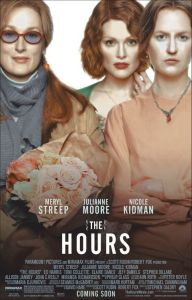
Okay, after watching the Golden Globes award show and seeing The Hours crowned with the highest prize, and hearing incessantly about Nicole Kidman’’s fake prosthetic nose in the movie, it was time to venture into that darkened theater and see how good the awards-friendly The Hours was. Little did I fully realize what I was getting myself into.
Nicole Kidman plays Virginia Woolf, who is in the midst of writing her novel Mrs. Dalloway, where she proposes to display a woman’s entire life through the events of a single day. Julianne Moore plays Laura Brown, a housewife in 1951 having difficulty adjusting to a domestic life that she feels ill equipped for. Meryl Streep plays Clarissa Vaughan, a gay copy-editor in 2001 planning a party for a poet and former lover (an emaciated Ed Harris), who is suffering from the late stages of AIDS. These three storylines will be juggled as the film progresses, with each woman’s life deeply changing before the end of the day.
The Hours is a meandering mess where the jigsaw pieces can be easily identified. The attempt at a resolution for an ending, tying the three storylines together, is handled very clumsily. The film spins on and on that you start to believe the title may be more appropriate than intended. What this movie needed was a rappin’ kangaroo, post haste! The film is wrought with victimization and screams “Give me an award already!” Before you know it you’’re being bludgeoned to death with what is profoundly the most over serious Lifetime network movie ever assembled. And there’s nothing fundamentally wrong with Lifetime movies but The Hours does not share the sensibilities of its TV brethren.
 Kidman, nose and all, gives a strong performance displaying the torture and frailty of a writer trapped within her own mind but too often relies on wistful staring or icy glares. Moore is effectively demoralized but cannot resonate with such a shallow character. Streep is the least effective of the three and fizzles among an over-stuffed assembly of characters.
The supporting cast is unjustly left for dead. The characters are seen as parody (Toni Collette as Moore’s un-liberated homemaker neighbor), extraneous (Claire Danes as Streep’s daughter, Allison Janney as Streep’s lover, Jeff Daniels as Harris’ ex-lover, you know what, almost anyone in the Streep storyline), one-note (the workmanlike John C. Reilly who plays yet another doting and demystified husband) or merely obnoxious (Moore’s brat child that refuses to separate from her). It appears The Hours is the three lead actress’ game and everyone else is not invited to play along.
Stephen Daldry’s direction shows surprising stability and instinct after his art-house pandering Billy Elliot showed little. The technical aspects of ‘lThe Hours are quite competent, especially the sharp editing and musical score, which just points out further how slickly hollow and manufactured the film is.
The Hours is an over-glossed, morose film that is too self-important for its own good. It sucks the life out of everything. And for all its doom and gloom and tsunami of tears, the only insightful thing The Hours is trying to pass off onto the public is that women are more depressed than you think.
Nate’s Grade: C
——————————————————
WRITER REFLECTIONS 20 YEARS LATER

I thought 2002’s The Hours would be a good movie to come back to not necessarily because I thought it would be revelatory but because I thought it may have been emblematic of my more dismissive, glib attitude when I was a twenty-year-old smart alack getting published in his college newspaper and considering myself a hotshot wordsmith. I was worried that my initial review would come across as snide and condescending considering the subject matter. I dubbed it the “most over serious Lifetime network movie ever assembled” and yet, twenty years later, after having devoted two more hours watching The Hours, I must say that this comment still holds merit.
I was fully ready to disavow my younger self as being unkind to this movie, or being too quick to dismiss a movie about women’s suffering through three generations, especially as a young man trying to be clever and, by early 2000s standards, snarky and cynical. Well, even in 2022, I still dislike The Hours, and it’s because of how overwrought everything comes across in this movie. This movie is overstuffed with the trapping of importance, and the 1950s section featuring Julianne Moore as an unhappy housewife stifling her desires (not to be confused with her 1950s unhappy housewife also stifling her desires in 2002’s Far From Heaven) is played to the point that it could be self-parody. That’s not the kind of artistic approach you’d think you would want in something so transparently desirous of special award consideration. For me, it was unmistakable even early on, and the heightened melodramatic atmosphere made me, at several points, almost want to giggle at how obvious and cloying and annoyingly reaching each moment came across. There is no subtlety to be had with The Hours, and that’s fine, but there is also no real striking substance beyond a few transitory moments of grace that stand out. The Moore segment has her drifting through the day like a zombie and almost on the verge of tears at every single turn. I felt sorry for Moore, who is coasting on emotional instinct as the character she’s been given is, at best, meant to be a symbolic placeholder of millions of women of her era. Her interaction with her son makes her sound like a deranged android grasping for human behavior. The moment where they sift flour together and claim it’s beautiful was just so stupifying. It’s amazing to me that Moore was nominated for Best Supporting Actress for this role. She’s also the example of the kind of woman that Woolf was writing about with her titular Mrs. Dalloway heroine, but without Woolf explicitly commenting, the entire 1950s segment is one big airless melodrama, meant as a misdirect of the movie’s miserablist obsession with suicide. By the time old lady Julianne Moore shows up to unload a hasty monologue explaining decades of unknown drama, you may have decided that the three stories could have been two (or one).

Each of the three plot segments is intended to better inform the other, to coalesce into a thesis statement on the plight of women, except each storyline is so thinly written. Without the others to provide direct companionship, each one of these storylines would be pitifully minimal and fail to evolve the notions of feminine hardship. Virginia Woolf (Nicole Kidman) is sad because she feels stifled by the country and doctors who are trying to improve her mental health. Laura Brown (Moore) feels stifled because she is a cloested lesbian pretending to be a happy and doting housewife to her oblivious husband (John C. Reilly, not to be confused with his other oblivious husband in 2002’s Chicago). And Clarissa Vaughan (Meryl Streep) is sad because one of her closest friends (Ed Harris) is dying from AIDS. That’s it. Each of the three timelines is threaded together for the intention of greater relevance, but what it really does is put the onus on the viewer to find more relevancy in context. Sometimes the three women will be doing the same actions, sometimes one will make a comment that seems to be answered by another, and sometimes they’ll inadvertently quote one another or Woolf’s novel. Except the connections and layers are superficial and clinging to an obvious thesis and biding its overlong time for absent depth.
Much of the early publicity around The Hours circulated around Kidman’s fake nose, which producer Harvey Weinstein hated (he also hated the score by Phillip Glass that would later be nominated for an Academy Award) but Kidman absolutely loved. During the time of production, she was divorcing Tom Cruise and was a tabloid magnet but the prosthetic nose allowed her a degree of refreshing anonymity with the paparazzi. She kept the nose on for the entire movie. I’ve been more critical of Kidman’s since her early 2000s career summit (Moulin Rouge, The Others, The Hours), but she legitimately is good in this and has more spark and reserved melancholy than she’s shown in numerous latter roles. Whether she deserved the Best Actress Oscar over the likes of Diane Lane (Unfaithful), Salma Hayek (Frida), Renee Zellweger (Chicago), and Moore (Far From Heaven), is another question I think I already know the answer to, but it allowed every single critic and would-be Oscar historian to use the same hacky joke: “she won by a nose.”

This cast is stacked to the point that even small parts are played by great actors. On top of the big three you’ve got Harris and Reilly, Toni Collette, Claire Danes, Margo Martindale, Eileen Atkins, Allison Janney, Miranda Richardson, and Jeff Daniels. It’s an embarrassment of acting riches, which makes it all the more disappointing when they are kept strictly as archetypes and stereotypes.
Director Stephen Daldry is a complete mystery to me. His first three directing features earned him three Oscar nominations for Best Director (2000’s Billy Elliot, The Hours, 2008’s The Reader). I thought The Reader was horribly misguided but it led to Kate Winslet winning her first Oscar, and I thought his follow-up, 2011’s Extremely Loud and Incredibly Close, was also horribly misguided and was still nominated for Best Picture. I don’t understand the adulation.
In my original review, I concluded by saying, “The Hours is an over-glossed, morose film that is too self-important for its own good. It sucks the life out of everything. And for all its doom and gloom and tsunami of tears, the only insightful thing The Hours is trying to pass off onto the public is that women are more depressed than you think.” I thought re-evaluating the movie twenty years later would prove more insightful and perhaps prove my younger self wrong, but the me of the year 2022 was the one in the wrong. I agree that its central thesis is relevant, but having three underwritten stories of sorrow stacked atop each other and expecting poetry is asking a lot. I wish this movie was indeed better but it’s prime early 2000s overwrought Oscar bait.
Re-View Grade: C
Share this:

RRR (2022)

The Indian film sensation that has converted millions across the world has one new convert: me. I’ve been hearing about RRR all year and how outlandish it is, how wild and audacious this three-hour action historical musical can be, and that it’s a celebration of the exuberant possibilities of film, and to every part of that sentence I pump my fist and declare an enthusiastic yes. Think of it as a superhero movie that also happens to be a musical. RRR is set in 1920s India and follows two real-life figures central to India’s independence from Britain. Komaram Bheem (N.T. Rama Rao Jr.) and Alluri Sitarami Raju (Ram Cgaran Teja) never met in real life, but the movie makes them not just enemies but also the best of friends. Both men are set on a collision course, with Bheem searching for his little sister who was kidnapped into the big city by the British governor (Ray Stevenson), and Raju is working his way through the ranks of the British police and searching to arrest Bheem. What might get in the way is the greatest bromance in years, as these guys don’t just like one another, they will swear their undying allegiance and love for the other. Raju helps his BFF talk to a nice British girl he is crushing on, and he even helps Bheem by leading a dance off between hilariously haughty British elites. That “Naacho Naacho” dance is a shot of pure joy and encapsulates the movie: it’s frantic, frenetic, overpowering, and purely genuine. There isn’t a hint of irony in any of the overzealous 186 minutes here. The lead characters act like super powered gods, or burst into song and dance, complete with cover-worthy poses, but at no point does the movie want you to laugh at it; it wants you to get on board and enjoy how perfectly crazy the movie is. It took me about an hour, but I was won over completely by RRR. There is a man getting whipped who moves the crowd into a revolutionary mob through the power of his song. There’s a guy throwing a leopard at another man’s head. A man kicks a running motorcycle into the air and then uses it as a projectile. It’s got spectacular action with more style than a hundred Hollywood movies. The action is so well choreographed and clear to understand that it’s immensely gratifying to watch. The extravagant wire work adds to the grandiose mythic nature of the movie. The arc that Raju has is more compelling and satisfying than many in even American indies. Not only are these gents buff as hell, and effortlessly charming, but they can and will dance circles around the competition. I won’t pretend I have a deep knowledge of Indian cinema but this seems like an excellent entry for many Western fans to explore the stylistic heights of Indian cinema. This is a wild romp with cheer-worthy heroes, a bromance for the ages, and villains you can’t wait to topple. RRR is a bit exhausting by the end but I was never bored during its different tonal shifts. It might not be the best movie of the year but it’s certainly going to be the most movie you’ll get in 2022.
Nate’s Grade: A-
Share this:

Rosaline (2022)
 Rosaline is a new romantic comedy in the vein of the meta Rosencratz and Guildenstern are Dead, playfully re-imagining Shakespeare’s doomed romance in a much more light-hearted rom-com tone. For you see, dear reader, Rosaline (Kaitlyn Dever) was the young woman who Romeo (Kyle Allen) was infatuated with… until he met Juliet (Isabela Merched), and then it was all Juliet 24/7. Rosaline is the spurned lover trying to regain her former boyfriend with the help of a handsome suitor and her gay best friend, Paris (yes, the one supposed to marry Juliet away from Romeo in the end). Rosaline is a delight for several reasons, chief among them the quick-witted screenplay by the Oscar-nominated pair Scott Neustadter and Michael H. Weber (The Disaster Artist, 500 Days of Summer) and the eminent charms of Dever as a forward-thinking, snarky, exasperated woman bumping against her society’s demands. Dever makes every joke that much better and is so charmingly diffident. We may know the story of Romeo and Juliet, but the fun of the movie is how it subverts our expectations or presents goofy answers around the peripheral of the main story, like how Rosaline was manipulating actions from afar, sometimes unintentionally. The tragic tone is replaced with something much more cheery and amusing, and that might irk diehard fans of the Bard. I found it to be a winning and irreverent low-stakes re-invention of a literary classic, elevated by charming performances and a beguiling and clever screenplay (I’m giving credit more to the screenwriters than the source material novel, as it had many one-star reviews on Good Reads). For fans of Shakespeare adaptations with a feminist twist, check out Rosaline and fall under its star-crossed spell.
Nate’s Grade: B
Share this:

Secretary (2002) [Review Re-View]

Originally released September 20, 2002:
Secretary is a new romantic comedy with a few kinks to it. It’s actually the most romantic S&M movie ever. It’s the first S&M romantic comedy since maybe Garry Marshall’s disastrous 1994 Exit to Eden. I’m still trying to get the image of Rosie O’Donnell in a bondage mask out of my ongoing nightmares.
Lee Halloway (Maggie Gyllenhaal) is fresh from a stop at a mental institution for her hazardous habit of cutting herself to feel relief. Her overbearing mother stashes the entire kitchen cutlery in a locked cabinet. The sheltered Lee resorts back to a kiddy make-up box stashed under her home bed. Instead of colorful brushes and arrays of lipstick, she has a selection of sharp objects. Lee goes job hunting to step back from her habit, and is hired as a secretary to E. Edward Gray (James Spader). He is a rigid taskmaster who delights in pointing out typographical errors with his red marker, his weapon of choice. Gray enjoys his dominance and Lee complies, even if it’s routing through garbage. He ticks away Lee’s flaws like a checklist of annoyance but also appears to have genuine concern for her. When he notices her wounds Gray confronts her and convinces Lee to stop cutting herself.
The turning point arrives when Gray orders Lee into his office one afternoon. He commands her to bend over his desk and then delivers a sound spanking. Lee stares at her purple rump with fascination, like something has been awakened inside her. Soon enough Lee purposely makes typos so she can re-assume her spanking position.
 Maggie Gyllenhaal is a cinematic find with a fearless and breathtaking performance that is at once delicate, nervous, self-controlled, seductive and delightful. Gyllenhaal, with her heart-like face and pert lips, radiates star quality. She allows the audience into Lee”s head and we quickly fall in love with this peculiar yet charming heroine. If there is any justice in this world Gyllenhaal should at least get an Oscar nomination (she didn’t). Spader can do this left-of-center creepy character stuff in his sleep.
Secretary on the surface may seem like a fetish flick but it’s no different than boy (sadist) meets girl (masochist) and falls in love. Director Steven Shainberg treads carefully around serious subject matter, like Lee’s self-mutilation, to focus on these two very special characters. Secretary isn’t making any loud statements on sadomasochism or post-feminism, it’s just showing us that S&M is the route these two people take to find true love. It doesn’t judge them for their unconventional tastes and neither should we. This is one of the finest romances in recent memory and it seems to come from one of the most unlikely places.
Sadomasochism has been predominantly shown involving pain or some leather-masked madman evoking torture. Secretary may be the film that shows there can be pleasures with pain. Some people regard what Lee and Edward do as sick, perverted, or downright wrong. Secretary is a foot in the door to get people to understand what willing sadomasochism really is about. We all have fetishes and interests, and S&M is the number one fetish truth be told. This isn’t your everyday romance.
Obviously, this is a movie that will not appeal to everyone. The relationship between our leads is surprisingly complex but gentle and even sweet (if that’s the proper word for an S&M romantic comedy). Secretary shows that it truly takes different strokes and, despite an overly silly ending, is the most pleasing romance of the year. You’ll never look at red felt pens the same.
Nate’s Grade: A
——————————————————
WRITER REFLECTIONS 20 YEARS LATER

I’ll be honest with you, dear reader, because I think you deserve that. I didn’t recently re-watch Secretary. I did re-watch it a year or two ago, and the return experience was so jarring that I didn’t feel that I would greatly benefit from watching it so soon again, but I knew I would have to include it on my 2002 re-watch list when it was time. When I first watched it in 2002, I was smitten with its offbeat charms about an unconventional romance through the BDSM community and a young woman’s self-actualization through accepting her kinks. It was a star-making performance from Maggie Gyllenhaal (originally was going to be Gwyneth Paltrow) and as a sucker for quirky romances, it was one of my favorite films of the year. Nearly two decades later, I took out my DVD copy to share with my now fiancé, who is also a fan of quirky romances and who had never watched Secretary. Surely, I thought, she would be entertained. Dear reader, she was very not entertained. She was horrified. She was shaking with disgust. She was having a literal violent reaction to the movie and its onscreen display of what constituted romance, and I will say it struck me differently too. I understand that not every film will age well, as our sense of what is funny or acceptable or what is even compelling will change over time as our culture inevitably shifts. That’s art. But hoo boy has Secretary aged about as well as milk in the ensuing twenty years.
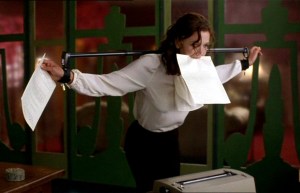 The very nature of the S&M relationship between boss and secretary was already problematic when it was released in 2002, but in a post-Me Too universe it is inexcusable and taints any charms the movie may have had. Mr. Grey (James Spader), the dominant boss and rigid stickler for rules, is the villain of the movie and not its Byronic hero, the brooding and damaged man that a pure-hearted woman just needs to find a magical way to reach and reform. He is not romantic. He is appalling, and the early critical praise, myself included, excused far too much of his behavior. While not condoning his excesses, critics may have given more leeway because the end result was framed as a happy ending, with Lee (Gyllenhaal) being cared for by Mr. Grey. However, he completely uses his position of authority in many inappropriate manners, and while they do develop a mutual relationship, eventually, the power dynamic is not equal at all. This takes away the agency of Lee and makes the romance feel like a false choice. Much of her relationship can be summarized by the awful moment he ejaculates on her back: she just has to take whatever he dishes and like it. That’s not romantic. That’s not cute. That’s toxic. It also hurts the overall movie that the way Lee proves her devotion as the film’s climax is to stay fixed at her boss’ desk for many days, to the detriment of her physical health. Yes, Mr. Grey gets Lee to kick her habit of self-harming but she replaces one need with another. He resembles a predator by most every definition, and to try and say, “Well, he’s just complicated,” is bad man excuse-making.
I tried imagining tweaks and alterations that could make this all work, but anything where he is her boss muddies the issue of consent. Maybe if he was a visiting businessman, but that would also offer a questionable dynamic. The core of Secretary is built upon the secretary/boss interplay and imagery. The tagline is, “Assume the position,” and depending upon the poster, you might only get a woman’s rear in fishnets as the sole imagery. Director Steven Shainberg (Fur) and screenwriter Erin Cressida Wilson (Chloe, The Girl on the Train) are clearly veering into the obvious office power dynamics for provocation. They are very intentional about subverting romantic clichés and looking for something different for our heroine. We have a nice guy, played with squirmy energy by Jeremy Davies, who just won’t cut it. He’s too vanilla for her and afraid to be too forceful in his spanking. It’s like the filmmakers are declaring that Lee demands more, and her specific combination of qualities just so happens to align with this gross man. The movie wants us to hold our judgment, and I could in 2002 in a “love is love” declaration, but what I see on-screen in 2022 is not indicative of love. It’s obsession. It’s codependency. It’s sad.
 The other problem, sadly, is Maggie Gyllenhaal’s fragile performance. The choices she makes collapse Lee, greatly infantilizing her and magnifying all the icky feelings I had. She’s playing Lee less like an adult woman who is struggling to figure out her confusing life, and impulses, and more like a teenager who woke up in the body of an adult woman. Part of this is the screenplay but it’s not helped by the acting choices that Gyllenhaal engages with. I do really enjoy her as an actress, and it’s easy to see why she could captivate so many circa 2002 with this performance, but it plays so differently now. Today, she comes across as another young woman trying to remodel herself to please a man. Her little girl acting choices only make the courtship feel even more abhorrent. I wonder if they were trying to aim for the movie to be its own kinky fable, wherein the infantilization would harken back to older fairy tale tropes and Mr. Grey as the unorthodox knight in shining armor.
This is one of the biggest critical swings I’ve had since re-watching twenty-year-old movies and my initial reviews, and I’d say even one of my biggest changes on any movie I’ve watched. I do think you can make a funny and sexy S&M rom-com; for years I thought Secretary was it. Not so. I wouldn’t even recommend this movie and it used to be in my top of 2002. I suppose people who are curious could give it a chance, but I think the objections outweigh whatever positives can be gained from viewing. Oh well. That’s the nature of art. Not every movie or book or song will have the same power over time. They stay the same but we, the prism upon which art is judged and related, are constantly in flux. That’s just the way it is. This won’t be the last movie where my opinion changes dramatically. I just won’t watch Secretary again, and that’s okay.
And you’ll never be able to convince me that E.L. James didn’t take her BDSM character’s name from this film.
Re-View Grade: D
Share this:

Licorice Pizza (2021)
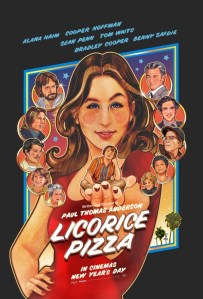
It took me many months but I’ve finally watched the last of the 2021 Best Picture nominees, and now I can safely say, I just don’t understand all the love for Licorice Pizza. It’s writer/director Paul Thomas Anderson’s (Phantom Thread, Boogie Nights) nostalgic L.A. hangout movie, but the axiom of hangout movies is that they only really work if you actually want to hang out with the participants. I’m not certain I needed or wanted to watch either of our lead characters navigate the curious bounds of their possible romantic entanglement. Alana Haim plays Alana, an under-achieving 25-year-old looking to better define herself, and Cooper Hoffman, son of the late Phillip Seymour Hoffman, who appeared in five prior PTA movies, plays an over-achieving 15-year-old that is in a hurry to grow up and conquer the adult world. He’s crushing on her, she’s flattered but says it’s not appropriate, and over two hours we watch a series of meandering episodic adventures that test their will-they-won’t-they determination. I found Haim’s character to be generally unlikable and, worse, uninteresting. She’s petulant, needling, prone to jealousy but also clearly likes the attention but doesn’t know how far to test it. Hoffman’s character, based in part on Tom Hanks’ childhood friend and producing partner Gary Goetzman, is like a human puppy dog, so overwhelming and sunny and anxious to be liked, but I can’t see any more depth to him or her. They’re just kind of annoying and maybe that’s the point about looking back. I don’t see the larger thesis or theme in many of Anderson’s small and unfunny asides. He’s trying so delicately to recreate a feeling of time and place of early 1970s Los Angeles, but the movie doesn’t succeed in answering why anyone else should really care about this personal PTA slice of nostalgia. The best part of the movie, by far, is the segment where Bradley Cooper plays the lascivious and self-absorbed hairdresser-turned-producer John Peters. Too many of the other misadventures feel like table anecdotes brought to overextended life with technical pizazz and minimal emotional accessibility. Licorice Pizza left me cold and unfulfilled.
Nate’s Grade: C+
Share this:

Persuasion (2022)
 Jane Austen is one of those name brand institutions, and yet the pioneering author only has six actual titles to her name (a seventh was unfinished; two were published after her death, including Persuasion). There have been five previous adaptations of Persuasion, including one from 2021, so I wasn’t rankled when the early trailers for Netflix’s Persuasion took a chance with their adaptation. There are plentiful fourth wall breaks where our protagonist, Anne (Dakota Johnson), and handheld camerawork that makes it feel more faux documentary at points, and there is more modern jokes and modern rom-com sense and sensibilities, and judging by the social media response, there are a lot of angry Austen purists who loathe these changes (could this movie be more heretical than Pride and Prejudice and Zombies?). I found the 2022 Persuasion to be perfectly pleasant and easy to watch. Johnson is tailor-made for the headstrong, intelligent, yearning lead of an Austen movie, and with her directly speaking to the camera, I felt a kinship with her, and this stylistic choice also allowed the screenwriters to sneak in more of that flowery Austen prose. Some of the jokes are a little clunky but I laughed or smiled at most of the comedic elements, especially Richard E. Grant as Anne’s foppish and status-obsessed father. I enjoyed Henry Golding (Crazy Rich Asians) as the caddish Mr. Elliot, a man born with a Cheshire grin. I enjoyed plenty of this movie, including its racial diversity, and the staples of these Regency romances like the exquisite production design, costumes, and English countryside. I can understand some grumbling that this isn’t “their Persuasion,” but not every movie is for every person, and there’s nothing about the 2022 movie that retroactively cancels out other adaptations that fans would prefer. For 100 minutes, it felt like Austen had been re-framed as a rom-com blueprint, and Persuasion had renewed charm for me.
Nate’s Grade: B
Share this:

Thor: Love and Thunder (2022)
 Thor: Love and Thunder reminds me a lot of Guardians of the Galaxy vol. 2, admittedly a film I’ve come more around on since my initial viewing in 2017. When Ragnarok was released later that same year, it was an irreverent blast, a breath of fresh air for a franchise that didn’t really know what to do with its hero, and under director Taika Waititi’s sensibility, the character had new, witty life. A similar response occurred with the original Guardians of the Galaxy as the world fell in love with the offbeat characters and storytelling and style from writer/director James Gunn. Before 2014, we didn’t know what to expect with a Guardians movie. When the sequel was released, we had a template of expectations, and the follow-up didn’t feel quite so fresh, quite so lively, and falling back on repeating too many of the same moments or jokes because it’s what was expected. It felt a bit burdened with the creative shackles of upholding these expectations. The same feeling of same-ness permeates Love and Thunder, and to be fair that’s also because the success of Ragnarok raised our expectations for a Waititi MCU movie.
Thor (Chris Hemsworth) is trying to find his way after the events of 2019’s Endgame. He’s gotten in shape, spent some time palling around with the Guardians of the Galaxy (returning in 2023!), and reconnected with the love of his life, Jane Foster (Natalie Portman). She’s been chosen by Thor’s old broken hammer to be its new wielder, granting her superhero status. Except in her human status, she’s dying from stage four cancer. Just as Jane comes back into his life, Thor might have to come to terms with losing her all over again.
 This movie just doesn’t feel like it has the same natural prankish energy of Ragnarok, though part of this again might be myself acclimating to Waititi as a filmmaker and storyteller. Prior to Ragnarok I had only known him for the delightful vampire mockumentary What We Do in the Shadows, and since Ragnarok Waititi has become his own industry, winning a screenwriting Oscar, lending his name and acting to hit TV shows, including a version of What We Do in the Shadows, and even Disney wants his mark on Star Wars. In short, the man is everywhere. In 2022, we now have a much better idea of what to expect from a typical Waititi project. Love and Thunder is recognizable to the man’s omnipresent brand, and still a fun movie with some solid gags, but it also feels a bit sloppy and repetitive.
I kept thinking about all the powerful dramatic potential in the different storylines that are barely explored because the driving plot is a universe-hopping caper to save a bunch of kidnapped children (yes, the children represent something, the next generation, renewal, legacy, but let’s carry on). Tackle the pathos of Jane Foster, who in her normal human state has her body betraying her. She feels weak and incapable of the greatness she feels burdened to still accomplish with her declining time. With the power of Thor, she becomes a superhero, and with super swole arms. However, this power trip also has its own ironic downside. Every time she powers up, the magic hammer is actually draining more of her life force, meaning she’s actually speeding up her terminal illness. Here is a character given a dire situation and an escape and yet that escape only worsens the illness. There’s such powerful drama there to explore as she comes to terms with how to spend her final moments, among them reconnecting with her super ex-boyfriend. This could have sufficed as the entire movie and told from her perspective.
Then there’s Gorr the God Butcher, gloriously played by Christian Bale like he’s in a James Wan horror movie. Here is another example where the villain doesn’t just have a sympathetic back-story but where they are correct in their aims, though maybe not in their methods (think Killmonger arguing Wakanda should do more). Gorr is tired of the gods crushing the little guy with their general entitlement, indifference, and selfishness. These fancy deities aren’t worthy of worship. The power structure needs upending. It’s easy to get behind Gorr’s plight and see connections to our own imbalanced world. This too could have sufficed as the entire movie and told from his perspective. Now, things could have gotten even more interesting and complicated for Jane, because she’s not officially a god unless she’s yielding Thor’s hammer and joins those rarefied ranks. It would pose another question of whether wielding this power would be worth her remaining time, especially with a heat-seeking missile coming for her on a righteous quest of vengeance that is slowly eating him alive. Both are dying but can they fulfill their goals?
 If these storylines had been given careful development and the necessary time to breathe, Love and Thunder could have been one of the most interesting movies in the ever-expanding MCU cannon. Instead, it’s galloping to work so hard to stick to the Waititi brand expectations, to reignite our feelings of Ragnarok, and so these promising elements ultimately get shortchanged by hit-or-miss comedy bits. I liked several of them even despite myself. The set piece where Thor and Jane and friends travel to Omnipotence City has such imaginative heights. Russell Crowe is having a grand time as a hilarious Greek caricature of Zeus that is more concerned about the upcoming company orgy and brushing feta crumbles from his beard. I loved the almost Lego Movie-esque zany sight gags of the cohabitation of gods from different religions (Korg’s god sits on an iron throne of scissors, its own visual joke). It’s such a fascinating concept that I wish we could have spent even more time here. Let’s see the Egyptian gods mingling with the Sumerian gods while pranking some weird alien deity. The set piece serves two narrative purposes: gathering a powerful magic weapon, and learning the gods are sitting out the battle with Gorr for their own short-sighted self-preservation. It’s mostly a pit stop. Again, there was more pathos that could have been explored here as people meet gods, but this is my cross to bear. The general banter is amusing and has more hits than misses even if the hit percentage is lower. I laughed every time the magic axe would silently pop onscreen in jealous judgement. I even enjoyed the screaming goats even though from their first moment they are the exact same joke. Regardless, whenever Thor and company would travel to a new place and I heard that familiar goat scream, it would make me giggle despite my reservations.
I also had my qualms with the concept of Eternity, a magical place located at the center of the universe but destined to grant a wish to whomever gets there first. It’s too transparent as a plot device and its very existence this far into the MCU creates too many nagging questions. In the history of the universe, no other creature successfully reached this wish-granting locale? And if this existed at least to Thor’s understanding, then why didn’t the characters think about this as an option to thwart Thanos and his universe-halving finger snap? I know the answer, because it wasn’t written into a movie until now, but this is the drawback of throwing ultimate power plot devices without more careful context. Eternity could have been a secret just to the inner circle of the famous gods, unknown to all but a few, but even that strains some credulity. If Zeus is such a carousing hedonist of legendary status, I’m sure he would have either blabber-mouthed its existence or sought it ought for his own gain. I genuinely liked the set piece at Eternity, a small planet that sucks all color from existence, making the imagery even more striking like the inky panels of a comic. The same question happens when Thor shares his power late in the movie. Couldn’t the Avengers have used this too?
I fully acknowledge that my criticisms are butting against the movie Waititi wanted to tell. I’m pushing for its inherent dramatic potential while it wants to be a more comic and romantic adventure about the power of love. I think by the end it gets there, and the dramatic confrontations have some emotional weight to them, especially about the idea of what we leave behind for others after we’re gone. Although, even this is mitigated by the general stakes-lowering reality that death never seems so permanent in the world of comics and monetarily useful IP. It’s a joke how many times Loki has been brought back from the dead and Thor doesn’t even know that his trickster brother has been brought back from the dead again (again again). We’ve now established time travel and an emphasis on the multiverse of alternate universes, which means at a moment’s notice, any meaningful death or sacrifice has the possibility of being undone. This is also the reality of a moneymaking machine that has dominated the movies and pop-culture landscape for 14 years. No death is ever going to be for real in this environment so why should I put so much emphasis on the dramatic potential of what losing a loved one, or your sense of self, can have? I can sit back and enjoy the lesser, but still enjoyable, Waititi quirk on display for two hours of silly.
 Hemsworth (Spiderhead) is so sharply skilled at comedy that I feign to remember his previous existence as a dramatic actor. He’s still on the same sublime, charismatic yet blithely self-effacing vibe he was with Ragnarok. Portman (Annihilation) comes back after close to a decade for a clear reason to leave her mark on what had been an otherwise forgettable character and giving her a renewed sense of power and direction and agency. Bale (Ford v. Ferrari), as mentioned, is fantastic. I appreciate that his character isn’t physically huge and bulky. He looks quite the opposite, like he’s wasting away, like somebody slathered an ashy coat of paint from living-skeleton Bale after The Machinist (yes, also the obvious Voldermort comparison). He is relishing every teeth-stained syllable as a nightmare creature living from the shadows. The prologue with his character is heartbreaking and yet understated (and truth be told, having young children in my household, it hit me more personally), and I turned to my fiancé and said, “I’m supposed to not like this guy?” I wish the opening credits were then a montage of Gorr seeking and slaying wicked gods. Bale is playing his role like he’s definitely not in a Waititi movie about goofy screaming goats; he’s playing Gorr like a tragic hero of myth. This is why I would have been happy had the whole movie been told from his perspective. The new characters from Ragnarok suffer the most and become sidelined as “Others Along on the Quest.” For Korg, this is fine, but for Tessa Thompson’s Valkyrie, I mourn her absence. Also, both characters are definitively queer now, though Korg might be more a question, making Love and Thunder the gayest movie in the MCU, and just after Pride Month, so take that for what you will, folks.
As a fun matinee, Love and Thunder will amuse and brighten, even if its comedy highs don’t quite hit as high this time under the burden of franchise expectations. Love and Thunder is a movie that will be best known for Portman and Bale, both of whom elevate the scattershot material with their dedication and professionalism. It might even be known for Crowe’s hammy scene-stealing, or the super-powered cadre of cute kiddos, or even the screaming goats. It’s a movie more of moments and ideas, too many underdeveloped or lacking the gravitas they deserve, especially concerning Jane and Gorr. I feel like a grump bemoaning that the big superhero movie should have more time spent on a woman contemplating her own existential demise as well as man’s relationship and fealty to our gods. Still, it’s Waititi doing his signature brand of quirk with $200 million of house money from Disney. Thor: Love and Thunder is a lesson in diminished returns but when you have Ragnarok as your starting point, it’s at least guaranteed to still be worth your two hours once and deliver some chuckles and smiles.
Nate’s Grade: B-
Share this:

Good Luck to You, Leo Grande (2022)/ Cha Cha Real Smooth (2022)
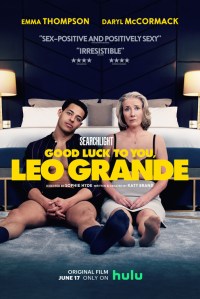 I was taken immediately and repeatedly by the many charms and intriguing personal details of Good Luck to You, Leo Grande (hence referred to as Leo Grande for the sake of my typing). This little indie played at the 2022 Sundance film festival and is primarily two people in one hotel room talking for the entirety of its 97-minute run time, and oh how early I was enraptured. This is a small-scale but laser-focused character-driven drama with edges of comedy and romance. It’s sex positive, very mature and tasteful given its subject matter, and the general awkwardness of watching two strangers combat sexual and personal hang-ups and vulnerabilities melted away thanks to the deftly superior acting, writing, and directing of those involved.
Emma Thompson plays Nancy Stokes (not her real name), a retired school teacher who worked for a parochial institution and taught Christian religion. Her husband has died and she reveals that, over the course of their thirty years together, she has never truly known physical pleasure. She seeks to change that by hiring a professional sex worker, Leo Grande (not his real name), played by Daryl McCormack. We will chart Nancy’s sexual awakening over four intimate encounters.
 What stood out immediately to me was how well developed the story unfolds at such a natural pace. I’ve watched more than a few indies that simply don’t know what to do with their premise, that feel like they’re biding time to get to feature-length, and some that are likewise constrained to single or minimal locations but fail to secure the most essential need: providing a reason for the audience to care. Whether a movie takes place in one room or a hundred rooms, you have to make the time spent meaningful whether through compelling characters or a story that keeps you engaged and waiting for more. You need to connect to the characters or be intrigued by the revelations to come, and Leo Grande does both immediately. Its setup is rife with drama and conflict, two people navigating their relationship to physical intimacy, two people who have never met until now for a transactional evening. There are obvious, natural personal conflicts to be explored here, with the novice out of their depth in many senses. There are also plenty of intriguing possibilities, because as these two get to know one another so too are we getting to know each and getting glimpses of who each of them are outside of this room. Both people are putting on fronts of some sorts, trying to settle into a performance of who they could be, and peeling away the layers of this subterfuge becomes even more intimate and engaging. Writer Katy Brand, known for outrageous British sketch comedy, skillfully maps out the story so that each conversational stop, detour, and ramp-up feels organically composed. It takes a great writer to keep your attention from a movie about two people talking, and Brand is that good. The contrast between our characters and intimacy, from forced to unlocked, keep us glued intently.
I also think there’s an interesting generational character study here, though the film doesn’t ever make any grand pronouncements about the symbolic representation of its heroine. Nancy is over 60 and at a point where she’s used to compliments with the added qualifier of “for her age.” When she discusses her sexual history with her husband, it’s almost like a confession that she’s been unable to get off her chest for decades, an acknowledgement of her disappointment and longing. Her husband was the kind of man who would lie in bed, roll on top, and then a minute later roll off, mission accomplished (no wonder this woman has never experienced an orgasm). Talking through this embarrassment, it brings Nancy to tears, realizing she’s lived so much of her life without accessing physical pleasure, a joyful repose that so many others seem to revel in. This bold step, hiring a sex worker online, is her making a leap outside of her comfort zone, and the subsequent return engagements give her new opportunities that have eclipsed her for so long.
 In essence, this is woman who feels like she’s playing catch-up. Her character is from a generation where women didn’t make as much of a fuss about reciprocal pleasure. Her view of her aging body is one of general shame. She will repeatedly say she has no idea what she’s doing. Nancy feels like she’s been missing out for so long and wants what has been denied to her. However, she also has her own personal sexual hang-ups she’s pushing through, with decades of religious upbringing and enforcing moral codes with her students and their wardrobe choices. All of it adds up as far as her view on sex and her body. Leo asks her if she just wanted sex why not find a man in a pub and go from there, and she curtly says she doesn’t want an old man, an old man that will simply be another version of her husband, another disappointment in a lifetime of unrealized intimacy; she decidedly wants a young man. She’s indulging in her desire and a young man best represents a promise of sexual fulfillment (and she definitely doesn’t have any teacher/student fantasy, she will let you know). I think there are many more Nancy’s in the world, older women who soldiered through their lives, carrying the burdens of others while sacrificing their own pleasure, and are now at point in their lives where they are hearing more about body positivity, about female pleasure, and about being worthy of physical intimacy on their own terms and desires. Nancy is a character having a delayed sexual re-awakening; in her confession with Leo, she details her first impulse of desire when she was 17, a feeling that she hasn’t experienced as surely for the decades hence. While being a unique and well-rounded character, Nancy also serves as a representative of an older generation and perspective coming into conflict and revelation with a modern sense of intimacy and self.
Leo Grande is a smooth and charming man but one who doesn’t feel oily or like he’s obnoxiously masculine. With McCormack’s kind eyes and soothing Irish balm of a voice, it’s easy to see how this man could set others at ease. But then you also have to remember that Leo Grande is not who this man really is; it’s a character he’s playing, and as Nancy opens herself up to this man, she’s looking for him to do the same, for them to share something more special than a simple client-professional relationship. The more that Nancy pushes and pries, the more that Leo himself is pushed outside his own comfort zone. Leo is willing to talk about some things, like his frayed relationship with his mother, a point of unity with Nancy and her adult children, and his cover story of being away and working on an oil rig, an outlandish excuse that makes Nancy and eventually Leo break into laughter. By the nature of this character dynamic, Leo must be the more confident and assured participant to better contrast with Nancy’s personal and cultural insecurities. He’s the pro and she’s the novice. However, that doesn’t mean emotionally he’s as self-assured and without regret. Listening to these two characters bounce off one another and come in and out of intimate contact is fully entertaining.
I hope that Thompson (Cruella) gets nominated for an Oscar for her portrayal. She’s in just about every second of the movie and so much of it hinges upon her baring herself, physically and emotionally, to this man and us, the tacit observers. It’s a performance of radical self-love in so far as Nancy is reclaiming her body as a point of pride rather than as one of shame. In some ways, she’s shedding her past sins, easy judgement on the mores of others and their bodies. Thompson goes through such a wide range of emotion and gets to play so many different revealing sides to this woman putting herself in a most unfamiliar position. It’s Nancy coming to terms with her own disappointments, misgivings, and hypocrisy, and Thompson is splendid at every moment. She gives so much life to this character without sacrificing her complexity or occasional coldness. By the end, when her character hits her arc’s climax, it feels like a journey fully earned.
 Another 2022 Sundance indie, this recipient of the Audience Award and a plum Apple Plus streaming spotlight, feels less smooth despite its title. Cha Cha Real Smooth is from writer/director/star Cooper Raiff, the twenty-five-year-old up-and-coming filmmaker best known for 2020’s Shithouse, a talky and introspective movie about older teens trying to gravitate with the adult world they feel ill-equipped to handle. While I found some promise with Raiff’s naturalistic dialogue, I found the lead characters to be too dull to really care about. Enter Cha Cha (which will also, henceforth, be how I refer to the title) which benefits from deploying more recognizable rom-com and indie movie plot mechanics. Working from a more familiar movie template, it actually helps Raiff better temper his writing and focus his story. While I enjoyed the movie overall, I would say it still has not won me over to the charms of Raiff just yet.
Raiff plays Andrew, a recent college grad who is still very much trying to figure out his life. He knows he doesn’t like his mother’s (Leslie Mann) new husband (Brad Garrett). He also doesn’t like his job working at a mall food court. He’s also not happy that his ex-girlfriend broke things off before leaving for Barcelona. He’s struggling to plan his “what comes next” when he stumbles into a job being a “party starter” after his enthusiastic chaperoning of a local bar mitzvah. Soon the neighbors are all seeking Andrew’s party-starting ability to make their next bar or bot mitzvah a fun time. Andrew becomes attached to a thirty-something single mom, Domino (Dakota Johnson), and he autistic teen, Lola (Vanessa Burghardt), he persuades onto the dance floor to loosen up. Domino is intrigued by the younger man and asks him to babysit Lola, especially since the two have bonded and earned a trust. Andrew doesn’t know whether Domino is feeling the same level of attraction but someone who would not be happy is her fiancé, Joseph (Raul Castillo).
 You spend a lot of time with Raiff as the lead, so your ultimate determination on Cha Cha will hinge on your perception of Andrew and as Raiff as a performer. He’s got an easy smile and his enthusiasm can be endearing at points, like he’s incapable of being still in thought. I found the scenes where he encourages little kids to be cute and easy to enjoy. He’s an infectious presence when he’s dealing with children. However, when Andrew is dealing with adults or people his own age, he seems to be out of his depths with arrested development. He’s rude and pissy with his stepfather for no real discernible reason given. He’s fairly thick-headed about romantic ideals about following his girlfriend to Spain, who declines his grand offer. Andrew’s uncertainty about charting his own path is a familiar story, and Raiff takes advantage of the overall coming-of-age blanket of tropes. The problem is that too many of them feel easily discarded. The only characters that seem to matter in Cha Cha are Andrew and Domino. Even Andrew’s younger brother (Evan Assante), who loves his big brother so much that he is constantly asking for advice on romancing a girl he likes, and the kid even cries at the prospect of his brother moving out of his room, is just another underwritten foil like Andrew’s mother, always supportive, and stepfather, always wary, and friend-with-benefits girl, always… there? These characters are meant to be reflections of our main character, serving to make him look charming or sincere or naïve or deluded but always serving Andrew. This can work in screenwriting but it helps if the characters don’t feel so obviously cultivated to make our hero look good.
I did find the central will-they-won’t-they relationship between Andrew and Domino to actually be entertaining. Much of this helps from Johnson sliding into a role that definitely fits her skill set. The role doesn’t even seem too different from her struggling thirty-something mother in The Lost Daughter. In the last few years, I have grown as a fan of Johnson with strong supporting turns in Bad Times at the El Royale, Peanut Butter Falcon, and as a dying mother in Our Friend. In each one of these roles, there is an inherent melancholy to her that she so effectively radiates. She has certainly broken free from the long shadow of the Fifty Shades franchise. Much of Domino feels from the point of view of a young man projecting onto her, and I think that is also Raiff’s larger thematic point. In Shithouse, a significant plot development is when Raiff’s central character has a different interpretation of a sexual encounter. He bombards the young woman with eager texts and is carried away with making an attachment, whereas she did not view their college hookup on the same terms. Although, this hard wisdom is undercut at the end of Shithouse by this same lady relenting and saying, “Yeah, okay, I’ll be your girlfriend.” To Andrew, Domino is a wounded soul looking for a rescue and he’s her dutiful man in shining armor. From his perspective, she is crying out for kind attention and support that he feels is being neglected. The learning curve for Andrew is that Domino can distinguish between a person who excites her and a person she can see herself settling down with. Their age discrepancy is never really addressed until the very end, though Johnson herself is only 32 years old, which doesn’t seem like an insurmountable gap though Domino’s age is kept purposely vague. I would have preferred the movie being told from her perspective as she had the most interesting role. Johnson and Raiff have an easy-going chemistry, with his overeager charmer meshing with her subdued, glassy-eyed, taking-it-all-in openness. She makes him feel a little more excited, but ultimately, that may not be as important as other more practical concerns.
 This leads to what seems like the lesson of Cha Cha, because for a movie that seems to operate on a powerful level of irony-free sincerity, the big life lesson it seems to impart is that becoming an adult is one about accepting compromise and disappointment. Sure, that’s an important lesson, to adapt as well as process personal reflections, but with Raiff’s movie, Domino’s lesson seems to be she’s accepted that her fiancé doesn’t make her feel all the things that young Andrew does but he will provide stability for her and her daughter and that means more at this point. I cannot say whether the movie is asserting that Dakota’s reasons are mature and something Andrew will come to understand in time when he gets a little older or whether we’re supposed to see her as someone willfully forgoing her personal happiness to settle for something less and that, to Raiff, is what adulthood means, settling for less. The way that writer/director Raiff could have shore his thematic intentions would be with the supporting characters, seeing this larger nugget of wisdom reflected in his own mother’s relationship with the stepdad who Andrew could attempt to understand better rather than view with contempt. This is where underwriting the supporting characters can also undermine the artistic aims of your movie. It appears like Raif, at 22, is saying that growing up means essentially giving up on some level, which is a strangely pessimistic lesson for a movie that trades in such earnestness and sunny go-go positivity.
I sound more negative with Cha Cha Real Smooth than I’m intending. It’s a relatively breezy movie to watch with fun exchanges, solid jokes, and characters that I found amusing and some of them even engaging. It has its charms and sweetness and I can completely understand falling under Raiff’s spell. This is definitely a step in the right direction for Raiff as a filmmaker after his 2020 debut, and I think he’s going to continue to grow and tell these personal, highly verbose little indie dramas with big feelings where whomever Cooper Raiff portrays learns some life lesson, likely from his interaction with the person of the opposite sex he desires. As such, every Raiff movie from here on out seems likely to rest upon your feelings about him. With Cha Cha, the sequences between Andrew and Domino or Lola were my favorite, so the film mostly worked.
Good Luck to You, Leo Grande and Cha Cha Real Smooth are both fine examples of indie filmmaking supporting distinct voices adding their stamp on the larger contours of the romantic comedy genre. Leo Grande is a grand example of character writing and it’s even poignant and a little sexy. It’s extremely tasteful and nuanced and even empowering for an entire movie about two strangers meeting in a hotel room for sex. Cha Cha is a fun and formulaic coming-of-age movie and with Dakota Johnson hitting her stride with a winning character with pools of depth. There are some writing and thematic shortcomings but it’s still a charming experience. Both movies can definitely brighten your mood and generate their share of smiles for 100 minutes.
Nate’s Grades:
Good Luck to You, Leo Grande: A-
Cha Cha Real Smooth: B-
Share this:

Father of the Bride (2022)
 Those familiar with the 1991 Steve Martin movie, or the 1950 original with Spencer Tracy, or even the 1949 novel by Edward Streeter, who was born in 1891, will understand that Father of the Bride is an old story that can still be relatable with new wrinkles and details. The core elements of the story, about the stress and chaos of wedding planning, or the pressure and patience of family, are still present with this new version where Andy Garcia and Gloria Estefan star as the parents of the bride (Adria Arjona). Garcia is a first-generation Cuban-American, a successful Floridian architect about celebrating old traditions, and a bridezilla of epic proportions terrorizing every soul in Miami. He is an awful person, holding to outdated and cringe-inducing misogyny and at several points making demands that because he is the father of the bride, he will be dictating exactly how his daughter’s wedding will proceed no matter the objections from the bride. Even when the groom’s wealthy Mexican family comes into the picture, neutralizing his power of the purse, Garcia’s bad dad just gets even more pushy and prissy. Ultimately, of course, he sees the error of his ways, the opulent wedding is nixed for something more spur of the moment combining traditions old and new, and everyone seems to get along by the end as one big happy family. I liked the added subplot of Garcia and Estefan hiding the fact that they are getting a divorce, which provides farcical potential. However, some of the subplots feel lightly developed, especially the other daughter being tasked with making all the bridal dresses for her sister. She wants to be a designer but cannot get a break, and yet the final reveal of the wedding gown is absent any drama, taking away from the relationship between the two sisters. Same with a friend who may or may not be queer and vibing for the bride’s sister. It’s strange that the two daughters get underdeveloped when they’re so essential to the wedding, and especially considering the movie is practically two hours long. I wish the filmmakers had trimmed some of the redundant “Andy Garcia is awful” moments and given more time to other supporting players. Father of the Bride is a chuckler of a movie, never netting bigger laughs but providing a few chuckles and smiles here and there. It’s a pleasant movie to watch, though I don’t think Garcia’s tyrannical father has earned his epiphany and forgiveness by the end. Given a Hispanic spin, the personal details and cultural authenticity allows an old story to feel fresh or at least fresher.
Nate’s Grade: B-


 nathanzoebl
You must be logged in to post a comment.