Blog Archives
Ghost Town (2008)
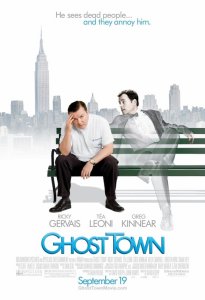 It seems the genesis for this flick was like someone asked what The Sixth Sense would be like with jokes (or someone rented Topper and said, “Why not again?”). The idea of a misanthropic man who sees dead people is elevated by the sheer comic genius of star Ricky Gervais. The famous British comedian is better known across the pond for his dry, sarcastic wit and penchant for awkward, pained comedy, but Ghost Town is a great mainstream introduction to the comedic chops of this squat Englishman. The film follows a familiar trajectory and even introduces a romance for the man who loathes other people, but Gervais and co-writer/director David Koepp make it worthwhile and endearing. I could watch Gervais and his beaming co-star Tea Leoni crack each other up for hours. The comedic premise is finely explored (there are more than enough scenes of people looking odd at Gervais talking to himself). The movie tilts toward being a supernatural romantic comedy in the second half but manages to stay snappy and character-driven. It’s a sweet movie with some nice comic jabs that don’t dwell on nastiness. Ghost Town is a charming and engaging light comedy that might cause a few sniffles in between chuckles. I have a warm place in my heart for this movie.
Nate’s Grade: B
Share this:

Over Her Dead Body (2008)
 This is abysmal comedy from beginning to end. It peaks in the second minute when Eva Longoria’s shrewish character is killed by a large angelic ice sculpture. It’s all down hill from there, my friends. Longoria stars as a deceased bride who won’t let her still-living fiancé (Paul Rudd) find happiness. The bland comedy could have more accurately been retitled, “Cockblock from Beyond the Grave” (it was at one time titled Ghost Bitch). I have no idea why Rudd is apart of this travesty and seeing him do his trademark smirk and shoulder shrug just made me weep. The comedy is nails-on-the-chalkboard obvious. There is nothing smart, clever, or interesting within any of this movie’s 95 minutes. Writer Jeff Lowell (John Tucker Must Die) felt the need to direct as well because surely there was no one else on this planet that could handle this. Longoria is powerfully obnoxious and egotistical until her last-minute personal epiphany that others deserve to be happy too. What did Rudd ever see in this ghost bitch?
Nate’s Grade: D
Share this:

The Wackness (2008)
 Every Sundance Film Festival seems to coronate new talent and new films that never seem to materialize once they step outside of the happy bubble of festival life. It happened with Happy, Texas, with Tadpole, with Hav Plenty, with Primer and numerous others that never managed to get started with the public. At the 2008 Sundance film festival, the biggest buzz followed the documentary American Teen and The Wackness. Writer/director Jonathan Levine’s coming-of-age tale won the Audience Award for Drama and boasts shimmering visuals, formidable actors, and a hip soundtrack. Too bad the drama gets the least attention in that package. I suspect The Wackness will be yet another Sundance buzz flick that, while well made, fails to leave a mark on mainstream crowds (here’s hoping more for American Teen).
Luke (Josh Peck) has just graduated from a New York City high school and is winding down the summer before he moves on to college. He has a unique summer job: Luke sells marijuana out of an ice cream vendor’s box. One of his clients, Dr. Squires (Ben Kingsley), is a therapist. He trades therapy time to Luke for pot. The two of them form an unanticipated bond and Dr. Squires makes it a point to see that Luke is making the most of his youth. Luke is smitten with the doc’s stepdaughter, Steph (Juno‘s Olivia Thirby, gratifyingly authentic), and determined to lose his virginity and find love before the summer fades away.
 The strength of The Wackness is in the unexpected father/son relationship that forms between Luke and Dr. Squires. Kingsley is sensational in his role and provides all the pathos and unexpected discoveries that the coming-of-age genre is associated with. I think that’s what’s most interesting about Levine’s film, is that Kingsley is going through all the coming-of-age moments reserved for teenage protagonists. Dr. Squires and Luke form a surprising and deep relationship where they learn from each other. Luke learns to talk about his life’s sadness and make it a part of his life, instead of sweeping it under a proverbial rug. Dr. Squires learns to re-embrace life and to kick his heavy supply of pharmaceutical prescriptions. He is coming of age at middle age. He even gets to second base with an Olsen twin (Mary-Kate is only in the film for two scenes and an estimated five minutes). Most of all, Dr. Squires needs a friend and Luke fulfills this desperate void. Kingsley is funny, pathetic, and the real star of The Wackness.
My main problem with The Wackness is how familiar it all comes across. It follows the coming-of-age model down to the end, so a savvy audience is going to realize that Luke will fall in love, get his heart broken, stand up for himself, and gather a bit more wisdom by the time the end credits roll. You’ve seen this movie played in a thousand different ways before, and now The Wackness makes it 1001; you will essentially know every beat of this story before it happens. The film doesn’t break any new ground and doesn’t manage to provide much commentary or lasting insight while it comes of age. The screenwriting fails to hide what disinterests Levine. So we get quick glimpses of Luke’s home life and I swear in every one of them his parents are just yelling. That’s all Levine is interested in, setting up one ten second shot of Luke overhearing his parents shouting again and again. Dr. Squires’ wife (Famke Jannsen) gets the same kind of treatment. She gets a cursory amount of screen time to glower and that’s about it. I can tell Levine is only interested in his three main characters (Luke, Dr. Squires, Steph) but then why does he not concentrate on them further and scuttle what he feels is wasted time?
The Wackness is awash in pointless nostalgia. The movie is set during the summer of 1994 for no real reason. The time setting doesn’t impact the film in any manner except for some digs at Mayor Giuliani’s policies (he was only in office for sixth months or so when the film opens). Levine dishes out pop-culture references like the 8-bit Nintendo game system, old chunky GameBoys, Kurt Cobain’s suicide, mix tapes, and lots of rap music. The Wackness is an ode to mid 90s rap music and Luke is a lover of acts like A Tribe Called Quest, De La Soul, and some up-and-coming guy named The Notorious B.I.G. The soundtrack is also meant to convey good nostalgic vibes of a simpler time only — 14 years ago. Setting the film in 1994 is a lazy attempt to cover the lapses in screenwriting with cozy audience nostalgia. And is there anything really culturally transcendent about the summer of 1994?
 Peck may have lost like 100 pounds since he was fat comic relief on a Nickelodeon kids show, and he’s marginally handsome, but this kid needs some more practice before he’s a dramatic actor. I understand that his character gets stoned often and, as a typical teenager, is trying to pull off a too-cool-for-the-world-“whatever” attitude, but he seems freaking catatonic. He’s too aloof for his own good. His acting is dry and monotone and he feels like he’s constantly zoning out. Again, I understand that this works with his stoned persona but Peck is hardly ever convincing in the part and his acting shortcomings rob the role of a greater level of sympathy. A great actor can make you like a character that eats babies and kicks puppies, or the other way around, but Peck is not that actor. I believe that part of The Wackness‘ failure to connect and elevate beyond its genre trappings is due to Peck’s poor performance. He’s just kind of boring character and, to borrow a term from our pals on the other side of the pond, a bit of a wanker.
As a director, Levine has a playful and visually appealing look for the film, bathing it in arid tones to echo the hot summer days. The cinematography is a character all its own, giving the film a colorful and lively flair that makes every scene worth watching even if the script fails to do likewise. Levine has a handful of clever visual tricks up his sleeve, like a middle finger that moves through a crowd of New Yorkers at rapid speed before finding and dialing a pay phone. Levine has definite talent as a director and it shouldn’t be long before Hollywood comes knocking and plucks him away to make The Fast and the Furious 8: The Search for Curly’s Gold.
The Wackness feels like a coming-of-age film that goes through the motions. The main character is stoned to the point of comatose and he’s a rather boring protagonist, made even duller by Peck’s lackluster acting ability. Writer/director Levine flexes enough visual artistry to make him a talent to watch, however, his screenplay is too familiar with little personality or flavor to stand out against the pack. The movie looks good, it sounds good, and Kingsley is certainly good, it’s just a shame that it isn’t his movie. Steph tells the mopey Luke that all she sees is the goodness life has to offer and all he sees is “the wackness” (you can go home happy to understand the title). I guess I similarly be accused of focusing on the “wackness” of The Wackness because it’s certainly not a bad movie. It just happens to be ordinary. Though it does have some torrid Kingsley-on-Olsen Twin action. I suppose that isn’t too wack.
Nate’s Grade: C+
Share this:

WALL-E (2008)
 At this point, is there anything Pixar can’t do? They’ve explored the secret life of toys, what’s under the sea, the pains of rearing a family of super heroes, and of course a rat that dreams of becoming a chef. Seriously, anyone that can make that last one not only work but one of the most sparkling, imaginative, enchanting, and poignant films of the year deserves every accolade in the book. Pixar’s newest film, WALL-E, is certainly its most ambitious and potentially its most rewarding yet.
The year is 2700 and the planet Earth has long been left behind by mankind. Humans have exhausted their resources and left behind a planet that looks like one never-ending landfill. Skyscrapers are being built out of garbage cubes. The Waste Allocation Load Lifter – Earth class (WALL-E) robots have been left to toil away and clean up mankind’s mess. There is but one WALL-E robot left and it leads a solitary life of routine. It gets up, it compacts trash into cubes, and it assembles those cubes into eventual giant structures. Then one day a probe lands called EVE. This floating capsule-like robot is easily frustrated and quick on the trigger and WALL-E falls completely in love with his unexpected new companion. The two become close and then EVE is taken away unexpectedly. WALL-E hitches a ride on the ship that collects his beloved and journeys through space to save her.
 I was having reservations citing certain words of praise but this film deserves every ounce of praise; WALL-E is a masterpiece. This is a beautiful story told in a beautiful way in a beautiful looking movie. I imagine kids will be tickled by the funny robots but I really believe that this film will play much better for adults, and when was the last time a mainstream, American family film did that? Most “family” films are an excuse to do something lowbrow and cynical to make a quick buck, like the atrociously cringe-worthy trailer I saw for Beverly Hills Chihuahua (seriously, a civilization of singing/rapping Taco Bell dogs?). Pixar, and God bless them, are proving with each new release that family films need not be brain-killing hours. That reliable Pixar quality touch is never more present than with WALL-E. If you told me that a film that takes place on a trash-filled Earth, with minimal dialogue, and a romance between two robots would be the most thrilling, moving, and wonderful film of 2008, I would have scoffed.
Writer/director Andrew Stanton (Finding Nemo) relies on a universal visual storytelling language to tell the bulk of his tale. WALL-E plays like a gloriously enjoyable silent movie where body language and physicality advance the storyline and provide surprising depth; ignoring brief TV clips of Fred Willard and Hello Dolly, the movie doesn’t have actual dialogue until the 45-minute mark. And it is fantastic. The character of WALL-E is immediately empathetic and the audience will see slivers of themselves inside this independent robot that finds another reason for being. It’s a simple love story told in simple strokes, but it just so happens that Stanton has provided great emotional heft to those strokes. The film has such a huge and vibrant heart. More is said in indecipherable robot bleeps than in much of the tripe Hollywood calls dialogue. Watching WALL-E court EVE, a bit unsuccessfully at first, begins as cute, moves into being adorable, and ends up being greatly touching and flirting with the profound. How many other movies, let alone romances, end with the long-desired climax of two characters merely holding hands? This movie is a delight from beginning to end and a classic example of the power of expert storytelling.
When the film transitions into space is when the potent environmental message, and subversive satire, emerge. Beforehand we have witnessed the awe-inspiring landscape of Earth littered with garbage and empty shopping centers. Humans left the Earth to wait for the robots to do all the work and make the planet hospitable for life once again. For the last 700 years humans have been living in a heavy-duty luxury spaceship. Humans have grown to be fat, lazy, and completely self-involved; people only communicate with others through video screens, even when the other person is inches away. The movie also manages to satirize consumer culture, and in the future one corporate behemoth essentially dictates life’s choices; I found it highly amusing that the former president of the future (a live-action Willard) is also the CEO of the super corporate conglomerate. Business and government have merged completely. The social commentary isn’t as merciless as Mike Judge’s Idiocracy, nor is the environmental message subtle in the slightest, but the satire is sharp enough and blunt that some viewers might be offended, and I think that is genius.
Being a Pixar film, naturally WALL-E is resplendent to look at. The animation is superb and the imagination on display seems limitless. This is one of those films I’m certain I could watch again and again and find something new every time. I don’t really need to say much more about the visuals because they are breathtaking to behold (Roger Deakins, by the far the greatest living cinematographer, was even consulted to help with the look of the film. How awesome is that?).
 And yet even though WALL-E is primarily a love story the film also manages to be greatly exciting and equally funny. Stanton’s screenplay nimbly assembles characters and reintroduces them at key points to push his story onward. I loved that WALL-E is introduced to all sorts of unique robots on the mankind’s space ship and that he even stumbles into, more or less, a group of malfunctioning robots that come to his aid (think the Island of Misfit toys). Stanton manages to reconnect his storytelling threads so that every moment in this movie matters. The last third of the film is a back and forth cat-and-mouse struggle that manages to pump up suspense in smart ways. Stanton lays out his scenario for action and then builds organic complications. I am deeply satisfied when a filmmaker has a firm command of action that they can setup a situation, establish the rules, and then naturally construct obstacles and surprises that feel natural and germane to the story. Pixar has always been able to craft exciting action scenes that felt fully realized and WALL-E is no different.
If there is but one minor quibble I have with this near-perfect film, it is the missed opportunity to explore the mortality of robots. While WALL-E is going through his day-to-day duties he passes by older versions of other WALL-E models. The movie could have pushed just a little harder with the concept that this tiny robot is going to live to collect trash and then die like all the rest, becoming another piece of forgotten garbage. I think if Stanton had only explored this idea a little more it would have made his robo-love story even richer considering that both robots are going against their programming because they have found something that completely changed their world — love. The idea of mortality was explored to excellent effect in 1999’s Toy Story 2, so perhaps the Pixar folk didn’t want to fall into a philosophical repeat.
WALL-E is a wonderful love story, a heartfelt and immensely charming character piece, and a thrilling sci-fi tale that soars to broad heights of imagination. It’s timeless while still being rather timely thanks to its environmental message. Moments after the movie was over I wanted to see it again. I think I’ll feel the same way after the second viewing and the third. This is a phenomenal movie that will stand the test of time as one of the greats.
Nate’s Grade: A
Share this:

Sex and the City (2008)
 A lady told me that the Sex and the City movie is like “the Super Bowl for women,” and I couldn’t agree more, especially with the way box office receipts are already shaping up. The smash TV show seemed to become its own brand, launching designer duds and trinkets into the mainstream for single women. I willingly saw the Sex and the City movie on opening night, and I must say it’s an interesting experience to watch the film with a packed house of estrogen. The woman next to me was on a roller coaster ride of gasps and tears, at once passing out tissue to others that she had planned ahead to bring. I was never much of a fan of the show. I found the humor to be pretty lazy and the characters to be somewhat annoying after so many episodes; truth be told, I think I can only watch three before having to walk away. I open this review detailing my biases but with that said, four years after the TV show’s finale, the Sex and the City movie feels like a deflated after party.
Carrie Bradshaw (Sarah Jessica Parker) is planning her life with her beau, Mr. Big (Chris Noth). They find a swanky Fifth Avenue apartment and he buys it for her, then she feels jitters about what might happen if they break up and she’s homeless. Naturally, this causes them to get engaged. Of course something goes wrong before the “I do’s” and Carrie must pick up the pieces of her life.
She has her three friends to reach out to. Career girl Miranda (Cynthia Nixon) is living with her husband Steve (David Eigenberg) and their son. She and Steve have had quite a dry spell when it comes to sex, and one day he strays and cheats on her. She feels violated and she immediately moves out. She won’t listen to Steve’s apologies. Charlotte (Kristin Davis) is happy with her husband and adopted Asian daughter. That’s really about it for her. Samantha (Kim Cattrall) is living out in L.A. managing her boyfriend, the hot actor Smith (Jason Lewis). She feels isolated and misses New York City. She also feels somewhat like a cat without her claws, as her sexy neighbor presents quite the temptation.
 Writer/director Michael Patrick King seems to have condensed an entire season into a movie. It feels like eight episodes packed together but with little central momentum to provide some form of cohesion. There’s no larger scope, not meat to this story, but King feels like he has a checklist of female “events”. So we get weddings, canceled weddings, fashion shoots, pregnancies, and lots and lots of shopping. Sex and the City ends up transforming into hard-core consumerist, female wish fulfillment pornography. The film is heavy with subplots and many of them feel like retreads that the TV show would have already covered and recovered after six seasons. The movie feels overly melodramatic and it isn’t much fun. Carrie spends most of the film moping and heartbroken; she spends a Mexican vacation intended to be her honeymoon in bed. Samantha has to spoon-feed her in order to get her to finally eat something. For some this will come across as moving and heartwarming, but for me it came across as pathetic. King’s idea of comedy doesn’t help. The jokes are pun-heavy and corny, and most sound like they should be followed by someone saying, “Badum dum dum, yeah.” When a film has to resort to a dog humping things over and over you know it has issues.
The movie medium is not the ideal place for these ladies. In half hour doses they come across better, but when blown up to a gargantuan 145-minute length, they become self-absorbed and vapid stereotypes. I didn’t like any of the characters. Perhaps you will. The characters come across as whiny, insecure, and pretty myopic. Miranda holds onto her self-righteous vigor about refusing to forgive her insanely ingratiating husband’s one-time affair yet she holds onto the guilt that her spur-of-the-moment comment doomed Carrie’s wedding. She doesn’t tell her friend about what she said, encouraged by Charlotte to button up out of kindness. In turn, Carrie doesn’t tell Miranda what a mistake it was to make a clean break from Steve after he cheated once. Carrie does this out of kindness to their friendship. They are prolonging each other’s misery. And later Samantha returns with an extra 15 pounds in tow thanks to her constant eating to douse her impulses to cheat. The gals react with such shocked expressions it becomes uncomfortably mean.
 Jennifer Hudson shows up after the hour mark to become Carrie’s new assistant, and she serves as a saintly reminder of how optimistic and buoyant love can be. The character is a total waste and seems tacked on to a story desperately searching for fertile narrative ground. Apparently with oodles of free time Carrie needs someone to check her e-mail for her. I don’t understand why any one of the girls couldn’t have filled this role; it would draw the characters closer together and make the movie shorter. In fact, Charlotte is given shamefully little to do in the film. Her biggest concern is how perfect her life is. Her 4-year-old child (she’s overly meek and barely speaks a word, they might want to have that looked into) is nothing but a prop. She appears in scenes of the girls talking, or shopping, or talking about shopping, but rarely if ever do we see Charlotte dealing with motherhood. Her character’s biggest moment onscreen is crapping her pants. Yes, you read that right.
The rampant consumerism is depressing, especially at such a bloated running time. I’m not going to charge the film with setting back feminism or anything but why do the main characters have to be so shallow, brand-conscious, and live to splurge? The emphasis on buy, buy, buy to make yourself feel good is a rather sad and empty message. I get that the TV show and the movie are supposed to tap into a woman’s fantasy, and the film really panders to Carrie’s princess indulgences and demands. So of course we’re going to get several montages of fashion and shopping and gads of product placement overkill. Seriously, the Sex and the City folk must be pocketing some major dough from all the fawning recommendations they make over brand names (History fact: Louis Vuitton died in 1892). But here’s the thing — the clothes don’t even look good! The difference between designer fashion and complete clownish garbs is practically nonexistent. The outfits these women wear are horrendously garish and bizarrely impractical even for high-end New York career women (high heels on NYC streets?). I’m stunned by the idea that the fashion that these characters wear is deemed glamorous.
 The movie didn’t have to be this clunky. The men are all relegated to the sidelines for giant portions of the film, only to show up and act penitent or selfish. The film’s conclusion, where Carrie and Mr. Big reconcile, looks like it might take its own advice and “write its own rules” but then it ends blandly predictable. Sex and the City could have explored the interesting dynamic of four women well into their 40s and how they navigate the waters of relationships and carnal cravings. Samantha herself turns 50 during the course of the movie and, let’s face it, she has probably gone through or is about to experience menopause. Samantha was always the most promiscuous character, so wouldn’t that be an interesting conflict and feel a bit more realistic? Then again, realism isn’t exactly what Sex and the City is about. If it were there would be no way that Carrie’s terrible, platitude-riddled writing would spawn three best-selling books.
Fans of the Sex and the City TV show will likely enjoy the big screen version of their favorite gal pals. After six seasons, I suppose a 2 hour 25-minute movie won’t feel long enough for the diehards with their cosmos at hand. I am admittedly not a fan of the show, and the movie comes across as long, draggy, aggressively shallow and a tad disingenuous. The actors mug hard, which looks bad when it’s blown up to fit a movie screen. The jokes are pretty stale and the plot spirals into too many subplots. I don’t really want to spend another 145 minutes with these women, especially if this is how they’re aging and maturing. Don’t say I didn’t warn you.
Nate’s Grade: C
Share this:

The Hottie and the Nottie (2008)
 Paris Hilton is certainly a polarizing figure. The hotel heiress and tabloid star inspires so much hatred from the public and yet others still fawn over her. She simultaneously inspires ire and interest, and filmmakers have been trying to give their movies a publicity boost by adding Hilton into the cast. It didn’t work wonders for 2005’s House of Wax, though audiences got to witness Hilton get nailed (tee hee). Most of her starring ventures have been straight for DVD, except for this year’s beauty-and-the-beast crude comedy, The Hottie and the Nottie. It was released just in time for Valentine’s Day (hooray!). According to the numbers-crunching website Box Office Mojo, The Hottie and the Nottie played at 111 theaters for a mere three days before being yanked for DVD. It made a total of $27,696, averaging a pitiful $250 per screen. That averages out to 28 people seeing it per screen for its entire theatrical run.
Nate Cooper (Joel Moore, Dodgeball) is a 26-year-old dude who is just dumped by his latest near psychotic girlfriend (Kathryn Fiore). His latest dustup in love makes him reflect fondly to his first experience with the L-word. It was first grade and Christabelle moved into town. Nate moved to Maine after the first grade and never saw her again (seriously, does anyone ever remember the first grade with such clarity and deep feelings?). He decides to track down the adult Christabelle (Paris Hilton) who is working in Los Angeles. But before he can woo the “hottie” he has to get around the “nottie,” said nottie being the hideous likeness of June Phigg (Christine Lakin, Georgia Rule, TV’s Step by Step). Christabelle and June have been friends since the first grade and Christabelle has sworn a vow of abstinence until she can find a guy for her friend. Nate goes to great lengths to find a man willing to plumb the depths of “nottie-tude,” including hypnotizing a man (Adam Kulbersh, the only funny actor in this mess) into associating the image of June with a space babe. Then along comes Johann (Johann Urb). He’s a chiseled hunk who works as a dentist and insists on helping June’s unorthodox chompers for free. He seems too good to be true and Nate is convinced that Johann is buttering up the “nottie” because he really has his eyes set on scoring with the “hottie.”
 The central premise is that Hilton is the pinnacle of beauty and that no man could resist her. The script is filled with all sorts of flattering compliments on how Hilton is the perfect specimen of desire. Early on she’s described as Nate’s “first real vision of beauty” and the one “all other girls will have to measure up to.” Men line up just to watch her pass by on her jogging route. She just doesn’t turn heads she makes men lose their minds, pour drinks in their laps, and force their wives to slap them in the face. She even has an albino stalker. Johann asks Christabelle, “Have you ever done any modeling? You have great bone structure.” The movie is a shallow 90-minute tribute to Hilton’s genetics.
The film tries to champion a misguided message but fails. There’s some lip service paid to inner beauty but Nate never sees the “nottie” as a “hottie” until she starts to physically transform and reconfigure her body. He remains shallow until the ugly girl meets the demands of others. No one seems to see her inner beauty until she focuses on the outer. Not only this, the film presents no rationale why Nate would start to fall for the “nottie.” There is no groundwork, they just all of a sudden talk more, make a few jokes, and then it’s straight to the longing looks and soft emo music. It makes no sense even for a cheap romantic comedy.
The dialogue is full of clunkers. Christabelle tells Nate, “I think a life without orgasms is like a world without flowers.” Um okay then. When she gets into the requisite third act fight with Nate, Christabelle says, “I am out of your league. You can’t sing, you can’t dance, you’re a terrible athlete and a really crappy liar.” Now what does that mean exactly? It’s meant to be dramatic but it ends up with a different meaning. Christabelle is inferring she can sing, dance, is an athlete, and… is a good liar? I would also like to know what the hell Nate does as far as a job, because it’s never mentioned and yet he has the time and money to buy lavish gifts like $2000 spa treatments.
 The comedy is excruciating. The Hottie and the Nottie is physically nauseating to watch. I’ve written before that there’s a difference between gross-out and just gross, and this movie doesn’t seem to understand this. I nearly vomited after seeing an infected toenail land in some guy’s mouth. Snot bubbles, varicose veins, gnarly teeth, extreme acne, and overgrown hair are not comedy without context. Presented alone, they compose a vile health department slide show. There’s nothing funny in just being gross. Beyond that, the film is fairly lazy and obvious with its setups and punch lines. There may have been one moment that genuinely made me laugh and that was because it was unexpected. There aren’t any memorable or even remotely clever comic set pieces.
It is difficult to describe Hilton as an “actress” because her whole public persona she’s built for herself something of an act. The film seems to cut around her limited acting skills because there’s never a shot that lasts longer than two or three sentences. If director Tom Putnam is honest with himself he will some day release a fascinating commentary about the pains of directing this movie.
But special mention must be made to a man that feels so audacious he must put the term “the” in front of his name. (The) Greg Wilson plays Nate’s only friend in this reality and oh God is he terrible. He does the word “terrible” an injustice. He seems to be shouting every line completely overboard as if he were on some glib VH1 pop culture show where every line feels like it should be followed by a rim shot. His jokes are groan worthy and his spastic line delivery is all over the place.

This is a vapid excuse for a movie and a waste of time. And yet, for my vast knowledge on the world of bad cinema, The Hottie and the Nottie is awful, unfunny, stomach-churning, and morally repulsive but it is still a better movie than Meet the Spartans. Hell, at least this flick even attempts a three-act story structure with something close to characters.
Nate’s Grade: D
Share this:

Forgetting Sarah Marshall (2008)
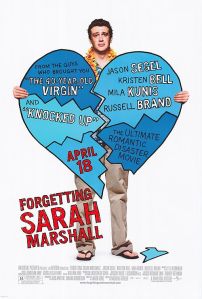 So much ink has been spilled on Jason Segel’s full-frontal nudity that you would think the public has never known that penises have appeared on film before. It seems that female nudity is used to titillate and male nudity is used for awkward laughs, and this is the case with Forgetting Sarah Marshall, which Segel stars in and wrote. His character Peter is humiliated by a breakup, even more so because the man is breaking down while in the buff. He even states at one point the naive belief that as long as he doesn’t put clothes on reality cannot hit. It’s funny and sad and he’s completely vulnerable, but Forgetting Sarah Marshall is much more than the story of one slightly doughy man and his penis. This is a story from producer Judd Apatow (The 40-Year-Old Virgin, Knocked Up) about heartache and mending and the struggle it takes to keep a relationship healthy. But it is also about a man and his penis.
Peter (Segel) is dating TV actress Sarah Marshall (Kristen Bell), star of the brilliantly reflexive title Crime Scene: Scene of the Crime. Peter provides the music for the TV show, which he laments is nothing more than “ominous tones.” Then one day she has some bad news. She’s breaking up with him (this is where Segel loses it, both emotionally and from a clothes perspective). Peter mopes and cries for days, goes out to clubs with his step-brother (Bill Hader), and tries to engage in meaningless sex but that too leads to crying and moping. Peter takes a vacation to Hawaii in order to forget his ex, but as chance would have it Sarah is already there with her new man, British rocker Aldous Snow (Russell Brand). Peter is stuck in the same hotel as his ex and her new lover. The hotel staff takes pity on Peter and they all seem to look out for him, setting him up in a $6,000 suite, involving him in hotel activities, and feeding him drinks. Rachel Jansen (Mila Kunis) works at the front desk and takes a special interest in Peter and his woes. She helps Peter get over Sarah and fin
 Forgetting Sarah Marshall is another hit from the Apatow brand. It features another leading man with an unorthodox physique and a healthy interest in geek culture. However, Peter doesn’t need to learn to be responsible, or outgoing, or to transition from boy to man. He’s actually fairly well adjusted and even has a job that suits his composing talents. His dilemma is heartbreak, a universal affliction if ever there was one. He’s a little frumpy and has a thing for puppets, but Peter is really a sweet guy who is working through the pain of a breakup. He was together with Sarah for over five years, so it feels strange when the characters keep harping on him to get over it in the span of a few weeks. He is awash in self-pity and wails so loudly that other guests complain about a woman crying in his room. He makes for a capable lead and his budding romance with Rachel allows him to heal. The romance is strongly felt and I was completely absorbed by wanting Peter and Rachel to have a happily ever after.
Segel is a charitable screenwriter. The could have easily become a vanity wish-fulfillment project, but instead he rounds out the main characters and builds a deep supporting cast that add delightful additions that enrich the narrative. I admire Segel’s decision making when it came to fleshing out his characters instead of writing them off as stock types. In an ordinary romantic comedy, the beautiful girl that dumps the lead is a bitch. It would have been extremely easy for Segel to demonize Sarah and keep her as an established antagonist, but instead he makes her feel real. She has real, solid reasons for her breakup with Peter, and she has several revealing moments that open her character up and humanize her. Aldous is another pristine example of Segel’s screenwriting skill. In an ordinary romantic comedy, the girl always dumps the nice guy for the douchebag, and Aldous starts in that territory. But a magical thing happens and as the film continues Aldous becomes very charming; he’s unpretentious and is the same transparent and genial man to everybody. He appreciates Peter’s music and gets him and Peter’s passions. Peter says at one point, “This would be so much easier if you weren’t so cool.” It would have been easy and even expected for Segel to cast both the ex-girlfriend and her new boyfriend as evil cretins. Instead, he broadens and rounds out all the central characters to the point that they feel like real people and not just comedy types.
 The movie is resolutely pleasant and amiable, lacking gut-busting laughs but offering plenty of cringe comedy. It’s not as outrageous as other Apatow comedies, or as good, but it is completely entertaining. There is one terrific sequence that stands out in my memory. It involves the two couples sitting at an awkward dinner. Then they comment on how awkward it is, then they comment on commenting how awkward it is. The dinner bathes in unease but then as it carries on you see the different tensions. Aldous and Peter hit it off discussing their dislike for a terrible horror script offered to Sarah that involved a killer cell phone (sounds like One Missed Call). They are genuinely bonding. Sarah hides her growing dissatisfaction with the decisions she’s made, but Rachel catches on. She kisses Peter long and hard and shoots Sarah a very knowing glance that all women know as “back off.” This dinner packs all of the different tensions of the movie into one well-written, expertly performed scene. The characters aren’t shouting their feelings point-blank but you can follow along to the conversations that are unsaid.
I love comedies that involve deep supporting casts, where a supporting player can enter at the right moment and deliver a perfect in-character addition. I was delighted at how wide Segel cast his net of characters and yet how well incorporated they are. There’s a newlywed couple (30 Rock‘s Jack McBrayer, Maria Thayler) that haven’t mastered the art of sexual intercourse. They’ve waited until marriage and know are wondering what all the fuss is about. Hearing McBrayer’s amped-up frustration is funny, but it’s even better when he solicits advice from Aldous on pleasing a woman. The tutorial between the two left me in stiches and made me like Aldous even more. I enjoyed spending time with all of these characters. Apatow regulars Jonah Hill and Paul Rudd pop up in hilarious cameos. Rudd is a super stoned surf instructor and Hill is an obsessed Aldous Snow fan who creepily doesn’t abide touching boundaries. The supporting players never outstay their welcome and add great splashes of variety to the story.
Forgetting Sarah Marhsall continues the Apatow tradition of mixing raunch with sentimentality. There’s plenty of dirty humor but it’s the little touches that won me over. I loved the title of Sarah Marshall’s TV show, perfect references to movies like The Buena Vista Social Club, Rachel reflecting Peter’s romantic advances only to initiate the first kiss, the brilliant music video for Aldous Snow where he carries an earnest sign that reads, “Sodomize Intolerance,” the flashbacks to Peter and Sarah’s relationship, the helpful advice of Dwayne the bartender and his great knowledge of fish native to Hawaii, and a vocally competitive dual of sexual intercourse. This is a comedy that works because even they details have been looked after with care.
 Segel easily conveys his character’s sweetness; the man can’t help but be sweet even in anger. Bell is given complexity with her role and nails bitchiness and tearful regret with the same skill she radiated on her defunct TV show, Veronica Mars. I never thought Kunis was capable of playing more than a shrill ditherhead thanks to her role on TV’s That 70s Show but she nicely handles the drama. She makes the romance more than believable but desirable. The actors all do a great job but it is Brand that steals every single scene he is in. His carefree demeanor and hysterical physical gyrations cast him early as one type of character, but his charisma rules the day and will win over audiences.
This is all familiar romantic ground covered by countless other movies. Boy loses girl, boy meets new girl, boy gets new girl, but Forgetting Sarah Marshall adds the Apatow touch. Another Freaks and Geeks alum writes another male-centric but hilarious comedy that deals with mature themes in untidy ways. The movie takes place in a world that resembles ours, where people are not cast in black and white, good or bad, victim and victimizer. Segel’s screenplay lets the audience empathize with a wealth of characters, and the humor is bittersweet but mostly on the sweet side. Any film that ends with a puppet musical about Dracula has to be seen as special.
Nate’s Grade: B+
Share this:

Definitely, Maybe (2008)
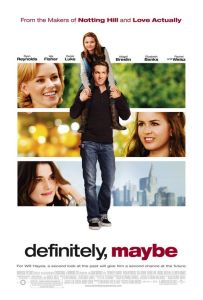 Adam Brooks has spent his whole career in the romantic comedy gutter. His screenwriting credits include French Kiss, Practical Magic, Wimbledon, and the second Bridget Jones flick. Not a whole lot of quality there. Definitely, Maybe is Brooks fourth writing and directing effort but the first to get a major push from the Hollywood studios. Maybe the same purveyors of formula fluff realize that Brooks finally has something good on his hands.
Will Hayes (Ryan Reynolds) picks up his ten-year-old daughter Maya (Abigail Breslin) from school on perhaps the worst day of the school year: sex education day. Kids are crying, parents are stammering to explain, and Maya casually exits her classroom, walks up to dad, and says point blank, “We need to talk.” She wants to know all about the story of how her father and mother, now divorced, met. Finally Will agrees but decides to play a game. He will changes names and identifying characteristics and Maya will have to guess which of his three loves became her mother. Emily (Elizabeth Banks) is Will’s college sweetheart from Wisconsin. Summer (Rachel Weisz) is an ambitious journalist with a taste for older men. April (Isla Fischer) is a Bohemian free spirit that Will meets working on the 1992 Bill Clinton presidential campaign. Maya sits in her bed and pays rapt attention to what she calls a “mystery romance.”
Miraculously, Brooks has written a romantic comedy where the characters are, dare I say it, well developed human beings. These folks are more than stock roles for the genre; in fact, each woman is smart, genuine, charming, fun, and desirable, and yet each woman also has her own set of realistic flaws. Brooks makes sure that we, the audience, admire each woman and recognize that any of the three would make a fine selection. These characters feel real, which is almost unheard of for a genre about ticking biological clocks, cloying and precocious tykes, irrationally sexist and self-absorbed characters, forced misunderstandings that lead to contrived reconciliations that involve some form of chase. Having recently seen 27 Dresses, which plays close to the typical rom-com formula, I appreciate Definitely, Maybe even more.
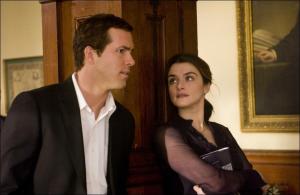
This is a romantic comedy that respects its characters and respects its audience. The people might make bad or impulsive decisions but Brooks doesn’t pass judgment, and, my God, it’s refreshing for the genre. I rolled my eyes when I read blurbs about Definitely, Maybe being “the best romantic comedy since [1976’s] Annie Hall.” While I wouldn’t necessarily go that far, Definitely, Maybe is definitely the best and most enjoyable conventional Hollywood romantic comedies in years (For those wondering what non-conventional romances got me jazzed, here is a small list: Eternal Sunshine of the Spotless Mind, Amelie, Secretary, Once, Sweet Land, A Very Long Engagement, Brokeback Mountain, Aimee and Jaguar, and Before Sunset).
Brooks chronicles Will’s romantic escapades along the timeline of Bill Clinton’s rise in national politics, which is an interesting way to look backwards in time and still be relevant to modern audiences thanks to Mrs. Clinton’s race to reoccupy the White House. I found it interesting that Will’s emotional journey seems to be charted along the same ups and downs as Bill Clinton’s time in office, so when Clinton is mired in the Monica Lewinsky scandal and questioning the definition of the word “is,” Will has lost his idealism and grown into a cynic. He even openly criticizes with great frustration and ire the man he helped put into office. Will’s enthusiasm and disenchantment for Clinton mirrors his budding relationships with women.
Definitely, Maybe has a handful of memorable moments and some amusing dialogue, but Brooks has crafted one hell of a meet-cute scene between Will and April. After an initial first meeting at the campaign headquarters, Will is purchasing a pack of cigarettes when he spots April purchasing a pack of organic cigarettes. He playfully mocks her more expensive purchase. She counter punches and says that her brand is made from better stock and will actually smoke slower, thus being the better purchase. He challenges her to a smoke-off and the two step outside, light up, and for the sake of scientific research they take equally long drags, and sure enough Will’s cigarette cannot last as long. They laugh and eventually Will visits April’s apartment and learns about her poignant search for her lost copy of Jane Eyre out there that has her father’s inscription. It’s a great scene that allows both actors to size each other up.
Thanks to each woman being presented fairly the movie doesn’t make it obvious which woman will eventually become Maya’s mother. The ladies fade in and out through the plot. The guessing game gimmick grabs our intrigue early and Brooks doesn’t tip his hand until the film’s end. What I find interesting is that Will changes with each woman and could feasibly be happy with any of the three, a desirable predicament if ever there was one. The movie even tackles divorce sincerely and without any doom and gloom overly dramatic pronouncements. Definitely, Maybe doesn’t go out on a limb and certainly isn’t remotely edgy, but the flick has a soothing, amiable adult spirit. It may not be revolutionary but simply telling a good story with mildly relatable characters seems like a great step in the right direction for this oft-sneered at genre.
Reynolds knows how to work his suave charisma to a fault. He’s certainly a capable leading man for romantic comedies and he can deadpan with the best of them. He seems like he could use a bit more direction, because there are moments where he seems to be falling back on his standard sly, indignant persona that has characterized his comedy work from 2002’s Van Wilder and on. His interaction with all three women produces varying spikes on the chemistry chart, and for my money he scores the best sparks with the subdued seduction of Weisz.
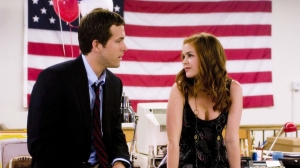 The women of Definitely, Maybe are the real winners here even if only one will eventually take home Will. Fisher becomes the heart of the movie and, given the most emotional material, shines the greatest. Banks is wholesome and easy to get cozy with. Weisz is the most enigmatic of the three and offers a beguiling yet very knowing charm. She has a very seasoned sensibility. Her on-again off-again affair with an aging literature professor (a fabulous Kevin Kline playing a fabulous blowhard) adds an intriguing dynamic to her character. The only irritant for me was Breslin’s acting, which was just off enough to annoy me.
Definitely, Maybe is a romantic comedy that proudly treats its characters with respect and develops them into relatable, authentically human characters in a typically inauthentic universe. Brooks mines a gimmick for all its worth, but even after the signs become clear the film is still pleasurable in its predictability thanks to the great characters. It’s rare to see a romantic comedy that bestows a moderate amount of characterization; usually these roles just fall under archetypes. Brooks has shied away from the trappings of the genre (there isn’t a single sing-a-long!) and crafted a genuine romantic comedy that doesn’t rely on sentiment and easy answers even as it heads toward happy ending material. The movie even tackles divorce from a non-judgmental yet honest approach. As far as I’m concerned, Brooks has made amends for his previous screenwriting duds and made a movie that men can truly enjoy as they’re dragged into the theater by their significant other. I would definitely recommend Definitely, Maybe to fans of the genre. This is one worth seeing, folks.
Nate’s Grade: B+
Share this:

27 Dresses (2008)
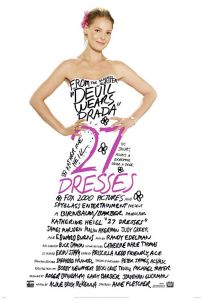 Katherine Hiegl is a likeable enough actress. She got her big break in 1994’s My Father the Hero, which had the exceptionally gross premise of having an adolescent’s father posing as her European lover to score the guy she’s really got her eyes on. The most memorable moment of the movie was a 15-year-old Heigl strutting around in a thong bathing suit. Her resume got better with a steady stream of network TV shows like Roswell and Grey’s Anatomy, and then she broke into another level of stardom thanks to the runaway success of [I]Knocked Up[/I] where she carried Seth Rogen’s baby. Then she told Vanity Fair that she felt Knocked Up was “sexist” and that the women were portrayed as shrews and that the men were fun-loving dudes (I must have seen a somewhat different movie). She’s entitled to her opinion, but what seems very odd is that Heigl’s follow-up to her breakout role is 27 Dresses, a romantic comedy about a woman who is a perennial bridesmaid and yearns for her own perfect wedding when her life will be complete.
Jane (Heigl) busies her time helping others to have heir ideal weddings. She has contributed to so many wedding ceremonies that she has amassed a closet full of 27 bridesmaid dresses that serve as trophies. Jane is in love with weddings. She is also harboring a crush on her boss (Edward Burns, wooden as always) that seems to be going nowhere. Jane’s younger sister Tess (Malin Akerman) comes to visit and immediately hooks up with Jane’s boss/crush. Jane’s wisecracking best friend (Judy Greer) is quick with a quip and declares Tess to be some very negative terms. Poor plain Jane is also taken aback when she meets wedding columnist, Kevin (James Marsden), whose fawning words about weddings are like poetry for Jane. He turns out to be a cynical guy who feels weddings and marriages are “the last legal form of slavery.” When Tess gets engaged to the boss man, wedding responsibilities fall upon Jane and Kevin is right beside her, ready to trade barbs about romance and perhaps start one of his own.
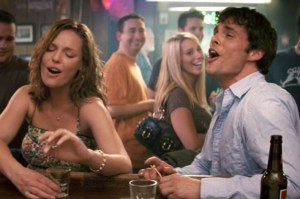
 27 Dresses hews pretty close to the familiar romantic comedy formula trappings. Opposites attract, bickering will lead to romance, and then true love will overcome all misunderstandings, that’s a given. Another given is the fact that we will get a montage of Heigl trying on all 27 titular dresses. 27 Dresses also includes the wisecracking best friend who has no purpose of her own but to comment on the troubles of our heroine with stark bluntness. Once again, this is the type of film where one character has some earlier, negative opinion or statement that resurfaces late to bite them in the ass after they have learned how flawed and shallow that original opinion was (otherwise known as the 11th hour misunderstanding). One party has a personal epiphany and runs to catch the other party leaving by some means of transportation (I’ve seen boats, taxis, motorcycles, barges, but usually they run to catch a plane). And then there’s the sing-a-long; oh what romantic comedy would be worth its salt if it didn’t include a group sing-a-long to some older tune that just united everyone in spontaneous song? 27 Dresses uses Elton John’s “Benny and the Jets” to rock out a beer bar. Really, “Benny and the Jets”? Rocking out a bar? And it’s not even a gay bar? Hmm. 27 Dresses is rather predictable from the first frame onward, but familiarity isn’t necessarily a deal-breaker for a strictly genre movie.
I’ve seen plenty of romantic comedies and I like to judge them fairly, so I use my patented cute-to-cringe count whereby I take stock of the number of times I smile, laugh, or find a moment, line of dialogue, or even choice of song that leaves a favorable impression. I then compare this figure with the number of times I want to roll my eyes, check my watch (if I had one), vomit, or any piece of dialogue or moment that feels so saccharine, so unbelievable even in the rom-com universe that I want to laugh derisively. The final tally for 27 Dresses was somewhere in the middle but I’ll admit it skewed closer to the positive “cute” side of the spectrum.
The acting overall really helps to make the most of the formulaic material. Heigl seems destined to thrive in the rom-com genre; she has an every girl appeal and seems apt making funny faces of seething indignation (take note of the amount of times she uses food in her mouth for comic effect). She seems like the heir apparent to Sandra Bullock movies. Her chemistry with Marsden is ripe and they bring out good thing in one another with their playful give-and-take. Marsden has a terrific smile (seriously, the man might have the best choppers in the industry) and is suitably dreamy but he also has an enjoyably droll delivery. Akerman plays a spoiled brat well, though she isn’t given the opportunities to flash her rather skillful comic skills that she displayed in The Heartbreak Kid remake. Greer is a top-notch scene-stealer and deserves her character deserves her own movie. She has the most fun role to play but Greer sinks her teeth into the character and delivers a juicy performance that feels slightly naughty, uncensored, and carefree.
The movie falters when it trips up in maintaining believability. There’s an extensive scene in a Goth bar/club where the costumed extras are acting like… costumed extras. It’s the least believable Goth club I have ever seen in a movie, not that I was expecting Hollywood fluff to pain an accurate picture. It’s just wall-to-wall stereotypes, but not only that, they’re distracting and lame and dated stereotypes. Then Jane marches outside to scream to the heavens an expletive-filled rant about her bad luck when, ut oh, right next door to the Goth club is an old couple celebrating their 50th wedding anniversary. What? Grandma and grandpa Old People celebrating their marriage vows next door to a Goth club? This incongruous setting takes a long, long while to set up one very blah joke that could have functioned anywhere. Realistically, the joke is that Jane is swearing unbeknownst to others, so why even have it next to the world’s crummiest Goth club? If you’re going that route, why not have grandma and grandpa Old People dressed in tacky Goth apparel as well? This may become my most nit-picky criticism of all of 2008 but it really stuck in my craw.
 A better example is how the film handles Jane’s bratty sister, Tess. For 90 minutes we bare witness to Tess being a thoughtless, self-absorbed, lying, horrible human specimen, and then the movie tries to change strides. In the very end, it wants us to open up and look at Tess’ life and realize that she doesn’t have it so awesome because she was fired and dumped. Oh my, that must be perfectly excusable then for her rampant inexcusable, me-first behavior. If 27 Dresses has an antagonist in its midst than Tess is that bridezilla. The movie plays her bitchiness for comedy but then wants an audience to forget every whine and betrayal because, woe is her life, Tess wants to be happy. Tess remains an unsympathetic twit from beginning to end, no matter how hard the movie and its soft piano score try to change your mind.
The fact that 27 Dresses thought it could throw in some contradictory evidence at the last minute to make an audience forgive Tess is very telling. It showcases that the film has a hard time grasping the realities of characterization; Kevin is cynical about weddings because he was stood up at his; Jane must focus on making others happy because she is afraid of focusing on her self; Ed Burns is a douche. That isn’t necessarily an indictment on the film per se, just my honest opinion. 27 Dresses spells everything out in bold statements that hit like anvils, like when Kevin’s news editor congratulates him on his front-age story ridiculing Jane: “Hey, you got what you wanted, right?” Gag. The movie is too lockstep with the genre’s clichés that it doesn’t push hard enough with its characters, so we get plenty of intermittently cute moments but cute moments that will be easily forgotten and stored away like one of Jane’s hideous bridesmaids gowns.
27 Dresses is more or less par for the course in a genre littered with sappy clichés and cookie-cutter characterizations, and yet the movie possesses enough charm to outdistance its lapses in believability. The acting ensemble help make the movie enjoyable in parts, especially the chemistry between Heigl and Marsden. 27 Dresses passes the time but you wish that Heigl, Marsden, and especially Greer would be teleported to a better movie. One free from bitchy younger sisters, bar sing-a-longs, giddy dress-up montages, and Ed Burns. Did I mention that his character is a douche?
Nate’s Grade: C+
Share this:

Evening (2007)
 A chick flick crammed with lots of bona fide stars and A-list talent that manages to squander all talent. It slogs on and on, the back and forth nature of the plot does little to keep an audience alert, and the story it tells in the past is so pedestrian, so minuscule, and ultimately so mundane that you can’t help but wonder why an old woman on her deathbed would be flashing back and remembering it. This high profile weepy never finds the right tone and often settles for maudlin and predictable plot turns. Evening is the kind of movie that kills the chances for a large, female-driven film to get made in Hollywood.
Nate’s Grade: C-


 nathanzoebl
You must be logged in to post a comment.