Blog Archives
Your Sister’s Sister (2012)
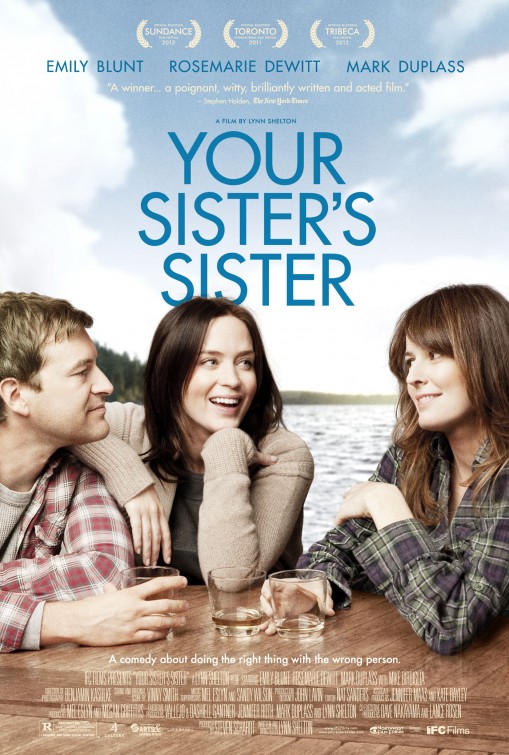 Lynn Shelton is quickly becoming one of my favorite indie film artists. Her writing and directorial offerings are somewhat relegated to the fly-on-the-wall hipster “mumblecore” category, but what separates Shelton is her narrative momentum, her laser-like focus with character, and her sense that a movie needs to build to something significant. With 2009’s Humpday, it was two dudes who might have sex as a test of their masculinity (you really need to see the movie for the full context). With Your Sister’s Sister, it’s the full ramifications of a bunch of delicious relationship secrets getting out there. Everyone in the film has something to hide and something to lose, and watching it all play out with humor and sweetness and honesty that is rare in movies.
Jack (Mark Duplass) is still coming to terms with the death of his older brother. His best friend, Iris (Emily Blunt), who was his brother’s girlfriend at the time of his passing, offers a suggestion. She arranges some alone time for the guy to clear his head. He bikes out to her family cabin but is surprised to find a guest already there, Hannah (Rosemarie DeWitt), Iris’ older sister. Hannah and Jack break the ice by bonding over their personal loss: his brother and her ending a seven-year relationship with her girlfriend. Over a long night of drinking, the two decide to impulsively have sex. The next morning is even more awkward when Iris shows up at the cabin, planning to finally reveal her own feelings for Jack. What follows may be one of the few character-based sitcom plots I’ve witnessed.
 Much like Shelton’s previous movie, the greatest strength of the film is how beautifully naturalistic it all feels while still telling an engaging story. The film has a relaxed vibe that washes over you, allowing you to immerse yourself in what feels like a real group of friends. There’s a tremendous naturalistic ease the film exudes, with the actors so familiar with one another that they truly feel like family. When I have well developed characters, and actors who seem so knowledgeable of their character’s tics and flaws and secrets and smallest details, I could honestly listen to them talk for hours. I don’t want to mistakenly give the impression that this movie is a dull yakfest where the participants are in love with the sound of their own exceptional voices. Each scene in this movie advances the plot further, twisting the screws, complicating matters, and brimming with delightful awkwardness and tension. With 2009’s Humpday, I wrote: “What I really appreciated about Humpday is that every moment feels genuine and every scene has a point. I was amazed that Shelton and her small unit of actors had made it so that every conversation had purpose; there is so little fat to this screenplay. Each scene reveals something new about a character or pushes the narrative forward toward its uncomfortable climax, and each moment never breaks the reality of the story.” And the same can be said for Your Sister’s Sister as well.
While the premise is a bit of a sitcom novelty with some farcical developments thrown in, the depth of the characters and the fantastic acting help to make sure that Your Sister’s Sister is nothing but graceful and beguiling. And the escalating conflicts, personal revelations and complicated feelings, always find a way to come across as organic to the story. That’s another amazing part of the film, that even with all the sexual hijinks that it still manages to feel grounded and surprisingly relatable. These are interesting, complicated, flawed, and spectacular characters, and watching them interact, profess their love through small actions and big declarations, seeing their heartfelt camaraderie, and watch them navigate their troubled lives to find some semblance of a happy ending is a joy to watch. This is a potent little movie, fully realized, poignant, funny, and genuine.
The film was shot over the course of 12 days and Shelton has said that much of the dialogue was improvised, working off her outline. Improvisation is a dangerous tact when dealing with a dialogue-driven film, such as this one. Just because it’s coming off the top of your head doesn’t mean it’s going to sound good. Not everyone is gifted with the ability to improv dialogue that is true to character, revealing, advances the story, as well as just being entertaining. Luckily, Your Sister’s Sister is the exception.
If Your Sister’s Sister does have a weakness, it’s the third act that seems to stall out without giving us much in development before tidying the broken relationships up again. The film’s comedic structure could feel, in lesser hands, like a generic sitcom. It is to Shelton and her actors’ credit that the twists and turns still manage to feel as believable as possible. The third act hits when all the secrets come out, pushing the characters away. Rather than (minor spoilers) ramping things up, we merely endure an extended wordless sequence of images of Jack biking around and the sisters burying the hatchet. Then it’s time for our big happy romantic declaration that tidies everything up, and we’re done. While satisfying on an emotional level given our empathy for the trio, the third act does seem very thin for an otherwise lean and well-structured story. It feels like perhaps Shelton only had enough plot for two acts.
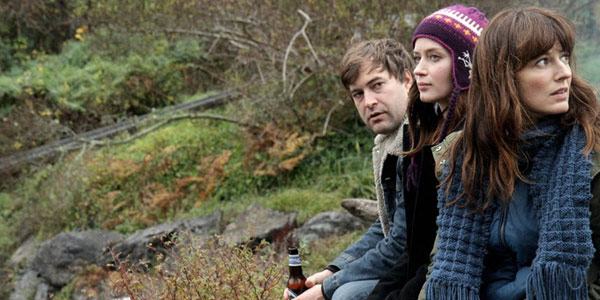 The main trio is a rather engaging ensemble that convincingly plays a besotted group of friends and family. Duplass (Safety Not Guaranteed) has gotten considerably more attention since starring in Shelton’s last movie; the man and his schlubby, smirky charm are ubiquitous. He has a way of being edgy without pushy and nonplussed and flummoxed without going overboard. Duplass has a natural fit for comedy but the man can really excel with the meatier drama bits as well, displaying the painful yearning of a man caught between his desire and the need to move on. He’s a winning and likeable presence that can still be endearing even when he’s flailing around or making others uncomfortable.
DeWitt (The Watch) was a late addition to the cast, replacing Rachel Weisv (The Bourne Legacy) when scheduling conflicts got the best of her. She deserves extra kudos for how good she is considering the miniscule prep time she had compared with her costars. DeWitt is amusing in how cagey and sardonic she can be, and her chemistry with Blunt (Looper) is outstanding. I greatly enjoyed the subtle nuances between them, the way their body language and gestures added extra layers to their relationship, the familiar communication and sisterly code, and just the smallest details that felt well thought out. The relationships in Your Sister’s Sister feel sweetly genuine, and with the benefit of great actors, it lays the groundwork for characters we care about.
Three people sharing time in a cabin might not seem like an exciting setup for a movie, unless, of course, there’s some supernatural presence murdering them in grisly fashion. However, when you lock away three great actors who know their characters inside out, a smart script that allows them the space to develop but pushes the movie forward scene-by-scene, and direction that feels seamless with the storytelling, then you have something special, and that something special is Your Sister’s Sister. While I think Shelton’s previous film had more at play concerning male relationships and sexual politics, this one, with a more straightforward, farcical plotline, is still plenty entertaining and with strong character work (the ending does leave one very large question unanswered). This is charming, sweet, unassuming little indie film that will provide a solid dose of smiles and laughs.
Nate’s Grade: B+
Share this:

Silver Linings Playbook (2012)
 I am in love. It’s been days since I watched Silver Linings Playbook and I’m still under its spell. It’s a movie that gave me such rapturous emotional peaks, a deeply satisfying crowd-pleaser that doesn’t just nail the big moments, it crushes them. This is a movie that works so well with just about every facet of storytelling, from acting to writing to directing, that you’re liable to be in awe as I was.
Pat (Bradley Cooper), a high school history teacher, came home one day to find his wife in the shower with another man. He admittedly lost it, beating the man bloody, and has been remanded to a state psych ward for the past eight months. It’s determined that Pat is an undiagnosed bipolar case, and the court orders him to stay on his meds and stay 500 feet away from his now ex-wife, Nikki. Having lost his home, Pat is living with his parents (Robert De Niro and Jackie Weaver), both of whom don’t know how to help their troubled son. Pat is convinced he can win back his wife. He starts conditioning by running, wearing a garbage bag to better sweat off the pounds, and meets Tiffany (Jennifer Lawrence). She’s been fighting through depression after coping from the sudden death of her police officer husband. She agrees to help Pat get in contact with his ex, passing a letter, but at a price. He must compete with her in a dancing competition. They spend hours practicing their routine, getting to know one another, and stabilizing one another, providing a foundation for healing and success.
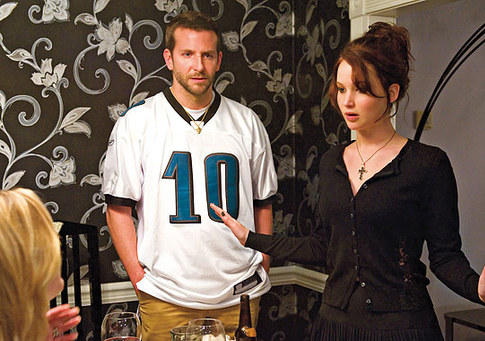 The story itself isn’t anything groundbreaking; you could glibly label it as the “bipolar rom-com” and it does adhere to that structure for the second half. But this is David O. Russell we’re talking about, the man behind 2010’s The Fighter, yes, but also offbeat dysfunctional family comedies like Spanking the Monkey and Flirting with Disaster. The man has a way of working within the framework of conventions and finding the rough edges, to make stories at once familiar and excitingly new. Is there anything groundbreaking with Silver Linings Playbook? It’s your boy-meets-girl formula at heart, but the execution is so extremely sure-footed, so exceptionally handled, that the movie leaves you buzzy and beaming. Once it ended, I wanted to run around, shouting from the rooftops for people to run out and see this movie. You want others to share in something so special and affecting. I felt a similar passion after seeing the unconventional romance Safety Not Guaranteed, and I’d advise any fans of Safety to certainly check out Silver. Being a rousing, crowd-pleasing sort of movie is not necessarily a yoke to weigh down its artistic integrity. As if enjoyment and creative accomplishment are opposing forces. I freely admit that Silver Linings Playbook is a masterful movie that knows what it takes to get an audience cheering, and I was thrilled to be part of that cheering throng. Here is a movie that just makes you feel good, and when was the last movie you saw that made you feel glowing with happiness?
This in an emotionally rich film; I was so happy after my screening that it felt like a high I didn’t want to come down from. To engineer a reaction that enhanced, that enlightened, that potent, well I must sing the praises of Russell and his actors. I bought into the love story and family drama big time. The payoffs are meaty and numerous, and I often found the film to be sincerely moving. There’s a great satisfaction in watching two oddballs find their special someone’s, and when the characters are this interesting, this human, and so well portrayed, it makes every stop along the journey that much more engaging and emotionally triumphant. It’s got an ending that pulls it all together in spectacular fashion, giving us exactly what we want while feeling earned and on its own eccentric terms. This is a deeply felt and compassionate film, one with as much uplift as acerbic rebellion. You feel like these people really do love one another. Silver Linings Playbook has memorized the playbook on how to win over an audience, but it always comes down to the same Xs and Os: strong characters, a compelling story, and people we genuinely care about, and that includes distaff supporting characters too.
 The characters are so interesting and beautifully flawed, and the actors are so in tune with one another, delivering bar-raising performances that take the movie into another realm of enjoyment. When actors are given plum roles about people with mental illnesses or disabilities, it must be very enticing to overindulge in tics and self-conscious mannerisms. That doesn’t happen with Silver Linings Playbook. Beyond an uptick in tempo, the actors portray their parts as characters rather than ailments. If anything, the acting in this movie is practically restrained given the circumstances. What’s more, Silver Linings Playbook is a fine example of what can happen when the cast works in tandem, challenging one another to up their game. It’s like every actor felt revived from all the talent on display. Russell knows how to push his actors like few other directors, and while this has lead to notorious Internet videos of his actors losing their cool, it’s also given way to raw performances that burn in your memory. Russell gets his actors to bring their A-game and then some. The Fighter got three Oscar nods for acting and I wouldn’t be surprised if Silver Linings Playbook gets three as well (I think Lawrence and De Niro are locks).
Cooper (The Hangover) has always had a certain smirking, leering quality about him, a guy used to portraying louts with charisma. I have never seen him tackle anything nearly as challenging as what he does with Pat. He’s unpredictably combustible, ready to explode at any moment, but also empathetic, trying to do better. Pat isn’t meant to be seen as a loveable loser. This guy has serious problems he’s working through. Cooper is simply incredible, showcasing skills and nuance you didn’t know the man had, radiating with an intense outpouring of spontaneous energy that doesn’t ever feel forced. Cooper is not bouncing off the walls here as some wild-eyed loony, playing upon codified ideas of what a bipolar person behaves like. He’s a deeply complicated guy, processing challenging and contradicting feelings in a brain that doesn’t necessarily follow the rules. He has so many impulses leading him in different directions. Pat is obsessed with his goal of impressing his wife, so much that he seems blind to the tangible connection he’s formed with Tiffany, and we yearn that he realizes the catch in front of him. I was won over completely by Cooper’s committed, attentive, anxious, and lively performance.
Readers will know that I harbor a serious crush when it comes to the talented actress, Lawrence (The Hunger Games). I was expecting her to be great in this movie, as this is pretty much my default setting with the actress at this point. I was not expecting what she delivered, a performance that is so enthralling, so astonishing, that you’ll be left stupefied that a woman at only the young age of 22 could be this phenomenally gifted. Lawrence had several scenes that just left me speechless. Lawrence is in elite territory now as far as I’m concerned. Her command of the character is just about impeccable, and you perk up every moment she’s onscreen. She’s a damaged woman recovering from her own powerful grief, but she’s so many things at any one moment. She can be lusty, provocative, angry, sullen, commanding, vulnerable, and hurtful. There are scenes where she will bounce around a plethora of emotional states, but each one gradually shifts to the other, making the transformation genuine and another layer to the character. If she were just some crazy girl we wouldn’t care if she eventually got her happy ending with Pat. With Lawrence’s talents, and Russell’s sharp writing, Tiffany becomes a figure worth fighting for, a bruised romantic that finds her rare kindred spirit who accepts and appreciates her messiness.
The supporting cast from top to bottom may not be at the same level as Cooper and Lawrence, but their output is also impressive. De Niro (Limitless) hasn’t been this good in ages, delivering a few monologues that will hit you square in the gut. Weaver (The Five-Year Engagement) is something of an enabler for the family, but she also gets her moments to shine and reassert her strength and dignity. Chris Tucker (in his first non-Rush Hour movie since 1997) is the least Chris Tucker I’ve ever seen him. He’s downplayed his motor mouth tendencies completely, and he’s a wonderful presence as he ducks in and out. He even teaches Tiffany how to “black up” her dance, a fact that most heterosexual males in the audience will be thankful for this time of year.
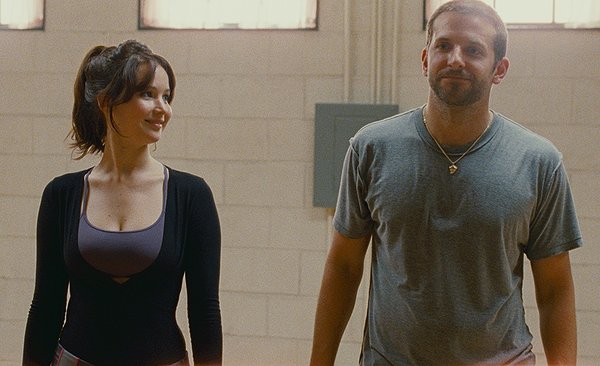 Russell deserves serious credit for portraying mental illness in a manner that doesn’t dance around the seriousness of the condition. Statistically one in three people suffer from a mental illness at some point in their life, and I’ll even admit that post-divorce, I too fell amongst those ranks (I’m a statistic!). In the case of Pat, He’s not just some unfeeling jerk who says inappropriate things or has problems reading social cues. He’s a guy going through serious personal struggles, same with Tiffany. These are not jokes. They are not send-ups of mental illness; they are people. At no point does the humanity of these characters get lost. We will laugh at their inappropriate comments, sure, but we are never laughing at them from some cushy sanctuary of superiority. I also think Russell examines an interesting, more socially-acceptable form of mass mental illness, namely the OCD-nature associated with sports superstitions. Smart and capable people can get caught up in the allure of superstitions, and when it concerns sports in general, groupthink overpowers. I consider myself a sports fan as well (I’m a double statistic!) and fully accept the ridiculous nature of fandom, but I thought it was a clever move for Russell to hold the mirror up to our own cracked community and its irrational behavior. And as any Philadelphia sports fan will acknowledge, they take fandom to a whole other level.
At this point, I don’t know what more I can write about this movie without coming across as a complete, frothing madman. Football, mental illness, ballroom dancing! I’m smitten big time with Silver Linings Playbook. I’m completely in the tank for this film. Future viewings (already planning one soon) will probably highlight certain minute flaws I’ve failed to notice the first go-round. And even if those flaws become more apparent (yes the final dance is something of a contrived climax) I simply do not care. The movie’s many virtues far exceed any shortcomings that could potentially arise. It plays to some familiar rom-com elements but it goes about its business with its own funky charm. The acting, writing, and directing are all on such a heightened level of excellence, it’s amazing just to watch all the parts work together so masterfully. I wasn’t just won over by this movie; I’ve become its disciple. I preach the gospel of Silver Linings Playbook. Here is a rapturous feel-good movie that doesn’t feel like it’s pandering or dulling its edge even after it takes some conventional turns. Cooper is terrific, Lawrence is astounding, and together they form the couple you cheer for. Silver Linings Playbook is everything you’d want in a stellar movie. I can’t wait to watch it again and get caught up in its wondrous spell once more. It took a long ten months but The Grey has finally been knocked off the perch. Silver Linings Playbook is nothing short of the best film I’ve seen this year.
Nate’s Grade: A
Share this:

Breaking Dawn: Part Two (2012)
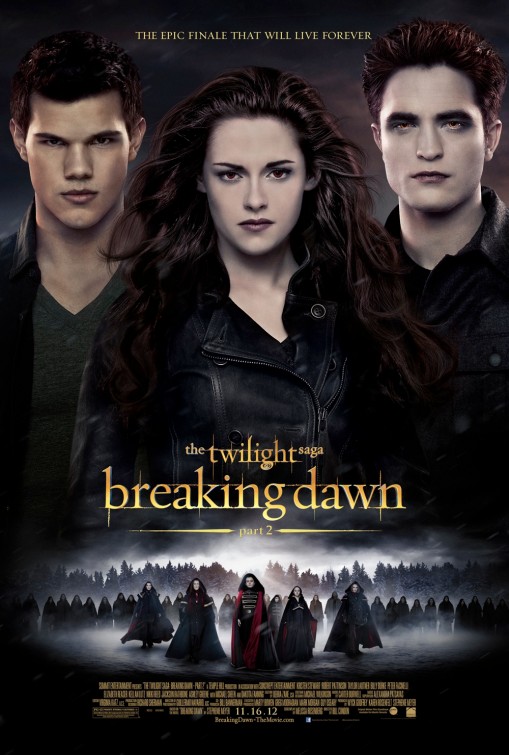 Ignoring the ironic nature of the Breaking Dawn Part 2 poster taglines declaring love to be “forever,” the box-office juggernaut that is the Twilight franchise is coming to an end. Based upon Stephenie Meyer’s outrageously popular series of books, we’ve followed the love life of Bella Swan as she’s experimented with human, vampire, and werewolf. The studio heads decided to take Meyer’s final book and split it into two books. Breaking Dawn Part 1 had a wedding, honeymoon, pregnancy, supernatural birth, and Bella’s death/resurrection. And yet, that movie was still crushingly boring. My hopes were substantially low for Part 2, despite director Bill Condon’s (Dreamgirls) best efforts to jazz up all the awful plotting, characters, and romance. Then a funny thing happened. I started enjoying myself, and then the movie took some chances that I felt were daring considering its rabid fanbase. And then watching Breaking Dawn Part 2 became more than watching the film, it was also the experience of watching the audience. To that end, the movie delivers and I may rue these words but I kinda sorta almost liked enough of it.
Bella Cullen nee Swan (Kristen Stewart) and her husband, immortal vampire Edward (Robert Pattinson), have gone through the wringer. In her waning days as a human, Bella got knocked up during her honeymoon, and her half-human half-vampire baby killed its mama on the way out. Now Bella’s a vampire and a mom (note to self: start writing new script – “Single Mom Vampire”). Her daughter, Renesmee (Mackenzie Foy’s face on a whole lot of other people’s bodies), is rapidly growing. She’s mistaken for a vampire baby, which is a punishment worthy of death. This news gets Aro (Michael Sheen) to rustle up his Volturi forces, a group of vampires with super powers. They’re coming for the Cullens and little Renesmee. The friendly vampires scour the world, gathering “witnesses” to the tyke’s half-vampire status, but really they’re gathering an army to defend themselves. It’s super vamp against super vamp and heads will roll.
 I clearly understand that I am in no way the target audience for this franchise and that my reams of pithy words will find little traction in the hearts of the Twi-hard faithful, but I’d like to state that I’ve never been a hater of the movies. Well, let me rephrase that. My thoughts ping-pong from liked okay (Twilight) to hated (New Moon) back to liked okay (Eclipse) back to hated (Breaking Dawn Part 1), and now here we back are to liked okay. Consider it a double-dip recession in quality. I still view the whole franchise as an exercise in pre-teen wish fulfillment, but I’ve already written extensively upon that theory so I won’t bother re-litigating that battle. With all that said, I found myself oddly enjoying myself for sustained durations. It’s just as silly as the other movies but finally we can move on from mopey Bella and her dubious romantic triangle. Finally we don’t have to suffer through two hours of kids making (new) mooneyes at each other (did I just out myself as “old”?). By this I mean finally something ELSE happens rather than the incremental coupling of Bella and Edward. Granted their kid is really more a prop than a character, but at least the story has taken one gigantic leap forward. Finally Stewart can actually smile and, you know, do things of actual consequence!
It’s no secret that the Twilight saga, as its monetary benefactors would like to dub the franchise, has noticeably been better the less time it spends with its female protagonist, Bella. Breaking Dawn Part 2 might just be the least Bella-filled episode yet, a cause of celebration for my brethren who view Ms. Cullen as an infuriating, insufferable, insulting protagonist. At least in this movie she develops a sense of self-identity, though too often that identity falls into the camps of Wife and Mother. With this movie, she’s adjusting to life as a vampire, so we get cutesy scenes of her hunting prey, learning how to fake looking like a puny human, and arm-wrestling the strong cocky vampire guy to, you know, for the strides in girl power. Too little too late, Bella. I find it more than a little funny that Bella’s super power is passive in nature, fitting a passive protagonist that waist for people to give her meaning and tell her what to do. I should stop before another rant unspools as I’ve done on previous Twilight writing occasions. In short: Bella sucks.
We’re introduced to a lot of new characters in this movie and each brings some sliver of backstory to develop. I’m not saying they’re all deserving of attention or interest, but at least these new clans of vampires brought some much-needed life to what has often been a claustrophobic, monotonous love triangle. Opening up Meyer’s world and seeing other vamps with special powers are a fun detour that I wish had taken place sooner. I liked seeing Lee Pace (TV’s Pushing Daisies) as a soldier from back to America’s colonial days. I’m left scratching my head why certain vampire members were added to the ranks when they didn’t even show up for the final showdown. What was the point of having Joe Anderson (Across the Universe) show up and be all skeptical about the group’s chances of winning… and then not have him join? So he was skeptical from the start and then remained so, choosing to sit the finale out. Well I’m sure glad we spent time on him then. Also, the movie falls into the trap of establishing super-powered beings that are too powerful. We get one guy who can control the elements. Not just one or two but freaking all of the elements. He’s like Captain Planet minus that dumb kid with the lame heart power. During the climactic battle, this kid uses his power ONCE. How do you give him a wealth of super powers and then sideline him? There’s also an Amazon vampire who can control people’s vision, namely making them see whatever she wants. How are these two assets not utilized for tactical supremacy?
 I had the suspicion that Breaking Dawn Part 2 might be the best film in the series simply by the fact that it’s the one with the most Michael Sheen. God I love this man. His last-minute turn in the appalling New Moon banished the suicidal thoughts swirling in my head. Even when he’s in bad movies, Sheen is usually the best thing about them (see: TRON: Legacy or the Underworld films). Here’s an actor who knows exactly how ridiculous everything about this universe is, and by God he sinks his teeth in. The benefit of added Sheen cannot be overstated. The movie greatly benefits by having a strong outside threat early. Only the third movie, Eclipse, had an external threat from the start, and that gave the film a much-needed sense of urgency. I was with Sheen and the Volturi on this one. They were merely following the laws of vampires meant to protect their own kind. Vampire babies are a no-no since they cannot control their otherworldly urges, so they and their makes must be destroyed. You know you’re in for a darker Twilight when early on we witness a baby getting tossed into a roaring fire. I admit that I have a susceptibility to falling under the sway of magnetic villains. Perhaps this speaks to some character defect of my own. It probably just speaks to the fact that movies often have boring heroes and charismatic villains. Sheen is so hammy and delightful and I just wanted more of him amidst the melee that punctuates the end. The man even looks like he’s about to lead a marching band during the battle and he’s still badass. Such is the awesomeness of Michael Sheen. Of this there can be no question.
But then the Condon and series scribe Melissa Rosenberg do something almost extraordinary given the slavish devotion to the series fans have. They divert from the source material in broad strokes during the climactic vampire brawl. I won’t go into exact details but the preview audience I was with was absolutely losing their collective minds. Women were screaming, cries of “Nooo” rang through the room; all around me was the echo of consternation and shock, women trying to absorb the reality of what they were viewing. Sitting with them, taking in their shrieks and lamentations, the general horror of what might happen next… it was a thing of beauty. I can almost recommend seeing Breaking Dawn Part 2 simply to be part of this experience. However, you’ll have to act quickly and be selective. You’ll need a packed theater filled with vocal Twi-hards, likely an opening weekend evening crowd, the kind that openly cheer shirtless revelries from the male co-stars. And then just sit and wait, knowing that soon all that revelry will turn to shock. I sound so mean-spirited explaining this and that’s not my intention. I didn’t necessarily enjoy the discomfort of the Twi-hards. I enjoyed the bewilderment. It felt like the theater was alive, coursing with the energy of alert uncertainty. Anything could happen, including some very not nice things. To be one tiny drop in an ocean of furious estrogen, well it’s an experience that deserves mentioning. Its strange experiences like this that make me love going to the movies, and that, ladies and gentlemen, is a combination of words I’d never thought I would write about any Twilight film.
Also, though my expectations were never that high to begin with, I have to credit Condon with fashioning a fairly exciting action brawl, one that’s surprisingly graphic at spots for a PG-13 movie primarily aimed at young girls. The series has been building up to a massive showdown, and the movie itself has been putting the feuding factions into place, so it’s satisfying that the finale truly feels climactic and delivers some thrills. For the record, Meyer’s book was free of any climactic battle. This movie is chock full of decapitations. I cannot recall another PG-13 film that had this many beheadings. I think you could watch a drama set during the French Revolution and you wouldn’t witness this many people lose their heads. Is there no other ay to kill a vampire? What ever happened to the good old fashioned staking of the heart? These kids these days; all they want to do is decapitate. To dull the grisly spectacle, the beheadings are weirdly bloodless. Condon does a bangup job of setting up plenty of mini-payoffs and duels throughout his busy action centerpiece. Then when it looks like the carnage is at an end, the movie takes a page from the Final Destination playbook, which Twi-hards will probably find relieving. I thought it was a major cop-out but whatever. Let the kids have their happy ending.
 Before you get your hopes up too extravagantly, this movie still offers plenty of stupid. I don’t care how you explain it, the imprinting thing is stupid incarnate. I still find it eternally creepy that Jacob couldn’t have the mother so he settles for the daughter. The fact that everyone treats this development so seriously makes me laugh. And oh boy, let’s talk about those Amazon vampires. First off, I find it hilarious that Meyer’s vision of vampire clans from around the world really just boils down to Europe and the Amazon. When they stepped onto screen wearing, and I kid you not, loin clothes and tribal markings, I was flabbergasted. Doesn’t anyone find this depiction to be at least deeply ignorant and culturally insensitive? I’ll stop short of calling it quasi-racist; though attaching “quasi” to anything lets you get away with most declarations (“This movie is quasi-watchable”). But when our big battle over a frozen lake takes place, why are these Amazon characters STILL wearing loincloths in the frozen landscape? Then there’s the annoying fact that Renesmee rapidly grows, meaning that Bella and Edward get to skip out on actually raising a baby. If Meyer intended to punish these kids for having sex in Part 1, then she needs to follow through on her antiquated sexual hang-ups.
As the franchise draws to a close, I’m trying to take stock of the five films and their overall impact (sadly, we all know with the potential riches, a reboot is likely only five years out). The end credits play out like a gauzy yearbook for the franchise, visually highlighting every significant speaking role, including the two different actresses who played villainous Rachel. The Twilight series has been very good to me as a writer; I’ve produced long-winded reviews with each new entry, and the opening-day people watching has become part of the spectacle I enjoy. That’s really what we’re dealing with here – spectacle. It’s all gooey romantic fantasy nonsense with some pretty bland characters, questionable messages for young girls, and such deadly seriousness. If we were grading on a curve, I’d say Breaking Dawn Part 2 is actually tolerable thanks to nominal character development, less whiny Bella, an influx of new characters, extra Sheen time, a better sense of humor, and a climax that truly feels climactic.
I can’t say the Twilight movies have gotten better as they’ve gone, though Condon has proven to be an apt choice to steer this franchise to a close. He’s given the franchise a bit more life, a bit more blood. I’ll never admit that the love story of Bella and Edward deserved five full-fledged movies, but I recognize the significance Twilight stands in many young girls lives. Fans will eat this stuff up. They’ll certainly enjoy the Bella/Edward sex where she doesn’t end up bruised. For them, it ends in a fitting sendoff, even after the jolts of text deviation morphs into giggled recounts on car rides home. For them, Breaking Dawn Part 2 will be the perfect ending to their beloved series. I can’t imagine anyone indifferent to the series working up that much interest, but I can say with sincerity that Breaking Dawn Part 2 is the best film in the Twilight series and potentially worth seeing for the rollercoaster ride of bewildered fan reactions. Now that the last blood has been drained from this franchise, let’s move on to more important items… like the next Hunger Games movie.
Nate’s Grade: B-
Share this:

Cloud Atlas (2012)
 Most people regarded David Mitchell’s 2004 sprawling novel Cloud Atlas was unfilmable. It has six different stories each set in a different time period, slotted into a different genre, and each a variation on storytelling. Mitchell’s tome was structured like a series of nesting dolls, each narrative pulling back to reveal a character reading the previous manuscript, and eventually the direction was reversed. We go from the mid-nineteenth century to post-apocalyptic and back again. I read the book over the summer and found it to be enthralling, especially because each storyline was written so distinctively in a different writing style. The post-apocalyptic linguistics definitely took some getting used to. How could you turn this unwieldy book into a workable movie?
The Wachowski siblings, Andy and Lana, teamed up with German director Tom Tyker (Run Lola Run) to try and find a way. They decided to split up the stories into a musical syncopation, with stories blending into one another. As a result, Cloud Atlas is six different movies for the price of one but it’s far more than the sum of its parts. Cloud Atlas coalesces, bleeds, and bends, becoming a Mobius strip of causality and courage and love. The trio of directors, who shot simultaneously with two separate film crews, has done the impossible and translated Mitchell’s brilliant novel into a soaring, compelling, and multifaceted epic on hope and humanism.
Where to begin with this one? Well, in 1849, Adam Ewing (Jim Sturgess) is traveling across the Pacific back to his home in San Francisco. He’s fallen ill on the ship and keeping the secret of a stowaway in his chamber, a Moriori slave named Autua (David Gyasi). In 1931, Robert Frobisher (Ben Whishaw) is a penniless gay musician looking for refuge. He offers his services to the aged but still famed composer, Vyvian Ayers (Jim Broadbent). Ayers will dictate and Frobisher will assist in writing. In 1971, Luisa Rey (Halle Berry) is a reporter investigating a series of murders tied to a nuclear facility and a report the head honcho (Hugh Grant) doesn’t want exposed. In 2012, Timothy Cavendish (Broadbent) is a small-time publisher who mistakenly checks himself into a nursing home that won’t allow him to leave. In 2140, a new working class is grown from the lab. Somni 451 (Doona Bae) is one of these fabricants. With the help of a revolutionary (Sturgess), she escapes her confines and learns the horrors of the totalitarian world and becomes part of the rebellion. And 100 winters after “The Fall,” mankind has descended into agrarian tribes. Zachry (Hanks) is a goat herder who reluctantly agrees to take Meronym (Berry) to a hallowed mountain. Meronym belongs to the last group of technology-abled civilization, the Prescients, and Zachry mistrusts her and is tempted to kill her to protect his people. Just describing this stuff is tiring and could take up two reviews.
 This is going to be a very divisive movie, this much I can tell. It’s so powerfully earnest that you either embrace its mushiness and ambitions or you smirk and mock its New Age philosophy and optimism. There will be no middle ground with this film. We’re talking about transmigrating souls over the course of 500 years, Tom Hanks as a post-apocalyptic goat herder, and an evil presence known as Old Georgie, who looks like the forgotten cousin to the Wicked Witch of the West. There is some stuff in this movie that is plenty goofy, especially when seen on the surface. It takes a while to ease into the film, adjust to its tempo and accept the context of those goofy elements. But once that’s established then it feels like you can handle anything. There’s such an overflowing of feeling in this movie that it’s easy to make fun of it, to dismiss it under the safety of ironic detachment. It would be easy to decry the Cloud Atlas team for being self-indulgent or pretentious. What they are doing is far from normal, but the achievement of Cloud Atlas is the graceful way it finds to connect the rhythms of a deeply felt humanity. It has its stirring moments and memorable scenes, but when compacted and collected into a beautiful whole, that’s where the movie transcends. When an authoritative character barks, “You are but a drop in an ocean,” and our hero responds, “What is an ocean but a series of drops?” you either roll your eyes or you cheer. This is an earnest movie that wears its humanism on its sleeve. You either roll with that or you don’t, and I decided to embrace the big, messy, mushiness of the whole project and was swept away.
For a three-hour movie, the time flew by, and by the end I knew I had to see Cloud Atlas again. The first viewing requires much in the way of processing. You’re stringing together the disparate strands of the narrative, you’re listening hard to decipher the post-apocalyptic tongue of Zachry and company, and then you’re also keeping track of what actors are playing what characters, crossing lines of race and gender. The disguised actor factor is something of a fun ”who’s who” party game throughout the movie; initially distracting and somewhat questionable (especially the cross-racial makeup). I think seeing Cloud Atlas a second time will allow me to immerse myself further, finding new depths and connections. The pacing is surprisingly swift for a three-hour movie. You barely notice the time is gone, and honestly I could have done with even more movie, especially during the Neo Seoul segment. Given the six segments, some stories are going to be more compelling than others. I don’t think too many people are going to be as compelled with Frobisher’s creative sessions as they are Somni’s escape from enslavement. Initially, you’ll be scratching your head what they all have in common, and the lighthearted segments seem to clash with the more severe segments of systemic abuses. But then the big picture starts to eventually emerge and you see the parallel themes of oppression, bondage, rebellion, sacrifice, abolition and the yearning for freedom at all costs. The filmmakers find clever ways to thematically link their different tales. The movie starts to become a musical experience, much like Frobisher’s central melody, the overlapping notes of repetition and the swelling movements of human life in minor and major.
 As anyone who endured the Matrix sequels will attest, the Wachoswkis are film theologians and Cloud Atlas is unabashedly spiritual. The filmmakers openly favor examining the spiritual side of Mitchell’s novel rather than the political. I found the results to be intriguing but short of profound. From a philosophical/theological standpoint, Cloud Atlas is not breaking new ground or even going into great depth. We’ve got some basic Eastern notions like reincarnation and trying to improve upon one’s soul through various lifetimes. There’s also the notion that death is just a transitional phase and not the end. The film is also very interested in the transcendentalist interconnections of human history. “With each crime and each act of kindness, we give way to our future,” says Somni at one point. I like this; it’s essentially karma in its purest form but it also denotes that every choice gives ways to multitudes of possible futures (perhaps pedestrian but I still like it). I feel that human kindness is long-reaching and casts out many ripples, and Cloud Atlas is a film all about the ripples, seeing the long-reaching effects to causes, and discovering that individuals can become movements and movements can become inspiration. I also like the relatable debate over religious belief in the far-flung future; the Valley people worship Somni as their gracious Goddess, but the more advanced Prescients view her as a person, noble and with strong and important ideas but flesh and blood. And yet the film doesn’t look down on Zachry and his people for their beliefs; Somni inspires them to do good. Do the details matter when the results are positive? Cloud Atlas has plenty of intriguing questions roiling around, moments of pause worthy of post-screening debate. It’s not too deep but it’s far from shallow (the Wachoswkis love their Christ-like imagery, don’t they?).
From a filmmaking craft standpoint, Cloud Atlas is often breathtaking. In some respects it feels like something radically new, a $100 million dollar art film. The visuals are wonderful and the different time periods all come across handsomely mounted, perfectly realized, the details vivid and period appropriate. The future worlds are easily the most engrossing just because of how different they are. You’re never spoon-fed the answers in this movie, so we’re left to put together what lead to each future. I would have loved to have gotten even more details about Somni’s world, a time where democracy has been replaced by “corpocracy,” a world run by corporations. The ambitious story structure of Cloud Atlas could have easily become confusing, but the filmmakers smartly give each segment its own little undivided period to set up that world and its unique tone. They even provide date stamps. Then things get more spliced together, the different storylines cascading and braided together. Some of the storylines have to wrap up early and others are saved for heartbreaking finales of tragic resonance. The elliptical romances spanning centuries provide nice counterpoints and satisfying out-of-time conclusions for storylines that don’t always end cheerful. The movie is often thrilling, intellectually stimulating, disturbing, and poignant, though to be fair it comes up short when it comes to emotional involvement. Like the stunted depth of its philosophy, the movie has a way of drawing you in but never fully; it’s all about a wealth of human feelings and the nature of humanity yet it quixotically comes up short emotionally.
With up to six roles to play, the actors are given plenty to work with. It would be redundant to say you’ve never seen many of these actors like they are in Cloud Atlas (has anyone ever seen Berry in whiteface?). Every actor gets to play heroes and villains, saints and sinners. Only Weaving (The Matrix) and Grant (The Pirates! Band of Misfits) play antagonists in just about every story, and when you have Weaving at your disposal you have to give the man a role with menace. Grant gets to play a post-apocalyptic marauding cannibal. You won’t see him eat anybody’s face in one of those Bridget Jones movies. Like the filmmakers, the actors display full commitment to their varied roles no matter how silly some of the future diction may sound (“for true-true”). Hanks instantly anchors your empathy as Zachry and grounds a storyline that has the biggest danger of slipping into silliness. Readers will know I’m not the biggest Berry fan, and that is probably being charitable. However, I was truly impressed with her work in Cloud Atlas and would easily classify this as her best work since her Oscar-winning turn in Monster’s Ball. Her portrayal of Luisa Rey has such fire and her Meronym has such melancholy. Broadbent (The Iron Lady) is still highly enjoyable as a pompous sort, I’m always happy to see Keith David, and Weaving is delightful in his venomous villains, as a devil, a hit man, and most vividly as the Nurse Ratchet-style sadistic head nurse antagonizing Cavendish. The real breakaway star is Bae (The Host), who also benefits by having the most involving storyline. Her gradual awakening is just about note-perfect, alternating between curiosity, horror, amazement, and finally anger. All of those emotions need to be free of histrionics but if too underplayed then Somni seems like a walking zombie. Bae finds the right somber middle ground and her journey is the most emotionally rewarding.
 In the end, there’s so much to unpack, dissect, discuss, debate, and contemplate with this movie, and every hour I think of some new connection that dovetails the plots. Cloud Atlas is a thrillingly artistic mosaic, a giant puzzle that begs for closer examination. Unlike the films of Terrence Malick, this is a dense, challenging work that is also accessible and, here’s the heretical part film snobs, entertaining. We get a kaleidoscope of the human experience told in beautiful flourishes. There are a lot of demands with Cloud Atlas, and ultimately it may demand multiple viewings to completely sort out one’s opinion on this gigantic picture of gigantic feeling. I’m still uncertain whether I really enjoyed it or loved it, nagging doubts concerning the limited emotional attachment to consider. I’m curious what a second viewing, stripped of analyzing which actor is in what body, will allow me to further appreciate the scale and scope of the film’s achievement.
The individual stories of Cloud Atlas may not be terribly profound but collectively this movie is something special. I anticipate it will be trendy to mock its sincerity and ambition and New Agey spirituality (not that a negative opinion is automatically invalid). We live in a cynical world. It’s rare to find a movie that has so many things to say with such intense earnestness. It’s even more rare for that movie to be good. Due to the sci-fi elements and time hopping, The Fountain and 2001 will be natural film comparisons, but In some ways Cloud Atlas reminds me more of another divisive film, 2001’s Moulin Rouge!. Both were sincere movies about the genuine power of love and human connection, told with such artistic flair, drive, and ambition, and both attempt to transform the traditional tropes of storytelling and drama into a brave new 21st century collage of sight and sound and sprawling spirits. Simply put, you’ll never see a movie like Cloud Atlas again. So do yourself a favor and see it already, then find someone to talk about it and compare how fast the time goes. Then, if you’re like me, see it again.
Nate’s Grade: A
Share this:

Salmon Fishing in the Yemen (2012)
 Salmon Fishing in the Yemen will likely not be outdone in 2012 for strangest title of a mainstream film release. It is indeed about the crazy idea of bringing salmon to an emerging system of rivers in a Middle Eastern country. You’d expect some cultural conflicts and even some can-do uplift by the end. What I wasn’t expecting was a hokey romantic comedy to take hold of the movie. Ewan McGregor plays a repressed fish expert who partners up with Emily Blunt, whose company represents a wealthy Yemen sheik with a cockamamie dream. I felt that the sheer magnitude of project, transforming an environment, the triumph of the human spirit and cooperation, would be compelling enough. But this trifle of a romance demands the greater attention. There’s a contrived plot point where Blunt’s boyfriend of three weeks is presumed dead in Afghanistan. Guess who comes back later? This entire storyline hinges around the fact that she was only with the guy for three weeks; even she admits, “I never got to know him better.” The coupling feels extra tacky because McGregor is married too. Sure his marriage appears to be in a rut, but does that excuse his behavior? The political satire of the British government also feels pretty tin-eared and forced, like they’re compensating with volume for wit. Then there are the corny moments like McGregor foiling an assassination attempt on the sheik with a fly fishing rod. Yes, he whips it around the attacker’s arm like Zorro. Salmon Fishing in the Yemen is a nice enough little film, at least it would have been had it ever been allowed to jettison the yoke of a lackluster romantic comedy.
Nate’s Grade: C+
Share this:

For a Good Time, Call (2012)
 Given the success of the female-centric mega hit Bridesmaids, it was only a matter of time before we got a slew of girls-behaving-naughty R-rated sex comedies. Enter the phone sex comedy For a Good Time, Call, which has the distinction of being co-written by Seth Rogen’s real-life wife, Lauren Miller, who also stars in the film. It advertises a good time and mostly delivers, though you might not think as much about the movie in the cold light of day.
Lauren (Miller) has just been dumped by her self-involved boyfriend and fired from her job. She’s looking for a new place to live when a mutual friend sets her up with a huge New York City apartment. The catch: her roommate is Katie (Ari Graynor), an acquaintance from college she has despised ever since a very horrifying party foul of seismic proportions. Katie’s going to lose her posh home unless she gets a roommate, so the women reach a mutual understanding. Then one day, listening to Katie’s hyperactive sexual noises, Lauren discovers how her roommate really pays the bills. She’s been running a phone sex line and getting guys off for $3.99 a minute. Lauren decides to get involved in the business end, and before long the ladies have become a professional outlet and roll in their riches. Invigorated, Lauren starts experimenting herself, letting her freak flag fly, and before long she’s also getting in on the calls.
 Graynor is no stranger to stealing a movie, as she did perfectly in the sweetly unassuming 2008 teen romance, Nick and Norah’s Infinite Playlist. This girl has had the markings of a star for years and finally she’s found the vehicle to showcase her comedic vivaciousness. To say Graynor makes this movie is an understatement to her talents. Graynor is this movie’s pulse, its lifeblood, its font of energy, its wickedness, its exuberance, its very soul. This woman is amazing. She can take a simple line and with an effortless dose of comedic verve, it can become a gut-buster. I could watch twelve movies in a row with Graynor playing at this level of exciting excellence. The part is pretty familiar, the dirty girl who has problem with a filter, but Graynor makes the most of every opportunity. I loved her adorable theatricality, like a foxy, younger, brassy Bette Midler (God, did I ever think I’d string those words together?). I loved her enthusiastic hip shake, wearing large body stockings, while singing, “I’m ready to beat date rape!” Naturally, Katie gets all the best lines but her interplay with Lauren also works well. When the movie focuses on Lauren, and by extension the unremarkable performance by Miller, you start to feel things slag. Lauren is passive becoming active, but really even by the end she can still be cited as boring. Katie is active, hungry, brash, charming, and wonderfully portrayed by Graynor, and when she dominates, you’ll ask for more.
Except for the lively theatrics from Graynor, the movie can often feel hung up on generic sitcom plot devices and character generalities. The premise itself is perfectly fine, but the movie seems to exist in some randy fantasy world. We still have a main character in the world of publishing that will obviously be offered the Big Job at an inopportune personal time (as movies have shown, every human being on the planet either works in publishing, advertising, or theater). And then there’s the Bad Boyfriend, who breaks up with our heroine in the opening moments of the movie because they are “boring” together. Any guesses whether he shows up late as well, begging her back? I’d probably be more forgiving of these contrived plot turns if the movie did more to present Lauren and Katie as real characters. As written, they are pigeonholed into opposites (prude/wild woman) and rarely do we learn more about them. Lauren loosens up, Katie gains some self-respect, and they girls becomes BFFs. That development I found rather unconvincing, probably because there was little development. All of a sudden Lauren has an interest in joining the business, and one montage later, the girls have buried the hatchet. It feels like everything changed overnight. The attempts to ladle in some forced sweetness feels, in some regards, more crass than the sex jokes. I’ll credit the movie for keeping me amused while watching, but upon further reflection, the girls and their relationship feels rather slapdash and rote.
The comedy itself gets too easily complacent with all those naughty words bandied about. Oh sure there’s plenty of effective jokes about sexually frank conversations, and the inherently awkward nature of phone sex mechanics, but For A Good Time, Call seems too easily satisfied. I wish that Miller and co-writer Katie Anne Naylor had pushed their comedic setups further, had taken a few more left turns rather than settling for the familiar sex gag. Here’s an example: Lauren’s prissy parents make an unexpected visit and the girls have to hide their business particulars. That’s a fine starting point, but where else does it go? The comic tension is too easily resolved instead of escalated. Then, surprise, the parents make a SECOND unexpected visit. This time the sex decorations are prominently displayed. We’re waiting for some good comedic tension, some squirming, but again, it’s over before the good stuff can even get going (am I right, ladies?). The Justin Long (Going the Distance) flamboyantly gay friend is never as funny as the movie thinks he is. There’s a scene where Lauren is interrupted while masturbating, but we only realize after the fact when the joke is already over. Why introduce such a scenario if you were just going to settle for a weak “smelly finger” joke? Perhaps I would find the material funnier if I was a woman, relating more to the female dynamic on screen, but do you see how condescending that line of thinking gets? I unabashedly adored Bridesmaids (my #3 film of that year). I don’t think anyone needs to grade a comedy on a curve for any reason, especially if they think they’re trying to be polite.
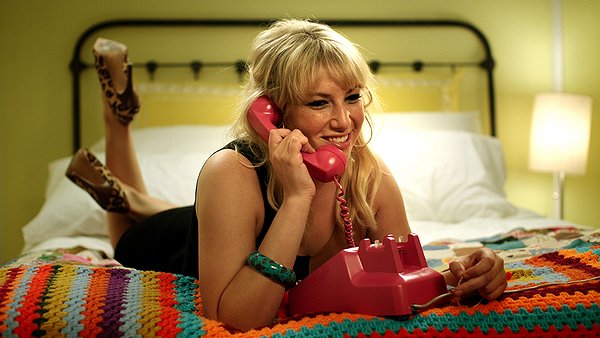 I’m not going to make more or less of its sexual politics than what is presented. I think there is genuine merit when women take ownership of their sexuality. Why should women feel judged for wanting equality when bedroom activities and impulses are concerned? Whatever helps people build a healthy self-image should be championed, as long as it’s between consenting adults. Watching Katie and Lauren personally grow based upon their unique entrepreneurship is welcomed. However, I can’t help but shake my feelings that there is something lurking, some deeper sub current that is not worth celebrating because the movie seems to play into male fantasy. Even though I adored Graynor, I think it would have served the film better if the more sexually-liberated character, the pro when it comes to working the phones, was actually a less attractive woman, perhaps a mousy gal you’d never expect such lurid behavior from. I think that would offer more comedic potential as well. I think this would also puncture some of the airbrushed fantasy of the film’s cheescake world of a phone sex line.
I have my complaints but I was laughing fairly regularly and enjoyed the experience, so if you’re just looking for a good time at the movies you can consider For A Good Time, Call. Watching Graynor sink her teeth into her role and go full gusto is a rowdy pleasure, and it’s easy to see that this woman is a star. The smutty jokes are fun and offer plenty of ribald laughs, but I always felt like the movie was too complacent, too settled, and curiously clumsy when it came to comic payoffs. The film is pretty flatly directed by Jamie Travis. The characters are pretty thin, and the plot feels ripped from a flimsy TV sitcom, but I laughed aplenty and found the movie difficult to dislike. It’s not the most nuanced sex comedy, or the most ribald, but For a Good Time, Call delivers enough big jokes and Graynor is too sensational to miss.
Nate’s Grade: B
Share this:

The Amazing Spider-Man (2012)
 It’s only been a mere ten years since Marvel’s signature web-shooting, wall-crawling super hero leaped onto the big screen and smashed box-office records, and yet he’s already getting the reboot treatment. Usually we reserve reboots for movie franchises that ended in colossal artistic failure. I don’t know anyone that will ardently defend director Sam Raimi’s Spider-Man 3, but I know of no one that puts its in the same vicinity as the atrocious, franchise-slaying Batman and Robin. Spider-Man 3 suffered in comparison to its predecessors, which formed the gold standard of super hero films (even in my review I called out for some new blood if this was any indication what we had left to expect). But then in 2010, Sony decided that it would rather start all over with its billion-dollar franchise, so Raimi was out, so too were stars Tobey Maguire and Kirsten Dunst, and 500 Days of Summer director Marc Webb was tapped to direct. The (rebooted) Amazing Spider-Man swings into theaters with a serious case of déjà vu attached. Are we far enough out to forget about Raimi’s accomplishments? My spider sense is telling me we’ve been here before and better.
Peter Parker (Andrew Garfield) is a geeky high school student living with his Uncle Ben (Martin Sheen) and Aunt May (Sally Field) ever since his parents had to vanish mysteriously one night. Peter is picked on at school and crushes on cutie-pie Gwen Stacy (Emma Stone) but all that changes when he’s bitten by a genetically engineered spider. He gains super spider-like abilities including improved dexterity and the ability to stick onto surfaces. He designs his own webbing devices that allow him to shoot long tendrils of super-strong spider webbing he can swing around with. Peter is trying to unravel the mystery of what happened to his parents and he seeks out Doctor Connors (Rhys Ifans), a notable genetics scientist who worked with Peter’s long lost dad. Peter supplies his father’s secret math formula and gives Connors the breakthrough he was hoping for in genetic replication. When injected with a serum, creature should be able to regrow lost appendages. Connors turns himself into a human guinea pig because he’s desperate to grow back his amputated right arm. But the serum causes Connors to transform into a hideous lizard creature for periods of night and only Spider-Man can stop him.

Simply put, I liked Spider-Man when it was made the first time and called Spider-Man. I understand the desire to reboot after the disappointing mess that was 2007’s Spider-Man 3, but did we need to start completely from scratch? Could we not have just eased into a Spider-Man 4 and replaced the original actors? Though I personally had no problem with Bryce Dallas Howard as Gwen Stacy (yum). I don’t need to see another version of the Spider-Man origin tale because it was already covered just ten years ago. The worldwide public is familiar enough with Spidey’s back-story that I don’t understand why we couldn’t just start with our hero already doing his business. I don’t need another hour of setup for the guy to become Spider-Man. This “sameness” seems to sap much of the energy out of Amazing Spider-Man, a competent and occasionally thrilling superhero flick. It does plenty of things well enough but you just can’t shake the feeling that the movie, at its core, is unnecessary or at least tripping over redundancy. Do we really need to see Peter Parker discover his powers again? I understand that we want to experience part of his joy at discovering his fantastic new abilities, but it just feels like all too familiar. I don’t think we would have missed anything by simply condensing all the back-story and doling it out as a series of concise flashbacks.
Despite some serious déjà vu, The Amazing Spider-Man has some other serious issues. Firstly, the tone just seems like a bad fit. This is a much darker, somber, and angsty tone for a character that was never intended to be as brooding as, say, Batman. Just because the dark tone worked for Christopher Nolan’s Batman films doesn’t mean it’s the right fit for every comic character. I’m not saying that Peter Parker doesn’t have his issues and plenty of guilt to struggle with (more on that in a moment), but this movie feels like the fun has been squeezed out. It’s a kid who was abounded by his parents, bullied at school, and he teems with repressed frustration. Peter Parker is not meant to be a brooding antihero. He’s supposed to be the high-flying jokester. Regardless, you can interpret the character however you’d like, I just don’t think this darker, gloomier incarnation works despite the best efforts from Garfield. The spirit of the movie feels like it’s being suffocated at times. Raimi’s films had their dramatic material but they never lost a sense of fun. It’s hard to tell if anyone is enjoying himself or herself for much of Amazing Spider-Man.
Now let’s talk about one of those areas of Parker’s guilt, namely his guilt over the murder of dearly beloved Uncle Ben. Peter chooses not to get involved and from that action Ben is murdered by the same criminal Peter could have thwarted earlier. In Amazing Spider-Man, it’s transformed into an inane example of being at the wrong place at the wrong time. Ben just so happens to run into the same guy and he stupidly wrestles for the man’s gun. It’s hard to make any real connection for Peter to blame himself. Spider-Man 3 did something similar by rewriting the back-story so that the Sandman was responsible for Uncle Ben’s death. I wrote: “By introducing a new killer it means that Peter has no responsibility for his uncle’s death. This completely strips away the character’s guilt and rationale for what compels him to swing from building to building to fight crime.” Now, this new Spider-Man, since he’s so edgy and dark, is only hunting for bad guys who bear a likeness to the robber who killed Uncle Ben. Yes, Peter Parker has become a vigilante defined by his all-consuming sense of vengeance. And guess what? He never finds the guy. Get used to all sorts of storylines being dropped or forgotten throughout the film (I guess we’ll have to wait for future films to explain what happened to his parents).

While I think a darker interpretation of Spider-Man is mislead, I wish the movie would see it through rather than keep having moments to break the reality of this more grounded approach. I’ll buy that Dr. Connors turns into a giant lizard creature from the magic DNA serum whatever. I’ll even buy that he goes mad with power because of it. However, what I won’t buy is that this guy, all of a sudden, decides to relocate his lab into the sewers. What? The guy has everything he needs in a giant scientific tower, and he says he “gave the staff the week off.” Well then do your crazy mad scientist science stuff in your lab. Why the sewers? Do you know how many trips this guy would have to make to haul all that equipment down into the sewers, and remember he’s only got one friggin’ arm! The entire character of the Lizard feels so poorly developed and adds no greater thematic message to the movie. And then there’s the case of Peter Parker being a world-class dweeb mocked in high school. As presented, he’s a pretty hunky, smart, athletic kid who has fabulous hair. It makes no sense that he has absolutely zero friends and that there wouldn’t be girls crawling all over this guy. Are there no alternative-style girls in this school besides the one girl with glasses we keep cutting back to for reaction shots? And how many times is Aunt May going to watch her nephew come home at odd hours and covered in bruises before she says anything?
Then there’s just the forehead-smacking number of coincidences in the movie. With most movies you accept that the characters exist in a small universe where they will regularly continue to run into one another, but in Amazing Spider-Man it’s absurd. As my pal Mike Galusick noted, you have Peter who just happens to have the last steps needed in a formula who just happens to go to Oscorp and poses as another student with shocking ease who just happens to wander off a tour and much up with lab stuff because security cameras do not exist in this universe and who just happens to meet the same scientist who is responsible for his parents missing and the guy also happens to have a head intern who just happens to be Peter’s crush and she just happens to be the daughter of the police captain (Denis Leary) trying to hunt down Spider-Man. Phew. I haven’t even mentioned the construction worker dad (C. Thomas Howell, for real) whose kid was saved by Spider-Man so he makes sure to rally all his fellow construction workers to synchronize their beams for Spidey. It is moments like this that undermine the filmmakers’ grounded approach.
It sounds like I really disliked this film, and I didn’t. Amazing Spider-Man is a completely serviceable superhero tale and the cast does a great job of covering up for many of the narrative shortcomings. The action, what there is, seems a little too rushed and missing that spark that Raimi had in abundance. There is one nifty sequence that Webb deserves credit for: in the foreground a librarian listens to classical music, which drowns out the background action as the Lizard and Spider-Man smash through shelf after shelf of books. This was the only moment in the movie where it felt fresh and exciting and I wanted to see where it would go. It’s just that the movie cannot capitalize on its potential. Take for instance a late incident where the Lizard unleashes his mutant gas and transforms a cadre of police officers into giant lizard creatures. You’d naturally expect that if you were introducing a lizard army that we’re upping the stakes and that the movie would do something with this new team of antagonists. Wrong. No ramifications. Webb’s film does benefit from advances in computer wizardry as the CGI is far more advanced and Spider-Man doesn’t resemble the cartoon character he often did in Raimi’s trilogy. The brief moments swinging through the city, feeling the rush of exhilaration with the character, are the movie’s visual highpoint. I found the Lizard’s face eerily similar to the goombahs in the reviled Super Mario Brothers movie.

Garfield (The Social Network) and Stone (The Help) certainly feel like a step up from before. Even though Garfield seems a bit old for high school, he does a more than credible job of being a super smart kid who slowly grows in confidence and demeanor. He can do it all, handle the comedy, the emotional angst, the formation of courage. Garfield is a great addition and he gets along wonderfully with Stone; the actors have great chemistry, which may explain why they started dating after the production ended. Stone brings a comedic zeal to the part and seems far more approachable and les standoffish than Dunst’s Mary Jane ever did. While the movie seems to indicate a fully formed romance for its stars, what we see on the screen plays out more like a nervous flirtation. The actors are cute when they seem to be stammering in awkwardness and mutual attraction. I wish the movie gave us more development rather than skipping ahead, but hey, these kids are great together.
The Amazing Spider-Man, when you get down to it, is less than amazing. It’s a capable super hero movie with some fancy effects and stunt work, but the mounting plot holes, incongruities, tonal conflicts, and overwhelming sense of sameness prove to be a foe even Spider-Man cannot topple. This aims to be a leaner, more emotionally engaging, realistically grounded Spider-Man, but it just can’t pull it off. Garfield and Stone are great but it’s impossible to erase Raimi’s original trilogy from your memory. His films weren’t perfect, though Spider-Man 2 came closest, but they were loving odes to the character and knew how best to link action with character for maximum impact. I can’t think of any real memorable moments in this movie, which is troublesome given its hefty budget and its hefty mission of supplanting the Raimi films. I didn’t have a bad time while watching The Amazing Spider-Man but my involvement and enjoyment was very limited. Even with a glossy reboot, I guess The Amazing Spider-Man is proof enough that sometimes it’s better to go forward rather than reliving the past.
Nate’s Grade: B-
Share this:

Safety Not Guaranteed (2012)
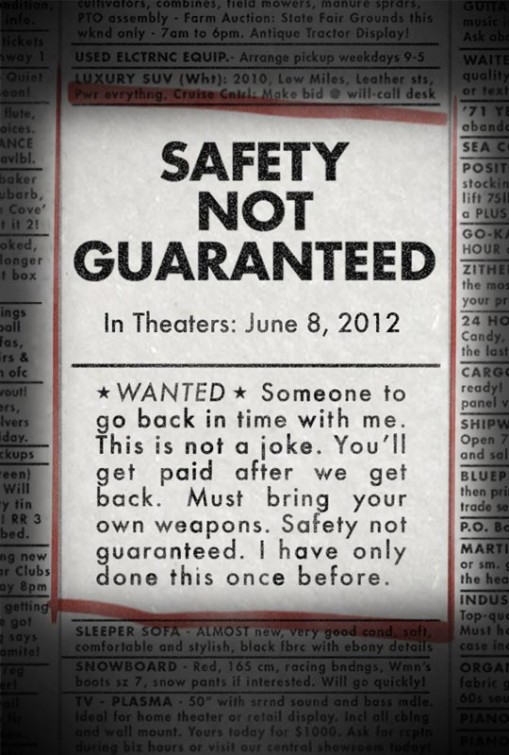 A man puts a classified ad in the newspaper asking for an unusual companion. No, it’s not some weird sex thing. Kenneth (Mark Duplass) intends to travel back in time to correct a few regrets. He’s looking for a partner, though he specifies his traveling companion must bring his or her own weapons and that safety is not guaranteed. This quirky ad grabs the attention of Jeff (New Girl‘s Jake Johnson), an egotistical writer for a Seattle magazine. He takes along a pair of interns, the surly Darius (Aubrey Plaza) and the nerdy Arnau (Karan Soni). Together, the gang heads out of town to seek out Kenneth and determine whether or not he is for real. However, Jeff’s real intention for this “work vacation” was to travel back to his hometown and try and score with Liz (Jenica Bergere), an old high school flame he is horrified to discover has… aged. Darius is the only one who can get close to Kenneth, but what starts as an opportune assignment into investigating a weirdo becomes something more. The guy, sweet if a little off, may be on to something… big, and Darius may be falling for him despite her own misgivings.
Safety Not Guaranteed is a modest film but does it ever sneak up on you and deliver an emotional wallop. I’m a romantic at heart, and so I’m generally affected by seeing two lonely people find their special something in the world reserved for them, and it’s even more affecting when these people are oddballs, and thus it’s even more resonant and meaningful for them to find that connection so elusive before. At its heart, Safety Not Guaranteed is a quirky yet naturally developing love story, and those are my favorite kind. I found my heart melting every time Darius couldn’t help herself and smiled. Perhaps it’s because Darius is our outside heroine or that Plaza is best known for her stone-faced deadpans on TV’s Parks and Recreation, but every one of those smiles felt so richly earned and rewarding. These aren’t the typical rom-com characters that are going to lapse into great speeches about love at key clichéd moments; while dabbling in some fantastical elements, Safety Not Guaranteed exists in our own recognizable world. And with that established, the unguarded moments of genuine happiness for characters we care about translates into a surprisingly touching experience. My heart felt so full at different points, melting and swelling and doing other non-medically accurate things. I honestly had tears in my eyes at different points. By the perfect end, I was so hopeful and overjoyed and left the theater soaring on my good vibes. I can’t guarantee everyone will find the same level of engagement in the romantic relationship, but I believe that the movie is inspired, clever, and authentic enough to deliver a crowd-pleasing finish. It’s earnest without being hokey.
 I’m trying to tiptoe around spoilers, though for those critical readers out there I’m sure you can infer a thing or two about the end of the film given my positive, beaming response. I’m sure my reaction would have been quite different if, say, Darius and Kenneth died in a horrible fireball because he was criminally insane from the start. All I’ll say is pay attention to certain discrepancies and see if they might prove to be a conversation-starter when you leave the theater.
Have I mentioned how truly funny this movie is? I’ve been talking all about the “rom” portion of the equation, but Safety not Guaranteed is a consistently funny movie, with a few big laughs. The movie’s sharp sense of comedy is more than everyone simply derisively laughing at the nutball. To be sure, Kenneth provides plenty of comedy in his super serious demeanor, and the movie doesn’t overplay the idea that he may be mentally unbalanced. The jokes come from the character interaction more than any contrived set piece, and the pleasure is in watching conflicting personalities bounce off one another. Every character contributes nicely to the comedic rhythms of this picture, adding a line here, a reaction there, to assemble one very funny movie. In movies where one character enters a relationship under initial false pretenses, usually you just keep waiting for that particular shoe to drop. You wait for the truth to come out and then deception reconciliation dominates the third act. Thankfully, the movie speeds over this narrative trap and gets us to the good stuff. We don’t need an entire act for people to be contrite and prove their love when what we see onscreen is obvious enough.
What elevated Safety Not Guaranteed for me was that beyond the oddball romance, there’s careful and compassionate attention paid to a slew of supporting characters. Now with a scant 80-minute running time, and the attention-grabber of a guy who thinks he can travel through time, naturally the supporting characters have minimized roles, but what I enjoyed was that they were not just relegated as stock players. The film has two stock roles, Nerd and Jerk, and fleshes them out further (though, to be assured, those are still defining characteristics). Arnau is a guy who is convinced any interaction with girls will ultimately lead to personal embarrassment. He’s only focused on the future and what he needs to get there, barely living in the present. It’s nice to watch him grow some confidence, albeit a small amount, and find some degree of enjoyment. And then there’s self-described asshole Jeff, who only submitted the story so he could come back and bang his old high school girlfriend. Some will find Jeff’s minimal personal growth to be disappointing and stagnate, but I thought anything substantial for this character over a three-day period of time would be unrealistic. Jeff is chasing his past memories, a faded time that had so much possibility when he was a stud in high school. The movie explores this notion of returning to a period of innocence as well. Going back to a time before overwrought cynicism, before settling, before compromising, before life became work, it’s something of a wish that the characters seem to be chasing. Jeff realizes how truly empty his life is, yet he’s probably too set in his ways to alter his path, which is a shame because Liz certainly seems like a lovely, caring, and capable romantic opportunity. Hey, she bakes, too (Bergere is great and easy to fall for). The unlikely friendship that emerges between Jeff and Arnau is also quite enjoyable and disarmingly sweet.
 I also need to single out the score from first time composer Ryan Miller, the lead singer and guitarist for one of my favorite alternative rock bands, Guster. The music has a lilting, dreamy quality to it but then follows a steady melodic rock path, reminiscent of the melancholic score for Little Miss Sunshine. The strumming guitars, plinging pianos, and swelling violins come together in harmony with little sci-fi touches. The score gives the film another sense of enchantment. I’ve been listening to “Big Machine,” the song Kenneth plays for Darius, on a loop for over an hour, if that gives you any indication on how much I enjoyed the original tune. The fact that “Big Machine” plays over the end credits when the movie meets its perfect end has got to account for some of my positive association. I think Miller has a bright future in crafting film scores.
Plaza (Funny People) deserves to break out in a big way after this film. She’s the heart of the movie and deeply vulnerable, covering it up with nonchalant cynicism. Darius is well within her surly comfort range so it’s no surprise that she excels with the hipster character, but the moments of dramatic weight are not given flippant treatment. Duplass (TV’s The League), just about everywhere in 2012, delivers a committed performance, though it seems mostly committed to the goofiness of his character. Yet when Duplass is able to show you some of the edge to his character, that’s when the performance walks a line between dangerous and exciting. The movie hinges on the two actors working together and they have good chemistry; the goofball and the cynic.
It’s so nice to discover a movie that lifts your spirits, that touches your heart without reaching for the treacle, and delivers a funny experience without compromising its modest aims and modest tone. Safety Not Guaranteed obviously plays a deliberate dance with the audience, vacillating between moments that make Kenneth seem crazy and moments that make you question whether he’s legit. The movie reminded me in a lot of ways of the underrated 2000 flick Happy Accidents, which featured Vincent D’Onofrio as a romantic suitor who also might be a time traveler or just plain nuts. Safety Not Guaranteed is a charming movie that seems to work a spell on you while watching; you get so invested in watching lonely people find meaningful human connections that you are compelling the movie to end under some happy scenario. Director Colin Trevorrow and writer Derek Connolly deserve to make waves in Hollywood with what they’re able to accomplish with a tidy budget and some clever yet earnest writing. This beguiling love story is all about stretching out of your comfort zone and taking a plunge into the unknown. Just like Kenneth, we’re all looking for a partner worthy of that plunge (not necessarily a romantic partner, mind you). Take the plunge and go see Safety Not Guaranteed, one of the best movies of the year. Not bad for a movie potentially based upon an Internet meme, huh?
Nate’s Grade: A
Share this:

Moonrise Kingdom (2012)
 It feels good to be a Wes Anderson fan once again. The indie auteur has a very distinctive style that he seems to have little regard in altering. I’ve been critical of Anderson’s idiosyncratic style, comparing it to crafting wonderfully composed, intricate dollhouses minus compelling or relatable characters to inhabit these artfully constructed mini-worlds. Without that necessary element, it’s all just fancy window dressing. Finally, Anderson, with Moonrise Kingdom, has concocted another movie where the characters grab more of your attention than the backgrounds.
Set in 1965 on a small island just off the New England coast, the movie follows the adventures of Sam (Jared Gilman) and Suzy (Kara Hayward), both twelve years old. Sam has run away from his summer camp, the Khaki Scouts, led by Scout Master Ward (Ed Norton). Suzy has run away from her parents (Bill Murray, Frances McDormand). The small island’s one police officer, Captain Sharp (Bruce Willis), enlists the help of several Khaki Scouts he deputizes to find the missing duo. It’s revealed through a serried of letters, and flashbacks, that Sam and Suzy have been plotting their escape for over a year. They’re in love, and they’re going to make sure nobody interferes.
 What more relatable than young love? Sam and Suzy just want to be together and the rest of the adult world seems intent on keeping them apart. Right away you’re pulling for these kids, rooting for their triumph, and the movie does a fantastic job of replicating the innocence of young love without overly romanticizing a very nervous, awkward time in life. When Sam and Suzy practice kissing, for what is obviously the first time, I defy anyone sitting in the audience not to feel a recognizable pang of insecurity. The experimentation is a tad more realistic than you might expect with the PG-13 rating but still nothing to shatter the youthful innocence of the picture. There is not a tawdry moment in Moonrise Kingdom. It’s a time in life when the knowledge of sex existed without a keen understanding of sensuality, like in Miranda July’s Me, and You, and Everyone We Know. It’s more like fumbling around with what you think is appropriate activity. Still, the fact that the movie features twelve-year-olds in their underwear dancing and mildly experimenting means Moonrise Kingdom might draw a swath of ticket-buyers for the wrong reasons (beware the patron in a raincoat).
The scrupulous attention to detail is the same obsessive quality you come to expect from a Wes Anderson movie. He builds living worlds and his color schemes and shot arrangements add much texture to this idiosyncratic landscape. Unlike Life Aquatic and Darjeeling Limited, these artistic elements work in harmony rather than conflict; Anderson actually seems to care about the people here. Chances are if you’re not a Wes Anderson fan, Moonrise Kingdom will probably not be the movie to win you over. The whimsical, storybook nature of the film actually accentuates the broader themes; bright-eyed exploration, the magic of possibility with love, and an unyielding hope. The movie feels like one of Suzy’s storied adventures come to life but without compromising the relatable character conflicts. The movie does build a nice head of steam thanks to the pursuit of our runaway romantics. There’s also a palpable sense of danger lurking, as the kids risk life and limb and even experience death, albeit a dog (Suzy: “Was he a good dog?” Sam: “Who’s to say?”). It’s a poignant tale of childhood but it doesn’t feel childish, a family film meant for people probably too young for families.
Moonrise Kingdom walks a fine line between whimsical and overly precious. Less skilled filmmakers haven fallen suit to making insufferably twee film productions consumed by their own indulgent sense of preciousness. Moonrise Kingdom is full of the typical Anderson quirk but it doesn’t overpower the narrative or define the characters in such limited personal scopes. There’s plenty of laughs to be had with the film, most in the wry chuckle variety; I was laughing throughout, finding those staple peculiar touches to be the most amusing, from the Scout Master reading a magazine titled “Indian Corn,” to Bob Balaban’s questionably omniscient narrator, to some improvised natural earrings.
The movie is consistently funny but also far sweeter than I would have imagined given the detached, arch nature of Life Aquatic and The Darjeeling Limited. Again, the kids are precocious and the adults act more like children, but everyone is really hurting and lonely and looking for a means of coping or persevering, with the biggest source of pain being love; the longing, the ache, the uncertainty of when and if it will return. Usually Anderson’s films involve dysfunctional families mending some degree of their brokenness by film’s end and formulating a connection. With Moonrise Kingdom, the plot is on two kids falling in love and their will to endure. I appreciate that Anderson and co-writer Roman Coppola (Darjeeling Limited) do not trivialize or look down upon the relationship between Sam and Suzy (“Oh, it’s just puppy love you silly, naïve, waifs.”). To them it feels like everything. The tender approach to young love opens the film up to a broader audience without compromising the director’s unique vision. I’d hardly say the film approaches overt sentimentality. What’s there feels earned and more reserved than what we might expect from burgeoning romance. When the expressions of affection occur, they have greater weight and make a greater impact charming the audience.
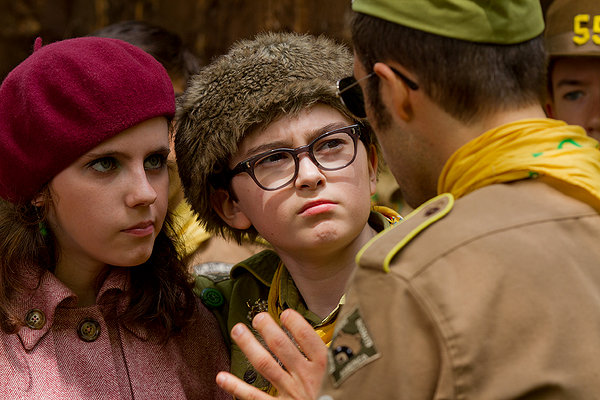 The first-time child actors do a credible job with carrying the film. Hayward and Gilman are charming and easy to like, though I wish Anderson had pushed his young actors a tad harder. They seem stiff at times and a little above-it-all in attitude. I applaud the kids for acting somewhat reserved rather than going crazy with their budding hormones. Both characters are also characterized as “emotionally disturbed,” though this seems like another of the film’s damning details about the out-of-touch adults dictating their lives. I just wished we sensed a greater degree of urgency from them about this whole adventure and the possibility of losing one another. They feel a tad blasé, all things considered.
The bigger celebrity names in the cast assume smaller roles, and many of the supporting characters are thinly sketched with personal conflicts mostly kept at a simmer. These are grownups that, at their heart, don’t know what to do with their feelings. Sam and Suzy feel liberated by their feelings. I found Murray’s blustery sense of anger amusing, and Willis does some subtle work to give you a sense how truly lonely his character is to the core, but it’s Jason Schwartzman (Scott Pilgrim vs. the World) who steals the show in my book as the fast-talking, mercurial, scheming Cousin Ben who seems to have whatever somebody needs. When he agrees to marry Sam and Suzy and acknowledges that their marriage will not be deemed official under any court whatsoever, you get a sense that Moonrise Kingdom has been missing a propulsive and delightful character like Cousin Ben. I wish he had been inserted earlier, but this is Sam and Suzy’s movie, after all.
It’s not on the same level as Rushmore of The Royal Tenenbaums (my favorite Anderson films), but it’s a film that feels a lot more alive and emotionally resonant. It feels like a return to form for Anderson, remembering that the characters and their drama need to be as engaging as the set design. The turbulent young love of Sam and Suzy is sweet and leads to some tender yet poignant moments that warm the heart without making you overdose on cheap sentiment. The idiosyncratic touches are all there, the ironic humor, and the stellar soundtrack selection (Benjamin Britten’s deconstructive orchestral marches stand out as a thematic core), everything you’d expect from a Wes Anderson movie, except this time you’ll find the characters recognizable, their struggle compelling, and the end rewarding. Moonrise Kingdom isn’t the most substantive film playing in theaters but damned if it isn’t the most alluring, amusing, and affectionate, yet all on its own terms. Who would have guessed that a pair of twelve-year-olds would help us show what real love is in 2012?
Nate’s Grade: A-
Share this:

Hysteria (2012)
 The birth of the vibrator doesn’t seem like a tale that demands telling until you realize that the most prolific sex toy of all time started during one of the most sexually repressive cultures, Victorian England. In 1880, the plague of the era was a malady known as “hysteria.” Half the women in London seemed to suffer from this condition where, as the doctors of the times believed, a woman’s uterus had become unaligned and needed to be properly readjusted; the readjustment produced a “paroxysm” of relief. To treat hysteria, these trained professionals would oil their hands, insert them inside a woman’s vaginal canal, and apply alternating pressure. They were getting these women off. Hysteria presents a charming document about the invention of the vibrator, a miracle of modern science. However, I wish the movie had taken a more mature approach to the material.
The alignment process was an arduous one, and Dr. Robert Dalrymple (Jonathan Pryce) needs a new set of hands. Enter Mortimer Granville (Hugh Dancy), a crusading young doctor who butts heads with the medical establishment over things like washing hands and germs. Under Dr. Dalrymple’s tutelage, the practice is never busier, relieving upper class women of hysteria. It’s going so well that Dr. Dalrymple would like to eventually pass the practice on to his young protégé, as well as his proper young daughter, Emily (Felicity Jones). Then there’s the doctor’s other daughter, Charlotte (Maggie Gyllenhaal), who clashes with authority, is outspoken about women’s suffrage, is critical of the limited role women play in society, and devotes her time to a lower-class shelter to provide refuge and education to those in need. She represents a brand-new kind of woman in time, and Mortimer cannot get a handle on her. Mort is suffering some pretty serious hand cramps from his line of work when he gets a splendid idea from his childhood friend and amateur inventor, Edmund St. John-Smythe (Rupert Everett). It seems with a quick fix, the electric feather duster may have other more scandalous uses.
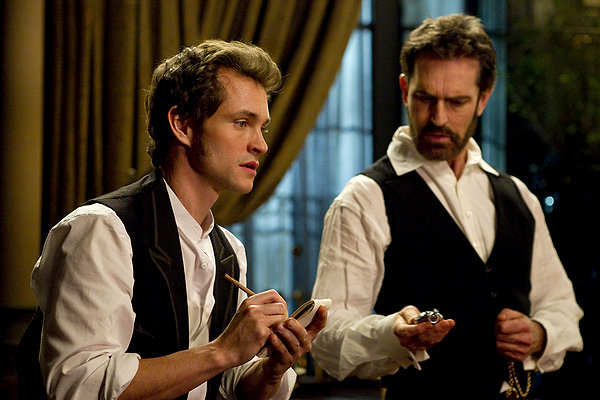 Hysteria is short of being hysterical but it’s certainly charming and provides an interesting history lesson with a light touch. The very nature of women’s hysteria is a fascinating moment in history where men were bending over backwards to find medical assessments for what is, in essence, horniness. The fact that these women’s doctors were getting carpal tunnel from all the manually stimulation of their clients has got to be one of the strangest workplace hazards. In certain regards, the invention of the vibrator has saved lives, or at least the hands of medial practitioners. It’s probably also made a whole lot of women a whole lot happier. Feminine sexuality was just an obtuse concept to the well-educated men in charge. One character says, with absolute certainty, that women cannot achieve sexual pleasure unless through insertion. As another fun historical note of male ignorance when it comes to female anatomy, when Deep Throat was being banned in the U.S., the federal judge who deemed it obscene cited, in his writing, that one of the many dangers of the provocative flesh film was that it mistakenly exposed women to the idea of an orgasm without insertion. This is almost 100 years later and yet men in high places of power are still carrying on complete ignorance of something they very literally know very little about. In that regard, Hysteria is jolly fun as we watch women get their jollies. There’s always something fun about watching uptight characters cut loose, especially when they find pleasure that has been denied them.
Having a talented cast is also a benefit when you’re working in comedy. Dancy (Adam) plays our straight man with fine properness. He has a few moments where he gets to delightfully squirm thanks to bold women and bold topics. He’s got some solid chemistry with Gyllenhaal (Crazy Heart), who is the feisty spitfire we expect in this sort of movie. Gyllenhaal is charming without being obnoxious, and her English accent is impeccable. Pryce (G.I. Joe: Rise of Cobra) and Jones (Like Crazy) are funny in their understated, stuffy British formal way, while Everett (Stardust) provides a great comedic jolt as the self-possessed, blithe technophile, ready at a moment’s notice for a good wisecrack. Sheridan Smith (How to Stop Being a Loser) also deserves special mention as a maid who was formerly employed as a prostitute. Her randiness is a nice counterpoint to all that Victorian repression and she pushes the movie further into sex farce.
While amusing, I wish the filmmakers would have taken a, dare I say it, more mature approach to a very interesting subject of history. The structure and very aim of the movie is that of a typical romantic comedy, which is a shame given the atypical subject matter. It’s pretty much a romantic comedy transplanted to merry old England. Much of the humor of the movie is divided into two camps: 1) watching the uptight Victorian-era Brits cut loose with decorum, or, 2) self-aware humor about the ignorance of the age. The first is always fun since we’re watching people sneak their true feelings through the wall of social repression. Director Tanya Wexler makes sue of a lot of sight gags and heartily enjoys cutaway reaction shots of ladies going orgasmic. It’s enjoyable but the fact that Wexler has to keep going back to the reaction shots for jokes, it loses its effect. Then there’s the self-aware humor built entirely upon dramatic irony, where the writers tweak the knowledge of a bygone era with all of our clever foresight: “Oh those stupid Victorians, not believing in things like germs and female orgasms.” After a while, the self-aware humor becomes tiresome. We get it; these silly Brits did not understand female health and proceeded to rule in their ignorance. I wish the movie left behind the easy jokes for some stronger social commentary. To this very day, we have men legislating women’s bodies and their reproductive rights (see: Oklahoma saying life begins weeks before conception, or Virginia demands medically-unnecessary vaginal probes for no other purpose than to shame women, and so so much more…). Ignorance knows no end, and one imagines the rom-com that makes fun of our current social mores and understanding.
 It’s during the last act where Hysteria really starts to come apart at the seams. Beforehand, it’s been a fairly light comedy with some punctuations of commentary from Charlotte and her idealistic desire for equality. But then, and spoilers will follow, the movie suddenly transforms into a courtroom drama with Charlotte on trial. Her very mental health is on trial and if she’s found to be a hopeless case of incurable hysteria, then she’ll be shipped to a sanitarium and have her uterus forcibly removed. Wow. That is some heavy stuff for a movie that spent an hour making sex jokes. The courtroom setting leads to some pretty transparent speechifying; any subtlety goes out the window and we listen to messages about women’s suffrage, equality, and empathy. This conclusion feels like it was ripped from another movie. It’s tonally jarring. Then, after our lead takes his moral stand and confesses to his belief that there is no such thing as hysteria, that women are just stuck in sexually unfulfilling relationships in a sexually repressed age, everyone goes home to think about life. Then, thirty days later when Charlotte gets out of prison, she’s met by Mortimer where he, I kid you not, proposes to her on the spot. For a movie about breaking misconceptions about women, tying things up with a marriage proposal seems almost hypocritical. It also marks a pretty big leap in the burgeoning romantic relationship between Charlotte and Mort. It seems rushed and a strange way to end a movie about female empowerment. The rom-com elements have won out over any higher messages.
Hysteria starts strong but goes limp. Hysteria runs out of juice. Hysteria is a pleasant experience but doesn’t deliver a proper climax. Hysteria is not the feel-good movie of the year. The very nature of the movie lends itself to all sorts of innuenduous critical blurbs. It’s a rom-com transplanted to Victorian England and I wish that it tried a little harder with the material rather than settling for easy jokes relying upon the ignorance of the age. The cast is superb and the movie is certainly fun, but it falls apart in the end when the messages overtake the narrative. So what is the best Hysteria blurb? I’ve had better.
Nate’s Grade: B-


 nathanzoebl
You must be logged in to post a comment.