Blog Archives
In a World… (2013)
 Actress Lake Bell’s writing/directing debut, In a World, is a comical look inside the world of voice acting, particular in the field of movie trailers. It’s an interesting world and told with enough comic acumen by Bell (TV’s Children’s Hospital), a serious student of vocal artists. She plays Carol, a woman who breaks into the trailer voice over biz, causing ripples in a field dominated by baritone-voiced men, like her legendary father (a perfectly unctuous Fred Melamed) who holds to sexist dictum. There’s a cute romance involved with Demetri Martin, an effective subplot about Carol’s sister having an affair, and an ongoing commentary about the uncomfortable infantilized voice many young women utilize. The story is threatened by a percolating mistaken identity rom-com convention, but thankfully regroups for a third act pitting father against daughter in vocal performance, as it should be. As a director, Bell has a steady feel for her scenes, following a subdued comic rhythm that also feels eccentric without going overboard. As a writer, she gives her characters space to grow, to make mistakes, and to triumph but not without complications. As an actress, Bell is charming and a terrific lead anchor for a film filled with likeable, quirky characters. In a World is a little movie but it’s effortlessly cute, winning and pleasant in the right places, and filled with a great cast of comic actors. Beware: upon exiting the film, it is unavoidable that you will do your own fake trailer “In a world…” impressions.
Nate’s Grade: B
Share this:

Don Jon (2013)
 Joseph Gordon-Levitt, one of the most talented and, yeah I’ll say it, dreamy young actors working today is proving to be more than a pretty face. Don Jon is his assured writing and directing debut, and it shows that every man has one more reason to feel insecure compared to Gordon-Levitt. The titular Jon (Gordon-Levitt) is a New Jersey lothario who sleeps with lots of women but the real thing just can’t measure up to his porn. The schism between reality and sexual fantasy is too much. Jon tries to reform his porn-addiction ways when he meets a hot lady (Scarlett Johansson) but old habits are hard to break, especially when he has to wait before sleeping with a woman. The narrative isn’t terribly deep or that developed but remains entertaining throughout, buoyed by feisty performances and stylish direction. The editing, sound design choices, and smooth camerawork made me feel like I was watching a promising Scorsese student. I found Don Jon to be a far more successful look at sex addiction than the recent sex addict drama, Thanks for Sharing. The parallel between porn and Hollywood rom-coms, both an inflated fantasy of relationships, doesn’t really stick, and Jon’s family is a bunch of loud Italian stereotypes, but the lead guy is a self-possessed lunkhead anyway, so it makes sense for his family to follow suit. Don Jon is funny, sexy, and an enjoyable diversion at the movies. What it really does, though, is provide the first notch in what may prove to be an exciting directorial career for its star.
Nate’s Grade: B
Share this:

Thanks for Sharing (2013)
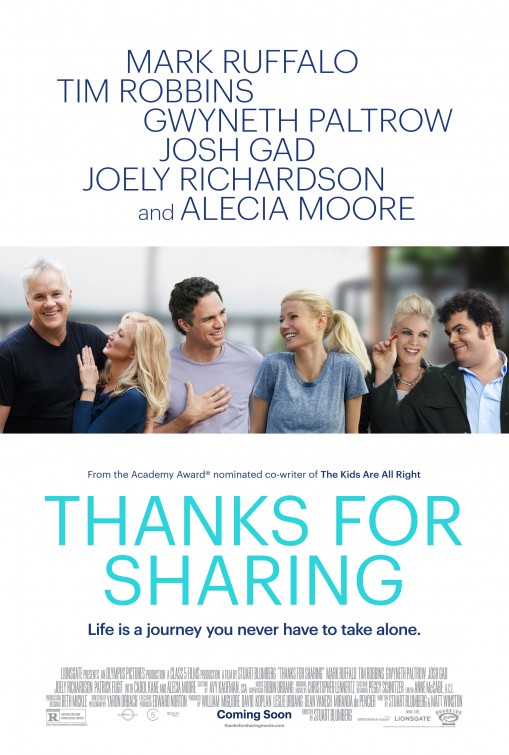 “Isn’t sex addiction one of those things guys make up when they’re caught cheating?” asks a character in Thanks for Sharing. This movie treats the topic of sex addiction very seriously, rattling off plenty of adverse side effects rather than just a wandering eye. Director and co-writer Stuart Blumberg (The Kids Are All Right) is certainly empathetic to his characters on screen. I just wish the movie knew what it wanted to be.
We follow three sex addicts in one therapy group, all at different points of recovery. Mike (Tim Robbins) is the paternal figure of the group. He’s long been married to his high school sweetheart. Adam (Mark Ruffalo) is five years sober and being prodded by Mike to start seriously dating again. He meets Phoebe (Gwyneth Paltrow), a cancer survivor, and hides his addiction from her. Worst of all is Neil (Josh Gad), a doctor who has been mandated to attend sex addict group therapy after “bumping” into people on the subway and recording an upskirt video of his boss. He doesn’t believe he has a problem, but, under the guidance of Adam and Mike, comes to the conclusion that the only person who can fix his impulses is himself.
 Thanks for Sharing is an admittedly entertaining movie, at turns, but it’s a movie with one debilitating identity crises. What kind of movie does it want to be tonally? We get raunchy sex gags, and then the film transitions into rom-com fluff, and then the film transitions into hard-hitting addict drama, and then it’s all back again. All of these elements could have been carefully threaded into one movie, but Blumberg and co-writer Matt Winston cannot nail down a consistent tone. In fact many of the changes can be quite jarring. One minute people are engaged in wacky sex hijinks, and the next they’re lamenting all the horrible life choices they’ve made in tears. When there isn’t a clear tone, or clear transitions, then the comedy undercuts the drama and vice versa. Therefore, certain elements can be appreciated or be found engaging, but the movie cannot become more than the sum of its parts. And let me get into whether sex addiction is really a topic that can work in the realm of romantic comedy. With the right finesse anything can be presented in a comedic light that still maintains the humanity and dignity of its flawed characters. However, is something as easily misunderstood as sex addiction, whose particulars can be quite appalling to many, the right fit for a genre that is predicated on whimsical coupling? I don’t think so. Thanks for Sharing doesn’t change my mind.
About that rom-com part, notably the relationship between Adam and Phoebe, it’s easily the least interesting part of the film. Both of these characters are fairly bland. Adam’s the sober guy trying to keep things going, except that we never really feel like he’s challenged. We don’t feel the threat that he’s going to relapse. And we don’t really get to know much else about the guy. He vaguely works for some sort of environmental firm. As a character, he is defined by Phoebe, herself a collection of quirks that doesn’t coalesce to form a human being. The film weirdly keeps harping on the fact that Phoebe likes her food to not touch, as if this minor peculiarity is some harbinger of a greater OCD complex (she’s into physical fitness!). The fact that other characters have to jump in on this makes it even more transparently reaching. Worse than all this, the couple’s interactions, and much of their budding relationship, feels overwhelmingly artificial. The dialogue should be sparking, charming, but you get no real sense of why either of these people would fall for the other, excluding the obvious physical attributes of each. The rom-com convention of the Big Secret (Adam’s addiction) is left dangling until, surprise, it’s defused early. I’d expect the movie to push further since there is a wealth of drama to be had about the trust levels of dating a sex addict, but instead it just forces them apart all too easy. Then there’s the fact that the movie covers perhaps a month of time and their relationship seems to move ridiculously fast, mostly because Blumberg is impatient for his couple to get to a more physically intimate stage.
Thanks for Sharing works far better as a darker drama, and as a movie, when it focuses on the roles of Mike and Neil. The film smartly connects sex addiction with other impulse control issues; for Mike he’s been sober from booze for 15 years, and for Neill he has weight control issues. These are the characters we see struggle, these are the characters at the more interesting points. Neill especially is a doctor whose hit rock bottom and can’t get away from the felonious things his addiction tempts him to do. Mike has a surrogate family with his support group. Now that his prodigal son (Patrick Fugit) returns, that adds tension to his family dynamic, both at home and in group. I would have preferred Thanks for Sharing to be told chiefly from the perspective of these characters, eliminating Adam and Phoebe altogether. But even these good storylines find themselves wading into all-too familiar plot devices. Mike’s arc involves reconnecting with his son, which will lead to a misunderstanding, a conflict, and ultimately forgiveness, and you see every step coming. Neill’s journey gets an unexpected boost when he takes initiative to help Dede (Pink a.k.a. Alecia Moore), one of the only ladies in group. Of course it takes a pretty girl to push Neill out of his selfishness and self-loathing, but he does progress, and it’s the most emotionally rewarding moment in the film. The problem is that Neill’s storyline is tied up in a platonic head-scratcher. Dede takes Neill to a dance hall where they are just there to… dance, but the kind of dancing that hipsters do. It all seems like something for people on drugs, but whatever reason, Neill shaking his groove thing, and coming to an understanding that he will not be touching Dede, makes his character better. I was surprised that Blumberg was able to end the movie on something of a downbeat, falling back to the central message of one day at a time, vigilance.
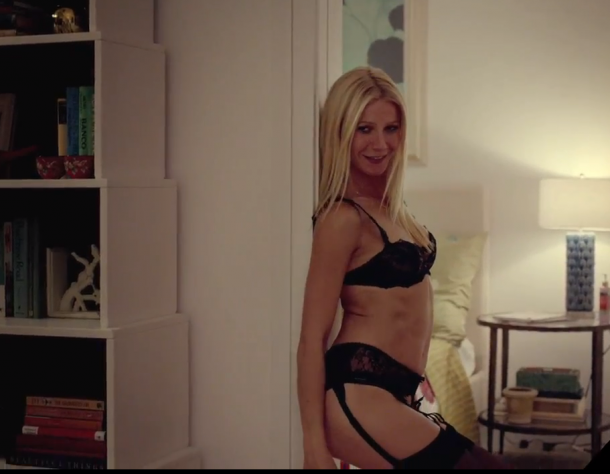 There is one standout scene that really gets to the scariness of sex addiction succinctly. Once Adam falls off the wagon, which shouldn’t be much of a spoiler people, he regroups with Becky (Emily Meade) a gal he had a one-night stand with. Their flirtation is quick, settling into their attraction, and then she engages in behavior that, meant to be alluring, is rather insightful. She has a daddy fixation and wants to be punished as a “bad girl” with Adam pretending to be her stern father. That could be a red flag, but Adam carries on. Then she asks him to slap her. Adam refuses. So she does it herself, beating herself, eventually descending into a mess of tears, screaming. Adam tries to console her, stupidly deciding to try and make contact with her after she keeps screaming, “Don’t touch me!” She locks herself in the bathroom and threatens to harm herself. This one moment in the film gets at the damage of sex addiction like nothing else. It points to possible abuse, but really it all falls apart so rapidly that your head is spinning. The conclusion is pat and anticlimactic, but the lead-up is fantastic. If the rest of the movie had been thematically closer to this scene, Thanks for Sharing would be worth sharing.
From an acting standpoint, the cast does a fine job portraying their characters and his or her respective foibles. Ruffalo (The Avengers) is a bit too even keeled for his character. Gad (Jobs, The Internship) is the film’s comedic spark but also its greatest source of internal drama, which Gad handles well, showcasing the desperation of Neill. The real surprise is actually pop singer Pink in her first real acting performance (Charlie’s Angels: Full Throttle counts under no circumstances). Her introductory monologue, which she nails, makes you take notice that Pink has some genuine acting muscles.
Thanks for Sharing is an uneven mishmash of genres and ideas, rarely settling down into something worthy of the talent at work here. The comedy works against the drama, the drama works against the comedy, the clichéd character developments don’t serve anyone, and the overall artificial nature of the central rom-com coupling drags the enjoyment level further down. There is good work here, good acting and some memorable scenes and offhand laughs, but all Thanks for Sharing can amount to is a series of scant moments, passing encounters of entertainment. I didn’t find many of the characters to be as nearly compelling as the filmmakers did, and some of their hasty resolutions and developments feel far too simple for an addiction this complicated. The potential of the film is never fully realized. While I’m doubtful rom-com is a good fit for a serious exploration on sex addiction (wasn’t Shame hilarious?), it does lend itself to a bevy of juicy setups and possibilities. We get little of these. It’s as if the film wanted to present a case for the legitimacy of sex addiction, front-loaded with stats and horror stories and characters to open our eyes, and the notion of telling a laudable story was secondary to the educational efforts. Congrats. Now give me a story to care about.
Nate’s Grade: C+
Share this:

The Spectacular Now (2013)
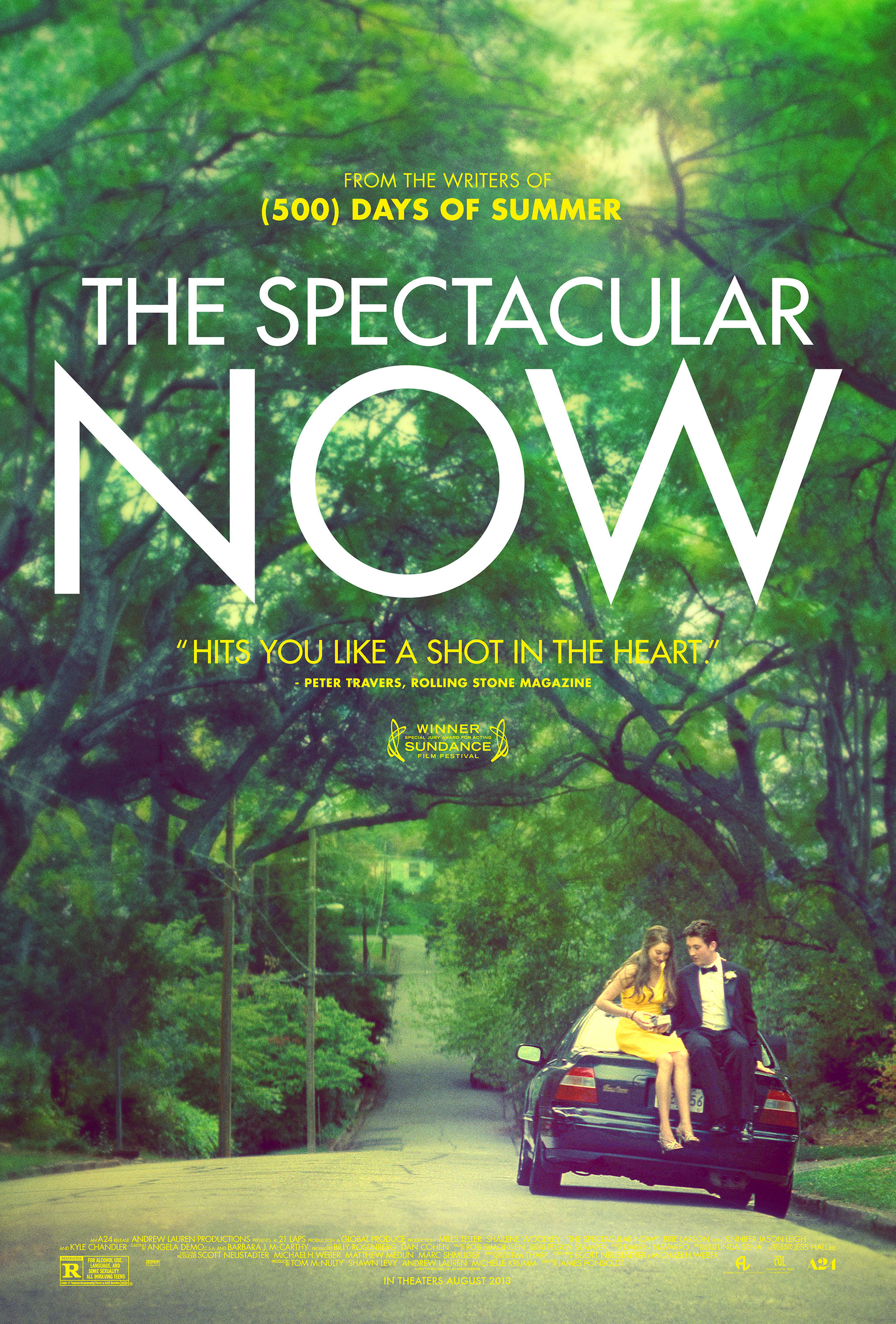 I say this as a fan but John Hughes was probably the best and worst thing that happened to the modern teen movie. He certainly brought an extra level of pathos and relatability to the genre, but then again he also dealt in stereotypes, often languishing his characters to stock archetype ghettos (the Jock, the Prep, the Nerd, etc.). In the ensuing decades, it’s been hard to break as many teen films, of those aimed at teenagers, have casually dealt in these easy labels. That’s why something like The Spectacular Now is such a welcomed respite. Here is a teen movie that aims to tell a story about people and their problems, not simply a regurgitation of high school cliques and clichés. This isn’t a film where all the pieces magically come together; this is a high school movie that more closely approximates real life. This is more Cameron Crowe than John Hughes material.
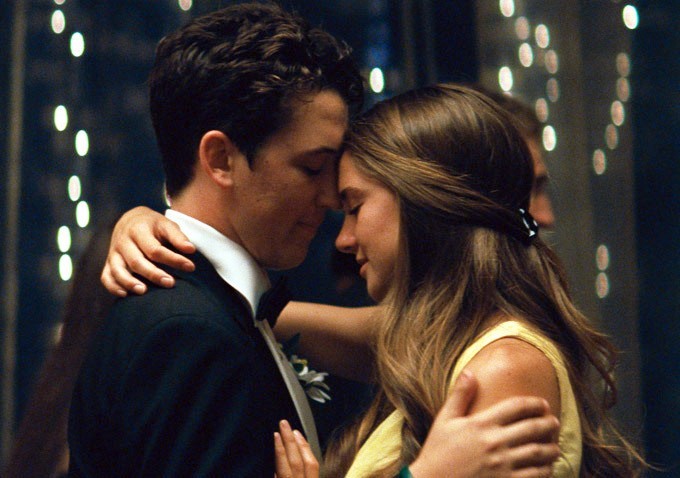
Sutter (Miles Teller) is the most popular guy in school, or so he’d tell you. He’s the life of every party, the kind of guy who everyone enjoyed, and the guy who could charm the pants off any girl. He’s recently broken up with his girlfriend Cassidy (Brie Larson), though still harboring serious feelings for her. Of course the best way to get over the old girl is with a new one, and Sutter sets his sights on Aimee (Shailene Woodley). She’s a smart, somewhat quiet gal that immediately takes a shine to the spotlight that is Sutter’s affections and attention. He’s not entirely over his old girlfriend, still angling to get back together, but also Sutter’s whole perspective could be summed up as an extreme case of carpe diem. The kid is partying like there’s no tomorrow because he’s convinced he has no real future, so he’s going to live it up while he can.
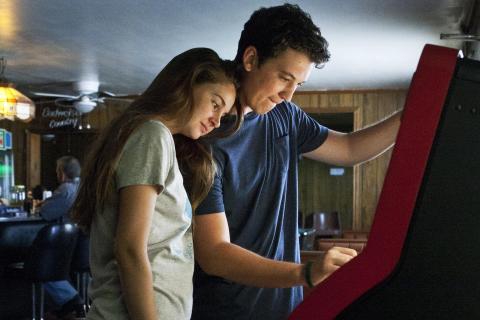 You’ve easily seen this movie before but it’s rare to see it given so much depth, maturity, and care. At heart, this is the story of Sutter learning he’s a screw-up and getting his life back in order, learning some self-control and responsibility, and winning over the good girl. But The Spectacular Now is so much more than that, and it’s especially sadder than you may have expected with its wise-talking, charming protagonist. This is the story of a teen coming to grips with parental abandonment, gaining insight into his own delusional detours to avoid pain, and the horrible realization that he is, in his present reckless condition, a bad influence dragging down the future of the girl he genuinely cares for. That’s a lot of heavy emotional drama and none of it revolves around the clichéd staples of teen movies, like those checkpoints such as prom and the Big Test. This is the story about one damaged man coming to terms with the state of his damage and gaining the courage to change his direction. He’s an alcoholic but the movie doesn’t ever put the narrative on hold for soapbox preaching. If anything, Sutter’s alcoholism is handled so subtlety, with most character silently acknowledging but unsure or indifferent to act, that it may strike a few chords with audience members. Then there’s the fact that none of this is heavy-handed; the filmmakers have done a fabulous job of giving each character credibility. They behave like real human beings. Even the easily slotted antagonists, namely Cassidy and Sutter’s deadbeat dad, are given shades of recognizable humanity and depth. Even though Cassidy waffles in her feelings for her ex, I cannot dislike her because her character portrayal is so honest. She’s struggling with her feelings for a screw-up with redeeming qualities. That’s fairly relatable, even if she’s not our winsome romantic lead. The filmmakers drag a typical teen movie story into our real world setting, adding depth and telling observance. You will recognize many of these characters.
There are few superlatives to describe the cuteness of the blossoming relationship between Sutter and Aimee. It’s so smooth and relaxed yet completely believable, and the two actors have such a warm and natural chemistry with one another, enough that I seriously contemplated if they dated outside the film (rumored but nothing conclusive). You feel their budding affections, the sweet swoon of young love, and the hiccups along the way. Woodley (The Descendants) does an outstanding job with her mannerisms and affectations; her awkwardness around her feelings is adorable, but not in that prefabricated cutesy way often ascribed to the oft-mentioned Manic Pixie Dream Girl roles. She’s a fairly normal teenager on the fringes of high school, keeping her nose down and looking ahead. In movie terms, you couldn’t readily classify a gal like Aimee, and that’s because she’s a real character fully fleshed out by the screenwriters and the actress. Woodley’s performance is near invisible of acting tropes and constraints. She just dissolves into the character as all exceptional actors do.
But this is Sutter’s movie and, in accordance, Teller’s (Rabbit Hole) film. The young man puts on an acting camp in this film, shedding the various layers of armor from his sad clown of a character. As I said, we’ve seen this character before, but Teller and the screenplay are able to give Sutter such extraordinary depth. The carefree life-of-the-party character is turned into an introspective character study, essentially examining the darker side of Ferris Bueller. He’s using alcohol and his blithe attitude to blunt the pain that he fears he’ll end up like his old man, that his life has already peaked and he’s not even out of high school. Teller is such a successful charmer that he already wins you over to his side despite some boorish behavior because we see that the guy has a good heart. In the film’s opening, he’s propping up his friend to finally get the guy a girl, and the ensuing mess ends Sutter’s own relationship. The last act involves Sutter coming to grips with the negative impact of his actions, notably on Aimee. Teller is so effective at giving you glimpses of the sadness eating him whole. His concluding scenes when he finally breaks down feel like a hard-fought victory for the character as he confronts his doomed fate. At every turn, Teller impresses, and compounded with Woodley, they form an unbeatable team of sterling young acting talent.
 Special mention to Kyle Chandler (Super 8) for his pivotal walk-on roll as Sutter’s bad dad. He’s so pathetic and so desperate and so wonderfully realized by Chandler. He doesn’t get a Big Scene, he doesn’t get a Big Speech, he doesn’t even do anything out of the ordinary for a shifty, unreliable, selfish drunk, but those few minutes he’s onscreen, it all becomes so deeply sad and clear where Sutter’s life is headed without intervention.
The only depiction that I had trouble believing was Sutter’s almost consistent drinking and driving. Throughout the film, he has his trusty Styrofoam Big Gulp cup with him, spiked with booze. The man hasn’t graduated high school yet and is already a high-functioning alcoholic. Because of this I can believe that people would not be alarmed seeing him drive after imbibing a few drinks. However, the man is constantly drinking while behind the wheel of an auto and several times he appears completely trashed. I find it alarming as well as a bit far-fetched that not one character, not even Aimee, would raise objection to Sutter’s continued dangerous behavior. We also witness several scenes of Sutter drinking in bars. It’s conceivable he has a fake ID at his disposal, and it’s even more conceivable that he could talk his way into any establishment, but it’s more food for thought. Then again maybe this is just one of those towns where nobody cares about innocent lives being snuffed out by drunk drivers.
The Spectacular Now is an earnest film that doesn’t overdo it, providing challenging life lessons to fully formed, complex, believable characters. It doesn’t sugarcoat the heartache and harsh reality out there for vulnerable teens. It’s a charming romance tied up with an insightful character study of one young man hiding his sadness and anxiety of life’s disappointments with humor and booze. Thanks to the tremendous acting of its onscreen pair, you root for Sutter to turn his life around because you see value in him as a person, even if he doubts it himself. You’re on his side from the start, and you know how nicely he matches up with Aimee. You want this movie to pull off the spectacular, and for long stretches it feels just as if that will happen. The ending aims for ambiguity but is far more hopeful than its source material. I was charmed thoroughly by this film and its lead characters but even more I was thoroughly engaged in their dilemmas, moved by their struggles, and encouraged by their perseverance and growth. The Spectacular Now (extra points for never even having a character spout the title) is a funny, warmhearted, measurable restrained, knowing film that could open eyes. It may not be spectacular to some, but it’s surely a great film.
Nate’s Grade: A-
Share this:

Safe Haven (2013)
 For a solid two acts, I couldn’t hate Safe Haven, the latest in the bland, paint-by-numbers coastal romances based on a novel by Nicholas Sparks. It was chiefly inoffensive but predictable at every step, but I didn’t mind. At this point, Sparks is a brand and you know what you’re getting. Julianne Hough (Rock of Ages) plays a woman on the run from a corrupt Boston cop. She may or may not have killed a man. She hides out in a North Carolina fishing village and comes to love a hunky widower (Josh Duhamel) with a pair of annoying kids. Their coupling is somewhat restrained given the sudsy context; they don’t kiss until close to an hour in. What benefited the film was having a dangerous external threat, the corrupt cop, circling in. This alone raised the stakes of what ordinarily would be a pleasant but mostly mild romance between two pretty people. However, it is that third act, the concluding half hour, where Safe Haven just loses its mind. One twist is a given, though it makes the Boston PD look either incompetent or collusive, but the final twist comes out of nowhere, bringing in a supernatural factor that left me gob smacked. All I kept repeating was, “What?” It’s such a contrived, immediately stupid twist ending, trying to bridge a simple romance with something like The Sixth Sense. I can’t say whether the twist existed in Sparks’ source material, but wherever it originated, I can predict you won’t find a dumber twist ending to a film all year. Safe Haven is two parts of a good-looking albeit mediocre movie with a final dash of half-baked lunacy.
Nate’s Grade: C-
Share this:

Before Midnight (2013)
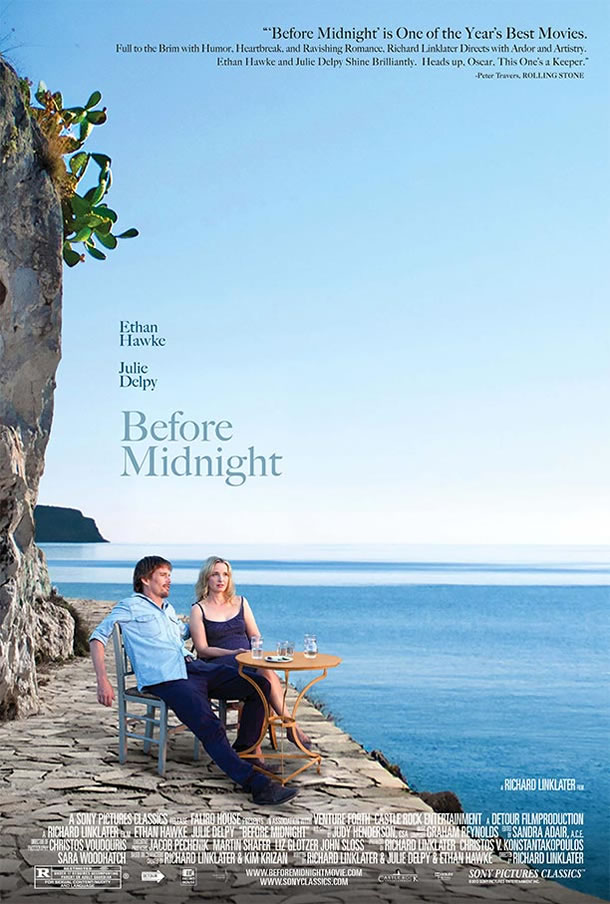 If you’re a fan of writer/director Richard Linklater’s previous movies (Before Sunrise and Before Sunset), as I am, then a new Before movie is a cause of celebration. It feels like we’re checking in with old friends. It’s fascinating to take stock of these characters and their new points in their lives, now approaching middle age. This series is becoming the dramatic equivalent to the 7 Up documentary series that periodically checks up on its subjects every seven years in their lives (56 Up came out this year). Individually, the films are wonderful, but when taken as a whole, the series becomes something truly special, something indelible and sweeping and transporting. Before Midnight is a wonderful movie, brimming with heart as well as ache. It’s also one of the best movies you’ll see this year and another touchstone to the impressive legacy of the series.
In 1995, 23-year-olds Jessie (Ethan Hawke) and Celine (Julie Delpy) met on a train and spent a magical day strolling through Vienna and essentially falling in love. In 2004, Jessie was touring Paris on his book tour, having turned the events of that Vienna night into a successful novel. Celine meets him and the two pal around, reconnecting, with Celine revealing how much that night meant to her as well. Now, in 2013, Jessie and Celine are together, though unmarried, and have twin seven-year-old daughters, Ella and Nina. They’ve been vacationing in Greece for a month while Jessie works on a new novel. Over the course of one long day, the couple will try and stir old passions and question whether they still share the same commitments.
 We’re watching the evolution of two human beings, and your response will vary depending upon your own life’s stopping point at the time of viewing. I must say, as a man now in his early thirties, that I enjoyed Sunrise and Sunset even more, finding greater thematic resonance to the characters, their anxieties, and the concern about faking your way through the “adult world.” I imagine I will find these movies even more emotionally engaging as I continue to age and cross similar hurdles as the characters do. For fans of the series, we’ve already invested 20 years and four hours of screen time with these characters. There’s more at stake when they fight. Watching the other movies beforehand, which I heartily recommend for multiple reasons, also provides stirring points of contrast, the romanticism of youth, the exuberance of promise. What Before Midnight does, and does so exceptionally, is take the romance of the earlier films and put it to the test. There’s a lovely dinner scene with several couples, and you realize that each one is an analogue for Jessie and Celine: the teenagers, the middle-aged couple starting out, the older couple discussing the demise of their previous spouses. It’s hard not to contrast the different stops and the different realities of love by the age.
Fair warning, Before Midnight is the least romantic of all three movies (I want a new movie every 9 years or so until the last one is essentially Amour). The first movie was them connecting. The second movie was about them reconnecting. The third movie establishes that they’ve been together for nine years and have a pair of twin daughters. The focus of Midnight is the struggle of maintaining a long-term relationship, something rarely given such thoughtful, perceptive, and compassionate depth on screen. We’d all rather watch lovebirds make goo-goo eyes at one another while we swoon appropriately, but Midnight’s many battles, small and large, new and ongoing, explore a relationship reality that many should find alarmingly relatable. While the particulars may be different, you may be surprised at how similar these conflicts can be. Exclude stuff like vacationing in Greece, the cushy jobs, and look to the mounting difficulty to retain that spark, a reminder of why you fell in love long ago, with the responsibilities of parenting and work stretching you in different directions. Routine can quickly transform into malaise. Jessie has a teenage son from a previous relationship, and this pushes him into great remorse when the kid departs, making him feel inadequate as a parent, which leads him to suggest unlikely relocation scenarios. Celine, being something of a worst-case scenario creature, notes the moment, saying this is when couples start falling apart. She’s worried he’ll resent her for choosing against a cross-country move. However, as the movie progresses, you realize there are already enough long-simmering resentments between the couple. This is a hard movie to watch at times because Jessie and Celine both go for broke when they argue, and it can get ugly (he dismisses her feelings as “crazy”; she vents about his lack of virility). Ending on a moment of ambiguity, like the other films, it’s perfectly reasonable to assume you just watched a two-hour breakup movie. Their problems don’t really seem resolved but I guess we’ll see in nine years, won’t we? Hopefully the next one isn’t called Before Divorce.
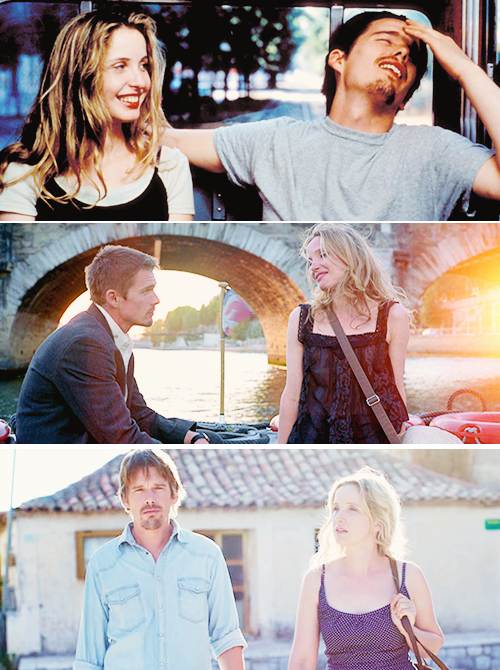 The hallmark of the series, its sparkling conversation, is alive and well, with added maturity and reflection. When you get dialogue this good, this fluidly natural, this engaging, I could listen to them talk for days. In my mini-review for Before Sunset I compared it to listening to birds sing. The shots can last upwards of ten minutes as the camera just slowly walks ahead of Hawke and Delpy as they converse. In the first film we got a foot-tour of Vienna, the second Paris, and now Greece. The sights, while nice, are incidental because I was consumed with the dialogue, which spills so effortlessly from Hawke and Delpy, relishing playing these characters once more. Their give-and-take is often breathless, with nary a pause between them, and it can become overpowering for the uninitiated (lots of old ladies, I have found, dislike this movie, though when asked, none have seen the previous two). But there’s such added dramatic subtext now that we’ve jumped ahead in time. Rather than yearn for the characters to get together, now we’re assembling what we can of their history together and the durable conflicts. The exposition never feels forced, and each new bit provides another prism to view the character actions. You’re studying the characters, parsing their words, sizing up their honesty, and analyzing the various tests and dodges they dole out to one another. It’s a more active experience than you might expect for watching people talk a lot.
Hawke (The Purge) and Delpy (2 Days in New York) are so exquisitely natural with these characters and together and never better. They know these people inside out, and they should because both are credited yet again as co-screenwriters with Linklater. I’d expect another Oscar nomination in their future, much like Before Sunset. Delpy has a wonderful faux youthful voice she uses for hilarious disdain to narrate Jessie’s female fans. Both actors go a long way to flesh out their characters, provide degrees of new wisdom and worry while making us care about their problems. One character does not have the moral high ground, which makes their arguments all the more challenging to process. I don’t want to make it sound like Before Midnight is some twenty-first century Whose Afraid of Virginia Woolfe? There are innumerous moments of humor and grace and compassion, but the louder ringing of the raging conflicts can swallow them up. I also found it intriguing that this is the first movie in the series with nudity from our couple. Granted, it would seem somewhat forward if it happened in Sunrise and Sunset considering the narrow timeframes. As presented in Midnight, it loses erotic context and becomes another indicator of the struggles of maintaining passion.
I want to reiterate that I really hope that Linklater and his stars continue to bless us with a new film every decade, checking back on the lives of Jessie and Celine. The next one, if we continue the nine-year tradition, will deal with them turning fifty, which seems like a grand opportunity for some existential ennui. Also, Jessie son from a previous marriage will be roughly the same age Jessie was in 1995’s Before Sunrise. That could provide another interesting perspective for dad. I’m just not ready to say goodbye to these characters yet. Much like the 7 Up documentary series, the movies provide a point to reflect on our own lives, how we’ve changed and grown, the setbacks and triumphs, surprises and sadness. Catching up with the series, I viewed the movies very differently than I did when I first watched them. The art remains the same but the frame changes; we change. The glorious aspect of Linklater’s series is that we get to chart that change, checking back with old friends we’ve grown with. The movie’s attention to character and the relatable problems of middle age and long-term relationships is rich, nuanced, and just about everything This is 40 should have been and wasn’t. Before Midnight may lack the idealistic romanticism of previous entries but it substitutes a soulfulness to a series that has always been mature beyond its years. Approaching half a life lived, the characters still have plenty of life in them, plenty of dreams worth pursuing, and plenty more hurdles to go. It has been an ongoing privilege to get to spend time with these two. I pray this is not the end but just another stop on what ends up being one of cinema’s definitive statements on love through the ages.
Nate’s Grade: A
Share this:

The Host (2013)
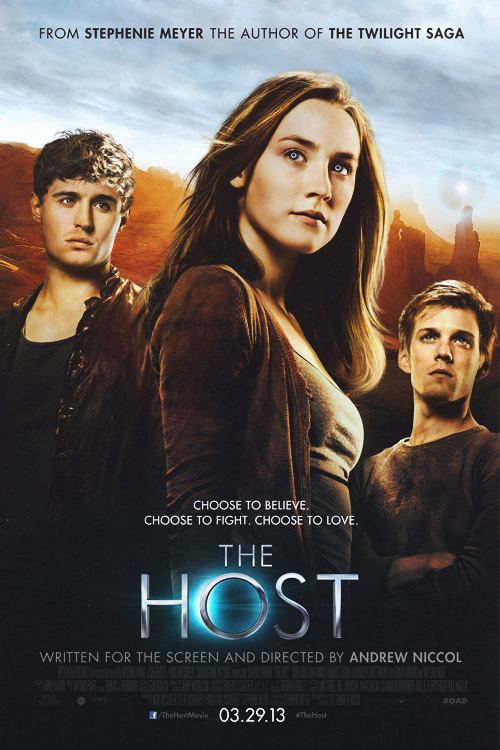 It’s impossible for me to ever separate The Host, a sci-fi would-be romance based upon the best-seller by dubious author Stephenie Meyer, and the demise of famous film critic, and personal influence, Roger Ebert. On April 4, 2013, America’s most prominent film critic, a man who with Gene Siskel changed the face of film criticism and the dialogue with movies, died after his cancer had returned. Upon hearing the news, I was overcome with grief and shed a few tears for the loss of a great writer and a great man who influenced a generation of online film critics like myself. Then I saw what was Ebert’s last published film review — The Host. Knowing his last review on this Earth is this awful movie, that it may be the last new release he ever saw, well it just feels ignoble. The man deserved better and so does anyone else who watches The Host, a movie I saw the very day of Ebert’s death.
Set on earth years after an invading alien race has already conquered, life isn’t too bad. There aren’t any wars or pollution or hunger. The aliens, looking like little glowworms, latch onto the spines of humans and use them as hosts. They control the bodies of the humans but some of us won’t go down willingly. Melanie (Saoirse Ronan) is an 18-year-old gal who fights as part of a resistance movement, led by her Uncle Jeb (William Hurt). The aliens abduct her and Melanie’s body gets a new owner – Wanderer, also referred to as Wanda. Good old Melanie is still in her head, feisty, and goading Wanda into finding Melanie’s family hiding out in the desert with Jeb. Also there is Melanie’s boyfriend, Jared (Max Irons), who is upset that his girlfriend has become “one of them.” Ian (Jake Abel), on the other hand, is adjusting well to the change, as he falls for Wanda and she him. In between these hormonal complications, Wanda is being chased by the appropriately named Seeker (Diane Kruger), who is deadest on bringing some human-style violence to Wanda/Melanie and the resistance fighters.
 The Host, like much of Meyer’s more popular Twilight saga, is a rather dramatically inert story that just seems to exist with little sense of momentum or direction or purpose, beyond providing another bloodless onscreen romance that ceaselessly finds unsettling messages to convey to young girls. Once again it all comes down to a stifling romantic triangle where none of the participants ever seems to work up the necessary passion to garner continual interest. There’s a bit more heavy petting going on but even when these people are having sex dreams, they imagine Melanie with her bra on (such a limited imagination). Please don’t confuse this as some implicit regret on my part that the movie didn’t sexualize its lead heroine (she’ll be turning 19 soon, so fear not pervs). At least the Twilight movies can be seen through the prism of pre-teen wish fulfillment. The Host, on the other hand, is just an Invasion of the Body Snatchers-style sci-fi movie where no one seems that preoccupied with anything too urgent. If the aliens are really that gung-ho to root out the resistance fighters, why aren’t they looking for heat signatures? Why aren’t they studying truck movements? The fighters aren’t very stealth-like in their comings and goings either. Hell, why don’t they even just keep a lookout for people wearing sunglasses, an obvious sign they have something to hide. It’s like the aliens and the humans are simply just going about their business without any danger. That’s because the ultimate fulcrum with which all the plot hinges upon is the romantic whims of a teen girl teaching an alien how to love. Sigh.
The least successful adaptation is likely including Melanie in the action through the use of bratty voiceover. She likes to chime in with snide remarks and pushes Wanda away when she starts getting feelings of her own for another boy. It is simply unbearable. You ever been stuck in the car with a really annoying brat? That’s what it felt like. Now I realize that having the dueling voices was an easier prospect on the printed page, but a similar challenge was tackled with 2003’s Dreamcatcher when an alien possessed Damien Lewis. We had a visual representation of Lewis taking refuge inside his own head. That was better than watching him, and it pains me even now to type it, engage in an argument with himself where the voice of the alien adopts a British accent. Maybe we could have had a better visual representation of Melanie inside Wanda, or maybe something with mirrors, that’s always a good go-to visual for characters of dueling minds. As developed, The Host feels like Melanie’s strapped in next to you, providing incessant and annoying commentary, and all you want to do is tell the kid to shut up.
Given the world-conquering plot elements, I can’t help but think Meyer found one of the least interesting stories to tell within this world. The invasion aspect seems far more compelling a story to tell than one girl stuck in a love triangle. I suppose it’s because Meyer is bringing a different perspective to science fiction, but I found most of this movie to be unbearably boring. And her premise, while flawed, could have been workable. Learning to live a symbiotic relationship with an alien that controls your physical being, there’s plenty of room there to tell an interesting and insightful story. The issues of identity and control could be richly explored. Instead, we get Melanie liking one boy and Wanda liking another, and so Melanie fights from inside to stop Wanda from acting out her exciting new feelings. Given the scope of everything going on, alien invaders and underground resistance organizations, it all feels so slight and myopic and overindulged melodrama. I suppose the whole thing could be a metaphor for puberty, a teen girl whose body is taken over by an alien presence, causing her to act irrationally and deal with swoons of affection she doesn’t know how to properly handle, causing her to act out and alter her perceptions of herself. Then again, I may just be giving Meyer and the movie more credit than they deserve.
The saddest part for me was that Andrew Niccol directed this movie as well as adapted the screenplay. He is responsible for these characters, these plot beats, these samples of dialogue. This is the man who gave us The Truman Show, Gattaca, and Lord of War. Granted, Niccol’s last movie, 2011’s In Time was a great idea in need of a far better script, but I always have high hopes with this man given his track record. From a visual standpoint, he takes a few pages from Gattaca where everything in the world is sleek and shiny and looking like an orgasmic car commercial. The shimmering cinematography by Roberto Schaefer (Marc Forster’s longtime DP) is crisp with plenty of cool colors to signify the mood of our pleasant overlords. There are plenty of nice things to look at, and female fans will likely extend that compliment to the young men duking it out for Melanie/Wanda’s affections. It’s just that everything moves so glacially, so stubbornly slow, that the movie feels like it’s run out of gas long before it’s over. At over two hours, there desperately needed to be some judicious chopping with this movie’s flabby midsection. If you’re not a fan of Meyer’s book, Niccol fails to give you any tangible reason why you should care or keep watching. I even thought about leaving at one point, and that’s an urge I can usually quell, so that’s how monotonous it truly got.
 It’s nice to see Ronan (Hanna) growing into the capable leading lady we all thought she could be, though this movie does her no favors (gone is the gangly awkwardness of The Lovely Bones). I understand that for the majority of the movie she’s playing Wanda, the alien controlling the body of Melanie. There are going to be certain limitations to this portrayal, but Ronan just sounds overly sedated for most of the movie. Then there’s her annoying voiceover, which dips into a Southern accent at several intervals. I guess when Mel gets mad it brings out her roots? Likewise with Meyer’s heroine du jour, Bella Swan, I just don’t see what all the fuss is about over this character. She’s a pretty plain heroine with courageous whims but it’s another example of a film where the supporting characters have to key us in on character traits we just aren’t picking up on our own.
I’m always puzzled when filmmakers decide to make their aliens so, well, alien. Independent evolution in a different star system is going to develop some funky designs, sure, but when you got magical glowworms as your sentient life, I find it hard to believe that they built all that super duper technology to achieve their world-domination. A glowworm made a spaceship? With its glowworm tentacles and its size of about three inches? At least the aliens on Star Trek looked like they knew there way around auto shop. For that matter, we’re in the future where everybody drives a crazy shiny vehicle no matter how off road it gets, but the stupid alien occupiers can’t master the tricky science of contact lenses? And this goes for the human rebels as well. The telltale sign you’re controlled by the aliens or not is the translucent blue ring around your iris, but why hasn’t either side just popped in some contacts to blend in? The aliens can master space travel but get squeamish about things touching their eyes?
The Host is another of Meyer’s poorly plotted, insipid melodrama that manages to be all about teen hormones except those hormones feels so hermetically sealed off. It’s another neutered romance, and this was supposed to be her so-called “adult book”? It’s the same themes and tropes from her non-adult Twilight series, just with a coating of sci-fi rather than supernatural. Even Niccol, admittedly in a bit of a slump, can’t save this picture, and ultimately the overly long, lightly plotted, and tremendously tedious affair lumbers to its predictable conclusion, replete with happy ending (let’s just say that Ian gets a hotness upgrade as far as his lover). The concept of an alien species stripping human beings of free will and living not just amongst us but within us, that’s a solid idea that could make for a compelling story. Meyer found the dumbest story to tell, her bread and butter, a love triangle where both guys have struck her at some point in the film (dwell on that). It pains me that The Host may have been Roger Ebert’s last movie. As far as I’m concerned, this movie murdered Ebert.
Nate’s Grade: D
Share this:

Magic Mike (2012)
 After all the hype and the derision from my friends, I finally saw Steven Soderbergh’s male stripper opus Magic Mike, and it does not pain me to say, as a red-blooded heterosexual male, that I found it mostly enjoyable. I understand the detractors, many of whom were let down by the relentless, frothing hype generating the film’s box-office success. The characters are fairly shallow, and almost all of the supporting players are one-dimensional; many of the male strippers only have their abs and a name to work with as far as characterization. There’s also the general absurd nature of the world of male stripping, where women are whipped into a frenzy and men almost comically gyrate atop them, or in some instances, literally pick them in the air to swing their junk into. The last act also rushes all sorts of storylines: the rookie’s fall from grace, Mike (Channing Tatum) coming to the realization to leave the business, a hastily thrown together romance. With all that said, I was always interested in just watching the ins and outs of this profession put on screen. And when the plot falters, there are always the impossible charms of Tatum to bring me back. Matthew McConaughey is also fascinating to watch as a mixture of showman, zen artist, and sexual being. I even found the dance/stripping sequences to be worthwhile as few insights into the various characters. While being less than magical, Magic Mike’s shortcomings don’t take away from what it has to offer. That may be the most unintended inuenduous statement I’ve ever written for a film review.
Nate’s Grade: B-
Share this:

Rust and Bone (2012)
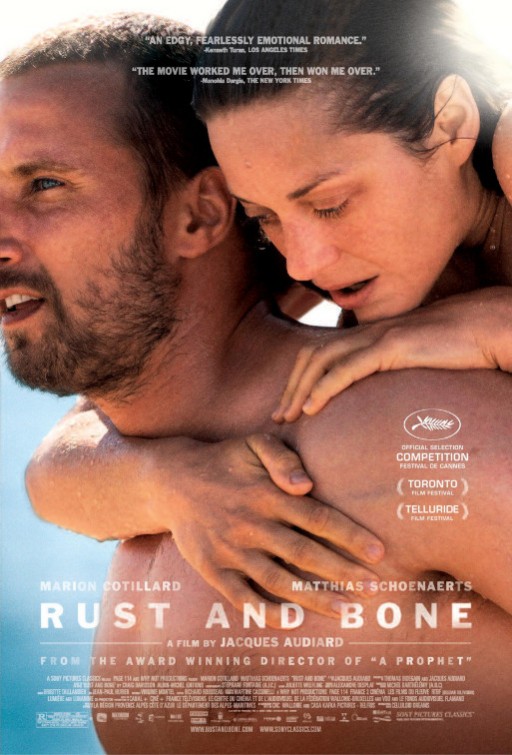 The French film Rust and Bone’s U.S. release seemed to hinge entirely on whether star Marion Cotillard would garner a coveted Oscar nomination. When that didn’t happen, it seemed like the studio just threw up its hands and said, “Well, that’s it.” Rust and Bone, co-written and directed by A Prophet’s Jaques Audiard, has been given a very ignoble release, an afterthought for an awards season that didn’t go Cotillard’s way. While I would have nominated Cotillard for her powerful performance, I certainly wouldn’t think much else about Rust and Bone, a frustrating film that doesn’t know whose story it’s telling or what movie it wishes to be.
Alain van Versch (Matthias Schoenaerts) is struggling to take care of him self and his young son, Sam. Alain’s ex-wife, and Sam’s mother, used the boy as part of her drug trades. Alain moves in with his sister and gets a job as a nightclub bouncer. It’s at the club where he meets Stephanie (Cotillard), a marine trainer. She’s also feisty and getting kicked out for starting a fight. Stephanie works at a Sea World-esque water park, and one horrific day one of the whales makes a wrong turn. It runs into the stage, knocking Stephanie unconscious into the water where, we learn, a whale has eaten her legs below her knee. She contacts Alain and the two form an unlikely friendship, one that turns physical as Stephanie worries what her sexual performance will be like under her new circumstances. Alain dreams of becoming a professional kick boxer/MMA fighter, and he performs in underground fights as another means of income. Stephanie tags along and helps motivate him win his fights. The two grow closer, but Alain struggles with what real feelings might mean.
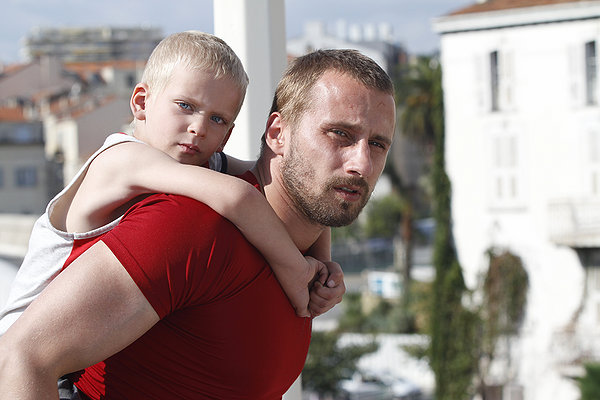 Rust and Bone has a serious case of multiple personality disorder. It looks like it’s going to be one movie, then all of a sudden it changes into another, and then when you think you’ve got a handle on that, it suddenly transforms into another. I’m perfectly fine with a movie switching gears suddenly, however, with Rust and Bone, I felt like I was getting three different half-hearted drafts rather than an actual movie. I went into the film knowing little other than the selling point, that Cotillard was playing a woman readjusting to life after a freak accident took her legs. For the first twenty minutes of the movie, I didn’t get a shred of this. I got a single father trying to scrape together what he could for himself and his son, often resorting to sneaky and illegal measures. Then shortly after Stephanie is introduced, the movie becomes all about her. We’re dealing with her recovery and her anger and her loss. Just when I think I’ve settled onto the narrative direction of the movie, it becomes Alain’s movie again. Now we’re following his budding career as an amateur kick boxer, with Stephanie as his cheerleader. Then she dissolves into the background of the movie yet again, and it’s all about him. I don’t think the movie knew which character it wanted to be its focal point, so we get a sloppy interspersing of storylines vying for dominance. Personally, I was much more invested and intrigued by Stephanie’s recovery than anything having to do with Alain trying to be a better father and failing. Then there’s other muddled storylines like hidden cameras in the workplace that only further distract. It’s just all too much and at the same time not enough.
Then there’s the matter of the romance between Stephanie and Alain. I suppose you could say they are both wounded people trying to gain a greater sense of independence, battling new concepts of self-identity, but I think I’m doing the film too many favors. The sad part is that these two people are extremely shallow and limited form a characterization standpoint. The only defining quality about Stephanie is her injury. Sure she’s feisty and can get into bar fights, and that fact that she’s attracted to Alain says something about her, but really, her only characterization is her new physical limitations and her adjustment to them. Her physical needs are given much more attention by the screenplay than her emotional resonance. It makes me sound like a hardhearted bastard but I’ve said it before, I need characters that have more depth to them other than that they suffer. Alain, on the other hand, is even worse. He’s a pretty flat character who’s actually a really terrible father. He loses his temper easily, chooses quick sex over picking up his kid at school, plus there’s the whole abandonment thing. It’s hard for me to believe that anything really sinks in with this lunkhead. His relationship with Stephanie, meant to open him up, instead reconfirms what a jerk he is. He uses women as sexual playthings, and treats Stephanie with this same careless abandon. He clearly doesn’t see her as anything but a comfortable fling, which he shows through his actions. If Alain’s romantic views have changed, the film doesn’t show any of this progression. I didn’t care about him and I certainly didn’t care about the two of them together.
Acting-wise, Cotillard (The Dark Knight Rises) is quite moving throughout as she tries to come to grips with everything that has been taken from her. Her more traditionally dramatic crying scenes are powerful, sure, but it’s the quiet moments that Cotillard nails. There’s a moment where she goes through her former routines hand motions, and in that moment, set to Katy Perry’s “Firework,” it becomes clear she is moving beyond her accident, accepting and getting stronger. It’s a subtle celebration of the human spirit’s ability to rebound, and Cotillard makes sure the moment is moving rather than cheesy. Also, there’s a very tender moment when she returns to the water park and reunites with the whale that took her legs. Through the glass, she goes through her training motions and the whale still resounds accordingly to her commands. It’s a wordless, touching moment that communicates so much, the nature of forgiveness, the culpability of an animal, but really about the connection between man and nature. Also, the fact that these two scenes are available on YouTube means somebody else must have seen them as standouts as well. She’s also naked frequently, if that matters to you.
 Schoenhaerts (Bullhead) is too opaque for his own good. He seems to settle for his brute physicality, and as such the movie does little to flesh him out further. He has a couple nice moments, especially at the film’s climax, but it’s too little to overturn the prevailing notion that his character is unworthy of co-lead status.
Probably the most impressive thing from Audiard’s film is the special effects to remove Cotillard’s legs. While the technology doesn’t seem like it has changed since Lt. Dan’s days in 1994, it’s still a striking image to process. I’m still wondering why exactly Stepheanie gets tattoos on her (remaining) thighs, reading “Right” and “Left.” Is she worried about going under the knife and the doctors taking more away from the wrong limb? That seems past the point of return. With the special effects technology, and the film’s quotient for sweaty sex scenes, this is the art house equivalent of erotica for those discerning few with amputation fetishes.
When it came time to determine which film would compete at the Academy Awards, France chose the feel-good buddy comedy The Intouchables over Rust and Bone. It’s easy to see why. Except for Cotillard’s fierce performance, and some spiffy special effects, there is nothing remarkable about this ultimately frustrating and shallow movie. The mismatched love story between Stephanie and Alain feels implausible and too focused on surface-level desires; not enough to justify some statement of personal growth on both their parts. There needed to be a complete restructuring of the screenplay. Too often it keeps switching focus, changing gears, mixing in other subplots until it all feels like one big mess lacking firm direction. I might have loved a movie that focused on Stephanie and her recovery, perhaps even one about Alain, though I doubt it. What Rust and Bone offers is a movie that’s persistently in doubt of its own identity, trying its hand at everything, forging necessary care to its lead characters. It’s a fine film that could have been a great one, if only it really knew what it wanted to be in the first place.
Nate’s Grade: C+
Share this:

Warm Bodies (2013)
 Given the explosion in zombie culture and the avalanche of zombie movies, it was only a matter of time before a studio pitched the romantic possibilities. They may be dead but they still have needs. Based on Issac Marion’s young adult novel, Warm Bodies attempts to tell a love story from a zombie’s perspective. Writer/director Jonathan Levine, so skillful with tone in the comedy/drama 50/50, tackles an even trickier balancing act, making a zombie romantic. With some visual flair, an eclectic soundtrack, and a winning onscreen pair, Warm Bodies is a sweet love story that does enough right to leave you smiling.
In the aftermath of a zombie apocalypse, R (Nicholas Hoult) is a zombie who spends most of his days shuffling through an airport. Occasionally he has a series of conversations with his pal, M (Rob Corddry), which mostly amount to grunts. R can’t remember who he was before he became a zombie, or even what life was like before it all went to pot, but there is one thing that will make him feel alive again – human brains. You see, this tasty delicacy allows zombies to relive the memories of their victims. It’s a nice release from, you know, decomposing. The zombies that have completely given up all sense of self peel off all their skin, becoming the Bonies, a wraith-like band of creatures that will feed off anything, even the dead.
 This is R’s life until his chance encounter with Julie (Teresa Palmer). He’s smitten instantly and feels something weird in his chest. His heart has started beating again. He doesn’t want to eat her, just protect her. Of course he did also happen to eat her now-ex-boyfriend (David Franco). R whisks her to safety to his home in an airplane cabin. They listen to records and he instructs her on ways to pose as a zombie. She’s cautious but grows fond of her zombie protector (zombie Stockholm syndrome?). But R is proof that the zombies can change and that humanity can be saved. There’s just the matter of convincing Julie’s father, General Grigio (John Malkovich), who had to shoot his own wife after she turned. He wants them all dead and will do whatever it takes to protect the last bastion of the living.
Levine has found what may be one of the only optimistic zombie films out there. Usually these movies end one of two ways: 1) everybody dies (the preferred option), or, 2) the heroes manage a final escape but are most likely doomed beyond all hope (just pushes the inevitable off screen and into our imaginations). Tethered to a genial but winning romance, Warm Bodies is a zombie movie with a genuine sense of hope, revival, and even finds way to carve out a happy ending that, while predictable, feels right tonally.
The twee romance has a lot more in common with indie stylings than it does, say, Twilight, which will likely be invoked by many a critic and ticket-buyer alike. It’s not so much the brooding, sullen, exasperating kind of “romance” Twilight has primed people to expect when monsters date young girls. Thanks to the helpful voiceover, we see R as a thoughtful (being generous here considering his peers) guy who, like most teens, is trying to battle his inner urges and sense of awkwardness. He may be a zombie but Levine and Hoult have found a way to make R relatable and a likeable dead chap to root for. It also helps that he and Palmer (I Am Number Four) have above average chemistry together. Sure it’s a little weird that she takes the whole guy-crushing-on-me-kinda-ate-my-old-boyfriend, but like any relationship, there are just obstacles you’re going to have to overcome together. And as my pal Eric would attest, any Franco had it coming (his big bro did lead to the end of mankind in 2011, so maybe he’s responsible for the zombie apocalypse).
I appreciated that even with a PG-13 rating the movie still has a bite to it. Premise-alone, there is plenty room for some intriguing mismatched comedy. I enjoyed the aspect that consuming human brains unlocks that person’s memories. I like that R saves brains for later snacks. I liked that he used this absurd plot device to help him get closer with Julie and makes him feel guilty. Warm Bodies finds a way around the whole bodies decomposing issue, which is important since we don’t want our Romeo to be too disgusting for the teen girls. It refrains from overt gore, relying on implied carnage and preferring a chaste smearing of blood on lips, like he just got carried away eating a cherry pie. Honestly, I didn’t miss the gore. While the concept of a completely putrid corpse, with its flesh rotting and falling from its face, finding romance would be darkly comical, I think Levine chose the savvier path, forming a romance that doesn’t overdose on irony, which it would if the dead-boy-meets-girl romance were more grotesque. That’s the reason the Bonies exist, to provide a more grotesque and more evil foe that can provide perspective on the nobility of the not-all-the-way-dead people.
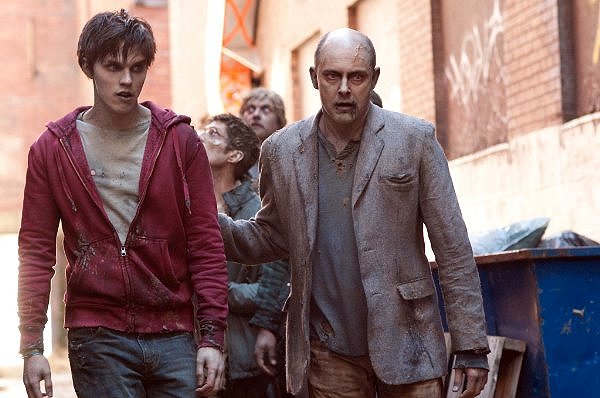 Levine works enough comic angles that the comic possibilities feel explored, although much like the horror and romance could have been pushed even further. As is, I found R’s musings wryly enjoyable, and his undead bromance with M provides some of the funniest moments in the film. Corddry (TV’s Children’s Hospital) is terrific in the movie and even finds what little room he can to add a touch of poignancy with his character. Often the humor, like the horror elements, is pretty relaxed but effective, refraining from oversized wackiness. You seriously would think that the movie would go bigger with its comedy considering everything at play.
Hoult (X-Men: First Class, TV’s Skins) does a credible job as a zombie, let alone an American zombie; it’s not all shuffling and caveman monosyllabic grunts. The actor is adept with communicating the awkwardness of his character in physicality. It’s funny how much you end of empathizing with a character that is dead. Hoult is also a pretty hunky guy, Vulcan eyebrows and all, but his amiable demeanor and young love clumsiness will win over as many guys in the audience as ladies. Palmer, also sporting an American accent, gets the blood pumping. Julie is underwritten but rises above just being a typical damsel-in-distress. It’s nice that later in the movie, when R breaks into the human camp, the roles are reversed, and Julie gets to protect him with her wits and will. Malkovich (R.E.D.) gets the worst of it just because his character is so rote.
I suppose I could lambaste the movie’s love-conquers-all logic with a dash of critical cynicism, but I feel like its low-key yet unfailingly romantic side is another of the movie’s charms. Sure, the idea that teenage love changing the world one beating heart at a time sounds like someone took the lyrics from an 80s power ballad and had it come to life (I’m reminded of the Patton Oswalt bit about the music video of an 80s hair band against the police: “He’d deflecting the bullets with the power of his rocking!”). There’s no real explanation why the zombies are getting better, though the concept of reclaiming their humanity appears to be contagious. I guess you could make some mild commentary on the healing power of human connection, but I don’t think Levine goes too far with any sort of subtext/social allegory, though there are enough slipshod Romeo and Juliet parallels. To the audience members who rankle at the unexplainable zombie cure, I would like to draw attention to the fact they are ignoring the fantastical logical puzzle of corpses coming back to life in the first place. If nobody minds why the zombie virus/crisis starts, then I don’t see why I should be sweating over what solves it.
Warm Bodies is a return to horror for Levine. Before his Sundance breakthrough The Wackness, the man got his start directing 2006’s All the Boys Love Mandy Lane. He’s made what may be the only zombie movie that I can say is “cute,” and that’s perhaps the best word for Warm Bodies. It’s a cute movie, perfectly pleasant, charming in its low-key sweetness while still managing to be clever. It’s dark but not too mordant, and sweet but not sappy. The last act doesn’t feel like it has the proper balance that the rest of the movie coasts with, but it wasn’t enough to ruin the film. At its core, it’s a cute love story, a zom-rom-com that’s much better than being relegated as “Twilight with zombies.” Yes it could have been darker, more macabre with its humor, and there are plenty of gloomy opportunities afforded by the premise of an undead boyfriend, but Levine and his actors have conceived a film that manages to be many things, chief among them enjoyable. It’s a zombie movie that might make you feel squishy but under completely different circumstances.
Nate’s Grade: B


 nathanzoebl
You must be logged in to post a comment.