Blog Archives
Little Miss Sunshine (2006)
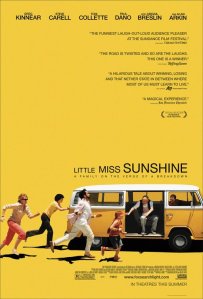 Slowly but surely, Little Miss Sunshine is gaining momentum as the breakout comedy of the summer. It’s gotten some of the most glowing reviews of the year and is poised to capture the hearts of not just fans of indie cinema but also patrons of the big suburban multiplexes, your red state soccer moms and NASCAR dads. After having seen Little Miss Sunshine, I feel like I must have missed the bandwagon.
Little Olive (Abigail Breslin) is bursting with shriek-worthy excitement. She just found out she’s a regional contestant in the national Little Miss Sunshine child beauty pageant. Her family crams into a beaten down, canary yellow Volkswagen bus and heads off on a cross-state journey for Olive. Along for the ride are Olive’s fractured family — older brother (Paul Dano), who has taken a vow of silence until he becomes a fighter pilot, stressed-out but supportive mom (Toni Collette), ambitious self-help failure dad (Greg Kinnear), a potty-mouthed, heroin-snorting grandpa (Alan Arkin), and a suicidal gay uncle (Steve Carell). It’s a long road to the pageant, especially with such an eclectic group of people whose only thing in common are their chromosomes.
 I just couldn’t shake the overwhelming feeling that Little Miss Sunshine should be more. It’s not really much of a comedy. There are some funny moments, and pushing the bus is a running gag with better legs than I would have guessed, but the film has a lot of stretches where the laughs are low to nonexistent. It’s not really much of a character piece either. None of the characters are that well defined or allowed to stretch out. The family members are all archetypes of indie film weirdness: the gay intellectual, the verbally inappropriate grandparent, the self-deluded father, the frazzled mother, the loner brother, and the precocious tyke. Little Miss Sunshine does a fine job of setting up its family of cracked characters but then seems to twiddle its thumbs when it comes to development. The only character insights come in a scattered few small moments with Olive. Dad is essentially poisoning his family with his self-help claptrap, casting the world into “winners” and “losers.” There’s a heartfelt moment brilliantly played Breslin where she confesses to grandpa that she doesn’t want to be a loser because her dad would stop loving her. Aside from that, Little Miss Sunshine seems to wind its characters up and then leave them be. I wanted more of just about everything but the movie wouldn’t budge.
The movie spends quite arguably too much time at the Little Miss Sunshine beauty pageant. Child beauty pageants are a well deserved, albeit easy, satirical punching bag, and they creep the hell out of me. Seriously, turning little girls into highly sexualized Barbie dolls seems cruel, unnatural, and very very creepy to me. There was a stupendous documentary that aired on HBO years ago called Living Dolls that traced the life of a six-year-old girl and her stage mother. It was a harrowing film, and the obsessive mother is one of the most disturbing villains I’ve ever seen in a movie, scripted or otherwise. In the film you see how people transform little girls into flirty, overly made-up little adults. It’s sickening.
The reason I bring this up is because Little Miss Sunshine because they lift a direct metaphor. In Living Dolls the main girl is playing one of those tiny slide puzzles where the finished result is an honest to God yellow smiley face. It’s a perfect metaphor of this child attempting to find happiness when no one seems to want her to live as a child. And then I saw the exact same moment in Little Miss Sunshine. Rip-off or accidental homage, you decide. In the same vein, every time Kinnear invokes the name of his literary agent, Stan Grossman, I kept thinking of Fargo.
In Sunshine, the family is aghast at the pageant scene but support Olive anyway. Then things get way too easy. The film concludes with the 5,785th rendition of the weirdos celebrating what makes them who they are, their weirdness, and sticking it to the thumb-nosing naysayers. Then the movie abruptly ends. That’s all, folks. Little Miss Sunshine was already built on the aching backs of two very familiar indie staples, dysfunctional families and road trips, and offers little else to justify its existence.
 It’s hard to really drag this film through the mud. It was proficiently made by the music video directing team of Jonathon Dayton and Valerie Faris (Smashing Pumpkins’ Tonight Tonight). The acting is generally good. The better actors rise to the top despite their limited character depth. Carell is a big name in comedy right now, and he gives a rather subdued, sarcastic performance that will resonate best with audiences. Kinnear is better at playing smug types than pathetic types. His character really is the villain of the piece, so it’s nice to see his transformation even if it is awfully spontaneous. Collette always looks to be on the verge of a nervous breakdown. Breslin (Signs) is pretty cute and will pierce your heart during the aforementioned talk with grandpa.
There are some amusing moments and fun pieces of dialogue, and the film has its heart in the right place. The screenplay needed to go through a few more drafts to strengthen character and story. I can honestly say my favorite part of Little Miss Sunshine was listening to its very Sufjan Stevens-like soundtrack full of meloncholic horns, cellos, violins, squeezebox and electronic whispers. I would recommend the soundtrack ahead of the movie.
I feel some shades of guilt as I gather my opinion, however I cannot deny the overwhelming urge that Little Miss Sunshine should have been more. It needed more comedy, more character depth, more attention to story, and more opportunity for its ensemble of actors to sink their teeth into the material. This appointed indie darling is intermittingly amusing, has some laughs, and may be worth a free afternoon or as a rental. To me, it’s also a big example of wasted potential. Little Miss Sunshine is a beauty that needs more work before it can shine on a greater stage.
Nate’s Grade: C+
Share this:

Brick (2006)
 I appreciate movies that try something different. That isn’t to say I love all movies that try, like Gus van Sant’s latest collection of watch-grass-grow cinema. More often than not I appreciate stabs at originality even if it results in colossal failure. That’s why I can never beat too much on M. Night Shyamalan. When Brick came out last spring it had my attention immediately. Writer/director Rian Johnson placed a hard-boiled detective story in the contemporary setting of a high school. And true to my promise on my podcasts, I bought it the day it came out on DVD. For fans of crime fiction and excitingly bold cinema, rent this movie.
Brendan (Joseph Gordon-Levitt) is a kid that knows the ins and outs of the high school scene. He’s currently looking into what happened to Emily (Emile de Ravin), his ex-girlfriend who was last seen trying to fit in with the popular types. She was in some form of danger and contacted Brendan for help. With the help of The Brain (Matt O’Leary), an old friend, Brendan must negotiate a web of unsavory characters, each with their own game. There’s Dode (Noah Fleiss), a burnout who was last seen crushing on Emily. There’s Laura (Nora Zehetner), a rich girl accustomed to hanging out with bad boys. It all leads to The Pin (Lukas Haas), the man controlling the area’s drug supply and who, we’re told, is “way old, like 26.” The Pin’s been volatile ever since a brick of heroin went missing. If Brendan’s head isn’t spinning piecing together all the clues, surely the audience’s will be.
 Brick is a film that refuses to simply be an afternoon afterthought. This is a movie that demands you sit on edge, poised to decode its complicated detective jargon and twisty storyline. It takes a while to first get into the movie because of its stylized dialogue and how straight everyone plays it. Johnson has recycled the same hard-boiled talk you’d expect coming from the mouths of Humphrey Bogart and Lauren Bacall. I heard that some theaters actually gave a glossary of terms and verbal exchanges for people who went to see Brick. Whether that’s true or not, your brain is working overtime to decipher what is being said, and I love that. I love that Brick doesn’t take time out to explain its terminology but expects you to keep up as best you can. I don?t want to scare readers off, because even if you don’t know any noir vernacular you’ll be able to know what’s going on, but it’s just cooler to be in on the fun. The snappy dialogue is only one part of Johnson’s extremely intelligent, very meaty script.
Brick relies on a gimmick, yes, but what an inventive and clever gimmick. There’s just an extra level of fun for film noir fans, spotting the same archetypes (mysterious damsel in over her head, femme fatales, goons, underworld boss) and locations (gin joints become house parties, detective offices become teen bedrooms). Brendan even gets chewed out by his superior who wants results… his assistant vice principal (Shaft‘s Richard Roundtree). There’s such a common language of film noir and its staples, and part of Brick‘s enjoyment is placing all of them. I’m fully aware that Brick will exist more as an artifact in a film class than as a film casual moviegoers will actively watch. The plot is blissfully twisty with many intriguing players, and once it’s all laid out it actually holds together. Brick is rewarding for those willing to stay attentive.
The movie succeeds because of how committed everyone is. The gimmick seems doomed to fail but the movie has creativity in spades. Of course it’s all highly unrealistic but it all works splendidly within the world it creates. Because the filmmakers play it all straight, you never look at the movie from an outside perspective. You’ll never laugh at it unless you’re giggling about how much fun it is. Unlike other recent brainteasers like Syriana, you do have an emotional connection to the movie and you do care about the characters and are interested to see where the story goes (and it’s not nearly as confounding as Syriana). I love that Brendan outsmarts everyone and sometimes he does it by taking a pounding. I love that he takes so many beatings that he actually gets sick from swallowing so much blood. It’s the attention to details like that where Brick shows its commitment to the world it has created. Brick is reveling instead of deconstructing the detective genre, like the audaciously cheeky Kiss Kiss Bang Bang.
 There are some humorous winks that remind you of Brick‘s gimmick, which is surprisingly easy to forget. The Pin’s mother serves juice to her son’s “friends;” The Pin walks along a beach discussing the details of his operations and then drops a peculiar non-sequitur, asking Brendan if he’s ever read J.R.R. Tolkien (“His descriptions of things is really good. He makes you want to be there.”) That moment has haunted me still months after I viewed Brick in a theater. The Pin is a scary bad guy but it’s that line that makes me go back and say, “Yeah, but they’re just kids.”
Johnson masterfully handles his actors. Gordon-Levitt is fast becoming one of the most versatile young actors. He’s the moral anchor of the movie and Levitt carries the film on his back. He’s great handling the dialogue but even better making Brendan seem human in a highly stylized tale. Zehetner leaves quite an impression as a smoky seductress who may be the biggest player in the film. Haas plays his villain role to eerie perfection.
Brick is an exciting, disarming, demanding, vibrantly different movie that is stone cold cool. This is not the easiest movie to get into, but once you open up to its freshly retro wavelength then Brick is one greatly rewarding movie. Johnson has built a movie around a gimmick but it all holds together so well thanks to his total commitment. The dialogue is heavy in noir slang and the story is crammed with twists and surprises. I loved this movie from the first frame to the last. Johnson has found a refreshingly original movie by going back in time. They don’t make ’em like this anymore.
Nate’s Grade: A
Share this:

Me, You, and Everyone We Know (2005)
 This movie is going to affect people very differently. Writer/director Miranda July, a note performance artist, has created a world of people fumbling for human connection. It’s deeply arty, meaning that meaning will be considerably different per viewer. For whatever reason, I was able to ride July’s artistic wavelength and enjoyed the series of oddball characters and weird vignettes, like a chain of cars keeping a goldfish alive atop one of their roofs. The film deals frankly with sexuality and involves teens experimenting, but the film exists in a world where sexuality still had its curiosities and detached humor, truly like a kid’s point of view. This movie has two of the most profoundly romantic moments of any film I’ve seen all year, but they are just moments. Me, and You, and Everyone We Know is a movie built around moments. There are enough of them for me and I appreciated July’s unique voice.
Nate’s Grade: B+
Share this:

The Brothers Grimm (2005)
 Director Terry Gilliam is one of the true artists working today in movies. His manic, off kilter, visually grand imagination has crafted wonderfully vivid fantasias, but it also has given Gilliam a reputation for being the captain of a sinking ship. The Adventures of Baron Munchausen is regarded as one of Hollywood’s bigger failures, unfairly I might add. A fascinating 2003 documentary called Lost in La Mancha detailed the bizarre circumstances and implosions that forced Gilliam to shut down production of his pride and joy, a film about Don Quixote. We’re talking things as out of control and unlucky as acts of God conspiring to doom this project. But then, Gilliam has always been fighting someone or something his whole film career. The studio refused Gilliam’s cut of Brazil so he sneaked out a print, showed it to the Los Angeles film community, and they dubbed it the best film of that year. Gilliam is a man governed by his idiosyncrasies. He’s blessed with a unique voice but cursed with the prospects of not having anywhere to say something (would he not make simply the most divine Harry Potter film yet?). And so Gilliam strikes his hands at something a bit more commercially minded with the action/comic fable, The Brothers Grimm.
Will (Matt Damon) and Jakob (Heath Ledger) Grimm are nineteenth century ghostbusters, so to speak. They travel from town to town ridding the villagers of evil spirits, witches, and all sorts of demonic creatures. Trouble is it’s all a lie. The Grimm brothers and their pals set up the spooks and rob the town blind. Will enjoys the fame, and especially the women, but Jakob feels apprehensive. It?s the Napoleonic wars, and the French have occupied the Germanic lands. A snooty general (Jonathan Pryce) plans to behead the two Grimm brothers unless they solve a strange case in a rural town. A slapsticky, torture-loving commander (Peter Storemare) is sent to watch over the “Grimmies.” At the village, Will and Jakob discover the town has had 10 of its daughters kidnapped with little explanation. With the help of a free-spirited woman (Lena Headey), the brothers encounter giant wolves, moving trees, lickable frogs, and the giant tower of the Mirror Queen (Monica Bellucci). The Queen was given eternal life but not eternal youth. In order to gain eternal youth, the Queen needs to take the lives of 12 hearty girls, and only the bumbling Grimm brothers stand in her way.
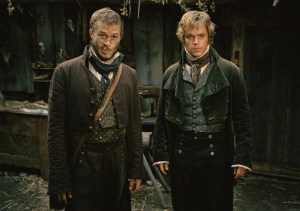 The acting is an example of the film’s messy feel. Ledger talks with marbles in his mouth. He’s putting more detail into the character than it deserves. Damon seems like he’s sleepwalking through the film, and his accent fluctuates wildly. He’s sort of a grinning straight man to Ledger’s tic-heavy daydream believer. Belluci is a ravishing beauty and proof positive for Hollywood that women over 40 don’t need to be put out to pasture. Too bad all she’s expected to do is look pretty and seductive in The Brothers Grimm. Pryce plays his role like a cartoon caricature. Stormare has already given one crazy performance this year (Constantine), and his frenzied, nearly indecipherable performance seems to be the closest to Gilliam’s whacked-out wavelength. Stormare is entertaining in every scene he’s in but can be found guilty of chewing scenery like it was a delicious candy house.
The Brothers Grimm is a gorgeous looking film. The sets are massive and greatly detailed. The location shoots in Prague seem like the perfect environment for Gilliam’s beyond-this-world landscapes. Gilliam experiments with advanced computer graphics for the first time and adds his oddball touches. A child has her eyes taken by a glob of mud, and then the mud reshapes itself into a lumbering gingerbread man. A horse spits out a spiderweb and ensnares a child. And it looks really freaking creepy. The Mirror Queen’s defeat is another standout effect as she breaks apart like shattered glass. The look of The Brothers Grimm is outstanding, but it’s what takes place inside those pretty pictures that dooms the film to mediocrity.
 The Brothers Grimm is an unfocused mess. It has disjointed subplots and several story elements that just don’t fit. The wacky French occupation feels like a leftover from a different movie. It just doesn’t work and grinds the movie to a screeching halt with every resurfacing. The Brothers Grimm will routinely work its way into a narrative corner and then use a “magic” cheat to escape (magic axe, magic mirror, magic kiss). Gilliam has always been a master maestro of chaos and visual oddities, but this time he’s tackled a film with a very weak script by Ehren Kruger (Ring Two). Kruger doesn’t bother laying the groundwork of his magical world or establish the rules. Therefore anything can happen and rarely feels satisfying. The characters are one-note, each given a single character trait to play with (skeptic, believer, idiot, etc.). The pacing is pretty sluggish. The first act takes an eternity to set up the film’s characters, plot, and yet it still feels sloppy. The twists and turns are easily telegraphed and unexpectedly boring. The plot is frustrating, shortsighted in scope, and far too conventional for Gilliam’s tastes. When The Brothers Grimm reaches its happy ending you’ll swear you can hear Gilliam gagging somewhere.
Gilliam adds a worthy macabre tone to the film. There will be touches that you know are pure Gilliam, like a woman skinning a rabbit as she talks, or a cat flying into the blades or a torture device. In fact, The Brothers Grimm has a lot of humor involving the comic demise of animals. This isn’t exactly a film appropriate for young children despite the appeal of a fairy tale background. The film wants to tweak fairy tale legends like the two Shreks, but Gilliam wants to make them disturbing nightmares, not something of irreverence. This puts the film’s tone at odds. One minute you’ll have a scene that?s morbid, darkly funny, and unconventional, and then the next minute you’ll have a scene that’s cliché, dull, and whimsically misplaced.
The Brothers Grimm feels like a Terry Gilliam film under glass. The script is weak and plodding, the characters barely leave a dent, and the tone is uneven. The plot is pulled in too many directions and lacks momentum. There are a handful of fun comic diversions but the movie feels like a loose collection of disjointed story elements. There are flashes of grim humor and visual elegance but more often than not the film is just stupendously boring. The Brothers Grimm feels the same way the Coen brothers’ Intolerable Cruelty felt: a unique vision compromised and downsized by studio conformity. You can see the indie spirit but the heart just isn’t beating. The Brothers Grimm is mediocre at best. How very grim indeed.
Nate’s Grade: C
Share this:

The Hitchhiker’s Guide to the Galaxy (2005)
 I’m a big fan of the late Douglas Adams’ series, so going in I had a slate of expectations but also a working knowledge of this kooky universe. I really don’t think this film will work for anyone but the fans. The movie isn’t even structured like a screenplay, it has more of the novel’s loose loopy feel. Some things work wonderful, like the Vogons, giant marvelous looking puppets made by Jim Henson’s studio. The cast is mostly excellent (Alan Rickman steals the show as the voice of Marvin, a very depressed robot). The animated guide entries in the Hitchhiker’s book are colorful, stylistic, and witty. Somethings, however, don’t work at all. The additions to the story, an increased romantic angle between our lead Arthur Dent (Martin Freeman) and Trillian (Zooey Descehanel) as well as a flat happy ending that rewrites all the opening danger. The Hitchhiker’s Guide to the Galaxy occasionally serves up some juicy bits of wacky humor or visual fantasy (John Malkovich’s bit part is weird) but unless you were a fan of the book series, you’re really not going to be able to follow along or have any interest in keeping up.
Nate’s Grade: C+
Share this:

Garden State (2004)
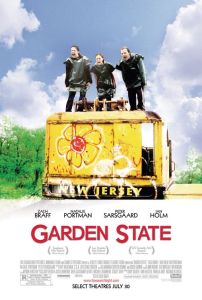 Zack Braff is best known to most as the lead doc on NBC’s hilarious Scrubs. He has razor-sharp comic timing, a goofy charisma, and a deft gift for physical comedy. So who knew that behind those bushy eyebrows and bushier hair was an aspiring writer/director? Furthermore, who would have known that there was such a talented writer/director? Garden State, Braff’s ode to his home, boasts a big name cast, deafening buzz, and perhaps, the first great steps outward for a new Hollywood voice.
Andrew Large Largeman (Braff) is an out-of-work actor living in an anti-depressant haze in LA. He heads back to his old stomping grounds in New Jersey when he learns that his mother has recently died. Andrew has to reface his psychiatrist father (Ian Holm), the source of his guilt and prescribed numbness. He has forgotten his lithium for his trip, and the consequences allow Andrew to begin to awaken as a human being once more. He meets old friends, including Mark (Peter Sarsgaard), who now digs graves for a living and robs them when he can. He parties at the mansion of a friend made rich by the invention of silent Velcro. Things really get moving when Andrew meets Sam (Natalie Portman), a free spirit who has trouble telling the truth and staying still. Their budding relationship coalesces with Andrews re-connection to friends, family, and the joys life can offer.
 Braff has a natural directors eye for visuals and how to properly use them to convey his characters feelings. A scene where Andrew wears a shirt and blends into the wall is a perfect visual note on the characters sleep-walk through life. Braff’s writing is also familiar but satisfyingly unusual, like a repackaging of old stories told with a confident voice. His characters are interesting and memorable, but dont feel uselessly quirky, unlike the creations of other first time indie writers. The melancholy coming-out of Andrew from disconnected schlub to post-pharmaceutical hero really grabs the audience and gives them a rooting point. At times, though, it seems as though Braff may be caught up trying to craft a movie that speaks to a generation, and some will see Garden State as a generation’s voice of a yearning to feel connected.
Braff deserves a medal for finally coaxing out the actress in Portman. She herself has looked like an overly medicated, numb being in several of her recent films (Star Wars prequels, Im looking in your direction), but with her plucky, whimsical role in Garden State, Portman proves that her careers acting apex wasn’t in 1994’s The Professional, when she was 12. Her winsome performance gives Garden State its spark, and the sincere romance between Sam and Andrew gives it its heart.
Sarsgaard is fast becoming one of the best young character actors out there. After solid efforts in Boys Don’t Cry and Shattered Glass, he shines as a course but affectionate grave robber that serves as Andrews motivational elbow-in-the-ribs. Only the great Holm seems to disappoint with a rare stilted and vacant performance. This can be mostly blamed on Braff’s underdevelopment of the father role. Even Method Man pops up in a very amusing cameo.
The humor in Garden State truly blossoms. There are several outrageous moments and wonderfully peculiar characters, but their interaction and friction are what provide the biggest laughs. So while Braff may shoehorn in a frisky seeing-eye canine, a knight of the breakfast table, and a keeper of an ark, the audience gets its real chuckles from the characters and not the bizarre scenarios. Garden State has several wonderfully hilarious moments, and its sharp sense of humor directly attributes to its high entertainment value. The film also has some insightful looks at family life, guilt, romance, human connection, and acceptance. Garden State can cut close like a surgeon but it’s the surprisingly elegant tenderness that will resonate most with a crowd.
 Braff’s film has a careful selection of low-key, highly emotional tunes by artists like The Shins, Coldplay, Zero 7, and Paul Simon. The closing song, the airy Let Go by Frou Frou, has been a staple on my play list after I heard it used in the commercials.
Garden State is not a flawless first entry for Braff. It really is more a string of amusing anecdotes than an actual plot. The film’s aloof charm seems to be intended to cover over the cracks in its narrative. Braff’s film never ceases to be amusing, and it does have a warm likeability to it; nevertheless, it also loses some of its visual and emotional insights by the second half. Braff spends too much time on less essential moments, like the all-day trip by Mark that ends in a heavy-handed metaphor with an abyss. The emotional confrontation between father and son feels more like a baby step than a climax. Braff’s characters also talk in a manner that less resembles reality and more resembles snappy, glib movie dialogue. It’s still fun and often funny, but the characters speak more like they’ve been saving up witty one-liners just for the occasion.
Garden State is a movie thats richly comic, sweetly post-adolescent, and defiantly different. Braff reveals himself to be a talent both behind the camera and in front of it, and possesses an every-man quality of humility, observation, and warmth that could soon shoot him to Hollywood’s A-list. His film will speak to many, and its message about experiencing lifes pleasures and pains, as long as you are experiencing life, is uplifting enough that you may leave the theater floating on air. Garden State is a breezy, heartwarming look at New York’s armpit and the spirited inhabitants that call it home. Braff delivers a blast of fresh air during the summer blahs.
Nate’s Grade: B
Share this:

Napoleon Dynamite (2004)
 Napoleon Dynamite was an audience smash at the 2004 Sundance film festival. Fox Searchlight jumped at the chance to distribute a film written and directed by Mormons, starring a Mormon, and set in film-friendly Idaho. MTV Films, the people behind alternating good movies (Better Luck Tomorrow, Election) and atrocious movies (Crossroads, Joe’s Apartment, an upcoming film actually based on Avril Lavigne’s “Sk8r Boi” song), came aboard and basically said, Look, we really like the movie, and we want to help bring it to a wider, MTV-influenced audience. And thus, Napoleon Dynamite seems to have become the summer biggest must-see film for sk8r bois and sk8r grrrls nationwide.
Napoleon Dynamite (John Heder) is an Idaho teen that marches to the beat of his own drum. He lives with his Dune Buggy riding grandmother and 31-year-old brother Kip (Aaron Ruell), who surfs the Web talking to women. When their grandma gets injured, Uncle Rico (John Gries), stuck in the 80s in fashion and mind, takes up shop in the Dynamite home and coerces Kip to hustle money from neighbors. Meanwhile, Napoleon befriends Deb (Tina Majorino), an otherwise normal girl with a sideways ponytail, and Pedro (Efren Ramirez, who was actually in Kazaam!), the new kid at school. Together, they try and get Pedro elected to class president, but standing in their way is the mighty shadow of Summer (Haylie Duff), the most popular girl in school. Oh yeah, there’s also a llama.
 First time director, Jared Hess, and first time cinematographer, Munn Powell, orchestrate shots very statically, with little, simple camera movements and many centered angles. The style is reminiscent of the films of Todd Solondz (Welcome to the Dollhouse), or, more precisely, Wes Anderson. This shooting technique makes the characters stand out even more, almost popping out at you behind flat backgrounds like some Magic Eye picture. Hess easily communicates the tedium of Idaho with his direction. Can anyone name any other film that takes place entirely in Idaho? (Please note that My Own Private Idaho takes place in Portland and Seattle, mostly).
The star of the show is, of course, Heder. His wickedly funny deadpan delivery helps to create a truly memorable character. He achieves a geek Zen and, judging from the incredible amount of kids under-14 that appeared both times I saw this film, is most likely the greatest film realization of a dork. Its grand dork cinema, a genre long ignored after the collapse of the mighty Revenge of the Nerds franchise. So while Napoleon isn’t exactly relatable (llamas, Dune Buggy grannies and all), the right audience will see reflections of themselves. You’ll be quoting from Napoleon all summer.
Napoleon Dynamite is going to be an acquired taste. Its filled to the brim with stone-faced absurdities and doesn’t let up. If you’re not pulled in with the bizarre antics of bizarre characters in the first 10 minutes, then you may as well leave because otherwise it will feel like the film is wearing you down with its indie weirdness. Napoleon Dynamite seems to skirt the sublimely skewed world of Wes Anderson, but Napoleon lacks the deep humanity of Andersons films. What the audience is left with is a sugary, sticky icing but little substance beneath, and, depending on your sweet tooth, it’ll either be overpowering and a colossal disappointment or it’ll taste just right for the occasion. Alright, I’m done with baking analogies for the year.
 Some will find a certain condescension against the characters. Napoleon Dynamite doesn’t outright look down upon its characters, but it does give them enough room to paint themselves fools. Uncle Rico is really the films antagonist, yet hes too buffoonish to be threatening. It’s a fine line for a film to have condescension toward its characters, but Napoleon Dynamite ultimately leaves with a bemused appreciation for its characters. The film presents the good characters as unusual but lovable and ready for growth (Kip, Pedro, and of course Napoleon), but the bad characters (Summer, Uncle Rico) aren’t demonized. In essence, Napoleon Dynamite is the best example of a film that makes an audience laugh at and with its characters simultaneously.
Napoleon Dynamite is assuredly an odd duck. Some will cheer; others will want to head out the door after a few minutes. It’s hard to say which reaction an individual will have. If you have a geek-enriched history populated with unicorns, Dungeons and Dragons, and/or social ostracism, then you may be more inclined to admire Napoleon Dynamite. I laughed out loud throughout the film and found it to be an enjoyable diversion, and I went the whole review without one Jimmy Walker reference.
Nate’s Grade: B
Share this:

Eternal Sunshine of the Spotless Mind (2004)
 No other movie this year captured the possibility of film like Michel Gondry and Charlie Kaufman’s enigmatic collaboration. Eternal Sunshine was a mind-bending philosophical excursion that also ended up being one of the most nakedly realistic romances of all time. Joel (Jim Carrey restrained) embarks on having his memories erased involving the painful breakup of Clemintine (Kate Winslet, wonderful), an impulsive woman whose vibrant hair changes as much as her moods. As Joel revisits his memories, they fade and die. He starts to fall in love with her all over again and tries to have the process stop. This labyrinth of a movie gets so many details right, from the weird physics of dreams to the small, tender moments of love and relationships. I see something new and marvelous every time I watch Eternal Sunshine, and the fact that it’s caught on with audiences (it was nominated for Favorite Movie by the People’s friggin’ Choice Awards) reaffirms its insights into memory and love. I never would have thought we’d get the perfect romance for the new millennium from Kaufman. This is a beautiful, dizzingly complex, elegant romance caked in visual grandeur, and it will be just as special in 5 years as it will be in 50, that is if monkeys don’t evolve and take over by then (it will happen).
Nate’s Grade: A
Share this:

Bubba Ho-Tep (2003)
 Bruce Campbell gives a memorable performance as the aging king of rock ’n roll, Elvis, spending his remaining years wasting away in a Texas nursing home. He and a black man (Ossie Davis), who thinks hes JFK, battle a mummy thats feeding on the souls of the nursing home. Its a fabulous premise, pure and simple. The trouble is, Bubba Ho-Tep works well in great bits and pieces but doesn’t have the hold of a feature film. This feels more acquainted to a short film or a TV sketch. There are parts where I was laughing hysterically (Davis has my favorite line: ”They took my brain! Im thinking with sand up there!”), and then there are other moments toward the end where I was catching myself nodding off. Writer/director Don Coscarelli has a cool visual palette of light and shadow, reminiscent of Guillermo del Toro (Blade 2). He also has a wicked sense of humor. The best moments of Bubba Ho-Tep are the back-story involving how the real Elvis swapped places to live a normal life. Campbell is wonderful, and the movie is alive in spurts, but it cant shake the illusion of feeling stretched.
Nate’s Grade: B-
Share this:

Punch-Drunk Love (2002)
 So what do you get when you cross clown prince Adam Sandler and the writer/director of the lengthy epics Magnolia and Boogie Nights? Well you get the most unique romantic comedy ever, that’s what.
Barry Egan (Sandler) is a self-employed supplier of novelty toilet plungers. His seven older sisters have made it their job to torment him ever since he was young. In moments of confession of his unhappiness Barry usually prefaces by pleading with people not to tell his sisters. Barry is a timid introverted wallflower yet full of volatile rage fit to senselessly trash a restaurant bathroom. Lena Leonard (Emily Watson) pursues Barry after being introduced through one of his sisters. Lena latches onto the oddball and he finds the maternal comfort and acceptance he has missed his entire life. Somehow these two souls have crossed paths and become exactly what the other has always needed.
But Barry has trouble ahead of him. One night he called a phone sex line and innocently gave out all of his personal information over the phone. Now a sleazy Provo mattress store owner (Phillip Seymour Hoffman) is extorting money from Barry and using four blond Mormon brothers as his muscle. When Barry confronts the thugs, whom have now begun to endanger Lena as well, he boldly states, ”I have a love in my life and that gives me more strength than you will ever know.” You cant help but believe it and genuinely feel for the resurgence of this character’s dignity.
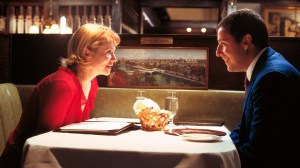 Writer/director Paul Thomas Anderson spins an engrossing character study deconstructing the angry goofball Sandler has been so accustomed to playing in all his slapstick comedies. He plays the same character archetype but is now given new dimensions to play with and depth. The true revelation of Punch-Drunk Love is that Sandler can really act. No, really, I’m dead serious.
The direction and writing are much more restrained than with Andersons previous films. The world of Punch-Drunk Love is full of stark colors, slow camera movements and vast amounts of spatial emptiness. The scope is much narrower, focusing on a small set of characters and just allowing them to tell the story without outside interference — like a frog shower. Due to the attention paid to Barry, everyone else becomes underwritten including the stoic love interest. After being convinced of Barry’s instabilities the audience is left to assume sheer blind faith at what Lena sees in Barry.
Punch-Drunk Love gleefully ignores and plays with romantic comedy conventions. The running time is under 90 minutes, (which is still only HALF of Magnolia) but the pacing is precise. John Brions percussion heavy musical score wonderfully displays the boiling anger behind Barrys placid exterior during key moments.
The storytelling of Punch-Drunk Love is full of uneasily accessible quirks and will likely be reacted to with hostility by mainstream America. What Anderson has crafted is an arty Adam Sandler movie that few thought even possible. Next thing you’ll tell me is that David Lynch will do a G-rated Disney Film. What’s that now?
Nate’s Grade: B+


You must be logged in to post a comment.