Blog Archives
Finding Neverland (2004)
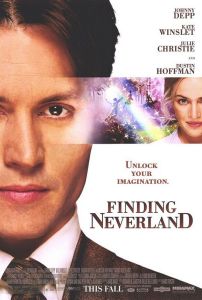 My friend George Bailey and I came to a similar conclusion during a recent conversation. There are a handful of movies, usually released around this time of year, that are packed to the gills with awards hype and general goodwill. Then I see them and feel underwhelmed for whatever reason and I walk out and feel that I should like the movie more than I do (if I do at all). I don’t know what to call it, societal guilt, elitism, but this is exactly what I felt when I left Finding Neverland.
J.M. Barrie (Johnny Depp) is in search of his next play. It?s 1903 London, and the financier (Dustin Hoffman) of his last play has taken a financial bath. Barrie’s also emotionally closed off from his wife (Radha Mitchell). One day in the park, Barrie stumbles across Sylvia (Kate Winslet), a widow managing four boys by her lonesome. Barrie takes a shining to her children and delights in spending long days with Sylvia and her boys. From his encounters with Sylvia and the boys, Barrie works up the inspiration to write a new story, called Peter Pan. Of course the public has its own gossip about a married man gallivanting about with a widow and her boys (think recent Michael Jackson scandals). Then there?s Sylvia?s mother (Julie Christie), who is set to put her house back in order starting with removing Barrie from their lives.
 The message of the movie is about the need for adults to slow down, open their imagination, and become bewitched by the power of believing. Because it’s not like there aren’t any other Hollywood movies out there that teach us to loosen up and enjoy life. Thank you Finding Neverland, I never would have found this out by myself. The message of belief overpowering all is also a bit naive, but then it works into the whole cross-stitching of sap the movie is generating.
Not even Depp can save the film. Long established as one of the most versatile and exciting actors, Depp finds ways to disappear into his oddball characters. In Finding Neverland, Depp sports an impressive Scottish brogue, but, sadly, this is the most impressive aspect about his performance. There had been much talk about Finding Neverland being Depp’s next opportunity at finding Oscar, but it would be a shame if Depp won for such a lackluster, artificial performance especially when he’s been brilliant so consistently in other movies. J.M. Barrie was somewhat eccentric, but in Finding Neverland he comes off as mostly vacant. The film tries to show that Barrie didn’t really fit in, but instead of becoming a showcase for Depp’s acting it becomes a showcase for Depp’s silence. The performance is so subtle that it doesn’t even come off as a performance. If Depp stood in the background of a movie, it would be akin to this performance.
Winslet has also been a very versatile actor. Her role in Finding Neverland never really deepens beyond Disadvantaged Woman. She’s been hit by adversity, she’s beset by four rambunctious kids and an icy mother, but that’s about all the film does for her characterization. Winslet is a tremendously talented actor, as evidenced by her Oscar-worthy performance in this year’s Eternal Sunshine of the Spotless Mind. So why strand her in a role where her character’s greatest acting moment is coughing fits?
Director Marc Forster (Monster’s Ball) has the frustrating habit of having two shot styles he shoots in. He decides between medium shots which usually involve two or three people, or large close-ups. While I was watching Finding Neverland I never once thought to myself that something was filmed in a visually interesting way. Some of Forster’s decisions seem unnecessary, like when he has to visually show us scenes of imagination instead of allowing the audience to, gasp, use their own imagination (hey, isn’t that the message of the movie?).
Finding Neverland tries so hard to be a three-hanky movie (and truth be told I heard a lot of sniffling in my theater during the last half hour), but what stops the film short is how unbelievably transparent everything is. Finding Neverland could have explored the rich complexity of an enigmatic figure like J.M. Barrie, but instead it settles for goopy sentimentality at every opportunity. Barrie becomes sugar-coated into an earnest father figure, and in the process key facts are sugar-coated as well. What do you mean? Well, Sylvia’s husband didn’t die until several years after Barrie wrote Peter Pan. Barrie’s wife didn’t have her affair until long after Peter Pan. Also, the original Peter threw himself in front of a train because of how upset he was about his connection to the famous character. I guess that’s why this is a biographical movie merely “inspired” by true events, much like Hidalgo.
The filmmakers rely on cloying tricks to make an audience care about its characters. The movie paints in very stark black and white tones, mainly “adults = shortsighted” and “children = special.” This is a film that is proud to take the easy road and makes little effort to cover its pride. It plays toward audience expectation and thus loses any long lasting magic.
Finding Neverland takes the easy road for audience-friendly sappiness. Barrie insists that 25 orphans be strategically placed around the theater on opening night of Peter Pan. Sure enough, the theater is full of old white men with monocles, and apparently they just don’t get the spirit of theater. The orphans laugh and squeal from the stage antics, and somehow this triggers all those old curmudgeons to learn to laugh once again. You see, all it takes is strategically placed orphans to make us laugh at life again.

When Sylvia is hanging laundry she starts to gently cough. If you’re smart, you’ll instantly figure out what trajectory is in store for her, but even if you miss this single cough don’t worry, because Sylvia will be doubled over with coughing later to spell it out for everyone. You can all but see the strings being pulled (the audience will cry… now!). All can be overcome in the end, those who didn’t understand will, and we’ll all be happier and live life to the fullest, in theory of course.
Finding Neverland wants to be Shakespeare in Love, another whimsical movie that shows how a writer utilized the people and events around them to pen a masterwork. Except in Shakespeare in Love there was a romance to fall back on, as well as some ripe comedy, but with Finding Neverland there isn’t anything to fall back on. It’s a Hallmark card mass-marketed to the largest possible audience.
Everything about Finding Neverland is disappointingly under whelming. The direction is shabby, the actors are marooned by their weak roles, and nothing is sacred in the film’s pursuit of that tearjerker ending. This is a movie for people that ask little of their movies, and yet I can reasonably see Finding Neverland becoming an audience favorite and riding good word of mouth all the way to awards season. Finding Neverland is a film that never takes flight because it’s too content to stay grounded by going the easy route.
[Nate’s Grade: C
Share this:

Sky Captain and the World of Tomorrow (2004)
 Sky Captain and the World of Tomorrow started as a six-minute home movie by Kerry Conran. He used computer software and blue screens to recreate New York City and depict a zeppelin docking at the top of the Empire State building. The six-minute short, which Conran spent several years completing, caught the attention of producer John Avnet (Fried Green Tomatoes). He commissioned Conran to flesh out a feature film, where computers would fill in everything except the actors (he even used the original short in the feature film). The dazzling, imaginative results are Sky Captain and the World of Tomorrow.
Polly (Gwyneth Paltrow) is a reporter in 1930s New York. She?s investigating the mysterious disappearance of World War scientists when the city is invaded by a fleet of robots. The city calls out for the aid of Sky Captain, a.k.a. Joe (Jude Law), a dashing flying ace that happens to also be Polly?s ex. Joe and Polly form an uneasy alliance. He wants to stop Totenkopf (archived footage of Laurence Olivier) from sending robots around the globe and rescue his kidnapped mechanic, Dex (Giovanni Ribisi). She wants to get the story of a lifetime, a madman spanning the world to abduct scientists, parts, and the required elements to start a doomsday device. Along the way, Captain Franky Cook (Angelina Jolie) lends her help with her flying amphibious brigade. Together they might stop Totenkopf on his island of mystery.
 Sky Captain is a visual marvel. It isn’t necessary a landmark, as actors have performed long hours behind green screen before (just look at the Star Wars prequels). Sky Captain is the first film where everything, excluding props the actors handle, is digitally brought to life inside those wonderful computers. The results are breath-taking, like when Polly enters Radio City Music Hall or during an underwater dogfight with Franky’s amphibious squadron. Sky Captain is brimming with visual excitement. The film is such an idiosyncratic vision that there’s no way it could have been made within the studio system.
Sky Captain has definite problems. For one, the characters are little more than stock characters going through the motions. The story also takes a backseat to the visuals. The dialogue is wooden and full of clunkers like, “You won’t need high heels where we’re going.” Generally the dialogue consists of one actor yelling the name of another character (examples include: “Dex!” “Joe!” “Polly!” and “Totenkopf!”). My father remarked that watching Sky Captain was akin to watching What Dreams May Come, because you’re captivated by the painterly visuals enough to stop paying attention to the less-than-there story and characters. The characters running onscreen also appears awkward, like they’re running on treadmills we can’t see, reminiscent of early 1990s video games.
Let’s talk then about those characters then. Paltrow’s character is generally unlikable. She’ll scheme her way toward whatever gains she wishes, but not in a chirpy Lois Lane style, more like a tabloid reporter. She whines, she yells, she complains, she berates, and she doesn’t so much banter as she does argue. Sky Captain is more enigmatic as a character. He seems forever vexed. Jolie’s Captain Franky Cook gives her another opportunity for her to use her faux-British accent. Jolie’s character is the strong-willed, sexy, helpful heroine that should be the center of the film, not Paltrow’s pesky reporter.
It’s also a bit undignified to assemble Laurence Olivier as the villain. It’s very unnecessary, but at least he wasn’t dancing with a vacuum cleaner.
 Now, having acknowledged the flaws of Sky Captain, I must now say this: I do not care at all. This is the first time I’ve totally sidestepped a film’s flaws because of overall enjoyment. I have never felt as giddy as I did while watching Sky Captain and the World of Tomorrow. When the giant robots first showed up I was hopping in my seat. When I saw the mixture of 1930s sci-fi, adventure serials, and Max Fleischer cartoons, I was transported to being a little kid again. No movie has done this so effectively for me since perhaps the first Back to the Future. I loved that we saw map lines when we traveled from country to country. I love the fact that the radio signal hailing Sky Captain is reminiscent of the RKO Pictures opening.This is a whirling, lovelorn homage that will make generations of classic movie geeks will smile from ear to ear. I don’t pretend to brush over the flaws, with which story and characters might be number one, but Sky Captain left me on such a cotton-candy high that my eyes were glazing over.
One could actually make a legitimate argument that the stock characters, stiff dialogue, and anemic story are in themselves a clever homage to the sci-fi serials of old, where the good guys were brave, the women plucky, and the bad guys always bent on world domination. I won?t make this argument, but it could lend credence more toward the general flaws of Sky Captain and the World of Tomorrow.
Sky Captain is an exciting ode to influences of old. It’s periodically breath-taking in its visuals and periodically head scratching with its story, but the film might awaken childhood glee within the viewer. I won’t pretend the film isn’t flawed, and I know the primary audience that will love Sky Captain are Boomers with a love and appreciation for classic cinema. Sky Captain and the World of Tomorrow will be a blast for a select audience, but outside of that group the film’s flaws may be too overwhelming.
Nate’s Grade: B+
Share this:

Kinsey (2004)
 Bill Condon’s probing, fascinating biopic of Indiana University sex pioneer Kinsey (Liam Neeson) could not come out at a more important time. Kinsey lived in the Dark Ages of sexuality and fought against what he saw as “morality disguised as fact.” Kinsey broke barriers studying the science of sexuality and gathered nationwide statements to amass the first thorough book on what’s under the sun and what’s going on under the sheets. Today, we live in a splintered world where people listen to information that affirms their beliefs, and tune out contradictory evidence even if it’s fact (look at the latest report on abstinence-only programs dishing out highly erroneous information). Kinsey railed against this dangerous line of thinking. The man was no saint and had issue comprehending some of the more complicated human emotions. Kinsey is exceptionally well acted and Neeson gives a career best performance. Kinsey is fearlessly graphic in its frank discussion but also enormously intelligent. The fact that conservative groups are actually protesting it shows that Kinsey’s work is far from over.
Nate’s Grade: A-
Share this:

Starsky & Hutch (2004)
 The big screen adaptation of yet another 1970s television show has about one joke in it that the 70s were funny. So after scene after scene of people with funny hair, in funny clothes, and talking funny, Starsky and Hutch doesn’t so much coast as it skids to a flat, lifeless halt. Ben Stiller and Owen Wilson are an amiable duo and Vince Vaughn makes a credible cocaine creep, but director Todd Phillips (Road Trip) is left to unsuccessfully hammer his film with sight gags. Scenes and jokes will stretch on much longer than their recommended shelf life. Will Ferrell makes a welcomed cameo to give the film its only moment of juice. Snoop is wasted. You may laugh at all this but the Beastie Boys did it better with their “Sabotage” video and that was ten friggin’ years ago.
Nate’s Grade: C
Share this:

Hidalgo (2004)
 It is important to talk about Hidalgo being marketed as a “true story.” As a general rule, it’s good to be wary of movies that are heavily pushed as being “true stories” or “based on true events.” You have to pay close attention to the wording. Last fall, The Texas Chainsaw Massacre remake was heavily marketed as a film “inspired by true events.” Which means it’s about as real as your dreams are. With this said, Hidalgo is based on the real Frank Hopkins and his stories about his life. Oh yeah, it just so happens that Hopkins is also a pathological liar and none of this is real. So, what the marketing of Hidalgo should really say is something like “based on the true story of what we heard from a pathological liar.” Something like that.
In fact, if you do some minor research, you’ll discover that the only thing true is that there was a guy named Frank Hopkins. He wasn’t part Native American, a Pony Express employee, a member of Wild Bill’s Circus, and he never had a horse named Hidalgo AND there has never been any 3,000-mile race in the Arabian desert. Yet Disneys marketing department still goes with “based on a true story.” I’ll remember that next time I have a dream involving little people and ice cream.
 Hidalgo is the “story” of Frank Hopkins (Viggo Mortensen), a former Pony Express employee who’s turned to the bottle to try to forget the slaughtering of Native Americans (exactly like Tom Cruise in Last Samurai). Hopkins enters a legendary 3,000-mile race across the Arabian desert to regain his spirit. The race, across the “Ocean of Fire,” is dangerous, the elements are brutal, and the other riders will stop at nothing to win. Can the American cowboy who no one believes in triumph in the end?
Taking a hard look at Hidalgo, roughly 50 percent of the finished movie is watching Hopkins travel from Point A (usually on the left) to Point B (usually on the right). So, yes, half of this movie is watching someone walk one direction. I can’t imagine what the editing process was like. How do you know exactly where one shot of Hopkins walking should go? Sure, Lawrence of Arabia had a lot of walking in the desert from left to right, but it was also 4 hours long! Both films do star Omar Sharif, though.
25 percent of what is left involves people sitting around talking about all kinds of clichés, like pining for acceptance, independence, equality, etc. These sequences tend to bog down Hidalgo‘s narrative and bring the action to a halt. I realize that these “sit down” scenes are meant to be breathers and expand the characters. However, the characters don’t deepen because they are amidst a patchwork of clichés instead of a story. The actors are also saddled with some laughably awful dialogue, like, “There is a tempest in my tent,” or the greatest groaner of them all, “Even a blind man could see you’re beautiful.”
So, continuing numbers crunching, an audience is left with 25 percent of a movie, and what is that 25 percent? In short, the rest. Hidalgo does have some lively action sequences and exciting horse races but these bursts of fun are much too far apart. When getting down to it, Hidalgo is 25 percent an interesting movie. Now, whether 25 percent of entertainment is enough for someone depends on how hard-fought they are for amusement.
The thing Hidalgo has going for it is Viggo’s star power. He is a handsome guy and has a smoldering presence but he whispers more lines than any actor I know. Maybe he threw out his voice after three of years of yelling with The Lord of the Rings.
 There are just some wondrously odd moments in Hidalgo. When Hopkins gets to the Arabian desert he notices a group of chained black people walking beside him. “Never seen slaves before?” a rider asks Hopkins. Then we cut away. What was that? The movie gives a shoulder shrug to slavery and then moves on. Later the slave kid becomes part of Hopkins’ pit crew, which also includes a wily old goat farmer. What? I have no idea how this kid became like Hopkins’ servant, and I have no idea why he’d be so happy about it. This part of the movie leaves me stumped, especially for a film where a character is so forward thinking about tolerating other races (as the protagonists always are in movies now). By the time you get to a laugh-out-loud sequence where Hopkins is on his knees chanting Native American chants, and the wavy ghosts of his brethren encircle him, you may have already checked out of the building.
Some of the blame must be heaped upon director Joe Johnston (Jumanji). His pacing is quite slack (136 minutes) and yet he stuffs more subplots and minor characters than the narrative seems able to handle. A very long subplot involving a kidnapped princess is a nice diversion, but entirely inorganic and almost to a distracting level of fantasy. Johnston also employs some hatchet CGI work that seems like it was left over from The Mummy movies. It does not speak well to the quality of a film when it’s been on the shelf for close to a year. The surprise antagonist who kidnaps, kills, and does whatever to win the race has no repercussions at the end. They lose. That’s it. Hopkins doesn’t even find out the person is a villain. What’s up with that? There’s no comeuppance
Hidalgo is not a bad film, but it’s not exactly a good film either. It’s cliché-ridden, clumsily plotted, and full of bad dialogue and stiff characters. The movie looks good, and the horses are beautiful, but this is one tale to put out to pasture. Those hungry for a grand adventure with a hunky lead may be partially pleased, but that’s only if they can put up with 25 percent of an entertaining movie.
Nate’s Grade: C+
Share this:

The Passion of the Christ (2004)
 The Passion of the Christ is a retelling of the last 12 hours of Jesus Christ’s life (perhaps you’ve heard of him?). In these final hours we witness his betrayal at the hands of Judas, his trial by Jewish leaders, his sentencing by Pontius Pilate, his subsequent whippings and torture and finally his crucifixion. Throughout the film Jesus is tempted by Satan, who is pictured as a pasty figure in a black hood (kind of resembling Jeremy Irons from The Time Machine if anyone can remember). The Passion spares no expense to stage the most authentic portrayal of what Jesus of Nazareth endured in his final 12 hours of life.
For all the hullabaloo about being the most controversial film in years (and forgive me for even using the term “hullabaloo”), I can’t help but feel a smidgen of disappointment about the final product. The Passion is aptly passionate and full of striking images, beautiful photography and production values, and stirring performances all set to a rousing score. But what makes The Passion disappointing to me is the characters. You see, Mel Gibson’s epic does not devote any time to fleshing out the central characters. They are merely ciphers and the audience is expected to plug their feelings and opinions into these walking, bleeding symbols to give them life. Now, you could argue this is what religion is all about, but as far as a movie’s story goes it is weak. The Passion turns into a well-meaning and slick spectacle where character is not an issue. And as a spectacle The Passion is first-rate; the production is amazing and the violence is graphic and gasp-inducing. Do I think the majority of people will leave the theater moved and satisfied? Yes I do. But I can’t stop this nagging concern that The Passion was devoid of character and tried covering it up with enough violence to possibly twist its message into a Sunday school snuff film.
 For my money, the best Biblical film is Martin Scorsese’s 1987 The Last Temptation of Christ (also a film mired in controversy). Last Temptation, unlike Gibson’s spectacle, was all about Jesus as a character and not simply as a physical martyr. Scorsese’s film dealt with a Christ consumed by doubt and fear and the frailties of being human. But the best part is the final 20 minutes when Jesus is tempted, by Satan, to step down from the cross and live out a normal life. Jesus walks away from the cross, marries Mary Magdalene, fathers children (this is where the controversy stemmed from but they were married) and dies at an old age. Jesus is then confronted by his aging apostles who chastise him for not living up to what he was supposed to do to save mankind. Jesus wakes up from the illusion and fulfills his mission and dies on the cross. Now, with the story of Last Temptation an audience has a greater appreciation for the sacrifice of Jesus because they witness his fears and they witness the normal life he forgoes to die for man’s sins. There is a sense of gravity about what Jesus is sacrificing.
With The Passion Gibson figures if he can build a sense of grand sacrifice by gruesomely portraying the tortures Jesus endured. Even if it is Jesus, and this may sound blasphemous, torturing a character to create sympathy and likeability is the weakest writing trick you can do. Yes Jesus suffered a lot, yes we should all be horrified and grateful, and yes people will likely be moved at the unrelenting violence he endured, but in regards to telling a story, I cannot feel as much for characters whose only characterization is their suffering. Sure, The Passion flashes back to some happier moments of Jesus’ life, which I like to call the Jesus Greatest Hits collection, but the movie does not show us who Jesus was, what he felt (beyond agonizing pain) or the turmoil he went through in finally deciding to give up his own life for people that despised him. The Passion is not about character but about spectacle.
So let’s talk about the violence now, shall we? Gibson’s camera lovingly lingers on the gut-churning, harrowing, merciless level of violence. But this is his only message. It’s like Gibson is standing behind the camera and saying to the audience, “You see what Jesus suffered? Do you feel bad now? FLAY HIM MORE! How about now?” What was only three sentences of description in the Gospels takes up ten minutes of flogging screen time. Mad Mel has the urge to scourge. After an insane amount of time spent watching Jesus get flayed and beaten the violence starts to not just kill whatever spiritual message Gibson may have had in mind, but the violence becomes the message. The Passion does give an audience a fair understanding of the physical torture Jesus was subjected to, but the movie does not display Christ as fully human, enjoying life and love, or fully divine. The only thing The Passion shows us about Jesus is that the son of God sure knew how to take a whuppin’. For Gibson, the violence is the message and the point is to witness what Jesus endured. Some would call that sadistic.
 The actors all do a fine job and it’s impressive that everyones’ lines is in two dead languages (Latin and Aramaic, though for the life of me I can’t tell them apart). But the acting is limited because of the nature of the film. Had there been more moments of character the acting would come across better. As it stands, the acting in The Passion is relegated to looks of aguish or looks of horror, interspersed with weeping. Monica Bellucci (The Matrix sequels) really has nothing to do as Mary Magdalene but run around in the background a lot. Jim Caviezel (Frequency, Angel Eyes) gives everything he has in the mighty big shoes he tries to fill. It’s too bad that his Jesus spends most of the screen time being beaten, which kind of hampers his acting range.
Now let’s address the anti-Semitic concerns. Let’s face facts; you are not going to have a film about the crucifixion of Jesus and have some Jews coming off in a good light. Just as you would not have a film about the Holocaust and have some Germans coming off in a good light. It is unavoidable. The Passion does portray a handful of Jewish religious leaders as instigators for Jesus’ eventual crucifixion, but there are also Jewish leaders who denounce their actions and just as many people bemoaning the torture of Jesus as there are calling for it. Who really comes off looking bad are the Romans. Excluding the efforts to make Pilate look apprehensive, the Roman soldiers are always seen kicking, punching, whipping, spitting on Jesus and laughing manically with their yellow teeth. How anyone could watch The Passion and come away anti-Semitic and not anti-Italian is beyond me.
And like I said before, most people will be extremely satisfied with the film because it’s hard to find a person who doesn’t have an opinion on Jesus. Gibson is counting on audiences to walk in and fill in the holes of the character so that The Passion is more affecting. Gibson’s film is worthy spectacle, and despite the vacuum of character I did get choked up four separate times, mostly involving Jesus and his mother. The Passion is a well-made and well-intentioned film that will hit the right notes for many. I just wish there were more to it than spectacle. I really do.
Nate’s Grade: C
Share this:

Cold Mountain (2003)

Cold Mountain (2003)
Premise: At the end of the Civil War, Inman (Jude Law, scruffy) deserts the Confederate lines to journey back home to Ada (Nicole Kidman), the love of his life he’s spent a combined 10 minutes with.
Results: Terribly uneven, Cold Mountain‘s drama is shackled by a love story that doesn’t register the faintest of heartbeats. Kidman is wildly miscast, as she was in The Human Stain, and her beauty betrays her character. She also can’t really do a Southern accent to save her life (I’m starting to believe the only accent she can do is faux British). Law’s ever-changing beard is even more interesting than her prissy character. Renee Zellweger, as a no-nonsense Ma Clampett get-your-hands-dirty type, is a breath of fresh air in an overly stuffy film; however, her acting is quite transparent in an, “Aw sucks, give me one ‘dem Oscars, ya”ll'” way.
Nate’’s Grade: C
Share this:

The Last Samurai (2003)
 The Last Samurai (2003)
Premise: Alcoholic Civil War vet (Tom Cruise) is hired by the Japanese emperor to modernize his army. After being captured by samurai, he finds solace and fights alongside his former enemy against the emperors modernized army.
Results: A miscast Cruise is not turning Japanese, no matter if he really thinks so. The Last Samurai is a conservative by-the-book epic the limply transports the framework of Dances with Wolves and effectively creates Dances with Japanese People. Dont believe me? Lets go to the videotape. Civil War vet (check) haunted by massacre of Native Americans (check), finds peace with a foreign culture (check), falls in love with one of the foreign women (check), and must battle the invading former culture that threatens his new happiness (check). The film does have lovely cinematography and production design, if that means something to you.
Nate’s Grade: C+
Share this:

Master and Commander: The Far Side of the World (2003)
 Without sounding easily amused, this movie really is glorious filmmaking. With Peter Weir’s steady and skilled direction we get to really know the life of the early 19th century. We also get to know an armada of characters and genuinely feel for them. Russell Crowe is outstanding as Captain Jack Aubrey. His physicality and emotions are expertly showcased. When he gives a motivational speech you’d understand why people would follow him to the ends of the Earth. Paul Bettany (again buddying up to Crowe after A Beautiful Mind) is Oscar-worthy for his performance as the ship’s doctor and confidant to the Captain. He’s not afraid to question the Captain’s motives, like following a dangerous French ship all around South America. Master and Commander hums with life, and the battle sequences are heart-stopping and beautifully filmed. It took three studios to produce and release this and every dollar spent can be seen on the screen. Master and Commander is fantastic, compelling entertainment with thrills, humanity, and wonder. It’s grand old school Hollywood filmmaking.
Nates Grade: A
Share this:

The Human Stain (2003)
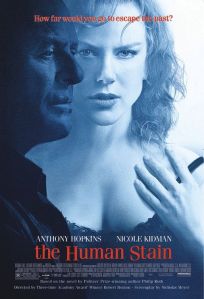 Anthony Hopkins as a black man? Nicole Kidman as a white trash janitor? And the two are LOVERS? This is a movie that is sunk by some lamebrain casting decisions. It’s one of those art pieces that yearns to be something more but just gasps for air.
Nate’s Grade: C


 nathanzoebl
You must be logged in to post a comment.