Blog Archives
The Assassination of Jesse James by the Coward Robert Ford (2007)
 This is a harrowing, haunting, beautiful, mesmerizing movie that is easily one of the best films of 2007. Casey Affleck is an acting revelation as Robert Ford, the man who worshipped Jesse James and obsessed over him before eventually turning sour and killing his hero. This languid Western, paced at 2 hours and 40 minutes, establishes a mood of gnawing paranoia as the law closes in and Jesse suspects his gang members will betray him. The day-to-day worry and dread of a life of crime really translates, and Jesse James proves an intelligent, unstable leader to mix the pot. The movie builds slowly but the tension grows unbearable and puts knots in your stomach. The acting is outstanding all around, and Brad Pitt proves a great choice for a 19th century American icon weary of his legendary status. The movie presents a fascinating peek into Jesse James’s gang and presents a wealth of historical information, none more intriguing than when the public turned on Robert Ford for terminating one of American’s folk legends. The narration provides sharp, illuminating details in brief expository scenes, and thanks to Roger Deakins’ stunning cinematography, Jesse James is an authentic period picture that is a marvel to view. I was awed by this artistic achievement that still resonates with me long after I finished watching. This film simply envelops you.
Nate’s Grade: A
Share this:

Elizabeth: The Golden Age (2007)
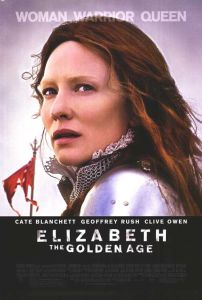 This unanticipated sequel to the 1998 film that put Cate Blanchett on the map is pretty much the same setup from the original go-round. Once again, Elizabeth is trying to assert her authority, once again Catholics are plotting an assassination to place Elizabeth’s good Catholic sister on the throne, once again Elizabeth pines for a man she cannot have, this time in the dashing form of Sir Walter Raleigh (Clive Owen). Everything is cranked into overkill, which means there are plenty of speeches and plenty of bellowing. The romantic triangle between Elizabeth, Raleigh, and Elizabeth’s most beloved assistant to the Queen (Abbie Cornish) is a waste of time and does not dignify any of the three. The camerawork ranges from awe-inspiring to maddening, with the director relying on bird-eye-view long shots and always throwing some object in the foreground to obscure the action. It gets old quickly. Blanchett gets to suit up with armor and ride a horse around, but this Elizabeth redux leaves much to be desired. If they ever kick around an Elizabeth 3 in, oh, 10 or so years, hopefully they can move on to a new story structure while I watch the aging queen through a lattice 300 feet high.
Nate’s Grade: B-
Share this:

There Will Be Blood (2007)
 Paul Thomas Anderson is one of the most gifted filmmakers working today, bar none. There Will Be Blood is only his fifth film and marks a radical departure from his intimate, inter-laced character dramas. Blood is an epic in size and scope and has been blessed with numerous awards and vehement praise. Critics say this film is one for the ages. My anticipation was fed to unhealthy proportions thanks to the hyperbolic praise and Anderson’s track record of audacious visionary cinema. There Will Be Blood is certainly audacious, and not just with its bladder-testing running length. This lethargic throwback to 1970 filmmaking exists for the purpose of a single performance and neglects other important tenets of storytelling. At 158 minutes, I can safely assume for many that there will be boredom with There Will Be Blood.
Our first glimpse of Daniel Plainview (Daniel Day-Lewis) is in the pit of a hole. It’s 1898 and Plainview is chipping away at the earth looking for scraps of silver. His meager beginnings set the stage for other mining prospects when, on the hunt for silver, he discovers even bigger riches – oil. Thanks to the advancing automobile age, the world has a thirst for oil that knows no bounds and makes Plainview a wealthy man. He’s an unscrupulous business figure that trots around his “son” HW (Dillion Freasier) as one more angle to fleece gullible townsfolk out of their property rights. HW’s father died in a drilling accident when he was a baby and Plainview has looked after him since.
One day Paul Sunday (Paul Dano) enters Plainview’s office and is willing to name a prime piece of land that oozes oil. Plainview agrees to pay Paul his sum and heads out with crew to Little Boston, California. The small town is easily enamored by Plainview’s promises of riches and prosperity. He purchases as much tracts of land as he can and begins drilling for that valuable black liquid. Eli Sunday (also Dano) is Paul’s twin brother; he wishes to build a church and become a prominent religious figure for his town. He sees the oil as his ticket to a throng of adoring congregants that will do his bidding. Oil is struck and several parties vie for dominance.
 I fear that Blood may be too languid for its own good. I’m all about allowing a film to take its time to establish a world and the people that inhabit it, and to its credit Blood spectacularly recreates turn-of-the-century America and the craze for oil. The cinematography and production design are stunning in gorgeously recreating a bygone era with such dusty detail. The film is packed with evocative imagery that will linger in your memory, like a burning oil derrick that feels like someone just drilled down to hell. The mixture of smoke, fire, and oil set amidst the hazy twilight is a remarkable sight. Visually speaking, this movie is close to flawless.
The nascent plot is what hampers Anderson’s Blood from reaching masterwork territory. The focus is on a misanthropic man who despises people and wants only to seclude himself, and yet he has genuine affection for his son until Daniel feels betrayed by his ambitions. I understand that the movie is a far-reaching character study, and Daniel Plainview is a fascinating and ferocious character, a perfect yet perplexing combination of greed and ambition, but I feel like Anderson has spent so much thought on his characters and forgotten to write a story around them. The silent, early portion of Blood gives us a quick summation of how Plainview rose to fortune and power and it’s rather compelling how much story comes across with no words of dialogue. This wordless pattern seeps into [i]Blood[/i] and there are stretches here and there where you may not hear a wisp of dialogue for, oh, 15 minutes, but by this point the movie is beyond setting up its storytelling universe. Again, I have no issues with the use of silence to convey meaning and metaphor, but it feels downright neglectful for Anderson to have concocted such intense, lively portraits of people and then to encase them in a void of speech.
Significant human interaction is kept to a minimum and I couldn’t help but feel that the movie was uncomfortably coasting without conflict for too long. Blood sets up Eli Sunday and Daniel Plainview as rivals, two men intent on grabbing power and the upper hand. The film takes a winding path to set these players in motion but I was encouraged that now, finally with two adversaries pitted together, the film would kick into another level and showcase a violent struggle worthy of a titan like Plainview. I recall every summary I read of There Will Be Blood noting that Eli is the thorn in Plainview’s side for many years and that their feud took up the bulk of the labored running time. This does not happen at all. Eli drops out for long stretches of plot and is forgotten unless Anderson feels that the character needs to be shoehorned back into the central drama at arbitrary points. This is no battle either, it’s all one-sided; Plainview handles Eli without breaking a sweat. With this in mind, I’m puzzled at how the conflict between Eli and Plainview was supposed to take center stage. Anderson had such wonderful potential to paint a doomed rivalry that eclipsed both men, but instead the external conflict only appears whenever Anderson desires some new sounding board for Plainview. That means that Blood can go for what feel like entire acts before it appears that conflict will be introduced or elaborated upon. There is a vacuum of story here and Eli Sunday, as written and performed, is far too submissive and easily beaten to present any formidable challenge.
 Why present characters at odds if you’re not going to push them further? Why write such vivid and amoral characters if you’re going to have them sit out or stay still? Plainview is the star of the show, I get that, but that isn’t an excuse for underwriting every single other character in an entire 158-minute movie. There are no intriguing character dynamics in this movie. Eli Sunday is forgotten. HW presents the closest insight into the humanity (what’s left) of Plainview, but the character is treated like a mute doll and when HW unexpectedly leaves the story so too does the only significantly interesting emotional relationship. Anderson establishes that greed comes in all shapes and sizes, be it an oil tycoon or a false prophet feasting on the coffers of his congregation. There is great thematic tension between the spiritual and the material but it never comes to a head. I kept waiting for confrontation but what Blood kept dishing out time and again was willful stagnation.
The extended ending forces a marginally contrived final reunion between Eli and Plainview but it doesn’t feel like any sort of payoff. The brutish and abrupt finale will cause many to scratch their heads and say, “That’s it?” until their scalps bleed. It’s a rather unsatisfying end for a film that boasted such grand ambitions.
The musical score by Radiohead guitarist Jonny Greenwood certainly wasn’t bad but it definitely did not mesh with the movie. Greenwood’s score consists mostly of a cacophony of violin strings buzzing about like a swarm of angry bees. The score seems to have a life of its own, intruding upon the scene at whim and upstaging character dialogue at times. The mixture of shrieking violins and some heavy percussion makes the movie feel less like a costume drama and more like a horror movie. The score seems to percolate and signify approaching danger. The score is also overly redundant and feels unnaturally paired to There Will Be Blood. It’s a marriage that doesn’t ever match.
 Day-Lewis doesn’t act often in movies and when he does it’s usually something special. His performance in Blood is outstanding, and it better be, because the film is built exclusively around his performance. He is an angry man bent on crushing opponents and making sure no one else gets sight of success. Day-Lewis is an immense talent and can dabble with multiple emotions with sheer, sightless subtlety. His distinct manner of speaking is finely attuned, though sometimes I felt like I was watching the world’s longest, and best, Jack Palence impersonation.
The other actors fall victim to the one-man show nature of the narrative. Dano comes across as miscast. He seems too youthful and ineffectual for the role. When he’s beaten and bullied his voice goes into a high-pitch squeal that is not becoming for the character. Dano’s acting takes the empty characterization one step further and removes any audience empathy.
Going by the repeated slam that Anderson is less a visionary and more a regurgitation of homage, if Boogie Nights was his Scorsese movie, Magnolia his Altman movie, Punch-Drunk Love his French New Wave movie, then There Will Be Blood is his Kubrick movie. It’s a plodding, challenging, and idiosyncratic movie that hits universal themes like family, greed, desire, and vengeance but does so in a small-scale story that feels intimate and epic simultaneously. The movie is dripping with artistic integrity and breathtaking filmmaking ability; however, it’s also a crushing disappointment. Anderson is a gifted writer/director with few contemporary peers, but he strands such vivid characters in a dessert of storytelling. There is little external conflict and the characters feel neglected or too easily forgotten. The focus is one misanthropic man but the film shortchanges him by not supplying additional substantial characters or conflict. Perhaps There Will Be Blood will stand the test of time and be the classic or landmark that critics are wetting themselves to declare it. It’s just simple economics in my mind: a character study cannot fully resonate without a strong network of supporting characters and/or lasting conflict. I have never been let down by a Paul Thomas Anderson film yet but I suppose there’s a first for everything.
Nate’s Grade: B-
Share this:

Atonement (2007)
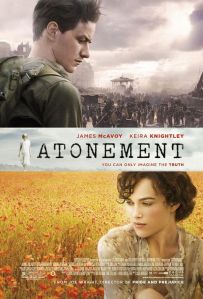 No film this awards season seems to have been kicked and beaten more than the sweeping period romance, Atonement. This poor movie has a strong stable of well-respected British thespians, a red-hot young director in Joe Wright (2005’s Pride and Prejudice), plenty of lofty, top-notch production values, and the whole enterprise is based off a highly acclaimed novel by author Ian McEwan. Where did all the hate come from? I think it has something to do with the fact that somewhere along the line Atonement became, on paper, the presumptive favorite to win Best Picture. Then reality hit and it hit hard. Atonement wasn’t even nominated by the Writer’s Guild, the Producer’s Guild, or the Director’s Guild and yet the film still managed to eek out a Best Picture nomination for 2007. I became suspicious that Atonement would turn out to be this year’s Dreamgirls, namely a presumptive front-runner that was too calculating and self-conscious and ultimately free of substance to make its mark. While Atonement is perfunctory and nothing altogether special, the film still succeeds as a worthy piece of entertainment that doesn’t deserve to be dragged through the mud.
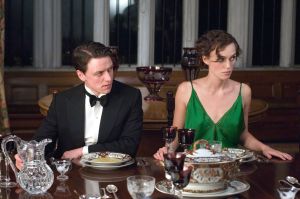 In the mid 1930s, Robbie (James McAvoy) works as a housekeeper’s son on a lovely English estate. He has his eye on Celia (Keira Knightley) and puts his burning passion to paper, typing two very different notes. The first one is blunt (and features a naughty word that rhymes with “blunt”) and the second one is more of a poetic declaration of his affections. Robbie has instructed Celia’s younger sister, Briony (Saoirse Ronan), to pass his love letter to the rightful party. He realizes too late that he sent her off with the wrong letter and Briony reads it herself, dumbfounded at the message and terminology. Briony is a bright child that fancies herself a playwright, but she’s still a child that cannot fully grasp the meaning of Robbie’s advancements. When she intrudes on Robbie and Celia having spontaneous sex against a library wall, she can only assume that Robbie is attacking her older sister (stupidly, neither says anything to clear up the awkwardness and just leaves the scene wordless). That same night Briony discovers her cousin being attacked and she’s certain that Robbie is the culprit, or is she? Her false confession sends Robbie to jail and alters lives forever.
Flash ahead to World War II, and Robbie has joined the Army to be released from jail, Celia reunites with him for the first time in years, and a now 18-year-old Briony (Romola Garai) realizes her foolishness as a child and tries expunging her overwhelming feelings of guilt by working as a nurse and tending to the ghastly numbers of wounded soldiers.
Atonement is visually ravishing to watch. The cinematography by Seamus McGarvey is lushly colorful and blends light and shadow to an extraordinarily effective degree, draping the performers in contrasting colors that pop. Wright’s camera always seems to be perfectly located to discover beautiful compositions indoors and out; the movie is just visually pleasing on all fronts, like seeing Knightley in her dark green dress bathed in the glow of police lights at night. At several points, however, the film’s look does get overly soft and glossy, like the cameraman smeared gobs of Vaseline over the lens. The period costumes and production design are agreeably period-y. The musical score has moments of great lyrical poignancy and then it shatters when the score resorts to integrating the sound of a clacking typewriter as a percussive instrument. I wanted to beat my head against a typewriter to make it stop.
 There’s a vague mechanical air over the entire two hours, like the filmmakers felt that merely assembling all the right pieces and having the right, awards-friendly pedigree would be enough. The five-minute uninterrupted tracking shot along the Dunkirk beach epitomizes this flawed belief. This superfluous shot wanders around soldiers stationed on a beach, winds around the outskirts of the bombed out city, and finally rests in a pub crawling with Brits, but nothing is added by the shot continuing uninterrupted and the staging fails to illuminate anything remarkable about the expensive set. The shot exists simply to call attention to its self and to serve as another bragging point for the filmmakers. The Dunkirk shot adds little to the atmosphere of the film because the scene barely flirts with giving a bigger picture of what is happening. Instead, that shot, like the movie, while well composed and entertaining, is an exercise in self-congratulation.
The film loses serious momentum as it transitions into war and its period of titular atoning. The movie just isn’t as compelling watching Robbie shuffle around at war. Rarely is he in any danger and he just seems to be biding time. Atonement is a tad too prim, a tad too demure to really go deep enough. The romance is intended to be of the unrequited variety but it feels malnourished even at an unrequited level, which is truly saying something. There is so much more beneath the surface but the film never wants to push too far for whatever reason. Knightley and McAvoy have a nice workable chemistry and that’s part of what makes the first half of Atonement the better half. So much of the story involves internal struggle but the movie doesn’t wish to invest the time needed to explore serious psychological wounds. Atonement never capitalizes on the intriguing if melodramatic opening of the film. This is by no means a love story, no matter what the marketers wish to convince otherwise. The romance between Celia and Robbie has little setup to seem believable or worthwhile. This is a movie about the power of words, which naturally is a topic that functions better in books.
After Kinsey and now Atonement, Vanessa Redgrave seems to have found a contemporary niche or her talents: she shows up in the final minutes to give a monologue that demands that the audience reflect from a fresh perspective. Redgrave plays an older adult Briony who has written several best selling books and is being interviewed for television. The ending is designed to be more devastating in print form, and it wants to call into question the nature of fiction and whether or not one lie and be absolved by another. But in the medium of film, the shockwaves are minimal because the language of film is visual. The stutter-step plot structure, which occasionally bends backwards to replay an event from an alternative perspective, is an extraneous annoyance that’s finally justified by Redgrave’s late appearance. What is the true cost for a “happy” ending?
 While Knightley and McAvoy get all the attention and cause teen girls to swoon uncontrollably, the real star of Atonement is 13-year-old Ronan. The young actress is a revelation as a sophisticated girl entering the earliest stages of womanhood. She’s nursing some serious puppy love on Robbie and his disinterest fuels her false confession; she means to punish him. Ronan is eloquently precocious at the start, acting wise beyond her years, but when she steels a glimpse at Robbie’s unfortunate letter, she drops her older pretensions and presents the spirited and unrestrained eagerness of a girl that’s madly curious and madly in love. Ronan effortlessly switches between the two sides of Briony, playing the astute, proper young lady or the nervy, confused girl trying to make sense of her budding sexuality. Kudos to the casting director as well for casting an older actress to play the 18-year-old Briony that genuinely looks like a grown-up Ronan.
Naysayers dismissing Atonement as outdated rubbish are diluted; it’s a well-crafted movie from considerably all angles. Then again, those that champion the film as a testament to bravura filmmaking are also diluted; the film is good, yes, but entirely unexceptional. Atonement is a fine film that takes a reportedly unfilmable novel and gives it a good attempt.
Nate’s Grade: B
Share this:

Evening (2007)
 A chick flick crammed with lots of bona fide stars and A-list talent that manages to squander all talent. It slogs on and on, the back and forth nature of the plot does little to keep an audience alert, and the story it tells in the past is so pedestrian, so minuscule, and ultimately so mundane that you can’t help but wonder why an old woman on her deathbed would be flashing back and remembering it. This high profile weepy never finds the right tone and often settles for maudlin and predictable plot turns. Evening is the kind of movie that kills the chances for a large, female-driven film to get made in Hollywood.
Nate’s Grade: C-
Share this:

Bloodrayne II: Deliverance (2007)
 It’s been some time since infamously derided director Uwe Boll reared his head and much has changed. 2006’s Bloodrayne was his last theatrically released movie but that movie was originally shot in 2004 and pushed back. In the meantime Germany revised its tax code closing the loophole that helped finance many of Boll’s cinematic duds thanks to German financiers being able to write off their debts. Boll has finished an additional three movies that are all scheduled for release in 2008, including the star-studded (for Boll) Lord of the Rings rip-off, In the Name of the King: A Dungeon Siege Tale opening this month. Boll may never get a chance to direct a theatrically released film again, which may explain his decision to helm a direct-to-DVD sequel to Bloodrayne.
The dusty town of Deliverance, Montana is under assault from the monstrous Billy the Kid (Zack Ward). Except Billy is no ordinary bandit but a powerful vampire intent on keeping his dastardly deeds nice and quiet until the railroad moves in with a nonstop supply of fresh meat and future members of the undead. Newspaper reporter Newton Pyles (Christopher Coppola, no relation to the famous family) has ventured to Deliverance in hopes of witnessing and writing exciting tales of the Wild West, and instead he’s become the man forced to write the cover-up of Billy’s actions. The vampires have kidnapped the town’s children with the idea of feasting off them while they wait. The town’s only hope is half-human, half-vampire Rayne (Natassia Malthe). Under the guidance of rustler Pat Garret (Michael Paré), the pair gather a team to combat Billy the Kid and free Deliverance from evil.
 Stylistically, Bloodrayne II: Deliverance is Boll’s desperate attempt to ape the look and feel of HBO’s popular Western series, Deadwood. It really is rather obvious to anyone that has ever seen the show. The costumes in Deliverance look similar, the sets are dressed similarly (though they still come across as too tourist attraction stagy), the gas-lamp lighting and use of darkness seems pretty similar, and the screenplay even manages to sprinkle in a few “cocksuckers,” which any Deadwood fan would know was the term of choice for historic cowpokes. Boll has the directing habit of borrowing liberally from his sources, so I expected nothing less for his attempt at a Western. The mundane cinematography goes to great lengths to declare how handheld the camerawork is. There is a noticeable difference between following the action as it develops for a docu-drama feel and simply shaking and bobbing the camera for a misguided attempt at artistic effect. After a while you feel like the cameraman must be balancing on a unicycle. There’s an over reliance on particular camera shots and close-ups are strictly reserved for the eyes and fingers during buildups to gunfights. The lavish mountain scenery of Canada (er, I mean Montana, yeah, Montana) is probably the visual highlight of a film.
The action is surprisingly decent. The climactic shootout between the forces of good and evil isn’t going to rival anything I saw in the updated 3:10 to Yuma, however, to Boll’s credit, the action is not ineptly constructed. He develops parallel lines of action and separates Rayne’s posse to deal with separate heroic last stands. Gunfights are naturally easier to stage than sword battles (shot 1: bad guy fires, shot 2: good guy ducks then fires, shot 3: bad guy gets hit) and that might explain why Rayne doesn’t break out her signature arm-blades until the very end of the climax. Rhetorical question time: who brings an arm-blade to a gunfight, anyway?
But it is structure that weighs down Bloodrayne II. Boll finally has a handle on crafting some workable action sequences and he just blows it. Bloodrayne II has exactly three action sequences and the first two are rather puny. There is a long drought in between action and in its place are a lot of dull conversations amidst increasingly dull characters. Vampires and the Wild West is a concept that can work; fun can be had with vampire cowboys and high noon (make that midnight) duels, and yet Boll seems uneasy about embracing its supernaturally campy potential. Bloodrayne II has little blood, zero gore, no nudity, no sex, and a pitifully scant amount of action. In other words, it’s missing all of the exploitation elements that make a movie like Bloodrayne II worth watching.
Screenwriters Christopher Donaldson and Neil Every throw in a lot of side characters into the stew but then quickly dispatch them as well, which at least keeps the audience on their guard and wary that anyone that assists Rayne is destined for a sudden end. Most egregiously, they speed through one of the best segments in all of movies: the getting-the-team-together sequence. Rayne and Garret are collecting a posse that includes a con man preacher (Michael Eklund) and a drunk affectionately known as Slime Bag Franson (Michael Teigen). Part of the enjoyment of the Western is following the unifying of a team and watching relationships form, and Bloodrayne II rushes through this process. It collects its gunfighters in brief introductions and then heads right for the finish.
 There seems to be little continuity between the two films even ignoring the change at lead vampire slaying lady. The vampires in this entry behave drastically different from the older European ones in the first film. Rayne seems to have lost her healing abilities, which were what the circus folk put on display when she was their money-earning star of their own little freak show (apparently during the 100-plus year gap between films Rayne got a little hammered during Spring Break and got a lower back tattoo). I bring up the healing issue because at one point Rayne is shot several times while escaping via swimming through a river. She’s struggling to regain her strength and confesses to Garret about her true nature and her need for blood. In one of the most curious moments for a movie that pairs vampires and cowboys, Garret slices open his arm and holds it over Rayne, dripping blood all over her face. The characters even seem to catch the weirdness as they both remark how much more useful a simple cup might have been.
It wouldn’t be a Boll movie without an abundance of the bizarre, the ludicrous, and the unintentionally funny. Rayne travels great distances on horseback to Deliverance with the intention of slaying some vampires she knows are responsible for murdering her friends. She finds the reflection-free accomplice (House of the Dead‘s Tyron Leitso) and holds a stool to his windpipe, choking the bastard. Instead of finishing him off Rayne relents and lets him live because, wait for it, he let her participate in his card game. Talk about a strange shift in motivation. During the climax, the townsfolk are stirred to rise up against Billy and his vampire clan thanks to the mayor and Pyles finally growing some spines. They set out to shoot them some vampires, but really what will they accomplish? Bloodrayne II established earlier that the vampires could take being plugged with bullets unless the ammunition is combined with garlic. I doubt the townspeople know they need that key ingredient to their firearms. How do the people in 1880s Montana manage to get a copy of the Chicago newspaper Pyles writes for? The railroad hasn’t made its way to Deliverance so I’m at a loss for the speedy spread of print journalism 1,000 miles away.
But the most unintentionally funny moment comes at the end when Billy has staged an elaborate system of pulleys so that when Rayne opens a door it drops a weight that will raise a series of nooses around the captured children’s necks. The kid on the furthest right is hung to death and the children seem to be arranged according to height, which seems a little OCD even for a vampire. The tallest kid on the far left of this makeshift gallows reacts very differently. While the rest of the child actors are crying, fretting, and acting like the ropes are cutting their breathing, this kid on the far left is just standing stone-faced and still.
The dialogue is expectantly awful, including clunkers like Pyles saying, “I have a question. I came looking for stories of the Wild West,” and then never actually asking a question (what kind of reporter doesn’t know what a question is?). The best/worst example of dialogue is literally the final line spoken and it blindsides the audience like a car crash. Garret says with a glint of wisdom, “Life is like a penis. When it’s hard you get screwed and when it’s soft it can’t be beat.” Wow. Someone alert the motivational poster industry because I have a gut feeling this will rival the perilous “Hang in there” kitty.
The first Rayne, Kristanna Loken, decided she’d rather stick with her Sci-Fi TV show, which has since been cancelled, than don the arm-blades once more for Boll. Malthe (Elektra, Skinwalkers) has the acting prowess you would expect from a former Maxim magazine model. It’s not like the role of Rayne involves much emotional complexity; mostly an actress has to be able to deliver some clunky dialogue and look attractive while swinging a sword. Malthe is certainly a fine looking woman but she is a non-starter when it comes to the world of acting. Whenever she speaks it’s in the same emotionless, dry tone even when she’s supposed to be angry. She comes across like an ineffectual dominatrix who’s studied acting by watching tapes of Shannon Doherty.
 Ward is hilariously miscast and completely unconvincing as an evil bloodsucker cowboy. Ward got his start in the classic A Christmas Story and I remember him best playing the goofy, dumb younger brother on comedian Christopher Titus’ hysterical TV show, Titus. Ward tacks on a lousy Eastern European accent that comes in sharp conflict with the setting and material of the film. Are vampires immune from having accents rub off on them, because Rayne seems to have assimilated well into frontier speech patterns? I challenge others not to crack up when he yells, “Now the slaughter begins.” In his defense, Ward isn’t given many scenes to play and the screenwriters have to fall back on the cheap “kids in danger” device to establish his villainy.
The other actors don’t fare much better. Coppola annoys within minutes of appearing onscreen. A helpful bartender (Chris Spencer) is astoundingly bad even for an Uwe Boll movie. He plays the part like Ted Lange in the Wild West. Boll go-to actor Paré actually seems at home with the Western material and his curt, monotone delivery fits well with the material. He’s a good fit for this genre but that doesn’t excuse his poor performances in four previous Boll flicks. The best actor in the movie is the original sheriff-turned-vampire (John Novak) who works an impressive snarl and a natural physically intimidating presence. He would have made for a serviceable lead villain over Ward.
Bloodrayne II: Deliverance is far less fun than the original while being better in some regards and worse in others. There isn’t much artistic growth shown. Boll was naturally meant to transition to the relegated realm of direct-to-DVD movies. It’s more his terrain what with the queasy production values, bad acting, and shoddy, repackaged scripts. In the world of direct-to-DVD a movie can live on into infinity thanks to assembly line sequels. Did anyone realize there are now, thanks to direct-to-DVD releases, seven Children of the Corns, four Bring it Ons, and a whopping 13 Land Before Times. It’s here where Boll’s quick production turnarounds will yield the most gain and where he may even thrive. He’s already planning to direct a Bloodrayne 3 and producing an Alone in the Dark 2 (regrettably there was a 2005 direct-to-DVD sequel to House of the Dead though it had no Boll involvement whatsoever). I think Uwe Boll is finally where he belongs.
Nate’s Grade: D
Share this:

The Lives of Others (2006)
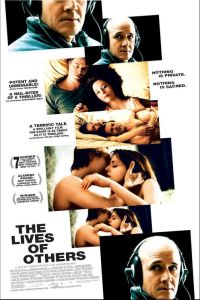 A mesmerizing and piercing human drama that burns into your memory long after it’s over. This Oscar-winner for Best Foreign Film actually deserved to beat out Pan’s Labyrinth. This vastly intriguing, dense, and extremely moving film explores life inside East Germany before the Wall fell, a life not often seen in the movies. The crux of the movie follows a career officer (Ulrich Mühe) in the secret police who has been assigned to eavesdrop on a playwright and his actress girlfriend. It is this assignment that shakes the man’s blind faith in his government, and The Lives of Others becomes nerve-wracking when our silent listener decides to become active in trying to protect his subjects from his boss. This is masterful, artistically illuminating filmmaking with a tight, deeply felt story and superb acting and direction. Germany has been crafting some of the world’s finest cinema as of late, including Oscar-winner Nowhere in Africa and Oscar-nominees Downfall and Sophie Scholl. See this film before Hollywood remakes it and ruins it. Tragically, Mühe died of stomach cancer in July 2007 just as American audiences began to see The Lives of Others and witness the depths of his talent. He will be missed by the world of cinema but his work in The Lives of Others is a lasting testament.
Nate’s Grade: A
Share this:

No Country for Old Men (2007)
 Joel and Ethan Coen are two of cinema’s most talented oddballs. Together, they’ve created some of the most intricate, eclectic, and best movies of the last 25 years. Their last two efforts, 2003’s Intolerable Cruelty and 2004’s remake of The Ladykillers, didn’t feel like Coen movies; they felt like they were compromised and missed the artistically deft touch. As a result, both movies were mild failures for filmmakers that have a series of genre-spanning masterpieces to their name. No Country for Old Men is the first time the brothers have adapted someone else’s work, in this instance Pulitzer Prize-winning author Cormac McCarthy’s 2005 novel. Not too shabby if I say so. Fortunately for all lovers of film, the Coens have embraced McCarthy’s blood-soaked tale and crafted an exciting, honest, and intensely provocative modern Western that stands out as one of the greatest films of the year.
In dusty West Texas, Llewellyn Moss (Josh Brolin) is out hunting the lonely plains when he discovers a blood trail. It leads him to four empty cars riddled with bullet holes, dead bodies collecting flies, and a sack containing two million dollars in cash. The signs are all there that this was a drug deal gone badly, and two million will never go unnoticed, but Moss sees this as an opportunity of a lifetime and takes the money. The men in power have hired Anton Chigurh (Javier Bardem) to find their drugs and money and exact retribution. Chigurh’s preferred method of killing involves a high-pressured air canister that can blow out doorknobs and human brains. Chigurh chases after Moss all the while Sheriff Ed Tom Bell (Tommy Lee Jones) is following the trail of death to try and save Moss or any future innocent victims.
 What a fine-tuned, nerve-wracking, and engrossing cat-and-mouse thriller this film is. The action is brief but the buildup can be nearly unbearable to endure. The tension is magnificent. Chigurh chases Moss from hideout to hideout and some of the tensest moments are just waiting. There’s a moment where Moss is calling the front desk of his newest motel and we hear the phone ringing unanswered again and again from the hall, all the while Chigurh’s footsteps inch closer. But it’s the moments of silence that cause the most dread. When Moss is trying to recover his loot, all the while Chigurh is in the opposite motel room, it becomes a balancing act of sound and silence. No Country for Old Men is expertly orchestrated to involve the use of sound as a tool for high suspense. None of our main three characters inhabit a scene together. Sure Moss and Chigurh shoot at one another but even then it’s short and focused on waiting for response and counter response. Moss is no dummy and he sets up some traps for his would-be dispatcher. No Country for Old Men is unnerving, intelligent, near flawless entertainment.
Chigurh, as masterfully played by Bardem, is the stuff of nightmares. I was literally afraid to go home after seeing this movie and it is because No Country for Old Men fashions a villain so methodical, so cold-blooded, and so downright deadly and cunning that I felt as if he could very well be residing under my bed at night waiting. Bardem is hypnotically horrifying and the Coen brothers establish early on how ruthless their cinematic boogeyman is. The very first moment we’re introduced to Chigurh he escapes from police custody and strangles the inattentive officer on duty. He drags him to the floor and chokes the life out of him, but the Coens position the camera not on the last desperate kicks of the officer but on the face of Anton Chigurh, and it is nasty. His eyes are bugged out and his intensity comes across as sadistically jubilant. He seems like a caged animal finally let loose. It’s a scary yet fascinating introduction to a deadly character.
Chigurh is a humorless and determined man, and every scene he steps into instantly changes. A gas attendant casually asks Chigurh about the weather and gets on his bad side and the stone-faced killer in the Dutch boy haircut proceeds to press the poor man with increasing agitation, yet Chigurh always speaks in such a placid tone that makes him far creepier. He’s a maniac that never raises his voice. Chigurh then corrals the man into one of his signatures, having a victim decide their fate by the flip of a coin. Before the man can say anything the coin is flipped, Chigurh intones to “call it,” and the man nervously repeats that he needs to know what he’s at stake to win. “Everything,” Chigurh responds. This scene starts off so innocuous but becomes monumentally unsettling thanks to the rising dread and Bardem’s deeply committed portrayal. Bardem is alarming, ferocious, grimly efficient, mesmerizing, and deserves an Oscar win, not just a mere nomination, for what is his finest performance to date.
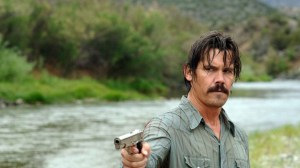 There are many ways to describe Chigurh, but it seems most appropriate to speak of him as nothing short but the full-tilt vengeance of God. He’s a hired killer, yes, but that doesn’t stop him from killing indiscriminately. He murders several innocent victims, he murders his competition sent out to nab Moss just because it insults him, and even after the money no longer becomes a concern, Chigurh still plans to continue his wrath out of sheer moral principle. He made a promise of swooping vengeance and he will stick to it. This means that anyone could die at any moment while onscreen with Chigurh, and No Country for Old Men has plenty of surprises as it toys around with our baited anticipation. When Chigurh gets the drop on his competition he doesn’t shoot the man immediately; instead the scene plays out for an agonizing length even after we listen to the room phone ring several times, and then blam! Chigurh answers the phone and casually raises his boots so the pooling blood doesn’t touch his feet. This is the most memorable incarnation of soulless evil I have seen in the movies since Hannibal Lector came to iconic form in 1991’s Silence of the Lambs.
Brolin is having quite a career year for himself after compelling turns in American Gangster (where he also shoots a dog), In the Valley of Elah, and Robert Rodriguez’s Planet Terror half of Grindhouse. Brolin gives the audience a figure to root for even though he never actually displays true heroism, just survival instincts. Jones serves as a wise and guiding father figure that feels out of place in a world that is becoming increasingly, shockingly violent. It’s a role that Jones has performed before but it’s a role that fits the actor exceptionally well. Woody Harrelson pops up as a charming and laid back handler trying to convince Moss to give up before things get worse. Kelly Macdonald, as Moss’ wife, cuts through the darkness in a refreshing performance.
The technical craftsmanship is on par with previous Coen excellence. Roger Deakins’ cinematography is exquisite, Carter Burwell’s score barely makes its presence felt, and the editing is tight and focused. The sound design, which I’ve already discussed in detail, deserves an Oscar. This being a Coen brothers’ film, it wouldn’t be complete without some dark humor to punctuate the bleakness. They have a perfect ear for local vernacular and Texas shorthand, so the dialogue feels sharp but realistically twangy without being condescending as some had accused Fargo (I do not agree with this accusation).
 What works in the favor of No Country for Old Men may perhaps be its undoing for a mainstream audience. The film works against conventions and this provides for some stellar surprises and upheavals, none of which is bigger than killing a certain character off-screen. No Country for Old Men definitely seems like it’s laying stage for a climactic showdown and then one key figure has been bumped off by a group of ancillary characters that have little overall bearing over the plot (I have read that the same gap happens in McCarthy’s novel). If this doesn’t perturb audiences then the final 10 minutes ought to do it. There’s no sense of closure for the movie and this will frustrate many, but it all fits rather nicely with the movie’s highly nihilistic tone. Like Chigurh’s coin, the film focuses much on the randomness and cruelty of fate. By sticking to this ethic, the Coen bothers are eschewing the traditional Hollywood rulebook and playing around with our expectations for characters and plot. The outlook isn’t too sunny for many involved. It works and demands an audience remain on edge for fear that anything could happen at any moment. However, don’t say I didn’t warn you if you walk out of No Country for Old Men and say, “What was that all about?”
No Country for Old Men is exactly the kind of material the Coen brothers needed to return to form. This is a lean and stirring thriller that plays to their strengths and echoes some of their most riveting and twisty work, like Blood Simple and Fargo. In many ways the film feels like a Western, a high-stakes drama, and a tragedy that takes its time to unravel. It may have taken some time but the Coen brothers are back, baby, and No Country for Old Men is fit to stand beside their hallowed pedigree of cinematic classics.
Nate’s Grade: A
Share this:

Beowulf (2007)
 Taking note of director Robert Zemeckis’ new motion-captured animated version of Beowulf, I began to wonder what other classic works of literature could use a good CGI sprucing up. Dusty old tomes would have greater relevancy to the youth of today if they were coated in animation and presented in a 3-D format. Just think of the works of Jane Austin with a flying, zooming camera and the aristocratic families repeatedly jutting marriage contracts toward an audience. This might be the only way to make The Great Gatsby tolerable.
The 1000-year old story begins in the dining hall for King Hrothgar (Anthony Hopkins). Their loud and drunken reverie is interrupted by the monstrous creature Grendel (Crispin Glover). The creatures rips men apart, lays waste to the hall, and munches on a few heads for the long journey back to his cave. The King offers a reward for anyone who can slay the monster and bring peace to the Danish lands. Enter Beowulf (Ray Winstone), a determined warrior and competitor who seeks eternal glory. He brags that he will kill their monster and then kill Grendel’s mother (Angelina Jolie) next. However, the slinky lass offers a tempting promise that she can make Beowulf the greatest story in all the world.
 This is not the same Beowulf you were forced to read in high school English. I confess never having read the 3,183-line ye olde English poem, but I don’t think it had scenes of burping, public urination, a “coming” sexual joke, and some unexpected man-on-monster action (not the kind you’d readily think). This is a bloody and often exhilarating retelling intent on jazzing up a classic work for a younger generation. The action sequences have tremendous scope and can be relentless, and when witnessed in 3-D they are even more immersive and breathtaking. Stepping aside from the thrills and chills, Beowulf also works as a cautionary tale about the dangers of lust and particularly pride. Beowulf is a boastful and arrogant fellow, enough that he chooses to fight Grendel in the buff so that it will be even more challenging and thus ego stroking (as they battle, objects conveniently obscure the audience from seeing Beowulf’s manhood). The main deviation from the poem, connecting the various characters on a much more personal level, works with he context of the story and the overarching theme about the costs of vanity.
I encourage all potential Beowulf ticket-buyers to seek out where their nearest 3-D screening resides and to plan and, if needed, carpool to that theater immediately. This thing is meant to be seen in three dimensions, and in that environment Beowulf is amazing to behold. This is my first encounter with the next generation of 3-D and it is a giant leap beyond the funny glasses with blue and red lenses. Hollywood has hopes that this technology will be the next great invention that drives people to the movies and turn it into a unique experience that cannot be duplicated in the quiet privacy of your own home. I must say I was thoroughly impressed with how immersive the process becomes. Beware, though, because of the deep focus your eyes will dart around the screen resting from object to object, marveling at the different planes of depth; you may feel some strain and a headache after awhile. Objects keep sneaking into your peripheral vision and the movie takes many opportunities to hurl things at the screen, and thus the audience, be they coins, swords, arrows, limbs, heads, pots, and blood splatters. The CGI animation coupled with the 3-D technology makes for a compulsively stunning first-rate spectacle.
The visual look is a great step forward from 2004’s The Polar Express, the first time Zemeckis used his newfangled motion-capture toys. I really disliked the look of Polar Express, and the kids and their dead, glassy eyes creeped me the hell out. I’m still not entirely sold on what motion-capture even brings to the world of animation; to me, it seems like animators can dictate movement just as well as copying from an actor. Where the animators do make strides is in their depictions of real people. It’s not photo-realism, in fact sometimes the characters look like plastic dolls, but you can see all the pores in the skin and follicles of hair in bristling detail. The look of the movie reminded me a lot of the video game God of War, especially when Beowulf is slicing and dicing one-eyed sea monsters. I think that’s a pretty fair assessment ultimately, that the film better resembled a slickly produced video game cut scene than reality.
 In the end credits, I noticed that someone is specifically singled out and credited for the design of Grendel’s mother. I’m all for credit where it’s due, but Grendel’s mother was simply designed as Angelina Jolie with a tail coming out of her head. The character design looks remarkably like its big name actress and she struts around mostly naked, though her body drips with a melting gold finish that stops the nudity from having any real definition (it’s kind of like she’s in a melty candy shell). This may be enough for frisky moviegoers that must have missed out on the other movies Jolie bares her flesh for, or perhaps the head-tail fetish folk will finally have their day. It makes a lot of sense for Zemeckis to choose Jolie for the seductress role. It seems that mortal men just can’t help themselves around her and they end up doing the nasty, which produces little nasty creatures. If there were anyone in today’s world that could make men weak with overwhelming lust, it would be Jolie. Just ask Brad Pitt.
The character work on Grendel, however, is fascinating and startlingly grotesque. He resembles a cross between Frankenstein, Dobby the elf, and a coffee pot, all covered in rotting, patchy skin. The amount of detail is amazing and simultaneously stomach-churning. Glover offers a magnificently eccentric frame to build from. Grendel comes across less like a monster and more like a misunderstood wretch that just wants some peace and quiet by any means necessary. The screenplay gives Grendel some deeper backstory and a motivation for his murderous rampages (the poor guy is hyper sensitive to music, which blares in his head and causes agony).
Beowulf does have some slow moments and a noticeable lag in the middle before it sets up a climactic dragon battle. I was actually starting to nod off somewhere along the middle. The screenplay, adapted by Neil Gaiman and Roger Avary, squanders a load of underwritten characters, like a queen, a young concubine, and a religious advisor that asks if they should also pray to this new Roman God, Jesus something or other. Zemeckis is too enamored with the 3-D technology at his fingertips and clutters his screen too often to play around with the depth of field. I cannot fathom how this movie would play out in a regular 2-D environment, but needless to say, I’m sure the constant barrage of things pointing at the screen would get old quick.
Beowulf is a rousing and thrilling experience when seen in its intended 3-D format, otherwise it might get a tad tiresome and the visuals would come across as less accomplished. Zemeckis is getting better acquainted with the limitless freedom his motion-capture technology afford him and his imagination, however, I mourn the loss of Zemeckis ever directing another live-action film again. He seems to be completely taken with his technology and while it will improve with age I just wish the man who gave me so many wonderful movies like Back to the Future and Who Framed Roger Rabbit? would just go back to basics.
Nate’s Grade: Movie itself: B
3-D presentation of film: A-
Share this:

The Fountain (2006)
 After six years of anticipation, I cannot escape my crushing disappointment with writer/director Darren Aronofsky’s long-awaited follow-up to one of my favorite films, Requiem for a Dream. While the film manages to be visually resplendent, there is no emotional involvement at all because of how abbreviated the story is. This thing barely covers 90 scant minutes and, this may be the first time I’ve ever said this, but The Fountain needed to be an hour longer, minimum. The separate time frames bleed into each other and there’s a lot of repetition, but then we discover that the cutaways to the 16th century and the visions of the LSD-heavy future are simply side trips detailed in a book. The real meat of the story is on one man losing the love of his life to illness and how they come to grips with eventual loss; however, I can’t feel as much empathy when the movie fails to take any time to set up characters. Aronofsky keeps things interesting, and rather weird, but this romantic fable ends up being nothing more than a misguided folly thanks to a total lack of breathing room for the characters to live. This was probably my single biggest disappointment of all the 2006 movies.
Nate’s Grade: C


 nathanzoebl
You must be logged in to post a comment.