Blog Archives
The Birth of a Nation (2016)
 Sold for a record $17.5 million at the Sundance Film Festival, there were big expectations for the Nat Turner biopic, The Birth of a Nation. Writer/director/actor Nate Parker was the toast of the town and the studio had its sights set clearly for a fall release and a big Oscar push. Then came the revelation from Parker’s past linking him to an accusation of sexual assault (it should be noted he was acquitted of the charge, though it should also be noted the woman declined to continue pressing charges during the second trial). Suddenly the Oscar hopes for Birth of a Nation were put into a tailspin and journalists were wondering if this salient news would provide older Oscar voters just the excuse they needed not to watch the movie. After having finally seen the film for myself, I can attest that this movie wasn’t going to go far into the Oscar race anyway. My friend Ben Bailey said it best as we walked out of The Birth of a Nation, making an apt comparison to the 2013 Best Picture Winner: “12 Years a Slave was a better movie made from a less interesting story; and this is a more interesting story but given a much lesser movie.”
In 1830, Nat Turner (Parker) is earning extra money for his friendly slave owner (Armie Hammer) as a preacher, convincing slaves on other plantations to work harder and obey their cruel masters. He reaches a breaking point and organizes a revolt, violently killing the same plantation owners that kept them in bondage. Nat felt his revolt could be the catalyst for slaves all over, but it was put down by overwhelming forces two days later.
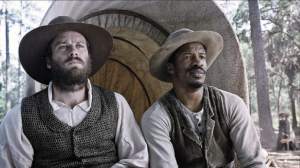 Nat Turner is a historical figure extremely deserving of a big Hollywood spotlight. The problem is that Parker’s movie feels like the arthouse version of the Hollywood Martyr Blockbuster, a field popularized by director Edward Zwick (Glory, Blood Diamond). This thing checks just about all the formula boxes you’d expect by showing the arc of a character called into action, forced to take a stand against an exploited people and series of injustices, and the eventual death for the cause. It’s meant to be inspirational but that sense of inspiration can be capped when you see the machinations. All storytelling at some level is about pulling the strings of an audience, but the storyteller must do their best to make this as nonobservant as possible so as not to disturb the experience. Parker doesn’t have that skill quite yet, either as a director or as a screenwriter.
His movie kept my interest but I felt oddly removed from it, unable to fully absorb the characters, which should never happen in a revolt against slavery. Case in point, we know how the movie is going to end so Parker needs to engineer something of a win for Nat, and that’s where Raymond Cobb (Jackie Earle Haley), nasty slave catcher, comes in handy as a conquerable antagonist. He ends up being the man responsible for chasing Nat’s father away, so it’s even more personal. During their final fight, Cobb implausibly wrestles atop a struggling Nat (this guy has to be at least 60 years old and it’s Haley, not Stallone). Parker even includes the knife that’s just… out… of… reach. I rolled my eyes. Parker shouldn’t have to resort to these tactics to rouse his audience, and as stated above, they’re just too nakedly transparent in their formula machinations. I wanted more suspense sequences like during the opening when Nat’s grandmother has to think on her feet to conceal contraband, smart uses of dramatic irony and ratcheting up the tension. The movie is structured too narrowly as Nat’s call to action, but Parker seems preoccupied with hitting all these other checkmarks to fully open him up as a human being.
Structurally, this movie is amiss because we don’t need 90 minutes to justify why slaves would violently revolt against their masters. The best part of Birth of a Nation is its final act when the revolts come and the slave owners get what they have coming. Some will equivocate that not all slave owners abused and terrorized their slaves to the same degree of abject cruelty, but the very nature of owning another human being is an assault on fundamental morality. 12 Years a Slave had an excellent 15-minute section where it disproved the notion of the “good slave owner” with Benedict Cumberbatch’s character. Even he too was corrupted because the institution of slavery is a corrupting agency. What that movie was able to communicate in 15 minutes is what The Birth of a Nation takes 90 minutes to do the same. The entire movie should have been the slave revolts with some choice flashbacks interspersed to give the movie even better context for the personal animosities against specific slave owners. That way we can better explore the emotional side of Nat Turner and his company without resorting to extended degradation. Parker deserves some credit for being very tasteful in his depiction of the brutality against slaves and the heavy heart of aiding and abetting an unjust system. It doesn’t whitewash, so to speak, the horror of slavery but also refrains from exploiting tragedy for easy gains. With that being said, and I may be alone in this observation, but I found it a bit peculiar that the sexual violence committed against women seems to be primarily framed as how it impacts the male characters, making them sad or angry at the mistreatment of their women. I may be over-analyzing this but it happens twice and stuck out to me. The structure of the movie does a disservice to the emotional power it demands, and Parker should have shown us the bloody campaign rather than the lead-up to the campaign.
Parker also shows some noticeable shortcomings when it comes to directing his fellow actors. His performance is a highlight and his moments where he’s trying to hold back the tide of mixed emotions working for the slave owners and using Scripture to justify the worst of the worst. This is a great showcase for Parker as an actor of suitable range. It’s not a great showcase for any other actor. The performances are a bit big when needing restraint, and a bit broad when nuance would be required. There’s no character that even comes close to the deeply wounding impressions left by the brilliant Lupita Nyong’o and Michael Fassbender from 12 Years a Slave. Hammer (The Man from U.N.C.L.E.) is given one note to play after the first act and that is aspiring drunk. I don’t know if there’s a scene where he isn’t accompanied by some bottle. It’s meant to communicate his increasing sense of shame he has to excuse, but it’s also a fairly facile acting crutch. The women in the film come across as angelic (there’s even a vision of an actual angel in the film) or maternally strong as steel. The lack of variance becomes frustrating, as it seems that Nat Turner is the only character, and by extension actor, allowed depth. You’ll enjoy the actors on screen but be scratching your head to recall anything memorable.
 The Birth of a Nation is very purposely meant to evoke the title of the famous 1915 D.W. Griffith movie, the world’s first film blockbuster and also virulently racist to its core. It’s about the formation of the Klu Klux Klan in a Reconstruction era to save all the honorable white people from the new hordes of wanton free slaves. It’s deeply offensive though an undeniable touchstone in the history of narrative filmmaking. I was looking for some kind of larger thematic connection beyond slavery but it seems that Parker’s movie is meant to be a reclamation of the title. There’s a moment at the very end that made me think that there was another possibility (spoilers). As Nat Turner is executed, one of the last images is a close-up on the face of a young teenage slave who witnesses his death. The camera then pulls out and that boy has aged into a man and is fighting with a battalion of other black soldiers during the Civil War (the movie literally becomes Glory!). I was wondering if we were going to continue skipping forward in time, next to the Civil Rights marches, next to protests against police brutality in the modern era, so that Parker was drawing a direct line from the experiences of old and how they have shaped the America of today, the birth of our current national racial injustices. This doesn’t happen, unfortunately. The Civil War flash forward is the only jump in time.
I’ve been critiquing Nate Parker’s movie for the majority of this review and I don’t want to leave you, dear reader, with the false impression that this is a bad movie; overrated and slightly disappointing, yes, but not bad. If it didn’t sound like faint praise I would say that The Birth of a Nation is a perfectly fine movie. It held my attention though I kept thinking of other ways this movie could have improved, from a restructured plot that begins with the slave revolts, to more attention to the supporting characters, to less fidelity to the patented formula of the Great Martyr Biopic. This was a passion project for Parker and took him over six years to complete. Walking out of my theater, I simply didn’t feel like that same passion was evident on the screen.
Nate’s Grade: B-
Share this:

Miss Peregrine’s Home for Peculiar Children (2016)
 Miss Peregrine’s Home for Peculiar Children feels like Tim Burton’s X-Men franchise, and it’s just as awesome as that sounds. Burton has always had an interest in the outcasts and misfits of society and now he has his chance to leave an imprint on the ever-present superhero phenomenon. His own personal group of gifted youngsters is looking to form a funky family and fight against fearful forces that have their sights set on exploiting these special children or worse. It’s a natural fit for a man who has become a Gothic industry unto himself over three decades of peculiar and spooky filmmaking. This is Burton’s chance to flex franchise tentpole muscles with a subject matter perfectly attuned to his offbeat sensibilities, and watching the fabulous final product is akin to watching a master musician dive into Beethoven’s Fifth. This movie was flat-out delightful.
Jake (Asa Butterfield) is reeling from his beloved grandfather’s (Terrence Stamp) mysterious death. The old man loved sharing his stories about tending to the shape-shifting Ymbryne Miss Peregrine (Eva Green) and her wards, a group of children with special abilities including starting fires, controlling plants, invisibility, and being able to float lighter than air. On a trip to Wales to investigate grandpa’s stories, Jake discovers a time portal and is taken back to the WWII era where Miss Peregrine is waiting for him. She and her children relive the same day and will never age. They’re hiding from Barron (Samuel L. Jackson) and his group of scientists who wish to hunt the children. Jake is tasked with being the new protector, as he is the only one that can see an invisible band of slender monsters known as hollows that feast on the children.
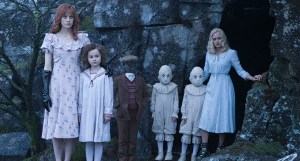 There’s a whimsical nature to the dark elements, and the script is rife with enjoyable payoffs and fun moments that cry out for a full visual immersion. This is Burton’s best film since 2007’s Sweeney Todd (I have a soft spot for that macabre musical), arguably best since 2003’s Big Fish, and maybe his most fun movie since his 90s heyday. If you’re a Burton fan, you’ll be tickled by all the imagination and humor. I grew up on the cinema of Beetlejuice and Edward Scissorhands and The Nightmare Before Christmas (yes, directed by stop-motion maven Henry Selick but still very much a Burton film), so I’ll admit that seeing Burton in high form once again warmed my little mischievous heart.
You get a sense just how involved Burton was in the filmmaking and its details, the degree of passion and involvement, and also his commitment to being a dark movie intended for peculiar children and adults with macabre interests all over the world. I kept thinking that the 12-year-old version of myself would have adored this movie, never mind the 34-year-old version of myself who greatly enjoyed it too. This feels like a natural evolutionary step for children and adolescents who gorged themselves on the works of Edward Gorey and R. L. Stine. It’s not a significant spoiler but it’s something I feel you, dear reader, need to know in order to properly assess just how wonderfully morbid the movie can come across. There is an entire visual feast of a group of villains dining upon the delicacy of… children’s eyeballs. You read that right. It’s a silver platter piled high with severed eyeballs, and they get slurped down like it’s spaghetti. I could only cackle to myself at the audacity of the movie to embrace the fun of the darkness rather than hiding from it, mitigating it, trying to be delicate with tone. The villains want to return to a normal state that can only be achieved by consuming the eyeballs of peculiar children, and so they are hunted not for sport or prejudice but for eyeballs. That’s wonderfully squirmy, and it definitely affected me, an avowed cinema patron who gets extra squirmy with any onscreen eye trauma. There are other creepy and memorable moments, like a dead child being used as a ventriloquist doll and the slenderman-styled hallows creatures. The moments are plenty but they don’t choke the story’s momentum, which hums along with great imagination and lucidity.
There’s a lot going on with Miss Peregrine, and Jane Goldman’s (Kingsmen) screenplay juggles a lot of rules and world building without losing momentum. I was intrigued early and the movie would widen its focus, providing more texture and connection to the world in calculated doses. It was enough that I always felt like I was learning something while still being able to see how the pieces snapped together in retrospect. There’s time travel that has to be done at a very specific point, the rules of who can travel back in time to these bubbles of safety, the history of this specific day stuck in time, the non-linear history of the protectors, the fact that the bubbles are also teleportation hotspots, the history with Jake’s grandfather, the history of the Ymbryne and their powers, the powers of all the peculiars, dream prophecy, mad scientists and their peculiar ailments, the differences between the hallows and the predatory scientists, and also establishing the character dynamics of several lost children and a budding YA romance. It’s amazing that Goldman’s script is as understandable as it is considering all that heavy lifting. It’s not completely free of muddled plot points and some hazy explanations, but those instances are a clear minority to what works so effectively. I wanted to know more about this world, and once they added time travel and teleportation, I was hooked. I enjoyed the movie so much that I’m considering reading the additional books for my next freaky fix.
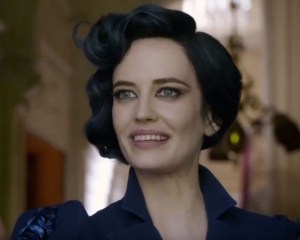 The acting ensemble is full of bright spots and none brighter than the new queen of genre gusto, Eva Green. I raved about Green’s magnetic performance in the considerably lesser 300 sequel. She was easily the best part of that movie and it suffered whenever she wasn’t on the screen. The same can be said for the too-long-in-the-making Sin City sequel. She was the best thing in Burton’s otherwise forgettable Dark Shadows feature. In short, this woman is incredible, and she digs into the vampy and ridiculous with the right degree of malevolence and glee. Green is a wonderful hostess into this magical world, and her foreknowledge gives her a caffeinated energy that makes her even a tad more peculiar. Her children are all fine actors who have uneven parts thanks to the unfair distribution of their powers. Not everyone gets super useful abilities. I felt sorry for the kid who projected his dreams from his eyeball especially during the third act scuffles. A mouth in the back of the head doesn’t seem very useful either. I enjoyed the idea that the invisible kid needs to be fully naked to be fully invisible, and everyone acknowledges this reoccurring fact with shoulder-shrug nonchalance. The standout amongst the peculiars is Ella Purnell as the winsome girl who will float away. She has an innocent and yearning quality that doesn’t sink her character. She’s more than just a love interest to Jake and Purnell helps channel great affection. Jackson (The Hateful Eight) is expectantly highly entertaining as the lead villain and Butterfield (Ender’s Game) is perfectly acceptable as an audience surrogate into this wild world.
I was duly impressed with just about every element, from the structure of the screenplay and its precision with information and intrigue, to the level of acting, to the dark and whimsical tone, to Burton’s own peculiar particulars that fill out the film with adoration. It may sound corny but there is an affection woven throughout the film, for its dispirit outcasts, for their strangeness, for the ardor of telling a spooky story that can appeal to children without pushing away adults. There’s a care that’s been absent Burton’s other recent films, especially Dark Shadows, which left me bewildered whether Burton had any genuine fondness for the source material. Miss Peregrine’s Home for Peculiar Children is a haven for fans of the peculiar, Burton’s oeuvre, and those looking for a quality children’s film that has some bite. I can only hope for more fantastical adventures.
Nate’s Grade: A-
Share this:

The Light Between Oceans (2016)
 A melodrama through and through, The Light Between Oceans is at its core a pretty-looking movie about pretty-looking people being sad. The premise almost seems like a parody of prestige indie filmmaking in the 1990s. Tom (Michael Fassbender) is a shell-shocked WWI vet-turned-lighthouse keeper in Australia who falls in love with mainland lady, Isabel (Alicia Vikander). They marry and have difficulty conceiving, with Isabel enduring two grueling miscarriages. Then one day a dingy washes ashore with a crying baby inside and a dead man. Rather than alert the proper authorities, they decided to bury the man and raise the child as their own. Years later, the couple discovers the girl’s real mother, Hannah (Rachel Weisz), who has been racked with unanswered grief ever since. The couple is then thrown into an emotional crucible testing their ethics and moral compromises and the question of ultimately what’s in the best interest of this little girl. It’s a movie that’s geared to put you through an emotional wringer, and the actors do their part. Vikander (Oscar winner for The Danish Girl) is downright luminescent and dives deep into all of her character’s varied and heightened emotions. The scenes of her dawning realization of the miscarriages and her helplessness are heartbreaking without being maudlin. Weisz is shaken to the core when her identity is robbed from her; she’s so fragile and holding on to hope so hard you might think she’ll collapse any moment. Fassbender internalizes the most and fully communicates the inner struggle of his character’s guilt. Director and chief adapter Derek Cianfrance (The Place Beyond the Pines) has made an intimate relationship drama in a beautiful, sea-swept location, and the kind of Big Feeling classy melodrama you came to expect from Anthony Minghella. The problem is that Cianfrance’s characters are held too much at arm’s length for resonance. We empathize but not nearly as deeply as we could, and by the end the movie washes away like the surf.
Nate’s Grade: B-
Share this:

Ben-Hur (2016)
 How can one review the 2016 version of Ben-Hur without bringing up its multitude of predecessors, chiefly the 1959 Best Picture winner with one of the greatest sequences in all of cinematic history? I try and judge each movie on its own merits but remakes are difficult by nature because without the fame and hopefully good will of the original, they wouldn’t ever exist, and yet they have to find their own voice and purpose in order to justify why we even need another version of the movie. I understand some of the excuses why even tackling a new Ben-Hur would be advisable, mostly coming down to a more audience-friendly running time that’s half of the 1959 classic. Of course truncating a four-hour biblical epic has its own problems too, and while this newest Ben-Hur isn’t a three-chariot pileup of a misguided mess, it certainly pales in comparison and comes across mostly as a jazzed up yet mediocre imitation of something immutably great.
Judah Ben-Hur (Jack Huston) is a wealthy first century Jewish man who is sold into slavery as punishment from his adopted brother Mesalla (Toby Kebbel), a Roman soldier. Messala is also one of the greatest chariot racers for the Roman Empire, and so Ben-Hur, after surviving a slave ship shipwreck, rises to the top of the chariot ranks to confront Messala, seek vengeance, humiliate him, and find his family once more.
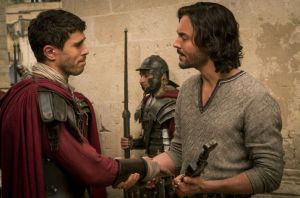 It’s obvious that this new remake wasn’t going to banish any cinephile’s memories of the 1959 version, but some of the decision-making handicaps the overall impact of the 2016 version, chiefly among them the characterization and casting of its lead. Judah Ben-Hur is definitely lacking when it comes to being a strong and engaging hero. The casting of Huston does not abate this. For fans of TV’s Boardwalk Empire, it’s clear that Huston can be a very capable and intriguing character actor, and he has an easy handsomeness that might slide him readily into mainstream big-budget projects. The problem is that Huston lacks the gravitas the role requires and this is further hampered by the limited characterization, and the two negative qualities twist together, lessening and lessening the quality of the picture. He’s certainly no Charlton Heston (unfair comparison, I grant you).
Here’s how bland it got: I was feeling more sympathy for the character presented to be the central antagonist. In the first act, I felt more for Messala and his plight than I did for Ben-Hur, and I’ll explain why. Ben-Hur comes from a wealthy Jewish family and a life of privilege, yet Messala did not want to fall back on this and wanted to make his own path, joining the Roman army. He returns several years later and connects with Ben-Hur, asking him to help root out zealots that would jeopardize a peace with Rome and incite violence against innocents. It so happens Ben-Hur is secretly harboring a zealot and, surprise, the guy stupidly tries to assassinate Pontius Pilate in full view of the Middle Eastern world. Ben-Hur allows the zealot to flee for his own safety. Messala has little choice in bringing some consequences but he’s asking for the zealot’s name, you know the guilty party, or else he knows that Ben-Hur’s family, Messala’s adopted family, will suffer in place as punishment. He’s begging his brother, pleading with him, and yet Ben-Hur refuses even though it may cost his own family members their lives. This plot point, by the way, is new. In no other version of Ben-Hur does a zealot jeopardize the Ben-Hur family. It’s always been an overreaction to the accidental coincidence of falling tiles from the family roof that doomed Judah Ben-Hur to slavery. This change makes the protagonist more culpable. It was here that I felt I was on Messala’s side. My friend Ben Bailey likens this to siding with a “kind Nazi” and says Rome was the Evil Authority that should be bucked at every opportunity and burnt to the ground. I don’t know what this says about me but I think it shows that the writing failed to make me root for our hero.
The movie gets slightly better once Morgan Freeman enters, as most movies do, and from there the plot streamlines into training to be a world-class chariot driver to take away from the glory of Messala and thus the roman overlords. The story follows familiar underdog plot beats seen in other sports genre movies from hob-knobbing with the disdainful and overconfident elites to training montages; it’s all here. It’s all marching toward that climactic brother vs. brother chariot race, and I’ll give the filmmakers credit that it’s respectable. There are some genuinely exciting moments and some great camera angles to communicate the danger and thrills of the action. The editing is a tad too choppy and the camera setups strangely favor far too many close-ups for a large-scale competition. Nothing could compare to the 1959 chariot race, which still holds up as one of cinema’s greatest sequences, more so with the renewed appreciation for practical effects. It’s not CGI horses and chariots and people in the stands cheering along. All of that is real and all of it is stunning to witness play out to tremendous realistic heights.
Director Timur Bekmambetov (Abraham Lincoln: Vampire Hunter) is not exactly the first name you might think of tackling a biblical epic. His sensibilities seem, at first glance, a bit lowbrow for such a venture, but the man is a gifted visual stylist, as he’s shown to perverse degrees in the perversely watchable Wanted. If you’re trying to bring the story of Ben-Hur to a new audience for a new century, Bekmambetov will at least ensure that it looks pretty, and most certainly it does. The biggest fault is with the challenges of the adaptation and the shortcuts and alterations that hamper the development of the characters and their ultimate arcs. Bekmambetov has one virtuoso sequence, and no it’s not the chariot race. It’s when Ben-Hur is chained in the galley of a slave ship and becomes one of the rowers. We’re trapped in his limited perspective during an attack sequence and it’s a terrific sequence. The confusion, the adrenaline, the fear are all accurately portrayed, and as the battle escalates and the ship is under attack and eventually sinks, it’s a race to escape his chains that is visually striking and exhilarating to watch. I don’t blame the director for this movie not working well.
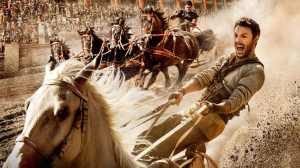 Another side effect of the overall truncating of the Ben-Hur saga is that the religious elements, namely the inclusion of Jesus Christ, feel really tacked on and obvious, reaching for a faith-based audience but doing so clumsily. Jesus (Rodrigo Santoro) is on the outskirts of the events of the movie, just enough to clue you in to his parallel presence (“Oh look, it must be Palm Sunday”), but he’s really another means to an end. The purpose of Jesus is to (spoiler alert) help facilitate Ben-Hur to abandon his anger and vengeance and instead adopt a position of forgiveness for Messala. The problem is that at a little over two hours long, and with the Jesus stuff fully feeling flimsy and tacked on, this big turning point for our protagonist also feels flimsy. Why would he be moved by the sacrifice of Jesus when his knowledge of the guy is primarily a helpful carpenter who fetched him water when he was thirsty? It doesn’t add up the way the movie wants.
Was a Ben-Hur remake doomed to fail considering the parameters it was fighting against? Not necessarily. While no remake will ever displace the majesty of the 1959 classic, a new movie doesn’t have to, merely opening up a new angle on a familiar story (the novel was originally published in 1880) and providing something of substance. It doesn’t have to cancel out one good movie to be its own good movie. There are enjoyable aspects of this newest Ben-Hur but all they end up becoming are aspects, frayed bits that fail to become a satisfying whole. It was a mistake to cast the blandly effective Huston in the lead and leave the character underdeveloped; a protagonist can survive one of these sins, not both. It was a mistake to coast for as long as it does with its second act. It was a mistake to provide more significant supporting characters, and Jesus doesn’t count. It was a mistake to film much of a chariot race in tight close-ups. This is not a disaster despite the money that will likely be lost. It’s easy enough to watch but hard to fully connect, and those memories of the 1959 film keep creeping back, providing unflattering comparisons.
Nate’s Grade: C+
Share this:

Free State of Jones (2016)
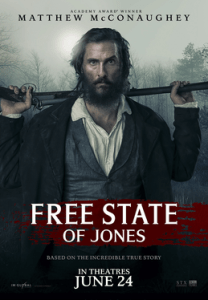 Well meaning and somberly recreated, Free State of Jones is a historical drama that wants to illuminate the story of Newton Knight (Matthew McConaughey) who deserted from the Confederate army and seceded from the very people who seceded from the United States. Knight and the people of Jones county Mississippi declared themselves independent and awaited the consequences. At first the Confederate army is annoyed, but as armed skirmishes increase and Knight’s team swells with poor farmers and runaway slaves, garnering Robin Hood-esque folk hero status, you’re expecting an escalating level of force that will doom Newton. We’ve seen this kind of historical drama before where men (usually men) of courage and politics ahead of their time are stamped out by the forces of oppression and we then celebrate their noble sacrifice. I kept waiting for Jones to go this route, and then (slight historical spoilers) the Civil War ends and instead the last half hour is an episodic history tour that includes the rise of the KKK, registering freed black men for voting, and early voter suppression acts. There is also a storyline strewn throughout that takes place in a 1940s Mississippi courtroom. At first you’re left scratching your head about the flash forwards, and then the connections come to bear. We’re watching Knight’s (great?) grandson and his legal troubles because the courts don’t know whether he’s the byproduct of Newton’s first wife (Kerri Russell), who left him, or his common law second wife (Gugu Mbatha-Raw), a former slave. It’s a storyline that just doesn’t really gel with the movie as a whole and really only serves to remind you that 100 years later Mississippi was still a pretty terrible place to live. Free State of Jones’ failure is that it doesn’t make this slice of history emotionally engaging. We don’t get a strong sense of whom Newton is as a person except for his 99% rabble rousing. His relationship with Mbatha-Raw’s character is the most engaging part of the film given its inherent conflict, and I’ll credit writer/director Gary Ross (Seabiscuit) with how restrained he is about dealing with her sexual abuse from slavery. The relationship is treated very tenderly and Mbatha-Raw aces her scenes. Also warning to dog lovers: there are several sequences of violence against man’s best friend that will be hard to watch. Free State of Jones works better as a history lesson rather than as a fully formed movie.
Nate’s Grade: C+
Share this:

Hail, Caesar! (2016)
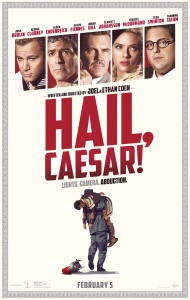 The biggest enemy of the celebrated Coen brothers always seems to be expectations. I count only two misfires during their storied filmmaking careers, but sometimes their larks are pilloried for not quite measuring up to their masterpieces. Hail, Caesar! is on par with Burn After Reading and O Brother, Where Art Thou? It’s still a fun, fizzy, and entertaining film and a celebration of Old Hollywood and its movie magic. Loosely centered on an embittered studio head (Josh Brolin), the film is a series of vignettes highlighting different 1940/50s pastiches, including the realms of Esther Williams, Carmen Miranda, Gene Kelly, and John Wayne. If you’re a fan of the old Hollywood pictures and their stars, the indulgences will play better; you can certainly feel the warmth the Coens have for the films of yesteryear. The plot kicks off with a major star (George Clooney) kidnapped, but it’s really the small side stories and moments that are most memorable, and the Coens are still unbeatable when it comes to being silly and clever. I loved a scene where Brolin asks religious advisors for approval over the script of his biblical epic and they offer legitimate notes over flawed story logic. There’s also a delightful song and dance numbers with a group of sailors lamenting the lack of ladies (“But mermaids ain’t got no gams”). The real star of the movie is Alden Ehrenreich (soon to be young Han Solo) as singing cowboy-turned-actor-turned-studio-sleuth. The sequence where his character tries to rapidly adapt into a “serious actor” on the set of some British melodrama makes for great fish-out-of-water comedy, gamely matched by an increasingly exasperated Ralph Fiennes as the director. The ending doesn’t exactly tie everything together but Hail, Caesar! is more a movie of distractions, of spinning plates, or bumbling bosses trying to hide bad behavior from the press and keep hold of their sanity. If you’re a fan of old Hollywood, there should be just enough to make you smile. If you’re not a fan, then you’ll shrug off the Coens and their latest film lark.
Nate’s Grade: B
Share this:

The Nice Guys (2016)
 Ever since I heard about its production, and especially after watching the first trailer, I have been intensely anticipating The Nice Guys, mostly because of my fervent and undying love for 2005’s Kiss Kiss Bang Bang. That gem was writer/director Shane Black’s manic and deliriously entertaining comedy noir that reinvigorated star Robert Downey Jr.’s career. The Nice Guys looked very much like a spiritual successor or predecessor given its swanky 1970s setting. While an enjoyable and funny caper, there is a significant gap between KKBB’s genius and the altogether amusing though lesser escapades of The Nice Guys. Perhaps it’s unfair of me to have had my expectations too high, to be hoping for another magical onscreen alchemy like KKBB. Whatever the case, I was slightly let down by The Nice Guys around the time I realized that the best jokes were in the trailer. They are admittedly great jokes but what was left too often hit lower registers of funny. Ryan Gosling and Russell Crowe have great chemistry together and Gosling especially showcases a talent for physical comedy that has been underutilized. When the movie finds ways to undercut detective movie tropes, like Gosling cutting his hand badly after a failed attempt to break into a locked window, that is when it feels most alive and fun. The action elements don’t feel as significantly connected, like a bunch of washout villains like a hitman named John Boy who has no memorable personality. The shaggy dog mystery has some entertaining detours but once again the real draw is the comic interplay of the two male leads and Black’s razor-sharp dialogue. The man perfected the buddy cop interplay at some point, and often the casual conversations and one-liners are more highlights than the set pieces. The Nice Guys is a funny, smart, and diverting detective action-comedy that is a solid effort from everyone involved. It’s just that I was hoping for a touch of the divine again and had to come back to Earth.
Nate’s Grade: B
Share this:

Carol (2015)
 Have you ever watched a movie that was so understated you wanted to jump into the onscreen world and push the characters around? That’s exactly how I felt with Carol, an unrequited lesbian romance set against the closeted and intolerant era of 1950s America. Carol (Cate Blanchett) is a rich wife who meets Therese (Rooney Mara), a department store employee who assists with her Christmas shopping. They are both drawn to one another in the strange way that love works, and their possible relationship could jeopardize Carol’s custody of her young child. Because of the time period, so much of this romantic liaison is internalized and thus we get longing looks, small gestures that are meant to speak volumes, and plenty of starting and stopping, leaving the audience to fill in the blanks. I don’t have an issue with unrequited romances but Carol is one that feels like its entire world, painstakingly recreated, has been placed under glass for study. There’s no passion evident throughout the movie and I was left wondering what exactly Therese saw in Carol and vice versa. Neither woman has a particularly strong personality, though that could be a side effect of having to live publicly as a different person. I couldn’t get into them as characters and so felt little interest in seeing them together, which made the constant circling and nervous indecision even more belabored. Blanchett and Mara are quite good and director Todd Haynes (I’m Not There) handles the material with respectful subtlety, I just wish that Carol could have shaken off some of that subtlety and given me a better reason to care about these women. It’s understated to death.
Nate’s Grade: C+
Share this:

The Hateful Eight (2015)
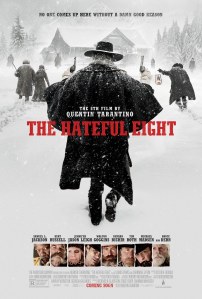 The Hateful Eight almost didn’t happen thanks to our modern-day views on copyright and privacy. Writer/director Quentin Tarantino sent the first draft of his newest script to three trusted actors, and within days it had spread to the outer reaches of the Internet. Tarantino was so incensed that he swore to shelve Hateful Eight and never film it. After a staged reading in L.A. with many of the eventual actors for the film, he changed his mind, to the relief of his sizable fanbase and actors everywhere. The Hateful Eight is a drawing room mystery with plenty of Tarantino’s signature propulsive language and bloody violence, but it’s also the director’s least substantial film to date.
In post-Civil War Wyoming, famous bounty hunter John “The Hangman” Ruth (Kurt Russell) is taking the outlaw Daisy Domergue (Jennifer Jason Leigh) to hang for her crimes. Along the way, he meets up with Major Marquis Warren (Samuel L. Jackson), a bounty hunter who served in the North and carries a letter written to him from none other than Abraham Lincoln. They’re both heading to Red Rock to extract their bounty earnings. Due to an oncoming blizzard, they’re forced to make a stay at Minnie’s haberdashery, except Minnie isn’t anywhere to be found. There’s Bob the Mexican (Demian Bichir) who says Minnie left him in charge, a foppish hangman Oswaldo Moblay (Tim Roth), a quiet cattle driver Joe Gage (Michael Madsen), a Confederate general, Sandy Smithers (Bruce Dern), and Chris Mannix (Walton Goggins), the son of a Confederate rebel who claims to be the newly designated sheriff of Red Rock. Over the course of one long night, everyone’s true identity will be learned, because someone is not who they seem to be and is secretly waiting to free Daisy and kill the rest.
 Even as lesser Tarantino, The Hateful Eight is still an entertaining and talky stage play put to film. The setup is strong and invites the audience to play along, to scrutinize the assorted characters and determine who is telling the truth. There are plenty of twists and turns and some violent surprises to keep things interesting. The conversations of the characters are such a pleasure to listen to; I want to luxuriate in Tarantino’s language. His wordsmith abilities are unparalleled in Hollywood. There’s a reason every star is dying to snag a part in a Tarantino movie, especially now that they’ve caught Oscar fire as of late. That’s somewhat crazy to think about. Cinema’s ultimate indie voice with his encyclopedic knowledge of the medium, high and low art, has become an institution within the system and his violent period films are now looked at as year-end prestige pictures. Tarantino’s M.O. has been to take B-movies and to transform them into A-movie level talent and intelligence. Never has a Tarantino flick felt more B-movie than The Hateful Eight. It was inspired from episodes of TV and it’s easy to see that genesis in its execution. It’s a self-contained mystery that comes to a head. It’s a limited story that’s likely taken as far as it could possible go, pushing three hours. I’m a tad befuddled why this was the movie Tarantino insisted on filming in “glorious Panavision 70 millimeter.” It’s almost entirely set in that one-room interior location. The extra depth that 70 millimeter affords would appear to be wasted, unless you enjoy looking at general store items on shelves in the background. Still, The Hateful Eight is a movie that doesn’t feel like three hours and harbors enough intrigue and payoffs to hook.
I tried to diagnose why this felt like lesser Tarantino, and it’s because over the course of almost three hours we don’t have much at stake because the people inhabiting the movie aren’t really characters but tough-talking facades. Tarantino is often cited for his uniquely florid dialogue, and nobody writes dialogue like Tarantino and his naturally stylized cadences, but another of the man’s skills is how great he can write a coterie of colorful characters that pop from the big screen. You might not be able to remember many lines from Hans Landa or Vincent Vega or Django, but you remember the vivid characters. Tarantino is preternaturally skilled at building characters that feel fully realized with their own viewpoints and flaws and prior experiences. He can make characters stand out but he also has the great ability to make the larger-than-life characters feel real, which is truly genius screenwriting for characters so flamboyant. The older romance in Jackie Brown is perfectly captured and felt. It’s downright mature. This is the first time I would say Tarantino has disappointed when it comes to his characters.
There are broadly drawn folk aplenty onscreen and they still talk in that wonderfully florid language of Tarantino’s that actors must savor like a fine steak, something they can sink themselves in for and enjoy every morsel. However, the characters onscreen have never felt this empty before. They are what they are and the only real change that occurs is that many will be dead before the end credits. They don’t have arcs per se but end points. It’s all about unmasking and identifying the rogues in a room full of rogues. Beyond Warren and Mannix, we’re left with precious little for characterization beyond bravado and nihilism. The effect of how empty they are would be felt less if we weren’t stranded with them for near three hours. Trapped in a room with a group of suspicious characters can only go so far, and ultimately it’s a parlor game that cannot sustain longer staying power. I doubt I’ll ever watch this with the frequency of other Tarantino flicks.
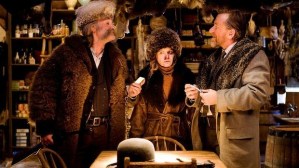 “You keep talkin’. You’re gonna talk yourself to death,” says one of those hateful numbers to another member. I’d pay to listen to Tarantino rewrite the phone book, that’s how excellent the man is with his dialogue. The man likes to hear his words and I like listening to them too. The problem is that The Hateful Eight has no reason for its gargantuan running time. As stated above, the characters we’re getting are nowhere near as complex or interesting as previous Tarantino escapades, so the talking can grow weary. Tarantino has patented a new formula from 2009’s Inglorious Basterds that involves characters playing a game of I-know-you-know-I-know while they suss out the truth, all the while the tension finely simmers until it blows. It’s a long fuse of suspense that can pay off rich rewards, like the near-perfect tavern scene in Basterds. The dinner table scene with Candie and the skull of his favorite house slave is another good example. Once our titular eight have gathered at Minnie’s, the entire movie is this sort of scene. It may be broken up into chapters and flashbacks but it feels like one long scene.
There’s also far less at stake than there was with Basterds or Django Unchained, even Reservoir Dogs, and that’s because the protagonists had goals and we had built up far more allegiance and time with them. When they were in danger, it mattered. The danger doesn’t feel as immediate because so little else is happening. There are plenty of comparisons to Dogs, which also utilized a hidden identity and a confined location. I think the difference was that, besides it being Tarantino’s first foray as a director, the tension was felt more because the danger was immediate from the start and we cared about character relationships. I cared about Mr. Orange and Mr. White and their bond. I can’t say I cared about any of the characters in Hateful Eight. I found them interesting at points, sure, but they were all a bunch of rotten bastards with little variation short of a burgeoning understanding between Mannix and Warren. The wait at Minnie’s feels like the Basterds tavern scene on steroids, pushed to the breaking point, and yet absent the urgency.
The acting is yet another tasty dish served up by Tarantino, and it feels like the actors are having the time of their lives playing their lively scoundrels. Jackson (Kingsmen: the Secret Service) settles in nicely and always seems to elevate his game when he’s reciting Tarantino’s words. He’s icy cool in scenes where the other characters are trying to do whatever they can to fire him up. He’s less bombastic than we’ve come to expect from Jackson. For bombast, there’s Russell (Furious 7) who cranks his performance to the broad heights of his bellicose lawman. Goggins gives a sly and extra caffeinated performance that answered the question of what it would sound like if you dropped his character from TV’s Justified into a Tarantino movie. Roth (Selma) feels like he’s doing his best manic Christoph Waltz impression. Dern (Nebraska) is a racist codger with a soft spot for his kin. Madsen (Kill Bill vol. 2) seems somewhat wasted as a taciturn “cow puncher.” Bichir (The Heat) gets some laughs as a seemingly aloof caretaker. It’s Leigh (Anomalisa) who steals the show, especially in the film’s second half. Daisy is a character that relishes being bad, and Leigh takes every opportunity to enjoy the fun. Her character plays a bit of possum during the first half but it’s the second half where she lets loose and becomes unhinged, and her exasperated and grotesque responses are often played for great sputtering comic effect. It’s a boys movie but it’s the lone woman who will prove most memorable. Tarantino’s last two movies have won acting awards and Leigh just might make it three-in-a-row.
 There are also some uncomfortable elements that can deter your viewing enjoyment, which isn’t exactly a foreign charge against Tarantino’s career. At this point you can probably repeat the oft-cited accusations: flagrant use of the N-word and exploitative violence. At least the historical background provides a context for the other characters unleashing the N-word, and I’d argue it tells us something about the characters as well. The characters that use the N-word when referring to Warren are the ones with allegiances to the Confederacy and those viewpoints don’t vanish even after you lost a war. They’re dismissive and intolerant and view Warren as sub-human. It also doesn’t approach Django Unchained-levels of excess, so I let it slide (I know my perspective as a white male makes my opinion on this effectively meaningless). It was the violence that got to me, specifically the violence directed at Daisy. Tarantino’s penchant for violence goes all the way back to his ear-slicing debut, so it’s nothing unexpected. He often tells stories about violent men and women fighting their way in a world governed by violence. I accept that these characters are bad to their core. That doesn’t excuse behavior. Violence on screen can be tempered with authorial commentary, but it’s the association that bothered me with Hateful Eight. For the entire movie, Daisy is put through the physical wringer. Our very first image of her is with a black eye. She’s a nasty woman and Ruth often expresses his distaste of her by punching her in the face, which is played as dark comedy. This happens repeatedly. We’re meant to recoil from much of the bloody violence on screen but repeatedly we’re meant to laugh at the violent suffering of Daisy. Tarantino has often used over-the-top violence as dark humor, and I’ve laughed along with it. This was one instance though where I stopped laughing and starting shifting uncomfortably in my seat.
Even lesser Tarantino can still be plenty entertaining and superior to most of what Hollywood usually cranks out as product. The Hateful Eight can be exciting, funny, surprising, and plenty of things, but what it can’t be is more than a lark. Tarantino has taken stories that would seem like larks, particularly the Kill Bill series, and infused them with pathos and meditation and soul to go along with all that snazzy genre stuff. It’s disappointing that Hateful Eight isn’t more than what’s on screen, but what’s on screen is still worth watching, though I don’t know whether it’s worth watching a second time.
Nate’s Grade: B
Share this:

In the Heart of the Sea (2015)
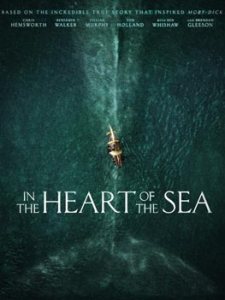 In 1822, the men aboard the Essex, a whaling ship sailing from Nantucket, Massachusetts, encountered a beast unlike any they have ever seen. Captain Pollard (Benjamin Walker) and his first mate, Owen Chase (Chris Hemworth), were at odds throughout the voyage, that is until they encountered a 100-foot long white whale. The creature destroyed the Essex, forcing the crew to drift at sea and hope to find land, but the whale follows them as well. Tom Nickerson (Tom Holland as a young man, Brendan Gleeson as the older version) recounts this traumatic survival tale to author Herman Melville (Ben Whishaw), who is desperate to write this true story.
There’s an old-school throwback vibe to In the Heart of the Sea with its high seas adventure, but there’s just not enough attention to adventure, character, or even plot for this movie to really set sail properly. The first act feels so sluggishly long. It’s trying to set up life on a whaling vessel in the early 19th century but I didn’t feel like we got a coherent sense of life aboard the seas or how the various components worked. I didn’t know that whalers row out from the main ship, so there’s that. The opening act sets up the dull conflict between Chase and Pollard, which can be summarized as blunt upstart vs. unchecked privilege. The conflict doesn’t evolve from this dichotomy. Both men are boring in their unyielding simplicity. Hemsworth (Avengers: Age of Ultron) made a stronger impression in Rush, but a humorless movie role is not in his best interests as an actor. When the action does arrive, it can be genuinely thrilling. Director Ron Howard does a slick job of conveying the danger and destruction of the whale attack. Sadly, it’s over too soon and then the remainder of the movie is 45 minutes of a survival drama adrift in the ocean reminiscent of last year’s Unbroken. This period of isolation forces the characters to make some hard choices, yet we don’t feel the impact of those choices because the narrative, too, feels adrift. Implausibly, the giant whale has followed them for thousands of miles. Are whales really this vindictive? The documentary Blackfish makes me wonder but it still feels unbelievable. What was the whale waiting for? For the men’s spirits to be completely broken before it might attack again? We’re told this whale is a “demon” but who exactly are the bad guys in this story?
 I believe another stopping point for this story is that the culture has moved beyond the acceptance of whaling as an honorable profession, to the point that I, and I assume others, was on Team Whale after witnessing a bloody hunt. It’s pretty gross, especially when they’re harvesting the whale body for the precious oil. Perhaps modern audiences, so far removed from hunting as an essential component of life have become more squeamish, or perhaps modern audiences just recognize something as barbaric when they see it. As a result, it’s hard to root for these guys. When the giant whale attacked it felt like retribution. My sympathies were more for the large mammal than the bipeds on ship. At the end of the film (some spoilers), the white-haired moneyed men of Big Whale Oil are worried what the truth will do to their industry. They want the surviving crewmen of the Essex to deny the existence of this gargantuan whale. This makes little sense to me other than awkwardly forcing a Big Business cover-up for relevancy. First off, whaling seems like a pretty unsafe working environment to begin with, especially considering voyages could last up to three years. Would the reality of one big bad whale destroy an industry? I doubt it since there is such money to be had. If anything it might rejuvenate the timber industry to reinforce the ships to make them more durable against larger whale attacks.
At first I thought a framing device was entirely superfluous; why do we need to watch Melville elicit this tale rather than simply just watching the tale itself? It seemed like a distraction, but as the movie progressed I understood that this framing device was its own sub-story and had its own complexity, namely the older Tom coming clean to the decisions that still haunt his soul. It’s an unburdening for both gentlemen, as Melville admits his deep fear that he is a mediocre writer (he’s no Nathaniel Hawthorne) and that he will be unable to tell this story as well as it truly deserves.
As these two men are allowing themselves to become more vulnerable and sharing their demons and doubts and worst fears, I started to realize that this framing device was weirdly more compelling than all the whale action. That’s because older Tom and Melville are the best drawn characters in the movie, which seems like a screenwriting mistake of sizable proportions. Obviously the nautical survival stuff should be the most compelling, and yet I as more taken with two men sitting by an oil lamp discussing their lives. Older Tom is infinitely more interesting than younger Tom; part of this is because young Tom hasn’t experienced the full effect of the events that shape older Tom, but most of this is from the very clear fact that young Tom is kind of a mute witness in this movie. He rarely speaks and is just kind of there, taking up space. There’s one personal harrowing moment when he’s thrust inside a hollowed out whale carcass to extract more blubber, but that’s the only personal perspective offered through young Tom. A question concerning the framing device: how is older Tom retelling events he had no participation or witness to? Another issue is that the characters on board the Essex are bereft of anything that would allow us to feel for them beyond simple human survival. Chase and Pollard are given one note to play and their eventual understanding and cooperation is fine but it feels like fleeting details in a story, lost to memory or disinterest.
 From a purely technical aspect, this is one of the better Howard films. The cinematography by Anthony Dod Mantle (Slumdog Millionaire) is rich and often breath taking, with plenty of stunning aerial and underwater images. The whale attack sequence is harrowing and thrilling. Howard finds ways to imply the harsher aspects of this life without going overboard, maintaining that PG-13 rating. While the look of the film has an enhanced color palate thanks to the extra boost of CGI filters, I still appreciated the vibrancy of the on screen images. As I said with the similarly boosted Mad Max: Fury Road, I’d rather have vibrant and bright colors than a drab and washed-out color palate. Even as the movie drifts and the characters fail to grab you, at least the visuals are pretty. While sitting through the second half, I started to rethink my own prejudices concerning Howard as a filmmaker, a man who lacks a distinctive style but has a definite feel for how to tell a story. I’m not going to excuse him for The Grinch and other misfires, or his tendency to settle for maudlin in place of subtlety, but the man is a born filmmaker.
In the Heart of the Sea is an old school movie that feels too sluggish, too underdeveloped, and too free of characters for the audience to invest in. When the framing device scores the biggest emotional pull, you better start rethinking your rip-roaring high-seas adventure. Master and Commander this is not. As the inspiration for Moby Dick, I wish I had just watched a remake of Melville’s actual novel (now with extra chapters about rope!). If you ever wanted a movie that ends on a blurb by Nathaniel Hawthorne as a payoff for Melville’s artistic neurosis, then your wait is over. In the Heart of the Sea feels like a whale of a tale that is hard to believe, which ends up inspiring a far greater story, which made me yearn for just watching that superior tale. Sometimes the “truth” behind famous stories is less interesting.
Nate’s Grade: C+


 nathanzoebl
You must be logged in to post a comment.