Blog Archives
Bowling for Columbine (2002)
 Documentary filmmaker, political activist and corporate pot-stirrer Michael Moore prefaces his latest film Bowling for Columbine by admitting his lifetime membership in the National Rifle Association (NRA). He even received a marksmanship award as a teenager in his hometown of Flint, Michigan. Bowling for Columbine is Moore’s sprawling and hilarious search for answers among America’s zealous gun culture and alarmingly high number of homicides. It’s the tangents Moore just can’t help but take along the ride that add some of the more fun moments.
He opens a checking account at a Michigan bank that’s offering a gun for new customer accounts. Moore astutely asks an employee, “Do you think it’s a good idea handing out guns in a bank?” Moore travels to Canada to find out what reasons exist that make our cultures so different when it comes to crime. After hearing from citizens about how they don’t lock their doors, Moore decides to go door-to-door and see for himself. Sure enough, he walks into half-a-dozen homes.
Moore is better at pointing the finger than fathoming real answers. He touches media sensationalism, our nation’s bloody history, corporate greed, past military involvement, and an environment of fear being developed by those who profit from such actions. The sobering truth is that there are no easy answers to be debunked. The film’s climax involves an impromptu sit-down with NRA president Charlton Heston. Moore questions the sensitivity of the NRA after it held support rallies days after the school shootings in Littleton and Flint. Heston becomes weary and walks out of the interview after five minutes.
The film demands to be seen. It’s complex, challenging, and thought-provoking. Not only is Bowling for Columbine the most important film of 2002, it’s also one of the best.
Nate’s Grade: A
Share this:

My Big Fat Greek Wedding (2002)
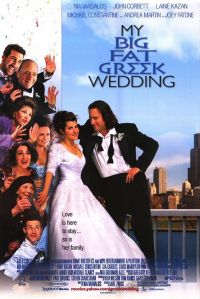 Toula Portokalos (Nia Vardalos) opens by telling us that as a Greek woman she has three responsibilities, “1) Marry a Greek boy. 2) Have lots of Greek children. 3) Make lots of food.” Toula works in her family’s restaurant letting life pass her by, while her father pleads with her to get married even though she is already “old” at 30. It doesn’t seem like that day will ever come for Toula, nor is she looking forward to it, until a handsome stranger (John Corbett, Aidan from Sex and the City) catches her eye in the restaurant. Through more encounters the two seem to have sparks flying off from the heat they generate. He pops the question and Toula happily says yes. There’s only one slight problem – he’s not Greek.
My Big Fat Greek Wedding isn’t anything provocative or innovative but it does have its charming moments and engaging humor. These “ethnic family comedies” are really a double edged sword to work with. You see, they will exaggerate the cultural eccentric-ness of the characters to the point of gross parody but then rely on them to become endearing lovable characters who the audience appreciates for the very same reasons it’s laughing at them. And while Greek Wedding can be found guilty of this notion as well it really does take someone from the inside to come up with this stuff, so there must be some love there to start with.
Vardalos, who also wrote the script, is a perfect casting choice exactly because of her everyday looks. This isn’t someone like Jennifer Aniston trying to pull off being poor and un-pretty; this is a normal looking gal pulling off normal. It works exceptionally and Vardalos certainly knows how to hit a joke. The supporting cast of goofy yet lovable Greeks is played with admirable gusto by the many assembled players. A favorite of mine is the elderly grandmother who continues to try and escape from their home. And yes, an N’SYNC member is in this movie. Why I will never know. Is he even Greek? Is “Fatone” a Greek name?
My Big Fat Greek Wedding is a big helping of family comedy and easy to see why it’s become as crowd pleasing as it is. It’s nothing new or extravagant, but hey, I’d easily go see this again than ever venture close to a theater showing XXX or Blue Crush or Pluto Nash or The Master of Disguise or…
Nate’s Grade: B
Share this:

Monster’s Ball (2001)
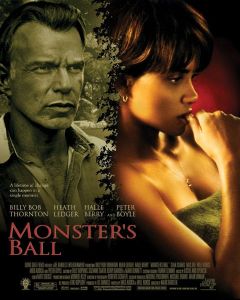 Monster’s Ball has already garnered two Oscar nominations, including one for the lovely Halle Berry for Best Actress, and received numerous end of the year accolades. Is Monster’s Ball the startling ruminations on race that you’re being told? Well
yes and no.
Monster’s Ball has already garnered two Oscar nominations, including one for the lovely Halle Berry for Best Actress, and received numerous end of the year accolades. Is Monster’s Ball the startling ruminations on race that you’re being told? Well
yes and no.
Set in the South, Hank Grotowski (Billy Bob Thornton) and his son Sonny (Heath Ledger) are prison guards at the state penitentiary and preparing for an execution. The man to die is Lawrence Musgrove (Sean Combs) who will be leaving behind an overweight young son and making a widow out of Leticia (Halle Berry). The tension in the Grotowski home escalates especially as Hank has chosen to care for his own ailing father (Peter Boyle), who still finds the time to spout out racist rhetoric through an oxygen mask. One last confrontation leaves a permanent mark of emptiness on the family.
 Leticia is struggling to just make ends meet and fight an impending eviction. Her car keeps breaking down on her, she’s been let go from her job as a waitress and she has to raise a son by herself all the while trying to encourage him to lose weight. Leticia is breaking down and her world around her is crumbling. One night Leticia gets into an accident walking home along the roadside and needs assistance badly. The one who pulls the car aside to help is actually Hank. As time goes by he helps Leticia however he can whether its giving her a ride home from the diner or just staying with her so she won’t be alone.
Hank and Leticia come together out of mutual need and grief. They are two people entirely wrong for each other that kindle a passion that seems to transcend race. Leticia needs someone to take care of her, after having a husband on death row and fighting to stay above the poverty line. Hank needs someone to take care of, out of a mixture of compounded loneliness and grief.
Thornton reprises the repressed protagonist of The Man Who Wasn’t There with his portrayal of Hank. His lips are pursed, looking a tad like Mr. Limpet, and he expresses more with a furrowed brow and stare than words could manage. Thornton’s performance is good, and the audience does really end up rooting for Hank, but the performance doesn’t resonate, possibly because of the writing for the character. I guess one could say Monster’s Ball is Halle Berry’s legitimization as an actress. Berry gives the performance of her career and has moments where she’s on the verge of ripping your heart out.
Monster’s Ball is not exactly the scorching portrait of race relations that it has been hyped to be. It’s really more of a story about two characters with race being underscored except for a convenient occasion where it can become the catalyst to a fight.
The film also takes some of its metaphors rather simply. The connection between father and son includes Hank and Sonny using the same prostitute. Hank eats every night in the same diner and always orders a bowl of chocolate ice cream (get it?) and black coffee (get it?).
 All the ballyhoo over the explicit sex scene (thank you so much news-fluff) is undeserving. The sex scene is no different than a hundred seen before and many on Showtime during the late hours. The scene serves its purpose thematically in the story for its characters but it really isn’t “hot and steamy” as it’s been dubbed to be. Move along, folks.
Besides the acting Monster’s Ball has some other accomplishments up its sleeve. The cinematography is gorgeous and uses lights and darks to an incredibly effective degree. There are many scenes where you might be paying more attention to how the scene looks than the scene itself. The music is also commendable for the simple task of not becoming intrusive and actually enhancing the story. This is what scores are intended to do.
Monster’s Ball may be the biggest suck-in-air-uncomfortably movie to come out in a long time. I found myself enacting this measure every time someone did something horrible, said something racists or surprisingly died. This may be because I had the entire theater to myself for my own amusement. Monster’s Ball is certainly a well-written and well-acted film. It’s just not up to snuff when it comes to Best Picture speculation.
Nate’s Grade: B
Reviewed 20 years later as part of the “Reviews Re-View: 2001” article.
Share this:

Training Day (2001)
 Denzel Washington won an Oscar for this? Instead of Malcolm X? For THIS?! Yes he gets to huff and puff as he plays against type as a dirty cop, but is this reason alone to give an Academy Award to such a forgettable and collectively implausible film? Ethan Hawk, his co-star, is actually better in the film. All I can say is right actor, wrong movie. It’s like rewarding Kevin Spacey for Pay It Forward over the other screamingly better movies. It doesn’t make sense. There are plenty of hip-hop stars making cameos or small roles (Dr. Dre, Snoop, Macy Gray) but most of the time Training Day feels like tired and dead air especially as the contrivances begin to pile onto one another the longer this day goes. And Denzel is huffing and puffing but the house still stands. Man, the voters must really have not wanted Russell Crowe to win.
Nate’s Grade: C-
Share this:

Black Hawk Down (2001)
 In the fall of 1993 Somalia was a nation being torn by civil war with feuding warlords and slowly being crippled by rampant hunger. The UN intervened to try feeding the starving nation but warlords like Mohamed Farrah Aidid cut off many of its shipments of food. The United States had plans to capture two top lieutenants of Aidid’s in the capital of Mogadishu. Over 100 Delta units and Army Rangers were sent into the heart of the Mogadishu market to execute the operation.
Things didn’t go well from the start as casualties began to pile up and first one, then two Black Hawk helicopters were shot down from ground fire. Medical vans and Humvees were continually blocked access to help the stranded soldiers by civilian roadblocks consisting of smoldering debris. It wasn’t supposed to take longer than 45 minutes. It ended up lasting over 15 hours. In the end 18 American lives were lost, over 70 were wounded, and over a 1000 Somalian lives were lost. What’s truly amazing is the courage the men displayed, and the fact that being surrounded by a sea of armed Somalians that more lives weren’t lost.
 Black Hawk Down is essentially a two-hour action sequence. The emphasis of the film is on the stark recreation of the Somalia skirmish and it is indeed an achievement in grueling realism. You truly feel like you have been thrown into the middle of this firefight. With all the gunfire and chaos it leaves little time for getting to know characters. This is probably why they have names written on their helmets so the audience can attempt some semblance of who’s who.
The film is by no means for the faint of heart. Saving Private Ryan had some intense violence, but it was mainly condensed for the opening and closing 20 minutes. Black Hawk Down, on the other hand, is two straight hours of non-stop blood and gore. The violence and the intense realism are not gratuitous but indicative of the horror these men faced. If you can’t stomach a soldier plunging his entire forearm into the chest cavity of another to cut off a bullet wound – stay at home and read a good book.
 Ridley Scott is on an ultra-violent hot streak after directing big name Hollywood tokens like Hannibal and Gladiator. His handling of Black Hawk Down is masterful, just for the simple fact of keeping the audience free from confusion. Throughout the duration we know who is where, where they want to go, and the general geography of the hot spot. The staging of the entire battle is beautifully filmed and the recreation of the Mogadishu market place is amazing in its fine detail. Some criticism has been projected at the film for portraying the Somalians as basically black people with guns. This is entirely true, but one must remember that the film is told from the American point of view.
The acting, as expected in a war film, takes a back seat to the heroic histrionics and the fireworks. Josh Hartnett is sullen in his duty as Staff Sergeant Matt Eversmann but always a comfortable figure to see on screen amidst the chaos. Ewan McGregor plays a soldier promoted to action instead of desk work and adds some touches of humor to the fray. Tom Sizemore is the most recognizable person as the often-frustrated Lt. Colonel Danny McKnight who fearlessly strolls across the battlefield while bullets whiz by.
Black Hawk Down for some will be the right movie at the right time, though it was never intended to be. The riveting action is more than entertaining and worth admission price, but you might leave pondering on the sacrifice few know the full details. Just make sure to go to the bathroom before the film starts.
Nate’s Grade: A-
Share this:

Sexy Beast (2001)
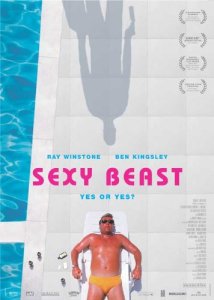 Never, under any circumstances, do you want to piss off Gandhi. Sexy Beast is a British crime story where the ferocious mad dog Don Logan (Ben Kingsley) is trying to recruit a retired hand (Ray Winstone) into one last job back in London. Winstone is enjoying the sun of California with his middle-aged ex-porn star wife who he loves dearly. But Don does not take “no” for an answer. Kingsley is the true focal point of the film and is astounding and brutally terrifying as the wound up gangster. He gives an electrifying performance that is the polar opposite of India’s non-violent leader. When Kingsley vanishes from the screen Sexy Beast suffers and becomes a variation of the old crime film, except a very short one at that being under 90 minutes of running time. Video director Jonathon Glazer has done a fine job for his debut but there isn’t much to this tale without Kingsley’s memorable efforts.
Nate’s Grade: B
Share this:

In the Bedroom (2001)
 In the Bedroom hits all the right notes of agonizing pain, devastation and loss. The heart of the film is on the grief encompassing Matt and Ruth Fowler (Tom Wilkinson and Sissy Spacek) over the loss of their son. The Fowlers are well regarded in their cozy New England town. Matt is a flourishing local doctor and Ruth teaches a chorus of local high school girls.
In the Bedroom opens with Frank Fowler (Nick Stahl) chasing his older girlfriend Natalie (Marisa Tomei) across an open grassy field. Frank is a budding architecture student home for the summer and thinking of prolonging his time so he can stay together with Natalie. Frank and Natalie have a distinct age divide but also seem to have been given different lots in life. She has a pair of boys from her abusive husband Richard (William Mapother) that she is finalizing a divorce from. Richard is hopeful he can reconcile with Natalie if he just gets another chance, but Natalie is stern in her refusal.
 Ruth sees the relationship as a detriment to her son’s future. She’s even more upset that Matt is so casual with their son dating an older, working-class mother. Frank rushes over to calm Natalie after another of Richard’s outbursts of violence has left her house in shambles. She rushes her children upstairs just as Richard returns back. He manages to sneak in through a back door and confronts Frank in their kitchen, shooting and killing him. What should seem like a clear-cut case begins to unspool. Natalie admits she didn’t actually see the gun fire and the charges are dropped from murder to manslaughter. Richard is released on bail and free to stroll around occasionally bumping into the grieving and outraged Fowlers.
The majority of the film is the aftermath of the murder and the strain it puts upon Matt and Ruth and their marriage. Beforehand jealousy, anger, and bitterness would simply sit but slowly the tension begins to bubble to the surface. Ruth holds resentment and blames the leniency of Matt for the death of their son. Matt tries to get out of the house as much as possible, even if it means sitting in his car in their driveway at night.
One of the most harrowing scenes of In the Bedroom is also its emotional and acting centerpiece. After the mounting frustration with justice, Ruth and Matt explode into an argument that had slowly been building long before their son’s death. This is the first time they have truly talked about the whole situation and accusations fly like bullets in their first emotional confrontation. In the Bedroom could have easily fallen into the area of sticky made-for-TV land, but the exceptional performances all around by the cast and the deft and studied direction never allow it to falter.
Spacek (Carrie, Coal Miner’s Daughter) can begin writing her Oscar acceptance speech right now. Her portrayal of Ruth displays the pride and seething anger, but keeps her human throughout. She exhibits pure, raw emotion that strikes directly inside you leaving a knot in your stomach and in your throat. Her performance is truly breathtaking and so emotionally visceral to watch. Wilkinson (The Full Monty) plays Matt with passive-aggressive doubt and repression. He dominates in any scene he is in and takes the audience on a wide range of emotions. He has a commanding presence and compliments Spacek’s Ruth nicely. Perhaps the greatest thing Tomei (My Cousin Vinny, Slums of Beverly Hills) was known for was miraculously winning an Oscar and dumbfounding a nation. With ‘In the Bedroom’ she is given the ubiquitous “And” credit at the end of the opening cast list. She has less to work with and less screen time to work it, fully earning the “And”‘ credit she has.
 Todd Field is an actor-turned-director and has appeared in such a wide array of films from Twister to Eyes Wide Shut. Field has layered his film with rich symbolism and an intelligent, patient pace. Most of the action in movies is centered on what is going on in a scene, but the most telling moments of In the Bedroom are what are not going on in the scenes. Field creates such an intimate portrait that the camera almost turns into another character, catching the lingering silences and the burgeoning inner turmoil. Field also adapted the screenplay from a short story by Andre Dubus, whom he dedicates the film to.
In the Bedroom is not going to be for everyone. Some will find it slow and some might even find it boring. As it stands, it is a powerful film on the study of loss that grips you and refuses to let go. You will feel all the blame, jealousy, anger, and pain of this family and for such emotions to resonate from the screen to the audience is a great achievement.
Nate’s Grade: A
Reviewed 20 years later as part of the “Reviews Re-View: 2001” article.
Share this:

Mulholland Drive (2001)
 Mulholland Dr. has had a long and winding path to get to the state it is presented today. In the beginning it was 120 minutes of a pilot for ABC, though it was skimmed to 90 for the insertion of commercials. But ABC just didn’t seem to get it and declined to pick up David Lynch’s bizarre pilot. Contacted by the French producers of Lynch’s last film, The Straight Story, it was then financed to be a feature film. Lynch went about regathering his cast and filming an additional twenty minutes of material to be added to the 120-minute pilot. And now Mulholland Dr. has gone on to win the Best Director award at Cannes and Best Picture by the New York Film Critics Association.
Laura Harring plays a woman who survives a car crash one night. It appears just before a speeding car full of reckless teens collided into her limo she was intended to be bumped off. She stumbles across the dark streets of Hollywood and finds shelter in an empty apartment where she rests. Betty Elms (Naomi Watts) is a young girl that just got off the bus to sunny California with aspirations of being a big time movie star. She enters her aunt’s apartment to find a nude woman (Harring) in the shower. She tells Betty her name is Rita after glancing at a hanging poster of Rita Hayworth. Rita is suffering from amnesia and has no idea who she is, or for that fact, why her purse is full of thousands of dollars. Betty eagerly wants to help Rita discover who she is and they set off trying to unravel this mystery.
 Across town, young hotshot director Adam Kesher (Justin Theroux) is getting ready to go into production for his new film. He angers his mob producers by refusing to cast their chosen girl for his movie. After some harassment, threats, and a visit by an eyebrow-less cowboy assassin (God bless you David Lynch), he relents.
In the meanwhile, people are tracking the streets looking for Rita. Betty and Rita do some detective work and begin amassing clues to her true identify. As they plunge further into their investigation the two also plunge into the roles of lovers. Rita discovers a mysterious blue box and key in her possession. After a night out with Betty she decides to open it, and just when she does and the audience thinks it has a hold on the film, the camera zooms into the abyss of the box and our whole world is turned upside down.
David Lynch has made a meditation on dreams, for that is at the heart of Mulholland Dr. His direction is swift and careful and his writing is just as precise. The noir archetypes are doing battle with noir expectations. The lesbian love scenes could have been handled to look like late night Cinemax fluff, but instead Lynch’s finesse pays off in creating some truly erotic moments. Despite the population of espresso despising mobsters, wheelchair bound dwarfs, and role-reversal lesbians, the audience knows that it is in hands that they can trust. It’s Lynch back to his glorious incomprehensible roots.
Watts is the true breakthrough of Lynch’s casting and she will surely be seen in more films. Watts has to play many facets of possibly the same character, from starry-eyed perky Nancy Drew to a forceful and embittered lesbian lover.
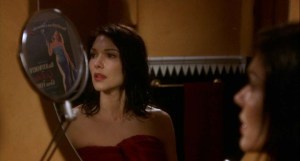 One scene stands out as a perfect example of the talent Watts possesses. Betty has just been shuffled off to an audition for a film and rehearsing with Rita all morning. She’s introduced to her leathery co-star and the directors await her to play out the audition scene of two kids and their forbidden love. As soon as the scene begins Betty vanishes and is totally inhabited by the spirit of her character. She speaks her lines in a breathy, yet whisper-like, voice running over with sensuality but also elements of power. In this moment the characters know, as the audience does, that Betty and Naomi Watts are born movie stars.
It’s not too difficult for a viewer to figure out what portions of the film are from the pilot and what were shot afterwards. I truly doubt if ABC’s standards and practices allows for lesbian sex. The pilot parts seem to have more sheen to them and simpler camera moves, nothing too fancy. The additional footage seems completely opposite and to great effect. Mulholland Dr. has many plot threads that go nowhere or are never touched upon again, most likely parts that were going to be reincorporated with the series.
The truly weirdest part of Mulholland Drive is that the film seems to be working best when it actually is still the pilot. The story is intriguing and one that earns its suspense, mystery, and humor that oozes from this noir heavy dreamscape. The additional twenty minutes of story could be successfully argued one of two ways. It could be said it’s there just to confound an audience and self-indulgent to the good story it abandons. It could also be argued that the ending is meticulously thought out and accentuates the 120 minutes before it with more thought and understanding.
Mulholland Dr. is a tale that would have made an intriguing ongoing television series complete with ripe characters and drama. However, as a movie it still exceeds in entertainment but seems more promising in a different venue.
Nate’s Grade: B
Reviewed 20 years later as part of the “Reviews Re-View: 2001” article.
Share this:

Moulin Rouge! (2001)
 Director Baz Luhrmann’s last project was the MTV-friendly William Shakespeare’s Romeo + Juliet (like someone else has a Romeo and Juliet) which was adored by the under 15 set that now buy N*SYNC merchandise. Luhrmann waited a long time for his follow up with Moulin Rogue, a manic musical that seems like candy for the eyes. It may have been a long time but it was well worth the wait.
The sparkling world of Moulin Rogue is around turn of the century France. Christian (Ewan McGregor), an aspiring writer, has traveled to this place against his father’s wishes. Christian believes in the beauty of love and the pull of the heart. Within minutes of setting foot in France he gets wrapped up into a production by a dwarf (John Leguizamo) and his cadre of assistants. Christian is sent to the most provocative club in town, the Moulin Rogue. Here he attempts to persuade the most famous showgirl Satine (Nicole Kidman) to help push for their musical to get financial backing. Satine inadvertently confuses Christian for the man she is supposed to seduce for a large some of money, the Duke (Richard Roxburgh). And thus the merry band of misfits get their play the backing while Christian blossoms a love for Satine. But their love must remain hidden for the Duke is led to believe that Satine is his and his alone.
 Kidman owns this movie, plain and simple. From her first shattering entrance being lowered from the ceiling to the last scene, she is absolutely magnificent. McGregor gives a nice performance as the dough-eyed lover. Jim Broadbent plays the Moulin Rogue’s owner, Zidler with howling delight in all his manic expressions. Even Roxburgh gives an underwritten antagonist the right amount of weasely twitch.
One of the more surprising features is how well the two leads can actually sing. Kidman gives a soft and sexy take on “Diamonds are a Girl’s Best Friend” and McGregor can belt out a tune with some admirably throaty pipes. As these two veer in and out of songs it’s a pleasure to watch and hear.
Luhrmann has crafted a musical with ADD, but I say this as a compliment. Moulin Rogue‘s pace is fast and pounding. People twirl above the sky, the camera zooms wildly through town streets, and dump trucks worth of confetti fly through the air. Moulin Rouge is exploding with glitz and never lets up. The editing and visual artistry is stirring. By about ten minutes into the proceedings when a green fairy starts singing a seductive version of “The Hills are Alive” you know you are in for something else. And what a something else the film delivers. There was not a moment I didn’t have a smile glued to my stupid face.
 Moulin Rogue could be described as a musical for people who dislike traditional musicals. In traditional musicals people go along stuffy formula, then break out into great choreography song-and-dance. With Lurhmann’s musical is a breakneck of pomp where the characters zip around to exaggerated Hanna-Barbara sound effects and start chiming away with 70s and 80s pop songs that we all know. After the initial shock/humor of hearing characters belt out renditions of “Roxanne” and “Like A Virgin,” a familiarity sets in and it blends in to produce a surprising artistic addition.
The story of the movie is nothing new or extraordinary; it’s well worn territory. But where Moulin Rouge breaks apart and shines are with its style and exposure. The visuals are astoundingly lush and lively, the music is game and pumping, and the movie is just screaming to be seen. This was a true work of love.
The movie is bursting to the seams with life. I loved every single second, every single frame, every single moment of Moulin Rouge. I can’t wait to go see it again.
Nate’s Grade: A
Reviewed 20 years later as part of the “Reviews Re-View: 2001” article.
Share this:

Memento (2001)
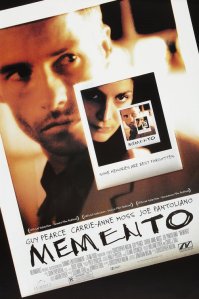 A film is taking the nation by storm and it isn’t anything from a big studio. In fact it’s the first release of a new indie production house called New Market, and these people have lassoed a real winner. Memento is a murder mystery bubbling with perfect elements of noir, suspense, and trickery. Memento is the tale of Leonard Shelby (Guy Pearce) who is searching desperately for John G., the culprit he believes that raped and murdered his wife. Along the way Leonard gets assistance from his friend Teddy (Joe Pantoliano) and Natalie (Carrie Anne-Moss), a down on her luck bartender.
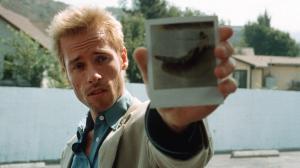 Except Leonard has a peculiar problem plaguing his one-man investigation for justice. After the attack on his wife the assailant knocked him out, and Leonard was left with no short-term memory whatsoever. Leonard cannot develop new memories. So if something happens to him, he is liable to immediately forget it within five minutes. To aid himself he write on small post-its telling him which car is his, what hotel he’s at, etc. all over his body are tattoos of clues he has amassed. He takes Polaroids of people and writes their names on them to remind him of the faces he sees that he won’t remember. Leonard’s investigation is about what his notes tell him. He doesn’t know whom he can trust and whom he cannot.
If this wasn’t enough to make Memento interesting the entire tale is told out of sequence and run from end to beginning. The entire film is told backwards. This action robs the audience of the same information that escapes Leonard. We too know neither who to trust. The effect could fall into gimmick territory but makes the movie fresh and adds for some great comic situations as well, like when Leonard awakens with a bottle of champagne in his hand and tells himself he doesn’t feel drunk.
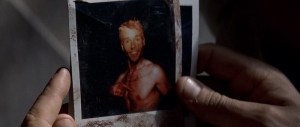 Pearce is gripping as the emotionally shattered and fractured Leonard. He is a man that can trust nothing and must live from repetition, but is intent on bringing his wife’s killer to bloody justice. Pantoliano and Moss provide good support as the weary characters that weave into Leonard’s plight. The acting it excellent all around. They leave us guessing and reassembling our perceptions as more of the puzzle unravels.
Memento is top-notch film noir. It’s a breathless thriller of a first rate caliber. The direction given by Christopher Nolan from his screenplay is tight and highly effective. The character of Leonard is fleshed out in all his paranoia, pain, and frustration. Nolan has delivered a gift to movie audiences always hungry for fresh material. One has to see the film a second time just to see how well the segments play together.
Memento is the coolest movie around. Rush out and see it, then see it again, and then again. It’s the best movie of 2001 by far as of now and has the Best Original Screenplay Oscar locked [Editor’s note: it lost to Gosford Park of all things.] It’s destined to be a cinematic classic people will talk about for years.
Nate’s Grade: A
Reviewed 20 years later as part of the “Reviews Re-View: 2001” article.


 nathanzoebl
You must be logged in to post a comment.