Blog Archives
Crash (2005)
 A searing look at race relations and a powerful human drama at that. This flick has some of the sharpest memories I’ve had from any movie all year, particularly the relationship between a Hispanic locksmith (Michael Pena) and his daughter and a special invisible cloak. Their first scene, where he talks her out of hiding under her bed, is one of the most beautifully written short scenes I have ever witnessed. A late scene involving the two of them knocked the wind out of me completely and is the most vivid moviegoing moment of all 2005 for me. Every character has at least one great moment, though time is not spaced equally amongst this large ensemble. Crash has the intriguing practice of introducing near every character spouting some kind of racist diatribe, and then the movie spend the rest of its running time opening you up to these characters and getting to like them. Writer/director Paul Haggis has such a natural ear for terse, realistic dialogue that can really define characters with such brevity. A fine movie, despite the overarching coincidences.
Nate’s Grade: B+
Share this:

Corpse Bride (2005)
 Not as good as Nightmare Before Christmas, but really, what can be? Tim Burton second stop-motion animated film is beautifully crafted and emotionally involving. It’s interesting because all three characters in the movie’s love triangle have really done nothing wrong, and our sympathies are stretched to all three. The contrast of the world of the living (drab, formal) and the dead (colorful, lively) is stark, and death in Corpse Bride is presented as simply another stage of living. Therefore, you don’t have to worry about scaring the kids with this one. The ending is a bit too conventional and the songs are all lackluster, nothing ever as remotely hum-able as Danny Elfman’s masterpieces in Nightmare Before Christmas. Despite the unfair comparisons, Corpse Bride is easy on the eyes, amusing, and nicely romantic.
Nate’s Grade: B
Share this:

Brokeback Mountain (2005)
 Go ahead and work the snickers out of your system. Brokeback Mountain has been dubbed “that gay cowboy movie,” and been condemned by certain fundamentalist Christian organizations as “a very dangerous and insidious message to America.” But what message is Ang Lee’s film even putting out there? It seems to me that Brokeback Mountain is putting a human face on a slur, making homosexuals look like you or me. For some that prospect may be terrifying. The movie is playing well on the blue-state coasts, expectedly, but it’s also surprisingly playing well in America’s heartland. It seems that people are lining up all over to see a movie about two gay cowboys in love. And perhaps the more people that witness Brokeback Mountain, the harder it will be to listen to those so-called family advocacy groups with their sterling Christian morals. Maybe people will really see what’s behind many of the words of outcry – hate and ignorance (I am in no way insinuating that disliking the flick means you are homophobic). Despite all this political talk, Brokeback Mountain is by no means a political movie. It’s a love story, above all, and it’s a doozy.
In the summer of 1963, Ennis Del Mar (Heath Ledger) is a quiet man looking for work in rustic Wyoming. He finds a job as a sheep herder working atop the canyons and mountains of Brokeback. Working alongside Ennis is Jack Twist (Jake Gyllenhaal), a charismatic rodeo rider. The weeks are long and Ennis and Jack are all the company they have, excluding the hundreds of sheep they tend. Eventually, the more taciturn Ennis finally opens up and bonds with his herding partner. “That’s more words than you’ve spoken in two weeks,” Jack says. “Hell,” Ennis adds, “That’s the most I’ve spoken in a year.” The rules have been laid out: every night one man sleeps in a tent campsite, the other sleeps next to the sheep to guard them. Well one night Ennis has had too much whisky and cannot make it back to the sheep. Jack invites him to sleep in the tent instead of freezing outside. Then something surprising takes place – both men have an alcohol-fueled bout of rough sex. The next morning both men stress they “ain’t queer,” but they have a hard time fighting their feelings inside. Ennis warns that, “If this thing, it grabs hold of us again… at the wrong place… at the wrong time… and we’re dead.” He recounts a childhood memory where his father showed him the corpse of an older homosexual man, brutally beaten and mutilated. For them, their love must stay on Brokeback Mountain.
 The men part ways. Ennis marries Alma (Michelle Williams), a quiet woman after his own heart, and fathers two daughters. In Texas, Jack meets fellow rodeo rider Lureen (Anne Hathaway) and gets involved in a relationship with her, fathering a son of his own. But Jack still thinks of his Brokeback pal and sends him a postcard. Ennis nearly lights up at the returned sight of Jack and the two passionately embrace. He tells Alma that Jack is an old “fishing buddy” and they sneak away every few months for a fishing getaway. Really the men are returning to the countryside to rekindle the love that they haven’t left behind. But can they keep their love a secret, and should they even have to?
I wonder if Lee would ever have directed this if 2003’s Hulk didn’t bomb so badly. Lucky for us, he’s taken the Brokeback helm and infuses lots of emotion into the story. The Wyoming countryside (actually Canada, but it’s all close enough) is gorgeous, and the film has a great earthy feel. Best of all, Lee allows his love story to breathe and go at its own pace, never cutting corners or rushing an emotion. There’s a lovely, lilting feel to the film, and Lee’s guided hand allows the story to play out to its grand promise. Based on Pulitzer Prize winner Anne Proulx’s 11-page short story, screenwriters Diana Ossana and Larry McMurtry (Lonesome Dove, The Last Picture Show) have given incredible depth and subtext to the tale. McMurtry, in particular, has great knowledge of the West and the cowboy lifestyle, and the screenplay gives you an idea of small-town Western life. There are a few moments at bars, social scenes, stores, but they brilliantly give you every detail you’d need to know about this way of life. I even loved how the people of Wyoming wore fashions that were five years removed from their height of popularity, which is exactly how fashion moves around to the smaller parts of America. Ossana and McMurtry are also commended for presenting their characters as people first and never as agenda bulletins. All three lend a level of authenticity that makes the story feel organic and never trite.
In films about forbidden desire and heartbreak, the acting is the cornerstone for how powerful the tale resonates. The acting in Brokeback Mountain is phenomenal. Ledger is the breakout star and the majority of the film’s focus. He gives the performance of his life. Ledger is outstanding as the reserved, taciturn Ennis, brought to believe that queers were something sub-human and now he wrestles with his own identity. He may be a restrained man of few words but you see every emotion bubble under the surface, every conflict played out in his eyes. Ledger’s few violent or emotional outbursts are startling because they show an uncontrollable feeling, one even he can’t withhold 24/7.
Gyllenhaal has the showier role but masterfully displays the frustration of forbidden love. He’s willing to sacrifice everything for Ennis, and the fact that Ennis won’t do likewise tears him apart. Isn’t love enough, he wonders. There’s a moment in the film that so sharply displays Jack and Gyllenhaal as an actor. It involves two different shots in a moving truck. The first is Jack headed to Ennis’ ranch, singing, bouncing, and with a wall-to-wall smile. The second is Jack driving away from the ranch unfulfilled, sullen, broken, and seemingly unable to cry another tear. It’s two small moments and they sum up Jack and Gyllenhaal perfectly. The only thing unsettling about Gyllenhaal’s performance is his late 70s porn star ‘stach. With his tremendous work in Jarhead and now Brokeback Mountian, Gyllenhaal is in class all his own (he’s got the dreamiest doe-eyes in Hollywood).
The ladies of Brokeback Mountain have less screen time to play with but they each deliver fine performances. Williams is a silent, put-upon mother and is shattered when she discovers her husband’s secret love. She just crumbles. She’s never the same and Williams showcases her character’s distress and mounting bitterness. One of the film’s highpoints is her confrontation with Ennis, many years later, finally sharing all that she knows. Me thinks an Oscar nod is headed in her post-Dawson’s Creek future. Hathaway plays quite an opposite character. She begins as a wild, headstrong cowgirl with a healthy sexual appetite, something perhaps Jack sees as a reflection of his self. Then their love dies at some point and she pours herself into work, but Hathaway illuminates every step along the way. Her small smile during a scene where Jack finally browbeats her obnoxious father is terrific.
This is an elegiac, engrossing love story. Brokeback Mountain is not necessarily a “gay thing,” more so it’s a story about forbidden love and about the consequences of moving forward without ever letting go. That sounds universal, right? Nothing “gay” about that. Brokeback Mountain explores the force of love and shows how uncontrollable and unpredictable it is. Jack and Ennis are just as surprised by their feelings and their rough night of passion as the audience, but the happiness they share is hard to argue.
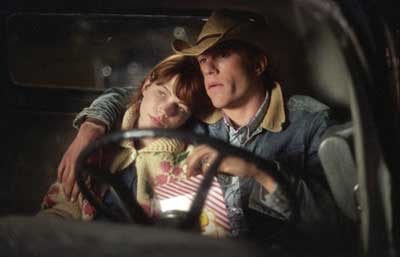 Because of the film’s gentle pace, and Lee’s loose control, we really immerse ourselves in their relationship as they frit away the hours looking after sheep. There was a woman in my theater (I won’t name names, partly because I don’t know hers) who felt that Brokeback Mountain was far too slow and could have been put to better use by cutting 2 hours out. The film’s placid pace is integral to the story’s success; you need to see how expansive that countryside is to feel alone, you need to have the many small conversations to draw out a closer camaraderie, you need the added time to open up to these men, and then once you have –BAM! — they turn their worlds upside down. This buildup is necessary for our connection to the characters but it’s also essential so we can understand what happens. Yes, the film portrays love as it truly is: an all-encompassing emotion that can be as maddening as it is passionate. But Brokeback Mountain doesn’t dare introduce a gay romance, something so dangerous in this land, all lickity-split. It’s supposed to be a surprise to these men, grown up with John Wayne movies and strong, silent role models. The movie enjoyably takes its time to seduce an audience with its tale before choking out every last tear in the end.
The tragedy of Lee’s film is that these men have each found the love of their life but, because of society’s prejudices, are not allowed to act. As a result, each man puts on a different face and pretends they’re a happy heterosexual Western buck for the public, but each is being eaten away inside. Ennis drinks a lot and is full of self-loathing. Jack is less publicly reserved about his feelings and finds momentary comfort with other warm bodies, mostly through silent nods with other closeted gay men. I’m reminded of a line in Paul Thomas Anderson’s Magnolia: “I have a lot of love to give; I just don’t know where to put it.” Ennis and Jack cannot quit each other but they also tragically can never fully commit to one another, at least without any threat of ostracism or death. That’s the power of Brokeback, that it shows you these simple men, shows you their love, and then won’t let that happy ending ever manifest that we yearn for. When we reach our somber, haunting conclusion there weren’t many dry eyes in the theater, mine included. Brokeback Mountain is a love story that won’t let itself be happy, and that’s what provides all the kicks to the gut and lumps in your throat.
I think some of the more hostile criticism of Brokeback Mountain is because of how normal Jack and Ennis are presented. Neither is a swishy stereotype, neither is any less of a man, and that notion probably terrifies the homophobes: “Well, they look normal, and if they get gay then maybe I will too!” That’s a shame really, because those ignorant few will miss out on a powerful, sweeping, complex, aching love story with fantastic acting. Ledger and Gyllenhaal will make you feel every moment of joy, every moment of pain, and every lingering conflict on what makes them whom they are. Lee stressed that he wanted to show the world a love story where you really felt that love was an uncontrollable force. His heartfelt, touching film is a revolution for being a normal love story, albeit with two classic Marlboro men. There is no propaganda, no gay agenda, but perhaps the film will open people’s eyes and strip away any narrow definitions we have toward the ownership of love. Brokeback Mountain set out to merely tell a good story, not change the world. It’s accomplished the first part and maybe, just maybe, it’ll spark discussion, debate, and lasting memories to lay groundwork for the second.
Share this:

Walk the Line (2005)
 I found this movie enjoyable but full of your standard, by-the-book biopic moments (rise/fall, addiction, famous faces, losing a brother at young age); still the performances were what the film hinged on and they were fantastic, especially with the added pressure of singing in their own voices. Walk the Line was good but didn’t really connect for me, and I think part of that is because the plot revolves around June Carter refusing to “be” with the Man in Black for 10 years. Yes they were each married to other people and their time on stage was like a forbidden courtship all its own, but it’s just not that compelling of a conflict, to me at least.
Nate’s Grade: B
Share this:

Good Night, and Good Luck (2005)
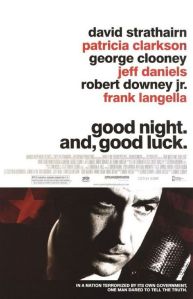 George Clooney’s pet project is articulate and a tad dull. The black and white cinematography is elegant; you can practically taste all the smoke onscreen. The idea of press vs. fear-mongering politician is very relevant today, and the film’s insight into the running of TV news is really interesting, but this is a movie that works best as a study and not as strict entertainment. It?s not stuffy or ideologically overwhelming; in fact it’s easy to follow and easy to get into, even if it leans too heavily on speeches. Clooney, as I predicted, is transforming himself into a terrific director with a great feel for his material. With Good Night, and Good Luck it seems like he got exactly what he wanted, regardless if an audience is going to walk away feeling they got their money’s worth.
Nate’s Grade: B
Share this:

Munich (2005)
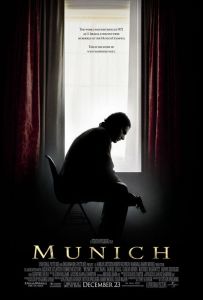 If 2005’s War of the Worlds was Steven Spielberg’s look at 9/11, then Munich should be considered his examination of the aftermath. What could be more relevant today than a film about combating terrorism, violent reprisals, and where a government leader says, “Every civilization finds it necessary to negotiate compromises with its own values?” Anyone seen the news lately? Spy eavesdropping, prison abuses, hemming and hawing on what the definition of torture is, it’s all compromised values in the name of security. This is our world and Spielberg analyzes the costs of war. Munich is visceral, haunting, thoughtful, and compelling as both an idea piece and as a mainstream thriller. It’s Spielberg’s most mature work in a decade.
In 1972, a group of Palestinian terrorists known as Black September took 11 Israeli athletes hostage during the Munich Olympics. The world watched as the standoff stretched for hours, finally ending in a firefight at the airport and the terrorists throwing grenades into helicopters housing their hostages. Every Israeli athlete and Black September member had been killed. “They’re all gone.”
But it doesn’t stop there. Israel Prime Minister Golda Meir (Lynne Cohen) recruits Mossad agent Avner (Eric Bana) to run a secretive counter strike. Avner is to assemble a team, track down the architects of the Munich massacre, and assassinate each one. Their mission is only known by a select few, and their only contact is via a handler (Geoffrey Rush) and a safety deposit box that fills up with money. Joining Avner are Steve (Daniel Craig), the South African with a hot-head, Robert (Mathieu Kassovitch), the toymaker turned bomb maker, Hans (Hanns Zischler), the document forger, and Carl (Ciarán Hinds), the clean-up man. The men crisscross the globe hunting down their targets, and with each successful kill there is escalating retaliation by Black September. Soon Avner’s group becomes a target themselves and he questions if the men they are snuffing out have any connection to Munich.
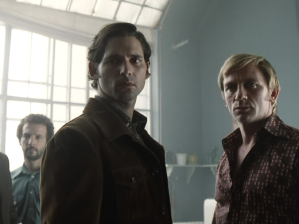 When I first heard about Munich I thought it would be a dramatization of the hostage situation, and Spielberg does revisit the sequence in horrifying and bloody flashbacks. The film’s focus is on the aftermath of Munich, though it does not pretend to be fact. This is a made up story based on rumors. As new evidence clears, it looks like the Munich retaliatory slayings were unrelated Palestinian men.
For events that began in 1972, Spielberg punctuates his drama with a gnawing sense of timeliness, closing his film with the very image of the World Trade Center in the New York skyline, connecting an invisible line from Munich to our world today. This is a mature, meditative examination on the retaliatory response to terror. Munich is even-handed in its views and dives into challenging territory where an easy answer is an insult. This isn’t a pro-Israeli movie or an anti-Palestine movie (though it’s already earned condemnation from fundamentalists on both sides), and every side gets a moment in the spotlight to effectively argue their case. The result is a movie that thoughtfully and reflectively looks at the cost of vengeance and compromising our values. Munich, even with its glut of important messages and mouth pieces, never forgets to be entertaining. The cameras are often handheld and Speilberg’s winding shot compositions give a visceral feeling to the events.
Bana (Troy) is the moral anchor of the film and gives a staggering performance. He begins proud and humbled, living in the shadow of his father’s name, an Israeli war hero. As the assassinations play out, each changes Avner and Bana expertly expresses his character’s turmoil, finally succumbing to paranoia and fear. The final act has relatives telling Avner he has done right, that his dead family is smiling with approval, and Bana’s sad, haunting eyes tell the full story of what he truly believes. He looks like he’s aged ten years in such a short time span. Each member of the hit squad fills out their role nicely, with Craig (Layer Cake) imparting tough, hip savvy, Kassovitch (the director of Gothika, oddly enough) is nebbish and the first to morally crack, Zischler is stoic button-lipped,and then there’s the fantastic Hinds (Julius Caesar on HBO’s Rome), an experienced man that?s so calm and knowing and wryly warm-hearted. He’s such a delightful onscreen presence. Rush is only onscreen in spurts but is brash, humorous, and unsentimental to the very end. He’s an actor that rarely misfires, if ever.
Too often we bandy about the term “evil;” our enemies are “evil,” atrocities are brought about by “evildoers,” but by painting in such broad, simplistic strokes, demonizing the enemy as “evil” (and conversely implying you are the side of good) you strip away the reality of the situation. The worst thing you could do in this war on terror is simplify the situation. These are not evildoers; these are people deciding to commit atrocious acts. If they are dubbed monsters or simply evil then we’ve reduced the argument to a kindergarten lesson. Munich doesn’t show the Palestinian targets as mustache-twirling evil doers (no one is spotted tying a damsel to railroad tracks). These are men with convictions, family, and humanity. “Evil” is too tidy a term, and Spielberg understands this. Are evil acts necessary to combat evil? Do we become our enemies when we resort to their ruthless tactics? Robert, shaken from a recent kill, pleads that Jews are supposed to be righteous, that’s what separates them from their persecutors. Assassination is not a righteous act, despite what Pat Robertson may spout off on TV. In the end, the only trustworthy people in the film may be a strange French family that sells information to the highest bidder, regardless of politics.
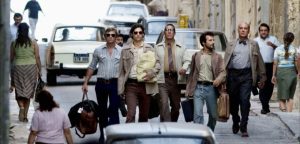 There’s one moment in the middle of Munich that will stick with me forever. There’s only one pure vengeance murder in the movie and it involves a female killer (Marie-Josée Croze). It’s a kill the audience is thirsting for and demanding; the other assassinations were murky, men unknown to have any involvement in terror other than being a name on a sheet. This is an instance where the audience wants revenge and then Spielberg gives exactly what we want and disgusts us. The kill is so sharp, so uncompromising that the violence is startling and, more importantly, it hurts. The reality of it is painful to watch. Spielberg has masterfully turned our quench for violence and shown the ugly reality.
Munich also succeeds as a thriller, pulsing with immediate danger and drawing the viewer in. There were key moments that I was chewing on my knuckles because of how taut the suspense was. As a thriller, Munich briefs us on these men’s mission like all good spy movies, brings us into their fraternal order, and then we watch each assassination play out, many never going according to plan. What elevates Munich is how real everything feels and how dangerous every moment comes across. This is a thriller that it makes the heart pound but also courses with subtext, and exquisite dialogue by Tony Kushner (Angles in America), who magnificently frames his characters with the tiniest details, who crafts deft symbolism in moments of doubt and paranoia, and who, channeled with the film’s masterful acting all around, creates a stirring study of the cost of violence and the broken bodies it leaves behind, even those that live to ponder another day. Kushner’s writing is a perfect match for Spielberg’s effortless artistry.
This is Spielberg maturing as a filmmaker, despite some missteps here and there, mostly with the length and a late sequence where he juxtaposes the final Munich hostage flashback with Avner climaxing in coitus with his wife. The characters are sharp, the acting is resonant, and the thrills are palpably engrossing, giving the film a refined sense of danger where anything could happen. Munich is more than a thriller and more than a think-piece. It’s a close examination of the cyclical nature of retaliation and reprisal, dooming both parties into an endless bloodbath. Don’t be frightened by all this heady talk because it’s also a very entertaining movie. Munich isn’t the best film of the year; it’s pretty good but it’s definitely one of the more important movies of the year and worth seeing.
Nate’s Grade: B
Share this:

Grizzly Man (2005)
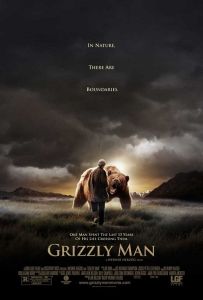 Werner Herzog goes through hundreds of hours of the late Timothy Treadwell’s own footage of himself living amongst Alaskan grizzly bears. He lived every summer with the bears, his “friends,” for 13 years, until one bear killed him and his girlfriend (the deadly altercation’s audio was captured, though Herzog never plays it in the film). Treadwell was retreating from a human society and putting animals on equal pillars as human being, even predators he treated as “men in bear suits.” Treadwell never references his girlfriend, who can only be seen barely once or twice in his hours of footage. That would destroy his fantasy that he’s out there alone, living it up with these creatures. Grizzly Man is an absorbing character study into the working of a very troubled man. It’s interesting how he uses the camera an audience and means of catharsis. He bounces from point to point, brought to tears a bumblebee died mid-flight on a flower. He does different takes of his own nature footage. Herzog presents an altogether different point of view about nature, more cold and survival of the fittest and less cuddly. He brings a critical analysis to Treadwell’s idealized platitudes. The bears Treadwell was spending time with were on protected land, so there really wasn’t much need for his activism. He definitely had a martyr complex going. This critical perspective gives Grizzly Man depth, dueling views of nature playing it out in the documentary form. Weirdly, it seems like a lot of the interviewees in Grizzly Man treated their moments like they were auditioning for Hollywood. This would be a really interesting double feature with March of the Penguins. Treadwell wished for death because his cause would be even greater. Now there’s a movie that will reach millions. Be careful what you wish for.
Nate’s Grade: A-
Share this:

Syriana (2005)
 Written and directed by Stephen Gaghen, Syriana is very reminiscent of his Oscar-winning work with Traffic. It’s very dense, complex, and demanding of its audience, which is both its best and worst aspect. I needed a notepad to keep up with the multiple criss-crossing storylines. It’s similar to Traffic in scope and texture, but this film seems a whole lot angrier. Whereas Traffic felt like it was trying to hold a mirror up to society, show us the truth of the failing War on Drugs, this movie feels like a wake-up call as well as a call to arms. Syriana is desperate to shake people out of complacency and show them how the world is running. I love the fact that the “Free Iran” committee in the film that preach Iran’s desire for democracy are not backing the emir’s son that wants to educate his country, install democratic freedoms, put women on equal footing as men because … he wants to open the oil fields to China because they’re offering more money. They are backing the less-enlightened son because he’s willing to give America what it wants: oil. The movie is a mostly potent microcosm about questioning who has our best interests at hand. It’s a bit slow at parts and incredibly rushed at others, and your head will be left spinning trying to keep track of the wealth of information it throws at you. It is thought-provoking even without an emotional connection. This flick reminded me of The Constant Gardener, also a screed against the evils of big business though grounded in an evolving love story. This is a movie I admire more than I can say I enjoyed.
Nate’s Grade: B
Share this:

Capote (2005)
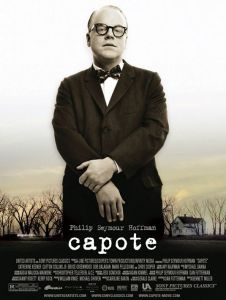 This is a really solid, probing movie about human relationships and the oversized personality of famous author Truman Capote. It’s a very illuminating character piece on its titular star. We see many different facets of his character; part of the connection is because Phillip Seymour Hoffman is so flat-out brilliant in his portrayal of Capote. He’s got that unmistakable nasal voice down, but Hoffman excels at the little things of character, his command of a crowd, his inflections, his physical movements, his ability to look exhausted and pained but embarrassed and prideful at the same time. Capote shows you why everyone wanted to rub elbows with him with how he tells a story and whips up an audience. This is another in the trend of warts-and-all biopics, and you see how calculating he is (he says he never lies). Every confession he offers is manipulative and meant for self-gain, like when he tries to get a witness to talk or get the Kansas P.I. to show him the murder photos. You see how the wheels work within this character. And then Capote shifts as he delves further into the case into his unlikely relationship with Perry Smith. Capote keeps them alive by providing money for their attorneys so he can get more for his book. But there can be only one ending to provide closure to his book — their death. There are several wonderful exchanges of dialogue between Smith and Capote and their quiet, smiling lies they give each other. All we see of Smith is the polite man who draws and read poetry in his jail cell, and the bond growing between him and Capote. The film’s climax eradicates any sympathy built and we see the unpredictable, unmerciful nature of violence. Capote really hammers home the dichotomy of persona, with each side playing the other. The cast is splendid and everyone makes their small roles click, particularly Catherine Keener as novelist Harper Lee and Chris Cooper as the Kansas P.I. What’s even more surprising is that Capote was even better the second time I saw it. There’s so much to find in this excellent character piece.
Nate’s Grade: A
Share this:

March of the Penguins (2005)
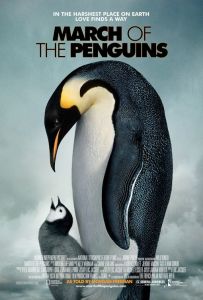 In the vein of 2003’s Winged Migration, comes the newest nature documentary, March of the Penguins. A French film crew spent several months in the Antarctic and documented the mating habits of the adult Emperor penguin. Originally the film was told from a first-person point of view with the penguins narrating their lives. There was supposedly even a song by the baby penguins chirping for food. Eegads. Thankfully, the American distributor dropped this Milo and Otis approach, wrote some brand new third-person narration and tapped Morgan Freeman to voice it. Now that?s a step in the right direction. The results are a dazzling family-friendly documentary about birds that seem out of this world.
At a certain age, the adult Emperor penguins will leave their fishing grounds and begin their long march. No one knows how they know when and where to go, but scores and scores of penguins will travel hundreds of miles to a fertile breeding ground where the ice will be thick enough.
Once they’ve reached this spot the males must choose a female companion and then make with that hot penguin love. If the conception is successful the mamma penguins must now pass the egg off to the males. To do this both birds must keep their toes together the whole time. It doesn’t take much exposure to the harsh Antarctic elements to freeze the egg and null the penguin’s efforts. If this exchange is successful, the mamma penguins must now march 70 miles to fill their bellies with fish. They’ve given up fifty percent of their body weight birthing the egg and are literally starving to death. It’s now the daddy penguin’s responsibility to hatch the egg and guard it from the frigid temperatures until their mate returns. This perilous process will repeat until the baby is strong enough to be left on its own.
 Throughout the many months, we watch the penguins endure incredible hardships. They begin by walking (or by waddling) hundreds of miles and then bracing temperatures as bitter as 80 degrees below zero. While the males carry the egg, they will go as long as four months without eating. The community will huddle together for warmth against the elements, and they even cycle teams out so that every penguin gets a turn in the center. The daddy penguins can pick out the voice of their baby even though they haven’t heard their voice since birth. Penguins are freaking awesome.
It’s amazing how characteristically human the penguins can appear. It’s striking to see penguins show affection for each other, from rubbing their beaks to craning their heads and pushing their bodies together. In one remarkable scene, we see the fields of penguins after most of them have decided on a mate. As far as the eye can see there are penguins pressed together in twos declaring their monogamous affection.
But these flightless birds also display painful emotions. After one strong windstorm, a mother penguin searches for her baby and finds it sprawled against the ice and dead. She starts poking the body at first but then lets loose a wail of grief. It’s remarkable how much you can feel for grieving penguins. We’re also told that, though rare, some mama penguins that have lost their little one will try and steal a baby.
The biggest draw of March of the Penguins is the wonderful photography. Covering the majority of a year, we see the entire mating and birth cycle in surprisingly candid and beautifully realized detail. It’s easy to get lost staring at the gorgeous images, from the vast and desolate Antarctic landscapes, to the long lines of hundreds of marching adult penguins, to the irresistibly cute and fluffy baby penguins (they look like stuffed animals come to life). This is what separates March of the Penguins from every day, run-of-the-mill TV nature shows, though National Geographic did help produce. The high-quality cinematography, absorbing story, and sheer adorability of the penguins make this a movie that demands to be seen on the biggest screen possible.
 March of the Penguins is also a perfect film for families. The plight of the penguins will be enough to ensure younger kiddies keep watching. The images will dazzle people of all ages and make you feel all warm and fuzzy, like a baby penguin. There’s great humor in watching these birds but there?s also great wonder. You’ll be surprised how often you may discover yourself narrating along; my favorite comment apparently was “Damn, that’s a whole lotta penguins.” What’s even more mysterious is that I didn’t care at all overhearing other people doing the same thing. March of the Penguins is an experience that also easily lends itself to viewer involvement, which makes it perfect for kids. There are some scarier moments when predators hit the scene but nothing that should be too traumatic.
March of the Penguins is a wonderful, heart warming, dazzling documentary that should charm audiences of all ages. You’d have to have a heart of stone not to be amused, impressed, or delighted by the penguins and their fuzzy brood. The photography is amazing in its scope and detail, and you?ll want to take a baby penguin home with you (just look at that picture! Look at it!) This is a lovely and enchanting summer entry that should pick up steam as it picks up additional screens. Catch those penguins now before they march out of your town.
Nate’s Grade: B+


 nathanzoebl
You must be logged in to post a comment.