Blog Archives
Boyhood (2014)
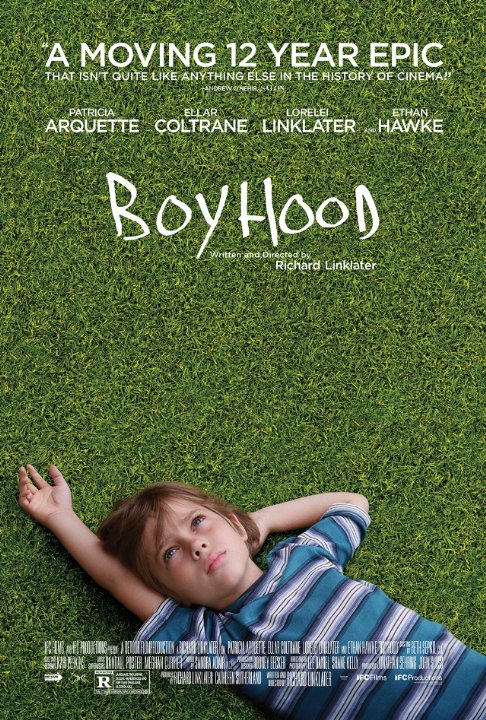 Richard Linklater is one of the most experimental filmmakers in the indie community, but just about everyone was caught unaware when he announced the completion of his newest project, Boyhood. For the past twelve years, Linklater and a small crew had been shooting a secret movie chronicling the life of a boy from age six to eighteen. The ensuing twelve years gave Linklater plenty of time to examine his narrative, and he also happened to make nine other movies while working on Boyhood. Now his covert pet project is playing to near euphoric reviews and plenty of early awards buzz. As big a fan I am of Linklater as a storyteller, especially with his brilliant Before trilogy, I feel hesitant to find fault in such an ambitious, sprawling project. This is a very good movie all around, but I have enough remaining reservations that keep Boyhood from being in the same league as Linklater’s best work.
Mason (Ellar Coltrane) and his older sister Samantha (Lorelei Linklater, the director’s own daughter) are living with their Mom (Patricia Arquette). She’s struggling to get by, with little help from their Dad (Ethan Hawke), who took off to Alaska to find work but really as a means of shirking responsibility. Dad comes back into their lives, Mom enrolls in school to provide a better life for her children, and along the way and many moves there are bad stepfathers that come in, new children and step-siblings, new schools, new boyfriends and girlfriends, and all the moments that add up to comprise a life.
Boyhood is less a film and more a cinematic experience that’s hard to replicate. It thrums with the natural rhythms of life, rising and falling on the small moments. Now there are a few larger scenes of drama, mostly concerning breakups and an abusive alcoholic stepfather, but otherwise the film follows the natural progression of not just Mason but his enter sphere of influences, namely family members, friends, girlfriends, etc. It’s a portrait of time beyond all else, and Mason’s parents are just as interesting to follow. Like their children, they too are in over their heads, looking for proper footing and a sense of identity, and in the ensuing 160-some minutes, we won’t just watch a boy become a man but two adults become responsible, accomplished, and determined caregivers. There is much to take in and to immerse one’s self in the refreshing minutia of life itself. The film feels authentic at every step, sometimes to its own detriment (more on that below), and it’s quite easy to plug into this relatable family drama and become engrossed. Don’t let the hearty length scare you, we are moving through 12 years and as such the segments don’t overstay their welcome. After every time leap, there’s a small game of trying to play catch up, noting all the differences, not just the actors growth spurts, but the new touchstones; before Mom was arranging a date with her psychology professor, and now they’re coming back from their honeymoon. It also allows us to watch the subtle transformation of characters but also watching the long consequences of anger. Dad takes Mason and Samantha out and is floored by the revelation that neither remembers a family camping outing that was filled with laughter. What they remember, starkly, are the shouting matches between mom and dad. It’s a definite wake-up call.
 Because of its in-the-moment nature, it’s difficult to single out storylines that play out significantly better than others. Each person is going to respond better to different moments, the points of relatability and comfort. I loved a scene where Dad plunges into the awkward territory of having the Sex Talk with his teen daughter. It’s just as awkward and funny as you’d expect, but they plow along and it’s a small moment where Dad shows his own growth as a responsible parent, a man who understands the world his children will enter and the pitfalls that await, who wants them to do better than he did. It’s a funny scene sure enough but it’s also a clear shift in Dad as a character. The allure of realism is rarely broken throughout the film, which imbues the film with a bracing sense of honesty in its details. There aren’t any big inspirational speeches (maybe one by a teacher), mostly talks meant to bridge the gap of understanding. There aren’t any eureka moments, in fact Mom even bemoans the absence of feeling something more significant when her children have left the nest. There aren’t any singular-defining dramatic moments because we are all the sum total of many moments, good and bad. The greatness of Boyhood is that it is a film of moments but moments you want to indulge in, like lingering nostalgic memories. It’s a richly pleasant experience.
My friend and critic colleague Ben Bailey asked me whether this story would have been irreversibly different or worse had they just cast several young actors or used makeup as a primary force to illustrate the passage of time. After giving it a good ponder as any critic should, the conclusion I came up with was a surprising… “No.” With the 7 Up documentary series, or Linklater’s own Before trilogy, the passage of time is also a reflection of us, allowing us to likewise catch up with the familiar faces but reflect upon our own lives. Plus it’s a work in progress, a series that matures and evolves and with each additional segment becomes a stronger and more compelling whole. With Boyhood, we get the entire passage of time all in one movie, and it just doesn’t play the same. With the other series I’ve mentioned, we get entire movies to dig into these people at different pit stops in their lives. With Boyhood, it’s less so. Here we get the (to our knowledge) full story, and watching the actors age is its own interesting experiment, but is this story really aided by this approach? I have my doubts, at least to the degree to justify the 12-years-in-the-making gimmick that has captured most of the media attention. It’s just as interesting to compare and contrast the other actors, notably Mason’s onscreen parents. 2002 Ethan Hawke is still the young reckless heartthrob, whereas 2014 Ethan Hawke has a bit of a paunch, lines around the eyes, and the gradual acceptance of his changing life style. But does the gimmick add any greater thematic impact to the film other than the odd notoriety of watching a visual yearbook for a select series of actors?
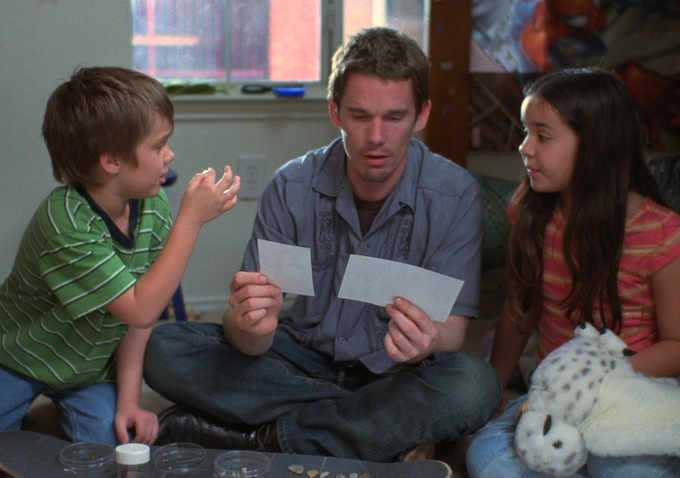 The other quibble I have is larger, mostly that the movie is tied to a character that is rather something of a bore. As a child, Mason is more reactionary to the world around him, taking in all these experiences, especially the hurtful remarks of adults and the long-term effects of all that marital discord and abusive stepfathers. He’s quiet, a bit lackadaisical, generally procrastinating and stretching rules, but he’s really just a boring kid who grows into a boring teenager. Now there are certainly plenty of relatable qualities to him that extend beyond his external situations and family conflicts. Plenty will be able to relate about the struggle to fit in, the points of self-discovery, and the initial buzz of a romantic mingling, among other coming-of-age moments. The problem is that Mason is struggling with finding his own onscreen identity. It would be foolish to have this kid suddenly know with divine clarity who he is and what he wants to be, but would it be breaking the confines of realism to give this character a personality? He ends up becoming this blank canvas for the audience to project themselves onto. If we’re going to spend nearly three hours watching the emergence of a character, it needs to be someone the audience can engage with so that their journey has a lasting emotional impact. Mason is an ordinary teenager, which means he’s an otherwise shrug-worthy figure for this massive of an undeserved spotlight.
Perceptive, funny, warmly affectionate, and well made in just about every capacity, Boyhood is an enjoyable movie from start to finish, another fine achievement for director Richard Linklater. It is a movie about a young man coming into his own, but it’s also a film about those around him doing likewise, maturing, aging, but mostly gaining some stronger sense of themselves and stepping out to make this happen. It’s a tale of life told in micro and macro, and while it lacks the cumulative impact or the 7 Up series of the Before films, it certainly has enough measured drama and honest reflections to stir a bevy of feelings with its audience. I only wish the main character was a more interesting focal point for this twelve-years-in-the-making project, especially with all that added time for Linklater and company to double back and alter their narrative. The character quibbles, and the ultimately unnecessary gimmicky nature of its conceit, are enough to blunt its overall longstanding resonance for me, but this is still a very fine movie and one that no other filmmaker working today could deliver. I just wonder what other secret films Linklater is keeping from us.
Nate’s Grade: B+
Share this:

The Grand Budapest Hotel (2014)
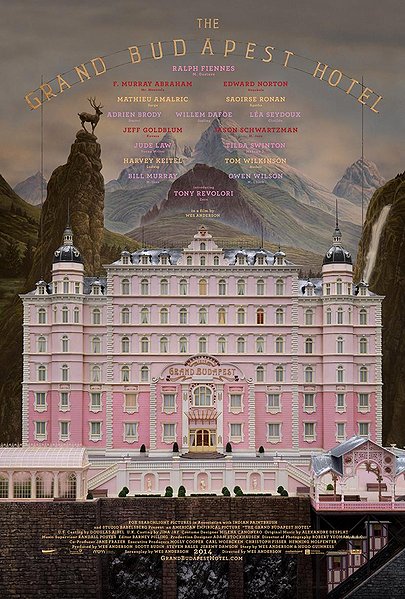 Wes Anderson is a filmmaker whose very name is a brand itself. There are a small number of filmmakers who have an audience that will pay to see their next film regardless of whatever the hell it may be about. Steven Spielberg is the world’s most successful director but just having his name attached to a movie, is that enough to make you seek it out and assume quality? If so, I imagine there were more than a few disappointed with War Horse and Kingdom of the Crystal Skull. But Wes Anderson has gotten to that height of audience loyalty after only seven movies, mostly because there are expectations of what an Anderson film will deliver. And deliver is what the quirky, fast-paced, darkly comic, and overall delightful Grand Budapest Hotel does.
In the far-off country of Zubrowka, there lays the famous hotel known the world over, the Grand Budapest. The head of the hotel, the concierge, is Gustave (Ralph Fiennes), a highly mannered Renaissance man who caters to the every whim of his cliental. Zero (Tony Revolori), an orphaned refugee, is Mr. Gustave’s apprentice, a lobby boy in training learning from the master in the ways of hospitality. Gustave likes to leave people satisfied, including the wealthy dowagers that come from far just for him (Gustave: “She was dynamite in the sack,” Zero: “She was… 84,” Gustave: “I’ve had older.”). One of these very old, very rich ladies is found murdered and in her rewritten will, the old bitty had left a priceless portrait to Gustave. Her scheming family, lead by a combustible Adrien Brody, plots to regain the painting, which Gustave and Zero have absconded with.
 For Wes Anderson fans, they’ll be in heaven. I recently climbed back aboard the bandwagon after the charming and accessible Moonrise Kingdom, and Grand Budapest is an excellent use of the man’s many idiosyncratic skills. The dollhouse meticulous art design is present, as well as the supercharged sense of cock-eyed whimsy, but it’s a rush for Anderson to pair a story that fits snuggly with his sensibilities. The movie is a series of elaborate chases, all coordinated with the flair of a great caper, and the result is a movie over pouring with entertainment. Just when you think you have the film nailed down, Anderson introduces another conflict, another element, another spinning plate to his narrative trickery, and the whimsy and the stakes get taken up another notch. The point of contention I have with the Anderson films I dislike (Life Aquatic, Darjeeling Limited) is the superficial nature of the films. As I said in my review for Darjeeling, Anderson was coming across like a man “more interested in showing off his highly elaborate production design than crafting interesting things for his characters to do inside those complex sets.” With this film, he hones his central character relationships down to Gustave and Zero, and he can’t stop giving them things to do. Thankfully, those things have merit, they impact the story rather than serving as curlicue diversions. We get an art heist, a prison break, a ski chase, a murderous Willem Dafoe leaving behind a trail of bodies, not to mention several other perilous escapes. This is a film packed with fast-paced plot, with interesting actions for his actors, maybe even too packed, opening with three relatively unnecessary frame stories, jumping from modern-day, to the 1980s, back to the 1960s, and finally settling into the 1930s in our fictional Eastern European country.
The other issue with Anderson’s past films, when they have underachieved, is that the flights of whimsy come into conflict with the reality of the characters. That is not to say you cannot have a mix of pathos and the fantastical, but it needs to be a healthy combination, one where the reality of the creation goes undisturbed. With Grand Budapest, Anderson has concocted his best character since Rushmore’s Max Fisher. Gustave is another overachieving, highly literate, forward-driving charmer that casually collects admirers into his orbit, but he’s also a man putting on a performance for others. As the head of the Grand Budapest, he must keep the illusion of refinement, the erudite and all-knowing face of the luxurious respite for the many moneyed guests. He has to conceal all the sweat and labor to fulfill this image, and so he is a character with two faces. His officiously courtly manner of speaking can be quite comical, but it’s also an insightful indication that he is a man of the Old World, a nostalgic European realm of class and civilization on the way out with looming war and brutality. And as played by the effortlessly charming Fiennes (Skyfall), Gustave is a scoundrel that the audience roots for, sympathizes with, scolds, but secretly desire his approval, much like Zero. It is a magnificent performance that stands as one of the best in any Anderson film.
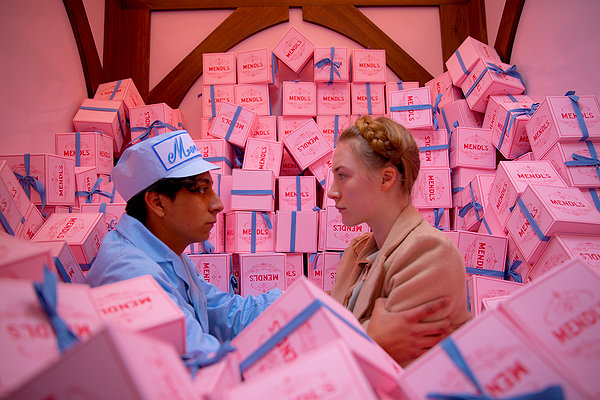 The fun of a Wes Anderson movie is the zany surprises played with deadpan sincerity, and there is plenty in Grand Budapest to produce smiles and laughter. It’s hard to describe exactly which jokes land the best in a Wes Anderson film because they form a patchwork that elevates the entire movie, building an odd world where oddballs can fit right in. It was under a minute before I laughed, and I smiled through just about every remaining minute of the film. I enjoyed a joke involving a dead cat that just kept being carried from scene to scene. I enjoyed a sexually graphic painting that just happened to be lying around. I enjoyed the fact that Zero draws on a mustache every morning to better fit in with the men of his day. But mostly I just enjoyed the characters interacting with one another, especially Gustave and Zero, which forms into the emotional core of the film. It begins as a zany chase film and matures as it continues, tugging at your feelings with the father/son relationship (there’s also a subtly sweet romance for Zero and a pastry girl played by Saoirse Ronan). One of the big surprises is the splash of dark violence that grounds the whimsy, reminding you of the reality of death as war and fascism creep on the periphery. In fact, the movie is rather matter-of-fact about human capacity for cruelty, so much so that significant characters will be bumped off (mostly off screen) in a style that might seem disarming and unsatisfying. It’s the mixture of the melancholy and the whimsy that transforms Grand Budapest into a macabre fairy tale of grand proportions.
The only warning I have is that many of the star-studded cast members have very brief time on screen. It’s certainly Fiennes and Revolori’s show, but familiar names like Bill Murray, Tilda Swinton, Tom Wilkinson, Jeff Goldblum, Lea Seydoux, Jude Law, Harvey Keitel, Jason Schwartzman, Owen Wilson, F. Murray Abraham, and Bob Balaban are in the film for perhaps two scenes apiece, no more than three minutes of screen time apiece. Norton, Brody, and Dafoe have the most screen time of the supporting cast. Though how does Revolori age into the very non-ethnic Abraham? It reminded me of Street Fighter: The Legend of Chun-Li (here me out) where, as she ages, Chun-Li becomes less and less Chinese in her facial appearance. Anyway, the brevity of cast screen time is not detrimental to the enjoyment of the film, considering all the plot elements being juggled, but I would have liked even more with the dispirit array of fun characters.
The Grand Budapest Hotel is Wes Anderson at his best, pared down into a quirky crime caper anchored by a hilariously verbose scoundrel and his protégé. Naturally, the technical merits of the film are outstanding, from the intricate art direction and set dressing, to the period appropriate costumes, to the camerawork by longtime cinematographer Robert Yeoman. The movie is a visually lavish and handcrafted biosphere, a living dollhouse whose central setting ends up becoming a character itself. The trademark fanciful artifice is alive and well but this time populated with interesting characters, a sense of agency, and an accessible emotional core. The faults in Anderson’s lesser films have been fine-tuned and fixed here, and the high-speed plotting and crazy characters that continually collide left me amused and excited. If you’re looking for a pair of films to introduce neophytes into the magical world of Wes Anderson, you may want to consider Grand Budapest with Moonrise Kingdom (Royal Tenenbaums if they need bigger names). In the end, I think Anderson more than identifies with his main character, Gustave, a man enchanted in a world of his own creation, a world better than the real one. Who needs the real world when you’ve got The Grand Budapest Hotel?
Nate’s Grade: A
Share this:

Nebraska (2013)
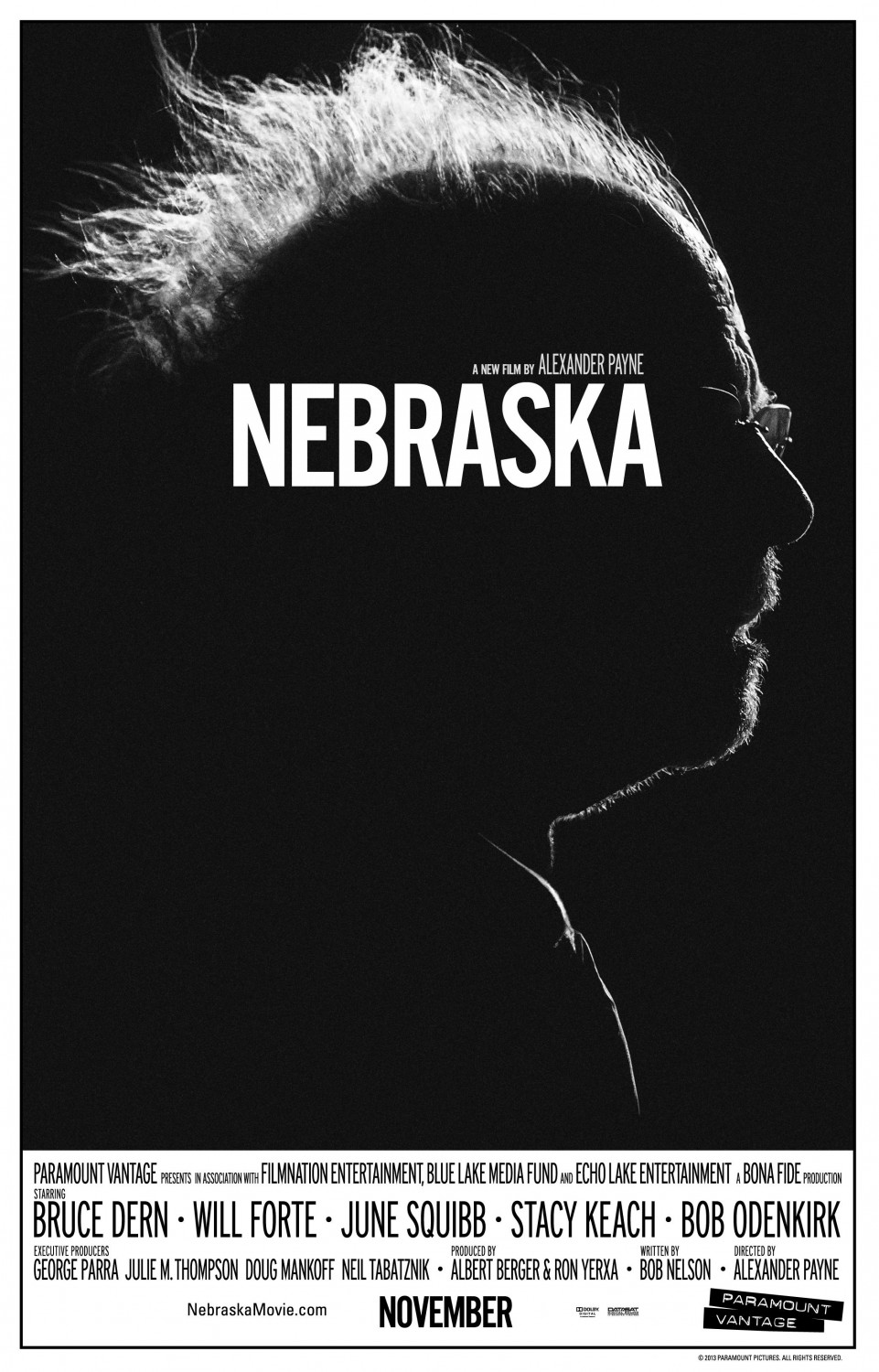 Nebraska is a slow burn, wryly-funny character study of understated proportions, highlighting Midwestern culture rarely given its big screen due. So, in essence, it’s an Alexander Payne movie.
Woody Grant (Bruce Dern) is an elderly man convinced he has won a million dollars and all he needs to do is travel to Lincoln, Nebraska to claim his loot. It’s one of those mass mailings really meant to get people to buy magazine subscriptions, but Woody will not be stopped, sneaking out to walk all the way to Nebraska from his home in Billings, Montana. David (Will Forte) is in a rut himself. He’s recently been dumped, his job is going nowhere, and his father refuses to accept his million dollars isn’t real. There’s a question of how lucid Woody is, and so to placate his old man, David decides to drive his father to pick up his winnings, to humor him before his mind may be gone for good.
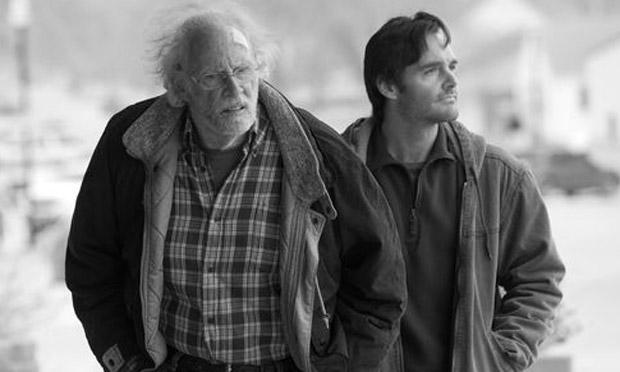 Despite the overtly sitcom machinations of the inciting incident, which even the characters dismiss, the film is really a drama about the relationship between a father and son and the culmination of our life choices. Woody and David are not close by any conventional means but over the course of their road trip, David begins to see his father in a different light; the old wounds are not forgotten, but David is learning about who his father is through others. He’s been so mad at his father for so long that it was the only identity he had for the man. Now in his deteriorating mental state and physical fragility, his father has a sense of vulnerability that brings about decidedly mixed emotions. In his fragile state, is he the same man or at least the same man David remembers? Then there are all the family revelations springing out from the situation. With a genuine millionaire in their midst, the family is coming out of the woodwork clamoring for their own pieces for all the unpaid assistance they’ve given Woody over the years. Initially, it makes Woody look like he’s been stuck trying to find his footing his whole life, as we learn about the lingering post-traumatic stress effects from his war service. Was he lazy, undiagnosed PTSD, or, as another character surmises, too ashamed to say no when others asked for help, and so he was taken advantage of in the guise of assistance from unscrupulous friends and family. The question remains who is Woody?
This is one of those observational slice-of-life films, and your enjoyment of it will depend on your threshold for the taciturn types. These are the strong silent types who keep most of their feelings to themselves. There’s a very funny sequence where Woody and his aged brothers have gathered around a TV, and to listen to the dry mostly car-related conversation bounce back and forth like a dead, floating wiffle ball, is a great comic moment but also a nice insight into an older generation and their communication. Given the perspective of the film, it’s hard to deduce whether the plainspoken people are being satirized or whether it’s a loving send-up of a specific culture. With Payne’s involvement, I lean more on the affectionate tweaking rather than a mean-spirited ridiculing of small town folk and their small town ways. There are funny situations, like David and Ross teaming up for some misplaced justice, and there are characters more broadly drawn for laughs, particularly Woody’s wife (June Squibb), but the overall interaction of the characters, their speaking vernacular, and how they viewed themselves, that is what made me laugh the most and appreciate the script. You feel like you’re dropping in on these people’s lives; every character feels like they could be a real person, not a stereotype. And boy does money really bring out the worst in people.
With Woody and his son visiting his old haunts, the movie inevitably becomes a reflection of a man taking stock of his life, regarding the choices he made and did not make. The pit stop in town opens up the character and David learns far more about his father, with old girlfriends, old business partners, and old rivals. What I appreciated further is that Nebraska doesn’t try and soften Woody; he’s not going to be some old curmudgeon who over the course of 90 minutes has his icy heart thaw and comes to realize the errors of his ways. Nope. Our views on the old man may soften when we get a fuller picture of who he is ad the life he’s lead, but the man himself is the same. He’s readily belittled, insulted, looked down upon, even by his own family members, especially his sassy wife. It’s easy for him to retreat into alcohol and wonder what if. As the family picture broadens and becomes more clear, the film approaches simply yet touching revelations about the family and the nature of legacy. There’s a father/son examination, but there’s also the discussion of what to do when your parents become too ill to take care of themselves. It’s not exactly The Savages, but there’s a circling sense of burdensome decision-making that provides an extra level of pathos to the sitcom setup. By the end, Nebraska squeezes out some earned sentiment without losing its edge or sense of identity. There’s a lot more going on then just some send-up of rubes.
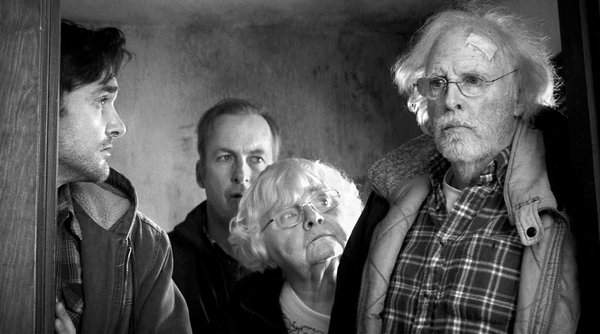 People have been raving about Dern (TV’s Big Love, Django Unchained) ever since the film’s Cannes premier, where the man earned top acting honors. The man deserves every positive words penned. He’s simply fantastic. The character vacillates between outward hostility, spacing out, and general Midwestern emotional reserve, and Dern is able to sell you on every emotional beat without breaking character. He’s unrepentant and demands to be taken for who he is, and his matter-of-fact bluntness has a certain charm to it, like when he admits to David that he never had any plans for kids. He just liked to “screw” and their mother was a Catholic (“You do the math”). I even appreciate that Woody would use the term “screw,” which seems more appropriate. As a two-man show, it’s a shame that Forte (TV’s 30 Rock, The LEGO Movie) doesn’t exhibit the dramatic chops to keep up with his onscreen pop. It’s nice to see him attempt something so different but his limitations are too evident; it’s just another gear that’s not present. At no point would I call Forte’s performance bad but he’s just unable to keep up. Squibb (About Schmidt, Meet Joe Black) is a hoot though the character seems to be permanently stuck in “wacky” mode. She’ll crack you up with her unrestrained commentary, but you may wonder if there’s any more to this character than saying outrageous, curt comments.
This was the last Best Picture nominee I’d failed to catch up with, and while it’s entertaining, funny, and unexpectedly touching thanks to terrific acting and a sharp script, but it also might be the weakest Alexander Payne film yet. This is the first film that the Oscar-winning director hasn’t written himself. Bob Nelson’s screenplay may never have even been glanced over by Payne had it not been for the state of its title (Payne’s films general take place in Omaha). It’s got Payne’s stamp, as would any film he directs, but it also feels like it’s missing something ephemeral, not to get too pretentious. This is a quality study of a cracked group of characters that, upon further review, aren’t as cracked as we may think. They’re just flawed people trying to get along as best they can. Even amidst the snide and antagonistic conversations, there’s gentleness here about the value of family that resonates above the din of the shouting. By film’s end, what started as a cockeyed sitcom transforms into a film that has more meaning and emotion, never betraying its guarded sense of self. When I say the weakest Payne film, this is not an insult but merely an observation. Even the weakest Alexander Payne film is going to be so much better than just about everything out there.
Nate’s Grade: A-
Share this:

The Great Beauty (2013)
 In the Eternal City, a.k.a. Rome, Jep Gambardella (Toni Servillo) has served as its unofficial emcee for years. The literary magazine writer has been coasting for years, living off the prestige and fame from an international hit novel he wrote in his twenties. Now at the age of 65, Jep has come to the conclusion that his life has been lacking the beauty he has sought. All the parties, the late nights, and the fast living have caught up with him. Jep explores the city and its peculiar inhabitants to examine his own life.
It’s impossible to watch The Great Beauty without conjuring images of the great director Fellini. It certainly brings to mind a modern La Dolce Vita. There’s a heightened sense of reality mingling with the surreal, the lives of the rich socialites stepping into the reaches of irony-free satire. At a small party, one rich lady compliments the jazz playing, and another lady says, “The only jazz scene worth listening to today is Ethiopian jazz.” I burst out laughing harder than I have all year. These are people living privileged lives that have lost their tenuous grasp on reality, unaware that they have become caricatures. Their silly ennui has consumed their perspectives. Like Fellini, the movie explores a cloistered world of the Roman elite and their tragicomic absurdities with a touch of the surreal and meditative. I can’t so much pinpoint a clear plot or structure that guides the film, but there are numerous moments, images, scenes that standout in my memory. A private Botox party is played as a zany spiritual gathering where applicants take waiting numbers and a doctor whisper about the great journey they are on together, and then injects botulism into your face. Nuns are everywhere, which shouldn’t be a surprise, but the sight of nuns just randomly populating scenes lends to the surreal nature. Then there’s the 104-year-old nun positioned to be a saint. She looks like a mummy, prefers to sleep on a floor of cardboard, and her mind is still capable of great insight. The ancient nun manages to thematically sum up the film’s interests in beauty, culture, religion, remembrance, and death.
 The relaxed nature of the film and the abstract plot, with little sense of linear trajectory, will certainly test the patience of several moviegoers. At my theater, after twenty minutes several middle-aged couples walked out, muttering, “This is one of the worst movies I’ve ever seen.” I don’t know what these people were expecting when they walked into a 140-minute Italian film, but there declaration is flat-out wrong. I mean, these people probably haven’t even seen InAPPropriate Comedy (cheap shot, achieved). The opening involves the death of a Japanese tourist, and then it switches over to a raucous rooftop party that rivals what we saw in last summer’s Great Gatsby. This is a slow movie but it is slow with purpose, if that makes sense. Jep’s life for so long has been about the party scene, the dulling of the senses, the rush of adrenaline and alcohol. After his sixty-fifth birthday, he’s decided he has no more time to chase after momentary thrills. The journey that follows is mostly a collection of anecdotes and ideas, but many of them have strong staying power. The most notable story is a budding romance he forms with Ramona (Sabrina Ferilli), a 40-year-old stripper with no illusions about who she is. Their relationship is sweet and it ends abruptly, far too soon than a viewer would wish. I know if Hollywood ever remade an English version of this film, they’d structure the whole movie around this relationship. I suppose another benefit of a free-floating, stream of consciousness style plot is that few storylines overstay their welcome.
Jep has come to a turning point, a stark realization that his life is empty. A nice reminder of this notion, as well as a haunting “what could have been” review, is when the husband to an old girlfriend seeks him out. She has recently died and inside her diary, she writes passionately about Jep from their romance way back when they were teenagers. She only has a passing remark for her husband of 30-some years, and it rips the poor man apart. She was always hung up on Jep, always thinking about what might have been, the path not taken, and this defined her intimately. For the first time since he was young, Jep is looking at the world with different eyes and a hunger that exceeds Earthly pleasures. His friends all suffer from the doubt that they’ve wasted their time, that they were never good enough, and they accept their defeat and leave Rome one by one. One man, so humbled, doesn’t even want to bring any furniture with him, so he leaves it all behind. The only thing he’s taking with him is the years of regret, apparently. There’s a nice moment when he’s reiterating the story of his first kiss to Ramona, which also involves this now deceased woman. He can’t remember what she said to draw him, and the look of disappointment at his failing memory, at being unable to relive a moment that meant so much to him so long ago, it crushes him. Who knows how long Jep had held onto that memory as a source of respite. Jep is examining his life’s disappointments and misanthropy but it may already be too late.
There are plenty of messages and points of contemplation throughout the film, but the major theme seems to be as simple as, “Stop and smell the roses,” And yet, that doesn’t make the film less engaging and responsive. Jep is asked why he never wrote another book after his great success. There look to be a number of reasons, but he confesses he was waiting to be inspired again by the titular Great Beauty. Naturally, by this point, we and Jep have come to realize that waiting for beauty is foolish when it is all around us at any moment (especially in Rome). Most of Jep’s adult life has been consumed with social frivolities and passing pleasures, but only now does he seem to stop and fully appreciate his surroundings and his company, naturally, when his friends are departing. It’s a universal theme and one that hasn’t gotten old and the film’s handling is anything but sop-headed sentimentalism. It even ties back to the opening, where the Japanese tourist keels over dead. The man is so busy trying to document his vacation rather than experience it, and in the end, it’s all for what?
 Like Jep, we too will fall in love with Rome as he strolls around it. Gloriously photographed, it’s a treat to experience the major works of art in Rome, so much so that it may stir your passions to see them in person. Even as the plot becomes lugubrious, you don’t mind because of how lovely Rome and its facilities look. Characters doing little and ruminating in Kansas may get boring, but characters doing little and ruminating in Rome, well at least that’s scenery worth watching.
I’ve read many differing interpretations of the film and its messages, the impact of different scenes and which hit hardest, and it reminds me what good art is meant to do; it’s meant to inspire us, entreat us, but also stir us to engage with it, and The Great Beauty does just that. It’s a bawdy, beautiful, and entertaining film but one that also takes its time, luxuriates in atmosphere, and asks the audience to ponder as Jep does about regret, lost opportunities, and the contradictions of happiness. The surreal touches can provide plenty of laughs, but it’s the smaller appreciation of side characters, ideas, and the contrasts that provide more intellectual payoffs. The film is far more free-floating and meditative than American audiences are used to, but unlike, say the works of Terrence Malick, I felt like I could celebrate the absurdities and joys of life along with the people onscreen. It’s existential without being laboriously pretentious, and the comedy and stylish flourishes help anchor the entertainment. The Great Beauty is a beguiling movie that admittedly could have been chopped down from its 140-minute running time. If you’re a fan of Fellini, or art history, then this is a must-see. For others, I’d advise giving this a try, though don’t be surprised if it takes a while to grow on you with its ponderous nature.
Nate’s Grade: A-
Share this:

Philomena (2013)
 A more family-friendly alternative to the wrenching The Magdalene Sisters, the drama Philomena is ostensibly a good movie, but woe unto thee if you thought you were in store for a crackling comedy. Philomena Lee (Judi Dench) was forced to work in a Catholic workhouse in Ireland when she became pregnant as an unwed teenager. Her child was placed into adoption into America and now, 50 years later, she wants to find her long-lost son and learn about him and his life. Helping her in her quest is Martin Sixsmith (Steve Coogan, co-writer as well), a recently unemployed journalist. Their odd couple pairing should inspire comedic repartee, as so the ads would also have you believe. The film is funny, in spurts, but it’s much more effective as an illuminating drama on the abuses of the church-run workhouses that guilted poor girls into, sometimes lifelong, slave labor. At the thirty-minute mark, when Martin comes across a makeshift graveyard of dead teen mothers, who were forced to give birth on the workhouse premises as punishment for their sins, you can pretty much abandon any hope of a ribald road trip comedy. Once your expectations are realigned, you can enjoy the film for what is has to offer: an intriguing mystery, solid characterizations, a terrific Dench performance, and an ending that doesn’t pull punches. Be warned, you will walk away from this movie wanting to punch nuns in the face. Coogan’s role is one of anger and outrage, and there’s plenty to go around with church corruption, scandals, and cover-ups uncovered. But it’s Philomena herself who is the life lesson for us all; her church fails her but her forgiveness is the model we should all strive for. It’s a moving film with as much compassion as it has criticism. Just don’t watch it in the company of a nun.
Nate’s Grade: B+
Share this:

Saving Mr. Banks (2013)
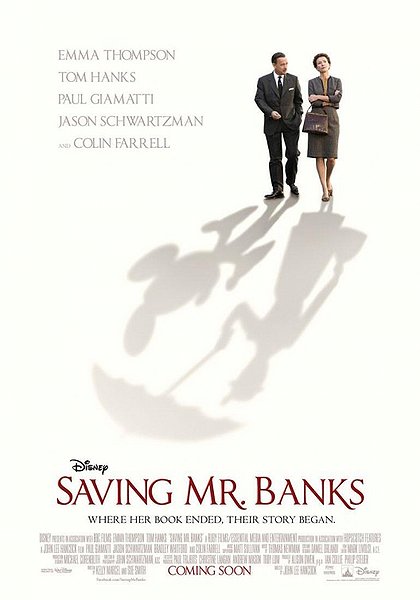 Seemingly sure-fire Oscar bait, Saving Mr. Banks left enough Academy voters cold and it’s easy to see why. First off, the behind-the-scenes sparring to adapt Mary Poppins is the movie we want to see, watching crotchety author P.L. Travers (Emma Thompson) butt heads with head honcho Walt Disney (Tom Hanks). The movie is at its best when these two share the screen, with Walt’s genial strong-arming finding little traction with Travers stern refusals (no Dick van Dyke, no animation, no mustaches). What I wasn’t expecting was a parallel storyline detailing Travers childhood in Australia dealing with an unstable home life thanks to a drunken father (Colin Farrell). It literally takes up half the movie, and while there are a few interesting juxtapositions, the screenplay just trades off scenes; one in 1961, then one in 1906, then back again, etc. The issue is that the flashbacks are never very revelatory and have no business dominating the running time. All of the information gleaned from these flashbacks could have been corralled into one late flashback, or even mentioned in a speech. Saving Mr. Banks gives you two movies running parallel, but most people will only be interested in the one. It’s a pleasant film, benefiting from strong performances by Thompson and Hanks (perfectly cast), but one can’t shake the feeling of Disney P.R. pervading the film’s retelling. It comes from the perspective that Disney is always right and that Travers was always wrong, having to work through her personal issues before relenting, even tearing up at the final product. In real life, Travers never forgave Disney and never allowed another of her Poppins books to be adapted into a film, though not for want of trying by the studios. It feels unfair to portray an author’s artistic integrity as an obstacle that needs to be defeated, but there it is, and Disney’s Mary Poppins, while beloved, resembles much of what Travers feared. Who defends the cranky authors of the world when they have a point? Saving Mr. Banks is an entertaining film, charming and likeable, until you begin to look beyond the fairy dust and realize the revisionism before your eyes.
Nate’s Grade: B-
Share this:

Fruitvale Station (2013)
 In the early hours of New Year’s Day in 2009, 22-year-old Oscar Grant was forcefully escorted off the Oakland transit system by armed officers. He was believed to be involved in some sort of gang-related scuffle on the train. Over the din of confusion, shouting, and anger, Oscar was shot and killed by a transit cop. His death sparked waves of outrage in his hometown and grabbed national headlines. Ryan Coogler was so passionate about Oscar’s death that he decided to write and direct a movie detailing the last hours of Grant’s life. He snagged Michael B. Jordan and Octavia Spencer (The Help) to star, attached Forrest Whitaker (Lee Daniels’ The Butler) as a producer, and the ensuing film, Fruitvale Station, debuted at the 2013 Sundance Film Festival and won the top honors. Thanks to Coogler, many more people will have a chance to get to know Oscar Grant as a person rather than an unfortunate statistic.
Coogler creates a remarkable debut film for himself, one where the details of life feel richly realized and observed. Sure there are obvious symbolic metaphors introduced like boiling lobsters and a lost dog that dies in Oscar’s arms (yes, foreshadowing), but as a whole Fruitvale Station feels like real life transposed onto celluloid. Coogler also works hard to humanize all the participants in his film, save for the transit cops at the end. There is a refreshing lack of judgment throughout the film as people are allowed to be the ambiguous creatures we are. No more so than Oscar. He has moments that make you wince, but mostly we watch a man struggling to get his life in order. He’s terrific with his daughter, loving and naturally attentive; he puts his family’s needs ahead of his own when it comes to money; he even helps a stranger learn how flash fry a fish, though there’s a hint of flirtation guiding his actions. But he also can’t hold onto a job, has trouble being more actionable in his life’s decisions, and temptation is always banging on his door to lead him back to prison. He’s a complicated man and Jordan (Chronicle) masterfully brings the man and his complexities to life. This is a star-making performance by Jordan (as was his turn on The Wire) and I was stunned at how easily Jordan dissolves completely into his role. There isn’t a physical nuance or line delivery that feels false. It’s a sympathetic humanization and Jordan’s performance is a gift. Combined with Coogler’s deft handling, Fruitvale Station is engrossing.
 For much of the film I felt like I was attending a funeral. It’s hard to watch at times, especially watching Oscar’s family wait at the hospital for the news we already know is coming. It reminded me of 2006’s United 93, where the overwhelming sense of dread held over every scene, every innocuous moment held the extra weight that it would be the last time this person was doing this or talking to this person; the dread of waiting for the end we all know is coming. Coogler opens his film with real phone video recordings of the death of Oscar Grant, so from the first moment on we’re awaiting the horrible inevitability. I suppose it gives every moment an extra dimension of pathos, and to some this may be cheap and easy, but it all comes down to perspective. Surely if you knew the final day of your life, you’d likely find extra meaning in the simplest things, bidding goodbye in a thousand different subtle ways. This message isn’t exactly new; it was already old when Thornton Wilder hammered it home in his 1937 play Our Town. Carpe Diem, seize the day, live every moment like it’s your last, stop and smell the roses; you get the idea. And so, the entire running time of Fruitvale Station is a mournful examination on the contradictions, complexities, and connections of a single human life.
Oscar Grant is not lionized as a saint nor is he vilified as some mindless thug without redemption. Carefully, Coogler constructs a complicated man struggling to right his life. Through flashbacks we see he’s spent time in prison, and he’s got a quick flash of a temper that can lead him into impulsive and violent confrontations. It’s significant that we see this prison flashback to summarize completely the life Oscar is trying not to return to. The temptation is always present to fall back on old patterns of comfort, namely cheating on his girlfriend (he has a lot of girls’ numbers in his phone) and going back to selling drugs to make ends meet. Oscar’s ongoing struggle with personal responsibility has cost him his supermarket job (he was late far too often), and he’s kept this news to himself, choosing not to worry those close to him. But his options are limited as an ex-con, let alone a guy fighting his own demons, but he keeps fighting because the Oscar we see, the glimpses of what he could become, are one who wants to be better. He dumps his supply of drugs rather than go through with a sale. The gesture is noble but also partially self-destructive from a pragmatically financial way of thinking. He’s in a deeper hole, money-wise, but he seems committed to making the change. A late encounter with a kind stranger also provides the possibility of a new job, a new chance, one that seems all the more tragic because we know it is a promise that will never be captured. Oscar Grant was likely never going to be a man who changed the world. He was an ordinary man. But we still mourn the death of ordinary men, even those who have made mistakes and are fallible.
 It’s impossible to view Fruitvale Station without its relevant connections to the Trayvon Martin case of 2012. Both of these men were black youths deemed to be “up to no good” with quick judgment skewed by prevailing racial bias. Both men were killed for being viewed as threats due to their race and gender. However, unlike Trayvon, we have a litany of witnesses and video evidence documenting the senseless execution of Oscar Grant. That transit officer argued he mistook his tazer for his gun because, surely, a suspect who is already handcuffed, face down on the ground, and having his head pressed down with the boot of an officer, surely that man needs to be tazed just for good measure. That officer, by the way, served 11 months of a two-year prison sentence for involuntary manslaughter (justice served?). It’s senseless tragedy built upon miscalculated racial alarm, and the reason we have a movie, the reason there were riots in Oakland, is because this specific case had witnesses. How many other innocent young men die every year because someone wrongly and hastily deemed them to be “up to no good”?
Coogler isn’t trying to stir the pot of racial animus or deify Oscar Grant into some martyr for the cause. Fruitvale Station only follows the last day of Oscar Grant’s life but in doing so it becomes an illumination of a human life. Oscar was an ordinary man before he met so unfortunate an end, but Coogler wants us to remember him not simply as a newspaper headline, but as a person. It’s a worthy endeavor that succeeds heartily but may prove to be dull to many, including several of my own friends and critical colleagues. I can’t argue that the life of Oscar Grant is notable to follow beyond the sad final twenty minutes. But that doesn’t bother me, because with the talents of Coogler and Jordan and their indomitable sense of purpose, the film becomes a fitting portrait of Oscar Grant as a human being and a life lived, not just a life prematurely extinguished. It’s powerful, upsetting, brimming with emotion and fury, and it’s also eerily relevant to today and will, I fear, only continue to be more relevant as the next Oscar Grant or Trayvon Martin captures the national spotlight. Coogler’s excellently realized film is a eulogy to an ordinary man, flaws and all, but also a call to do better.
Nate’s Grade: A-
Share this:

The Wolf of Wall Street (2013)
 Martin Scorsese. The greatest living filmmaker on the planet. Enough said. When his latest, The Wolf of Wall Street, was pushed back due to an editing crunch, the rumor mill started as it normally does. Are there problems? Is it any good? Will it be forgotten this late into the awards season? While I can’t speak for the Academy, but for me The Wolf of Wall Street just about blows every competing movie out of the water this season. It’s brash, exhilarating, uproarious, mesmerizing, and just about every other adjective you can fetch from a dictionary. This is first-class filmmaking from a master, and consider Wolf of Wall Street the white-collar companion piece to Scorsese’s gangster masterpiece, Goodfellas. It’s that good, folks.
Based on his memoirs, Jordan Belfort (Leonardo DiCaprio) rises on Wall Street from a rookie stock trader to the king of his own empire. From the late 80s to the 90s, Jordan assembles a cutthroat team that knowingly sells lousy stocks to gullible investors and stuffing their pockets with hefty commissions. “Better there money was with me. I knew how to spend it better,” he admits. His closest friend and business partner, Donnie Azoff (Jonah Hill), literally quits his job to work for Jordan after spying one of his pay stubs. The guys start their own firm, specializing in high-pressure sales and on penny stock commissions. From there, they expand and expand until they’re making their own noise on Wall Street. The trading floor more closely resembles a frathouse party, complete with chimp, strippers, marching bands in their underwear, midget tossing, and other objectionable behavior. Jordan easily succumbs to the sex and drugs of the high-finance world of money, leaving his plain wife for Naomi (Margot Robbie), a gorgeous underwear model. He’s got a giant estate, a huge yacht, his own helicopter, and more money than he can spend. He’s also got the attention of the FBI and Agent Patrick Denham (Kyle Chandler). With the feds circling in, Jordan has to take extra steps to keep the good times rolling.
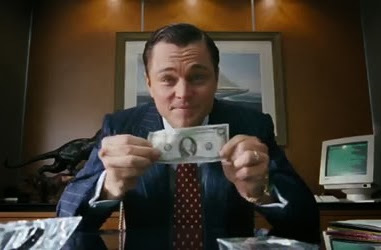 With a running time exactly one minute shy of three hours, it’s easy to call The Wolf of Wall Street self-indulgent and excessive, except that’s exactly the point. The movie is an orgy of unchecked male ego, a perverse bacchanal of Earthly pleasures that Caligula might blushingly admire. They are literally two orgies depicted in the movie and plenty of thrust-heavy sexual congress (I counted eight walkouts in my theater, most of them the little old lady variety). Here is a tilt-o-wheel of madness. These people were living like there was no tomorrow, had more money than they knew what to possibly do with, and would figuratively dance while Rome burns (in this instance, the stability of the U.S. economy). What’s important is to communicate that these individuals were having the time of their lives. It wasn’t just the hedonistic pleasures and the mountains of drugs; it was the power, the uninhibited embrace of a life available via poorly regulated capitalism. Many of those brokers in Jordan’s company were people from ordinary backgrounds. Their self-made success (that wasn’t so much earned as swindled) is a point of pride that fills them with purpose. They are seizing their full potential. There is no doubt in my mind that every broker in this movie would do it all again in a heartbeat. There is no remorse on display anywhere. The only remorse is having the ride unceremoniously end. “Was it obscene? Yeah it was obscene. In the normal world,” Jordan narrates. “And who wants to live there?”
I won’t say that there aren’t scenes and moments that could have been trimmed, but I was enjoying myself way too much to care about the bloat. This is the fastest three hours you’ll ever experience in your life. There’s some fat, yes, but man does this picture just move along like a freight train. The screenplay by Terence Winter (creator of HBO’s Boardwalk Empire) is impeccably drawn. The movie just courses with energy and watching it is often an exhilarating rush, communicating the highs the characters are undergoing. The supporting players are used to great effect to punctuate the comedy moment to moment. I loved Rob Reiner’s exasperated and profane performance as Jordan’s father. Naturally the bad behavior is entertaining in how absurd and over-the-top it can get, but one key sequence ranks up there with the finest sequences Scorsese has ever put to film. It’s the “Lemon” sequence, named after a legendarily potent batch of Quaaludes. It is a sequence of pure movie bliss, brilliantly edited and staged, as Jordan is placed in a precarious position when the drugs kick in, and his comic floundering is riotous. Winter and Scorsese have taken what, in other hands, could have been a modern American tragedy and decided to portray it as a darkly comic fantasia. I laughed long and hard throughout the movie. There are numerous scenes I can think back on and start laughing again. The ridiculous nature of moments, like discussing the logistics of tossing midgets at a dart board (“This is their gift”) is to be expected, but it’s the overall degenerate lifestyle these clowns chase after with impunity that kept me laughing.
I’ve read cantankerous critiques of the film, chastising Scorsese for celebrating the lavish lifestyle and excessive hedonism of his characters. I could not disagree with this appraisal more. The error is assuming that witnessing Jordan behaving badly is akin to celebrating it, as if adopting the perspective of our lead is the same as excusing his actions. Scorsese makes it clear early, and often, that Jordan Belfort is not a good person. Hopefully you don’t need him hitting his wife for this point to stick. This guy is fleecing people out of their life savings, living high off the fat of the land, and openly admitting to the camera how deeply illegal his activities are. But you’re under his spell, much like his brokers that worship him with unflinching zeal. Jordan, especially as portrayed by DiCaprio, is a volcano of energy and single-minded determination. He whips his troops up like a religious revival, manipulating you with every tactic in his employ. Early on, he’s defrauding ordinary middle-class and low-income clients, but because we’re all addicted to the adrenaline rush of the sale, of the con, we push this troubling reality from our minds. When he moves onto wealthier clients, we adopt a similar attitude of Teresa, Jordan’s first wife, mainly that these people can afford the losses and therefore get what they deserve from a silver-tongued shyster. It’s the audience that proves to have a selective memory because we’re drawn to Jordan’s charisma, expertise, and talent, so we ignore the pesky details of who gets stuck with the bill. Don’t pin that on Scorsese. He makes it abundantly clear that Jordan is a bad man, and the depths of his greed is but the tip of the iceberg when it comes to Wall Street. Jordan’s firm was a tiny player. Think of what horror stories Goldman Sachs or Lehman Brothers would offer if ever exposed.
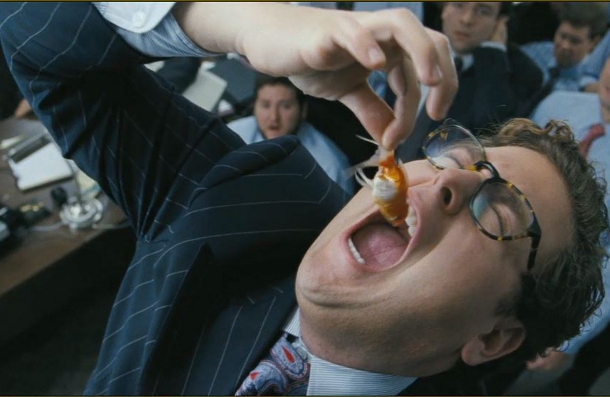 This is my favorite Scorsese film since Goodfellas, and they have plenty of similarities. It makes sense because these men of finance take their cues from movie gangsters, styling themselves as tough guys. At one point, brokers hold a guy over a building to intimidate him. There’s also certainly as much cocaine as there may have been in Scarface. But like that classic of the gangster cinema, Scorsese propels us into the hidden world of the financial institution run amok, allowing us a backstage pass to the people profiting from wrecking the economy. It’s a fascinating perspective that confirms some of our worst fears about stockbrokers. It’s a misogynistic boys club and the few women that do participate have to play by their hyper masculine, juvenile rules. These are people that find any number of ways to skirt the law, rip off their clients, and live in luxury until they can find another sucker. It’s a system built for the entertainment of the few on the backs of the many, and it’s just as relevant today as it was in the 90s. With Jordan’s inside knowledge, we’re educated on the many corrupt ways of Wall Street.
Marking the fifth collaboration with Scorsese, this may be the finest DiCaprio (The Great Gatsby) performance yet. The man sheds his vanity, easily fitting into the shark that is Jordan Belfort. He’s ruthless in one moment and completely inept in another, at the whim of his vices. DiCaprio taps into Jordan’s leadership qualities with the dynamite sales speeches, but he also shows what an insecure man he is at heart. He’s got a taste for the good life and is reinventing himself, including trading up in wives to attain that proverbial American Dream. He’s living empty pleasure to empty pleasure and he doesn’t care. DiCaprio acts as our ringmaster through his own circus, and you’ll be delighted and horrified by his actions (and also his peculiar, bird-like dance moves). There’s not a bad performance in the whole cast, and this is one huge cast. Hill (This is the End) is a becoming more and more credible as a dramatic actor, though he excels at the blustery outrageousness as Jordan’s number two. He’s a treat. Robbie (About Time) nails her New Yawk accent but more importantly nails the portrayal of a trophy wife who recognizes and eventually resents her lifestyle. And oh does she just exude sexual heat.
I want to focus on the very end of the film, so there will be some mild spoilers in this paragraph but nothing I feel that would ruin the viewing experience. You have been warned, spoiler phobes. As expected, Jordan eventually winds up in jail for his felonious misdeeds. Ordinarily this would be the end of our traditional law-and-order morality tales; the bad guys are locked away to pay for their crimes. Jordan tells us how nervous he was on his first day of prison, that is, until he remembered one very important fact: he’s rich. White-collar prison is not the same as other penitentiaries, and we see Jordan loftily playing tennis. His sentence is only three years as well, which seems like an insult given the thousands of lives he may have instrumentally ruined. But that’s the ultimate condemnation in the end: the system is rigged for people like Jordan, people with money. In the end, he wins. He goes to prison, his family life is torn asunder, and his personal relationships are strained, but the guy wins. He continues his speaking engagements motivating everyday saps how, with his cherished expertise, they too can rake in wealth. The final shot of the movie tells me everything I need to know. It’s a slight pan out to the crowd in attendance of Jordan’s speaking session. We see the collection of faces, each person hanging onto Jordan’s every word, each filled with idolatry. They want to be him. Despite everything, the bad behavior, the crimes, the waste, they all want to be him, and that’s why people like Jordan will always succeed, will always prevail, will always have the last laugh. There will always be a healthy supply of suckers that want to believe whatever nonsense he’s peddling. That’s the point. He won.
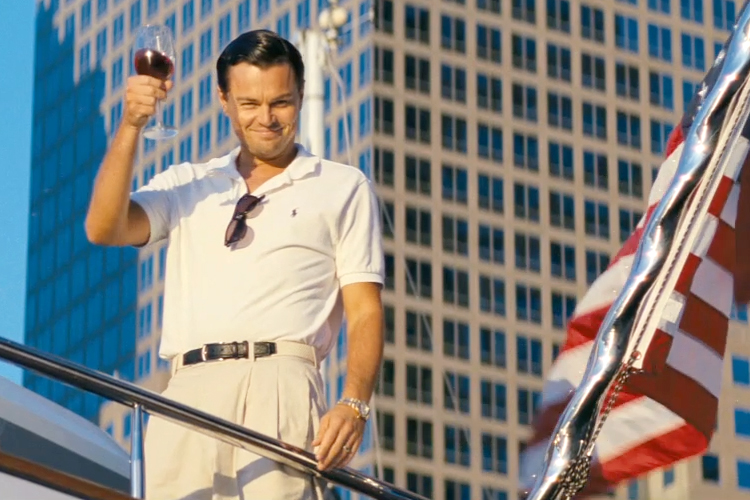 Recently I watched the very good crime caper American Hustle and noted that its director looked to be fashioning a loving Martin Scorsese homage. Well, after watching The Wolf of Wall Street twice (not back to back, mind you; I’m not nuts) I can say that there is no Scorsese like the source. This is vintage Scorsese. This is brilliant filmmaking, a bold movie that practically sings, it flies by with exhilarating force and acumen, daring you to keep watching. The fact that 71-year-old Scorsese could make a movie this highly energetic, this debased, this brash, this borderline indecent, and this awesomely entertaining is encouraging. It’s even more hilarious to me that older Academy members at a recent screening of the film accosted Scorsese, essentially being termed a “debauched scoundrel.” That’s got to count as some badge of honor. Yes, at three hours the movie can get long but it’s never dull or taxing. The propulsive narrative, the hilarious humor, the shrewd characterization, the wanton excess, the filmmaking bravado that hums, it all coalesces into a disturbing and disturbingly enjoyable condemnation of greed and our inherent celebration of this lifestyle. There is not one aspect of this movie that falls flat. The Wolf of Wall Street is an invigorating piece of cinema. The choice of music, the swinging cinematography, the wide ensemble of actors, the feverish editing, it all comes beautifully together to form a whole that surpasses everything else in cinema this year. Dig in.
Nate’s Grade: A
Share this:

August: Osage County (2013)
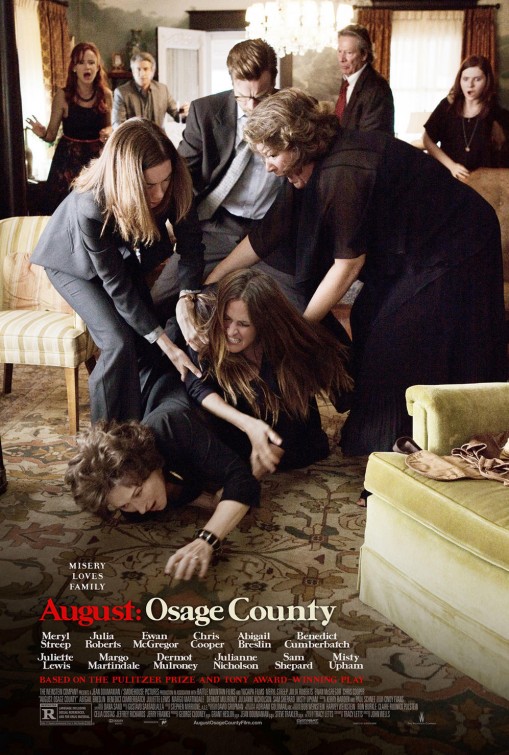 This holiday season, the movie with the most acting, by far, is likely to be August: Osage County, the adaptation of Tracy Letts’ Tony award-winning play. It’s a large dysfunctional family getting back together and opening old wounds, so, you know, the most relatable Christmas movie for some. It’s easy to see what attracted such A-list talent to this project because these characters are actor catnip; each is overflowing with drama, secrets, revelations, anger, and it’s all channeled through Letts’ barbed sense of humor and wickedly skillful dialogue. With Meryl Streep as the pill-popping matriarch, Julia Roberts as her resentful daughter, and a host of other inter-generational conflicts and secrets, you may feel exhausted by the end of its 130-minute running time (the stage play was 3.5 hours, respectively). The emotional confrontations feel like grueling pugilist matches, the melodrama kept at a fever pitch, but the film is never boring. Streep is her usual astonishing self and the deep ensemble gives each actor something to chew over. This is the best Roberts has been in years, and she’s not afraid to get nasty (“Eat your fish!”). Just when you think the story might soften, Letts unleashes another body blow, allowing no uncertainty that this is a family doomed. The story also provides insights into tracking the path of cruelty through the family tree, limb by limb. August: Osage County is stridently funny but also punishing in its no-holds-barred approach to family drama. If you’re looking for a movie that makes your family seem normal and even-tempered, this may be it.
Nate’s Grade: B
Share this:

American Hustle (2013)
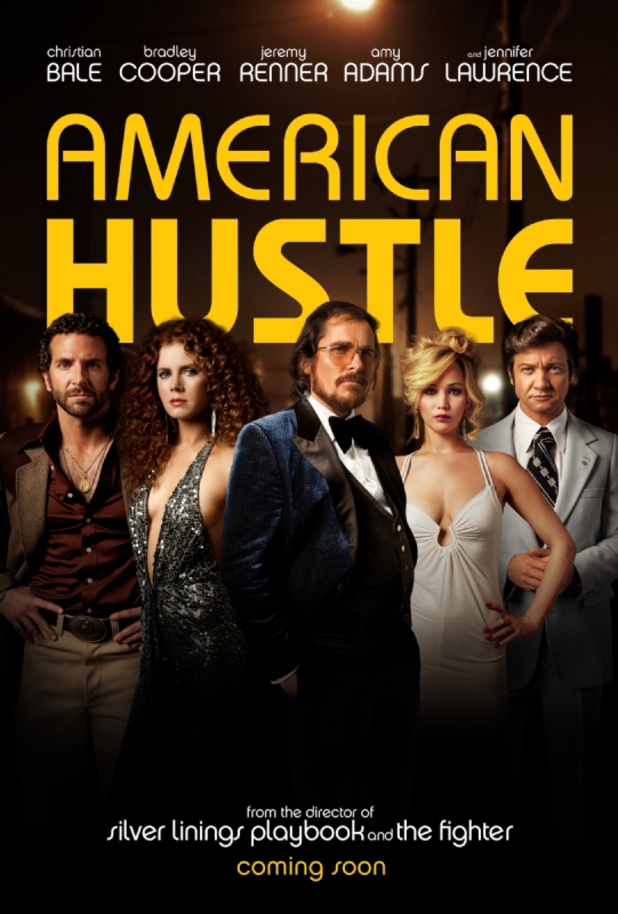 With two movies, writer/director David O. Russell has vaulted to the top of Hollywood. Previously known for his own difficult behavior, Russell’s last two films, The Fighter and Silver Linings Playbook, were both critical and commercial hits (Silver Linings made over $230 million worldwide). Both brought a bushel of Oscar nominations as well, making Russell one of the hottest directors for actors and producers. But a new side seems to have emerged over these last two movies, one less of Russell the domineering director and one of Russell the open collaborator. It feels like he’s just hitting his stride too. American Hustle is Russell’s latest and it’s sharply written, engrossing, lively, surprisingly comic, and readily entertaining.
In the late 1970s, the FBI set up an undercover sting to nail political corruption, ultimately nabbing several U.S. congressmen and one standing U.S. Senator. Richie DiMaso (Bradley Cooper) is an FBI agent who snags the perfect assistance. To catch a crook you have to think like a crook, and so Richie has strong-armed a pair of lucrative con artists into helping him. Irving Rosenfeld (Christian Bale) is a professional down to his elaborate hairpiece. He’s used to fleecing desperate people and selling phony artwork to the gullible, but he’s been too shy about making too much noise. If you stay small, you go unnoticed. Irving’s partner in crime is Sydney Prosser (Amy Adams), a kindred spirit who has reinvented her self. She and Irving are in love, and now they’re trapped by Richie to set up New Jersey mayor Carmine Polito (Jeremy Renner). The one unpredictable element is Irving’s young wife, Rosalyn (Jennifer Lawrence), who could blow up the whole operation with her careless and self-involved tantrums.
 Russell has once again given audiences one of the most entertaining films of the year, this time allowing them to participate vicariously in a con game, trying to anticipate the twists and turns and assessing everyone’s personal angle. This is a fictionalized rendition of the Abscam case (the opening text drolly says, “Some of this actually happened”) and it gives us a slew of meaty characters that have something going on. The central point elaborated in this pop crime caper is that we’re all cons, we’re all pretending, on some level, to be different people; Russell’s film just takes this notion to the extreme. Irving and Sydney are trying to escape lives of ordinary malaise, of being victims, of the more powerful dictating their options for them. With Sydney, she’s pretending to fall for Richie, but we don’t fully know which side she may choose to end up on. Richie is trying to also escape his dull life of desk jobs and lower middle-class dinners. His ambitions get hold of him, and with Irving’s aid, he catapults himself toward achieving those oversized dreams of his, never mind the ethical lapses in nabbing the bad guys. For Carmine, he’s so fiercely devoted to his community that you don’t doubt his loyalty for a second. He’s a man who sincerely wants to help others and is knowledgeable enough about how the world works, knowing he may have to grease some wheels to get the progress started. He is the most moral figure of the five main players and you may find yourself rooting for him to escape the snare closing in on him. Then there’s Rosalyn who has her hooks in Irving, looking for a sense of stability for her and her child. She’s a volatile cocktail of emotion but she knows what she needs to do to keep Irving anchored to her needs, though she’s also cognizant enough to latch onto a better provider if one materializes. Mixing and matching those characters, you have an eclectic mix of personalities clashing, many at odds with one another as far as goals, and the conflict stirred up is delicious.
Russell also attaches on his Martin Scorsese filter, delivering a freewheeling film about criminals from their wizened point of view, explaining the ins and outs of their hustle with flamboyance, style, and vigor. While the opening is a tad slow, including an opening minute watching Irving work his almost breathtaking comb over hairstyle, we plow right along into this world of hustlers and con men, learning tricks of their trade (hint: desperate people are desperate) and the tools to stay ahead of detection. We’re awash in multiple perspectives, each with voice over, a frenetic camera, and emboldened editing. It’s the Scorsese approach given studious application to the Abscam affair. It’s a great thing that Scorsese is the finest living filmmaker and devoting a two-hour-plus homage to the man’s most stylized crime pictures is a plus. Russell’s movie feels alive but also hungry, like many of his characters, restlessly searching for something. The scenes land but they don’t feel like they’re standing still; everything is propulsive in this movie. The small operation of Irving and Sydney is taken to the big leagues thanks to Richie’s ego, and the FBI’s desire for splashy headline busts, but wider exposure also exponentially multiplies the danger. Once the gambling scheme attracts the investment of the Mob, that’s when everyone has gone too far. I was clenching my fists in suspense toward the end, worried that our fictional cons may be too far in to survive.
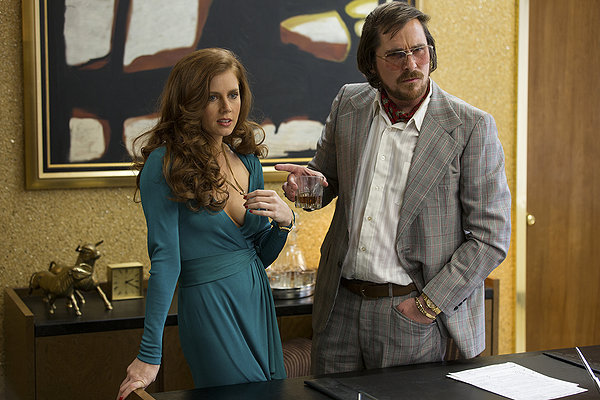 Russell hasn’t lost his magic touch with actors. His last two films have netted seven acting Oscar nominations and three wins, and the cast of American Hustle meets that same level of excellence. Perhaps even more so than The Fighter, the characters are given a very broadly comic brush, easily and routinely stepping into a carnival row of over-the-top behavior. It provides plenty of entertainment of the mishap and absurd variety, but there are also lone piercing moments of great empathy with these messy people. Mostly, the various actors all seem to be in a great syncopation, each one contributing where the other left off, building a great and compelling picture. When this ensemble is firing, it’s hard to beat. Special mention to comedian Louis C.K. (TV’s Louie) making the most of every scene he’s in as an FBI party pooper. His running gag involving a personal ice-fishing story is one of the film’s best jokes.
Bale (Out of the Furnace) is our guiding voice in this world, a flimflam man of the first order who fools maybe even himself. He’s got his own code of ethics and a heart behind that pot belly (another physical transformative performance by Bale the chameleon). He’s briskly entertaining but my only complaint is that, by being so suave and slick, he seems a tad too low-key at points given the risk involved. I know it’s part of the act, but from an audience standpoint, it makes him seem a tad too modulated. His equal is Renner (The Bourne Legacy) who is so earnest that it practically breaks your heart when he oversteps into morally murky territory.
However, Bale’s performance is compensated by the sheer craziness of the Silver Linings co-stars, Cooper and Lawrence. Cooper (The Place Beyond the Pines) is a lawman but also the film’s biggest antagonist. He gets drunk with power and the credit he’s receiving at the FBI. He’s also a deeply insecure man who is trying to style himself like Irving and Sydney as a posh reinvention. Cooper gives him a manic energy and taps back into his reservoir of eager-to-please egotism. Lawrence (Catching Fire) is the most unpredictable character. She acts on impulse, flirts with sabotage, and soaks up the spotlight she’s so rarely afforded. Lawrence is having the time of her life playing a loud, shrewish, vampy housewife who has a noticeable habit of starting house fires.
Beforehand, I would have thought that Lawrence and Adams should have swapped roles (still an interesting experiment), but having now seen the film, each suits them well. Adams (Man of Steel) is the saddest character of them all to me because she’s the bruised dreamer anxious to be anyone but who she really was. She relishes the con, more so than Irving, and ties much of her self-identity to her shyster skills.
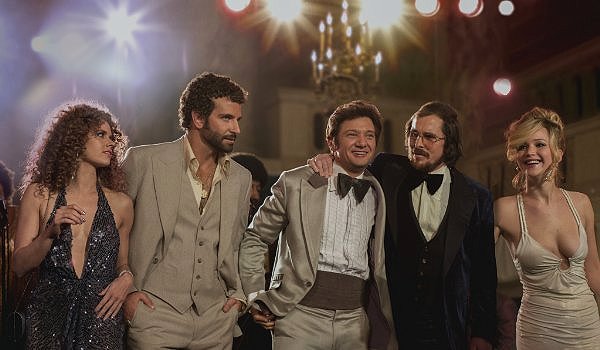 I’ve been dragging my feet writing my review and I’ve been trying to determine why, beyond, obviously, holiday-related sloth. American Hustle is readily a good movie that provides plenty of entertainment, meaty characters, and fun, but why do I keep feeling like it’s missing one undetermined ingredient? I can’t even articulate what at the moment but after having seen the film two times now, I feel like perhaps my emotional involvement was stunted. It’s a finely tuned script that delivers big performances for big-time actors, with a dandy ending that manages to dish out satisfying conclusions to its bevy of wheeler-dealers. But why didn’t I care more, why didn’t I feel more resonance by the time the end credits landed? The best theory I can surmise at this time is that we’re caught up in the con game, where everyone is pretending to be somebody else out of necessity or desire, that when it’s all over, we reflect on what a fun ride it’s been with fun characters but do we feel like we’ve gotten anywhere? I feel like I was more interested in the characters than attached to them. Again, American Hustle is still a sensationally entertaining movie and this paragraph is but a quibble, but it’s enough to thwart me from fully embracing and celebrating Russell’s film (confession: having already seen Scorsese’s brilliant Wolf of Wall Street, this could be coloring things for me with Russell’s Scorsese homage).
American Hustle is a fun ride with arresting performances, oodles of style, energy, and comedy. It’s a crime caper of the first order, easing you into this world and watching people play all sides. Even better, we’re given a volatile mix of personalities that clash, forming new and lasting conflicts, some of which could endanger the entire operation. These are interesting people to spend time with and so we can excuse the indulgences of a 140-minute movie that offers even more with this fantastic cast. Russell with a Scorsese filter is an even more improbably entertaining filmmaker. This is a crowd-pleasing sort of movie, much like Silver Linings, that doles out punchlines and payoffs with aplomb. It’s easy to go along for the ride, laugh uproariously, and then by the end sort of wonder whether it was all worth it. The emotional detachment to the characters may be a minor complaint for a film this largely satisfying, but since we’re spending so much time on our characters, I think I would have preferred something a tad more substantive by the end. It’s a great ride, with great characters and great humor, but there is a nagging concern that it may have been a better ride than a story. Regardless, American Hustle is an enjoyably alluring con that mines the absurdist fashions, personalities, and political overreach of the 1970s, painting a tale of criminals who may be the real heroes of the American dream.
Nate’s Grade: A-


 nathanzoebl
You must be logged in to post a comment.