Blog Archives
He’s Coming to Get You! (2025)
 Kyle Rayburn might just be one of the nicest human beings you’ll ever meet, and he’s admirably unafraid of pursuing his dreams, whether it’s starting a chicken wing food truck or making micro-budget horror comedies in central Ohio. The man has gusto, and it shines through the seams of his hardscrabble yet charming earlier cinematic efforts, Night Work and Satanic Soccer Mom from Ohio. Each of Rayburn’s movies is filmed for under $5000 and shot on an iPhone. He’s in a production groove, promising the next adventure during the credits of his latest completed movie (coming up next: Slam Hounds), and his latest cinematic salvo is the evocatively-titled He’s Coming to Get You!, a title that William Castle surely would have nodded in solemn approval. It’s more or less The Crow by way of Sam Raimi, who even gets name-checked in the movie, a supernatural-fueled revenge thriller with goofy slapstick and self-aware references. It’s a fairly entertaining beginning and ending to a movie that, unfortunately, at just an emaciated 51 minutes in length before end credits, lacks the development for a satisfying exploration between start and finish.
George Russo (Scott Baker, Sulphur for Leviathan) is turning thirty-three and looking forward to a night of cavorting with his long-time girlfriend, Aja (Alyss Winkler, Space Babes From Outer Space). A team of sex traffickers (Jason Crowe, Seth McGuffin – yes, that is his real last name) is determined to capture Aja for their boss. They mug the happy couple and shoot George in his face, killing him and kidnapping Aja. An occult bookstore owner (Grace Plazolles-Hayes) resurrects George through the power of voodoo. He’ll be alive for the remainder of the night, enough time to track and rescue Aja. He’s also a “pain sponge,” meaning that he can take lots of physical punishment and keeps on going, the Energizer Bunny of vengeance, if you will. Can he rescue his beloved before it’s time once again to shuffle from the mortal coil? Will he be able to inflict maximum justice while also trying out some long-sought kung-fu moves?
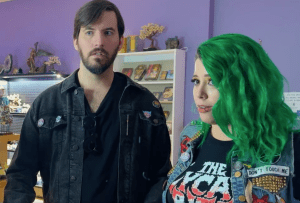 From that description, you can see how the premise would suffice as a movie for He’s Coming to Get You! (it’s never going to be normal in my brain to type a period after the punctuation in the title). There’s something inherently appealing about revenge stories, and you add a supernatural element that doesn’t just level the playing field for our undead underdog but gives them a key advantage, and we’re hooked. It really is The Crow with a better sense of humor, or, well, any sense of humor. Along those lines, giving our avenging crusader a sense of humor that would fit into Army of Darkness is a great boon. The heavier aspects of the movie like murder, assault, and trafficking are mitigated by having a main character who has definite Bugs Bunny by way of Bruce Campbell energy. It’s the filmmakers way of saying to the audience not to get too worried because the results will be more like an amiable, goofy hangout.
After three movies, I can say that Rayburn and his co-writer/producer Ben Reger love making movies that are, first and foremost, concerned with imparting good times no matter the twisted material. I laughed out loud a few times, like when a thug, seconds before his imminent death, replies forlornly, “I never saw Pari.” I laughed at George attempting a kung-fu move and then berating himself, “Nope, felt wrong the second I tried.” There’s a pair of bumbling cops (played by Rayburn and Reger) that you can tell they have such affection over, even if they seem like the most incompetent cops on the beat. It all encapsulates a certain teenage boy ethos of rock and roll, scatological humor, babes, and cartoonish violence. The infectious vibes of the movie are back and appealing, a feature that can elevate low-budget movies with obvious limitations. It’s the same with the mumblecore movies of the 2010s, low-budget slice-of-life movies buoyed by strong characters and sense of place. There is no budget on engaging storytelling. It’s the same with Rayburn and Reger’s collaborations. Whatever the premise, theirs is a universe you’ll want to make pit stops for the irreverent good times and weirdness.
 And that brings me to my biggest hesitation with He’s Coming to Get You!, mainly that in its final form it comes across more of a proof of concept for a bigger movie than feeling like a complete feature. This is primarily because of its length and the rushed development skipped over for an abbreviated Act Two. The total running time before end credits is 51 minutes, but if you subtract the opening credits that play over the montage of George getting up for the morning, that’s an additional three and a half minutes, taking the running time to a paltry 48 minutes or so, fitting an hour of network TV rather than a feature-length film. From a structural standpoint, George is killed at the 21-minute mark, resurrected and sent on his mission at the 31-minute mark, foils the bad guys by the 46-minute mark, and then the movie ends at minute 51. That’s it. It’s hard not to feel a little cheated; the “coming to get you” part of the title is only 15 minutes. Imagine The House on Haunted Hill but you’re only on Haunted Hill for all of ten minutes.
The movie is sprinting through potential plot and further world-building that would help to make its storytelling feel more original and engrossing. Once George is resurrected, he is given great powers but there aren’t any notable rules on the powers besides the fact that they, and he, will expire upon morning. The villains never really have a chance to even process their new adversary as he just shows up, kills them, and then wins the day on his first attempt. The absent struggle and creative development hampers some of the fun, like the movie was in a rush to call it quits over practical considerations. After George is resurrected, there’s one other group he gets to test his new powers on before it’s already time to eliminate the people who killed him. In The Crow, the main character targeted the gang of killers one-by-one, with them learning about this new threat gradually and planning counter-moves. The way it plays out in this movie is all too easy. It’s like an acknowledgement that an audience won’t want to watch a full movie of a supernatural hero getting everything he wants too easily, but the answer isn’t to just shorten the movie, it’s to better develop the premise and ensuing conflicts and challenges and unique world-building. I’d rather watch a version of this movie where George has to figure out his powers and has certain rules and limits than a speed-run to the finish without any interesting challenges, organic complications, or surprises.
 There is one moment toward the very end of He’s Coming to Get You! that I feel is emblematic of the positives and drawbacks of the development, but it involves some mild spoilers since it concerns the conclusion, so be advised, dear reader. Aja and George are reunited and finally get some privacy in the bedroom. Aja has been promising quite a bevy of sexual activity for George’s birthday. They’re finally alone, she performs a strip tease, then she crawls into bed and the movie cuts to them just talking and laughing. I thought that was a nice subversion. They have one final night together, so why spend it on physical copulation when you could wile away the hours talking to your favorite person, hearing their laugh, reminding yourself why you love them before they’re gone for good? Besides, having sex with a resurrected dead body, who has been stabbed and beaten throughout the movie, might make for an extremely upsetting final memory of your lover. Plus there’s the whole possible joke of being unable to control blood flow since, you know, blood doesn’t flow anymore anyway. I thought this was clever and sweet. Then it’s revealed that George and Aja did indeed have their sex off-screen and this is just post-coital pillow talk rather than a subversive replacement. Oh? Oh well then.
After three movies, I can start to catalogue the Kyle Rayburn film experience: silly comedy cul-de-sacs, low stakes regardless of circumstance, celebration of schlock, amiable vibes, actors having fun regardless of experience, lo-fi visuals, minimal if any coverage beyond shot-reverse shot edits, and underdeveloped stories. This has been my chief criticism with each of Rayburn’s previous movies, that they benefit from fun ensembles and intriguing premises but that more work could have been done to better realize the potential of each. I often walk away from these movies thinking we got the first draft onscreen. He’s Coming to Get You! is the most real world setting in a Rayburn vehicle, so there aren’t as many interesting characters or details to the world to cover some of those plotting shortcomings, so the vacancy becomes more notable and damaging to the entertainment. It’s easy to graft onto the relaxed, schlocky wavelength of the movie but by the end I felt a little shortchanged in creativity and execution, missing a movie middle. I’m happy Rayburn is following his dreams and has built a staple of returning players. He’s Coming to Get You! has enough going for it that I wish the team had dug in more. I only wish that whatever the next three or four projects prove to be, that Rayburn and his team take more time to really work through their particular story conventions to make them the best version they can be, not just completed.
Nate’s Grade: C+
Share this:

Soul to Squeeze (2025)
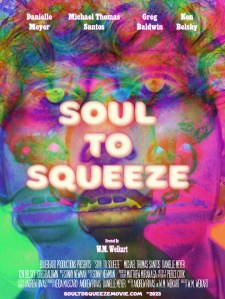
It’s been some time since I’ve reviewed an Ohio-made indie (having a baby and adjusting to a new job will do that). My goal has always been to discover the rare diamonds in the rough and to provide professional film criticism to these smaller-scale movies trying to make some noise. I’ve been doing this for a few years now and I’ll admit I haven’t found that many diamonds, so to speak. My wife has long since stopped watching these movies with me and declared me a masochist for continuing this quest. What can I say, I’m still hopeful to discover what Ohio filmmakers can do when given a platform. One such filmmaker, who has since relocated from Ohio to the City of Angels, is W.M. Weikart. I reviewed his 2019 short film Pure O and we have several mutual friends. He asked me to review his next project, a feature-length movie shot with some Ohio-bred talent in front of and behind the camera, so I’m considering Soul to Squeeze as Ohio-indie-adjacent. It’s a trippy, beguiling experience, and it’s one that will prove befuddling to some but is an experience that gets better with every additional minute.
The story itself is relatively simple. Jacob (Michael Thomas Santos, CSI: Vegas) is a young coed who agrees to be the subject of a mysterious experiment. He lives in a house for days and experiences a series of bizarre auditory and visual hallucinations, picking at his mind, memories, and hidden trauma that he’s been trying to ignore for years. Or are they actually hallucinations after all? Can his mind survive?

These experimental/psychological triptych kinds of movies hinge on a few points of potential viewer engagement. First, the most obvious is simply being interesting and memorable in its weirdness. If you’re going for a crazy sensory experience, it helps if there’s actually something crazy worth watching. This was one of my biggest issues with the 2023 horror indie Skinamarink, a strange nightmare that mostly felt like the same ten boring images jumbled around for 80 very tedious minutes of dashed hopes. There’s only so much formless imagery I can watch without some larger connection, and if your movie is going to live or die based upon your outlandish nightmare imagery, then you better rise to the challenge. Skinamarink did not. Thankfully Soul to Squeeze has a larger agenda that reveals itself over the course of its 80-minute running time. We have a character trying to hide from some trauma he’d rather ignore, so we know this experience will force him to confront those feelings and, hopefully, find some way to process his intense emotions and come out the other side a better person. Or it will drive him completely mad. Either storytelling path offers intrinsic entertainment value. There’s purpose under the imagery so it’s not all abstract nonsense waiting for someone else to project meaning onto the disconnected pieces.
Now, it takes a little long to get going to begin to reveal that trauma and that connectivity. For the first forty minutes, weird things are going down without much in the way of a larger set of rules, which could have benefited the engagement, such as disturbing or confounding visions happening between certain hours of the day, allowing our protagonist time to anxiously dread their arrival. Or there could be an escalation in the intensity of the visions and their duration. There could also be the question over whether the visions are real or not, especially if they’re occurring after he’s forced to eat the provided food in the house. Perhaps he even tries to abstain from eating to then discover they still come like dreadful clockwork. Unraveling past residents of this experiment could also foretell what possible fates, both helpful and harmful, could await. Our protagonist could also try and escape as the visions get more personal and find he cannot escape. The character could be a little more active. Jacob seems very compliant for a wounded character undergoing psychological experimentation, which begs the question why he would continue with this treatment after it begins picking away at the secret he doesn’t want to face. There are other directions that the main character could have gone through while we waited for the larger thematic clarity to come into focus with the visions after 40-minutes of atmospheric noodling.

When you’re going for a more experimental narrative with heavy visual metaphors, it can be tricky to find a balance between arty and pretentious, or, to put it in other words, between David Lynch and student films. This balance is tipped toward the latter early, especially when I think a blue flower comes to life and is… a French woman… spouting platitudes before turning back into a flower. It’s stuff like that which can seem a little daft but without the intention of weird humor. In contrast, there’s a strange but amusing scene where our character comes across a sitting mermaid on display in a museum. She literally eats a pearl necklace from Jacob’s hands and then smiles mischievously as it reappears around her neck, now her own possession. There is a larger metaphorical connection here that’s revealed later, with the necklace having a connection to Jacob’s traumatic past and even the concept of the mermaid too. There’s a phone conversation that we get both sides of that ends up starting as one of the earliest points of confusion and agitation for Jacob and then, by its return, serves as an unexpected vehicle for our protagonist’s emotional growth and reflection. It’s a clever and rather satisfying creative boomerang.
Soul to Squeeze impressively masks its low-budget nature through creative choices and elevated technical craft. Weikart has a natural eye for visual composition and lighting especially, so there’s nary a moment where the movie isn’t at least appealing to the eyes. Having a director who can frame an engaging shot is a godsend when you’re primarily going to be stuck in a single location for 80 minutes. A smart and talented visual artist can really hide the limitations of a low budget well. This is also by far one of the best sounding low-budget indies I’ve heard. The sound mixing is impeccably professional and the score by Sonny Newman (Burn the Witch) is very pleasant and evocative and soothing when it wants to be. Sound design is one of the biggest areas that holds back so many micro-budget film productions, and it’s so refreshing to have a movie not only where sound has been given great attention but also incorporated into the presentation and experiences in meaningful and artistic ways. The visuals can be rather eye-catching, like when Jacob’s TV transforms into a multi-screen monster where eyeballs and a giant mouth take up residence on the various screens, and aided by a slick sound design, it all allows the sensory experience to be even more compelling and accessible. As the film progresses, the bigger picture comes into focus, which means more exposition is thrown at the viewer. Weikart and his team cleverly find ways to present the information through a series of sufficient images and sounds that imply plenty with minimal (some of the sound and picture arrangements can take on a certain true crime dramatic recreation feel). I don’t have a final budget number but it looks better than many indies I’ve seen with considerably higher budgets.

There is one very significant technical choice that I wish had been more essentially incorporated into the story of Soul to Squeeze. As its promotional materials declare, this is the “the first film ever to have a continuously changing aspect ratio throughout the entire film. It begins in a 4:3 aspect ratio and expands out to a 2.35:1 by the end.” For the layman, that means throughout the film the aspect ratio is changing from the old boxy TV standard to a wider and wider widescreen. Now, you could make an argument that this is meant to represent the progression of Jacob’s thinking, that his world is literally expanding, but if that’s the case it feels a little too metaphorical to land as an essential tool for this story to be told at its best. It’s kind of neat but ultimately feels more like a gimmick. Perhaps the nights could have been labeled sequentially, and with each additional night the aspect ratio alters, expanding the horizons. You could even make it a Wizard of Oz motif, with Jacob opening a door and coming out the other end with a different aspect ratio to communicate the transition to a new plane of thinking and reality. Without calling more attention to its changes, and without connecting it more deliberately with the onscreen action, it becomes only a slightly noticeable visual choice over time that may go ignored by most.
By design, Soul to Squeeze is meant to be mystifying and experimental, which will try some people’s patience if they don’t find the ensuing imagery and weirdness to be entertaining. I wish there was more of what I appreciated in the second half to be present in the first half, and I’ll freely admit that I might have missed some of those clues and connective tissue just due to the strange and abstract nature of the movie. I was never bored and often amused at the various ideas that animate the movie (a game show host narrating breakfast is quite surreal and hilarious). The movie looks good, sounds good, and moves along at a fitting pace. The biggest gripe I have with these kinds of movies is whether it will ever add up to anything or is every moment just another in a chain of interchangeable weirdness? With Soul to Squeeze, there is a connection to much of the imagery and hallucinations, so there is a larger design that coalesces. I think there are some specifics that would have potentially aided the overall experience, but adding specificity could deter the immersion and grasping for understanding desired from these kinds of movies. Soul to Squeeze might not be that quintessential diamond in the rough I’m in search of with these Ohio (and Ohio-adjacent) indies, but it’s still a professionally made, creatively engaging, and fairly entertaining curio that can surprise at a moment’s notice.
Nate’s Grade: B
Share this:

Spencer + Penny, Forever (2023)

In the best way, Spencer + Penny feels like a Pixar short, something sweet and subtly profound that then suckerpunches you into a mess of feelings that you didn’t think were possible given the abbreviated length as well as the subject matter. You may ask yourself, “Am I really about to cry over some pencils?” and I’m here to tell you yes, and it’s okay to cry. In just a matter of seconds, this Ohio-made short film gets you to think from a different perspective, that of a mechanical pencil named Spencer (voiced by writer/director Eric Boso), and through that object we will feel all-too familiar human traits. There’s elation at aligning with one’s purpose, but also a melancholy that comes when we feel spent, empty, and rundown, needing to be replenished. Because of Spencer’s unique identity, his lead can be replaced, though this also causes him to feel hollow at times. Then one day he meets a friend, a traditional wooden pencil named Penny (voiced by Samantha Martin). She’s chipper and unflappable in her enthusiasm and optimism, lifting Spencer’s spirits. And then this relationship rapidly changes through a simple and elegant visual means of montage, and all at once this cute film about two pencils, and thematically about mental health, has transformed into one about mortality and legacy. It works so well that I was shocked to be feeling urgent emotions, begging a muted pencil to speak back. That’s quite a creative coup for Boso (Bong of the Living Dead). The short itself is visually lean and clean, given to presenting the story like it was a writing utensil catalog. The sparse visual arrangements further made Spencer + Penny, Forever feel like a children’s storybook come to whimsical life. I enjoyed the emphasis given to erasers and the disappointment we feel at making mistakes but the acknowledgement that mistakes are also a part of life, a big idea but made easily digestible for all ages through the carefully crafted writing style of a bittersweet child’s storybook.
I won’t delve into detailed spoilers but I think the ending concept is fitting but we needed a different path to finally wind up there. It’s sweet but feels like a different story starting, which may well be the point. I also think the metaphysical and eschatological implications are rather large to try and make this work, so I think something more practical with the in-universe setting and a direct connection would have felt like a more appropriate thematic conclusion. Still, it works, I just quibble with the means we reached this ending.

Spencer + Penny, Forever was produced for the 2023 Winterfilm Festival in Ohio and won several awards, including Best Writing, Audience Award, Best Music (the music does have a definite Jon Brion-esque quality of deceptive whimsy that blends into heartache), and Best Film. It’s easy to see the movie as a crowd-pleaser and an unassuming charmer, able to delicately hit weightier themes with cute observational quirk (a.k.a. The Hidden Life of Writing Utensils). It will be entering the festival circuit shortly and I’m sure I won’t be the last person walking away from Spencer and Penny and shaking my head and smiling that an eight-minute short made me think differently about my pen.
Nate’s Grade: B+
Share this:

Obstacle Corpse (2022)

Hope Madden has been an esteemed critic, journalist, and writer for many Columbus media publications and television for years. She and her husband, George Wolf, run MaddWolf, a popular film blog, and head the Fright Club podcast and horror film programming at the Gateway Theater. They know movies inside and out and they know horror. So it makes sense for Obstacle Corpse to be Madden’s first feature as a writer and director. It’s a high-concept horror comedy filmed in the Columbus, Ohio area and now available to watch on Amazon. Madden and Wolf are both part of my Columbus film critics’ group, and so I will, as I always strive for with reviewing Ohio-made indies, attempt to be as objective as possible knowing many involved in the cast and crew. Obstacle Corpse is, above all things, enjoyably demented. It’s a low-budget horror movie that understands that an indie horror movie is going to succeed through concept, personality, and mood, and Madden pays attention to each of those winning dimensions.
Sunny (Sylvie Mix) just wants to impress her domineering and dismissive father. She signs up for the Guts and Glory competition, a twelve-event obstacle course, to prove herself. Each contestant is expected to bring a partner, so she brings her best friend Ezra (Alan Tyson) who is ready to get back home and out of the woods pronto. That’s even before they discover that the teams have gathered for some brutal competition. Each team is also required to kill their teammate over the course of the grueling events, so will Sunny and Ezra survive, and will they possibly turn on one another to save themself from the deadly games?

The premise is a quick hook, a deadly version of an obstacle course, and makes twisted sense, not just from a canny take-something-from-childhood-but-make-it-deadly calculus of recent gimmicky horror. There are plenty of adult-oriented obstacle courses known for their physical endurance, like the Tough Mudders and Spartan Race and Ninja Warrior, so an escalation into literal life-and-death stakes as an experiential attraction makes sense in a twisted fashion. Madden has also done what I wish several other indie filmmakers would and distinguished her large net of crazy characters. There’s a wonderful sense of personality to the different groups, which helps the audience keep track of the many different faces, but it also allows the characters to be more playful. I don’t care why some would dress up like clowns for this competition and others as baseball players, I’m just glad that these characters are happy to stand out. I enjoyed a middle-aged man eager to transform every moment into a phony social media tableau. I readily enjoyed the hyper-competitive nature of Stephanie (Gareth Tidball), an intense woman who gets off on the thrill of each challenge. I enjoyed one grumbling angry man (Wolf) who could be counted on to struggle in last place no matter the obstacle. I enjoyed a tracksuit-clad bickering couple. I liked a family of siblings that distinguished itself in paired T-shirts, with one pair wearing “single” and the other wearing “double.” I didn’t quite understand it since they were both pairs but I liked the effort all the same. Even little details can add much.
The mood of Obstacle Corpse is chiefly one of carefree fun, an amiable tone that brings a comedic lightness to even the most ghastly of circumstances. It’s prevalent throughout the movie and makes the 80 minutes easy to digest. Madden’s good times are best summarized by the scene-stealing performance of Mason (Donovan Riley Wolfington, Madden’s son), a costumed chef dishing out cold vengeance from his ice cream truck. This character is presented as a change agent, an unexpected wildcard who is disrupting the establishment overseeing the games. He’s a live-wire of energy, channeling Deadpool or a Looney Tunes cartoon at different points, and he will dismember contestants while gleefully singing his violent versions of Christmas carols. It’s a standout performance in a large cast of varied characters, and Wolfington is just operating on another level of insane amusement. The character also becomes one to easily root for because he’s an antihero underdog taking advantage of others underestimating him, and he’s also that change agent, bringing a bloody sense of justice to those involved in the continuance of the games. A late-in-the-game revelation about his history made me wish for more development to better utilize the key info, but Wolfington is the best mascot for the movie’s demented charms.

Given its large cast, there are several that made a favorable impression as they navigated the comedy aspects. Mix (Poser, Double Walker) is a definite find for Columbus cinema and will be going places in no time. She is a natural actor and serves as our baseline of normality, a shifting concept in a world of violent mayhem. Tyson (Stowaway) is a great foil as Sunny’s friend. He’s more effete and unimposing, at first glance, so his incredulous reactions are a welcomed source of comedy and reason. Tony White does a lot as a clown/mime who befriends our “normal” characters. He gives a very expressive and charming performance, and yet there are a couple of moments where his tortured emotions serve as a surprising well of feelings (he is labeled as Sad Clown, after all). Even producer Jason Tostevin (Hellarious) has a laconic menace as the head of the games security, and he delivers a monologue about achieving your peak greatness that sounds like a self-help guru comfortable into the exploitative routines. He’s our face of the establishment, so as things begin going haywire from our anarchic chef, his discomfort provides a consistent outlet for satisfying comeuppance. You can tell the cast is enjoying themselves, and that casual camaraderie helps to add to the overall silly and bloody fun of the movie.
I wish the parameters of this killer event had a bit more clarity and development to really maximize the possibility. First, I thought that these many obstacles were themselves going to be part of the killer challenge, something akin to Squid Games where familiar childhood playground games have been transformed into life-and-death contests. That’s not the case, so watching characters overcome a cargo net or a set of tires feels somewhat disappointing because what would the appeal of this physical track be beyond the murdering? I think part of the joke is that these are ordinary park obstacles that are causing so many so much struggle. The rules of this course can also be rather murky. We see the enforcement of what happens when a contestant kills outside of an official obstacle course event, but the rest of the rules are left too vague. Contestants are welcome to bring their own weapons, like bats and knives, so could someone simply bring a high-powered gun and mow down the entire competition? How does this work exactly? What prize do the winners receive at the end other than having killed their partner? Did Sunny’s father understand what exactly she was getting into and approved? I’m also left slightly bewildered how many of these teams are family members that are so eager to kill one another. I’m not opposed to the possible fratricide plot, but I think the movie needs to present more conflicts within the couples to present as possible explanation for this murderous intent (maybe an old score to settle like stealing a girlfriend, maybe it’s an inheritance battle, maybe it’s sussing out what the particulars are of the familiar tension, etc.). It’s shocking to watch an older brother pitch his younger brother into a fire and kids killing kids (off-screen), but the shock value only goes so far, and having more setup or context could have added more satisfaction. I guess many are just wannabe psychopaths looking for any excuse to indulge their darker impulses.

I think about the brilliant simplicity of 2019’s Ready or Not. The movie’s premise is essentially a killer game of hide and seek, already a rather uncomplicated children’s game. But the filmmakers carefully established the rules and stakes, with the family holding to he belief they need to kill the person hiding before sunrise or else they will all die thanks to a generational curse. It’s outlandish but the movie presented all the vital information and then let things rip. In the case of Obstacle Corpse, it’s around the fifty-minute mark before our main characters, the normies, discover the actual deadly stakes of the game, and their response seems a tad… relaxed. Part of this is, as earlier described, the amiable low-stakes charm of the movie, so nobody ever brings too much of a sense of actual reality to the absurd competition and its slapstick violence.
I also wish Obstacle Corpse had coalesced more of a class-conscious political commentary. We are introduced to a wealthy couple who are bankrolling the games under the auspices of live online betting, a concept also explored in many other movies that summarize the villains as bored rich people betting on the lives of the poor (Squid Games, Escape Room, The Hunger Games, etc.). That works, though the script only gives us one or two check-ins with our wealthy couple as they seem more interested in canoodling than keeping up with their own spectacle. Maybe that signifies how blase they are about human life but it felt like a missed opportunity. I kept envisioning a version of Obstacle Corpse that really trained its fire on the callousness of the rich, with the teams each being a boss or CEO and some lackey or intern that they’re stringing along, meaning each competitive couple already has a class distinction. The plot informs us that the veterans know they are inviting their guest to their intended doom, so why not project onto a corporate or wealthy head and their contempt for a lower-class worker they see as literally disposable? Perhaps these fragile wealthy men think they’re so much more capable or threatening than they really are, a concept given some attention through the hyper-macho character of Richard (Brian Spangler) who can’t live up to his overblown expectations. There’s an overinflated sense of toxic masculinity that relates to physical dominance that was worthy of even more deconstruction and criticism. I think this dynamic would have allowed the movie to hone and target its ire with more potent satirical firepower.
Even with some of my misgivings about clarity and untapped thematic potential, Obstacle Corpse is an enjoyable horror comedy for fans. The blood gushes constantly and the gore is impressively grotesque for its minimal budget. There are some impressive shots for a movie 95 percent filmed in the woods. Madden has crafted a movie that works regardless of budget, with its larger-than-life characters and conflicts resulting from a strong and memorable high-concept premise. The emphasis is more on comedy than horror, like the world’s most demented summer camp outing. Given the large cast of characters, the movie always has a new batch of people to jump through, which keeps the movie fresh even when the suspense can slacken because of the comedic emphasis. It’s not a one-joke movie, and the fun of the cast can often be felt, especially the grand ball of a time had by Wolfington. There are things left out I wish had been explored further, but this is a solid start for Madden and her team in the realm of indie genre filmmaking. If you enjoy your comedy with a heaping helping of blood and bad taste, give Obstacle Corpse a chance.
Nate’s Grade: B-
Share this:

Three Quarters Dead (2023)

I don’t normally review short films but I was asked to by an Ohio filmmaker, and so I agreed to do my best in providing a review of a movie that runs a total of only seven minutes. Three Quarters Dead is the latest from writer/director Angelo Thomas, a rising Ohio filmmaker who already has two movies under his belt, The Incredible Jake Parker and the documentary, DeRosa: Life, Love & Art in Transition. Short films must still function under the same guiding rules as feature-length films: there needs to be a beginning, middle, and end; characters should be engaging; conflict should be clear and developed; and the audience needs a reason to care. Granted, you expect more from an 80-minute movie than an eight-minute movie but you’re still expecting the basics of story, character, and entertainment to land. Three Quarters Dead is a cute little movie that nibbles at the edges of some profound concepts but settles a little too quickly.
We begin at the end, well the end of Zach’s (Eric Six) life. He’s moved on from the mortal plane and wakes up inside a peculiar movie theater. There are only three other patrons sitting in attendance and two of them are skeletons. David (David Reid Hatfield) is the only other living patron, though perhaps that term doesn’t even qualify. He has a sickly, zombie-like pallor and prefers to munch on popcorn sprinkled with maggots. David serves as a guide for wayward spirits, helping them transfer to the Great Beyond outside the theater. Until then, they can sit and watch movies for possibly an eternity of downtime.
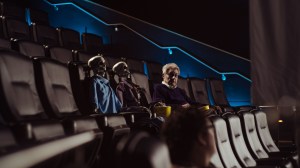
The premise of a movie theater as purgatory is a fun concept and has several areas to connect with the theological and philosophical aspects inherent in any life-after-death story. I liked the projectionist being the equivalent of God looking down from above, offering light and diversion while the mortals sit and wait for answers that might never come. I liked the idea that David has been here so long that he forgot who he is. He is literally deteriorating physically and mentally. The presence of skeletons implies that you can possibly rot away and never even make it to the other side (unless these are just for ambience). Whenever you present a fantasy setting, the audience is going to be keen to adjust to the rules and expectations of this abnormal setting. The premise begs plenty more questions. I was surprised at no point does the short imply what the souls are even watching. This would provide more material either for comedy, like complaining about being stuck watching only so many movies so many times, for character exploration, maybe the movies are chosen that have a specific meaning to each soul, or some melodramatic rumination, like the characters are watching home movies of their own life and its ups and downs, regrets but also the joys that fill the bounds of a life lived. Considering that Zach is revealed to have taken his own life (he even has the note still with him, though its words are not shared either), it would have been helpful to either shed more details about this unique space and its connections for our newcomer or the newcomer’s life that he’s bidding goodbye to. I was left with an unrequited desire for more than the story was willing to offer for its seven minutes.
The central metaphor of a movie theater as a supernatural setting is a good starting point. The script was a little too locked-in on the discovery period and needed more development. Zach is such a blank from a character standpoint, which is acceptable since he’s the audience’s entry point. He seems to emit no real strong emotions or defiance about his strange situation. This may be a result of just being overwhelmed by the sheer existence of another spiritual plane, or this could also be him trying to remember who he was when he was alive. The dynamic of New Guy/Veteran is a comedy staple, learning the ropes from the charming and wily veteran. It seems like a storytelling disadvantage to limit the knowledge base of both parties. We’ve just spent a few minutes with David when he learns that Zach will actually be his replacement. I wish this had been revealed upfront rather than reserved for an ending meant to provide some uplift and reward. We still could have had the same end results but now there would have been an immediate urgency, David only having so many minutes (maybe even make it real-time) to teach his replacement the ropes before he gets recalled to that Great Beyond. If Zach is taking on this new responsibility, you would think he’d need to understand how exactly he’s supposed to help souls transition.

The movie is technically polished and has a nice score from Brooks Leibee (DeRosa). The shot selections are somewhat minimal, likely a result of budgetary time limits, but it also makes the movie visually staid. Many of the edits are simply from two shots from the same angle. It’s efficient but can also be bland over time. Also, I’m surprised there wasn’t a godlike point of view shot from the projectionist booth, at least a high angle looking down from above, but that might have given away the fact that nothing was actually on the screen during filming. The makeup effects for David are simple but effective and do well to assist the actor’s mordant performance.
I enjoyed both actors, though Hatfield (Dogwood Pass, Quarantwinned) has the more fun role as the decrepit veteran teaching us all about this unique space. He gives glimpses of even more honed comedic skills that I wish the short could have utilized. Six (Christmas Collision) is given the less fun role of being responsive but the character is so subdued that he can feel like a proverbial and literal seat-filler. I liked the two actors together and wished their interaction had a bit more energy to it.
Three Quarters Dead is an amusing and light-hearted short even as it skirts over some more meaningful and darker material. It’s a promising idea with more intriguing directions that are unexplored. Partly because of the limits of short-form storytelling but also partly because the concept just wasn’t creatively pushed further. It’s a quick seven minutes that elicits some smiles and maybe even a chuckle (I enjoyed the quarters classification of its title). You won’t regret watching it, and trust me, I’ve watched dozens of short films that I do very much regret ever having seen. Even with a few precious minutes, bad filmmaking and a paucity of coherent ideas can become most evident. Three Quarters Dead is a fun little horror comedy that coasts on charm, good vibes, and the tantalizing possibility of more, but like the characters trapped inside that theater, you’ll be left waiting.
Nate’s Grade: B-
Share this:

Free to a Bad Home (2023)
 Last year, I was approached by HaleHouse Productions, a company led by the Ohio filmmaking and brotherly duo of Kameron and Scott Hale, to review their first feature, Entropy. It was a small indie shot with a bunch of friends over the course of the COVID-19 lockdown, and I appreciated the artistic aptitude of ganging together during such trying times, but ultimately I found the movie’s flaws to be too overwhelming. I was slightly surprised when HaleHouse reached out to me a year later and solicited another review for their next horror movie, Free to a Bad Home. After all, I had been critical about their earlier film, but they said they appreciate reading the reviews, and this has always been my aim when I write these critiques for Ohio-made indies, to try and provide a professional review with clear and coherent constructive criticism and earned praise. So I figured why not, and I watched Free to a Bad Home, and now I’m wondering if HaleHouse is still going to seek out my opinion when it comes time for movie number three.
I was happy that the Hale brothers (credited as both writers and directors) took the anthology route because, greedily, it means more stories to be told, and it also conveniently allows the audience to leap to another story if the current one wasn’t exactly firing. It’s a numbers game: rather than hoping for one story to entertain, now we have three shorter stories to hopefully engage and entertain. However, the needs of telling a short are still very similar to that of a feature-length screenplay; you still need interesting characters, you still need a story with a beginning, middle, and end, and you still need to use your time wisely, whether it’s a five-minute story or a two-hour one. While Free to a Bad Home divides its time between three smaller tales, and one perfunctory wraparound, I can’t say the movie still knows what to do with its 80 minutes (divided by three). Any horror movie needs adequate time to establish mood. There are plenty of movies that are nothing but a mood piece, like David Lynch or the recent indie breakout Skinamarink, where the intent to present an experience that detaches the audience from the known and places them into a limbic middle zone of uncertainty and dread. Storytellers are going to need some time to establish the main characters, their dilemmas, the setting, and where and when things are going peculiar or wrong. Watching Free to a Bad Home, it felt like each segment had an idea but left it frustratingly vague and with regrettably little development to carry it.
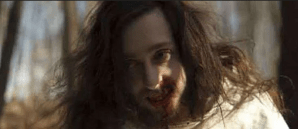 Ignoring the wraparound, the first segment is about Amy (Miranda Neiman) overcoming loss while visiting her old home. She spends a lot of time walking around, hearing strange noises, and getting lost through drinking. Her sister comes around too. It lasts around twenty minutes and much of it hinges upon the very ending twist, which explains what happened to her husband and why it is weighing so heavily on Amy. Except the preceding twenty minutes doesn’t feel like we’re getting more intrigue or insights into Amy or even her fraying psychology. She’s seeing weird visions of a guy in bed sheets and a strange sinkhole in the woods, but a lot of the running time is sitting and waiting. We understand she’s in some stage of mourning. This isn’t really further developed after being established, and that’s the issue with many of the segments. It’s an idea, and there’s a conclusion that is generally predictable, but we’re missing the middle. You could include the first three minutes, the last three minutes, and cut out the in-between, and the “Amy” segment would play out the exact same way. The problem is that the end is too obvious to simply keep the character in a holding pattern for so long with only minimal action. The character is very much sitting around and waiting, and so are we for too long. It’s structured like a haunted house story where a woman is coming undone. Except we don’t get better insights into this person over time, nor do we get increasingly scary haunting or her unraveling mental stability.
The second segment follows Ryan (Jake C. Young) breaking into a home and taking just the most absolutely leisurely time looking for anything of value. We spend nearly ten minutes just watching this guy walk into a room, look around, and then leave to go search in another room. I think the drawn out time is meant to heighten the vulnerability of our thief, making the audience worry that he’s spending too long and is more likely to get caught. First of all, that requires me to find this character likable or interesting to care if he avoids exposure and arrest. This could happen if somehow during these ten minutes we’re learning about dear old Ryan. Maybe we see his problem-solving skills, maybe he gets an inopportune call that he tries to get out of but reveals his own status of financial insecurity, and maybe he even encounters evidence of the family that lives here and makes comment, like he’s a disgruntled employee trying to take what he feels is deserved from a wealthy executive. Anything other than watching one guy walk into several rooms and look around for valuables. At long last he finds something unexpected, a woman named Camilla (Roni Locke) chained to a mattress. Rather than pretend to be a traumatized victim of trafficking, which would be the easy assumption, this woman declares herself a demon who will help Ryan open the family’s expensive safe. However, if he were to release her, she promises to kill the family next door. Do we know anything about them? No, not really, but the devil’s bargain is established: personal gain for the death of strangers. Once again, the ending seems obvious given the lack of substantial character development. The hook is the offer from the evil entity and the cost of his own selfishness, but this hook is diminished when we don’t exactly get any personal struggle wrestling with the decision or its horrific outcome.
 The final segment is the longest, nearly half the total running time, and we follow Julia (Olivia Denis) who is going with her older sister and her friends to a Halloween party. There’s the start of something here with a younger sibling eager to grow up and hang out with older peers, with the drawback of getting into trouble in the pursuit of being seen as cool. Except none of the four characters we follow to the party really distinguish themselves as people. We spend more time watching them do acid in the car, slowly, than we do anything else. It’s a full ten minutes of watching ladies drop drugs into their eyes while moody neon lighting bathes their skin and the synth score rings. We’re clearly going for an immersive mood here but the drug usage, so heavily covered, isn’t ever conveyed in plot or perspective. When the characters arrive at their party, we don’t see any hallucinations or hear anything amiss, which could have been more visually interesting as well as ratchet up tension that things are unwell. Instead, the ladies attend a very sparsely attended gathering where they unveil a smiling corpse and then take turns projectile vomiting onto the body. Then the women are chased and easily dispatched. The end.
So what do all the story segments have in common? There’s plenty of idle waiting. There’s a real dearth of characterization outside whatever the initial premise might afford. There are specific stylistic fixations that are often to the detriment of pacing and story, like the low-light investigation of Ryan and the trance-like neon dream of the ladies tripping on eye drops. There are also obvious endings that don’t feel any better realized or subverted or better set up. Every anthology collection is going to be a mixed bag depending upon your personal tastes, but there’s a certain safety in numbers. I didn’t love all 26 segments on 2012’s The ABCs of Death but there were enough that tickled my fancy, likewise with the many V/H/S collections. However, each of the three anthology tales in Free to a Bad Home suffers from simply not having enough to do.
There are concepts here that can work. The idea of an anthology movie following a cursed object is a fine starting point, almost like the horror equivalent of 1999’s The Red Violin, an underrated indie that traced the adventures of a special violin through centuries of owners. The idea of a criminal coming across a caged demon who tempts them with a Faustian bargain is good. The setup of a younger sibling wanting validation and tagging along for something they are unprepared for, that’s a strong starting point for a night of unexpected terror. A woman alone in her old home and haunted by her memories is a familiar but potent starting point for horror. These core ideas can work but not one is given substantial development to make them matter.
 If you wanted to trace the lineage of a cursed object, I think it would have been more creatively fulfilling to tell your stories in distinctly different time periods, highlighting shifting values but also the different appeals this haunted object might have had depending upon the times. Imagine a woman coming across a cursed piece of jewelry in 1890 or 1950 versus modern-day. There’s nothing in any of the three stories that ties them to a specific time period, so why not venture into other times to give a larger sense of history and the ramifications of this curse? As a low-budget indie, I understand the production reasons why the three stories are all contemporary, though the movie opens with a quick succession of suicide and murder in two earlier time periods. Creatively, the movie feels too easily satisfied and needed to push its ideas and horror further. As it stands, Free to a Bad Home feels like a collection of disappointing shorts rather than one single story disappointment, which oddly enough makes the movie feel even more disappointing.
For being a small indie Ohio production, there are some impressive artistic values. The cinematography by William E. Newton (Black Wolf) can be occasionally entrancing, like during the drug-addled driving sequence that is a little too in love with its protracted mood. The practical makeup effects are sparing but can be unsettling and effective, most notably during a coda where a woman picks at a very open wound on her face and works it to disgusting lengths.
Free to a Bad Home doesn’t separate itself from the glut of cheap horror movies with half-formed stories. Rather than squandering one story over the course of 80 padded minutes, now it’s squandering three-ish stories over the course of 80 padded minutes. I’m a little surprised there isn’t more horror as well, whether that’s conventional exploitation elements like gore and sex, or simply just constructed and sustained sequences of terror and dread. For genre fans with a love for DIY indie spirit, there may be some entertainment to be had with Free to a Bad Home. You can tell the Hale brothers and their small crew have their passions for the material. I only wish more scrutiny and perhaps outside assistance in the writing and development of future tales to make the most of the potential. Free to a Bad Home is available on Tubi and other streaming services, making the title even more apt. For me, there was just too little going on creatively to maintain my ongoing interest and waning attention.
Nate’s Grade: D+
Share this:

Bones and All (2022)
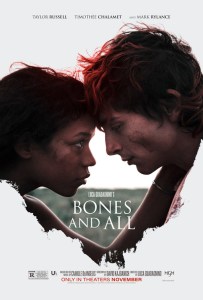 What do you get when you team up Oscar-nominated director Luca Guadagnino, twee handsome man Timothee Chalamet, and the ravenous consumption of human flesh? You get the new indie drama Bones and All, a literal love story between cannibals. It’s boy-meets-girl-meets-dinner.
It’s 1980s Reagan America, and Maren (Taylor Sheridan) is in high school and not allowed out to parties for a good reason. Her father (Andre Holland) nails her bedroom window shut, and we soon realize why when, at a slumber party, Maren eats one of her friend’s fingers. It’s back on the run except Maren’s father has finally had enough. He leaves her behind one morning with a tape recorder to explain. Maren travels to the Midwest and discovers other Eaters, those afflicted with her same impulses. One of them is the young man Lee (Chalamet), who Maren decides to follow. They can look out for one another, but what’s to be done when the hunger strikes, and how far will they go to feed?
 Bones and All is a doomed Romeo and Juliet romance with its own provocative subversion. I was hooked for the first half of the movie, as the script slowly revealed that these cannibals are born this way and their compulsion may also give them super powers, like the ability to smell their own kind as well as key characteristics, like a last feeding or even when a person may be close to death. The movie plays along the fringes of a monster or superhero formula, where we have people with extraordinary abilities, or a curse they must keep hidden depending upon your perspective, and how this challenges their vulnerability and sense of self. It’s reminiscent of vampirism, the need to feed, so we’ve seen aspects of this kind of story dozens and dozens of times, but the world and rules can still be engrossing to learn. Maren and Lee trade stories of their “first time,” though in this context it’s the first time they fed on human flesh, and it so happens both are with a traumatized babysitter. It’s a morbid bonding experience but such is partnering with a person who shares your unorthodox appetites. I was getting shades of Bonnie and Clyde, with our cross-country duo keeping on the run, and also Let the Right One In, where a man is reluctantly killing in order to feed and protect his ward. There’s also the 2017 French film Raw with a young woman discovering her family trait of cannibalism. The source material of Bones and All is a 2016 YA novel by Camille DeAngelis and the script feels very much like the total of its many pop-cultural and literary influences.
There’s still something compelling here about two oddballs finding a person who understand their unique situation. The addiction analogy is apt and provides an interesting discovery, as both Maren and Lee inherited their eating habits from a parent similarly affected. Maren’s search for her biological mother is a solid direction as it also promises a search for answers. Russell (Netflix’s Lost in Space, Escape Room) is an understated but captivating lead. Her character has never been out on her own and doesn’t know much about a larger world of Eaters, so every encounter is her stretching her boundaries and discovering what she is capable of. She also needs to learn how to better live with her impulses, or whether she even can, and being paired with a more experienced companion allows her to explore those feelings with better understanding. Chalamet (Dune) is part scraggly drifter, part twink prostitute, part deceitful vampire, and part sensitive boyfriend. In other words, he fits right in as a brooding Byronic love interest that Maren questions how close she can allow herself to be in his presence. The us-against-the-world sensibility of young and/or forbidden love is amplified with the extra genre trappings. In many ways, Bones and All feels like a strange amalgamation of Guadagnino’s last two movies, the 2018 gory remake of Suspiria and the 2017 tender gay romance, Call Me By Your Name.
 Where the movie starts to lag is its second half, which is built upon two conflicts that feel inadequately developed. The first, and biggest, is the relationship between Maren and Lee. It’s natural for Maren to be wary of Lee early on, especially with how much is at stake if either one of them. There’s also the danger of being alone with a cannibal, much like befriending a wild animal and always having to keep one eye open. It becomes a guessing game of trust and compulsion, can either control their urges? However, the romantic coupling between Maren and Lee felt very distant, as if the movie intended for them to be these star-crossed lovers and instead both of them looked at each other and shrugged and settled on being friends. It’s not that there isn’t really any heat or chemistry there. I can ignore that when both members are struggling to control how much of themselves they offer to the other. It’s a relationship built upon mutual survival and the occasional make out, but the difference between the two of them is at once emphatically stated and then casually ignored. The big hiccup for a Maren/Lee relationship seems to be that Lee will kill people in order to feed and Maren disagrees with this. You would think over the course of their time together the movie would follow one of two directions: 1) Lee’s willingness to kill for food becomes more extreme and Maren is pushed away, or 2) Maren begins to share in Lee’s willingness to kill and changes her moral outlook. Neither of these really happen, so when Maren considers leaving Lee’s company, I was left wondering what changed. He’s presented as dangerous, but he doesn’t become more unhinged, and there isn’t a point of no return for their relationship. I didn’t feel much when this union was arbitrarily was put on pause.
The other conflict is an external one and a nag. I thought there would be more attention about Lee and Maren having to hide from encroaching law enforcement. Instead, it’s another Eater who becomes a stalker, and this character would have been best served as a one-sequence passing weirdo. The reappearances feel contrived and poorly integrated once the fledgling Lee/Maren relationship takes center stage. There isn’t enough to the character to deliver with multiple appearances. The fact that this character plays such a big role in the second half is a letdown. If Lee and Maren were worried about people coming after them, why not the police tracking them for the murders they leave behind? Why not even a gang of Eaters that have decided there is even more security in number and have no compunctions over eating their own kind? That topic isn’t even explored, whether eating an Eater would be even more compelling. You could even have someone deem themselves a Super Eater who seeks out other Eaters to consume, either because he or she feels they are an even more exquisite taste/addiction, or because they have a self-righteous sense of purpose and feel eliminating other Eaters will protect the innocent they feed upon. It’s not even expressed whether they have to eat living people or if old corpses could suffice. There are different external threats that could have been better developed and integrated, so it’s a shame that the one we have is given so much more attention than deserved.
 With every movie, it’s important to judge what you’re presented rather than what could have been; it would be unfair judging a hamburger at a restaurant for not being a pizza. Still, I felt like the more compelling perspective to tell this cannibal love story was a parent protecting a child rather than as disaffected teenagers. I thought following Maren’s father from raising her and realizing she had a problem but ignoring it until he couldn’t, and then his challenges to reign in her impulses, would be the more compelling and dramatically charged point of view. It doubles down on the theme of what a parent would do for their child, as well as the personal fear of every parent whether they are capably raising the child to be a moral and self-sufficient adult. Then you mix in the possibility of the genetic lineage for cannibalism, and you can have the parent trying to pass down their knowledge to their progeny or the parent feeling immense guilt for bringing this would-be innocent into a situation that may spell their doom. Every time the narrative went back to Maren listening to her father’s audio narration, I felt like I was getting a bigger picture of the weight of the years of raising Maren. I suppose that also might lean a little heavily into a similar Let the Right One In dynamic. I understand that Bones and All is an adaptation of a YA novel and young outsider lovers is par for the course with the genre, so I wouldn’t expect such a radical adaptation even if it feels like a superior story perspective for drama.
Even as things didn’t fully come together for me, I was always interested in Bones and All for its two-hour duration. It’s not every day that genuine artists are putting their all into a love story that also involves chewing the nipple off a dying man. It didn’t really work as a romance for me because I didn’t really feel invested in the coupling of our main characters. There is so much more intriguing dramatic potential here with these story particulars that I can’t help but feel slightly disappointed by the end results hewing very closely to YA staples. More could have been explored in the romance, especially what nourished the attraction and what would compel Maren to rethink her feelings. As a gauzy, young lovers-against-the-world drama, it has its melancholic pleasures and diversions, one of which is that it was filmed primarily in southern Ohio. It was also filmed in Columbus, so I got to point to the screen and say, “Hey, I recognize that Greyhound bus station” (that was the extent of the Columbus filming, one five-second external cutaway). Bones and All can surprise plenty of viewers, and I’m positive many will be swooning from its mixture of romance and depravity, but the bigger surprise for me was that it left me ultimately hungry for more of everything.
Nate’s Grade: B-
Share this:

Satanic Soccer Mom from Ohio (2022)
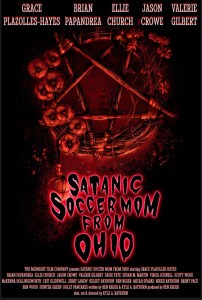
When you have a catchy title like Satanic Soccer Mom from Ohio, you know you have to deliver the goods. This gleefully schlocky suburban satire horror comedy (how many more adjectives you want?) is the follow-up from director/co-writer Kyle Rayburn, an unabashed genre enthusiast. I was granted an advance copy to review this new Ohio-made indie and I’ll try to remain as objective as possible, dear reader, despite the fact that Kyle is one of the nicest men on Earth and even allowed me to film an episode of my rom-com Web series in his own home. Satanic Soccer Mom from Ohio is more low-key than you may be expecting. Its chill vibes and relaxed, ironic humor are more indicative of a stoner hangout movie than something with demon figures and threats of damnation. I think plenty of viewers could latch onto the fun, weird wavelength of an undemanding silly comedy, although there are places I wish Satanic Soccer Mom had gone even further with its spirited sense of creativity.
Annie (Gracie Hayes-Plazolles) is trying to hold it all together in suburban Ohio. Her husband won the lottery and then vanished, and her suburban community is awash in gossip and speculation about what has happened to him. Annie is trying to raise her two kids alone, keep ahead of adult responsibilities like bills and soccer practice shuttling, and holding back from snapping at the clucking hens of the neighborhood, the Karens, lead by chief Karen Green (Valerie Gilbert). It all changes when she accidentally summons a horned demon, Balthazar (Brian Papandrea), who is willing to grant her three wishes at a price, as per proper Faustian bargains.
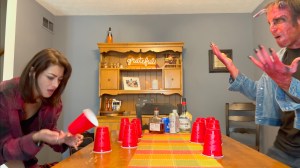
There is a breezy charm to Satanic Soccer Mom from Ohio, a casual, shoulder-shrugging amiability that invites you not to think too hard about the proceedings and just have fun, and if you can connect on that wavelength, then the meandering nature can also be part of that unexpected charm. It’s easy to see the works of Kevin Smith as a reference for Rayburn, but I was also reminded of the hangout cinema of Richard Linklater, where you adjust to the rhythms of characters and their daily lives and interactive camaraderie. Of course, nobody had their boobs literally fall off in Linklater’s world (though there’s still time yet), but it’s that same relaxed tone and feeling that permeates Satanic Soccer Mom. There’s something most amusing about populating your movie with fantastic creatures but keeping a deadpan sense of mundane reality. It’s one of the reasons I enjoyed the short-lived Adult Swim series Your Pretty Face is Going to Hell, a workplace sitcom set in an office literally in hell. If done well, the surprising triviality of the fantastic setup provides its own sly sense of humor. I enjoyed that the movie didn’t have apocalyptic stakes but instead illuminated conflicts very relatable to many: getting over a painful relationship, struggling to juggle the responsibilities of adulthood, fitting in but also knowing when to push back and assert your independence. Having the duplicitous neighborhood Karens be a bigger pain for Annie than an actual demon is a fun reversal. Same as Annie wasting her magically granted wish on ordinary adult requests, like a never-ending cup of iced coffee. The unblinking, roll-with-the-punches attitude of the characters made the movie entertaining even when little was going on from a plot standpoint, and that’s a big boon for an 80-minute indie.
I consider Satanic Soccer Mom from Ohio to be a silly buddy film, and it improves greatly once Balthazar becomes entwined in Annie’s domestic drama. This is also because Papandrea (Feaster Sunday) is the funniest performer in the movie. I loved the bickering dynamic between Annie and her demonic little helper. They reminded me of squabbling siblings, cemented even further during a contentious and competitive game of Mario Kart. This is also the key character dynamic for the movie, the ordinary in conflict with the extraordinary, the protagonist suffering and the relief with the strings attached. The movie is never better when these two are sharing the screen. Plazolles-Hayes (Night Work) has a spunky Parker Posey energy to her, an incredulity to her wide-eyed stares and eyebrow arches that feels earned. She’s the straight woman in a series of crazy developments, and Plazolles-Hayes doesn’t get lost in the craziness. Papandrea is a natural hell-raiser, a mischievous performer who makes the most of his material and elevates it with a grinning desperation that makes it all funnier, like a failing comic on stage. Balthazar is also highly engaging when he’s pretending to be a “normal human,” and his obvious, schticky delivery and mannerisms reminded me of Vincent D’Onofrio’s physical performance in Men in Black. I can still recall the moment he was trying to quickly hide from Annie’s children and just lifted whatever objects were near to badly obscure him (“What are you… four?” Annie berates him). The casual shade Papandrea imbues the line, “Okay… sinner,” is simply award-winning comedy. It’s also a diverting commentary that Annie gets along better with a demon than most humans, though I’m sure there are many among us who could relate. It endears Annie to the audience and proves how unflappable she is despite her troubles, worldly and other-wordly.
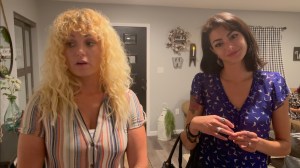
I also want to mention a few other performances that made the most with their screen time. Gilbert (Straitjacket) is so amusingly self-satisfied without becoming a full-blown suburbanite caricature of “Midwest nice.” I especially enjoyed the few moments she dropped the act and revealed the curdled reality behind her sweet-smiling facade. Virgil Schnell (Night Work) is hilarious with how transparently desperate he is to be with another woman, even willing to whip off his shirt to help a woman clean up a slight dab of spilled wine. Ellie Church (Harvest Lake, Jessie’s Super Normal Regular Average Day) is well-acquainted with low-budget horror and provides a welcomed sense of easy-going camaraderie for Annie as her lone friend in town.
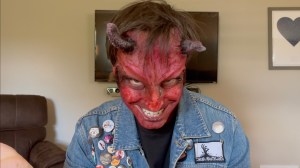
As one of those who previously watched Rayburn’s first film foray, 2019’s Men in Black-meets-True Blood caper, Night Work, I can see definite growth as a filmmaker. Both movies were made on shoestring budgets (only $5,000 total) and filmed primarily on a iPhone camera, though the low-budget look isn’t a big point of detraction for either movie. You can’t judge a small indie movie made for $5000 and filmed on the weekends by the same technical standards of bigger movies. You have to accept some tech shortcomings, like the absence of dynamic lighting or polished audio or complex camerawork. There’s very little visual coverage in Satanic Soccer Mom, many scenes composed of a closed shot-reverse shot circuit of edit choices, but it took me out of the movie only sparingly. The rough-around-the-edges DIY aesthetic can provide its own micro-budget charm too, and Rayburn and co-writer Ben Reger (Night Work) are aware enough to write around technical limitations and emphasize ideas and quirky character interactions. He even has a character joke in narration, “That’s what we could afford to show you.” Rayburn is also smart to cast well and get out of the way of his actors. The ensemble feel like they’re gelling on the same comedic wavelength, which is harder to do than most would think, and thus each performer feels in concert no matter the wild turns. The makeup effects for Balthazar are stylish and effective on a budget, and his whole denim jacket and button-heavy attire and punk rock attitude reminded me favorably of Viv from the short-lived but brilliant British comedy TV series The Young Ones, formative to my own burgeoning sense of humor.
However, even with the emphasis on the ideas, there are enough moments that left me wanting more. I can understand some viewers feeling cold to its blase tone with its fantastical characters. Some viewers will not be able to get over the fact that a woman has a demon wish-granting service and the creativity only goes so far, mellowing in shallow waters for its own good vibes. With all the wish-granting, reality-altering possibilities that a demon represents, it can be something of a letdown for the wishes to be so mundane and minute. One of Annie’s wishes is for her (minor spoiler warnings) to be able to go out in town and pretend to be someone else, so she magically transforms into a different actress (Nickii Rayburn, the director’s wife, so good husband points there) for one raucous night. I can understand that this wish gets at Annie’s distaste for the oppressive negativity of her town, but couldn’t she just have gone to a different bar in a different town where nobody would know her? She could also just wish for the idiots in town to forget about her. It’s the same for why Annie even chooses to hang out with the Karens if she despises their company so much. I understand why the scene exists from a plot standpoint, as another contrast between Annie and the suburbanites she doesn’t fit in with, but then why even bother spending time with these women? There are engaging character aspects with Annie that feel only briefly touched upon, chief among them her complicated feelings about being abandoned by her husband. There’s a nice moment where Balthazar confirms her suspicions and Plazolles-Hayes gets to emote, finally able to process a key point of grief, and it’s one of the few genuine dramatic moments of the movie. However, without prolonged comedy set pieces, the movie would have benefited with more scenes like this for balance. The movie coasts a bit too long without a larger plot direction, so it can feel very scene-to-scene. Then the end includes multiple deus ex machinas, which can make the preceding problems feel too slight.
While I chuckled throughout, the comedy felt too subdued and too easily satisfied creatively. I’m surprised, given the premise, that there aren’t really comedy set pieces. I suppose there’s one, Annie and her pal getting stoned and attending craft night with the Karens, but that’s it. Much of the humor is ribald banter, so much will rest upon the quality of the dialogue writing. It helps having such sharp contrasts for conflict. I laughed throughout but kept wanting the movie to go further, to build off its gags and complications and peculiar turns. One of the dunder-headed Karens flippantly remarks about what could have happened to Annie’s husband, saying, “become a horse man,” and this would have made a fine opportunity to have her continue this weird fantasy tangent, accidentally revealing her own strange sexual kinks, something to separate her from the herd and then shame her back into social submission. That could have been a running gag. Or Bathazar’s one runty horn being a source of insecurity, something he has to defend (“I’ll have you know, plenty of lady demons have referred to my horns as ‘more than adequate.’”). There’s a truly wonderful random gag about the Karens raising money for “Saxophones for the Homeless,” and I was pleading for a visual representation of this concept, with a homeless man shrugging at the useless gift. I often wish there were comedy scenes and jokes that pushed beyond the first idea, taking one joke and finding a deeper, more belly laugh-inducing bit rather than settling for a passing chuckle. I’m talking about scenes where Annie gets stoned and giggles, or the inclusion of a record scratch sound effect to really ensure that a punchline landed and was meant to be unexpected. I wish Rayburn and Reger demonstrated as much confidence with all their jokes as they do their final gag involving an angel and the selected color of her wings (it’s definitely a memorable exit).
Two movies in and Rayburn is starting to establish a penchant for establishing weird and wild worlds with goofy, profane characters, rich in crude banter and crazy ideas, but worlds that I wish to explore further. Satanic Soccer Mom from Ohio is an amusing and charming movie, especially if one can gel with its overall amiable tone and forgive the inevitable technical shortcomings. I’m far more forgiving of tech issues than I am with narrative and comedy shortcomings, because those are strictly on the creative brain trust fully developing their story potential and exploring the possibilities of their funny. It’s hard not to feel like Satanic Soccer Mom is a solid first draft of a story and could have benefited from a few more passes and polishes to really punch up the comedy and better explore the character dynamics. That stuff isn’t budget dependent. Again, it’s easy to feel the passion everyone had for this project and especially the good times. We need movies that can provide that level of entertainment, no matter their flaws, and Satanic Soccer Mom from Ohio is likely going to be the most feel-good buddy movie ever with this title.
Nate’s Grade: B-
Share this:

Adeline (2022)
 The story behind Greg James, the filmmaker from Ohio, is surprisingly tied to, of all things, dodgeball. In 2004, the movie Dodgeball: A True Underdog Story was released and grossed $168 million worldwide, but there were two legal challenges accusing copyright violation to writer/director Rawson Marshall Thurber, and both have central Ohio connections. The first was by writers Ernando Ashoka Thomas and David Price, a Bexley, Ohio native that put his own experiences as an adult dodgeball tournament organizer into the script. Where things get interesting is that this other script, entitled Dodgeball: The Movie, was passed along in March 2001 to Shaun Redick, who worked for an agency and was friends with Thurber. This was one month before Thurber finished and registered his draft of his dodgeball screenplay. During the copyright lawsuit in 2005, a judge determined that a jury might “reasonably infer” that Thurber had access to the other dodgeball screenplay via Redick. There were other similarities between the two scripts that appear to be more than just formula and genre trappings, like both featuring a wheelchair-bound former dodgeball champion who becomes a coach and dies in a freak accident midway through before the big game but then reappears as a ghost to cheer them on.
The second and lesser-known suit was for authorship of that other dodgeball script, and that’s where James comes in. He and Thomas worked together under the YNOT production company they founded. They directed and produced a movie in 2001, Raw Fish, that Thomas wrote. Afterwards, in 2001, Thomas was working on the dodgeball script and James claims he was a co-author (Price was not listed as co-author until 2004 in screenplay registration). Thomas listed himself as the sole author on all the drafts he copyrighted and shared, and because James did not assert his copyright dispute until 2005, the statute of limitations ran out. James said that Thomas removed James’ name from the cover page before submitting the draft but never inquired further because he trusted his would-be partner. Lacking proof of collusion, and beyond the three-year window, James’ case was dismissed. The suit with Thomas and Price against Fox was later settled for an undisclosed sum, and James was left with nothing.
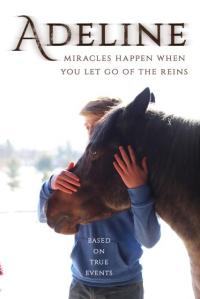
 James returned to Columbus after 25 years in L.A. and was inspired to make a local story into a feel-good family film that could inspire others. Adeline is based on a horse at Serendipity Stables that provided therapeutic care for children with disabilities and those on the spectrum. In 2002, a tornado struck and Adeline reportedly held people against a barn wall to protect them rather than running away from danger. The horse’s bravery was rewarded by locals donating over $15,000 to allow Adeline to receive life-saving surgery (Adeline lived another three years). Adeline is James’ homecoming, and it’s sweet and slickly produced to look like any number of other faith-based inspirational family films, and that’s also its problem, if you find that to be a problem.
In a small Ohio town, Kay (Jane Mowder) moves onto a horse ranch and her presence changes everything. Bethany (Orli Gottesman) is running from foster home to foster home for setting fires, but one encounter with Adeline the horse and she’s rethinking her pyromania. The town preacher John (David Chokachi) and his wife Terry (Erin Bethea) have an autistic son who takes a shine to Adeline and actually speaks. John is skeptical and worries putting faith into Kay and her holistic solutions will lead to another disappointment. He challenges his parishioners to not lose sight of where to place their faith, and then the big tornado comes twistin’ through.
 If you’re fans of sweet feel-good movies, Adeline will likely hit most of what you’re looking for, but I found the central idea a little too simplistic to the point of incredulity. In short, this is a magic horse. This is the only conclusion I must derive from what I see onscreen. I love animals. I always have. As my fiancé would attest, they flock to me. With that being said, I have a problem with animal movies because too many of them feel lazily projected onto the animal as its symbol. I had this same feeling with the 2020 inexplicably Oscar-winning My Octopus Teacher: “Does this octopus really see this man in a snorkel as a friend or an ally? She reaches out a tentacle to touch the appendage of this underwater man, but what does that mean? Is this signaling a friendship or is it merely signaling an animal taking stock of its surroundings? I don’t know and depending upon your personal relationship with the animal world, you will either accept everything [this man] says at face value without skepticism or you will see him as a slightly foolish romantic.” Adeline is such a magic horse that all it takes is Bethany looking once into her eyes to break her free from her fire-setting impulses. Adeline is such a magic horse that all it takes is a couple of rides and the preacher’s autistic son is now talking. This horse is spoken about in such grandiose terms and yet the screenplay by Sam Lewis doesn’t make the horse a character, which can be done for animals (see: Seabiscuit). The problem is that if effort is not put into giving the horse something, then the horse is merely a plot device for easy miracles. It might as well have been a magic couch whereupon every sit heals thy sitter. Given this horse’s track record, I’m surprised the town didn’t trot Adeline into their office to fix any budget shortfall. I know this is based on a true story, and I’m being more than a little facetious, but we need more from the drama than “Person A nuzzles horse or rides horse. Person A is now better. Repeat.”
Where the movie seems to want to go is the idea of alternate routes of healing, and this has dramatic potential that’s never fully realized. Much of the conflict revolves around John being skeptical and unwilling to see the benefit of the horse. His job asks him to put his faith in God and not a horse. He’s also hurting because of the frustrations with raising a non-verbal autistic child that he has difficulty communicating and connecting with. At one point, he even says he blames God for cursing his family (yikes). It looks like Adeline is going to be a conflict between traditional faith and alternative healing, an Old School versus New Age kind of battle. It appears that John might even feel threatened by the horse, like his parishioners will start looking to the special horse for answers and healing rather than their local minister. Does he feel threatened? Does he think his authority is being challenged by the horse or by God? Had the script really explored this personal crisis it could have made for an interesting character study about belief systems in conflict. Instead, it mostly plays as John being the most stubborn man who has to be the last one to accept the gift of Adeline. Lacking that depth, it means we’re just waiting for John to finally come around to the obvious, and it can be a frustrating waiting game. Even after the horse protects a dozen people from a tornado, David still pushes back. He even lays out a theory that since the horse farm was the only one hit by the tornado that God must disapprove (people literally groan and walk out of church in disgust after he proposes this theory). I think re-centering the movie on one man’s crisis of faith, accelerated by already feeling shaken from his son’s diagnosis, would be the smarter storytelling foundation rather than making the horse the magic new neighbor.
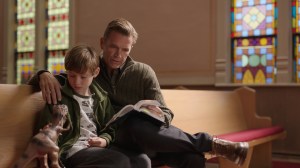 The story has too many characters and subplots that don’t get enough attention, but at the same time Adeline benefits from a pacing standpoint by having more stories to switch over. The Bethany storyline could have been its own movie but she feels more like Exhibit A for the miraculous potential of the horse. We’re told that she can’t stop starting fires and bounces from foster home to foster home, and all of a sudden Kay agrees to adopt her on the spot, and why not if all it takes is one encounter with Adeline to prove curative for Bethany’s troubles? Because this conflict is amazingly resolved so quickly, we have to add the extra conflict of the town teenagers bullying Bethany for her past, though this is comprised to one scene where the kid she may or may not have a crush on, Jason (Jake Satow), stands up for her and punches the lead bully. This is the end of Bethany being picked on for her past. Having an outcast character in a small town is a good viewpoint and a natural source of conflict going up against community expectations. Unfortunately, Bethany is just treated like a testimonial. Likewise, the autistic child is merely a plot device, and the script then transforms Terry into little more than a pleading support network. She wants her husband to acknowledge the healing power of the horse. That’s about it. She’s the sweetly smiling, eyes-glistening “why won’t you see?” figure in these kinds of movies. I think the character that suffers the most is Kay. She doesn’t feel like a person but yet more of a plot device. She stirs up the status quo, and she has a mysterious past, and yet she’s just deliverer of miracles without further dimension.
Even though its budget was half a million dollars, Adeline looks and sounds like a professional movie that would ably fill the scheduling slots of a Hallmark or Christian TV network. The cinematography by Dan Parsons (Treasure Lies) is rich and autumnal in its color palate, and the use of dappled lighting and depth of field visual arrangements helps add an extra pleasing cinematic quality to the movie. The score is also quite nice by Erik Schroeder, a man with over 100 scoring titles to his name. It’s pleasant and twinkly without overwhelming the emotions on screen. The special effects with the tornado and its destructive wake are quite good for the budget. The acting is above average too. Mowder (Foxcatcher) is dignified, Chokachi (Baywatch) is perfectly flummoxed, Bethea (Fireproof) is winsome, and Gottesman (1-800-HOT-NITE) has a natural presence that makes me think she has even bigger opportunities on the horizon. Plus, there’s the always enjoyable Ralph Scott (Double Walker) as John’s unflappable friend and soothing voice of reason.
 There is plenty to enjoy with Adeline. It’s a passion project where you can feel the affection of everyone, and James has an invisible ease behind the camera. The acting and technical merits are solid and the pacing keeps things moving smoothly. Where Adeline frustrated me is with its screenplay that settled too often on its staid formula. We’ve seen these kinds of movies before and Adeline rests upon that familiarity a little too often for me. Genre fans will find enough to satisfy them, and everything is kept at such a family-friendly level of nice (even the disagreements are short and never more than G-rated) that is wholesome without feeling overly maudlin. I think the screenplay could have done much more with its pieces, but my opinion is going to be a minority for the movie’s target audience. Adeline is a nice movie about good people experiencing good tidings and will leave many people feeling, mostly, good.
Nate’s Grade: C
Share this:

A Story for Winter (2021)
 Writer/director Nathan Weidner is a local teacher at Canal Winchester schools where he teaches video production and French. The 54-year-old has made two other movies before, both of which available on YouTube, but it’s clear that A Story for Winter is his passion project. The man wrote the first draft in 2009 and was rewriting it for over a decade. It’s inspired upon his own real-life family tragedy. Weidner’s daughter Meah was born in 1988 with cerebral palsy. She was non-verbal and Weidner said he always wondered what she could be imagining. The movie’s end is even dedicated to her with archival footage. Sadly, Meah was taken tragically when her mother’s new boyfriend shook her too violently (he is now serving a life sentence). In the summer of 2021, Weidner gathered former high school students, a budget of $3000, and his iPhone 12, and over the course of 15 August days he made his movie. Weidner was the photographer, editor, producer, and even wrote and performed a mournful song in the movie. A Story for Winter is currently available on Amazon and is a clear labor for love for Weidner and everyone involved wanting to see this through. Their intentions are pure and lovely. I wish the final movie was a bit more focused to better tap into its accessible emotions.
Dr. Owen Hughes (Adam Ashton Scott) is the new small-town Ohio doctor after his 80-year-old predecessor kicks the bucket. He’s chaffing under adapting to the new position, and he insists he will not see children for medical consultation. He freaks out when his newly eloped wife, Connie (Allison Kuck), even suggests they could have a child. His chilly stance begins to soften when he meets Winter (Chloe Gardner), an ailing child in town with cerebral palsy who was abandoned by her drug-addict parents. She’s being taken care of by the kindly Cora Preston (Cynthia Smith) who has opened her home to many foster children, most of whom have some form of special needs. She recognizes that Winter will not be long for this world but that doesn’t mean the life she has remaining cannot still have its rewards. As her condition worsens, Dr. Hughes opens himself up by telling allegorical fantasy stories to Winter about his own troubled family history.
 The first thing you have to acknowledge with A Story for Winter are its technical and professional limitations. It’s unfair to complain too much about obvious limitations of time and budget. You’ll notice that there is very little editing coverage or camera movement in the movie. Until the late narration-heavy fantasies, just about every shot is stationary. Characters will often talk directly in front of one another and the edits primarily feature a shot-reverse shot rhythm that feels born out of necessity than creative vision. The excuse of the newly moved couple explains the sparse nature of the home furnishings. However, there are some budgetary choices that made me scratch my head that could have been avoided. The setting is around Christmas to slot the movie as one of those feel-good holiday movies, a thriving industry unto itself. There are some references to Christmas as a theme of giving and blessings but it’s more a superficial connection, so I think the story could have stood on its own minus the holly jolly. Regardless, it’s a snowy Christmas season that keeps several characters housebound. Considering the budget and that it was filmed in the summer, I would avoid anything that would give away the unreality of the season. This movie disagrees. We see obvious green screen shots of Dr. Hughes driving in the snow. Even more befuddling, there is a plurality of exterior shots of the home except it has been rendered as a completely CGI model. It is not subtle. I kept wondering why even bother with these shots. Does it make the movie more seasonal? If so, why not use affordable stock footage or, failing that, wait until actual winter in Ohio and record thirty seconds of an establishing exterior shot of the same house but now with real snow? So even with being considerate to the limitations at hand, there are creative decisions that seem iffy.
I think many fans of sweet Hallmark movies will find A Story for Winter to be heartwarming and be inspired from its message. Characters talk about the value of human life as well as the prospect of human suffering in familiar Christian terminology. I’ve never been a big fan of “this person exists to teach you how to be a better person” as a plot device, but I can understand and sympathize with the human impulse to find larger meaning in personal tragedy. However, where the movie feels more complete, for me, on a message front is that even those who have limited times on this planet are still of value and our compassion. I’m reminded of 2016’s Arrival that hinged on a twist ending that the (six-year-old spoilers ahead) flashbacks were actually flash-forwards, and Amy Adams wasn’t mourning a past daughter but knew ahead of time that her eventual daughter would tragically die at a young age, and yet she chose to have her. For that review, I wrote, “Knowing what is to come means that a child was brought into existence to die sadly as a teenager and will suffer, but she will also live and love and laugh for many days beforehand, and knowing the end provides a lens that incentivizes every moment spent together. Yes, she will die eventually but any one of us could be snatched from the world at any moment. At least she got to know love and life for so many years before it was taken away from her.” I thought it was very nice when the movie gives Winter her voice, granted it’s through dream sequences, which means it’s Dr. Hughes’ conception of what that voice could be. I wish the movie had given her more time to express herself rather than utilize her as the key to getting Dr. Hughes to finally reveal his own family drama, though also through the lens of fantasy.
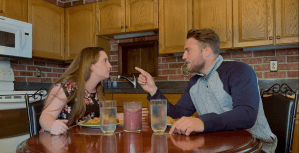 My emotional investment was stalled because of two main factors: Dr. Hughes being a jerk and having far, far too many underdeveloped subplots competing for attention. Our protagonist is a prickly person, immediately dismissive and practically disdainful of his medical practice coworkers. He’s also a jerk to his wife and makes a snide comment whenever he feels she could have been doing more to settle their home. He keeps complaining about eating on disposable plates or Styrofoam containers. Hey, buddy, you can put dishes away too. They are recently married, eloped after a year of dating, and Connie’s extended family is not too happy about it. What better way to assure her than have her marital partner is the right person for her with him being a mean jerk? He’s also actively hiding his past and hastily establishes a cover story for not explaining to her that the town sheriff (Bryce Millikin) is his “uncle.” This should all be red flags to his wife, and how he treats her makes me dislike this man even more. For half of the movie, Dr. Hughes is a jerk, and then after the hour mark, he just spills his own personal history. There are short flashback clips peppered throughout of a young Owen with his distraught, inebriated, irritable mother and his younger sister suffering from an incurable illness. It’s enough to establish why a child with a terminal ailment would affect him so, never mind just general empathy. Now, beginning with a grumpy character and watching them transform is nothing new to storytelling. Ebenezer Scrooge wasn’t exactly a nice guy either, although we got glimpses of his past self so we knew there was a core of decency that could possibly return.
The movie cannot be a character study of Dr. Hughes finding his way back from his grief and grievance. The character doesn’t have enough dimension to him because the movie is divided with so many subplots. Namely, in our 100 minutes of movie, we have: 1) fitting into a new town and sliding into the shoes of a beloved predecessor, 2) being newlyweds with his wife and the strain of their marriage, 3) caring for Winter and opening up to her, 4) the many lives of Aubrey House, 5) Connie’s family unexpectedly coming over for a Christmas gathering, 6) Dr. Hughes explaining Winter’s past through a fantasy allegory, 7) Dr. Hughes communicating with Winter through his lucid dreams, 8) Dr. Hughes sharing his own family tragedy through a fantasy allegory, and 9) Dr. Hughes coming to terms with his relationship with his mother and forgiving her. There are more aspects to each of these, and some are more prominent than others, but that’s A Story for Winter. It’s easy to see the connected tracks but the narrative could have benefited with some careful pruning to better emphasize its most essential moments.
 I don’t think much is added by keeping Connie in the dark about her husband’s past. You can still dole out the truth over time, saving the full picture for the end of your movie. It’s not like she’s seriously second-guessing her marriage, or at least we are not given a scene that expresses this doubt. I also think little is gained through the first allegorical vehicle, using the realm of children’s fantasy to explain Winter’s own past to her. The character of Winter, again through the lens of Dr. Hughes’ subconscious mind, doesn’t seem too concerned about coming to terms with her own family’s faults. Perhaps she’s meant as the starter vehicle for Dr. Hughes to then come to terms, but why go through this process twice? Revealing Dr. Hughes’ backstory is also not a mystery that I was too desperate to uncover. The movie seems to think delaying the full information will provide more dramatic catharsis, but I’m not as certain. I think uncovering Winter’s past, then dealing with it through allegory, then doing the same with Dr. Hughes, is just making things too busy. Especially when Connie, her family, and everyone else is put on literal hold during these lengthy fantasy interludes, freezing them out from further development. The only two characters the movie really examines are Winter and Dr. Hughes, so why not consolidate? Too much feels ladled on to either pad the running time, make superficial connections to holiday film staples to satisfy its presumed audience, or reflect upon Owen’s emotional journey. If the world is cultivated to better bring one man to a change of heart, then let’s give enough room for that journey to feel well-developed and organic and satisfying.
The conclusion about acceptance and, more importantly, about forgiveness is sweet and still has some dramatic points that will hit plenty of viewers. Weidner knows how to craft a workable redemption story, though much of the comedy bits are a bit stale and hokey, though that could also be a selling point for fans of Hallmark movies that view hokey comedy as comfort food. My criticisms are directed at what could help make this the improved version of the screen story. Streamlining, being less precious with our protagonist back-story, and giving more consideration and depth to Connie would have benefited the overall emotional investment and uplift.
A Story for Winter is a nice movie made by people who really wanted to see the director’s vision become a reality, something so close to home and so personal. I won’t fault the limited budget, the bland editing and shot selections, or the amateur acting by the leads. However, creativity is not dependent on money. Even with its minuscule budget, I think Weidner could have made further judicious choices to maximize the characters and story he had on the page. There are interesting characters here but they are too defined by their circumstances, thus becoming static mouthpieces about their experiences and not enough about them in the present. Maybe I’m being a seasonal Grinch, as admittedly Christmas movies are not a salve for me, so take everything with whatever caution you’d heed. A Story for Winter feels a little too beholden to its message and its feel-good holiday genre trappings to really explore the human drama at its beating heart. It’s a commendable micro-budget DIY effort with all the right intentions, though some of its storytelling choices managed to hold back my full intrigue and investment.
Nate’s Grade: C


 nathanzoebl
You must be logged in to post a comment.