Blog Archives
Supergirl (2026)
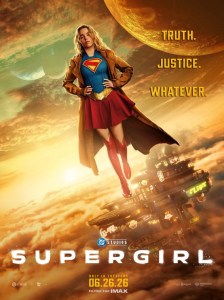
I have implicit faith in James Gunn as a filmmaker. He’s earned my trust over the decades, especially in the realm of superhero cinema, and especially after his rip-roaring and reverential relaunch of Superman in 2025. However, when it comes to James Gunn the reigning head of DC movies and television, well, I have more reservations. When he took over the high-profile position and plotted the new direction of DC cinema after the ignoble death of the Snyderverse, Gunn claimed that he would stress quality over quantity, particularly that the studio would not move forward with a project unless he felt the script was great. It’s a nice sentiment considering Marvel movies have for so long retooled and rewritten on the fly. However, it’s also a damning statement that can come back to haunt Gunn if any future DC movie has a script that feels, well, let’s say less than great. It’s one of those cautionary statements, like a politician saying, “I’ve never lied and I’ve never cheated on my wife.” You’re already priming your skepticism.
Enter 2026’s Supergirl, based on a highly regarded eight-issue comic Supergirl: Woman of Tomorrow by renowned author Tom King and artist Bilquis Evely. I’ve read the 2021-2022 series, being an enormous fan of King ever since his astonishing and award-winning Vision series, and I can see why Gunn would model Supergirl’s big-screen relaunch with this story. It’s essentially a sci-fi version of True Grit, a familiar formula that’s easy to grab an audience with salient themes about vengeance, forgiveness, duty, and responsibility in a world that often feels too indifferent (a frequent repeated refrain is “It’s too big. We’re too small”). It’s a pretty great story and seemingly a great blueprint for a potentially great movie. Having now seen the Supergirl adaptation, I come back to Gunn’s explicit promise. Did he think this screenplay, by actor-turned-playwright Ana Nogueira, was great? Did he think this movie was ready? The whole of me doubts it, given Gunn’s innate understanding of story and character development from his other blockbusters. Yet, I can also recall Gunn’s company-man hyping of 2023’s Flash movie, saying he genuinely felt it was one of the best superhero movies ever. Audiences generally disagreed. I’m starting to think there are two James Gunns, the filmmaker and the boss. I trust the filmmaker. I don’t know yet about the boss, and Supergirl’s muddled and disappointing execution does not help solidify my faith.

Kara Zor-El a.k.a. Supergirl (Millie Alcock) is touring the galaxy for her birthday. She’s specifically visiting planets with red suns because it neutralizes her alien powers so she can actually feel the inebriating effects of alcohol. She wants nothing to do with quests and the downtrodden and that’s where Ruthye (Eve Ridley) comes in. She’s looking for hired muscle to avenge her family. The marauding Krem of the Yellow Hills (Matthias Schoenaerts) is the leader of the Brigands, space pirates profiting off the abduction and sale of young women in particular. Things get personal for Kara when Krem steals her own spaceship and mortally wounds her dog, Krypto, with a poisoned arrow. Supergirl has three days before her little pooch succumbs to the poison. She sets out with Ruthye to track down Krem, rip the antidote conveniently hanging around his neck at all times, and maybe facilitate some old-fashioned vengeance.
Where did this movie go wrong? I think we have a few culprits and poor decisions when it comes to the development of character arcs, themes, and in general making an audience care. Most people do not have the generational built-in knowledge about Supergirl and her origin, so the movie needs to be an introduction for us and provide a compelling reason why we should care about this latest hero. Having an arc where a character begins in an isolated, self-loathing, and cynical place only to become more engaged, motivated, and virtuous is a common arc, the stuff of Westerns and the like, the redemptive story of the old gunslinger who learns to fight for something bigger than himself. As evidenced in Supergirl, she’s reclusive and drowning herself in alcohol because of her survivor’s guilt, being one of only two Krytonians, along with her cousin Kal-El, a.k.a. Superman. She doesn’t feel at home, both literally when it comes to a place to call her own as well as within her own skin as a person. She certainly turns up her nose at the idea of being a hero or let alone the prospect of do-gooders. She says, “Clark sees the good in people. I see them for how they really are.” You can see where this is going as far as a character arc. It should be an important and triumphant moment when she, at long last, dons the Supergirl outfit, something she had dismissively rejected earlier. We should care. I still recall how emotional it was for many to watch Wonder Woman triumphantly walk across No Man’s Land in full regalia. The moment in Supergirl is more of a shrug because Kara is mostly a shrug of a character. I don’t think the screenplay presents enough to invest an audience’s emotions into her journey. Part of this is because the entire story feels confused and muddled, so for her to have self-epiphanies made me say, “Uh, really?”
That’s because this character arc goes into a dismaying place, with Supergirl making a choice at the end that seems counter-productive to being a more virtuous example for others. I think she argues she’s sparing an innocent from having to live with something they will regret that could change them, not to allow them to become as hardened and hurt as Kara. But isn’t she also reforming? Doesn’t that say something about starting over with redemption? Also, we’re not given a sufficient back-story that delivers a credible life Supergirl would not wish others to follow. With some later flashbacks, which I think could have served as the opening five minutes, we see Kara’s tragic back-story, losing her planet, then her family, then her adopted home, the only one she’s ever known up until landing on Earth. It’s tragic but it’s not like she’s suffering because of her own mistakes she has to live with. What ills from her past is she trying to prevent others from repeating? The circumstances are not exactly immediately repeatable.

As we begin, Ruthye wants sweet vengeance whereas Kara is indifferent. That’s different from Kara being indifferent to life, reliant upon her super strength to pummel people into submission as her first option. You could begin with her prone to solving every problem with violence and then end on her recognizing the harm of violence and the power of mercy. That’s an identifiable arc. Same with Ruthye going from upstart on an adventure to a more sure-handed and capable fighter, gaining confidence and certainty and learning about the emptiness of vengeance to bring personal closure. The movie doesn’t really do that either. Ruthye is a wet blanket of a character prone to whining, and by the end of the movie, she’s just as hapless in a battle as she was in the beginning. I don’t want to overly harp on the differences with the source material, but in the original comic, the entire story was told from Ruthye’s perspective as our narrator, and she was verbose and assertive, essentially the same persona of Mattie Ross from True Grit, with Supergirl being our curmudgeonly Rooster Cogburn. It made her more relatable and interesting. Now she’s been turned into a sulky teenager who gets rewarded with partying with her new friend.
Director Craig Gillespie (I, Tonya, Cruella) has been directing for nearly twenty years, going back to 2007’s Lars and the Real Girl. He’s a versatile director but seems to lean toward the quirk, with a heavy dash of Scorsese stylistics like fourth-wall breaks, flashy camera movements, and specific music cues. I don’t know if he was wrong for this material because I don’t think any director would necessarily rise above this script and its problems. The characters’ arcs are muddled. The villain is a dud, which is why they make him a sex trafficker midway through, because he lacks more definition beyond having a bedazzled 1990s jean jacket’s worth of studs embedded in his face. There’s also the frequency of Supergirl losing her powers. I know it’s to provide some danger and stakes since she’s so overpowered to skew the battles, but this happens literally four times. At some point, Krem shoots her with kryptonite arrows, but if she isn’t widely known across the universe, why would he assume these would be effective? Regardless, the action scenes are relatively lackluster and visually sludgy. Much of the movie takes place in dust-heavy desert dwellings, so it makes the movie feel like you want to wipe the camera lens. I can see the Mad Max: Fury Road leanings, especially with rescuing captive wives from janky biker gangs, but if we were going this route, why not make it central from the beginning? The tone of the movie is going for a jokey, breezy, attitude with-a-capital-A Guardians of the Galaxy vibe but it doesn’t work. It feels too forced and phony, the pale imitator of Gunn’s signature prankster anarchy. Too much of the movie feels like disparate elements thrown together over a prolonged and chaotic editing and re-shoot period. The finished film feels far from cohesive, and while that’s not exactly all Gillespie’s fault, he doesn’t save it.
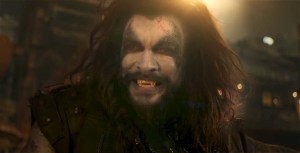
Jason Momoa (Aquaman) is simultaneously perfect for the role of intergalactic bounty hunter Lobo as well as completely extraneous to this movie. He doesn’t belong and takes away from important time we could have been building the characterization and arcs for our leading ladies. And yet, there was a transparently obvious way to make Lobo more integrated into the story, so much that it is baffling to me that the filmmakers didn’t utilize it. Lobo is after one of the other Brigands to bring him in for a bounty, a guy we never really get to know. Why isn’t Krem his sought-after bounty? Having this character trying to capture Krem would immediately improve his involvement in the narrative. Now instead of just being a guy on his own tangentially related solo mission, now he’s a competitor at cross-purposes with Kara. His appearances now have meaning and he becomes a more urgent threat, the guy who will snatch Krem and deny Supergirl and Ruthye completing their goal. That’s a significant added conflict. Ruthye wants Krem dead. Supergirl wants him alive to save her dog. Lobo just wants him to collect a sizable sum of money. That’s how you do it, and yet the screenplay misses this storytelling avenue. As a result, Lobo feels like an interloper, an occasional fighting ally but more so a haphazardly grafted-on character meant to goose a narrative lacking certain energy or humor. Momoa is perfect as this character (seriously, look up drawings of Lobo, first introduced in 1983) as it allows him to growl, guzzle beer, wisecrack, and act like a carefree badass with more than a nod of machismo buffoonery. He’s having fun, but he could have been more meaningful to the movie rather than a special guest appearance diversion.
Gunn and Gillespie have a well-known affinity for needle-drop songs, but there’s one needle-drop choice in Supergirl that is gasp-inducing in its miscalculation. Plenty of modern blockbusters will marry anachronistic music for specific effect, so I’m not against unorthodox music selections. Not everything needs to be literally on-the-nose like 2016’s Suicide Squad, a movie with so many needle-drop music selections that it served as a lazy narrative shorthand. With Supergirl, there’s a slow-mo sequence toward the climax that circles around Ruthye when she finds herself in the fraught center of battle. As explosions and debris tear around her, with Supergirl zipping to and fro averting possible harm, a lilting song begins with an acoustic guitar followed by a woman singing the lyrics to Jimmy Eat World’s “The Middle,” with electronic anthemic flourishes, enough so that makes it feel wrong to those familiar with the early 2000s tune. I generally enjoy tonally different takes on familiar pop songs, but this… does not work. Not only does it not work, it’s astounding how poorly matched this is to the scene. It immediately ripped me out of the movie and made me question the decision-making of so many related to this film. The cover itself is fine from a music standpoint. I have nothing against Kelty Greye and KidMote, the artists responsible. In fact I feel bad for them. They don’t deserve this derision. It’s not their fault. Their song could have been the perfect addition in a different movie. As used in Supergirl, it’s stunningly bad and joins the dishonorable hall of fame along with Leonard Cohen’s “Hallelujah” awkwardly playing during sex in Watchmen and the truly bizarre rendition of “Smells Like Teen Spirit” by child slaves in Pan.

We’re now two movies into Gunn’s renewed DC film universe, with only two more scheduled on the horizon, a smaller genre experiment following Batman villain Clayface, and Gunn’s Superman sequel in 2027, Man of Tomorrow (maybe why they stripped the comic’s original title from this movie?). There’s not a lot to establish a larger universe of heroes and villains and drama. It’s been almost three years since Gunn announced a new Batman movie directed by Andy Muschietti and we haven’t heard anything else. It’s possible that the expansion of this new filmic universe is on a shorter leash, seeing how a small output performs before investing in a larger vision. I don’t think this movie will help matters. Supergirl is a fairly disappointing entry in the superhero canon, lacking charm and panache and excitement and satisfaction. It fails to make the case for Kara as an engaging character, although Alcock’s performance is fine. There’s just a pervading sense of blandness and a grasping quality where you feel the filmmakers’ indecision. It would be easy to say this was far from super, but I’m going to say Supergirl certainly could have flown much higher.
Nate’s Grade: C


You must be logged in to post a comment.