Blog Archives
The Craft: Legacy (2020)
 I don’t know who this new 2020 Craft is intended for and I don’t think the movie knows as well. If you’re a fan of the 1996 original, which has developed quite a reputation for many millennials, then I think you’re going to be relatively disappointed with this remake/reboot/sequel, whatever Blumhouse is calling this. By that description it should be evident that The Craft: Legacy has a bit of an identity crisis. It’s not exactly a remake because it retains so little from the original except in its witchy teenage premise, it’s not exactly a reboot because it doesn’t come together on its own for a new identity, and it’s not exactly a sequel because the only tangential connection to the original is tacked on in the literal final seconds of the movie. If it was trying to please fans of the original, it’s too lacking, and if it’s trying to chart its own course for a new generation of fans, well that doesn’t work either. As a result, it’s another PG-13 remake of an R-rated move that feels like it’s playing to a different crowd.
Lily (Cailee Spaeny, Bad Times at the El Royale) is the new girl at school. Her mother (Michelle Monaghan) is remarrying Adam (David Duchovny), a popular motivational speaker with three older sons of his own. She befriends a group of diverse teenagers when they suspect Lily might have the potential for special gifts. The girls try sending Lily a psychic message and then ask her to join their fledgling coven. The four of them combine their powers and promise to use their synchronicity for good to push back against the patriarchy.
 That narrative uncertainty of writer/director Zoe Lister-Jones (Band-Aid) seeps into every moment of the 97 minutes. You get a sense that Jones had a central topic she wanted to provide commentary and then a checklist of “witch stuff” to include that she wasn’t sure about. The activation of the powers in the original related to outcasts grabbing a power denied to them, getting even, going too far, learning some lessons, and then our protagonist having to topple her new friends and the danger they posed thanks to their new powers. With The Craft: Legacy, the magic feels like an afterthought to changing hearts and minds. We only really see one spell and its lengthy outcome where Lily makes her high school bully woke, and he stays that way and joins the girl group as their sensitive pal. This is, by far, the most interesting part of the movie, and yet there’s a larger implication that the movie ignores because it would place our heroines in an uncomfortable light. They’ve reformed the bully into a model citizen of a modern mature man who can admit his vulnerabilities, but they’ve also robbed him of agency and free will. Is this version of him what’s really hiding underneath, or is he simply being manipulated by their spell? This subplot gets more attention than any of the other witches combined. I don’t know anything about the other friends in the group, besides they take their witchy duties seriously and one of them is trans. They get assigned elemental powers later (Earth, Fire, Wind, Water) and that is more definite characterization than anything else. If you asked me what their names were or their defining personality traits I would be stumped.
After last year’s Black Christmas remake, it’s peculiar how closely The Craft: Legacy is following a similar formula. I applaud the diversity behind the camera and having female directors remake these stories for a new time and a new audience, and the concept of toxic masculinity as a threat to all women is potent and provides plenty to work into a horror/thriller dynamic. Yet Black Christmas had to go one step further by saying the evil fraternity that was preying upon women was secretly mind controlled by an evil magic goo of evil. It lets them off the hook. Now with The Craft: Legacy, we have an obvious villain as a symbol of toxic masculinity, and because he’s so obvious I kept waiting for him to be a more insidious foe, manipulating young men into a warped way of thinking about strength and virtue. However, this doesn’t happen. The antagonist feels like any generic abusive husband on any disposable Lifetime original TV movie. The topic doesn’t feel explored or nuanced for its big theme or cleverly matched up with the iconography of horror for extra genre commentary. What about the different sons? couldn’t they reflect different stages of his influence? Or the young and more innocent son, couldn’t he be a target of reprogramming? The movie doesn’t give us anything to really chart. It feels like much must have been left behind through several edits. If Jones and her team wanted to use their movie to make a pertinent statement on toxic masculinity, I was hoping for more than a relatively obvious, “It’s not good.” Even the Black Christmas remake gave its theme more consideration than this and talked about its generational impact.
 In the original, each member of the foursome has a backstory, a personality, a central conflict before and after developing her powers. While the conclusion was like Wicca X-Men, the rest of the movie was an effective high school drama with relatable characters. They were Catholic schoolgirls rebelling against their school and their families in the 1990s by practicing witchcraft. It was a statement. Now, the girls practicing witchcraft in a regular school during modern times just feels like an accepted experimentation from a culture that has become more tolerant, and that’s fine, but that means the movie has to provide other avenues to make new statements. The lackadaisical response to the supernatural really harms the movie. It makes it feel like the hook could have been anything. If the characters are given great power, use it sparingly, and then decide they might not be responsible enough so soon after, that’s simply boring storytelling. That’s the equivalent of a man finding a wish-granting genie, and then after the first wish where he asks for new pants he decides, “Oh, too much for me.” This is what I mean by The Craft: Legacy being too timid about being a supernatural horror thriller. It’s got the feminist perspective you’d expect from the underdog characters gaining powers, but it’s lacking a fundamental understanding or appreciation of its genre. It’s mostly confined to multiple nightmares and the occasional jump scare. The concluding good powers versus evil powers face-off is so awkward and cheesy that it deflates any good will earned.
The Craft: Legacy is a perfunctory remake/reboot that doesn’t seem interested in its characters, in its supernatural horror aspects (a sleepwalking brother that’s used as a jump scare and never explained?), or even in the exploration of its major theme on toxic masculinity. There isn’t much in the movie that is outright bad but there is nothing that shines either or proves to be memorable. The 1996 original isn’t exactly a genre classic but it looks so in direct comparison to this flat rehash.
Nate’s Grade: C
Share this:

Mission: Impossible – Fallout (2018)
 Coming down from the surging adrenaline rush, I was trying to determine when was the last time an action movie made me feel the immersive, delirious highs that Mission: Impossible – Fallout offers in spades, and what I came up with 2015’s Mad Max: Fury Road. Simply put, this is the best straightforward action movie in three years. It’s the best Mission: Impossible movie in the series, which, if it hadn’t already, has assumed the peak position of the most consistent, most entertaining, and best action franchise in Hollywood. Allow me to explain how returning writer/director Christopher McQuarrie (Jack Reacher) makes an action movie that demolishes the competition.
Ethan Hunt (Tom Cruise) has been pulled back into spy action thanks to the lingering fallout (eh, eh?) of the capture of Solomon Lane (Sean Harris), whose followers, nicknamed The Apostles, have stolen three plutonium cores. It’s Ethan Hunt’s fault the nuclear cores got loose, and so he and his team, Luther (Ving Rhames) and Benji (Simon Pegg), must clean up after their mess. The CIA sends its own asset, the burly August Walker (Henry Cavill), to help oversee the mission and specifically Ethan Hunt, who must pose as a shadowy terrorist broker to maintain appearances with important figures in the criminal underworld. In order to get the nuclear parts, Ethan Hunt has to retrieve Solomon Lane and release him back into the open. Complicating matters further is Ilsa Faust (Rebecca Ferguson) who needs Solomon dead to clear her own spy debts.
 Every action movie lives or dies depending upon its unique set pieces, often the first thing constructed by a studio and then the plot mechanics are ladled on merely as the barest of connecting tissue. They need to have stakes, they need to have purpose, they need to be memorable, and they need to be understood and develop organically. Mission: Impossible – Fallout could be taught in filmmaking schools about how to properly build action set pieces. They are brilliant. McQuarrie finds interesting ways to set them up, complicate them, and just keep the escalation going in a manner that still maintains the believability of the moment. Take for instance a foot chase where Ethan Hunt is trying to nab a bad guy through downtown London. Where McQuarrie pushes into the extraordinary is by having that foot chase on a multi-level terrain. Ethan Hunt has to chase after his target but multiple stories above the ground, and so he’s leaping out windows, jumping over rooftops simply to keep up. It’s a simple twist that takes what we’re familiar with and, literally, elevates it to new heights. Or take for instance the mission in Paris to capture Solomon Lane. At first it’s capture, then it’s flee police, then it’s flee another assassin. There are multiple stages to this sequence, each with a new goal, each with new complications, and each with new eye-popping stunts and escapes. The action finds natural points to progress, making smart use of the geography, and keeping different elements at play to come in and out to add more problems. This is how you do action right. As soon as the half-hour mark settles in with the arrival of Walker, the movie is practically nonstop in its set pieces until the very end. At a steep 147 minutes, this is the longest Mission: Impossible movie yet but it’s breathless in its execution.
Amazing set pieces that are cleverly designed is one aspect of a great action movie, but if you can’t tell what’s going on, what’s the point of all that cleverness? Fortunately, McQuarrie understands this and adheres to a visceral depiction of the action that creates gloriously immersive and pulse-pounding sequences. The set pieces are terrific, so it stands to reason the stuntwork should be terrific, and to make sure you appreciate the stuntwork, McQuarrie makes sure the photography highlights the verisimilitude. It’s a symbiotic (or as the Venom trailer tells me, “sym-BI-oat-ic”) relationship but when done correctly, as evidenced in this film, it’s the key to truly kinetic action sequences. Take for instance a parachute jump that marks the start of the second act. McQuarrie films it as a sustained long take, and as the camera plummets to the ground chasing after the two men, our brains can tell us that there is some special effects trickery to mitigate the dangers, but our senses are overwhelmed with the sustained illusion of tension. The fight choreography is equally up to the challenge. A bathroom brawl with Ethan Hunt and Walker and another man becomes a lesson in how many things can be smashed and what can be used as a weapon. A high-speed motorcycle chase through Parisian streets gets even more frantic when Ethan Hunt drives against traffic, and the scene becomes even more exciting when McQuarrie’s lens allows us to see the danger in all its glory.
 The Mission: Impossible franchise has been notable for its insane stuntwork but also, chiefly after the second installment, its edict to practical effects and maintaining the believability of its reality. It’s still movie spy shenanigans and globetrotting adventures, yes, but the moment-to-moment thrills feel like they’re really happening. The Fast and Furious franchise has gained great acclaim for the bombast of its physics-defying spectacle, and the Mission: Impossible franchise seems to have gone purposely in the opposite direction. It’s real Tom Cruise jumping off that building, it’s real Tom Cruise riding through traffic on a motorcycle, and it’s real Tom Cruise falling and climbing up a speeding helicopter during the thrilling finale. Cruise has had a death wish when it comes to throwing himself into the high-wire stunts of his franchise, but even at 56 years old he’s still at it, essentially trying to commit suicide on film for all of our amusement. Cruise is one of the few remaining movie stars and his commitment is without question.
This is also the first Mission: Impossible film that feels like the characters matter. It’s a direct continuation from the previous film, 2015’s Rogue Nation, bringing back the (somewhat lackluster) villain, the newest spy counterpart/potential love interest, the CIA and IMF brass, and the essential supporting team members from prior engagements. Because of this it feels more like what happened previously was establishment for a new story building upon that foundation. Rather than starting all over, the characters find ways to deepen their relationships, and the film opens up Ethan Hunt as a character and the toll his duty takes on those closest to him. There are some nice quiet moments that examine these characters as actual people. Several complications are as a direct result of personal character decisions, some good and some bad. I was joking with my pal Ben Bailey beforehand about wondering whether they’d find a way for Ving Rhames to matter, since he hasn’t been much more than “a guy in the van” for four movies, and by God they make him matter. They make each team member matter, finding moments to give them, mini-goals they’re entrusted with. During the dizzying helicopter chase in the finale, supporting players are left with their own task. Luther has to defuse a bomb but doesn’t have enough hands. Benji has to find something valuable in a very needle-haystack situation designed to torment and waste precious time. Ilsa is at cross-purposes for most of the film, not wanting to harm her fellow allies but also being given her own orders to prove her loyalty and protect her future. All of this comes to a head and it makes the parts feel as important as the whole. That’s great storytelling.
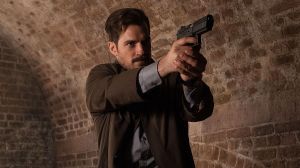 Let’s talk about that million-dollar mustache of Cavill’s. It was a year ago that Justice League re-shoots required Cavill and the Mission: Impossible team refused to allow their actor to shave his mustache, thus leading to that unsettling fake baby lip Superman was sporting in a majority of his scenes in the haphazard Justice League film. I just read an AV Club interview with McQuarrie where he for the first time discusses the whole mustache brouhaha and apparently Paramount estimated that it would have cost them three million for the effects to uphold Cavill’s upper lip continuity. Warner Brothers refused to pay up and so went down that ill-fated CGI mustache-removing route. It was shortly afterwards that Cruise shattered his ankle in a roof-leaping stunt (that is in the finished film and advertisements) and the production had to shut down for a month. If only Warner Brothers had waited, perhaps we all could have avoided this mustache mess.
Mission: Impossible – Fallout is a new highpoint for the best action franchise going in movies today (I’m still waiting for a third Raid film, Gareth Evans). The set pieces are memorable and unique, leading from one into the next with exquisite precision and thought. The action sequences are stunning and shot with stunning photography, highlighting the stunning stuntwork by the best death-defying professionals. It’s the first Mission: Impossible movie that doesn’t climax at its middle; in fact there’s a pretty obvious reveal that feels like it was going to be a late Act Three twist, but McQuarrie recognizes the audience thinking ahead, and there’s like a whole other exciting 45 minutes after. The stakes are better felt because the characters matter and are integrated in meaningful ways. This is the most I’ve enjoyed Henry Cavill in a movie (with possible exception of another spy movie, Man From U.N.C.L.E.), and you know what, his mustache works too. While the vertigo-inducing Burj Khalifa sequence is the best set piece in the franchise, Fallout has everything else beat at every level. Mission: Impossible – Fallout is a reminder that there are few things in the world of cinema better than a properly orchestrated, properly filmed, and properly developed action movie operating at full throttle. This is one of the reasons why we go to the movies, folks. See it in IMAX if possible. Soak it up.
Nate’s Grade: A
Share this:

Source Code (2011)
 Captain Colter Stevens (Jake Gyllenhaal) awakes on a train. His mind has been transplanted into the body of Sean Fentress, a doomed train passenger. Fentress, along with 200 others, were killed in an explosion on a commuter train heading in to Chicago. But this has all happened in the past. Colter has been quantum leaped into a top secret government program known as the source code. It uses people’s brain waves to simulate a recorded reality. The last thing Colter can remember is a firefight in Afghanistan, and now he’s aboard a train looking for a mad bomber. Whatever info he can retrieve will help the officials (Vera Farmiga, Jeffrey Wright) prevent a second terrorist bombing scheduled that day. Colter only has eight minutes to interact with the train passengers and deduce who the bomber is. After eight minutes, the train explodes and the reality resets itself again. Things get even more complicated when he falls for Fentress’ fetching female friend Christina (Michelle Mongahan). Can he save her? Can he save anyone? Can he get out of the source code?
Source Code manages to be a twisty, trippy little film that doesn’t so much knock you out but definitely packs a bit of a punch. Its simplicity is its very best asset. There’s a bomb on a train (ignore the questionable movie sci-fi physics). Colter has exactly eight minutes to learn what he can before he and everybody else blows up. Then the fun starts anew. The movie is less a time-travel flick than an alternate reality sort of experiment. Personally, I love movies that present a timeline and then slowly thumb away at the edges, stretching the narrative space, showing the audience the various intricacies of this tiny world. Whether it’s Pulp Fiction, Groundhog Day, or the propulsive fun of Run Lola Run, I enjoy a story that expands outward into a greater foundational complexity. I enjoy the clockwork of a story that shows me how the different pieces work together. I enjoy that through the variations I can experience a richer world, seeing what happens to a passenger as they leave the train, seeing how a character’s actions can impact another, seeing how altering that character’s action alters other forces in the story. That kind of narrative trickery, perfected in Groundhog Day, makes the story feel like a living creature because you witness the interconnected relationships of everything and everyone. It also makes it pretty fun to watch.
 Director Duncan Jones makes slick use of tight spaces like he showcased in 2009’s celestial sci-fi thriller, Moon. The quick pacing and collective rhythm of the movie helps contribute to its entertainment factor. Source Code is playful enough in design and execution. It remains consistently clever with its plotting, but what’s really surprising is that Jones is able to find a personal human story inside all the thriller trappings. Colter is trying to make sense of his situation, but he’s also trying to reconcile the idea of life, death, fate, and getting to speak with his parents who assume he was killed in Afghanistan (he’s been with the source code project for over two months). There’s a human face to all this, and while the love story feels tacked on and underdeveloped, Colter’s emotional turmoil and existential struggles to reassert his identity and find some peace from his life ring true. Gyllenhaal (Prince of Persia) is an ever capable lead who takes a near Hitchcockian leading man role and plays it straight to fine effect.
At the same time, Source Code tries to have it all with an ending that I don’t truly believe it pulls off. Spoilers will lurk, so skip the next two paragraphs those who wish to remain pure and chaste. The film does a fairly nimble job of setting up an appropriate, if mostly downbeat, ending. Colter doesn’t want to be a brain in a box; he doesn’t want the government using him as their newest tool for the rest of his unnatural days. He was pulled from the brink of death and he now just wants to die in peace. In the recorded reality of the source code, he’s allowed the chance that most of us will never have – he can find closure. Whereas he would have died on a desert battlefield, now Colter has an opportunity to speak to his father one last time, to say goodbye. The entire denouement of Source Code seems to be establishing a memorial for the people who were lost on that train, because once the source code is erased so too will they be. They’re electronic recreations but in the end it reminds you that they were real people, and now they get something of a proper sendoff, a fairly touching memorial to the people who will just be seen as numbers in a news report.
 And then… just as Colter makes peace with passing over, he passes over into another reality. The train doesn’t blow up. The people are able to get off. He gets to walk hand-in-hand with his new sweetheart. Jones doesn’t make it clear what really happens, which can lead to some mounting confusion. Did they really alter the past? Did they create a parallel dimension? In one dimension is everyone on the train dead whereas in another everyone lives, short of Sean Fentress? And how crappy is that? Yes, Gyllenhaal is a charming and terrific looking guy, but does no one shed a tear for the fact that he stole another man’s body? Sean Fentress may not have had the courage to ask out his pretty friend, but that doesn’t mean he deserved to have his identity hijacked and his existence more or less erased from time and space. It’s a weird blemish that the filmmakers don’t truly want to address, and why would they? The ending lacks commentary of any sort strictly because the movie wants to have it all. It wants the sad, mournful ending, it wants the happy “Everything’s gonna be okay” ending. It almost let’s you choose. But Source Code doesn’t come across so much as a film that begs to be opened for different interpretations so much as a film that didn’t want to upset anyone by picking an ending.
Source Code is nicely paced, nicely plotted, and it produces just as many intriguing questions as it does substantial thrills. Jones finds interesting ways to make the same material different. The various characters, converging storylines, and science-fiction mumbo jumbo are all nicely woven into a satisfying bite-sized sci-fi thriller. It fumbles with the landing, in my view; it seems like a pandering appeal to please every faction of the audience, or at least to confuse them with the illusion that they have gotten what they wanted. This is an intellectual sci-fi potboiler in disguise as a thriller. Roll with it, play along, don’t think too hard about the moral implications of its murky ending, and enjoy the ride.
Nate’s Grade: B+
Share this:

Due Date (2010)
 Due Date feels less a wholesale rip-off of 1987’s Planes, Trains, and Automobiles and more of a full-blown film inspired by the one sequence where Steve Martin unleashes a profane tirade at an airport clerk. It has two talented actors (Robert Downey Jr., Zack Galifiankas) in situations that should come across as funny, but the movie only gets so many laughs. The road trip angle has been done to death but the mismatched pairing of Downey, acerbic anger, and Galifianakas, continued goofball man-child, should have compensated for any stale genre formula leftovers. I think Due Date, under the direction of Todd Phillips (The Hangover, Old School), really just doesn’t know what to do with all its misplaced mean-spirited rage. So we end up with kids getting punched, people being beaten by disabled veterans, multiple cars crashing in spectacular fashion, public masturbation with dogs, people enduring great injury, and somehow the characters bond through all the adversity, even though neither changes at all. The comedy setups are all fairly transparent and can only deliver medium-sized payoffs; when a man’s ashes are kept in a coffee can, you know it’s only a matter of time before the inevitable occurs. For better or worse, this is a two-man operation; the supporting actors are all wasted, particularly Downey’s Kiss Kiss Bang Bang co-star Michelle Monaghan (Eagle Eye) as Downey’s pregnant wife. She isn’t even given one funny thing to say or do the whole movie. Due Date is a comedy that will make you laugh sporadically but it should have performed better. It’s a mid-level comedy with medium-level payoffs that ultimately prove to be underwhelming given the upper-level talent involved.
Nate’s Grade: C+
Share this:

Gone Baby Gone (2007)
 Ben Affleck doesn’t necessarily establish any gifted visual style with his directing debut, however, Affleck the Screenwriter and Affleck the Actor ensure that the movie succeeds swimmingly as a murky morality play. The film is an actor’s showcase and they get plenty of room to maneuver, with standout performances by Ed Harris as an embittered cop and Amy Ryan as the living embodiment of the worst white trash would-be mother on the planet. Where Affleck earns his artistic stripes is by asking hard questions with moral ambiguity and not dishing out easy answers. This is an above average crime thriller that uses its lower class Boston setting as an additional character. There are only a handful of relevant flaws, like Michelle Mongahan’s character being pointless except to cry, and a mystery that clever moviegoers will have figured it out early thanks to the economy of characters and some shifty glances. The missing child mystery allows Affleck to explore some very dark places and non darker than the human soul. Affleck may not dazzle with visual prowess, but the man sure knows how to tell a damn good story and direct actors to award-winning levels. Give this man another movie.
Nate’s Grade: A-
Share this:

Mission: Impossible III (2006)
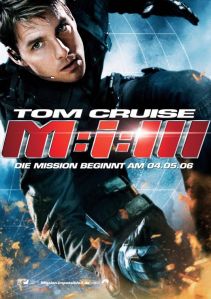 Few celebrities have had the intense flame-out Tom Cruise has experienced in a little over a year’s time. First there was the PDA-heavy relationship with Katie Holmes, never a wet tongue-kiss away from a camera. Then there was the couch aerobics on Oprah Winfrey’s set, bleating his over-the-top declarations of love like Roger Rabbit. This was followed by a series of testy interviews about his war of words on psychiatry and prescription drugs. Entertainment Weekly just ran a cover story asking, “Is Tom Cruise worth his paycheck?” He’s gone from Hollywood’s most bankable actor to a national punch line. To bring new life to Cruise’s spy series, he tapped TV mastermind J.J. Abrams to make his feature debut after Cruise churned through two seasons of spy series Alias DVDs. Abrams is a gifted franchise starter, first with Alias and then with Lost, and with Mission: Impossible III he does the best he can to erase the memory of Tom Cruise, daredevil of furniture.
Ethan Hunt (Cruise) is out of field work at the Impossible Mission Force, training recruits for the big time. He’s settled into a comfortable home life with Julia (Michelle Monaghan), a woman he’s blissfully engaged to be wed. Ethan’s happy home is disrupted when IMF needs his services. It seems one of his trainees (Keri Russell, Felicity goes badass) has been captured by an arms middleman Owen Davian (Phillip Seymour Hoffman), a man that will get any deadly force to the right bidder. Hunt reluctantly goes back into the field, assembling a team that includes Luther (Ving Rhames), Zhen (Maggie Q, quite fetching), and pilot Declan (Jonathan Rhys Meyers). Their mission goes badly and Hunt is reprimanded for his cavalier actions. He’s determined to snag Owen and get justice. This leads to an incredibly stuffed game of cat-and-mouse, each jockeying for leverage. There’s some super powerful device called the “rabbit’s foot” that everyone wants but it’s not really important. What is important is that Owen is eager to strike back at Ethan’s most vulnerable point — harming Julia.
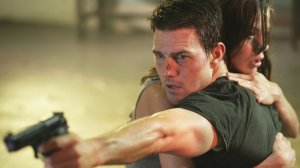 This movie is quite possibly one of the greatest TV adaptations of all time. No, not the Mission: Impossible series but Alias. Just like J.J. Abrams’ TV brainchild, this slick, propulsive caper puts a smart spin on familiar ground. We’ve got the flash-forward narrative trickery, the super gadgets, the undercover teamwork, the world-trotting sprawling vistas, and anchoring the whole thing with an emotional counterpoint, trying to lead a double, “normal” life and keeping your loved ones equally safe and in the dark. There’s a great scene in the middle of a mission where Ethan and Luther casually discuss the impossibilities of living a normal life given what they do. Luther warns that those close to you will only end up getting hurt, and by this point thanks to a startling, right-to-the-point opener with a gun to sweet Julia’s head, we know he’s right. That’s what makes the third go-round different: Abrams has injected some emotion into the darn thing. Ethan is pressed back into service and then becomes something of a knight in shining Kevlar, trying to save his beloved in the crossfire of international espionage. There are a handful of scenes between Cruise and Monaghan and they sell the emotional drama in tender quiet looks. As a result, the audience and Ethan are rooted to their seats beyond just the assembly line of pyrotechnics. Just like Alias (at least up until Season 3 when it jumped the shark with the long-lost sister). It’s like if True Lies was played straight and Tom Arnold was mercifully forgotten.
Ah, but what pyrotechnics they are. Things get heated with a trip to the Vatican and they literally do not let up, all the while raising the stakes by pulling Ethan’s home life closer to the danger of his job. You’ll be left breathless absorbing all the exhilarating action sequences, which to my best estimate are more than the first two flicks combined. The stunts are superbly death-defying. What makes action sequences so enjoyable, pay attention you Hollywood rubes, is when the stage is set and then we watch organic complications. Abrams has a tremendous feel for action and playfully extends virtuoso sequences of awesome carnage. An attack on a bridge is simply outstanding and gave me an overload of geeky joy. We’re given the tight, controlled setting, and then Abrams introduces the outside conflict and keeps developing it masterfully step by step. There’s air attacks, there’s running back and forth amongst the wreckage, there’s searching for guns while escaping attack, and then there’s flying leaps over gaping concrete holes. I was jumping in my seat with boyish glee. The slow-mo gun toss between Cruise and Russell? Awesome. The swing-shot jump off a gigantic skyscraper in Shanghai? Awesome. The use of Simon Pegg (Shaun of the Dead) as gadget guru? Awesome. Mission: Impossible III is, if nothing else, an incredible adrenaline rush orchestrated by a man with a finger directly on the pulse of his audience. By summer popcorn standards, Mission: Impossible III is everything you could hope for. Sure it’s highly implausible but it’s just so damn fun.
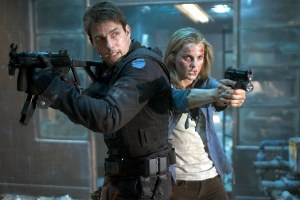 Abrams has created quite a breakthrough for himself. Long regarded as a TV visionary for his tangled, engrossing pop-pulp like Alias and Lost, Abrams shows what he can do with a bazillion dollars and one of the world’s most recognized stars. Abrams intelligent, deft handling of his material, elevating tired genre devices with flash and reverence, reminds me of a young Steven Spielberg. This is a man that respects his material and respects his audience, but still knows how to bring home an entertaining movie. I’ve followed Abrams’ career since getting hooked on Alias in 2001, and I’m confident he will become the best friend a movie geek could ever have (Star Trek fans should be clicking their heels about Abrams’ rumored involvement). Even though Mission: Impossible III is Abrams’ film debut (and on record the most expensive ever for a first time film director) he already shows more command, more wit, and more hipness than most of Hollywood’s graying old guard.
Finally, this is the first Mission: Impossible film to utilize the team aspect of the TV show. Granted, Cruise still does most of the running, jumping, climbing trees, but thankfully this movie is more than the Tom Cruise Kicks Everyone in the Face Show a.k.a Mission: Impossible II. The supporting cast all have their one great moment and part of the fun is their interaction, seeing the pieces fit into place. Just like last summer’s Batman Begins I would like to see another movie immediately with everyone involved. Make it happen. This is the Mission: Impossible world I want to explore in greater detail.
Mission: Impossible III is not bulletproof. The movie seriously needed more time for its villain. Hoffman does a great job of bringing his bad man to grumpy life. He goes about business with a detached nonchalance, like a plumber fixing his 10,000th clog. It may sound silly but it works because Hoffman gives his character a lizardy, unscrupulous sense of ethics. He really will put a bullet between the eyes of anyone, possibly while reheating some food in his microwave. That’s the greatness of Hoffman’s villain, how ordinary he sees his line of work and what it calls him to do. Now, with such a terrific villain it would behoove Mission: Impossible III to give him plenty of screen time. Sadly, Hoffman has about three real scenes, and his end is anticlimactic and so is the film as a whole. And what does IMF have to do to curb moles? There’s been one in all three Mission: Impossible movies. Maybe they should offer better vacation plans.
Tom Cruise may have done a lot to wear out his welcome with the public but he knows to surround himself with good people. The decision to let J.J. Abrams helm Mission: Impossible III has finally given this franchise vision and sustained excitement. This movie is far more emotionally based than any other in the series and there’s a genuine emotional reason for all the fireworks this time. The team aspect is finally addressed and Hoffman makes a truly lecherous, scary villain. But the bread and butter of this flick are its breathless action sequences, brilliantly choreographed by Abrams, a name destined for even greater things. Abrams knows how to spin genre clichés into clever, loose, twisty, funny, thrilling, emotionally centered gold. I don’t care if Cruise abused a couch and the public’s good will; Mission: Impossible III is an extravagant popcorn movie and a great way to start the summer. If only they were all like this.
Nate’s Grade: B+
Share this:

Kiss Kiss, Bang Bang (2005)
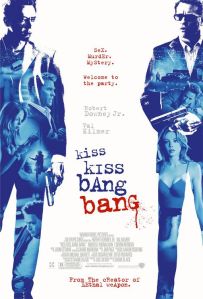 Shane Black was a Hollywood icon by the time he was in his early 20s. In 1987 he sold a script called Lethal Weapon to producer Joel Silver that put a jolt back into action flicks and gave the template for all buddy-cop comedies to come. He earned a then-record $1.7 million for his script, The Last Boy Scout, topped later by the $2 million paycheck he got for The Long Kiss Goodnight. It’s a shame both scripts were marginalized by their film directors. Black went underground for a long time, nursing his wounds over what had happened to his screenplays. Then in 2004, Black began his comeback vehicle, a modern day detective story that also lampooned Hollywood, and this time he’d direct his own material. The final product is called Kiss Kiss, Bang Bang, and Black’s comeback film is nothing short of a cinematic knockout and the most refreshingly entertaining movie of all 2005.
Harry Lockhart (Robert Downey Jr.) is a small-time crook on the run from the cops when he stumbles into an acting audition. They hand him a script, tell him his partner’s dead, and are so impressed with his “acting” that he’s immediately flown to Hollywood. Harry is teamed up with Gay Perry (Val Kilmer), a cop who does advisory work and just happens to be gay. During a house party, Harry reunites with a childhood friend, Harmony Faith Lane (Michelle Monaghan). They reminisce about their childhoods in Indiana and their fascination with the Johnny Gossamer detective novels, but she has much more on her mind: her sister’s gone missing and she needs Harry to find her. Trouble is Harry hasn’t told her he’s not a real detective. He’s gone from crook to pretend actor to pretend detective, and before Christmas is over he’ll be up to his neck in bodies, intrigue, double-crosses and all the stuff that would make for a rip-roaring Johnny Gossamer book.
 First and foremost, Kiss Kiss, Bang Bang is one deliriously fun party. The film moves at breakneck speed through its smart, cheeky gags. Black’s dialogue is hilarious and feels so effortlessly natural coming from Downey Jr. and Kilmer, like he’s got their speech patterns tattooed in his brain. In fact, the dialogue feels so robust and natural, never glib and self-conscious, that it almost comes across as feeling like a heavy improv session between two immensely talented actors. Kiss Kiss, Bang Bang, Black’s opus to the hard-boiled detective genre, has more twists and turns than a seizure patient doing the Hokey Pokey. You never know where this movie will head next or what joke will topple you over with unexpected laughter, and that’s what makes Kiss Kiss, Bang Bang so unabashedly thrilling to watch. Even when the movie does start to veer into more conventional material, Downey Jr. is there as our narrator to point out what we’re all thinking and to make fun of the expected. Kiss Kiss, Bang Bang can get jubilantly perverse at parts (a corpse getting a golden shower), but the macabre touches never deflect from the film’s boundless, inconsumable energy. Everyone is having the time of their lives in Black’s comic caper, and it shows.
Seriously, this movie is the definition of a laugh riot. It’s like a carnival ride through a gag factory (that sounds kind of spooky, actually), and Black has such an assured confidence to his writing, evidenced in his set-ups, reversals, and the insightful tweaking of Hollywood that could only come from one of its own (Harry laments that the nation turned over and shook and all the normal girls hung on while the crazies landed in L.A.). Here’s a conversation between Harmony and Harry about a promiscuous actress:
Harmony: Well, for starters, she’s been f***ed more times than she’s had a hot meal.
Harry: Yeah, I heard about that. It was neck-and-neck and then she skipped lunch.
Just re-reading it makes me laugh. How many comedies make you laugh just thinking about them in retrospect? Kiss Kiss, Bang Bang is one of those oh so rare delights. It even has a talking bear in it!
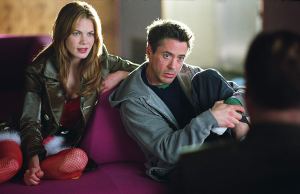 The lone detraction for Kiss Kiss, Bang Bang is the movie’s overall lack of substance. It doesn’t reach for anything more than bold entertainment, and to that end it succeeds in spades. Some may argue the movie is spinning so fast to try and distract you from its empty center, but I say enjoy the ride while it lasts. I only wish this movie was longer, like Lord of the Rings-long. I did not want to leave this world and these characters. My claw marks might still be visible on the armrests where they had to throw me out.
Black also proves to be a very slick director with a natural eye for camera placement. His photography is very pleasing, relying on different light placements to add surreal touches that accentuate the narrative. Black keeps his movie at a breathless pace and knows how to handle his actors. His narrative side-steps enliven the film and grab our attention, and Harry’s voice over is never overused to explain the minutia the script cannot. The only drawback for Black might be that his film could be too smart for its own good. I mean, most of the movie going public will be stooped by a joke about adverbs. Black has an obvious love for detective yarns and film noir, that’s evident with the film’s style and the fact that chapter titles are Raymond Chandler novels, but some familiarity with this world will sharpen your experience. Kiss Kiss, Bang Bang never panders to its audience, and that may hurt Black as far as making a movie that will reach out to Middle America (Perry apologizes to the Midwest for using the “f-bomb” as often as they do).
The chemistry between Downey Jr. and Kilmer is incredible, positioning them as one of the finest comic pairings in recent cinema history. Their indelible camaraderie is the true heart of Kiss Kiss, Bang Bang. They bat insults and injuries with comic aplomb. Both characters are unapologetic, Harry as a nattering criminal screw-up way in over his head, and Perry as gay man who’s fine with that and will rip your testicles off just the same if you cross him. He’s not stereotypical swishy or flamboyant, but he’s very enjoyably dry and sarcastic. Both actors have a history of being troublesome to work with, but Downey Jr. and Kilmer have been two of our most amazingly talented actors … when they want to be. Kilmer is the coolest customer in the film, being nonchalantly badass even when he’s about to blow his top (this is NOT a gay joke, by the way). Downey Jr. is his usual charming, amiable, fast-talking self, but even his tiniest details speak comedic volumes, like his reactions and general awkward physicality. I cannot imagine anyone else doing as excellent a job in these roles, especially Harrison Ford who was sought by producers for the Gay Perry part (feel free to shudder at what might have been Hollywood Homicide 2.
 Monaghan is a break-out actress that could have been even more break-out-er by this time. She’s mostly had small unmemorable roles in films like Unfaithful and The Bourne Supremacy, but 2005 was set to be her year. She had roles in Constantine, Mr. and Mrs. Smith, and Syriana. Unfortunately, her scenes were cut from Syriana and Constantine, and her role was drastically pared down in Mr. and Mrs. Smith. The only thing Monaghan has to show for 2005 is Kiss Kiss, Bang Bang, and that’s all she’ll need. She’s bright and pretty, but she also gives Harmony a great sense of being run down, another girl getting off the bus to Hollywood with stars in her eyes only to find out the harsh reality. Her combative relationship with Harry as they reconnect and try and wonder how they went astray is another film high point. She’s a comedic asset and should be on Hollywood’s speed dial if they need a charming, funny, capable actress.
Kiss Kiss, Bang Bang is a wicked good time. It’s complex, twisting, riveting, unique, hilarious, and just about every synonym you can think for the word “awesome.” Black’s comeback may be too smart for its own good, and having a general understanding of film noir will enhance your experience, but this is one comic caper that’s so much fun, so stylish, so damned entertaining, who cares if it lacks substance? Kiss Kiss, Bang Bang is a refreshing blast of fresh air and should please anyone looking for a smart Hollywood film mixed with doses of their familiar sex and violence. But that’s what makes Kiss Kiss, Bang Bang so exhilarating, nothing about it could be classified as familiar. Seeing this flick is like being invited to the party of the year. Just make sure to head to your theater before your invitation gets lost in the mail.
Nate’s Grade: A


 nathanzoebl
You must be logged in to post a comment.