Blog Archives
Saturday Night (2024)/ September 5 (2024)
Recently two ensemble dramas were thought to have awards potential that never materialized, and I think I might know at least one reason why: they are both undone by decisions of scope to focus on either a single day or a 90-minute period to encapsulate their drama.
 With Saturday Night, we follow show creator Loren Michaels (Gabriel LaBelle) the night before the premiere episode of the iconic sketch TV series, Saturday Night Live. The story is told in relative real time covering the last 90 minutes before its initial 11:30 PM EST debut in 1975. We watch Michaels try and deal with squabbling cast members, striking union members, failing technology, his ex-wife (Rachel Sennot) who also happens to be a primary producer of the show, muppets, and studio bosses that are doubtful whether this project will ever make it to air. I understand in essence why the real-time setting is here to provide more pressure and urgency as Michaels is literally running out of time. The problem is that we know the show will be a success, so inventing doubtful older TV execs to add extra antagonists feels like maybe the framing by itself was lacking. Think about Air but you added a fictional exec whose only purpose was to say, “I don’t think this Michael Jordan guy will ever succeed.” There are interesting conflicts and subplots, especially with the different groups that Michaels has to manage, but when it’s all stuffed in such a tight time frame, rather than making the movie feel more chaotic and anxious, it makes those problems and subplots feel underdeveloped or arbitrary. I would relish a behind-the-scenes movie about SNL history but the best version of that would be season 11, the “lost season,” when Michaels came back to save the show and there were legitimate discussions over whether to cancel the show. Admittedly, we would already know the show survives, but does the public know what happened to people like Terry Sweeney and Danitra Vance? Does the public know what kind of sacrifices Michaels had to make? That’s the SNL movie we deserve. Alas, Saturday Night is an amiable movie with fun actors playing famous faces, but even the cast conflicts have to be consolidated to the confined time frame. This is a clear-cut example where the setting sabotages much of what this SNL movie could have offered for its fans.
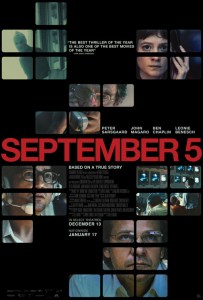 With September 5, we remain almost entirely in the control room of ABC Sports as they cover the fateful 1972 Munich Olympics after the Israeli athletes are taken hostage by terrorists. It’s a subject covered in plenty of other movies, including Steven Spielberg’s Munich and the 1999 Oscar-winning documentary One Day in September, but now we’re watching it from the perspective of the journalists thrust into the spotlight to try and cover an important and tragic incident as it plays out by the hour. It’s an interesting perspective and gives voice to several thorny ethical issues, like when the news team is live broadcasting an oncoming police assault, which the terrorists can watch and prepare for as well. The movie is filmed in a suitable docu-drama style and the pacing is as swift as the editing, and that’s ultimately what holds me back from celebrating the movie more. It’s an interesting anecdote about media history, but September 5 fails to feel like a truly insightful addition to the history and understanding of this tragedy. It’s so focused on the people in the studio and restrained to this one day that it doesn’t allow for us to really dwell or develop in the consequences of this day as well as the consequences of their choices on this fateful day. The movie feels like a dramatization of a select batch of interviews from a larger, more informative documentary on the same subject. It’s well-acted and generally well-written, though I challenge people to recall any significant detail of characters besides things like “German translator” and “Jewish guy.” It’s a worthy story but one that made me wish I could get a fuller picture of its impact and meaning. Instead, we get a procedural about a ragtag group of sports journalists thrust into a global political spotlight. There’s just larger things at stake, including the inherent drama of the lives at risk, than if they’ll get the shot.
Nate’s Grades:
Saturday Night: C+
September 5: B
Share this:

The Substance (2024)
 In 2017, French filmmaker Coralie Fargeat released her debut movie, Revenge, her daring spin on the rape-revenge thriller. It was an immediate notice that this filmmaker could take any genre and spin it on its head, providing feminist influences on some of the most grisly and male-dominated exploitation cinema. Even more so, she makes whatever genre her own and on her own terms. The same can be said for The Substance, a movie that utilizes sensationalism to sensational effect. It’s a movie that is far more than the sum of its Frankenstein-esque body horror parts.
Elisabeth (Demi Moore) is a television fitness instructor who has been massively popular for decades. Upon her 50th birthday, she’s promptly dismissed from her job by her studio, concerned over her diminished appeal as a sex symbol. She gets word of a mysterious elixir that can help her reverse the ravages of aging. It arrives via a clandestine P.O. box in a container with syringes and very specific instructions. She needs to spend seven days as her younger self, and seven days as her present self. She needs to “feed” her non-primary self. She also needs to understand that she is still the same person and not to get confused. Elisabeth injects herself with the serum and, through great physical duress, “Sue” emerges from her back like a butterfly sprouting from a fleshy cocoon. As Sue (Margaret Qualley), she’s now able to bask in the fame and attention that had been drifting away. Sue becomes the next hot fitness instructor and everything the studio wants. Except she’s enjoying being Sue so much that going back to her Elisabeth self feels like a punishment. Sue/Elisabeth starts to cheat the very specific rules of substance-dom, and some very horrifying results will transpire as she becomes increasingly desperate to hold onto what she has gained.
 Let me start off this review looking at the substance of The Substance, particularly the criticism that there is little below its surface-level charms. First off, let me defend surface-level charms when it comes to movies. It’s a visual medium, and sometimes the surface can be plenty when we’re dealing with artists at the top of their game. Being transported and entertained can be enough from a movie. Not every film needs to force you to re-evaluate the human condition. It’s perfectly acceptable for films to just be diversionary appeals to the senses. With that being said, the simplicity of the movie’s story and themes works to its benefit. The plotting is very clear, setting aside the rules, and then we watch the spiraling consequences when Elisabeth, and then Sue, decide to go against the rules and pay dearly. The ease of the storytelling is so precise with its cause-effect escalation, so that even when things are getting crazy, we know why. The commentary on aging in Hollywood isn’t new or subtle; yes, the industry treats young women like products to be exploited for mass consumption until they get older and are seen as less desirable. Yes, the pressure to fight the irreversible pull of aging can lead to increasingly desperate actions. Yes, being forced to cede the spotlight to someone you feel inferior can be humiliating. It’s nothing new, but it presents an effective foundation for what becomes a highly engaging, garishly repellent, and jubilantly visceral body horror deconstruction into madness. Rarely do we get an opportunity to say a movie must be seen to be believed, and The Substance is that latest must-see spectacle.
I found the exploration of identity between Sue and Elisabeth to be really interesting, as we’re told repeatedly in the instructions that the two are the same person, and yet the two versions view the other with increasing resentment and hostility. For all intents and purposes, it’s the same woman trying on different outfits of herself, but that doesn’t stop the dissociation. In short order, the two versions view one another as rivals fighting over a shared resource/home. Sue becomes the preferred version and thus the “good times” where she can feel at her best. The older Elisabeth persona then becomes the unwanted half, and the weeks spent outside the coveted persona are akin to a depression. She keeps to herself, gorges on junk food, and anxiously counts the prolonged hours until she can finally transform into Sue. Again, this is the same character, but when she’s wearing the younger woman’s body, it can’t help but trick her into feeling like a different person. This division builds a fascinating antagonism ultimately against herself. She’s literally fighting with herself over her own body, and that sounds like pertinent social commentary to me.
 While The Substance might not have much to say about aging and Hollywood that hasn’t been said before, where the movie separates itself from the pack is through the power of its voice. This is a movie that announces itself at every turn; it is a loud, emphatic personality that can take your breath away one moment and leave you riotously laughing the next. The vision and filmmaking voice of this movie is unmistakable, and while we’re covering familiar thematic ground on its many subjects, the director is assuring us, “Yes, but you haven’t seen my version,” and after a few minutes, I wanted to see wherever Fargeat wanted to take me. I loved the very opening sequence that catalogues our star’s career through a time lapse shot of her Hollywood Walk of Fame star. We see the public unveiling, arguably the height of her stardom, and then progress further, from tourists taking their picture with the star, to people ignoring it, a passing dog peeing over it, and a homeless shopping cart wheeling over it. In one shot, Fargeat has already efficiently told our character’s rise and fall through imaginative and accessible visuals. There are other elements like this throughout that kept me glued to the screen, eager to see the director’s take on the material.
This is a first-rate body horror parable with wonderfully surreal touches throughout. The creation of Sue, being born from ripping from Elisabeth’s back, is an evocative and shocking image, as is the garish stapling of Elisabeth’s back/entry wound (why it makes for the poster’s key image). It’s reminiscent of a snake slithering out of its old skin, but to also have to take care of that old skin, knowing you have to metaphorically slide it back on, is another matter entirely. The literal dead weight is a reminder of the toll of this process but it’s also like they’ve been given a dependant. The spinal fluid injections are another squirm factor. I loved the way the Kubrickian production design heightens the unreality of the world. I won’t spoil where exactly the movie goes, but know that very bad things will happen beyond your wildest predictions. The finale is a tremendously bonkers climax that fulfills the gonzo, blood-soaked madness of the movie. If you’re a fan of inspired and disturbing body horror, The Substance cannot be missed.
Demi Moore is a fascinating selection for our lead. While it might have been inspired to have Qualley (Maid, Kinds of Kindness) play the younger version of her mother, Andie McDowell (Groundhog Day), it’s meaningful to have Moore as our aging figure of beauty standards. Here is an actress who has often been defined by her body, from the record payday she got for agreeing to bare it all in 1996’s Striptease, to the iconic Vanity Fair magazine cover of her nude and pregnant, to the roles where men are fighting over her body (Indecent Proposal), she’s using her body to tempt (Disclosure), or she’s using her body to push boundaries (G.I. Jane). It’s also meaningful that Moore has been out of the limelight for some time, mimicking the predicament for Elisabeth. Because of her personal history, the character has more meaning projected onto her, and Moore’s performance is that much richer. It reminded me of Nicolas Cage’s performance in Pig, a statement about an artist’s career that has much more resonance because of the years they can parlay into the lived-in role. Moore is fantastic here as our human face to the pressures and psychological torment of aging. She has less and less to hold onto, and in the later stretches of the movie, while Moore is buried under mountains of mutation makeup, she still manages to show the scared person underneath.
 Qualley has more screen time in the second half of the movie and has the challenge of playing a very specific kind of character. Sue is the idealized form for Elisabeth which makes her character even more exaggerated and surreal. She’s a figure of pure id, strutting her stuff because she can, luxuriating in the sense of power she has because of the desire that she produces. Qualley goes full hyper-sexualized cartoon for the beginning part of the role, where she’s the coveted version riding high. It’s the second half, where things begin to slip away, that Qualley shines the most as the cracks begin to take hold in this carefully arranged persona of confidence.
Much needs to be said about the hyperbolic sexualization of its characters, particularly Sue as the new young fitness star. Obviously our director is intending to satirize the default male gaze of the industry, as her camera lingers over tawny body parts and close-ups of curves, crevices, and crotches. However, the sexual satire is so ridiculously exploitative that it passes over from being too much and back to the sheer overkill being the point. This is not a movie of subtlety and instead one of intensity to the point that most would turn back and say, “That’s enough now.” For a movie about the perils and pleasures of the flesh, it makes sense for the photography to be as amplified in its rampant sensuality. There are segments where every camera angle feels like a thirsty glamour shot to arouse or arrest, but again this is done for a reason, to showcase Elisabeth/Sue as the world values them. The over-the-top male gaze the movie applies can be overpowering and exhausting, but I think that’s exactly Fargeat’s point: it’s reductive, insulting, and just exhausting to exclusively view women on these narrow terms. This isn’t quite our world, as the number one show on TV is an aerobics instructor, but it’s still close enough. I can understand the tone being too much for many viewers, but if you can push through, you might see things the way Fargeat does, and every lingering and exaggerated beauty shot might make you chuckle. It’s body horror on all fronts, showing the grotesquery not just in how bodies degrade but how we degrade others’ bodies.
On a personal note, while I’ll be back-dating this review, I wrote portions of it while sitting at my father’s bedside during his last days of life. He’s the person that instilled in me the love of movies, and I learned from him the shared language of cinematic storytelling, and one of my regrets is that I didn’t go see more movies with my father while we could. I really wish he could have seen The Substance because he was always hungry for new experiences, to be wowed by something he felt like he hadn’t quite seen before, to be transported to another world. He was also a fan of dark humor, ridiculous plot twists, and over-the-top violence, and I can hear his guffawing in my head now, thinking about him watching The Substance in sustained rapturous entertainment. It’s a movie that evokes strong feelings, chief among them a compulsive need to continue watching. It’s more than a body horror movie but it’s also an excellent body horror movie. Fargeat has established herself, in two movies, as an exciting filmmaker choosing to work within genre storytelling, reusing the tools of others to claim as her own with a proto-feminist spin and an absurdist grin. The Substance is the kind of filmgoing experience so many of us crave: vivid and unforgettable. And, for my money, the grossest image in the whole movie is Dennis Quaid slurping down shrimp.
Nate’s Grade: A
Share this:

American Fiction (2023)
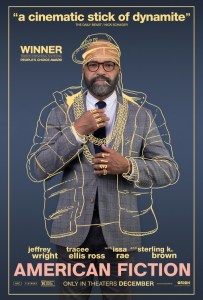
Cord Jefferson’s hilarious, inflammatory, and insightful comic fable can be boiled down to the question of what exactly does it mean to be a “black writer” in this day and age? According to the main character, English professor and middling writer Thelonious “Monk” Ellison (Jeffrey Wright), he would pointedly argue that he is a black writer and thus his novels, never ones to climb a best-seller chart, should qualify as black literature. The publishing industry seems to think differently. Their conception of a “Black story” is one defined through poverty, guns, drugs, gang violence, degradation, and all sorts of depressing stereotypes of socioeconomic disadvantage. If there are stories of triumph, they will usually be relegated to the same familiar settings of struggle: slavery, the Civil Rights era, and modern ghettos. A simple slice-of-life about a middle-class family isn’t necessarily seen with the same level of acceptance. With American Fiction, Jefferson and Monk push through, trying to exploit a system of exploitation at its own game, and the results are biting and hilarious and a condemnation of the low expectations that can govern the supposedly open-minded values of others when it comes to celebrating authentic minority stories.

The movie really takes off once Monk decides to, as a sarcastic lark, give the publishing world what it seems to crave, a novel (My Pafology) that plays into every urban stereotype. He adopts a nome de plume, “Stagg R. Leigh,” and riffs that he’s currently a fugitive from the law. The intention was to make fun of the limited black literary stories that he despises, and yet the incendiary manuscript becomes a hot commodity. They’re already talking about turning it into a movie. Monk is aghast but the money is very appealing, so he puts his moral superiority aside to see how far he’s willing to pander if the check is right. His alter ego is deemed more authentic and compelling when he doesn’t even exist and is only a combination of the same worn-out and destructive stereotypes. It becomes an ongoing game for Monk to see where exactly a line can be drawn. He actively tries to make his manuscript objectively worse, and at every step it only seems to have the opposite reaction among white editors and agents and producers salivating to celebrate it. There’s a very telling scene where Monk is part of a literary award body scouring through manuscripts for potential worthy award-winners. He and another prominent black author (Issa Rae), the best-selling author of We’s Lives in Da Ghetto, are critical of My Pafology and its adherence to harmful stereotypes, but the white liberals won’t hear it and want to reward it. “It’s really important that we listen and uplift black voices,” one of them says obliviously. Of course, if they knew the truth that the author was really an upper middle-class East Coast academic, there wouldn’t be the same rush to elevate this “brave and inspiring” story of the streets. To Monk’s ire and chagrin, there is no bottom when it comes to the appetite for degrading stories that neatly fit into a pre-existing mold.
Jefferson’s screenplay, based upon the 2001 novel Erasure by Percival Everett, is bristling with biting intelligence. This extends beyond the identity crisis of Monk in the world of publishing to his personal life, and the time spent with his fractured family is just as illuminating as the time spent in publishing. Monk’s need for money is driven less from his own desire to live large and more about caring for his ailing mother who needs to be placed in a costly assisted living home as she plunges further into dementia. His shared moments with his mother can be heartbreaking as well as informative. His relationship with his brother, Clifford (Sterling K. Brown), who is embracing his black sheep status as a now openly gay middle-aged man, is a regular point of reflection for both characters who feel their identities are in free fall. Their conversations about being accepted as you fully are help reinforce the major themes mirrored through Monk’s publishing odyssey with his alter ego. The Hollywood satire is best encapsulated by Adam Brody’s shallow movie producer, a good white liberal who is sold on the project after he perceives that Monk leaves their meeting after hearing police sirens. His every appearance is a gift. Not everything in Jefferson’s adaptation feels as exceptionally well integrated. I don’t think the romantic subplot quite works but Jefferson is smart enough to frame that as possibly the larger point, an offshoot that presents an alternative of happiness for our bitter protagonist that he will inevitably decline.

This is also a deserving showcase for Wright (Westworld, The Batman), one of our best character actors who rarely gets the plaudits he deserves. He’s a brilliant actor when it comes to consternation and exasperation, and his unexpected journey of discovery and success allows him to assess how much he’s willing to go along with a deceptive narrative in a ludicrous industry of perception. Wright’s performance is equal parts amusement, like a conman who can’t believe he keeps getting away with his ruse, and head-shaking anger at being marginalized unless he erases the complicated, unique parts of himself.
I also want to celebrate the very ending of American Fiction that goes even harder on industry satire. Jefferson gets extra meta and presents a series of possible endings for Monk’s story, from Monk’s preferred ending that leans more ambiguous and open-ended, to the Hollywood happy ending and other versions, each their own condemnation on the studio system and the larger demands of mass audiences for tidy endings. It’s a level of comic bravado that American Fiction hasn’t really fully channeled until that moment and its absence makes this conclusion, a choose your own adventure of bad endings, hit even harder. He’s been saving his full satirical might until the very end and it was worth it.
Who exactly gets to qualify what constitutes the black experience? Certainly not I, a 41-year-old white guy writing on the Internet. Even though the source material is over twenty years old, the struggles of identity and acceptance and the lens of which we subject others’ experiences through are still relevant in an increasingly hostile cultural environment for different attempts at diversity. American Fiction is hilarious and smart and produces as many thought-provoking questions as solid belly laughs. It’s a cutting satire but with characters that are compelling beyond their connection to larger satirical points. This is more than a message movie, and it’s a statement debut film for Jefferson as a filmmaker and primarily as a storyteller. Jefferson began as a journalist and has worked on several critically-acclaimed TV shows, winning an Emmy for an extraordinary episode of HBO’s Watchmen. He is a talent, and American Fiction is proof that he has a voice and the confidence to carry it through into one of the best films of 2023.
Nate’s Grade: A-
Share this:

Not Okay (2022)
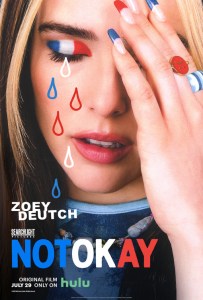 I don’t really know what writer/director Quinn Shepherd (Blame) was trying to say with Not Okay. It’s supposedly a jet black comedy about social media celebrity and FOMO, and the lead character Danni Sanders (Zoey Deutch) is definitely a callous hanger-on wanting to taste fame by gloming onto real-life tragedy, but the tonal inconsistency hamstrings the cohesion of the message and the overall entertainment value. The film begins well, establishing Danni as selfish and clueless, with some sharp lines like her feeling she missed out on a big millennial formative experience of 9/11 and asking, “Can tone deaf be a brand?’ She fakes being in Paris to impress a douchey vaping influencer (Dylan O’Brien) and during this time terrorists bomb the French capital. Sensing an opportunity, Danni pretends to be a victim and she is given a voice, a platform, and sympathy from strangers. Halfway through, however, the movie transitions into something more earnest by introducing a real survivor of trauma, Rowan (Mia Isaac), a school shooting survivor who advocates for political reforms. Until this character, everyone is the movie has been a stereotype, pastiche, or easy send-up, and now the movie wants us to take it seriously, and the satire just atrophies. You can either go one of two ways with a concept like this: satirize some aspect of our shallow society in go-for-broke style like World’s Greatest Dad, or turn it into a personal thriller of how far will she go to maintain the lie and will she be caught like Shattered Glass. Not Okay tries to do both and in doing so the accrued tonal dissonance causes both approaches to suffer. I don’t care whether she’ll get caught because she’s not interesting as a person because she’s made to be an avatar of attention-seeking validation, and also it’s easy to disprove her illusion. I am not laughing because the movie drops being a comedy for much of the second half and its satirical points are fairly broad and already been done in better movies. The problem is that Shepherd doesn’t own the unlikability of her protagonist. She wants her to learn a lesson and be affected by her harmful actions. The end has a blunt message about white saviors co-opting the voice and spotlight from genuine suffering of people of color, and in a smarter movie it would resonate more. However, with Not Okay, it’s just another example that all human suffering can be co-opted to make obvious insights appear more meaningful to the right audience.
Nate’s Grade: C+
Share this:

Don’t Look Up (2021)
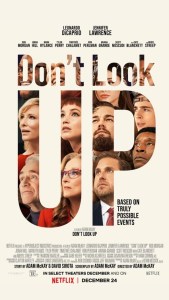 A scorched Earth satire that flirts with a literal scorched Earth, Don’t Look Up is writer/director Adam McKay’s star-studded condemnation of everything stupid and myopic in media, politics, and pop culture. Jennifer Lawrence plays a doctoral student who discovers a comet heading for direct cataclysmic impact with Earth, and she and her astronomy mentor (Leonardo DiCaprio) are trying to sound the alarm but nobody seems to be listening. Not the president (Meryl Streep) and her inept chief of staff/son (Jonah Hill). Not the greedy CEO (Mark Rylance) of a tech company. Not the media where morning TV co-hosts (Cate Blanchett, Tyler Perry) are more compelled by music star breakups than pressing science. It makes a person want to stand up and scream about priorities, and that’s McKay’s point, one that will be bludgeoned again and again. This movie is animated with seething rage about the state of the world and the cowardice about facing obvious problems head-on. It’s fit as a climate change allegory but COVID-19 or any scientific crisis could be applied as well. It’s about choosing ignorance and greed, about deferring to our worst instincts, and those in power who profit from inaction. I laughed at several points, some of it good cackling, and the movie is dark to its bitter end. This is the bleakest movie of McKay’s foray into his more sober, activist movie-making (The Big Short, Vice). It’s less Seeking a Friend for the End of the World, exploring the foibles of humans reconciling their last moments of existence, and more Idiocracy, where there is a lone voice of reason and the rest of the population are aggravating morons that refuse to accept reality even if it literally means just looking up with their own eyes. In some ways, the dark laughter the movie inspires is cathartic after years of COVID denials and mask tirades and horse medicine. The satire is bracingly blunt but also one joke on repeat. If you’re the right audience, that one joke will be sufficient. I don’t think the movie quite achieves the poignancy it’s aiming for by the end of its 138 minutes, but the anger is veritably felt. Don’t Look Up wants us to save the world before it’s too late, though the people that need to see the movie the most will be the ones fastest to dismiss it. Still, congrats to McKay for making a movie this depressing and relevant for the holidays.
Nate’s Grade: B+
Share this:

He’s All That (2021)
 I’m sure there aren’t too many who consider 1999’s She’s All That a great film, or even a great high school comedy film, but I know there are fans and I know nobody was clamoring for a Netflix gender-swap remake starring one of Tik Tok’s most famous users. We didn’t need the original but it was a mildly amusing version of My Fair Lady, or its older inspiration Pygmalion, set in the superficial class system of an American education system. It came out during the heyday of 90s teen cinema remaking older literary concepts (Ten Things I Hate About You) and made short-lived careers for stars Freddie Prinze Jr. and Rachel Leigh Cook. My amazement is Netflix rehiring the same writer, R. Lee Fleming Jr., now 50-something, and asking him to remake his twenty-year-old hit for the voice of Generation Z (It’s not even like “all that” has held up in slang parlance). This movie feels every bit the dismal corporate-sponsored, cash-grabbing, star vehicle that it is. Nobody in Generation Z cared about She’s All That, and now very few will really care about He’s All That.
This time we follow Padgett Sawyer played by Tik Tok star Addison Rae (83 million followers in real life!). Padgett is a high school senior who has millions of online followers who hang onto her every word of advice. She uses her position as an influencer to even help pay the bills at home to relieve her overworked mom (Rachel Leigh Cook, not the same character) and maybe pay for her college. She live streams catching her boyfriend cheating, loses her cool, and becomes a meme thanks to an unfortunately timed snot bubble. Now she has to earn back those lost followers and her respect or else she might not still maintain her ascendant social media standing and pay for school. Her catty friend challenges her to makeover a loser guy at school and the hopeless case ends up being Cameron Kweller (Tanner Buchanan), a sarcastic, arty loner who wears a beanie and has long hair (a wig) and rides horses and practices karate. What a loser. She buddies up to Cameron and through that friendship she starts to question her own sense of self and learns what’s really important as she physically changes this guy to be more acceptable to a mainstream opinion of people she’ll never meet in real life. Or something like that.
 The inordinate influence of social media is a very worthwhile avenue to explore for modern satire as a means of separating this He’s All That from its predecessor and making it relevant. The problem with He’s All That is that the movie refuses to go very deep or hard-hitting with this topic because it’s also meant to be a vehicle for fame to launch the feature acting career of Rae. I’ll fully admit, dear reader, that I had no idea who Rae was until watching this movie and I don’t really get the appeal (more on her acting ability later). In this movie, Padgett is obsessed with maintaining her carefully curated online image, a ruse that relies upon a fantasy that no human being could adequately maintain. She wakes up and goes through an entire routine of makeup and hair styling before she records herself “just waking up.” It reminded me of a joke from the fabulous TV series The Marvelous Mrs. Maisel where the title character makes sure her husband never fully sees her in the morning how she actually looks. It was funny then because it commented on the pressure of wives in the 1950s, let alone those from Jewish families, to live up to an impossible beauty standard to appeal to the man’s comforts and desires. With He’s All That, it really becomes the last joke at the expense of our main character. The movie is too afraid to delve any deeper for fear of directing negative attention toward its star and her influencer ilk. It even conveniently sets up the good of her position, what with her able to pay some bills. She can’t be all bad, you’ll say, because she’s helping her mom. I guess we like social media facades now.
Padgett’s plight really doesn’t make much sense in the context of the movie. She’s dropped perhaps a fifth of her many followers after the embarrassment of her public breakup with her louche of a boyfriend, a wannabe recording artist. First off, I don’t know why this personal incident would be so detrimental to her character. Her boyfriend was clearly bad, she stood up for herself, and I would think that would only make people like her more and draw more followers to her brand. The only reason she has to worry is because we’ve awkwardly included Kourtney Kardashian and an even bigger social media influencer. I don’t know why we have a Kardashian here, and I don’t know why she doesn’t merely play herself, unless that too would be another example of striking too close to home with the satirical depictions. Regardless, Padgett is worried she’ll have to, gasp, potentially take out student loans for college. She believes that picking someone to grant a makeover would get back lost followers, which makes some sense, but then her friend also elects to make a personal bet about selecting some campus schlub and turning them into a heartthrob. Why does our main character need two motivating forces for why she agrees to participate in this bet? It’s needlessly extra for a movie with so little else going on.
 Another fault is that there is no chemistry between our leads, which kills the investment in any romantic comedy. The two actors are not a good fit from the beginning, and this comes down to two factors, the underwritten characterization and the limited acting ability of Rae. It was a joke in Not Another Teen Movie, a not-so-great spoof over those popular 90s/early 2000s teen comedies, that the thing separating the obviously beautiful girl from “plain Jane” territory was merely glasses and a ponytail. Cameron is already an appealing guy so when he gets his big physical transformation it’s really just scrubbing off stubble dust and removing the beanie. His character, a self-described outsider, would be unlikely to be seduced by the wiles of popularity. There’s also precious little to be uncovered with the character of Padgett, so the movie can’t even have Cameron fall for Padgett as he realizes she isn’t like his preconceived notions. There’s no heat or sizzle or any point of intrigue between these two that would compel an audience to root for their eventual coupling. Cameron, we’re told, like “Kurosawa, Kubrick, and kung-fu movies,” and he’s basically the gender reverse of a shallow rendition of a manic pixie dream girl who is ultimately just there to get the protagonist to stop and appreciate life and then sublimate their own interests and desires to that of the protagonist. This is a romance where you root for irrevocable heartbreak.
Rae might be an overall pleasant presence but she’s not quite there in the acting department yet. Her limited range really dampers many of the dramatic moments. Her line readings are extremely monotone. There are moments where I thought she was just going to smile her way through a scene. There were several scenes where I was convinced they could only have filmed two takes because this had to be the best one by default. I don’t want to pile on Rae. I don’t know the woman and she’s only twenty years old and this is only one role. Except He’s All That has also clearly been tailored for her and she cannot live up to these standards at this time. There’s an egregiously long dance battle at the prom that goes on forever just to take advantage of Rae’s dance skills from her Tik Tok dances. It’s the same kind of contortion done to make room for Buchanan’s (Cobra Kai) martial arts skills with a silly fight with Padgett’s ex-boyfriend.
 If I was overly cynical, I would estimate that the producers of He’s All That sought an older IP that might still have some pull with an older audience that could be stripped down to its parts and slapped together with a formula that could platform its young stars while also barely hitting that 80-minute feature running time requirement. Except that sounds exactly like what’s happened with He’s All That as well as the preponderance of product placement. This entire movie is a cynical enterprise. It’s not funny at all. It feels completely inauthentic with its portrayal of modern teenagers and social media lifestyles and even the appeal provided by a social media following of fans giving instant validation to every coordinated effort to be your phony best self. The director is Mark Waters, a man who helmed Mean Girls, the 2003 Freaky Friday, and the dark indie comedy The House of Yes. He has talent. He knows how to shoot a comedy. He knows that not every scene needs to be overly lit like night and shadow have no meaning and it all looks so cheap. While watching He’s All That, you’re left with the strong impression that everyone should know better, and you should know better than spending 80 tepid minutes of your time watching this cynical exercise.
Nate’s Grade: D
Share this:

Bombshell (2019)
 More an expose on toxic work environments than anything overtly political, Bombshell is an effective true-life drama about the many pitfalls, humiliations, traps, harassment, and compromises that women face in the workforce. We follow the downfall of news magnate Roger Ailes (John Lithgow), the imposing man who built the Fox News empire and who also bullied his employees and solicited sexual favors from the many women who were on his payroll. Margot Robbie plays an invented character meant to provide that entry point into Ailes the creep in creepy action. She’ll be harassed and pressured for sex by a man described as “Jabba the Hut,” and Robbie is terrific in her big dramatic moments portraying what the pressure and shame does for her ambitious anchor. The other two main characters wrestle with how far to go in a corporate culture of keeping secrets from very powerful, very dirty old men. Gretchen Carlson (Nicole Kidman) is consulting lawyers for a personal harassment lawsuit against Ailes the person, not Fox News, but she needs other women to come forward. Megyn Kelly (Charlize Theron) is struggling with the scrutiny she has endured after then-presidential candidate Donald Trump turns his small Twitter thumbs against her. The Fox bigwigs won’t go on record to defend her, and their journalists, because they need Trump to drive ratings. The movie uses several Big Short-style narrative tricks to help tell its sordid tale, including swapping narration and fourth-wall breaks; a run through of hearing from Ailes’ past victims in their own words is striking, especially a woman who says she was only 16 at the time. Part of the fun are the many many cameos and just watching actors portray different Fox News personalities (Richard Kind as Rudy Guiliani!). The makeup is also phenomenal and Theron looks unrecognizable as Kelly. The film itself doesn’t feel like it’s telling you anything you already don’t know about the subject; people will compromise their morals for personal gain, power leads to exploitation, women are unfairly treated, and it’s easier to fall in line than stand up to power. There’s still a thrill of watching the downfall of a serial abuser, and the acting is strong throughout, but Bombshell can’t shake the feeling of being a slicker, more star-studded TV movie version of recent history. Even with the urgency of the topic, it feels light, and not because of its use of incredulous humor. I could have used more behind-the-scenes details, and maybe that’s where Showtime’s miniseries The Loudest Voice comes in, retelling the same story with Russell Crowe as Ailes. It’s a solid movie on a very pertinent subject and worth seeing but it also makes me wish for a harder-hitting, more widely sourced expose on this very bad man who felt forever protected by the status quo of power.
Nate’s Grade: B
Share this:

Late Night (2019)
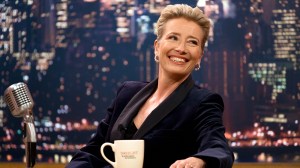
 Late Night follows the fictional long-running TV talk show host Katherine Newberry (Emma Thompson) who has been informed by her network exec that his current season will be her last season. She will be replaced and the show will be retooled. Along comes Molly (Mindy Kaling), an aspiring comedy writer who works in a chemical plant. She’s hired on the spot to serve as a token and offer more diversity in Newberry’s all white, all-male writers room. She has to find herself, find her voice, stand up for herself, and try to get the show to change with the times if it’s going to potentially survive the eager network axe.
For fans of the inner workings of show business, and the ups and downs and push and pull of creatives, Late Night was made for you. I’ve always been fascinated by the nuts-and-bolts of creative ventures in the entertainment industry and especially a writer’s room where people hash out ideas, build out a storyline, and generally bring our TV to life. I enjoyed the short-lived show where Jim Rash would interview different TV showrunners about their writer’s room processes and how they would resolve creative decisions. It’s one reason I loved HBO’s The Larry Sanders Show, a deeply satirical and self-deprecating look at the bowels of Hollywood. So if you’re like me and enjoy the inner workings of creative people working in tandem, then Late Night is already starting on fertile ground for you. Kaling’s world is informed by her years of television writers room experience, as well as running her own show, and that experience better informs the reality of Late Night, from the joke-writing process, to the wariness of content that may push away sponsors, to the means of staying relevant in a vastly changing landscape of how people get their media and entertainment. You feel Molly’s sense of triumph, and disappointment, when her first joke is placed into the monologue and then removed. The movie feels informed and real to its tiniest detail, which makes it all the more interesting.
 The film is consistently funny because Kaling is writing with such a sharp grasp of her characters. Right away the dynamic between Katherine, a cynic with an acid tongue, and Molly, an idealist but a novice who is pushing for reforms, establishes so much wonderful conflict and eventual resolution. It’s universally enjoyable watching a character come into her own, transform the lives of others for the better, and to have characters who butted heads form a mutual friendship and understanding. That’s all present, but with Kaling’s command of writing the characters come first. They drive the story, and while the destination is rather predictable with this sort of thing, that doesn’t make the journey any less satisfying. The character of Katherine Newberry is interesting because she’s a woman who has established her own perch in late night, but she’s still older, white, and from an elitist, privileged bubble. She’s stuck in the middle, which makes her such an interesting character to explore and push into new territory. Kaling has mined some talk show headlines for her story’s drama and it doesn’t feel cheap. Past mistakes are given weight and force characters to reckon with them in a way that acknowledges the extent of the ramifications and the people that have been hurt. Kaling also has a generous sense of writing for her supporting players, giving many a small moment to make an impression and enough for serviceable secondary character arcs.
There’s a definite message afoot with Late Night and it goes about it in a way that makes it far more accessible — as entertainment. Rather than dragging out a soapbox, the movie does the smarter ploy by demonstrating why a homogeneous writers room of the same kind of voice/perspective can be limiting and potentially regressive. Molly is the long-overdue change agent to the show, to the characters, and to the old ways of thinking of what television, and by extension the entertainment industry, had to be simply because it had always been that way. The film’s sense of advocacy for representation is strong and a central tenet, but this doesn’t get in the way of telling a good story with enjoyable characters. By demonstrating through its tale, Kaling has smartly packaged her movie as an empathy test designed to expand the perspectives of its audience, to get them to think how difficult it may be for a woman, let alone a woman of color, to find work in her chosen field. It’s the kind of movie you could take your grandparents to and have them nod along in approval.
Allow me to get a little personal here as I reflect on the topic of representation. I think recognizing one’s self and one’s stories is a huge deal. The power of empathy is potentially endless but that doesn’t mean that all stories need to be told from the familiar template of a straight white dude encountering conflict and change. With good storytelling, anybody can feel for anybody’s plight, but that doesn’t mean that those in the industry should stop trying to give voice to others who have historically been marginalized. TV, and particularly late night TV, is something of a boy’s club and needing more women. A recent analysis on late night TV concluded, with the exception of TBS’ Samantha Bee, that the typical late night talk show writing staff is only one quarter female. More people deserve more opportunities to shine because we, as a society, benefit when we have a plurality of stories from a plurality of voices and perspectives. It makes us all better.
 During the summer of 2018, I wrote a rom-com Web series (The Spirit Inside Me) that was told from the perspective of a bisexual woman and dealt with an eventual romance with another woman. You better believe I consulted with my queer friends to make sure every script didn’t feel like it had been written by a straight dude. Then we started to make it a real thing throughout the fall and winter of 2018/early 2019, and the mission statement of the series, and for me, was to try and get as many women involved in the production as we could. There were nine total episodes and I wanted to try and line up as many female directors as possible (if able all of them would be directed by women). Our show was from a feminine perspective, concerning an unorthodox LGBTQ relationship, and I wanted a feminine perspective to imbue as many facets of the production as possible. We put out notices for crew and emphasized that we were looking for women first. You would have thought I had just insulted people’s mothers the way some men responded back. They told me this was “reverse discrimination” and insulting and that the best talent should win out. I dismissed these whiny grievances and continued to seek and hire women. I know many women, even in our small community of filmmaking, don’t get as many opportunities as men. I wanted to give them those experiences. I felt it would make our series better and, personally, it just felt like the right thing to do because I could. With the show currently in editing (stay tuned!), it’s actually one of my happiest decisions as I really enjoyed seeing several women rise to their opportunity and shine. I’m not writing this to pat myself on the back or seek woke plaudits. This is such a slight example of mine over the overwhelming obstacles women face breaking through in a male-dominated industry that doesn’t want to share, but I felt it was worth sharing, dear reader.
Late Night was a movie that kept me smiling and feeling good all over. It warmed my heart, it made me laugh, and it gave me a group of characters to latch onto that earned my affections. Thompson is tart and witty and wonderful. Kaling is lovable and charming and hopeful. They make for a dynamic, combustible combination. Late Night is a fine example about the benefits of diversity, representation, and empathy, and it’s also a cute and funny movie that will make you happy by the time the credits roll. Tune in.
Nate’s Grade: B+
Share this:

The Front Runner (2018)
 In 1987, former Colorado senator and governor Gary Hart (Hugh Jackman) was the leading Democrat in primary polling and a sure bet to take on George H.W. Bush for the White House. In three weeks time, his campaign was in tatters and he folded. It all stems from a supposed affair he was conducting with Donna Rice (Sara Paxton). They deny anything but Gary acts like he has something to hide, evading the media’s questions about his marriage and his past history with infidelity. Enough time has passed in the political landscape to take a deeper dive into Gary Hart’s disintegration in the spotlight, and the moment serves a tipping point for changing media coverage. Journalists talk about the “old days” where candidate infidelity and ailments were just ignored as a gentleman’s agreement of sorts between the gatekeepers, but should they have? While a candidate’s martial relations are significantly less important than policy and governance, they do reflect character and what he or she (but, let’s face it, mostly he) acts with authority. Strangely, The Front Runner wants to paint the hungry journalists digging into Hart’s past as the real enemy, going above and beyond the bounds of ethics for crass sensationalism. This is directed and co-written by Jason Reitman (Tully, Up in the Air), a shrewd storyteller with a knack for human drama, which makes the “both sides are bad” equivocation all the more curious. Jackman is strong and has several scenes of righteous speeches talking about how he didn’t sign away his privacy, except when you run for president, you kind of do, and the American public deserve to know if their leaders abuse power. The movie favors long takes with a wide supporting cast of players that speak like they stepped out of an Aaron Sorkin workshop (an exchange celebrating the “integrity” of news anchors wearing bad suits feels ripped right from Sorkin’s unguarded typewriter). The film is nicely sympathetic to the “other woman” in this scenario and treats her like a human being with dimension. The PR recovery and shady deeds of Hart’s team reminded me of the Chappaquiddick, which placed an unfavorable scrutiny on Ted Kennedy and his team of political spin masters after his deadly car accident. It all makes for an entertaining movie with solid performances and interesting character shading, but its perspective is too wobbly, trying to lay the blame on everyone it can find.
Nate’s Grade: B
Share this:

Nightcrawler (2014)
 The surprise of Nightcrawler is that it works well on different levels: as a psychological descent with a deranged lead, as a media critique on sensationalism, and as a genre thriller. Jake Gyllenhaal (Prisoners) gives a truly transfixing performance as Leo Bloom, an ambitious sociopath who will stop at nothing to become the best at what he does. It so happens he films accident and crime footage to sell to the local news stations, and he’s not beyond getting his hands dirty if it means a better camera angle or a better payday. The actor reportedly lost 30 pounds and he appears otherworldly, his lanky frame and gaunt face making his bulging eyes pop. There’s a hypnotic intensity to his performance and a darkly comic irony that he speaks almost entirely in business buzzwords and jargon. The film chronicles his rise to power and how he uses his leverage to manipulate the people around him. The media satire is a little heavy-handed but still makes its points, especially in an age of scandal and hysteria. Rene Russo is also great as the desperate and bloodthirsty news producer who is charmed by Bloom but then gets too far in. Writer/director Dan Gilroy (brother of Tony) has crafted a haunting central figure that is morally repulsive yet entirely engaging, especially with a career-best performance from Gyllenhaal. He’s a fascinating psychological case, even if he remains relatively the same character from the start. He makes every moment an opportunity in suspense. Gilroy has a natural sense for visuals and especially how to pace his tension, drawing it out with precision in the final act as Bloom’s arrangements cause disaster. The nighttime Los Angeles setting and swirling tension remind me of Michael Mann’s Collateral. This is a movie that sticks with you long after thanks especially to the power of Gyllenhaal.
Nate’s Grade: B+


 nathanzoebl
You must be logged in to post a comment.