Blog Archives
Iron Man (2008)
 Robert Downey Jr. and Jon Favreau seem like decidedly odd choices for a studio to hand over a multi-million dollar potential comic franchise. Iron Man certainly isn’t one of the better-known super hero properties but Marvel Studios felt confident that having Favreau behind the lens and Downey Jr. in a heavy suit of armor was the right direction. They couldn’t have been more right. Iron Man is a rock solid action vehicle that flies by in a blast. My biggest complaint: the film never utilizes the ready-made theme song by Black Sabbath.
Tony Stark (Downey Jr.) is the billionaire CEO of Stark Industries, a high-grade weapons manufacturer creating bigger and better ways for people to kill each other. His life is a never-ending party, going from gambling to girls to gizmos. His assistant, Pepper Potts (Gwyneth Paltrow), keeps Stark as grounded as he can be. Stark is traveling to Afghanistan to demonstrate the awesome might of some of his new missiles when his convoy is ambushed. One of Stark’s own weapons sends shrapnel into his chest. He is kidnapped by terrorists (read: Arabs with guns) and held captive inside a cave. Stark is kept alive by a glowing electromagnet do-dad in his chest that manages to keep the shrapnel from entering his heart. Raza (Faran Tahir) orders Stark to build him a missile or else. So Stark does what any mechanical boy genius would do: he builds a giant suit of armor and busts his way out.
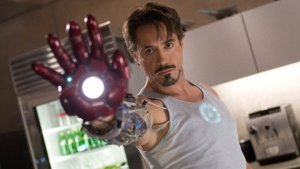 Stark’s friend Jim Rhodes (Terrence Howard), an Air Force officer, rescues him in the desert. Once back at home in his Malibu mansion, Stark has a personal epiphany. After seeing the human damage his weapons cause he no longer wants to manufacture weapons. His business partner Obadiah Stane (Jeff Bridges) and the board of directors are not interested in Stark’s revision. They want to keep doing what they do, making weapons for the highest bidder. Stark begins building a more advanced mechanical suit based upon the prototype from Afghanistan. He will use his technical expertise and great fortune to destroy his own weapons, even if he has to become an ironclad superhero to do so.
Downey Jr. is Iron Man, yes, but he IS Iron Man. He makes this character, this movie, and serves as the film’s ambassador to an audience that has grown tired of mopey teenagers imbued with super powers. His character is a man going through a mid-life crisis of sorts, reevaluating his life and trying to find meaning in his work. There’s something satisfying about watching an older adult wreck of a man taking on a genre that feels like it’ stuck in a high school atmosphere. Downey Jr. is a fantastically engaging, talented actor and when he turns on his narcissistic quick-witted charm it is impossible not to be won over. He provides the film with a tremendous spark and manages to make a womanizing, alcohol-swilling, super wealthy arms peddler/playboy into a figure of sympathy and a hero for the masses. Downey Jr. has expert comic timing and makes Tony Stark a cool swinging superhero. Just listen to his line deliveries and the energy and pacing he puts into the dialogue; it’s terrific. He also gives Stark the necessary drama to pull off the weight of guilt.
Iron Man is also a victory for Favreau as a director. The Swingers star has become a stealthily competent director. He helmed 2003’s Elf and 2005’s underappreciated Zathura and I suppose Marvel Studios saw what I saw in those films. The direction is focused and he makes smart decisions, never overwhelming an audience and always centered closely to the story. Favreau is more concerned with storytelling than noisy, empty special effects. Hell, Iron Man doesn’t even enter the film until an hour into it. There is a confidence and patience to his direction; it manages to convince an audience that they will be rewarded for their time.
 Favreau doesn’t pander and knows well enough that practical special effects will inspire the greatest sense of awe in a summer flick. Iron Man‘s special effects are almost seamless from the practical to CGI. I enjoy popcorn action movies so much more when I’m not nit-picking the special effects. This isn’t a slam on CGI itself, but computer effects have the tendency to declare their fakeness. Sure the special effects were amazing in last summer’s Transformers (how it lost the visual effects Oscar to the subpar Golden Compass I’ll never know), but the CGI-ness of it could be overpowering. When I cannot decipher a special effect automatically, then I know I have been fully immersed in the action. Favreau smartly lays out a bevy of nifty practical effects for the first half. By the time he transitions to broader CGI then he’s already laid the foundation for realism.
Favreau isn’t the best action director but this only presents an issue in the film’s last act. The action sequences in Iron Man take a back seat to watching Tony Stark piece together his new life. I was more interested in seeing Stark test and reconfigure his designs. The construction of Iron Man, to me, is more intriguing than seeing a man in an iron suit battle some guy in a bigger iron suit. The fun is watching him become Iron Man. The action sequences are serviceably kick-ass but too short. I loved watching Iron Man punch people and seeing their bodies fly backwards. Even at over two hours there just isn’t a whole lot of traditional action to Iron Man but this suited my tastes. I’d rather watch an actor with Downey’s talent interact with an A-list cast than watch robots fight and smash personal property.
Iron Man is aided by a strong script credited to two of the writers of Children of Men. It’s structured as an origin tale but it takes its time to set up events and characters that will have lasting meaning. Stark confronts being a weapons manufacturer in a post-9/11 world. He finally stops and asks, “What is the cost?” His own company is double dipping, selling weapons to both sides in a conflict, weapons that will kill U.S. men and women pledged to protect America. Stark has a true change of heart, both figuratively and, later, literally with the assistance of Pepper. There’s a political undercurrent to the film’s drama that manages to be timely and provide at least some thought to go along with the popcorn thrills. Iron Man finds a way to force its characters to combat real moral questions that result from their actions.
 The supporting cast has a combined seven Oscar nominations for acting, so this is a step above the acting level of a Fantastic Four. Howard is mostly underwritten but he provides a nice sense of camaraderie with his friendship with Stark. Bridges is an obvious villain just from the first sight of his bald dome and big, bushy beard. He’s got a mean scowl but Bridges provides a warm and fatherly guide for Stark. But man, when he gets menacing he is rather scary. But my highest praise in the supporting work goes to Paltrow, who coolly delivers arch snappy one-liners in a retro do-everything secretary role. And yet the role also offers some reflection, like after dancing in public with her boss she worries over gossip and what perception will construe the moment into. She, his employee, wearing a plunging backline dress that looks gorgeous on the actress, dances with her boss, an infamous womanizer. And then in this moment of doubt there’s a nice, unexpected moment for both a comic book movie and a would-be romance, and the “would-be” is the correct term. She has great chemistry with Downey Jr. and watching the two of them playfully bicker is another reason Iron Man soars above the confines of genre and formula. Plus she looks great with red hair.
Iron Man is a great start to the summer movie season and will be hard to beat. It doesn’t have the psychological depth of Batman Begins or the high-flying fun of Spider-Man 2, but this film certainly deserves to be mentioned in that same group. Favreau has crafted a respectful comic book movie that manages to place special effects in service of an interesting story played by extremely engaging actors. Downey Jr. is the movie’s secret weapon and he delivers a smart, witty, charming, sardonic and enormously entertaining performance that anchors a fine example of what big budget popcorn filmmaking done right looks like. Batman and Spider-Man might want to be on the look out because the new kid on the block is generating some serious heat.
Nate’s Grade: A-
Share this:

Fantastic Four: Rise of the Silver Surfer (2007)
 No better or no worse than the original, this less than fantastic follow-up to the cruddy 2005 superhero dysfunctional family melodrama ups the apocalyptic ante with the emergence of the powerful Silver Surfer, the herald for a cosmic cloud, yes cloud, that consumes the life forms of planets. The special effects run the gamut from fake and awful to passable, but what ultimately kills this movie is how little substance there is. It’s lightweight, shallow, and more interested in making the kids giggle. Example: The Human Torch, after touching the Surfer, can now switch powers with any of the members after they touch him. The Thing, covered in spongy orange rock, is lamenting his state but finds solace in his relationship with a blind woman. The Human Torch asks what Mr. Rock Dude what would do if he had but a few moments left in this world. Now, I’m thinking that the Human Torch is going to swap places with his buddy so that The Thing can enjoy even one night as a regular flesh-and-blood human being with his sweetheart. Maybe they could even knock boots without her getting serious rug burn. But no, the movie does nothing and just moves along because it doesn’t have the scope, the interest, or even the time to flirt with anything outside its limited plot. The storyline, what little there is, is predictable from beginning to end and the action sequences, while expanded from the first film, still fall far short of eliciting tension or tickling the imagination. I swear the only reason the flying jet thing is introduced was to sell toys. You have a bunch of people with unique super powers; the least the script could do is think of exciting things to do.
Nate’s Grade: C
Share this:

Ghost Rider (2007)
 Nicolas Cage’s career has been flaming out, so what better role than a burning skeleton biker who serves as a bounty hunter for the Devil, in this case Peter Fonda. A cliché-riddled script, laughable performances, cheesy effects and dull villains doom any entertainment prospects this movie might have had. Cage, as the titular rider, gets to fight a group of escaped demons who all have one connection to an element; one has the power of fire, another the power of wind, etc., it’s like a hellish Captain Planet squad. But what’s the point when Ghost Rider simply vanquishes them so easily? It’s repetitive and goes nowhere. There’s one moment Sam Elliot “turns” into an older ghost rider/bounty hunter and rides along with Cage to save the day. But then he says, “Well, I could only do that once more, so good luck.” What? You could only turn into a flaming ass kicker one more time and you wasted it on riding a horsey through the desert? Eva Mendes is awful as her role of “girlfriend from past,” and why, if she and Cage grew up as childhood sweethearts, does he look over 15 years older than her in the present? I guess working for Satan can really take a lot out of you.
Nate’s Grade: D
Share this:

Spider-Man 3 (2007)
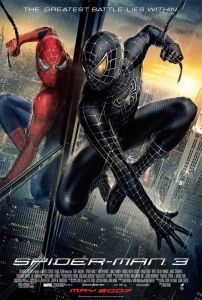 Who the hell are you Spider-Man 3 and what have you done with the franchise I loved? After the massive commercial success of first two Spider-Man chapters, my expectations had been raised fairly high. The more time that passes the more I reflect on how disappointing Spider-Man 3 sadly is. Part of my dashed hopes are because the 2004 Spider-Man sequel was a wonderful follow-up to a pretty swell introduction, and I placed that movie in my Top Ten list for the year and consider it one of the best comic book movies of all time. There’s some great popcorn entertainment to be had with Spider-Man 3, but man is this film just beside itself in wasted potential, a lack of focus, and some really poor choices.
Things are going pretty well for Peter Parker (Tobey Maguire). He plans on asking Mary Jane (Kirsten Dunst) to marry him and New York City is planning a parade out of appreciation for Spider-Man. But the good times can’t last long. Harry Osborn (James Franco) has accepted his fate and become a second generation Green Goblin villain, out to avenge his father’s death at the hands of Spider-Man. But Peter also has to be on the lookout for his job at the newspaper. Eddie Brock (Topher Grace) is an unscrupulous photographer out to replace Parker and nab a picture of Spider-Man caught in a bad light. An alien substance has also hitched a ride to Earth via meteorite and sought out Peter Parker. The black goo attaches itself to Peter and forms a black Spidey suit, one that gives him intoxicating power and a slimy menace. The new Peter cavalierly flirts with bouncy lab partner Gwen Stacy (Bryce Dallas Howard), hurts his friends, and loses his do-gooder ways.
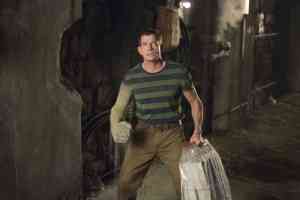
Meanwhile Flint Marko (Thomas Haden Church) has escaped from prison. It seems the police got it wrong and now inform Peter that Marko confessed to being the one who killed Peter’s uncle. While on the run Marko happens to tumble into an open pit that is a science experiment and becomes fused at a molecular level with sand. He uses this new power to rob banks in order to save his sick daughter at home. Peter, with the power of the alien suit, hunts the Sandman to get his own slice of sticky vengeance.
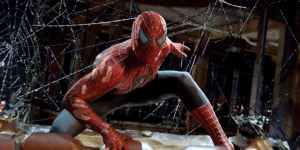 The film has way too much on its plate. There are too many characters, too many undeveloped storylines, too many coincidences, too many contrivances (Amnesia? Really? Really?), and too many aborted moments of drama. Spider-Man 3 is an undisciplined mess. The film practically stumbles from one scene to the next and lacks the coherency and intelligence of the earlier entries in the series. The third film tries to do too much and please too many interests, and as a result it may end up pleasing few fans. I had some trepidation when I learned that there was going to be upwards of three villains for this movie, but I swore that it could work since Batman Begins confidently worked around a trio of big bads. Three villains do not work in Spider-Man 3. Let me dissect this rogue’s gallery and where they fall short.
1) The Sandman is kind of a lame idea from the start. His power seems to limit his available locations, and I’m surprised that he wouldn’t stick to beach areas as a means of playing to his sandy strengths. Regardless, the character plays no part in almost anything that happens, and the Sandman is given one note to play. He’s got a sick daughter and he robs to try and pay for her medicine. That’s great on paper but it never really seems to give the character any sense of urgency or frustration. If he got special sand powers why not sneak into banks through cracks in walls instead of forming as a giant sand monster? Church attempts to imbue the character with a sad soul but he just comes across as being wooden. If he was really on the hunt for money to save his daughter then why does he just slouch around all the time? Wouldn’t it be easier to rob a city not patrolled by a web slinging super hero? How can he say he’s a misunderstood victim of luck just minutes after he tried killing Peter? He seems like a dull lunkhead. The Sandman is given a tiny wisp of character detail (sick kid!) and that’s it. He doesn’t get any other characterization and is kept on the run and pops up whenever the film needs him. He becomes a token character until the very end where Church is given 2 minutes to pour his heart out to Peter. Two minutes of character at the start, two minutes at the end, and a gaping center. The Sandman isn’t so much a character as the ideal of some issue that the filmmakers want to have Peter work through.
And what is that issue? Why vengeance and forgiveness. You see, Spider-Man 3 foolishly rewrites its own history and now it was the Sandman hat killed Peter’s Uncle Ben. This revision does not work at all and actually legitimately damages Spider-Man. Just like Bruce Wayne is tackling crime to alleviate his guilt, so too is Spider-Man, who can never shake the fact that he could have prevented his uncle’s death had he done the right thing moments before. By introducing a new killer it means that Peter has no responsibility for his uncle’s death. This completely strips away the character’s guilt and rationale for what compels him to swing from building to building to fight crime.
 2) Eddie Brock/Venom is wasted as well. Director Sam Raimi has said before he’s not a fan of Venom and doesn’t get the character, and I feel that his contempt carried over into the film. Venom and the black alien goo are given about the same abysmal care as other half-baked plot points. Eddie Brock has about three total scenes before he gets to transform into Venom thanks to the alien substance, and none of these scenes fully flesh out who the character is or justify his relationship with Peter Parker. When we do see Venom in the finale its all too rushed and hokey. The effects make him look less like alien and more like a wax figurine (I suppose there could be intelligent wax life amongst the stars). For whatever dumb reason the alien suit has to retreat so we can see Grace’s face while he taunts and mocks with bad vampire teeth that are meant to inspire what exactly? The character is rushed and underdeveloped and should have been saved for the next sequel instead of being given lip service in this one. Venom is supposed to be the evil doppelganger to Spider-Man, not some smart-alleck with frosted hair that gets about 15 minutes of screen time. I like Grace, I really like him a lot and envision him as his generation’s Tom Hanks, but he does not work in this movie. He could, but I get the sneaking suspicion that Raimi sabotaged the Venom role on purpose or at least subconsciously. The villain goes out with a whimper and it feels like a giant, foolish wasted opportunity that becomes more maddening the more I discuss it. The presence of Venom feels like a shallow attempt to placate a younger generation of comic fans and to sell more action figures.
The alien goo suit is supposed to tempt Peter and bring out his wicked wild side. So what does he do? He acts like he’s auditioning for the lead in The Mask. This embarrassing sequence is painfully goofy and will make you cringe and shield your eyes. Peter flirts with girls and dances at a jazz club, and this is supposed to be the dark side of Spider-Man? What the hell? I acknowledge that Peter has always been an unpopular dork and would be a dork even if he ventured to the dark side, but how does this square with the more serious and edgier tone the film is grasping for? Evil Peter seems more like a broody emo kid, with shocks of black hair in his eyes and traces of eyeliner. The dark side of Spider-Man, much like the rest of the film, is given little time or thought. Peter’s trials with the symbiotic suit last about a reel or two and then it’s abruptly finished.
 3) Harry should have been the main focus of this sequel and it?s a shame the filmmakers had to cram so much crap into a story already heavy with plot leftovers. Harry has the most obvious arc through the three movies and deserves better than to be knocked out of commission by amnesia. The conflict between Peter and Harry is where the film finds its emotional core and it would have been wise to expand this section and eliminate one of the other underutilized villains (my vote: both Venom and Sandman). Harry’s vow to avenge his father is far more interesting than what the other two villains have as motivation, and plus Harry requires no extra time-consuming setup to slow the pacing down. I’m glad the final battle encouraged Harry to come out and play; the film finally gives Franco the screen time he deserves, but it should have been more. The worst plot device in the film involves Harry’s all-knowing butler who has some vital information he most certainly should have shared years ago. So much time is spent on storylines that go absolutely nowhere, and the musical chairs of villains, that the film resorts to having a freakin’ butler tap someone on the shoulder and say, “Excuse me sir,” just to tie things up in the most awkwardly shrift way possible. And even if what the man says is true, how does his perspective add any clarity to the situation? Think about it. I have.
The romance between Peter and Mary Jane feels awfully trite and meandering. Spider-Man 3 lacks the tight focus of the second film. It throws contrivances to place a wedge in their relationship, like the fact that Mary Jane is fired from her Broadway gig but doesn’t tell Peter, or the fact that they never seem to answer the phone on time when the other person is apologetic. Gwen Stacy is less a character than simply a dimwitted blond tool to make Mary Jane jealous and sulk. The ups and downs in this relationship feel pretty forced and some moments defy all human understanding. At one point Mary Jane is forced by Harry to break up with Peter to spare both their lives. So she breaks the news in a park, and Peter is devastated, but why in the world does she never say anything again? Why would she not clear things up after time had passed to explain her actions? Spider-Man 2 ended with Peter finally getting the girl but also on a hint of doubt, and it was marvelous. Spider-Man 3 just sort of ends with everyone presumably in the same place they started.
Spider-Man 2 really succeeded on how focused it was and how it related its action with character. Spider-Man 3 has to resort to cheap and lazy devices to cover its storytelling pitfalls. Don’t even get me started on the fact that the film has to resort to a newscaster narrating our final battle where he actually asks, “Is this the end of Spider-Man?” This might be the end of the quality associated with Spider-Man.
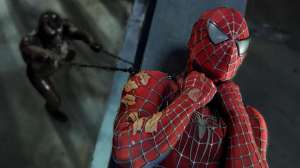 After having spent a whole slew of words detailing in length where the film goes wrong, allow me to illustrate some of what the film does right. Whenever it sticks to action, that’s when Spider-Man 3 works, and Raimi has cooked up some wonderful whiplash-inducing action sequences. The first battle between Peter and Harry is intense and sets the film on the right path, but the action as a whole isn’t as closely tied to Peter’s domestic life and emotional troubles as it was in the other films. A high-rise rescue from a crumbling office building will stir some 9/11 memories but it is awesome to behold. The effects have improved and the swinging shots through New York look the best they ever have. The greatest moment in the film is perhaps the birth of the Sandman as he rises grain by grain from a pile of sand and attempts to reform himself. Aided by some lovely music, the moment takes on a beautiful and unexpected poignancy. This is where Raimi and the CGI wizards hit it out of the park. Nothing rivals the train sequence in Spider-Man 2, though.
It might be dangerous to say, but I feel jilted from this film and either new blood needs to be brought in or the filmmakers need more time and control to make a Spider-Man sequel worthy of its name. This is the gold standard for super hero movies and its been tarnished and sullied. Spider-Man 3 has moments to dazzle and excite but it also feels battle fatigued from carrying the dead weight of extraneous characters and half-baked storylines. There are too many balls in the air for Raimi to juggle. This Spidey chapter squeezes too many ideas in too short a space. After obliterating box-office records, Sony has stated that they plan on three more Spider-Man sequels. If this film is the tipping point, then I’m afraid of what will be swinging down the pipe in years to come.
Nate’s Grade: C+
Share this:

X-Men: The Last Stand (2006)
 The story behind the making of X-Men: The Last Stand is more interesting than most. Bryan Singer had directed the first two X-Men films and had done a fine job establishing many loveable characters and the universe that housed them. Warner Brothers has been trying to get their Superman franchise flying for so long, going all the way back to 1996 when Kevin Smith wrote the script, Tim Burton was to direct, and Nicolas Cage was going to be the man in tights. Since then directors and drafts of screenplays have come and gone, including Brett Ratner, best known for directing both Rush Hour movies and a slate of mostly mediocre movies. Then Warner Brothers poached most of the X-Men 2 team to make Superman Returns, hiring Bryan Singer as director, plus X2‘s screenwriters, cinematographer, editor/composer, and maybe even the cat that licked Wolverine’s claws. Fox was left without a captain for X-Men 3. They daringly picked Matthew Vaughn (Layer Cake) but then he dropped out for family reasons. Then Fox went with their second choice … Brett Ratner. Both directors had essentially switched projects. Hollywood’s funny like that.
It’s been a few months since the events in X-Men 2. Scott “Cyclops” Summers (James Marsden) is still mourning the loss of his love, Jean Grey (Famke Jannsen), who sacrificed herself to save the rest of the X-Men. He’s tormented by her voice, whispering all around him and pleading with him to return to Alkali Lake, the site of her death. Miraculously, Jean returns from the dead but she’s much different. Her persona has broken and the Phoenix has taken over, a destructive killing force unparalleled on earth.
Magneto (Ian McKellen) has great use for such a force. There’s been news of a new drug that suppresses the gene that causes people to be born as mutants. This discovery has been dubbed a cure. The question persists, is should being different be curable and what would that even mean? Magneto sees the writing on the wall, knowing that any cure would only be voluntary for so long. He collects new mutant fighters along with his stalwarts the shape-shifting Mystique (Rebecca Romijn) and fire starter Pyro (Aaron Stanford), a former student at Xavier’s School for the Gifted.
 Over at Professor X’s (Patrick Stewart) school, the mutant students are each questioning life with a cure. Rogue (Anna Paquin) is considering it so she can finally touch her boyfriend, Bobby “Ice Man” Drake (Shawn Ashmore) without killing him. Plus, so he’ll stop spending so much time with Kitty “Shadowcat” Pryde (Ellen Page), a girl who can walk through matter. Storm (Halle Berry) and Wolverine (Hugh Jackman) are left to run the team after some disastrous setbacks. Henry “Beast” McCoy (Kelsey Grammer) is a man covered in blue fur and appointed as head of Mutant Relations for the president. He senses the growing danger and anxiety the administration has with mutants and joins the X-Men to do what he feels is right.
It feels like that in a rush to production that character development, subtlety, and subtext were chucked out the window to make time for more boom-boom action. The first two X-Men flicks juggled the characters and introductions but still managed to squeeze in one great moment for the characters we cared about. The plot moved at a mature pace, insightful and touching on elements of psychology, politics, and personal struggles to fit into a society that fears you. There was some sophisticated, relevant stuff bandied about this franchise in between the kick-ass action. But with X-Men 3, you basically have Halle Berry doing less with more. She’s got more screen time, in part to her demands, and now she can use that extra time onscreen to show us how perfectly bland her character is as the film’s most laughable moral ideologue. The idea of a cure for the mutant gene is vastly interesting with all kinds of great avenues for character introspection and socio-political debate. But X-Men 3 renders all of its debate to be merely superficial, another in a series of plot points to get the action moving quicker.
The X-Men franchise was already overpopulated with lots of characters vying for screen time, so I don’t understand the decision to add even more characters to the ensemble and cut down the running time to a brisk 100 minutes. As a result, certain characters sit out for long stretches of the film, are inactive during key moments, some are mostly forgotten, or some meet unjustifiably hasty ends. If I was still an ardent comic book fan, and a follower of the X-Men, I might view the third film as heresy. Why even bother bringing the character of Angel into the movie if he’s just going to be on for two minutes, including a forehead-smacking deus ex machine moment? The Dark Phoenix storyline is the most pivotal storyline in the comic’s history, so why even bother dragging it into X-Men 3 if it’s just going to be Zombie Jean Grey? It feels like Ratner is off screen with a pole poking Janssen whenever the story needs her to wake up and stir up some stuff.
 I hope comic fans enjoy the brief glimpses of some of their favorites, because X-Men 3 does a good job of throwing characters into a meat grinder. I had to check online to just to find out who they were, and even then my realization was followed by, “Her? Him? What?” And what the hell is up with Porcupine Face? That has got to be the worst mutant ability of all time. What’s he going to do to his enemies? “Hey, will you come a little closer. I have a secret to tell you. Closer … closer … closer still … that’s right, now please lean against my face.”
The movie trades character for action, so is the action even good? Ratner is a workmanlike director devoid of any personal style, which further brands X-Men 3 as ordinary. The action sequences aren’t anything extraordinary, there just happens to be more of them. The climax pits mutant against mutant in short-lived bursts. A battle between Ice Man and Pyro should be awesome, but Ratner stages the showdown like he was choreographing his neighbor’s kids. This battle lasts a whopping 45 seconds. The climactic end battle, the “war to end all wars,” is rather sloppy. Ratner keeps cutting back and forth between his pairing of Good mutant vs. Evil mutant (why do the two black girls seem forced to fight each other?), but his showdowns are all too quick to quicken the pulse. Wolverine’s brawls in the woods never rise up to the adrenaline-soaked fights in X-Men 2. The special effects and make-up are just as good; they’re just not being put to as good a use. If Ratner is going to dump character for action he has to make his action exceptional. The movie feels on autopilot.
Ratner is not fully to blame for the shortcomings of X-Men 3. Screenwriters Simon Kinberg and Zack Penn (Elektra) have crafted an overly rushed story that is more tailored for getting the job done than telling a good story. They present some big ideas and interesting elements, like a love triangle between Rogue-Ice Man-Shadowcat, but then most of the promise is either skipped over or dropped. They’re trying to juggle too many balls at once, and it just makes me miss Singer and the X2 screenwriters and how effective they were in defining character even in the smallest of moments. Some of the X-Men 3 dialogue is awfully stilted, like “You of all people know how fast the weather can change” and “Sometimes when you cage the beast, the beast gets angry.” There’s also a silly subplot about Storm teaching Wolverine what it means to be responsible. Try and count how many times you roll your eyes with that one. How many times are they going to have the president look blankly at a TV screen and gasp, “My god”? There’s some clever use of mutant powers during battles (mostly involving Shadowcat) but there’s just as many routine moments as well.
 The acting is all over the map. Jackman owns his role as Wolverine. McKellen and Stewart bring a needed dose of grandeur to the proceedings. The X-kids are enjoyable, and Ellen Page (knocking ’em dead in Hard Candy) makes a very nice addition to the fold. I’ve likely enjoyed Paquin the most in this series, next to Jackman of course, so it’s so frustrating that she just plays Jealous Girlfriend at Window. I think it’s criminal how little she’s examined in the movie, especially since the supposed cure has the most questions and ramifications for her. Grammer is essentially Frasier in blue fur, but that’s essentially what Beast is so it works. He has a very nice moment when he sees what life would be like minus his mutant likeness. It’s really hard to judge most of the performances because of how short they appear in the movie.
X-Men: The Last Stand is far from boring but it’s more serviceable than special, and lacks the maturity and imagination that its previous films held. This was a franchise full of limitless potential, so to see it drop to something ordinary is sad, especially if this is the rumored end of the franchise (a record opening gross over Memorial weekend says otherwise). This franchise feels dumbed down; yes it’s still entertaining on a mass market level but it doesn’t have the creativity and precision that Singer’s movies had. X-Men 3 is fast-paced and not without its great geek moments, but it’s also the least emotionally involving of the films. When the deaths and departures come you’ll probably shrug your shoulders because of how the film presents them. X-Men 3 is fine, but I expect better from this franchise.
Nate’s Grade: C+
Share this:

Elektra (2005)
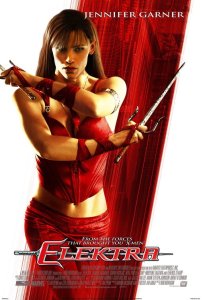 January is typically a cinematic wasteland. It’s the place where films go to die. So imagine my surprise when I heard that Elektra, a comic book movie built around a nimble sai-spinning assassin, was going to be released in January 2005. I remember at one time there were plans for a summer release, which means Elektra had fallen from the very top to the very bottom of expectation. After viewing Elektra for myself I can perfectly understand why anyone would want to dump this clunker.
Elektra (Jennifer Garner) is a feared assassin-for-hire (she even has an agent for her hits). She’s been brought back to life by a powerful sensei, but has ignored a possible higher calling to make her money killing folks. Apparently she is the mythical warrior that will keep the balance between good and evil, or something or other. Her next hit ends up being a nice guy (Goran Visnjic) and his teenage daughter. Elektra doesn’t have the heart to kill them, so she joins them and all three run away from the really bad guys, an ancient group known as The Hand.
Elektra doesn’t really bare comparison to other comic book films because Elektra feels more like a video game. In true video game fashion, I’ll numerically list the likenesses:
1) There is no such thing as characterization, just definition by super power. One assassin is super strong, another can suck the life out of creatures, and a third has the amazing ability to have his tattoos come to poorly rendered life (lucky this guy doesn’t have butterflies and fairies). With a powerful lack of imagination, these assassins are called Stone, Pestilence, and Tattoo (not the Russian girls who make out with each other. That’s Tatu.).
 2) The only sense of a story is pitting Elektra against one bad guy after another. There aren’t character arcs and subplots so much as there are end stage boss battles. It gets really repetitious.
3) The film seems like it’s bending over backwards to get character special moves into the story. With 1995’s Mortal Kombat, the writers, and I use that term in the loosest possible sense, had to work a story that included popular video game moves. Working so hard to include something so trivial and arbitrary really ties the storyteller’s hands. Elektra feels like the film would rather try and include some character’s special move rather than formulate a cogent storyline.
4) Once our assassins are vanquished they burst into clouds of yellow dust. I am not kidding. When they die they explode into clouds of mustard-hued gas. Just like in a video game, once you kill the bad guy they disappear with no necessary cleanup. It’s really thoughtful of them.
5) A second player can jump in at any time! In Elektra, different characters magically appear whenever it’s convenient and I?m not even talking about the super assassins.
6) Just like in a video game, you get an extra life! I don?t know why the producers of Elektra didn’t just make a prequel. With a sequel they have to work around their heroine’s untimely death in 2003’s Daredevil, and so we are introduced to the idea that a warrior of great mind can bring people back from the dead. So if Elektra dies (again) she can just be brought back to life. This whole idea practically eliminates any sense of danger and consequence.
So little of Elektra makes any kind of sense. Characters make rash choices and surprise appearances. The villains are a bland, cliched crop from some back order of ancient kung-fu brotherhoods. The plot is mysteriously oblique and has the frustrating habit of using cheats to get around logical roadblocks. About halfway through Elektra I gave up shrugging my shoulders and rolling my eyes. There is no definition on character limits, so anything can happen, and when it does it’s usually very stupid.
 Even worse is how dreadfully dull Elektra can be. The last two acts are compromised of nothing but a long, boring chase scene. The action sequences are brief and unoriginal, which include the thousandth inclusion of a hedge maze. There’s one moment where Elektra is battling in a room that has sheets flying all around for no good reason. It’s visually reminiscent of a Where’s Waldo? page. Take that for what you will.
The film is brisk, clocking in at just 90 minutes, but you don’t care about the characters because 20 minutes is spent establishing them, and the remaining 70 is spent watching them run.
The only redeeming quality of Elektra is its star. Garner is suited for the running, jumping movies, but she also has great acting chops behind her square jaw and impeccable physique. She casually generates intensity but also has a light, humorous touch. It doesn’t hurt that she looks fabulous in a red bustier. Her character is given OCD but then this plot is dropped entirely. Without the appeal of Garner, Elektra would simply be Catwoman.
Elektra is a flat comic adaptation that plays more like a video game, and just like in real life, watching a video game is no fun at all. Things happen, characters appear, people explode into clouds of yellow dust, and it’s all a bunch of uninteresting, half-baked nonsense. Elektra is frustrating, labored, ridiculous, and empty of thought and enjoyment. Why should I pay to watch Garner kick ass when I can watch Alias on TV and see Garner kick ass for free? And the plots of Alias are brazenly complex, fun, and high-spirited. I care about the people and events on Alias. With Elektra, the only thing I cared about was when the film was going to be over.
Nate’s Grade: D
Share this:

Spider-Man 2 (2004)
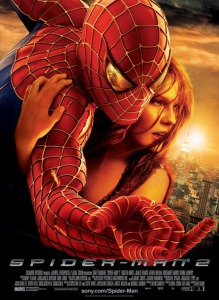 No other movie had higher expectations than Spider-Man 2 and no other movie met and trounced those expectations than director Sam Raimi’s high-flying webslinging sequel. Spider-Man 2 was that rare sequel that excelled in near every way. The action sequences were lively and highly exciting, but what made Spider-Man 2 so thrilling was its success in building strong emotional characters. After all, how many superhero films are written by the writer of Ordinary People? (One wonders what he would have done with Catwoman) Alfred Molina, as Doc Ock, made for a great formidable foe and brought surprising humanity to the dastardly part. Spider-Man 2 was a momentous crowd-pleaser that also dazzled the hardest critics. It reaffirmed exactly what a summer popcorn film can make us feel.
Nate’s Grade: A
Share this:

The Punisher (2004)
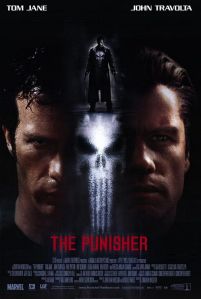 It’s probably a bad omen when the co-writer of Armageddon makes his directorial debut (J.J. Abrams is a fluke). The Punisher is one of the ugliest movies I have ever seen. The action isn’t exciting; it’s pat, poorly shot and grotesque. The story isn’t interesting. It’s not enough that The Punisher has his family killed; he has to have his ENTIRE family killed during a reunion. When he does exact his vengeance, the film stops an audience from engaging with the characters and pushes them away by callous misstep after callous misstep. This is just sadistic, ugly, and over-the-top while simultaneously being entirely, sadly predictable. By the time John Travolta gets dragged by a slow-moving car through a field of explosions, you may have thrown up in your mouth, swallowed it, and thrown up again.
Nate’s Grade: D
Share this:

Hulk (2003)
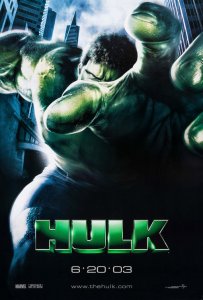 Comic book movies are all the rage these days. The X-Men films, Spider-Man, even Daredevil all managed some level of success because they were, at their heart, entertaining pulp and treated the source material with some sense of reverence. Now Ang Lee’s monstrous film Hulk lumbers into theaters and one could best describe it as being too serious for its own good.
Bruce Banner (Eric Bana) is the quiet guy, the one who bottles everything inside. His lab partner Betty Ross (Jennifer Connelly) has recently broken off their relationship due to his emotionally shut-off demeanor. Well Bruce gets hit with a lethal dose of gamma rays and it kicks up something inside him. You see, Bruces long-absent father (Nick Nolte, looking frightfully like his drunken mug shot photo) experimented some kind of regeneration serum on himself. When he fathered Bruce he passed on whatever genetic alteration. So now when Bruce gets mad he turns into a 15-foot raging Jolly Green Giant (the CGI in this movie is not good). He starts enjoying the freedom letting go can bring. Nothing gets him more mad than some yuppie (Josh Lucas, badly miscast) trying to buy out his lab and then kill him to sell his DNA to the military. Along the way, Betty’s father (Sam Elliott) tries to hunt Bruce and his greener-on-the-other-side alter ego for the good of us all.
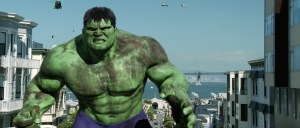 Director Ang Lee has injected most of his films with a sense of depression and repression, from the biting and darkly astute The Ice Storm to the stoic Gary Cooper-like silence of the aerobatic samurai in Crouching Tiger, Hidden Dragon. He’s a master filmmaker without question. Lee bites off more than he can chew with Hulk much like the gifted Cameron Crowe did with the sci-fi Vanilla Sky. Lee is so damn ambitious that Hulk tries to be everything and it ends up fulfilling nothing. His film is the most ambitious and the most tedious super hero/comic book movie of all time. What does it say when the super green Hulk has more personality than the bland Bruce Banner?
The acting is a non-issue here. Connelly remains one of the most beautiful women in all of movies and has incredibly expressive eyes and brows. She has this strand of hair thats always in the right side of her face. It’s so awkward. Bana gets the least fun part as the mentally scarred kid afraid of his own anger. He doesn’t do much but then he isn’t given much. Elliott overacts with impressive gusto whereas Nolte overacts like every line was his last breath.
After about an hour or so of beleaguered talking and flat characters, I started to become restless. I wanted to see Hulk smash, Hulk smash good. Instead what you get is endless scenes of cheesy speeches, sci-fi babble speech, phony philosophy, and mind-numbingly awful pacing. Seriously, Hulk has worse pacing than glaciers. You’ll see the Mona Lisa yellow faster than this movie will be over. And in some weird paradox, I think it will never be over.
 Lee attempts to make the film a living comic book. You’ve never seen this many wipes short of a Brady Bunch marathon on TV Land. Lee splits his screen into multiple panels and slides them around much like the layout of a comic book. However, this visual cue is overused and calls attention to itself in a how arty are we kind of pretentious way. If Hulk was attempting to be a comic book movie, then where the hell did all the action go? This movie could have been subtitled The Hulk Goes to Therapy because everything excluding an over-the-top final act revolves around people working out childhood issues. Man, there’s nothing I like to see more during the summer than a $150 million dollar movie about people working out childhood issues. Oh yeah!
Hulk is an overlong and ambitiously meandering film thats incredibly serious, incredibly labored, and incredibly boring. Someone needs to tell the creators of this film to lighten up. The big-screen adaptation of the big green id may have heavy doses of Freudian psychoanalysis (try and tie THAT with the merchandizing onslaught) but the film is barren when it comes to fun. Even comic book fans should be disappointed. I heard a story of a kid who saw Hulk and asked his mom when the movie was going to start, and she replied, “90 minutes ago.” Should you see Hulk in the theater at full price? No. Instead, give your money to me. It will have more resonance and action than anything this bloated, joyless, self-important vacuum of entertainment could offer.
Hulk mad? Audience mad! Audience leave theater. See other better movies instead. Hulk sad. No Hulk 2. Audience happy.
Nate’s Grade: D+
Share this:

Spider-Man (2002)
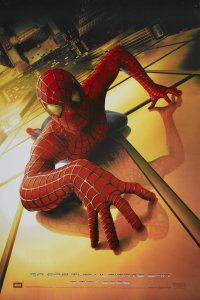 Hollywood take note, Spider-Man is the prototype for a summer popcorn movie. It has all the necessary elements. It has exciting action, great effects used effectively, characters an audience can care for, a well toned story that gives shades of humanity to those onscreen, fine acting and proper and expert direction. I recommend movie execs take several note pads and go see Spider-Man (if they can get in one of the many sold out shows). What summer needs are more movies in the same vein as Spider-Man, and less Tomb Raider’s and Planet of the Apes.
Peter Parker (Tobey Maguire) is a dweebish photographer for his school yearbook clinging to the lowest rung of the popularity ladder. He lives with his loving Aunt and Uncle who treat him like a son. Peter has been smitten with girl-next-door Mary Jane Watson (Kirsten Dunst) ever since he can remember, but he’s been too timid to say anything.
At a field trip to the genetically altered spider place (there’s one in every town) Peter is snapping pictures when he is bitten by one of the eight-legged creatures. He thinks nothing of it and awakes the next day to a startling change. He has no need for his rimmed glasses anymore and has a physique that diet ads would kill for. He also discovers he can cling to surfaces, jump tall building in a single bound and shoot a sticky rope-like substance from his wrists. Hairs on his palms and shooting a sticky substance from his body? Hello puberty allusion! Peter tries to use his new abilities to win the girl and when that doesn’t work out he turns to profiting from them. He enters a wrestling contest in a homemade costume and proceeds to whup Randy Savage. Following the fight Peter’s Uncle Ben is dying after being involved in a car jacking Peter inadvertently let happen. Haunted by grief Peter becomes Spider-Man and swings from building to building as an amazing arachnid crime stopper.
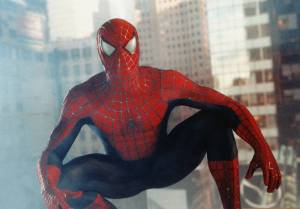 But every hero needs a villain, and that is personified in the Norman Osborn (Willem Dafoe), scientist and businessman. Osborn is experimenting with an aerial rocket glider and a dangerous growth serum. When the military threatens to cut his funding and shop elsewhere Osborn haphazardly undergoes the serum himself. What it creates is a duality of personalities; one is Norman, the other is a sinister and pragmatic one. The evil alter ego dons the glider and an exoskeleton suit and calls himself the Green Goblin. The Goblin destroys all that are in his way, and has his yellow eyes set on the pesky Spider-Man.
The casting of mopey-eyed indie actor Tobey Maguire over more commercial names like a DiCaprio or a Prinze Jr. (I shudder to think of a Freddie Prinze Jr. Spider-Man) left some people scratching their heads. Of course the casting of Mr. Mom to portray the Dark Knight likely got the same reaction in the 80s. Maguire plays the nerdish and nervous Peter Parker to a perfected awkwardness with his sensitive passivity. When he explores his new powers with exuberant abandon then begins crime fighting, we as an audience are with him every step of the way pulling for Peter.
Kirsten Dunst was also a surprising casting choice but works out very well. She allows the audience to fall for her along with Peter. Her chemistry with Maguire is great and could be a major reason why rumors have surfaced about the two leads taking the onscreen romance off screen.
Willem Dafoe is one of the creepiest actors in the business (though he made an effective creepy-free Jesus) and delves deliciously headfirst into the cackling menace of Spider-Man’s nemesis. Dafoe, with a face that looks like hardened silly putty and jutting rows of teeth, relishes every maniacal glare and endless evil grin. But instead of being one-note he adds certain amounts of sympathy and understanding as Norman Obsorn. No one could have done this role better than Dafoe.
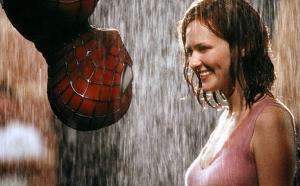 Director Sam Raimi was most known for his cult splatter house Evil Dead series, but he’s got a new resume topper now. Raimi was chosen over a field of directors because of his passion for the character and story. Raimi brings along integrity but with a joyous gluttony of spectacular action sequences. He expertly handles the action and daring-do all the while smoothly transitioning to the sweet love story. He has created the movie Spidey fans have been dreaming of for 40 years.
Spider-Man swings because of the respect the source material has been given, much like 2000’s X-Men. The story follows the exploits of the comic fairly well but has some stable legs of its own. The multitudes of characters are filled with life and roundness to them, as well as definite elements of humanity. You can feel the sweet romance budding between the two young stars, the tension and affection between Osborn and son, but also the struggle with Norman and his new sinister alter ego.We all know villains are the coolest part anyway. Isn’t that the only reason the last two Batman films were made?
There’s the occasional cheesy dialogue piece but there is that one standard groaner line. In X-Men it was Halle Berry’s query about what happens when lightening hits a toad. In Spider-Man it was the response to the Green Goblin’s offer to join him, to which he asked “Are you in or are you out?” (Obviously channeling George Clooney). The dreaded response: “You’re the one who’s out Goblin. Out of his mind!” Sigh. Maybe a well placed “freaking” before “mind” would have made the line better.
Spider-Man is the best kind of popcorn film: one that leaves me anxiously anticipating the sequel (which will come out two years to the day the first one was released).
Nate’s Grade: A-


 nathanzoebl
You must be logged in to post a comment.