Blog Archives
The Grey (2012)
 I’ve always been fascinated with survival thriller/horror, where we think step-by-step with the characters through an unlikely scenario. I greatly enjoyed Frozen, a horror movie about three teens stranded on a ski lift, and Buried was in my top ten list for 2010. I enjoy the thought exercise and find the scenarios easily empathetic as long as people don’t make boneheaded decisions. Director Joe Carnahan has been paying his bills as of late with stylized, overdone, and generally overblown action movies like Smokin’ Aces and The A-Team. I would not have expected Carnahan to deliver anything that could be described as nuanced or meditative, but lo and behold The Grey is a survival thriller that’s as thoughtful and emotional as it is viscerally exhilarating. The Grey is the first great movie of 2012 and I’m astounded that it was released in January, the dumping ground for cinematic dreck.
We follow a group of grunts working on an oil pipeline way out in the northern Alaskan territory. They’re heading south for some R&R when their plane crashes due to electrical issues. Ottway (Liam Neeson) and seven other men are the lone survivors. While checking for supplies, they discover a pack of wolves feasting on some of the choicer corpses. Ottway is a wolf expert, hired by the oil company to patrol the grounds and hunt antagonistic wolves. He explains that wolves have a hunting radius of 300 miles and a kill radius of 30 within the den. It is uncertain where these men find themselves, so they bundle up and head south, hoping to escape the predators, find food and water, and discover a way to help.
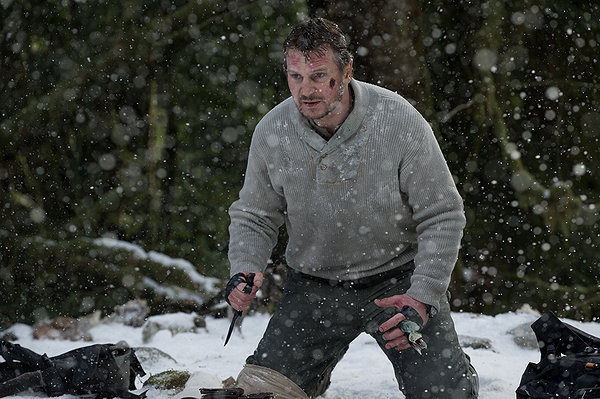 The Grey is a harrowing, haunting, and intense thriller, masterfully played by Carnahan. The threat is real and brutal, enough that it convinces the men to leave the safety of the plane wreckage to possibly escape the wolf kill radius. We’re told that wolves are the only animal that will kill out of vengeance (look out Sarah Palin). The attacks are vicious and the violence is bloody and occasionally shocking, though it never seems gratuitous. The special effects and canine animatronics are seamlessly integrated. The sound design for this movie is exceptional, probably the best use of sound to fashion anxiety since 2007’s No Country for Old Men or even Spielberg’s War of the Worlds. The sounds of the wolf pack echo around the theater, completely keeping you off guard, disorienting the audience. Carnahan creates such a vivid picture of dread that we’re convinced that the wolves could sic at any moment. And when they do the editing becomes chaotic, mimicking the ferocity of the animals and depicting the frenzied fear of the attacked.
I was a terrible bundle of nerves throughout most of this movie. The plane crash is an exemplary sequence of terror, capturing the terrifying moments from Ottway’s limited point of view. The rest of the movie doesn’t get any less tense just because they’re on stable footing. There’s one scene where the wolves attack a guy who has fallen back from the group. Carnahan brilliantly captures the helpless reality by showing the men trying to race back in knee-high snow. They can only stomp so far while the man is ripped apart in the background. The action sequences, though to be fair they’re really more suspense pieces, are the most nerve-wracking I’ve endured since the brilliant Best Picture winner, The Hurt Locker. Of course these being life and death stakes, there is plenty of death, as the men are generally picked off one by one, though not all by the pack of wolves. The frigid elements are just as dangerous as the killer wolves. The men could just as easily freeze to death. The need for shelter and food is dire (the men even joke about the famous cannibalism from Alive). One of them is suffering just from his brain being unable to acclimate to the elevated attitude. That’s almost enviable considering the doom that constantly hangs over the other survivors.
Naturally there’s some friction between the survivors as far as the best course of action. Ottway has assumed Alpha dog status thanks to his expertise on wolves and the Arctic climate, but that does not mean that the rest of the men follow lockstep. Give the alarming situation, it will be in these men’s best interest to work together for survival. Some of the men chafe at being what to do but the movie doesn’t drags out this conflict, thankfully, because jockeying for power positions seems like an absurd waste of time. There are heavier issues at play. The impact of the movie would be blunted if the characters came across as one-dimensional; then we wouldn’t care about their fate. Carnahan and co-writer Ian Mackenzie Jeffers, based on Jeffers’ short story “Ghost Walker,” find creative ways to enrich and reveal the character of these lone men. They feel believable and their reactions to the implausible dangers seem plausible, keeping us invested. Ottway keeps flashing back to an image of his wife (Anne Openshaw) for strength, this angelic brunette telling him not to worry. It’s what he has to hold onto, though when we learn more about the context of this image it becomes even more meaningful. One character has had enough struggling and has no will power to continue. He argues that whatever life he may return to is no reward.
 The thrills and scares are what are to be expected, but The Grey is also a much more thoughtful and intellectually stimulating picture than you may have hoped. Carnahan’s script covers a wide array of survival tactics without breaking from the reality of its premise. It’s just interesting to watch a group of men use their wits to make best use of their dwindling supplies and dire situation. It becomes a game that the audience plays, systematically judging every choice and assessing if we would follow suit. Beforehand, the men engage in a theological discussion regarding the existence of God, faith, the belief that there is a divine plan. The men are fighting for their survival but having an existential crisis all the same, trying to supply meaning to the horrific, find reasons to keep fighting. “We crashed going 400 miles per hour and we survived. That has to mean something,” one of them reasons. Or it all could just be very bad luck. Ottway at one point, an admitted non-believer in a higher power, bellows to the sky for something, anything. His desperation is effective and turns what could have been trite into a nice character moment. One of the men shares a memory of his daughter, who would wake him up by gently dangling her hair in his face. It’s a touching moment and when that same character meets an untimely end and is helped to the other side by a vision of that same daughter, it becomes profoundly moving (the quick snap to reality is a jarring point for grisly comparison). The Grey has plenty more on its mind than making an audience jump. It also wants to make the audience think and, in the end, feel genuine emotion.
The ending may rankle some who felt, especially with the advertising, that the film was going to be a two-hour Neeson ass-kicking vehicle, but for me it was fitting and the only way this story could have ended. Though let me advise all potential ticket-buyers to stay during the end credits for a small bit that offers a tad more resolution, though still leaves as much to be determined by the viewer. It’s not exactly ambiguous considering how things are left.
Neeson (Unknown, Clash of the Titans) has settled nicely into his newest incarnation as middle-aged ass-kicker, such an odd path for the man who famously portrayed Oskar Schindler. At some level, it’s below an actor of Neeson’s standards to be running through such genre frills, but it’s also a joy to see someone who can really, truly act give gravitas to his men of action. After he delivered his warning in Taken, I was completely on board and ready to watch this man bust some skulls. Beyond the physical challenges, the role really puts Neeson through an emotional wringer and the man gives a strong, stirring performance. You’d be glad to have this man in any predicament. The rest of the cast fill out their parts well, with Dermot Mulroney (The Family Stone) making the best use of his time onscreen to create a character.
The Grey is a startling movie; horrific, jolting, thrilling, moving, beautiful, philosophical, and extremely captivating. Carnahan has crafted an exciting movie that transcends genre. There were moments so tense that I was chewing on my knuckles. There were moments so intense I felt like I had to look away. And there were moments so poignant that tears welled up in my eyes. I look forward to watching this movie again and finding even more at work. No grey area here, this is one truly excellent movie.
Nate’s Grade: A
Share this:

Unknown (2011)
 With Liam Neeson kicking ass in a European country, fighting a nefarious conspiracy, and trying to reclaim what has been taken from him, you’d be excused for thinking that Unknown is a sequel to the highly popular Taken. And the films do share plenty in common. Both involve Neeson trying to regain his life against a ludicrous conspiracy, and both are equally ludicrous in their action sequences, and yet both are fun, passably diversionary entertainment. Neeson gets into a car accident to find that his wife (January Jones, blankly Betty Drapier wherever she goes) doesn’t recognize him and enjoys the company of another man asserting the identity of Neeson. Is he really crazy? That idea lasts about ten minutes before the bad guys and their bad guy accents come to kill Neeson and tie up a loose end. The action is swift, well edited, and fairly exciting, a highpoint being a thrilling car chase through the streets of Berlin. The movie has enough clues and questions to string along an audience, though by film’s end you wish you got more scenes with Neeson in full-on attack mode, as seen in Taken from start to finish. What is it about losing one’s memory that always turns men and women into better people? Perhaps prison rehabilitation should consist of a Flinstones-esque treatment of knocks to the head to adjust moral consciousness for the better.
Nate’s Grade: B
Share this:

Chloe (2010)
 Director Atom Egoyan, working simply as a director, brings some serious heat to this somewhat lurid and Euro trashy art house potboiler. Egoyan gives the movie a credibility that it might otherwise lack. It starts promisingly enough with a doctor (Julianne Moore) convinced that her husband (Liam Neeson) is cheating on her with his younger students. So to prove her suspicions, she hires a sexy call girl to seduce her husband. Chloe (Amanda Seyfried) agrees to help, but nobody seems to fully understand the magnitude of the consequences as Chloe inserts herself more into the family. For a solid hour, the movie offers some tantalizing drama about infidelity, doubt, and the nature of attraction. Then the movie shifts focus after a few tawdry, but effectively steamy, sex scenes. Sadly, the movie abandons the smaller-scale drama for lame thriller shenanigans. Chloe becomes a spurned lover pushed to the edge, like a third rate Fatal Attraction. At that point, Chloe just completely unravels into an unremarkable late-night Cinemax thriller. Even the gratuitous nudity feels tacky, and as a red-blooded heterosexual male, that’s a statement that makes me depressed.
Nate’s Grade: C+
Share this:

Clash of the Titans (2010)
 Rather unremarkable and rather dingy, a big-budget remake of Clash of the Titans removes all the fun from the campy 1981 original. Stop-motion is replaced with the sheen of super CGI, but the whole souped-up production feels hollow and overly serious for a movie involving fantastical creatures and Liam Neeson as Zeus. The original film was by no means a classic but it had an enjoyable retro spirit thanks to effects by Ray Harryhausen. The gods are trivialized and hardly in the movie, which is a shame. Danny Huston, as Poseidon, gets one single line in the film. Worse, Perseus (Sam Worthington) is given the motivation of revenge, instead of love, seeking to stand up to the gods who have left man to stew in despair. He blames the treacherous Hades (Ralph Fiennes) for the death of his father. And so the epic adventure is for vengeance, which gives everything a somewhat nasty pall. Who wants to watch a story about Greek mythology where the main character wants to rid the world of the gods? Why would Zeus go along with this? For a fairly straight forward plot, the movie frantically rushes from scene to scene. The action sequences are a particular letdown for director Louis Leterrier (Transporter). The CGI effects, mostly efficient, are like quick blurs and whooshes. You can?t tell what’s happening or you just don’t care. The movie has no character development and I’m not even certain I liked Perseus. Worthington?s scowling and howling is starting to get old after three high-profile action roles in an 18-month window. Would you believe that there isn’t even a titan to be clashed?
Nate’s Grade: C
Share this:

The A-Team (2010)
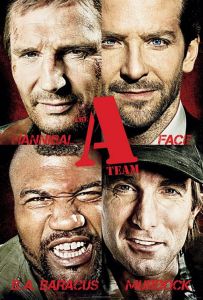 “Overkill is underrated,” quips Col. Hannibal Smith (Liam Neeson) in this big-screen adaptation of the 1980s hit TV show of the same name. And appropriately enough, like its source material, The A-Team is the very definition of mindless action. It’s completely shallow, goofy, yet over plotted and occasionally too serious for its own good, but like the A-team, the movie delivers when it counts. There is an undeniable pleasure in watching professionals work together, hatch a plan, and then watch that plan come to fruition. The A-Team is like an ADD-child because it can rarely sit still; five minutes won’t pass before something blows up. Writer/director Joe Carnahan (Smokin’ Aces) makes sure to keep things flying on screen so that the audience won’t stop and think about the multitude of plot holes and absurdities. The signature sequence that sums up the movie best is when the A-Team boys have escaped a downed aircraft by hiding inside a tank with parachutes attached. As they tumble back to earth they must try to “fly that tank” to land properly. It’s ridiculous on its face but rather entertaining. But the movie has its tongue firmly planted in cheek, even when it comes time to incorporate the show’s signature catch phrases (you could make an effective drinking game for the amount of utterances of “fool,” and, “I love it when a plan comes together”). The A-Team is overblown, silly, high-octane B-movie that obliterates your senses and thinking abilities, which means it successfully captures the spirit of the TV show.
Nate’s Grade: B-
Share this:

Taken (2009)
 From La Femme Nikita to District B13, the French know how to make a rollicking action movie, and Taken is no different. Liam Neeson plays a former covert government agent who has his daughter (Maggie Grace) kidnapped by the Parisian sex trade. He tells his daughters abductors to let his daughter go, and if they don’t he will find them and he will kill them. “Good luck,” says the abductor. And we’re off! At this point, the movie completely had me and I was ready to watch Oscar Schindler kick all kinds of ass. Having an actor of Neeson’s caliber involved in the rigorous derring-do helps ground the fantastic coincidences and leaps of logic inherent with an action movie. The action is briskly paced (the movie barely clocks in at 91 minutes) and fairly consistent, though I admit that the movie never felt like it was building in intensity, only changing locations. There’s some lip-service paid to topical issues like sex trafficking, but really Taken is all about watching Neeson karate chop dudes in the neck, which he does a lot. I started fearing for the safety of my own neck, like Neeson would jump out of the shadows and give my neck a good punch. You may need to shut your brain off at parts, but Taken is an undeniably fun experience and I look forward to the inevitable sequels (Neeson: “What, something else has been taken… from me!”). Taken is a rock-solid action movie with plenty of terrific and thrilling set pieces that pack more punch than plenty of expensive Hollywood summer capers.
Nate’s Grade: B
Share this:

The Chronicles of Narnia: The Lion, the Witch, and the Wardrobe (2005)
 I have never read one single word from C.S. Lewis’ classic children?s tales, The Chronicles of Narnia. I have never read one word from J.R.R. Tolkien’s Lord of the Rings tomes either. I read five pages in Dune and returned it to the library (50-page glossary of vernacular my ass!). I have also never read one word of any Harry Potter book, and I’m quite all right with that. I have several friends that were consumed by Lewis’ series in their childhoods and now are consumed by J.K. Rowling’s series. I don’t confess to be geek-free; I read the Shanara series by Terry Brooks when I was in junior high. I collected comic books, I watched cartoons, I still do both to an extent, but I suppose I left the fantasy genre with my appreciation for flannel all the way back in junior high (I also discovered women). Whenever I enter a fantasy film I bring with me no baggage. And so I strolled into The Chronicles of Narnia: The Lion, the Witch, and the Wardrobe ready to be entertained by a good story, whether Lewis, a big Christian theologian and author, was advancing some kind of Christian allegory or not. After seeing all 125 minutes, it’s safe to say I’ll be in line for any potential sequels.
In the heat of WWII, the Pevensie children are being transported out of London to live with a kindly professor (Jim Broadbent) on a safe rural farm. Peter (William Moseley) is the oldest and assumes the leader position vacated by their departed father. Susan (Anna Popplewell) is the brainiest, Edmund (Skandar Keynes) is the moodiest, and little Lucy (Georgie Henley) is the precocious true believer.
 One day during a game of hide and seek Lucy hides in an upstairs wardrobe. To her delight and amazement, she is transported to a magical, snow-covered realm known as Narnia. She encounters a faun, half man-half hoofed animal, named Mr. Tumnus (James McAvoy). He’s shocked to see a live human girl before his eyes and invites her for tea. There’s an old prophecy that says when two Sons of Adam and two Daughters of Eve arrive then the 100-year winter will end. The evil White Witch (Tilda Swinton), the one ruling Narnia with an icy fist, wants the humans captured and dead so she can rule forever. Lucy tells her siblings about her amazing adventures but they don?t believer her, that is, until they all tumble forth into the land of Narnia. The older kids mostly want to return home, but Edmund has sold them out by aligning with the White Witch. Now they’re on the run from her pack of wolves and the Pevensie children must seek out the powerful Aslan (voiced by Liam Neeson), a heroic lion who is all that stands in the way of the White Witch.
I declare my undying love for Tilda Swinton, truly the best character actress we have working today. Swinton already gave one bizarre yet outstanding performance this year as the androgynous angel Gabriel in Constantine (Swinton does androgyny better than anyone else; hell, she was convincing as a man and a woman in Orlando). In Narnia, Swinton exhumes a chilly command that could make you stand at attention. She’s such a hostile, icy, stone-faced villain, and Swinton has such calm confidence the whole time. She preens like a rock star and has the oversized ego to boot. She’s the kind of bad girl you could really fall in love with, especially if you have monstrous maternal issues.
The rest of the actors are mostly good. Henley steals every scene she’s in, and I’m not talking about the added attention of her suitable British choppers (my apologies to U.K. readership). Neeson seems a little bored with yet another wise teacher role just this year. I would be more interested in hearing the original voice of Aslan, the stupendous Brian Cox (Troy). McAvoy has a gentle sweetness to him.
Director Andrew Adamson integrates the flashy computer effects with surgical-like precision. Adamson?s experience as co-director for the Shrek films has given him the know-how to coordinate massive effects sight unseen and still coherently direct his live-action actors (ahem, George Lucas, ahem). The special effects in Narnia are outstanding. The characters move and behave with staggering authenticity (I know most of these creatures are mythical and have no comparison). The vistas and landscapes are beautiful, particularly the winter wonderland of Narnia. Adamson has a keen eye for visuals and lavishly recreates his visions; the climactic battle is bloodless but no less exciting.
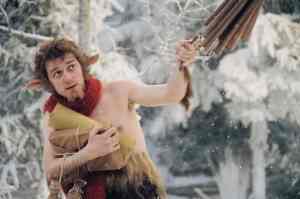 Most of the story flaws come from the source material. Narnia lacks the epic scope of the Lord of the Rings movies as well as the seriousness. As a result, no one feels very much in danger even during the more harrowing moments of battle. Lucy’s gift of “resurrection juice” kind of let’s the air out of the tension balloon. What suspense is there if a character has a magical healing elixir they can just whip out? The two girls are removed from the final battle and have little impact on its outcome. The White Witch’s tactic of freezing her enemies instead of killing them seems to be foolish, especially when they can be thawed at inopportune times. A major character’s sacrifice seems a tad superfluous if he can just reappear, lickity split like he had an extra life. Lots of secondary characters get the shrift when it comes to characterization, so you feel less than you should when something happens to them; this is even further hampered by Lucy’s Jesus Juice.
There’s a real genial sense of magic to Narnia. When little Lucy first transports to this magic realm, her face lights up in that adorable cherubic way, she wafts through the falling snow, catching it with her hands. Her moments with Mr. Tumnus are note-perfect from the dialogue, to the vocal inflections, to where the scene leads. Their relationship is very tender and provides some of the film’s best moments. Looking back, I can pick apart the movie, but while I was sitting in my theater I was deeply surprised how affected I was. I felt their fear, I felt their sorrow, and most of all I felt some sense of magic. The logic part of my brain was telling me how silly it was to see Santa Claus, let alone witness jolly ole Saint Nick handing out weapons for all the little good girls and boys (“Ho ho ho, kill ’em good for Santa.”). Yet while I watched I never questioned these things. The power of Narnia had taken full hold of me and I was swallowed whole by its tale.
Narnia is a good entry point for children in the world of fantasy. It’s suspenseful without being scary, and familiar without being too simplistic. Unlike Tolkien’s complicated worlds and heavy tales, Narnia is more a children’s story, what with the inclusion of unicorns, centaurs, fauns, and a menagerie of talking animals. There’s the suitable kid fantasy, like becoming king and fighting monsters, but there’s also a focus on family reconciliation and being accountable for your own actions. This isn’t a story that will overwhelm its audience but will leave them hungry for more adventures. The characters are mostly sketches (the leader who doesn’t want to be a leader, the overly logical one, the disaffected youth constrained by too much discipline, the little believer in the unknown), so it’s a testament to the filmmakers that the story and the characters have as much resonance as they do. The Lion, the Witch, and the Wardrobe sets up the parameters of the Narnia universe and its inhabitants and now future sequels can add meat to this bare skeleton. Narnia is a fantasy film the whole family can enjoy.
 The Christian allegories and metaphors mostly fly under the radar, with the exception of one extremely obvious scene that might make Mel Gibson wince. I even think Narnia is better enjoyed as a straight-up story than as an elaborate series of codes and messages harkening toward Christianity. If you view Narnia with the intent to break down its meaning and supplant connection to the Bible, then you’re really missing out on some great storytelling. And Narnia isn’t outwardly religious; it’s mostly a film preaching good values rather than simply good Christian values. Most of the lessons and values taught within Narnia are universally applicable to all people.
The Chronicles of Narnia: The Lion, the Witch, and the Wardrobe is a superbly entertaining retelling of C.S. Lewis’ classic children’s series. Adamson connects all the expected fantasy dots while seamlessly incorporating awe-inspiring special effects. The bountiful imagination up onscreen is the film’s biggest charm, rendering a divine touch of magic to the finished proceedings. Despite any better judgment pointing out the simplicity of the tale and characters, the production is first class and compelling. I was completely surprised how affecting I found the film and how immersed I became. This is great storytelling aided by gifted storytellers. Narnia is bigger than a family film, more accessible than a “Christian movie,” and more entertaining and endearing than most films released this year by Hollywood.
Nate’s Grade: B
Share this:

Batman Begins (2005)
 I have been a Batman fan since I was old enough to wear footy pajamas. I watched the campy Adam West TV show all the time, getting sucked into the lead balloon adventures. Tim Burton’s 1989 Batman was the first PG-13 film I ever saw, and I watched it so many times on video that I have practically worn out my copy. Batman Returns was my then most eagerly anticipated movie of my life, and even though it went overboard with the dark vision, I still loved it. Then things got dicey when Warner Brothers decided Batman needed to lighten up. I was only a teenager at the time, but I distinctly remember thinking, “You’re telling the Dark Knight to lighten up?” Director Joel Schumacher’s high-gloss, highly stupid turn with Batman Forever pushed the franchise in a different direction, and then effectively killed it with 1997’s abomination, Batman and Robin. I mean these films were more worried about one-liners and nipples on the Bat suits. Nipples on the Bat suits, people! Is Batman really going, “Man, you know, I’d really like to fight crime today but, whoooo, my nipples are so chaffed. I’m gonna sit this one out”?
For years Batman languished in development hell. Warner Bothers licked their wounds and tried restarting their franchise again and again, only to put it back down. Then around 2003 things got exciting. Writer/director Christopher Nolan was announced to direct. Nolan would also have creative control. Surely, Warner Brothers was looking at what happened when Columbia hired Sam Raimi (most known for low-budget splatterhouse horror) for Spider-Man and got out of his way. After Memento (My #1 movie of 2001) and Insomnia (My #5 movie of 2002), Nolan tackles the Dark Night and creates a Batman film that’s so brilliant that I’ve seen it three times and am itching to go again.
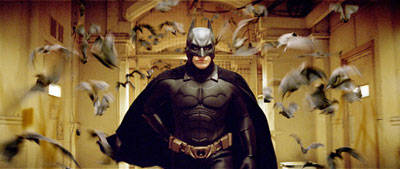 The film opens with a youthful Bruce Wayne (Christian Bale) in a Tibetan prison. He’s living amongst the criminal element searching for something within himself. Henri Ducard (Liam Neeson) offers Bruce the chance to be taught under the guidance of the mysterious Ra’s Al Ghul (Ken Watanabe), the leader of the equally mysterious warrior clan, The League of Shadows. Under Ducard’s direction, Bruce confronts his feelings of guilt and anger over his parents’ murder and his subsequent flee from his hometown, Gotham City. He masters his training and learns how to confront fear and turn it to his advantage. However, Bruce learns that the League of Shadows has its judicial eyes set on a crime ridden Gotham, with intentions to destroy the city for the betterment of the world. Bruce rebels and escapes the Tibetan camp and returns to Gotham with his own plans of saving his city.
With the help of his trusted butler Alfred (Michael Caine), Bruce sets out to regain his footing with his family’s company, Wayne Enterprises. The company is now under the lead of an ethically shady man (Rutger Hauer) with the intentions of turning the company public. Bruce befriends Lucius Fox (Morgan Freeman), the company’s gadget guru banished to the lower levels of the basement for raising his voice. Bruce gradually refines his crime fighting efforts and becomes the hero he’s been planning on since arriving home.
Gotham is in bad shape too. Rachel Dawes (Katie Holmes), a childhood friend to Bruce, is a prosecutor who can’t get anywhere when crime lords like Falcone (Tom Wilkinson) are controlling behind the scenes. Most of the police have been bought off, but Detective Gordon (Gary Oldman) is the possibly the city’s last honest cop, and he sees that Batman is a figure trying to help. Dr. Crane (Cillian Murphy) is a clinical psychologist in cahoots with Falcone. Together they’re bringing in drug shipments for a nefarious plot by The Scarecrow, a villain that uses a hallucinogen to paralyze his victims with vivid accounts of their own worst fears. Bruce is the only one who can unravel the pieces of this plot and save the people of Gotham City.
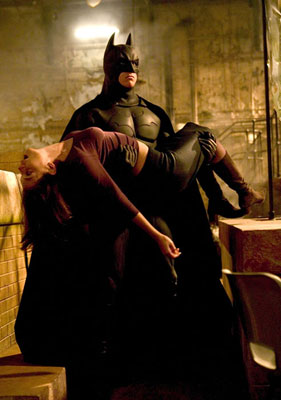 Nolan has done nothing short of resurrecting a franchise. Previous films never treated Batman as an extraordinary character; he was normal in an extraordinary world. Batman Begins places the character in a relatively normal environment. This is a brooding, intelligent approach that all but erases the atrocities of previous Batman incarnations. Nolan presents Bruce Wayne’s story in his typical nonlinear fashion, but really gets to the meat and bone of the character, opening up the hero to new insights and emotions, like his suffocating guilt over his parents murder.
Nolan and co-writer David S. Goyer (the Blade trilogy) really strip away the decadence of the character and present him as a troubled being riddled with guilt and anger. Batman Begins is a character piece first and an action movie second. The film is unique amongst comic book flicks for the amount of detail and attention it pays to characterization, even among the whole sprawling cast. Nolan has assembled an incredible cast and his direction is swimming in confidence. He’s a man that definitely knows what he’s doing, and boy oh boy, is he doing it right. Batman Begins is like a franchise colonic.
This is truly one of the finest casts ever assembled. Bale makes an excellent gloomy hero and really transforms into something almost monstrous when he’s taking out the bad guys. He’s got great presence but also a succinct intensity to nail the quieter moments where Bruce Wayne battles his inner demons. Caine (The Cider House Rules, The Quiet American) is incomparable and a joy to watch, and his scenes with the young Bruce actually had me close to tears. This is by far the first time a comic book movie even had me feeling something so raw and anything close to emotional. Neeson excels in another tough but fair mentor role, which he seems to be playing quite a lot of lately (Kingdom of Heaven, Star Wars Episode One). Freeman steals every scene he’s in as the affable trouble causer at Wayne Enterprises, and he also gets many of the film’s best lines. Oldman (The Fifth Element, Harry Potter and the Prisoner of Azkaban) disappears into his role as Gotham’s last good cop. If ever there was a chameleon (and their name wasn’t Benicio del Toro), it is Oldman. Holmes works to the best of her abilities, which means she’s “okay.”
The cast of villains are uniformly excellent, with Wilkinson’s (In the Bedroom) sardonic Chicagah accented mob boss, to Murphy’s (28 Days Later…) chilling scientific approach to villainy, to Watanabe’s (The Last Samurai) cold silent stares. Even Rutger Hauer (a man experiencing a career renaissance of his own) gives a great performance. Seriously, for a comic book movie this is one of the better acted films of the year. And that’s saying a lot.
Batman Begins is such a serious film that it almost seems a disservice to call it a “comic book movie.” There are no floating sound effects cards and no nipples on the Bat suits. Nolan really goes about answering the tricky question, “What kind of man would become a crime-fightin’ super hero?” Batman Begins answers all kinds of questions about the minutia of the Dark Knight in fascinating ways, yet the film remains grounded in reality. The Schumacher Batmans (and God save us from them) were one large, glitzy, empty-headed Las Vegas entertainment show. No explanation was given to characters or their abilities. Likewise, the Gothic and opulent Burton Batmans had their regrettable leaps of logic as well. It’s hard not to laugh at the end of Batman Returns when Oswald Cobblepot (a.k.a. The Penguin) gets a funeral march from actors in emperor penguin suits. March of the Penguins it ain’t. Nolan’s Batman is the dead-serious affair comic book lovers have been holding their breath for.
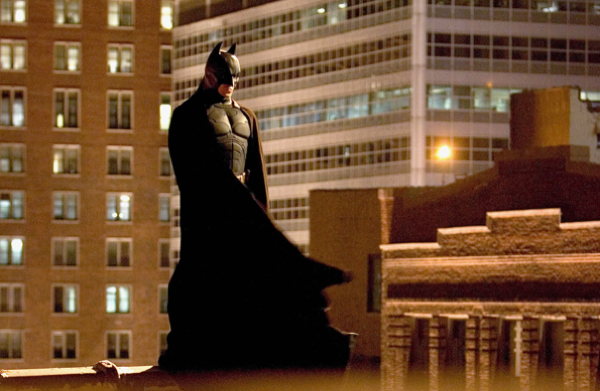 The action is secondary to the story, but Batman Begins still has some great action sequences. Most memorable is a chase sequence between Gotham police and the Batmobile which goes from rooftop to rooftop at one point. Nolan even punctuates the sequence with some fun humor from the police (“It’s a black … tank.”). The climactic action sequence between good guy and bad guy is dutifully thrilling and grandiose in scope. Nolan even squeezes in some horror elements into the film. Batman’s first emergence is played like a horror film, with the caped crusader always around another turn. The Scarecrow’s hallucinogen produces some creepy images, like a face covered in maggots or a demonic bat person.
There are only a handful of flaws that make Batman Begins short of being the best comic book movie ever. The action is too overly edited to see what’s happening. Whenever Batman gets into a fight all you can see are quick cuts of limbs flailing. My cousin Jennifer got so frustrated with the oblique action sequences that she just waited until they were over to see who won (“Oh, Batman won again. There you go.”). Nolan’s editing is usually one of his strong suits; much of Memento’s success was built around its airtight edits. He needs to pull the camera back and let the audience see what’s going on when Batman gets physical.
Another issue is how much plot Batman Begins has to establish. This is the first Batman film to focus solely on Batman and not some colorful villain. Batman doesn’t even show up well into an hour into the movie. As a result, Batman Begins perfects the tortured psychology of Bruce Wayne but leaves little time for villains. The film plays a shell game with its multiple villains, which is fun for awhile. The Scarecrow is really an intriguing character and played to gruesome effect by the brilliant Cillian Murphy. It’s a shame Batman Begins doesn’t have much time to develop and then play with such an intriguing bad guy.
Batman Begins is a reboot for the film franchise. Nolan digs deep at the tortured psyche of Bruce Wayne and come up with a treasure trove of fascinating, exciting, and genuinely engrossing characters. Nolan’s film has a handful of flaws, most notably its oblique editing and limited handling of villains, but Batman Begins excels in storytelling and crafts a superbly intelligent, satisfying, riveting comic book movie. The best bit of praise I can give Batman Begins is that I want everyone responsible to return immediately and start making a host of sequels. This is a franchise reborn and I cannot wait for more of it.
Nate’s Grade: A
Share this:

Kinsey (2004)
 Bill Condon’s probing, fascinating biopic of Indiana University sex pioneer Kinsey (Liam Neeson) could not come out at a more important time. Kinsey lived in the Dark Ages of sexuality and fought against what he saw as “morality disguised as fact.” Kinsey broke barriers studying the science of sexuality and gathered nationwide statements to amass the first thorough book on what’s under the sun and what’s going on under the sheets. Today, we live in a splintered world where people listen to information that affirms their beliefs, and tune out contradictory evidence even if it’s fact (look at the latest report on abstinence-only programs dishing out highly erroneous information). Kinsey railed against this dangerous line of thinking. The man was no saint and had issue comprehending some of the more complicated human emotions. Kinsey is exceptionally well acted and Neeson gives a career best performance. Kinsey is fearlessly graphic in its frank discussion but also enormously intelligent. The fact that conservative groups are actually protesting it shows that Kinsey’s work is far from over.
Nate’s Grade: A-
Share this:

Gangs of New York (2002)
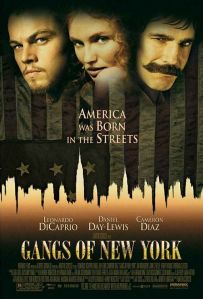 Watching Martin Scorsese’s long-in-the-making Gangs of New York is like watching a 12-round bout between two weary and staggering prize fighters. You witness the onslaught of blows, see the momentum change several times, and in the end cant really tell which fighter is victorious. This is the experience of watching Gangs of New York, and the two fighters are called Ambitions and Flaws.
The film begins in the Five Points district of 1840s New York among a vivid gang war over turf. Amsterdam (Leonardo DiCaprio) witnesses the slaying of his father, Priest Vallon (Liam Neeson), at the blade of William Bill the Butcher Cutting (Daniel Day-Lewis) and his Native Americans gang. So what does this son of a dead preacher-man do? Well he grows up, plots revenge by making a name under the wing of the Butcher becoming like a surrogate son. But will vengeance consume him?
 Watch Leo DiCaprio assemble toughs, rake heels, and ne’er do wells to his Irish gang of rapscallions with facial hair that looks to be tweezed! Witness a one-dimensional Leo suck the life out of the film like a black hole! See Leo become the least frightening gangster since Fredo. Watch the horribly miscast Cameron Diaz play pin-the-tail-on-an-accent! Witness as she tries to play a pickpocket with a heart of gold that falls hopelessly and illogically in love with Leo! Marvel how someone looking like Diaz would exist in a mangy slum! See the brilliant Daniel Day-Lewis upstage our stupid hero and steal every scene he inhabits! Witness one of the greatest villains in the last decade of movies! Watch Day-Lewis almost single-handedly compensate for the films flaws with his virtuoso performance! Admire his stove-top hat and handlebar mustache!
Witness a wonderful supporting cast including John C. Reilly, Jim Broadbent and Brendan Gleeson! Wish that they had more screen time to work with! Wonder to yourself why in all good graces this film took nearly two years of delays to get out! Speculate away!
Gangs has the sharp aroma of a film heavily interfered with by its producers. The whole exercise feels like Scorsese being compromised. Gangs is a meticulous recreation of 1860s New York that often evokes an epic sense of awe. The story has more resonance when it flashes to small yet tasty historical asides, like the dueling fire houses and the Draft Riots. But all of these interesting tidbits get pushed aside for our pedantic revenge storyline with Leo front and center. You know the producers wanted a more commercial storyline, which probably explains why Diaz has anything to do with this.
 The script is credited to longtime Scorsese collaborator Jay Cocks, Steven Zallian (Academy Award winner for Schindler’s List) and Kenneth Lonergan (Academy award nominee for You Can Count on Me). So with all these writing credentials, dont you think one of them would realize all of the dumb things going on with the story? The ending is also very anticlimactic and ham-fisted. Just watch as we segue from a graveyard to present day New York, all thanks to the Irish rockers of U2!
I know this much, Day-Lewis needs to stop cobbling shoes and act more often. Gangs is his first visit to the big screen since 1997’s The Boxer. He spent part of this hiatus in Italy actually making shoes. I don’t know about everyone else but this man has too much talent to only be acting once every five years. Somebody buy his shoes and get him a script, post haste!
Scorsese’s Gangs of New York is at times sprawling with entertainment in its historic vision and at other times is infuriating, always dragging behind it a ball and chain called stupid revenge story/love story. I’m sure the film will get plenty of awards and Oscar nods in prominent categories, and this seems like the Academy’s familiar plan: ignore a brilliant artist for the majority of their career and then finally reward them late for one of their lesser films. So here’s hoping Scorsese wins the Oscar he deserved for Raging Bull and Goodfellas.
Nate’s Grade: C+


 nathanzoebl
You must be logged in to post a comment.