Blog Archives
Killers (2010)
 Where to begin with this? It’s an action romantic comedy that can?t commit to either genre. First off, this witless rip-off of Mr. and Mrs. Smith (or Knight & Day) can?t even get on track thanks to zero chemistry between Katherine Heigl and a routinely shirt-free Ashton Kutcher. They don’t gel at all. Just because two actors can make goofy faces doesn’t mean they’ll light up the screen as a couple. Their energies do not click. Heigl emits some magic combination of elements that makes her an unusually likeable and compelling actress on screen; note, I never said good, but she’s an ace with the rom-com material. When will she start choosing better material, and movies where she gets to assert herself instead of being a ditz and the butt of jokes? The plot is absurd and the film’s tone doesn’t know how to settle down. One second it’s a jaunty, irreverent action jag, and then the next it’s trying to be some winsome romance about two people who may have rushed into marriage. Oh, and they happen to be living in a neighborhood crammed with sleeper agents all trying to kill Ashton. When you hear the reveal for why this is happening, it will seriously make you rethink the notion of “tough love.” It makes little sense in any realm of thought. The action lacks flair and sizzle, let alone minute tension, and the comedy is just as joyless. Heigl slides right into screwball mode and the film confuses an ongoing argument as characterization. The duo act so cavalier conveniently forgetting that people from all walks of life are trying to kill them at every turn, for the lamest of reasons. Why hire sleeper agents to lie and wait if you want to kill a guy? Is that really the most cost efficient policy? They don’t even get a single decent joke out of this premise. The only thing this movie kills effectively is time.
Nate’s Grade: C-
Share this:

Rampage (2009)
 When I heard that Uwe Boll was writing and directing a movie called Rampage, my thoughts immediately went to the 1980s arcade game of the same name. In the game you played as one of various classic movie monsters, like King Kong or Godzilla, and the mission was to obliterate a city building by building and avoid the military forces trying to take you down (edit: later turned into a 2018 movie starring The Rock). At first I thought there was no way that Boll could raise a budget big enough for a giant monster movie, then I paid closer attention to Boll’s Rampage and discovered it only had one cost-effective monster — man. Boll’s film revolves around a single man massacring a small town. Most surprising of all, Rampage is actually earning Boll a full slate of positive reviews. Critics have mostly taken a shine to this violent shoot-em-up, going so far as to all it Boll’s best film to date. I suppose Boll’s recent upgrade in ability he showcased with Stoic and The Final Storm raised my expectations that the prospect of a “good Uwe Boll movie” is actually a concept not just in the theoretical realms any longer. It could happen. I can honestly say that Rampage is not it.
Bill Williamson (Brendan Fletcher) is just a regular dude living at home with his parents and bouncing from dead-end job to dead-end job. That’s all about to change. Bill seems to have taken a cue from his friend Evan (Shaun Sipos), who has advocated radical measures be taken to make the world a better place. Bill has been building a bundle of arms and body armor for one mission — to kill as many people as possible in a day.
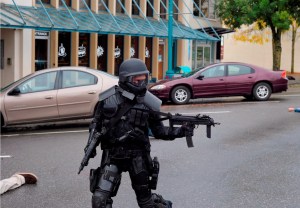 I think the movie’s main weakness is that it’s too insular. We can never free ourselves from Bill Williamson’s head (really, Boll? William Williamson? Are you even trying?). I understand that Boll tries to drop us into the psychosis of a seemingly ordinary 23-year-old burnout that snaps. To that end, Boll effectively fills the background with an mélange of chatter; short news radio bursts are strung together noting the ails of the global ails of the world. It feels like an actual peak into the anxiety-riddled skull of the main character. But this guy just isn’t that interesting. We’re never given any real insight into his thought process because Boll holds back whatever Bill really thinks until the very end, which means for the majority of the movie we’re just watching a nut in body armor. A far majority of the movie is tagging along on Bill’s killing spree, watching person after person gunned down. Is this entertainment and for whom?
Boll assembles a better thesis about what makes people grab guns and lash out than he did in 2003’s school shooter rumpus, Heart of America, which also starred Fletcher as a chief bully. But that doesn’t mean that the pieces fit together any better. Bill’s rationale is that the world is overpopulated and could use a good pruning. So everybody goes. This is a pretty weak justification, especially when you consider that he’s slaughtering the denizens of a SMALL TOWN who has plenty of room for growth. Will purposely goes out of his way to gun down the servers who irritated him the day before, thus he seeks vengeance not ideological purity. Boll at least switches spree motivations late into something a tad more consumerist, but by then it’s too late. We need outside perspectives for this story to become more than a horror highlight reel of death. This movie could have worked from a Falling Down-esque narrative divided between the man on the rampage and the man in hot pursuit. That dynamic would provide for more thrills as well as a natural good guy and bad guy designation. But Boll doesn’t want any such designation. He wants us to be uncomfortable from beginning to end, to empathize with Bill early on and become horrified about what this says about all of us. A radio broadcaster says, without a hint of irony: “I don’t know how this could happen here or anywhere?” You’re uncomfortable but not because of what Bill is doing. You never empathize with the guy because he’s a loser and pretty hotheaded. It’s because the movie is bereft of commentary that makes it uncomfortable because then the violence becomes celebratory.
Rampage is set in a small town for some sort of ham-handed message about the unpredictability of violence, but could something of this magnitude truly go down in today’s technologically saturated world (for extra sledgehammer irony, the town is called Tenderville)? I will even give some leeway that a small town has a limited number of police officers and Bill blows up the police station as his first goal, but then where are all the neighboring cops? When we live in a world where everybody owns a cell phone, and every cell phone owner is an amateur journalist, it’s somewhat preposterous that news of this magnitude would remain so isolated for so long. As soon as a crazy guy walked down the center of town and murdering everybody, you better believe that CNN would have some cell phone video up in a manner of minutes. Surely the barrage of 911 calls would have informed emergency technicians that the police station was bombed and the killer is still on the loose. Where are the neighboring communities’ police officers? Where are the helicopters? In the age of information, nobody seems able to communicate anything. And why do people have trouble locking and barricading their doors? As Bill goes window-shopping for victims all the store doors remain unlocked, allowing him easy access to blow away customers. If Rampage was set in a violence-torn area that had become eerily accustomed to the sound of gunfire then perhaps people’s initial indifference to gunfire could be explained. But remember, this is a small town for maximum intentional dramatic impact. They should be extremely responsive to the sound of continual gunfire. And these people should be packing too.
 The scheme of Bill’s coalesces in the last ten minutes of the movie, attempting to offer clarity and advance the material. Beware gentle reader, spoilers will follow, but you’ve already come this far. In the end, Bill has planned his killing spree with the intent of framing his only friend, Evan. Bill has made sure all his mail-order purchases were delivered to Evan’s home, Evan is the one with the long YouTube rants about overpopulation and people standing up to make change, and Evan’s father is a former radical from the 1960s who justified violence in the name of good causes. Of course we only learn that last bit in the film’s closing seconds because why would something like that be relevant to know beforehand, right? Bill meets his buddy in the woods for their scheduled paintball date, tazes the bastard, then stuffs a gun in Evan’s hand and has him pull the trigger to fulfill his role as patsy. The cops will think Evan has killed himself after being pursued into the woods. This is why Bill had to come back and brutally gun down an entire salon of women because he took his mask off and exposed his real face. Bill then disappears with the money.
As you expect, there are more holes to this plot than Swiss cheese. First off, there’s a noticeable height difference between Evan and Bill (Fletcher is only 5’4″ tall). Take into account different boot sizes, massive amounts of security camera footage, the registration for the cars that Bill turned into suicide bombs, the fact that the stolen bank money would now be marked, an autopsy report that would discover the stun gun wound and the awkward position for the self-inflicted gunshot wound, and the eye witnesses that must have seen Bill roaming around his neighborhood head-to-toe in his armor, never mind the fact that a massacre of this size practically guarantees the FBI’s involvement, and you’ve got so many areas for this master plan to unravel. That’s probably why Rampage ends with a post-script informing us Bill took off and has yet to be caught because somehow he’s a criminal genius.
This is Fletcher’s (Freddy vs. Jason, HBO’s The Pacific) movie and he pretty much hides behind his character’s literal and figurative mask. It’s not too hard to glower and walk with purpose, which is what Bill does for most of the movie. He doesn’t come across as overtly threatening, which is probably the point, but nor does Fletcher ever show insight into Bill’s dark recesses. He just seems like an irritable child with guns who wants to settle some scores from a bruised ego. Fletcher has acting ability but his assimilation into the Boll Players should worry anybody who wants to see that ability again (four Boll films and counting). Curiously, Katherine Isabelle, the star of the clever teen-girl-werewolf Canadian horror series Ginger Snaps, has a near cameo appearance as one of the salon workers who gets murdered. Having an actress like her play such a small character with brief screen time seems bizarre. Maybe Fletcher, as the film’s co-producer, called in a favor from his Freddy vs. Jason co-star.
 Boll’s direction pretty much gets swallowed whole by the void of his main character. Every decision seems made to suit some kind of allegorical message that never seems to materialize. The camerawork is self-consciously shaky; there’s no reason a simple family conversation over the breakfast table should look like a 9.8 earthquake is going on simultaneously. The film also has the annoying habit of jumping forwards and backwards in time for split-second edits. I couldn’t tell if these flash edits were mere foreshadowing peaks at what was to come, trying to sate a bloodthirsty audience getting antsy, or if they were small fantasies playing out inside Bill’s head, showing his violent tendencies and delicate hold on reality. Well, they were just previews for the main attraction, which makes their use hard to fathom. If Boll wanted an audience to be shocked by what was to come, why give them previews? The film would have worked better without the non-linear quirks. Boll makes sure his camera is never far away from Bill, and during stretches the camera is pinned on Bill’s face as he huffs and puffs and kills people off screen. It’s Boll’s one somewhat interesting moment of artistic restraint. Boll is improving as an action director in certain regards. Rampage has some nice stunt work and some pretty well executed explosions.
Don’t believe the steady stream of good press for Rampage. I never thought I’d have an opportunity to write these words … but Rampage does not live up to the hype. It is not Boll’s first successful movie; I’d argue that his Vietnam movie Tunnel Rats came much closer to being a good and entertaining movie. Rampage is a rather empty vehicle to watch innocents get massacred. It lacks subtext and commentary, so the violence becomes gratuitous and meaningless, which is much more uncomfortable than anything Boll intends with his narrative. Obviously, Boll has modeled his story after recent incidents like the Virginia Tech gunman in 2007. Sadly, there is no shortage of crazed gunman stories in the news to pick from. If Boll attempted to squeeze some subtext into the various proceedings, satirizing the sensationalistic media turning people into fragile, potentially-lethal time bombs, or perhaps even the allure of fame through whatever costs, even the most infamous, then maybe watching countless people get shot would at least offer some meaning. I wasn’t expecting a Funny Games dissection level of violence and voyeurism and the participation of the viewer, but I expected more than watching a dude in a suit of armor kill fleeing civilians for an hour. If that’s your idea of entertainment than perhaps you should go play a video game that rewards such behavior. Don’t worry; it’s only a matter of time before Boll transforms that into a movie next.
Nate’s Grade: C-
Share this:

The Book of Eli (2010)
 Where did the Hughes brothers go? Albert and Allen Hughes have four movies to their names, one of them a documentary about pimps, and their last flick was 2001’s From Hell. I know that Jack the Ripper thriller underperformed at the box office, starring a pre-Pirates Johnny Depp, but was it enough to throw these guys in movie jail for nine years? The Hughes brothers are talented filmmakers, first evidenced by their debut feature Menace II Society, which they wrote and directed when they were only twenty years old. I actually really liked From Hell. I get that it isn’t anywhere as complex as the source material from famous comics scribe Alan Moore, but the movie was slick, stylish, twisty and twisted and satisfying (although, Heather Graham has the worst accent in the history of movies). Where have these brothers been all this time? Nine years later, the Hughes brothers take a whack at the popular genre of the moment –Apocalyptic Cinema. The Book of Eli kind of comes across like a Hollywood version of The Road. It’s all about duplicating the look, without getting too bleak, and failing to replicate the sense of humanity in desperation. Why worry about that when you can have explosions?
It’s been 30 years since the sun scorched the Earth. Food is scarce. Gangs roam the highways. The law is a forgotten concept. Eli (Denzel Washington) is a loner heading westerly and trying to make out a meager existence. He takes the boots off a dead man, hunts emaciated cats for food, and looks for a safe shelter from the blistering sun. He struts into a dusty town looking for clean water. The town is under the rule of Carnegie (Gary Oldman), a man in search of a very specific book for his own purposes. It just so happens that Eli is in possession of this book. Eli refuses to hand over his property, speaking about his mission to transport the book to where it belongs. Carnegie sends his thugs out to kill Eli and retrieve the book. Helping Eli is Solara (Mila Kunis), a teenage prostitute who feels Eli has answers that nobody else has.
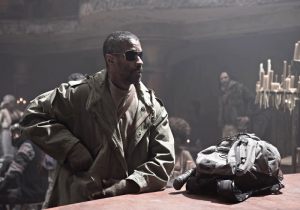 What we have here is a post-apocalyptic Western. Denzel is the lone drifter that comes into a town besieged by lawlessness or a corrupt agency of power. He even has a fight in a saloon that doubles as a whorehouse. He takes on an unlikely younger apprentice and enforces his own moral code through a series of shootouts. It just so happens that in Eli, he also has a giant machete and knows kung-fu. This is pretty strict genre stuff, mixing in apocalyptic elements for some extra flavor. The Hughes brothers give everything an ashy grimy gloss, making the most of desolate locations they shot in New Mexico (“When you need some place that looks like the end of the world, film New Mexico!”). The sparse locations and desaturated cinematography do well in establishing an unforgiving reality of the landscape.
The Hughes brothers certainly have a sense of style when it comes to the camera lens, yet they don’t approach being too self-conscious with their visuals. There’s an extended fight sequence that plays entirely in silhouette. There isn’t an overabundance of special effects in the film to clutter up the bangs and booms. There is one shootout outside a home (with Michael Gambon no less) that mimics some of the unblinking camerawork of Children of Men, swinging from side to side throughout the escalating firefight. It’s a fun visual motif that thrusts the viewer in the middle of the action. Otherwise, the action is all fairly standard stuff. It?s entertaining to watch Denzel take out a bushel of bad guys time and again, but what does that add up to with such a worn out story and half-hearted characterization? The script by Gary Whitta is heavy on apocalyptic mood and light on details. Cue more ass kicking.
Washington is stoic, almost Eastwood-like in his grit. He’s an easy antihero to root for, the reluctant avenger that manages to slice and dice his way through trouble. I won?t say this movie forces Washington to stretch his reserve of acting muscles, but it is undeniably pleasing to watch him perform his own fighting stunts. Oldman hasn’t gotten an opportunity to play a scenery-chewing villain in quite a while. Let’s face it; Evil Oldman will always overrule Good Oldman. This man was created to play sociopaths that have no ability to control the volume of their voice. This man needs a chance to bellow once every movie. Kunis proved she was a capable actress in Forgetting Sarah Marshall, but her role is fairly limited here to sidekick. She stares with her dark eyes and gets to hold a gun. That’s about it. The Hughes brothers have populated their post-apocalyptic world with familiar faces. Tom Waits is a merchant, Ray Stevenson (HBO’s Rome) as the Number One Henchman, Jennifer Beals as the blind mother to Solaris, and Gambon as a well-armed homeowner with an appetite for human flesh. That?s a good stable of actors to fill out a bunch of stock roles. It certainly makes The Book of Eli more entertaining.
The religious element doesn’t dominate the film but it does serve as food for thought. You see the book of Eli’s in high demand is actually he King James Bible. But you see, this isn’t any bible wrapped in leather with a metallic locked binding (all this for a Bible?); this is the LAST BIBLE ON EARTH. That is why Carnegie craves it. In the 30 years since the vague apocalyptic event, apparently mankind rounded up all the Bibles and burnt them, perhaps to express their displeasure with God. Eli operates on the premise that Denzel has the only Bible in the known world, which just seems downright silly. Did people search through every habitable dwelling, every library, and every hotel drawer? There have to be hidden Bibles out there. Even in this extreme setting, it seems to strain credibility to think that mankind is left with one copy of the most widely published book in the history of the world.
 Ignoring this fact, the religious element remains nebulous even though the film chronicles the journey of the Christian text. God is referred briefly but mostly the talk steers around the ideas of “faith” and “fate” and “the right path.” Eli feels he has been chosen for a special mission, and so he trudges west with his eyes on the prize. Carnegie wants to use the Bible as a “weapon” to pervert people’s faith into giving him more power. He wants to abuse religion as a motivational force to expand the reach of his control. Here’s the thing though, Carnegie has control over a town already and rules by fear. This seems to be working fine for him. So he wants to rule by love instead, using the Bible to spread the Gospel of discipleship? It’s somewhat unclear what exactly Carnegie plans to use the text for especially considering that most of the remaining population is illiterate anyway. He could just as easily hold up any book (The Da Vinci Code is shown, why not that one? It even has “code” in the title) and proclaim it the Word of God. It’s not like these people, struggling just to eat and find water, are going to question the power structure.
Not content with being a competent genre film, The Book of Eli ends on one of those ghastly twist endings that forces you to rethink everything that came before it. It doesn’t ruin the movie, but this twist certainly leads a charge toward building a counterargument toward disproving it. I won?t get into particulars but it seems unlikely that Denzel would be as good a shot as he was if the twist holds up.
The Book of Eli has its share of thrills and some interesting visual style, but there isn’t anything here you haven?t seen in hundreds of other post-apocalyptic movies. The dusty landscapes, the biker gangs, the aviator goggles, the cryptic threats, the necessity for leather as a fashion statement. This isn’t a bad movie by any means; it’s just another entry in a cluttered genre that, with our renewed fascination of the end times, is only getting more cluttered. Washington and the assortment of actors put in fine work but it’s ultimately the story that lets them down. This is a by-the-books genre flick with a touch more style courtesy of the Hughes brothers and a touch more gravitas courtesy of Mr. Washington. My advice to the human race: stock up on Bibles. Apparently, in the post-apocalyptic future, they will be more valuable than gold. Invest now while you still can. I got 15 of them and will entertain all offers.
Nate’s Grade: C+
Share this:

Let the Right One In (2008)
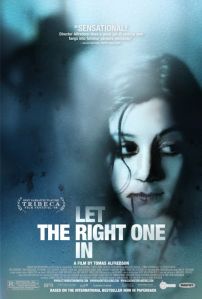 This is a pre-teen vampire love story that is miles away from Twilight folks; it’s solemn, mature, stark, violent, tense, and astoundingly ambiguous. Director Tomas Alfredson pares down the emotions and the entire film takes on a very reserved and curious atmosphere, which I feel heightens the sense of wonder and dread about a supernatural romance. The relationship between 12-year-old Oskar (Kare Hedebrant) and 12-year-old looking vampire girl Elie (Lina Leandersson) is entirely believable and constantly intriguing, as key information is doled out like breadcrumbs. Oskar is negotiating puberty and Elie is well aware of what awaits. The movie works as an example of methodical horror where emphasis is placed upon anticipation and the imagination. The climax at a community pool is one of the best film finishes of the year. I was a tense ball of nerves, and I love the movie’s closing shot. Even better, the movie works as an intriguing and intricate drama about human relationships. I can revisit Let the Right One In and dub it an unconventional and moving romance. Or I can revisit the film and dub it a melancholy examination of a manipulative and parasitic relationship, as Oskar might be doomed to a fated life like Elie’s former guardian. I can keep revisiting this Swedish horror film and discover more to discuss and diagram each time. And I didn’t need a single scene where the vampires played super hero baseball games.
Nate’s Grade: A-
Share this:

Wanted (2008)
 Wanted isn’t so much a movie as a fetish vehicle for teen males, with sexy cars, sexy guns, and sexy tatted-up Angelina Jolie, daring the predominantly male audience to decide which is sexiest (I am not a car aficionado nor a gun person, so I’ll say that Jolie easily outpaced her competition).
Wesley (James McAvoy) is a pathetic office drone that sweats out his days never raising his voice. His best friend is constantly screwing Wesley’s bitchy girlfriend, his boss constantly harangues him into panic attacks, and, saddest of all, a Google search results in nothing for Wesley Gibson’s name. He tells us he has done nothing with his life. This all changes when a mysterious woman named Fox (Jolie) tells Wesley that the father he never knew has just died. Not only that, Wesley’s father was one of the world’s greatest assassins and he might just be a chip off the old block. Wesley is recruited into The Fraternity, a thousand year-old organization whose membership includes the best-trained killers. Sloan (Morgan Freeman) is the leader who assigns the targets. He gets his orders, literally, from the Loom of Fate, a weaving loom that writes binary letters via stitches. The Loom of Fate decides whom the planet would be better off without. Fox and her cohorts train Wesley to accept his destiny and avenge his father’s murder.
 The movie fails to establish any form of internal logic or continuity, so anything preposterous suddenly becomes accessible. That means people can jump from one skyscraper to another, you can outrun a moving train, cars will do the damndest things, and that you can curve a bullet simply by rotating your hand and shutting off that little part of your brain that says, “This is defying all laws of physics.” For some reason, people are able to shoot bullets down in mid-air as a defensive maneuver but they rarely take aim at the person, surely a bigger and slower target. It’s like The Matrix outside of the Matrix with no reason for being Matrix-y. The idea is that these super assassins have super hearts that beat like 400 times faster, which pumps more blood and allows their senses to heighten. This somehow allows them to slow down time, zoom in on subjects, and react extra fast. It doesn’t make any sense but then again this is a movie where the killers are taking orders from the Loom of Fate. While I’m on the topic, really, a loom that stitches targets in binary code? Isn’t there an easier way for fate to decree who should be bumped off than someone scrutinizing the stitch work of a rug? What happens when it lists a name with more than one owner? How many “John Smiths” must be killed to secure that the correct Mr. Smith has been erased? My father thought the Loom of Fate was the most bizarre and interesting aspect of the movie.
Despite the freewheeling action, there is something decidedly depraved about fully embracing Wanted. The premise of awesome killers demands awesome carnage, and Wanted dishes out violence as an act to be savored and glorified. Wesley’s self-actualization is linked with getting better at making others suffer, and in the end the film advances a questionable message to follow suit. The movie exists in a hyper-realistic video game universe devoid of consequences. I can see future news reports of idiot teenagers playing their own deadly game of curving bullets (they may have to establish a Wanted category for the Darwin Awards). But yet the most disconcerting feature of Wanted is its dismissive nature toward human life. I’m not even talking about the assassin premise, though trained killer flicks usually work better when the pros have some sort of personal code. Wanted is a fetishistic worship of human bodies being taken apart in loving, gory detail under the auspices of being “cool.” Innocent life barely merits a half-hearted shrug. When Wesley and Fox bring their fight on board a train the eventually force the vehicle off a cliff, and the movie makes no mention of all those innocent people plummeting to their doom. That would get in the way of the film being “cool.”
With all that said, Wanted can feel like a high-octane rush to the senses. This film is soaked in adrenaline. The stunt work is astounding and the action is ramped-up to ridiculous levels. I say ridiculous because the film never establishes any form of internal logic or continuity, but I also say ridiculous because the action can be tremendously exciting and embellished with stylistic flourishes. Wanted is a slick and imaginative action movie, and the fact that it often dances with satisfaction makes me sick for enjoying it so. Summer is the perfect opportunity for empty calorie movies with style to spare, and Wanted is a five-course meal of glossy, disposable artifice. Director Timur Bekmambetov previously directed the Russian vampire films Night Watch and Day Watch, but Wanted is a giant leap forward in budget and sheer scope. Life inside this man’s head must be crazy. He takes the outlandish and makes it seem common.
 The story is rather derivative and smashes the plots of Fight Club and The Matrix together, proving that not only were screenwriters Michael Brandt and Derek Haas alive in 1999 but they were also furiously taking notes. The whole notion has been done to death, a loser who secretly harbors superior talent and ability waiting to be realized. It still proves to be a popular and mostly pleasing storyline because it taps into a universal desire to be special. Brandt and Haas aren’t so much constructing a story as they are constructing a series of eye-popping moments. There is very little substance beneath all the fireworks (stand up for yourself and slay your antagonists?). Normally I’d take issue with a film’s trashy vapidity; however, when that film happens to be so good at being so good looking.
McAvoy is rather believable when he plays the dweeb eking out a miserable existence. He knows how to play meek and anxiety-riddled while maintaining a vulnerability that stops his character from coming across as a figure of annoying inaction. He sure gets beaten up a lot and I’m not quite sure why this is supposed to make him more inclined to join The Fraternity, but then again it hasn’t stopped thousands of college males from wanting to join their own fraternities. McAvoy is less believable when he suddenly transforms into a super soldier, like a pint-sized Rambo. Jolie relies on her exceptional sex appeal in lieu of acting, which is fine with me. It’s good to see her in a role where she can fully make use of her physical talents. Freeman is essentially in the Samuel L. Jackson role and even gets a chance to drop an MF-bomb.
Wanted is a crazy cool and mostly crazy action thriller that is more than a little sick in the head. Its video game universe covets beautiful bloodshed and exquisite carnage. It’s rather depraved and morally questionable not in approach but in execution (no pun intended, well maybe). Wanted is a gory, profane, darkly humorous action movie that secretes adrenaline with every frame. The imagination on display is impressive but you may wish that it had been used for better purposes.
Nate’s Grade: B
Share this:

Smokin’ Aces (2007)
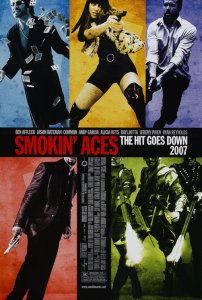 Writer/director Joe Carnahan (Narc) wants to impress an audience so bad with his muscular and macho gangster flick, but his Smokin’ Aces is vapid, nihilistic, and opines not to simply be a Tarantino rip-off, but a rip-off of a Tarantino rip-off. The premise seems ripe enough as we follow a rogue’s gallery of hitmen and killers trying to be the first to knock off a mob snitch/Vegas magician (Jeremy Piven) for a million dollar bounty. The colorful characters are introduced and some are quickly and unexpectedly taken out, but Carnahan never fully knows what to do with his bushel of baddies after he establishes their character quirks. The killers don’t really interact that much with one another and some of them hardly have any screen time at all; perhaps less would have been more in this jumbled stew. Carnahan throws out a few nifty visual tricks but it’s all superfluous and empty. Smokin’ Aces moves quickly, doesn’t make much sense in the beginning and end, and little to any of the characters have satisfying conclusions. So much of the writing feels like lame macho posturing without anything new or interesting to add to an overstuffed shoot-em-up. There are cops, robbers, plenty of gunfire, lesbians, and all sorts of convoluted twists, but it never holds together. Carnahan throws a lot of different elements together but they never extend beyond the elemental stage, so every storyline and character feels like an introduction that?s never capped off. The man has no idea what to do with what he’s started, and a karate kid on Ritalin is all the proof I need. Guy Ritchie did this territory far better service with the marvelously entertaining 2001 film Snatch. Rent that instead and save yourself the headache.
Nate’s Grade: D+
Share this:

Hannibal Rising (2007)
 People love a good villain, and is there any greater villain in modern movies than Hannibal Lector? The flesh-eating, etiquette-minded fiend was most memorably portrayed by Anthony Hopkins in the Oscar-winning Silence of the Lambs. Even though he was only in the film for a whopping 16 minutes (the shortest screen time ever for a Best Actor), Hopkins stole every second. The character has resurfaced in additional movies like 2001’s Hannibal and 2002’s Red Dragon.
The history behind Hannibal Rising is that long-time film producer Dino Di Laurentiis owns the rights to the Hannibal character and essentially told author Thomas Harris, the man behind every Hannibal book, that he was making another movie starring America’s favorite cannibal, and it was going to be a prequel set amidst his boyhood days, and he was going to do it with or without Harris. With a proverbial gun pointed at his head, Harris decided if anyone is going to ruin his character it might as well be himself. He simultaneously wrote a new Hannibal book and a screenplay for it, both tied to be released within a few short months of each other. The results are about what you would expect for an artistic venture born from people wanting more money.
 Hannibal Lector is a young kid living in Latvia. His family even has an ancestral castle but this doesn’t matter because it’s 1944 and the Germans and Russians are going at it. His father and mother are mowed down by gunfire as his family flees to a cottage in the woods for protection. Sadly, this will not be the worst thing that happens to Hannibal. A group of deserted soldiers, led by Grutas (Rhys Ifans), finds the cottage and takes refuge in it, hiding from their superiors, the ongoing battles, and the viciously cold winter. Long story short: there’s nothing to eat and the soldiers kill and eat Hannibal’s sister to survive. Flash forward to 1956, and Hannibal (Gaspard Ulliel) is a rebellious Stalinist youth. He escapes his boarding school and heads out to France to find his aunt, Lady Murasaki (Gong Li). She teaches him about the ways of the samurai and sharpens his fighting skills, because that’s what Asian people do in Hollywood movies. Hannibal is haunted by nightmares of his sister’s murder and his inability to protect her. He vows to find the current whereabouts of the men who took her from him and exact bloody revenge.
I guess when you get down to it I never needed to know the back-story to Hannibal Lector. He was such a dominating, frightening, and fascinating presence in Silence of the Lambs, someone who could worm his way inside your head and download everything he needed to know to exploit you. And yet, the man still adhered to his own set of standards, as Clarice remarked that he only ate the “rude.” He’s like a kinky literary professor. In 2005, Hannibal Lector was declared by the American Film Institute as the greatest film villain . . . ever. What I’m trying to get at is that no explanation for what made Hannibal into the demented figure he is would ever be satisfying. I don’t need to know why Hannibal is how he is, just as I didn’t need to know why Willy Wonka is; they just are. There’s also a logistical quirk: because we know this is a prequel, it means Hannibal Lector is never in any danger. He has to survive to populate more books and movies. Hannibal Rising was doomed to fail the second anxious studio execs got dollar signs in their eyes.
The film really drops the ball by turning the most unique villain in modern literature into a mere creepy kid out for vengeance. Hannibal Rising is a gloomy revenge flick dressed up to feel more astute and highbrow, but it’s nothing but a run at Charles Bronson Death Wish territory. Hannibal tracks down his sister’s killers one by one and plots his bloody revenge, and with each death the film seems to deflate. The character is given a stable of psychological devices you’d find in trashy serial killer page-turners. The fact that he remains moderately sympathetic is a testament our warm feelings for a guy that eats people. Hannibal Rising also ducks risky territory by making the marked men bastards even 10-something years later. They’re either corrupt authority figures or petty criminals; Grutas even runs a houseboat that he cycles sex slaves in and out of. Splendid. Now, it would be truly daring if the film had the courage to show these men as people trying to do right in the world, continually haunted by the choices they made to survive. That would call into question the nature of violence and forgiveness. The film even hints that Hannibal might have unknowingly eaten his sister as well. The psychological ramifications of that could be really interesting. But no, that’s too much, so what we get are a bunch of sneering stock baddies for Hannibal to systematically pick off.
 Hannibal Rising shows its agenda with one very telling scene. When young Hannibal is living with his aunt he scours through her collection of samurai art. Then one mask catches his attention and he places it against his face, and wouldn’t you know it, the mask looks very similar to the one he will eventually wear like 40 years later. Why even include this scene? In 1991’s Silence of the Lambs, Hannibal wore this famous mask for all of one scene. The filmmakers are tipping their hat at what we know with Hannibal; the film is more concerned with reminding us about our memories of a character off screen than the one that’s in the story.
Despite all these failings, Hannibal Rising still manages to be passably entertaining. I credit director Peter Webber (Girl with Pearl Earring) and actor Gaspard Ulliel. Webber keeps the pacing light for a two-hour movie and adds a fine Gothic feel with a crisp, autumn look. He tries hard to bring some art to an overly glorified revenge flick. Ulliel (A Very Long Engagement) is something of a minor revelation. He digs deep into his character and finds a perverse pleasure in his portrayal of the cinema icon. He’s scary and weird but manages to still be grossly entertaining even when he’s doing gross things. It’s the sheer power of his performance that makes the film worth watching. I didn’t see this coming from the cute, boyish lovesick kid from Engagement, but Ulliel creates a clockwork-like performance of sinister eeriness. When he glares, his eyes burning with sharp intensity, he has this little dimple on one side of his face, like a permanent mark from evil grinning. He has a terrific look to him and I’d dare say there would be plenty of surprised moviegoers that find themselves thinking Hannibal Lector is a tad sexy. Hopefully Ulliel is destined for better things after mastering English so well, something his Engagement co-star seems to still be struggling with in American movies.
There really is no reason for this movie to exist. It’s not bad by any means, it’s just entirely unnecessary. It’s passably entertaining and has some grisly gore to it but much of it is pure genre. I’m more interested with the older, wiser Hannibal than this young pup. In the pursuit of the almighty dollar, Hannibal Rising sure wants to be a tasty dish. The problem is that this dish has already gone cold.
Nate’s Grade: C
Share this:

Homeroom: Heart of America (2003)
The film spans one morning of a “normal” high school in Oregon (it looks like the school is a three-story motel). It’s the last day of school and everyone is ready to jump into the real world. The storylines are rife with every high school cliché that can be found. Drum roll please, and they are:
1) Good Virgin (Stefanie MacGillivray) is dumped by Jerky Jock (Will Sanderson) because she refuses to put out. The majority of this storyline takes place in the guy’s car where he sadistically tells her all the details of the many other girls he was “forced” to sleep with (“The whole school f*cks. Everybody except you.”). One of these girls is the transient High Girl (Elisabeth Rosen), who has fallen in love with Jerky Jock over the course of him using her for sex.
2) High Girl has no parental involvement and lots of free time. She thusly gets high a lot and trips out for most of the movie. Dealer Dude spends all day implausibly hanging around the high school with sacks of drugs to sell. He’s stopped by Idealist Guidance Counselor (Maria Conchita Alonso) who wants to make a difference.
3) Good Student apparently wasn’t good at contraceptive planning because she’s pregnant. She wants an abortion and her life back. She’s also upset with her Boyfriend who wants to keep the baby and support her but is also willing to support whatever decision she makes.
4) Mean Creative Writing Teacher (Michael Paré) gets a good talking-to by the school principal (Jurgen Prochnow). The teacher is struggling with his own writing and taking out his frustrations by being overly critical of his students’ works. His grades appear to be unfair and unprofessional. One of his students is High Girl.
5) A team of bullies regularly beat up and humiliates Barry (Michael Belyea) and Daniel, who masterminds a plot for revenge. Daniel (Kett Turton) is tormented by his abusive father (Clint Howard) who just laughs when he sees bruises and black eyes on his son. The bullies are lead by King Bully (Brendan Fletcher) who is visited by his older brother, Former King Bully (Steve Byers), who reminisces about the good ole days of beating people up because they were different. These storylines mix and match until our inevitable shoot-em-up conclusion.
 Heart of America is based on a story by Boll and written by Robert Dean Klein (Blackwoods). The plot structure is competent and the film is mildly entertaining, which was a great surprise for me. The cinematography is above average for its budget and the score is quiet and reflective. Heart of America, with all its shortcomings, is still a better movie than Gus van Sant’s school shooter opus, Elephant (I dread to see this statement on the front of a re-released DVD).
Despite all of its simplicity, Heart of America makes some boneheaded decisions. It closes with lengthy text detailing other school shooters in the previous years. The text takes away from the drama and has no significant purpose other than to say, “You’ve just watched kids shoot up their school. Here’s how some other kids did it. If you’d like to learn more, visit your local library.” Heart of America also lacks subtlety; every item that is meant to carry a message of significance is hit so hard you’ll wonder if a gong is rattling. Then again, Boll isn’t well known for subtlety. This should explain Heart of America’s aches and pains with revealing its twists and revelations.
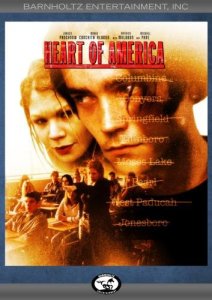
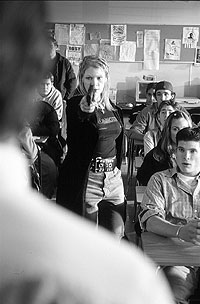
For two acts we’re led to believe that Daniel and Barry are the ones who are going to shoot up their school. Daniel IM’s his co-conspirator and reminds them not to “punk out on him.” Then minutes before the bloodbath it’s revealed that his co-conspirator is . . . another person! It’s High Girl, who takes a gun and gladly goes about killing classmates. Heart of America intentionally teases the viewer whether Barry will not follow through and this twist is intended to be something of a surprise. Trouble is someone should have told that to the DVD manufacturing folks. On the Heart of America DVD cover (as you can see for yourselves above) are the faces of Daniel and High Girl side-by-side. Superimposed over them is a list of school shooting locations that have been crossed out (it’s little wonder that Boll held back from the final one saying, “Anytown, U.S.A.”). Below all of these images is another picture of High Girl, this time standing in class and pointing an accusatory finger at some unforeseen figure. Any person intending to watch Heart of America will instantly associate High Girl with Daniel and already be thinking they’re Bonnie and Clyde. You can’t have a twist when you’re advertising it on the front cover of your DVD. Would The Sixth Sense have been as effective if the poster had Bruce Willis walking through walls like Ghost Dad (no respect to Ghost Dad intended)?
The most disturbing moment in Heart of America doesn’t even take place around the school. It involves a story Big Brother tells his bully clan about his greatest accomplishments. One of these is inviting a mentally challenged girl into his basement, getting her drunk, and then assaulting her. At first I thought it was rather unwarranted and unethical to have flashbacks of Big Bro’s story so that we can actually see the assult. Then it hit a slightly interesting juxtaposition, as Big Bro’s positive recount of his victim’s experience doesn’ match what we see happening. So I was willing to let it slide for a while until the film hit a deplorable low – a gratuitous nude scene of the mentally challenged girl (dubbed “Slow White”). You can tell it’s gratuitous too because most of the scene isn’t even shot at angles that expose her. It’s disturbing on the level that Boll was knowingly trying to shoehorn in some nudity and elicit titillation. The decision actually detracts from the power of the scene because it feels so tackily gratuitous.
 Once the end credits start to roll, the casual viewer will think two things: 1) What is that awful, tonally inappropriate pop song playing that actually has the lyrics, “The roads you made are the ones you pave,” and 2) what the hell was the message of Heart of America? In the first ten minutes or so we see teens on drugs, teens on medication, teens with no parental involvement, teens with parental abuse, and teens bullying to feel better about themselves. Do any of these things cause school violence, or is it some kind of magic combination? I never expected Heart of America to fashion a thesis on why kids grab guns and shoot up their schools but the ending feels ridiculously, artlessly devoid of meaning.
To further get into this point of discussion I will be spoiling all of the major plot lines of the movie, so in the rare instance anyone is remotely interested in watching Heart of America, scroll down. You won’t be missing much, trust me.
As expected, Daniel and High Girl get revenge primarily upon their tormentors. What I don’t get is that before High Girl sweeps into her classroom for her vengeance, she tells Dealer Dude, “I couldn’t have done it without you.” Huh? Does she mean she wouldn’t have gone to these lengths had she not be high? Or is this statement farther reaching, like blaming Dealer Dude for being apart of a system that has turned her into a degenerate drug user? I have no idea, but High Girl struts into class and kills Creative Writing Teacher, who had made fun of her and forced her to read her poetry aloud. Got it. But then she aims her pistol at Jerky Jock, whispers “I love you,” and then shoots Good Virgin to death. Apparently High Girl did not catch the news that Jerky Jock had dumped her minutes earlier. So what is the point of Good Virgin’s storyline? The only thing I can surmise is that if you don’t have sex you will be killed. If Good Virgin had given up her goodly virginity then Jerky Jock wouldn’t have been on the prowl, and he wouldn’t have used High Girl for throwaway sex, and then she wouldn’t have shot Good Virgin in jealousy. You see how this works? It’s the exact opposite of a horror movie. Daniel also shoots and kills Good Student’s boyfriend/father of her baby. What is that saying? Why couldn’t any of the shooters have clipped Patrick Muldoon’s nails-on-the-chalkboard horndog sex ed teacher? It seems Boll has a soapbox but he has nothing understandable to say.
Heart of America makes the audience not only side with the school shooters but also practically roots for them. Daniel and Barry undergo constant bullying from the get-go. The film, in its simplistic approach, plays the bullies as irredeemable assholes and Daniel and Barry are the hapless victims. Heart of America practically justifies its characters resorting to violence. Sure some innocent people get caught in the fray, but then aren’t they all to blame somehow? Again, I have no idea what Boll is trying to say.
Despite Boll having no command with actors (Muldoon is a constant reminder of this), the younger actors in Heart of America give pretty good performances. Turton (Saved!, Walking Tall) really festers with anger and discontent but also gives insights into a fragile kid just wanting to live. Belyea really works his nervous indecision to a nub, going so far as to hide his mother’s car keys so she won’t chance going to his school. Fletcher (Freddy vs. Jason) is a grinning monster as a bully but, in the film’s lone turn at character depth, also shows how uncomfortable he is being a bully. It seems that he too is just doing it to fit in. Fletcher’s pained and awkward reactions are a welcome sign of humanity, though it seems to be too little too late when we the climax hits. Rosen seems decidedly disconnected and dead-eyed scary.
 It’s puzzling that the top listed actors in Heart of America’s credits are as follows; Jurgen Prochnow, Michael Paré, Patrick Muldoon, and Maria Conchita Alonso. All four of those actors amount to about ten minutes of total screen time; Muldoon essentially has a grating cameo. Why are the kids not credited as the rightful stars of the show? The adults all give terrible performances (seriously, I cannot overstate how awful and creepy Muldoon is) but the kids are all right. The most shocking fact about the cast is that somewhere in this mix is Emmy-nominated Mad Men actress Elisabeth Moss. Look for her in here somewhere as “Robin Walters.”
Heart of America works with paint-by-numbers characters and Boll only doles out one color. The jock is a jerk. The virgin is good. The bullies are mean. The stoners are high. Very seldom does the film delve any deeper than these cursory characterizations. Because of this simplicity Heart of America strains credibility during its more unrealistic moments. At one point, King Bully and his posse force Daniel and Barry to eat dog poop and the moment is played as a defining point of drama. Does this stuff really happen? If it does then it certainly doesn’t happen often enough to be included in Boll’s depiction of a “normal” school. Then again, Boll’s idea of a normal American educational environment also involves raping mentally challenged girls. The name of the movie itself indicates how typical everything is supposed to seem.
This is a thought-provoking film, with the main thought being “What the hell is the movie trying to say?” Heart of America wades in a kiddy pool of high school clichés. The characters are paint-by-numbers and lack definition beyond their social title (Virgin, Jock, Bully, etc.). This film is awash in unresolved statements and stacks the deck so the audience will practically root for the school shooters. With no help from Uwe Boll, the younger actors are the movie’s stars and give good performances despite the limited range of their characters. You won’t know anything deeper after watching Heart of America. It’s Boll’s Big Statement Film but your guess is as good as mine as to whatever that is. Violence breeds violence? Parents need to spend more time with their kids? Don’t force kids to eat poo if they’re not ready? Heart of America is unrealistic, strained, unfocused, shallow and clumsy, and it’s also Boll’s best work to date.
Nate’s Grade: C
Share this:

Match Point (2005)
 This is an excellent return to form for Woody Allen and his best film since 1987’s Crimes and Misdemeanors. The first half is deliberately slow, yes, but it is justified by the second half which more than makes up for it. The first half needed to be as slow as it is to set up the incredible minutia of this rich, elite world that former tennis pro Chris (Jonathon Rhys-Myers) has been adopted into. We need to see how comfortable this life is to understand why he doesn’t want to give it up and why he goes through the machinations he does in the second half. The characters and dialogue are spot-on and Allen has transported his world of the upper crust New York elite so well over to London, and the change of scenery has reawakened his writing. Allen knows the privileged world very well and their disconnected view point. However, he rightly centers his film not on the neurotic upper crust but on his social climbers Chris and Nola (Scarlett Johansson), a beauty engaged to Chris’ prospective brother-in-law. It is the second half of Match Point that makes it great. Allen tightens the screws on his social climbers and the tension is superbly taut. The dark turns and in the final act are greatly entertaining, as Allen delves further into his look at a universe built around chance and disorder. The returning imagery of the ball hitting the tennis net elicited gasps from my audience, and I was one of them. I love that Allen lets his story continue to unfold after the dark twists. The film’s biggest flaw is anchoring the entire point of view on Rhys-Myers, a somewhat limited actor that reminded me of Jude Law’s character in Closer. Johansson is an excellent noir femme fatale, her husky voice perfectly suited. Frankly, if ever there was a Scarlett Johansson nude scene, this movie was crying out for it. She has her tawdry affair with Chris and there’s even a sequence where we see her laying on her stomach nude while he applies baby oil to her. Their sex is supposed to be so impassioned and carnal, in contrast to his boring but stable relationship with Chloe (Emily Mortimer). And yet no nudity? Woody Allen, you’ve let me down. Your film, on the other hand, is intelligent, sharp, dark, taut, and wonderfully entertaining.
Nate’s Grade: A
Share this:

The Matador (2005)
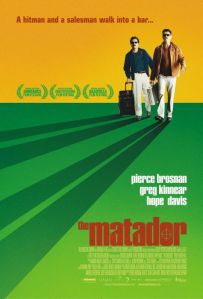 This is an adequate movie that doesn’t really resonate because at its heart it feels like a lot of interesting ideas and characters that are languished with a sitcom plot. I never thought Pierce Brosnan’s performance as the aging hit man was as funny as the film thought it was. The Matador is actually a more interesting movie than funny or amusing. The movie doesn’t go deep enough; the story isn’t as refined as it could be, and there are so few set pieces that this flick could have worked as a play. The end feels a bit too tidy and asks Greg Kinnear’s ordinary husband character to act out of character. There?s an extended talk in The Matador between Kinnear and his wife and Brosnan upon his unexpected visit, and it feels like a sitcom like the wacky neighbor next door has come over and hatched a hilarious scheme. I enjoyed the characters but they really just sit and stew in a really weak story. The characters are richly drawn but have nowhere to go.
Nate’s Grade: B-


 nathanzoebl
You must be logged in to post a comment.