Blog Archives
Child 44 (2015)
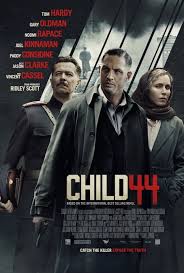 Unfairly cast out like some unwanted vermin, Child 44 is a police procedural based on a best-selling novel that the studio simply wanted to get rid of quietly. It was “dumped” into theaters and, as expected, began its disappearing act. That’s a shame, because it’s actually a rather involving mystery and an especially fascinating perspective into a little known world of being a cop on the other side of the Iron Curtain. Tom Hardy plays Leo, a member of the Soviet state police who is tracking a serial murderer preying upon orphaned children across the countryside in 1953. His wife (Noomi Rapace) is terrified of him and secretly a rebel informer. The two of them get banished to a Soviet outpost when Leo refuses to turn her in; he also refuses to accept the state’s conclusion over the dead children. In a weirdly perplexing turn, the Soviet Union believed murder was a Western byproduct. “There is no murder in paradise,” we are told several times, and since the U.S.S.R. is a communist worker’s “paradise,” whatever reality that doesn’t jibe with the party line is swept away. The murder mystery itself is fairly well developed and suspenseful, but it’s really the glimpse into this bleak and paranoid world that I found so intriguing. Child 44 is a slowly paced film thick with the details of establishing the dour existence of Soviet Union life. You truly get a sense of how wearying and beaten down these people’s lives were, how trapped they felt, how justifiable their paranoia was. The husband and wife relationship grows as they’re forced to reevaluate their sense of one another, and it genuinely becomes a meaty dramatic addition. Child 44 is a slow movie but the pacing serves the deliberate and oppressive tone of the film. It’s a film with some problems and missteps (certain antagonists make little sense in their motivations), including some incoherent action/fight scenes (fighting in the mud? Way to visually obscure everybody, guys). However, this is a better movie than the studio, and a majority of critics, would have you believe. It’s engrossing and taut and ambiguous and consistently interesting, with another standout performance by Hardy. Like many of the characters, this movie deserved a better fate.
Nate’s Grade: B
Share this:

Ex Machina (2015)
 Alex Garland is a screenwriting staple in Hollywood. He’s a science fiction specialist, adapting everything from Kazuo Ishiguro’s wrenching Never Let Me Go to the Halo movie. He’s worked with Danny Boyle, adapting his novel The Beach, and then on 28 Days Later and Sunshine. If you’ve noticed a theme with the titles, Garland tends to subscribe to a pessimistic view of human nature. And yet each film is grounded by the humanity of its characters no matter the extreme circumstances. Garland’s gift is making the fantastic grounded on a recognizable human level. Ex Machina is his latest and his directorial debut but you’d never have guessed it with how controlled and polished the film comes across. It’s a cerebral sci-fi film that haunts, enchants, and consistently engaged the imagination.
Caleb (Domhnall Gleeson) wins a corporate contest to spend a week’s vacation in the home of a reclusive Google-esque tech billionaire, Nathan (Oscar Isaac). Caleb is here to test out Nathan’s newest invention – artificial intelligence. He’s built an android woman named Ava (Alicia Vikander) and he wants Caleb to interview her.
Ex Machina throws you right into the hook within minutes, and it was mere minutes for me to get hooked. Garland does a glorious job of teasing an audience with his story and unlocking further mysteries that develop intrigue. At the start, knowing the Turing test, we’re just as interested in Ava as Caleb is, trying to figure her out and how lifelike she may be. But then the conversations start to linger and, during a brief power outage that cuts the feed to the omnipresent cameras, Ava warns Caleb that his host is not whom he thinks. As soon as the power is back and running, it’s as if the comment never happened. The pristine underground quarters have an eerie tranquility to them, almost as if Apple is designing high-end prisons. Garland’s movie becomes consumed in paranoia. Is Ava being honest? Is Nathan being honest or underhanded? What’s in some of those “off limits” rooms? What is the true test at hand? Who is the silent Asian assistant? At one point, Caleb slices open his own arm to search for circuitry, and you completely understand his reasoning. This mounting sense of paranoia and dread, tagged with Garland’s mysterious and well-developed storyline, are enough to keep your eyes glued to the screen and rapidly second-guessing and triple-guessing your shifting loyalties.
 Garland also smartly doesn’t dance around the obvious plot device of having a beautiful robotic woman, namely the inevitability of romance to bloom. What is it about android women that science fiction seems to love so much? From Blade Runner to Fritz Lang’s Metropolis, the genre loves the concept of robotic women. Perhaps this is merely a byproduct of a genre written by a majority of men, or perhaps it taps into something more unconscious about the desire to control women, or a fear of women, but that’s a conversation for another day. Ava is certainly a stunning creature, thanks to Vikander, but also from the sleek production design that makes her feel like the world’s most gorgeous Mr. Potato Head with her lycra-like skin for easy detachment. Her exposed stomach of bolts and bulbs is also a constant reminder of her “other-ness.” There’s an obviously sexual dynamic to the character, and while she’s technically nude for most of the film, watching her slip out of stockings and a dress has a strange erotic quality. Thankfully, the percolating would-be romance between man and machine actually plays a vital part throughout the script and especially with the end. There’s even a darkly comic yet disconcerting reveal about why Ava looks as she does. Is Ava capable of feelings? Is she falling for Caleb, or does she merely view him as a means to an end?
It’s essentially a sci-fi play with limited locations and three primary actors. The power is on Garland’s effortlessly engaging script, which is far more cerebral and philosophical and nuanced than you might expect from its premise. This is a film that allows its characters to breathe, to organically develop relationships and doubts. The concept of A.I. has been explored in many sci-fi stories before but Garland finds fresh resonance by paring down his story to a manageable trio. Nathan’s reclusive home is like a twenty-first century version of the haunted house and full of fun detours begging to be explored. Garland’s cinematography and production design are reminiscent of the cool artifice of David Fincher’s films. The world feels like a small step into the future but constantly unsettling. Garland’s story always has another mystery to unlock, always driving the story further as Caleb’s weeklong stay is coming to a close. Garland has a natural eye for images and composes several startling sequences that can equally evoke beauty as well as disquiet. There’s a moment where Ava passes a wall of faces as if they were simply a row of hats. Simple moments like Ava “dressing up” are given a gentle poignancy that isn’t overplayed for effect. Garland’s film is what I wanted 2014’s Under the Skin to be. Both of them are unsettling, moody, and atmospheric with striking Kubrickian imagery, but Garland’s film is less purposely oblique.
The trio of actors provides strong work, especially Swedish actress Vikander (Seventh Son, A Royal Affair). As the film is told from Caleb’s perspective, she has to find a very exact balance with her performance with elements of innocence, uncertainty, and ethereal curiosity. She’s rather placid but you always feel like there’s more just under the surface, whether it’s the ache of sentient realization or something more sinister. She’s a test subject, a captive, and a possible romantic interest. Vikander hits every right note to remain mystifying and beguiling. Gleeson (Unbroken) is becoming a go-to young actor for Hollywood. His awkwardness and enthusiasm to be part of history is an easy channel for the audience, but as Garland’s script spins along, Gleeson’s enthusiasm ebbs to concern, for Ava and then himself. The source of Ex Machina’s surprising font of humor is Isaac (A Most Violent Year) as a too cavalier tech genius. He’s so nonchalant and chummy, usually soused, that you start distrusting his amiable nature.
 It’s a shame then that the film couldn’t quite hold onto these ambiguities to the end. Garland has had third act missteps in many of his films, some tone-altering and simply losing momentum like 28 Days Later, and some as disastrous as Sunshine’s blurry slasher killer, which ruins a perfectly good-to-great sci-fi thriller. Ex Machina too exhibits its own share of third act issues, namely a confluence of contrivances with the characters. There are certain revelations you should already be suspecting giving the nature of the film, and if you’ve watched other movies before. Those reveals work in relation to Garland’s plot; however, the climax feels a bit too forced and obvious for a movie that has been, up to that point, expertly keeping the audience on its toes. Nathan spilling the beans on all the different levels of the experiment comes across not as an outlet of his character’s blasé narcissism and more a need for the script to force a confrontation. The different levels of intrigue fade away to what is a rather conventional climax that feels poorly developed and woefully inadequate for the story being told. I will credit Garland with the courage of his resolution, though, which provides deliberate decisions that cast the rest of the film in another dimension. It also feels completely right, while still allowing for Garland to work his Kubrick fetish fully to its eerie erotic ends.
Ex Machina is a hard movie to pin down because it balances various genres with delicacy, providing a little something for every sci-fi fan. It’s a well-developed mystery that constantly unravels new layers that only hooked me further, but then I was hooked from the immediacy. The relationship between the main three characters is enough to hold an entire film thanks to Garland’s scripting. I started doubting my own senses and that is a testament to Garland’s artistic vision. It’s a nice antidote to the louder bombast of Hollywood, especially with science fiction films that confuse shrill and busy with appealing and satisfying. Here is a film that doesn’t forget to entertain but respects an audience enough to take its time to properly develop its mysteries, tension, and characters. Ex Machina is a stellar debut for Garland as a director and I wouldn’t be surprised if he starts shifting more of his attention to getting back into the director’s chair. It’s not a perfect film, as it too suffers from Garland’s streak of third act troubles, but it’s a remarkably assured, sleek, and absorbing movie that gets under your skin.
Nate’s Grade: B+
Share this:

Atlas Shrugged Part III: Who is John Gault? (2014)
 Thank goodness there won’t be any more of these turgid, laborious, and insufferably awful movies that stretch the loose definitions of cinema. Atlas Shrugged Part III concludes a storyline that did not need the bloated, Peter Jackson-style treatment. Mostly because after four hours, the series still fails to justify its film existence. The production values are pretty low, the storyline consists of robotic characters spitting out ideologies rather than dialogue, and the romance between Dagny (our third actress playing the part) and Henry Reardon, which was a focal point for two movies, is casually brushed aside so Dagny can swoon with the mysterious John Gault. The needless subtitle for the film is “Who is John Gault?” and the answer is an innovator who invited the world’s richest CEOs to escape to a magic kingdom of their own. Analyze that hilarious reality. It’s an island of the 1%, but what does being experts on derivatives do when it comes to individual survival in the wilderness? Do these people plant their own vegetables, build their own homes, or do the menial labor they are not accustomed to? Where did they get the materials for all the goods for this libertarian paradise? Nothing about how this world operates makes sense. If the government, set up to be nefarious and inept, was concerned about Gault why can’t they find them with their wealth of spy resources? The entire Atlas world, transported to a near future that still relies heavily on logistics of the past, strains credulity, from the rise of rail to the idea that a copper shortage is crippling the country’s power supply. This is the kind of film where the good guys (business elites) dress in plaid and drive pickups, whereas the bad guys (government) wear suits and smoke and drink in darkly lit restaurants. This is the kind of movie where “Project F,” a nefarious torture device created by the government, is literally nothing more than a glorified car battery. Then there’s the climactic moment when Gault becomes a full-fledged messianic figure, something in sharp contrast with author Ayn Rand’s views on religion. In fact, Jesus is a prime example of self-sacrifice for the benefit of others, which conflicts greatly with the Randian viewpoint that selfishness is all humans should seek. The entire film is about cognitive dissonance, from the characters, the filmmakers, and Rand herself.
Nate’s Grade: D-
Share this:

Foxcatcher (2014)
 Haunting and engaging with great performances, Foxcatcher is a dark drama based upon real events that lead to tragedy with the United Stated Olympic wrestling team. Steve Carell immerses himself in the role of eccentric wealthy scion John du Pont, a man eager to carve out validation for himself. He bankrolls the U.S. team to train at his onsite facilities, notably assisting Mark Schultz (Channing Tatum) who is eager to get out of the shadow of his older brother (Mark Rufallo). This is a bleak drama that goes to some dark avenues but it’s not as applicable as the Cannes raves would have you believe. I was never bored but I did find the movie to be somewhat limited in scope. It’s really the life and times of a rich weirdo with a manufactured world around him thanks to his privilege. Du Pont sees himself as a mentor and a teacher, but really he’s just the guy writing the checks, and when his constructed view of reality is challenged, that’s when things get dangerous. He’s not as psychologically complex as advertised. Director Bennet Miller (Moneyball, Capote) ensures the film is overrun in dread so you anticipate that something very bad will happen, and as a result it can be something of a murky slow burn that isn’t necessarily worth the 130 minutes of wait. Foxcatcher is another example in the 2014 trend of the performances being better than the film itself. It’s an intriguing film with great performances, just don’t expect exceptional commentary.
Nate’s Grade: B
Share this:

The One I Love (2014)
 A simple yet high-concept sci-fi hook that’s nicely examined and developed for its duration, The One I Love is a relationship drama with a twist, one I won’t feel bad about spoiling considering it happens in the first 15 minutes. Mark Duplass and Elizabeth Moss play a married couple going through counseling to work out their trust issues. They head out to a resort home to spend a weekend getaway; however, whenever one of them enters the guesthouse, their spouse is magically there. Not just them but an idealized version of them, the best representation. The two explore what this means, establishing a series of rules of intimacy that of course will start to be ignored. The mystery of why this doppelganger honeymoon suite is happening is inconsequential. What matters is how our couple responds to it and the film thankfully allows this conflict to stew, maximizing its potential to explore the jealousies and insecurities of relationships. Duplass and Moss are terrific and have fun with their many iterations. The One I Love finds ways to continually surprise while still feeling grounded by its real-world application of its science fiction premise. The ending is a tad predictable but still satisfying, likely inspiring many conversations afterwards with would-be couples who watch the film. At its core, it’s an intriguing story that’s very well developed while never losing sight of its characters and their relatable nature. It’s smart, funny, and always interesting, and well worth exploring on your own when given the chance.
Nate’s Grade: B+
Share this:

Locke (2014)
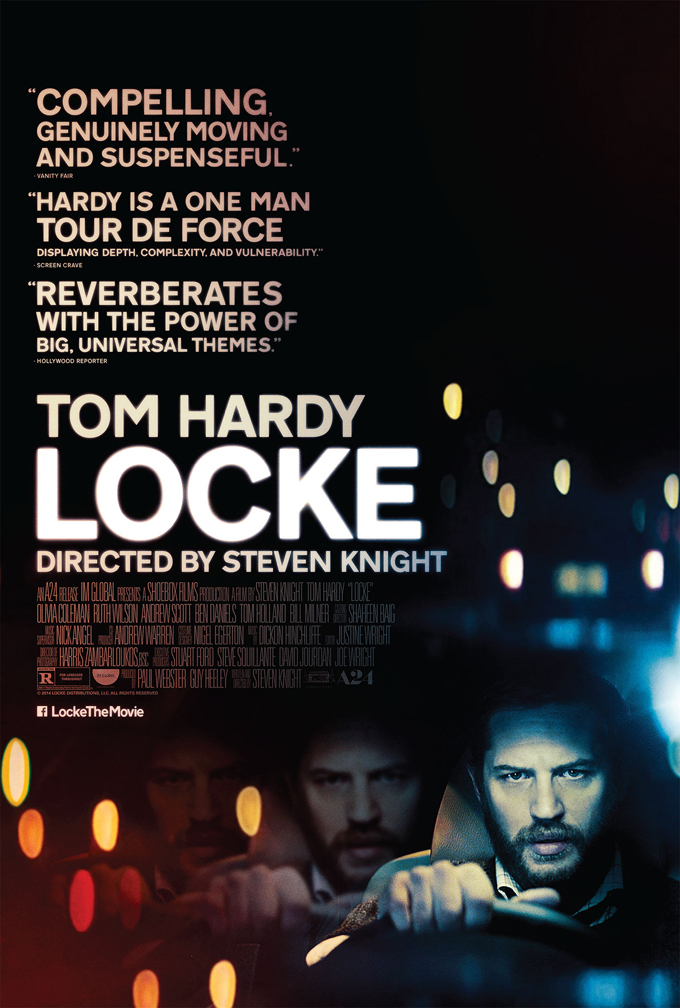 Essentially a one-man show, write/director Steven Knight’s film spends every one of its minutes inside a car with its titular star played by Tom Hardy. Over the course of one real-time late-night drive to London, our driver confronts a series of moral crossroads both personal and professional. It takes a while to get going but once the main conflicts are established, it’s a pleasure watching Hardy try and orchestrate all of them into complacency in the comfort of his car. I kept imagining how someone would translate this into an intimate stage show. The tension builds nicely as Locke has to come to terms with accepting he cannot fix his mistakes. The biggest drawback is that the film abruptly ends without much in the way of a payoff. The whole time Locke is on a mission, berating his invisible absentee father he envisions in his backseat, determined not to make the same mistakes, but then the movie just limps to a finish. It could have used another 10-15 minutes of resolution to feel more complete. Hardy is strong and keeps your attention, often offering glimpses of the complex emotions he’s trying to hide. An intriguing film experiment in minimalism, there are worse ways to spend 85 minutes than inside a car with Tom Hardy. However, there are also better ways.
Nate’s Grade: B
Share this:

Kirk Cameron’s Saving Christmas (2014)
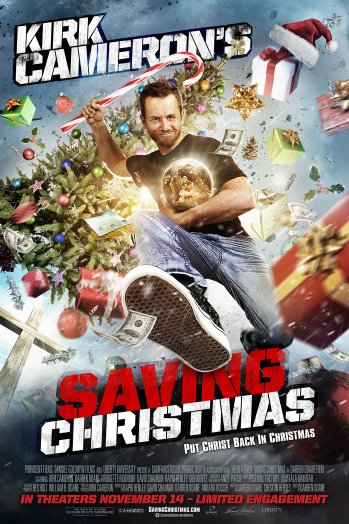
Given the title, Kirk Cameron’s prominent placement, and a poster involving Cameron with a background explosion of holiday paraphernalia, one would assume Saving Christmas would concern itself with the oft-repeated “War on Christmas.” I was expecting Cameron to lament our use of “Happy Holidays” and the like. Perplexingly, Cameron’s war is not with those outside Christianity but those within. Saving Christmas is a shoddy evangelical sermon with shoddier theology, straining to fill out a running time, and ultimately being pro-materialism and anti-empathy. Come again?
At Kirk’s (Cameron) family Christmas party, his brother-in-law Christian (Darren Doane) is a Grinch. He complains that Christmas has been co-opted by secularism. Santa Claus and other symbols with pagan origins dwarf the nativity and baby Jesus. Christian removes himself from the party and sits in his car. Kirk won’t allow this to stand. He gets inside the car and proceeds to explain why Christian is wrong about Christmas.
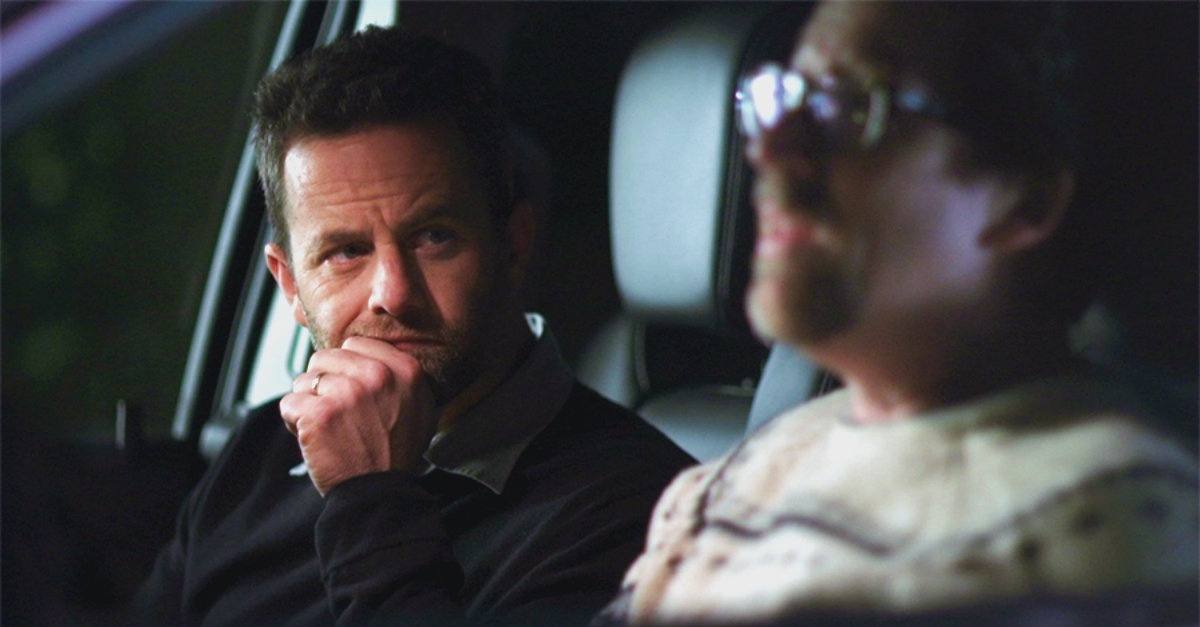
To call this a film is to be more charitable than perhaps even Jesus would be. Saving Christmas (or Kirk Cameron’s Saving Christmas as listed in certain places) is a smug sermon presented by Kirk Cameron lecturing his “bro”-in-law in a car. The majority of the film takes place in a parked car. If that sounds deeply cinematic to you, then stick with me. The film shambles its way to 80-minutes, exasperating to fill out a minimum feature-length running time. There’s about ten minutes of “hilarious” bloopers. There’s a five-minute opening where Cameron speaks directly into the camera and sips from his mug of hot chocolate three separate times. There’s a five-minute, though it feels tortuously endless, “hip hop Christmas dance” performance by a bunch of white people (it is powerfully uncoordinated, like you’re watching someone’s home movie of their kids). You do get to watch Cameron effectively do the Worm, though (his finest acting moment onscreen, in my humble opinion). There’s also the occasional, very tin-eared comedy break with supporting characters that skirt the line into stereotypes. When it all comes together, there’s maybe a total of 40 minutes of an actual movie here, laboriously stretched out. And when I say “movie” I mean Cameron and Christian talking back and forth in a stationary car. This is not a movie. At all.
Director and co-writer Doane is one of the most inept filmmakers I’ve observed. This is a horrible looking movie with many clueless edits and strange visual compositions. His onscreen wife is always seen looking wary and in slow motion, like her face has frozen. There’s also the annoying habit of not properly framing his subjects, who will get caught behind a pot of hot chocolate or some poinsettias. This is just bad filmmaking. The lighting is amateurish or overdone, like when Kirk spends about five minutes standing back-lit, as to communicate his inherently angelic nature. Doane will also keep focusing on repeating scenes like he’s filling time. The film has a very rushed and patched-together feel, as if they had a weekend to film it at Cameron’s place with his friends and family. The “comedy relief” is also terribly executed, with two characters having a conversation holding mugs to their face, the better to disguise the fact that one of them is not actually speaking his lines. The pacing is also dead. The movie keeps faking you out when it’s going to end but then continues on, overstaying its welcome so Cameron can have yet another victory lap to hear himself talk.
Cameron and his producers seem to subscribe to an all-or-nothing approach when it comes to recognizing the malleable symbolism of cultural artifacts. Is there any harm in acknowledging the past connections of certain ceremonial customs and artifacts we use today? While the origins of the Christmas tree can go back to the pagans, Cameron seems to forget to mention that it was Martin Luther who took the Christmas tree as a German holiday tradition and gave it a Christian spin. Of course acknowledging such would indicate that the Christmas tree wasn’t always the same symbol. But who cares? History is a melting pot as far as cultures are concerned, and we pick up many customs that become passed down for various reasons, often expanding and adapting. Is there any implicit harm in simply admitting that a Christmas tree has an origin that predates Christianity? Today it is a different symbol commemorating a different holiday. Just because we know history doesn’t somehow devalue our customs and traditions. Cameron and his cronies seem to disagree, which is why he presents flimsy arguments to reclaim historical authority. What he’s really doing is treating the symbols of the season as metaphors, applying deeper meaning to them. That’s fine and good. If Cameron wants to see the Christmas tree as a representation of the cross, or the trees of the Garden of Eden, that’s fine. But he shouldn’t pretend that this interpretation is gospel. That’s the thing about metaphors; they’re subjective and pliable. They are not absolute.
Amazingly, Saving Christmas ends up becoming a misguided and ludicrous defense of materialism and the commercialism attached to Christmas. In Cameron’s very narrow perspective, anything associated with the holiday has to be positive. Yes, Cameron literally argues that all the material excess and spending actually honors God. Instead of looking at the presents under the tree as just that, look at them as the outline of a skyline of a new Jerusalem, Cameron offers in one of the more head-scratching moments. He conflates the spending of money with celebration, admonishing people to buy “the biggest ham, the richest butter” as long as they just don’t “max out their credit cards.” That’s the limit he sets, so everything below that must be agreeable. Just to hammer the message home further, Cameron says that materialism is good because “Christ was made material.” That sure is a slippery slope of ethics there. It’s not much of a leap to then justify greed or to equate spending the most money with being the godliest. Why would any film, let alone a Christian one, choose to defend unchecked materialism?

I know Christian is more a foil for Cameron to helpfully inform, a straw man who cannot articulate his intellectual rationale, but Christian is the worst skeptic of all time. If he truly believed what he does then he should be able to provide evidence to support his stance. It wouldn’t be hard. The historical record is loaded with stuff ready-made to counter-argue Kirk’s cherry picking of relevant theology. The very concept of late December existing as a pagan holiday celebrating the winter solstice (Saturnalia) is backed up by a treasure-trove of sources, despite Cameron’s snide rejoinder that “last time I checked, God created the winter solstice.” The Romans would even exchange gifts on December 23 in celebration and feast. If Christian were a real skeptic, he’d at least have a cursory knowledge of this stuff before even approaching specifics. Instead he sputters and is proven to be a fraud, duped into believing these anti-Christmas thoughts. Every time Kirk finishes another of his rather unconvincing asides, Christian shakes his head, dumbfounded, and says he never looked at things like that. He is the most easily converted skeptic since the Spanish Inquisition.
I kept going back in my head to a vital point of Christian’s that is never referenced or challenged by Cameron: wouldn’t all this money better be spent helping the disadvantaged? Christian looks at the extravagant money spent on an ostentatious party and thinks of how many people could have been fed, how many wells could have been dug in villages. “You’re wrong,” Kirk says. “About everything. You’ve drunk the Kool-Aid.” Even as Cameron bends over backwards to defend materialism, he never addresses Christian’s fundamental point, which is that the money can be better spent elsewhere. To the movie’s worldview, Christian is a “jerk” and he’s “terrorizing” (I kid you not, they specifically use the word “terrorize”) his family with his negativity. This is a guy who wants to put the “Christ back in Christmas” and he’s setup as the bad guy. He’s not storming the party, aggressively challenging people, calling them names. He sits to himself, eventually leaving the space for his car. It doesn’t sound like he’s terrorizing anyone and is rather considerate of others. No matter, no one is allowed to have a different opinion than Kirk Cameron and so he will not allow one man’s empathy to bring everyone else down as they spend lavishly to celebrate the birth of a poor carpenter.
And that’s what’s most distressing for me when it comes to this poorly made and poorly reasoned movie; I’m concerned that others will use Cameron’s distorted teaching as a justification for excess over empathy. Cameron seems to use the film as a defense of his affluent privilege. He uses the Bible to back up his lifestyle and to defend materialism. Did we forget that part where Jesus said to sell all your possessions and help the poor? The film is packaged as a comedy and a family movie with a spiritually uplifting message, but what’s so uplifting about saying “SPEND SPEND SPEND” is how you show love? Just because Cameron says a nutcracker is representative of King Herod’s foot soldiers prowling Jerusalem for the baby Jesus doesn’t make it strictly so. To call this a movie would be too charitable and I am not in the season of giving. Saving Christmas is a lump of coal disguised as a open-hearted message. Skip this movie and donate your money instead to some charity. At least that will do some actual good.
Nate’s Grade: D
Share this:

Inherent Vice (2014)
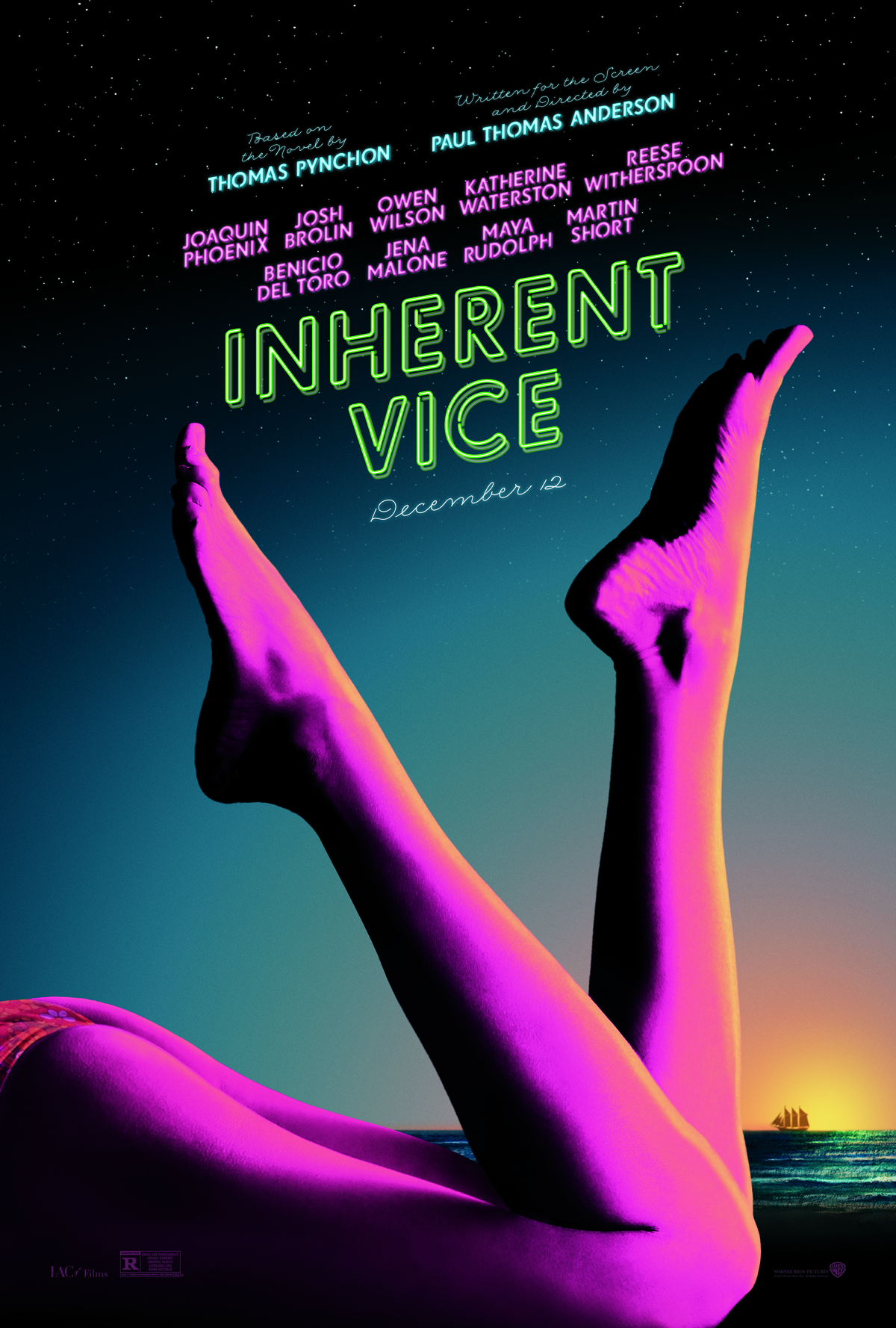 This is one of the most difficult reviews I’ve ever had to write. It’s not because I’m torn over the film; no, it’s because this review will also serve as my break-up letter. Paul Thomas Anderson (PTA), we’re just moving in two different directions. We met when we were both young and headstrong. I enjoyed your early works Paul, but then somewhere around There Will be Blood, things changed. You didn’t seem like the PTA I had known to love. You became someone else, and your films represented this change, becoming plotless and laborious centerpieces on self-destructive men. Others raved to the heavens over Blood but it left me cold. Maybe I’m missing something, I thought. Maybe the problem is me. Maybe it’s just a phase. Then in 2012 came The Master, a pretentious and ultimately futile exercise anchored by the wrong choice for a main character. When I saw the early advertisements for Inherent Vice I got my hopes up. It looked like a weird and silly throwback, a crime caper that didn’t take itself so seriously. At last, I thought, my PTA has returned to me. After watching Inherent Vice, I can no longer deny the reality I have been ducking. My PTA is gone and he’s not coming back. We’ll always have Boogie Nights, Paul. It will still be one of my favorite films no matter what.
 In the drug-fueled world of 1970 Los Angeles, stoner private eye Doc (Joaquin Phoenix) is visited by one of his ex-girlfriends, Shasta (Katherine Waterston). She’s in a bad place. The man she’s in love with, the wealthy real estate magnate Mickey Wolfmann (Eric Roberts) is going to be conned. Mickey’s wife, and her boyfriend, is going to commit the guy to a mental hospital ward and take control of his empire. Then Shasta and Mickey go missing. Doc asks around, from his police detective contact named Bigfoot (Josh Brolin), to an ex (Reese Witherspoon) who happens to be in the L.A. justice department, to a junkie (Jena Malone) with a fancy set of fake teeth thanks to a coked-out dentist (Martin Short) who may be a front for an Asian heroin cartel. Or maybe not. As more and more strange characters come into orbit, Doc’s life is placed in danger, and all he really wants to find out is whether his dear Shasta is safe or not.
Inherent Vice is a shaggy dog detective tale that is too long, too convoluted, too slow, too mumbly, too confusing, and not nearly funny or engaging enough. If it weren’t for the enduring pain that was The Master, this would qualify as Anderson’s worst picture.
One of my main complaints of Anderson’s last two movies has been the paucity of a strong narrative, especially with the plodding Master. It almost felt like Anderson was, subconsciously or consciously, evening the scales from his plot-heavy early works. Being plotless is not a charge one can levy against Inherent Vice. There is a story here with plenty of subplots and intrigue. The problem is that it’s almost never coherent, as if the audience is lost in the same pot haze as its loopy protagonist. The mystery barely develops before the movie starts heaping subplot upon subplot, each introducing more and more characters, before the audience has a chance to process. It’s difficult to keep all the characters and their relationships straight, and then just when you think you have everything settled, the film provides even more work. The characters just feel like they’re playing out in different movies (some I would prefer to be watching), with the occasional crossover. I literally gave up 45 minutes into the movie and accepted the fact that I’m not going to be able to follow it, so I might as well just watch and cope. This defeatist attitude did not enhance my viewing pleasure. The narrative is too cluttered with side characters and superfluous digressions.
The plot is overstuffed with characters, many of which will only appear for one sequence or even one scene, thus polluting a narrative already crammed to the seams with characters to keep track of. Did all of these characters need to be here and visited in such frequency? Doc makes for a fairly frustrating protagonist. He’s got little personality to him and few opportunities to flesh him out. Not having read Thomas Pynchon’s novel, I cannot say how complex the original character was that Anderson had to work with. Doc just seems like a placeholder for a character, a guy who bumbles about with a microphone, asking others questions and slowly unraveling a convoluted conspiracy. He’s more a figure to open other characters up than a character himself. The obvious comparison to the film and the protagonist is The Big Lebowski, a Coen brothers film I’m not even that fond over. However, with Lebowski, the Coens gave us memorable characters that separated themselves from the pack. The main character had a definite personality even if he was drunk or stoned for most of the film. Except for Short’s wonderfully debased and wily five minutes onscreen, every character just kind of washes in and out of your memory, only registering because of a famous face portraying him or her. Even in the closing minutes, the film is still introducing vital characters. The unnecessary narration by musician Joanna Newsome is also dripping with pretense.
 Another key factor that limits coherency is the fact that every damn character mumbles almost entirely through the entirety of the movie. And that entirety, by the way, is almost two and a half hours, a running time too long by at least 30 minutes, especially when Doc’s central mystery of what happened to Shasta is over before the two-hour mark. For whatever reason, it seems that Anderson has given an edict that no actor on set can talk above a certain decibel level or enunciate that clearly. This is a film that almost requires a subtitle feature. There are so many hushed or mumbled conversations, making it even harder to keep up with the convoluted narrative. Anderson’s camerawork can complicate the matter as well. Throughout the film, he’ll position his characters speaking and slowly, always so slowly, zoom in on them, as if we’re eavesdropping. David Fincher did something similar with his sound design on Social Network, amping up the ambient noise to force the audience to tune their ears and pay closer attention. However, he had Aaron Sorkin’s words to work with, which were quite worth our attention. With Inherent Vice, the characters talk in circles, tangents, and limp jokes. After a protracted setup, and listening to one superficially kooky character after another, you come to terms with the fact that while difficult to follow and hear, you’re probably not missing much.
Obviously, Inherent Vice is one detective mystery where the answers matter less than the journey and the various characters that emerge, but I just didn’t care, period. It started too slow, building a hazy atmosphere that just couldn’t sustain this amount of prolonged bloat and an overload of characters. Anderson needed to prune Pynchon’s novel further. What appears onscreen is just too difficult to follow along, and, more importantly, not engaging enough to justify the effort. The characters fall into this nether region between realism and broadly comic, which just makes them sort of unrealistic yet not funny enough. The story rambles and rambles, set to twee narration that feels like Newsome is just reading from the book, like Anderson could just not part with a handful of prose passages in his translation. Much like The Master, I know there will be champions of this movie, but I won’t be able to understand them. This isn’t a zany Chinatown meets Lewboswki. This isn’t some grand throwback to 1970s cinema. This isn’t even much in the way of a comedy, so be forewarned. Inherent Vice is the realization for me that the Paul Thomas Anderson I fell in love with is not coming back. And that’s okay. He’s allowed to peruse other movies just as I’m allowed to see other directors. I wish him well.
Nate’s Grade: C+
Share this:

Dom Hemingway (2014)
 Undeservingly lost in the shuffle, Dom Hemingway is a brash and wildly entertaining dark crime comedy. Jude Law is a sheer force of nature as the title character, a charismatic and garrulous criminal with no shortness of ego or volume. He’s just getting out of a 12-year jail sentence and taking stock of his life. His wife is dead, his grown-up daughter (Game of Thrones’ Emilia Clarke) hates him for his absence, and his bosses are ready to reward him for his long silence. The only person who could screw things is up is Dom, and he does, as he’s prone to impulsive fits, shouting matches, and oversized bravado. This is really a series of comic vignettes and vulgar monologues, but the writing by Richard Shepard (The Matador) is slyly hilarious, leaving me in stitches throughout (“I am not burying your body today! I didn’t bring the right shoes for it.”). The comic voice here is assured and finely attuned to the broad wavelengths the characters. It’s not exactly he colorful, cartoon criminal universe of early Guy Ritchie films, but there’s a definitely heightened atmosphere here that blends well with the manic nature of Dom. Law is bouncing off the walls; you may have to wash the spittle off your TV. But he’s compelling from his first minute onscreen to his last. The third act squeezes in a degree of emotions though by then we’ve been enjoying the depravity too much to switch focus. I don’t think the work has been put in to make Dom a three-dimensional character, but that won’t stop Dom’s film from being a blast of entertainment with swagger to spare.
Nate’s Grade: A-
Share this:

Birdman or (The Unexpected Virtue of Ignorance) (2014)
 Expecting a comedy from Mexican director Alejandro Gonzalez Inarritu would have preposterous. The man was known for his cinema verite of suffering, notably Babel, 21 Grams, Biutiful, and his best film, Amores Perros, roughly translated to Love’s a Bitch. Perhaps there isn’t much of a shift going from tragedy to comedy. Inarritu’s newest film, Birdman or (The Unexpected Virtue of Ignorance), has been wowing critics and audiences alike, building deafening awards buzz for its cast, Iarritu, and the superb cinematography, but will it fly with mainstream audiences? This may be one of the weirdest Oscar front-runners in some time.
Riggan (Michael Keaton) is an actor best known for playing the superhero Birdman in the early 1990s and walking away from the franchise. He’s still haunted by that role (sometimes literally) and struggling to prove himself as an artist. He’s brokered all his money into directing, adapting, and starring in a theatrical version of Raymond Carver’s short story, “What We Talk About When We Talk About Love.” The show is in previews and about to open its run on Broadway but it’s already got a rash of problems. The leading man needs to be replaced immediately. The supposed savior is famous actor Mike (Edward Norton), an undeniably talented but temperamental actor who pushes buttons to find some fleeting semblance of “truth.” Mike’s girlfriend, Lesley (Naomi Watts), is growing tired of his antics and desperate for her own long-delayed big break. Laura (Andrea Riseborough) is Riggan’s “girlfriend” and co-star and may be pregnant. Sam (Emma Stone), Riggan’s personal assistant and also his detached daughter, is fresh from rehab, and spiteful against her neglectful dad. Toss in Riggan’s best friend/manager/play producer (Zach Galifianakis), Riggan’s ex-wife (Amy Ryan), and a feared theater critic (Lindsay Duncan) who is determined to kill Riggan’s show to send a message to the rest of Hollywood polluting the integrity of the theat-tah. Oh, and throughout all this, Riggan hears an ominous voice that alternating encourages him and humiliates him.
 It’s an industry satire, a bizarre comedy, a father/daughter drama, an examination on identity and the complicated pulls of affection and admiration, and a stunning virtuoso technical achievement. As a movie, Birdman is hard to pin down or categorize. It’s a movie that you definitely need to experience on your own rather than have described (don’t stop reading, come back…), and that is a reason enough to see the film, a rare aspect among modern movies. It’s an artistically offbeat movie and yet it ultimately is about one has been actor looking back on his career and coming to terms with his own impact with pop-culture, art, and his family. It’s about a man struggling to find his place in his own life, beset at all odds by doubters and traitors and obstructionists. The refreshing aspect about Riggan is that he’s a has-been but not a sad sack; he’s fighting from the beginning, sometimes pathetically and sometimes in vain, but the man is always fighting to regain his dignity, to reclaim his life’s narrative, and to fight for his legacy. Riggan, after all, set the stage for the modern superhero industry that currently dominates Hollywood bean counters. He was too just soon, and the parallels with Keaton (Batman) are superficially interesting but there’s more of an original character here than a reflection of the actor playing him. He’s neurotic, egotistical, hungry, and fighting for respect, like many actors, and the film flirts with the façades people inhabit. Many of the characters are emotionally needy, desperate for validation wherever they can find it.
Another strength of the film is that it finds a moment for each of its talented ensemble players to shine, chief among them Keaton. The actor hasn’t had a showcase like this in some time and he is a terrific guiding force to hold the entire story together. Whether it’s marching in his tighty whities or working through his complicated degrees of neuroses, Keaton is alive in a way that is electrifying. We see several highs and lows over the course of two hours, some moments making us cheer on Riggan and others making us wince, but he comes across more like a person than just the butt of a joke. It’s also just fun to watch him adopt different acting styles when he steps on stage, including one early on where he’s purposely too stilted. It’s so comforting to watch Norton (The Grand Budapest Hotel) get to be great again, not just good but great. Early on, you see the appeal of Mike, his allure, and Norton keeps pushing the audience, as well as the characters, back and forth with his wealth of talent. Stone (Amazing Spider-Man 2) spends most of the film as the sulky daughter but she gets to uncork one awesomely angry monologue against her loser dad. The thawing father/daughter relationship ends up supplying the film with its only degree of heart. Watts (The Impossible) is comically frazzled for the majority of her time but gets a memorable character beat where she breaks down in tears, realizing her dream of “making it” might never materialize. Riseborough (Oblivion) also has moments where he sadness and vulnerability cut deep. The supporting characters aren’t terribly deep but they all have a moment to standout.
It’s a decidedly offbeat film that dips into the surreal though never dives completely inside. The movie is rather ambiguous about whether or not the fantastical flourishes are a result of Riggan being mentally ill, or at the least overtaxed with stress. Is there really a Birdman or is it a voice in his head, a manifestation of his ego or a ghost to remind him of the past when he was a star? Does Riggan really have the powers he seems to believe he does, including the ability to make objects move with his mind? Innaritu playfully keeps the audience guessing, treating the bizarre in an offhand manner reminiscent of magic realism. The bizarre embellishments blend smoothly with the film’s darkly comic tone. It’s a funny movie but one that you laugh at between clenched teeth.
 Is it all the unblinking camerawork a gimmick? I don’t think so. While the story can engage with its weirdness and surreal unpredictability, the long tracking shots bring a heightened reality to the unreal, they bring a larger sense of awe to the proceedings, watching to see the magic trick pulled off to the end. If anything, it’s an extra thrill to the script and greatly compounds the artistic audaciousness of the film, but I think it also channels the live-wire energy of theater, of watching actors have to walk that tightrope of performance and blocking, weaving together to pull off the ensemble. It makes the film medium feel more like live theater. Thematically I think the style also connects to the anxious mentality of Riggan. In the end, I don’t truly care that much whether it’s a gimmick or not (though I vote it is not) because the camerawork is rapturous. Made to resemble an entire two-hour tracking shot, it is a joyous thrill to watch these technical wizards do their thing, to watch the best in the business perform a visual magic trick over the duration of two hours. Even if you don’t care for the overall movie you can at least be entertained by the imaginative and thoroughly accomplished cinematography by Emmanuel Lubezki, fresh from his Oscar for Gravity and who should be clearing shelf space for the next bushel of awards he’s destined to win with this film. It’s an intoxicating experience to behold, though the film is structured into 10-minute or so chunks for feasibility. If you want to watch a real cinematic magic trick, check out the film Russian Ark, which is an entire movie, performed in one uncut single tracking shot.
I’m still wrestling with the debate over whether Birdman is an artistically ambitious romp or a truly great movie. Much like the characters in the film, I’m wrestling with whether I have confused my admiration with adoration. It’s a movie that I feel compelled to see a second time, and maybe a third, just to get a handle on my overall thoughts and feelings. That may be a sign that Birdman is a film for the ages, or maybe it’s just a sign that it’s not as approachable and denied a higher level of greatness by its obtuseness. Inarritu’s surreal showbiz satire is plenty entertaining, darkly comic, and a technical marvel thanks to the brilliant camerawork. The percussion-heavy musical score is another clever choice, naturally adding more urgency and anxiety to the proceedings. Birdman is a strange and beguiling movie, one that deserves to be seen, needs to be experienced, and stays with you rolling around in your brain. That sounds like a winner to me.
Nate’s Grade: A


 nathanzoebl
You must be logged in to post a comment.