Blog Archives
Millions (2005)
 This movie feels like someone is projecting straight from the bountiful imagination of a child. It’s wildly whimsical and fantastical; it’s a fantasy film and a family film that never falters into treacle. Director Danny Boyle (Trainspotting) of all people has crafted a masterful living fantasy with great emotional heft. I was left very teary by the end and have remained so with repeat viewings. Millions has great visuals, great acting, and is a great movie.
Nate’s Grade: A
Share this:

Charlie and the Chocolate Factory (2005)
 The visuals by Tim Burton are suitably lavish but it’s missing the heart of the 1971 film. I never thought I’d say a movie worked despite Johnny Depp’s performance, but that’s the case here. It was far too off. Whereas Gene Wilder had the dichotomy of warmth and madness, Depp was just the kooky Michael Jackson-esque weirdo in a bobbed haircut (I thought Neverland had been found). Perhaps the added Michael Jackson vibe makes the premise a lot darker, what with luring children into a chocolate factory. Charlie is a really boring character lacking definition beyond his “goodness.” Once they get to the factory he?s basically wallpaper, watching his peers fall one by one to their vices. I’m not sold on a Wonka back-story. I don?t need to know why he is as he is; I need no tormented childhood and daddy issues. This new film has more polish but the old film has more togetherness and lasting power.
Nate’s Grade: B-
Share this:

Corpse Bride (2005)
 Not as good as Nightmare Before Christmas, but really, what can be? Tim Burton second stop-motion animated film is beautifully crafted and emotionally involving. It’s interesting because all three characters in the movie’s love triangle have really done nothing wrong, and our sympathies are stretched to all three. The contrast of the world of the living (drab, formal) and the dead (colorful, lively) is stark, and death in Corpse Bride is presented as simply another stage of living. Therefore, you don’t have to worry about scaring the kids with this one. The ending is a bit too conventional and the songs are all lackluster, nothing ever as remotely hum-able as Danny Elfman’s masterpieces in Nightmare Before Christmas. Despite the unfair comparisons, Corpse Bride is easy on the eyes, amusing, and nicely romantic.
Nate’s Grade: B
Share this:

Harry Potter and the Goblet of Fire (2005)
 I’m really liking how much more mature this series gets as it goes. I’m also enjoying the fact that they’ve had two talented directors in a row with, surprise, artistic vision. Harry Potter 4 isn’t the best film as far as plot is concerned (if they needed Potter’s blood could they not have done this at any time?). It is, however, the best as far as character, turning near every scene into an awkward coming of age moment. The movie is far more comical than the rest; seriously, nearly every scene has some comedic underpinning. The emergence of the Dark Lord (a nasally-challenged Ralph Fiennes) is creepy, and the series gets better as its outlook gets darker.
Nate’s Grade: B
Share this:

King Kong (2005)
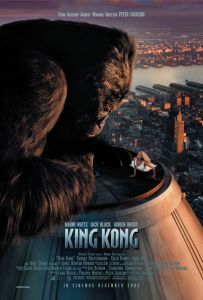 Has there been any movie this year that’s had a bigger hype machine than Peter Jackson’s King Kong? Coming after his Lord of the Rings trilogy, about two billion in revenue and a slew of Oscars in tow, Jackson decided to recreate the movie that captured his imagination as a child. It was King Kong that made Jackson want to become a filmmaker, so now he is returning the favor. Universal ponied up a staggering 200 million dollars for a budget and paid Jackson a record 20 million to sit in the director’s chair. Like his Rings series, this Kong clocks in at a gargantuan 3-hour running time. Will audiences share Jackson’s adoration with the story of a woman, a big ape, and a bigger building?
Carl Denham (Jack Black) is a filmmaker feeling studio pressure. The suits want to reel him in before he even starts shooting his next picture. Carl scrambles to get his crew and equipment onto a boat before the studio can shut him down. He?s on the prowl for a new lead actress and spots Ann Darrow (Naomi Watts), a hungry out of work vaudeville actress. He quickly convinces her to be apart of his movie and hurries her aboard, the selling point being that Jack Driscoll (Adrien Brody) has written the story. Carl practically kidnaps Jack and they all set a course for the mysterious Skull Island, a place only rumored to exist. The ship’s captain and crew are wary but sure enough their vessel washes ashore on an exotic island. But this is no sunny getaway, as the crew is immediately besieged by hostile natives and Ann is taken prisoner and offered as a sacrifice to Kong, a 25-foot gorilla. Jack leads an expedition to retrieve Ann, who begins to bond with her hairy captor (Stockholm syndrome, anybody?). Kong rescues Ann from dangers, be it bug or dinosaur, but flies into a vicious rage when she’s plucked away from him. Carl realizes an even bigger attraction: a giant ape to headline Broadway and line his own pockets. His schemes come true as Kong is knocked out and transported back to New York City. However, no stage is too great for Kong, as he busts free and looks all over for the love of his life, Ann.
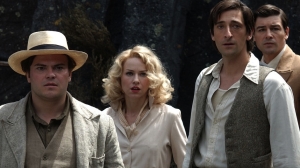 The sweet love story gives Jackson’s update a surprising emotional richness. In the 1933 original, Fay Wray never stopped shrieking until the big guy toppled off the Empire State building. She had no emotional connection to her furry captor and his unrequited love. In the 2005 King Kong, the strength of the movie is the relationship between Ann and Kong. Jackson of course stacks the deck of his story to all but guarantee an audience will fall in love with the big brute (he appreciates sunsets, how romantic!). There?s not much choice whether or not to sympathize with Kong, especially those moments where we stare into his soulful eyes welling up with emotion. King Kong has always been a tale of exploitation with man as the true monster. By administering time to fully develop a convincing relationship between beauty and beast, it makes the later scenes of exploitation have a larger sense of tragedy. Immense credit goes to Watts for selling this relationship and spurring our sympathy for Kong, instead of making their bond something for snickers and eye-rolling. Poor Adrien Brody though. It’s pretty bad in a romantic triangle when you’d rather pick a giant primate than Brody.
The performances go a long way to adding to the enjoyment of King Kong. Watts is a luminous actress and a natural beauty. It’s because of her that the second half of the movie has a beating heart and some kicks to the gut. Brody is ho-hum but given little to work with as a, wait for it, second banana. Black works wonders to make his villainous role so charismatic. Denham is a huckster that would step over his dying mother to make a buck, and yet Black’s charming and funny even at his most dastardly and cowardly. I don’t think King Kong would have worked the same with different actors; few could bring the heart and emotion Watts emotes, and few could bring Black’s comic virtuosity that makes it plausible why others would follow his showman character. Colin Hanks (also along side Black in Orange County), as Denham’s assistant, imparts a favorable impression. I’d like to see him paired up with Topher Grace sometime. Give it some consideration, Hollywood.
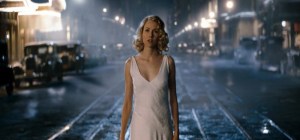 King Kong is a spectacular vision by one of cinema’s greatest visionaries. Jackson has lavishly recreated the excitement of his youth, bringing the story of Kong into the modern age with studly panache. The film is marvelously beautiful to take in and has plenty of moments that will reawaken the child within you, transporting you to an age when movies truly seemed larger than life. During the epic battle between Kong and the T. Rexes, I knew the exact curiosity and excitement Jackson felt when he saw the 1933 original. The action is intense and rarely lets up once our adventurers reach Skull Island. The special effects are some of the best movies have ever seen. Kong moves with expressive accuracy that goes a long way toward expressing his humanity, whether it is in a sigh or a tantrum. Andy Serkis has yet again brought life to another entirely CGI character. King Kong is well worth the price of admission just to sneak a peek at the Jackson’s limitless imagination.
With Jackson’s beefed-up recreation, he has also brought with him a terrible amount of bloat. This King Kong runs a frightful 3-hours plus, and most viewers will just feel exhausted by the time the lights go back up in their theater. Jackson’s love affair with his material is indisputable but it also seems to cloud his judgment as far as pacing is concerned. Numerous scenes seem to stretch longer than necessary and lose their point of interest, the first hour seems too drawn out and prosaic, and the movie haphazardly mixes in the serious with the soapy (Kong on ice?). Some scenes lose their sense of believability the longer they stretch on, even in a movie filled with giant monsters. Certain subplots have set-up but no follow-through, like all the added attention to Jimmy (Jamie Bell), the ship’s teen that wants to experience danger too. Jackson even makes sure we catch that he’s reading Heart of Darkness. So where does this character go? Nowhere and very slowly at that. The character has no bearing on anything that happens with the plot and is dropped entirely once they leave the island. There’s no point. Did something get cut from the inevitable 8-hour extended edition DVD that will prove how pivotal Jimmy really was? I doubt it.
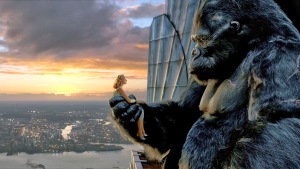 Some nipping and tucking and a comprehensive editing overhaul would certainly make King Kong a better movie, but it would lose its sense of spectacle. I can’t complain about length too much since Jackson packs such a wallop of entertainment like few others, so while King Kong certainly is a bloated and exhaustive film, it’s also an artistically bloated, exhaustive film. Jackson sure does have reverence for his source material (some lines and scenes are directly lifted), though he may have overlooked the 1933 King Kong‘s 100-minute running time.
Peter Jackson’s King Kong is an epic, epically grandiose, epically imaginative, epically action-packed, and epically bloated. The update is a bit exhausting but Jackson packs more entertainment per minute than few others in the film business, even if he has too many minutes to work with. Watts really sells her tender relationship with Kong and gives the film a surprising emotional heft absent from the 1933 original. Because of our emotional investment the film has a greater sense of sadness and tragedy as it plays out. King Kong was the 800-pound gorilla of the movie year and Jackson knows how to deliver a visual epic, even if he tiptoes into self-indulgence. While I can protest the length, pacing, and some subplots that go nowhere or strain credibility, it’s hard to argue that King Kong is the popcorn spectacle of the year. Your bladder may hate you by the end of it but you won’t want to miss a second.
Nate’s Grade: B
Share this:

The Chronicles of Narnia: The Lion, the Witch, and the Wardrobe (2005)
 I have never read one single word from C.S. Lewis’ classic children?s tales, The Chronicles of Narnia. I have never read one word from J.R.R. Tolkien’s Lord of the Rings tomes either. I read five pages in Dune and returned it to the library (50-page glossary of vernacular my ass!). I have also never read one word of any Harry Potter book, and I’m quite all right with that. I have several friends that were consumed by Lewis’ series in their childhoods and now are consumed by J.K. Rowling’s series. I don’t confess to be geek-free; I read the Shanara series by Terry Brooks when I was in junior high. I collected comic books, I watched cartoons, I still do both to an extent, but I suppose I left the fantasy genre with my appreciation for flannel all the way back in junior high (I also discovered women). Whenever I enter a fantasy film I bring with me no baggage. And so I strolled into The Chronicles of Narnia: The Lion, the Witch, and the Wardrobe ready to be entertained by a good story, whether Lewis, a big Christian theologian and author, was advancing some kind of Christian allegory or not. After seeing all 125 minutes, it’s safe to say I’ll be in line for any potential sequels.
In the heat of WWII, the Pevensie children are being transported out of London to live with a kindly professor (Jim Broadbent) on a safe rural farm. Peter (William Moseley) is the oldest and assumes the leader position vacated by their departed father. Susan (Anna Popplewell) is the brainiest, Edmund (Skandar Keynes) is the moodiest, and little Lucy (Georgie Henley) is the precocious true believer.
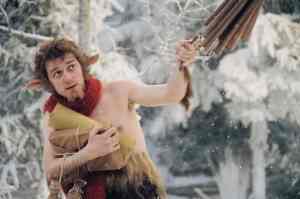
 One day during a game of hide and seek Lucy hides in an upstairs wardrobe. To her delight and amazement, she is transported to a magical, snow-covered realm known as Narnia. She encounters a faun, half man-half hoofed animal, named Mr. Tumnus (James McAvoy). He’s shocked to see a live human girl before his eyes and invites her for tea. There’s an old prophecy that says when two Sons of Adam and two Daughters of Eve arrive then the 100-year winter will end. The evil White Witch (Tilda Swinton), the one ruling Narnia with an icy fist, wants the humans captured and dead so she can rule forever. Lucy tells her siblings about her amazing adventures but they don?t believer her, that is, until they all tumble forth into the land of Narnia. The older kids mostly want to return home, but Edmund has sold them out by aligning with the White Witch. Now they’re on the run from her pack of wolves and the Pevensie children must seek out the powerful Aslan (voiced by Liam Neeson), a heroic lion who is all that stands in the way of the White Witch.
I declare my undying love for Tilda Swinton, truly the best character actress we have working today. Swinton already gave one bizarre yet outstanding performance this year as the androgynous angel Gabriel in Constantine (Swinton does androgyny better than anyone else; hell, she was convincing as a man and a woman in Orlando). In Narnia, Swinton exhumes a chilly command that could make you stand at attention. She’s such a hostile, icy, stone-faced villain, and Swinton has such calm confidence the whole time. She preens like a rock star and has the oversized ego to boot. She’s the kind of bad girl you could really fall in love with, especially if you have monstrous maternal issues.
The rest of the actors are mostly good. Henley steals every scene she’s in, and I’m not talking about the added attention of her suitable British choppers (my apologies to U.K. readership). Neeson seems a little bored with yet another wise teacher role just this year. I would be more interested in hearing the original voice of Aslan, the stupendous Brian Cox (Troy). McAvoy has a gentle sweetness to him.
Director Andrew Adamson integrates the flashy computer effects with surgical-like precision. Adamson?s experience as co-director for the Shrek films has given him the know-how to coordinate massive effects sight unseen and still coherently direct his live-action actors (ahem, George Lucas, ahem). The special effects in Narnia are outstanding. The characters move and behave with staggering authenticity (I know most of these creatures are mythical and have no comparison). The vistas and landscapes are beautiful, particularly the winter wonderland of Narnia. Adamson has a keen eye for visuals and lavishly recreates his visions; the climactic battle is bloodless but no less exciting.
 Most of the story flaws come from the source material. Narnia lacks the epic scope of the Lord of the Rings movies as well as the seriousness. As a result, no one feels very much in danger even during the more harrowing moments of battle. Lucy’s gift of “resurrection juice” kind of let’s the air out of the tension balloon. What suspense is there if a character has a magical healing elixir they can just whip out? The two girls are removed from the final battle and have little impact on its outcome. The White Witch’s tactic of freezing her enemies instead of killing them seems to be foolish, especially when they can be thawed at inopportune times. A major character’s sacrifice seems a tad superfluous if he can just reappear, lickity split like he had an extra life. Lots of secondary characters get the shrift when it comes to characterization, so you feel less than you should when something happens to them; this is even further hampered by Lucy’s Jesus Juice.
There’s a real genial sense of magic to Narnia. When little Lucy first transports to this magic realm, her face lights up in that adorable cherubic way, she wafts through the falling snow, catching it with her hands. Her moments with Mr. Tumnus are note-perfect from the dialogue, to the vocal inflections, to where the scene leads. Their relationship is very tender and provides some of the film’s best moments. Looking back, I can pick apart the movie, but while I was sitting in my theater I was deeply surprised how affected I was. I felt their fear, I felt their sorrow, and most of all I felt some sense of magic. The logic part of my brain was telling me how silly it was to see Santa Claus, let alone witness jolly ole Saint Nick handing out weapons for all the little good girls and boys (“Ho ho ho, kill ’em good for Santa.”). Yet while I watched I never questioned these things. The power of Narnia had taken full hold of me and I was swallowed whole by its tale.
Narnia is a good entry point for children in the world of fantasy. It’s suspenseful without being scary, and familiar without being too simplistic. Unlike Tolkien’s complicated worlds and heavy tales, Narnia is more a children’s story, what with the inclusion of unicorns, centaurs, fauns, and a menagerie of talking animals. There’s the suitable kid fantasy, like becoming king and fighting monsters, but there’s also a focus on family reconciliation and being accountable for your own actions. This isn’t a story that will overwhelm its audience but will leave them hungry for more adventures. The characters are mostly sketches (the leader who doesn’t want to be a leader, the overly logical one, the disaffected youth constrained by too much discipline, the little believer in the unknown), so it’s a testament to the filmmakers that the story and the characters have as much resonance as they do. The Lion, the Witch, and the Wardrobe sets up the parameters of the Narnia universe and its inhabitants and now future sequels can add meat to this bare skeleton. Narnia is a fantasy film the whole family can enjoy.
 The Christian allegories and metaphors mostly fly under the radar, with the exception of one extremely obvious scene that might make Mel Gibson wince. I even think Narnia is better enjoyed as a straight-up story than as an elaborate series of codes and messages harkening toward Christianity. If you view Narnia with the intent to break down its meaning and supplant connection to the Bible, then you’re really missing out on some great storytelling. And Narnia isn’t outwardly religious; it’s mostly a film preaching good values rather than simply good Christian values. Most of the lessons and values taught within Narnia are universally applicable to all people.
The Chronicles of Narnia: The Lion, the Witch, and the Wardrobe is a superbly entertaining retelling of C.S. Lewis’ classic children’s series. Adamson connects all the expected fantasy dots while seamlessly incorporating awe-inspiring special effects. The bountiful imagination up onscreen is the film’s biggest charm, rendering a divine touch of magic to the finished proceedings. Despite any better judgment pointing out the simplicity of the tale and characters, the production is first class and compelling. I was completely surprised how affecting I found the film and how immersed I became. This is great storytelling aided by gifted storytellers. Narnia is bigger than a family film, more accessible than a “Christian movie,” and more entertaining and endearing than most films released this year by Hollywood.
Nate’s Grade: B
Share this:

Zathura (2005)
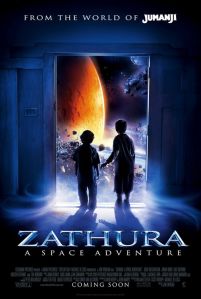 I’m kind of perturbed at how Zathura is being dismissed by the movie going public as, “Jumanji in space.” Seriously folks, does Jumanji hold that big of a place in our collective hearts as a nation? The only thing the two films have in common is that they’re both based on books by noted children’s author/illustrator Chris Van Allsburg (The Polar Express) and that they both involve board games coming to life. That?s it. Do we say that Titanic is ?Romeo and Juliet on a boat” because they both involve doomed lovers? Do we say that Jaws is “Moby Dick with a shark?” Or that Blade: Trinity is “The Hunger minus lesbians”? Or that The Island is “Parts: The Clonus Wars with a budget?” Okay, maybe the last one is accurate, but Zathura is a fabulous family film that has little comparison.
Danny (Jonah Bobo) and Walter (Josh Hutcherson) are brothers that have little in common. Ten-year-old Walter loves sports and isn’t too interested in the “kiddy” things his six-year-old brother likes. Danny himself is battling his own fears and feels left out by his older brother. Their big sister (Kristen Stewart) just wants both of them out of her hair. The family is visiting their dad’s (Tim Robbins) new house. While dad’s out to get some work done, Danny and Walter are antagonizing each other. Walter sends his little brother to the scary basement where Danny finds an old, dusty board game called Zathura. He sets up the tin game board beside his brother and starts playing. Small rockets on poles lurch across the board according to a spinning number. Then a card pops out and says, “Meteor showers,” and sure enough their living room is deluged with fiery meteors (Danny yells to take “erasive action”). Walter is shocked to open the front door and discover their house isn’t parked neatly in the neighborhood but orbiting through the vastness of space. To get back home the squabbling brothers must complete the game, and along the way they’ll encounter giant robots, a lost astronaut (Dax Shepard), and the Zorgons, a race of aliens hungry for some warmth and some fresh meat.
 The child acting is rather outstanding. The interaction between Bobo and Hutcherson (Kicking & Screaming) is great. Each really defines and shapes their character well, from Bobo’s whiny insecurity to Hutcherson’s disinterested anger and overt competitiveness. Stewart (Panic Room) leaves a very sizable impression as the agitated older sister. She has the looks and talent to explode in Hollywood in a few years, a la Rachel McAdams. Dax Shepard (Without a Paddle) is the biggest acting surprise. He gives a weighty and endearing performance as a father figure in the film, and he’s totally on the same wavelength with the movie’s tone.
Yes, Zathura gets a bit more conventional with its story as it draws toward the conclusion (trials of courage, learning from past mistakes, reconciliation), but there’s really only one kind of ending for this film. What did you expect from a 30-something page children’s book, half of which are drawings? Zathura may be predictable but it’s got a loose energy, a comedic zest, and a sense of wonder that elevate the familiar.
Smart family films are about as rare as they come. Zathura breaks the template of what “family film” means nowadays; it doesn’t go for cheap, tasteless jokes, it doesn’t hurl scattershot pop-culture references (seriously Shark Tale, are children going to be amused by a Scarface reference?). Refreshingly, the movie doesn’t have a single joke revolving around flatulence or someone getting hit in the nuts. This is a smart, good-natured family film that will thrill adults and children alike. John Favreau (Elf) is carving a really nice niche for himself directing these high quality family films that are in short supply. His direction is focused and his decisions are right on the money. He doesn’t overwhelm the film with an orgy of special effects. He gets the tone of this movie and never panders to his audience, but he keeps the pace bouncy and the tension racked. I was rapt in suspense during the Zorgon docking sequence, and yet Favreau can also illuminate the tensions of our childhood fears, like a dark basement. Favreau is proving himself to be a dynamite artist behind a lens.
 Isolating the action inside the house definitely helps build the film’s drama. Instead of unleashing the crazy world of the jungle and watching it wreck havoc, Zathura keeps everything bottled up. This decision does wonders for the film’s suspense by giving a claustrophobic overtone. This is a movie more concerned with storytelling than loud special effects. In short, Zathura is light years beyond Jumanji.
The family dynamic feels exceptionally realistic, and the film has a terrific sense of humor. Siblings do behave this way, and Zathura captures their everyday conflicts in a meaningful way. The dialogue has a real zest to it but never feels trite or inauthentic. Mark my words, “Get me a juice box, biyatch,” will be the best movie line you hear all year. Zathura really soars because of its rib-tickling sense of humor. This isn’t Man Drops Banana Peel followed by Man Falls Down. No I?m talking about a consistent tone that’s sly and whimsical, complete with comedic payoffs for even inanimate objects. The various story elements really come together nicely. Zathura is a blast that will hard to beat this holiday season and beyond.
Favreau has directed yet another family film destined to become a classic. The thrills are thrilling, the comedy is whimsical and smart, the storytelling is careful and focused, the special effects are great, the acting is superb, and even the score really soars. This is just a delightful movie of all stripes and should please adventure-seekers of all ages. I was laughing and cheering from beginning to end and so was my theater. It’s a family film that proudly and refreshingly reminds us the possibilities of family films. Zathura is tremendous fun and one adventure that will suck you in instead of just sucking.
Nate’s Grade: B+
Share this:

Catwoman (2004)
 Halle Berry has not exactly followed up her 2001 Best Actress Oscar with the wisest choices. There was a starring role in a James Bond movie, Die Another Day, there was Gothika, a spooker that didn’t scare anyone, except studio executives who saw the final gross. Now there’s Catwoman, a big-budget superhero film that’s got such a ripe odor to it to smell from miles away. It’s not good when a studio pulls a trailer because fans laugh at it, and it’s certainly not a good sign when the studio hires reshoots a month before the film is released. Catwoman’s looking for a big chunk of the superhero money out there, but will it land on all fours?
Patience Phillips (Berry) is a frazzled, down-on-her luck graphic designer at Hedare, a giant cosmetics corporation led by husband and wife team George and Laurel Hedare (Lambert Wilson and Sharon Stone). Patience is described as being “fun-deficient,” and lets people walk all over her. She tries saving a cat from a ledge one morning, and Officer Tom Lone (Benjamin Bratt) jumps out of his car to intervene, thinking she’s a jumper. He rescues her, though she doesn’t need it, and then asks to go out some time for coffee, the universal first date without it having to be a date.
 Patience is returning her designs late one night and overhears that Hedare’s newest product has the unfortunate side effect of making people’s faces melt if they discontinue use. The Hedare goons chase her down a water drain and flush her into a river. She’s revived somehow by the same cat she tried saving from the ledge. Patience reawakens with superhuman powers, heightened sense, and expert agility. There are some kinks, though. She sleeps in odd places, gobbles tuna by the handful, and loves to swing a whip. Who knows what she does to go to the bathroom. The new Patience is a bit confusing to Tom, but he goes along for the ride. He’s also on the hunt for the Catwoman, a mysterious leather-clad woman responsible for some jewelry theft. Patience unravels Hedare’s cosmetics conspiracy and aims to stop George and Laurel from mass production, all the while staying one step ahead of her boyfriend’s investigation. But Laurel is also experiencing some growing pains of her own. Unsatisfied with being pushed out her company’s advertising spotlight for being “too old,” she begins using heavy amounts of their newest beauty product and makes her skin as tough as living marble. With this new power, she schemes to retake power from her husband, as well as eliminate a pesky Catwoman.
Let’s not mince words and get directly to the elephant in the room: Berry’s hideous, trashy costume. This is, by far, the worst costume ever in a superhero movie, and possibly the worst costume in cinematic history. It’s so overwhelmingly ridiculous that perhaps the filmmakers felt Catwoman’s ultimate weapon against evil was having it die from laughter. It’s a bizarre combination of a mask with large mouse ears, leather bra, criss-crossing belts, gloves with diamond-tipped nails, and leather pants that look like they were mauled by a bear. Oh, and then there’s also the open-toed shoes. What? A superhero who wears open-toed shoes? All evil doers would have to do is step on her feet. The only purpose the outfit serves is to make Berry look sexy, but you didn’t need a stupid, tacky outfit for that.
The story of Catwoman takes a giant leap into weird mythology. Apparently, possibly immortal cats decide someone will become a Catwoman, a woman we’re told is not bound by our foolish rules. There’s no explanation why the cats choose who they do, what the purpose of this is, or what is even expected in return. We do get a montage of Catwomen through the ages dating back to ancient Egypt. Apparently, Catwomen follow the same lines of mythology like Buffy the Vampire Slayer: “Unto each generation, a Catwoman is born.” It’s also kind of funny that a film called Catwoman, about mythic Catwomen, has a crazy old cat lady (poor Ruth Fisher).
 The villainous scheme in Catwoman is awful. I can’t imagine the FDA not having some grumblings when their test bunnies start having their faces melt off. More importantly, what company would EVER release a product that melts your face in our litigious society? Just think of the mounting class action lawsuits that could very likely bankrupt that company. So, right there the villain’s plot is moronic for two big reasons. Don’t even get me started on Stone’s superhuman strength aided by the beauty cream we learn melts faces.
The acting is what you would expect. Berry is a beautiful woman, no doubt, but her performance is split between flighty wallflower and naughty dominatrix, neither of which is convincing. Bratt is the worst police officer ever (he can’t identify Catwoman even though only a tiny part of her face is obscured) and tries valiantly to hold his own amongst the ridiculousness. Wilson was such a stock corporate villain that they could have erected a cardboard cut-out of him and gotten the same performance. I never thought I’d say this, especially after The Muse, but Sharon Stone is the best thing about this movie. She’s an ice queen, but an entertaining one until she goes overboard on her beauty cream.
Catwoman is the first superhero film for Warner Brothers since their disastrous franchise-killing Batman and Robin in 1997. It’s hardly a coincidence that Catwoman is the also the worst superhero film since Batman and Robin. The film is trying really hard to be Spider-Man. Before her feline transformation, Berry is a frumpy dweeb, and afterwards she gets heightened senses, a new jolt of self-confidence, and the love of her man. Catwoman even has the guts to rip-off Daredevil, an amusing but fairly flawed movie itself trying to be Spider-Man. There’s a scene where Patience and Tom play a competitive game of basketball surrounded by chanting children. This is a direct rip-off of the scene in Daredevil where Ben Affleck and Jennifer Garner play fight on a playground. I don’t know about you, but when you’re ripping off Daredevil of all movies, you have problems.
This film has five credited writers, which works with my Rule of Five for films: if there are five or more people responsible for the script, then there was no script. Who amongst the five wants to take credit for all the dreadful cat puns in the dialogue, like Catwoman saying, “What a purrr-fect idea.” There’s also this wonderful repartee where Laurel says, “For you, Patience, it’s game over.” Then Catwoman responds, “It’s overtime!”
 Catwoman is director Pitof’s (perhaps short for Pitof-ful?) first real break as a director. He began his career as a visual effects artist on films like Alien: Resurrection, City of Lost Children, and The Messenger, but can anyone recount a visual effects artist that went on to become a decent director? (If you bothered to answer with Joe Johnston, then I don’t think you understood the question)
Movie Director Pitof has a love for cheesy CGI shots, but what’s more harmful is his penchant for confusing quick-cut edits. After watching Catwoman, I had to pop some Advil when I got home because the film’s editing had actually caused me a headache. It became so annoying that I started counting “one Mississippi, two Mississippi, etc.” to gauge the average length of a shot. Let’s just say that we didn’t make it past “one Mississippi” about 95% of the time. Now, there’s nothing inherently wrong with quick-edits; The Bourne Supremacy used them effectively to keep a lively, unpredictable experience. Catwoman’s editing is just jarring, especially during action sequences where you’d be hard-pressed to figure out what’s exactly going on.
The effects work is also rather pathetic. Pitof adores zooming exterior shots that become tiresome after the eighth or ninth time. Worse are all the scenes where Catwoman jumps and leaps through the city like she’s Spider-Man’s long-lost sister. The film is bending over backwards to try and ape Spider-Man, and these joyless, silly sequences of CGI Halle Berry crawling and jumping around the city don’t help the comparison. I do suppose that making a CGI Halle Berry flex and bend in her leather outfit was probably the most rewarding work for an animator since digitally making a breast grope itself in Hollow Man.
Who exactly is this movie intended for? If the filmmakers were going for fans of the Catwoman character, then why did they break away from the comic’s history and create something distant and different? If the filmmakers were strictly making an action movie, then why all the visual fluff, idiotic romance, and headache-inducing editing? I suspect that the producers felt that the names Catwoman and Halle Berry would be enough to put butts in the seats. So, then, I deduce that the selling point of Catwoman is, “Wanna see Halle Berry in a sexy leather outfit?” Now, most males will say, “Sure thing,” but why would they pay seven to ten dollars to see sexy non-nudity when they could go online. The short answer to who this film is intended for is, of course, no one.
 Catwoman is derivative, incomprehensible, dumb, and just plain boring. The only people who will get a kick out of Catwoman are either hormonal teenagers aroused by Berry’s outfit, or those who enjoy jeering a terrible movie. I can’t even recommend seeing Catwoman because of its ineptness. It’s bad, oh boy is it bad, but it’s not insanely idiotic like Bulletproof Monk or Dungeons and Dragons to the point where the lunacy is a must-see. It’s just boring bad, enough that it almost put me to sleep.
Perhaps the funniest thing of all, Berry has publicly stated in interviews weeks after Catwoman’s release that she’d love to don her leather outfit and do a sequel. Maybe she needs to talk to the producers who lost a bazillion dollars and inadvertently created a midnight movie howler. Catwoman will certainly get delegated to the litter box, but how many lives does Berry have left in Hollywood?
Nate’s Grade: D
Share this:

Harry Potter and the Prisoner of Azkaban (2004)
 The first two film adaptations were huge hits, but were derided by some as being too loyal to the books that it stifled the creativity. Now, Harry Potter and the Prisoner of Azkaban is out and its the first film to deviate from the books. How will Potter nation take the news?
Harry Potter (Daniel Radcliffe) is entering his third year at Hogwart’s School of Witchcraft and Wizardry. Harry is also getting older, getting angrier, and learning more and more about his parents. Hes on alert that the murderer, Sirius Black (played the fabulous Gary Oldman), has escaped from Azkaban prison and is out to get Harry. Black had a hand in the deaths of Harrys parents, and now it seems hes looking to finish what he started as a follower of Lord Voldemort. Harry relies on his friends, Ron (Rupert Grint), Hermione (Emma Watson), and a kindly new Defense Against the Dark Arts teacher named Lupin (David Thewlis) to conquer his fears, his burgeoning hormones, and to face Black when the time comes.
The best decision the Harry Potter producers made for this chapter of the series was in getting a new director. Alfonso Cuaron finally infuses the Potter series with a sense of visual life. Instead of Chris Columbus’ stubborn admiration of his fake opulent world, Cuaron keeps things fluid with a constantly roving camera and long takes. For the first time in the series, you can argue that this Harry Potter film looks and feels like its own actual movie. Gone is Columbus annoying penchant for displaying everything in close-ups. The film also benefits from some new realistic exteriors and dressed-down attire, ditching the school uniforms. Theres also a new cinematographer, so instead of Columbus dull amber glow, the series takes a gratifying turn toward the menacing, with an emphasis on dreary blacks and silvers.
 The best improvement of all, however, was in getting away from the apparent slavish loyalty to the books. The third book is the longest of the three but the third film is the shortest; 15 minutes shorter than Sorcerer’s Stone, and 25 minutes shorter than Chamber of Secrets. Thank God. At the rate they were going I thought the next book, Goblet of Fire (700-some pages), was going to be like 9 hours.
So, under Cuaron’s guidance, Prisoner of Azkaban eschews the unnecessary plot elements and details fans will grumble over but moviegoers couldnt care less over (Quidditch?). Cuaron’s film may be heavy with exposition, but it never talks down to its audience. The result is a movie trying to be a movie and not trying to cram in as many details of the world as possible so fans wont have their feathers ruffled.
The young actors of Hogwarts have definitely been struck by puberty, and it has done their acting a world of good. Radcliffe will never be an exceptional actor but here he presents new and interesting dimensions to Harry demonstrating his arrogance and tempestuous anger. Tom Felton, who plays the snarky blonde-haired Draco Malfoy, appears to be maturing into a ganglier Macaulay Culkin. The one actor that truly seems to have a bright future, though, is Emma Watson. You cannot help but love her whenever she’s on screen and she seems to be developing into a fine actress.
The most notable addition to the adult staff in the film is Michael Gambon, replacing the late Richard Harris as Hogwarts headmaster, Dumbledore. Gambon turns the character from a kind-hearted grandfather type to more of an aging hippie but it works. Emma Thomson also appears as some sort of psychic professor, teaching students to read tea leaves; however, her entire role seems superfluous unless it impacts future installments (I have not read a single book). Once again, Alan Rickman rules all and needs to get more time in these movies. I don’t know how, but it needs to happen. Thewlis is the most welcomed addition in his pivotal role as Professor Lupin and delivers some of the more dramatic scenes of the film with radiance and ease. He creates a lovely father-son relationship with Harry that supplies Azkaban with a nice sense of compassion. Oldman is similarly great but unfortunately he shows up so late into the film that he seems terribly underused. There is a scene late into the film, where Thewlis, Oldman, Rickman, and the great character actor Timothy Spall share a scene. I never thought it would be a children’s fantasy series that would finally unite all these talented British stage actors but I’m thankful for it nonetheless.
 Prisoner of Azkaban is the darkest tale yet, and Harry Potter works best when things get scary. The nightmarish element design creates a wonderful sense of dread, and Cuaron deftly handles his young characters dealing with rage and death and, scariest of all, budding hormones. Theres even a sly nod to Cuaron’s steamy coming-of-age film, Y Tu Mama Tambien (it involves a three-way hug between our trio of kids).
he effects of the film are beautiful and greatly add to the entertainment value of the film. The Dementors, cloaked flying guards of Azkaban prison, are terrifying to look at, and their leitmotif of chilling the air when they are near makes for some great visuals and ominous moments. I got actual goosebumps the first time they arrived on-screen, and then when I saw this film a second time, fully knowing the story, my skin still crawled when they arrived. Perhaps the greatest addition to Harry Potter‘s special effects bestiary is the Hippogriff, which resembles a combination between an eagle and a horse. It is a gorgeous creation and worlds better looking than the three-headed dog from the original film. It also provides one of the more breath-taking moments of the film, when Harry goes soaring across a lake on the back of the Hippogriff.
Having said all this, yes Prisoner of Azkaban is the most exciting and visually alluring film of the series, also its darkest, but I couldn’t help feeling disappointed with the central storyline. Most people will love it, especially fans of the books, but after walking out of the theater I could not help but wonder if the film had a climax at all? It really kind of didn’t. There was no sense of real story momentum and the middle had some definite moments of drag. The last act of Prisoner of Azkaban is exactly like Back to the Future Part 2: time-travel, correcting the future, not running into your past selves. This is not a good comparison. So while the characters are getting more interesting as they get older, this plot doesn’t really hold up very well. It almost feels like a preface of whatever events will come in the fourth film.
Prisoner of Azkaban is an interesting watch. I am told it deviates the most from the book and it manages to generate a considerably darker and scarier atmosphere than its predecessors. For my money, any changes are good, as films are about ADAPTATION and not copying, so dispensing with subplots and details is A-Ok with me. But how will the die-hards react? Im sure youll hear plenty of grumbling all over, but Cuaron has injected needed life into this series and presented an idea of what it can grow to be. So, while I think Prisoner of Azkaban has a superior visual sense, pacing, and adaptation; I also feel the story may be the weakest we have been told. I can only imagine what the outcry will be among the fan base when Goblet of Fire is released November 2005 as one film.
Nate’s Grade: B+
Share this:

Lord of the Rings: Return of the King (2003)
 To all those hairy-footed Tolkien geeks that chewed me out for having the audacity to call 2002’s Two Towers, of all things, boring, let me say this: while I still find the second entry of The Lord of the Rings to be disappointing and pretty flawed, the final chapter, Return of the King, is a glorious and satisfying conclusion. Instead of doing a usual review (plot synopsis, strengths/weaknesses, etc.), I’m going to bring back the charges I had against Two Towers and explain why Return of the King does not suffer from these ills. Will the defendant please rise as I read aloud the charges.
Charge Number One: Two Towers has nothing going on for its majority except hyping an oncoming battle.
And I still feel this way. Short of the great Helms Deep battle, there was oh so little going on in Two Towers that they could have easily trimmed an hour away from it. And don’t give me this crap about the whole kingdom of man subplot or Aragorn (Viggo Mortensen) realizing his eventual responsibilities. Whatever. Now, in Return of the King, there is so much going on and the pacing is so tight, that despite being the longest film by far (3 hours and 20 minutes), this is the FIRST Lord of the Rings films that has not put me to sleep in the theaters. The nearly hour-long battle involving the 200,000 Orc army with its huge elephant creatures is mesmerizing and visually stunning. But even after the battle and before, unlike Two Towers, there is plenty going on that actually matters, not just three characters running around endlessly.
 Charge Number Two: Despite nothing going on except waiting for a battle, Two Towers has little characterization of any of its characters.
So even though little is going on, Two Towers still doesn’t use all this free space to deepen characters. But in Return of the King, the characters come through and shine. The hobbits are back to the front burner and the film is better for it. Sam (Sean Astin, in the finest performance of the film) and Frodos journey becomes increasingly important and the strain and deception of Gollum puts a wedge between their friendship. When Frodo (Elijah Wood) looks scornfully at Sam and dismisses him from their journey, it’s heartbreaking. Why? Because after two years we as an audience have come attached to these characters and do feel for their struggle. When Sam, toward the climax, says, “I may not be able to carry the ring, Mr. Frodo, but I can carry you!” I dare anyone to try not choking up. We also get deeper moments of character with peripheral characters, like Faramir realizing he can only satisfy his father by a suicidal mission. Even the smaller characters from the second film, like Eowyn (Miranda Otto) and her kingly father Theoden (Bernard Hill), have wonderful moments where the emphasis is on characterization. Return of the King is filled with rich character moments that remind us how much we enjoy and feel for these people … uh, and hobbits.
Charge Number Three: Most of the characters from Fellowship of the Ring have scant appearances in Two Towers.
This still holds true. Gandalf (Ian McKellen, brilliant) returned from the dead but had about three minutes of screen time. The elves (Liv Tyler, Hugo Weaving, Cate Blanchett) were given the amount of screen time most people would consider cameos. And then the hobbits were left alone for the overlong subplot involving Theoden and his clan. What Two Towers really was was the dwarf, elf, and Aragorn movie. And I like each of those characters but this story is not theirs its the hobbits. So the disproportionate amount of time spent with Gimli (John Rhys-Davies), Legolas (Orlando Bloom) and Aragorn felt like what would happen if, in Star Wars, C-3PO and R2D2 had their own film. It wasn’t as interesting and it wasn’t right. But with Return of the King, the attention is back to the hobbits, and all of the characters in the entire film have at least one stirring moment of quality time. Gandalf is back in a big way and its welcomed. What else is welcomed is the increasing attention Merry (Dominic Monaghan) and Pippin (Billy Boyd) have. They started as merrymakers, but by this trilogys end they are desperate to join the ranks and fight. The shared moments between Merry and Eowyn in battle are great. The moments between Pippin and Gandalf are even better. And even though the elves still get the short end of the stick, they make lengthier appearances that are more satisfying. It appears, though, that Cate Blanchett’s longest amount of time in this whole trilogy was narrating the opening prologue.
 Charge Number Four: Excessive dwarf jokes.
Even if you disagree with me on the previous three charges, you must agree with me that Two Towers had about a million dwarf jokes too many. Return of the King, to my knowledge, doesn’t even have ONE dwarf joke. Fabulous. This is not to say I want less Gimli. The subplot involving the Two Towers trio seeking an army of the dead (a tad deus ex machine) is intriguing, and his competitive banter with Legolas is still ripe (Bah! That still counts as one!).
Return of the King is an amazing experience and one that is a fully satisfying conclusion, unlike say, I don’t know, maybe the last two Matrix films. The danger feels more abundant now that the end is near and the tension mounts. The payoffs are rewarding and the climax is fittingly climactic. However, the 20-minute resolution is a bit drawn out. It seems director Peter Jackson can give us three hours of fast-paced action but cant speed through a medley of hugs. You think its over…. and then theres more, then you think its over…. then there’s more. This is a small quibble for such an epic trilogy, and Return of the King proves that it’s really one large triumphant film, with a bit of a sag in the middle. What? Did you think I’d get through all this Lord of the Rings love-fest and not take one last jab at Two Towers? Though I still prefer Fellowship of the Ring out of the three, Return of the King cements the trilogys cinematic greatness in our time. Oh yeah, and the cinematography, special effects, production design, makeup, and score are magnificent too.
The defendant is cleared of all charges.
Nate’s Grade: A


 nathanzoebl
You must be logged in to post a comment.