Blog Archives
Evan Almighty (2007)
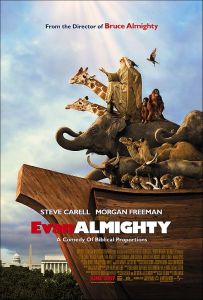 This big-budget sequel goes heavier on slapstick and poop jokes but also crams in environmental messages. I was wondering how the filmmakers were going to angle the whole Noah flood thing without it being world destroying, because nothing says funny like everyone drowning to their deaths. Steve Carell tries hard to make the material work and I give him points for trying. This sentimental comedy has some moments of lively levity, mostly from Carell being bewildered at what is happening, but the film eventually succumbs to some weak, half-hearted messages about treasuring family and producing acts of kindness (I won’t bother spoiling the regrettably inane acronym of ARK). The supporting cast is wasted, none more than Lauren Graham as Carell’s underwritten wife. The Lord works in mysterious ways and so too do movie executives. Upping the budget doesn’t mean the laughs have been super-sized as well. Evan Almighty is passable entertainment thanks to Carell. It’s hard to be preachy when you have so many jokes about poop.
Nate’s Grade: C+
Share this:

Stardust (2007)
 Director Matthew Vaughn is about as far away from his previous film as he can get. 2005’s Layer Cake is about as far from princesses and unicorns and pixie dust as can be expected. He turned down X-Men 3 to helm this adaptation of famed comic scribe Neil Gaiman’s graphic novel, Stardust. In style with one of the film’s characters, allow me to say to Vaughn, well played, sir.
In turn of the century England, Tristan (Charlie Cox) is trying to woo Victoria (Sienna Miller), the haughty town hottie in the small village of Wall. The town is called such because there is a winding stonewall that runs alongside that people are forbidden to cross. He’s given seven days to retrieve a fallen star for Victoria to prove his affection for her. In order to do so, he needs to venture beyond the wall, and beyond the wall is another world altogether. The fallen star is a result of an dying king (Peter O’Toole) hurling his enchanted necklace to the heavens. The jewelry collides with a star and causes it to crash to earth. But it’s no smoldering rock taking refuge in that crater; the star has actually taken the form of a slender, long-haired blonde woman named Yvaine (Claire Danes). I can only hope other astral bodies that crash into this planet will result in the same lucky outcome. But Tristan is not the only one after the fallen star. Three very old witches have taken notice and seek to cut out the star’s heart and consume it, which will grant them youth once again. The oldest witch (Michelle Pfeiffer) uses the last bit from the previous star to shed her wrinkles, but every time she uses a speck of magic she loses part of her much-desired youth. Also on the hunt for the star are the king’s ruthless sons, each trying to retrieve their father’s necklace and declare themselves the next king, and each trying to bump off their family competition.
 Stardust is very much in the fractured fairy tale style of The Princess Bride, complete with nudges and winks. The movie works more with the macabre, but this only seems to heighten its magical qualities. I loved the ongoing wisecrack-filled commentary from the increasing number of ghost princes (“Well played”), and I loved that each was stuck in limbo Beetlejuice-style looking as they did when they died. Stardust is stuffed with hocus pocus hokum but it never seems foolish; the movie takes great steps to present the rules and characters of its universe, and as all of the assorted creatures race toward a showdown, Stardust makes total sense. It doesn’t betray the logistic parameters it establishes for such a fantastical parallel world. It means that if you can accept the opening 20 minutes than you should be fine for the duration of Stardust. The film spins a familiar tale of hidden princesses, races against time, battles over a throne, and wicked witches, but it handles the material with aplomb. Stardust‘s biggest asset, beyond the cheeky sense of humor Vaughn instills, is that literally anything could happen next. Suddenly there’s a flying pirate ship out to harness lightning, or a goat-turned-inn keeper, and it’s all so exciting what could be waiting around the corner next.
Vaughn assembles a lot of pieces and then keeps the momentum strong. He makes judicious use of special effects and keeps the audience involved with all the story’s moving pieces. Vaughn has taken the usual fantasy quest framework and channeled the imagination and dry wit of Gaiman. Not every moment runs as smooth as possible, and some are downright awkward, but Stardust stokes a nice balance between high-flying adventure and doodle-on-your-notebook romanticized love. Vaughn’s steady control and vision allow the material to really shine because the audience can open themselves to the magic of the movie.
The acting ensemble brings a lot of enjoyment to this enchanted tale. Pfeiffer is a bewitching villain and relishes her bad girl role; she’s a devious delight but is even better when dealing with the physical comedy of her increasingly aging body. De Niro is immeasurably enjoyable thanks to a role that conflicts with audience expectations for the famous force of movie masculinity. I was howling with laughter watching him cross-dress, swish, and become a giant exaggerated gay stereotype. It might seem trite or offensive to some had it not been for the setup and the film’s tolerant philosophy. Danes delivers a performance that seems to teeter on camp. She ramps up her vocal inflections thanks to her hyper English accent and seems to perform like she’s in front of a mirror and testing out all of her facial muscles. A bit odd. Cox fits snugly into the Hollywood slot of bland male lead.
 The one main drawback for the film is that the screwball bickering between Tristan and Yvaine never really works. The constant arguing rarely comes across as funny and is too poorly veiled to camouflage the film’s romantic intentions. The romantic setup is pretty formulaic. The audience will know right away that Tristan is not meant for his conceited and high-maintenance village girl, and that true love is staring him in the face along the course of his most fantastic voyage. We know from the first second of their meeting that their combative relationship will in time transform into a romantic relationship. But that’s not to say Stardust isn’t a romantic fable. Its heart is simple but it is genuine. While its path is predestined and unshakable, this does not stop the audience from feeling something between Tristan and Yvaine and their eventual coupling. I may be going soft, or perhaps Stardust just won me over completely, but I found myself even slightly moved by the romantic climax.
Stardust is assembled, like most fairy tales, from the working parts of other tales. It’s rather predictable with its big moments (boy meets star girl, boy loses star girl, boy regains star girl), but oh what a fun time the film has from point to point. Stardust is vibrantly alive and cheerfully creative and watching the film almost becomes a dizzying experience. It has a sweet and gentle romance at heart, and its knowing whimsy and charms are hard to resist. You’ll never look at Robert De Niro the same way again.
Nate’s Grade: A-
Share this:

Harry Potter and the Order of the Phoenix (2007)
 The most interesting aspect for me about the ongoing Harry Potter big screen adaptations are how each new director handles the material. Christopher Columbus got the ball rolling with his autumnal and slavishly loyal films, Sorcerer’s Stone and Chamber of Secrets. Then Alfonso Curaon made the series feel magically its own for the first time with Prisoner of Azkaban. Mike Newell made The Goblet of Fire feel like a teen romantic comedy. Now it’s David Yates’ turn to be at the Potter helm. Yates has little to his resume beyond assorted TV movies, but his direction must have impressed the Potter brass. Harry Potter and the Order of the Phoenix feels somewhat like setup to more important events yet to come, but with Yates and new screenwriter Michael Goldenberg, this new entry feels up to the entertainment challenge of its forebears.
Harry Potter (Daniel Radcliffe) is entering his fifth year of education at Hogwarts School of Magic. The Ministry of Magic is trying to silence Harry’s claims that Voldermort (Ralph Fiennes) has arisen anew. They’ve installed one of their own, Delores Umbridge (Imelda Staunton), as the new Defense Against the Dark Arts professor. But she’s not interested in teaching the students actual magic. The Ministry feels it’s best for the Hogwarts youth to just have a theoretical knowledge, so they’re distributed out of date and censored textbooks. Umbridge gathers greater power and eventually has the run of Hogwarts, forcing Harry and his friends, like longtime buds Ron (Rupert Grint) and Hermoine (Emma Watson), to practice their own protection spells in hiding. Umbridge and the Ministry are convinced Harry and Headmaster Dumbledore (Michael Gambon) are trying to unseat their leadership. In actuality, they’re just trying to warn people about a war that is on the horizon.
 The fifth movie is also the most grownup in tone and temperament yet. Harry is in a very different place and feeling alienated from the important people he cares about. The Ministry of Magic is turning the public against him by making everyone believe that Harry is a liar. Order of the Phoenix explores a lot of psychology and doesn’t have anywhere near the humor of previous installments, especially 2005’s heavily comedic Goblet of Fire. I think this is a step in the right direction. Harry’s mortal enemy has been resurrected, his schoolmate has been murdered, and you can’t really go back to zippy Quidditch matches and silly spells that make people hurl slugs. The Harry Potter universe has gotten darker and more serious and Order of the Phoenix reflects this. Harry warns his peers during a training session that death is a real consequence of what they’re about to face, and that bad things will indeed happen to good people.
Order of the Phoenix is structured into two dominant storylines: Umbridge and the school repression, and Voldermort’s attempts to infiltrate Harry’s mind. Voldermort is handled as a murky puzzle, mostly in a succession of quick flashes and nightmares, and this results in the storyline feeling more like a fuzzy memory. I found the Umbridge character to be far more interesting and even far more menacing than He Who Must Not Be Named. The combination of political suppression of the truth, fear mongering and paranoia, torture interrogations, trampling over civil rights, and teaching students censorship in the name of safety is a fascinating correlation with our own modern society. The book may have been released in 2003, and written by an English woman, but the political repression feels alive and relevant today. While I appreciated the well-crafted peeks to the nasally-challenged Dark Lord, I found Harry raging against the system trying to keep him mum to be the real meat of Order of the Phoenix. I lost some interest once Umbridge had been vanquished.
Harry Potter advocates of all stripes and sizes constantly ask me why I have little interest in sitting down and reading the actual novels, why I’m content to wait the extra time for the movies. The answer is two-fold: 1) I’m lazy, and 2) I think the slimmed down screenplays may boil the essence of J.K. Rowling’s verbose books and present a better and more focused story. In all honesty, I don’t really care about who wins a Quidditch game, or how someone helps a magical creature that is of no consequence to the story. Rowling’s massive tomes seem so overstuffed, and I repeat that I am passing this judgment never having read one book, that I don’t mind all the superfluous subplots and characters that are trimmed and/or eliminated in the path of economic storytelling. The essential essence of the story and all the really important elements will be included, any the quibbling of what gets tossed aside is often enough to confirm for me that I don’t need to read the books to see what I’m missing. Then again, this entire paragraph may do nothing but prove that I am willfully ignorant or just plain wrong. Oh well. Two more movies to go and two more books not to open.
 Yates brings in the shortest Harry Potter movie to date at 2 hours and 18 minutes long, but the hastened pace sometimes causes the film to stumble or lack clarity. There’s a death late in the film (while I’m sure the entire world knows the person’s identity I will refrain from spoiling) and I had no idea what had just taken place. The death is abrupt, and the person just sort of leans back and disappears into some gate that is never given context. The whole scene is meant to be defining drama but if I hadn’t known ahead of time what was supposed to happen then I would have been scratching my Muggle head. The prophecy that the bad guys want so badly seems rather unimportant, so the ending scuffle over this little glowing ball seems like much ado about nothing. Most of the new characters, like Helena Bonham Carter as Bellatrix Lestrange, don’t feel well incorporated into the overall story. But the worst part of the hasty pace is the fact that when we finally get an all-out wizard battle between good and evil that it ends far too quickly. The Order and Voldermort’s Death Eaters are going at it with colorful attacks jettisoned around the room, but this exciting bite of action turns out to be little more than a morsel. After the wizard-on-wizard combat, Order of the Phoenix goes back to a pretty predictable finish with little in payoff. And was Hagrid’s giant goofy brother really necessary to include?
The adults have always been impeccably cast in the Potter flicks, and real star of the fifth film is Staunton (Vera Drake). Umbridge is a juicy role and Staunton brilliantly plays this fascist little school marm in Pepto pink. She has this exquisite stuttering giggle, and her ever-smiling, cherubic face quivers like there are strings attached. Staunton makes even the most innocent “excuse me” sound like it’s dripping in poison. She’s so peppy and seemingly wholesome but in the same moment is There’s one scene between Umbridge and Professor Snape (the irreplaceably awesome Alan Rickman) where he can’t stand her presence and adds an extra dose of snarl in his annoyed replies; this woman has found a way to make Alan Rickman even more awesome. Order of the Phoenix is at its best when Staunton is stalking the corridors and enforcing her brand of control. I’ll miss her dearly.
 I think I need to reverse my stance on the child actors of this profitable series. With the first movies, it seemed like Watson was the real star as the studious and nitpicky Hermoine. It also appeared that Grint would never escape the trappings of squealing cowardly relief. Radcliffe seemed to suit the material but felt overly wooden and I predicted he would never be anything but a blah actor. I now must rescind my earlier predictions. Watson has become more grating as the films progress, She outshined her fellow actors when they were 11, but now that she’s a teenager and working the same limited, yet extremely huffy, acting range, turning her character into more of an annoyance than an ally. Radcliffe, on the other hand, is nicely growing into his role and expressing deeper emotions and anxiety as the weight of his Harry’s name and destiny weighs on him. I think Radcliffe will have a career outside the boy wizard; he was strikingly funny on an episode of HBO’s Extras that sent up his youthful image. I don’t think we’ll ever hear much from Grint and Watson again once the end credits roll on movie seven.
After five movies, I think we pretty much know what we’re going to get with the Harry Potter series. The stories are getting more mature and serious, and this means that the films need more attention to adaptation and weeding out the nonessential elements. I think the fans that are still grumbling about the books being butchered have missed the point (they’re also still fuming over the “new” Dumbledore, even though Gambon has been in 3 movies now). Order of the Phoenix was the longest book but has been turned into the shortest movie, and it still resonates as an exciting and emotionally engrossing fantasy now taking definite and irrevocable steps toward something dark and meaningful. Yates is scheduled to direct the next Potter chapter,The Half-Blood Prince, and even though I won’t have a new director’s style to analyze, I look forward to more adventures with these characters. Just don’t tell me to read the books.
Nate’s Grade: B
Share this:

Pirates of the Caribbean: At World’s End (2007)
 Shiver me timbers Jerry Bruckheimer. The Pirates of the Caribbean movies are taking no prisoners when it comes to money and fans. Ten months after 2006’s Dead Man’s Chest comes the concluding chapter to the Pirates saga. At World’s End is longer, bigger, and more expensive, but it is also the first Pirates movie that felt like a ride I wanted to get off.
The British navy, at the command of Lord Beckett (Tom Hollander), is eliminating all piracy once and for all. He now controls the heart of Davey Jones (Bill Nighy) and so controls Jones and the crew of the Flying Dutchman, the most fearsome ship run by cursed barnacle-encrusted crewmen. As the very busy hangmen will attest, it’s not a friendly time to be a pirate. The Black Pearl has set out to Singapore to find support from Soa Feng (Chow Yun-Fat), one of the nine pirate lords. The Pearl is now commanded by Barbosa (Geoffrey Rush) who was brought back from the dead thanks to the witchy Tia Dalma (Naomie Harris). They travel to the ends of the earth to Davy Jones’ locker to rescue Jack Sparrow (Johnny Depp), who was last seen in the belly of a beast. Elisabeth (Keira Knightley) and Will (Orlando Bloom) are both aboard and still bickering about their stalled romance. Once Sparrow returns to the land of the living, the group meets with the other pirate lords from all across the globe in an effort to pull together and stand against Beckett.
 As it turns out, the fear that Pirates of the Caribbean: Dead Man’s Chest was a 150-minute trailer for this movie was unfounded. That’s because the third movie in the Pirates of the Caribbean series completely ignores or messes up the many intriguing setups from the second film. Character motivations from Dead Man’s Chest are mostly unresolved and revert to stock generalizations. Jack Sparrow feels like he’s been grafted onto an unrelated storyline. Most disappointingly is what happens to Davy Jones, the greatest addition to the Pirates landscape. This awesomely-realized villain was scary and fascinating and looked fantastic thanks to Oscar-winning special effects. At World’s End takes such an intriguing villain and turns him into an impotent tool to Beckett. He’s been transformed into a houseboy who might as well fill people’s teacups. Yes Davy Jones thankfully figures into the climax but why in the world’s end must an audience wait that long? Davy Jones reminds me a lot of the ghostly twins from 2003’s The Matrix Reloaded who were completely dropped from the second Matrix film to the third.
But not only does At World’s End fumble the hand-off from the previous sequel, the movie itself establishes many setups with poor or unsatisfying payoffs. So much is made about the pirate lords from all over the world, and we see a colorful collection of international pirating groups that is fitfully amusing, but the whole section has no point at all. Chow Yun-Fat’s character is a non-starter; in fact none of the new characters introduced in At World’s End play any importance on the overall plot. The film is building to a final all-out battle between the united pirate lords and the British navy. We witness the awesome sight of the sea filled with vast armadas of ships, and as an audience we are getting hungry for some epic nautical action. Then At World’s End pretends that none of the other ships matter and sets its entire battle as one ship versus one ship inside a whirlpool. While this is admittedly exciting it isn’t anywhere near as exciting as an entire war amongst hundreds of ships. The filmmakers have all the money in the world and they couldn’t give us a little something bigger in scope? The pirate lords could have just as easily been cut from the movie if they were just going to stand on the sidelines and wave a flag.
The pirate lords make a big deal about their apprehension with releasing the sea goddess Calysto from her earthly prison. The pirates trapped her into the body of a human in order for them to gain control of the seas. They reckon she’ll be one very bitter sea goddess and take out some apocalyptic wrath out on the pirates. So the pirates release her, cowering in fear at her powerful reprisals and,,, nothing. Calysto vanishes, causes some mildly inclement weather, and is never seen again. Talk about a lot of pointless hot air.
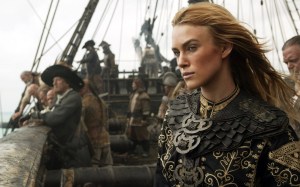 I think perhaps the clearest example of how the movie screws up is with the monstrous Kraken. This slimy beast got a ton of attention in Dead Man’s Chest and was a ferocious terror on the high seas. Now, I would expect that such a creature that played an integral role in Dead Man’s Chest would be back for the next sequel. Ignoring its prominence in the plot, the thing just looked amazing onscreen. But with At World’s End the giant monster is killed off screen and in between the movies. I felt insulted when I saw the mighty carcass washed ashore like a pathetic beached whale. What is satisfying about that? Why would Beckett make Davy Jones kill such a powerful weapon he could use for his own unseemly gain? It makes no sense. The Kraken isn’t the only character done a disservice by a plot stuffed to the gills. Some are killed in terribly pointless incidents and it just becomes irritating.
At World’s End is missing the high-flying fun of the first two Pirates movies, and this venture just feels draggy, tiresome, and far too dreary. You know you’re headed for some morose subject matter when a movie hangs an eight-year-old before the opening credits. This latest film is crushed to death by the weight of excess plot and confusion. There’s a damn near 20-minute section of the movie that’s nothing but characters double-crossing, triple-crossing, quadruple-crossing each other; it literally requires a character to spell out what has just taken place and set the record straight. I don’t think At World’s End ever recovers from this absurdly confusing miscue.
The film seems more interested in talking over an audience than delivering something genuinely thrilling and stirring. There’s a curious lack of action and nothing new matches the imaginative action set pieces of the previous films, like the duel atop the roving water wheel. Excluding a large melee between the Black Pearl and the Flying Dutchman as the climax, the action pops in and out in shortly timed bursts. For a movie within a hair or running three hours, there needed to be more action. Instead of derring-do, At World’s End spends interminable periods of people talking, usually in personal quarters, and explaining the increasingly laborious plot to each other. All of the Pirates movies are filled with false endings and heaping helpings of extra plot, but this is the first time I really felt the real drag of its running time. Director Gore Verbinski still knows how to keep things looking good but he can’t save the film from its anchor of a maddening and convoluted plot.
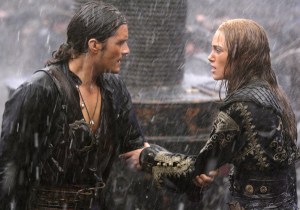 The movie is not without its due pleasures. Depp is always going to enchant with his now iconic character, but the true star of the film is Rush, who makes welcomed return. The special effects are still tops. The sequence rescuing Jack from the world of the dead provides many trippy moments that possess their own strange beauty, like when we watch the Black Pearl sail against the black, star-spotted sky. It’s fun seeing Keith Richards appear in cameo as Jack’s father and the stated inspiration for Depp’s performance. A small man and a large gun makes for one very funny sight gag. A Mexican standoff that actually involves an armed monkey is a comic high point. It’s just that all the fun or memorable moments seem to be the ones that matter the least. At World’s End still manages to do enough right to work, especially its Singapore opening. As far as a movie that upholds the quality of its franchise name, that’s a whole other matter.
Pirates of the Caribbean: At World’s End is a somewhat entertaining but heavily flawed final film to a trilogy. It’s the darkest and trippiest of the three movies, but it also makes the least amount of sense and has the least amount of action. That doesn’t seem like a good exchange in my book. There are not enough important events to justify the bloat. At World’s End has a hardcore case of butterfingers when it comes to handling plot and character setups from earlier films, and as a result almost nothing and no one ends in a satisfying fashion. The effects are still eye-popping and Depp will always be a comic treasure, but this lackluster movie feels like tripping at the end of a marathon. I had so much hope for At World’s End after how gratifying I found the other two movies but I cannot quell my disappointment. This is not a fitting conclusion. This feels more Matrix Revolutions than Return of the King. Of course it’ll make tremendous amounts of booty at the box-office, but will demand for a fourth be as rabid after this muddled and murky capper?
Nate’s Grade: B-
Share this:

Pan’s Labyrinth (2006)
 Fantasy has a naturally cheerful tone. Someone did not tell that to Mexican writer/director Guillermo del Toro. The Hellboy director is obsessed with all things creepy, crawly, and gooey, and his films all seem to revel in the things that go squish in the night. Pan’s Labyrinth is a children’s tale not intended for children. It’s more in line with the fairy tales of old that were violent, sickening, and something to strike fear in disobedient kids.
Ofelia (Ivana Baquero) travels with her pregnant mother to live in a cottage along the Spanish countryside. Her mother has remarried The Captain (Sergi Lopez), a brutal officer in the ruling fascist government. He’s a stern and unforgiving man and plotting to eliminate the remaining scattered resistance soldiers. Ofelia discovers a series of stone stairs that lead to an underground labyrinth. Inside is a faun (the titular Pan) who recognizes the spirit of his world’s missing princess inside Ofelia. He gives her tasks to complete that will prove whether or not she can return to the other world.
This is a fabulously dark Alice in Wonderland for a more mature set. Pan’s Labyrinth is very similar to del Toro’s 2002 The Devil’s Backbone, a smart and affecting ghost story set against Spain’s bloody civil war. del Toro has set his supernatural fantasies against some very real and very dangerous backdrops. The Devil’s Backbone was more than just a ghost story, and now Pan’s Labyrinth is more than just a fairy tale. The real world is a violent and cruel place and worthy of a magical escape. However, the fairy tale creatures are not from the Disney school of kinder, gentler folklore. The faun is evasive and prone to outbursts when he/it does not get his hooved way. The other creatures, like a giant slimy toad, are all after their own gain and don’t much care for a little girl’s interference. There is no escape to safety.
 There are plenty of staples commonly found in fairy tales. Ofelia has to complete three tasks before the cycle of the moon. She has to complete trials of courage and prove her purity of heart. The characters look familiar but they definitely don?t behave the same. Pan’s Labyrinth has a continuing sense of dread. People die vicious deaths and the threat of violence is ever present.
The real world segments are just as engaging as the grander flights of fantasy. del Toro spins a very worthy tale of secrecy and suspicion at the dawn of Franco’s Spain. Several members of The Captain’s quarters are aiding the remaining resistance officers and risking their lives to hide their allegiance. It also draws the viewer in because these characters are the kind ones that look after Ofelia, who accidentally stumbles upon their secrets. The Captain is an earthly monster equal to the horrors of the fairy tale world. He has a deadly fixation with wasted time and punctuality (another Alice in Wonderland homage – the ticking pocket watch). Whether he’s torturing or shaving, the man seems peeved in all that he does. He tells the doctor that if a choice must be made, save the baby over the mother. His legacy demands an heir.
del Toro straddles differing genre lines like few artists out there. He has a great love for monster movies and horror but he also has great feel for human drama and a child’s wide-eyed point of view. Ofelia rests her head on her mother’s pregnant belly and speaks to her unborn brother. When her mother is experiencing complications she implores her brother to be gentle. It’s a little action but comes across as so honest and heartfelt from a child. The film is touching and exciting and pretty scary when it wants to be. Pan’s Labyrinth is a genre-bending gem that?s exceptionally well executed. The production design and make-up effects are terrific and lend to the otherworldly feel. The special effects are mostly a mix of practical designs and creepy make-up work, especially with the “Pale Man.” I especially enjoyed how the fawn moved and sounded, all clicks and creaks like he hadn’t moved his bones in ages. del Toro and his movie magicians do an excellent job of transporting you to two distinct worlds.
I could have used more labyrinth in my Pan’s Labyrinth. As it stands, the movie is divided as 15% fantasy world and 85% real world. That?s not enough for me. Maybe I just loved the fantasy elements too much or was expecting more of a live-action Spirited Away. Then again, del Toro has his mind set on an ambiguous ending that will divide the skeptics from the believers. Are there opposing worlds? Is Ofelia just making it up to escape reality? Whether what’s happening is real or not is irrelevant; Ofelia believes it is real. I feel that the movie could have been even greater had it utilized its fantasy side more.
 Take for instance the “Pale Man,” a grotesque monster that has to place its eyeballs in the palms of its hands to see. When Ofelia enters his realm its covered in ancient art showing this faceless creature devouring children. A giant pile of shoes sits in a corner as a constant reminder of the creature’s appetites. However, the creature sits at the head of a table motionless, unless some irresponsible child takes a bite from the illustrious feast of food at the table. Then the “Pale Man” springs to life. The imagery is horrifying but beautifully sickening, and it’s just too regrettable that Pan’s Labyrinth only gives such a memorable monster one single scene. I kept hoping that the movie would revisit the world it had begun establishing, all for not. I thought at least del Toro would have a fascist officer chasing after Ofelia and she would trace a portal back into the “Pale Man’s” world. Then she would escape but the officer would be trapped. He’s take a bite from the feast and then our occularly-challenged friend would go, “Well, you’re a little older than I like, but hey, beggars can’t be choosers.” CRUNCH! You must judge a movie for what it is, not what it could be, but I am certain Pan’s Labyrinth would have been even more remarkable had it just done more with its wild imagination. Oh well.
2006 has been something of a revelatory year for Mexican directors working within the Hollywood system. Alejandro Gonzalez Inarritu released Babel (bleh); Alfonso Curaon released Children of Men (wonderful), and now del Toro’s dark fantasy Pan’s Labyrinth is just starting to get a wider release. The film straddles the lines of genre, touching upon horror, human drama, fairy tale, historical action, and still finds time to be invigorating and moving. The production design and make-up effects do wonders to bring del Toro’s mordant imagination to chilling life. del Toro reigns supreme in the realm of sticky and icky things. Had the film actually spent more time interacting with its twisted fantasy creatures, I would gladly call Pan’s Labyrinth the best film of 2006. But alas we can’t all have our wishes comes true no matter how many fauns we encounter.
Nate’s Grade: A
Share this:

Night at the Museum (2006)
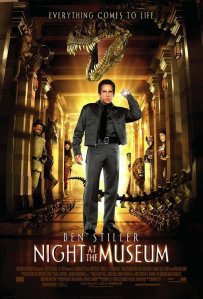 Night at the Museum works because of the possibilities of its fun premise whereupon all the dusty items at New York’s Museum of Natural History come magically to life when the sun sets. I think every wide-eyed kid at some point had the same dream. Whether the movie taps into that childlike wish or panders to it is up for speculation. No doubt, this is a special-effects heavy family film that doesn’t aim its sights very high. Some storylines misfire like Ben Stiller’s tour guide love interest, Teddy Roosevelt (a very game and well cast Robin Williams) and his unrequited love for Sacagawea, and, in fact, a lot of it comes across as amusing but not very funny. The emotive bits feel awfully clumsy. But Night at the Museum has just enough to stay lively and remain unexpected enough to delight. Stiller works his usual shtick but remains the best comedic meltdown actor we have. The biggest surprise was seeing 86-year-old Mickey Rooney serve up some beat downs. I could easily see this becoming a franchise and I’m sure the studio has the same thing on their mind. Night at the Museum is a fun diversion for the holidays and will surely increase museum attendance nationwide. There are worse things than a film inspiring renewed interest in history.
Nate’s Grade: B
Share this:

Pirates of the Caribbean: Dead Man’s Chest (2006)
 America loves its pirates, plain and simple. We as a nation are infatuated with the characters and the high-seas adventure of 2003’s Pirates of the Caribbean: Curse of the Black Pearl. We?re starving for more, and when the first in a two-part sequel was released it only became one of the biggest movies of all time. Pirates of the Caribbean: Dead Man’s Chest has shattered box-office records, rolling up $100 million in two days and a record $135 million weekend gross, easily surpassing former champ Spider-Man‘s supposedly invincible $118 weekend tally. America loves its pirates more than Spiderman, Star Wars, and who knows, maybe even Jesus. After all, Dead Man’s Chest did just kick out The Passion of the Christ from the top ten all-time grossers. Mel Gibson sure has a lot of grief at this moment.
Jack Sparrow (Johnny Depp) is a wanted man on the high seas. The East India Company, whose emissary now controls the Caribbean town of Port Royal, is after Jack and his special compass. But Captain Jack has bigger fish to fry. Davey Jones (Bill Nighy), ruler of the seas, wants what was promised to him: Jack’s soul. Jack made a bargain with the sea creature and now his time is running out. He must assemble a crew and track down the whereabouts of a buried chest. Inside this chest is the still-beating heart of Davey Jones, and he who controls the heart controls Jones, and thus the seas. That is why the East India Company is so interested in Jack. They’ve made an arrangement with groomis interuptis Will Turner (Orlando Bloom), who had his wedding hijacked and his bride (Keira Knightley) locked away. If he can retrieve Jack’s compass, then he and Elizabeth will be pardoned for aiding and abetting a known pirate. Will and Elizabeth each set off to find Jack Sparrow and to gain their freedom.
 The filmmakers have taken notes in the school of sequels from The Empire Strikes Back. Like the second Star Wars chapter, we’re left with the heroes separated and licking their wounds, evil appears to have the upper hand, and the lives of some beloved characters are left in doubt. Just as long as there’s no Ewoks, Disney has guaranteed my place in line on opening day 2007 for Pirates 3.
It?s hard to fully judge this Pirates sequel because it’s part one of a two-part story. I’m holding out my final say, especially if this movie just turns out to be an expensive 150-minute teaser trailer for Pirates of the Caribbean 3. I can?t fully judge many story and character arcs because we don?t know where movie #3 will carry them. Maybe it’ll end up being like the middling Matrix sequels, where subplots and characters were dropped as if the Wachowski brothers had screenwriting butterfingers (it’s a film critic’s unwritten duty to deride the Matrix sequels at any chance). At least this movie ends with a jolt that I did not see coming.
Most surprisingly, Dead Man’s Chest suffers little from the creative deadlock of sequels. Dead Man’s Chest is more a sci-fi monster fantasy than a swashbuckler. The supernatural edge has swallowed the series whole. Take for example Jack’s broken compass. What once was an oddity befitting its owner is now seen as another element of magic. Some of the interest seems lost if things are simply explained away as being magical. The story, unlike the Matrix sequels (See: above), expands and enriches its universe. Some leftovers from the first film made me cringe. I thought we were headed for a bad track, where the movie uses the audience’s memory as a cheap storytelling device. Familiar characters might pop up every which way, smiling, and saying, “Hey ho, remember me?” Miraculously, the leftovers are integrated so well with the new tale that they really do matter and don’t come across as cheap shortcuts. Norrington (Jack Davenport) and the two comic relief cursed pirates are all smartly woven back into the troupe, and each impacts the story in a non-obtrusive manner. Even the undead monkey is used well.
I made it a point to keep my expectations in check for Pirates of the Caribbean: Dead Man’s Chest. It would be naive to think that you could catch lightning in a bottle again. Yes, now with audience expectation we lose the originality and unpredictability that made the first Pirates adventure so joyously delicious. And yet I found myself getting riled up just the same and being whisked away by spirited entertainment. My expectations may have been tempered for Dead Man’s Chest but I still greatly enjoyed the ride. It seems that my opinion sharply differs from my overly negative critical colleagues; my own sister said Pirates 2 was one of the worst movies she’s ever seen. That seems a bit rash. She hasn’t even seen any Uwe Boll movies.
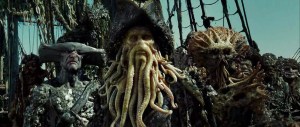 There are moments that seem to stretch the credibility of the story. It’s been said before that it’s not the impossible that bugs you but the improbable, and this holds true for Dead Man’s Chest. I’m able to believe Davey Jones and his creepy crawly crew, but I’m not able to believe that Elizabeth Swan could single-handedly best them all at once in sword fighting. The movie becomes dangerously close to eye-rolls in parts, but generally steers clear of moments that rip you out of the story. Of course a Pirates film would be nothing without Johnny Depp. He’s the main reason the first film was so memorably embraceable and entertaining. It?s not every day someone gets nominated for a Best Actor Oscar playing an addled, swishy comic pirate. He’s truly the star and has been one of our finest actors long before he had any box-office clout. He’s created a character so beloved that he’s crossed over into the cultural lexicon. How many Jack Sparrow outfits do you see come Halloween? I had a friend directing a high school performance of A Midsummer Night’s Dream and every young actor wanted to audition as Captain Jack interpreting Shakespeare. Come to think of it, Jack Sparrow would certainly liven up some of the bard’s dusty works.
Depp is still hilarious and likeable even when he’s being a scoundrel. We simply love this character; I love this character. The unpredictable nature of Jack feels squeezed dry by the demands for familiarity with sequels, but Depp finds new ways to enthrall in Dead Man’s Chest. Some people are going to be uncomfortable with Jack being more dastardly, willing to trade others’ lives to save his own hide. I think desperation is an interesting place to put this character. Besides he has his big hero moments as well.
New dimensions are added to the other characters. Knightley gets to be shrewd and try her hand at pragmatic treachery. It eats her up inside at the end and Knightley, a nice comedic actress, allows us to see the rough seas of guilt within her. Bloom will always be Bloom, meaning he’ll be handsome, British, and seemingly too little for grownup movie stuff. Will is given a whole new set of daddy issues when he actually gets to spend time with dear departed dad (Stellan Skarsgard). Best of the rest (“the rest” being everyone other than Depp) is an unrecognizable Nighy, who saunters his deck with the fiery air of a preacher. Nighy manages to make Davey Jones even more interesting. Naomie Harris (28 Days Later) makes her presence felt as a witchy woman responsible for Jack’s compass.
The action sequences are gigantic and well constructed. They expand with organic complications and a lively, graceful sense of humor. An already fun sword fight atop a watermill wheel gets even more pleasing when the giant wheel breaks free and the fight continues. Three characters climb inside and out, all vying for a key that keeps changing hands thanks to gravity. A human-sized fruit-kabob tied to Jack has a wonderful payoff for something that seemed completely random. The special effects are gorgeous. You can practically taste the slime and sea salt from the creatures. Davey Jones is a fantastic design and I’m dying to know how they did his tentacle beard. Whether it be motion capture, CGI, or puppetry (was someone billed in the credits for “operating” Bill Nighy? Does that sound like a fluffer?), it’s all dazzling to behold. The Kraken is ferocious and so well designed that it’s destined to give an entire nation?s children nightmares for weeks. Coupled with the equally super expensive Superman Returns, it seems that nowadays if you want special effects that will retain their wow-factor, it helps to have a $200 million dollar budget. Director Gore Verbinsky has a terrific eye for shot compositions; I am convinced that if you give this man good material then he will give you popcorn gold. If you give him bad material, well, then you get shiny but pointless stuff like The Weather Man.
 I know this movie, at its center, is empty. It’s grand throwaway entertainment, a true popcorn romp, but yes, when you get down to it the film has little to it. It’s an explosion for the eyes and has some great characters and action choreography, but Dead Man’s Chest is nothing more than very pricey, very tasty cotton candy.
Pirates of the Caribbean: Dead Man’s Chest feels less like a rehash and more like the start of an exciting new voyage. It’s darker, bigger in scale, scarier, louder, brasher, but still barrels of fun. Time will tell whether the back-to-back sequels will support enough intrigue to cover two very long, very expensive action movies. But Dead Man’s Chest has the key Pirates ingredients returning: clever screenwriting duo Terry Rossio and Ted Elliott, and, naturally, the irreplaceable Johnny Depp. An early eye gouging might set the icky tone, but this is one sequel that compares favorably to its source. We’re left in a very Empire Strikes Back position, but not after running out of breath keeping up with the many treasures of Dead Man’s Chest. Nothing will recapture the magic of the 2003 original but this is one summer sequel that delivers without letdown. Then again, after Pirates 3, it could all be for naught. See you in 2007!
Nate?s Grade: B+*
*Final grade pending the outcome of Pirates of the Caribbean 3.
UPDATE: Having just seen the third film, I’m somewhat conflicted. Many items from Dead Man’s Chest have little payoff in the third film, At World’s End. So while I wouldn’t grade Dead Man’s Chest any higher after seeing where it concludes, I still find it to be too fun to rate any lower. Its final grade stands.
Share this:

Lady in the Water (2006)
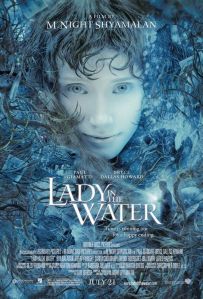
Writer/director/twist-abuser M. Night Shyamalan must have been smarting from the cool reception to his last high-concept thriller, 2004’s The Village. Shyamalan has built a reputation for smart, eerie, complex movies, as well as forced twists and endings that leave the films in shambles. He went back to basics. Lady in Water started as an ongoing story he told his kids at bedtime. His kids participated in the creation of the story. If we didn’t learn from last year’s The Adventures of Sharkboy and Lava Girl, movies where children helped shape the story should be left as bedtime stories. Lady in Water is further proof of this.
Cleveland Heep (Paul Giamatti) is the fix-it man at an apartment complex. Someone’s been swimming in the pool late at night and clogging up the filter. The unexpected culprit is Story (Bryce Dallas Howard), a waif of a girl. She says she is a “narf,” a sea nymph who’s crossed from her world, the Blue World, to ours. Her purpose is to plant the seed of change by finding a special individual. When her mission is complete a giant eagle will carry her back to her world. Cleveland accepts being her guardian and protector and assists her on her quest. He mingles with the apartment complex’s eclectic residents, trying to figure out who fits what role to help Story. There is one hairy problem. A scrunt, a wolf-like beast with twigs and long grass for fur, is after Story. An evil monkey creature is overseeing the whole weird affair.

Early on, Lady in Water was advertised as “a bedtime story by M. Night Shyamalan,” and just like your typical bedtime story, the thing feels entirely made up on the spot. The story sounds like a little kid making up a book report: “There’s this grass wolf, see, and it’s after this sea lady, and there’s these evil monkeys that oversee everything, and an eagle carries her away when she’s done, but she’s like the unknown Queen of the sea ladies, and she has helpers but can’t say who they are, and they all have special abilities, except some of them can only do stuff, and no one can see her leave.” What? Was Dio an unaccredited co-writer for this? Lady in Water feels like Shyamalan is haphazardly throwing spontaneous obstacles and rules into his story, hoping something sticks when it just muddies up the story.
Naturally, there are many unanswered questions brought about by the supernatural subject matter. Why is it an eagle that plucks Story away to safety when she?s fulfilled her mission? Wasn’t part of the schism between man and the Blue World because man moved to land? Wouldn’t something aquatic make more sense to rescue her? What about the entirely unnecessary evil monkey judge? Why is it even there? Why does it just sit there idly if the scrunt breaks the rules (and if the scrunt is a rule-breaker then why not just bust inside Cleveland’s home and eat the chick)? For that matter, if the monkey judge is so evil then why does it even respect the rules? Why don?t the evil monkey judges side with the already evil scrunts? Why do the scrunts hate the narfs so? Who established these systems of rules for narf contact and scrunt hunting? Do the monkey judges allow the narfs to get killed as long as it’s during the right time? Is it like a boxing match (“Touch gloves, to your corners, and no biting after the bell”)? And of course everyone believes this tripe. Shyamalan could fall back on the excuse that his tale is a bedtime story and not meant for extensive examination. Sure, not everything needs to be explained but that doesn’t mean Shyamalan can get away with being lazy.

There’s no finesse in the writing. Shyamalan seems to have taken his frustration with the dwindling critical reception of his works hard. The movie critic character, Mr. Farber (a droll Bob Balaban) is one of two items, either the embodiment of his ire, a figure out of touch with human emotion and the public’s trust, or Shyamalan making a preemptive strike. The critic complains there are no more original stories left in Hollywood; well, Mr. Smarty Pants, what do you think of a tale of narfs and scrunts? The problem is that the film critic is not unlikable, just cynical, and despite how dismissive Shyamalan may wish to be, the critic’s complaints and observations about the film industry are solid. In Lady in Water, characters do speak their feelings so casually. People explain back-stories and motivations like it was written on foreheads. The critic character is so inconsequential as well, so the notion that Shyamalan spends so much energy on him makes it feel like a score being settled.
What’s more irritating is how self-involved the movie comes across. The whole purpose of Story’s venture to our world is to inspire a gifted writer, a writer whose work will be seen as unchecked genius that will cause great change throughout the world. Nations will renounce war, men and women will greet each other as brother and sister, and the world will be a profoundly better place to live, all thanks to one artistic genius that changed the world. And who plays this artistic genius lying in wait? M. Night Shyamalan. In conjunction with the critic character, perhaps Shyamalan is proclaiming that his movies will stand the test of time, despite what those fuddy-duddies at their typewriters say. Lady in Water is either an intense example of artistic insecurity or an unflappable, monstrous ego.
Shyamalan is too gifted a filmmaker to make outright bad movies. However, he is prone to making very misguided choices. The addition of the monkey judge just mucks things up and more unanswerable questions. Are the monkeys like the regional overseer? Is there a tri-state office run by a giraffe with twigs on its head? Shyamalan’s plot is too formless and relies on some garish ethnic stereotypes, like the nattering Jewess and the screechy, rail-thin Korean teen. His sense of direction takes a back seat to his writing. Many moments are filmed out of focus, or the camera bounces around trying to capture whoever’s talking, always seemingly just out of reach. His visual aesthetic feels noticeably simpler. There’s a certain unapologetic yearning in Lady in Water to be a Steven Spielberg film, from the John Williams-like score, to the assembly of characters wanting to believe again, to the heaping helping of schmaltz. Lady in Water is proficiently crafted (special thanks to cinematographer Christopher Doyle) but the movie is an unmistakable artistic misfire.

Giamatti is a dependable sad sack, and he deploys an array of stutters and tics to convey how damaged Cleveland Heep is. He’s good but then he always is, no matter how stupendously awful his material may be (he did survive Big Momma’s House). Howard is one of the more beguiling and intriguing young actors in the movies right now. She bewitched me in The Village, but in Lady in Water she befuddled me. It’s hard acting as a made-up creature. Howard relies on lots of vacant, supposedly, ethereal staring. She comes across as less supernatural and more like a club kid on ecstasy.
Lady in Water is not an unmitigated disaster but it’s definitely not good by any stretch of the imagination. M. Night Shyamalan seems to fray with every new movie, and Lady in Water is by far the man’s most ridiculous and self-involved flick. He’s too great of a talent to write off, even during his misfires, but we can’t be expected to iron out his narrative kinks every time. Shyamalan’s films generally center on broken people looking for their place in the universe and finding a grander plan for their pain. Hopefully, after the birth pain of Lady in Water, Shyamalan can find his place in the artistic landscape and spare us more half-baked bedtime stories.
Nate’s Grade: C-
Share this:

Cars (2006)
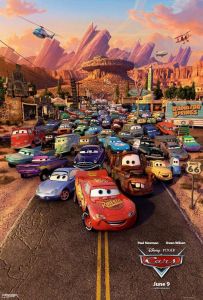 While I’d never call Pixar’s latest animated film a disappointment, it is the company’s first speed bump in their unprecedented reign of unmatched quality. Cars is technically dazzling; it’s almost redundant to say a CGI film is the best-looking ever because the technology keeps improving with time but Cars is incredible to watch. The lushly painted vistas, the way light gleams on surfaces, the blurs of color, the near-photographic likeness of cars themselves, this is a beautifully animated film, obviously. What isn’t as beautiful is the lackluster storyline. I can feel Pixar’s heart in the right place but they don’t put enough effort to touch our own hearts. Cars lacks the depth of Pixar’s other features. The two Toy Story films managed to take a kiddy concept of the secret life of toys when no one’s watching and infuse it with serious moral dilemmas and a mature insight into mortality and community. In Cars, the main storyline involves a cocky hot rod Lightning McQueen (voiced by Owen Wilson) who lives in a glitzy world that revolves around him. He goes off the beaten path and finds himself trapped in Radiator Springs, a tiny town that’s all but been dried up since the interstate took folks away from them. There, Lightning learns there’s more to life than material riches from this eclectic mix of good, honest small-town folk. What I’ve just described to you could be the plot of hundreds of movies championing the likes of small town folk. They surprisingly never really go much deeper, though Paul Newman is terrific as an old time car that had a taste of the glory and arrogance way back.
This is the first Pixar movie to exist in a world without humans, which begs the question how living automobiles were able to construct their world minus opposable thumbs. Cars themselves are weirdly inexpressive creatures.
The climax to Cars is suitable and heartfelt but the movie, at two hours in length, sputters a while in the middle. This is the first film directed by Pixar’s big cheese, John Lasseter, since 1999’s Toy Story 2, so excuse me for expecting a little more. Still, the movie is certainly fun, exciting, more cute than funny, and it has a genuine sweetness to go with its visual prowess. I just wish the 8 credited screenwriters, including Lasseter himself, had revved up their imaginations a bit more beyond the conceptual stage. Cars isn’t a great movie, but coming from Pixar, it’s still very good. Hey, anyone that can make the voice of Larry the Cable Guy tolerable deserves my thanks.
Nate’s Grade: B
Share this:

Howl’s Moving Castle (2005)
 The flick is wonderfully imaginative, as to be expected from Miyazaki. The Pixar people really do an excellent job of bringing these films to an American audience and treat the English dubs with reverence. I’m not someone who’ll bemoan an English dub when it comes to anime but it’s nice to see effort and respect. The story is a bit similar to Princess Mononoke with the warring factions, the mystic and the industrial, and Miyazaki’s refusal to paint in black and white. There are so many delightful touches here from the fire demon to the door portal to one segment that just involves two old ladies ascending stairs for three minutes. And yet it’s the spirit Miyazaki infuses and the attention to story and character that sets his films apart. There’s a genuine sense of magic while watching his films and Howl is no different. The only bit of contention I had with the movie is how abrupt the ending is. Howl’s Moving Castle is a bit soaked with confusion and some narrative cop-outs (“Surprise! I’m the prince responsible for the war!”). I would have loved another 30 minutes in this world as well as a better opportunity for Miyazaki to bring his story down with a smoother landing. Still, saying this is a slightly lesser Miyazaki film is like saying a million dollars is less awesome than 2 million dollars. Howl’s Moving Castle is another sterling addition to a master storyteller.
Nate’s Grade: A-


 nathanzoebl
You must be logged in to post a comment.