Blog Archives
Leave the World Behind (2023)
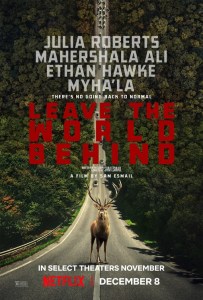 Apocalyptic thrillers can oddly enough serve as a therapeutic means for dealing with our fears of being helpless against forces well beyond our control, but they’re also reflections of our current state of anxiety as well. There’s more than just giant hurricanes or earthquakes breaking records on the Richter scale, it’s about how we respond to the momentous and alarming changes and what that says about The Way We Live Now. The new Netflix apocalyptic thriller Leave the World Behind, based on the 2020 book of the same name, has some big mysteries that I feel safe to say won’t fully be explained by the end. There is a possible explanation but it’s a movie more consumed with how people respond to tumult than the tumult. I found the majority of the movie to be gripping and engaging, and while it doesn’t exactly nail the landing, writer/director Sam Esmail (Mr. Robot, Homecoming) crafts a paranoid thriller with flair. It’s an apocalyptic thriller at crossroads with a paranoia thriller and a disaster movie, and the biggest challenge of them all is ultimately being able to trust another person during a time of remarkable uncertainty.
Amanda (Julia Roberts) and her husband Clay (Ethan Hawke) have elected to take a spur-of-the-moment family vacation out of New York City and onto a lavish home in Long Island. Everything seems so placid until the phones no longer get a signal, the TV broadcasts are strictly limited to a blank emergency screen, and two strangers show up (Mahershala Ali, Myhal’la) saying this is their house and they would like to stay inside. They claim that the U.S. is under a cyber assault and there’s more to come.
 Leave the World Behind has two intriguing questions to keep the audience hooked: what is actually happening and who are these new people? Most disaster movies put you in the thick of the action, from presidential boardrooms to scientific outposts keeping up with the changing data and going over the options to prevent further loss of life. This movie purposely leaves you in the dark in a well-kept Long Island home and the first thing that goes is the expediency of knowing things from our phones. When two new people come knocking at the door to say the world is falling apart and this is our home, trust us, it’s hard not to hold some level of suspicion. Can we take these people at their word? What kind of agenda could they secretly have? And if so, what does that say about what has happened or what is happening in the outside world? They seem like they know more than what they’re letting on, so how much do they know themselves? It’s the slow drip of information that makes the movie simmer in such an anxious predicament of looking at every new piece as another new question. This places the viewer uncomfortably in similar territory as Amanda, who despite her prejudices might be right not to trust the newcomers. We’re stuck on the outside wondering what has happened and what may be left. The movie is carefully crafted to only give us so much to work with while our minds start reading and rereading everything for more connection and meaning, running rampant and going stir crazy just like the characters. While the second big question naturally gave way and could only produce so much tension, the main thrust of the movie kept me hooked and excited and worried and actively questioning just what exactly was going on.
I appreciate how Esmail is a restlessly ambitious filmmaker. He took on directing duties for the entire second season of Mr. Robot and from there continued coming up with new challenges. There was an episode meant to be told as an episode-length elaborate tracking shot. There was an episode that was told almost without any spoken words, entirely through visual action. There was an episode that was presented like a five-act stage play and it was enthralling. While these are the easy to recall gimmick episodes, Esmail’s directing vision for his series never eclipsed the series itself. It elevated the episodes but the emphasis was still on the significance of the characters and their emotional states (highly recommend Mr. Robot, one of my favorite 2010s TV shows, to anyone who has yet to watch). With Leave the World Behind, only his second feature after 2014’s parallel universe rom-com Comet, Esmail refuses to let any sequence pass without some kind of visual flourish. His camera is constantly swooping through the visual landscape, flipping and spinning and craning above the characters from on high. It reminded me of Brian DePalma, who also loves the high angle pans across rooms and also abides by the dogma that there should be no uninteresting shots in a movie. It’s easy to appreciate but without an engaging story can quickly become a distracting exercise in empty artifice, which is also how I view most DePalma. Here, much like Esmail’s accomplished prestige TV work, the style makes me better appreciate how much effort and thought Esmail has put into his presentation and his ideas. The man wants you to see his work, and there’s no fault in that as long as you’re enjoying the experience, which I was for the most part.
 There are some supremely well-crafted moments played to a breaking point of intensity. Early on, as the family relaxes on the beach, they see a ship in the distance, an ordinary sight on a seemingly ordinary day. Then hours pass and it’s getting closer, and closer, and finally the realization begins to settle in that this thing is now a danger and they need to very much run very much now. Esmail’s camerawork keeps the scene feeling kinetic, with a long take that establishes the colossal danger as the tanker runs aground and the family has narrowly fled in time. In many ways this moment also serves as an ecological metaphor, with problems looming in the distance but ignored until they are at their most dangerous and right on top of us. Another sequence involves Clay venturing outside and discovering what appears to be a dust storm the color of blood. It’s getting closer and closer and the movie is testing how much we can take before you start hitting an imaginary gas pedal to strongly suggest Clay out of there. There’s another sequence that’s a literal pile-up of driver-less cars coming to the same nexus point like they’re all migrating. It makes for an immediately eerie sequence that becomes extra horrifying once the Teslas become unmanned missiles.
The themes of disconnection aren’t exactly subtle but that doesn’t mean they are misguided. This movie is about as subtle as an oil tanker heading straight for you, but I didn’t mind because of the skill of the storytellers and the ongoing mysteries that kept me begging for every new morsel. The messaging isn’t exactly complex. At one point Amanda has a speech that might as well be titled “This is Why Humans Are Terrible and We Deserve This.” Following this, another character tells her that they may not agree on much but she agrees with every word she just uttered with her speech, so you know this is the kind of pessimistic monologue that can reach across the doom-scrolling aisle. The movie almost frustratingly ends without a larger sense of clarity over what has been happening, a fate that would have greatly angered my wife. Esmail gives you something that can work as an explanation without making it definitive; it’s merely a theory but it’s enough to hold onto if you desperately need an explanation. However, the way the movie ends feels less conclusive and more like the conclusion of a season of television where the characters, now grouped together, are in for something fierce next year so stay tuned. The nature of this story is designed to leave you hanging, and that’s why I circle back on it mattering more on how these characters respond to this apocalyptic event versus what is clearly happening.
 Chilling and effectively plotted to keep you guessing until the end, Leave the World Behind is an apocalyptic thriller that really simmers in the anxiety of the unknown. It’s not perfect but it’s pretty good, as long as you can accept not having all the answers. The acting is strong but it’s the control and finesse that Esmail exhibits as director and screenwriter that really makes the material engaging and impactful. It’s an apocalyptic thriller where the scariest proponent might be having to live with one another.
Nate’s Grade: B
Share this:

Knock at the Cabin (2023)
 Knock at the Cabin continues M. Night Shyamalan’s more streamlined, single-location focus of late, and while it still has some of his trademark miscues, it’s surprisingly intense throughout and Shyamalan continues improving as a director. The premise, based off the novel by Paul Tremblay, is about four strangers (Dave Bautista, Nikki Amuka-Bird, Rupert Grint, Abby Quinn) knocking on the door of a gay couple’s (Jonathan Groff, Ben Aldridge) cabin. These strangers, which couldn’t be any more different from one another, say they have come with a dire mission to see through. Each of them has a prophetic vision of an apocalypse that can only be avoided if one of the family members within the cabin is chosen to be sacrificed. Given this scenario, you would imagine there is only two ways this can go, either 1) the crazy people are just crazy, or 2) the crazy people are right (if you’ve unfortunately watched the trailers for the movie, this will already have been spoiled for you). I figured with only two real story options, though I guess crazy people can be independently crazy and also wrong, that tension would be minimal. I was pleasantly surprised how fraught with suspense the movie comes across, with Shyamalan really making the most of his limited spaces in consistently visually engaging ways. His writing still has issues. Characters will still talk in flat, declarative statements that feel phony (“disquietude”?), the news footage-as-exposition device opens plenty of plot hole questions, and his instincts to over-explain plot or metaphor are still here though thankfully not as bad as the finale of Old, and yet the movie’s simplicity also allows the sinister thought exercise to always stay in the forefront. Even though it’s Shyamalan’s second career R-rating, there’s little emphasis on gore and the violence is more implied and restrained. I don’t think Shyamalan knows what to do with the extra allowance of an R-rating. The chosen couple, and their adopted daughter, are told that if they do not choose a sacrifice, they will all live but walk the Earth as the only survivors. It’s an intriguing alternative, reminding me a bit of The Rapture, an apocalyptic movie where our protagonist refuses to forgive God and literally sits out of heaven (sill worth watching). The stabs at social commentary are a bit weaker here, struggling to make connections with mass delusions and confirmation bias bubbles. I really thought more was going to be made about one of the couple being a reformed believer himself, with the apocalyptic setup tapping into old religious programming. It’s a bit of an over-extended Twilight Zone episode but I found myself nodding along for most of it, excusing the missteps chiefly because of the power of Bautista. This is a very different kind of role for the man, and he brings a quiet intensity to his performance that is unnerving without going into campy self-parody. He can genuinely be great as an actor, and Knock at the Cabin is the best example yet of the man’s range. For me, it’s a ramshackle moral quandary thriller that overcomes Shyamalan’s bad writing impulses and made me actually feel some earned emotion by the end, which is more than I was expecting for an apocalyptic thriller under 100 minutes. What a twist.
Nate’s Grade: B-
Share this:

Don’t Look Up (2021)
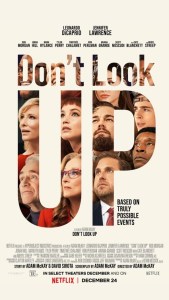 A scorched Earth satire that flirts with a literal scorched Earth, Don’t Look Up is writer/director Adam McKay’s star-studded condemnation of everything stupid and myopic in media, politics, and pop culture. Jennifer Lawrence plays a doctoral student who discovers a comet heading for direct cataclysmic impact with Earth, and she and her astronomy mentor (Leonardo DiCaprio) are trying to sound the alarm but nobody seems to be listening. Not the president (Meryl Streep) and her inept chief of staff/son (Jonah Hill). Not the greedy CEO (Mark Rylance) of a tech company. Not the media where morning TV co-hosts (Cate Blanchett, Tyler Perry) are more compelled by music star breakups than pressing science. It makes a person want to stand up and scream about priorities, and that’s McKay’s point, one that will be bludgeoned again and again. This movie is animated with seething rage about the state of the world and the cowardice about facing obvious problems head-on. It’s fit as a climate change allegory but COVID-19 or any scientific crisis could be applied as well. It’s about choosing ignorance and greed, about deferring to our worst instincts, and those in power who profit from inaction. I laughed at several points, some of it good cackling, and the movie is dark to its bitter end. This is the bleakest movie of McKay’s foray into his more sober, activist movie-making (The Big Short, Vice). It’s less Seeking a Friend for the End of the World, exploring the foibles of humans reconciling their last moments of existence, and more Idiocracy, where there is a lone voice of reason and the rest of the population are aggravating morons that refuse to accept reality even if it literally means just looking up with their own eyes. In some ways, the dark laughter the movie inspires is cathartic after years of COVID denials and mask tirades and horse medicine. The satire is bracingly blunt but also one joke on repeat. If you’re the right audience, that one joke will be sufficient. I don’t think the movie quite achieves the poignancy it’s aiming for by the end of its 138 minutes, but the anger is veritably felt. Don’t Look Up wants us to save the world before it’s too late, though the people that need to see the movie the most will be the ones fastest to dismiss it. Still, congrats to McKay for making a movie this depressing and relevant for the holidays.
Nate’s Grade: B+
Share this:

Finch (2021)
 Delayed almost two years thanks to COVID and eventually sold to Apple, Finch is the story of Tom Hanks trying to survive the irradiated post-apocalypse with a dog and a robot. That’s the pitch and that’s actually about the extent of the movie. Tom Hanks plays a man dying from UV exposure and trying to create a provider for his beloved dog, who itself has a sad back-story. It’s a simple story but the movie succeeds on the detail of its world-building and the sincerity of Hanks and Caleb Landry Jones (Get Out) in a mo-cap performance as the nascent robotic helper who names himself “Jeff.” It’s a post-apocalyptic buddy film, a road trip movie, and a survival thriller against the new reality of supercharged weather elements and the threat other people can present. The set pieces are effectively developed and open up Finch as a character. Almost after every big moment we have a quiet one where Finch uncorks a monologue that explains more about his own tragic past, the tragic events that left much of Earth to be highly irradiated, or the relationship he had with his own absentee father. Hanks is nicely vulnerable and warmly paternal as a man teaching a robot how to be human in the pursuit of caring for others. This could have been a post-apocalyptic one-man show, a Cast Away meets I Am Legend, but Jones is an enjoyable foil as the clumsy robot who is trying to make his creator proud. The robot design is very minimal but Jones is able to find small ways to communicate the childlike emotions of the character. The movie doesn’t have any devastating moments of suspense, terror, or meaty character drama. It coasts on a pleasant and gentle spirit with a touch of melancholy but Finch mostly keeps things in a relatively heart-warming territory. Finch isn’t much more than its initial pitch, but I’m happy to spend two hours with Tom Hanks trying to teach a robot how to be nice and brave in order to save a dog (spoiler alert: the dog lives too).
Nate’s Grade: B
Share this:

Awake (2021)
 Every so often I’ll watch a movie and be really intrigued or hopeful with the premise, something that really grabs my imagination, and then that hope crashes and burns in disappointment of a story that never fully takes advantage of all the tantalizing possibilities of its start. In short, I say, “That movie didn’t deserve its premise.” That’s the first thing I thought about after watching Netflix’s new apocalyptic thriller, Awake, where humanity is suddenly incapable of going to sleep. There’s an engrossing drama about the psychological descent and a potent political thriller about the destabilizing of civilization once people are unable to get their forty winks. The premise peculates with such promise, and for it to become yet another end times road trip, hewing so closely to a solidifying formula, is like trapping everyone in a (bird) box.
Jill (Gina Rodriguez) is a former soldier, recovering addict, and current security guard who is also selling opioids on the side to make ends meet. One day, people are no longer able to sleep, everyone except her young daughter. Jill rescues her two children, gets into a car, and drives off for a far off scientific research base where a scientist (Jennifer Jason-Leigh) studying sleep might have the knowledge of how to solve this worldwide mystery.
 I think most people have dealt with the effects of sleep deprivation at some point in their life, especially if they have ever had a newborn child. The subject matter is very relatable. I had a bout of insomnia years ago where I was averaging less than two hours of sleep for weeks, and it was the worst physical endurance I’ve gone through in my, admittedly privileged, existence. I felt like a zombie, barely able to function, my head forever fuzzy, and I lost all desire to eat and had to compel my body to consume food I knew it needed for fuel. I even purchased the Ensure nutritional drinks. It was a miserable time and I was even getting a minimal amount of sleep rather than none whatsoever. I’ve had rough sleep certain nights and feel like I’m running on fumes for the rest of my workday. It takes far more time to bounce back from bad sleep, and I’m wondering if I’ll ever actually get consistently restful sleep again for the rest of my life. With all of that stated, Awake should be an easy movie to plug right into and relate to the deterioration. However, it’s so unclear and clumsy in its depictions of the world. It’s unclear until the very very end how long the world has gone without sleep, and so we run into examples that seem to paint two different pictures of our apocalyptic environment: overplaying and underplaying.
At times, Awake is overplaying the effects of the mental breakdown of society. At points, it feels like society has broken down so completely and over a confusing timeline. There are run-ins with a group of elderly naked people just standing around and acting serene, a prison where the inmates walk out for unspecified reasons involving the guards, and a church that has already gone full-borne cult crazy by thinking that sacrificing the little girl who can sleep means they’ll be able to share in her slumber. The movie didn’t establish these people as crazy religious fundamentalists, so this sudden bloodthirsty turn feels like a leap. Even in 2007’s The Mist, the trapped townspeople gave into the corrupting influence of the religious bigot over time and distress. It reminded me of another Netflix apocalyptic, parental road movie, 2019’s The Silence, where it seemed like it was mere hours before a select group of people started cutting their tongues out and declaring they needed to kidnap women for the purpose of re-population. I suppose some people are just looking for the first good excuse to indulge their baser impulses, but then explore more of this feature with meaningful characters that will matter when they break bad. I think the movie would have greatly benefited from a clear timeline, some helpful titles keeping up with the clock, things like “50 Hours In,” and the premise could have been revised to be a slow evaporation of sleep rather than a strict cut-off. Maybe people are only able to get two hours a night, then one hour, then 30 minutes, and people are freaking out because they know it’s getting less. Let society have some measure of reconciling with the totality of what is to come.
 At times, Awake is also paradoxically underplaying the effects of the mental breakdown of society. For the majority of the movie, our characters aren’t really acting differently even though they have been awake for multiple days. This is what also made me so confused. How much time has passed if nobody seems to be making a big deal about it? The slips in reaction time and awareness don’t really feel integrated until the chaotic conclusion. The family comes across the wreckage of an airplane and make no big deal of it. For that matter, if we’re establishing that sleep deprivation is causing planes to fall from the sky, I think there should be thousands of these crash sites dotting the landscape, unless the airlines have wised up and decided to ground their pilots because they’re afraid of potential post-post-apocalyptic class action lawsuits. Travels with Jill become too leisurely for everything that is going on (note to self: pitch an Anthony Bourdain-style travelogue during an apocalyptic social breakdown and tasting the new culinary delicacies). She senses that she will die and needs to train her children to survive in this new world without her. However, if only her daughter can sleep, then presumably only she will be left alive in due time and it’s less about fending for herself against other people and more how to live off the land. There’s an existential and more poetic, prosaic version of Awake where Jill is trying to cram years and years of parenting into a precious couple of days, where she also tries to secure a fortified hiding place for her daughter to wait out the rest of humanity dying off before she can come out like a hibernating animal. For Jill, its about securing her child’s survival rather than reversing this plague that is dooming humanity. There’s a stronger movie that could have been made had Awake been more personal and more serious rather than schlocky and muddled.
The movie does have a few moments of bizarre effect or risible tension, but these moments are few and far between and director/co-writer Mark Raso (Kodachrome) is very transparent about his genre influences. There’s a roadside checkpoint where a group of armed people try and break inside Jill’s vehicle and pull her and anyone else out the windows. The car is still driving as the assault goes on and the camera remains inside the vehicle while rotating around the interior as the attack plays out in a real-time long take. If you’ve seen the sci-fi masterpiece Children of Men, then this description should already be ringing a few bells of recognition. It’s not that Raso cannot pay homage to the sci-fi inspirations of his tale, but when you draw direct comparisons by emulating very specific artistic choices done by superior filmmakers, you’re inviting a negative impression. A standoff between Jill and an increasing exodus of prisoners had a queasy anxiousness to it because the movie lets the scene build with direct, immediate stakes. There’s a similar scene where Jill is hiding in a garage from voices, but the stakes don’t translate as well because our knowledge of who the other men are is limited. She could just sit in a corner and wait. The plane wreckage scene is impressively designed, and there are a few genuinely surprising moments, like the crowd of naked old people, to keep things curious, but Awake too often settles again and again for the most formulaic and least interesting creative path.
 If this all sounds a lot like Netflix’s Bird Box, then congrats, because you’ve likely caught onto the reason this movie exists. Both movies feature an unexplained worldwide phenomenon that results in the breakdown of society where mobs and cults have formed, and both movies feature a single mother trying to lead her two children, one boy and one girl, through the hazards of the road so they can reach a supposed secure place where authority figures will have answers, and both movies feature a normal facet of human existence that, once removed, is making people go crazy and mess with their perception. Both of the movies also provide plum roles for high-profile actresses. Rodriguez (Miss Bala) is a compelling actress who has shined in lighter, rom-com material (Jane the Virgin), in quirky character-driven indies (Kajillionaire), and in somber existential horror (Annihilation). She has the tools to be great. Awake did not give her enough. There are a couple of scenes, late, of her starting to lose her bearings, and it’s here that I wished the filmmakers had realized that showing the effects of this cataclysm would be best than underplaying or overplaying the deprivation. Awake is an apocalyptic road trip that will bore more than excite and frustrate more than engage. Who knew sleeplessness was such a snooze?
Nate’s Grade: C-
Share this:

The Midnight Sky (2020)

The Midnight Sky is really two sci-fi survival movies in one. In 2040, the world is experiencing a planet-killing ecological disaster. A team of astronauts, lead by a pregnant Sully (Felicity Jones), is returning from a multi-year mission to check if a moon of Jupiter is habitable. On Earth, Augustine (George Clooney with a Santa beard) is the lone scientist left at an Arctic research station. He has cancer and sees his life as having run its course, that is, until he finds a small girl (Caoilinn Springall) who missed being evacuated. They band together to brave the wintry, poisonous elements to travel to another outpost to better communicate with the returning astronauts and possibly secure an escape from this dying world. It sounds like it should be a very exciting and interesting movie. There are even sinking ice floes, space walks amidst deadly asteroids, and Augustine having to stop at points lest he overtax his frail body. In practice, the movie isn’t so much exciting as it is ponderous, grasping for a larger philosophy and existential meaning that seems entirely elusive. We’re treated to several flashbacks of a young Augustine (different actor but still voiced by Clooney) that seem superfluous until a grand reveal that made me audibly groan so loud I thought my neighbors would complain. I kept waiting for the relevancy between the stories to be demonstrated, and when it happened it was not worth the two-hour wait. The realization was so hokey that it retroactively made me dislike the movie’s moments that had been working earlier. As far as direction, this might be one of Clooney’s strongest turns as a visual storyteller, even if he borrows liberally from other recent sci-fi movies, notably Gravity, The Martian, and Interstellar. There are moments of stark beauty and terror. Ultimately, the whole movie amounts to a sad man taking stock of his life and legacy (is he a metaphor for the Earth? Is the Earth a metaphor for him?), and I’m still wondering how something this glum could also be so maudlin. The pacing is another issue. I was always eager to jump to the other storyline to see what they were doing (a cinematic “grass is greener” mindset). The acting is fine and I wish I could have spent more time getting to know the crew of this space mission (including Kyle Chandler, Demian Bichir, David Oyelowo, and Tiffany Boone) or conversely gotten to feel more of bond between Augustine and his near-mute charge that felt like it was providing insight into this man. Looking back, there’s a reason for some of the stilted characterization, but having an excuse for why your characters aren’t better developed is like preparing an excuse why you did something self-sabotaging. The rest of The Midnight Sky doesn’t better compensate for this storytelling choice, and so the movie feels too dull, frustrating, opaque, and overly manipulative, aided and abetted by Alexandre Desplat’s sappy score. No more than the sum of its parts, you can soon watch The Midnight Sky on Netflix and fall asleep to it on your own couch.
Nate’s Grade: C+
Share this:

She Dies Tomorrow (2020)
 She Dies Tomorrow has unwittingly become a movie of the moment, tapping into the encroaching anxiety and paranoia of our COVID-19 times in a way where the horror of newspaper headlines and existential dread has been transformed into a memetic curse. The new indie thriller is an uncanny and unexpected reflection of our uncertain times and it makes She Dies Tomorrow even more resonant, even if writer/director Amy Seimetz (Upstream Color, 2019 Pet Sematary) doesn’t fully seem to articulate her story. We’ve dealt with curses in films before and we’ve dealt with foreboding omens of impending death, but how would you respond if you knew, with certainty, that you were going to die the next day? How would you respond if you knew that your existence was itself a vector for this mysterious contagion and that by telling others you are dooming them to the same deadly fate, as well as their loved ones, and so on? Sure sounds similar to a certain invisible enemy that relies upon communal consideration to be beaten back but maybe that’s just me.
Amy (Kate Lyn Sheil) is a recovering alcoholic who knows, with complete certainty, that she will die the next day. Her boyfriend killed himself after saying he was cursed to live one last day, and now she’s convinced the same fate awaits her. Her sister Jane (Jane Adams) is worried about her mental state and then becomes obsessed with her warning. Jane then believes she too will meet the same fate, and discusses this to her brother (Chris Messina) and his wife (Katie Aselton) and two of their dinner guests. Each comes to believe that this deadly declaration is true. They must decide how to spend their remaining hours and whether the curse spreads beyond them.
 It seems like with Color Out of Space and The Beach House, 2020 is the year of movies where characters slowly succumb to forces beyond their understanding and that they cannot overcome. Halfway through She Dies Tomorrow, we have a half dozen characters that have been infected, and we watch how each respond to the recognition of their impending doom. One man wants to take care of personal decisions he’s been postponing. Another decides to come clean about wanting to end their relationship. Another debates whether it’s more humane to allow their child to pass in her sleep rather than rouse her to expire aware and conscious. That’s the kind of stuff that is intensely interesting, allowing the viewer to question what their own decisions and thoughts might be under these unique circumstances. I also liked that Seimetz keeps some degree of ambiguity (though perhaps too much for her own good). The curse is never fully confirmed. Could it simply be people going crazy and giving into a mental delusion that their fate is decided beyond their governance? Could they all be hypochondriacs giving into their worst fears and finding paranoid community? Is there a relief is adopting self-defeating fatalism?
The slow, fatalistic approach of the storytelling and the spread of the curse channels the crushing feelings of depression and helplessness, an emotional state many can identify with right now. There’s a heaviness throughout the movie that feels like an oppressive existential weight. As soon as these characters recognize the truth of the “I’ll die tomorrow” creed, they don’t fight. They don’t run. They don’t even rage against the unfair nature of their imminent demise. There isn’t a cure or even a mechanism for delay. The rules of the curse are fairly vague but it seems to follow the specifics of once you’re been exposed to an infected individual, and they mention their own impending death, that this starts the clock for your end. The characters lament how they’ve spent their lives, what they might like to have done differently, and come to terms with some marginal level of acceptance. Amy wants her body to be turned into a leather coat after she’s gone. Another woman opines how much she’ll miss trees, something that she took for granted. Another character marvels at the beauty of the sunset, which will be his last, drinking in the natural splendor with a new appreciation that he never had before. One woman says she regrets spending so much of her days talking about dumb nonsense, and then her firend disagrees, saying he enjoyed her nonsense and it brought him laughter. Taking stock of a life, there will always be regrets that more wasn’t accomplished or appreciated, and many of these same characters are determining how to spend their last hours, whether they prefer a partner or going it alone. In that sense, She Dies Tomorrow reminds me of the mopey indie version of Seeking a Friend for the End of the World or the more palatable, less operatic version of Melancholia.
 At barely 90 minutes, this is also a very slow and meditative movie that will likely trigger frustration in many a viewer. I’ll admit that my mind wandered from time to time with some of the, shall we say, more leisurely paced segments or redundant moments. There is a heavy amount of ennui present throughout here, so watching a woman listen to the same classical record, or laying on the floor in a catatonic daze, or staring off uninterrupted into the middle distance adds up as far as the run time. There isn’t much in the way of story here to fill out those 90 minutes. Amy infects her sister, who infects her brother and his wife, and from there they all deal with their new reality. From a plot standpoint, that’s about all She Dies Tomorrow has to offer. It has flashes of interesting character moments, like the couple who talk about their long-delayed breakup, or the couple discussing the ethics of letting their child die in her sleep, but too often the movie relies on mood over story, letting a numbing futility wash over the characters and conversely the audience. I’m not saying that mood can’t be the priority. It feels like apocalyptic mumblecore but with a screenplay with too much internalization to really take off. It can seem like an overextended short film. I can’t help but feel that Seimetz is just scraping the surface of her story potential and that these characters could have been even more compelling if they were given more than resignation.
Sheil (Equals, House of Cards) gives a suitably withdrawn and shell-shocked performance. She reminded me of a cross between Katherine Waterston and Dakota Johnson. The other actors, including familiar faces like Josh Lucas and Michelle Rodriguez, all adjust their performances to fit the tone and mood of this world, which means much is dialed back. I wish I had more moments like when Aselton (The League) viciously unloads what she really thinks about her aloof sister-in-law. The cast as a whole feel overly anesthetized, a bunch of walking zombies bumbling around the furniture, and while it’s within Seimetz’s intended approach, it does drain some of the appeal from the film.
Given the overwhelming feeling of daily unease we live with during an ongoing pandemic, I can understand if watching a movie like She Dies Tomorrow doesn’t exactly seem desirable. It can prove engaging while also airy, navel-gazing, and adrift. It’s several big ideas spread thin with overextended melancholy and nihilism. In a way it reminds me of 2016’s A Ghost Story, another indie reaching for some big statements about the human condition and grief and our sense of self and legacy. But that movie didn’t quite have enough development to make those ideas hit. Instead, I’ll remember it always as the Rooney Mara Eats a Pie For Five Minutes movie. There’s nothing quite as memorable, good or bad, here with She Dies Tomorrow. It’s mildly affecting and generally interesting, though it can also try your patience and seems to be missing a whole act of development. If you only have one more day to live, I wouldn’t advise using your remaining hours on this movie but you could do worse.
Nate’s Grade: C+
Share this:

mother! (2017)
 Now I know why there weren’t any promotional screenings for mother! in the lead-up to its national release. Director Darren Aronofsky’s highly secretive movie starring Oscar-winners Jennifer Lawrence and Javier Bardem was marketed as a horror thriller, a claim that is generous at best and dishonest at worst. This is not Rosemary’s Baby by a long shot. It’s a highly personal, livid, and visually audacious think piece on mankind, so it’s no surprise that general audiences have hated it and graded it with the rare F rating on Cinemascore (a shaky artistic metric, granted, but still a dubious honor). Aronofsky is a polarizing filmmaker who routinely makes polarizing works of art, so the stupefied outrage is not surprising. mother! is a challenging film that demands your attention and deconstruction afterwards. It’s not a passive movie going experience. I’m still turning things over in my brain, finding new links and symbols. mother! isn’t for everyone or even many. It requires you to give into it and accept it on its own terms. If you can achieve that, I think there is enough to be gained through the overall experience.
Lawrence and Bardem are husband and wife living out in the country. He’s a poet going through serious writer’s block and she’s remodeling the house in anticipation of a future family. One day a stranger (Ed Harris) comes by looking for a place to stay, and Bardem invites him into his home. The stranger’s wife (Michelle Pfeiffer) soon follows, looking for her husband. These uninvited guests awkwardly make themselves at home, testing Lawrence’s politeness and the bonds of her marriage. More and more strangers follow, flocking to Bardem and the home, and their unpleasantness only grows, pushing Lawrence into further states of agitation, desperation, and shock.
 The first thing you need to know before sitting down to watch mother! is that it is one hundred percent metaphorical. Nothing on screen has a sole literal intention. The movie is clearly Aronofsky’s statement about mankind’s harmful tendencies, as well as a larger potential indictment, but this is a movie that exclusively traffics in metaphor. Accepting that early will make for a much better viewing experience. It took a solid thirty minutes for me to key into the central allegory, and once I understood that lens the movie became much more interesting (this was also the time that more unexpected visitors began complicating matters). I was taking every new piece of information from the mundane to the bizarre and looking to see how it fit into the larger picture. I would genuinely recommend understanding what the central allegory may be before watching the film. Looking back, I can appreciate the slower buildup that, at the time, felt a bit like an aimless slog awaiting some sense of momentum. Even the significant age difference between Bardem and Lawrence is addressed and has a purpose. mother! is the kind of movie that gets tarred with the title of “pretentious,” and yeah, it is, because if you’re devoting an entire two-hour movie to metaphor, then you’re going to have to be a little pretentious. Terrence Malick movies feel like obtuse, pedantic navel-gazing, whereas mother! felt like a startling artistic statement that had a legitimate point and was barreling toward it with ferocity. It invited me to decode it while in action, keeping me actively alert.
When dealing in the realm of metaphor, much is dependent upon the execution of the filmmaker, and Aronofsky is one of the best at executing a very specific vision. Black Swan and Requiem for a Dream are both excellent examples of Aronofsky putting the viewer in the distressed mental space of the characters, utilizing every component of filmmaking to better communicate the interior downward spiral. With mother!, Aronofsky attaches his camera to Jennifer Lawrence for the entire movie; we are always circling her or facing her in close-ups, always in her orbit. She is our tether. When she walks out of a room, we follow, trying to listen to the conversations going on without us. When the revelers and mourners show up, we experience the same confusion and irritation as her. The film builds in intensity as it careens toward its hallucinatory final act. It’s here where Aronofsky unleashes his targeted condemnation with extreme vigor. It’s one confusing moment cascading upon another, strange images that ripple like a nightmare. There are some pretty upsetting and offensive acts meant to provoke outrage, and Lawrence is always the recipient of much of that cruelty. Like a Lars von Trier film, Lawrence plays a heroine whose suffering serves as the film’s thematic underpinning. Aronofsky’s commitment to his vision is complete. He doesn’t leave anything behind.
 Existing as a highly metaphorical work of art, there are numerous personal interpretations that can be had from mother! although, even with that said, one interpretation seems very obvious (spoilers to follow). This is first and foremost a Biblical allegory with Bardem portraying God and with Lawrence as Mother Earth. They live by themselves in tranquility but God is bored and unable to find solace. That’s when Ed Harris (Adam) and then Michelle Pfeiffer (Eve) show up, and all of God’s attention is soaked up with these new people, who bring their warring sons (Cain and Abel) and then more and more strangers. The people won’t listen to Mother Earth’s requests and warnings, and after trashing her home and breaking a sink that causes an explosion of water (Aronofsky Noah meta reference?), she and God kick them all out. She says afterwards, “I’ll get started on the apocalypse.” It’s Aronofsky’s retelling of humanity’s existence from a Biblical perspective up until the fiery, vengeful end. From here there are all sorts of other symbols, from Jesus and the Last Supper, to the spread of the Gospels, and the corruption of God’s Word and the subsequent cruelty of humanity. These newcomers are selfish, self-destructive, ignorant, and pervert the poet’s message in different ways, caging women into sex slavery, brutally executing divided factions, all while God cannot help but soak up their fawning adulation. God finally admits that Mother Earth just wasn’t enough for him, like a spouse coming to terms with her husband’s philandering. He’s an artist that needs an audience of needy worshipers to feel personally fulfilled. Ultimately it all ends in fire and ash and a circular return to the dawn of creation. For viewers not casually versed in Biblical stories, the film will seem like an unchecked, unholy mess.
This is going to be a very divisive movie that will enrage likely far more viewers than entice, and this result is baked into Aronofsky’s approach from the start. Working in the realm of allegory doesn’t mean the surface-level story has to be bereft of depth (Animal Farm, The Crucible, and Life of Pi are proof of that). However, Aronofsky’s story just feels pretty uninviting on the surface, lacking stronger characterization because they are chiefly symbols rather than people. There are recognizable human behaviors and emotions but these are not intended to be recognizable people. This limits the creative heights of the film because the surface isn’t given the same consideration as the metaphor. If you don’t connect with the larger metaphor and its commentary, then you’re going to be bored silly or overpowered by artistic indulgences. Everything is, ironically, a bit too literal-minded with its use of metaphor. The movie’s cosmic perspective is, to put it mildly, very bleak. It can be very grueling to watch abuse after abuse hurled upon Lawrence, so it doesn’t make for the most traditionally fun watch.
 mother! is a movie that is impossible to have a lukewarm reaction to. This is a shock to the system. Aronofsky’s wild cry into the dark is a scorching cultural critique, a condemnation on the perils of celebrity and mob mentality, and a clear religious allegory that posits mankind as a swarm of self-destructive looters that are as ruinous as any swarm of Old Testament locusts. It’s an ecological wake up call and a feminist horror story. It’s an artistic cleave to the system that’s meant to disrupt and inspire debate and discussion. This is going to be a movie that affects a multitude of people in different ways, but I feel confident in saying that fewer will connect with it and its dire message. Motherhood is viewed as martyrdom, and Pfeiffer’s character sums it up best: “You give and you give and you give, and it’s just never enough.” It’s about dealing with one-sided, usury relationships, surrendering to the insatiable hunger of others who are without appreciation or introspection. It’s not a horror movie like It about scary clowns. It’s a horror movie about how we treat one another and the planet. Aronofsky can confound just as easily as he can exhilarate. mother! is a provocative, invigorating, enraging, stimulating, and layered film that demands to be experienced and thoroughly digested.
Nate’s Grade: B+
Share this:

Noah (2014)
 Meticulous director Darren Aronofsky gained a lot of creative cache after Black Swan raked in over $200 million worldwide, a Best Actress Oscar, and heaps of critical acclaim, including from myself (not to imply I was a deciding factor). The man had what all artists dream of, a perfect moment to seize whatever creative project his heart desired. And what he chose was to remake the biblical story of Noah for the masses, with an artistic fury and idiosyncrasy the likes of which audiences have never witnessed. The decision left many scratching their heads, wondering why Aronofsky would waste his time with a story already well told, in an outdated genre (Biblical epic), that would likely turn off evangelical ticket-buyers with any deviations and turn off mainstream audiences with any devotion. It looked like a big budget folly with no way of winning. The box-office is still unwritten, though I suspect the effects will net a pretty penny in overseas grosses, but as far as a creative statement, Noah is far more triumph than folly.
Noah (Russell Crowe) is living his life in isolation from the communities of king Tubal-cain (Ray Winstone). Noah and his wife Naameh (Jennifer Connelly), their two older sons Shem (Douglas Booth) and Ham (Logan Lerman), youngest son Japheth (Leo Mchugh Carroll), and adopted daughter Ila (Emma Watson), are living on the outskirts of civilization, aided by a group of fallen angels. Then Noah is given apocalyptic visions of an oncoming flood and the mission to save the world’s animals. After speaking with his 900-year-old grandfather Methusselah (Anthony Hopkins), Noah is convinced what he must do, and it involves a lot of intensive manual labor.
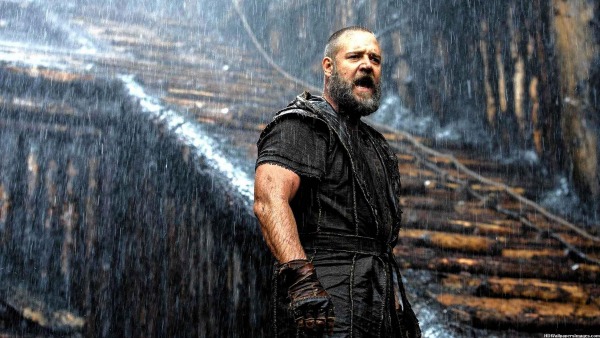 Aronofsky treats Noah and the beginnings like Greek mythology mixed with a Lord of the Rings-style fantasy epic, and it’s madly entertaining. The visuals are stirring, large-scale, and sumptuously memorable (the Earth covered in spiral weather patterns is a standout, along with Noah’s visions and a Tree of Life-style triptych narrating the birth of life). The film has come under fire from conservative critics for its creative deviations from the Bible, but sidestepping a larger conversation, why should a movie be punished because it wants to entertain a wider berth of people than the faithful? Does it truly matter that the people refer to the Big Guy as “The Creator” rather than “God”? Would these people even use the word “God”? This just seems like a petty battle of semantics. It seems like certain critics are looking for any nit to pick. Sure giant rock monsters that were fallen angels might make people snicker, but why should this aspect of the story be any more preposterous than a man and his family gathering two of every biological creature on the planet? I loved the rock creatures, I loved how Aronofsky introduces them, I love how they walk, I love that Aronofsky even finds a way to give them a redemptive storyline, offering an emotional payoff. Seriously, why should these be any harder to swallow for narrative stability?
There were fears that Aronofsky would be less than reverent to the source material with his additions and subtractions bringing it to the big screen; Noah is a Biblical epic for our modern age but also one fervently reverent to the lessons of the tale. First off, a literal version of the Genesis tale would be boring and short. There is going to be some additions and they should be welcomed. What Aronofsky and his co-writer Ari Handel (The Fountain) have done is taken a story filled with casual larger-than-life events and given it a smaller human perspective that is thought provoking. When Noah’s sons ask about wives, it’s personal planning but also a necessary part of, you know, repopulating the planet. They’re being anxious teen males but the small, relatable plot line also finds a way to relate to the larger picture, a tactic Aronofsky frequents. There’s a focus on family, fathers and sons, jealousy, but it really comes down to a personal level, differing perspectives about the overall purpose of man. The human-scale provides a richer context for the Biblical tale’s better-known aspects, like Noah turning to the bottle. As a result, we get the special effects spectacle without sacrificing the potent human drama at work. While the movie may never refer to “God” by name, it’s respectful and reverent.
 Another aspect about what makes Noah so daringly visionary is that it doesn’t blink when it comes to the darkness of the story. Over the years popular culture has neutered the tale of Noah into a cutesy tale about a guy on a boat with a bunch of happy animals. I think we’ve purposely ignored the lager picture, namely how truly horrifying the entire story is. It’s an apocalypse, humanity is wiped out; children and babies are drowning. Everybody dies. The later brilliance of Noah is that it doesn’t mitigate this horror. Once Noah and his family are inside, the floods having arrived, they painfully listen to the anguished wails of those struggling for life in the waters. The movie forces the characters, and the audience, to deal with the reality of a world-destroying cataclysm. Noah’s visions of the ensuing apocalypse are beautifully disturbing. The film takes place eight or nine generations removed from Adam, and God is already willing to take his ball and go home. After watching mankind’s wickedness, you might sympathize with The Creator. Aronofsky’s film has an unmistakable environmentalist stance (how does one tell this story without being pro-nature?), but he also shows you the brutality of mankind. The citizens of Tubal-cain have no respect for life, at one point kidnapping crying young girls and literally trading them for meat to eat. Resources are dwindling and people are pushed to the brink. There’s some sudden and bloody violence, as death is not treated in the abstract or with kid gloves. This is no cutesy story for the little ones. No stuffed animal tie-ins.
Of course once the flood occurs, the story seems like it’s at an end, Noah and his family having only to patiently wait out before starting over. It’s during this second half where the movie becomes even more personal, challenging, and philosophical. Noah believes that his family was spared to save all of those creatures born on Days 1-5, not so much Day 6 (a.k.a. mankind). He accepts this burden with solemn duty, declaring that his family will be the last of mankind to ever walk the Earth. However, spoilers, his own family pushes him to the test of this declaration. His adopted daughter is pregnant. There is hope that mankind can continue if the child is a girl. Noah sticks to his guns, saying that the child will live if a boy but killed if a girl. Now we’ve got a ticking clock, so to speak, while in the ark, and it manages to be a personal test of Noah’s own faith. How far will he go to enact what he believes to be God’s plan? He’s single-minded in this regard but he’s no zealot, more a flawed and troubled man of virtue trying to make sense of an improbably difficult conundrum. That’s the stuff of great drama, finding a foothold in a debate over the nature of man, whether man is inherently evil and shall lead, once again, to the ruination of God’s paradise. Can Noah place the personal above his burden? This looming conflict tears apart Noah and his family, forcing them into hard choices. Even assuming the film wouldn’t end with Noah butchering his grandchildren, I was riveted.
There’s an intellectual heft to go along with all the weird, vibrant spectacle. The film doesn’t exactly break new ground with its fundamental arguments and spiritual questions, but when was the last time you saw a Biblical movie even broach hard topics without zealous certainty? Definitely not Son of God. There’s an ambiguity here to be admired. Noah isn’t a spotless hero. The villain, Tubal-cain, actually makes some good points, though we all know they will be fleeting. Tubal-cain is actually given more texture as an antagonist than I anticipated. He’s a man who interprets man’s mission on Earth differently. Whereas Noah views man’s role as being stewards of the Earth, Tubal-cain views man as having been given dominion. They were meant to reap the pleasures of the Earth. Before marching off to take the ark, Tubal-cain pleads for The Creator to speak through him; he longs for a connection that he feels is missing, and so, perhaps a bit spiteful, he declares to act as the Creator would, laying waste to life. That’s far more interesting than just a slovenly king who wants to live to see another day.
 Aronofsky also benefits from a great cast that sells the drama, large and small. It’s been a long while since Crowe (Les Miserables, Man of Steel) gave a genuinely great performance; goodness it might have been since 2007’s 3:10 to Yuma remake. The man can do quiet strength in his sleep, but with Noah he gets to burrow into his obsession, which just so happens to be sticking to the edict that man does not deserve to spoil the Earth. It’s a decision that challenges him throughout, forcing his will, and Crowe achieves the full multidimensional force of his character. He can be scary, he can be heartbreaking, but he’s always rooted in an understandable perspective. Connelly (Winter’s Tale) overdoes her mannerisms and enunciation at times, like she’s practicing an acting warm-up, but the strength of her performance and its emotions win out. Watson (The Bling Ring) is winsome without overdoing it, Hopkins (R.E.D. 2) provides some comic relief without overdoing it, and Lerman (Percy Jackson) gets to thrive on angst without overdoing it. In short, you’ll want these people to live. Winstone (Snow White & the Huntsman) is always a fabulous choice for a dastardly villain.
Darren Aronofsky’s Noah is a labor of love that maintains its artistic integrity amidst special effects, threats of infanticide, and giant rock creatures. Aronofsky has forged a Biblical epic that reaches beyond the pew, providing added surprise and depth and suspense. The man takes the modern fantasy epic template and provides new life to one of mankind’s oldest tales, staying reverent while opening it up for broader meditation. It’s a weird movie, but the silliness is given a wider context and grounded by the emphasis on the human perspective. It’s a dark movie, but the darkness is tempered with powerful feelings and a sense of hope that feels justified by the end. It’s also a philosophical movie, but the questions are integral, the stakes relatable, and the answers hardly ever easy to decipher. This is a rare movie, let alone an example of a Biblical film, that succeeds by being all things to all people. It’s reverent, rousing, thought provoking, exciting, moving, and a glorious visual spectacle of cinema. Aronofsky’s epic is a passionate and thoughtful movie that deserves flocks of witnesses.
Nate’s Grade: A-
Share this:

This Is The End (2013)
 There are three apocalyptic comedies this year and Seth Rogen’s This Is The End is undoubtedly the biggest in profile. The plot is simple: Rogen and his pals, Jonah Hill, Jay Baruchel, Craig Robinson, and Danny McBride, are holed up in James Franco’s lavish home while the world comes to an end outside. Your enjoyment level for this movie will largely depend on your enjoyment level of the cast since they are playing self-involved, idiotic versions of themselves. While it dithers with the occasional self-indulgent sidetrack, I found Rogen to be savvy about providing enough for an audience to invest in. There’s a slew of Entourage-style cameos, though mostly pre-apocalypse, to ease us into the film. It’s fun seeing Michael Cera and Emma Watson (Perks of Being a Wallflower) play against type, but there’s so many blink-and-you’ll-miss-them figures that it can be tiring. But once it rains fire, demons emerge, and the righteous are Raptured, the movie gets outlandish and even better. For a solid hour it’s a survival tale where egotistical actors are at one another’s throats and it genuinely gets funnier as it goes. The comedy is, as you would expect, completely vulgar but hilarious often enough. A shouting match between Franco and McBride over masturbation habits, complete with angry, enthusiastic miming, is a thing of comic glory. I was not prepared for how well Rogen and his collaborator Evan Goldberg (they wrote and directed the movie) are able to handle suspense, special effects, and a climax that is equal parts silly and heartwarming. There is a rewarding payoff to a character arc amidst all the talk about penises, human and satanic, and cannibalism, and that’s saying something. I only wish the ending had more punch, settling for an extended and mostly lame pop-culture cameo that seems to sap the good times. Still, if you had to spend the apocalypse with a bunch of guys, you could do worse.
Nate’s Grade: B


 nathanzoebl
You must be logged in to post a comment.