Blog Archives
Zero Dark Thirty (2012)
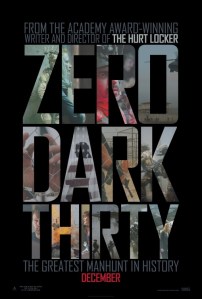 Director Kathryn Bigelow and journalist-turned-screenwriter Mark Boal, Oscar winners for 2009’s Best Picture-winner war film The Hurt Locker, were hard at work on their next movie when fate intervened. They were about to start production on a film about a 2001 incident where U.S. Special Forces almost nabbed Osama bin Laden, the notorious mastermind behind 9/11. Then on May 1, 2011, the world learned that Seal Team Six stormed bin Laden’s secret compound in Pakistan and executed the most wanted man in the world. Bigelow and Boal scrapped all plans and rewrote their movie from scratch. Now they had the ending we’d all demand; isn’t a movie where we get bin Laden way better than one where he narrowly escapes? Zero Dark Thirty (military terminology for well after dark) is the stunning result of Boal’s impressive reporting and condensing, Bigelow’s masterful direction, and a great supporting cast that brings history to vivid life. If you’re like me, you’ll walk out of the theater whistling to yourself, speechless at the spellbinding artistic achievement of the movie. This, ladies and gentlemen, is what essential, invigorating, quality filmmaking is all about.
We may know about Seal Team Six and the lead presented from tracking the courier, but few people know of the CIA analyst at the heart of the manhunt. Maya (Jessica Chastain) is a young agent stationed in Afghanistan who desires nothing more than to be the one who helps ensure that bin Laden gets killed. We follow her decade-long quest as she chases down leads, interrogates prisoners, and successfully presses the CIA brass for action, resulting in the fateful raid that took out bin Laden.
 You can tell early on that Zero Dark Thirty is going to be an excellent film. Given the pedigree of is creators, my expectations were enormously high. I rated their previous collaboration as my top film of that year. I knew I was in capable hands when the film opens on September 11, 2001 but skips any visuals. We sit and watch a minute of a blank screen while the sounds of desperate 911 calls become a wall of sound. It’s enough to reassert the stakes while still being restrained. Bigelow’s directorial command is astonishing, pitting you in the thick of the action. There are a lot of moving parts with a movie like this, wheels within wheels, and Bigelow keeps everything moving and focused. It helps that the bigger manhunt is broken up into a series of mini-missions over the ten years. Bigelow and her talented production team have recreated the ends of the world to bring this story to life. That added sheen of verisimilitude gives every moment a sense of magnified power, an electric sense of relevancy. You’ll get goose bumps as they start circling the actual location of bin Laden. Bigelow, who won an Oscar for her virtuoso work on The Hurt Locker, still knows how to play every one of your nerves. There’s a clandestine meet up with a possible turncoat that is stuffed with dread. Every checkpoint, every safety procedure waved, you’ll be biting your nails, the voice in your head clearly saying, “Oh no, this isn’t going to go well.” Zero Dark Thirty is more crime procedural than the action thriller. Even so, Bigelow’s direction is top-notch and brings an intense, churning verve to the film, down to the smallest detail.
The film plays out like an absorbing, hard-hitting piece of investigative journalism, recreating the steps and false turns over the ten-year manhunt for bin Laden. There is a lot of information to process and over 100 speaking roles, and Boal and Bigelow do not stoop to pander to the less intelligent in the audience. You will be expected to catch up or fall behind. It can get confusing at points but Boal does an exceedingly articulate job of narrowing the particulars of the bin Laden case and presenting a clear through line. It’s a story that hops around the globe through a series of mini-missions, from a meet up with a possible al Qaeda spy to locking down a phone number to trace a courier in Pakistan. You see every step, every deal, and every effort that it takes to land the big break, namely tracking down bin Laden’s trusted courier to his Abbottabad compound. Boal even separates his narrative with titled sub-sections like a lengthy piece of journalism. We all know where the story is going to end up, but Boal’s supreme talent is making every step meaningful and tense leading up to that fateful raid May 1, 2011. The level of reportage detail is completely enthralling and will be relatively unknown to most filmgoers. Beyond 9/11 and the London bombings, I confess to being ignorant of the other al Qaeda attacks highlighted throughout. Therefore, not only is Zero Dark Thirty an exciting manhunt, it’s also an educational endeavor for most Americans.
 The proceeding two hours are an engrossing manhunt, but when Zero Dark Thirty gets to the raid sequence, that is when the movie ascends to a level of cinematic excellence unsurpassed this year at the movies. There is nothing else in 2012 that comes close to matching the 30-minute raid on bin Laden’s compound. My heart was in my throat the whole time. I was physically shaking. I was pinned to my chair. The conclusion, nabbing bin Laden, is one of the most riveting sequences in film I have ever seen. It’s like Bigelow has complete control of your senses, and even though we all know how this story ends, you’ll be glued to the screen, pulse racing, anticipating every step. After the film ended, I told my friend Eric that I felt like I needed to start smoking, thus was how exhilarated I felt leaving the theater (message to kids: don’t smoke, even if you see Zero Dark Thirty). My head was bustling afterwards. All I could think about was the masterful conclusion to a very good movie. The raid sequence is brilliantly recreated and just about portrayed in exacting real time; you feel like you’re right there along with the members of Seal Team Six. For a civilian, it’s fascinating jut to watch the minutiae of what went down, but under Bigelow’s taut direction, it’s the moment every American has been waiting for since September 11, 2001. Bigelow is also careful not to portray the death in any sort of jingoistic, fist-pumping context. She sticks with her docu-drama approach, avoiding sensationalism, and you don’t even see the shot that takes down bin Laden. The film is also very careful not to linger on bin Laden’s dead body or even reveal his face; she doesn’t, as President Obama said, “spike the football.” Bigelow deserves a second Oscar just for her superlative handling of those unparalleled 30 minutes of pure filmmaking bravado. Plus, it’s the best ending of the year at the movies.
Let me address the brewing controversy ensnaring the movie regarding its depiction of torture. Zero Dark Thirty does demonstrate torture but it never glorifies it or presents it as anything less than dehumanizing and morally repugnant. But torture did happen (I’m sorry Dick Cheney… “enhanced interrogations”) and to whitewash this regrettable period of time from the historical record is a disservice to the truth. This country, as well as any other, engages in extreme and detestable measures; we only hope that our leaders have the moral clarity to make these ethical lapses as few and far between as possible. Now, the politicians and bloggers have attacked Bigelow’s movie as tacitly condoning torture, indicting that it was successful in getting that big break. This is not the case. Zero Dark Thirty shows a variety of methods being used, and yes we get a heavy helping of torture and humiliation, but it’s when Maya and others start treating the detainee like a human being again, offering food and conversation, is when the progress is made. The film does not explicitly declare one interrogation method successful, however, I can see where people will draw their own (wrong) conclusion. If anyone wants to read my exact stance on torture, just check out my lengthy review of the 2007 Oscar-winning documentary, Taxi to the Dark Side. In short, torture does not work and Zero Dark Thirty does not purport that it does, though many may conclude otherwise. It seems to me that the critics don’t have enough faith in the audience to accept ambiguity.
2011’s breakout actress, Chastain (The Help), is the focal point of the movie and she delivers. Her character has no life outside of doggedly hunting for bin Laden. She’s completely driven by the goal of killing him, and as such she gets to uncork some dandy angry monologues dressing down her colleagues for their failing dedication. Chastian does a fine job of keeping a veneer around Maya, shrouding her emotions into a mysterious calm, which seems realistic given the nature of the character but also makes it tricky to connect with her emotionally. This movie is not the great character study that The Hurt Locker was, and so Maya gets some rather shrift characterization: she’s a workaholic fighting for credibility. The real star of the movie is the story so all the characters take a back seat to Boal’s journalism. While Chastain is quite good, I have to shrug my shoulders at the various critics groups throwing Best Actress accolades her way (go Jennifer Lawrence).
 The supporting cast doesn’t have a weak link amongst them, from Kyle Chandler (Super 8) as an outpost boss, Mark Strong (Tinker Tailor Soldier Spy) as a CIA superior screaming at the bin Laden team to “find me targets to kill,” Jennifer Ehle (Contagion) as Maya’s closest friend in a hostile land, James Gandolfini (TV’s Sopranos) as CIA director Leon Panetta, Stephen Dillane (Game of Thrones’ Stannis Baratheon) as a skeptical NSA head, and Chris Pratt (TV’s Parks and Recreation) as a member of Seal Team Six. That’s right America, TV’s Andy Dwyer helps cap bin Laden. But the real standout is Jason Clarke (Lawless) as an interrogator who eventually leaves the field for an office but still makes headway for Maya.
Much like The Hurt Locker, here is a movie that transcends politics and genre. Zero Dark Thirty is a nerve-wracking thriller, it’s an intelligent crime procedural, and it’s an engrossing and powerful work of relevant art. It operates on such a high level of artistic achievement that little else from 2012 even comes close. This thorough, intense, provocative, thought-provoking, morally ambiguous, thrilling, and generally tremendous movie is taken to a whole other level with its concluding act, brilliantly recreating the raid that took down Osama bin Laden, the most cathartic and satisfying ending of the year. You’ll be liable to whistle in awe at how accomplished Zero Dark Thirty is. Of course audiences should not accept every thing they see in the movie as unimpeachable gospel, as dramatic license is needed to help shape a formidable narrative. This is still a movie that desires to entertain and yea does it entertain. I look forward to the American public getting a chance to experience the same riveting theatrical experience that I had with my critical brethren, as well as the sense of catharsis and relief by film’s end. Zero Dark Thirty forgoes sensationalism for modulation, eschews moral righteousness for ambiguity, and expects the audience to keep up with its retinue of information. And you’ll be grateful to be given the chance to tag along. Run out and see this remarkable movie when you have the chance. Movies don’t get much better than this, folks.
Nate’s Grade: A
Share this:

This is 40 (2012)
 In the five years since 2007’s comedy smash, Knocked Up, writer/director Judd Apatow has ascended to heights in Hollywood that few ever achieve. And while his disappointing 2009 film Funny People may have been an example of the man flying too close to the sun (let’s mix metaphors, why not?), he’s had a stable career guiding mostly hit comedies to big numbers, particularly last year’s Bridesmaids. For Apatow’s next directing effort, he picks up a handful of supporting characters from Knocked Up and gives them their own spotlight. This is 40 is Apatow’s “sort-of sequel.” It may seem familiar in tone and style to his previous efforts, but there’s one big difference between this film and Apatow’s previous works. This movie never feels like it goes anywhere. Even Funny People went somewhere even if I disliked it.
Five years after the events of Knocked Up, Peter (Paul Rudd) and Debbie (Leslie Mann) are struggling to keep their household afloat and sane. Their daughters, Sadie and Charlotte, (played by Apatow’s real daughters, Maude and Iris), are constantly fighting, Debbie’s worried one of her employees is stealing from her business, and Pete’s trying to save his record company without alerting his family to his panic. Pete has put all his efforts into promoting a new album from 1970s rocker Graham Parker, but really he’s fighting a losing battle against mainstream taste. Pete has also been secretly loaning out money to his no-good father (Albert Brooks), while Debbie has been trying to reconnect with her distant biological father (John Lithgow). Weirdly enough, both fathers have started secondary families and have broods of young children. As Debbie and Pete both approach the big 4-0, both of them make resolutions to better themselves, renew their family bonding, and reignite the spark in their romance. Of course, after two kids and several years of marriage tallied, it’s easier said than done.
 The Apatow films have always had their own loping rhythm to them, an easygoing quality that isn’t as directed by plot as character. So when I say that This is 40 feels rather aimless, I want readers to recognize that this goes beyond the normal loosely plotted Apatow affairs. Usually his movies have defined events to direct the overall trajectory of the plot; a baby on the way, losing one’s virginity, etc. I’m hard pressed to say what exactly is the direction of This is 40. It’s about the ups and downs of a married couple, but there isn’t necessarily any definable conflict. They’re sort of in a malaise and internalizing their unhappiness, but the movie is the sum total of many small conflicts that never seem to congeal. As a result, the movie feels like it’s often coasting, going beat-for-beat until something new takes it on a mild diversion. It’s a movie of diversions without a unifying path. Sure the couple becomes, presumably, stronger by the end of the film, but I can’t say what’s taken place to explain this progression. The movie plays out like a series of loosely connected scenes. I enjoyed myself, and found the movie often amusing, but I kept wondering what it was amounting to. It was never enough of a niggling concern to stop from being entertaining, but when it was done, I thought to myself that I just watched Apatow’s friends hang out for two hours and call it a movie.
There’s also the issue of indicating this is a sequel to Knocked Up or at least exists within the same universe. There’s very little continuity between the two films other than Pete and Debbie’s family. Jason Segel (The Muppets) and Charlyne Yi (Paper Heart) make reappearances playing characters with the same names, but they don’t seem like the same characters (though the gyno doc is the same – hooray). My major sticking point is the complete absence of the stars of Knocked Up, Ben (Seth Rogen) and Alison (Katherine Heigl). Now I wasn’t expecting a drawn out cameo from these two, especially after Heigl publicly badmouthed Apatow and the movie that made her a star. I did expect some passing reference, even something as small as, “Ben and Alison are looking at schools for their daughter.” I just wanted something to feel satisfied. Where this becomes a problem is that I’m fairly certain that Ben and Alison would be attending several of these major social events for their family members. They make a big deal about Pete’s 40th birthday party, so why wouldn’t Ben and Alison be there? And with her litany of marital woes, wouldn’t Debbie seek out, you know, her sister to talk with, the same sister she hung out with all the time in Knocked Up? Apatow might as well have just given everyone a new name if this was as sequel-y as This is 40 was daring to go.
Part of my lukewarm reception to the film is likely my lack of empathy with the problems of the main characters. Good storytelling should allow anyone to be able to empathize with characters dissimilar to themselves. I found many of the problems in This is 40 to be the stuff of rich fantasy. Pete is worried his record company, that he started, might not make it. He’s also been secretly giving his mooch of a father $80,000 (!) over the years. Maybe these people could stand to cut back and live within their means. Their house is huge, downright opulent, and it seems like Pete has wasted plenty of money on needless expenditures, which his own employees eventually point out at work. Did they need a big 40th birthday bash? Do their kids need every expensive gadget? When they take a vacation, does it need to be in a lavish hotel along the beach? I found too many of these complaints to be whiny and indulgent. That’s not to say that there aren’t serious relationship problems that are given thoughtful attention. This is 40 is arguably Apatow’s most mature and reflective film yet, though that might be faint praise to some. I would rather the movie spent more time focusing on the relatable concerns of a relationship crumbling rather than the stress of possibly having to move from a super-rich house to a merely somewhat rich house.
And yet the movie is routinely funny and charming, thanks to the Apatow standards of cast camaraderie, character, and the mixture of raunch with sweetness. I like these characters and so I enjoy spending time with them, and even if I feel like we’re not going anywhere fast, I don’t mind that much. I’ll gladly spend two plus hours with these funny people and their mid-life crises comic follies, at least once. The characters are well drawn and played by capable comic players that can do their Apatow jazz deal, finding peculiar riffs to work and squeeze out mirth. I thought a discussion over the appeal of being a widower and the fantasy of a spouse’s untimely demise to be quite funny as well as a topic generally unspoken (“This is the mother of your children we’re talking about. You want her to go peacefully.”). Rudd (Wanderlust) and Mann (The Change-Up) are terrific together and entirely convincing as a longstanding couple, people who know the ins and outs of one another. It’s fascinating just to watch the nuts and bolts of a relationship that is still a battle; it also helps when you like both participants and find that they each have valid points. Though I cannot fathom how hiding impending financial doom is a smart move.
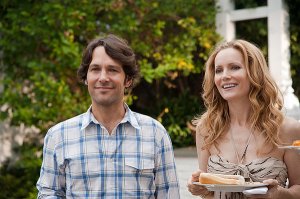 Apatow does a fine job of making sure the dramatic parts do not overweigh the film, usually settling things with a nicely punctuated joke or pop-culture critique (oddly enough, TV’s LOST becomes a major reoccurring gag, though you expect a bit more of a comedic payoff when they get to the controversial finale). I’m not sure that many people are going to know who Graham Parker is, but here he is folks. There are a lot of Apatow players peopled throughout, like Chris O’Dowd (Bridesmaids), Lena Dunham (TV’s Girls), and Melissa McCarthy (Bridesmaids), making fine work with minimal screen time. You’ll recognize other familiar faces as well. Occasionally the jokes feel like they go on too long, catching the downward slope of an overstayed improv riff, but I was laughing throughout and enjoyed the unpredictable nature scene to scene. You’ll likely predict the outcomes for certain storylines and conflicts, since Apatow is a sucker for the squishy ending, but you’ll feel like it got there on its own relative terms. It’s not exactly a happy ending but it’s a less unhappy ending.
There are plenty of supporting actors that shine in this movie, though I feel that I need to single out the great Albert Brooks (Drive). He plays such a passive-aggressive, manipulative, mooch of a father, but he does it in a way that almost wins you over, how straightforward he is with his bad behavior. When Pete tells him he cannot loan any more money, Brooks blithely, almost cheerily, theorizes that murdering some of his recent kids can solve this problem. He marches out, gets a hose, and asks the kids to volunteer who wants to be murdered. It’s scenes like this that manage to be funny but also cutting to a dramatic truth that the film hovers around, occasionally hitting the bullseye. Megan Fox (Transformers) is also enjoyable as a, what else, vivacious employee men are falling all over themselves for. And even Apatow’s own kids give rather strong performances, now playing actual characters rather than scene-stealers. Maude, the oldest, has a lot of dramatic scenes as the teenager daughter coming to grips with hormones and her crazy parents. The Apatow clan might just get some outside work after people see dad’s movie.
While I doubt Apatow has made any sort of definitive statement on what it means to approach four decades worth of life (and poop jokes), This is 40 is a perceptive and enjoyable movie even if it feels like a collection of scenes. Good thing I like these characters and enjoy spending time with them, otherwise I might find this whole film to be a bit aimless and self-indulgent. Seriously, how many scenes are there going to be of people singing along to music? This is 40 has enough going for it, be it comedy or some insightful dramatic moments, though it keeps an audience a bit removed due to the unrelatable nature of their posh problems. If there’s a This is 50 in the works, next time get me some more Rogen time. I’d rather watch him deal with raising a teenage girl in the age of social media. You don’t have to know anything about Knocked Up to follow along with This is 40, but then again, if you haven’t seen Knocked Up, just go watch that movie instead. Trust me.
Nate’s Grade: B
Share this:

Hitchcock (2012)
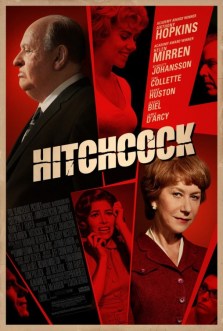 I think Alfred Hitchcock would be amused at his continued notoriety, not just from the quality of his films but also from the magnitude of his own presence. 2012 offers not one but two different movies about the master of suspense, both of which are oddly close in time period. HBO’s The Girl explored Tippi Hedren’s account of what it was like to film The Birds, with Hitchcock being a provocateur. The more straight-forwardly named Hitchcock looks at Alfred’s trials to make one of his seminal films, 1960’s Psycho. I only wish that the movie spent more time on Psycho and less time on the Hitchcock marriage.
Alfred Hitchcock (Anthony Hopkins) is starting to feel like he’s being left behind in Hollywood. He’s looking for his new project, something to rekindle his creative fervor, get those juices flowing once more. Then he comes across the book Psycho, based upon the murders of Ed Gein, a man who thought his dead mother was telling him to kill and make skin suits of his victims (Gein is also the inspiration for The Texas Chainsaw Massacre and Buffalo Bill in Silence of the Lambs; truly the gift that keeps on giving for horror). Murder, cross-dressing, incest. You can understand the hesitation from studio heads to bankroll the picture, even with the great Hitchcock name attached. With the sturdy support of his unflappable wife, Alma (Helen Mirren), Hitchcock puts his own money and clout on the line to see Psycho through. As the pressure mounts, Alfred is worried that his wife is spending a bit too much of her time with a certain screenwriter who wishes to woo her efforts away.
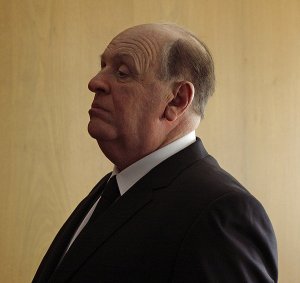 Sir Alfred was a blunt individual so I will follow suit and mince no words – this movie is terrible. How could it possibly be? It has tremendous acting talent and the rich angle of looking at the making of one of Hollywood’s most controversial and famous movies of all time the groundbreaking Psycho. Alas, it’s when the movie takes its many sidesteps away from the behind-the-scenes action of Psycho is where it goes astray. First off, I find the narrative framing around the marriage of the Hitchcocks to be superficial and hamstrung. We’re telling this vastly interesting story and grounding it in a very slight manner, gauging every creative struggle through the prism of whether or not Alfred and Alma will stick together. I assume it’s supposed to provide an emotional entry point for the movie, but I just didn’t care. I didn’t care about the jealous spasms Alfred felt as his wife spent more and more time with a caddish screenwriter, and boy did that storyline get tiresome. I want to know more about Psycho and not this dumb portrayal of martial woes told with such graceless handling. The whole portrayal seems so minute and clumsy and such a poor framing device when the making of Psycho is a juicy enough story. I didn’t need the focus to be on whether the Hitchcock marriage will persevere. Oh, and the resolution for this feels completely pulled from thin air, without any groundwork laid to explain the about-face into compassion in those final minutes.
Then there’s the portrayal of Alfred Hitchcock himself, which is so dubiously shallow when it comes to psychology. Oh, he’s obsessed with blonde leading ladies? Oh he’s a bit of a control freak? Oh he can be overbearing and demanding and standoffish? Wow, what powerful insights into arguably the most famous director in movie history. The movie, adapted by John J. McLaughlin (Black Swan), feels like it was made by someone who did the bare minimum of research on the man. There are no new insights or even mildly interesting ones to be found. It’s the standard boilerplate repeated with different actors. And then there are the nails-on-a-chalkboard scenes where Hitchcock imagines himself talking confessionally to none other than Ed Gein (Michael Wincott). Excuse me? Oh my goodness do these tacky sequences just grate. I don’t even understand their inclusion. Is this a manifestation of Hitchcock’s own sense of madness when it comes to moviemaking? Does he feel some connection to the horrible disturbed man who inspired his newest film? Does Hitchcock only feel like he can communicate to a figment of his own imagination? Whatever the reason, I wanted to smack myself in the head every time Hitch and Gein had a heart-to-heart. I should have known I’d be in for a bumpy ride when, in the movie’s opening minutes, a news reporter asks Hitchcock, after the premier of 1959’s North by Northwest, why he doesn’t just hang it up? Did this idiot even see North by Northwest? Would you ask Spielberg if he should retire after viewing Saving Private Ryan or Kubrick after A Clockwork Orange?
Then there’s the matter of Hopkins as Hitchcock. It never feels like the right fit. Turkey jowls aside, the man doesn’t look too similar to Hitchcock nor does he adopt a demeanor that proves convincing. Sure he goes for that highly imitable voice and cadence that Hitch is well remembered for, particularly his openings on his own TV show. You never feel like Hopkins has a real strong bead on the character, and surely the fault lies with the weak characterization relying on the collective knowledge of Hitchcock’s outsized public persona. Likewise, Mirren (The Debt) is fine but gets to play another of her steely strong-willed matriarchs. Mirren won’t let you done when it comes to performance but, given the lack of strong characterization, she goes on autopilot. The best actor in the movie is surprisingly Scarlett Johansson (The Avengers) who has a striking similarity to Janet Leigh, and not just in what you’re thinking. She’s instantly likeable and takes the Hitchcock peculiarities in stride, putting up a strong front but voicing her concerns when appropriate.
 Director Sacha Gervasi (Anvil! The Story of Anvil!) gooses up his story with all sorts of horror genre techniques, including editing fake outs and violent edits. I’m also unsure why so many liberties needed to be taken with the retelling of this story. I’m not going to be a person decrying the use of fictionalized elements in a true-life story for dramatic effect (I loved Argo), but you have to do so in a way that tells a better story without getting too far away from the essential truth of the matter. Hitchcock, in raising the talents of Alma, attributes many of Psycho’s development achievements to her keen womanly insights when they came from others. That’s fine, except that the movie portrays her in such a rarefied state of genius that she quickly becomes the movie’s surefire narrative cheat. Having problem with the last act? Let’s have Alma fix it. Having problems with the editing? Let’s have Alma fix that. It’s not compelling of a story for one character to chiefly have all the answers instinctively and without any sense of struggle. I understand that Alma did a lot of unaccredited work on Hitchcock’s movies, though it wasn’t uncommon for women to be screenwriters at that time and you’d think the pull of being a Mrs. Hitchcock would get her well-deserved credit. Regardless, I wish that Gervasi and McLaughlin had given Alma more depth than being put upon wife/secret savant collaborator.
It’s a shame because there’s a genuinely interesting movie to be had somewhere in here. The making of Psycho was fraught with difficulties and the studios just didn’t get it. Watching Hitchcock work through that process and persevere would be far more interesting. I enjoyed the multitude of famous cameos, like Michael Stuhlbarg as Lew Wasserman, Hitchcock’s agent and eventual head of Universal Studios, and even Ralph Macchio as Psycho screenwriter Joseph Stefano. I suppose the ins and outs concerning one of the most famous movies of all time could be considered, erroneously I feel, to be too “inside baseball.” That’s why I think the filmmakers expanded the romantic drama angle and had it consume the majority of the running time. Often the stupid perils of the will-they-or-won’t-they romantic squabbles feel so petty and cheap considering the magnitude of the work going on. Hitchcock feels like a movie that found the least interesting and essential angle to tell the story of the making of Psycho. Diehard movie fans might find some fun to be had with the minutia of Hollywood and Hitchcock’s life, but I cannot fathom how anyone could view this portrayal as effective. It’s not insightful, it’s not challenging, it’s not relevant, and it’s certainly not entertaining. This movie is not deserving of the name it bears.
Nate’s Grade: C
Share this:

Life of Pi (2012)
 Director Ang Lee’s openly spiritual survival drama is really all about a kid, a lifeboat, and a tiger. Or is it? Based on the best-selling book, Life of Pi is a hard movie to put into words. You can assess what you’ve seen on screen but the emotional experience and the narrative purpose are a little trickier to nail. Our main character, Pi, is trying to survive adrift in the ocean, his only “companion” an angry tiger. I appreciated that the tiger acts, well, mostly like a tiger; ferocious, scared, territorial, and hungry for some tasty Pi. Just because they’re stuck together doesn’t mean this wild animal becomes cuddly. Lee has put careful attention into crafting a film that uses 3D artfully, and you can tell a big difference from the normal slapdash efforts made for an extra buck. The shipwreck scene is terrifying, the moments of wonder at sea are majestic, and the tiger is a marvel of CGI, rarely looking fake. Despite the life-and-death circumstances, I cannot say I was truly emotionally invested in the story, and I think that has to do with the reveal at the end. I won’t spoil it but we find out the story is also an allegory and there’s a deeper, sadder meaning to the dramatic events onscreen. The very nature of storytelling as a means of psychological redress is an idea worth pondering by film’s end. I just don’t know if it was a strong enough ending to send me on my way. The movie looks great, it’s imaginative and contemplative, but by the end, Life of Pi hadn’t convinced me about the existence of God, as it promised to do, but left me emotionally at arm’s length. Maybe that’s subtext for man’s relationship with God, but I won’t go there. I wish Pi’s emotional journey was held to the same level of art as the physical struggle.
Nate’s Grade: B
Share this:

Killing Them Softly (2012)
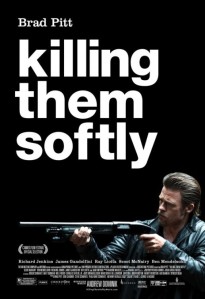 A funny thing happened while watching Killing Them Softly, the latest film from writer/director Andrew Dominik (The Assassination of Jesse James by the Coward Robert Ford). After an hour, I noticed a couple people stand up and leave, never to return. Then another and another like permission had been communally brokered. I counted ten walkouts at my showing, which was more than I had at Cloud Atlas, a film that I can at least understand the possible exodus. But this? It also got a rare F grade from CinemaScore, joining the ranks of The Devil Inside, Wolf Creek, and The Box. Before you put that much stock in what is essentially a movie going exit poll, Alex Cross was given an A grade from audiences. But why all the venomous hate? I can only theorize that the mainstream audience feels it was sold a bill of goods, a crime thriller with one of Hollywood’s biggest stars. The audience did not want to go on the lengthy talky detours. They wanted people to get dead. Whatever the reason, Killing Them Softly has killed its audience, who choose not to go softly in their disapproval.
Set amidst the economic meltdown of 2008, Frankie (Scoot McNairy) and Frankie (Ben Mendelsohn) are two lowlife thugs hired to rob a mob-affiliated card game. The trick is that local gangster Markie (Ray Liotta) had previously paid a group of guys to rob his own card game, fleecing his own customers. In his drunken revelry, Markie admitted as such to his pals. Now the situation is ripe for exploitation. Because any future robberies will have their suspicions pinned firmly on Markie, whether he had anything to do with them or not. As a result, no one is gambling, the public has lost confidence in the markets, and the mob needs to get things back to business. Jackie (Brad Pitt) is called in to make that happen. He’s a professional killer, who prefers to kill at a distance, without all those messy emotions. He has to trace the culprits responsible and give them the reckoning they have coming.
 From a plot standpoint, Killing Them Softly is pretty thin. It’s just about the ramifications of two nitwits robbing a card game. This lack of narrative depth will rankle most filmgoers, but I didn’t mind it so much because Dominik uses the crime thriller veneer to examine the sheer ugliness of a criminal lifestyle. This is a pretty character-driven crime flick, and it has to be when there’s a malnourished plot. It takes some lengthy sidesteps, notably with James Gandolfini’s (Zero Dark Thirty) character, Mickey. He’s supposed to be a professional, but the man is a complete wreck. He’s belligerent to those in service positions (waiters, prostitutes), chronically drunk, and weirdly empathetic for his struggling wife, yet seemingly powerless to change his life’s downward slide into self-medicated self-destruction. Mickey is the ghost of Christmas Future, the vision of what this lifestyle does to people who make a living out of it, who actually live into their retirement age. The two young crooks, Frankie and Russell, are idiots yes, but even when they have money their lives are so empty. Russell is so disgusting, sweating profusely, that you can practically taste his stank. Frankie is a little more cognizant of the danger he’s in, and yet the moron doesn’t leave town after his big score. I’d think that’s the first thing you do when you rip off the mob. The day-to-day anxiety of a life of crime is just not worth the effort. You constantly have to look over your shoulder, a life dominated in paranoia, where every stranger or furtive glance could have sinister meaning. Even when you make money, you’re theoretically taking money away from someone else’s profit, and these are the kind of people that don’t take kindly to friendly competition. This is no enviable, glamorous life.
I think Killing Me Softly would be a better, easily more satisfying movie had it eschewed the attempts at extra weight and commentary. It’s no surprise that the scenes that follow a more traditional crime thriller route are the best. There’s palpable tension when Frankie and Russell are in over their heads. The conflict is prevalent and the suspense is nicely stretched out, notably during the card game robbery. Being neophytes, you don’t know what they’re liable to do but you can bet it won’t be smart. This is when the movie is most alive, most engaging, and most entertaining. When it plays it straight, and explores the sliding power plays at stake in a world of cash and guns, it can be a nasty but taut little movie. I’m just sorry that Dominik took a functional crime thriller and gave it an extra sheen of Important Things to Say (”America’s not a country. It’s a business.”). The political parallels never feel more than tacked on attempts to grope for deeper meaning. Oh I get it, I understand the comparison of mob enforcers and corrupt Wall Street execs, hoodlums and crooks in different casual wear, but that doesn’t mean the parallel is that meaningful. It’s on-the-nose and a bit in your face (really, people are watching C-SPAN in dive bars?).
 Given Domink’s last film, I expected there to be some visual flourishes, though I’m unsure of whether they added much to the proceedings. Dominik sure can make violence entrancing, setting a slow motion slaying in the rain with stirring beauty to ironic Motown music. But he can also make the violence feel brutal, like a beat down on Markie that uses choice sound effects and editing to make you feel the punches. Even the opening seconds feel like an artistic assault to the senses, the loud static of noise interrupted by bursts of Obama’s sound bytes. The extreme camera angles, the visual felicities, the ironic music selections, they all seem to underscore the movie’s subtext-as-text approach.
Pitt (Moneyball) doesn’t come into the movie for the first thirty minutes. You’re welcome to see him, especially since he has such a coolly threatening demeanor, but also because here’s a character that will mix things up. I found myself rooting for the guy, partially because he was an accomplished professional but also because I wanted there to be consequences for idiots doing dumb to powerful enemies. I enjoyed the slow-burn intensity of Pitt when he was turning the screws on the screw-up. Richard Jenkins (Cabin in the Woods) is also enjoyable as a mob shill left to communicate the wishes of his higher-ups. McNairy (Argo) gives a performance that screams desperation, as he realizes the depth of trouble he finds himself into. And even Liotta (Charlie St. Cloud) does a fine job as a lout who misjudges the friends he keeps, discovering the costs of bragging.
In many ways, I feel like Killing Them Softly is akin to last year’s Drive, a more meditative crime thriller with bursts of gruesome yet beatific violence. Likewise, many filmgoers will be sore thinking they were catching straight crime thrillers and been given arty genre ruminations instead. And like my ambivalent feelings toward Drive, I can’t work up that much enthusiasm for Killing Them Softly either. It’s certainly got more ambition than most crime flicks but I’d rather it concentrate on telling a more engaging story. Dominik’s film is a bit too indulgent for its own good, given to visual flourishes and a narrative routinely sidetracked. And yet, I found it fairly interesting at just about every turn, well-acted, and intensely suspenseful and effective at different points. But it doesn’t add up to enough to recommend. The political allegory probably rubbed the walkouts the wrong way as well. The political allegory is too obvious, too pat with its “they’re all crooks” broadside. I wish the movie had abandoned the squalid, nihilistic art house ambitions and just kept things straight. When it has less on its mind, it works best. But for many, Killing Them Softly will be too tedious to see to the bloody end.
Nate’s Grade: B-
Share this:

Anna Karenina (2012)
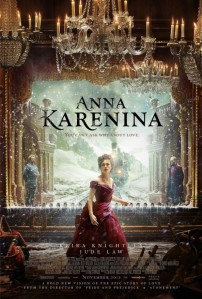 I’ve never read a Russian novel before, mostly because I don’t need to read 900 pages of bleakness and repressed happiness. With that said, I knew very little going into Anna Karenina (the very title sounds too heavy in syllables, like you’re stuttering). What didn’t help matters was director Joe Wright’s edict to set the story as if it was being performed on a living stage. This bizarre visual concept is interesting for a little while until you realize that it never goes further than the obvious note that the lives of the elites were played out in public for cruel judgment. The staging also gave me many periods of confusion where it felt like a character fantasy was taking place. The peculiar staging seems superfluous and the real draw for the film, not the relatively fine performances or Tom Stoppard’s (Shakespeare in Love) adaptation. I don’t think it works as a movie because, much like Wright’s Atonement, it feels too self-satisfied in its own mannered artifice. It’s an overload on style and the film neglects to give me a reason to care about the story and the characters. Keira Knightley as the titular heroine is hard to embrace, Aaron Taylor-Johnson (Savages) seems miscast as her dashing lover, and Jude Law (Hugo) comes across as unreasonably tolerable of his wife’s flights of fancy, so much so it makes it hard to sympathize with her downward spiral. It’s a pretty movie and I applaud its attempt to do something different, but Wright’s Anna Karenina feels too fanciful to come across as tragic.
Nate’s Grade: B-
Share this:

Lincoln (2012)

Steven Spielberg’s long in the works biopic of Abraham Lincoln could have easily been retitled, The Thirteenth Amendment: The Movie, such is the narrow band of focus. Lincoln is an engrossing, handsomely mounted study in the political machinations that went into passing the 13th amendment to outlaw slavery. Unless you’re a fan of history or politics, I can’t imagine that this movie is going to prove that engaging for you. This is a big movie about Big Moments with lots of people with beards giving speeches. Daniel Day-Lewis does a tremendous job as our titular sixteenth president, giving the man more foibles and traces of humanity than I can remember from any screen portrayal. Liam Neeson (The Grey) had long been attached to be Spielberg’s Lincoln, but I cannot fathom any other actor in the role after seeing Day-Lewis’s amazing work. I think he’s a shoo-in for his third Oscar. It’s intriguing to witness what a political animal Lincoln was, able to play off different sides to get his way. In the end, you may even feel a stir of patriotic pride, inspired by the good that government can grant with the right leaders for the right causes. The supporting cast all provide great performances, from Sally Field as the volatile Mrs. Lincoln, to James Spader as a conniving lobbyist, to Tommy Lee Jones as a stubborn curmudgeon… so basically Tommy Lee Jones. Just about every speaking part is a recognizable character actor. Who’s going to turn down the prospect of a Spielberg Lincoln movie? The tighter window of focus allows the movie greater depth as an important political juncture in our nation’s history, but Lincoln could have also been the 19th century equivalent of that Schoolhouse Rock song, “I’m Just a Bill.” This is an easy movie to admire but I think a more difficult film to love, to fully embrace.
Nate’s Grade: B+
Share this:

Silver Linings Playbook (2012)
 I am in love. It’s been days since I watched Silver Linings Playbook and I’m still under its spell. It’s a movie that gave me such rapturous emotional peaks, a deeply satisfying crowd-pleaser that doesn’t just nail the big moments, it crushes them. This is a movie that works so well with just about every facet of storytelling, from acting to writing to directing, that you’re liable to be in awe as I was.
Pat (Bradley Cooper), a high school history teacher, came home one day to find his wife in the shower with another man. He admittedly lost it, beating the man bloody, and has been remanded to a state psych ward for the past eight months. It’s determined that Pat is an undiagnosed bipolar case, and the court orders him to stay on his meds and stay 500 feet away from his now ex-wife, Nikki. Having lost his home, Pat is living with his parents (Robert De Niro and Jackie Weaver), both of whom don’t know how to help their troubled son. Pat is convinced he can win back his wife. He starts conditioning by running, wearing a garbage bag to better sweat off the pounds, and meets Tiffany (Jennifer Lawrence). She’s been fighting through depression after coping from the sudden death of her police officer husband. She agrees to help Pat get in contact with his ex, passing a letter, but at a price. He must compete with her in a dancing competition. They spend hours practicing their routine, getting to know one another, and stabilizing one another, providing a foundation for healing and success.
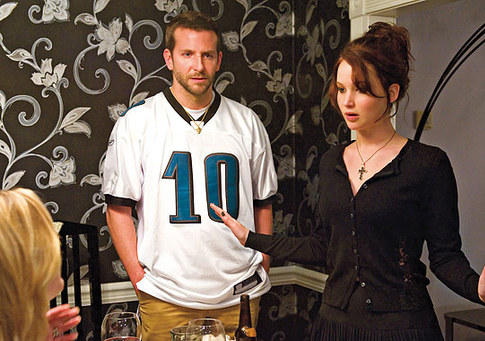 The story itself isn’t anything groundbreaking; you could glibly label it as the “bipolar rom-com” and it does adhere to that structure for the second half. But this is David O. Russell we’re talking about, the man behind 2010’s The Fighter, yes, but also offbeat dysfunctional family comedies like Spanking the Monkey and Flirting with Disaster. The man has a way of working within the framework of conventions and finding the rough edges, to make stories at once familiar and excitingly new. Is there anything groundbreaking with Silver Linings Playbook? It’s your boy-meets-girl formula at heart, but the execution is so extremely sure-footed, so exceptionally handled, that the movie leaves you buzzy and beaming. Once it ended, I wanted to run around, shouting from the rooftops for people to run out and see this movie. You want others to share in something so special and affecting. I felt a similar passion after seeing the unconventional romance Safety Not Guaranteed, and I’d advise any fans of Safety to certainly check out Silver. Being a rousing, crowd-pleasing sort of movie is not necessarily a yoke to weigh down its artistic integrity. As if enjoyment and creative accomplishment are opposing forces. I freely admit that Silver Linings Playbook is a masterful movie that knows what it takes to get an audience cheering, and I was thrilled to be part of that cheering throng. Here is a movie that just makes you feel good, and when was the last movie you saw that made you feel glowing with happiness?
This in an emotionally rich film; I was so happy after my screening that it felt like a high I didn’t want to come down from. To engineer a reaction that enhanced, that enlightened, that potent, well I must sing the praises of Russell and his actors. I bought into the love story and family drama big time. The payoffs are meaty and numerous, and I often found the film to be sincerely moving. There’s a great satisfaction in watching two oddballs find their special someone’s, and when the characters are this interesting, this human, and so well portrayed, it makes every stop along the journey that much more engaging and emotionally triumphant. It’s got an ending that pulls it all together in spectacular fashion, giving us exactly what we want while feeling earned and on its own eccentric terms. This is a deeply felt and compassionate film, one with as much uplift as acerbic rebellion. You feel like these people really do love one another. Silver Linings Playbook has memorized the playbook on how to win over an audience, but it always comes down to the same Xs and Os: strong characters, a compelling story, and people we genuinely care about, and that includes distaff supporting characters too.
 The characters are so interesting and beautifully flawed, and the actors are so in tune with one another, delivering bar-raising performances that take the movie into another realm of enjoyment. When actors are given plum roles about people with mental illnesses or disabilities, it must be very enticing to overindulge in tics and self-conscious mannerisms. That doesn’t happen with Silver Linings Playbook. Beyond an uptick in tempo, the actors portray their parts as characters rather than ailments. If anything, the acting in this movie is practically restrained given the circumstances. What’s more, Silver Linings Playbook is a fine example of what can happen when the cast works in tandem, challenging one another to up their game. It’s like every actor felt revived from all the talent on display. Russell knows how to push his actors like few other directors, and while this has lead to notorious Internet videos of his actors losing their cool, it’s also given way to raw performances that burn in your memory. Russell gets his actors to bring their A-game and then some. The Fighter got three Oscar nods for acting and I wouldn’t be surprised if Silver Linings Playbook gets three as well (I think Lawrence and De Niro are locks).
Cooper (The Hangover) has always had a certain smirking, leering quality about him, a guy used to portraying louts with charisma. I have never seen him tackle anything nearly as challenging as what he does with Pat. He’s unpredictably combustible, ready to explode at any moment, but also empathetic, trying to do better. Pat isn’t meant to be seen as a loveable loser. This guy has serious problems he’s working through. Cooper is simply incredible, showcasing skills and nuance you didn’t know the man had, radiating with an intense outpouring of spontaneous energy that doesn’t ever feel forced. Cooper is not bouncing off the walls here as some wild-eyed loony, playing upon codified ideas of what a bipolar person behaves like. He’s a deeply complicated guy, processing challenging and contradicting feelings in a brain that doesn’t necessarily follow the rules. He has so many impulses leading him in different directions. Pat is obsessed with his goal of impressing his wife, so much that he seems blind to the tangible connection he’s formed with Tiffany, and we yearn that he realizes the catch in front of him. I was won over completely by Cooper’s committed, attentive, anxious, and lively performance.
Readers will know that I harbor a serious crush when it comes to the talented actress, Lawrence (The Hunger Games). I was expecting her to be great in this movie, as this is pretty much my default setting with the actress at this point. I was not expecting what she delivered, a performance that is so enthralling, so astonishing, that you’ll be left stupefied that a woman at only the young age of 22 could be this phenomenally gifted. Lawrence had several scenes that just left me speechless. Lawrence is in elite territory now as far as I’m concerned. Her command of the character is just about impeccable, and you perk up every moment she’s onscreen. She’s a damaged woman recovering from her own powerful grief, but she’s so many things at any one moment. She can be lusty, provocative, angry, sullen, commanding, vulnerable, and hurtful. There are scenes where she will bounce around a plethora of emotional states, but each one gradually shifts to the other, making the transformation genuine and another layer to the character. If she were just some crazy girl we wouldn’t care if she eventually got her happy ending with Pat. With Lawrence’s talents, and Russell’s sharp writing, Tiffany becomes a figure worth fighting for, a bruised romantic that finds her rare kindred spirit who accepts and appreciates her messiness.
The supporting cast from top to bottom may not be at the same level as Cooper and Lawrence, but their output is also impressive. De Niro (Limitless) hasn’t been this good in ages, delivering a few monologues that will hit you square in the gut. Weaver (The Five-Year Engagement) is something of an enabler for the family, but she also gets her moments to shine and reassert her strength and dignity. Chris Tucker (in his first non-Rush Hour movie since 1997) is the least Chris Tucker I’ve ever seen him. He’s downplayed his motor mouth tendencies completely, and he’s a wonderful presence as he ducks in and out. He even teaches Tiffany how to “black up” her dance, a fact that most heterosexual males in the audience will be thankful for this time of year.
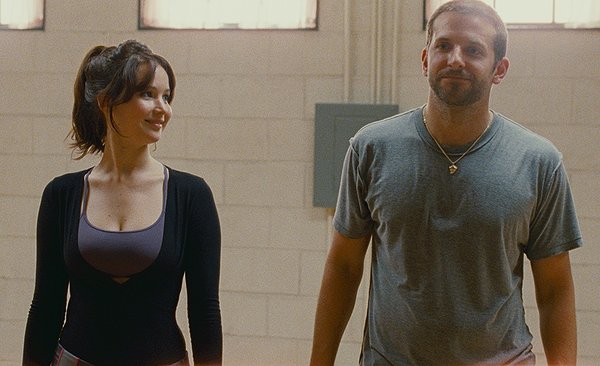 Russell deserves serious credit for portraying mental illness in a manner that doesn’t dance around the seriousness of the condition. Statistically one in three people suffer from a mental illness at some point in their life, and I’ll even admit that post-divorce, I too fell amongst those ranks (I’m a statistic!). In the case of Pat, He’s not just some unfeeling jerk who says inappropriate things or has problems reading social cues. He’s a guy going through serious personal struggles, same with Tiffany. These are not jokes. They are not send-ups of mental illness; they are people. At no point does the humanity of these characters get lost. We will laugh at their inappropriate comments, sure, but we are never laughing at them from some cushy sanctuary of superiority. I also think Russell examines an interesting, more socially-acceptable form of mass mental illness, namely the OCD-nature associated with sports superstitions. Smart and capable people can get caught up in the allure of superstitions, and when it concerns sports in general, groupthink overpowers. I consider myself a sports fan as well (I’m a double statistic!) and fully accept the ridiculous nature of fandom, but I thought it was a clever move for Russell to hold the mirror up to our own cracked community and its irrational behavior. And as any Philadelphia sports fan will acknowledge, they take fandom to a whole other level.
At this point, I don’t know what more I can write about this movie without coming across as a complete, frothing madman. Football, mental illness, ballroom dancing! I’m smitten big time with Silver Linings Playbook. I’m completely in the tank for this film. Future viewings (already planning one soon) will probably highlight certain minute flaws I’ve failed to notice the first go-round. And even if those flaws become more apparent (yes the final dance is something of a contrived climax) I simply do not care. The movie’s many virtues far exceed any shortcomings that could potentially arise. It plays to some familiar rom-com elements but it goes about its business with its own funky charm. The acting, writing, and directing are all on such a heightened level of excellence, it’s amazing just to watch all the parts work together so masterfully. I wasn’t just won over by this movie; I’ve become its disciple. I preach the gospel of Silver Linings Playbook. Here is a rapturous feel-good movie that doesn’t feel like it’s pandering or dulling its edge even after it takes some conventional turns. Cooper is terrific, Lawrence is astounding, and together they form the couple you cheer for. Silver Linings Playbook is everything you’d want in a stellar movie. I can’t wait to watch it again and get caught up in its wondrous spell once more. It took a long ten months but The Grey has finally been knocked off the perch. Silver Linings Playbook is nothing short of the best film I’ve seen this year.
Nate’s Grade: A
Share this:

Compliance (2012)
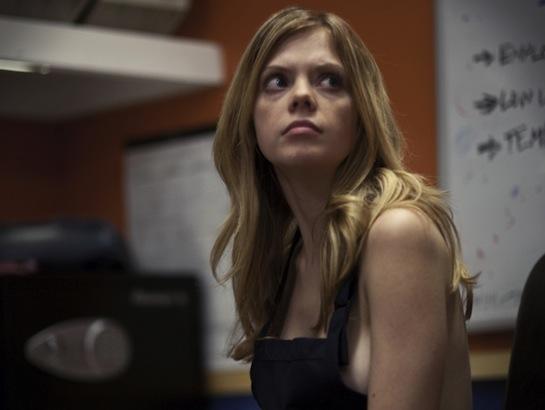
 The day at a fast food eatery began like any other. Sandra (Ann Dowd), the manager of the branch, has to shepherd her small group of employees through a hectic Friday evening. Then she gets a phone call from an “Officer Daniels” (Pat Healy). He tells her one of her workers, Becky (Dreama Walker), has stolen money from a customer. Sandra takes Becky into a storeroom and confronts her. Becky is aghast and professes her innocence. This is where things start to get out of control in writer/director Craig Zobel’s potent indie pressure-cooker. “Officer Daniels” insists that Becky be searched, then strip searched, and then worse, and Sandra and the employees begrudgingly go along. After all, it’s an officer of the law telling them what to do. Except that “Officer Daniels” is no police officer. This whole incident is an awful prank, and the people involved will never be the same.
This really is an indie horror movie, flipping the oft-repeated cry, “Don’t go in there,” with, “Why are you still doing this?” You may have to watch portions of this movie between your fingers. I was squirming and crying out at numerous points. The tension and dread just continue to mount, and you watch the characters slowly degrade, as they’re asked to do more insidious acts of humiliation in the name of compliance, and to watch them carry on the path of shame. It’s a step-by-step process of human degradation, so that the more disturbing moments of sexual obedience don’t feel entirely implausible given the journey through hell the characters have endured. It is impossible to watch this movie silent and detached. This is a provocative film that will garner many reactions but it’s also something of an endurance test. How long can you watch? How far can you watch these characters descend? The movie hooks you early and then you almost feel complicit, but you’re completely taken over by morbid curiosity.
 The movie is a powerful modern-day example of the Milgram experiment, the famous psychological exercise where a figure in authority, who assumes all responsibility, gradually gets average people to commit increasingly harmful acts to others. As long as people believe they are following orders, they can be convinced to do almost anything by someone in control. It’s easy to sit back and judge these characters, scoffing at how naïve they seem to be. It’s always easy for us to say what we would do in hypothetical situations, that is, until they happen. Compliance is an intriguing analysis of the shifting facets of power, authority, and manipulation. “Officer Daniels” enlists a host of tricks and verbal intimidation to persuade his victims to do things outside their better judgment (the caller’s true profession is a brilliant backstory). After a while, Sandra looks to be developing some slight Stockholm syndrome as she empathizes more with the plight of the phony officer on the phone than her employee. He provides just enough sympathy and validation she’s looking for to win her over. He also plays people against one another; he implores Becky to spare Sandra any extended grief, which often cows her into consenting. “Officer Daniels” isn’t the only one manipulating others; Sandra pressures employees to become involved in the situation, using her position of power to squeeze others into getting what she wants. There are numerous victims and culprits here.
Zobel could have easily given over to the exploitation elements of his story and made a very tawdry, voyeuristic exercise in sexual dominance. We watch as Becky bares all of herself and then goes even further, as “Officer Daniels” instructs male attendants to physically inspect her body cavities. It is a credit to Zobel’s sensitive direction that Compliance does not come across like a glorified S&M masturbation fantasy. He treats the incident very seriously, providing clear distaste without going overboard into preachy condemnation or superiority. It’s amazing that Zobel’s script finds so much empathy for his participants. You may be surprised at how relatable and “normal” these people seem. You may even recognize some of them. They’re all trying to do the right thing at heart, but that distinction gets extremely blurry as the night carries on. The point of Zobel’s script is that these people could be us. The added empathy makes the downward spiral all the more stomach-churning, as we want these characters to take a stand, to wise up and question the voice of authority.
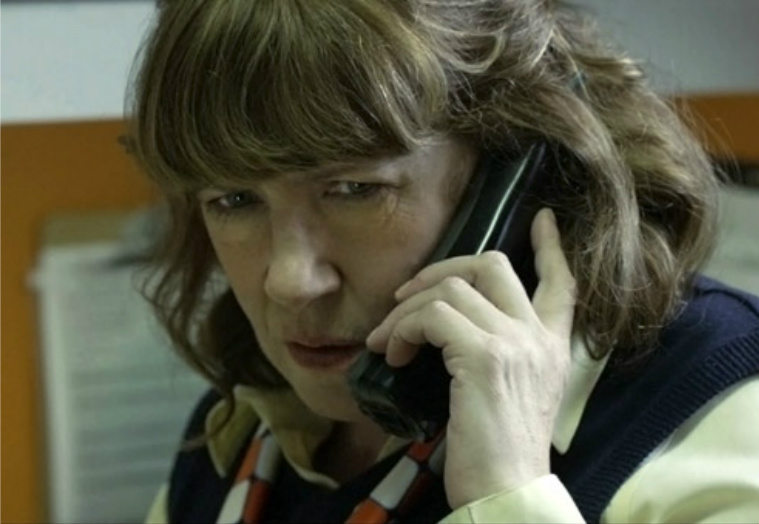 Dowd (Marley & Me) is downright heartbreaking and deeply frustrating in the movie. We get a clear sense of the pressure she’s under in her position, but she’s really the focal point of the movie. Walker (TV’s Don’t Trust the B in Apartment 23) is the martyr of the piece, and her slow resignation to the humiliation is deeply affecting, but this is Dowd’s movie. The longtime character actress takes the character of the dowdy Sandra, striving for respect, and transforms her into a figure worthy of Greek tragedy. She can be vindictive and, well, bossy, but she’s also a figure struggling for respect and validation and what she feels is morally just. We watch as her confidence starts getting chipped away, the flickers of doubt that she must tamp down because now she’s gone too far to reverse course. I don’t imagine that a movie as small as Compliance will be remembered around Oscar time, but I’ll certainly recall Dowd’s sad and transfixing performance.
I’d like to share a spooky bit of personal connection to the film. No I’ve never experienced anything this heinous before, but there was an offhand music cue that caught my interest. When we cut to the dining area early on, there’s an Admiral Twin song playing. Who is Admiral Twin? Why they’re a brilliant pop-rock band from Tulsa, Oklahoma that I’ve been singing the praises of since 2000. I’ve won over friends with my discipleship, but the band is still relatively unknown, playing few performances outside of their native Tulsa. Given the phonetic approximations of my name with the film’s writer/director, and the inclusion of an obscure indie band that few know (but should), it seems likely that Zobel may indeed be some far off relative of mine or, more likely, myself. I must have crafted an entire film without ever knowing about it. This seems like the most probable scenario.
I don’t want it sound like Compliance is some grueling exercise in group sadism. In lesser hands, it might have devolved to that. It’s a fascinating and provocative game that challenges and incenses an audience. The movie is a sickening but compulsively watchable dramatic experiment that will leave you talking for hours once it concludes. It’s an uncomfortable sit, yes, but that doesn’t mean it’s not worthwhile. The events in the film seem unbelievable and yet it’s based on a true story. This stuff happened, people. Not only that, it happened multiple occasions in multiple vicinities. What does that say about human nature? Will we only be as good as society lets us be? If we are absolved of responsibility, how far removed from our own sense of ethics will we go? Are we all susceptible to this moral failing under the right circumstances? I think that’s the truly terrifying and lasting lesson of Compliance. These people could be us, both victim and unwitting antagonist. Destined to stir debate and become a college ethics course favorite, Compliance is a gripping movie that will make you cringe but also give way to some scary introspection. How far would you go?
Nate’s Grade: A-
Share this:

Holy Motors (2012)
 I like movies that are different. I like movies that can be hard to understand. Holy Motors, a surreal French film, is both very different and very hard to understand. The movie follows a man as he goes about transforming into nine different characters, each with their own bizarre mission. Is he performing? For whom? Who is behind all this? Does he ever stop assuming false roles? Questions such as these hardly matter in movies such as this. You’re either transported by the lyrical weirdness and unpredictability, or you find it tiresome and much ado about nothing. After a while, I just gave up with this movie. I’m not a fan of weird for weird’s sake and I felt like that was all I got with Holy Motors. I’m sure you could write a doctoral-level thesis decoding this movie, but why waste valuable hours of your life? This movie is nothing but strange imagery that adds up to precious little. I thought the concept of playing roles/manufactured realities was better explored in Charlie Kaufman’s Synecdoche, New York. When a Kaufman movie is more accessible than your film, your name better be David Lynch or you’re in trouble. I’m sure several fans of the obscure and outrageous will find amusement at the sheer randomness with Holy Motors. It’s got martial arts acrobats, Kylie Minogue breaking out into song, magical resurrection, spontaneous band performances, talking cars, and for good measure chimpanzees. I hope you get more out of it than I did. I found the enterprise to be more tedious than titillating, more frustrating than fascinating, and not worth the trouble of fashioning meaning from the discarded puzzle pieces.
Nate’s Grade: C


You must be logged in to post a comment.