Blog Archives
The Impossible (2012)
 On December 26, 2004, an underwater earthquake triggered one of the deadliest tsunamis on record, devastating coastal cities along the Indian Ocean. Over 230,000 people are believed to have perished from the waves and resulting damage. The Impossible tells the harrowing and ultimately inspiring true-story of one family and their vacation from hell. We follow Marie (Naomi Watts) and Henry (Ewan McGregor) as well as their three sons, from oldest to youngest, Lucas (Tom Holland), Thomas (Samuel Joslin), and Simon (Oaklee Pendergast). They’re vacationing in Thailand for the holidays and then the tsunami hits, separating Marie and Lucas from the group. They are swept away by the punishing waves and Marie is badly hurt. Henry is desperately searching for his loved ones, Lucas is desperate to get his mother proper medical attention, and there are thousands just as desperate and just as in need.
It’s nigh impossible to watch this movie and be unmoved. It’s not very subtle when it comes to its themes and messages, but man is it ever effective. The family struggle could have easily descended into melodrama with a sappy, maudlin reunion, punctuated with swelling music to hit you over the head. It’s a fairly simple story with little to its plot. The family gets separated and then they desperately search for one another and, surprise, they reunite. It is after all based on a true story and they all lived, so there’s that. It’s the startling level of realism, the exceptional performances, and the poignant moments of human kindness and grace that suckered me in big time. I was an emotional wreck throughout this movie but in the best way possible. I cried at points, sure, but my tears and my emotions always felt genuinely earned. There’s no doubt that this is one manipulative movie. It knows what strings to pull, what buttons to push, and it does so with finesse. Last year I decried Extremely Loud & Incredibly Close for being overly manipulative and overdosing on false sentiment. However, with this movie, my investment was never in jeopardy. I was completely absorbed by the story and felt great empathy for the array of characters as they persevere. The horror of that 2004 tsunami is told in one small story, personalized, and giving an entry point for an audience to engage without feeling overwhelmed by the magnitude of destruction and death.
 Let me go into further detail about that wall of destruction, given astonishing, terrifying realism. The recreation of the tsunami ranks up there as one of the most frightening sequences I’ve ever seen in film. It’s a solid ten minutes of chaos, and you will feel the frenzy of that chaos. You’re put in the middle, floating along with mother and son as they helplessly try and cling to one another. The scope of the disaster will leave you gasping. I know they must have used sets and water tanks but I’m left stupefied how it all came together to look so seamless. It sounds macabre to compliment the marvelous recreation of mayhem, but director Juan Antonio Bayona (The Orphanage) and his team have turned disaster into world-class drama. It’s not just the powerful waves as well, there’s the field of debris just under the surface to contend with. When the first wave hits Maria, we experience her complete disorientation. The sights and sounds are blurs, the water oppressive, and the debris sudden, jolting, unforgiving. It’s the closest any person would ever truly want to get in the middle of a tsunami.
The majority of the film is about the family coming back together, and while their reunion is indeed a tearjerker, I found the film littered with many small moments that just soared emotionally. When a disaster of this magnitude hits, I’m always struck by the wealth of human kindness and cooperation that emerges in response. There’s something deeply moving about helping your fellow man in need, even if you cannot understand his or her language. Maria is aided by the Thai locals who do not treat her differently because she’s a white woman. She is just another person in need.
Whenever disaster strikes, we think of the people who plunge into the middle as heroes, but simple acts can be just as comforting and thoughtful. There are small moments of kindness, like lending a stranger your cell phone to call home, that speak volumes. In that one instance, Henry is so distraught, the weight of everything hitting him as he tries to put it into words, and his call is abrupt and somewhat incomprehensible thanks to his rising emotions. Henry is urged to call back, not to leave it at that, to leave his relatives dangling with such precious little and the alarm in his voice. So he’s given the phone again, and in a more measured demeanor, Henry is able to talk about the situation and promise to find his wife. It’s such an everyday gesture made invaluable to Henry. There’s a woman talking to Thomas about the stars in the sky, how we don’t know which are dead but they continue to live on, and the subtext is a bit obvious but it’s still heartfelt. Then there’s Lucas’ mission of organizing the triage center, scouring the grounds looking for missing family members. He takes it upon himself to make a difference rather than sitting idle. It’s that human connection in the face of adversity that proves most uplifting.
 Watts (J. Edgar) gives a performance of tremendous strength and fragility. The tenacity and resilience she has to keep pushing through is remarkable. She’s so strong but vulnerable at the same time, showing you the fine line she walks to stay above the fray for her child. She endures great physical trauma, a gnarly gash in her leg peeling off like tree bark. Then there’s the emotional burden of trying to be a mother to a child desperately in need of a sturdy parent. Watts could have readily played to the heights of the emotions, resorting to hysterics, but the quiet strength of her character makes her underplay the burdens she endures. She can’t simply just break down. You don’t get a true sense of the toll she has suffered until her life-and-death struggles at the very end.
The supporting team around Watts also deserves accolades. McGregor (Salmon Fishing in the Yemen) has several heartbreaking and heartwarming scenes, striving for hope. Lucas has to rise to maturity when his mother is wounded, protecting her, supporting her. Acting novice Holland rises to that challenge with great courage, though there are moments that still remind you he’s only a boy, like when he bashfully turns his back upon seeing his mother’s exposed breast. That awkward, indecisive moment where a young boy doesn’t know how to handle the sight, seeing his mother so exposed and vulnerable, is quite effective. The other actors who round out the family (Joslin and Pendergast) are quite superb as well. The family feels like a cohesive, loving unit, and every performance feels believable.
The Impossible is based upon the true experiences of a Spanish family, and yet the onscreen family we follow is white, so what gives? It’s not surprising for Hollywood to whitewash a story to appeal to a wider audience. Should we have any more sympathy for this family’s plight because they are white? Would we feel less if they were Spanish? I think the perils and victories would be the same regardless of language or ethnicity.
Watching the unflinching and stunning events in The Impossible, you will likely shed some tears, be they from horror, sadness, or happiness at the family’s reunion. While the ending is never in doubt, the movie has plenty of other potent and poignant small moments to keep your emotions safely stirred. It’s a visceral experience that will shock and exhilarate. There were moments where I felt like I had to cover my eyes. But The Impossible is not disaster porn, ogling over the suffering and endurance of the misfortunate. It’s as much about the response to tragedy as it is the wallop of that cruel tragedy in 2004. The perseverance, the open-hearted help of one’s fellow man, the strength of human connection, the long ripples of kindness, it all comes together to form one compelling, often moving, and quite memorable film experience. Add some formidable performances, top-notch direction, and tremendous technical achievement, and The Impossible is a rousing drama that speaks to the best of us even in the worst conditions (think of it as the antithesis of Ayn Rand’s philosophy). It may be manipulative, it may be somewhat straightforward, and it likely climaxes too soon, but when the results are this powerful and emotionally engaging, then I’m happy to have my buttons pushed.
Nate’s Grade: A-
Share this:

Atlas Shrugged: Part II (2012)
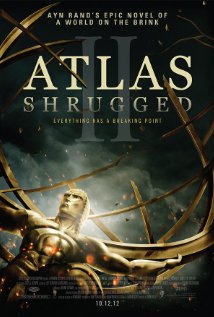 You’d think after the horrible and horribly boring Atlas Shrugged: Part One that a promised Part Two might just disappear into the ether. If only we could have been so fortunate. Ayn Rand’s cautionary opus about the evils of big government is given another creaky adaptation that fails to justify its existence. I feel like I could repeat verbatim my faults with the first film. Once again we don’t have characters but mouthpieces for ideology, an ideology that celebrates untamed greed. Once again the “best and brightest” (a.k.a. world’s richest) are disappearing and the world is grinding to a halt without their necessary genius. Does anyone really think if the world’s billionaires left in a huff that the world would cease to function? The assumption that financial wealth equates brilliance seems fatally flawed. Once again it’s in a modern setting where America has gone back in time to value railroads. Once again the main thrust of the inert drama is over inconsequential railway economics. Once again people just talk in circles in cheap locations. Once again the government agencies are a bunch of clucking stooges, eager to punish successful business. Once again Rand’s Objectivist worldview is treated as gospel and value is only ascribed to the amount of money one can produce. This time we have a slightly better budget, a better director, and some recognizable actors like Samantha Mathis, Esai Morales, Ray Wise, Richard T. Jones, and D.B. Sweeney as the mysterious John Gault. The story transitions to a ridiculous government mandate that include such incomprehensible edicts like making sure no one spends more money than another person. Can you imagine the paperwork involved? This woeful sequel will only appeal to Rand’s most faithful admirers, and you probably don’t want to hang out with those people anyway. There’s your clue: if you see someone carrying a copy of Atlas Shrugged: Part Two they either lack taste or are far too generous with movies. If there is indeed a concluding Part Three, it will be further proof that Rand’s market-based screeds are not accurate. The market has already rejected two of these dreadful movies.
Nate’s Grade: D
Share this:

Side Effects (2013)
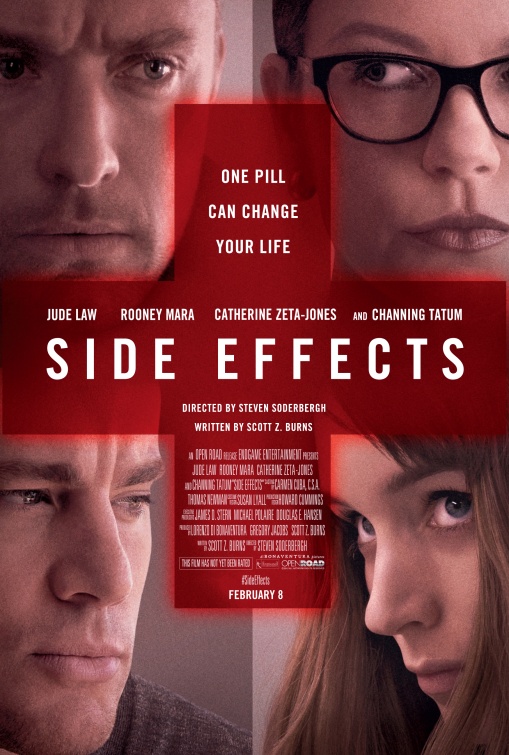 Steven Soderbergh’s supposed last stop before retirement is another of his genre exercises, but Side Effects feels like a firmer success, albeit modest, for the director to go out on. It’s the story of a woman battling depression, played with terrific cageyness by Rooney Mara (The Girl with the Dragon Tattoo). She gets prescribed a new drug and… does some very bad things. Who is culpable? The doctor, being funded by the drug companies? The woman who was sleepwalking at the time? The industry for blanketing patients with ads to demand their drug? After a rather slow start, the movie gets interesting and starts to try out different genres like hats. It appears for a good while we’re now going to be following her doctor (Jude Law) and his downfall as the industry turns on him and the media coverage intensifies. Written by Scott Z. Burns (Contagion), the movie has that same enticing sense of realism about how all the moving parts of a complicated industry would come into sync and conflict. Then the film tries out another identity, that of traditional thriller, with wronged parties orchestrating vengeance. I was invested until the end and felt sufficiently satisfied with the end results. Soderbergh’s smooth camerawork and cool color palate are well suited for a film about the battles of depression, and for a good while, before the thriller aspects take over, the movie is a fairly mature look at the struggles of depression and the industry that profits off it. Side Effects doesn’t seem like a closing statement for an artist as varied and unpredictable as Soderbergh, but as far as a Saturday afternoon goes, it’ll sure pass the time nicely.
Nate’s Grade: B
Share this:

Rust and Bone (2012)
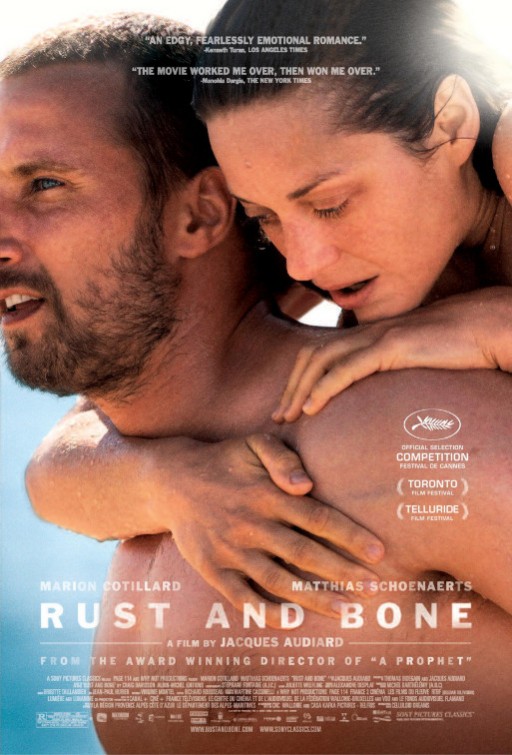 The French film Rust and Bone’s U.S. release seemed to hinge entirely on whether star Marion Cotillard would garner a coveted Oscar nomination. When that didn’t happen, it seemed like the studio just threw up its hands and said, “Well, that’s it.” Rust and Bone, co-written and directed by A Prophet’s Jaques Audiard, has been given a very ignoble release, an afterthought for an awards season that didn’t go Cotillard’s way. While I would have nominated Cotillard for her powerful performance, I certainly wouldn’t think much else about Rust and Bone, a frustrating film that doesn’t know whose story it’s telling or what movie it wishes to be.
Alain van Versch (Matthias Schoenaerts) is struggling to take care of him self and his young son, Sam. Alain’s ex-wife, and Sam’s mother, used the boy as part of her drug trades. Alain moves in with his sister and gets a job as a nightclub bouncer. It’s at the club where he meets Stephanie (Cotillard), a marine trainer. She’s also feisty and getting kicked out for starting a fight. Stephanie works at a Sea World-esque water park, and one horrific day one of the whales makes a wrong turn. It runs into the stage, knocking Stephanie unconscious into the water where, we learn, a whale has eaten her legs below her knee. She contacts Alain and the two form an unlikely friendship, one that turns physical as Stephanie worries what her sexual performance will be like under her new circumstances. Alain dreams of becoming a professional kick boxer/MMA fighter, and he performs in underground fights as another means of income. Stephanie tags along and helps motivate him win his fights. The two grow closer, but Alain struggles with what real feelings might mean.
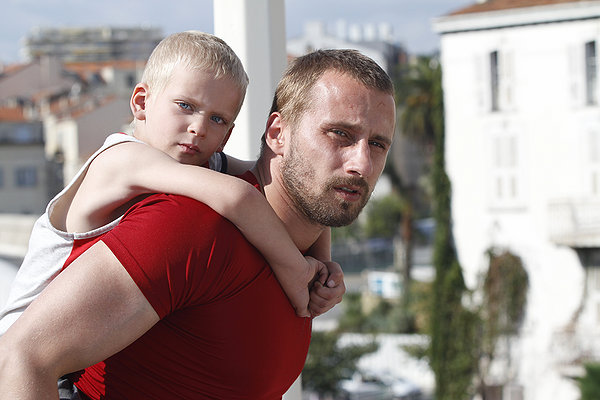 Rust and Bone has a serious case of multiple personality disorder. It looks like it’s going to be one movie, then all of a sudden it changes into another, and then when you think you’ve got a handle on that, it suddenly transforms into another. I’m perfectly fine with a movie switching gears suddenly, however, with Rust and Bone, I felt like I was getting three different half-hearted drafts rather than an actual movie. I went into the film knowing little other than the selling point, that Cotillard was playing a woman readjusting to life after a freak accident took her legs. For the first twenty minutes of the movie, I didn’t get a shred of this. I got a single father trying to scrape together what he could for himself and his son, often resorting to sneaky and illegal measures. Then shortly after Stephanie is introduced, the movie becomes all about her. We’re dealing with her recovery and her anger and her loss. Just when I think I’ve settled onto the narrative direction of the movie, it becomes Alain’s movie again. Now we’re following his budding career as an amateur kick boxer, with Stephanie as his cheerleader. Then she dissolves into the background of the movie yet again, and it’s all about him. I don’t think the movie knew which character it wanted to be its focal point, so we get a sloppy interspersing of storylines vying for dominance. Personally, I was much more invested and intrigued by Stephanie’s recovery than anything having to do with Alain trying to be a better father and failing. Then there’s other muddled storylines like hidden cameras in the workplace that only further distract. It’s just all too much and at the same time not enough.
Then there’s the matter of the romance between Stephanie and Alain. I suppose you could say they are both wounded people trying to gain a greater sense of independence, battling new concepts of self-identity, but I think I’m doing the film too many favors. The sad part is that these two people are extremely shallow and limited form a characterization standpoint. The only defining quality about Stephanie is her injury. Sure she’s feisty and can get into bar fights, and that fact that she’s attracted to Alain says something about her, but really, her only characterization is her new physical limitations and her adjustment to them. Her physical needs are given much more attention by the screenplay than her emotional resonance. It makes me sound like a hardhearted bastard but I’ve said it before, I need characters that have more depth to them other than that they suffer. Alain, on the other hand, is even worse. He’s a pretty flat character who’s actually a really terrible father. He loses his temper easily, chooses quick sex over picking up his kid at school, plus there’s the whole abandonment thing. It’s hard for me to believe that anything really sinks in with this lunkhead. His relationship with Stephanie, meant to open him up, instead reconfirms what a jerk he is. He uses women as sexual playthings, and treats Stephanie with this same careless abandon. He clearly doesn’t see her as anything but a comfortable fling, which he shows through his actions. If Alain’s romantic views have changed, the film doesn’t show any of this progression. I didn’t care about him and I certainly didn’t care about the two of them together.
Acting-wise, Cotillard (The Dark Knight Rises) is quite moving throughout as she tries to come to grips with everything that has been taken from her. Her more traditionally dramatic crying scenes are powerful, sure, but it’s the quiet moments that Cotillard nails. There’s a moment where she goes through her former routines hand motions, and in that moment, set to Katy Perry’s “Firework,” it becomes clear she is moving beyond her accident, accepting and getting stronger. It’s a subtle celebration of the human spirit’s ability to rebound, and Cotillard makes sure the moment is moving rather than cheesy. Also, there’s a very tender moment when she returns to the water park and reunites with the whale that took her legs. Through the glass, she goes through her training motions and the whale still resounds accordingly to her commands. It’s a wordless, touching moment that communicates so much, the nature of forgiveness, the culpability of an animal, but really about the connection between man and nature. Also, the fact that these two scenes are available on YouTube means somebody else must have seen them as standouts as well. She’s also naked frequently, if that matters to you.
 Schoenhaerts (Bullhead) is too opaque for his own good. He seems to settle for his brute physicality, and as such the movie does little to flesh him out further. He has a couple nice moments, especially at the film’s climax, but it’s too little to overturn the prevailing notion that his character is unworthy of co-lead status.
Probably the most impressive thing from Audiard’s film is the special effects to remove Cotillard’s legs. While the technology doesn’t seem like it has changed since Lt. Dan’s days in 1994, it’s still a striking image to process. I’m still wondering why exactly Stepheanie gets tattoos on her (remaining) thighs, reading “Right” and “Left.” Is she worried about going under the knife and the doctors taking more away from the wrong limb? That seems past the point of return. With the special effects technology, and the film’s quotient for sweaty sex scenes, this is the art house equivalent of erotica for those discerning few with amputation fetishes.
When it came time to determine which film would compete at the Academy Awards, France chose the feel-good buddy comedy The Intouchables over Rust and Bone. It’s easy to see why. Except for Cotillard’s fierce performance, and some spiffy special effects, there is nothing remarkable about this ultimately frustrating and shallow movie. The mismatched love story between Stephanie and Alain feels implausible and too focused on surface-level desires; not enough to justify some statement of personal growth on both their parts. There needed to be a complete restructuring of the screenplay. Too often it keeps switching focus, changing gears, mixing in other subplots until it all feels like one big mess lacking firm direction. I might have loved a movie that focused on Stephanie and her recovery, perhaps even one about Alain, though I doubt it. What Rust and Bone offers is a movie that’s persistently in doubt of its own identity, trying its hand at everything, forging necessary care to its lead characters. It’s a fine film that could have been a great one, if only it really knew what it wanted to be in the first place.
Nate’s Grade: C+
Share this:

Seeking a Friend for the End of the World (2012)
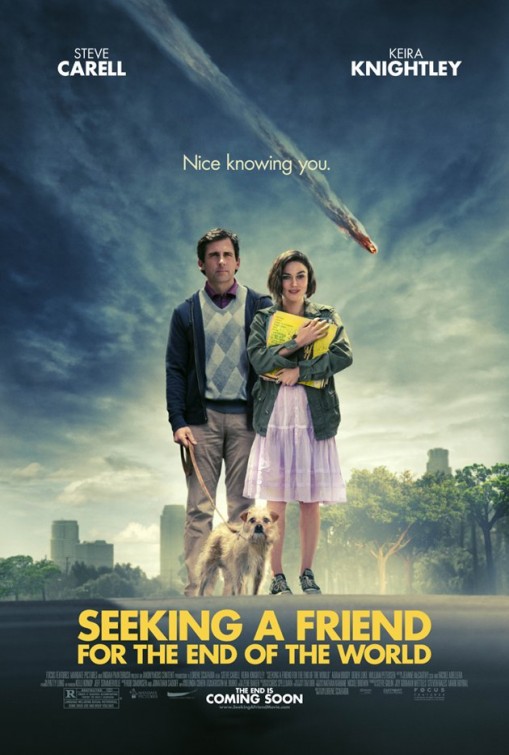 It’s the end of the world as we know it and I oddly felt fine… which is not a good sign for your apocalyptic movie. Seeking a Friend for the End of the World is a peculiar thing, all right. It takes place in the last three weeks of the human race. And lest you think the film wimps out on the promise of its title, think again. I was bemused for the first forty minutes, where writer/director Lorene Scafaria indulges in a series of one-scene vignettes of how humanity comes to terms with the certainty of annihilation. There’s an adult party where people joyfully try heroin, a hit man-for-hire service to bring back some of the mystery of death, and a restaurant where all the workers are spaced out on Ecstasy. I found each of these moments to be funny and a well though-out extension of the premise. But then the film’s diversions give way to the rom-com of our main characters, played by Steve Carell and Keira Knightley as your standard manic pixie girl. And the more time I spent with them the more I found myself not getting engaged. My emotional empathy was kept to a minimum; they’re nice people and all but I didn’t find them that interesting. The resulting movie feels like one of the weakest avenues given the premise. I credit Scafaria for not wimping out in the end, but as these characters faced oblivion together, I felt little emotional stirrings in my chest.
Nate’s Grade: C+
Share this:

Gangster Squad (2013)
 It’s hard to mention the action thriller Gangster Squad without a passing reference to the Aurora, Colorado movie theater shooting in the summer of 2012, the reason for the film’s five-month delay and reshot action sequence. Gone is a shootout at the movies and now we have a confrontation in the streets of Chinatown. I wish they hadn’t stopped there. If given the opportunity, and remember they did have an additional five months, I would have scrapped Gangster Squad almost completely and started fresh.
In 1949, former boxer Mickey Cohen (Sean Penn) has seized control of Los Angeles organized crime. His influence extends even into a police, which forces Chief Parker (Nick Nolte) to go to desperate measures. He asks Sgt. John O’Mara (Josh Brolin) to assemble a team of enforcers to fight back. They won’t have badges but they will be pushed to use whatever means necessary to carry out their mission, which means blurring the line between what is considered lawful. O’Mara assembles a super group of former officers and one of them, Sgt. Jerry Wooters (Ryan Gosling) gets into even deeper danger when he starts seeing Mickey Cohen’s main squeeze, Grace Faraday (Emma Stone).
This movie is like if The Untouchables and L.A. Confidential had an illegitimate child and then abandoned it in a sewer where degenerate hobos raised it. Gangster Squad rips off other gangster movies with liberal abandon that I can’t even begin to list the lifts. I’d be less offended if I felt that the movie had more on its mind than just replicating the tone and look of noir cinema. Actually, it feels more like what they want to replicate is the tone or style of the video game L.A. Noir.
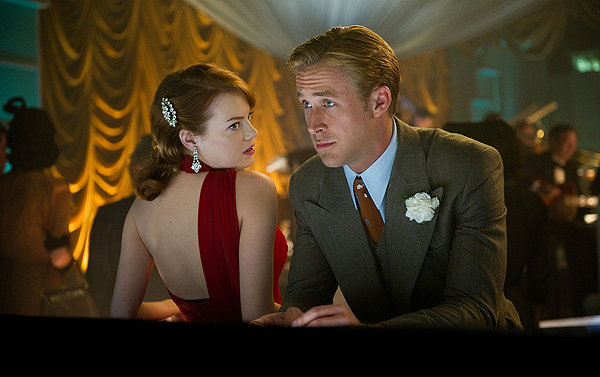 The main problem is that Gangster Squad really only has the skeletal outline of a plot. It’s missing any essential character and plot development. Here, I’ll summarize the barebones plot for you: Mickey Cohen is a bad guy. O’Mara forms a team. They have a montage taking out bad guys. Mickey takes out one of them. They have a showdown. That, ladies and gents, is it. There really aren’t any scenes that diverge from those scant descriptions. It felt like only five minutes passed from one of O’Mara’s guys getting killed (and just like The Untouchables, it’s the nerdy one) to them descending on Cohen’s headquarters and duking it out. Why does the film introduce the conflict of Wooters seeing Cohen’s girl if he never finds out? There isn’t even one scene presented to take advantage of this conflict. It just ends up being another half-baked plotline. It feels like the only development we get with Gangster Squad is through montages. What is also apparent is that O’Mara and his team really don’t have anything resembling the faintest notion of a plan. We watch them take out some bad guys via fights and shootouts but there’s no higher plotting to it. You get a sense that these former cops are just playing it by ear, looking for a fight every night. It’s hard to imagine that these people, even with their law enforcement and war experience, could be effective in the long term. Without any formative organization or greater planning, these guys just seem like dull bruisers bouncing from fight to fight with no sense of direction.
Then there’s the paucity of character work, relying solely on genre archetypes to do its work for the movie. O’Mara is the determined family man but his team can best be described by one-word classifications: The Black Guy (Anthony Mackie), The Nerdy Guy (Giovanni Ribisi), The Mexican Guy (Michael Pena), The Young Guy (Gosling), The Old Guy (Robert Patrick). That’s about it, though I suppose they do have different weapon preferences meant to supply all that missing characterization. Oh look, Officer Harris (Mackie) brings a knife to gunfights. That’s pretty much the beginning and end of his character. Wooters is so lackadaisical he feels like he’s on drugs, and Gosling’s soft-spoken, mealy-mouthed line delivery only adds to the effect. It feels like Gosling, in a stretch to find something interesting out of the mundane, said to himself, “I wonder if I could give a whole performance where I only speak under a certain vocal register.” Then there’s the woefully miscast Stone (The Amazing Spider-Man) as the femme fatale/mol to Mickey. I love Stone as an actress, but man-eater she is not and sultry seductress doesn’t fit her well either. Perhaps with the aid of a sharper script and a greater depth of character she could rise to the challenge. At no point does Gangster Squad really even attempt to make these people multi-dimensional. They never reflect on the moral turpitude of their own vigilante justice or the ramifications of their actions. There’s no room for ambiguity here.
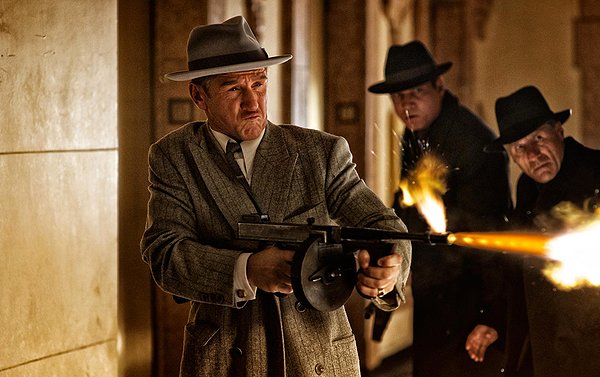 Finally, we must speak of Mr. Sean Penn (Milk). The man’s actorly gumbo goes into campy overdrive. In these rare circumstances, you aren’t watching Sean Penn Esteemed Actor so much as Sean Penn Human Vortex of Overacting. Normally I would criticize Penn for going over the top but over the course of 110 minutes, he single-handedly becomes the only entertaining thing in the movie. He’s chewing scenery up a storm, yes, but at least he’s channeling the pulpy silliness of the whole movie. I came to enjoy his antics and outbursts and thus became more empathetic of Mickey Cohen and his efforts than I did with O’Mara. Such is the danger screenwriters run when they spend more time crafting an interesting villain than a hero.
Gangster Squad is what happens when a movie is sold on title and genre elements. To be fair, it’s a bang-up title. The plot is half-baked at best, really only serving as a thin outline of a gangster movie, but instead of adding complexity and intrigue and characterization, they just ran with it. The actors are either camping it up or out of their element, the action and shootouts are pretty mundane, and the story is just uninvolving, even for fans of film noir like myself. It’s a good-looking film from a technical standpoint, but that’s as far as I’ll go in my recommendation (it could be an odd pairing with Milk considering the two shared actors). It feels like it just wants the setting elements of film noir, the atmosphere, and then figures just having good guys and bad guys shoot it out will suffice. That glossy, high-sheen period look just seems like a cool façade, and a cool façade seems like the only ambition of Gangster Squad. I can’t really recall any signature action sequence, snappy quote, plot development, or peculiarity worthy of remembering. It may be one of the most forgettable gangster movies Hollywood has produced.
Nate’s Grade: C
Share this:

Mama (2013)
 Guillermo del Toro is no stranger to the things that go bump in the night. He helped shepherd the horror film Mama to the big screen, and his love of heavy atmosphere and creepy, agile, lithe figures of terror is still evident. This is a rather effective and very creepy little horror movie that has enough little scares, big screams, and plain skin-crawling moments to recommend. The plot involves two little girls left to fend for themselves out in the wilderness. The two young actresses are fantastic, with terrific physical command of their bodies, able to slink and hop around like feral beasts. They help emotionally ground what could have been an otherwise ordinary ghost story. Oh yes, the girls prayed to a protector known as “Mama” who happens to be a malevolent and jealous spirit. Pity Jessica Chastain (Zero Dark Thirty), not just for her Gothic haircut and heavy eyeliner, but also as the girl’s reluctant foster mom. I’m shocked at how disturbing it is to watch a highly articulated physical specimen bend and snap and scurry at odd angles, broken arms bouncing like insect mandibles. And director/co-writer Andrés Muschietti knows how to properly tease an audience with just enough show and tell. The end is rather rote and familiar but, due to the emotional connection, has moments of genuine poignancy. Credit the considerable talents of the little ones as well as the devious vision of Muschetti and the guiding hand of del Toro. Give Mama a look.
Nate’s Grade: B
Share this:

Your Sister’s Sister (2012)
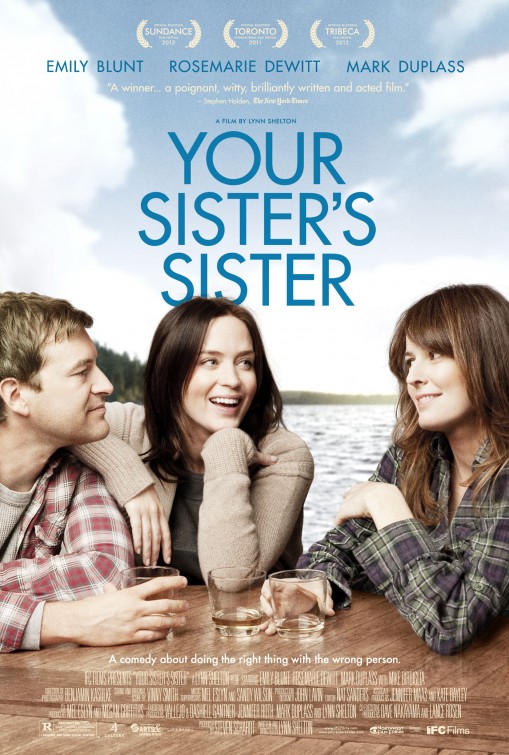 Lynn Shelton is quickly becoming one of my favorite indie film artists. Her writing and directorial offerings are somewhat relegated to the fly-on-the-wall hipster “mumblecore” category, but what separates Shelton is her narrative momentum, her laser-like focus with character, and her sense that a movie needs to build to something significant. With 2009’s Humpday, it was two dudes who might have sex as a test of their masculinity (you really need to see the movie for the full context). With Your Sister’s Sister, it’s the full ramifications of a bunch of delicious relationship secrets getting out there. Everyone in the film has something to hide and something to lose, and watching it all play out with humor and sweetness and honesty that is rare in movies.
Jack (Mark Duplass) is still coming to terms with the death of his older brother. His best friend, Iris (Emily Blunt), who was his brother’s girlfriend at the time of his passing, offers a suggestion. She arranges some alone time for the guy to clear his head. He bikes out to her family cabin but is surprised to find a guest already there, Hannah (Rosemarie DeWitt), Iris’ older sister. Hannah and Jack break the ice by bonding over their personal loss: his brother and her ending a seven-year relationship with her girlfriend. Over a long night of drinking, the two decide to impulsively have sex. The next morning is even more awkward when Iris shows up at the cabin, planning to finally reveal her own feelings for Jack. What follows may be one of the few character-based sitcom plots I’ve witnessed.
 Much like Shelton’s previous movie, the greatest strength of the film is how beautifully naturalistic it all feels while still telling an engaging story. The film has a relaxed vibe that washes over you, allowing you to immerse yourself in what feels like a real group of friends. There’s a tremendous naturalistic ease the film exudes, with the actors so familiar with one another that they truly feel like family. When I have well developed characters, and actors who seem so knowledgeable of their character’s tics and flaws and secrets and smallest details, I could honestly listen to them talk for hours. I don’t want to mistakenly give the impression that this movie is a dull yakfest where the participants are in love with the sound of their own exceptional voices. Each scene in this movie advances the plot further, twisting the screws, complicating matters, and brimming with delightful awkwardness and tension. With 2009’s Humpday, I wrote: “What I really appreciated about Humpday is that every moment feels genuine and every scene has a point. I was amazed that Shelton and her small unit of actors had made it so that every conversation had purpose; there is so little fat to this screenplay. Each scene reveals something new about a character or pushes the narrative forward toward its uncomfortable climax, and each moment never breaks the reality of the story.” And the same can be said for Your Sister’s Sister as well.
While the premise is a bit of a sitcom novelty with some farcical developments thrown in, the depth of the characters and the fantastic acting help to make sure that Your Sister’s Sister is nothing but graceful and beguiling. And the escalating conflicts, personal revelations and complicated feelings, always find a way to come across as organic to the story. That’s another amazing part of the film, that even with all the sexual hijinks that it still manages to feel grounded and surprisingly relatable. These are interesting, complicated, flawed, and spectacular characters, and watching them interact, profess their love through small actions and big declarations, seeing their heartfelt camaraderie, and watch them navigate their troubled lives to find some semblance of a happy ending is a joy to watch. This is a potent little movie, fully realized, poignant, funny, and genuine.
The film was shot over the course of 12 days and Shelton has said that much of the dialogue was improvised, working off her outline. Improvisation is a dangerous tact when dealing with a dialogue-driven film, such as this one. Just because it’s coming off the top of your head doesn’t mean it’s going to sound good. Not everyone is gifted with the ability to improv dialogue that is true to character, revealing, advances the story, as well as just being entertaining. Luckily, Your Sister’s Sister is the exception.
If Your Sister’s Sister does have a weakness, it’s the third act that seems to stall out without giving us much in development before tidying the broken relationships up again. The film’s comedic structure could feel, in lesser hands, like a generic sitcom. It is to Shelton and her actors’ credit that the twists and turns still manage to feel as believable as possible. The third act hits when all the secrets come out, pushing the characters away. Rather than (minor spoilers) ramping things up, we merely endure an extended wordless sequence of images of Jack biking around and the sisters burying the hatchet. Then it’s time for our big happy romantic declaration that tidies everything up, and we’re done. While satisfying on an emotional level given our empathy for the trio, the third act does seem very thin for an otherwise lean and well-structured story. It feels like perhaps Shelton only had enough plot for two acts.
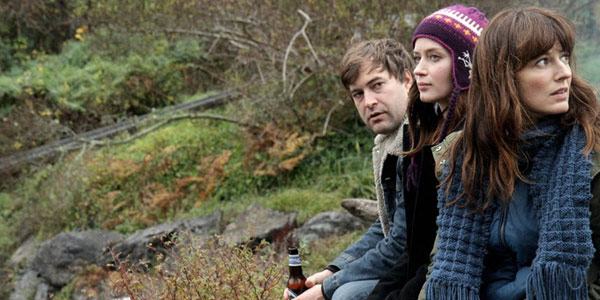 The main trio is a rather engaging ensemble that convincingly plays a besotted group of friends and family. Duplass (Safety Not Guaranteed) has gotten considerably more attention since starring in Shelton’s last movie; the man and his schlubby, smirky charm are ubiquitous. He has a way of being edgy without pushy and nonplussed and flummoxed without going overboard. Duplass has a natural fit for comedy but the man can really excel with the meatier drama bits as well, displaying the painful yearning of a man caught between his desire and the need to move on. He’s a winning and likeable presence that can still be endearing even when he’s flailing around or making others uncomfortable.
DeWitt (The Watch) was a late addition to the cast, replacing Rachel Weisv (The Bourne Legacy) when scheduling conflicts got the best of her. She deserves extra kudos for how good she is considering the miniscule prep time she had compared with her costars. DeWitt is amusing in how cagey and sardonic she can be, and her chemistry with Blunt (Looper) is outstanding. I greatly enjoyed the subtle nuances between them, the way their body language and gestures added extra layers to their relationship, the familiar communication and sisterly code, and just the smallest details that felt well thought out. The relationships in Your Sister’s Sister feel sweetly genuine, and with the benefit of great actors, it lays the groundwork for characters we care about.
Three people sharing time in a cabin might not seem like an exciting setup for a movie, unless, of course, there’s some supernatural presence murdering them in grisly fashion. However, when you lock away three great actors who know their characters inside out, a smart script that allows them the space to develop but pushes the movie forward scene-by-scene, and direction that feels seamless with the storytelling, then you have something special, and that something special is Your Sister’s Sister. While I think Shelton’s previous film had more at play concerning male relationships and sexual politics, this one, with a more straightforward, farcical plotline, is still plenty entertaining and with strong character work (the ending does leave one very large question unanswered). This is charming, sweet, unassuming little indie film that will provide a solid dose of smiles and laughs.
Nate’s Grade: B+
Share this:

Promised Land (2012)
 Actors Matt Damon and John Krasinski co-wrote Promised Land, which has been labeled as the anti-fracking movie. I wish. While it does take a suspicious view of the practice of extracting natural gas via high-powered underground water jets laced with chemicals, the movie feels too timid to really land home its points, settling on a familiar narrative of the redemption of one man working for The Man. The character development feels like it happens overnight rather than through a gradual process. Damon begins as a corporate raider, a guy selling false hope to the economic downtrodden, and ends up an altruistic environmental fighter. I mostly found him to be a pompous jerk. The scenes with Damon squaring off against Krasinski, an environmental activist, are easily the best, giving the movie a bristling energy it otherwise lacks. Krasinski provides a fine foil and some snappy competition until a late preposterous plot turn muddies everything up. I feel like the writers, as well as director Gus Van Sant, wanted to lure in wary moviegoers with something more broadly appealing (the evolution of one man) versus a more alarmist, message-heavy movie. That’s fine, but at least give me a better story. Promised Land even falls into the trap of having he Damon/Krasinski competition come down to a woman (Rosemarie DeWitt) they both fancy. Because otherwise it wouldn’t feel serious, right? It’s a solidly acted movie, with some nice turns by veterans like Frances McDormand and Titus Welliver (TV’s Lost), but the movie just doesn’t live up to the promise of its potential.
Nate’s Grade: B-
Share this:

Les Miserables (2012)/ Rock of Ages (2012)
 I have no qualms with my heterosexual nature to make the following statement: I love a good musical. Why shouldn’t I? None other than Martin Scorsese said any true film lover is a fan of horror movies and musicals, two genres uniquely suited to the visual flourishes of cinema. My tastes tend to run toward the more offbeat, like Avenue Q and Hedwig and the Angry Inch and Sweeney Todd and Dancer in the Dark. My favorite movie musical of all time is 1952’s Singin’ in the Rain, but that’s probably because I’m a movie lover first and foremost. A well-done movie musical can sweep you off your feet. The polarizing Moulin Rouge! is still my favorite film of 2001; I love every messy, ambitious, transporting second of it. And that’s what the best musicals and, in general, best films achieve: they transport us to another realm. Since the success of 2002’s Chicago, there’s been a run of hit-or-miss movie musicals proliferating the big screen. It’s hard to think of any longstanding Broadway hits that have yet to make the leap (you’ll get your turn, Book of Mormon). Of course it also works the other way, with plenty of movies being adapted into Broadway musicals, like Shrek, Elf, Ghost, Catch Me if You Can, Newsies, A Christmas Story, Sister Act, Legally Blonde, Bring it On, and Tony-winner for Best Musical, Once. Then you get movies turned into musicals and back into movie musicals, like The Producers and Hairspray. It seems like Broadway and Hollywood are stuck in a loop, feeding off one another’s spoils.
In 2012, two high-profile musicals got the big screen treatment: Rock of Ages and Les Miserables. The former is from 2009 whereas the latter is one of the most successful Broadway shows of all time, beginning in 1980 and spanning continents. Rock of Ages was savaged by critics and bombed at the box-office, whereas Les Miz is soaring this holiday season and is seen as a major Oscar contender. Of course one of these films is about the outrage of the lower classes being exploited by an unfair system that benefits the rich, and the other has Tom Cruise and a monkey named “Hey Man.” Having seen both films recently, and Les Miserables more than once, I think they present an interesting discussion on the pitfalls of adapting a popular theatrical show to film. You won’t have to wait long to figure out which movie succeeds and which falters badly.
 Les Miserables, based on Victor Hugo’s novel, is set in early 19th century France. Prisoner Jean Valjean (Hugh Jackman) is nearing the end of his twenty-year sentence for stealing a loaf of bread. Inspector Javert (Russell Crowe) is convinced Valjean will never reform and go back to a life of crime. After help from a kindly bishop, Valjean flees his parole and sets up a new life as a businessman. Fantine (Anne Hathaway), one of Valjean’s workers, gets thrown out and tumbles down a chain of regrettable circumstances. She becomes a prostitute to support her young daughter, Cosette. Valjean recognizes poor Fantine on the street and, horrified at his own neglect leading her to this path, takes it upon himself to care for her and her daughter. Years later, the teenaged Cosette (Amanda Seyfried) has fallen for the young revolutionary Marius (Eddie Redmayne). Marius enlists his good friend Eponine (Samantha Barks) to help find out who Cosette is, all the while ignorant that Eponine is clearly in love with him. The young people of France are riled up about class abuses and exploitation, and the spirit of revolution is in the air. Javert is also becoming suspicious of Valjean’s true identity, so Valjean feels the need to flee once again. However, Cosette’s love and the bravery of the young revolutionaries makes Valjean decide to stop running from his past.
Oscar-winning director Tom Hooper (The King’s Speech) made the ballsy but ultimately brilliant decision to have his performers sing live. Every line, every note, every performance is captured in the moment; there is nary a second of lip-synching. I cannot overstate how blessed this decision was. It places the emphasis on the performances, and that’s exactly what something as big and deeply felt as Les Miserables required for the big screen. Look, Hollywood actors are never going to be able to outdo trained and professional theatrical singers. What I expect from movie stars is movie-star level performances, and Hooper understands this. These actors aren’t playing to the cheap seats, belting the tunes with power and over exaggerated dramatics (note: there is absolutely nothing wrong with this style given the theatrical setting). In many ways, this is a more intimate Les Miserables, and it still maintains its charms and magic. There is no choreography, short of perhaps the more jovial “Master of the House” number, and Hooper puts us right in the muck of life in a 19th century impoverished slum. This is one dirty movie with lots of grimy period details, creating a reality that can only be implied on stage. The more visceral version of Les Miserables demands performances that are more naturalistic and less bombastic, to a degree. I am a cinephile first but I genuinely prefer my musicals with trained actors to trained singers. A great actor can add so much inflection and personality through the prism of song, whereas a great singer is concentrating on the notes first and foremost. I value performance over nailing the mechanics, and more movie musicals should follow Hooper’s path. This, ladies and gentlemen, is how to do the movie musical experience right.
 I don’t know if Hooper was exactly the right man for the job but he certainly does the beloved stage show justice. Hooper’s visual tics are still present. The man loves to film in close-ups and at all sorts of tilted Dutch angles; he also loves filming a conversation between two people where neither one will be in the same shot. It’s a peculiarity that I never really warmed up to. However, Hooper generally has the best interests of his movie at stake, capitalizing on the large outpouring of feeling. This is a Big Musical with big emotions, and it’s easy to be swept up in its exuberant earnestness and humanism. It even has a famous concluding line, “To love another person is to see the face of God.” It’s the kind of stuff you roll your eyes at under lesser circumstances. Now, thinking back, you’ll realize that many of these people were simply painfully naïve and that there was a slew of death for no good reason. Purists may chafe at some altered lyrics and truncated songs, but really this is pretty much the closest version of the famous stage show you’ll ever see adapted. Not one of the songs has been cut (in fact a new one was written for the film by the original composers), and at a lengthy 157 minutes, it’s practically as long as the stage show, and just about sung through every moment. There are probably ten total lines that are merely spoken. I predict hardcore Les Miz fans will lap up every second.
Les Miserables also boasts some fortuitous casting (Taylor Swift at one point was rumored to be up for a role… shudder), none more than Anne Hathaway (The Dark Knight Rises). She is nothing less than perfect as Fantine. There isn’t a false note during any of her acting. Her performance of “I Dreamed a Dream” is so powerful, so breathtaking, so intensely felt, that it ranks up there with some of the best moments in all of 2012 movies. And oh can this woman sing her ass off too. You feel every flicker of anger and devastation, the grain in her voice, on the verge of tears and fury. This woman deserves every accolade they can come up with this year. This woman is a total lock for Best Supporting Actress. She’s wonderful during every moment of her screen time and the lengths and emotional ferocity of her performance, and subsequent pitfalls the character endures, left me reaching for the tissues at several points.
The other standout amidst a pretty stellar cast is Barks. This is her first film work though she has plenty of experience with her character, portraying Eponine in the 25th anniversary run of Les Miserables. Her singing is terrific, as you’d imagine, but her acting is just as strong. Her rendition of “On My Own” is a showstopper of a number. Barks naturally transitions to the demands of film. I was completely on Team Eponine and found her to be an infinitely better catch than Cosette. After people get a glimpse of this woman, she is going to get plenty more acting offers, and a few concerned inquiries into the size of her waist, which at times looks like it might be the size of The Rock’s neck. Hooper also has the good sense to film both “I Dreamed a Dream” and “On My Own” in unbroken takes; focus tightly pinned on our outstanding actresses, letting the skill of their performances sell the big emotions.
 Of course the crux of the tale rests on two men, Valjean and Javert, and the rest of the cast does kind of get saddled in underdeveloped roles made more apparent as a movie. It seems blasphemous to say I was a little disappointed with both lead actors. Crowe (Robin Hood) is easily the weakest singer of the cast but that doesn’t mean he’s bad. He has a lower register and sings his parts like a rock musician rather than a Broadway player. Fans of the stage show will have to adjust their expectations for a more subdued Javert. Still, having an actor of Crowe’s talents is definitely a plus even if his singing is adequate. Jackman (Real Steel) is a Tony-winning thespian, so I held him to a higher standard. He’s got a lot of heavy lifting to do as Jean Valjean, and Jackman does an admittedly fine job with the bigger emotional parts. I just expected more from his vocal abilities but it’s not a major detraction. As my mother noted, it’s not too difficult to spot the classically trained singers in the cast. Also, for eagle-eyed Les Miz fans, look for the original Jean Valjean, Colm Wilkinson, as the Bishop in this movie.
There is the tricky nature of translating a Broadway production into some variance of period reality. There’s plenty of relevance with the class struggle illustrated in the second half of the movie (Bane would approve). It’s an obvious statement but film is a different medium than the theater and affords different opportunities. The depressing reality of lower class life and the vultures that preyed on others is striking, yes, but sort of conflicts with the comic relief characters represented by the scheming Thenadiers (Sacha Baron Cohen, Helena Bonham Carter). When the seriousness of the period is inflated, they feel like they sort of belong in a different movie. Then there’s just the conflict between stage reality and film reality. On the stage we’ll accept Marius falling madly in love with Cosette at first sight. When it’s on film, the guy comes across as a callous chump, oblivious to Eponine’s pining. He ignores the friend he’s had for years for some blonde in a bonnet. And the final number, reuniting all the dead cast members, works better as a curtain call than a finale to a film. These are just the quirks of theater one must just accept. I wouldn’t say the songs and music is in the same category as Sondheim or Webber, but there are definitely some hummable tunes here made all the more swooning. You’ll have a fine pick of songs to get stuck in your head for days (mine: “Look Down”).
 Earlier this year, Rock of Ages came and quickly left the box-office, failing to make a splash with the American public despite a healthy enough run on Broadway and touring the country. The stage show is a jukebox musical set to the head-banging tunes of 1980s hair metal. Adam Shankman, the director behind the bouncy and thoroughly entertaining 2007 Hairspray movie musical, was tasked with bringing Rock of Ages to the screen with the same finesse. Cherie (Julianne Hough) a hopeful singer just off the bus from Oklahoma, meets up with Drew (Diego Boneta), a nice kid who gets her a job at The Bourbon Room, a rock club running afoul with the mayor (Bryan Cranston) and his moral crusading wife (Catherine Zeta-Jones). The club owners (Alec Baldwin, Russell Brand) are relying on fickle, burned-out, taciturn, and overall mysterious rock legend Stacy Jaxx (Tom Cruise) to save their club from financial ruin. Along the way, Cherie and Drew look for their big breaks, fall in love, get pulled apart, and reunite in time for one final sendoff to leave the audience tapping their toes.
 Allow me to elucidate on my main problem with the rise in jukebox musicals: I find them to be, with rare exception, exceedingly lazy. The musical number is meant to advance the narrative and give insights into character and situation, just like any other aspect of plot. You’ll find great original tunes that do this. When you’re dealing with pop songs that the public is well familiar with, then your job becomes even harder, and I find many are just not up to the task. Too often jukebox musicals are designed to merely string together a pre-packaged and time-tested number of hit songs, utilizing the faintest of narrative threads to get from one song to the next. The appeal of jukebox musicals lies not with the story or characters but waiting for the next recognizable song and wondering how it will, poorly, fit into this new context. You’ll notice that these jukebox musicals seem to have twice as many song numbers. They know their selling point, and more singing means less time spent developing characters and story. And so my impression of the jukebox musical is one of a cynical cash grab following the bare minimum of narratives to achieve the status of musical so it can be resold with low risk. I’m simplifying things in my ire, yes, but there’s a definite reason that jukebox musicals have sprouted like mad in the past few years. They don’t require as much work and the audience seems to hold them to a lesser standard. Much like the worst of Friedberg and Seltzer (Disaster Movie, Meet the Spartans), it seems just recognizing the familiar has become the core draw of entertainment.
And this is one of the main problems with Rock of Ages. I’ve never seen the stage show, but my God for something that purports to live the rock and roll lifestyle, it’s certainly so tame and scrubbed clean of anything dangerous. This feels like your grandparents’ idea of what “modern” rock music is. After a cursory search online, I’ve found that the movie makes some significant changes to convert a story about rock and roll hedonism into sanitized family friendly fare (spoilers to follow, theatergoers): apparently in the stage version, Cherie and Jaxx had sex, Jaxx remains a creep and flees the country on statutory rape charges, though before that he and Cherie share a lap dance/duet to “Rock Me Like a Hurricane,” the family values crusader characters were new inventions, the Rolling Stone reporter (Malin Akerman, the best singer in the film) is considerably beefed up to provide Jaxx his happy ending, and they don’t even use the song “Oh Cherie.” I’m not a stickler for adaptation changes, but clearly it feels like Rock of Ages had every edge carefully sanded down to reach out to the widest array of mainstream filmgoers (Shankman says he cut Cherie’s lap dance number because it tested poorly with mothers). The funny part is that the movie lambastes a slimy manager (Paul Giamatti) for playing to demo numbers, shooting for pandering mass appeal rather than the art, man. Feel the hypocrisy.
 The first hour of Rock of Ages is mildly passable mostly because of the goofy supporting cast, but then the movie just keeps going, getting more and more tedious with every protracted minute. The second half involves Cherie and Drew apart and finding new lows; for him it’s selling his soul to join in a boy band, and for her it’s selling herself, working as a stripper. Let’s look back at that sentence. One of those life choices is not nearly as upsetting as the other. Nothing against the hard-working strippers in this country, but Cherie taking to the pole is definitely more of a moral compromise for the character than whatever the hell Drew endures. It’s this leaden second hour that made me lose faith that Rock of Ages would even provide a morsel of cheesy entertainment. It has the misfortune of two of the blandest leads I’ve ever seen in a musical. Hogue (Footloose) and Boneta (Mean Girls 2) are both physically blessed specimens of human genetics, but oh are these kids boring boring boring. Their love story is completely malnourished and you couldn’t scrape together one interesting thing about them combined. The fact that Rock of Ages further strips away any interesting personality from Cherie (see above) makes them even more disastrously boring. To be stuck with these two for another hour of vapid griping, only to magically get back together, is interminable. Thank God they pumped up the side characters because that is the only time when Rock of Ages even challenges for your attention. Cruise isn’t the best singer but he’s pretty good belting out 80s rock hits, and the man has his natural charisma and stage presence to spare.
So I guess where Rock of Ages goes wrong, and where Les Miserables succeeds, is thinking of how best to translate the experience of the stage to the medium of film. Shankman does a pitiful job staging his musical numbers, with lackluster choreography that rarely takes advantage of the sets and characters. Worse, Shankman feels like he strays from the tone and angle of the stage show, sanitizing the rock and roll lifestyle and looking for ways to squeeze in bland happy endings. In other words, he doesn’t capture enough of the essence of the original stage show to please neophytes and fans of the Broadway show. With Les Miserables, I think most fans of the stage show, and they are legion, will walk away feeling satisfied with the results, content that real artists treated the long-running musical with justice. Hooper opens up the world of the stage show, utilizing the parameters of film, and the emphasis on performance over singing mechanics maximizes the unique power of film. Les Miserables is a grand movie musical smartly adapted to the opportunities of film. Rock of Ages is a sloppy, neutered, criminally boring mess poorly developed and poorly translated to the silver screen. Let this be an educational resource for future generations. Take note, producers, and learn from the mistakes of Rock of Ages and the accomplishments of Les Miserables. Oh, and guys, if you see Les Miserables, it will get you super laid with your girlfriend (I have anecdotal evidence).
Nate’s Grades:
Les Miserables: B+
Rock of Ages: C-


You must be logged in to post a comment.