Blog Archives
Nickel Boys (2024)
 This might be the most immersive and biggest directorial swing of the year. Director/co-writer RaMell Ross adapts the Pulitzer Prize-winning novel by Colson Whitehead about a reform school for juveniles more like a prison during the Civil Rights era. Ostensibly, the Nickel Academy is an institution that is meant to teach moral lessons and responsibility through outdoor labor. In reality, it’s a school that benefits from labor exploitation and has no intention of fulfilling its promise that students can possibly leave before they turn eighteen. This is even worse for African-Americans, as the school is also segregated and the students have to endure the racism of the administrators and other white juvenile delinquents who still want to feel superior to somebody. It’s a cruel setting destined to spark risable outrage, especially knowing that our main character, Elwood Curtis, is a victim of profiling and being in the wrong place at the wrong time, a star student selected to take college classes at an HBCU. The big artistic swing of Nickel Boys is the choice to tell the entire movie through first-person perspective, with the camera functioning as our protagonist’s eyes and ears. As the camera moves, it is us moving. It makes the movie intensively immersive, but I had some misgivings about this storytelling gimmick. It limits the resonance of the central performance as we can’t see the actor and his expressions and emotions, which I found frustrating. Ross also decides to do this same trick twice with a second character who befriends Elwood. Now we can see more of our main character, through this other person’s eyes occasionally, but it’s also like having to re-learn the visual vocabulary, and switching from viewpoints was distracting for the immersion and to recall whose eyes were whose at any moment. There’s also flash-forwards to adult Elwood that only served to muddle the tension. There’s enough genuine drama in this setting that I wish Nickel Boys might have been a more traditionally-made drama. Still, it’s a fine movie, but the aspect that will make it stand out the most is also what I feel that holds it back for me from being more profoundly affecting.
Nate’s Grade: B
Share this:

The Brutalist (2024)

The indie sensation of the season is an ambitious throwback to meaty movie-going of the auteur 1970s, telling an immigrant’s expansive tale, and at an epic length of 3 hours and 30 minutes, and an attempt to tell The Immigrant Story, and by that we mean The American Story. It’s a lot for any movie to do, and while The Brutalist didn’t quite rise to the capital-M “masterpiece” experience so many of my critical brethren have been singing, it’s still a very handsomely made, thoughtfully reflective, and extremely well-acted movie following one man trying to start his life over. Adrien Brody plays Laszlo Toth, A Jewish-Hungarian survivor of the Holocaust who relocates to Pennsylvania in 1947. He starts work delivering furniture before getting a big break redesigning a rich man’s library as a surprise birthday gift that doesn’t go over well. Years later, that same rich man, Harrison Lee (Guy Pearce), wants to seek out Laszlo because his library has become a celebrated example of modern architecture. He proposes Laszlo design a grandiose assembly that will serve as a community center, chapel, library, gymnasium, and everything to everyone, standing atop a hill like a beacon of twentieth-century civilization. Everything I’ve just written is merely the first half of this massive movie, complete with an old-fashioned fifteen-minute intermission.
The second half is about crises professional and personal for Laszlo; the meddling and compromises and shortfalls of his big architectural project under the thumb of Harrison, and finding and bringing his estranged wife (Felicity Jones) to America and dealing with the aftermath of their mutual trauma. I was never bored with writer/director Brady Crobett’s (Vox Lux) movie, which is saying something considering its significant length. The scenes just breathe at a relaxed pace that feels more like real life captured on film. The confidence and vision of the movie becomes very clear, as Corbett painstakingly takes his time to tell his sprawling story on his terms. I can appreciate that go-for-broke spirit, and The Brutalist has an equal number of moments that are despairing as they are enlightening. I was more interested in Laszlo’s relationship with his wife, now confined to a wheelchair. There are clear emotional chasms between them to work through, having been separated at a concentration camp, but there is a real desire to reconnect, to heal, and to confront one another’s challenges. It’s touching and the real heart of the movie, and it easily could have been the whole movie. The rest, with Laszlo butting heads against moneymen to secure the integrity of his vision, is an obvious allegory for filmmaking or really any artist attempt to realize a dream amidst the naysayers. The acting is terrific across the board, with Brody returning to a form he hasn’t met in decades. Maybe his career struggles since winning the Best Actor Oscar in 2003 have only helped imbue this performance with a lived-in quality of a soul-searching artist. Pearce is commanding and infuriating as the symbol of America’s ego and sense of superiority. The musical score is unorthodox but picks up a real sense of momentum like a locomotive, thrumming along at a building pace of progress. The only real misstep is an unnecessary epilogue that spells out exactly how you should feel about the movie rather than continuing the same respect and trust for its patient audience. The Brutalist is an intimidating movie and one best to chew over or debate its portrayal of the American Dream, and while not all of its artistic swings connect, the sheer ambition, fortitude, and confident execution of the personal and the grandiose is worth celebrating and elevating.
Nate’s Grade: B
Share this:

Sing Sing (2024)
 An uplifting ode to the power of the arts, Sing Sing follows the men of a prison arts program and it’s easily one of the finest films of 2024. We follow the men of the New York prison of the title, lead by Divine G Whitfield (Colman Domingo), a thespian that relishes the dramatic spotlight and the deserved lead of every production. When the next show is suggested as a comedy, Divine G has to accept ceding the spotlight and mentoring a promising but struggling new member (Clarence Maclin) with talent and potential. It’s effectively a “let’s put on a show” formula of old, however, the setting and the weary reflections are what provide the movie its power. All of these men have made mistakes in their respective lives to wind up here, though Divine G maintains his innocence and is preparing his case for a parole board hearing. This program allows them an escape, an opportunity as one puts it to “become human again” While some may scoff at the acting games and costumes, this is sacred ground, a precious oasis for them to discover more about themselves. The sincerity of Sing Sing is wince-inducing. It is beautiful, tender, compassionate, and deeply personal while being very universal. The lived-in details are fantastic and give great authenticity to these men and their stories, wonderfully portrayed by several non-actors making the most of their own spotlights. Domingo (Rustin) is amazing as the proud and generous leader who is ably trying to lift his fellow men up even higher. The film concludes with real footage from the Rehabilitation Through the Arts (RTA) program, and it’s the fitting culmination for a movie that readily reminds us how restorative and needed the arts are for a fuller sense of who we are.
Nate’s Grade: A
Share this:

Blink Twice (2024)
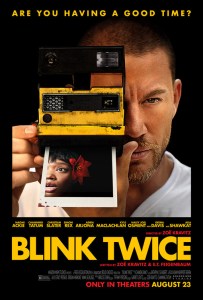 Zoe Kravitz’s directorial debut Blink Twice has stayed with me for weeks after I watched it, and with further harrowing revelations coming from the fallout of P. Diddy’s empire of exploitation, it has even more relevance. Think of it as a feminist revenge thriller set on Jeffrey Epstein’s island or a Diddy party. Channing Tatum plays a successful tech bro who hosts lavish getaways for the Wall Street and Silicon Valley elite, where the week is an orgy of food, drink, drugs, and of course sex. We follow Frida (Naomi Ackie), a waitress yearning for the finer things in life, so when Tatum’s rich and famous CEO invites her and her friend to his private island, she’s ecstatic. But everything is not what it seems, and Frida and the other women begin to notice weird clues, that is, when they can remember as time frequently seems to be lost for them. Blink Twice is a twisty, eerie mystery and Kravitz shows real skill at developing tension and suspense, with sequences that had me girding great waves of anxiety. There’s also an eye for style and mood here that makes me feel Kravitz has a real career as a genre director. I don’t think it’s spoilers to say that eventually the surviving women team up together to fight back against their oppressors, and it’s gloriously entertaining, bloody, and table-turning satisfying. The ending is designed to spark debate and controversy, and I enjoy that Kravitz and co-writer E.T. Feigenbaum do not want to make things too tidy, even with their protagonists. The themes here are broad but the execution is exact. There are several moments that stand out to me, from unexpected moments of levity to bold artistic choices that are mesmerizing, like an “I’m sorry” apology that goes through every level. If you’re looking for slickly executed genre thrills with great comeuppance, don’t blink when it comes to with Blink Twice.
Nate’s Grade: B+
Share this:

Juror #2 (2024)
 Clint Eastwood’s possible last movie as a director (the man is 94 years old, people) was buried at the theater through a limited release by its studio, which is a shame because Juror #2 is a fairly solid adult drama with some grueling tension built right in. I was wondering how screenwriter Jonathan Abrams was going to make this premise work, where a recovering alcoholic and expectant father, Justin Kemp (Nicholas Hoult), is impaneled on a jury for a murder case and discovers, over the presentation of evidence, that he might actually be the culprit. That same night, at the same location of where the supposed murder took place, is where Justin thought he hit a deer. What follows is a soul-searching account of one man being torn apart as far as what he should do. Does he let this other man take the blame so Justin can live out his life with his new baby and wife? Or does he come forward and admit his own firsthand knowledge of the events would present a very reasonable doubt for this trial? The movie becomes an extended balancing act of how long Justin can keep this secret and what angles he will work, trying to push the jury one direction or another through persuasive appeals. It’s familiar dramatic territory to anyone who grew up on 12 Angry Men, though with an extra high-concept twist. It’s a fairly straightforward drama that allows the story to take center stage and puts the focus on one man’s personal crisis. The acting is strong all around with Hoult (Nosferatu) being the predicted standout, showing the heavy weight of his guilt wirh every pained expeession. I think the ending does a disservice to the kind of movie that came before it, namely that it should be more definitive in its conclusion and provide a fitting resolution. This isn’t exactly the kind of movie that benefits from prolonged ambiguity, so the abrupt ending feels like a miscalculation and hampers a bit of the ending’s impact. However, Juror #2 is a good squirm session.
Nate’s Grade: B
Share this:

Million Dollar Baby (2004) [Review Re-View]

Originally released December 15, 2004:
Million Dollar Baby, much like its fledgling female boxing character, has come out of nowhere and made a considerable deal of noise. This little homespun film directed by Clint Eastwood didn’t have the glitz and sheen of other awards friendly movies, but now it seems that Eastwood?s own baby may clean up come Oscar time. Can Million Dollar Baby tackle the enormous hype surrounding it? Yes and no.
]Frankie (Eastwood) is a hardened boxing trainer too concerned for his fighters’ welfare to allow them to fight in championship bouts. He’s the kind of cynical old man that enjoys pestering a priest and causing him to unleash an F-bomb. Frankie and his longtime friend Scrap (Morgan Freeman) run a rundown gym and talk un-sentimentally about their older days as prize fighters. Then along comes Maggie (Hilary Swank), a 32-year old waitress who’s got nothing to believe in except her possibility as a boxer. She wants Frank to train her into the champ she knows she can be. He refuses saying he doesn’t train girls. She’s so determined she won’t take no for an answer. Frank finally agrees, especially after some help from Scrap, and starts to teach Maggie everything she needs to know to be a star pugilist. The two begin to open up to each other emotionally and Maggie seems destined to become a force in the ring.
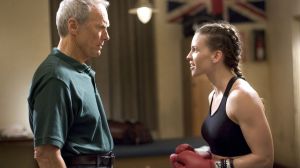
Million Dollar Baby‘s greasiest attribute is its trio of knockout performances. Swank owns every second of this movie. She’s unremittingly perky, conscientious but also dogged, stubborn, and irresistibly lovable. Swank embodies the role with a startling muscular physique and a million dollar smile. Her performance is equal parts charming and heartbreaking. Maggie’s the heart of Million Dollar Baby and Swank doesn’t let you forget it for a millisecond. Come Oscar time, I’m sure she will be walking onstage to grab her second Best Actress Oscar in five years.
No one does grizzled better than Eastwood, and maybe no other actor has made as much of an acting mark by squinting a lot. Million Dollar Baby is probably his best performance to date, though for a good while it sounds like Frank has something lodged in his throat (pride?). Frank has the greatest transformation, and Eastwood brilliantly understates each stop on the journey until landing in a vulnerable, emotionally needy place.
Freeman once again serves as a film’s gentle narrator. There isn’t a movie that can’t be made better by a Morgan Freeman performance. His give-and-take with Frank feels natural and casual to the point that it seems improvised on the spot. Freeman unloads some great monologues like he’s relishing every syllable, chief among them about how he lost his eye. It’s wonderful to watch such a great actor sink his teeth into ripe material and deliver a performance that may net him a long-awaited Oscar (I think he’s due, and likely so will the Academy).
For whatever reason, Eastwood is hitting a directing groove in his twilight years. First came Mystic River, an ordinary police whodunnit made exceptional by incredible acting. Now Eastwood follows up with Baby, an ordinary sports film made extraordinary by incredible acting. Hmmm, a pattern is forming. The cinematography is crisp and makes great use of light and shadow to convey emotion. Eastwood’s score is also appropriately delicate and somber. The boxing sequences are brief but efficient.
Million Dollar Baby is a very traditional story that is at times surprisingly ordinary. Maggie’s the scrappy underdog that just needs a chance, Frank’s the old timer that needs to find personal redemption, and Scrap’s the wise old black man. Once again, an old curmudgeon takes on a rookie and in the process has their tough facade melt away as the inevitable victories pile up. Million Dollar Baby is a very familiar story but then again most boxing tales are fairly the same in scope.
What eventually separates Million Dollar Baby from the pack is its third act twist. You think you know where Eastwood’s film is headed, especially given the well-worn terrain, but you have no clue where this story will wind up. The plot turn deepens the characters and their relationships to each other in very surprising ways. You may be flat-out shocked how much you’ve found yourself caring for the people onscreen. It almost seems like Eastwood and company have used the familiar rags-to-riches underdog drama to sucker punch an audience into Million Dollar Baby‘s final 30 minutes. We’re transported into an uncomfortable and challenging position, and Eastwood won’t let an audience turn away.

Million Dollar Baby is not the colossal masterpiece that critics have been drooling over. For one thing, the group of antagonists is not nearly as textured as our trio of leads. They’re actually more stock roles that further enforce the ordinary story of Million Dollar Baby. Maggie’s trailer trash family is lazy unsupportive batch of stereotypes. The evil female boxing champ just happens to be a German who doesn’t mind playing dirty. One of the boxers at Frank’s gym is an arrogant showboat just waiting to be nasty while the teacher’s back is turned. Million Dollar Baby excels at showing depth and humanity with its lead trio, yet it seems if you aren’t in that circle you’re doomed to wade in the shallow end.
Eastwood shows that great acting and great characters you love can elevate a common framework. The package may be similar to a lot of films before about scrappy underdogs, but Million Dollar Baby lacks comparison in its genre when it comes to its enthralling acting and characters. The father-daughter bond between Frank and Maggie is heartwarming. The final reveal of what her Gaelic boxing name means may just bring tears to your eyes. The results are a very fulfilling movie going experience, albeit one that regrettably may not live up to such hype.
Million Dollar Baby has been showered with heapings of praise and become a formidable Oscar contender. The story treads familiar waters but its outstanding acting and deep and humane characters elevate the material. The film can’t match the hyperbole of critics but Million Dollar Baby is an ordinary but greatly satisfying ride led by compelling acting. The film hums with professionalism and seems to just glide when everything comes together magnificently, particularly in that last 30 minutes. Eastwood is hitting an artistic stride and it’s actually exciting to see what Clint will do next. Million Dollar Baby may not be a first round knockout but it definitely wins by decision.
Nate’s Grade: B+
——————————————————
WRITER REFLECTIONS 20 YEARS LATER

Million Dollar Baby was its own underdog story that showed its strength when it mattered most, taking the 2004 Best Picture Oscar, as well as Best Actress for Hilary Swank and Best Supporting Actor for Morgan Freeman. It wasn’t even on many award prognosticators’ radar until the final month of the year. The odds-on favorite for most of 2004 had been Martin Scorsese’s Howard Hughes biopic The Aviator, a lavish recreation of Old Hollywood with the power of Harvey Weinstein behind it. After 2002’s Gangs of New York went 0-10 with its Oscar nominations, Weinstein vowed this would not happen again and that he would get Scorsese that first directing Academy Award, so no expense was spared with a $110 million-dollar budget, exceeding the previous highest Miramax budget from 2003’s Cold Mountain. The narrative was set, the power of Weinstein was behind it, and the context of Hollywood celebrating its own history has long been an appealing formula for an easy Oscar victory. Then came Clint Eastwood’s scrappy little boxing movie and it sucker-punched the established awards narrative, taking the top prize (Sorry Harvey, but if it was any consolation, The Aviator improved upon Gangs’ ratio, winning 5 of 11 noms).
Twenty years later it’s impossible to discuss the legacy of Million Dollar Baby without talking about the legacy of Eastwood as a director. He’s been directing movies ever since 1971’s Play Misty For Me. He initially stuck to what he knew, thrillers and Westerns, with the occasional passion project like 1988’s Charlie Parker biopic, Bird. It all changed for Eastwood with 1992’s Unforgiven, a searing deconstruction of the Western and masculinity and conveniently digested American myth-making that won Best Picture and Best Director for Eastwood. From there, the flinty-eyed, gravelly-voiced filmmaker was seen as an Oscar favorite, though he was only nominated for Best Director three other times out of the twenty-five films he directed after. Eastwood’s been regarded as some higher-minded adult director, but looking over his long list of directorial efforts, the man has always kept to his preferred milieu of thrillers and Westerns with the occasional somber biopic. The more assumed Academy-friendly projects typically gained minimal traction, usually acting nominations like with Richard Jewell, Invictus, and The Bridges of Madison County. Sometimes they’ve just been complete artistic whiffs, like J. Edgar, Jersey Boys, or Hereafter.
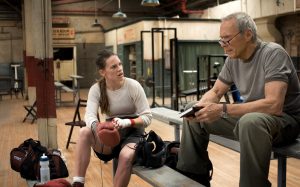
The movies that got the most acclaim from Eastwood as director were the elevated genre movies, be they crime thriller (Mystic River), Western (Unforgiven), or sports underdog drama (Million Dollar Baby). The man has an inherent interest in genre movies. He may make a WWII drama from the point of view of the Japanese, completely in Japanese, but then next he’ll make a movie about being a “Get off my lawn” grumpy grandfather taking on street gangs. He made a movie about sending geezers into space, a juror realizing he may actually be guilty of the crime he’s intended to judge, and a corrupt president covering up his crimes (that guy wasn’t even a convicted felon upon inauguration -ha). The man is at his best when he sticks to what he knows, and when he can collaborate with writers who can get the best out of his instincts, the results can be exceptional. He’s a man interested in telling genre stories, and I can respect that. He’s notoriously spartan in his directorial approach with actors, typically only allowing two or so takes before moving on, a.k.a. the anti-Kubrick. The photography is so stark is might be confused for being black and white. There is a stripped-down-to-its-studs quality to the best of Eastwood’s movies, which is why deconstructionist examinations over genres can be especially rewarding. It allows for a larger space for characters to expand and grow and challenge our expectations, which is where Million Dollar Baby still works so well twenty years after it unexpectedly KO’d the awards circuit.
This is a Cinderella sports story balanced by an invigorating surrogate father-daughter relationship. Maggie Fitzgerald (Swank) is so eager to prove herself as a boxer, and we’re so happy to see her gain success and dignity, helping to give her trainer Frankie Dunn (Eastwood) a new sense of purpose. Everything is going right for this pair and it feels like the Hollywood movie we would all know and love, and then it all gets violently torn away when Maggie is injured in the ring and becomes paralyzed from the neck down. From there, Million Dollar Baby transforms from its sports movie formula and becomes something so much more meaningful and interesting and emotionally affecting. We’re constantly playing a mental contrast from before and after the accident. She’s so optimistic and bouncy and full of life. To see the joyous Maggie using her body to give her confidence and identity and overcoming adversity and intimidating more professional opponents through force of will, and then to see her bedridden, wheezing through a ventilator, and so deeply lost in her slack eyes, it’s something awful. She survived the injury but her spirit has been obliterated. Now, this isn’t a commentary on how disabled people cannot live fulfilling lives and might as well be euthanized. Maggie is the one who makes the choice to be euthanized and she will not be swayed, and this decision puts it to her coach, a lifelong Catholic, to demonstrate his love for his pupil through assisted suicide. To me, all that is WAY more dramatically interesting than if she had simply won the big title fight and proven all her many doubters wrong.

Swank rightfully won her second Oscar for Best Actress with a performance of such vitality and despair. At the end, when she’s stuck in that hospital bed, and she’s trying to chew off her own tongue so she can bleed to death, it’s such a devastating change from the chipper, optimistic scrappy underdog. Eastwood is gruff and growly and nearly unintelligible at points, but his reactions and his generosity as an actor help Swank achieve even higher acting greatness. Strangely enough, while Freeman is perfectly good in his Oscar-winning role, you could have cut him completely from the movie and affected very little, besides needing a new outlet for Eastwood to unintelligibly grumble towards.
It can feel like Million Dollar Baby is two different movies smashed together, one without an ending and one without a beginning. If you felt like you were plugged into that rousing sports underdog movie, I can understand feeling cheated by the rug pull. I feel like the version of this movie, by its end, is the one it wanted to be all along, and it’s using your emotional investment in these characters to make the decisions all the more grueling and tragic. Twenty years later, I think I enjoyed the moments before the accident a little less and the moments after the accident much more, and considering the ending seems like the whole point for Million Dollar Baby, that seems like an endorsement for its staying power two decades hence. It still has enough power today from the performances and where it pushes those characters. Million Dollar Baby is still a winner because it fit so well as a vehicle that Eastwood could elevate. He’s 94 years old and not likely directing too many more movies, but if anyone can keep making movies into their triple digits, it’s this man.
Nate’s Grade: A-
Share this:

Heretic (2024)/ Conclave (2024)
Recently, two religious-based, single-location thrillers have emerged from the confines of indie cinema, and this combination is so rare that I felt a unique opportunity to review them both.
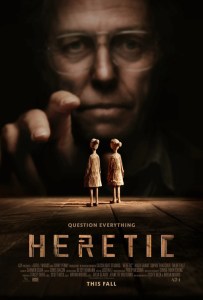 Heretic is a chamber movie about two teen Mormons (Sophie Thatcher, Chloe East) proselytizing to a middle-aged man (Hugh Grant) one dark and stormy night. He invites them in and seems kind and welcoming, but looks can be very deceiving. He has some very strong opinions when it comes to the nature of belief, and he will test both of these young Mormons on the faith of their convictions as he puts them through a series of trials and lectures. That last part might stun people, but Heretic is actually at its best during its lengthy lecture sequences. It might remind people of a nattering Reddit atheist being unleashed, but the movie really comes alive when Grant is challenging the roots of their belief systems as well as the historical contexts of religions. The Mormon ladies push back as well, countering some of the arguments so it’s not so one-sided. There’s a clear point of view to the movie but I wouldn’t say it’s didactic. The thrills ratchet as the two women start to fret about what this man has in store for them, how they might escape from his labyrinthine house, and how to signal for help. Unfortunately, the revelations can never quite match the fun of the mystery of motivations, and once it gets into a really convoluted place of switcheroos, then I think it loses momentum. The performances are all outstanding, led by Grant’s magnetic about-face turn as a snide villain. The same self-effacing charms he worked so well in the realm of rom-coms have a new eerie manipulative quality, luring his prey into his fiendish trap. The end attempts to go a bloodier and more ambiguous route that I don’t know it earns, but by that time, even after stalling out for the last act, Heretic won me over by virtue of its creepy convictions.
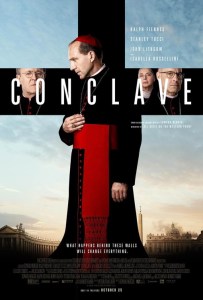 Conclave is an electioneering movie that places the viewer in the middle of the fraught voting process to determine the next pope of the Catholic Church. Ralph Fiennes plays a cardinal tasked with leading the conclave, the gathering of Catholic cardinals who will stay until a nominee has won a majority of their secret votes. Except it’s all not so secret as multiple candidates are openly campaigning for votes, trying to persuade different factions to support their candidacy. Each round of voting without a winner resets the field of play and leaves sides scrambling to reclaim footing. The movie is surprisingly very easy to get into, a crackling political thriller about the behind-the-scenes machinations and politicking for the highest office in the Catholic Church. There is a bevy of twists and turns and plenty of juicy revelations and betrayals, as these holy men start acting a little less holy to eliminate their competition or sully their chances. The constant churning is enough to keep things unsettled and intriguing, but there’s also a larger question for our protagonist, a man of faith who told the prior pope that he wished to leave his faith only to be denied by the pontiff for reasons we aren’t quite sure. Why did this pope specifically pick him for this position? The movie also asks deeper questions about the nature of power and leadership, namely are the people actively seeking it the right candidates for the right reasons? The very end of the movie knocked me out with a twist that I dare say nobody will rightly see coming, but it made me want to applaud. Conclave is an intelligently crafted thriller with weighty ideas and engaging performances.
Nate’s Grades:
Heretic: B
Conclave: B+
Share this:

Nosferatu (2024)
 Director Robert Eggers’ remake of a famous rip-off of the most famous blood-sucker in literature is a finely crafted and highly atmospheric drop into the past, as should be expected from Eggers (The Witch, The Northman). It doesn’t redefine cinematic vampires but rather puts the story through the contemporary lens of a toxic ex-boyfriend who refuses to relinquish what he feels belongs to him. The story should be familiar to most, even if they never watched the original 1922 silent film, nor its 1970s remake by Werner Herzog. Bill Skarsgaard plays the mysterious and threatening Count Orlock, a wealthy Transylvanian outsider looking to relocate to the big city in Germany, primarily to prey upon poor Ellen Hunter (Lily-Rose Depp), the “one who got away,” so to speak. He haunts her dreams and drives her mad, with Depp mesmerized and convulsing most convincingly. From there it’s a battle between Ellen’s husband (Nicholas Hoult) and an expert in the occult (Willem Defoe) over whose will will win out. Skarsgaard is fascinating and chilling and you too may want to imitate the thick-as-stew Count Orlock accent afterwards. The technical elements of this movie are masterful, from production design, to costuming, to the gas-lit and moody photography. Eggers is a deeply sincere filmmaker who translates his passions and madness onto the big screen with loving care. Nosferatu is gorgeous and unnerving, though I’m hesitant to say it rivals Francis Ford Coppola’s Dracula movie for modern vampire artistic triumph and pure horniness. It’s a gussied-up B-movie with a deeply committed filmmaker to deeply realized genre filmmaking, and so Nosferatu is an entertaining remake that most vampire fans will be happy to sink their teeth into this holiday season.
Nate’s Grade: B
Share this:

Smile 2 (2024)
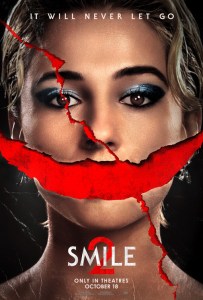 In 2022, thanks to genius viral marketing and the acknowledgement how deeply unnerving happy people can be, Smile was a surprise horror smash hit. Writer/director Parker Finn expanded on a previous short film and made serious money, which meant a sequel was a given. Finn returns to lead Smile 2 to even creepier genre pastures, this time following the mental demise of a pop star, Skye Riley (Naomi Scott) trying to make sense of this malignant curse. As much as I enjoyed the first Smile for its careful development and visceral intensity, I think Smile 2 might be even better.
From the opening sequence, it’s clear that we’re in the hands of a filmmaker that knows exactly what they’re doing. This is not merely another paycheck for Finn. He’s thought about how a sequel can build from its predecessor, stand on its own, incrementally build out the mythology, but mostly how to be an expertly made horror thriller designed to get under your skin. There were multiple sequences where I kept muttering variations of , “No,” or, “I don’t like that at all,” enough so that my wife in the other room would inquire what was directing these responses. Finn is tremendous at setting up the particulars of a scare sequence and allowing the audience to simmer in that anxious period of dread as we wait for something sinister to happen. He reminds me of James Wan and his ability to set up a nasty little scenario and then traps you inside awaiting the worst. There are sequences that compelled me to look away, not simply because they were overpowering, though the gore and makeup effects can best be described as impressively gross, but because the movie was finding different ways to make me uncomfortable, but in that good horror movie way. Finn’s camera makes what we should fear very clear, and his editing is precise. This is a movie that wants you to see the darkness and persistently worry about what’s coming just out of the frame.
 One of my minor complaints with the first Smile was that there wasn’t much below its grinning surface. Sure, the entire premise of a curse that spreads through witnessing horrific acts of self-harm lends itself toward the discussion of how trauma begets trauma, but beyond that the first film was more reliant upon supreme craft and well-engineered scares. There’s nothing wrong with a movie that exists primarily as a thrill ride as long as those thrills deliver upon their promise. However, with Smile 2, Finn uses the character of Skye Riley as a beginning point to discuss the toxic relationships that come with fandom. It should be very obvious for every viewer that Skye is going through some serious issues. She’s overcoming addiction, physically rehabilitating her body as well as socially rehabilitating her image, and trying to learn all her new choreography for an intense world tour. This is a woman who could use a significant break. And yet, as the movie progresses, you start to sense that there is this large machinery around her that needs her to perform because that is how she makes them all money. Even her own mother-as-manager (Rosemarie DeWitt) can seem questionable as far as her motivations; is she pushing her child because she knows it’s what best for her to focus on for recovery, or is she pushing her because the tour pays for her lifestyle? As the movie progresses, the characters fret that Skye’s increasingly bizarre behavior is going to ruin the tour first and foremost, and concern for her actual well-being is secondary at best. All these people have their paychecks attached to this woman fulfilling her contractual obligations. You can also extrapolate the intense pressure the industry places on people with mental illness and self-destructive personalities to conform to standards that are unfair and often un-meetable. You might question why more pop stars don’t have head-shaving outbursts.
Because we know that the evil entity has the power to alter our sense of sight and sound, it means the viewer must be actively skeptical about what is happening. Is this really happening? Is this sort of happening but elements are different? Or is this completely a hallucination? It makes the plot the equivalent of shifting sand, never allowing us to be comfortable or complacent. This can lead to positive and negative feelings. It keeps things lively but it can feel like the plot never really moves forward, at least in a cause-effect accumulation. It can often feel like the movie is moving in starts and stops, and if you’re not onboard for the craft, the acting, and the scares, then the results can likely feel frustrating, especially when large swaths of time are canceled out. For me, I enjoyed the extra sensory game of keeping me alert because it led to a barrage of surprises and rug pulls, some of them admittedly annoying, especially losing what amounts to maybe an entire act of the movie, but also they were a definite way to keep upending the narrative certainty. This sneaky approach also very viscerally places us in the paranoid mindset of our protagonist, as we too are unable to trust our senses and tense up with certain unsettling auditory cues. Mainly, I was having too much fun with the devious twists and turns, and some wickedly disturbing imagery from the director, that I felt like it was an ongoing thrill ride through a funhouse of insanity that kept me guessing.
 In a just world, Scott (Aladdin, Charlie’s Angels) would be at the front of the pack in the discussion for the Best Actress Oscar. This woman is put through the proverbial wringer and she showcases every frayed nerve, every degenerating thought with such verve and command. It’s essentially a performance of a woman completely breaking down mentally, but Scott doesn’t just go for broke, putting every ounce of effort into inhabiting the breakdown, she creates a character that reveals herself through the breakdown. It’s not just screaming hysterics and histrionics; there are different levels to her dismantling psyche, and Scott portrays them beautifully. I felt such great levels of dread for her because of how successfully Scott was able to anchor my emotional investment. She’s also portraying different versions of Skye, and some key flashbacks reveal just how toxic her former addict self was that she’s trying to put to rest. It’s a performance about metaphorical demons and literal demons haunting a woman, as well as guilt that is eating her alive. Scott allows us the pleasure of watching a first-class performance through her shattering.
There’s a curious motif to the movie that many will probably ignore but my wife and I fixated on, and so I feel the need to briefly discuss this so that, you too dear reader, can have this fixation as well. There are at least four scenes where Skye drinks a large bottle of water in a manner that can be best described as monstrously destructive. She drinks that bottle like a lost man in the desert finding his first drink of water. She attacks it. My best analysis is that this is a character detail about Skye’s addictive personality and sense of dependency, projecting the same all-consuming need onto water that she had previously for narcotics. One of the best laughs is when a doctor takes stock of Skye and says how dehydrated she is. Regardless, take in how desperately Skye Riley drinks and think about perhaps applying that technique next time you need a refreshing drink.
 By its nightmarish conclusion, Smile 2 finds a fitting and satisfying end stop that promises a possible even bigger and more disturbing escalation for a Smile 3. Finn has established himself with two movies as a major horror filmmaker who can work within the mid-major studio system and still keep a perspective and integrity. I’m pleased that Smile 2 isn’t just more of the same old Smile, and in fact very few instances involve strangers with that signature facial expression. By the time you’re seeing the smile, it’s usually too late. I enjoyed the choice to find menace and darkness in a world of pop music brightness (the fake pop songs actually sound indistinguishable from what currently airs on the radio, bravo). I enjoyed the continuing tradition of casting famous Hollywood scions, like Jack Nicholson’s son playing Skye’s dead boyfriend (that family grin is uncanny, also bravo). What I really enjoyed was Scott’s uncompromising performance. Smile 2 has convinced me that Finn is the real deal, Scott might be one of our best modern scream queens and young actors, and to confirm introverted habits to avoid anyone who looks directly at me and smiles.
Nate’s Grade: A-
Share this:

Anora (2024)
 The critically-anointed Anora is the indie of the year, winning top prize at the Cannes Film Festival, the first for an English-speaking movie in over a dozen years, and poised to be a major awards player down the stretch, some might even say front-runner for top prizes. It starts like a deconstruction of Pretty Woman, with Mikey Madison (Scream 5) playing Anora, a stripper who recognizes the advantageous possibilities flirting with a young rich Russian scion, Vanya. He wants her to be his girlfriend, and over a sex-fueled week, he’s so smitten that he wants to make Anora his wife. This whirlwind relationship hits the wall, however, once Vanya’s family inserts themself into his life, determined to annul the hasty marriage at all costs.
The movie becomes infinitely better at the hour mark when the exasperated extended Russian family comes into the picture. You worry they might be menacing, as they don’t want this stranger with access to the family wealth, but they’re far more bumbling, and Anora transforms into an unexpected comedy. It certainly wasn’t an authentic romance. Clearly Vanya was a meal ticket more than a three-dimensional romantic interest. The kid is an immature, annoying dolt, so we know Anora isn’t legitimately falling in love with him. The scenes of them building a “relationship” could have been cut in half because we already understood the nature of the two of them using one another. The last hour makes for a greatly entertaining turn of events as the unlikely and bickering posse searches New York City for a runaway Vanya. The movie feels propulsive and chaotic and blissfully alive. Ultimately, I don’t know what it all adds up to. Anora isn’t really a sharply drawn character, but none of the characters are particularly well developed. The pseudo-romantic fantasy of its premise, becoming a “princess” of luxury, isn’t really deconstructed with precision. It’s an unexpectedly funny ensemble comedy at its best, but I’m left indifferent to what other value I can take away. It’s well-acted and surprising, but it’s a vacuous side excursion made into a full movie that somehow has bewitched movie critics into seeing more. Perhaps they too have become overly smitten with Anora’s surface-level charms.
Nate’s Grade: B-


 nathanzoebl
You must be logged in to post a comment.