Blog Archives
In the Heights (2021)
 Weeks ago, I listened to the original Tony Award-winning 2008 Broadway recording for In the Heights, the first major musical by multi-hyphenate artistic virtuoso, Lin-Manuel Miranda. I had never heard the music before and I found that, over the course of a couple hours, little of it stuck with me. There were a handful of tracks where I thought it was nice but nothing grabbed me the way that Hamilton’s soundtrack did from the very start. Because of that musical dip, my expectations lowered slightly for the long-anticipated movie musical of In the Heights. Well, dear reader, let me say what a monumental world of difference seeing the songs in their proper context, with character relationships, and the able performances of the actors can do for making the music come alive. In the Heights is an exuberantly joyous experience, one brimming with energy and good vibes and a warm-hearted welcome that serves as the best argument movie theaters can have to come back and experience the pleasures of the big screen with your friends and family.
Usnavi (Anthony Ramos) is a twenty-something bodega owner in New York City’s Washington Heights neighborhood and dreaming about returning to his home in the Dominican Republic. His young cousin Sonny (Gregory Diaz IV) helps him stock the shelves and keep the family business going. We follow the many faces of the neighborhood, like Abuela (Olga Merediz), who has helped raise everyone as a sweetly matronly figure, Nina (Leslie Grace), returning home from her first year at Stanford as the “girl who made something of herself,” Benny (Corey Hawkins) who was in a relationship with Nina and is looking to work his way up as a cab dispatcher, Daniella (Daphne Rubin-Vega) who is moving her popular salon into another neighborhood, and Vanessa (Melissa Barrera), an aspiring fashion designer who dreams of relocating into Manhattan’s fashion district. Usnavi has been nursing a crush over Vanessa for ages, but will he finally make a move before leaving the country for good to return to the Caribbean?
 This is such a positive and overwhelmingly optimistic story that it becomes infectious, a pleasing balm to sooth all that ails you. It’s very easy to get swept away in the enthusiasm and energy of the movie, enough so that after the exemplary opening number setting up our characters, our setting, and our relationships and goals, people in my theater actually clapped, and I almost felt like joining them. In the Heights succeeds through how relatable and specific it comes across, lovingly showcasing the diverse population of Washington Heights and the community that feels at home here. It’s built upon the celebration of its specific, Latin-American heritage and culture but the movie is also constructed to be so accessible and welcoming to others to learn and join in. The themes and conflicts of these people have specific touchstones to their community, like the threat of deportation and the encroachment of gentrification taking away their neighborhood, but the inner conflicts like feeling the pressure to succeed and questioning whether your dreams are practical are worries that anyone regardless of ethnic background can relate to. In the Heights finds that sweet spot where it’s reverential to its own cultural background and open for anyone.
Naturally, in a musical, much of the appeal will live or die depending upon the quality of the music and the vitality of the performances. With In the Heights, the music and lyrics are quite good and the presentation is phenomenal. If you’re a fan of Hamilton, and if you have ears I assume you would be, it’s fun to listen to the early seeds that would become the signature sound for Lin-Manuel Miranda. There are similar salsa/merengue melodies and hip-hop-infused syncopations that will be familiar to the legions of Hamilton fans, including some rhymes (“Eyes on the horizon” among others). In many ways it’s like watching a junior thesis project of a genius. The opening number does a fantastic job of table setting as well as bringing the audience into this world and getting us excited for more. Usnavi, and Ramos especially, takes full control of our attention and command of the world with fast-paced delivery and extra charisma. There are more bouncy, humorous tunes like “No Me Diga” set in a salon replete with literal bobbing weaves, more traditional Broadway ballads like “Breathe” about a character expressing her doubts and guilt, and the Cole Porter-esque smooth jazz of our young lovers dancing and declaring their affection for one another like “When the Sun Goes Down.”
 But the best moments are the ones that open up the big space and bring the whole community of Washington Heights into the mix. The electricity of the opening number is rekindled in “96,000” where a trip to the local pool turns into a jumping jamboree where everyone dreams about what they would do with a winning lottery ticket sold at Usnavi’s bodega. It allows each character an opportunity to share their dream and what is important to them, providing each person a platform to be more defined. It also taps into that bubbling optimism that permeates the entire movie. The grand finale also has the same effect as characters sing their hearts out about lessons learned and wisdom gained and, thanks to the medium of film, it provides a happy ever after resolution that was unavailable on stage. Miranda is excellent at weaving musical themes to come back into multi-harmonic convergences and crescendos, and it all comes to a rousing and uplifting conclusion.
Another concern about big screen musicals is whether they can translate to the visual landscape of cinema, whether they can escape the trappings of the stage, and In the Heights is exactly how musicals should be filmed. Director John M. Chu (Crazy Rich Asians) got his filmmaking start with the Step Up dance franchise and knows, whatever the film, how to keep things moving swiftly and full of vivacious energy. Even at nearly two-and-a-half hours long, In the Heights doesn’t feel like it has any noticeable down time. The filmmaking choices adapt with the needs and intents of the songs, so when we have a fast-paced multi-part song and dance, the editing adopts this speed, and when we have large ensembles the cinematography widens to take in the expansive group choreography. When things need to slow down and become more intimate, Chu’s camera adopts to this and relies on longer tracking shots and close to medium shots. The pool choreography in “96,000” is splashy fun and lively and very colorful, and the quick visual cues and edits of “In the Heights” incorporates the neighborhood into the music to make New York City feel like a living participant. Chu’s direction takes full advantage of what film can offer but still makes the viewer feel the same intimacy and vibrancy of live theater.
 There are two standout movie moments. The first is the song “Paciencia Y Fe” that does so much symbolic heavy lifting about the immigrant experience, discrimination, and the long struggle for personal dignity, that it made me tear up by the end for a character that, only moments before the empathetic expose, was a nominally nice old lady. The other is “When the Sun Goes Down” between Benny and Nina, which begins with them gazing out a fire escape and takes a magical turn into dancing along the walls of their building like Spider-Man. That transitional moment, from the ordinary to the extraordinary, is the only real magical realism in the show, so Chu has been saving it up for his big moment. The dance is beautiful to behold, and the perspective has an Inception-style spin that alters their balance and perspective of what is up. It’s a beautiful movie moment, captured in long takes, and reminiscent of Fred Astaire’s fanciful fantasias.
Ramos (A Star is Born) played John Laurens in the initial stage show of Hamilton, and its filmed production on Disney Plus, and now he gets his own starring vehicle. He is tremendous as Usnavi, convincingly laid back and charming while also being amusingly anxious around his crush. The awkward romantic fumbles are adorable. Ramos’ singing and skill with the flow of rap lyrics is impressive, but he’s also providing a performance first and worrying about the singing second, not that he should be worried on that front. Hawkins (Straight Outta Compton) surprised me with the range of his singing, and he’s such a pleasant presence to have along. Gregory Diaz IV (Vampires vs. the Bronx) is hilarious at times, like when he’s adopting a macho voice to ask Vanessa adult questions, but he can also break your heart like when he reveals his own legal vulnerability. His poolside solo is also a delightful interjection about what his own rap skills comprise. Merediz (Godmothered) is the only holdover from the original stage show and she is so captivating in her signature number that it’s easy to understand why she was nominated for a Tony Award. There are so many amusing and enjoyable supporting characters populated by familiar faces, like the women of the salon (Rent’s Ruben-Vega, Brooklyn 99’s Stephanie Beatriz, and Orange is the New Black’s Dascha Polanco) providing comic relief and a playful attitude, Jimmy Smits as the noble father giving of himself for his daughter’s future, and Miranda and Hamilton’s Christopher Jackson as dueling sweet treat vendors vying for summer supremacy. You’ll enjoy your time in Washington Heights thanks to these fine folks.
It’s unfair to directly compare In the Heights to Hamilton, like looking at an artist’s portfolio and complaining it isn’t quite up to the standards of Da Vinci, but one area where In the Heights does come up short is the depth of its characterization. The film exudes good vibes as it skips over topical and important political issues with an optimism that might, arguably, borderline on naivete. This feels almost like the opposite-minded compliment to Spike Lee’s Do the Right Thing, another tale of a New York City block one very hot day. The characters are kept at a genial level of interest that makes them enough to feel for and root for, but they’re not exactly deep portrayals with complex conflicts. All the characters have a singularly defined personal conflict that can be resolved by the end, and the lessons about learning to listen to others, appreciate family and self, and find home where you feel it are not exactly revolutionary or complex. Again, this stuff works, and I understand why the story needs characters that have lesser complexity and definition to fulfill the different levels of life. It’s just when compared to the depth of the real people of Hamilton where you realize that maybe the colorful characters of Washington Heights are held to a lesser standard and simply not as multi-dimensional.
 In the Heights is a joyous experience that I think I’ll enjoy more upon re-watching and listening to the soundtrack over the summer months. I can completely understand why people fell in love with this musical upon its initial release and touring, and I can also acknowledge that it’s clearly an earlier artistic steppingstone to greater later achievements for Miranda. That’s not to take anything away from the pleasures of this particular story, these particular characters, and especially these particular songs. In the Heights is a lively and welcoming musical experience that carries a deep affection for its cultural roots and invitation for others to join that celebration. It’s powerfully optimistic that it’s so easy to be swept away and smile with its charms and uplift. In the Heights takes advantage of its cinematic opportunities, the charisma and energy of the talented cast, and the soaring and lovely melodies and catchy rhymes from Miranda. In the Heights is a great way to kick off a return to a summer season at the movies.
Nate’s Grade: A-
Share this:

Holler (2021)
 In the time I have spent making a concerted effort at reviewing Ohio-made indie movies, I have yet to watch one that amazed me and earned an A-grade. There are several that are enjoyable, others admirable for their technical professionalism, and many that have glaring factors beyond limited budgets that hold back whatever the intended artistic intent was. I was excited with genuine hope for Holler, a small movie shot entirely in Jackson, Ohio and following the lives of a struggling band of small-town metal scrappers looking to survive. It’s the debut feature from writer/director Nicole Riegel (based upon her 2016 short film of the same name) and has recognizable TV actors involved like Jessica Barden (End of the F***ing World), Pamela Adlon (Better Things), Austen Amelio (Dwight from The Walking Dead) and Becky Ann Baker (Girls, Freaks and Geeks). It’s even getting a wide release nationwide through IFC Films, who graciously provided me a screener link. If any movie felt like it was going to breakthrough and become the first truly outstanding Ohio indie, this seemed like a major possibility. Unfortunately, Holler doesn’t merit hollering.
Ruth (Barden) is a high school senior in a small southern Ohio town wracked by poverty, factory closures, and the aftereffects of the opioid epidemic. Her mother (Adlon) is serving time in prison for her drug offenses when she should be in a treatment center. Her older brother Blaze (Gus Halper) is resigned that he’ll work himself to nothing, but he wants a better life for his bright sister and submitted her college application. Ruth and her brother join Hank (Amelio), a local scrapper who offers extra work for side projects stripping the parts from closed buildings.
 While watching Holler, I noticed my heart was sinking because, even with all this professionalism and authenticity on board, I kept waiting for the actual movie to kick in, and then I noticed an hour had passed and I realized, “Oh, this is the movie.” I have seen this artistic calculation with indie movies before and articulated it succinctly with 2012’s Beasts of the Southern Wild: “sacrificing story to the altar of realism.” This feels like a very authentic movie as far as its hardscrabble details about how impoverished people in small towns eke out a life on the peripheral of society. I know people have been pushed to the brink because of desperation, whether economic or psychotropic or beyond, and that scrapping can be a dangerous and competitive landscape to make a few bucks. When you’re struggling to get by, it’s all about what can lighten that struggle. If stripping the copper wire out of an abandoned building is more profitable, and less time-consuming, than bagging aluminum cans all over town, then it seems like a natural attraction to those with limited options. However, Holler feels less like a movie with a story needing to be told than a stark setting with an impression to leave.
The characters are too interchangeable and one-dimensional here to really invest in beyond general well-wishing. These small-town Ohioans have been hit hard by circumstances and as I was watching I wanted them to find some degree of happiness or improvement by the end, but that was because they were simply people in need and I am an empathetic creature and not because of their personal stories or characterization. It would be the same as if I had watched 90 minutes of a lost puppy trying to find shelter and then, at long last, that puppy got to sleep inside a coffee shop. I’m happy, and relieved on a general level, but am I personally invested in this specific animal and this specific story? Could it have been any living being at all?
 The characters of Holler are far too generalized where they keep repeating that same nub of characterization they’ve been given. The entire dynamic seems to be a universe of characters who exist to try and convince Ruth that she is better than everyone and deserves to leave. In an early scene, we watch Ruth sit down and write an essay for a friend to use as her own homework. It’s an early indication that Ruth is smart and not fulfilling her potential. It’s not her homework she’s completing but a friend’s and for money, money she initially refuses from pride. Unfortunately, the movie forgets to continue moments like this to provide further insights. Ruth is too often a walking cipher, taking in her dilapidated surroundings with alternating pensive and glum stares. She is more a symbol than a character, meant to serve as a face of those held back by economic anxieties and limited opportunities. Her mother is a symbol of the wreckage of the opioid crisis and how it has decimated rural communities. Her brother is a symbol of generational sacrifice. These characters don’t have complicated internal drama or intriguing contradictions or anything beyond the surface description because they’re designed to be specific voices meant to convey a Greek chorus of opinion. They’re sides of conversations made flesh rather than interesting or complex people. I wanted to become attached to Ruth’s plight especially as she embarks on performing more dangerous tasks for money with her scrap crew, but you never feel any real added danger or for that matter any real change. When Ruth is out scrapping in the middle of the night, the movie treats it no differently. When Ruth finally makes her decision about her life, it doesn’t feel like the culmination of her emotional journey and more so the character finally accepting the pleas of others over the course of 85 minutes.
The obvious artistic comparison point for Holler is 2010’s Winter’s Bone, another movie that explored in unflinching detail the degenerative disease of systemic poverty. Once again, we follow a young woman trying to provide for her broken family in the wake of a parental drug addiction and trying to stay one step ahead of debt collectors and eviction. Another artistic influence seems to be 1970’s Wanda, an indie featuring a housewife walking away from the malaise of her life in small-town coal country Pennsylvania. The difference with both chief artistic influences is that they had, quite simply, movies to tell with their big screen canvas. With Winter’s Bone, there’s an urgency where the protagonist has to find her absent father in short order to save her family home but also because he has made some very scary meth dealers very angry, so the way to save her family is literally to turn over the man who abandoned them to ruin. There’s a strong sense of personal stakes, there’s a ticking clock, and the themes tie into the emotional journey of our main character. With Wanda, the main character is the one abandoning her husband and children and she takes refuge with a bank robber on the run. With each of those descriptions, you can see the movie there, the reason why this story deserves your time.
 With Holler, I kept waiting for some turn or escalation or something to draw out the movie. The movie feels stuck in an expository gear I would associate with Act One territory and then it ends. I really thought more would be made of the illegal scrapping-for-money angle and whether this would present our lead character with increasingly fraught choices over her well-being. I thought maybe her descent into the criminal side of desperation would force more confrontations or consequences. Maybe there would be another crew that didn’t take too kindly to an entrepreneur muscling in on their hard-won turf. Maybe she would have to hide her injuries as she got more reckless. Maybe she’d even risk getting caught by the law and serving time in prison. Anything to offer insight into this less known world of scrapping. I regret to say that the angle that gives this low-budget indie its very hook could have been replaced with any other arbitrary plot element. Ruth could have been finding lost dogs or stealing cars or selling her bath water to perverts on the Internet. The circumstances of her personal choices are so generalized and don’t produce enough direct cause-effect relationships. The events fail to feel meaningful. The solution to Ruth’s dilemma also seems as generalized – go to college. What is she going to study? Does she have a career in mind? Does she even have personal interests? She rejects one teacher’s recommendation to avoid a crushing load of student debt and to learn a skill and work up, so then what is she going to do with tens of thousands of dollars in debt attached to her name? I understand that education is aspirational and one of the few things in life that, once gained, cannot be taken away, and I champion education as a person working within that sphere. However, “get out of economic desperation by just going to college” seems naively simplistic.
Holler is admirable for its grit and empathetic with the struggles of its people. It’s professionally made with a strong score by Gene Beck (Cowboys), all mournful strings applied to lived-in details that feel authentic to the region and these inhabitants. Even the angle of scrapping-for-money seems ripe for exploration to separate this little movie from the pack of poverty pictures. It’s the storytelling that cannot live up to the good intentions of those involved. The characters are too one-note, symbolic, and disposable, and the story elements are likewise too interchangeable and lacking in meaningful connections. It’s a small-town girl who must decide to leave home to take on massive student debt (happy ending?). Anything that happens in the prior 85 minutes feels like variations on the same point being made repeatedly and without nuance or complication or contrast. It feels less like a movie and more like an expanded short absent the substance to justify its expansion. I think Riegel has promise as a filmmaker and I hope more attention goes to her characters and plot for future projects. I must continue to wait once again for that elusive Ohio-made amazing indie.
Nate’s Grade: C+
Share this:

The Conjuring: The Devil Made Me Do It (2021)
 Three movies in, plus four spinoff films and more on the way, and The Conjuring franchise is losing some of its luster. The original director, James Wan, is still involved in an advisory capacity but his absence is felt in the director’s chair, not that The Devil Made Me Do It is poorly directed by Michael Chaves (Curse of La Llorona), but it’s starting to feel stale. The Warrens (Patrick Wilson, Vera Farmiga) are a husband-and-wife team of paranormal investigators traveling the country and solving 1970s/80s mysteries. This third entry feels the most like an expanded episode from a TV series, like X-Files, and maybe that’s because of its inherently procedural nature. The Warrens are defending a young man accused of murder but who says, as the subtitle describes, that he is not guilty by reason of demonic possession. From there, the Warrens are investigating to prove the demon exists and then trace its demonic history. The scares are low although the intensity feels cranked just as high; there are lots of scenes of gale force winds, shattered windows, characters yelling, and loud music. I miss the perfectly executed Old School horror sequences that were the hallmark of the earlier movies. It set up its rules, wound up the scene, and you just squirmed in anticipation. This franchise has never been revolutionary but more an expertly polished and honed tension machine. However, when the calibrations are off, then the franchise has even less going for it. There are some interesting ideas and elements, like Lorraine (Farmiga) being able to see from the eyes of the demonic killer, but the franchise feels more repetitive and stalled, with multiple exorcisms and Ed (Wilson)’s health being a motivating factor for his wife to prevent, again. The supporting characters are bland or broad and the mystery itself isn’t that interesting, nor is the ultimate villain. In the realm of Conjuring as weekly TV show formula, this feels like an acceptable middle episode with the expectations that they can improve the next week. The “based on true cases” selling point is also starting to grate in light of the reality that a man blamed his own actions on the devil and these controversial people sought to exonerate a murderer. The real-life version is morally abhorrent. The junky horror version can work as long as it doesn’t take itself too seriously. If the other Conjuring movies were gourmet entries, then this is more the fast food version. It may still satisfy fans but it’s definitely not as well made and with questionable ingredients.
Nate’s Grade: C+
Share this:

Cruella (2021)
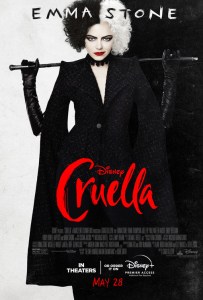 I don’t think I’ll be shocking any readers when I disclose that this Cruella doesn’t kill a single dog in her new movie. I hope I didn’t ruin the experience for anyone hoping for mass puppy slaughter. I figured Disney was going to go this route as they developed a villain biopic for Cruella DeVil, a woman obsessed with making coats from the skin of dalmatians. How exactly does one make a character like that sympathetic? Well by essentially making her a fan fiction version of Cruella DeVil and providing an even more dislikable antagonist to root against. The question then arises does this really count as a villain biopic when the character is so reconstructed? It follows the blueprint of 2014’s Maleficent where it posits that the story we’ve been told has been a matter of misunderstandings and smear campaigns from the Powers That Be. Cruella isn’t a puppy murderer. Now she’s a school outcast, plucky orphan with her own motley crew, and up-and-coming avant garde fashion designer looking to get her big break.
It presents her as an underdog on several fronts and with a back-story that might go down in history for its reclamation. Minor spoilers ahead, considering it’s early in the movie, but Cruella’s mother was literally killed by dalmatians pushing her off a cliff. The blunt re-imagining might even draw titters of laughter as the movie says, “Here’s the real reason she dislikes dogs.” However, even this tragic revision doesn’t make this Cruella hate dogs. There’s even a cute pooch on her team. This is a Cruella that’s not so cuddly but not unlovable either. She’s presented as a scrappy underdog with a punky attitude and whether this works will depend on your adherence to what a Disney villain biopic should be. Personally, I had no fidelity to the character of Cruella DeVil so I didn’t care. I wanted an entertaining movie with a strong lead performance from Emma Stone, and that’s what I got.
 Set in 1970s London, Estella (Stone) is a lonely girl born brilliant but tempered by an uncaring society. After the dalmatian-assisted murder of her mother, Estella and her pals are meeting out their days with small-time grifts and cons. Estella dreams of being a fashion designer and her boys manage to get her an entry level job at a department store. Her experimental window display gets the attention of The Baroness (Emma Thompson), a sharp-tongued and formidable fashionista that makes the world tremble. Estella adopts the identity of “Cruella,” with her natural half-black and half-white hair, to upstage the Baroness, draw publicity for her own unique fashion creations, as well as enact vengeance and retrieve her mother’s missing necklace/family heirloom stolen by the Baroness, as if you needed even more reasons to dislike this lady.
Cruella in many ways feels like The Devil Wears Prada mixed with a superhero origin tale. The Estella/Cruella dynamic is played like a secret identity, wherein she adopts one to achieve a personal goal and becomes seduced by the freedom the alternate identity has to offer. The first half plays quite like Prada, with our fashion upstart working her way up the chain, gaining attention for her insights and designs while fighting against a system meant to squash new ideas. The character of the Baroness is very clearly patterned after Miranda Priestly (Meryl Streep) and the command she wielded in her influential position atop the established fashion industry. At first, Estella wants to gain her approval and become a protégé, and then she wants to topple her, crush her, and it becomes a matter of how far she will go, with characters saying variations on, “You’ve changed. It used to be Estella, now it’s only Cruella.” Even The Devil Wears Prada featured a similar character descent for its protagonist. Except the question never seems too in doubt with Cruella because the character of Cruella is less a person succumbing and fraying, like the Oscar-winning 2019 Joker prequel, and more a tale of self-actualization and empowerment. That’s why it feels more like a superhero origin and less like the Joker’s origin. She’s becoming more confidant, more assertive, and more accepting of her true nature.
 Under the direction of Craig Gillespie (I, Tonya), Cruella feels like a colorful, sprightly caper, something with more attitude and dark humor than I would have believed capable of being forged from the Mouse House with their own intellectual properties. This could have easily been a cash grab but Gillespie and his team of screenwriters, including one of the writers from 2018’s The Favourite, decides to take that big Disney checkbook and have fun with it. This movie reminded me of a PG-friendly version of 2020’s Birds of Prey for adolescents. It’s got slapstick, schemes, contraptions, narrative shuffling, charming and weird characters, and a lot of visual style and attitude to spare. Above all else, this is a fun movie, and one that assembles set pieces and mini-goals that lead to enjoyable payoffs. There’s a funny big heist as the mid-point but it doesn’t go according to plan, as so we watch as Estella and her team have to adapt and get out of a series of escalating traps. The rivalry between Cruella and the Baroness leads to some gaga dress designs I’m certain will get Oscar attention in due time. There’s plenty of life simply coursing through this movie from the actors to the visuals to the extensive music library. Even when the movie is overstaying its welcome (this could have easily been trimmed down by 15 minutes) the movie still finds ways to keep you entertaining and pleased.
Chief among those reasons is Stone (La La Land) as our star. She’s honed her British accent after her Oscar-nominated performance from The Favourite and it’s easy to see a straight-line from that cunning social climber to this new role. Stone finds the right mix of camp and pathos to make the character work. She’s no exaggerated cartoon but she needs a certain energy level to keep you charged. She’s no mousy heroine but a powerful force looking for the right armor that fits. Stone might not be playing the Cruella DeVil of the 1961 cartoon but she’s playing a version of the character that is more capable of carrying a two-hour-plus movie. Special consideration should be paid out to Paul Walter Hauser, who was so memorably dimwitted in I, Tonya, and portrays Horace, a similarly dimwitted member of Cruella’s crew. The man knows what he’s doing when he’s given these roles and it’s easy to see why he keeps getting more.
The amount of needle-drop music cues in this movie puts 2016’s Suicide Squad to shame. I was amazed how that movie could literally go from song-to-song with barely a gap, sometimes only using mere seconds to make its sonic case. The Cruella soundtrack is wall-to-wall music selections, many from the 1960s and 1970s rock and punk scene, and it’s another holdover from I, Tonya that Gillespie has brought with him. The over reliance can become distracting in itself because of the sheer volume of musical selections, many of which can be exceedingly literal (you better believe, yet again, “Sympathy for the Devil” by the Rolling Stones is called in). It’s a sign of just how powerful the Disney brand can be as I’m sure a huge chunk of the movie’s budget went toward getting all these dozens and dozens of music clearances. If you consider it like a kid’s introduction to classic rock songs, it’s excusable, but the number of songs can also be distracting.
 Whether you consider Cruella a faithful or radical reinterpretation of the Disney villain, the live-action showcase is a star vehicle for its shining star. Stone is captivating and having a grand time in her fabulous fashions, and the movie makes it easy to feel her highs as well. It’s not exactly a great movie as many of its supporting characters are underwritten or overly convenient, and its question over the madness and identity of its heroine is more theory than practice, but Gillespie and his team have decided to make Cruella a fun movie, and to that end they have succeeded. It’s colorful, breezy, punky, funny, and consistently amusing, with outlandish set pieces, outlandish characters, and outlandish escapes. Yes, the mom-killed-by-dalmatians tragic back-story might elicit its own howls of bafflement, but the movie doesn’t belabor it for extra ironic impact. Cruella (or Cruella Lite, if you will) is an entertaining reinterpretation that knows what to scuttle to work on its own terms. Whether those alterations are too drastic or defang the character are up to you, but I’d rather watch a kinder, softer, yet still prickly Cruella than one skinning dogs.
Nate’s Grade: B
Share this:

Pearl Harbor (2001) [Review Re-View]
 Originally released May 25, 2001:
It turns out we went to war in 1941 not because of Japanese aggression, Hitler’s dominance in Europe, or the protection of freedom and democracy. Sorry kids. The real reason we went to war was to complicate and then clear up Kate Beckinsale’s love life. At least that’s what director Michael Bay and screenwriter Randall Wallace would tell you with their indulgent epic Pearl Harbor.
We open in Tennessee in the 20s with two boys who dream of being pilots. Rafe (Ben Affleck) and Danny (Josh Hartnett) grow into strapping young lads who flash their hot dog flyin’ skills at basic training, which brings them chagrin from superiors but admiration from peers. Rafe falls in love with a young nurse named Evelyn (Kate Beckinsale), who goes against ARMY rule and passes Rafe in his eye exam portion when he has a slight case of dyslexia. But he’s just so cuuuute. The romance builds but Rafe feels like he’s grounded when all he wants to do is fly, and volunteers to fight in the RAF over in Europe. He promises he’ll be back to see his lovely Evelyn. Of course he gets into an accident and everyone assumes that poor dyslexic Rafe is fertilizing a lawn somewhere with his remains. Hence Danny slowly but surely develops something for Evelyn in their periods of mourning, and the two consummate their puppy love with a tango in parachute sheets.
All seems well until Rafe returns back from the dead throwing a wrench into Evelyn’s second date parachute plans. Thus the Hollywood favorite of the love triangle endures until the end when the two fly boys enlist in the Doolittle attack against Japan, months after the ferocious attack on Pearl Harbor. The real purpose of the Doolittle attack was not militarily but merely for morale. The real purpose it serves in the movie is to shave off an end on our love triangle.
 Pearl Harbor allows us to follow a group of youthful and innocent starry-eyed kids from training to combat. Each seems pretty much exactly the same to each other. It’s near impossible to distinguish which character is which. It’s like the screenwriter didn’t even have the gall to resort to cliche supporting character roles, and he just made one character and duplicated it. The only one who was noticeable for me was the character of Red (Ewen Bremner, julien donkey boy himself), but that was simply because the man had a speech impediment. We also have our handful of young nurses alongside Beckinsale, and I had an easier time distinguishing between them; everyone had different hair colors.
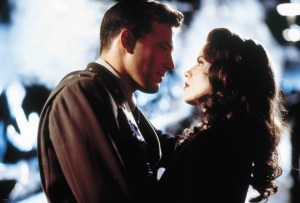
If you look in the pic, or the credits, you’ll see that two of the nurses would turn out to be Jennifer Garner (Alias) and Sara Rue (Less than Perfect), both stars of ABC shows, and ABC is owned by, yep, Disney. Coincidence? Probably. When they ran this on TV they actually advertised Jennifer Garner above Kate Beckinsale. That reminded me of when Seven ran on TV shortly after Kevin Spacey had won his well-deserved 1999 Best Actor Oscar for American Beauty, and they gave him second-billing in the advertisement over Morgan Freeman, the movie’s true main character.
Affleck has a hayseed Southern twang, but seems to mysteriously disappear for long stretches. Hartnett seems to talk with a deep creak, like a door desperately trying to be pushed open. Beckinsale manages to do okay with her material, but more magnificently manages to never smear a drop of that lipstick of hers during the entire war. We could learn a lot from her smear-defying efforts. Gooding Jr. is pretty much given nothing to work with. I’m just eternally grateful he didn’t go into a usual Cuba frenzy when he shot down a Zero.
Michael Bay has brought us the ADD screenings that are the past, loud hits of The Rock and Armageddon. Teamed up with his overactive man-child producer Jerry Bruckheimer once more, Pearl Harbor is less Bay restrained to work on narrative film as it is Bay free-wheeling. His camera is loose and zig-zagging once more to a thousand edits and explosions. Bay is a child at heart that just loves to see things explode. When he should show patience and restraint he decides to just go for the gusto and make everything as pretty or explosive as possible. This is not a mature filmmaker.
Despite the sledge hammer of bad reviews, Pearl Harbor is not as bad as it has been made out to be. The love story is inept and the acting is sleep-inducing, unless when it’s just funny. It doesn’t start off too badly, but twenty minutes in the movie begins sinking. The centerpiece of the film is the actual Pearl Harbor bombing that clocks in after ninety minutes of the movie. The forty-minute attack sequence is something to behold. The pacing is good and the action is exciting with some fantastic special effects. The movie is bloated with a running time a small bit over three hours total. Maybe, if they left the first twenty minutes in, then gave us the forty minute attack sequence, followed by a subsequent five minute ending to clear up our love triangle’s loose ends… why we’d have an 80 minute blockbuster!
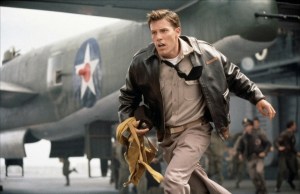 Pearl Harbor doesn’t demonize the Japanese, but it feels rather false with their open-minded attempts to show both sides as fair minded. It gets to the point where they keep pushing the Japanese further into less of a bad light that it feels incredibly manipulative and just insulting. It seems like the producers really didn’t want to offend any potential Pacific ticket buyers so the picture bends backwards to not be insulting. The only people who could be offended by Pearl Harbor are those who enjoy good stories. Oh yeah, and war veterans too.
The cast of Pearl Harbor almost reads like another Hollywood 40s war movie where all the big stars had small roles throughout, kind of like The Longest Day for the Pepsi generation. Alec Baldwin plays General Doolittle and is given the worst lines in the film to say. Tom Sizemore shows up as a sergeant ready to train the men entering Pearl Harbor. He has five minutes of screen time but does manage to kill people in that short window. Dan Akroyd is in this for some reason or other, likely because Blues Brothers 3000 has yet to be green lighted. John Voight is easily the most entertaining actor to watch in the entire film. He gives a very authentic portrayal of President Roosevelt. I still find trouble believing it was Voight under the makeup.
The blueprint for Pearl Harbor is so transparent. They took the Titanic formula of setting a fictional romance against a disaster, with the first half establishing characters and our love story, and then relegating the second half to dealing with the aftermath of the disaster. It worked in Titanic (yes, I liked the film for the most part), but it doesn’t work here. Pearl Harbor is a passable film, but the mediocre acting, inept romance, square writing, and slack pacing stop it from being anything more. Fans of war epics might find more to enjoy, especially if they don’t regularly have quibbles over things like “characters” and “plot.” To paraphrase that know-it-all Shakespeare: “Pearl Harbor is a tale told by an idiot. It is full of sound and fury, signifying nothing.”
Nate’s Grade: C
——————————————————
WRITER REFLECTIONS 20 YEARS LATER

Believe it or not, there was a point in time where people actually considered the possibility of Michael Bay making an Oscar contender. It seems mostly absurd now but at the time there was a benign sense of hope with the production of Pearl Harbor, the most expensive movie greenlit at the time ($140 million) and whose ultimate costs would exceed $200 million. The blueprint for the movie is easy to spot, borrowed heavily from the success of another risky and very expensive movie about sinking ships, James Cameron’s Oscar-winning blockbuster Titanic. If you’re looking for a movie to follow, you could certainly do worse than the highest grossing movie ever (at the time). There was great speculation and buzz about the movie, for its immense production scope, for the reported ambitions, for the prospect of Bay trying to make a serious movie, albeit a serious movie that still included a healthy helping of his usual explosions. There were similar rumors of disaster courting Titanic, then the first production to go over $200 million, and that turned out fine. Well, as should be obvious especially twenty years after its initial release, Michael Bay is no James Cameron in the realm of filmmaking and action storytelling.
Upon its release Memorial Day weekend in 2001, Pearl Harbor opened to a critical drubbing and general audience indifference. It failed to live up to whatever hype or hope had been attached, though it did snag a Guinness World record for most explosions if you value that honor. Bay has never since attempted a “prestige picture” again, resorting to the comfort of doing what he knows he can do well, showcasing large robots punching each other in between pretty explosions. I don’t know what the real legacy of the Pearl Harbor movie should be but I think, twenty years later, it’s a mediocre attempt to recapture something of a past, whether that was the movies of the 1940s or a very very specific movie from 1997 that rhymes with Smitanic. It’s too bad Pearl Harbor is still a three-hour shrug of a movie.
 A full 90 minutes is devoted to setting up the nascent characters and history before that fateful attack on the Pearl Harbor naval base in Hawaii on December 7, 1941, and that’s the first major misstep for the film. Much of the emotional involvement is built upon a romance that simply does not work in any capacity. Ben Affleck plays Rafe, a dyslexic pilot who charms Evelyn (Kate Beckinsale), a nurse who decides to help him cheat his medical exams. The first 45 minutes demonstrates their abbreviated courtship and romance through a series of cute moments that fail to coalesce into something more meaningful. And if you think that was rushed and abbreviated, after Rafe is believed to be dead, it’s about ten minutes before his best friend and fellow fighter pilot Danny (Josh Hartnett) is starting to fall in love with her and impregnating Evelyn in no time at all. Then Rafe returns, shocker, and everyone is upset with each other and confused, which is exactly what the Japanese military was waiting for, now knowing this is the ultimate time to strike its big assault.
I read that Bay rebuffed some of the more persistent criticism about the fetid romance, saying he and screenwriter Randall Wallace (Braveheart, We Were Soldiers) were aiming to replicate the romances of 1940s movies. To me this sounds like an inartful dodge. The romance in Pearl Harbor is not a throwback to a decade of movies that brought us Casablanca and The Shop Around the Corner and The Lady Eve, classic romances that knew how to pull your heartstrings and still register emotions to this day regardless of being over 70 years old. I think when Bay says he intended the romance to be older, nostalgic, he means simpler, and that’s just an insult to modern audiences as well as film audiences from the 1940s. This romance is just poorly written, not simple. Part of it relates to the chemistry between the three actors, which seems waterlogged, but most of the failure falls upon the shoddy character interactions. This is a movie devoted to having characters exclaim and explain things on screen rather than show you. Instead of watching characters fall in love over time, loosening and relaxing, flirting and deliberating, we just have characters declare feelings over the course of a few months of time. We’re supposed to feel conflicted when Evelyn finds comfort with Danny, but why should anyone care? Was anyone deeply invested in the relationship she had with Rafe? The other problem is that Danny is never even given a chance. His courtship is ridiculously short on time, and in fact his character drops out of the movie for what feels like twenty minutes before coming back to mourn Rafe’s loss. One of the guys says about Evelyn, “She’s got to be with someone, so it might as well be you.” Not exactly a ringing endorsement there, and also that’s pretty misogynistic thinking, my man.
 So much hinges on the romance and yet so little of it seems to carry as soon as the explosions kick in. Once the Japanese aerial assault begins, it’s all chaos until it’s over, and then it becomes about getting some measure of retaliation with the Doolittle raid for Act Three. The romance is, for all intents and purposes, put on hold for over half of the movie. It’s like the movie cannot make up its mind so it leaves it to the Japanese to clarify who Evelyn should end up with. When the entire emotional investment of the movie is predicated on a romantic triangle, and you don’t feel any semblance of human emotions for any combination, you might as well scorch the whole thing and have every participant make the ultimate sacrifice for God and country. This is why Pearl Harbor staggers because its love story does not put in the necessary work. I felt no more tension for Rafe or Evelyn in the bombing than any other nameless extra running for their lives.
As far as spectacle, Pearl Harbor can keep you entertained. Bay still knows intimately well how to stage scenes of multitudinous violence and chaos (his real lifelong romantic partner). The Pearl Harbor bombing is the absolute highlight of the movie and impressive in its scale. The shot of the bombing of the six American warships took six months of coordination to merely rig the 700 sticks of dynamite and cord for a shot that lasts all of 12 seconds. The production built the world’s largest gimble to simulate the top of the U.S.S. Oklahoma capsizing. The scale and scope of the attack is impressively massive and gives a real sense of how overwhelming this surprise attack was on the isolationist American military. The chaos that normally follows a Michael Bay action scene, where geography and mini-goals are lost, can actually be a virtue when communicating the surprise attack. You can get lost in all the noise and smoke. There are some moments that are just strictly movie silly, like a squadron of Zeroes chasing after individual people to shoot, or Tom Sizemore firing a shotgun while fighter planes zoom overhead. It’s little reminders that you’re watching a big screen entertainment of war rather than a realistic and jarring portrayal of the horror of combat. Bay only has one viewpoint when it comes to the military, to sacrifice, and to masculinity, so the tragedy of lives lost is only ever served upon the altar of a jingoistic reverence for military power. I would have preferred an entire half of the movie following the plight of the nurses trying to triage all the wounded and save who they could with dwindling supplies and even less time. That movie doesn’t get made by Bay. There aren’t enough explosions in that kind of movie and too much emphasis on realistic human suffering.
 I’m also confused about the movie’s political apprehension. It bends over backwards to portray the Japanese generals as honorable and morally conflicted, which is better than mustache-twirling stereotypes, but this is still the aggressor country that had already invaded and occupied China. All of the good intentions of being more even-handed with the Japanese, perhaps to fight against anti-Asian demagoguery or even solely from money reasons, get supremely muddled when Bay decides to make the Pearl Harbor bombing even worse than it was in reality. The Japanese took great offense that in the movie their planes are seen attacking hospitals and civilian targets, something that never happened according to history and witnesses on both sides. Bay reportedly included the extra attacks because he wanted the attack to seem more “barbaric.” What is the point of better trying to represent a group of people and make up extra barbarism?
Looking back at my original review from 2001, I believe this was a watershed review for me. I wrote over 1200 words and it’s more in keeping with my current reviews than my early reviews. I find the analysis to be more critical than my early reviews where I was more likely to settle for puns and scant broadsides. This review has a few of those, but I also found myself nodding along with much of it even twenty years later. There are some marvelous turns of phrases, like “A Longest Day for the Pepsi generation” and Harnett’s voice sounding like a stubborn door refusing to stay open. There’s a punchiness to the writing that I recognize and admire, and it’s like I can see myself developing and finding my critical voice at this early juncture, which was almost two years into my beginnings as a fledgling film critic in Ohio. This one feels like a step above. I couldn’t end this analysis better than I did back in 2001, so I’ll quote my then 19-year-old self to close out both reviews: “To paraphrase that know-it-all Shakespeare: ‘Pearl Harbor is a tale told by an idiot. It is full of sound and fury, signifying nothing.’”
Re-View Grade: C
Share this:

Wrath of Man (2021)
 Wrath of Man is the least Guy Ritchie movie of Guy Ritchie’s career. It’s a crime movie, yes, and based upon a 2004 French film, but it’s absent his trademark big colorful Cockney personalities, ironic coincidences and upheavals, and broad slapstick violence. It has some narrative shuffling on board, as you can’t have a Ritchie heist movie where he’s not cross cutting between characters explaining the steps of the heist and enact it simultaneously, but Wrath of Man has far more in common with a lean, stripped down crime thriller like Heat than Snatch or Lock, Stock, and Two Smoking Barrels. Even a fun caper like 2015’s Man from U.N.C.L.E. felt like a clear distillation of his signature style into a new mod studio setting. This movie doesn’t feel like a Guy Ritchie movie. There is style, sure, but it’s far more gritty and less self-consciously flashy. It’s a solid vengeance tale, a pulpy though confusingly structured B-movie, a crime story with a message about anticlimax, and a sign that Ritchie can restrain himself when his film project calls for it.
In an opening scene, we watch an armored truck robbed and both drivers are executed. The repercussions of this will echo throughout the story. H (Jason Statham, reuniting with Ritchie for the first time since 2005’s Revolver) is a new hire for that same armored truck company, escorting large sums of money. He and his partner, Bullet (Holt McCallany), are held hostage by armed thieves and H methodically dispatches them, killing them all. Who is this man? He’s someone trying to find the culprits behind the opening robbery for his own personal reasons of vengeance, and that means setting up tantalizing traps for would-be robbers and working his way across Los Angeles to determine who is going to feel his manly wrath.
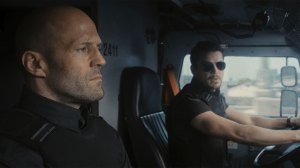 This is a darker and more somber vengeance movie where the violence has more weight to it. Everything feels heavier in Wrath of God. Even though this is strict B-movie territory, Ritchie does a commendable job of making the violence feel real and dangerous. It’s not cartoonish. There are recognizable genre moments, like too-cool interrogations, but this feels closer to a version of our own world where violence isn’t cool but awful. That may sound like the opposite of a recommendation, and I can hear someone say, “Why would I want THAT in my Jason Statham thriller?” Fair point, but the visceral nature of this depiction of crime makes the thrills feel more earned and less fleeting. The musical score by Christopher Benstead (The Gentlemen) is heavy dread personified for the entire two-hour running time. I was surprised how involved I found myself getting as the movie progressed, and during a climactic shootout I was feeling palpable nervous tension. I didn’t know who was exactly going to make it out alive, but I also wanted the “bad guys” to be taken down, but I was uncertain whether any of this would happen. Wrath of Man is an efficiently calibrated thriller when the action heats up. It doesn’t do anything special but what it does is build its moments with compounding dread. You’re waiting for bad things to happen, and you should expect bad things to happen, but you don’t quite know if they’ll happen to characters you like or don’t like, and that pumps up suspense. I was honestly surprised how invested I was during that shootout despite the limitations of characters as genre placeholders. The action and confrontations are chilly and ruthlessly efficient.
It’s the structure that’s the real villain here. I’m exaggerating a bit but there are significant structural curve balls that attempt to make Wrath of Man more unpredictable and I think take away from its overall impact and coherency. We see the opening robbery from three eventual perspectives, the drivers inside the truck, the perpetrators, and the bystander victims. We’re also shifting perspectives from chapter to chapter, but I’m not certain that all this fancy narrative shuffling is actually worth the strained effort. I’ll agree it keeps things unpredictable, but any movie where beginnings and middles are rearranged would achieve that same effect. Our first segment presents a mystery, but then it’s answered immediately in the next segment. The third segment answers another mystery, and it’s here where I started feeling like these answers weren’t quite worth the efforts to get there. There’s a notable anticlimactic design to much of the reveals, and while I believe it has ripe thematic purpose (more on that later), it also removes degrees of satisfaction that you can take from the movie. When you find out who H really is, you’ll be like, “Oh. Okay.” And from there he seems like an unkillable superhero. And when you find out who is responsible for the opening robbery, you’ll likely be like, “Oh. Okay.”
 The problem is that these answers aren’t nearly as satisfying because the people are so one-dimensional. The gang involved in the robbery, and responsible for H’s tragedy, are just one-note dudes and with a super obvious liability they keep on their team that takes away from their so-called professionalism. By taking characters in and out for long portions of the movie, we can lose track of meaningful supporting characters but also it limits the dramatic appeal. If we knew who hit that robbery early, and how they’re reacting, we might feel more conflict when they come head-to-head again with H in the climax. Or we might be better off simply not knowing them at all for as much time as they are given. Getting such shrift characterization, and with an obvious psychopath on board, feels like a half-hearted shrug. Likewise, knowing H’s tragic back-story later into the movie doesn’t really produce much more than had the movie opened with that information. It feels like Ritchie and company have recognized the limitations of their mystery and rearranged the pieces just to provide some extra questions for an audience to grapple with longer. I enjoyed early on discovering just how capable H was, and I enjoyed how the movie doesn’t pretend the obvious isn’t apparent (“Your shooting was… unambiguously precise”). However, this is Jason Statham, so we already know he’s going to be more than capable on the job.
I wanted to talk about the emptiness of the movie, and I don’t mean this as a pejorative assessment but in the themes. It’s about greed and pride and vengeance and, ultimately, it’s about how little any of these motivating factors add up. This is a gloomy movie about bad people, each with a reported reason for doing the bad things that they do. There’s been a million “crime doesn’t pay” messages in movies, but this is one of the few where I felt the futility of it all. By the conclusion, as innocent people are being killed by not-so-innocent people, and then they are just as easily dispatched by even less innocent people, I kept thinking of Marge Gunderson’s inability to reconcile criminal behavior during the end of the brilliant movie Fargo: “And all for a little bit of money? There’s more to life than money, ya know?” I don’t think it’s a spoiler to say that H does get his vengeance at long last in the movie’s resolution, but by that point I felt like it didn’t even matter. Sure I still wanted the antagonist to be toppled, but after such mayhem and such loss of life, and all for a little bit of money, the anticlimactic nature of the ending felt purposely designed. The movie has been leading up to this moment and yet when it comes, it’s not quite what we would have hoped. That intentional emptiness is meant to convey the hollow nature of vengeance as well as a nihilistic approach to crime movies. It kind of works but also it works because the movie didn’t do much work making this antagonist memorable or multi-dimensional so that I could relish his eventual smiting. It feels, in some ways, like the grimy B-movie equivalent of Matt Damon getting clipped at the end of The Departed (spoilers?).
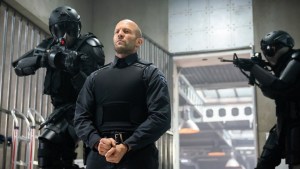 Wrath of Man is a solid vengeance thriller with some heavier themes and some weightier violence, but it’s still a movie where Jason Statham cleans shop. It’s still going to scratch those very basic demands but I applaud it for trying to be a little something more. It succeeds in some areas, like tone and theme and thrills, and doesn’t so much in others, like the non-linear narrative and too many one-dimensional characters. Ritchie demonstrates some artistic growth taking just a few fateful steps outside his cocksure and gaudy signature style. I would welcome more Ritchie signature movies akin to Snatch, but I would also welcome more well-oiled thrillers where Ritchie sublimates his style for the good of the story and mood. Either way, I’d just be happier with more good Guy Ritchie movies (and a sequel to The Man from U.N.C.L.E., please).
Nate’s Grade: B
Share this:

Those Who Wish Me Dead (2021)
 If I told you I had a movie where Angelina Jolie is on the run from a team of assassins and under the backdrop of a raging forest fire, you’d likely be intrigued. Then if I said that it was co-written and directed by Taylor Sheridan, one of the best screenwriters working today who excels at taking muscular genres of old and providing uncommon depth and poetry, then you might say, “Why aren’t we watching this right now?” Those Who Wish Me Dead, based on the book by Michael Koryta, is Sheridan’s second directing effort after 2017’s excellent Wind River, and while I would not classify it as a bad movie, it is easily Sheridan’s weakest film to date. There’s so much amazing potential here with these plot elements, this cast, and this rising filmmaker, and to only produce a square, straightforward 90s action throwback feels deeply unsatisfactory. There could have been so much more.
We follow Hannah (Jolie) and her team of Montana forest fire fighters. She is still recovering from a recent tragedy where she was unable to save campers from a fire. She’s been reassigned to a lonely lookout tower to deal with her guilt and PTSD. Along comes Connor (Finn Little) whose father is being hunted down by a team of hired assassins (Aidan Gillen, Nicholas Hoult). His father is killed but Connor escapes, finding refuge with Hannah and wary of trusting anyone new. The two of them make a trek to find help while the killers narrow their search and start a forest fire to provide a very attention-grabbing distraction for the local authorities.
 The problem with the plot description I just provided is that there really isn’t much more to anything. You can probably see the progression of Hannah’s character arc immediately, having to confront her past trauma through combating the forest fire and saving this young boy’s life to make amends mentally for those she could not save in her past. The Sheridan of his past work would recognize that familiar arc and provide extra nuance, commentary, and make the character more emotionally resonant. Unfortunately, this version only produces a lead protagonist that is, shockingly, disposable. You could have eliminated the entire character of Hannah from this movie for all the personal significance she provides for this story, and that stunned me. We don’t really get insight into he beyond generic observations. She doesn’t really bond with this kid in any meaningful way. She doesn’t really teach this kid anything generally useful for his own safety. This is the type of relationship dynamic where the adult teaches the kid some means of defense, and then in a pivotal moment in Act Three, the child uses that technique to save themselves or the adult. It’s textbook (think: Face/Off with the butterfly knife as but one example). This movie doesn’t do that. In fact, once this kid hands over to Hannah the “unseen paper carrying dead dad’s important information” then he also comes across as disposable. I guess he’s still a witness to murder but the valuable intel seemed more pertinent to thwart. The fact that these two characters can arguably be removed from the story, either entirely or far earlier, is not a good assessment of their value added.
The competing storyline with Jon Bernthal (The Punisher) is surprisingly the one that feels most attached to the events of the plot and could have been its lead vehicle. He plays Ethan, a small-town sheriff’s deputy who happens to be Connor’s uncle. Ethan also has a pregnant wife, Allison (Medina Senghore), and they both take up a generous amount of screen time. There’s a good reason for this because they’re the best part. The loving yet pointed interactions between the two of them are the best example of characterization evident in the movie. When Allison is confronted by the assassins, she’s sees through their law enforcement disguise easily. When the bad men want to torture her to get key information, she manages to subdue them and escape, all while being seven months pregnant. In two short scenes, this woman proves more capable and fearless and badass than our lead character.
 It’s easy to see a version of Those Who Wish Me Dead where the Ethan character and his drama completely cover the same narrative territory that Hannah offers. Ethan’s wife is pregnant, the baby is due soon, and yet Ethan feels scared and unsure about whether he has what it takes to be a father. He comes across a young boy on the run from big trouble and protects him, and over the course of their shared experiences, he bonds and discovers paternal capabilities within himself, he teaches the kid a thing or two about defense, and he becomes more self-assured about his own personal future. Admittedly, you could say that’s a simplistic character arc, but is the one presented any less simple where we watch a person haunted by trauma confront that trauma by the end? My point in this revisionary hypothetical is that this version would be more aligned with the plot elements that seem to get the most care and screen time. I know it’s based on a book, but it clearly feels like Sheridan has shown what parts he cares about more so embrace those parts.
It’s also quite easy to identify the parts of the movie Sheridan did not care as much about. There is a surprising sloppiness to much of the setup here, where key connecting information is excluded from the viewer perhaps out of a sense of trying to be ambiguous but also perhaps out of a sense of general indifference. I was confused why the assassins blew up a house in their opening moment, what information Connor’s father had stumbled upon, and even who these killers were and what their connections were with an unexpected Tyler Perry cameo where he appears to be their boss or handler or buyer or someone. The plotting can also be disappointingly redundant, as Hannah and Connor fall into a frustrating pattern of leaving the lookout tower, going back to the lookout tower, leaving the lookout tower again, repeat. Perhaps most egregiously, the raging inferno doesn’t even seem to matter. How can you make a movie about a forest fire where the forest fire barely matter in the scheme of things. It exists as an immovable obstacle but more so as a means of emotional catharsis for Hannah’s prior trauma. Far too often it feels like the fire is practically standing still, watching the actors from afar and not wanting to interrupt, and then at the very end, it’s comically overcharged, zooming at super speeds to compensate for its earlier lazy pacing. There aren’t any real specific survival scenarios tailored to the circumstances of a forest fire, which means this movie could have easily been a flood or earthquake or any disaster or none at all.
 Those Who Wish Me Dead reminds me of the vanishing mid-level thrillers that Hollywood used to crank out on a near weekly basis. That’s probably also part of the reason it feels like a throwback to an earlier time, a time where a big star could be thrown into a disaster and given evil-doers to topple and we’d all gladly gobble it down with a heaping helping of popcorn. Perhaps that unassuming nostalgia will prove enough for some people, especially in the wake of a year of minimal big screen blockbusters. There are still moments here that feel like the Sheridan of old, but too much of this movie cannot escape the gravity of being a dull action movie without anything to say and without characters to invest in. It’s not even that the movie is too simple, because simplicity can be its own virtue, but that it’s underwritten, with characters that could be exorcised completely from the narrative, and a batch of villains lacking entertaining personalities or memorable menace. It’s hard not to feel like everyone’s talents involved were wasted somewhat on something so basic, which is even more baffling when you again recognize those fantastic story elements. Chases. From assassins. Into a forest fire. There’s an obvious movie to be had there. Unfortunately, Those Who Wish Me Dead doesn’t capitalize.
Nate’s Grade: C
Share this:

Immortal Combat: The Code (2020)
 In many ways, the Cleveland-made indie Immortal Combat feels like a bigger version of what a bunch of little kids might accomplish with a camera, a backyard, a bunch of pretend weapons, and a lively imagination fed from martial arts epics and actions movies of old. There is a certain charm to it, escaping into the pure play of childhood, including wrist devices that are merely tapping your bare wrist, but as an actual movie, it might have some problems. Look, this is a martial arts action movie. You watch a martial arts action movie to be entertained with the feats of action, and that’s what you should be looking for with any movie with “combat” in the title (albeit in a misguided font that looks like a child’s chalk). On that front, Immortal Combat is flawed but still passable entertainment, though it feels like a project that was never intended to entertain more than its own select cast and crew.
Neil (Ben Zgorecki) is a member of the villainous Four 11 gang. He’s tasked with infiltrating the rival Five Elements gang but he turns against his former gang. The Five Elements have come into possession of a code that will save humanity from environmental disasters. The world is running low on breathable air and implantable medical devices are malfunctioning. The gangs are going to war to control this code and thus control the trajectory for mankind’s future.
 The performers have physical skills they have honed over years, and director Johnny K. Wu (Innserself) emphasizes angles and cuts to fully appreciate those skills. There are extended shots where you can admire how much the performers practiced and memorized their routines. However, that deference also comes at the expense of the vitality of the action as depicted on screen. Because we’re at a medium range or farther distance, because there are longer takes, we’re watching the actors perform and realizing just how slow everyone is with their pacing. Without quicker cuts, the energy level of these fights comes across as too often lackluster, with many of the fighters just kind of hanging around and treating these battles as less life and death and more like a grocery aisle they cannot commit to. I can appreciate someone doing a fancy spin kick from a technical standpoint, but it feels less impressive when everyone else around them seems gassed or drugged in response. There is a lot of fighting in Immortal Combat but the editing and staging choices make it feel less believable, exciting, and potent. That’s why it feels like a bunch of grown-up kids running around, falling over, and continuing their pretend fighting rather than something, say, along the lines of a John Wick, an action franchise that is built around the appeal of expertly executed fight choreography.
The plot of Immortal Combat, written by Wu, Andras Zoid, and Linda Robertson, ignores the first rule of hidden conspiracies and alternate fantasies, which is to shepherd your audience gradually and not to make assumptions. I see this plenty of times with fantasy films that incorrectly assume an audience has as much understanding as the filmmakers do about the histories of their world, the intricacies, the rules and challenges, etc. A new world, or a conspiracy, needs to be unraveled slowly and in pieces to be accessible, to not overwhelm the audience. We need the right components as if they were building blocks, creating a sturdy foundation to attach new information and new rules and lessons. If you have a mysterious Chosen One, you don’t vomit up every last bit of expositional know-how right away, you have to draw things out at a natural, inclined pace. With Immortal Combat, we have an entry point into this new world through the rather non-intimidating character Neil (a.k.a. “Cloud”). He’s our learning curve. The problem is that Neil just runs with any information at once and this presents a confusing overload. The world of Immortal Combat resembles ours except there are martial arts gangs, some of them with elemental powers, or at least names, and a vast corporate conspiracy with implanted medical devices and environmental disaster, but the communication of these elements is so muddled that I kept having to rewind the movie to try and follow. Take the opening narration as an example:
“IN OUR future, one simple breath could mean life or death. As we search for a solution, pollution engulfs our world. If we don’t find an answer fast, all living things shall perish. We are the Five Elements, we strive to protect humanity… Years ago, many warriors came to us seeking change, joined our way of life. Right after, A Code was discovered that could save the world and was injected into one of us. We even lost one of our clan’s mate. Now we must fight for our lives to bring the code – to the world…or die trying. With the MediCan Research Corporation and The FOUR 11 gang on our tails….We must protect the code….AT ALL COSTS.”
 I guess the pollution is killing everyone, yet we don’t really get a sense of this impending and immediate danger because life seems pretty normal; people are hanging out at bars, strolling around, not rationing what might be their final breath. Because of this pollution, a corporation is looking for a solution for its implantable medical devices, yet why is this even introduced except to provide another batch of shadowy bad guys with a plot crowded with shadowy villains? The corporation wants a solution, a code, which is what the heroes have, and the heroes want to get the code out to save humanity, so why aren’t they actively working together? Why introduce two sides who have the same goal if they are never going to meaningfully interact? I suppose the evil corporation would exploit the code for profit, but why not express this through actions? Also, why is this world-saving code only injected into one person rather than, say, uploaded to the Internet? Why risk your only vessel containing the world-saving magic code getting hit by a bus? If the goal is proliferation, there seems to be more safety in diversifying the code-carriers. The rival evil gang, the Four 11s, are a criminal syndicate but their leader has a sick child. Wouldn’t this code also help cure this child? Why are all these organizations working against one another? The world building of this universe feels cluttered and confusing and lacking narrative purpose. It resembles a little kid making up the rules as they go for a game you didn’t recognize.
As Neil is introduced into the Five Elements gang, we’re inundated with names but not so identifying personalities and things to better cement the deluge of characters. We have Cloud, Water, Earth, Fire, Wood, Gold, and if you forced me to identify who was who I would not even under penalty of law. There are so many characters in this movie and very few, if any, leave a favorable impression at all. They are repositories of kicks and punches and the occasional grunt. Water (the exquisitely named Crystle Paynther Collins) keeps bringing up her dead sister to the point that I waited for her to reference it every time she was onscreen, and she did not disappoint. Naming your main character Neil, and sticking him in khakis to perform martial arts, made me laugh. It’s not that his code name “Cloud” is that much more intimidating. When you introduce characters in movies, it’s a good idea to give them a moment to set them apart, and through action, which will better convey who they are and through visual storytelling. This is one of those movies where a character says, “You need to see Earth and Gold or else Wood and Fire will combust,” and you just shake your head and try and determine who these people are and what are their connections. It’s clumsy writing and there are too many characters to keep track of without stronger involvement. After watching 80 minutes, everyone just blurred together into People Who Kick (except for Neil and his mighty fighting khakis).
 The problem with Immortal Combat is the same I’ve seen with other low-budget indies, namely that these movie projects were not made for a mass audience. They play like an insular group project for friends and family of the production, people who are already in the know and on board, and the writing and development are tailored for this narrow band rather than a broader outside audience. To make a movie for others, you’d have to carefully explain your plot in a way that would be engaging, clear, and escalating, with characters distinguishable by personality, goals, and choices, and you’d want to integrate them in meaningful ways that also push our protagonist or heroes to victory. You’d have to put the work in to make it an actual movie. Immortal Combat feels like it was made strictly for its friends and family, like finding excuses to squeeze in extras for gang group shots despite the fact that the very presence of “non-threatening-looking” members calls into question the hiring practices and determination of this vicious martial arts gang. When people who look like your ordinary neighbors are in a martial arts gang, do you fear them? This also extends to our invisible special forces team. Some of these guys have a noticeable deficit in their effort or duty to their job. There’s nothing wrong with creating art with a small intended audience. I’m sure corporate offices make little videos all the time only intended to play to their employees. If you’re thinking beyond your immediate circle, however, then you must put more thought into your storytelling choices and make the plot and characters matter rather than finding room for everyone to fit onscreen.
Immortal Combat plays like an overextended martial arts demo reel and a plot was strung together to justify more and more exercises, resulting in a calamitous collection of confusing characters that are nearly interchangeable and often extraneous and expendable. The impact and excitement of all that martial arts choreography is blunted somewhat by the choices how to present the fighting and revealing the lackluster energy levels of some of the performers. I know in reality that fight sequences are often at a slower speed when filmed, same with car chases that typically only go at speeds of 30 miles per hour, but you make choices to obscure those nagging parts of reality to maintain the illusion that these kicks are furious and these cars go fast. It’s the same thinking when it comes to casting and crafting a story that naturally widens rather than simply polluting it with more names and faces that will only leave a dent for making dents. It looks like the actors and people behind Immortal Combat had fun making a movie, and to that end I have no qualms with any of them. Unfortunately, it doesn’t have the elements to reach beyond its circle.
Nate’s Grade: C-
Side note: the poster for this movie is wildly inaccurate. Like amazingly inaccurate. There are no characters in the movie resembling those on the poster, which definitely seems designed to be the Asylum version of Mortal Kombat.
Share this:

Without Remorse (2021)
 Tom Clancy’s Without Remorse is Tom Clancy without Tom Clancy. It bears no resemblance to the famous author’s 1993 novel even though the entire production feels remorseless about being generic military thriller genre grist. There’s nothing to spark the imagination here, no signature action sequence or well developed turn of events, no colorful personalities or hissable villains. It’s all predictable from the opening credits onward, from the opening mission that cannot go according to plan, to the assumption of the short shelf-life for the pregnant wife in Act One, to the Obvious Red Herring Antagonist and the Obvious Real Antagonist played by the big name actor, to the presumptuous preparations for building a franchise in post-credit sequences. The best thing about Without Remorse is Michael B. Jordan as our lead Navy Seal seeking vengeance and climbing the ladder of international conspiracy. Jordan gives a far better performance than this material and movie deserves, always demanding your attention. He’s charismatic even in generic thrillers like this one, and it is the definition of a generic military thriller lost in the dull minutia of a thousand other similar movies. There’s really nothing separating this movie from the glut of direct-to-DVD action thrillers starring the likes of Bruce Willis (who filmed his part over a weekend). The motivation for the villain’s plot to kick-start another global war with Russia is laughable when there’s a ideological motivation within reach that would have worked and been interesting, namely declaring Russia already an enemy of the country and forcing those in power to fight the war they are ignoring. Instead, the stated rationale is so much dumber. If you’re a fan of these kinds of action thrillers, or the sub-genre that Clancy carved out for himself for decades, then you’ll likely find enough to pass the time with Without Remorse. It had glimmers where it could have stepped outside the mighty shadow of its influences. I wouldn’t have been surprised if this was starring Dolph Lundgren rather than Michael B. Jordan.
Nate’s Grade: C
Share this:

The United States vs. Billie Holiday (2021)
 The good news is that Andra Day is a surefire star. In her debut performance, the singer makes a bold impression as Billie Holiday, with her raspy voice, sterling stage presence, and powerful singing. Day was nominated for an Academy Award, just as Dianna Ross was for her own film debut, also playing Holiday in 1972’s Lady Sings the Blues. The highlight of this movie is a tight close-up of Day singing “Strange Fruit,” her anti-lynching protest song, written by a Jewish schoolteacher, a song that incensed the U.S. government and essentially began the woe-begotten War on Drugs with a racist task force targeting Holiday as their first victim to make an example of. The moment is filled with rising emotions and barely held restraint and the sheer power of Day’s performance communicates the danger and anger of this politically-charged song that earned such controversy. However, the rest of the movie is a bit of an unholy mess, as director Lee Daniels (Precious) takes his signature campy, over-the-top style and cannot say no to any creative decision in his mind. I don’t know what’s harder to grasp, the clashing tones or timelines, as the movie literally and figuratively jumps all over the place, at one instant having Holiday on top of the world, and another being beaten by a parade of one-dimensional and nearly indistinguishable abusive men, to waltzing through heroin hallucinations, and cuddling close with an FBI informant (Trevante Rhodes) who is definitely a fictional character. Like the recent Judas and the Black Messiah, we divest time from the star to the men who betray her, but none of these louts and schemers are worth that precious time. It becomes an uncomfortable misery montage as we watch Holiday get abused, shoot up, cry, get harassed by the police, and repeat endlessly for 130 minutes. I don’t know if maybe Daniels was trying to make me feel like I was on drugs while watching but the antic, unfocused, and careening narrative and energy levels certainly made me feel dizzy and nauseated. An then there are ridiculous moments where I just wanted to laugh, like the backroom of racist government agents saying lines like, “This jazz music is the devil’s work. That’s why this Holiday woman has to be stopped.” This is based on a chapter of a book about the early War on Drugs, not Holiday’s biography, and it feels very much like her own identity and significance is being strung along just to be a martyr for the evils of government persecution. The movie paints her chiefly as a victim and then seems to glorify in victimizing her, and it all feels so garish and ghoulish and misguided. Billie Holiday deserves an amazing movie but she’ll just have to settle for an amazing performance in an otherwise melodramatic mess of a movie.
Nate’s Grade: C


 nathanzoebl
You must be logged in to post a comment.