Blog Archives
Ghostbusters: Afterlife (2021)
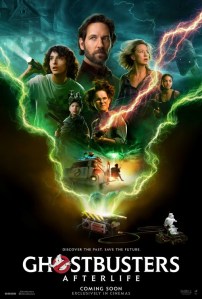
As I stated in my review for the 2016 Ghostbusters, allow me to wax nostalgic and explain my own private history with the franchise: “Growing up in the 80s, other kids had Transformers, or G.I. Joe, or He-Man, but I was a Ghostbusters kid. I fell in love with the 1984 original movie, slept below the poster for most of my childhood, and obsessively collected all of the action figures and toys, watched with glee the animated TV series, and hold the world and its characters in a special personal place.” This franchise means something to me. I think about the hours I spent playing in this world and my imagination and my own stories illustrated with marker and crayon, and it makes me extremely happy as well as reminds me how I fell in love with weird storytelling and macabre, ironic humor. I’ve been waiting for more Ghostbusters movies for my adult life. The 2016 movie was fine, I wasn’t enraged by it in the slightest, but it didn’t scratch that itch. While replicating some of the same plot beats, the 2016 movie was not reverent to its source material. Now the 2021 Ghostbusters, delayed over a year and a half from COVID, goes completely in the other direction. Ghostbusters: Afterlife is reverent to a fault, and while it has been met with mixed reviews and complaints of overdosing on slavish fan nostalgia, I found it to be a charming and fun family adventure that left me laughing, cheering, and even crying.
Egon Spangler (Harold Ramis, R.I.P.), original Ghostbuster, is dead, killed by a malevolent spirit. His estranged adult daughter, Callie (Carrie Coon), and her two teen children, Trevor (Finn Wolfhard) and Phoebe (Mackenna Grace), are shocked to learn of his death and their unexpected inheritance: a dirt farm in small-town nowheresville Oklahoma. They don’t know much about their grandfather and the kids are not exactly excited about relocating to a secluded mining town. Phoebe starts discovering weird pieces of technology hidden in the old house of her grandfather’s. A presence seems to be reaching out and trying to get the family to understand their real legacy. It appears that Gozer the Gozerian was not fully defeated on top of that New York City skyscraper in 1984, and Phoebe and her family must learn about the past in order to make sure we all have a future.
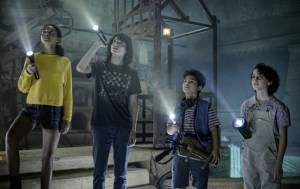
I can understand the charges of Afterlife being too nostalgic, but I don’t understand the charges of it being so enamored with its past that it poses a disservice to the movie standing on its own. This movie is intended at its very DNA to live within the shadow of the original films. The director and co-writer, Jason Reitman, is the son of the original films’ director, Ivan. It’s going to be reverent but that’s not an automatic bad thing. Whereas the 2016 reboot shrugged at past convention and went completely comedic, this edition takes the opposite approach, hugging onto the lore and past of Ghostbusters with heartfelt affection. If you’re a fan of the franchise, this adoring approach will likely be more favorable, not that the 2016 film is wrong for eschewing the established canon of the franchise and trying something new. If Afterlife had been a completely original story set in a Ghostbusters universe, I would have happily accepted that. However, just because something is outwardly nostalgic, or taps into fan service, does not mean it is destined to be an exclusive retread that only satisfies the hardcore base. I didn’t need the gratuitous Easter eggs of passing shots of a twinkie or Crunch bar, but they’re blink-and-you’ll-miss-them moments that don’t really relate to anything of consequence, so I can excuse them. Afterlife is similar to The Force Awakens in that it uses familiar plot beats to mirror events of its predecessors to ease back fans and new members to the fanclub, most especially in Act Three where Gozer’s demonic pooches are unleashed. I can understand many chaffing at this, but I feel that Afterlife does enough to justify its own creative existence even in facsimile rather than as some insular, facile, fan-stroking cash-grab.
This is, by far, the most dramatic of the Ghostbusters movies, a series that has existed in the realm of comedy. The prior movies were never spooky on adult terms, but they reached back into a primal, childlike curiosity and anxiousness over the unknown that made them creepy when they wanted to be. I don’t understand the umbrage some have expressed over Afterlife being more of a drama. First, the comedy is present throughout the movie with the characters making specific and wry observations that feel fitting for their situation. The humor is not as forced as the loping line-a-rama improv jazz riffs of Paul Feig’s 2016 film. I think this universe can sustain different kinds of stories being told, and I think that drama is perfectly acceptable as long as it’s earned, just like the comedy or horror elements. The central premise involves an estranged family coming to know the secret life of an absentee relative who abandoned them, so the more they learn about his Ghostbusting past and responsibilities, the closer they come to uncovering a clearer picture of who this man really was as well as their connections to him. Reitman and co-screenwriter Gil Kenan (Monster House) have smartly connected the investigation of the past into the development of personal relationships. We in the audience know the significance of the Ecto One and the ghost traps, but the new characters do not. We await them to understand the knowledge we already attain, but the movie doesn’t play this as characters dawdling. Each discovery unlocks new potential for the characters to shape who they choose to be, and each one gets them closer to their grandfather and reshaping their conception of the man who they wrongfully believed abandoned them for folly.
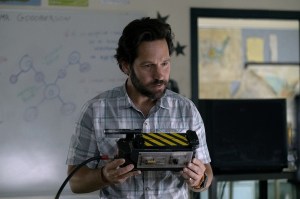
This all leads to a climax that had me genuinely in tears. I won’t exactly spoil it but Afterlife’s conclusion is less concerned with beating the Big Bad Gozer yet again and saving the universe. Reitman and company have smartly placed the real climax as an emotional catharsis; it’s more in keeping with Field of Dreams than some huge Marvel apocalyptic showdown. The ending is personal, emotional, and reaches into our universal desire for closure, for having that one last moment with a beloved who we no longer have any moments left to share, Reitman is clearly missing Ramis, a close family friend and inspiration who died in 2014, and this is his own way of processing his personal grief, offering an emotional output for the fans to share in, and allowing a grieving character/surrogate to find that needed release. It serves as a fitting conclusion and a special end note for any Ghostbusters fan who has held this franchise close to their heart for several decades, especially if shared with a paternal figure who may be gone.
The film also successfully channels a childhood perspective of awkward and awesome. It’s hard to create a story where a group of precocious adolescents discover strange things cooking in their sleepy small town without suggesting Stephen King and Stranger Things, but this isn’t necessarily a total negative. The earlier movies were always from a more cynical adult perspective. Yes, there were characters like Ray (Dan Ackroyd) and Egon who were true believers, but they were often set up for easy laughs. The tone of the series was mostly tied to the irony of the character of Peter Venkman (Bill Murray) that looked at the supernatural with droll detachment. This is the first Ghostbusters entry where the primary perspective is from children, and there’s something hopeful and heartfelt about a younger point of view with the supernatural material. These kids are excited and eager to learn more about the somethings strange in their neighborhood. It becomes endearing to ride along with them as they get to jump into the action. I loved the concept of a sidecar gunner seat for the Ecto One and how it felt like a childhood dream coming true. But it’s more than fan service because it serves as a point of progression for Phoebe’s sense of self, of embracing her scientific interests and roots, and taking charge in the face of unknown danger. It’s a coming out of sorts. When the kids are driving through (the always empty?) town and chasing a runaway ghost, wrecking storefronts from the boom of the proton pack, it’s a blast for them and us.

This is Reitman’s most commercial and mainstream film of his Oscar-nominated career. It’s interesting to me that this indie darling, who was on such a hot streak in the late 2000s, hit some speed bumps with the critical misfires of 2013’s Labor Day, 2014’s Men, Women, and Children, and 2018’s The Front Runner, so the next movie is a retreat to a big-budget franchise film. Reitman doesn’t necessarily have the best feel for large-scale spectacle, but he knows intimate character dramas and guides his actors well. Grace (Gifted, Haunting of Hill House) is wonderful as our plucky lead. Unfortunately for Wolfhard (It, Stranger Things), his dull character has nothing to do but pine for a local girl, scoff at his family, and then fix up the old ghostbustin’ mobile. Paul Rudd (Ant-Man) is as charming as ever as the school science teacher, especially as he nerds out over interacting with the Ghostbusters paraphernalia like an excitable fanboy living out his childhood dream. I wish Coon (The Leftovers) had more to do, but that’s my primary complaint in any movie where Carrie Coon is a supporting actress. Her chemistry with Rudd is strong and they could have done so much more together as adults trying to make sense of madness. They could have eliminated Wolfhard’s mopey older brother character entirely and given us more time with the goofy adults too. One feels like there is some secret contract where anything relating to 80s nostalgia requires the hiring of Wolfhard on hand.
Ghostbusters: Afterlife will not be the best movie of 2021. There are areas that could have been improved and streamlined and better developed. However, Ghostbusters: Afterlife will most assuredly be my favorite film experience of 2021. It’s a heart-warming continuation for fans with enough wit and whimsy to charm while owning its obvious and intended connections to the original. I may not be the most objective source on this particular matter, but I know what I like, and this movie had moments of pure happiness that just shot right through to my dopamine center. We’ll see if this movie can restart the dormant franchise, and strike more on its own, but even if this lone 2021 entry is all that we eventually get, I’m happy I got to experience this magic once again. I can’t wait to see it again with my dad.
Nate’s Grade: B+
Share this:

In the Bedroom (2001) [Review Re-View]
 Originally released November 23, 2001:
In the Bedroom hits all the right notes of agonizing pain, devastation and loss. The heart of the film is on the grief encompassing Matt and Ruth Fowler (Tom Wilkinson and Sissy Spacek) over the loss of their son. The Fowlers are well regarded in their cozy New England town. Matt is a flourishing local doctor and Ruth teaches a chorus of local high school girls.
In the Bedroom opens with Frank Fowler (Nick Stahl) chasing his older girlfriend Natalie (Marisa Tomei) across an open grassy field. Frank is a budding architecture student home for the summer and thinking of prolonging his time so he can stay together with Natalie. Frank and Natalie have a distinct age divide but also seem to have been given different lots in life. She has a pair of boys from her abusive husband Richard (William Mapother) that she is finalizing a divorce from. Richard is hopeful he can reconcile with Natalie if he just gets another chance, but Natalie is stern in her refusal.
 Ruth sees the relationship as a detriment to her son’s future. She’s even more upset that Matt is so casual with their son dating an older, working-class mother. Frank rushes over to calm Natalie after another of Richard’s outbursts of violence has left her house in shambles. She rushes her children upstairs just as Richard returns back. He manages to sneak in through a back door and confronts Frank in their kitchen, shooting and killing him. What should seem like a clear-cut case begins to unspool. Natalie admits she didn’t actually see the gun fire and the charges are dropped from murder to manslaughter. Richard is released on bail and free to stroll around occasionally bumping into the grieving and outraged Fowlers.
The majority of the film is the aftermath of the murder and the strain it puts upon Matt and Ruth and their marriage. Beforehand jealousy, anger, and bitterness would simply sit but slowly the tension begins to bubble to the surface. Ruth holds resentment and blames the leniency of Matt for the death of their son. Matt tries to get out of the house as much as possible, even if it means sitting in his car in their driveway at night.
One of the most harrowing scenes of In the Bedroom is also its emotional and acting centerpiece. After the mounting frustration with justice, Ruth and Matt explode into an argument that had slowly been building long before their son’s death. This is the first time they have truly talked about the whole situation and accusations fly like bullets in their first emotional confrontation. In the Bedroom could have easily fallen into the area of sticky made-for-TV land, but the exceptional performances all around by the cast and the deft and studied direction never allow it to falter.
Spacek (Carrie, Coal Miner’s Daughter) can begin writing her Oscar acceptance speech right now. Her portrayal of Ruth displays the pride and seething anger, but keeps her human throughout. She exhibits pure, raw emotion that strikes directly inside you leaving a knot in your stomach and in your throat. Her performance is truly breathtaking and so emotionally visceral to watch. Wilkinson (The Full Monty) plays Matt with passive-aggressive doubt and repression. He dominates in any scene he is in and takes the audience on a wide range of emotions. He has a commanding presence and compliments Spacek’s Ruth nicely. Perhaps the greatest thing Tomei (My Cousin Vinny, Slums of Beverly Hills) was known for was miraculously winning an Oscar and dumbfounding a nation. With In the Bedroom she is given the ubiquitous “And” credit at the end of the opening cast list. She has less to work with and less screen time to work it, fully earning the “And”‘ credit she has.
 Todd Field is an actor-turned-director and has appeared in such a wide array of films from Twister to Eyes Wide Shut. Field has layered his film with rich symbolism and an intelligent, patient pace. Most of the action in movies is centered on what is going on in a scene, but the most telling moments of In the Bedroom are what are not going on in the scenes. Field creates such an intimate portrait that the camera almost turns into another character, catching the lingering silences and the burgeoning inner turmoil. Field also adapted the screenplay from a short story by Andre Dubus, whom he dedicates the film to.
In the Bedroom is not going to be for everyone. Some will find it slow and some might even find it boring. As it stands, it is a powerful film on the study of loss that grips you and refuses to let go. You will feel all the blame, jealousy, anger, and pain of this family and for such emotions to resonate from the screen to the audience is a great achievement.
Nate’s Grade: A
——————————————————
WRITER REFLECTIONS 20 YEARS LATER

Twenty years later and it seems like nobody really talks about Todd Field’s In the Bedroom any longer, which is a crying shame. The movie was hailed by critics upon its release in late 2001 and earned five Academy Award nominations including Best Actor, Best Actress, Best Supporting Actress, and Best Picture. Field would then adapt Tom Perotta’s novel Little Children and direct its 2006 adaptation, again earning favorable reviews and multiple Oscar nominations, revitalizing the career of Jackie Earl Haley. And then Field seemed to vanish from view. There are a few dropped projects and a potential upcoming series with Daniel Craig, but Field has been too quiet as a director for over 15 years, and that’s far too long for a man that showcased such immediate natural talent from his very first opportunity in the director’s chair. In the Bedroom was a movie that I wasn’t exactly excited to come back to on my list of 2001 re-watches; it’s a heavy drama about grief and suffering and that’s not exactly the best entertainment remedy during the holidays. I’m happy to have gone back to the movie, as well as cross it off my list, because this return reaffirmed for me just how great Field is as a director, and a screenwriter, and just how vital this indie film feels. It’s the real deal when it comes to authenticity and emotional power, and watching this as a 39-year-old rather than a 19-year-old gave the enduring two hours added heft for its family tragedy.
The plot centers on the spiraling consequences of one death. Frank Fowler (Nick Stahl) is the 18-year-old son of Ruth (Sissy Spacek) and Matt (Tom Wilkinson), upper-middle class and pleasant but pointed. Frank is dating Natalie Strout (Marissa Tomei), an older woman and the ex-wife (though not yet legally divorced) of Richard Trout (William Mapother), a violent and unstable man and also heir to the local canning company. One fateful day, Richard angrily confronts Frank, a gunshot is heard, and Frank is dead. Richard swears it was self-defense, but Natalie is convinced her jealous ex was finishing the threats he had been making about her ever leaving him. The murder happens at the 40-minute mark, and from there the movie becomes a long examination on grief and guilt and blame, where characters drift from scene to scene like ghosts, some avoiding the painful realities of their enormous grief, finding hobbies or distractions, but most unable to fully articulate the resounding pain and emotions brimming under the surface.
 Under Field’s attentive care, there is a palpable dread hanging over every scene. The script allows different bereft perspectives, each person wrestling with feelings of personal guilt. Natalie blames herself for holding onto the relationship, bringing him into her world. Matt blames himself for not calling the police after an earlier fight between Frank and Richard, and he doubts whether he should have pushed harder on his feelings of reservation about the relationship with Natalie. Ruth has escaped into her insurmountable anger and uses it as the fuel to keep her going. The friends and neighbors do their best to be supportive but every conversation or poker game has the danger of veering too close to The Topic, and the awkward but well-meaning silences permeate and become more awkward. It’s a movie about people trying to get on with their lives but not knowing how to reassemble the broken pieces. By itself, that is enough meaty drama worthy of examination by top-notch actors and considerate screenwriting that allows us to really dwell in the beautiful discomfort. Field adds extra degrees of turmoil from the possibility that Richard will be given a slap on the wrists by the indifferent legal system. Richard posts bail thanks to his family’s wealth and even casually strolls through the town like nothing happened, making appearances while Ruth is shopping like her living in an inescapable nightmare. The Fowlers are consistently having their pain poked and prodded and reopened. One friend suggests if Matt has contemplated moving, and he admits he’s considered it, but it wouldn’t change what happened or lessen the pain of having their son’s killer protected by his status.
As you can imagine with that kind of material, In the Bedroom is an actor’s showcase. Wilkinson is the more featured role, and he’s the more laid back one, the one trying to make sense of things as best he can and failing. Wilkinson is terrific in the role and his hangdog expression from scene to scene denotes so much unspoken pain he’s grappling with behind his placid veneer. Just watching this man try and keep his life together is worthy of study. The weariness is harder to note with his performance but more rewarding to watch. Spacek is great herself but playing a role with less dimension. She is the stern voice of outrage and blame, the one who never liked Natalie and always suspected the worst. She has her signature blowup scene that serves as a long-in-the-making emotional confrontation with her husband, who she accuses of hiding from his grief rather than embracing it. However, her character is also painted in an unflattering and I would say unfair characterization. In the heat of their fight, Matt accuses his wife of being so controlling, so unforgiving that her son had no choice but to run away from her. While the character has been presented as cold and disapproving, she’s a victim too. This was Tomei’s confirmation as an actress that her surprise 1993 Oscar victory was no accident. She’s strong in her brief moments, especially when she’s recounting Frank’s murder under oath and realizes her inability to help the case with her conflicting witness testimony. It’s devastating to watch as she processes in the moment the doubt and then utter terror as she realizes that her next words, of honest yet painful reflection, will undermine the case she so desperately needs. I know the slap between Spacek and Tomei got more attention, but this is her clincher.
 All of this well-wrought examination of grief and guilt is sturdily handled, and it effectively sets up the last fifteen minutes of the movie into its own indie thriller. Finally pushed far enough, Matt takes matters into his own hands to find justice. The entire sequence is played out so deliberately that you might not breathe from the protracted suspense. Field and co-screenwriter Robert Festinger (Trust) have patiently built up these characters and their conflicts with such precision that they have developed genuine emotional stakes and uncertainty for the end. For first-time viewers, I imagine there will be legitimate doubt how the final events will play out. Is Matt being honest with his offer to have Richard run away from town? Is he making his stand in secret to absolve his wife of more pain and to rise to her verbal challenges of being too timid, or is she in collusion and possibly the Lady Macbeth from the bedroom shadows? It’s a long, taut sequence that feels like a fitting culmination of the many little details that have been set up, from character dimensions and motivations to small details that come together so smoothly, like a bridge worker or a friend’s large estate. It’s been twenty years since I’ve seen the movie and it still had my heart elevated, and I knew the ending.
Where In the Bedroom separates itself from the dramatic pack, and where it’s deserving of more attention and notoriety in retrospect, is how remarkably considered and assured this movie is about assembling its details and atmosphere. This is a deeply felt and deeply authentic movie that fills out the innumerable edges of this small coastal town with colorful characters that feel genuine, lives that feel lived-in, details that feel authentic without being obvious, and all without losing focus on the central performers as they struggle with their consuming grief. There are great artistic touches too for emphasis, like when Matt seeks out his lawyer to question points of strategy, and when the officious man retreats back to polite deferrals that fall back on the limits of the judicial system, the camera focuses on tight edits, first the man’s mustachioed mouth, then his fiddling hand in his pocket jangling his keys, a sound that intensifies into that of a jackhammer. It’s a clever and effective means of conveying the fractured, infuriating, dismayed response of Matt. However, most of the movie avoids flashy style that calls attention to itself. The very framing of the characters in the shots is so elegantly composed, making fine use of spaces and windows to help convey extra layers. This is a movie that does not feel like a first-time filmmaker or screenwriter. This same measured assurance can be seen in 2006’s Little Children, an equally well-observed, detail-rich, non-judgmental slice-of-life of small-town ennui. We need more Todd Field movies considering he’s two-for-two with literary adaptations.
 My original review in 2001 has some sentimental value for me. It was one of the first reviews I ever wrote for my college newspaper, The Chimes, in the position of film critic, an official role I held for five straight semesters (2002-2004). It was a goal of mine arriving at school and I saw it through, and this first review reminds me of the next stage of my career in film criticism and of my good times in small-scale publishing. My 2001 review gets some things right but I cringe at how awkwardly it’s trying to grasp for further meaning without understanding how to clarify my explanations. Maybe I was more taken with writing to my college-aged audience, hence why I devote a paragraph to explaining the use of the “And” credit in movie casting. There are some good points here and there, and the distillation of the plot and conflicts is solid, but as I’ve noticed with more than a few of my earlier reviews, the depth of critical analysis is shallower than I would prefer. Also, my hasty prediction that Spacek should “begin writing her Oscar acceptance speech now” was short-sighted, as she lost Best Actress to Halle Berry for Monster’s Ball (see you next in December, movie). In the Bedroom is a movie worthy of your time and a cultural re-examination.
Nate’s Grade: A
Share this:

House of Gucci (2021)/ The Last Duel (2021)
 The octogenarian filmmaker Ridley Scott has been a prolific and influential director for decades, but rarely has his high-powered work ethic been as obvious as within a 30-day window. Scott directed two movies, both aimed at adults and potential awards consideration, and both co-starring Adam Driver in a supporting role, and both as subtle as the outlandish fashions of the 1980s. Scott is not a subtle filmmaker by trade. He favors rousing excess and bold characters making bold decisions. This is not the first time Scott has managed to release two movies in a single calendar year (2017: Alien Covenant and All the Money in the World; 2001: Black Hawk Down and Hannibal) but for both movies to be released within a month, and share thematic similarities, is worth noting. The films also share many of the same artists (editor, composer, director of photography) as House of Gucci was filmed a mere four months after wrapping The Last Duel, which was delayed because of the pandemic. Both movies are based on true stories but go in different directions for artistic impact. House of Gucci veers into tragi-comic camp to its entertainment benefit, and The Last Duel spares subtlety for blunt political points.
The Gucci family has enjoyed nearly a century as fashion royalty. They’re known for their classic look, the care that’s put into their leather, and the long-standing resistance to change. Enter Patrizia (Lady Gaga), an ambitious young woman who doesn’t want to work for her father’s truck-driving company forever. She sets her sights on Maurizio (Driver), the mild-mannered son of Rodolfo (Jeremy Irons) and nephew to Aldo (Al Pacino), the co-heads of the Gucci empire. Their whirlwind romance leads to marriage and Patrizia insisting that her beloved take more control of the family business and make his mark as a Gucci.
 The real reason you should go to the theaters for all 150 minutes of gargantuan Gucci drama is because of the monumentally captivating performance by Gaga. I will suffer no fools on this subject: Gaga is flat-out wonderful. As the kids on the social media say, she clearly understood the assignment. Gaga is knowingly broad and hamming it up but she is having the time of her life. I was impressed with her acting in 2018’s A Star is Born and how natural she was onscreen. Now she’s playing a distinctly drawn character and she dissolves into the role, smirking it up and purring with every line. You won’t exactly trust this woman, who is proven to be conniving and ambitious but also effective at manipulating others and earning her position of prominence, but you’ll love watching her onscreen whether alone or dancing circles around her cohorts. Gaga understands completely that this sordid tale plays better intentionally dipping into camp, making bold and outrageous what otherwise could have been underplayed. It’s an outrageous story with outrageous wealth and privilege, and it deserves to be told in an outrageous manner. That doesn’t mean dismiss the drama as minimal, but it recognizes the tone that will best bring out the entertainment value of the soapy plot elements. No one needs this kind of story played miserably strait-laced and absent any light; nobody needs another astoundingly awful The Counselor (sorry, Ridley). Take the sex scene between Gaga and Driver. It is so loud, so obnoxious, so over-the-top, and it stays at that level for a thrust-heavy protracted period, that the movie, and Gaga especially, is inviting you to laugh along. Gaga is the one who fully understands the edict of more-more-more the most and demonstrates it with her charmingly over-the-top performance. She is fully deserving of Academy recognition and to be memorialized as a thousand memes and GIFs.
House of Gucci feels very much like a Ryan Murphy show condensed to a feature-length over-extended special. For those unfamiliar with Murphy’s genre-bending TV work on FX (American Horror Story, American Crime Story) and now Netflix (Ratchet, Hollywood), the provocateur never met a juicy twist or outlandish plot element he didn’t love to use, abuse, and inundate the viewer. He’s like a creative prankster freely celebrating the ridiculousness of the prime-time soaps of old while also providing ironic counterpoints to them. It can be a riveting experience when it all works together and an unmitigated yet often fascinating hot mess when it doesn’t. Subtlety also rarely factors into a Murphy show. He also loves opening up the fabulous lives of the fabulously wealthy, including the heralded Versace family, and the fabulous lives of Hollywood stars in tremendous acrimony, like Bette Davis and Joan Crawford, for our envious guilty pleasure consumption. The House of Gucci feels comfortably pitched in that Ryan Murphy sweet spot, especially if you’re a fan of the populist high-gloss escapism of Murphy’s campy forays.
 Because of this tragi-comic tone, House of Gucci keeps things rolling with eye-rolling excess and consistent laughter. It’s essentially watching Patrizia climb the ladder of power within the Gucci family, eliminating her enemies and neutralizing her opposition. She’s so strong-willed, ruthless, and successful, that it’s fun to watch this outsider, who was seen as a gold-digging harlot by some within the cloistered family, systematically tear apart the tut-tutting elites. It’s structured in many ways like a gangster movie with its rise-and-fall narrative and, in its final half hour, it becomes a full-fledged crime story, one whose outcome I had no idea about. If you’re unfamiliar with the Gucci family story and scheming, like me, the movie will play even better with its level of surprise and colorful characters. This is Scott’s most light-footed work since 2015’s The Martian.
Another shocking surprise is how enjoyable Jared Leto (The Little Things) is as clownish cousin, Paolo Gucci. The actor is buried under pounds of prosthetic makeup and is performing on the same tonal wavelength as Gaga; these two know best what kind of movie they’re starring in. Leto is so deliciously, amazingly over-the-top that all of his Method affectations are part of the appeal rather than being a distraction. This character is a riotous naïve hack, a Gucci with the worst ideas in fashion but the inability to recognize his creative shortcomings. He would be set up for tragedy in a different kind of movie, like a Falstaff if you want to go all Shakespearean, but in this version of this story, he’s a buffoon with no self-awareness. Every time he appears onscreen, it’s deserving of a live studio audience applauding like a TV sitcom character that has stumbled into a prestige drama by mistake. This performance is so hugely Italian is practically exhaling mozzarella cheese. He could be the missing Mario triplet. Watching Leto and Pacino go back and forth is like watching a competition over who can chew the most scenery with the most overblown Italian accent, and I gave in and loved every second of it.
 The overall length of House of Gucci starts to grate and the indulgence of the lavish lifestyles of the famous family gets repetitive. We don’t need five montages of wealth and luxury when one will do. Once Patrizia and Maurizio rise to control Gucci, the movie seems to coast, so much so that the eventual divide between the two seems arbitrary and undeveloped. When the movie transitioned to this point, I was left wondering what had exactly been their relationship breaking point. Maybe that’s the point and the absence is meant to convey how Maurizio has changed, given into the fast cars and fancy suits of a lifestyle he previously seemed indifferent to. The movie feels long and overly extended for a feature. The content could have worked as one of those glossy Ryan Murphy miniseries, but as a movie it could have used some judicious accounting.
House of Gucci is going to be the most entertaining for people seeking a less realistic, brooding, and contemplative drama about power and corruption and more seeking a delightfully baffling and campy mess of a movie. Lady Gaga and Jared Leto are playing their respective roles to the hilt, and it’s a hoot to watch them have as much fun with such broadly comic characters. Perhaps the tragi-comic tone will feel in poor taste for some (designer Tom Ford, a player in the Gucci resurgence in the 1990s, has said so), but I found House of Gucci to be a ridiculous movie that knew where it should go big and where it should go small, and it favored big early and often.
 In contrast, The Last Duel is based upon a true story of the last time France used judicial trial by combat. It’s the 1300s, and Sir Jean de Carrouges (Matt Damon) is a soldier for King Charles VI and looking to repay his mounting debts. He enters a marriage with Marguerite (Jodie Comer) for her dowry and promised land. However, Sir Jean finds his former squire and friend Jacques Le Gris (Driver) the recipient of the land, having been gifted it as thanks from the local lord, the carousing Pierre d’Alencon (Ben Affleck). Sir Jean is outraged by the offense. Then the bombshell hits: Marguerite accuses Le Gris of raping her. Le Gris denies it to his core. Sir Jean challenges his former friend to a trial by combat whereupon only one man will walk away alive.
The Last Duel could have also just as easily been titled, Sucks to Be a Woman: The 14th Century Edition. It’s a blunt assessment of systemic misogyny and the cruelty that was so casual that Church officials were blaming women for tempting men into raping them. This is an upsetting movie by design, and it’s filled with head-shaking arguments like a “real rape” cannot cause a pregnancy (“That’s science,” the court prosecutor says, in a nod to a future Todd Akin), that pregnancy is facilitated if the woman experiences an orgasm, so ipso facto how could the accused rape be in fact a rape if the lady is pregnant because that means she must have enjoyed herself. It hurts me to even type this diseased thinking, and I don’t consider it a spoiler to list some of the absurd arguments that will be unleashed in the name of institutional sexism. You could just as likely come up with your own ridiculous arguments playing a game of sexist Mad Libs and it will likely be featured at some point throughout The Last Duel. This is not a condemnation of the movie but a realization that its main journey is going to be a bleak grind, one that consistently makes you sigh deeply and feel uncomfortable for all the countless millions of women.
 I fully believe that there are important lessons to be had in empathy and shattering ignorance when it comes to uncovering history as it is and not history as it is written. For some, the events of The Last Duel will hardly be eye-opening, but that doesn’t mean that it cannot engender greater consideration and thought to not just the historical context of the Medieval period but on the classic tales of chivalry and masculinity that have been passed down verbatim through centuries. The division of character perspectives is almost like uncovering the historical perspective through layers of obfuscation and legend. We see the movie three times, each from the point of view of another. We start with Sir Jean who views his life as abused loyalty, a dutiful soldier who fights for God and country and is constantly attacked by scheming upstarts. This beginning perspective is the most basic one, lacking dimension and keeping to a rigid right/wrong dichotomy. This is the kind of boilerplate that goes into legends. The second perspective, and seemingly longest, presents the villain’s perspective but where he clearly views himself as a dutiful soldier whose loyalty is also abused. He becomes obsessed with Marguerite and dreams of her and is convinced that her evinced kindness is really flirtation. He completely views the rape as a consensual outing. This perspective is more reflective than the first and insightful insofar as it’s meant to convey how men of this society can fool themselves into thinking their abuse is requested and obliged. This perspective is meant to convey the, for lack of a better word, common thinking and confirmation bias of centuries of entrenched systemic misogyny.
Despite its grim subject matter, The Last Duel is assuredly a feminist film and does not condone or dismiss the actions of its sexual predators. In trying to showcase differing perspectives, the movie is not asking us to question whether the rape was real or not, it’s asking us to understand, not excuse, the perspective of the perpetrator to better understand, not excuse, the landscape that produced so many more perpetrators. It’s historical context that some will argue is exploitative. Do we need to have the brutality shoved in our faces to better understand the plight of women? The screenplay is written by Damon and Affleck, their first collaboration since 1997’s Oscar-winning Good Will Hunting, and they made the decision to have Nicole Holofcener (Can You Ever Forgive Me?) write the feminine perspective from their story.
 The third and final perspective is the one more aligned with the truth, and it’s here that we can begin to compare the points of difference between the prior two male perspectives. Early on, Marguerite’s marriage is de-romanticized. She is expected to bear a son at all costs. As time passes without a child, her husband begins to have his doubts about her worth. He didn’t have this problem with his first wife, he adds, to let her know where the problem is coming from. Yet Marguerite is also a natural problem-solver and manager, and when left alone to tend to her husband’s estate, she enacts policies that are clear improvements. Again, it’s another symbolic example of how many capable and intelligent women were intimidated into being primarily child-bearing mares. When she tells her husband she has been raped, Sir Jean takes it as an offense against him first and foremost. He also undresses and insists that Le Gris will not be the last man to “know [his] wife.” When Sir Jean boldly challenges Le Gris to a trial by combat, he fails to mention to his wife that if he were to lose, and thus found unfavorable in God’s eyes, then she will be burned alive as punishment for a false accusation. She asked for the justice of the courts, but that wasn’t good enough for her husband’s pride (to be fair, the courts were also stacked with bias to the liege lord). If the first perspective is the one most likely to be recorded, and the second most likely to be held by the men of this time, then it’s the final perspective that is reality, and one that has been ignored.
This all leads up to a climactic duel that had me rooting for both men to kill each other, unless that forfeited the life of Marguerite somehow through its arcane rules. I felt genuine tension because I was dreading the bloody outcome. I was suspecting the worst, with Le Gris to persevere and the movie to basically say, “Well, that’s what it was like, folks.” It’s a brutal sequence. The extended confrontation is thrilling exactly because the movie has done its work to establish genuine emotional stakes. I feared for the life of Marguerite, trapped in this ridiculous system of narcissistic men hitting each other for God’s favor rather than trusting the voice of the victim. It’s absurd in the same vein as drowning a woman to prove whether she was a witch is absurd. I won’t spoil the ending results, but I think it pays off the grind of the preceding two hours while staying true to the characters and their perspectives until the bitter end.
 The Last Duel is not exactly a subtle film, but when the political message is intended to be blunt and alarming, is it better to use the dross of artistic subterfuge or be blunt? The characters are more archetypes than multidimensional figures, and even the extra time with them produces more of the same but at least offers a reflection of their respective reality distortion fields. The symbols are rather obvious throughout, like Marguerite breeding horses (look, that mare is like you!) and the cultural lessons are not exactly revolutionary. But when people need to be shaken, to dramatically rethink their cozy relationship with historical assumptions, then I say you bring a rhetorical sledgehammer rather than a scalpel. One can almost hear a certain political figure of recent prominence flatly echoing, “But he strongly denies it,” as proof of innocence in the face of overwhelming evidence otherwise (“locker room talk” and the like). But this story of toxic masculinity and systemic victimization doesn’t deserve to be told subtle and with brave faces in the wake of quiet indignities. It’s trying to re-contextualize heroes and villains of chivalric legend without losing sight on the human viewpoint. Whether viewers think they need a 150-minute lesson in how awful it was to be a woman is going to be a personal decision, and the reason I think many adults stayed away (sorry Ridley, it’s not we Millennials that this movie was marketed toward). This could have been trimmed down, especially with all the overworked palace intrigue in the middle. It’s an uncomfortable movie by nature, but one with relevant power and empathy and grueling suspense. The Last Duel is an uncompromising movie that asks the audience to think most of the unseen perspective too often overlooked.
House of Gucci is meant for titillation and diversion. The Last Duel is meant for conversations and denied catharsis. Even when the movie ends, you’re left with the underlined impression that this one woman’s plight is the same as so many others who will never know the spotlight. Both movies take clear aim at distinctly different tones and achieve their aims through their devotion and execution. Scott is a brilliantly visual tactician who simultaneously makes the outdoors look their driest and wettest. I cannot say either movie is elevated to another level it would have been unable to achieve thanks to Scott’s able direction, but he feels more committed and invested in both stories, and in particular the performances, than in his most recent output. I’m happy that Hollywood is still making mature moves for grown-ups, even if The Last Duel looks like a costly box-office dud. Both of these Scott ventures are worth watching. It all depends on your desired mood. Do you want to lounge in luxury and laugh it up, or do you want to feel miserable but more educated? Either way, these movies will mostly deliver what they promise for your 150 minutes of attention.
Nate’s Grades:
House of Gucci: B
The Last Duel: B+
Share this:

The Eyes of Tammy Faye (2021)
 Deeply compassionate but perhaps a little too minuscule, The Eyes of Tammy Faye is the biographical movie about Christian broadcasting pioneer Tammy Faye and her rise and fall along with her bad husband, televangelist Jim Bakker. This is based upon the 2000 documentary by the same name, which is well worth watching the real Tammy Faye provide reflective insights into her unique life. For the live-action film, Tammy is played by Jessica Chastain, who apparently held onto the film rights of Tammy Faye for over a decade, meaning this has been a dream project for the Oscar-nominee. Chastain is fantastic and nails the chirpy voice, ebullient personality, and general naivete of a woman who was a true believer and loved all people so thoroughly that her empathy could be used against her, like when Jim (Andrew Garfield) chastises her for saying gay people are deserving of love, not condemnation, in front of none other than Jerry Falwell (Vincent D’Onofrio). The movie clearly presents Tammy Faye as a genuine soul, though part of this appeal is mitigated by the broadly comic tone of the movie. Under the direction of Michael Showalter, a man more known for farcical satires, The Eyes of Tammy Faye veers into stretches of camp bewilderment, where the movie is inviting you to laugh at its eccentricities. It never fully stabilizes, and the movie feels like it wants to humanize this woman but then also laugh at her. To be fair, Tammy Faye is such a broadly theatrical character who undergoes dramatic physical changes as she ages, her heavy makeup becoming like warpaint. The film’s makeup is likely going to be an Oscar-front runner as it completely transforms Chastain into the chipmunk-cheeked Faye over the course of four decades. The best parts of the movie for me were the strife between her and her husband, an insufferable man too high on his own ego and jealous of his wife’s success. When Jim Bakker confesses to his own infamous affair with his secretary and hasty cover-up, he tries to pin the blame on his wife, saying he must have done it to try and prove something to her. Tammy Faye is a unique woman who lived the gospel she preached when it came to unconditional love. She embraced those with AIDS in the 1980s (recreated in a moving interview), she saw her position as one to remind people of God’s kindness rather than his judgement, and her lifelong interest in puppets and children’s ministry shows her priority in making worship inclusive. The Eyes of Tammy Faye won’t tell you much more about Tammy Faye under the surface but then again maybe there wasn’t. She even says she’s an open book, what you see is what you get. The world would be a better place with more Tammy Fayes leading the way and fewer Jerry Falwells.
Nate’s Grade: B
Share this:

King Richard (2021)
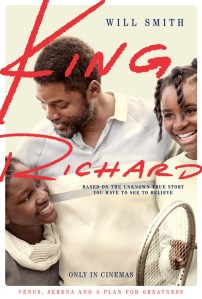 King Richard confounds me and also doesn’t. I can understand what the point was and shrug my shoulders at its choice of narrative perspective. It’s a hagiography that settles on audience foreknowledge to alleviate any tension, or sustained interest, and at its core is a contradiction of a man deserving scrutiny but served up for celebration. As my pal Michael Galusick put it, “I can’t believe there’s a movie about the rise to greatness for the Williams sisters [Venus and Serena], and it’s centered around their dad.” King Richard is an awards-season hopeful, produced by the Williams sisters, and a questionable biopic with a questionable perspective aimed at telling the hidden story behind the meteoric success of two of the greatest tennis stars of all time.
In the late 1980s, Richard Williams (Will Smith) is working all night as a security guard and spending his mornings to train his two pre-teen daughters, Venus and Serena, in tennis. Richard is convinced they will be superstars, that he and his wife Brandy (Aunjanue Ellis, Lovecraft Country) will be rich and move from their Compton, California neighborhood. Richard gets beaten by local gangs, studies tennis magazines and instructors, and tries to get his girls formal training from professionals while holding them back to his demands. He has a plan, he repeatedly tells others, for their success, and nothing will dissuade him from it.
 Firstly, we finally get a movie about the Williams sisters and their dominant rise through the world of tennis, and the movie is almost entirely centered upon their demanding father and his vigilant bordering on abusive training regimen? Richard is meant to be a contradiction and had the movie explored his contradictions in full this could have been an illuminating character study and warts-and-all biopic. However, it’s a movie that fully relies on every viewer’s implicit understanding of the great success of the Williams sisters, so the entire movie serves as a two-hour-plus “I told you so” to Richard’s doubters. Silly neighbor, questioning whether forcing his daughters to perform for hours in the pouring rain constitutes child endangerment. Silly wife, questioning why Richard has insisted his family move into the neighborhood of Compton to better raise his children through adversity and still complain about the dangers that Compton presents and that his daughters must rise above to leave and make something of themselves. Silly tennis coaches, questioning Richard, a man who has no tennis background himself, for demanding his sideline coaching be prioritized over the professionals. Silly “tennis parents,” the kinds that Richard says should be shot, even though he behaves the same way. Silly Williams children, feeling that their demands will be heard and acknowledged as far as their own personal paths and that the other Williams sisters will earn a similar level of attention and affection. Silly sports agents, for being skeptical about this man who says he had a 70-page “plan” for athletic success before his kids were even born and preaching that his unorthodox methods, including paying neighborhood kids to harass and intimidate his girls while they played, would be proven correct. Because, I suppose, it all worked out because Venus and Serena had tremendous success and were inspirations to millions of young African American kids who could finally see themselves in a sport that was privileged and exclusive for generations. He was right, so all of his unorthodox, crazy, dubious methods must have worked, so intuits the movie. It’s less because Venus and Serena have talent and skills and more that their dad worked really really hard and suffered.
With the involvement of the Williams sisters, King Richard only ever goes so far when it comes to critical analysis of its title character. He is certainly presented as a dedicated, hard-working dreamer, but his eccentricities and self-aggrandizing get sanitized as “tough father” when that toughness can cross over into obsession and abuse. It’s like watching 2014’s Whiplash but turned into a feel-good inspirational tale for the ages. At least Whiplash explored the harm of obsession and the pessimistic belief system that whatever it takes to a achieve greatness is excusable. With King Richard, the movie is not at all critical of this ethos. Oh sure, there are points where Brandy Williams speaks up with measured irritation at her husband making rash decisions, excluding the involvement and contributions of others to see his great plan through, and these moments are easily the best in the movie. Finally, someone is pressing this man on his methods and making him confront himself and his flaws. But then Brandy blends back into the background until another half hour goes by and the movie needs to tap her services again. This is the same woman, by the way, who in real life Richard hid her birth control pills in order to back her into a pregnancy and begin his master plan. That’s real. That happened. Same with intentionally keeping his children in Compton so they would learn adversity (tragic side note: one of his older daughters, Yetunde, died in 2003 near a gang house in Compton). And also the fact that Richard walked out on his previous family before Brandy, leaving behind five children all under the age of eight. When he speaks in the movie about always being there for his girls, unlike his father who ran out on him, it rings hollow with the full unflattering context.
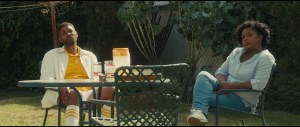 The movie seems to adopt Richard’s belief that if he didn’t push so hard for so long, while also withholding them from the tennis juniors circuit, denying them matches for three years, then perhaps they too would have burnt out and gone down a similar path as young superstar Jennifer Capriati. Except Venus’ first breakout success is because of her own insistence and Richard finally, at long last, acquiescing to the choices being made by his own daughters. Who knows, maybe she would have had success even earlier and not burnt out? It’s just as plausible considering that Richard’s regimen included forcing the girls to earn all As in high school on top of rigorous training. I think this detail is meant to make Richard seem like he values their education on par with their sports performances, but it reads to me as another high-pressure burden he’s beset upon his beleaguered daughters to meet his personal definition of success.
Again, if the movie portrayed this man in a more honest approach, questioning his methods and bringing light to his inherent contradictions, holding people to standards he was unable to hold to himself, taking credit solely for the success of the hard-working women in his family, then the movie would have been an intriguing and revelatory character drama. It would have justified shifting the perspective from Serena and Venus to Richard. But the script by Zach Baylin is too uninterested about those interesting details and contradictions. It knows Serena and Venus succeed so it all becomes a long journey of people doubting him only to be proven wrong. The movie feels more than enough like it reaches its emotional climax, father acceding to daughter as she approaches the big stage, and then there is twenty more minutes of tennis action. Why do we need a drawn-out tennis match at this point? The montage of real-life footage of tennis championships achieves the same emotional effect. If the decision was to finally dwell in the excellence and tenacity of Venus as an athlete cutting loose, then why does director Reinaldo Marcus Green (Joe Bell, Monsters and Men) keep favoring other people’s perspectives during the climactic debut match? We keep cutting back to Richard watching, or those in the crowd, or a squat TV screen monitor. I understand the nature of editing coverage, but if this is celebrating Venus’ moment and handing over the baton to her, then why not give her our full focus rather than repeated check-ins on Richard basking in the ascendant triumph of his hard work?
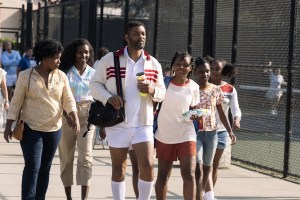 Anyway, if you can take King Richard on its own terms, maybe it will prove fitfully entertaining and inspirational as it follows its formula to the bitter end. It’s received widespread critical praise especially for Smith’s humbled performance. I think Smith is perfectly good, but I also think his inherent charisma, and a generation of audience good will, project onto the character to more excuse Richard’s questionable actions. It would be like watching Tom Hanks portray Jeffry Dahmer; you might not condone all his actions but, come one, that’s American treasure Tom Hanks eating human flesh there. As a sports movie or a father/daughter movie, certain fans of those features might plug into the emotional beats of a feel-good universe and ignore the problematic parts. Maybe we’ll get a story of Venus or Serena from their own perspective, one that sees their father in less flattering terms. In the meantime, King Richard is a feel-good biopic that made me feel bad the more facts I uncovered, and its hero worship of a, at best, complicated man without adequate hesitation made me feel like this was a gift from the Williams sisters for their dear old dad’s ego and legacy.
Nate’s Grade: C
Share this:

No Time to Die (2021)
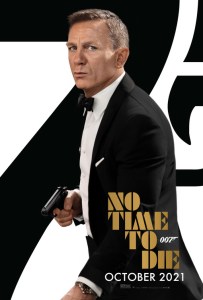 One cannot talk about No Time to Die without talking about finality. I’ll try and dance around significant spoilers but the movie by design is meant to serve as the capper to the Daniel Craig era filling out the world’s favorite martini-drinking British secret agent. I thought that 2015’s Spectre was the swan song for Craig as it brought back a famous franchise villain Blofeld (Christoph Waltz) made the man Bond’s secret half-brother, and it tried to explain how every bad thing that seemed to befall Bond was the machinations of an evil conspiracy, and then it literally ends with Bond driving into the sunset in his classic car with his girl (Lea Seydoux) by his side. It felt like the end, and it felt very much like everyone was just done and tired. And then the Bond producers wanted one more shot, or more likely one more lucrative franchise entry, to send an even older, battle-tested Craig on his way. I was wary of another Spectre-like entry, one that was tying back to the elements of decades-old for empty homage. Does anyone really care that the villain is meant to be Blofeld who means next to nothing to audiences in this era? After watching all 160 minutes of the longest Bond on record, for an actor who has portrayed 007 for 15 years, I have to say that No Time to Die is a terrific action movie and a welcomed second chance at a sendoff for the modern era of Bond that has gone through great artistic rebirth.
Bond’s cozy retirement is short-lived. Spectre agents have found him and Madeleine (Seydoux) and now Bond is forced to ship off his love for her safety. Years later, Lyutsifer Safin (Rami Malek) is determined to take down the last vestiges of the Spectre organization, the same group responsible for murdering his family. Bond is recruited by the newest 007 agent, Nomi (Lashana Lynch), to help MI-6 locate a kidnapped scientist with a powerful nanobot poison that can be genetically targeted to a specific person. Bond agrees especially once he realizes that Safn and his dangerous organization are targeting Madeleine, who has a big surprise of her own.
 As an action movie, I will argue that No Time to Die is better than 2012’s Skyfall, the Bond film that is widely seen as the high point of Craig’s tenure but one I find overrated. Director and co-screenwriter Cary Fukunaga, the second director ever given a writing credit for a Bond film, has crafted a beautiful movie with a real sense on how to showcase the majesty and suspense. Nothing will likely rival the superb cinematography by the legendary Roger Deakins on Skyfall, but this movie gets as close as you can get. It’s a remarkably beautiful looking movie. I mean that not just in the exotic locales and scenic vistas but simply in its depiction of action. The visual arrangements are noticeably several levels higher in quality, elegantly composed and lit to make each scene so pleasing to the eyes even before the information of the scene translates. Fukunaga (True Detective) frames the action in clear shots and clean edits so the audience is oriented with every shot and each patient edit point. For an era that began by trying to adopt the Paul Greengrass-style of docu-drama edits popularized with the Bourne sequels, it’s quite a welcomed change. I appreciate that action directors have creatively gone more in a direction of longer takes, wider shots, and a conscious effort to showcase the ingenuity and skills of its action choreography. Let us enjoy watching the masters of action operate at their highest level. Fukunaga understands this, and while the action might not be the best in the series, it is lovingly orchestrated and displayed.
There is a delightful mid-movie set piece that deserves its own attention mainly because of how actress Ana de Armas (Knives Out, Blade Runner 2049) steals the show. She plays Paloma, a CIA agent working in coordination with Bond, and the two of them wreak havoc across a Cuban neighborhood while wearing their finest evening wear. She immediately leaves a favorable impression and struts her stuff while operating heavy machinery with confidence. This part feels the most aided by co-screenwriter Phoebe Waller-Bridge’s contributions. Craig personally requested that Waller-Bridge, best known for award-winning TV like Fleabag and the first season of Killing Eve, come aboard and help polish the script, including characterization and dialogue. This sequence feels the most in keeping with her past spy thriller work and penchant for strong female characters who are meant to take the lead. de Armas is so memorable, and her segment so self-contained, that it feels like a backdoor spinoff to set up her own character’s franchise, and one that I wouldn’t hesitate to watch.
 If you thought Spectre was getting convoluted with how it tried to bend over backwards to explain how one man and one villainous conspiracy were manipulating all of Bond’s many miseries and setbacks, well then things are going to get even worse for you to keep up with. I’ll credit returning screenwriters Neal Purvis and Robert Wade, who have been with the storied franchise even before Craig’s 2006 debut, with attempting to make the continuity matter for a franchise that often throws up its hands at continued emotional stakes. By stretching backwards with ret-cons and added flashbacks, every new Bond movie tries to better evaluate the previous ones including the poorer movies, like Spectre and 2008’s Quantum of Solace. It’s like saying, “Hey, you didn’t like those bad guys in that movie? Well, these are the real bad guys,” or, “Well, maybe you didn’t like them, but their heinous actions gave rise to these new bad guys.” However, a consequence of continuing to add further and further clandestine machinations, and spiraling consequence from those machinations, is that Bond has now become a tangled web that is more convoluted without offering much in the way of payoff. I don’t think much more is gained introducing a new villain saying, “It was me all along,” when we don’t have an established relationship or interest with these new villains. Imagine introducing the Emperor back in Episode 9 of Star Wars and saying he was secretly behind everything… oh wait.
There are also benefits to this approach and No Time to Die crafts a sendoff unlike any other final entry for a Bond actor. This is a franchise going back sixty years, but the 007 brand has endured because no one actor is bigger than the brand. The franchise is regularly resetting with each new addition. The hyperbolic bombast and tongue-in-cheek frivolity of the Pierce Brosnan years (1995-2002) was replaced with a more grounded, gritty, and psychologically wounded Bond, made even more so by giving him personal attachments and then taking them away. I would argue this decade-plus with Craig (2006-2021) has involved the most mature and personal movies of the franchise;s history. It’s fitting then for the final film to pay service to that elevated take on the character. If you’re treating the secret spy as more of a person than a suit and a gun and a wisecrack, then that character deserves an ending that stays true to prioritizing more human elements of the character. To that end, No Time to Die works as a final sendoff, and I feel pretty confidant saying Craig is officially done now.
After a year and a half of delays from COVID, as well as its parent company, MGM, being bought for billions by Amazon, we finally have the final Bond movie in Daniel Craig’s successful run, and it’s a worthy finale for an era of the franchise becoming relevant again. I don’t know if that many people are emotionally attached to the character, likely more so just the nostalgia and the franchise, but if ever you were going to tear up from a James Bond thriller, this would be the one. It’s an exceptionally strong visual caper, with smooth and steady direction from Fukunaga, and while overly long and convoluted and a dull villain, it comes together for a worthy and celebratory conclusion that stands with the best of Bond. I’ll still cite 2006’s Casino Royale as the best Craig Bond, and one of the best ever, but No Time to Die is a solid second-place entry, and it does what few other Bonds ever could: fitting finality. Until, naturally, the popular series inevitably reboots with the next handsome leading man sipping a signature vodka martini (shaken, not stirred).
Nate’s Grade: B+
Share this:

Double Walker (2021)
 After watching so many nominal Ohio-made indies, it’s a welcomed surprise to come across one that falls into the category of an “almost” movie, and by that I mean one with clear ambition and talent that almost fully works as a legit movie without any lingering qualifiers. Double Walker, filmed partially in Columbus and now given a national digital release, comes so tantalizingly close to being a full recommendation without hesitation. I can see what it’s going for, and with a little more careful development and clarity I think it would have achieved all of its genre-busting goals.
Sylvie Mix plays Ghost, a young woman who appears in a white nightgown in the woods. Who is she? What does she want? She is escorted by a young man into his home, disrobes, and then murders him. We come to learn that this adult woman is the ghost of a deceased child, and she’s chosen to walk the Earth as a spirit to seek vengeance. She’s only able to be seen by believers and sinners, though technically every person is a sinner unless there is an unspecified threshold to pass. The Ghost makes a friend, visits with her grieving parents, and reevaluates what it means to be human.
 The first thing to know about this movie is that it is only 65 minutes long, short of the 80 minutes typically seen as the minimum expectation for a theatrical release. It’s not that far from meeting that goal, though the airy nature of the movie also makes it feel already stretched out. The other thing you should know about the movie is that you could describe it as Promising Young Woman meets The Crow, an avenging angel targeting the bad men responsible for her death, except tonally it’s not really a hard-hitting revenge thriller. It has those elements where our Ghost is stalking her very bad men, luring them into positions of vulnerability, and striking back for justice, but the movie seems more aligned in tone with something more ponderous and poetic like 2017’s A Ghost Story (though absent ten minutes of Rooney Mara eating a pie – thus fulfilling my obligation to mention this dumbfounding cinematic moment whenever I have the opportunity, you’re welcome).
For those people looking for sundry exploitation thrills, seized by the striking central image of its poster, you may be left checking your watch, but I found this middle ground between thriller and art film to be an interesting space for Double Walker to inhabit. The screenplay drops you into its bizarre scenario and unfolds slowly, which I think worked to the film’s potent atmosphere. You don’t really know what’s going on or what the character relationships are like. At first you see a grieving family, and next we cut to a man discovering a pale woman who seems lost in the woods. She comes across ethereal and mysterious. Then there is a murder, and from there we’re trying to identify the character connections and back-story, which comes across at a gentle yet assured pace that trusts the audience to put the different pieces together to form a whole. This works well except for an ending that comes across as too confusing, muddling an already convoluted system of supernatural rules that the movie seems to be undercutting, unless the whole thing is presented as a hopeful but passing dream, and if that’s the ending then I’m going to be quite disappointed. Still, this is a movie at its core more interested with the question over being human, being remembered, and personal identity than as a blood-soaked revenge thriller.
 Again, it has its moments of blood, but there’s a somber tone poem quality to the movie that elevates its ambitions and also ties down its ultimate execution. Director and co-screenwriter Colin West is using the structure of an exploitation film to do more than deliver sleazy thrills. He devotes much more time to watching our Ghost character adjust to life as a spirit. The Ghost is the same spirit as the little girl we saw being eulogized in the opening. This presents some awkwardness for the character and the viewer. For the character, she’s gone from the mind of a child to being in the body of an adult, and it’s not determined whether this adult body is what she would have eventually grown into being or whether it’s just a default model. This allows for an even more curious performance as a character that feels alien in their own skin but also fascinated by that change in perspective, like Scarlet Johansson in Under the Skin. I understand the Ghost studying her adult body with curiosity. However, for the viewer, the numerous nude scenes can make you uncomfortable with the understanding that this is a little girl transported into the body of an adult and she is using her sexuality to lure men to their perverted doom. Maybe I’m just more sensitive to this connotation, and “using her sexuality” seems like an overstatement as she’s simply a woman being present with predatory men. I will say the nude scenes are tastefully portrayed where the camera doesn’t feel like it’s going to painful lengths to feature flesh. I was about to accuse the movie of possibly being skeevy with its plurality of nude scenes (does the Ghost need to run out into the woods in the buff?) when I noticed that Mix is also the producer and co-screenwriter. I assume she approved of her depiction.
Because of her newfound identity, and separation from most living beings, Double Walker presents a main character who is trying to form connections but cannot. The Ghost tries to console her grieving mother but is unable to be seen or felt by her. She does meet a kind man (Jacob Rice) at a movie theater who helps her out and who is not looking to take advantage of her. He shares his family’s home movies, which is a slightly strange thing to do so soon with a nearly mute stranger, and compares the images captured on film like ghosts, crystalized memories of people no longer with us. I have thought of this comparison myself and will morbidly watch background extras in old movies and think, “Here they are, alive once more, but likely gone for some time.” The direct connection of ghosts and memory allows the movie another layer to provide additional meaning. However, Double Walker feels more like a stretched out short film than a fleshed-out feature. With a few extra wrinkles and plot development, this could have readily afforded a larger story. Later on, the Ghost makes a rash decision and an innocent is harmed in her path to vengeance. I think that’s an interesting direction and questions the righteousness of her cause, while at the same time the script finds a personal way to make that mistake even more grueling. Again, the script really could have gone into this consequence and pushed the character into more inner turmoil, to question the cost of her mission, and to question her perception of human life. There are areas where the movie could have gone into further deliberation, but they feel short-changed. Double Walker is settled being the extra long version of the movie it presents in its first act.
 This is a very professional looking and sounding movie and probably has the best photography of any Ohio-made indie I’ve watched yet. West also served as his director of photography, and his eye for visuals is crisp and pleasing. The use of light, shadow, foreground and background, composition, movement, it was very deliberate as well as being artistic in a way that didn’t feel like it was overly self-indulgent. West achieves an artistry without making it flashy, and that’s even harder to accomplish. The score and sound design are also polished as well. When the Ghost is luring a victim, the eerie sound is reminiscent of metallic scraping to elicit unease. The costuming keeps our Ghost in white outfits, noting her innocence but also visually connecting you to the associated color of traditional spirits (an also, maybe, A Ghost Story). It makes her standout on the screen. Speaking of that, Mix (Poser) is a natural actor. She has a presence to her and ably communicates the curiosity and otherworldly nature of her character’s dilemma. She doesn’t talk much, nobody really does in this movie, but there’s a melancholy to her that feels more pained than forced. The other actors do well with their minor roles, including other Ohio actors I’ve covered before like Justin Rose (False Flag) and Ralph Scott (Constraint) playing bad men who become ghostly prey.
By the end of Double Walker, I was left feeling almost satisfied, one of those film experiences where you can see the better movie just on the peripheral, the one that was so close. As it stands, it’s an arty and contemplative movie that uses the exploitation formula as a vehicle to explore more existential questions. I wish the movie had developed the story more from the potential on display, and what potential is on display. The filmmakers here feel like they are headed for great things. West has already filmed another movie he wrote, Linoleum, starring Jim Gaffigan and Tony Shalhoub about a science teacher who always wanted to be an astronaut and builds his own rocket ship in his garage. That sounds amazing and it has big names to fill out the cast. I’m rooting for West. This guy has the talent and ability to be a rising indie director and can do Ohio proud. Double Walker could end up being the flawed but promising start to a burgeoning film career. It’s worth watching but be warned that it might not be the movie you anticipate at first glance.
Nate’s Grade: B
Share this:

Eternals (2021)

Chloe Zhao is the biggest name Marvel has gotten yet for its cinematic universe (MCU). Sure, they’ve had major directing names before like Kenneth Branagh and Ryan Coogler, and successful populist genre filmmakers like Jon Favreau and Joe Johnston and Joss Whedon and Shane Black, and quirky auteurs like James Gunn and Taika Watiti. However, Zhao is the first Academy Award-winning director to jump into the Marvel sandbox. Zhao seems like an odd fit for something as mainstream and successful as the MCU, but she was excited to tell a big story with the biggest studio operating in Hollywood. Eternals (no “The”) is just as much about the question over what it means to be human as Zhao’s Best Picture-winning Nomadland, and it’s a lot easier to watch with one hundred percent less Frances McDormand pooping in a bucket in her van (granted, she did win an Oscar for that performance). Eternals has received the lowest critical rating of any MCU film in its thirteen-year history and I’m trying to figure out why.
Thousands of years ago, the Eternals were created by the Celestials, powerful beings that are responsible for birthing new galaxies into the universe. The Eternals were sent to protect the inhabitants of Earth from the Deviants, terrifying tendril-heavy monsters that will consume and overrun a world. The Eternals are instructed by their masters not to intervene in human conflicts; only to intervene to save them from Deviants. Now that the last Deviant has been dead for over 500 years, the Eternals have settled into comfortable lives among present-day humans. Then the Deviants return, evolving with added powers and posing a new threat to humanity and the Eternals, but the real threat might be outside the confines of Earth.

Eternals feels like a different kind of Marvel movie in that stretches feel like it’s a Stanley Kubrick movie, or a Terrence Malick movie, or a DC movie. The plot structure and tone even reminded me of Watchmen. Don’t get me wrong, the standard Marvel elements are recognizable, but this is a much slower, more methodical, more cerebral, and more challenging movie that really feels like a distillation of Zhao’s humanist indie naturalism and the crazy cosmos from Jack Kirby’s trippy source material. I can understand why some people would find this movie to be boring and poorly paced. There are extensive flashbacks and setup. It definitely doesn’t need to be a staggering 157 minutes long, second only to the three-plus hours of Endgame. Granted the movie is introducing a dozen characters, their relationships, their powers, their histories, as well as a new history for the universe that doesn’t relate to anything that came before it. There are assorted references to Thanos and the events of Endgame, bringing half the population back, but this is more a standalone movie that can serve as an introduction for those less well-versed in two dozen movies’ previously on’s. I knew going into Eternals it was going to be slow, and I knew several friends that outright hated it, but I think pacing is more to its benefit and detriment. The scenes feel like Denis Villenueve (Dune) is pacing them, where moments are given more time to breathe and where characters are given space to reflect and absorb. Like a Villenueve film, Zhao wants her audience to take in the grandeur of the moment, but she also wants the characters to be able to take in the drama of their circumstances. Some people will find it all too boring, and while there were points that could be trimmed, I was enjoying myself because of the attention to character perspectives that are given precedence over splashy beat-‘em-ups.
I was drawn in by the character reveals, their conflicts, and the time Zhao allows to examine their emotional and philosophical states. Look, it’s still a big, action-packed Marvel movie with plenty of monster fights and a world-saving cataclysm climax, and while those are agreeably executed, I was more taken by letting the characters pontificate on their problems. There’s Sprite (Lia McHugh), an eternally looking child who can never live an adult life she craves. There’s Druid (Barry Keoghan), a man with the power to control the minds of all humans on Earth but is explicitly instructed to remain hands-off with their conflicts. He is severely torn and emotionally wrecked over watching them slaughter one another and knowing he has the power to intervene and resolve genocide, prejudice, and poverty. That’s the eternal question over why a loving God seemingly chooses to be hands-off, all rolled into one character. There’s Thena (Angelina Jolie), a legendary warrior of physical renown but whose mental state is fracturing and who poses a potential lethal threat to her family. There’s her partner, Gilgamesh (Don Lee), who would rather watch over his love as she suffers and potentially declines than have her lose her identity and erase herself. There’s Phastos (Brian Tyree Henry), a man who only wants to help the humans with his technological skills but regrets his contributions and declares humans as unworthy of their keep after Hiroshima. Then there’s a reveal halfway through the Eternals that loads a needs-of-the-many sacrificial debate that positions different characters on different sides of the divide for the final act. I enjoyed that even the villains are presented with their rationale and are tortured over their choices they deem to be necessary for the greater good.

I’ve written a lengthy paragraph all on the meaty character conflicts, and none of them revolve around the goal to gather a magic item or learn a special power. I didn’t mind Zhao’s movie taking its sweet time to allow these conflicts and struggles to be felt because they were evocative, and Zhao’s storytelling shines when she focuses on the noble and often tragic struggles of people being complicated, contradictory, and confusing. Even the big dumb beasts evolve and have a perspective that has an understandable complaint. The final confrontation doesn’t come down to a giant sky beam and an endless army of disposable CGI brutes. It rests upon character conflicts and a romance that spans thousands of years where empathy is the secret weapon. Early on, you think it’s going to be a love triangle, and the movie just teleports out of that trope. I found myself more invested in the ending, even if I could already predict the conclusion. I was more interested in what the conflict was doing to the Eternals as a family fracturing under the weight of their destinies and the consequences of defiance. The film ends on a cliffhanger with significant fallout, and I don’t know how the rest of the MCU is going to square what we learned and accomplished here. This seems in sharp contrast to everything down the road.
Eternals is also an often beautiful-looking movie with Zhao’s penchant for natural landscapes and magic hour lighting. The editing and photography feel nicely matched and allow the viewer to really soak up the natural splendor and the impact of the battles. The action is kept at a human level with the camera tethered to the characters even when in flight. There is the occasionally eye-opening shot of a landscape, or Zhao’s use of visual framing, or the special effects revelations that reminded me of 2001: A Space Odyssey. It’s certainly not the most breezy, action-packed movie in Marvel’s lengthy canon of blockbusters, but it’s not devoid of spectacle.

So then why has Eternals scored so low with film critics and a significant portion of general audiences? Some wonder if the level of diversity and inclusivity of the movie is a factor; we have many non-white characters including a deaf character and a gay male character in a committed relationship, with a genuine and loving onscreen kiss no less (your turn, Star Wars franchise), and that seems like a trigger point for certain fans that grumble about “woke culture.” I’m sure for some that’s a factor. I think the length will be a factor too. I think the elevated emphasis on emotional stakes and philosophical conflicts might be another factor. This doesn’t feel like any Marvel movie that has come before. It’s much more comfortable with silences, with patience, and with cerebral matters (again, not to say the dozens of other MCU entries were absent these). This one is just different, encompassing the directing style and humanist attentions of Zhao and looking at a far larger scope of drama than toppling one super-powered being. I saw this in theaters with my girlfriend’s ten-year-old daughter and her friend and they both said they enjoyed it, so I won’t say it’s too mature or impenetrable for younger viewers. Eternals might be too boring for some, too long, and too different, but I was happy to endure it all.
Nate’s Grade: B
Share this:

Escape from Death Block 13 (2021)

Gary Jones is no stranger to schlock. The writer and director’s feature debut was 1994’s Mosquito about killer mosquitos that have fed on the blood of dying aliens. His filmography also includes such amusing titles as Crocodile 2: Death Swamp, Jolly Roger: Massacre at Cutter’s Cove, Planet Raptor, and 2013’s Axe Giant: The Wrath of Paul Bunyan, which was filmed in Ohio and featured several actors that have appeared in other Ohio indies I’ve reviewed, like Dan Kiely (Bong of the Living Dead), Kristina Kopf (The Street Where We Live), and Thomas Downey (Evil Takes Root). Jones knows his schlock. Escape from Death Block 13 is the man’s ode to the prison escape thrillers of the 1970s, and it even stars a lead actor who looks remarkably like Charles Bronson. I hoped that Death Block 13 was going to be the good kind of low-budget indie, the one that swerves into its schlocky genre trappings and limitations. However, too many of its creative limitations felt more notable, from limited actors, the limited location shoot, and especially the limited plot development for payoffs and action goodness.
Mick (Robert Bronzi) is a recent immigrant trying to set right his brother’s fate. He visits his dead brother’s boss, Renda (Nicholas Turturro), and demands the money cheated from his brother. Renda’s goons rough up Mick, and in the scuffle, Mick shoots a gun in defense and he’s the one arrested and charged with attempted murder. Inside the deadly prison, life is rough that the guards will let the prisoners fight to grievous harm because they have bets on who will win. Mick becomes a favorite of Warden Jack (Debbie Scaletta) who pressures him to go along and assist with her lucrative smuggling business of guns and drugs. Mick refuses and makes himself a target. He’ll need to adjust to life behind bars, stand up to the bullies, and plot his escape with the secret tunnels located under the grounds of the prison.

The question arises how far a Charles Bronson lookalike can get you as far as entertainment value, and that’s going to be a question for the soul of every viewer. The movie feels like it was a Cannon production, where the poster and title were the selling point and the rest, well we’ll get to that when we need to. The central image of a man that looks like Charles Bronson, holding a gun, looking grimaced, with a title about a prison break, it all feels meant to target a certain audience’s favorable memories of Bronson and his own popular action filmography. Low-budget exploitation genre movies have been made for less, so it’s not a damnable sin, but it sure means that the movie’s transparent intention to rest on its familiar elements needs to be overcome with story, characters, and most importantly, memorable action and ridiculous moments to satiate an audience’s genre appetites. Escape from Death Block 13 mostly gets there when the escape part happens, but beforehand, it’s a sloppy action movie that can test your patience because there are too many reminders of its own scaled-down shortcomings.
Chief among them is casting Bronzi as the lead. It feels like the mere casting of this Hungarian acrobat, stuntman, and Judo player, as per his bio, was the starting and ending point for his character. He’s an immigrant looking to avenge his brother and immediately gets thrown into the middle of a conflict as everyone seems to be incorrectly judging him (subtle commentary on the audience expectations?) based on his appearance. The gang thinks he’s up to no good, the other prisoners and the warden think he’s a troublemaker, and the law thinks he could be their missing piece and assist to bring down the corrupt warden. It could almost be self-parody the way every new batch of characters project an identity onto this blank hulk of a man. I think even Bronzi is leaning into this helpful projection and association with Charles Bronson. His real name is Charles Kovacs, but Bronzi sure sounds closer to Bronson. He also starred in Once Upon a Time in Deadwood, working to associate Bronson’s Once Upon a Time in the West, as well as the HBO Western series, and Death Kiss, working to associate Bronson’s Death Wish. Again, congrats to Bronzi for finding himself a career as a Charles Bronson stand-in. I look forward to the man’s continued career of kind of reminding people of the departed Bronson.

However, Bronzi is not a terribly good actor. His line readings are resolutely stiff, and his accent is thick, so it can be hard to understand what he’s saying with his flat affect. There’s one joke where he makes fun of another prisoner for not understanding his accent, but I didn’t quite understand the joke because I was having trouble with his vocal articulation. To the man’s credit he definitely has a presence and can convincingly strike an intimidating pose. He’s comfortable with the fight choreography though it’s nothing too complex to be strenuous. His emotional acting range and vocal delivery is another matter. I think the limited nature of Bronzi’s ability forced the filmmakers to minimize the number of lines and dramatic scenes for his character, thus making him even less distinct and relying more on his passing impression.
I legitimately think the movie could have been improved had everyone been dubbed. Bronzi is not the only actor of limited range in the movie, he’s just the one with the most screen time. There are many supporting actors who were clearly hired for their physical prowess rather than thespian abilities. These actors would say lines and it would make me giggle at points. There are other actors who take one note, like the police officer in an interrogation scene trying to go full intense exasperation mode, and then deliver every line in this narrow acting space. It’s moments like this where the movie feels destined to willfully drift into unintentional self-parody. I think having a purposely dubbed audio track would provide two benefits: 1) it would allow better vocal actors to lift some of the lackluster performances, and 2) it would further cement the movie’s silly schlock factor and give the audience permission to laugh along with. The best actor in the entire movie is the prison doctor and just for the one scene where he dies. After being injected with a deadly dosage, he goes into cardiac arrest and the actor is so dedicated, so over-the-top, and so prolonged in his death throes that I had to celebrate the man’s gumption. Here was a guy who took what was handed to him and found a way to make it delightful. I wish every actor was on this same tonal wavelength of good-bad rather than just dull-bad.
Once the titular escape happens, the movie jolts to a new life, enough so that I wish we could have gotten things moving faster. The last twenty minutes of the movie is replete with chaotic violence and over-the-top blood shots. The action is adequately choreographed and fast-paced enough to offer several different set pieces and cross-action to keep your attention. It’s all over the place, it’s more whole-heartedly schlocky, and the frantic pacing is a definite bonus. The problem is that as a prison break movie there wasn’t really any definite reasons why the characters had to wait until this late moment to stage their escape. Usually, these kinds of movies introduce the system of the prison so we understand the routines so that they can then be exploited, like a con or a heist job. We need to know the particular steps for the payoff to feel rewarding. Otherwise, like in Death Block 13, it just feels arbitrary. The evil warden doesn’t come across as too formidable. The guards are not too formidable. These people are not the smartest criminals in the world of smuggling. And the inmates could have banded together at any point and easily overthrown this weak power dynamic. Even the heavy-duty Gatling gun attached to the lookout tower isn’t too hard to overcome. The obstacles are vague or weak, thus making it feel like the big escape could have happened as soon as Mick was thrown into this pokey.
The movie was filmed in the Mansfield Reformatory, the same famously depicted in 1994’s Shawshank Redemption, but at points it sure doesn’t feel that way. I don’t know the exact budget-conscious decisions of the production or the shortcuts they had to work through, but there are several sequences inside and outside the prison that are obviously green screen. It made me start to meticulously examine the visuals and see if it was indeed the famous penitentiary or some other set meant to be stitched together through the power of editing. It’s possible the movie had a very limited availability to shoot inside the prison, so they took extensive pictures to recreate as a more convenient green screen background. I’m uncertain. The green screen work isn’t bad by any means but pretty obvious to the eye and limits the potential visual arrangements for staging the action, which can often resort to shot-reverse shot redundancy.
If the rest of the movie was like its concluding act, I would be recommending Escape from Death Block 13 to fans of low-budget schlocky action and fans of Charles Bronson. It’s strange to think part of the major appeal of this movie is that it stars a guy who strongly resembles another guy that was in movies decades ago that people mostly remember liking. The general association of other, better movies seems to be much of the creative backbone of this movie. The story isn’t packed with careful setups and payoffs, built upon a foundation of obstacles and mini-goals that need to be accomplished before the big escape finish. It relies too heavily on cliched genre moments, like multiple prison yard fights, and the riot ends in a hostage negotiation that could have been its own movie itself rather than a pat conclusion. The movie is weighed down by the acting limitations of its lead who looks the part but fails to do much more on screen. It’s an action movie that, even with caveats and understanding of its limits, manages to disappoint. I wish this had been crazier, or better plotted, or filled with more colorful and arresting characters, or bigger villains, or anything really. It’s an action movie that feels like the ghosts of other, better action movies starring a man who might as well be the living ghost of Charles Bronson.
Nate’s Grade: C
Share this:

Finch (2021)
 Delayed almost two years thanks to COVID and eventually sold to Apple, Finch is the story of Tom Hanks trying to survive the irradiated post-apocalypse with a dog and a robot. That’s the pitch and that’s actually about the extent of the movie. Tom Hanks plays a man dying from UV exposure and trying to create a provider for his beloved dog, who itself has a sad back-story. It’s a simple story but the movie succeeds on the detail of its world-building and the sincerity of Hanks and Caleb Landry Jones (Get Out) in a mo-cap performance as the nascent robotic helper who names himself “Jeff.” It’s a post-apocalyptic buddy film, a road trip movie, and a survival thriller against the new reality of supercharged weather elements and the threat other people can present. The set pieces are effectively developed and open up Finch as a character. Almost after every big moment we have a quiet one where Finch uncorks a monologue that explains more about his own tragic past, the tragic events that left much of Earth to be highly irradiated, or the relationship he had with his own absentee father. Hanks is nicely vulnerable and warmly paternal as a man teaching a robot how to be human in the pursuit of caring for others. This could have been a post-apocalyptic one-man show, a Cast Away meets I Am Legend, but Jones is an enjoyable foil as the clumsy robot who is trying to make his creator proud. The robot design is very minimal but Jones is able to find small ways to communicate the childlike emotions of the character. The movie doesn’t have any devastating moments of suspense, terror, or meaty character drama. It coasts on a pleasant and gentle spirit with a touch of melancholy but Finch mostly keeps things in a relatively heart-warming territory. Finch isn’t much more than its initial pitch, but I’m happy to spend two hours with Tom Hanks trying to teach a robot how to be nice and brave in order to save a dog (spoiler alert: the dog lives too).
Nate’s Grade: B


 nathanzoebl
You must be logged in to post a comment.