Blog Archives
Triangle of Sadness (2022)
 The Palme d’Or-winning satire Triangle of Sadness comes from excellent stock. Swedish writer/director Ruben Östlund made audiences squirm with 2014’s Force Majeure and 2017’s The Square, so I anticipated an excellent comedy that made me cringe as often as it made me laugh. The unwieldy two-and-a-half hour experience made me laugh, made me avert my eyes, and ultimately underwhelmed in approach and pacing. Lampooning the entitled, oafish, and essentially useless upper class is an easy enough comedic approach, but I guess I was waiting for something more specific or nuanced. I did enjoy the kindly elderly couple who made their fortunes on grenades and landmines. The movie starts off lackluster, with a handsome young couple (Charbli Dean, Harris Dickinson) arguing over money, and then transitions to its luxury cruise where the rich are pampered and pandered, like when the entire crew has to drop whatever they’re doing to change into a swimsuit and take a dip in the water to please a rich lady who bravely believes she is helping these poor souls “relax” from their troubles. Too often, the movie trades in pretty broad critiques and even humor. There’s a nauseating ten-minute sequence that is nonstop projectile vomiting and exploding toilets overrunning with filth (do you get it? The ship is also called “Society” and it sinks, so do you get that?). The last hour of the movie involves a small group from the cruise trying to survive on a deserted island, and it’s here where the power balance shifts, allowing Abigail (Dolly De Leon), one of the housekeeping staff, to become a de facto leader because she’s the only person with useful skills. The obnoxious rich people begin to get some comeuppance, but Östlund won’t allow easy payback for satisfaction. I missed the simplicity of Force Majeure‘s deconstruction of fragile masculinity. It was a much more coherent thesis that felt richly explored with its supporting characters and central dynamic. I think this movie was a little too scattershot and lackadaisical. It’s supposed to be about capitalism propping up a useless class of people, but there isn’t enough savagery during the island portion to really seal this prickly commentary. At no point, do people literally eat the rich, alas. Triangle of Sadness ends so abruptly that I loudly groaned, as it feels less ambiguous and more like I’m missing out on an actual conclusion of a movie, and after 150 minutes at that. It’s an entertaining and exacting experience but one that could have benefited from judicious trimming and a little more shaping, with its narrative and social criticisms. Also, R.I.P. Dean, who died shortly after the film’s release and was only 32 years old.
Nate’s Grade: B
Share this:

Amsterdam (2022)

It’s been seven long years since writer/director David O. Russell made a movie. He was prolific from 2010-2015, making four movies, which were nominated for a slew of Oscars, especially in multiple acting categories. Three were also nominated for Best Picture and Russell was nominated for Best Director three times as well. It was quite a vaunted run of mainstream and critical success, with devoted actors like Christian Bale and Jennifer Lawrence eager to sign up for Russell’s quirky ensembles (it helps when both won Oscars playing Russell roles).
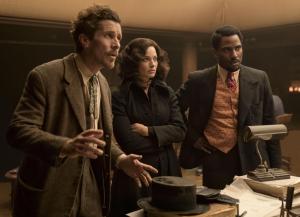
It’s natural to want to take some time off after such a busy creative period, but as the years stretched on, and after the Me Too accountability movement, Russell’s on and off-set behavior gathered more scrutiny and rebuke. His volatility had been known, like his screaming fit he had on the 2004 I Heart Huckabees set with Lily Tomlin. Even George Clooney recounts stepping up to Russell’s bully behavior on the set of 1999’s Three Kings (rumor has it Clooney was the one who released the Huckabees footage). On 2013’s American Hustle, Amy Adams said she cried repeatedly from Russell’s bullying and felt intimidated and isolated. Then there were the renewed revelations from Russell’s own niece who had been transitioning and accused Russell of inappropriate touching when it came to her changing body. Russell even admits to this, though he defends his actions by saying he was given tacit permission, or so he says. With all of this controversy and harassment swirling around Russell, it’s a wonder who would want to continue working with this kind of person. I guess as long as he was producing at his peak level, studio execs would excuse his bad behavior and keep funding his ballooning budgets. Well Amsterdam might just be the end of Russell’s star-studded big studio ride.
In 1933 New York, Burt Berendsen (Bale) is a WW1 veteran making ends meet as a doctor who specializes in veteran care. He and his best friend Harold Woodman (John David Washington) are framed for a murder and on the run, and the only way to clear their good names is to uncover a conspiracy that leads to a possible government coup. Helping the fellas out is Valerie Voze (Margot Robbie), a nurse who makes art from the shrapnel she recovers from inside war vets, and a wealthy socialite who also happens to be in love with Harold. Together, the three friends bumble their way through danger and mystery and crazy mishaps.
This is a mess of a movie, a waste of its top talent, and an excess of Russell’s excesses. The director has established a certain style since 2012’s Silver Linings Playbook, a movie I still to this day genuinely love (it was my top movie for that year). It’s a style that communicates mania, a nervous energy, and it made sense for Silver Linings Playbook as the movie was following a bipolar protagonist given to uncompromising bouts of mania. It makes less sense with each additional movie, but this improv-heavy, experimental, loose sensibility has become the default style for the director, and it feels misapplied. It leads to Russell bombarding his actors with questions or different requests in the moment, keeping them guessing, and actors have gone forward saying they never knew what they were shooting on the day and the shooting never stopped. This indulgence leads to stories that feel like a lot of elements are sloppily thrown together with the undying hope that somehow it will all come together in the end. With Amsterdam, it doesn’t.

It’s not a great sign when I can say that the entire first hour could be jettisoned. There’s little sense of urgency for far too long, and what is presented feels almost comically unrelated, like even Russell can’t believe his silly characters are in real danger. The uneven pacing creates many dead spaces that feel like an awkward improv detour that you wish could have been avoided. We’re introduced to Bert as a drug addict, and then as a World War One veteran helping other veterans with facial scars and wounds, Bert’s relationship with his pal Harold, then their history in France during the war, then their introduction to Valerie and their kinship, then we have a mysterious death that also leads to a secondary love interest, which requires more setting up of the first love interest and her disapproving family, and then we get police investigating and warning about the first death and then a second murder, this time blamed on our characters, and they’re off to clear their names by… reuniting with Valerie and then bumbling through more characters before, finally the movie presents what it’s actually about well after a full hour-to-80 minutes of movie. It is exhausting and feels like a meandering alternative story that was clumsily grafted onto the Business Plot of 1933. The first half of the movie feels like a slipshod screwball comedy, and then once the particulars of a fascist conspiracy to overthrow the president are introduced, it’s like watching Looney Tunes characters try and foil Adolf Hitler. It just does not tonally work.
The Business Plot is a lesser known event in history, glossed over by the fact that the chief perpetrators more or less got away with their insurrectionist planning. They never did succeed in overthrowing FDR and installing their puppet, but they also did not get prosecuted in the end and most of the media dismissed the scheme as hogwash. It’s undetermined how advanced this plot eventually got but a coup was discussed by a consortium of business leaders. It feels like Russell is applying what he learned from 2013’s American Hustle, which introduced a crazy group of fictional criminals and then, in its last hour, explored the real Abscam criminal sting of the 1980s. I can see themes that Russell thinks are still prescient today, like a dark element desiring to overthrow the U.S. government because it didn’t get its way, as well as the collusion of big business in political king-making, seeking shells that will do what their benefactors demand. The problem is the themes behind this scheme are too serious for Russell’s trifling antics. Think about retelling the insurrection on January 6th but for the first hour it’s two bumbling bank robbers who keep finding themselves in the worst possible situations, ending at the U.S. Capitol. If you’re going to treat the rise of fascism, assisted by corporate overlords, as a serious threat, and something relevant for today, then maybe don’t have most of the movie be wacky nonsense.
Russell’s past films have often glided on energy and in-character authenticity, but this one feels so grasping and desperate. When the master plan to reveal the conspiracy and its shadowy participants is throwing together a big veteran’s show, I was reminded of the movies of young Mickey Rooney and Judy Garland where the solution to any dilemma was to put on a show. Then at one point the literal Nazis are singing loudly in German and are being confronted by our characters and the good patriotic Americans counter by singing “America (My Country ‘Tis of Thee)” and I had to stop the movie and just let out a deep sigh. I think Russell was going for the famous reference in Casablanca, also against Nazis, but it just flounders into unintentional comedy, accentuated by the antsy energy that treats it like camp. There are a couple of spots that I laughed out loud, though I doubt that was the intended response, like watching Taylor Swift abruptly run over by a car. The attempts at actual humor are winding and often lead to little, and the characters feel like more of a collection of quirks than firmly established personalities and perspectives to anchor a movie. What does Bert having a false eye add besides something for Bale to fidget with? What does Chris Rock have to do here? What does Anya Taylor-Joy have to do here? Most egregiously, what does John David Washington have to do here? It feels like Russell just wanted a character for Bert to talk to. The screenplay is overstuffed and polluted with all these minor and underwritten characters that could have been better consolidated.

I suppose you can still have fun with Amsterdam and engage with it on a light-hearted level, smiling as you watch the many big stars having a good time messing around with accents, props, and wacky character traits and tics, like a bunch of kids with a dresser of costumes (maybe it is a throwback to those corny Rooney/Garland kids pictures after all). With other Russell movies, I’ve felt invigorated by the energy and artistry, encouraged to sit a little closer and be more attentive of the character turns, and dig into the actors making three-course meals of their roles. With Amsterdam, I felt the desperation to recreate the success of old patterns but the creeping realization that it wasn’t going to materialize. It’s just a big mess of a movie, not without interesting ideas or moments or good acting, but too much feels resoundingly and frustratingly frivolous. You could ditch entire characters, entire subplots, even entire hours of this movie. Amsterdam cost Disney/Fox $80 million dollars, the biggest of Russell’s career, and only earned a pittance, so I think there is a retraction in due order. Begin with not watching Amsterdam yourself.
Nate’s Grade: C
Share this:

Emancipation (2022)
 There is a question with every new movie depicting the Holocaust or slavery or some other horror of the past, why do we need this still? It’s a suitable question but one that rests upon the fleeting assumption of history being settled upon. “We all agree slavery was bad,” some opponent might say, “So why do we need another movie to convince us what we already know?” One need only look at the last couple years and the diverging controversies over teachers covering the ills of America’s past with clarity, and it’s clear that the idea of settled-upon history is an illusion. There will be people arguing slavery wasn’t as bad as history has perpetuated, that even the Irish experienced something similar as indentured servants (but they were still legally viewed as people). Some will erroneously argue that slaves were there by choice, or that their masters weren’t all cruel, and that even by having a roof over their head and the bare minimum for sustenance that they were “looked after.” There are battles happening all over the country, with one side trying to present the evils of slavery in an unvarnished manner and the other trying to obfuscate, mitigate, or distract from the facts because accepting a reality that your country has made mistakes somehow means being unpatriotic or loving your country considerably less. So to answer the question, as long as we have others denying history for political expediency, then yes, we need more media to remind us that the horrors of the past were indeed horrific. With that in mind, Emancipation is meant to be a rousing spectacle about one man’s incredible fight for freedom, but what it really comes across is a fumbling awards movie as awkward action movie.
Peter (Will Smith), or known as Gordon, is separated from his family and forced to work on the Confederate railroad in 1863 Louisiana. He hears about President Lincoln’s Emancipation Proclamation freeing the slaves and believes if he can just get to a Union camp, then he can return to his family. Peter fights back and escapes into the swamps and heads for Baton Rouge, a five-day journey. On his trail is the dangerous slave catcher Jim Fassell (Ben Foster), who will stop at nothing to secure Perter and prove his racial superiority to his fugitive.
 There are two competing impulses running through Emancipation that never seem to coalesce, always pulling the movie in opposite directions or at least undercutting its value in entertainment or substance. On the surface, Emancipation looks like an awards-ready spotlight. It’s got Will Smith playing a real-life historical figure who suffered greatly but triumphed in the end, a man whose image lives on in our history books (well, depending upon your state) and contributed to the abolitionist movement. He was a real person who made a real difference during a tumultuous time. I get a strong sense that Smith was following the 2015 template of Leonardo DiCaprio’s The Revenant for this project, and especially the Academy-friendly model of physical torment equaling Oscar gold as it did for Leo. It’s hard not to feel like the movie was formulated as an awards gamble, that sizing up all the elements, Smith saw a fast track back to the Oscars (this was in production before Smith did win his first acting Oscar for 2021’s King Richard). Naturally, Smith isn’t the first person to select Oscar-friendly roles for the purpose of earning some serious acting trophies. Nor should he be inordinately penalized for that ambition. All that matters is the end result, and it’s there where Emancipation struggles with its own identity crisis and where its transparency becomes a hindrance.
This movie wants to be a substantive drama that can enlighten us about the perseverance of the human spirit, and for the first thirty minutes Emancipation feels honed from the likes of 12 Years a Slave. Then at the Act One break, Peter and several other slaves break free, and from there the story becomes a tense chase movie for an hour, only to conclude its final half hour as a war movie akin to Glory. It’s a tonal balancing act that doesn’t quite work. I was interested in the first 30 minutes, which establishes the brutality of slavery in a way that feels empathetic but tasteful. It’s a question whether or not historical horrors should be watered down, made palpable to a wider audience, and if in doing so dilutes the power of history, but that’s another debate. When the movie becomes an elongated chase sequence is where my patience began to wane. This is where director Antoine Fuqua really seems to settle in, playing into his background of action movies (Training Day, The Equalizer, Olympus Has Fallen, The Magnificent Seven). Fuqua’s instincts are for action movies, and that’s what Emancipation becomes, but it so clearly wants to also be Something More and doesn’t quite accumulate into that. The Revenant stretch is reliant upon episodic survival and the final half hour is about a war charge. I suppose one can be generous and say that Peter’s canny survival skills are overt characterization, or that the environmental threats are representative of a larger hostile world, but the action movie parts were pretty to look at but also emotionally inert for me.
 I considered the lead character in 12 Years a Slave to be the least interesting person in his own story, but the movie found plenty of space for more immediately compelling figures. Not so with Emancipation, as once Peter goes on the run, it feels like overall characterization is put on hold. Smith is perfectly reasonable as a determined and dehumanized individual pushing back against the monstrosity of slavery, restricting much of his performance to the physical realm. The sheer intensity of his eyes can convey plenty that the script characterization lacks. Smith lowers his voice modulation, adopts an inconsistent Haitian accent, and gives a rather subdued performance given the sensational material. I think it’s because the film is geared more as an action movie rather than as an in-depth character study, so when we’re left with the characters, their limitations emerge.
This paucity also extends to the supporting characters. At first I thought that Charmaine Bingwa (The Good Fight) was going to be relegated as the suffering wife for our protagonist to get home, but then the movie keeps cutting back to her like she’s having prophetic dreams. What is happening here? The check-ins with Peter’s wife all deliver the same obvious information, namely his family misses him. This woman doesn’t even get a storyline of her own in the meantime, a conflict to overcome to keep her family out of further harm in the absence of Peter. The biggest supporting character is the villain, and even he is boring. Foster made a name for himself playing psychopaths in late 2000s cinema and has matured with more nuanced roles in The Messenger, Hell or High Water, and Leave No Trace. He’s one of our best actors, and yet he’s given so little here. His slave catcher gets a monologue that’s meant to provide insight into his admiration for the intelligence of black people. I kept waiting for something more with this guy to define him beyond a stock racist. I guess maybe the movie is saying he’s not as racist because he begrudgingly concedes that slaves aren’t stupid, but he’s still massacring them, so it feels like a minimal distinction of character. He also gets defeated in such an anticlimactic manner. If he’s only a stock villain, at least give us the thrill of defeating him.
 The cinematography by Robert Richardson (Once Upon a Time… in Hollywood) is at once gorgeous and also confounding. The emphasis is on deep focus, so you can see lots of rich details in elegantly framed compositions. There are sweeping camera movements, especially during the war-torn finale worthy of Matthew Brady, that are breath-taking, again calling attention to its handsomely mounted pedigree. However, the color palette has taken notes from Zack Snyder and drained away all color to the degree of looking monochromatic. Repeatedly throughout the movie, I would comment to myself about how beautifully filmed a scene was… and then complain about how the dour color grading sucked the life out of it.
Emancipation is a genre movie that envisions itself as a high-minded Oscar contender, and when it attempts to be something more than a crisp-looking chase movie, that’s where it exposes itself as lacking the substance it so desires. The life of Peter, or Gordon, is meaningful, the person behind the famous photo of the scarred back that made the cruelty of slavery a vivid picture. The experiences of every person who endured the hell of slavery is an indictment worthy of being told, but the personal story becomes grounded down into familiar B-movie pap. If the production was content to be a thrilling B-movie, that would be one thing, but it’s clearly engineered to be Something More, which is usually adjacent to Something Important. I think following The Revenant as a model was a mistake, and I think giving the reins to Fuqua was a mistake, and I definitely think the limited characterization and color palette was a mistake. Emancipation is a strange movie to watch. It’s about the horrors of slavery, and it’s also at the same time about a man wrestling a gator in the swamp. Emancipation is a movie that wants to pretend to be something it’s not but also won’t fully trust its deeper instincts and impulses.
Nate’s Grade: C+
Share this:

Bones and All (2022)
 What do you get when you team up Oscar-nominated director Luca Guadagnino, twee handsome man Timothee Chalamet, and the ravenous consumption of human flesh? You get the new indie drama Bones and All, a literal love story between cannibals. It’s boy-meets-girl-meets-dinner.
It’s 1980s Reagan America, and Maren (Taylor Sheridan) is in high school and not allowed out to parties for a good reason. Her father (Andre Holland) nails her bedroom window shut, and we soon realize why when, at a slumber party, Maren eats one of her friend’s fingers. It’s back on the run except Maren’s father has finally had enough. He leaves her behind one morning with a tape recorder to explain. Maren travels to the Midwest and discovers other Eaters, those afflicted with her same impulses. One of them is the young man Lee (Chalamet), who Maren decides to follow. They can look out for one another, but what’s to be done when the hunger strikes, and how far will they go to feed?
 Bones and All is a doomed Romeo and Juliet romance with its own provocative subversion. I was hooked for the first half of the movie, as the script slowly revealed that these cannibals are born this way and their compulsion may also give them super powers, like the ability to smell their own kind as well as key characteristics, like a last feeding or even when a person may be close to death. The movie plays along the fringes of a monster or superhero formula, where we have people with extraordinary abilities, or a curse they must keep hidden depending upon your perspective, and how this challenges their vulnerability and sense of self. It’s reminiscent of vampirism, the need to feed, so we’ve seen aspects of this kind of story dozens and dozens of times, but the world and rules can still be engrossing to learn. Maren and Lee trade stories of their “first time,” though in this context it’s the first time they fed on human flesh, and it so happens both are with a traumatized babysitter. It’s a morbid bonding experience but such is partnering with a person who shares your unorthodox appetites. I was getting shades of Bonnie and Clyde, with our cross-country duo keeping on the run, and also Let the Right One In, where a man is reluctantly killing in order to feed and protect his ward. There’s also the 2017 French film Raw with a young woman discovering her family trait of cannibalism. The source material of Bones and All is a 2016 YA novel by Camille DeAngelis and the script feels very much like the total of its many pop-cultural and literary influences.
There’s still something compelling here about two oddballs finding a person who understand their unique situation. The addiction analogy is apt and provides an interesting discovery, as both Maren and Lee inherited their eating habits from a parent similarly affected. Maren’s search for her biological mother is a solid direction as it also promises a search for answers. Russell (Netflix’s Lost in Space, Escape Room) is an understated but captivating lead. Her character has never been out on her own and doesn’t know much about a larger world of Eaters, so every encounter is her stretching her boundaries and discovering what she is capable of. She also needs to learn how to better live with her impulses, or whether she even can, and being paired with a more experienced companion allows her to explore those feelings with better understanding. Chalamet (Dune) is part scraggly drifter, part twink prostitute, part deceitful vampire, and part sensitive boyfriend. In other words, he fits right in as a brooding Byronic love interest that Maren questions how close she can allow herself to be in his presence. The us-against-the-world sensibility of young and/or forbidden love is amplified with the extra genre trappings. In many ways, Bones and All feels like a strange amalgamation of Guadagnino’s last two movies, the 2018 gory remake of Suspiria and the 2017 tender gay romance, Call Me By Your Name.
 Where the movie starts to lag is its second half, which is built upon two conflicts that feel inadequately developed. The first, and biggest, is the relationship between Maren and Lee. It’s natural for Maren to be wary of Lee early on, especially with how much is at stake if either one of them. There’s also the danger of being alone with a cannibal, much like befriending a wild animal and always having to keep one eye open. It becomes a guessing game of trust and compulsion, can either control their urges? However, the romantic coupling between Maren and Lee felt very distant, as if the movie intended for them to be these star-crossed lovers and instead both of them looked at each other and shrugged and settled on being friends. It’s not that there isn’t really any heat or chemistry there. I can ignore that when both members are struggling to control how much of themselves they offer to the other. It’s a relationship built upon mutual survival and the occasional make out, but the difference between the two of them is at once emphatically stated and then casually ignored. The big hiccup for a Maren/Lee relationship seems to be that Lee will kill people in order to feed and Maren disagrees with this. You would think over the course of their time together the movie would follow one of two directions: 1) Lee’s willingness to kill for food becomes more extreme and Maren is pushed away, or 2) Maren begins to share in Lee’s willingness to kill and changes her moral outlook. Neither of these really happen, so when Maren considers leaving Lee’s company, I was left wondering what changed. He’s presented as dangerous, but he doesn’t become more unhinged, and there isn’t a point of no return for their relationship. I didn’t feel much when this union was arbitrarily was put on pause.
The other conflict is an external one and a nag. I thought there would be more attention about Lee and Maren having to hide from encroaching law enforcement. Instead, it’s another Eater who becomes a stalker, and this character would have been best served as a one-sequence passing weirdo. The reappearances feel contrived and poorly integrated once the fledgling Lee/Maren relationship takes center stage. There isn’t enough to the character to deliver with multiple appearances. The fact that this character plays such a big role in the second half is a letdown. If Lee and Maren were worried about people coming after them, why not the police tracking them for the murders they leave behind? Why not even a gang of Eaters that have decided there is even more security in number and have no compunctions over eating their own kind? That topic isn’t even explored, whether eating an Eater would be even more compelling. You could even have someone deem themselves a Super Eater who seeks out other Eaters to consume, either because he or she feels they are an even more exquisite taste/addiction, or because they have a self-righteous sense of purpose and feel eliminating other Eaters will protect the innocent they feed upon. It’s not even expressed whether they have to eat living people or if old corpses could suffice. There are different external threats that could have been better developed and integrated, so it’s a shame that the one we have is given so much more attention than deserved.
 With every movie, it’s important to judge what you’re presented rather than what could have been; it would be unfair judging a hamburger at a restaurant for not being a pizza. Still, I felt like the more compelling perspective to tell this cannibal love story was a parent protecting a child rather than as disaffected teenagers. I thought following Maren’s father from raising her and realizing she had a problem but ignoring it until he couldn’t, and then his challenges to reign in her impulses, would be the more compelling and dramatically charged point of view. It doubles down on the theme of what a parent would do for their child, as well as the personal fear of every parent whether they are capably raising the child to be a moral and self-sufficient adult. Then you mix in the possibility of the genetic lineage for cannibalism, and you can have the parent trying to pass down their knowledge to their progeny or the parent feeling immense guilt for bringing this would-be innocent into a situation that may spell their doom. Every time the narrative went back to Maren listening to her father’s audio narration, I felt like I was getting a bigger picture of the weight of the years of raising Maren. I suppose that also might lean a little heavily into a similar Let the Right One In dynamic. I understand that Bones and All is an adaptation of a YA novel and young outsider lovers is par for the course with the genre, so I wouldn’t expect such a radical adaptation even if it feels like a superior story perspective for drama.
Even as things didn’t fully come together for me, I was always interested in Bones and All for its two-hour duration. It’s not every day that genuine artists are putting their all into a love story that also involves chewing the nipple off a dying man. It didn’t really work as a romance for me because I didn’t really feel invested in the coupling of our main characters. There is so much more intriguing dramatic potential here with these story particulars that I can’t help but feel slightly disappointed by the end results hewing very closely to YA staples. More could have been explored in the romance, especially what nourished the attraction and what would compel Maren to rethink her feelings. As a gauzy, young lovers-against-the-world drama, it has its melancholic pleasures and diversions, one of which is that it was filmed primarily in southern Ohio. It was also filmed in Columbus, so I got to point to the screen and say, “Hey, I recognize that Greyhound bus station” (that was the extent of the Columbus filming, one five-second external cutaway). Bones and All can surprise plenty of viewers, and I’m positive many will be swooning from its mixture of romance and depravity, but the bigger surprise for me was that it left me ultimately hungry for more of everything.
Nate’s Grade: B-
Share this:

Tar (2022)
 It’s been 16 years since writer/director Todd Field has helmed a movie, and if you’re a fan of his two previous efforts (2001’s In the Bedroom, 2006’s Little Children), and if you watch both it’s hard not to be, then a new Field movie is cause enough to celebrate. Tar is set up like a biopic for a brilliant yet problematic German conductor, Lydia Tar (Cate Blanchett), a renowned talent in her field who also happens to have a long history of grooming her female Julliard music students into transactional sexual relationships. The movie is presented like one of those Oscar bait-ready biopics, enough so that I looked up more about Lydia Tar’s life (surprise: she’s completely fictional). It’s a character study of a flawed creative superstar in the wake of a Me Too reckoning, and in one revealing and excellently written sequence, Lydia argues for the noble separation of the art and artist and harangues an undergrad for his refusal to play the old classical masters for their centuries-old outdated perspectives. She accuses him of playing into performative identity politics, of course glossing over her own narcissistic problems. The dialogue is impressively curated, with lengthy conversations feeling authentic and packed with details of the world of classical music and composition and different ways we appreciate and interpret art. The movie unfolds at a very relaxed pace, revealing key details and connections about Lydia without underlying their significance. You have to really keep up with the movie, and the first hour is quite slow to get over. It opens with a fifteen-minute New Yorker on-stage interview with Lydia, and names will be dropped that won’t be relevant for whole acts. It’s self-indulgent but the details feel so authentic that I was still impressed even as I was beginning to lose my patience or attention. Even the opening credits last over five minutes, and that’s just white text on a black screen. The movie picks up more of a momentum as Lydia’s career starts to unravel and her past inappropriate relationships are given new attention in a post-Me Too media environment. Blanchett, as you would expect, is brilliant. She’s a complex mess of contradictions, and whether she fully acknowledges them is up to the viewer’s interpretation. Once you start recognizing her “performance” of self, every scene becomes a careful study in how many facades a person can leverage and what degree of self-awareness she may be privy to. Field’s direction is very calculated and downright Kubrickian, emphasizing long takes and cool color palates (Field had a small role in Eyes Wide Shut) to go along with its intellectual, understated, methodical approach (also in running time, and at 150 minutes in length, it’s overlong). I wasn’t as captivated with Tar as I was Field’s other movies, but there’s still much to admire, a commanding performance from Blanchett, and I hope I don’t have to wait another 16 years for Todd Field’s next able effort.
Nate’s Grade: B
Share this:

Solaris (2002) [Review Re-View]
 Originally released November 27, 2002:
A most amazing thing occurred when I sat down in my theater to watch Steven Soderbergh’s sci-fi remake, Solaris. The majority of the theater was women, no small part I’m sure to George Clooney and the promise to see his posterior not once but twice. As the film progressed I kept hearing the rattling of seats and the exit doors. When the lights came back on more than half my theater had walked out on Solaris. I have never seen this many walk outs for any film before, and if one has to hold this title Solaris certainly does not deserve this dubious honor.
Clooney plays Chris Kelvin, super future psychologist who is struggling to overcome the grief over the suicide of his wife, Rheya (Natascha McElhone). Clooney is dispatched to a space station orbiting the mysterious glowing planet Solaris. Seems strange goings on, are, well, going on. When he arrives he finds that the station head has taken his own life and the two remaining crew members on board could use more than a few hugs. Clooney goes to sleep (in a bed resembling bubble-wrap) and is startled awake when his dead wife is suddenly lying right beside him. But is it his wife? Is it merely his memories being recounted? Is it Solaris messing with his gray matter? Does Rheya have consciousness of the past or of her self? What are her thoughts on her new materialization? Good luck Steven Soderbergh, existentialist party of one.
It’s not that Solaris is necessarily a bad film, it’s just that it’s plodding, mechanical and overly ambitious. There are long periods of staring, followed by brief exposition, then more staring, sometimes earnestly but mostly slack-jawed. Solaris is attempting to be an existential meditation on identity and self, but what really occurs is a lot of nothingness. For a movie that was over three hours in its original 1971 Russian conception, and a mere 93 minutes in its slimmer Soderbergh size, I could likely get this movie done in 6 minutes. It could be argued that its arduous pacing amplifies its methodical subject matter but whatever.
 Clooney has said in interviews how Solaris was the most challenging role of his career. To this I make a collective noise of disagreement. Clooney turns from grief-stricken to confusion, then back to grief-stricken with nary a line of dialogue. The effect is more dampening than emotional. Clooney’s conscience gets even worse when he banishes New Rheya into the cold vacuum of space then Another Rheya appears the next night. He just can’’t escape this dead woman.
I’m very pleased to see the glassy-eyed, apple-cheeked actress McElhone in movies again. She seemed to be on the cusp of mainstream acceptance after prominent roles in 1998’s Truman Show and Ronin, yet she just disappeared. McElhone is a wonderfully expressive actress and deserves to be a leading lady.
Soderbergh’s take on existential dread could be described as a noble failure. Solaris is the type of overreaching, underachieving film only really talented people could make. And for anyone wanting to leave after the double dose of Clooney’s derriere, they both happen in the first 30 minutes. You can go after that if you so choose.
Nate’s Grade: C+
——————————————————
WRITER REFLECTIONS 20 YEARS LATER

I think Steven Soderbergh is the perfect film artist to discuss the topic of the “noble failure.” That’s what I dubbed his remake of Solaris in 2002, and having re-watched it twenty years later I would still concur. Soderbergh is the ultimate idiosyncratic indie auteur who, miraculously, found himself Hollywood success and power. Soderbergh is probably best known for the Ocean’s Eleven trilogy of slick, star-powered heist movies, or his Oscar-winning 2000 movies Traffic and Erin Brockovich. The last time a person scored two Best Director nominations in the same year was 1938 (Michael Curtiz for Angels with Dirty Faces and Four Daughters, if you are dying to know). Soderbergh has never rested on his many laurels, and every new mainstream success inevitably saw the man flirt with new narrative and technical experimentation. It seems like Soderbergh gets restless every so often and needs to find a different reason to excite him about a filmmaking challenge. He made a small indie about workers in a decaying doll factory that was released same day on DVD as it was in theaters. He made a two-movie political epic on the rise and fall of revolutionary Che Guevara to showcase the amazing capabilities RED high-definition digital camera. He created an action vehicle for MMA fighter Gina Carano because he saw a future star-in the-making in her bouts. He filmed a movie entirely on an iPhone camera because he could. He made a movie about male strippers based upon Channing Tatum’s past experiences and it became one of the most successful movies of his career.
 In short, Soderbergh is a restless artist who always seems to be trying to challenge himself. However, many of those experiments don’t always work. 2018’s Unsane would have been forgettable minus its iPhone gimmick. 2006’s The Good German would have been forgettable without its pastiche to older Hollywood style. Even when his movies do not fully work, you feel Soderbergh’s passion to experiment and push his boundaries. It’s with this context that I re-watched 2002’s Solaris, based upon the 1972 meditative and melancholic sci-fi movie by Russian filmmaker Andrei Tarkovsky. It’s amazing to me that Soderbergh, right after his twin Oscar noms and the box-office success of 2001’s Ocean’s Eleven gave him artistic cache, said, “I want to remake a three-hour Russian movie from thirty years ago.” And the studio said, “Oh, well, keep it under 50 million and half as long and we don’t care.” In 2002, Solaris was one of my more memorable theatergoing experiences, as I detailed in my original review. I’ve had walkouts during other divisive movies but nothing like what happened for Solaris. I’m fairly certain it was a matter of the crowd being sold a sci-fi movie with Clooney’s handsome mug, “from the director of Ocean’s Eleven,” and the promise of catching some Clooney rear nudity (12 days prior, the movie had received an R-rating before successfully appealing to a PG-13). They weren’t expecting a very minimalist, cerebral, and slow movie about grief and identity (it got a rare F grade from opening weekend Cinemascore audiences). By the end of the movie, the majority of patrons in my theater had left early. I thought maybe revisiting this movie twenty years later would perhaps allow me to find new artistic merit into this box-office dud. I have not.
There are ideas here worth exploring and unpacking, especially once the main conflict is fully established, namely Clooney’s dead wife Rheya (Natascha McElhone). Why is she coming back is less an interesting question, and thankfully the screenplay by Soderbergh ignores answering. It’s all about the effect it’s having on her husband and whether or not she is who she is. There’s an existential question of whether or not she constitutes living and what aspects do we hold onto to prove we are who we are? Is this the real Rheya, has she been plucked back from an afterlife? Is this a Rheya who has access to her earlier memories? Or is this Rheya merely a composite of her husband’s memories and personal and flawed interpretations? The mind boggles.
It’s that final question that presents the most intriguing exploration, as it presents Rheya less a fully-dimensional character and more a prisoner to her husband’s perspective. His view of Rheya can be biased, flawed, filling in gaps with assumptions and speculations, like his speculation that the real Rheya was so remorseful about aborting her child that she took her own life after being confronted by her husband. This leads the Solaris-rebooted version of Rheya to be more undone by depression and suicidal impulses. I enjoyed this portion because it shifted the criticism onto Clooney who refused to let her be gone. He even plans on taking Rheya back to Earth, even though that might not be possible. Will she evaporate if she gets too far away from the orbit of Solaris? We’ve gone beyond whether or not Rheya is a hallucination because the other crew mates (Jeremy Davies, Viola Davis) see her too. The movie flirts with the confrontation of Clooney’s character’s implicit control, that he’s literally dreaming a version of her for his emotional needs and he doesn’t care whether or not it’s the real Rheya. It begs the question of how well anyone can truly know another person. There will always be some observer distance, unable to fully delve into every hidden quarter of another person’s mind and heart. Clooney accepting his loss would have been a fine ending point, or refusing to, and Solaris does end on a similar downer ending, though with more radiant ambiguity. It’s interesting but it doesn’t really open up thematically or character-wise, keeping Clooney’s mournful space psychologist at a unsatisfying clinical distance. Just because we see moments of characters longing and looking emotionally bereft does not mean we know them. Maybe, in the end, that was Soderbergh’s meta-textual in-movie criticism.
 At 93 minutes, there’s not much to Solaris beyond its intriguing questions that feel only fitfully toyed with. There is a lot of empty space here for diving deeper into the characters and the relationships and big questions, but the movie feels too weighed down with its overwrought import. Scenes don’t play out so much as escape from the ponderous atmosphere. There are intriguing questions here but there isn’t enough story material to keep me connected. As a result, I became restless myself, zoning out while I watched a person stare off into the distance for the eleventh time, this time knowing that their internal thinking had to be different, somehow, from the ten other times. It’s a sci-fi movie without big special effects or action sequences. It’s starring George Clooney in, possibly, his most insular, minimalist role of his career. It was never going to be a jaunty crowd-pleaser. I haven’t seen the 1972 Russian movie but given its lengthy running time and the fact that it’s reflective of a Russian cultural experience, I have to assume there is more substance there and an adequate foundation to tease out these questions, but I’m free to admit my assumptions, much like Clooney’s character, could be all wrong.
As for my original review in 2002, I got to hand it to my twenty-year-old self. This is a solid analysis and with some snappy wordplay to boot. I’m impressed by this review. Solaris is another of Soderbergh’s “noble failures,” a project that cannot quite grasp its reach, but I’d rather artists like Soderbergh keep trying and litter the cinema with noble failures than inundate us with the same-old same-old.
Re-View Grade: C+
Share this:

The Menu (2022)
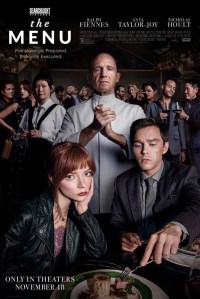 The first thing I thought about with the horror black comedy The Menu is what famous film critic and pun enthusiast Gene Shalit would do with this title and setup. He’d say, “Don’t send this one back to the chef,” or, “I’ll have seconds,” or, “Book your reservation now,” or any number of bad jokes (fun fact: Shalit is STILL alive and 96). Regardless, The Menu is an excellent main course for fans of dark comedies and biting satire. It’s not really scary or thrilling, even if it borrows liberally from the structure of contained thrillers. A dozen wealthy guests are selected for a once-in-a-lifetime dining experience from a legendary chef (Ralph Fiennes). The story is a balancing act of mysteries, with what is happening on this secluded island, each new course on the menu and what it reveals about its chef and his intentions, why each of the couples is present and what troubles they have, and why our head chef is so fixated on Margot (Anya Taylor-Joy), a last-second replacement date for arrogant would-be foodie, Tyler (Nicholas Hoult), and who she really is and whether she belongs here or not. Part of the wicked fun is watching things escalate and the characters freak out, or try and rationalize or bargain through the experience. I was chuckling throughout the movie, tickled by its sardonic humor and the excellent heightened performances from its ensemble cast. Fiennes (The King’s Man) is locked-in as his enigmatic yet intensely dedicated chef, so much so you might admire him while also being creeped out. His annoyance and cold disdain for the guests is a constant source of entertainment, especially a scene where he insists that the know-it-all foodie put on a chef’s robe and try his hapless hand at actual cooking. Hong Chau (Downsizing) is terrific as a no-nonsense sous chef simmering with barely concealed contempt. Her pronunciation of “tortilla” is one of the movie’s biggest laughs. With The Great and now this, Hoult is finding a great stride in playing outsized egotistical buffoons. By the end, I was left wanting a little more in the way of answers or catharsis or even its class conscious commentary, but The Menu still packs plenty in its 105 minutes to be an appetizing experience.
Nate’s Grade: B+
Share this:

My Son Hunter (2022)
 I’ll never understand the pathological obsession people have with Hunter Biden and what may or may not be on his laptop. This fixation on President Biden’s son seems so unshakably quixotic, hoping that with each new murky examination somehow, magically, there will be impropriety and criminality if you only look right. This dogged obsession with, at best, a tertiary figure to the true target of conservative ire reminds me of the crackpot theories concerning Vince Foster, a deputy White House counsel who took his own life in 1993. It was ruled a suicide by five investigations, and yet there are still enough people that are unsatisfied with this provable reality and want to see something more nefarious, more suspect, and simply more. Surely Vince Foster must have been assassinated by the Clintons, and especially Hilary, because he knew too much. It’s nonsense but to some it’s the only thing that makes sense. Such is the same with the Hunter Biden laptop, which some have deluded themselves into thinking could have been the difference maker between a President Biden winning by eight million more votes and a second-term for Trump. It’s difficult for the rational mind to fathom how many ordinary voters would truly care about a presidential candidate’s son’s liaisons, especially when that person is a private citizen and not employed in government.
I figured it was only a matter of time before a rapacious conservative media bankrolled a Hunter Biden Laptop Movie, and it seems only natural as Breitbart’s first foray into narrative filmmaking. The movie takes a lot of style and attitude notes from the latter films of Adam McKay, borrowing liberally from the mixture of documentary and cheeky fourth-wall breaking motifs from The Big Short and Vice. I’ll admit it makes for a slightly more entertaining movie, and My Son Hunter wasn’t the complete disaster that I had dreaded. It’s still not a good movie, by far, and its points are leaden and misleading at best and downright false and speculative at worst, but I’d rather watch a conservative movie that attempts to ape better filmmakers. Trying and failing is at least better to watch for 80 minutes than simply preaching to the converted and not even trying.
 Hunter Biden (Laurence Fox) is drifting through life, parties, and may be the biggest hindrance to a would-be President Joe Biden (John James). Hunter left his laptop at a repair shop but thankfully the media refuses to cover the story, instead downplaying it as a possible Russian disinformation campaign in the last weeks before the 2020 presidential election. Joe can’t have anything go wrong so close to his possible big victory, but Hunter, at least in this not-at-all biased interpretation, seems like a walking catastrophe waiting for his next landmine.
Before even discussing the filmmaking merits, let’s tackle the chief purpose of this movie, which is to defame Hunter Biden and by association Joe Biden. It’s not exactly breaking news that Hunter Biden has lived a troubled life. The man has been upfront about his own struggles with addiction; he wrote about it openly in his own 2021 memoir. Watching Hunter snort anything within reach, party with hookers, and hang out with lowlifes just feels gratuitous because it’s the same characterization over and over. That’s all the movie covers for its first 30 minutes, Hunter partying with strangers and strippers (but still in a demure way where nobody, even before passing out on the floor, removes their clothes). It feels like we’re wallowing in a man’s degradation and it’s unseemly because the intention is not meant to be empathetic. The target audience watching this won’t likely care about Hunter genuinely getting better as a person. That’s not what this expose is for, trying to better understand his humanity and vulnerability. This is merely a roundabout way to taint Joe Biden, a figure too boring by himself, so the critics have to settle for Hunter and his salacious escapades and work on grimy guilt by association.
I can hear some griping that the movie presents Hunter in a more sympathetic light, at least early, with him recognizing his own screw-up nature but feeling powerless to rise above. He also talks about the grief of losing his mother and sister at such a young age, as well as his older brother in 2015. However, any pretense of humanizing goes out the window once big daddy Joe arrives, and Hunter becomes a sniveling sycophant who shrugs his way through life, not just aware of his nepotistic privilege but fully comfortable with his participation in corruption and graft. Any introspection is abandoned and it makes any prior introspection appear phony. It’s hard to square the Hunter in the beginning who talks about the wounds of losing his mother with the Hunter who complains that his dad never supports his art, complete with cutaway to his finger painting. There’s an entire six-minute stretch where Hunter is lectured to, by his stripper named Kitty (Emma Gojkovic) who just happens to be the estranged child of Christian missionaries, about China’s concentration camps for its Uyghur population, and he stares slack-jawed, as if he hasn’t kept up with the news in years (the reprehensible concentration camps for Muslims have been well-documented by the mainstream media). This Hunter is merely a stand-in for vague political corruption, an irredeemable naif that is only meant to make his father appear worse, and that’s also why now that Republicans have won the House, you’ll see a lot more of Hunter Biden’s name in 2023 because, obviously, investigating his previous business handling as a private citizen is the cure for inflation and higher gas prices.
 So what does the movie profess to expose, especially so that had this evil laptop of incriminating evidence been properly adjudicated, then Donald Trump, the most unpopular president in the modern era, would have easily won re-election? It’s a rehashing of what led to Trump’s first impeachment in 2019. Hunter Biden was on the board of a Ukrainian energy company, Burisma, and he most definitely got that position because of his name, and of course this is the only instance in the history of the world where that has happened before to the scions of the rich and famous. When Jared Kushner, who actually worked in Trump’s White House, was offered over two billion dollars by the Saudi royal family upon leaving his taxpayer-paid position, I’m sure it was completely for his unparalleled expertise on Mid-East diplomacy. Anyway, this Burisma position was already investigated internally by the State Department for conflicts of interest, and the Ukrainian prosecutor that Joe Biden pressured to be removed as VP was not threatening to investigate Hunter. This prosecutor was corrupt and refused to investigate Russian-backed assets; he even refused to investigate Burisma. There was no inappropriate arm-twisting to protect Hunter or Joe Biden, as thoroughly debunked during the 2019 impeachment trial. It’s all pretty established, but that doesn’t matter to its target audience, the same group who keeps desperately re-shaking a disparate collection of incorrect election anecdotes to produce a bigger picture like one of those pesky Magic Eye pictures that only “true American patriots” can properly see.
That’s really the majority of the specific accusations against Hunter. It impugns his associates, like Devon Archer who was sentenced for defrauding a Native American tribe in 2022, but too many of the accusations are broad and reaching, much like the Burisma condemnation. Biden did invest in shares of a Chinese technology company, Face++, as part of a larger portfolio, and China has reportedly used this technology to surveil citizens it’s looking to persecute. This is not great, but I wonder how many other venture capitalists have holdings with connections to other similarly sundry applications, especially with technology. I’m not excusing this, I’m just saying this “a ha!” accusation isn’t quite the deathblow the movies seems to assume. If it was, it wouldn’t need a character to literally explain the context of why this is so damning. The larger accusations of bribery and funneling ill-gotten monies back to daddy Joe are weak too, no matter how many times the movie adds titles to tell us, “This really happened” (but it didn’t). So many of these accusations are like Burisma, where it’s a purposely misconstruing of events and a deliberate ignoring of context or corroborating information that would deter their argument.
Hunter Biden isn’t the world’s greatest businessman by any measure. He’s also not the world’s most infamous criminal who fails to be held accountable because of his cushy connections. Hunter Biden hasn’t even been banned from operating a non-profit in New York state because he used a kids-with-cancer charity like a personal piggy bank (sorry, that was Trump’s children). Let it be known by this self-professed progressive, if Hunter Biden is guilty of a crime then prosecute him. Put him in jail. I don’t care. He doesn’t deserve special treatment. But at the same time, if he’s just a guy with problems, he doesn’t deserve this crazy level of unbridled antipathy.
 Following the McKay model, characters will stare directly into the camera for comedic effect, to add additional commentary, like when the movie flatly states, “This is not a true story… except for all the facts.” Of course, the screenwriters have a harder grasp of those stubborn facts. These are the same writers of The Obamagate Movie, which proposes to expose the “Deep State conspiracy to undermine the Trump administration and the fake Russian collusion narrative.” Again, facts are stubborn things, especially when the end of the movie laments when, oh when, will truth matter over lies and the powerful be held responsible for their corrupt actions (were these people just willfully hibernating during the scandal-a-week Donald Trump presidency?). The attempts at humor are often juvenile and stupid, like an opening scene where Hunter has a psychic conversation with a tiny dog while he’s high on drugs, and this is after a cartoon graphic of Hunter’s heart pops onscreen. The jabs against Joe Biden are mostly of the creepy hair-smelling and loony grandpa variety with groan-inducing malapropisms (“Nothing can threaten my erection;” see instead of “election” the dumb man said “erection”). The movie also squeezes in other conservative grievances, like opening with a Black Lives Matter protest and admonishing the media for its portrayal. I think having one of the protesters working as a stripper (to pay off her college loans, she tells us) is meant to be some insult to liberal protestors or even higher education. The same with having a stripper announce her pronouns. Is this the nightmare world the liberals all demand when even the people sleazy men pay to get naked would inform us of their preferred pronouns? I’m surprised they went the entire movie without a trans joke.
I don’t know why Fox (Inspector Lewis, White Lines) would agree to portray Hunter Biden. He doesn’t exactly resemble the man. He looks like a more gaunt version of Ebon Moss-Bachrach (Girls, The Bear). Fox provides the best reason to watch the movie because he’s not acting like he’s in lazy agitprop. Give credit where it’s due, the man gives a dark journey-of-the-soul kind of desperate sheen to this man, that is, until the script just turns him into a shrugging and sulking man-baby. Gina Carano (The Mandalorian) makes a brief appearance as a Secret Service detail to the Bidens, who never missed an opportunity to snidely confide to the camera about how much she loathes these men. John James (Dynasty) doesn’t work as Joe Biden at all, but he seems like he could have been a Sopranos-style goombah goon character reference for Paulie Walnuts. Many of the Eastern European actors who the production utilized from its Serbia filming site seems to have been dubbed over, so I don’t know how much criticism to offer Golkovic as Kitty, the stripper who also happens to be a former lawyer too. She’s a Swiss army knife of uses, including the intended moral uprising the filmmakers would like to believe they can engender.
 I’d like to conclude as a reminder why journalists believed that the Hunter Biden laptop story, which broke in the final weeks of the 2020 election, and was teased by none other than Rudy “Hand down my pants” Giuliani, would be met with skepticism. For an election about competency, a national COVID response, and basic human empathy, it seemed awfully strange that Hunter Biden’s name was coming up again so late, and once more from Giuliani, the man who was caught meddling in American diplomacy so that he could strong-arm Ukraine into pushing a sham investigation to slander Joe Biden. It was all just a bit too convenient, and especially when there wasn’t any corroborating evidence at the time, just one business shop’s word that, no for real, this must be Hunter Biden’s legit laptop. In the end, I doubt any voters could have been persuaded by the laptop, and those that were would have voted for Trump already. Nobody cares about Hunter Biden. And nobody should care about this silly and slimy movie trying to make him into the new conservative obsession. Go after Joe Biden for policy reasons, go after him for his age, but his son? In Joe terms, that’s baloney, man.
Nate’s Grade: D
Share this:

Don’t Worry Darling (2022)
 By now, you’ve likely heard all about the gossip-churning headlines from behind the scenes of Don’t Worry Darling, which eclipsed everything else about the movie and is, sadly, the most interesting thing about an otherwise flawed Stepford Wives retread. There were scandalous rumors of affairs, rumors of actors uncomfortable with affairs, rumors of actors refusing to take part in publicity for the movie, which motivated legions of online super sleuths to analyze every social media missive to the finest point to discover hidden messages and meaning. There was even a point where the Internet debated for a week whether or not Harry Styles actually and actively spit upon Chris Pine at the Venice Film Festival (both actors deny this happening). Looking back, it was a wild time, a bit silly, and far out of proportion for the actual movie we eventually get with Don’t Worry Darling.
Alice (Florence Pugh) is living the perfect 1950s life – OR SO SHE THINKS. Her husband, Jack (Harry Styles), leaves with the other men for work in the desert facility owned by Frank (Chris Pine). The wives of the community diligently tend to the household chores, gossip poolside, and have a full-cooked meal and drink in hand for their returning breadwinners. Alice begins seeing disturbing visions she cannot explain, and another wife (Kiki Layne) starts acting up, trying to warn her, and men in red suits seem to pounce whenever someone steps out of line. It’s a lush suburban community designed by Frank, meant to be the sparkling, hopeful epitome of the American Dream, but it might be a nightmare instead as Alice investigates.
 Don’t Worry Darling is a fleetingly entertaining movie with big ideas but it doesn’t know how to handle them and what to say beyond its obvious points. Immediately in the movie, you’ll know something is wrong with this idyllic community. The Stepford Wives is an obvious comparison point, so I kept waiting for the movie to pivot from this predicted influence, to go a separate route or go deeper, making its commentary meaningful for today’s world. Unfortunately, the movie never does move beyond this influence, nor does the movie go deeper than to easily castigate its men for wanting to control their women and remodel them as dutiful, cheerful, robotic housewife throwbacks to the halcyon age of 1950s Boomer nostalgia. It’s all too surface-level for a movie about superficial men wanting to unburden themselves of having to live up to the expectations of women. There’s plenty that could have been said about the pernicious forms of toxic masculinity festering around the darker corners of society and the Internet, the rise of fragile men in the alt-right and incels and trolls, and their angry, entitled, self-loathing feelings toward women projected into harassment. This movie only merely glances at its touchy subject. The commentary is too basic, leveling men want to dominate women and erase their agency and identity for their own satisfaction, the same points from The Stepford Wives in the 1970s, which was a direct response to the feminist movement challenging traditional gender roles in the home. I won’t spoil the exact means of what this false reality is for Alice and the others, but suffice to say, it leaves a lot more questions for me than answers (Has nobody reported any of these women missing? Their friends and family? Why have such potentially deadly stakes? Why would modern men fantasize about six-decade-old Boomer nostalgia?).
In short, this reality is false, and the screenplay by Katie Silberman (Booksmart) and Carey and Shane Van Dyke (The Silence) makes it known immediately, so the story is structured with our foreknowledge in place. It becomes a game of how long before Alice puts together her conclusion and which strings she chooses to pull and what blowback from the established order that demands ignorance and obedience. There just isn’t enough intrigue here. In The Truman Show, the protagonist gradually began to doubt his reality but each suspicious peculiarity added to a better sense of the larger picture, and since it wasn’t until halfway through that we saw “the other side” of Truman’s manufactured world, the audience too was learning about this facade and all the effort to keep it hidden. Don’t Worry Darling has a repeated motif of Alice seeing confusing images of her and the other wives in a stark Bubsy Burkeley-esque musical number, but why? What does this reveal about the inner workings of the reality behind the reality? It’s not even made clear what it relates to literally, so it must be a metaphor, but it’s again too obvious and heavy-handed. I understand all the women are learning and practicing dance, but to what end does this serve? I needed further rules established about this secret society so I had more of an understanding of what was at stake as Alice begins to test her boundaries and put others in danger. The conclusion is also ludicrously short-sighted, just a matter of crossing a magical line, like a kid touching base in tag, and that’s before a segment of self-awakening that made me wonder if Alice had miraculously become Neo. It’s the kind of conclusion that feels way too easy and unfulfilling, attempting a note of “what happens next?” ambiguity but really feeling more unsatisfyingly incomplete and empty.
 Even though Don’t Worry Darling is flawed, Wilde’s directing is still an asset. She’s clearly having fun playing in a much different genre than 2019’s Booksmart, and the thriller elements are achieved by the eerie contrasts that Wilde finds to highlight of this hidden prison. The sunny cinematography and retro production design are sharp, and the musical score by John Powell (How to Train Your Dragon) has an off-kilter but electric charge to it, often working in hums and stutters to better accentuate the horror atmosphere creeping into this would-be paradise. Wilde even captures the speeding cars in the desert with a certain thrilling aplomb. Much publicity was made about the portrayal of the sex scenes within Don’t Worry Darling, namely, with a woman behind the camera, that they focus on feminine pleasure, a feature often lacking in a male-dominated field built upon the sizzle of the male gaze. I’ll agree that both scenes put more focus on Alice, also our main character so perhaps there’s that, but knowing the full context of the story, it seems more than a little misguided to purposely emphasize feminine pleasure. Also, it’s hard for me to actually believe these kinds of self-involved, parochial men would prioritize giving pleasure to their partner. This detail seems in conflict with the larger thesis.
Thank goodness for Florence Pugh, a refrain every viewer repeats with every movie co-starring the Oscar-nominated actress. Pugh (Black Widow) ably carries this movie on her back. Her performance has more nuance than the character writing provides, and it’s enjoyable to see her challenge the imposition of authority and push back. It’s yet another emotionally heavy role with several scenes of sobbing and screaming, and Pugh is one of the best actors when it comes to expressing the heights of emotional distress without overdoing it into histrionics. As my wife said by the end of the movie, Pugh deserves to star in a feel-good, chippy rom-com after all the grueling emotional work she’s endured in many of her more prominent roles.
 Harry Styles (Dunkirk) doesn’t fare as well, dwarfed by his scene partner. There is one moment where he has an emotional breakdown in his car that is nicely portrayed, a mixture of pity and guilt and pure cowardice, and Styles really nails it. However, his smooth hunky husband persona works well enough, enough so that it’s hard for me to see someone like Shia LeBeouf, who Wilde originally had cast in the role, working as intended considering his more intense presence would make you doubt the man’s intentions almost immediately. I wish somebody gave Chris Pine more to do in this other than smugly smirk in the background (admittedly his “being in the background” of one scene was an uncomfortable oddity that demanded further exploration).
There are things that genuinely work with Don’t Worry Darling, moments that dazzle and excite, technical elements that elevate the material, and performances that stick, but it all comes down to a disappointing and underdeveloped script that cannot figure out what to do with its messy themes. It’s too obvious where the movie is headed given its heavy thematic similarities to The Stepford Wives, but it could have taken that familiarity and reapplied it to today’s Internet-age misogyny preying upon female autonomy, but it doesn’t. It could have also fleshed out the particulars of its fraying world-within-a-world to better feel complete and intriguing and meaningful, but it doesn’t. It could have presented a compelling hero’s journey of Alice pushing back against formidable opponents, but it doesn’t do that. It could dress down these bad men and make them account for their misdeeds, but it doesn’t really. It’s a mystery with an all-too obvious answer, with the exception of the exact circumstances behind the pretty facade, and not enough substance and commentary that pushes beyond simple social moralizing. I guess ultimately the movie is much like its own gilded reality: pretty to look at but lacking much below the surface.
Nate’s Grade: C
Share this:

The Good Nurse (2022)
 I was recently having a conversation about how there seems to be fewer high-profile serial killers today, at least compared to the ignoble heyday of the 1970s-1990s, the kind of men, and yes, it’s almost always men, who fascinated millions and inspire countless books, movies, podcasts to detail the heinous details of their twisted and ritualistic crimes. I recall reading an article that proposed the rise of serial killers during that time period might have had something to do with the prevalence of lead paint and lead poisoning in homes before it was finally phased out in 1978. It seems like it would be harder to be a serial killer in the modern era, where almost every person has a device to call the police, or document your behavior, and submit it for the public record. Of course, we also have far more mass shootings and spree killers, so it’s not like things are perfect. I thought about this while watching The Good Nurse on Netflix, based on true events following a nurse in Pennsylvania who may have ultimately taken 400 lives before he was finally apprehended. How does a serial killer operate in the modern world? With help from lawyers.
Amy (Jessica Chastain) is a nurse working the night shift and trying to raise two young girls on her own. She suffers from a heart defect and keeps her ailment hidden for fear she will be fired before she crosses the period where she can earn health insurance from her job. She’s stretched thin, overworked, exhausted, and anxious, and that’s when Charlie Cullen (Eddie Redmayne) comes into her life. He’s a new nurse for their hospital, comes highly recommended, but then… patients start coding and dying and Amy can’t explain it. Somehow insulin is getting into their systems, and she begins to suspect Charlie is the culprit, and from there she works with law enforcement to investigate Charlie’s mysterious past work history and assemble a credible legal case of guilt.
 It’s obvious from the start Charlie is guilty, and thankfully the movie doesn’t drag this reveal out, even choosing in its long take opening to demonstrate one of his dispassionate murders. This is less a story about whether this person is in fact the actual killer and more a story about how to nab the killer, and the methodical, detail-oriented case work reminded me especially of 2015’s Best Picture-winner, Spotlight. Likewise, we already knew the Catholic Church was covering up sexual crimes from its priests, so it was more a story about the people responsible for bringing them to justice and how they worked their case. It’s a similar and similarly engrossing formula for The Good Nurse. Uncovering Charlie’s past, his way of avoiding crimes is eerily and infuriatingly reminiscent of the Catholic Church just reshuffling its dangerous priests from parish to parish. The prior hospitals that employed Charlie will not talk about him because to do so will open them up to legal liability, so instead they simply fired him for specious reasons and allowed him to gain employment at another hospital, repeating his deadly patterns. To get more involved, or to investigate further, would be financially deleterious to the hospitals, so they looked the other way. A post-script tells us that none of the hospitals that employed Charlie Cullen were ever criminally charged for their role in perpetuating the death this man left behind. The Good Nurse smartly understands that pinning down one villain is easy, but indicting the system is an even bigger story, and one that rightfully earns every ounce of viewer condemnation and outrage. The lawyers representing these hospitals are just as culpable for these preventable murders.
Much of the movie follows Amy’s personal investigation, dovetailing with two detectives (Nnamdi Aomugha, Noah Emmerich) trying to put together the meager crumbs that the hospital is offering after its own six-week-late internal review that necessitated contacting the police about the “irregularity” in a patient’s death. Each has key pieces, Amy with the inner workings of the hospital system and nursing expertise, and the detectives with the shady background report on Charlie, and it’s an exciting turning point when they join forces. From there, the movie reminded me of Netflix’s sadly cancelled series Mindhunter, where two FBI agents profiled America’s most notorious serial killers to learn insights about the patterns of pathology. It was also a series about talking, about trying to draw these dark men into confession, and the subtle manipulations necessary to get the key pieces of information desired. Amy brings hard evidence that her co-worker is stealing insulin but it’s not enough, and she questions how far to put herself in the middle of this investigation, especially since her daughters have grown close to Charlie.
 The direction by Danish filmmaker Tobias Lindholm (A Hijacking, A War) is very aligned with the fact-finding tone established the screenplay by Krysty Wilson-Cairns (1917, Last Night in Soho). The camera work is never flashy, preferring longer takes from unobtrusive angles, but without fully adopting the impatient edits docu-drama verisimilitude approach many directors would follow to better capture the reality. The directing is very methodical, cerebral, and restrained in the best way to enhance all of these elements from the story. It’s also not a surprise when you recall that Lindholm directed two episodes of Mindhunter’s first season. It’s the kind of assured direction that often gets ignored in award season but it’s the kind of direction this movie needed to better succeed in tandem with its slow-building, fact-finding mission. It’s not dispassionate, it’s deliberate.
Redmayne (Fantastic Beasts) is an actor I’ve been critical of with some mumbly, tic-heavy past performances, but he’s genuinely good and unnerving for how “normal” he comes across while holding back just enough in his eyes to make you want to take a cautious step back at various points. His role is the more internal one, and the character becomes an incomplete guessing game of how much of what you see is the real Charlie Cullen. Is the kind, compassionate Charlie who helps Amy’s daughter learn her lines for a school play, while encouraging her repeatedly, the real version of this man? Is the evasive man who bursts into sudden and shocking moments of emotional outburst the real version? Is it some semblance in between, and how does one square the difference? The movie’s focus isn’t on unpacking the psychology of this bad man (the title is not a reference to Charlie but of Amy) but on the hard-nosed efforts to finally bring him to justice. Because of this there aren’t as many showcase moments for Redmayne, but he genuinely made me jump during his bigger moments. His Midwestern accent also sounded a lot like (a non-Bostonian) Mark Ruffalo to my ears, further cementing the connections to Spotlight.
The real star of The Good Nurse is its story, given careful examination and worthy condemnation to the forces that allowed a mass murderer to continue his trade for years. When finally asked why, as if there can ever be a satisfying revelation for why bad people do bad things, Charlie can only shake his head and respond, “They didn’t stop me.” He kept killing because the hospital lawyers shuffled him around, protecting their own rather than innocent victims who place their faith in the hospitals and their staff to follow the Hippocratic oath and “do no harm.” The Good Nurse is an appealing movie for fans of true-crime and investigative procedurals. It stays focused on the human cost of those preying upon others, whether they be serial killers masking their misdeeds or corporate lawyers protecting profits and liability over human suffering. It’s a good movie and a good reminder that the over-worked, underpaid nurses are legit heroes.
Nate’s Grade: B+


 nathanzoebl
You must be logged in to post a comment.