Blog Archives
Hotel Rwanda (2004)
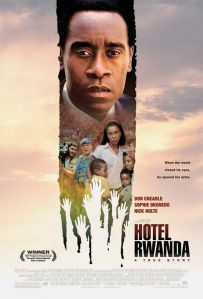 Hotel Rwanda almost didn’t get off the ground. You see, veteran supporting actor Don Cheadle is a favorite actor for directors but he’s not exactly box-office gold. Initial producers of Hotel Rwanda wanted none other than Will Smith to star. I don’t know about you good people but a sobering, challenging movie shedding light on the Rwandan genocide would lose some credibility if Smith was the above-the-title star. Producers also wanted Denzel Washington as a candidate; a better choice but still not right. The true-life portrayal of Paul Ruseabagina needed to be done by an actor that didn’t look like he could kick your ass. Paul was an ordinary man that didn’t ask to be a hero, not a hero looking for a fight. Cheadle was the perfect man for Hotel Rwanda. It just took a while for it to happen.
Back in 1994, Rwanda underwent a tumultuous civil war. In Rwanda, there are two ethnic groups, the Hutus and the minority Tutsis. Though the two look indistinguishable, there is an underlying tension because way back when Rwanda was under Belgian colonial control, the Belgians separated the Rwandan people by arbitrary rules like nose size, skin tone, etc. There is a rising tide of Tutsi resentment (radio propaganda refers to them as “cockroaches” needing to be exterminated). The Rwandan president has been assassinated and Hutu radio broadcasts are already pointing the finger at Tutsis.
 Paul Ruseabagina (Cheadle) is a Rwandan hotel manager that stocks up favors by scratching the backs of the right people. The wheels of Rwandan authority need to be constantly greased, and Paul knows when to deploy a well-timed gift, joke, or bribe. Paul?s wife Tatiana (Sophie Okonedo), a Tutsi as well as their children, is concerned when she starts seeing neighbors taken away at night. Paul assures her that their Tutsi relatives will be safe. Hutu rebels begin to start corralling neighborhoods to root out any Tutsis. Paul and his family retreat back to the hotel. As the violence increases more refugees arrive at the hotel for sanctuary, but Paul must keep the illusion that the hotel is still operational to ward off violence.
The United Nations promises to do something, but they remain only peacekeepers and not peace enforcers. The commanding officer (Nick Nolte) laments that he has only a handful of U.N. peacekeepers in charge of the whole nation. The United Nations and the West does do something: they evacuate all the white people. Citizens of Western nations are escorted out of the conflict, while they leave the rest of Rwanda to its own devices. Paul?s clinging hopes for Western involvement get bleak, and he assumes the responsibility for saving as many lives as he can, Hutu or Tutsi.
Cheadle gives one of the best performances of the year and he’s been nominated for a Best Actor Oscar. The strength of his character’s power lies in Paul’s ordinariness. He’s not a figure of intimidation, nor is he some kind of altruistic saint. There’s more than a passing resemblance to Oscar Schindler in Schindler’s List. Like Schindler, Paul is a man reluctantly pulled into risking his life for others and by the end he becomes consumed with saving as many lives as he can. Cheadle is so commanding that he can make you wince just by watching the weariness in his eyes.
There’s a moment late in Hotel Rwanda, where Paul is stalking the hallways trying to find his wife and children. And in an instant he suddenly remembers careful instructions he gave to his wife. Paul nearly bowls over with the sudden pang of terror but keeps his stride. It’s a sharp and powerful moment where the audience thinks alongside Paul and experiences the same awful gasp. In that moment, as well as countless others, Cheadle has worked his way so deep into his character that the two are one in the same. Cheadle has long been one of the most underrated actors, and now with Hotel Rwanda there is no doubt that Cheadle is one of the greatest living actors we have.
But Hotel Rwanda is not just a one-man show. Sophie Okonedo also garnered a Best Supporting Actress Oscar nomination. Okonedo is no pushover and she does more than needle Paul when it comes to the well being of their family. She’s a strong, caring, thoughtful woman. What makes her even more impressive is that, as a Tutsi, she could be murdered at any time. She gives an equally powerful performance of a woman finding strength amongst her own fear.
Writer/director Terry George keeps the emotion high by smartly relying on restraint when telling his portrait of horror. The events of the Rwandan genocide are so appalling, that it would have been so easy, and even understandable, had George loaded his film with scene after scene of graphic violence to jar the viewer. However, George refrains from numbing an audience with violent depictions, and instead chooses quieter, more somber moments that turn out to be far more terrifying than just seeing blunt violence. Hearing an aid worker recount witnessing a massacre of children to wipe out the next generation of Tutsis will chill you to the bone. There are some disturbing moments, like when Paul takes a very bumpy ride in the mists, but George refuses to numb an audience and works our emotions to a breaking point.
 Hotel Rwanda is sobering and very emotional, but you will also leave the theater with an overwhelming feeling of shame. It’s easy to watch films about dated atrocities like depictions of the Holocaust. You can say, “Well, I wasn’t alive. If I was, and people like me, surely we would not sit back and let such actions take place under our watch.” Not this time. Not with Hotel Rwanda. Everyone seeing Hotel Rwanda more than likely was alive in 1994, and we did exactly as a character warned: we watched what was happening on TV and went back to eating our dinners. Nolte’s U.N. rep tells Paul that the West refuses to see him and Rwandans as valuable (“You’re worse than a n****r [to them]; you’re an Af-ri-can.”). You?ll feel many emotions while viewing Hotel Rwanda and the deepest and longest lasting may be shame.
The film is clearly in the genre of “outrage cinema,” normally a genre that overpowers a viewer’s emotions. In lesser hands Hotel Rwanda would have been unrelenting to maintain a level of shock. George allows an audience to feel for the story’s characters before he lets the horrors loose. The result is that an audience attaches itself to characters because of who they are, not just because of the anguish they endure. As the intensity of the situation mounts we feel stronger ties to the people of Hotel Rwanda. That is good cinema.
Hotel Rwanda is an emotionally gripping portrait of the dignity found during our darkest days. George has skillfully created a sobering movie. Cheadle and Okonedo deliver wrenching performances as the faces of good amongst ongoing genocide. This isn’t like Black Hawk Down where the faces of screaming, angry black people merge into one black form the audience uneasily grows to hate. In Hotel Rwanda, the heroes are everyday Africans, the bad guys are everyday Africans, and the West is the apathetic referee unwilling to act. Hopefully after George’s film, it’ll be hard to hear about a million massacred and go back to eating your dinner.
Nate’s Grade: A
Share this:

Closer (2004)
 A funny thing happened to me when I sat in a theater to see Closer. It was packed, surely due to the film’s heavy star power. As the film played out I began to notice that my audience was laughing consistently, at moments that weren’t necessarily meant for humor. I don’t think they were laughing at the film, instead I think it was a defense. You see, I’m sure the majority of those couples read Closer to be a much different film than it is. They saw the pretty faces of Jude Law, Natalie Portman, and America’s sweetheart Julia Roberts. They were expecting something, let’s say, lighter than the cruel savagery of Closer. When America’s sweetheart Julia Roberts compares the taste of two men’s semen, you know this isn’t any Gary Marshall movie (forgetting Exit to Eden, and please do).
Dan (Jude Law) is an obituary writer planning to pen a novel one of these days. He locks his eyes on Alice (Natalie Portman), a stripper from the States, while walking one day. She gets hit by a car and Dan takes her to a hospital. Flash forward and Dan and Alice are dating but his eyes are already wandering. During a photography session with Anna (Julia Roberts) he kisses her but is spurned. He takes his revenge on some soul in cyberspace, pretending to be Anna and arranging a meeting. That sap turns out to be Larry (Clive Owen), and they actually do start dating. Then things get messy. Couples leave one another, get back together, swap lovers, and come crawling and begging for forgiveness or punishment. The rest of Closer is like a long game of relationship Red Rover.
 Director Mike Nichols has a definite affinity for his four actors (they are the only ones in the film with speaking parts). He shoots Closer as an actor’s showcase, with constant close-ups and no handheld camerawork. He places the emphasis on his actors. The results are more familiar to Nichols’ early films like Who’s Afraid of Virginia Woolf? and Carnal Knowledge. However, Closer isn’t as insightful as it thinks it is. It presents cruel characters doing dastardly acts, but this is stuff that wouldn’t impress Neil LaBute (In the Company of Men). There is intelligence to the film?s dialogue but it’s wasted on a ramshackle story.
The acting of Closer both helps and hurts the film. It seems that the two primarily wronged characters (Larry, Alice) give the better performances.
Owen is the standout performer of the ensemble. Playing the Dan role onstage has given him an intimate feel for the story’s characters. He’s the most decent of all four until the weight of circumstances finally pushes him to the limit. He’s the character the audience sees themselves in, so it helps that Owen gives a great performance of quiet dignity and slow self-destruction. He expresses more emotional turmoil in his eyes than most actors do with their whole body. Portman is having a breakthrough year for herself. First she showed pluck and grace in Garden State, and now with Closer she has graduated to the adult table. She radiates a fragility that makes you want to hug her. Portman will probably always look like a little doll (which works for her role as a stripper).
The beauty of Roberts and Law hurts the ugliness of their characters. I make no bones about my general dislike of Roberts as an actress. Her acting in Closer is like a soft-spoken, pouty child. She jumps from man to man, looking sullen or pensive, but comes off more petulant. Law is better, but his handsome devil is not in the details. Dan is a womanizing cad but we never get any understanding for why he acts as he does. Law can be hypnotizing, but like Roberts, his pretty facade takes away from the impact of Dan’s ugly behavior.
 Despite the title, you get no closer to getting to know or understand the characters. It’s really almost a stretch to call them characters because they’re more accurately different positions in an argument. The only characterization Closer has to offer is suffering and inflicting suffering. Closer really has one voice coming out of the mouths of different pretty actors.
The film has the annoying habit of skipping ahead in time and not telling the audience. We’re left to catch verbal asides that time has passed. After a while you’ll get the hang of it simply by assuming that the beginning of every new scene is the start of a new date in time. Closer is nothing but a string of uncollected scenes, usually involving people leaving a lover or starting a new fling. The actors come on, do their part, then they leave and we move on to a different scene. This is not staged as a movie.
The trouble with Closer is that it never really feels like it’s going anywhere. There’s no progression. Sure, couples swap, people get revenge, but the connection of sequences is lacking. The way it is, Closer could have gone on forever. It’s a series of scenes smashed together, not a story that rises and falls and builds to a climax.
Closer is an exploration into the darkness of human behavior starring some of the prettiest actors Hollywood can spare. The story goes nowhere, the ending doesn’t accomplish much, the characters lack convincing depth, but some of the acting is good and there is a ray of intelligence to the film. Fans of the above-the-title actors should enter Closer with caution. It’s a dark film with little to feel good about. Closer is brooding, moody, and probably the first and last time we?ll hear Julia Roberts talk about the taste of semen. Unless, of course, Gary Marshall starts pre-production on Exit to Eden 2: Rosie O’Donnell’s Bondage Boogaloo.
Nate’s Grade: C+
Share this:

Million Dollar Baby (2004)
 Million Dollar Baby, much like its fledgling female boxing character, has come out of nowhere and made a considerable deal of noise. This little homespun film directed by Clint Eastwood didn’t have the glitz and sheen of other awards friendly movies, but now it seems that Eastwood?s own baby may clean up come Oscar time. Can Million Dollar Baby tackle the enormous hype surrounding it? Yes and no.
]Frankie (Eastwood) is a hardened boxing trainer too concerned for his fighters’ welfare to allow them to fight in championship bouts. He’s the kind of cynical old man that enjoys pestering a priest and causing him to unleash an F-bomb. Frankie and his longtime friend Scrap (Morgan Freeman) run a rundown gym and talk un-sentimentally about their older days as prize fighters. Then along comes Maggie (Hilary Swank), a 32-year old waitress who’s got nothing to believe in except her possibility as a boxer. She wants Frank to train her into the champ she knows she can be. He refuses saying he doesn’t train girls. She’s so determined she won’t take no for an answer. Frank finally agrees, especially after some help from Scrap, and starts to teach Maggie everything she needs to know to be a star pugilist. The two begin to open up to each other emotionally and Maggie seems destined to become a force in the ring.
 Million Dollar Baby‘s greasiest attribute is its trio of knockout performances. Swank owns every second of this movie. She’s unremittingly perky, conscientious but also dogged, stubborn, and irresistibly lovable. Swank embodies the role with a startling muscular physique and a million dollar smile. Her performance is equal parts charming and heartbreaking. Maggie’s the heart of Million Dollar Baby and Swank doesn’t let you forget it for a millisecond. Come Oscar time, I’m sure she will be walking onstage to grab her second Best Actress Oscar in five years.
No one does grizzled better than Eastwood, and maybe no other actor has made as much of an acting mark by squinting a lot. Million Dollar Baby is probably his best performance to date, though for a good while it sounds like Frank has something lodged in his throat (pride?). Frank has the greatest transformation, and Eastwood brilliantly understates each stop on the journey until landing in a vulnerable, emotionally needy place.
Freeman once again serves as a film’s gentle narrator. There isn’t a movie that can’t be made better by a Morgan Freeman performance. His give-and-take with Frank feels natural and casual to the point that it seems improvised on the spot. Freeman unloads some great monologues like he’s relishing every syllable, chief among them about how he lost his eye. It’s wonderful to watch such a great actor sink his teeth into ripe material and deliver a performance that may net him a long-awaited Oscar (I think he’s due, and likely so will the Academy).
For whatever reason, Eastwood is hitting a directing groove in his twilight years. First came Mystic River, an ordinary police whodunnit made exceptional by incredible acting. Now Eastwood follows up with Baby, an ordinary sports film made extraordinary by incredible acting. Hmmm, a pattern is forming. The cinematography is crisp and makes great use of light and shadow to convey emotion. Eastwood’s score is also appropriately delicate and somber. The boxing sequences are brief but efficient.
Million Dollar Baby is a very traditional story that is at times surprisingly ordinary. Maggie’s the scrappy underdog that just needs a chance, Frank’s the old timer that needs to find personal redemption, and Scrap?s the wise old black man. Once again, an old curmudgeon takes on a rookie and in the process has their tough facade melt away as the inevitable victories pile up. Million Dollar Baby is a very familiar story but then again most boxing tales are fairly the same in scope.
What eventually separates Million Dollar Baby from the pack is its third act twist. You think you know where Eastwood’s film is headed, especially given the well-worn terrain, but you have no clue where this story will wind up. The plot turn deepens the characters and their relationships to each other in very surprising ways. You may be flat-out shocked how much you’ve found yourself caring for the people onscreen. It almost seems like Eastwood and company have used the familiar rags-to-riches underdog drama to sucker punch an audience into Million Dollar Baby‘s final 30 minutes. We’re transported into an uncomfortable and challenging position, and Eastwood won’t let an audience turn away.
 Million Dollar Baby is not the colossal masterpiece that critics have been drooling over. For one thing, the group of antagonists is not nearly as textured as our trio of leads. They’re actually more stock roles that further enforce the ordinary story of Million Dollar Baby. Maggie’s trailer trash family is lazy unsupportive batch of stereotypes. The evil female boxing champ just happens to be a German who doesn’t mind playing dirty. One of the boxers at Frank’s gym is an arrogant showboat just waiting to be nasty while the teacher’s back is turned. Million Dollar Baby excels at showing depth and humanity with its lead trio, yet it seems if you aren’t in that circle you’re doomed to wade in the shallow end.
Eastwood shows that great acting and great characters you love can elevate a common framework. The package may be similar to a lot of films before about scrappy underdogs, but Million Dollar Baby lacks comparison in its genre when it comes to its enthralling acting and characters. The father-daughter bond between Frank and Maggie is heartwarming. The final reveal of what her Gaelic boxing name means may just bring tears to your eyes. The results are a very fulfilling movie going experience, albeit one that regrettably may not live up to such hype.
Million Dollar Baby has been showered with heapings of praise and become a formidable Oscar contender. The story treads familiar waters but its outstanding acting and deep and humane characters elevate the material. The film can’t match the hyperbole of critics but Million Dollar Baby is an ordinary but greatly satisfying ride led by compelling acting. The film hums with professionalism and seems to just glide when everything comes together magnificently, particularly in that last 30 minutes. Eastwood is hitting an artistic stride and it’s actually exciting to see what Clint will do next. Million Dollar Baby may not be a first round knockout but it definitely wins by decision.
Nate’s Grade: B+
Share this:

A Very Long Engagement (2004)
 Deep in the heart of WWI trenches, we begin this sprawling tale by narrowing in on five French soldiers. Each man has been accused of self-inflicting a wound to escape service, and each man is sentenced to spend the rest of their likely short lives in No Man’s Land, the stretch of bare land between the two trenches. One of these men is Manech (Gaspard Ulliel), a young country boy engaged to the charming Mathilde (Audrey Tautou). When she learns his fated punishment and fails to hear word from Manech, she steps out to launch her own investigation into the possible whereabouts of Manech or the possible details of her fiancé’s demise. She enlists her family, solicits strangers, and puts ads in newspapers to unravel the truth. Along the way she hears various stories from all sorts of people and attempts to form them into a clear picture of what went on in that trench, good or bad.
A Very Long Engagement could be flippantly described as “Rashomon in a trench,” but from the get-go it grabs you by the lapels and will not let go. Once again, Jeunet tells his story in a criss-crossing narrative. Front and center we learn about each doomed man’s life in snapshot, and while the device has a slight eulogy feel, it’s a fantastic way to show the depth of characters in such brevity. A Very Long Engagement is an immeasurably rich film where each detail is threaded into the film to create a magnificent artistic tapestry beyond compare. The tiniest details in the film like Mathilde’s tuba playing (the only instrument whose sound mimics a distress call), to the mail carrier choosing to slide his bike over gravel just further enhance the vibrant, animated world of Jeunet.
 Jeunet is quite possibly the most visually gifted director working today (he turned down Harry Potter 5). He couldn’t film an ugly shot composition if he tried with all his French might. As expected, A Very Long Engagement is gorgeous to look at. The production design is massively intricate, the cinematography, while computer assisted, has a shimmering radiance to it. This is simply the best looking film of all 2004, Hero be damned. You could pause any second in this film and use it as a glossy postcard. Jeunet has the technical credentials to fasten together complex and beautiful worlds. A Very Long Engagement is a technical marvel and gorgeous to experience.
Tautou, also as expected, is wonderful once more. She’s the anchor of the film and the audience feels every heartbreak and glimmer of hope this talented actress explores. The supporting cast is full of familiar Jeunet players and each performance adds to the richness of the film. They feel like characters and not stock roles or cliches.
There is some difficulty with following the storyline. There are so many subplots built upon other subplots that the film’s momentum takes a bit of a dive in the second act. A Very Long Engagement can also get very confusing when it comes to remembering so many names. There are maybe 30 characters to keep track of and as the subplots mount new characters are added to the pile, including a widow played by a surprisingly fluent Jodie Foster. It’s best to employ some kind of memory trick to keep the many colorful characters of Jeunet’s world straightened.
 The focus of A Very Long Engagement is on Mathilde’s investigation into what really happened in that trench. She wants to know what happened to her beloved, and as her search picks up steam we get further glimpses of her relationship with Manech. One of my biggest problems I had with 2003’s Cold Mountain was that Jude Law was travailing through hell and back to get back to his beloved Nicole Kidman even though their relationship pre-war lasted as long as a Super Bowl commercial. It’s not that I disbelieve the overpowering nature of love, but I need more from my characters than shifty glances and a quick ejaculation of love (get your mind out of the gutter). Now, in A Very Long Engagement, Jeunet opens by showing the measures Manech will endure to return to his beloved, however, as the film goes on we also see enough peeks into the depths of their relationship beforehand, which dates all the way back to when they were children
A Very Long Engagement forges such a grand and sweeping love story that the audience gets just as immersed as Mathilde about the search for her man. There are so many lovely, intelligent moments between Mathilde and Manech, like their first sexual encounter. Every time Manech lights a new match Mathilde removes an article of clothing until, under the soft light of the newly lit match, she’s nude and blows the match out herself. The characters’ overriding love also taps into small truisms like when Mathilde makes arbitrary games for herself to ensure her love’s safety. (“If I can count to ten before that car passes, then he is alive.”) Mathilde’s faith and devotion are driving her investigation and the audience is behind her 100% of the way, fully invested in this mystery. When we reach our conclusion, I don’t mind telling you I was bawling like a baby.
The film has a merry whimsical tone during its origami-like narrative, but when it hits the trenches the film gets down and dirty. Jeunet shows a fascinating view into the hardships of everyday trench life as well as the machinery of death. Storming the other side’s trench, or “going over the top” as it was called, is seen in all its sordid features. There are hearty splashes of blood and gore that can be jarring.
There’s one terrifying scene in A Very Long Engagement involving the explosion of a makeshift hospital. The hospital is inside a hangar for zeppelins (hydrogen gas) and a missile has crashed into the roof with its nose sticking inside. One of the zeppelins becomes loose and slowly floats to the missile nose with unforgivable certainty. People are running around trying to shield themselves from the inevitable, but it does nothing. The moment is played so agonizingly slow that we become overwhelmed with terror. This was the life of WWI warfare.
 Having said this, the stark war violence doesn’t exactly gel exceedingly well with the whimsical romantic elements. For some, A Very Long Engagement will seem like two very tonally different movies butting heads and intruding upon the other (perhaps Amelie Goes to War?). Sometimes it does take a while to adjust to one tone after spending time with the other. I feel that the emotional investment in the characters and the anticipation of unraveling the mystery serves as thematic glue over the disproportionate tones. Some will feel chaffed by the two stark tones, but I think the power of the love story will conquer most hearts into experiencing the bloodshed of war to earn the shedding of tears by the film’s romance.
Jeunet has re-teamed with Tautou and created another masterpiece. A Very Long Engagement took hold of me from the start and mesmerized me with its beauty, grace, cruelty, excitement, and warmth. This is a great mystery and a great love story with great visuals and great characters. The opposing tones (whimsy vs. violence) won’t work for everyone, and the film takes one too many divergent paths in the middle, but A Very Long Engagement is a film of such startling originality and feeling that it should be treasured. I was floored by what Jeunet had to offer and deeply moved by the time I had to leave the theater. They don’t make them like this much anymore. Now if you’ll excuse me, I have something in my eye.
Nate’s Grade: A
Share this:

Alexander (2004)
 I was standing in a theater weeks ago and saw a large banner for Oliver Stone’s epic about Alexander the Great. I listed the names; Colin Farrell, Angelina Jolie, Val Kilmer, Rosario Dawson, Jared Leto. This had to be perhaps the greatest assembly of pretty actors ever in a motion picture. There’s a whole lot of sex appeal there, and Anthony Hopkins, as the film’s reflective narrator, isn’t too shabby looking himself for a man his age. After having seen Alexander, it’s safe to say the actors sure are pretty but the movie is far from it.
Alexander (Farrell) is one of the greatest historical figures. He rose to become a Macedonian king, dominated much of the known world before he was 30, and then died mysteriously at a young age. In flashes to his youth, we see Olympias (Jolie) coaching young Alexander on his future glory. Standing in her way is one-eyed King Phillip (Kilmer), Olympias’ husband though not the father to Alexander. She frets that he will sire a direct heir to the throne, and upon Phillip’s assassination, Alexander reaches new heights. He travels to Babylon with the purpose of avenging his father’s death, rumored to be paid for by Persian gold.
Alexander keeps traveling east conquering new lands but returning kings to their rule and assimilating “barbarians” into his armies. His generals begin to question Alexander’s actions, especially his surprise marriage to an Asian peasant woman (Dawson). He is unable to sire a male heir with her. Hephaistion (Leto), Alexander’s childhood friend and lifelong lover, worries that Alexander has become power hungry and distrustful of those around him. Many of his men only want to see home after seven years of battle. After defeat in India, Alexander decides to turn back but he never sees home again.
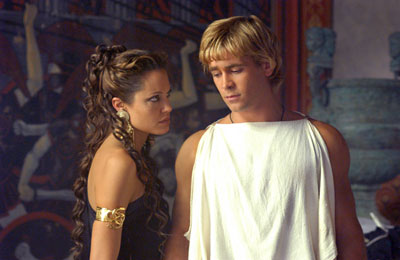 For such a lavish biopic, Alexander seems fairly remote. We don’t really get to know much about the psychology of Alexander. He’s a historical figure with equal parts good and bad ready for debate, but whenever Alexander does hit some of its star’s less-than-stellar moments, it seems to gloss right over them. Hopkins will narrate about some town that resisted, then we’ll see a quick image of it burning, and then we move on. Or we’ll see a slew of dead army officials and Hopkins will say, “He slaughtered all he felt were responsible for mutiny, but I’d expect any general to do the same.” There are several moments where we’ll hear Alexander massacred a town, or sold people into slavery, and then we get the next scene. It’s quite comical, almost as if Hopkins is a tour guide at a museum saying things like, “And then Alexander ate all of the first born babies. Moving on now…”
There are just so many awful laugh-out-loud, loopy moments in Alexander. It’s not enough that Jolie speaks in some bizarre accent; to make sure the audience understands that she’s duplicitous she has a snake wrapped around her in every scene. I’m not kidding; every scene that Jolie is in she has snakes coiled around her.
There’s a moment late in the film that is so hilariously dreadful, it’s hard to believe what you’re seeing. Hephaistion has caught ill and is on his death bed. Alexander is wrought with emotion but then strolls over to a window and begins another huge speech that ends up being all about his glory. What makes the scene go from bad to I-cannot-believe-they’re-doing-this bad is that Hephaistion, in the background, is convulsing and dying. You see his body tense up, twitch, leap into the air, and practically do some kind of triple axle, all while Alexander speechifies blithely unaware. I challenge anyone not to laugh.
Stone needlessly complicates his film with flashbacks, giant leaps forward in chronology skipping Alexander’s rise to respected leader, and skittish hallucinations. Stone is accustomed to breaking up the chronology of his films, but Alexander is too long and too campy to play around with for effect.
The acting of Alexander is set to overkill. Farrell seems miscast and doesn’t have the weight to carry such a historically meaty role. He looks pretty, and he can snarl like a pro, but the only thing worse than his overblown performance is his terrible blonde hair. This just wasn’t the right role for this talented actor. Jolie is so naturally seductive that she could have played her role mute and been effective, maybe more so. Kilmer seems to be working some kind of Irish accent but he comes off the best of the three. Leto gets overshadowed by his bangs.
Alexander also seems to speed over its star’s bisexuality. It wasn’t uncommon for men to bed both sexes, but the movie seems terrified of portraying anything beyond longing glances. Alexander and Hephaistion are reduced to some whispers here and there, but the limit of their physical affection stops at hugs. It actually is kind of funny the amount of times they hug, which I think is over five. You can tell the filmmakers wanted more but then were like, “Eh, let them hug again.” In some weird turn, it seems the film shows more depth with Alexander’s relationship with his horse than with his lifelong lover.
For a three hour movie about a military man who conquered much of the known world, there’s a shocking lack of action. Alexander has two action set-pieces and then that’s it. The first set-piece is a battle between Alexander and the vastly numbered forces of the King of Persia. The battle lasts twenty minutes and is disjointed, bloody, and perfectly indicative of the confusion of war. Stone cuts back and forth between majestic aerial shots showing the progress of battle and hand-to-hand combat amid the sand and dust clouds. Stone also labels certain sections of the armies, which gives a greater understanding of the battle. It shouldn’t be a surprise that this battle is the highlight of Alexander.
The only other action set-piece comes very late in the movie. Alexander’s forces have marched all the way into India. Warriors on the backs of monstrous elephants stampede onward to intercept Alexander’s armies. This battle is also chaotic, and Stone utilizes a lot of quick point-of-view shots like people getting squashed by pachyderms. The action is satisfying if a bit over the top (a warrior gets impaled on a slow-moving elephant’s tusks), that is until Stone goes off the deep end. Alexander gets wounded in battle and suddenly the film switches tints, bathing everything in reddish and bright neon hues. Everything has a tin outline. It’s rather ridiculous and unfortunately reminds me of Ralph Bakshi’s misguided animated Lord of the Rings.
 That’s all you get for action, so I hope you like speeches rich with superfluous historical name-drops, because that’s what Alexander is all about. I’d bet money that nearly an hour of this three-hour opus involves people delivering speeches. Alexander rallies his men, Phillip talks about the Greek tragedies, Olympias strokes Alexander’s greatness and need for kingship, his generals talk about his decisions, and then we get endless moments of Alexander talking about a new world, bringing people together, and respecting other cultures. Alexander seems to go dead as soon as some character pulls out a soapbox. Worst of all, many speeches involve lots of historical references that an audience cannot be expected to keep up with. The overall effect is like listening to an unwanted party guest drone on. Alexander may be trying to talk to death his enemy.
What makes all of this worse is that the dialogue and the drama are so melodramatic. The center of Alexander’s creaky psychology is a domineering mother and a scornful father who scream at each other a lot. Whenever someone has a disagreement in Alexander they resort to over emotive screaming. You may start tuning the actors out after awhile. Much of the dialogue is terrible, but there is the occasional howler line like, “It is said that the only defeat Alexander suffered was Hephaistion’s thighs.” You may concur with Alexander’s men and want to return to your family as soon as possible after watching this.
I was trying to think how something like this, so misguided and off the rails, could chug along without a peep from someone saying, “Hey, maybe this isn’t working.” Then I got it. You see, Alexander is Oliver Stone. Both men are revered for previous victories, both men are generals that take full control of their armies, and both men are fiercely stubborn. If someone questioned Alexander’s decisions, chances are they could be killed. Now I’m fairly certain Stone wouldn’t go that far (there may be many graves dug over the grumblings over U-Turn), but I can see how difficult voicing dissension might have been.
Stone’s long in the waiting Alexander epic is bloody, ponderous, exaggerated, talky, sumptuous and off-the-charts loony. This is a giant mess only a visionary director could amass. Only historical junkies might be entertained by Alexander, and the rest of us will just be glazed over. We never get to really know Alexander, nor do we even get our money’s worth for action, so unless you click your heels to the thought of hours of speeches, skip Alexander. Trust me, it’s far from great.
Nate’s Grade: C-
Share this:

The Incredibles (2004)
 You’ve been there before. You know the drill. You’re staring up, mouth agape, at the multiplex’s list of new titles wondering what to see. It happens to the best of us. Who can you trust in these situations? Most people used to think they could trust Tom Hanks, but after his accent experimentation in The Ladykillers and The Terminal, not to mention his giant creepy mustache in The Polar Express (with accents!), that train of trust might have left the station. A lot of people felt they could trust an Oliver Stone movie, and, well, look how that turned out. No, moviegoers, the only trustworthy name that won’t let you down is Pixar. With hits like Toy Story and Finding Nemo you know that those computer wizards are looking out for you. Their newest work, The Incredibles, will keep Pixar alive in the moviegoer circle of trust.
The Incredibles takes place in a world where superheroes walk, run, jump in single bounds, and zip through the sky. They’re beloved and revered, with the super-strong Mr. Incredible (Craig T. Nelson) at the head of the pack. But then a fiend strikes more powerful than any dreaded super villain: litigation. A mountain of lawsuits pile up against superheroes, and the government disbands its programs and relocates all super-abled beings into new identities and homes.
Fifteen years later, Bob Parr, a.k.a. Mr. Incredible, has married Helen (Holly Hunter), a.k.a. Elastigirl, who can stretch her shape, which comes in handy keeping their two children in line. Dash (Spencer Fox) begs his parents to allow him to use his power of super speed, especially at his schools sports. Violet (Sarah Vowell), all long haired Goth angst, uses her power of invisibility to just disappear during school and other functions she feels she doesn’t fit. It seems the only member of the family fully adjusted and happy to a “normal” life is Jack Jack, the Parr’s infant son who may or may not develop super powers of his own. Bob feels crushed by the grind of office work and hiding what makes him and his family special. He escapes at nights with old friend Frozone (Samuel L. Jackson) and the two of them relive the good old days with attempted heroic acts. Helen catches on and they have a huge fight with the kids as witnesses. Helen explains to her family in the best way that she can that their days as superheroes are over. They have to adjust to a different life now.
 Bob’s wanderlust is soon quenched when he receives a mysterious invitation from a beautiful, white-haired woman named Mirage. She offers Bob the chance to become Mr. Incredible once more, to use his gifts and abilities to stop a robot on the loose on some island. Bob leaps at the chance, hiding his ongoing super exploits from his wife, and regains a sense of purpose. He hasn’t been this happy in ages; however, it all comes to a head when he learns that Syndrome (Jason Lee), the one responsible for the run-amok robots, has other plans. Not only this, upon capture Mr. Incredible realizes that he has ties to Syndrome way back during one of his less-than-super moments.
Helen is shocked when she finds out what Bob’s been up to, but also partially relieved it’s not an affair. She visits their old costumer Edna Mode, whose glasses and black wig may be bigger than the rest of her shrimpy body. Edna has redesigned a team of superhero costumes, and with them in hand Helen becomes Elastigirl once more and takes Dash and Violet on a journey to save their father and become a family once more.
The Incredibles is a film bursting with entertainment. This is an explosion of imagination, of wit, of grand storytelling, that the audience should sit and soak up every loving and beautiful second of it.
The voice work is wonderful. I’m sure Disney execs were scratching their heads over Craig T. Nelson, but I cannot imagine anyone else that could deliver as much in the role. Hunter is excellent, as always, as a doting mother and crime fighter. Lee is great with a villainous role that has a lot more depth to it than near any live-action film. His verbal gymnastics are perfectly suited for a slighted super villain.
Writer/Director Brad Bird’s first feature was the 1999 masterpiece, The Iron Giant, which I consider the finest animated film of all time (you heard me, Walt). Bird’s first film was a masterful mixture of little boy fantasy, reality, strong characters, humor, and excuse-me-there’s-something-in-my-eye tenderness. I know many people who, after seeing The Iron Giant, say they were, “crying like they watched a puppy get hit in the face with a shovel.”
 With this being said, my trust in Bird as a master storyteller is still there. The Incredibles is the first Pixar film concerning real people, not just toys, ants, fish, monsters, and, uh, more toys, and the results are astounding. This is a film rich in complexity, human insights, family warmth, and, again, realism. Bird has fully realized The Brady Bunch of superheroes. They feel just as flesh and blood as any characters I’ve seen in any film this year. They have desires, secrets, shame, guilt, anger, burdens, pride, and above all, love. I mean, how many animated films have an actual subplot involving marital suspicion? You won’t find that in The SpongeBob Squarepants Movie. When Elastigirl and the kids go off to save her heroic hubby, she has a sit-down with her children and warns them that, yes, death is very real, and that these people will indeed kill them if discovered (this is the first PG-rated Pixar film, by the way). It’s a great moment that reminds you how much you care for these people.
Bird’s imagination seems incomparable. He has a razor-sharp feel for comedy, like Elastigirl’s scene caught between several sliding doors or the lively, hysterical Edna Mode personality, but he also possesses the ingenuity for crafting some of the most exciting action sequences in a long time. The Incredibles has uncanny action scenes, set to Michael Giacchino (TV’s Lost) blazing jazz score, which should make the James Bond producers die from envy.
Bird has created a stupendous action film, a heartwarming family drama, a hilarious comedy, and a gorgeous film to watch. Movies rarely get this entertaining, but for Pixar, it’s all just part of the norm. I hope someday we don’t take Pixar’s accomplishments and staunch consistency for granted, because they aren’t just reinventing what animation can do, they’re also reinventing what films themselves can do. You can have all the accents you want Tom Hanks; I’ll gladly take The Incredibles and its bounty of offerings.
Nate’s Grade: A
Share this:

Kinsey (2004)
 Bill Condon’s probing, fascinating biopic of Indiana University sex pioneer Kinsey (Liam Neeson) could not come out at a more important time. Kinsey lived in the Dark Ages of sexuality and fought against what he saw as “morality disguised as fact.” Kinsey broke barriers studying the science of sexuality and gathered nationwide statements to amass the first thorough book on what’s under the sun and what’s going on under the sheets. Today, we live in a splintered world where people listen to information that affirms their beliefs, and tune out contradictory evidence even if it’s fact (look at the latest report on abstinence-only programs dishing out highly erroneous information). Kinsey railed against this dangerous line of thinking. The man was no saint and had issue comprehending some of the more complicated human emotions. Kinsey is exceptionally well acted and Neeson gives a career best performance. Kinsey is fearlessly graphic in its frank discussion but also enormously intelligent. The fact that conservative groups are actually protesting it shows that Kinsey’s work is far from over.
Nate’s Grade: A-
Share this:

Maria Full of Grace (2004)
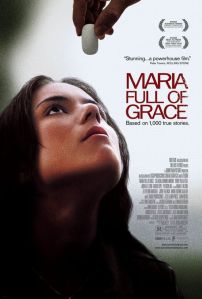 No other actress stood out to me this year as 23-year-old Catalina Sandino Moreno. She plays the movie’s Maria, a Colombian woman who agrees to carry 60-something condoms filled with heroin in her gut to the United States. The first half of the film is unjudegmental and nerve-racking, especially when Maria gets snagged by U.S. customs. The second half revolves around Maria trying to land on her feet in an unfamiliar land. The greatness of Maria Full of Grace relies on debut writer/director Joshua Marston framing his story like camera is an invisible voyeur. The film suggests that Maria is only one of thousands that have turned into drug mules to make ends meet or seek better lives. Maria Full of Grace is startling, immersive, delicate and quietly touching as Maria rediscovers the promise of the American dream.
Nate’s Grade: A
Share this:

The Village (2004)
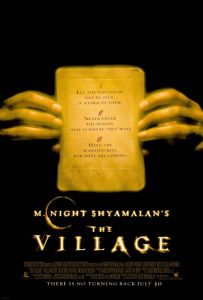 When saying director names you can play a fun little game of word association. Someone says, “George Lucas,” and things like big-budget effects, empty storytelling, and wooden dialogue come to mind. Someone says, “David Lynch,” and weird, abstract, therapy sessions dance in your head. The behemoth of word association is M. Night Shyamalan. He burst onto the scene with 1999’s blockbuster, The Sixth Sense, a crafty, moody, intelligent thriller with a knock-out final twist. Now, though, it seems more and more evident that while The Sixth Sense was the making of M. Night Shyamalan, it also appears to be his undoing. His follow-up films, Unbreakable and Signs, have suffered by comparison, but what seems to be hampering Shyamalan’s growth as a writer is the tightening noose of audience expectation that he kowtows to.
With this in mind, we have Shyamalan’s newest cinematic offering, The Village. Set in 1897, we follow the simple, agrarian lives of the people that inhabit a small secluded hamlet. The town is isolated because of a surrounding dense forest. Mythical creatures referred to as Those We Dont Speak Of populate the woods. An uneasy truce has been agreed upon between the creatures and the villagers, as long as neither camp ventures over into the others territory. When someone does enter the woods, foreboding signs arise. Animals are found skinned, red marks are found on doors, and people worry that the truce may be over. Within this setting, we follow the ordinary lives of the townsfolk. Ivy Walker (Bryce Dallas Howard) is the daughter of the towns self-appointed mayor (William Hurt), and doesnt let a little thing like being blind get in the way of her happiness. She is smitten with Lucius (Joaquin Phoenix), a soft-spoken loner. Noah (Adrien Brody), a mentally challenged man, also has feelings for Ivy, which cause greater conflict.
 Arguably, the best thing about The Village is the discovery of Howard. She proves herself to be an acting revelation that will have future success long after The Village is forgotten. Her winsome presence, wide radiant smile, and uncanny ability to quickly emote endear the character of Ivy to the audience. She is the only one onscreen with genuine personality and charisma, and when shes flirting and being cute about it you cannot help but fall in love with her. And when she is being torn up inside, the audience feels the same emotional turmoil. I am convinced that this is more so from Howard’s acting than from the writing of Shyamalan. She reminds me of a young Cate Blanchett, both in features and talent.
It seems to me that Shyamalan’s directing is getting better with every movie while his writing is getting proportionately worse. He has a masterful sense of pacing and mood, creating long takes that give the viewer a sense of unease. The first arrival of the creatures is an expertly handled scene that delivers plenty of suspense, and a slow-motion capper, with music swelling, that caused me to pump my fist. The cinematography by Roger Deakins is beautifully elegant. Even the violin-heavy score by James Newton Howard is a great asset to the film’s disposition.
So where does the film go wrong and the entertainment get sucked out?
What kills The Village is its incongruous ending. Beforehand, Shyamalan has built a somewhat unsettling tale, but when he finally lays out all his cards, the whole is most certainly not more than the sum of its parts. In fact, the ending is so illogical and stupid, and raises infinitely more questions than feeble answers, that it undermines the rest of the film. Unlike The Sixth Sense, the twist of The Village does not get better with increased thought.
Shyamalan’s sense of timing with his story revelations is maddening. He drops one twist with 30 minutes left in the film, but whats even more frustrating is he situates a character into supposed danger that the audience knows doesn’t exist anymore with this new knowledge. The audience has already been told the truth, and it deflates nearly all the tension. Its as if Shyamalan reveals a twist and then tells the audience to immediately forget about it. Only the naïve will fall for it.
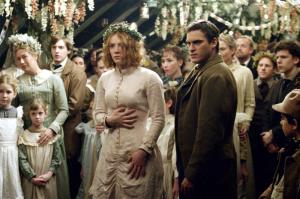 Shyamalan also exhibits a problem fully rendering his characters. They are so understated that they dont ever really jump from the screen. The dialogue is very stilted and flat, as Shyamalan tries to stubbornly fit his message to ye olde English vernacular (which brings about a whole other question when the film’s final shoe is dropped). Shyamalan also seems to strand his characters into soap opera-ish subplots involving forbidden or unrequited love. For a good hour or so, minus one sequence, The Village is really a Jane Austin story with the occasional monster.
The rest of the villagers don’t come away looking as good as Howard. Phoenix’s taciturn delivery seems to suit the brooding Lucius, but at other times he can give the impression of dead space. Hurt is a sturdy actor but can’t find a good balance between his solemn village leader and caring if sneaky father. Sigourney Weaver just seems adrift like shes looking for butter to churn. Brody is given the worst to work with. His mentally-challenged character is a terrible one-note plot device. He seems to inexplicably become clever when its needed.
The Village is a vast disappointment when the weight of the talent involved is accounted for. Shyamalan crafts an interesting premise, a portent sense of dread, and about two thirds of a decent-to-good movie, but as Brian Cox said in Adaptation, ”The last act makes the film. Wow them in the end, and you’ve got a hit. You can have flaws and problems, but wow them in the end, and you’ve got a hit.” It’s not that the final twists and revelations are bad; its that they paint everything that came before them in a worse light. An audience going into The Village wanting to be scared will likely not be pleased, and only Shyamalan’s core followers will walk away fully appreciating the movie. In the end, it may take a village to get Shyamalan to break his writing rut.
Nate’s Grade: C+
Share this:

The Door in the Floor (2004)
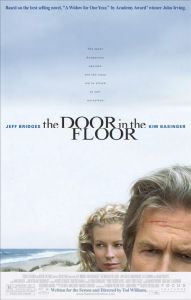 John Irving is one of the most accomplished and popular fiction writers of our times. His pulpy, unconventional, and compassionate novels have translated into many films with varying degrees of quality (World According to Garp, good; Cider House Rules, okay; Simon Birch, dreadful). The Door in the Floor is an adaptation of his novel, A Widow for One Year, but it only adapts the first third of the novel. This time around will the absence of quantity directly shape the quality of an Irving adaptation?
The plot for The Door in the Floor almost sounds like something you’d see late at night on Cinemax. Eddie (Jon Foster) is a teenager learning what it takes to be a writer. He becomes an assistant to Ted Cole (Jeff Bridges), a giant in the world of childrens literature but a playboy at home. Eddie spends the summer at Ted’s quaint cottage and is instantly smitten with Ted’s estranged wife, Marion (Kim Basinger). Theirs has been a loveless marriage ever since a tragic accident killed their two sons. Both are handling the grief in their own ways. Ted has become bitter and takes his anger out on his manipulation of other women, notably a neighbor (Mimi Rogers) who poses nude for his paintings. Marion has become insular and turns into a stone whenever the accident is mentioned.
 Eddie tires of his glorified chauffeuring duties for Ted and his mistress. He spends his lonely days fantasizing about Marion, including masturbating to the image of her clothes. When Marion accidentally stumbles into this embarrassing situation, she not only calmly apologizes but lays out additional pairs of clothing for Eddie to get his kink. This opens the door for Eddie to engage his fantasy, and embark on a deflowering tryst with Marion. Ted’s reaction isn’t one of anger or resentment but more of a job well done. It is around this time when we realize that Eddie looks remarkably like her two lost sons.
The film’s best moments are not the colorless, tepid tryst between Eddie and Marion, or the broader comic moments with Teds assault on tact; oh no, the best moments are when anyone onscreen shares time with Ruth (Elle Fanning), Ted and Marion’s precocious 4-year-old daughter. She’s a tad demanding, like insisting to know where every picture of her family remains, but comes across as adorable without stepping over into cloying. Her interaction with Bridges is wonderful, her wide-eyed questioning is sweet, and her acting is much more authentic than her sister, the more seasoned Dakota Fanning (Man on Fire). Hopefully the Fanning family has learned some dos and donts from the Culkin family.
Bridges performance is amazing. He bares more than just his backside in this film. The role of Ted is very meaty, and Bridges is the perfect actor to sink his teeth right into it. Bridges is alarmingly coy, blending a disarmingly comic roly-poly ability, as well as a brooding, stinging anger barely masked by ego and affability. I cannot imagine anyone else stepping into Ted’s shoes and delivering a better performance. Bridges’ tortured and droll work may be Oscar material.
 Basinger’s performance is equally amazing. Amazingly bad, that is. Her character is supposed to be shattered by the loss of her sons, but Basinger plays the role so heavily intoxicated by grief that Marion becomes nothing more than a walking ghost. She’s so zombie-like for the entire film, that her performance could be rivaled by a coma patient. For some reason unbeknownst to me, ever since winning a Best Supporting Actress Oscar in 1997, Basinger has yet to follow with a really good performance.
The Door in the Floor is Jon Foster’s real big break as a young actor. His previous roles amount to little, including Kevin Costner’s son in 13 Days and the vitally integral Gas Station Cashier in Terminator 3. Some awkwardness is apparent in his rise to larger material, but Fosters apprehension serves his character best, like a dinner scene between him and Marion where he tells a bad joke to break the ice. Foster’s performance is a bit bland, but that’s because his character is more of a transparent adolescent fantasy.
Poor Mimi Rogers, a.k.a. Mrs. Tom Cruise Number One. She’s a capable actress, and a fine-looking woman, but she’s been given such a small one-note character that it seems almost exploitative that such a well-known actress spends the majority of her time with her robe around her ankles. A late scene involving her violent hysteria at being dumped by Ted and it is meant to be comic but it seems more like a fizzy tantrum. All this and she gets the dubious notoriety of having a drawing of the most sensitive part of her anatomy projected in glorious widescreen.
By now an audience is more or less used to Irvings mix of slapstick and grief, of pathos and situational humor. The Door in the Floor follows this tried-and-true recipe and provides a healthy amount of entertainment for an audience. It can effectively make an audience laugh and supply knots in their throat at separate turns; however, in the harsh light of day, if you strip away at The Door in the Floor you’ll find that most every character is self-involved, curt, closed off, and just plain unlikable. Ted is a jerk. Marion is a zombie, and not so great a mother. Eddie is bland. The only real character worthy of empathy is Ruth.
 Now, movies dont necessarily all have to have likable characters, and in fact some of the most interesting and memorable characters are unlikable, but for a family melodrama its important to feel for their grief instead of feeling their grief. If you cant feel for the characters then youre just watching without any baited interest. Many films can make you feel bad by watching someone on hard times, but it’s a true accomplishment if you feel the character’s personal pains (and somehow the films of Lars von Trier accomplish both). Theres little investment beyond the surface level of amusement. So, The Door in the Floor is amusing,but it struggles to be anything beyond because of the limitations of its characters. For some, a movie that provides surface-level amusement from polished actors is good enough, and in some instances Id agree.
Director Tod Williams (The Adventures of Sebastian Cole) also served as the adapter of Irvings dense work. Williams knows a thing or two about family melodrama and the denial of guilt, and he keeps the pacing brisk and the laughs at an even pace. Williams’ best decisions are on the small visual notes he hangs on, like a stunning, visually alluring final image. The story is a bit uneven in tone, thanks to Irving’s eccentric source, but Williams saves his narrative whammy for the very end, and Bridges brilliantly delivers the backstory we’ve been holding our breath for.
The Door in the Floor is a solid, if surface-level enterprise in the exploration of guilt and mourning in a family setting. Bridges gives an amazing and memorable performance that helps make you forget about the rest of the films somewhat lackluster acting. Fans of Irving’s works will likely be taken back in pleasure, and fans of adult melodrama will not likely walk out disappointed. The Door in the Floor has glimpses of something more but settles for being a well-acted, nondescript affair.
Nate’s Grade: B-


You must be logged in to post a comment.