Blog Archives
Elizabethtown (2005)
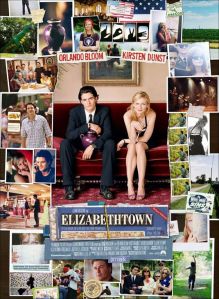 Cameron Crowe is a filmmaker I generally admire. He makes highly enjoyable fables about love conquering all, grand romantic gestures, and finding your voice. His track record speaks for itself: Say Anything, Singles, Jerry Maguire, Almost Famous (I forgive him the slipshod remake of Vanilla Sky, though it did have great artistry and a bitchin’ soundtrack). Crowe is a writer that can zero in on character with the precision of a surgeon. He’s a man that can turn simple formula (boy meets girl) and spin mountains of gold. With these possibly unfair expectations, I saw Elizabethtown while visiting my fiancé in New Haven, Connecticut. We made a mad dash to the theater to be there on time, which involved me ordering tickets over my cell phone. I was eager to see what Crowe had in store but was vastly disappointed with what Elizabethtown had to teach me.
Drew Baylor (Orlando Bloom) opens the film by narrating the difference between a failure and a fiasco. Unfortunately for him, he’s in the corporate cross-hairs for the latter. Drew is responsible for designing a shoe whose recall will cost his company an astounding “billion with a B” dollars (some research of an earlier cut of the film says the shoe whistled while you ran). His boss (Alec Baldwin) takes Drew aside to allow him to comprehend the force of such a loss. Drew returns to his apartment fully prepared to engineer his own suicide machine, which naturally falls apart in a great comedic beat. Interrupting his plans to follow career suicide with personal suicide is a phone call from his sister (Judy Greer). Turns out Drew’s father has died on a trip visiting family in Elizabethtown, Kentucky. Drew is sent on a mission from his mother (Susan Sarandon) to retrieve his father and impart the family’s wishes. On the flight to Kentucky, Drew gets his brain picked by Claire (Kirsten Dunst), a cheery flight attendant. While Drew is surrounded by his extended family and their down homsey charm and eccentricities, he seeks out some form of release and calls Claire. They talk for hours upon hours and form a fast friendship and stand on the cusp of maybe something special.
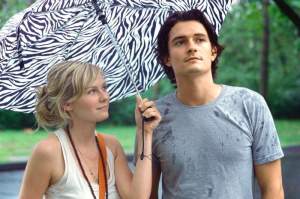 I think the most disappointing aspect of Elizabethtown for me is how it doesn’t have enough depth to it. Crowe definitely wears his heart on his sleeve but has never been clumsy about it. Elizabethtown wants to be folksy and cute and impart great lessons about love, life, and death. You can’t reach that plateau when you have characters walking around stating their inner feelings all the time, like Drew and Claire do. They might as well be wearing T-shirts that explain any intended subtext. Crowe squanders his film’s potential by stuffing too many storylines into one pot, thus leaving very little attachment to any character. Elizabethtown has some entertaining details, chiefly Chuck and Cindy’s drunk-on-love wedding, but the film as a whole feels too loose and disconnected to hit any emotional highs. If you want a better movie about self-reawakening, rent Garden State. If you want a better movie about dealing with loss, rent Moonlight Mile.
This is Bloom’s first test of acting that doesn’t involve a faux British accent and some kind of heavy weaponry. The results are not promising. Bloom is a pin-up come to life like a female version of Weird Science, a living mannequin, possibly an alien with great skin, but he isn’t a real compelling actor. He has about two emotions in his repertoire. His whiny American-ized accent seems to be playing a game of tag. He’s not a bad actor per se; he just gets the job done without leaving any sort of impression. To paraphrase Claire, he’s a “substitute leading man.”
Dunst is chirpy, kooky and cute-as-a-button but is better in small doses. Her accent is much more convincing than Bloom’s. Sarandon deserves pity for being involved in Elizabethtown‘s most improbable, cringe-worthy moment. At her husband’s wake, she turns her time of reflection into a talent show with a stand-up routine and then a horrifying tap dance. Apparently this gesture wins over the extended family who has hated her for decades. Greer (The Village) is utterly wasted in a role that approximates a cameo. Without a doubt, the funniest and most memorable performance is delivered by Baldwin, who perfectly mixes menace and amusement. He takes Drew on a tour of some of the consequences of the loss of a billion dollars, including the inevitable closing of his Wildlife Watchdog group. “We could have saved the planet,” Baldwin says in the most comically dry fashion. Baldwin nails the balance between discomfort and bewilderment.
 Elizabethtown wants to be another of Crowe’s smart, feel-good sentimental field trips, but it falls well short. I was dumbfounded to see how little the story progressed. It lays the groundwork for a menagerie of subplots and then, in a rush to finish, caps everyone off with some emotionally unearned payoff. To put it simply, Elizabethtown wants credit and refuses to show its work. The film is packed with characters and ideas before succumbing into an interminable travelogue of America in its closing act, but what cripples Crowe’s film about opening up to emotional growth is that the movie itself doesn’t showcase growth. We see the rough and tumble beginnings of everyone, we see the hugs-all-around end, but we don’t witness that most critical movement that takes the audience from Point A to Point B. The results are beguiling and quite frustrating. Take the subplot about Drew’s cousin, who can?t connect to his father either and wants to be friends to his own son, a shrill little terror, instead of a father. Like most of Elizabethtown‘s storylines, these subplots die of neglect until a half-hearted nod to wrap everything up. Father sees son perform and all is well. Son does little to discipline child but all is well. Elizabethtown is sadly awash in undeveloped storylines and characters and unjustified emotions, and when they’re unjustified we go from sentiment (warm and fuzzy) to schmaltz (eye-rolling and false). I truly thought Crowe would know better than this.
Crowe has always been the defacto master of marrying music to film. Does anyone ever remember people singing Elton John’s “Tiny Dancer” before its virtuoso appearance in 2000’s Almost Famous? Crowe has a nimble ear but his penchant for emotional catharsis set to song gets the better of him with Elizabethtown. There’s just way too many musical montages (10? 15?) covering the emotional ground caused by the script’s massive shortcomings. By the time a montage is followed by another montage, you may start growing an unhealthy ire for acoustic guitar. Because there are so many unproductive musical numbers and montages, especially when we hit the last formless act, Elizabethtown feels like Crowe is shooting the soundtrack instead of a story.
Elizabethtown is an under-cooked, unfocused travelogue set to music. Crowe intends his personal venture to belt one from the heart, but like most personal ventures the significance can rarely translate to a third party. It’s too personal a film to leave any lasting power, like a friend narrating his vacation slide show. Elizabethtown is gestating with plot lines that it can’t devote time to, even time to merely show the progression of relationships. The overload of musical montages makes the movie feels like the longest most somber music video ever. Bloom’s limited acting isn’t doing anyone any favors either. In the end, it all rings too phony and becomes too meandering to be entertaining. Elizabethtown is a journey the film won’t even let you ride along for. This movie isn’t an outright fiasco but given Crowe’s remarkable track record it can’t help but be anything but a failure.
Nate’s Grade: C
Share this:

A Sound of Thunder (2005)
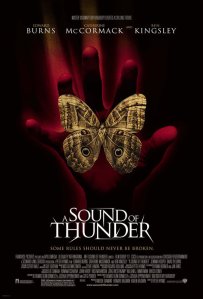 A Sound of Thunder, based on the classic short story by Ray Bradbury, is a movie that no one is going to see by design. It was shot way back in 2002, traded directors when Renny Harlin left to make Mindhunters and Peter Hyams (End of Days, The Relic) stepped in, sat on a shelf for two years, and now is being released without a peep. I have not seen a single TV ad, a single trailer, and until a few days ago I hadn’t even seen a poster for the film. It’s like the studio doesn’t want anyone to know that A Sound of Thunder exists and that they?re responsible. With zero advertising, the only people who are going to pay to see this are those familiar with Bradbury’s story. A Sound of Thunder will be gone in the blink of an eye. It doesn’t help that the movie is awful.
In the year 2055, time travel is here and available to those with deep pockets. Charles Hatton (Ben Kingsley) runs a service that allows rich people to travel back millions of years for the ultimate big game hunt — dinosaurs. The time squad is led by Travis Ryer (Edward Burns), a brilliant scientist biding his time working for the man. The time travel inventor (Catherine McCormack) warns about the dangers with playing around in the past. The tiniest alteration could drastically change the future. Hatton assures everything is safe; they hunt the same dinosaur that is just about to be destroyed and touch nothing else. Of course something does go wrong. On one hunt the clients run off the safe path and accidentally step on a butterfly. This causes “time waves” to sweep the present-day Earth and kick start some evolutionary changes. Travis is left to figure out what went wrong and fix it before humankind is wiped off the planet with the next wave.
 The movie pretends to play with brainy sci-fi principles, but A Sound of Thunder is really an empty vacuum of logic. As a precautionary measure, the team only travels back in time and hunts the same damned dinosaur. This dinosaur is special because it’s minutes away from getting stuck in a tar pit and then being obliterated by an exploding volcano. The team picks this dinosaur because hunting it won’t disrupt the fabric of time. Gotcha, but then why does stepping on a butterfly even matter? Is a butterfly seriously going to survive the oncoming volcanic blast and wall of ash? If the butterfly is just moments away from it too being destroyed, then why does killing it seconds earlier affect all of evolution? And how come these changes in time are always disastrous? Can’t someone just as reasonably step on a butterfly and wipe out cancer?
Let’s talk about A Sound of Thunder‘s alternate evolutionary timeline. In this world, because of our infamous butterfly stomping, apes and dinosaurs have inexplicably become linked. They’ve evolved into some weird hybrid, with a baboon head and the body of a dinosaur. This seems entirely implausible to me that two very different creatures would just blend together. At least A Sound of Thunder could have gone all out and had other animal mash-ups, like a whale/hummingbird or a walrus/cheetah. A Sound of Thunder could be rivaled by The Wuzzles in evolutionary theory (please tell me I’m not the only one who remembers The Wuzzles). I would have been more interested if A Sound of Thunder presented the future dinosaurs as fully evolved after an additional 65 million years. Let’s see dinos with industry, tools, community, language, and maybe even popular culture. It sure would be more interesting and imaginative than big dumb monsters.
A Sound of Thunder isn’t a sci-fi puzzler; it’s really a monster movie in disguise. After the evolutionary wrench, the film descends into a banal series of chase scenes, with our characters being plucked one-by-one by different monsters. The characters still manage to spout sci-fi dribble while on the run. Of course the characters can’t stop themselves from doing stupid things. A guy warns our team to be quiet lest they awaken the hordes of sleeping baboon-dinos hanging overhead. So what do they do? They make sure to shine their flashlights repeatedly in the creatures? faces. A Sound of Thunder is more preoccupied with what can go bump in the night than sci-fi brainteasers.

Not how evolution works.
A Sound of Thunder has some of the worst special effects I have ever seen. I’m talking about effects that would be shown up by some half-baked video game from the mid ’90s. It’s really hard to fully explain how profoundly bad the effects are. The green screen work is ugly and painful, with characters surrounded by halos and walking on invisible treadmills. The future’s boxy cars look like they were assembled by Lego. The look of the dinosaur is curiously retro, all sleek, entirely green or brown, and lacking definition. It looks like what people in the 1950s thought dinosaurs looked like. In the wake of Jurassic Park, a less realistic, more reptilian dinosaur is not the way to go. The film tries to save money by using the same dinosaur and repeating the scene with diminishing returns. Every special effect in A Sound of Thunder comes across as flimsy from the wildlife, to the skyscrapers, to the dinosaurs, to even a subway car and rising water. Every effect is so terribly obvious and obviously terrible.
The film’s acting is expectantly dull. Kingsley hams it up and has great fun as his money-grubbing business tycoon. He adds a zest to his lines. Burns plays every role so dead-panned that I doubt I will ever see an emotion from him that isn’t accompanied by a smirk. The rest of the actors couldn’t find their way with an industrial flashlight to shine in a monkey-dino’s eyes.
A Sound of Thunder is an inept sci-fi flick more concerned with hungry monsters than ideas. The special effects are abysmal, the acting is wooden, the plot holes are glaring, and the atmosphere is laughable. This giant schlockfest is so bad that it achieves a fun campy value, destined to become a drinking game for science fiction nerds. Only Ray Bradbury fans will be at the theater to see A Sound of Thunder, so in turn that means only Ray Bradbury fans will be disappointed with how terrible the film adaptation is. Everyone else will be at home scratching their heads; certain that a film called A Sound of Thunder never existed. Just like the studio wants.
Nate’s Grade: D-
Share this:

Red Eye (2005)
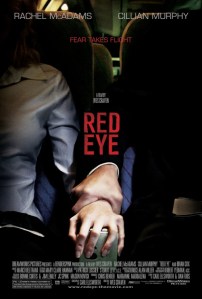 Red Eye is something of a comeback for Wes Craven, the horror master that’s been somewhat grasping at straws for several years (for further proof see Cursed). The concept is ripe for tension and the film has little fat on it, clocking in at a meager 80 minutes. It’s divided like so: 20 minutes set-up, 40 minutes on the plane, and 20 minutes off the plane for the conclusion. Red Eye is so enjoyable when we’re trapped on that flight, catching the icy stares of Cillian Murphy, that I personally would love an additional 20-30 minutes more in the air. There’s a nice chain of cause and effect, as the audience is with Rachel McAdams (fast becoming the Hollywood It girl) as she tries to think her way out of her jam, each time thwarted by the chilling Murphy once more. It’s a great duel of wits. The last act of the film is too conventional and predictable to close out such a great claustrophobic pressure cooker. It’s also a bit insulting that she’s ultimately rescued by a man after we watch 80-minutes of her plucky ingenuity and courage. Red Eye is a solid thriller carried by two great performers on the rise.
Nate’s Grade: B
Share this:

Batman Begins (2005)
 I have been a Batman fan since I was old enough to wear footy pajamas. I watched the campy Adam West TV show all the time, getting sucked into the lead balloon adventures. Tim Burton’s 1989 Batman was the first PG-13 film I ever saw, and I watched it so many times on video that I have practically worn out my copy. Batman Returns was my then most eagerly anticipated movie of my life, and even though it went overboard with the dark vision, I still loved it. Then things got dicey when Warner Brothers decided Batman needed to lighten up. I was only a teenager at the time, but I distinctly remember thinking, “You’re telling the Dark Knight to lighten up?” Director Joel Schumacher’s high-gloss, highly stupid turn with Batman Forever pushed the franchise in a different direction, and then effectively killed it with 1997’s abomination, Batman and Robin. I mean these films were more worried about one-liners and nipples on the Bat suits. Nipples on the Bat suits, people! Is Batman really going, “Man, you know, I’d really like to fight crime today but, whoooo, my nipples are so chaffed. I’m gonna sit this one out”?
For years Batman languished in development hell. Warner Bothers licked their wounds and tried restarting their franchise again and again, only to put it back down. Then around 2003 things got exciting. Writer/director Christopher Nolan was announced to direct. Nolan would also have creative control. Surely, Warner Brothers was looking at what happened when Columbia hired Sam Raimi (most known for low-budget splatterhouse horror) for Spider-Man and got out of his way. After Memento (My #1 movie of 2001) and Insomnia (My #5 movie of 2002), Nolan tackles the Dark Night and creates a Batman film that’s so brilliant that I’ve seen it three times and am itching to go again.
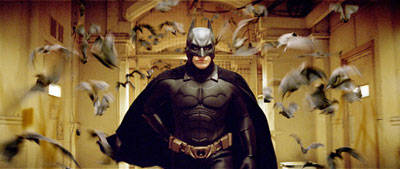 The film opens with a youthful Bruce Wayne (Christian Bale) in a Tibetan prison. He’s living amongst the criminal element searching for something within himself. Henri Ducard (Liam Neeson) offers Bruce the chance to be taught under the guidance of the mysterious Ra’s Al Ghul (Ken Watanabe), the leader of the equally mysterious warrior clan, The League of Shadows. Under Ducard’s direction, Bruce confronts his feelings of guilt and anger over his parents’ murder and his subsequent flee from his hometown, Gotham City. He masters his training and learns how to confront fear and turn it to his advantage. However, Bruce learns that the League of Shadows has its judicial eyes set on a crime ridden Gotham, with intentions to destroy the city for the betterment of the world. Bruce rebels and escapes the Tibetan camp and returns to Gotham with his own plans of saving his city.
With the help of his trusted butler Alfred (Michael Caine), Bruce sets out to regain his footing with his family’s company, Wayne Enterprises. The company is now under the lead of an ethically shady man (Rutger Hauer) with the intentions of turning the company public. Bruce befriends Lucius Fox (Morgan Freeman), the company’s gadget guru banished to the lower levels of the basement for raising his voice. Bruce gradually refines his crime fighting efforts and becomes the hero he’s been planning on since arriving home.
Gotham is in bad shape too. Rachel Dawes (Katie Holmes), a childhood friend to Bruce, is a prosecutor who can’t get anywhere when crime lords like Falcone (Tom Wilkinson) are controlling behind the scenes. Most of the police have been bought off, but Detective Gordon (Gary Oldman) is the possibly the city’s last honest cop, and he sees that Batman is a figure trying to help. Dr. Crane (Cillian Murphy) is a clinical psychologist in cahoots with Falcone. Together they’re bringing in drug shipments for a nefarious plot by The Scarecrow, a villain that uses a hallucinogen to paralyze his victims with vivid accounts of their own worst fears. Bruce is the only one who can unravel the pieces of this plot and save the people of Gotham City.
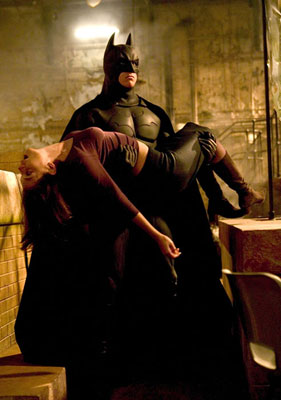 Nolan has done nothing short of resurrecting a franchise. Previous films never treated Batman as an extraordinary character; he was normal in an extraordinary world. Batman Begins places the character in a relatively normal environment. This is a brooding, intelligent approach that all but erases the atrocities of previous Batman incarnations. Nolan presents Bruce Wayne’s story in his typical nonlinear fashion, but really gets to the meat and bone of the character, opening up the hero to new insights and emotions, like his suffocating guilt over his parents murder.
Nolan and co-writer David S. Goyer (the Blade trilogy) really strip away the decadence of the character and present him as a troubled being riddled with guilt and anger. Batman Begins is a character piece first and an action movie second. The film is unique amongst comic book flicks for the amount of detail and attention it pays to characterization, even among the whole sprawling cast. Nolan has assembled an incredible cast and his direction is swimming in confidence. He’s a man that definitely knows what he’s doing, and boy oh boy, is he doing it right. Batman Begins is like a franchise colonic.
This is truly one of the finest casts ever assembled. Bale makes an excellent gloomy hero and really transforms into something almost monstrous when he’s taking out the bad guys. He’s got great presence but also a succinct intensity to nail the quieter moments where Bruce Wayne battles his inner demons. Caine (The Cider House Rules, The Quiet American) is incomparable and a joy to watch, and his scenes with the young Bruce actually had me close to tears. This is by far the first time a comic book movie even had me feeling something so raw and anything close to emotional. Neeson excels in another tough but fair mentor role, which he seems to be playing quite a lot of lately (Kingdom of Heaven, Star Wars Episode One). Freeman steals every scene he’s in as the affable trouble causer at Wayne Enterprises, and he also gets many of the film’s best lines. Oldman (The Fifth Element, Harry Potter and the Prisoner of Azkaban) disappears into his role as Gotham’s last good cop. If ever there was a chameleon (and their name wasn’t Benicio del Toro), it is Oldman. Holmes works to the best of her abilities, which means she’s “okay.”
The cast of villains are uniformly excellent, with Wilkinson’s (In the Bedroom) sardonic Chicagah accented mob boss, to Murphy’s (28 Days Later…) chilling scientific approach to villainy, to Watanabe’s (The Last Samurai) cold silent stares. Even Rutger Hauer (a man experiencing a career renaissance of his own) gives a great performance. Seriously, for a comic book movie this is one of the better acted films of the year. And that’s saying a lot.
Batman Begins is such a serious film that it almost seems a disservice to call it a “comic book movie.” There are no floating sound effects cards and no nipples on the Bat suits. Nolan really goes about answering the tricky question, “What kind of man would become a crime-fightin’ super hero?” Batman Begins answers all kinds of questions about the minutia of the Dark Knight in fascinating ways, yet the film remains grounded in reality. The Schumacher Batmans (and God save us from them) were one large, glitzy, empty-headed Las Vegas entertainment show. No explanation was given to characters or their abilities. Likewise, the Gothic and opulent Burton Batmans had their regrettable leaps of logic as well. It’s hard not to laugh at the end of Batman Returns when Oswald Cobblepot (a.k.a. The Penguin) gets a funeral march from actors in emperor penguin suits. March of the Penguins it ain’t. Nolan’s Batman is the dead-serious affair comic book lovers have been holding their breath for.
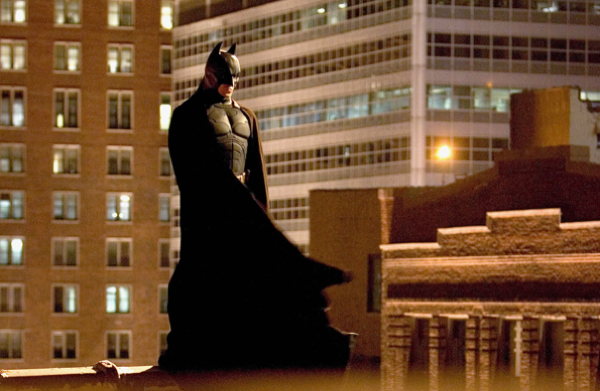 The action is secondary to the story, but Batman Begins still has some great action sequences. Most memorable is a chase sequence between Gotham police and the Batmobile which goes from rooftop to rooftop at one point. Nolan even punctuates the sequence with some fun humor from the police (“It’s a black … tank.”). The climactic action sequence between good guy and bad guy is dutifully thrilling and grandiose in scope. Nolan even squeezes in some horror elements into the film. Batman’s first emergence is played like a horror film, with the caped crusader always around another turn. The Scarecrow’s hallucinogen produces some creepy images, like a face covered in maggots or a demonic bat person.
There are only a handful of flaws that make Batman Begins short of being the best comic book movie ever. The action is too overly edited to see what’s happening. Whenever Batman gets into a fight all you can see are quick cuts of limbs flailing. My cousin Jennifer got so frustrated with the oblique action sequences that she just waited until they were over to see who won (“Oh, Batman won again. There you go.”). Nolan’s editing is usually one of his strong suits; much of Memento’s success was built around its airtight edits. He needs to pull the camera back and let the audience see what’s going on when Batman gets physical.
Another issue is how much plot Batman Begins has to establish. This is the first Batman film to focus solely on Batman and not some colorful villain. Batman doesn’t even show up well into an hour into the movie. As a result, Batman Begins perfects the tortured psychology of Bruce Wayne but leaves little time for villains. The film plays a shell game with its multiple villains, which is fun for awhile. The Scarecrow is really an intriguing character and played to gruesome effect by the brilliant Cillian Murphy. It’s a shame Batman Begins doesn’t have much time to develop and then play with such an intriguing bad guy.
Batman Begins is a reboot for the film franchise. Nolan digs deep at the tortured psyche of Bruce Wayne and come up with a treasure trove of fascinating, exciting, and genuinely engrossing characters. Nolan’s film has a handful of flaws, most notably its oblique editing and limited handling of villains, but Batman Begins excels in storytelling and crafts a superbly intelligent, satisfying, riveting comic book movie. The best bit of praise I can give Batman Begins is that I want everyone responsible to return immediately and start making a host of sequels. This is a franchise reborn and I cannot wait for more of it.
Nate’s Grade: A
Share this:

Cinderella Man (2005)
 Let’s talk a little about screenwriter Akiva Goldsman. This is the man responsible for travesties like Lost in Space and the franchise killing, pun-crazy Batman and Robin. There’s plenty of junk writers in Hollywood and plenty of good writers just saddled by junk to make a living, and either might apply to Goldsman. How in the world did he become a Hollywood go-to guy?It probably has something to do with Ron Howard. Goldsman adapted the screenplay for Howard’s film A Beautiful Mind and both walked away with Oscars. Suddenly the man who wrote Mr. Freeze saying, “You’re not sending MEEE to the COOLER,” had an Oscar on his mantle. Goldsman and Howard, in retrospect, seem like a match made in heaven. They both enjoy big Hollywood event movies that spoon-feed an audience and shave off the gray areas. Cinderella Man serves as the duo’s second collaboration and it’s exactly what you would expect a big Hollywood event movie to be from them.
Jim Braddock (Russell Crowe) is an up-and-coming New Jersey boxer who’s on a warpath to the heavyweight title. His wife Mae (Renee Zellweger) loves him dearly and he dotes on his three kids. Life seems so perfect in 1929 America. And then the Depression hits. Braddock breaks his hand in a fight and his skills slip tremendously. The boxing commission revokes his license and Braddock is forced to take a dock job to provide for his family. Times are tough and there doesn’t appear to be a way out, until Braddock’s old boxing manager (Paul Giamatti) offers him a one time only bout in the ring. Braddock is seen as a has-been but he knocks his opponent flat out. More fights come and so do more victories, and Jim Braddock seems destined for a remarkable storybook comeback. But then there’s the reigning champ Max Baer (Craig Bierko), an arrogant playboy. Baer also is a ferocious fighter and has actually killed two men in the ring. The championship leads through him and Braddock is unafraid. Mae is terrified she’ll become a widow and pleads with her husband not to fight. But now that he’s been through the gutter, Braddock knows what he?s fighting for: the survival of his family. To do that, he?s headed for a title match with Baer.
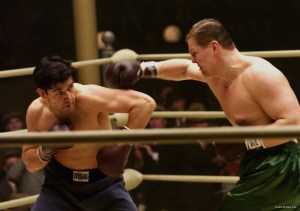 What elevates Cinderella Man from an “okay” film into a “mostly good” film is the singular brilliance of Russell Crowe. This man is simply one of the most amazing actors we’ve ever seen, and he’s been on an incredible hot streak since 1999’s The Insider (forget 2000’s Proof of Life, please). Yet again mastering another accent, Crowe excels at playing a noble man with guarded emotions and honest intentions. He’s an actor that can display such an intense wealth of emotions in the same moment. When he visits his old boxing bosses, hat in hand, begging for enough money to turn the electricity back on, Crowe has laid a sucker punch to your emotions. It’s getting to the point where I will go out and see any movie Russell Crowe stars in just to soak up his brilliant performance. He can throw a phone at my head anytime. Crowe’s stellar and resonant acting will hopefully be noticed come Oscar time; however, I doubt much else of Cinderella Man will be remembered.
Crowe’s sparring partner doesn’t fare as well. I’ve liked Zellweger in a lot of her roles (even the sappy One True Thing), but she’s entirely miscast as Braddock’s underwritten stand-by-your-man wife. She scrunches her face too much and squints for most of the movie.
Two great actors make the most of their meager roles. Giamatti serves as Braddock’s growling pit dog of a corner man and works up a good froth. Bierko almost transcends the film’s one-note villain caste and becomes a figure of showboating sensuality. He struts in the ring with a gallant pride that’s fun to watch, even though you know Howard?s whispering in your ear, “Booooo. Don’t like him. He’s the mean man. Booooo.”
The production design on Cinderella Man is great and really recreates the look and feel of the 1930s in all walks of life. The cinematography, on the other hand, seems washed out and overly dark in spots, though it may have just been my theater?s projection. I miss Roger Deakins, DP on A Beautiful Mind. Deakins knew how to beautifully light a scene and capture the audience with a precise, eye-pleasing angle. In contrast, Cinderella Man seems to think that sepia tones defined the time period of the 1930s.
Howard still has little to no trust in his audience. He can’t rely on the performances of his actors to express their motivation. We know why Braddock is fighting during the Depression, Howard. We don’t need split-second cuts of his family for reminders. It’s almost like Howard wants to point to the screen and tell the audience what to feel. It should be obvious by now but ambiguity doesn’t work here. That’s why Braddock is seen as almost saintly (never mind the connections to organized crime). That’s why Baer is seen as dastardly (never mind that in 1933 Baer heroically wore a Jewish star and knocked out Hitler’s favorite prize fighter, Max Schmeling). It seems that the details just get in the way when Howard wants to turn true-life stories into calculating crowd-pleasers.
At the docks, just in case we don’t get how tragic the Great Depression is (you know, in case you forgot what either the words “great” or “depression” meant), Howard has to bend over backwards to show someone stepping over a newspaper declaring how high unemployment is. When Braddock finds a friend in Hoovertown (Central Park turned into a neighborhood of shanties) we see him run over by a horse and buggy as another man crushed by the system or a runaway metaphor. When Baer fights in the ring Howard makes sure to get that sneering close-up of our villain. And surely anyone who’s a womanizing playboy must go down for the good of the nation. Howard is aggressive in his pandering.
Thanks to Goldsman and Hollingsworth’s mawkish script, Cinderella Man has the myth of complexity to it when it’s really content to go the easy route. It plays this story too close to the rules: embittered hero with humanity intact, stalwart wife, cocky villain, the grumbling manager. Cinderella Man is stripped of complexity and Goldsman and Hollingsworth want to lead the audience by the nose. When Braddock promises his son in a heart-to-heart that he’ll never split up the family, we know it’s only a matter of time before it happens. Their script is also full of workmanlike dialogue that does enough to just push the story forward but give little shading to its people (Zellweger’s, “You are the champion of my heart, Jim Braddock” is particularly not great.
 Cinderella Man really is a film more about the Depression than boxing, except for its pummeling and gritty final act of non-stop boxing. The script paints an almost insulting idea that the Depression was good for people to learn important life lessons, like family comes first, hard work will be rewarded, and one man can heal a nation. Seabiscuit fell into this same trap with its depiction of the Depression but at least Gary Ross’ film dealt with characters that weren’t tired genre archetypes. Cinderella Man could be described as “Seabiscuit in a boxing ring,” as yet again the triumph of an underdog pulls the country back together and gives the common man something to believe in. What I’d like to see is Braddock vs. Seabiscuit in a ring or even on the horse’s turf. Then we can finally decide once and for all who is responsible for getting America out of the Depression (somewhere FDR is spinning in his wheelchair-accessible grave).
The film does come alive when Braddock steps into the ring. The boxing matches are finely choreographed and pack a real wallop. You can practically feel the bruises and taste the sweat during the 15-round bout between Braddock and Baer. These scenes give you a good understanding of the progression of a boxing match and the real strategy that can turn a loser into a winner. Howard also has a smart visual cue during these lively moments. Whenever a bone gets broken, like Braddock’s hand, we cut to an X-ray shot of that scene and see the bone snap. It might seem old in a CSI-drenched landscape of entertainment but it’s effective and neat.
Cinderella Man is a rousing, heartstring-tugging crowd-pleaser that will inspire hope and redemption. Until you look at it more objectively. It?s easy to get sucked into Howard’s underdog tale and that’s because it’s been tailored to satisfy your emotions. Crowe rises above this heavy-handed yesteryear yarn with a riveting performance. I’m positive most people will walk away from Cinderella Man feeling uplifted and touched and would view me as being overly cynical. But with a maudlin story by Goldsman that simplifies the details, Cinderella Man feels like a feel-good-movie that’s been rigged. These people have no trust in their audience, so why should you put your trust in them?
Nate’s Grade: C+
Share this:

The Sisterhood of the Traveling Pants (2005)
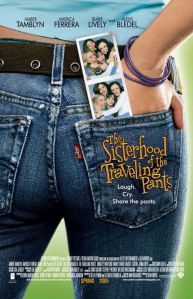 I had no real intention of ever seeing The Sisterhood of the Traveling Pants. It looked to be a competent movie, horrifically clunky title aside, but I really didn’t have any interest in seeing another movie where four young girls become four young women. Then my then-girlfriend says she wants to see it. I think we all know what happens next. Even though I was the only male in my theater (I kind of expected this), I found Sisterhood to be a sweet and heartfelt film I was glad I experienced. It had far more emotional truth to it than I ever would have expected.
Four very close friends are about to depart for the summer. Bridget (Blake Lively) is the confidant sports star and going off to soccer camp in Mexico. Lana (Alexis Bledel) is the demure artist and is going to visit her grandparents in Greece. Carmen (America Ferrera), a bigger girl with big ambitions, is traveling to South Carolina to spend time with her long-absent father (Bradley Whitford). It seems the only one staying put is Tibby (Amber Tamblyn), an angsty nonconformist stuck stocking shelves at a Wal-Mart-esque store and working on her documentary, which she has deemed a “suckumentary.”
Before they set off on their adventures the girls discover a magical pair of pants. It seems that this one pair of jeans fits each to a T, even the curvier Carmen. The girls form a sisterhood around these magically one-size-fits-all pants. They promise to send them back and forth to each other all summer and write down any luck the jeans have imbued them with.
 In Mexico, Bridget sets her sights on a hunky soccer coach (Mike Vogel). She’s brimming with confidence and flirts like a champ. Overseas in Greece, Lana meets Kostas (Michael Rady), a hunky fisherman attending university in Greece. Sparks fly but Lana’s grandmother forbids her to see Kostas. Carmen is shocked to discover that her father is planning on getting remarried to Wasp-y Lydia (Nancy Travis). It seems dear old dad has not told her everything. And Tibby is befriended by a dogged and precocious 12-year-old, Bailey (Jenna Boyd), who wants to be her assistant on the “suckumentary.”
The best part of Sisterhood is the excellence of the lead actresses. All four give well-rounded, warm, enlightened, and exquisitely affecting performances. They each get a good weepy scene and each actress nails it. Bledel has mastered the nervous stammer. She’s adorable as we witness her wallflower character coming out of her shell. Tamblyn mopes and sneers but grows the most thanks to the intervention of Bailey (Boyd is a scene-stealer if ever there were one). Ferrera was a terrific find in Real Women Have Curves, yet another intelligent and charming teen movie. In Sisterhood she gets to display tremendous anger and heartache and she sells every second of it. She is going to be a lovely actress to watch in the future. Lively is a newcomer to film even though she looks like Kate Hudson’s lankier cousin. She’s a girl that knows what she wants but doesn’t necessarily know why she wants it.
One of the smartest things director Ken Kwapis does is to keep the different story threads together. I first thought that Sisterhood would become a vignette movie, meaning that we’d get like a half hour of each girl’s adventure and then we’d travel to the next. It would have worked. But by keeping the girls’ stories intertwined we’re reminded of their bond and we can connect with them all. Kwapis even fits in some nifty scene transitions in his mostly unobtrusive direction. He lets the film’s focus rest on the characters and the performances, which are the strengths of Sisterhood.
The film seems to diverge into two storylines: the summer romances (Bridget and Lana) and the more dramatic (Carmen and Tibby). The summer romances are fun but the real meat of the movie is in Carmen and Tibby’s teary adventures. Carmen is devastated to feel that she’s been replaced and forgotten by her father. It all comes to head in a marvelous scene where Carmen cannot fit into a bridesmaid dress that fits Lydia’s rail thin daughter. She explodes in anger and pain against her father’s new family and runs off. Tibby, on the other hand, is your typical dour and rebellious teen (though in PG-land that means nose ring, colored hair, and thrift store attire). Her relationship with Bailey opens her up and the audience falls in love with both of them. The last half hour of Sisterhood hits an emotional crescendo with both storylines that will leave plenty reaching for the Kleenex.
 Sisterhood sure doesn’t lack melodrama but the film is played so earnestly that you really won’t mind. In other teen girl films, the inclusion of dramatic elements like suicide, abandonment, and even leukemia might cause the casual rolling of eyes. The difference is that Sisterhood respects both its characters and its audience. This is a sincere, unpretentious movie that has a genuine sweetness that won?t give you a toothache. In fact, the most unbelievable moment of the movie is that a pair of pants would fit them all. Again, pretty good for a flick rife with melodrama.
Sisterhood is unabashedly sentimental but it walks a fine line without ever getting truly sappy like some Nicholas Sparks tale (A Walk to Remember). Usually movies of this ilk whitewash over reality and oversimplify complex issues and emotions. Not so with Sisterhood, which deals with tough issues in an admittedly soap operish way but also forces its characters to endure tough resolutions. I am clearly not the intended audience for The Sisterhood of the Traveling Pants (I do by all accounts have a Y chromosome) but I enjoyed it all the same.
The Sisterhood of the Traveling Pants is an old fashioned, good-hearted family film that won?t make you cringe. It’s respectful of its audience and doesn’t take easy shortcuts with its story. It’s also respectful of teenagers and their experiences. The acting by our four leading ladies is uniformly outstanding. In a summer fueled by male-driven high-octane action flicks, something a little low key and sweet is always appealing when done right. This won’t exactly be a movie that will appeal to everyone, but Sisterhood is an above average and earnest take at all-too-familiar territory. Despite the clunky title, this teen-targeted weepie is a good fit for any audience wanting to feel good.
Nate’s Grade: B
Share this:

The Interpreter (2005)
 This is a polished political thriller that hearkens back to the day of the 1970s, where Hollywood was willing to put out smart, complicated, involving political intrigue and have faith that adults would enjoy. The premise is sound and director Sydney Pollack sure knows how to add layers of complication and mystery as well as make you doubt everyone’s involvement. A scene where all the film’s major players somehow get on the same down town bus is a masterpiece of nuanced suspense. The ending, not so much. Nicole Kidman, as the white African U.N. interpreter that hears a planned assassination one night, is credible but a bit weightless in her part. It’s not enough the pretty girls are taking the ugly girl parts (Monster,The Hours), but now they’re taking African parts? Granted, the idea of a white African allows for a new insight into the struggle for ethnic and cultural identity. Sean Penn gives a nicely rattled performance, giving his character more edge then it even deserves. The Interpreter is a geo-political thriller that trusts its audience and mostly delivers a good time.
Nate’s Grade: B
Share this:

Hostage (2005)
 A tense thriller that turns the hostage genre on its ear with a brilliant personal twist. Not only must the sheriff (Bruce Willis) try and talk a group of disturbed kids (led by the freaky Ben Foster) out of holding a mob accountant and his family hostage, but he must also try and recover soemthing inside the barricaded house because HIS family is being held hostage by the mob. It makes for some gripping decisions, as every move has two to three intentions, and Willis looks like he’s being put through the wringer. The movie is a great modern turn on the genre, until, that is, it all goes to crap in a preposterously violent showdown. Still, Hostage is a nice turn for Willis and a smart turn for the thriller genre.
Nate’s Grade: B
Share this:

The Ring Two (2005)
 I loved The Ring. Loved it. So I had some trepidation when I found out they were making a sequel. Surely it wouldn’t have the punch of the first film. To see Ring Two I went to a theater frequented by somewhat affluent teenagers and pre-teens. Big. Mistake. People were chattering away the entire time, laughing stupidly, and shouting ridiculously lame jokes: (on seeing a damp bed: “Oops, somebody wet the bed”). There were two managers that had to patrol the theater to keep order. Worst of all was a team of easily riled prepubescent girls that sat behind me, shrieking like banshees even during movie trailers. The same thing happened to me when I went to see The Village at the same theater. I must attract the most annoying people in the crowd. The sound quality in my theater was also very poor. Now, I can’t help but think that this was some divine act to warn me how bad Ring Two was going to be.
Rachel (Naomi Watts) has taken her son Aidan (the creepy David Dorfman) to a new town to start a new life. It’s been years since the incident with the videotape, and Rachel feels guilt about her role in spreading the killer tape. She’s got a new job at a small town newspaper but yet she can’t escape her past. A teen has been found with a contorted face, soggy floor, and a certain videotape. Rachel finds the tape and burns it. Samara, the evil young girl who started the evil tape, is none too pleased. Seems the evil tyke wants to be a real girl with a real mommy, and is slowly taking over Aidan. His temperature is dropping, he’s not sleeping, and bad things are happening. Rachel confronts more of Samara’s history to learn what it takes to stop her and get her son back.
 Everything that worked in the first film feels forced and meaningless when rehashed in Ring Two. In the previous film, there was context for the image of a tree on fire and Rachel yanking a fly right out of a TV screen. In Ring Two, these plot points are now reduced to being contrived signs of doom. There’s a scene where we’re supposed to be scared because a single fly comes out of a faucet. Huh? The fly and the tree made sense in The Ring, but in the sequel they are stripped of their context and seem alien. And dumb. After everything fit so tightly together in The Ring, it’s disappointing that little makes sense in the sequel.
Watts is such an enormously appealing actress that even in dreck like this she can come off as luminescent. With the two Ring films and Peter Jackson’s upcoming King Kong, Watts could establish herself as the scream queen of her generation. She’s a gifted actress and melts into whatever role she plays.
Ring Two‘s director, Hideo Nakata, knows a thing or two about the territory. He did direct the original Japanese Ringu films, which the American remakes are based upon. Nakata generates a fun sense of anticipatory dread. He also lucks into the occasional eye-opener like a bathtub whose water flows up and fills the ceiling. Nakata has a confidant touch but I miss the sheen of Gore Verbinsky’s direction.
What’s sorely missing is a killer premise like in The Ring. The premise was razor sharp, presenting a videotape as a virus and human nature’s willingness to taste forbidden fruit as the vehicle for its spreading. There was a sense of urgency because of the looming seven-day death deadline. In Ring Two there is no sense of urgency at all. In fact, the film takes an overly leisurely pace. It’s quite awfully boring. Samara wants a mommy and can?t really be stopped until a late revelation. This leads to a lot of impotent pacing and waiting. Except for a snappy opening, Ring Two completely ditches the videotape virus storyline that made its predecessor so compelling. As a result, it also ditches suspense and most of its intelligence.
 The Ring had a strong central mystery and a sense of urgency, which both blended to create tightly wound tension. Ring Two sputters around and relies on gimmicky jump scares as its main source of spooks. We see a character look into a mirror, look away, and then look back and something else is right there! Does this really work for anyone still? I just assume when a character ducks out of the way of a mirror that something’s coming. It’s these kinds of creaky, transparent tricks that Ring Two goes back to over and over to goose an audience. Because the story isn’t engaging the filmmakers have to resort to gimmicks. Since we’ve seen the results of Samara’s murders (the grotesque facial distortion) is it even scary to see it again when we know exactly what we’re about to see? The essence of horror is the unexpected. Finding the expected is about as scary as looking at leftovers in the fridge.
There’s a great moment early in Ring Two. Rachel and Aidan are driving through a forest and are followed and then attacked by a horde of deer. It’s the lone sequence in this sequel that feels different and exciting. It’s somewhat crazy, somewhat marvelous, and very weird. Too bad Ring Two relapses from there on into a turgid horror flick.
The Ring was a smart, tense, expertly crafted film that rose beyond genre conventions. Ring Two is nothing but genre conventions and repeatedly goes back to the well to drub up scares that aren’t there anymore (unless you’re the prepubescent girls that sat behind me). Watts is still in fine form and there are some visually striking moments. However, Ring Two is bereft of excitement and scares and has become just another tired, languished sequel. When I walk out of a horror moving saying, “I guess the best thing about that film was either Sissy Spaceck’s crazy cameo or deer,” then you are in a world of bad. Ring Two is meek, dumb, and boring. Let this one go straight to video.
Nate’s Grade: C-
Share this:

The Jacket (2005)
 In The Jacket, Adrien Brody plays a mentally disturbed soldier sentenced to spend his days in a treatment facility. He gets strapped into a straight jacket and locked inside a morgue drawer as part of his “therapy.” Inside these closed quarters, for whatever unexplained reason, Brody has the ability to travel through time. This got me thinking about some other weird/lame ways people travel through time in films. In 2004’s The Butterfly Effect a bearded Ashton Kutcher is able to jump through time by reading his childhood journals. Sure this is weird, and may give false hope to a nation of gloomy journal-scribbling teenagers, but when it comes to incompetent time travel techniques, 1980’s Somewhere in Time is number one with a bullet. Christopher Reeve’s character desperately wants to travel back to 1912. So he removed all modern furniture, clothing, and anything post-1912. Then he lies down on his hotel bed and keeps repeating to himself that he’s living in 1912. Somehow this works and Reeve gets to embark on romance, 1912-style y’all.
Jack Starks (Brody) is a helpful and well-meaning guy that just can’t catch a break. As a soldier in the 1991 Gulf War, an Iraqi kid he was trying to befriend shoots him in the head. When he returns home he starts a long trek through the Northeast. Starks helps out a mother and daughter whose car has stalled. He befriends the non-gun wielding little girl, Jackie, but her drunken mom nearly accosts Starks and they drive away. Then he gets a ride with a drifter (Brad Renfro). They get pulled over by a cop. The drifter kills the cop; Starks gets knocked out and framed for the murder. He’s sentenced to spend the rest of his days in a clinic for the mentally disturbed. And you thought you were having a bad day.
 The operator of the clinic (Kris Kristofferson) has some unconventional methods of therapy, like locking Starks in a straight jacket and sliding him into a morgue drawer. Inside this confined space Starks can zip through time to 2007. In the future he goes home with an angsty young woman (Keira Knightley) who, surprise, ends up being an adult Jackie, the girl he helped at the side of the road. They’re both confused and freaked out, but what spooks Starks even more is the knowledge that he dies on New Year’s Day, 1993. Starks must now get into that jacket so he can visit 2007 some more, fall in love with Jackie, and piece together clues to prevent his soon-to-be death.
Brody seems to be having as much bad luck post-Oscar as Halle Berry and Nicole Kidman. He’s in some funk playing glum character after glum character. Brody and his gaunt figure do have a natural haunted quality and he does excel at emoting grief and horror (hence the 2002 Best Actor Oscar for The Pianist). Brody gives the film more intensity than it deserves.
Knightley is a decent actress but has little to work with. Her role is wrapped in a slab of Gothic traits posing as characterization. When she talks it sounds like she has a cold. I don’t know if this is because of her attempted American accent, the glum character, or maybe she just had a cold from all that outdoor shooting in the snow.
Director John Maybury has the irritating habit of filming scenes entirely in jagged close-ups. Two people will be talking and then -WAM!- huge close-up of an eyeball. Then -POW!- giant mouth filling up the screen. Then -WAM! (again)- more of the same. This editing decision is a distraction but it also lacks purpose. It doesn’t effectively communicate character emotion or scene tension; it just annoys the crap out of you.
 The Jacket is fairly interesting for a good while. The premise is almost ingenious: a man must travel to the future to collect information to prevent his mysterious death in the past. The Jacket adds further intrigue with the question of whether Starks really is traveling through time. Maybe he truly is disturbed and this is all in his head. Sadly, but as expected, The Jacket disproves this tantalizing possibility after an hour of tease.
When the film does transition into its final half, the possibility it showcased seems to go slack. The answers seem either overly tidy or simply anticlimactic, like the truth behind Starks’ death. The Jacket opens strong and strings us along with some intriguing prospects but the end results merely peter out the film’s potential until The Jacket seems completely drained of blood.
Their relationship also has some unexpected creepy moments. Starks, in 1992, visits the little girl he will eventually have sex with in 2007. Yes she’s an adult when they take their tussle in the sheets, but having him later visit her when she’s a child is just plain cre-eeeee-py.
For a while, The Jacket aims to be an intelligent mind-bender but the film squanders its potential. The answers don’t seem nearly as thought-out as the film’s initially intriguing questions. Brody gives the movie more brooding intensity than it deserves. The Jacket is irritatingly directed, alternating between pale shots of white wilderness, extreme close-ups, and overkill on style. The Jacket seems like a nice fit for a while but becomes too frayed to be memorable.
Nate’s Grade: C+


You must be logged in to post a comment.