Blog Archives
The Princess and the Frog (2009)
 It’s taken this long to get an African-American leading lady/princess in a Disney animated film, and she gets to spend the majority of the flick as a slimy frog? This return to traditional 2-D animation for Disney is less than a triumph due to a pretty dull storyline. All the familiar elements are there, but the characters just fill voids rather than tell a story. There’s the downtrodden heroine with her dream, the arrogant prince who learns to value others, the comical talking animal sidekicks, and get ready for a slew of songs you will instantly forget despite the added gumbo flavor. Set in 1920s New Orleans, the film has plenty of ravishing visuals to get you through the formulaic plot. It’s a nice return to Disney’s bread and butter before the 3-D animation craze took off, and I pray that there will be plenty more traditional 2-D animation on the horizon from the Mouse House, but this isn’t the best film to reestablish the glory of traditional animation, racial politics aside.
Nate’s Grade: B-
Share this:

Prince of Persia: The Sands of Times (2010)
 This video game adaptation has the curious distinction of being both too simplistic and too complicated, sometimes in the very same breath. The harried screenplay could have used a lot more clarity concerning back-story, exposition, character roles, setting, rules of this Middle Eastern time period, supernatural rules, etc. At the same time, Prince of Persia is saddled with a pretty dopey story with weak characters. The plot is far too repetitious; somebody has the magic dagger that can turn back time, they lose it, they regain it, they lose it, repeat for over an hour. It feels like the story is never getting anywhere despite the fact that new, and still weak, characters are being introduced. The tone and look of the movie feels too beholden to its video game roots; the action is momentarily rousing but then seems overly coordinated to squeeze in all the game’s special signature moves. You’ll grow tired of all the wall flipping, wondering if a controller is stuck somewhere. For a movie dealing with a time-traveling dagger, give me more time travel. This fantastic plot device is used too sparingly in a ho-hum plot about an adopted son (Jake Gyllenhall, buff and with a sporting accent) of the king being accused of killing the king. Despite the Disney name, this feels less like a Pirates of the Caribbean knockoff and more cut from the same cloth that gave us the Mummy sequels. It’s loud, stuffed with empty special effects, and feels like junk food for your brain but it’s not even good junk food. Weirdest of all, the movie is one big metaphor for the U.S. invasion of Iraq (acting on false intelligence about some country aiding an enemy by manufacturing weapons). Seems Prince of Persia is Hollywood’s second attempt to rewrite our past political blunders in the Gulf and come up with a dubious happy ending.
Nate’s Grade: C
Share this:

Alice in Wonderland (2010)
 Director Tim Burton seems like the perfect candidate to take on the imagery of author Lewis Carroll. I would argue that, short of Dickens’ Christmas Carol, Alice in Wonderland is the most reproduced piece of literature in modern history. It’s going to take a keen vision to make these old characters interesting (the macabre American McGee video game sure felt like it could have been born from the mind of Tim Burton). Unfortunately, Burton and some 3-D wizardry are not enough to compensate for a story that only works in one dimension.
Alice (Mia Wasikoswki) is now a teenager girl who can barely remember her jaunt to Wonderland in her youth. She’s assigned to marry a simpering lord because in Victorian England that’s how women took care of their futures. Alice is more interested in taking over her dead father’s trading company. So when the time comes for her lord to ask for her hand in marriage, Alice stammers, says she needs some air, and chases after what looks like a rabbit with a pocket watch. She falls down a rabbit hole and winds up back in Wonderland, however it’s really known as Underland. It’s been 13 years since Alice visited this magical world, and in the meantime the Red Queen (Helena Bonham Carter) has ruled as a tyrant quite fond of removing the bond between head and neck. Her sister, the White Queen (Anne Hathaway), was deposed and lives in exile. The (W)underland residents live in hope that an Alice will return and free them as an old prophecy foretells. She’ll have to rely on old friends, like the Cheshire Cat (Stephen Fry) and the Mad Hatter (Johnny Depp) to fulfill her destiny, and, why not, slay the Red Queen’s fearsome dragon, the Jabberwocky.
 You would think that the combination of Burton, Depp, Lewis Carroll, and 3-D would produce an irrefutable masterpiece, at least from a visual and entertainment standpoint. I’m compelled to argue that the finished results are pretty much a mixed bag. The world of (W)underland seems fairly drab. Sure it was some big stuff and some weird stuff but from a color standpoint everything comes across as washed out, like Burton took one look and said, “Bright colors equate happiness. We can’t have that.” I understand the world wanting to convey a dispirited mood, but this isn’t any regular Burton film, this is Alice in Wonderland and we need a sense of, wait for it, wonder. Instead, we get an overwhelming feeling of drabness. Now, full disclosure, I didn’t catch the 3-D version of this movie for two reasons: 1) my then partner’s head was hurting and she couldn’t take 90 minutes wearing nose-pinching, eye-hurting glasses that play with her depth of field, and 2) the 3-D shows were all sold out. I could tell which elements where intended to pop in a 3-D environment, namely the Hare always throwing objects as a calling card and the materialization of the Cheshire Cat. The tone isn’t too dark to scare the Disney families but at the same time there’s a bit more menace to the proceedings. The Red Queen’s bulbous, disproportionate head makes for an eye-catching visual that doesn’t get stale. (W)underland is a more hostile world but at the same time it’s not too threatening. Pretty much all the villains have some moment of redemption that makes them less threatening. The weirdest motif in the movie is eye gouging, which happens twice thanks to the same diminutive character.
Having said that, this is a visual decision that I could live with if the story engaged my senses more. Alice is now an older 19-year-old girl that has to defend (W)underland by fighting a dragon and suiting up in armor. She has to accept her destiny and be THE Alice and save the kingdom. The mystery of whether Alice is the one true Alice, look no further than the title, folks. He doesn’t remember anything from her first encounter in (W)underland and yet she has no sense of awe or curiosity. Also, why now do the residents of (W)unerland seek out Alice to rescue them? They never thought about reaching out in the 13 years the Red Queen has been ruling?
 The plot is a fairly pedestrian “hero’s quest” that ends in a fairly pedestrian battle sequence where the armies of good and evil clash in CGI combat. The problem is that the original Alice in Wonderland source material really didn’t have much of a plot to it; it was really more a satire of the times, which featured Alice essentially going from one oddball to the other. The appeal was more the language than the story. It’s not the easiest piece of literature to adapt, to find a through line for a plot, so I guess making it about a hero’s destiny seems like the easiest, laziest path. The screenplay by Linda Woolverton (Beauty and the Beast) assembles all the memorable characters but gives them little else to do, other than act mad. You may start to feel Alice’s sense of frustration after a while. Because of the threadbare story, you know exactly where the movie is going to be headed (wow, unintentional pun). In some ways this movie functions as a sequel and in some ways this movie functions as a remake, meaning that the plot is pretty much stuck trying to decide where to go next in a standard fantasy narrative device.
And then there’s the dance scene. Oh, the dance scene. How do I approach this gingerly? The climax that’s established is not Alice slaying the dragon, accepting her destiny, and (W)underland triumphing over the Red Queen’s tyranny. The climax is Depp break-dancing. You read that right, though the residents refer to his crazy legs movement as “futterwackin,” which sounds suspiciously naughty. It’s a moment so goofy, so tonally inappropriate that it shatters the entire notion of suspension of disbelief. It rips you out of the movie and all for a cheap laugh. It’s bizarre. I acknowledge that, given the fantasy framework, that the ending ought to stay in touch with the fantastical setting. But break-dancing? Would The Wizard of Oz have ended better if the Tin Man and the Scarecrow started break-dancing? At least the Tin Man could effectively perform the Robot. It’s a real-world artifact that has no place in the world of fantasy.
 Depp is usually such a valued performer, digging deep into his character and reveling in their eccentricities. He’s the strangest and most exciting character actor that has become a box-office star. But that doesn’t mean he’s immune from giving a rare bad performance. While nowhere near as off-putting as his Willy Wonka, Depp’s Hatter is more distraction than anything. He comes across like a figure grappling with post-traumatic stress, causing him to mutter incomprehensibly in a Scottish brogue. He’s tiresome after a while. Carter (Sweeny Todd) can be pretty shrill, playing the same overwrought note time and again, but she still manages to give the best performance in the movie. Hathaway just sort of acts flighty and raises her arms, waltzing around like she’s trying to imitate Depp’s Jack Sparrow. She’s entirely wasted. Stephen Fry (V for Vendetta) is a delight as the voice of the Cheshire Cat, and our heroine, Wasikowska (HBO’s In Treatment) has a striking Grecian presence, even if her performance is more dour than it needs to be given the fanciful environment.
Tim Burton and Johnny Depp usually make for an unbeatable creative team, but I think Disney was the key figure in this arrangement. Alice in Wonderland wants to thrill without getting too scary, wants to delight without getting too original, and wants to dazzle without getting too weird. Burton’s visual inventiveness manages to make the movie entrancing at times and bewildering when the rest of the movie fails to live up to those fleeting moments. Truth be told, I actually enjoyed the real-world Victorian scenes more than many of the ones in (W)udnerland. The film is just too disjointed and uneven to fully embrace, regardless of the 3-D upgrade. There are moments that I adored and moments that I could have lived without — like the break-dancing finale. The finished product isn’t a terrible night out at the movies, and there are plenty of enjoyable elements to savor. However, Alice plays like a familiar fantasy that takes Lewis Carroll’s creatures and rearranged them into a watered-down Lord of the Rings hybrid.
Nate’s Grade: C+
Share this:

Race to Witch Mountain (2009)
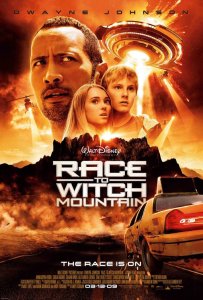 Does anyone ever fondly recall, let alone even recall, the 1975 original children’s film, Escape to Witch Mountain? This remake is Disney-fied in all places. It’s a lackluster kiddie adventure with more special effects, car crashes, and one-liners. Dwayne “The Rock” Johnson cements his tight grip on the family film genre; I really like this guy as an action hero and as a charismatic comedic actor, but being a wisecracking chauffeur to monotone yet strikingly Aryan-looking space aliens isn’t cutting it. The little green pre-teens need to get back to their ship and escape the clutches of government agents and an alien killer. This is one of those movies were everyone leaves their brain at home. This is the kind of movie where everybody is profoundly stupid and easily tricked. You’d think space aliens and intergalactic travel and psychic abilities would be met with more than incredulous jokes. Regardless, Race to Witch Mountain is devoid of fun, wonder, and excitement despite a decent effort by the assorted cast. This is lazy, by-the-numbers stuff masquerading as quality family entertainment. Families and children deserve coherent stories with actual characters and action sequences that feel like they matter. The only thing that really matters in Race to Witch Mountain is the fact that nobody will remember this movie in 35 years time, allowing Disney (or whatever alien/robot/alien robot overlords run the show at the time) to follow through with another thoughtless, mechanical remake.
Nate’s Grade: C
Share this:

Disney Nature’s Earth (2009)
 The kind folks at the newly established Disney Nature division want to make sure those who missed out on the stunning 2006 Discovery Channel/BBC miniseries Planet Earth get another chance. Earth is a re-edited, recycled version of the globe-trotting miniseries, cutting down 8 hours to a bladder-friendly 95 minutes. Disney has given the film a family-friendly narrative, following the exploits of three families; a mamma polar bear and her cubs, a whale and offspring, and an elephant and its little thundering toddlers (note to parents: the film doesn’t shy away from death but you won’t watch any onscreen kills). The footage is jaw-dropping and to witness it on the big screen is a must-see. The mini-series, and by extension the new movie, is a powerful advertisement for conservation without having to get on-message or preachy. The gorgeous images speak volumes. The filmmakers spent over 5 years compiling mass amounts of footage, and some cameramen sat in isolated and harsh conditions for a year in order to snap rare moments on film. While the film cannot rival the mini-series, it’s still a highly watchable experience with eye-popping visuals and, really, little else. It serves as a tasty appetizer for the larger main course, the immersive and riveting Planet Earth mini-series. But hey, there is something God-like about listening to James Earl Jones detail the particulars of life on this spinning blue orb. Earth is mostly spectacle but ho boy, is it first-rate spectacle.
Nate’s Grade: A-
Share this:

National Treasure: Book of Secrets (2007)
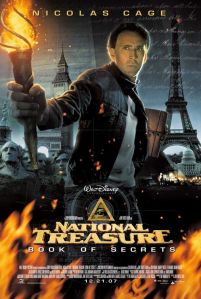 National Treasure: Book of Secrets is like a big dumb puppy that just wants love. It does a trick and thinks it deserves some form of recognition, and me with my cold heart just wants to shrug and move on with my day. How can I be so unmoved when there’s even a cartoon before the movie? For any prospective moviegoers, if you enjoyed the 2004 National Treasure, where I remind all that the U.S. Declaration of Independence had a secret treasure map on its other side, then chances are good you’ll enjoy Book of Secrets. That’s because they’re pretty much the same movie.
Ben Gates (Nicolas Cage) and his father (Jon Voight) are basking in their newfound respect from proving that their crackpot treasure schemes were in fact real. Their respectability is turned upside down, however, when Mitch Wilkinson (Ed Harris, with a dollop of a Southern drawl) has evidence that great-great-grandaddy Gates was responsible for planning President Lincoln’s assassination. He has a piece of John Wilkes Booth’s diary and a list of conspirators is jotted down, with great-great granddaddy Gates listed right there. The diary is authenticated and the Gates are devastated but ultimately unconvinced. They know their Civil War era ancestor would never betray his country and was unknowingly decoding a secret that could lead the Confederacy to an ancient golden temple, something that could help turn the tide of the war. This ancestor ripped pages out of the diary and threw them in a fire to protect the welfare of his country and was then shot by a secret Confederate soldier. In order to clear his ancestor’s good name, Ben Gates will have to find this hidden treasure, which is precisely what Mitch has wanted from the start.
 Gates re-teams with his pals from their first successful adventure, computer whiz Riley (Justin Bartha) and Abigail (Diane Kruger), who has thrown Gates out of their home due to his single-minded focus. Dating a treasure hunter is a certain path to a rocky relationship, ladies. Riley, who even wrote a book about his treasure exploits but still can’t get recognized, is game but Abigail has to be tricked into help. The group finally figures out that the only way to verify the temple’s hidden location is by getting their eyes on the mysterious President’s Book of Secrets, which only presidents can read. This means that Ben has no choice but to get the president (Bruce Greenwood) alone and beg to see a book not meant for outside eyes.
Book of Secrets is a little less dopey than the first preposterous National Treasure adventure, but that doesn’t mean it isn’t chock full of stupidity. According to these movies, apparently damn near everything in this country is built over an Indian burial ground or a giant cavern of treasure. I advise all readers to try digging in their backyards because it appears that the odds are in their favor (also: beware of your real estate company moving the tombstones but not the bodies). The clues are a little less mind-boggling, so instead of a single brick that’s been undisturbed for 200 years we get matching furniture for the Queen of England and the President of the United States. One doozey of stupidity is that one clue requires people to douse a large rock formation with water in hopes that they hit exactly the right spot and have an invisible eagle make its appearance. The plot is still structured on the clue-leads-to-other-clue template, which can be exhausting after a while because there’s never any indication of progress until the end arrives.
The subplot about kidnapping the president is ridiculous in the fact that, while already being dumb, it adds needless conflict. When Gates “”kidnaps” Mr. President he does so through a secret tunnel under George Washington’s Mt. Vernon estate. The passage closes behind them and cuts off the frantic Secret Servicemen. It is here where Gates makes his plea for the titular Book of Secrets, which the president confirms but cannot confirm publicly (well, it is a secret book of secrets). Instead of sensibly saying to his men, “Sorry guys, you know how old these places are, we got trapped, but Mr. Gates here helped get me out,” the movie tries to claim that the next course of action is that Gates will be on the run for kidnapping the leader of the free world. Huh? What makes this sequence stand out is how easily explainable it could all pass, and yet Book of Secrets figures the movie is better served by a contrived complication to add more outside pressure on Gates and his treasure hunting crew.
Of course all of the silliness and off-the-wall shenanigans would be acceptable if the film delivered some exciting action sequences that pinned you to your chair, but just like the first National Treasure, this movie is pretty much devoid of a well-thought out action sequence. Returning director Jon Turtletaub has no real visual flair and lets the material simply lay there on screen without much effort to jazz it up. Many action sequences are brief and never really flirt with complications. Usually, the script will propose a simple sequence of events like, say, “Good Guys on Run from Bad Guys” and then Turtletaub will show us exactly that, no better no worse. There’s nary a scene that actually utilizes its globetrotting destination to its advantage; most of the action is not geographic based, which means that it could happen anywhere because it doesn’t take advantage of the specifics of exotic locales. That is inexcusable to me, a big fan of good action sequences. A lengthy trip to an underground golden temple tries the patience as it rambles on and unabashedly apes the Indiana Jones series. Book of Secrets has a halfway decent car chase through the streets of London and that ends up being the highlight of the film. The trouble is that there’s more than an hour left at that point.
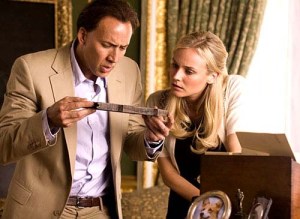 Book of Secrets is a slightly better film than the original. It jumps around in time through the lineage of the Gates clan and gives a better sense of the personal stakes for Ben and his father. Having their long-dead heroic family members linked to a dastardly assassination is good motivation for action, even if that action is ultimately finding an underground temple of gold (how A+B = C I will never know). The production design is skillful and the various European locations bring some sense of grander excitement that, sadly, will never be fully capitalized upon. The characters are still pretty shallow and one-note, but it seems like it’s less annoying this time because there’s less setup on who these characters are, which is, in short, shallow and one-note.
Cage is on autopilot and plays up his goofy mannerisms and William Shatner-esque line readings. This is a paycheck job for Cage and nothing more. Just because the first flick made tons of money is a lark to him and not an indication that he should try something different. He’s giving the people what they seemingly want, which is a wacky Nicolas Cage hamming it up with his patented version of kooky acting. Kruger is the exact copy of her character from the previous National Treasure, meaning she’s the bickering blonde counterweight to the conspiracy theorists on the journey. I suppose she plays a damsel in distress adequately. Voight gets more screen time this go-around thanks to a plump subplot involving the team seeking out the assistance of his ex-wife, played by Oscar-winning actress Helen Mirren. Yes, that Helen Mirren. Harris is given a do-nothing part as the villain and then the movie can’t even follow through on that. Everyone seems to have fun with all the nuttiness and goofy stunts, so I can’t fault them too much for faking it in a big Hollywood blockbuster.
I understand the appeal of these movies, which have found a sizeable audience willing to lap up a Cliff Notes of History along with their popcorn thrills. I imagine the fans of the original will show up in droves and make sure that National Treasure 3: The Mystery of Franklin’s Syphilis is fast-tracked for a future holiday release. I don’t mean to be a killjoy (my mother really enjoys these films) but I cannot get behind the National Treasure movement when the movies are riddled with rampant stupidity, contrived situations, convoluted conspiracies, one-note characters, and inept action sequences that never amount to much of anything beyond teetering homage to better adventure films. Book of Secrets is essentially the exact same movie reheated to take the chill off. Replace Sean Bean for Ed Harris as rival treasure hunter, add another female character, and there you have it, a mostly undisturbed formula that proved profitable in 2004.
Nate’s Grade: C
Share this:

Pirates of the Caribbean: Dead Man’s Chest (2006)
 America loves its pirates, plain and simple. We as a nation are infatuated with the characters and the high-seas adventure of 2003’s Pirates of the Caribbean: Curse of the Black Pearl. We?re starving for more, and when the first in a two-part sequel was released it only became one of the biggest movies of all time. Pirates of the Caribbean: Dead Man’s Chest has shattered box-office records, rolling up $100 million in two days and a record $135 million weekend gross, easily surpassing former champ Spider-Man‘s supposedly invincible $118 weekend tally. America loves its pirates more than Spiderman, Star Wars, and who knows, maybe even Jesus. After all, Dead Man’s Chest did just kick out The Passion of the Christ from the top ten all-time grossers. Mel Gibson sure has a lot of grief at this moment.
Jack Sparrow (Johnny Depp) is a wanted man on the high seas. The East India Company, whose emissary now controls the Caribbean town of Port Royal, is after Jack and his special compass. But Captain Jack has bigger fish to fry. Davey Jones (Bill Nighy), ruler of the seas, wants what was promised to him: Jack’s soul. Jack made a bargain with the sea creature and now his time is running out. He must assemble a crew and track down the whereabouts of a buried chest. Inside this chest is the still-beating heart of Davey Jones, and he who controls the heart controls Jones, and thus the seas. That is why the East India Company is so interested in Jack. They’ve made an arrangement with groomis interuptis Will Turner (Orlando Bloom), who had his wedding hijacked and his bride (Keira Knightley) locked away. If he can retrieve Jack’s compass, then he and Elizabeth will be pardoned for aiding and abetting a known pirate. Will and Elizabeth each set off to find Jack Sparrow and to gain their freedom.
 The filmmakers have taken notes in the school of sequels from The Empire Strikes Back. Like the second Star Wars chapter, we’re left with the heroes separated and licking their wounds, evil appears to have the upper hand, and the lives of some beloved characters are left in doubt. Just as long as there’s no Ewoks, Disney has guaranteed my place in line on opening day 2007 for Pirates 3.
It?s hard to fully judge this Pirates sequel because it’s part one of a two-part story. I’m holding out my final say, especially if this movie just turns out to be an expensive 150-minute teaser trailer for Pirates of the Caribbean 3. I can?t fully judge many story and character arcs because we don?t know where movie #3 will carry them. Maybe it’ll end up being like the middling Matrix sequels, where subplots and characters were dropped as if the Wachowski brothers had screenwriting butterfingers (it’s a film critic’s unwritten duty to deride the Matrix sequels at any chance). At least this movie ends with a jolt that I did not see coming.
Most surprisingly, Dead Man’s Chest suffers little from the creative deadlock of sequels. Dead Man’s Chest is more a sci-fi monster fantasy than a swashbuckler. The supernatural edge has swallowed the series whole. Take for example Jack’s broken compass. What once was an oddity befitting its owner is now seen as another element of magic. Some of the interest seems lost if things are simply explained away as being magical. The story, unlike the Matrix sequels (See: above), expands and enriches its universe. Some leftovers from the first film made me cringe. I thought we were headed for a bad track, where the movie uses the audience’s memory as a cheap storytelling device. Familiar characters might pop up every which way, smiling, and saying, “Hey ho, remember me?” Miraculously, the leftovers are integrated so well with the new tale that they really do matter and don’t come across as cheap shortcuts. Norrington (Jack Davenport) and the two comic relief cursed pirates are all smartly woven back into the troupe, and each impacts the story in a non-obtrusive manner. Even the undead monkey is used well.
I made it a point to keep my expectations in check for Pirates of the Caribbean: Dead Man’s Chest. It would be naive to think that you could catch lightning in a bottle again. Yes, now with audience expectation we lose the originality and unpredictability that made the first Pirates adventure so joyously delicious. And yet I found myself getting riled up just the same and being whisked away by spirited entertainment. My expectations may have been tempered for Dead Man’s Chest but I still greatly enjoyed the ride. It seems that my opinion sharply differs from my overly negative critical colleagues; my own sister said Pirates 2 was one of the worst movies she’s ever seen. That seems a bit rash. She hasn’t even seen any Uwe Boll movies.
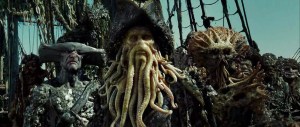 There are moments that seem to stretch the credibility of the story. It’s been said before that it’s not the impossible that bugs you but the improbable, and this holds true for Dead Man’s Chest. I’m able to believe Davey Jones and his creepy crawly crew, but I’m not able to believe that Elizabeth Swan could single-handedly best them all at once in sword fighting. The movie becomes dangerously close to eye-rolls in parts, but generally steers clear of moments that rip you out of the story. Of course a Pirates film would be nothing without Johnny Depp. He’s the main reason the first film was so memorably embraceable and entertaining. It?s not every day someone gets nominated for a Best Actor Oscar playing an addled, swishy comic pirate. He’s truly the star and has been one of our finest actors long before he had any box-office clout. He’s created a character so beloved that he’s crossed over into the cultural lexicon. How many Jack Sparrow outfits do you see come Halloween? I had a friend directing a high school performance of A Midsummer Night’s Dream and every young actor wanted to audition as Captain Jack interpreting Shakespeare. Come to think of it, Jack Sparrow would certainly liven up some of the bard’s dusty works.
Depp is still hilarious and likeable even when he’s being a scoundrel. We simply love this character; I love this character. The unpredictable nature of Jack feels squeezed dry by the demands for familiarity with sequels, but Depp finds new ways to enthrall in Dead Man’s Chest. Some people are going to be uncomfortable with Jack being more dastardly, willing to trade others’ lives to save his own hide. I think desperation is an interesting place to put this character. Besides he has his big hero moments as well.
New dimensions are added to the other characters. Knightley gets to be shrewd and try her hand at pragmatic treachery. It eats her up inside at the end and Knightley, a nice comedic actress, allows us to see the rough seas of guilt within her. Bloom will always be Bloom, meaning he’ll be handsome, British, and seemingly too little for grownup movie stuff. Will is given a whole new set of daddy issues when he actually gets to spend time with dear departed dad (Stellan Skarsgard). Best of the rest (“the rest” being everyone other than Depp) is an unrecognizable Nighy, who saunters his deck with the fiery air of a preacher. Nighy manages to make Davey Jones even more interesting. Naomie Harris (28 Days Later) makes her presence felt as a witchy woman responsible for Jack’s compass.
The action sequences are gigantic and well constructed. They expand with organic complications and a lively, graceful sense of humor. An already fun sword fight atop a watermill wheel gets even more pleasing when the giant wheel breaks free and the fight continues. Three characters climb inside and out, all vying for a key that keeps changing hands thanks to gravity. A human-sized fruit-kabob tied to Jack has a wonderful payoff for something that seemed completely random. The special effects are gorgeous. You can practically taste the slime and sea salt from the creatures. Davey Jones is a fantastic design and I’m dying to know how they did his tentacle beard. Whether it be motion capture, CGI, or puppetry (was someone billed in the credits for “operating” Bill Nighy? Does that sound like a fluffer?), it’s all dazzling to behold. The Kraken is ferocious and so well designed that it’s destined to give an entire nation?s children nightmares for weeks. Coupled with the equally super expensive Superman Returns, it seems that nowadays if you want special effects that will retain their wow-factor, it helps to have a $200 million dollar budget. Director Gore Verbinsky has a terrific eye for shot compositions; I am convinced that if you give this man good material then he will give you popcorn gold. If you give him bad material, well, then you get shiny but pointless stuff like The Weather Man.
 I know this movie, at its center, is empty. It’s grand throwaway entertainment, a true popcorn romp, but yes, when you get down to it the film has little to it. It’s an explosion for the eyes and has some great characters and action choreography, but Dead Man’s Chest is nothing more than very pricey, very tasty cotton candy.
Pirates of the Caribbean: Dead Man’s Chest feels less like a rehash and more like the start of an exciting new voyage. It’s darker, bigger in scale, scarier, louder, brasher, but still barrels of fun. Time will tell whether the back-to-back sequels will support enough intrigue to cover two very long, very expensive action movies. But Dead Man’s Chest has the key Pirates ingredients returning: clever screenwriting duo Terry Rossio and Ted Elliott, and, naturally, the irreplaceable Johnny Depp. An early eye gouging might set the icky tone, but this is one sequel that compares favorably to its source. We’re left in a very Empire Strikes Back position, but not after running out of breath keeping up with the many treasures of Dead Man’s Chest. Nothing will recapture the magic of the 2003 original but this is one summer sequel that delivers without letdown. Then again, after Pirates 3, it could all be for naught. See you in 2007!
Nate?s Grade: B+*
*Final grade pending the outcome of Pirates of the Caribbean 3.
UPDATE: Having just seen the third film, I’m somewhat conflicted. Many items from Dead Man’s Chest have little payoff in the third film, At World’s End. So while I wouldn’t grade Dead Man’s Chest any higher after seeing where it concludes, I still find it to be too fun to rate any lower. Its final grade stands.
Share this:

Sky High (2005)
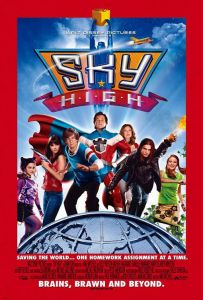 The film is pleasant, the acting overall is even pretty good, the humor is really peppy, but it’s not enough to overcome such a formulaic plot. Sky High feels exactly like a Disney afternoon movie; everything is there just fill in the blanks, Mad Libs style. Disney cranks these out like processed hamburgers. This time people have super powers and the budget is slightly bigger. There are some things I’ve seen so many times in teen movies. People still learn big lessons, people still go through social awkwardness, there’s another big house part where everyone is invited and someone has a misunderstanding, the best friend since childhood obviously has a crush on the lead that he cannot see, and the person the moves up the ranks of popularity becomes a self-centered jerk and shuns his true friends from the beginning. The best aspect is its comedic support cast including two members of Kids in the Hall, Bruce Campbell as a gym coach, Kevin Hefferman from the Broken Lizard troupe. This supporting cast should really be the focus of the story. A super hero high school is interesting but the staff of a super hero high school is even more interesting. Still, it has a nice sense of humor and is pleasant enough.
Nate’s Grade: B-
Share this:

Confessions of a Teenage Drama Queen (2004)
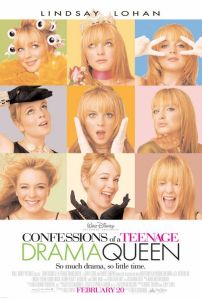 There was a glut of teen-oriented princess fantasy films in 2004 but none seemed as artificial, as simplistic, as transparent, and as dull as Confessions of a Teenage Drama Queen. Lindsey Lohan played Lola, a flamboyant new girl at school trying to fit in and find her way. This Disney confection aggressively spoon feeds its life lessons. You can successfully guess the entire plot of this trifle from the first second on. Confessions of a Teenage Drama Queen has a prolonged musical climax that’s a shameless ploy to set up Lohan as a pop singer and ensnare preteens into buying the soundtrack. When you get down to it and count the life lessons, simplicity, costume changes, and musical numbers, Confessions of a Teenage Drama Queen isn’t a movie, it’s an awards show patting itself on the back.
Nate’s Grade: C-
Share this:

The Haunted Mansion (2003)
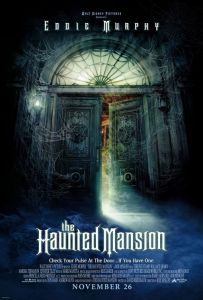 The best way to describe Disney’s third movie based on a theme park ride is this: its exactly like the ride. Which means it’s nice to look at but little else is there. Eddie Murphy, in his soul-selling kid friendly phase of his career, is a real estate salesman who cant pass up the prospect of a mansion. Never mind it’s haunted. He brings the family along, which includes a drop-dead beautiful wife, Sara (Marsha Thomason), and two annoying kids. There’s some storyline about Sara being the one to break the curse of the mansion, something about love never dying and a mystic key which leads to a mystic chest … I know, I’m bored already too. Despite being a mere 98 minutes The Haunted Mansion has sluggish pacing and some cheesy special effects. This is the kind of movie someone has a fear only because they need a moment to overcome that fear to save others. Murphy mugs for the camera and occasionally its funny, but he has the expression that even he doesn’t believe hes funny. Never good for an actor. Terrence Stamp is amusing as the butler. Jennifer Tilly is a highlight at the floating gypsy head in the crystal ball. The direction by Rob Minkoff (Stewart Little 2) is solid, and his opening sequence of the film’s back-story being played across the credits is the highlight. But what does it say when the highlight of the film is the opening titles? I don’t know who this film is for. It’s a bit too scary for young kids. Tweens won’t want to see a “Disney scary movie” and would rather see some of the PG-13 scares, like The Ring. It certainly isn’t for adults. Who is this movie for Disney? And I may be the only one, especially after recent events in the news, but when all the skeletons came out of their crypts … I thought Michael Jackson was going to come out and theyd all dance.
Nate’s Grade: C


 nathanzoebl
You must be logged in to post a comment.