Blog Archives
Super (2011)
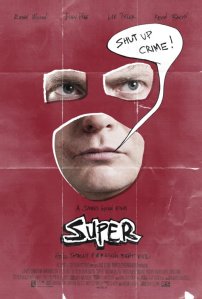 Super is a different kind of superhero movie. Writer/director James Gunn (Slither) has crafted a story that attempts to deconstruct the superhero fantasy. In his story, the people that put on the costumes to fight crime are just as dangerous as the criminals.
Frank (Rainn Wilson) has two memories he can hold onto as his life’s highlights: marrying Sarah (Liv Tyler), a former drug addict, and assisting the police in finding a crook. He works as a short order cook and dreams of being something more. Then local crime lord Jacques (Kevin Bacon) comes into Frank’s home, eats his eggs, compliments him on his cooking of said eggs, and then walks off with Sarah. He’s been gotten her hooked back on drugs. Frank tries to rescue her but Jacques and his goons (Michael Rooker, Sean Gunn) won’t let him get anywhere close to his wife. Then Frank becomes inspired. He feels that God has spoken to him and instructed him to become a crime-fighting super hero, the Crimson Bolt. With a wrench, Frank patrols his streets looking for crime to vanquish and a way to thwart Jacques. Along the way he gets help from Libby (Ellen Page), a 22-year-old girl who works in a comic book store. She jumps at the chance to live out her super hero fantasies and elects herself to be Frank’s sidekick, Boltie. Together they plot to clean up their city and maybe enjoy some of the perks of superhero-dom.
 Super mines familiar territory scene in other movies, the what-if scenario of what might transpire if people put on some tights and attempted to fight crime. Unlike last year’s similarly themed Kick-Ass, this is a movie that refrains from overt style. It does not portray Frank as a hero in any traditional sense. Gunn takes great pains to showcase the frayed mental state of his main character. Frank is troubled, seriously troubled. His attempts to escape his reality are borderline dangerous and his violent attacks are without warrant. I watched this movie shortly after seeing the suitable violent Hobo with a Shotgun (good pairing, folks), and the tone of the violence between the two films was starkly different. Hobo‘s violence is meant to make you laugh; Super is meant to make you wince, then laugh in a “Oh my God” kind of alarm. In Super, the extreme bouts of violence, which are not as prevalent as in Hobo, are meant to make you think how stunningly dangerous Frank and Libby are. When somebody cuts in line at a movie theater, the rest of the people react in disgruntled anger. But Frank goes into his car, changes his clothes, comes back as the Crimson Bolt and declares, “You don’t cut in line,” and strikes the guilty party across the face with his trusted wrench. The crowd is freaked out, naturally. These revenge fantasies are taken to the limits, and Frank has decided that everyone deserves the same punishment for breaking the rules of society whether they be a drug dealer or a line jumper (“You don’t butt in line! You don’t steal! You don’t molest little children! You don’t deal drugs! The rules haven’t changed!”). Frank follows in the same vein of disturbed social justice as Travis Bickle.
The characters are played straight, which only highlights their demented oddball qualities even more. Wilson is a strong comedic actor as he showcases week after week on TVs The Office. He’s always had something of a unique “off” quality to him, be it presence or looks or demeanor. It allows him to slip into cracked characters so easily. Frank is a troubled individual, but there’s something sympathetic about his plight to finally assert himself in the world and stand up to forces that he feels have victimized him. He’s a sad guy, lonely, deeply insecure, feels impotent to the world, and yet he can put on a costume and work out his varied psychological issues. Wilson can be terrifying, deadpanned hilarious, and even potentially touching as he desperately seeks a life filled with moments he can be proud of.
 But it’s the little firecracker that is Page (Juno, Inception) that makes Super come alive with risk. Page’s performance is bristling with uncontrollable energy; she practically shakes with excitement over becoming a superhero sidekick and leaving her boring reality. Then, when they actually do kill bad guys, she jumps around, taunting at the top of her voice, chuckling at a level of violence that should be disquieting to most normal human beings. That’s because Page, in particular, has tapped into her character’s manic wish-fulfillment role-playing persona. What would faze people makes me laugh and hop around in impish joy, because she is laying out her idea of justice. And Page is joyous to watch. She’s so excited onscreen that her words practically trip over themselves. And then there’s the superhero sexual angle. This is the first movie, by far, where I ever viewed the elfin actress in a sexual manner. And with Gunn’s film being what it is, prepare for some strange discomfort. Libby tries to seduce her superhero partner into being a partner of a different sort, and she leaves the sidekick suit on.
The tone is meant to make you squirm and laugh under your breath through gritted teeth. Seeing Frank legitimately hurt people can be funny in a bleak sense, and the delusions of the main characters and their inept execution as superheroes certainly adds plenty of chuckles. When Frank tells his newest sidekick that they’re going to fight crime, she’s bouncing off the walls in happiness. That is until she discovers “fighting crime” means sitting in an alley and just waiting for crime to materialize. “This is so boring,” she groans. Frank’s oft-repeated catch phrase of empowerment, while swinging his wrench of justice, is: “Shut up, crime!” But then he later starts to reconsider his place in the order of society, reflecting upon his brute force actions and whether he too has become a criminal in the pursuit of battling evil (“How can I tell crime to shut up if I have to shut up?”). The side stories involving the evangelical TV superhero The Holy Avenger (Nathan Fillion) are a hoot. They’re even funnier when you consider that Frank uses these outlandish bits of corny Christian message-delivery as confirmation from God. For those looking for some Kick-Ass kicks, they will be sorely disappointed until the violent confrontation between good (Frank and Libby?) vs. evil (Jacques and his minions).
 Super isn’t so much of a superhero parody as a morally queasy, crazy, discomforting comedy of the darkest sort. Gunn’s film shows that people with unchecked superhero fantasies can be just as dangerous as the criminals they seek to penalize. Gunn de-romanticizes the concept of vigilantism. Wilson and Page make a fun pair of superheroes with a few screws loose themselves. This is a different kind of superhero movie, the type that shows how dangerous and ridiculous and insane the fantasy can be in a real world where the bad guys have guns and a short fuse. Gunn’s Troma-fied super story has plenty of dark laughs, uncomfortable moments, and nutball characters. I don’t even fully know what to think about the film. Do I really like this? Am I supposed to? Is this all entertaining or just uncomfortable? Is it an entertaining form of discomfort? Does the ending, which aims for emotion, work, or has the film burned too many bridges and fried too many nerves to attempt something tonally different? Super probably won’t win any new converts to the genre, and I imagine its bleak laughs will push many away, but the film also has a car-crash watchability. I do not mean that in a backhanded way. Super keeps you watching but you don’t know if you want to.
Nate’s Grade: B
Share this:

Piranha 3D (2010)
 Truly missing out on seeing Piranha (as its home release now calls it) in 3-D will be one of my life’s greatest disappointments. This boobs-and-blood-soaked ode to 80s exploitation horror has its tongue firmly clenched in cheek. This is a gleeful gorefest that plays many of its absurd elements for laughs while squeezing in gratuitous nudity at every turn. There’s an underwater lesbian synchronized swimming sequence that I’m utterly certain would have been the greatest thing to witness in the third dimension. Regardless, this Jaws rip-off (Richard Dreyfuss even shows up in the opening dressed identically to his character and named “Matt”!) plays like an ironic parody of the genre while still satiating its red meat-hungry target audience of teenage boys. To this point, it succeeds admirably. It is crass beyond belief and delivers exactly what it promises. Watching actors like Elisabeth Shue, Adam Scott, Christopher Lloyd, and Jerry O’Connell ham it up alongside some fairly cheesy special effects critters, you never feel the waft of desperation. The movie ends too abruptly for my tastes, leaving too much open and unresolved for presumable sequels. As my friend Eric Muller said: “We watched a 3D movie in 2D that was really 1D.” While the movie is entirely one-dimensional in scope, that lone dimension is a blast. I know where I’m going to be when the rumored Piranha sequel is released. And this time, I’m seeing the campy carnage in 3D.
Nate’s Grade: B
Share this:

Killers (2010)
 Where to begin with this? It’s an action romantic comedy that can?t commit to either genre. First off, this witless rip-off of Mr. and Mrs. Smith (or Knight & Day) can?t even get on track thanks to zero chemistry between Katherine Heigl and a routinely shirt-free Ashton Kutcher. They don’t gel at all. Just because two actors can make goofy faces doesn’t mean they’ll light up the screen as a couple. Their energies do not click. Heigl emits some magic combination of elements that makes her an unusually likeable and compelling actress on screen; note, I never said good, but she’s an ace with the rom-com material. When will she start choosing better material, and movies where she gets to assert herself instead of being a ditz and the butt of jokes? The plot is absurd and the film’s tone doesn’t know how to settle down. One second it’s a jaunty, irreverent action jag, and then the next it’s trying to be some winsome romance about two people who may have rushed into marriage. Oh, and they happen to be living in a neighborhood crammed with sleeper agents all trying to kill Ashton. When you hear the reveal for why this is happening, it will seriously make you rethink the notion of “tough love.” It makes little sense in any realm of thought. The action lacks flair and sizzle, let alone minute tension, and the comedy is just as joyless. Heigl slides right into screwball mode and the film confuses an ongoing argument as characterization. The duo act so cavalier conveniently forgetting that people from all walks of life are trying to kill them at every turn, for the lamest of reasons. Why hire sleeper agents to lie and wait if you want to kill a guy? Is that really the most cost efficient policy? They don’t even get a single decent joke out of this premise. The only thing this movie kills effectively is time.
Nate’s Grade: C-
Share this:

Bad Lieutenant: Port of Call New Orleans (2009)
 This is a crazy movie. It is not weird, it is not bizarre; it is not silly. Werner Herzog’s whacked-out movie is a remake of a 1992 movie that wasn’t that good to begin with. This certifiably crazy movie mostly involves Nicolas Cage as a corrupt cop playing all sides and snorting everything that isn’t bolted down in the Big Easy up his nose. For a stretch during the middle, he starts to sound like Jimmy Stewart with lockjaw. The central murder investigation plot is pretty much an afterthought in an environment like this. You want the crazy, and with Cage and Herzog, it is in no short supply. There’s Cage threatening an elderly woman at gunpoint, crawling reptile POV shots, a man’s “soul” break-dancing after the man lies dead, and neon iguanas that may exist only in Cage’s drugged-out mind. The film has been described as a trippy parody of standard cops-and-robbers fare, or as a seriously demented anti-drug message, but I think the best description is just “crazy-ass movie.” It has moments that make you do nothing but shake your head and laugh, like when Cage is about to hit rock bottom and EVERY case/storyline gets solved in a matter of seconds to his bemused disbelief. The comedy is straight-faced but it is definitely there. Cage harnesses his eccentricities and delivers an insanely entertaining performance that reconfirms that there is indeed an actor underneath his Hollywood veneer. He is compulsively enjoyable and the movie is compulsively watchable, every crazy freaking second of it. Iguanas!
Nate’s Grade: B
Share this:

Jennifer’s Body (2009)
 Something of an unholy mess, Jennifer’s Body doesn’t have enough comedy to be funny and doesn’t have enough scares to be frightening. And yet the movie might have worked (heavy emphasis on the “might”) had someone completely rewritten the dialogue. Diablo Cody’s hallmark hyper-verbal, hipster dialogue runs at odds with the horror elements, undermining the finished product. Curses like “cheese and crackers” and calling each other names like “Monostat” and “Vagisil” are actually the high-point. This is just a big, swinging whiff for Cody’s wordsmith abilities. There are just some painful, wince-inducing lines that land with a thud. The film follows a strange story structure, placing the reveal of how Jennifer became what she is in the middle of the movie. By this point, we’ve seen her devour too many boys to see her as anything other than a monster. If the scene played out in a linear fashion, we may have actually felt sympathy for her as a scared, relatable girl, and her appetites might come across as some kind of cosmic justice. But it doesn’t work that way thanks to the scene order. Somewhere inside the body of this movie is a quasi-feminist reworking of the horror genre, but really the movie just seems like another genre fantasy byproduct that treats the ladies as walking meat. What does two girls kissing for an extended period of time have to do with female empowerment? The biggest surprise is that Megan Fox is actually kind of good as the demonic object of desire. Who would have thought that Fox would be the best thing in a movie written by an Oscar winner and directed by a Sundance Award winner?
Nate’s Grade: C
Share this:

In the Loop (2009)
 This is one of those movies that are so sharp, so bristling with intelligence, that you practically need to have a remote control glued to your mitt so that you can rewind and catch all the jokes. I turned the subtitles on myself just to make sure I could get everything. This British comedy is a wicked satire of the miscommunication and blunders that lead the U.S. and Britain into declaring war on a Middle Eastern country. There are some topical jabs but so much of the humor comes from the fractious character interaction; there is a real joy to watching these larger-than-life personalities clash over the course of two nations. It’s fascinating and biting and plays out like a more profane version of The West Wing. The cast is fantastic from top to bottom, with special notice going to My Girl‘s Anna Chlumsky all grown up and perfect with comic timing, and Peter Capaldi as the fearsome, fire-breathing British Director of Communications who can split an epithet like nobody’s business. You might expect his head to burst with how apoplectic he can get. This may be the most quotable comedy in years; every line of this screenplay is gold. There are Hollywood comedies that would kill for just one or two of the choice lines here, but In the Loop is chock full of the funny. It’s a machine gun spray of comedy. Something this scathing and this brilliant doesn’t come along every day.
Nate’s Grade: A
Share this:

Wolrd’s Greatest Dad (2009)
 The name Bobcat Goldthwait doesn’t exactly make you think accomplished filmmaker. Goldthwait is best known for his screechy, nervous voice utilized in animated features and the hallowed Police Academy series. But he’s also a writer and a director. His first effort was 1991’s Shakes the Clown, starring Bill Murray as an inept bank-robbing clown. Then he wrote and directed a 2006 movie called Sleeping Dogs Lie that centered on the romantic foibles of a woman who, on a whim, once gave her dog oral pleasure. I can’t see Hollywood touching that one with a ten-foot pole. These sort of unconventional, risky artistic concepts might prepare you for Goldthwait’s newest black comedy, the ironically titled World’s Greatest Dad.
Lance Clayton (Robin Williams) is an underappreciated man. His teenage son, Kyle (Daryl Sabara), hates him. He cannot find anyone interested in published his many manuscripts. His colleagues think little of him, students don’t attend his poetry class, and his quasi-girlfriend, Claire (Alexie Gilmore) is showing more interest in Mike (Henry Simmons), the new hunky, successful English teacher that got a story published in the New Yorker on his first try. Then everything changes. Lance comes home to find his son dead of auto-erotic asphyxiation. He rearranges the body and writes a suicide note, attempting to spare his son from being mocked in death. But then the school hacks into the police system and prints Kyle’s suicide note. The entire school is awash in grief and discovers what an insightful, troubled young man Kyle was. They all want to know everything they can about Kyle, and suddenly Lance has found an outlet for his writing.
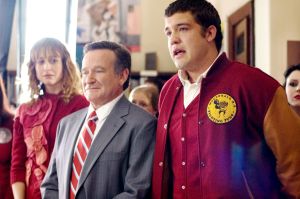 The movie satirizes grief culture with sharp acuity. Kyle’s classmates all react with horror and look back with extreme rose-colored glasses. Suddenly their fallen peer has transformed from the kid nobody liked into the wounded soul that touched all their lives. Bullies reexamine their behavior, girls that never would have given him the time of day now immortalize Kyle, and the faculty that wanted to expel him now wishes to rename the library in his lasting memory. This warm, fuzzy gauze of grief is Goldthwait’s target. He is satirizing how people turn tragedy into hypocritical attitude shifts. He ridicules the easy revision of history under the guise of collective sympathy. Not every youth is necessarily taken before their time. Not everyone was going to grow up to contribute selflessly to society, making the world a better place to live. Not every youth is deserving of canonization. Some people are just jerks from beginning to end, and Goldthwait proposes we do a disservice when we whitewash reality in the name of kindness and good taste. The only person who can see through this wave of hypocrisy is Kyle’s only friend, Andrew (Evan Martin), who doesn’t remember his crabby buddy being deep, articulate, or remotely smart.
Goldthwait’s screenplay is seriously dark and twisted but it’s also routinely hilarious, notably utilizing a deranged sense of irony. Lance uses his own son’s death as the vessel to become a respected writer. He uses his own dead son as his literary pen name. For once in his life, Lance now has an insatiable and adoring audience for his writings, and to top it all off they won’t dare be critical. Lance is manufacturing his son’s legacy and gaining unbeknownst critical praise. That’s fairly dark and fairly amusing stuff. It’s also funny that Kyle’s death has a greater positive effect on the community than Kyle being alive. The school rallies together and students use the death to justify personal growth. The fake journal of Kyle’s touches and enlightens, which further pumps up Lance’s ballooning ego and sense of purpose. At one point, a talk show host raises the question of whether it’s better to be a good person or thought of as a good person, and this gets to the heart of Lance’s dilemma. His actions are morally questionable. What started as an effort to protect his son’s dignity has morphed into personal gain. Is the world a better place because of this false rendering of Kyle? Is the lie better than the ugly truth? Is the lie justifiable? I honestly never expected to be confronted with tricky ethical questions while watching a movie made by Bobcat Goldthwait.
This is the best work Robin Williams has done in years, which I understand might not be saying much considering his recent slate of brain-dead family comedies. He hasn’t shown this much restraint, and talent, since his 2002 World Tour of Evil that included One Hour Photo and the masterful Insomnia. Williams drops every pretense of his well-known manic funnyman shtick and plays an actually subdued character. Lance is beaten down by the disappointments of his job and fatherhood. Williams effectively coveys the exhaustion of a man who repeatedly fails to connect with his brat of a boy. He doesn’t know what to do; the kid is practically a sullen stranger in his own house. Williams endures such slights and misfortunes with deadpan humor and sarcasm and the audience actually vaguely sympathizes with him through much, if not all, of the second half. Williams is mostly reactive and can come across like a calculated straight man to Goldthwait’s cracked-out script. You feel for the guy when he can capitalize on his son’s death and you practically want him to get away with it all.
Sabara has grown up considerably since being the chubby little tyke in the Spy Kids movies. It’s amazing how much you will detest his character. This kid is perverted, repugnant, obstinate, and just plain idiotic. He hates music (“All music? You hate all music?”), he hates movies, and he dislikes pretty much everything other than extreme pornographic fetishes. Kyle is a nightmarish child with no redeeming value. He had to be in order for the satire to work.
 World’s Greatest Dad is a misanthropic hoot of a movie but that doesn’t mean it is without flaws. Goldthwait has yet to prove any particular style or vision behind the camera. His direction isn’t a distraction by any means but it mostly just presents the story in an unobtrusive fashion. He also has the annoying habit of using music selections as a storytelling crutch. He?s prone to using several songs that describe the onscreen drama to a literal level. For a script as biting and clever, it’s disappointing that Goldthwait feels the need to use songs to spell out his implicit drama. This being satire, by nature the characters are mostly going to be thin. The classmates are little more than a cross sectional representation of high school stereotypes, ready to slide in for a joke. Other side characters are weak due to being underwritten or dropped. Claire is a shallow love interest flitting from suitor to suitor, offering little more than a conquest. Mike works as a foil to Lance but then is completely forgotten about in the second half. There’s one interesting scene where Mike, Lance, and the principal are all golfing and the roles are reversed, Lance is the confidant and respected colleague and Mike is jockeying for approval. But that’s pretty much the last you’ll ever see his character in a meaningful way other than taking up space in the background.
In the end, World’s Greatest Dad is not a comedy that will leave your sides aching or seams in need of stitching. It’s dark and disturbing but unlike the earlier Observe and Report, this movie actually provides an entry point for empathy. It’s provocative and twisted but it never pushes the audience out of the story. The intriguing setup is explored with careful consideration. The characters manufacture a false love for a kid that was all but ignored, and everyone is worthy of scorn to some degree. Even Lance is worthy of derision considering he’s exploiting sympathy to find the success that has eluded him his entire life. But Williams’ performance and Goldthwait’s sharp screenplay keep the film grounded amidst its satirical targets. Most surprising of all, there’s a a sweetness that emerges from this film’s black core. Lance regains a sense of humanity and purpose, and so do we due to his journey. Golthwait has come up with an unusual, morbid, and cynical comedy that manages to be somewhat life affirming by its final reel. I can’t believe I?m saying this, but I believe Bobcat Goldthwait is establishing himself as a strong comedic voice in the world of film. I eagerly await the next movie by the guy who did all the funny voices in Police Academy.
Nate’s Grade: A-
Share this:

Zombieland (2009)
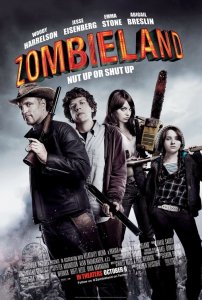 Zombieland is insanely entertaining and one of the most satisfying theatrical experiences of this year. It’s an American Shaun of the Dead, meaning that the zombie genre gets lovingly satirized with some wit, some bite, and a whole lot of blood. This movie isn’t nearly as clever as Shaun but it sure serves up the red meat of what you’d want in a crackling zombie action comedy. Woody Harrelson and Jesse Eisenberg make for an engaging odd couple pairing, director Ruben Fleischer posits a nice amount of visual whimsy with onscreen survival guide rules, and there is a glorious celebrity cameo midway into the movie that might qualify as my favorite 10 minutes of 2009. It’s funny and fiendish but it doesn’t break down the fourth wall. Zombieland does have some flaws to it, like a repetitious second act where the boys get duped by a pair of sisters (Emma Stone, Abigail Breslin) like three or four times, and the climax at an amusement park raises some obvious questions. Why turn on an amusement park and attract every zombie in town? Why dive out of a Hummer when you could drive off? The movie seems to take great aims to set up the damsels in distress, mostly because the inconveniently shut their brains off from survival mode. The silliness and macabre fun is infectious and Zombieland makes you hungry more adventures with these characters killing the undead in gross yet creative ways. I may be biased since Eisenberg’s character is from Columbus, Ohio (the crowd I was with cheered when we were informed our present home town had been decimated by zombies).
Nate’s Grade: A-
Share this:

A Serious Man (2009)
 The Coen brothers, Joel and Ethan, have been making stupendous movies for three decades, but they have never really gone too introspective. Usually their movies follow quirky characters making poor decisions and getting in too deep in a cruel world. A Serious Man is the first Coen film that feels personal. Set in the same landscape of the Coen’s own upbringing, 1960s Minnesota, A Serious Man gives a few insights into how these two remarkable men became who the filmmaking geniuses they are today. But if that isn’t enough for film fans, the movie is also hilarious and brilliant.
It’s 1967 in suburban Minneapolis. Larry Gopnik (Michael Stuhlbarg) is a meek physics professor up for tenure. Larry is beset at all sides, from his redneck neighbor encroaching on his land, to being bribed by a Korean student unhappy with his grade, to the news that his wife, Judith (Sari Lennick) is leaving him for his colleague, the more dignified Sy Ableman (Fred Melamed). Sy suggests that the best course of action is for Larry to move out to a hotel: “The Jolly Roger is eminently habitable.” The tenure board is having second thoughts because of anonymous letters, Larry’s daughter is stealing money from his wallet for a nose job, his son spends more time getting high than practicing for his bar mitzvah, and Larry’s unemployed, socially awkward brother (Richard Kind) is sleeping on his couch. Larry seeks counsel from three rabbis and tries to find meaning as to why his life is spinning out of control.
 This is a bleak comedy with almost all of the laughs coming from how much worse things get for Larry. Now, it’s not a pitch black comedy, something akin to being loathsome and eager to push an envelope; you simply can’t help but laugh at how he universe is ganging up on this poor man. His life is spiraling out of control and he is helpless to stop it, and his search for some sort of theological wisdom just leaves him more confused. The various rabbis don’t really have an answer to explain his suffering, and instead they each give comically nonsensical answers or stories. The junior rabbi, projecting his own low stature, asks Larry to seek God in small things, like the parking lot highlighted by his office’s lone window. “Just look at that parking lot,” he gushes hopefully. One rabbi gives a fantastic story about a Jewish dentist discovering a strange Hebrew message carved on a patient’s (a goy’s) teeth. The story eventually goes nowhere and the rabbi’s advice is merely a shoulder shrug and this bit of feeble wisdom: “Helping others? It couldn’t hurt.” To the Coens, Larry is the modern-day equivalent of Job, befalling misery and looking heavenward to ask, “Why me?” He could easily be any one of us. In the face of turmoil, it feels like the Coens prescription is to laugh, the only way to remain sane in this world. And so we do laugh, dubiously, and this is how we cope with life and its ongoing uncertainty.
And A Serious Man is seriously funny. I snorted out loud three times, unable to control my growing guffaws. The supporting group of characters is all wonderfully utilized, popping in for a perfectly timed plot development or a joke. This movie is relentlessly funny, structured like a runaway car that picks up momentous speed. Not a single frame feels at waste. The conversations between the supporting characters are priceless; every character has their precise place in this narrative, and the Coens manage them brilliantly. The writing is intricate and the Coens again showcase their magnificent ear for local color. Each of these people has a different speech pattern, from one Hebrew school kid’s abundant use of the F-bomb, to Larry’s daughter insisting she has to use the bathroom to always wash her hair, to Larry’s bathroom-hogging brother’s conditional response of, “Out in a minute.” It’s almost like a musical how well the various comedic elements harmonize. The mostly unknown cast of actors is all superb; I love how the Coens select actors with such great, easily recognizable faces. These people stand out just visually. Stuhlbarg, a theater veteran, is a terrific lead, and his performance is steeped in pursed-lip incredulity. I loved every conversation with the powerfully unctuous Sy Ableman, a character who hides his distaste in pompous vocabulary. I loved Larry’s interactions with his South Korean blackmailer and his broken English. I loved how Larry’s son will interrupt important occasions just to complain about the TV picture quality of F-Troop. I loved that the only person concerned for Larry’s well-being is the Columbia records salesman who signed up Larry for a subscription because he failed to reject their offer.
 I haven’t done extensive research on this one, but A Serious Man may be the most Jewish film ever, or at least since Barbara Streisand cross-dressed in Yentl. I’m not talking movies that explore a significant chapter in Jewish history, like the Holocaust, but I can think of no other movie so steeped in the minutia of Jewish culture. A Serious Man even opens with a seemingly unrelated anecdote with a 19th century Eastern European Jewish couple arguing, completely in Yiddish, whether a guest is alive or a dybbuk (demon). Not only do we get notable religious events and observances like bar mitzvahs, sitting shiva, counsel from rabbis, the concept of a religious divorce known as a get so that a “serious man” could remarry in the faith, but the Coens get everything right down to the tiniest detail, like the exact sound of soup slurping. Even the overall tone, perseverance in the face of struggle, is an extremely Jewish perspective given what has transpired historically to the Jewish people.
The abrupt ending will likely win no favors from the people that thought they were shortchanged by No Country For Old Men‘s anticlimactic close, but it certainly fits the movie’s bleak worldview. Larry is, by his own accounts, trying to be a “serious man” in an ever-changing community, so beware what happens if he compromises his moral values. The pessimistic finale leaves much to the imagination and whether you want to connect the events as uncoordinated random plot points, or as an ongoing celestial judgment, well the Coens are canny enough to let you figure it out. They don’t have any more answers than the rabbi and the goy’s teeth.
This will not be a movie for everyone, especially considering 90 percent of the laughs come from one man’s unrelenting misery. Larry isn’t exactly the deepest character, making it spotty to emotionally invest in his troubles. However, I found him to be an everyman cipher allowing the audience a safe entry point into the Coen spectacle of doom. The Coen brothers have always been technical marvels, but they seem to have raised their inconsiderable talents at the close of this decade. No Country for Old Men was a genre masterpiece, Burn After Reading was an entertaining farce, but perhaps A Serious Man is the most lasting picture. How do we explain bad things and bad things happening to people striving to be serious men and women in the world? I?’m not sure if the Coens have an answer or even think the answer is important. I think their viewpoint is to enjoy the ride and laugh while you can. As the Korean student’s father puts it, “Accept the mystery.”
Nate’s Grade: A
Share this:

Drag Me to Hell (2009)
 Sam Raimi returns to his spook roots in this delightfully disgusting horror flick. Drag Me to Hell has such a gleefully playful and perverse personality, alternating between being scary, being gross, being funny, and circling back for more. This is camp of the highest hokey order, and Raimi infuses every moment with inspired schlock. Poor Alison Lohman, the bank loan officer cursed to be dragged to hell in three days time. She gets a lot of fluids sprayed into her face (there’s an oral obsession to this movie; lots of mouth stuff) and she takes it like a trooper. She’s put through a physical wringer here and maintains her dignity and believability among staples to the head, grave digging, and talking goats. The ending seems to be coasting to a predictable finish and then it hits you in the head, upsetting your sensibilities. I loved it. Drag Me to Hell, ultimately, is little more than a glossy, entertaining blow-off, a reminder what an inventive director can do with the horror genre. It doesn’t all have to be nubile teenagers escaping a knife-wielding maniac. If there is one lesson I’ve learned from movies and television, you do not anger the gypsies. They have a monopoly on curses and they are not afraid to use them.
Nate’s Grade: A-


 nathanzoebl
You must be logged in to post a comment.