Blog Archives
The Place Beyond the Pines (2013)
 Ambitious filmmaking is welcome, but usually ambition leads somewhere, which is the main problem with co-writer and director Derek Cianfrance’s unwieldy 140-minute multi-generational crime drama, The Place Beyond the Pines. First we watch Luke (Ryan Gosling) as a traveling motorcyclist enter a life of crime to support his infant son. Next the focus shifts to Avery (Bradley Cooper) as a cop with a conscience running into corruption on the force. Last, we jump ahead into the future and watch the dramatic irony unfold as the children of Avery and Luke interact, waiting for them to learn their paternal connection. I believe Cianfrance (Blue Valentine) and his team was attempting to tell a meditative, searching drama about children paying for the sins of their fathers, the lingering fallout of bad decisions and moral compromises. Except that’s not this film. By the end of the movie, while some secrets have been laid bare, there really aren’t any significant consequences. The film does an excellent job of maintaining a sense of dread, but it doesn’t come to anything larger or thought provoking. The entire structure of this film is geared toward a tragic accumulation, but it just doesn’t materialize. That’s a shame because it’s got great acting through and through, though I have grown weary of Gosling’s taciturn antihero routine that seems like a rut now. Avery’s portion of the plot was the most interesting and anxiety-inducing, but I found the movie interesting at every turn. The characters are given pockets of nuance and ambiguity as they traverse similar paths of desperation and conciliation. The Place Beyond the Pines is a perfectly good movie, albeit disjointed, that cannot amount to the larger thematic impact it yearns for.
Nate’s Grade: B-
Share this:

The Counselor (2013)
 The magnitude of author Cormac McCarthy’s involvement should not go understated in discussions over The Counselor. The acclaimed, Pulitzer Prize-winning author has written modern classics often exploring the darker side of humanity. McCarthy’s first screenplay must have seemed like a hot commodity for all of Hollywood. It attracted director Ridley Scott (Prometheus) and a score of A-list actors. The anticipation was that McCarthy could match the brilliance of his prose. The Counselor, a dreary and lackluster thriller in every conceivable way, proves that McCarthy still has an uphill learning curve when it comes to serviceable screenwriting.
The titular Counselor (Michael Fassbender) seems to have a nice life. He’s just proposed to his girlfriend, Laura (Penelope Cruz), and their sex life is vigorous. Then an old client, Reiner (Javier Bardem), invites the Counselor in on a shady drug transportation deal. The allure of easy money is too much for the Counselor to resist. Naturally, things do not go according to plan. A Mexican cartel intercepts the transport truck, bodies pile up, and the stakes get very personal for the Counselor.
 To be blunt, if McCarthy had submitted this script under a different name, it never would have made its way to the big screen. This is the award-winning author’s first screenplay and it shows. The pacing is shockingly slack, with the film rarely having any sense of life onscreen. I’m not a slave to the standard three-act structure of Hollywood screenwriting, but you need to produce something that keeps pushing the film forward, heading to a finale that seemed inevitable. McCarthy’s script is bogged down with pointless scene after pointless scene, little arias that get away from him, indulging his characters to monologue at length about philosophical nonsense. There are lengthy conversations about diamond shapes, the very nature of existence, and all sorts of Matrix Reloaded-like lingual excesses. These characters talk round and round; it feels like there aren’t even other characters in the room. Their lengthy, pretentious conversations also do little to push the narrative along or reveal essential bits of character. You get to hear one crime kingpin talk about his favorite poet. Great, but what can you say about him beyond the fact that he’s well read? Every character in this movie, from top to bottom, is a vapid space. Some of them have interesting aspects/quirks, like owning cheetahs or masturbating on car windshields, but not one character can be described as interesting. Beyond the terms “ruthless,” “pragmatic,” and “naïve,” I cannot even fathom a way to describe anyone in this film. They don’t even really work as plot devices because that would imply causality. When you couple the void of characterization with ponderous, rambling dialogue, then you’re already sabotaging your entertainment chances.
The plotting is muddled beyond all comprehension. I like to consider myself a pretty sharp moviegoer, but I was left scratching my head far too often. With a paucity of characterization and some idle pacing, I was confused as to what exactly was going on, sometimes even just at a literal level. What was this plan? How do all the players fit in? Why are the betrayers acting as they do? Who works for whom? Why should I be shocked about revealing the identity of a betrayer when it was made all too obvious in a previous scene (note: this is so directly transparent that it cannot count as foreshadowing)? Why does the appearance of a DVD signify finality after a previous phone conversation already did the same thing? And most of all why should I care? Watching this movie is like traveling through a long, impenetrable fog. There are serious, ongoing clarity issues, which make those florid digressions and overall pointless character nattering to be even more maddening. There are well known actors that come in just for single scenes, and then those scenes amount to little to nothing on the overall bearing of the plot. The Counselor doesn’t feel like a fully formed story; it feels like a collection of 30 scenes served as disposable sides for actors during preliminary auditions.
Even worse, for a film about drug deals gone badly, murder, and Cameron Diaz masturbating on a windshield, The Counselor is deathly boring. I grew restless before the halfway mark and just kept hoping beyond all evidence that the film was going to find some direction and pick up the intrigue. It did not. The film’s essential story structure, criminals getting in over their heads and paying a price, is a familiar one. This structure can work to marvelous results both grand (Goodfellas) and small (Things to Do in Denver When You’re Dead). Hell, even McCarthy’s own novel lead to the brilliant, Best Picture winner No Country For Old Men. Look at how the Coen brothers approach the macho, nihilistic material as opposed to its author. They created a sense of all-consuming dread with efficiency, elegance, and their characteristic macabre sense of humor. Watching The Counselor, it’s like the turgid knockoff of a McCarthy novel. When I got home I felt like I had to watch a Quentin Tarantino movie to wash the bad taste out of my mouth. Tarantino is given to long indulgences of elaborate dialogue as well, but he makes his characters interesting, with personalities that grab you and stand out, and listening to his dialogue is a pleasure unto itself.
McCarthy’s brand of ruthless killing has its peculiar intrigue, but again it only functions as morbidly fascinating little asides. The use of tripwire is given high priority by the killers onscreen, decapitating a speeding motorcyclist and cutting into the jugular with another character. It’s a strange, harrowing, and gruesome manner of death, but is it at all practical? I know I’m treading dangerous waters bringing the concept of reality to a murky film, but what killer decides to set up a wire approximately neck high across a road? It seems likely that another car would travel that same road in the hours of buildup. It also seems highly lucky to adjust the wire to the exact height to cut into the neck. I’m no professional killer but it seems like a lot of setup and guesswork. I have to imagine there are far easier ways to kill a speeding cyclist or a man walking along the street. Attention professional hit men of the movies: stop making your job more difficult than it has to be. Nobody is awarding you a ribbon for Most Inventive Kill.
 There are plenty of pretty faces in this movie, genuine acting talent, and to strand them with precious little characterization is an outrage. Fassbender (12 Years a Slave) is a little too sly to play naïve, and his later actions lack a necessary sense of desperation to sell his emotional plummet. Cruz (Pirates of the Caribbean: On Stranger Tides) is so effortlessly sensual but is put on the sidelines early and stuck in the damsel-in-distress box. Brad Pitt (World War Z) is the slick snake charmer we’ve seen plenty of times before. But the worst lot goes to Diaz (Bad Teacher). She’s supposed to be mysterious and threatening as Reiner’s sexually adventurous girlfriend but Diaz plays things so stone-faced serious. This poor woman is given the most unerotic, bizarre sex scene in modern history to enact, and I don’t know whether to applaud or pity her. Sure she gets to uncork some meaty monologues about Malkina’s trenchant world perspective, but this is the movie that will be defined by Diaz humping a windshield. At least the movie plays this out somewhat realistically, with Reiner more horrified than aroused. What did that outrageous scene add up to? Also, Penelope Cruz plays a “Laura” and Cameron Diaz a “Malkina”?
I know it’s a petty thing but it really irritated me how often people refer to Fassbender’s character as “Counselor.” The end credits do reveal this to be his name. If you thought it got irksome hearing Leonardo DiCaprio say “ole sport” after every other sentence in The Great Gatsby, then enjoy the repetitive declaration of Fassbender’s lone job title. “What do you think, Counselor? I don’t know, Counselor. I’d think things over, Counselor.” Do people really refer to somebody by this title as their name, and so frequently? He also doesn’t seem to be a competent lawyer at all.
The Counselor is such an unforgivably boring slog, languid and rudderless when it should be thrilling and complex. The characters are nonexistent, the plotting is muddled and confusing, the dialogue often laborious and roundabout, and the overall film is too meandering to properly engage an audience. Even talented people can produce bad movies, and here is further proof. With this cast, with this crew, there is no excuse for The Counselor to be overwhelmingly stilted and tedious. I cannot fathom what attracted the talent to this film beyond the cache of working on “Cormac McCarthy’s first screenplay.” If the results of The Counselor are any indication, I don’t know if we’ll be seeing too many McCarthy screenplays in the future, or at least McCarthy scripts that haven’t been vetted by other writers who better understand the contours of the medium. His florid arias and abstract, directionless plotting can be forgiven on the page but not on the screen. Scott doesn’t help matters, taking great care to film the luxury of the lifestyles on screen. What we’re left with is a tepid movie about bad people meeting bad ends, with little entry for an audience to care or even find entertainment. The art direction is given more care than the characters. In the weeks leading up to its release, The Counselor adopted a tagline from a quote by Laura: “Have you been bad?” It was turned into the Twitter hashtag promoting the film. Well, Counselor, you’ve been very bad.
Nate’s Grade: C-
Share this:

Only God Forgives (2013)
 Only God Forgives is an apt title for a movie that is replete with such suffering and brutality. Here is a movie that thinks wanton bloodshed and depravity is the same as character depth, and the fact that it’s from Nicolas Winding Refn, the writer/director of Drive might not be as surprising as you’d believe. I enjoyed 2011’s Drive but I wasn’t as taken with it as other critics, my chief complaint being a groping pretentiousness that confused emptiness as contemplation. I see the same issue with Only God Forgives, a grisly morality play that’s simplistic and overwrought at the same time. Once again Ryan Gosling plays a man of few words, so few that I counted he only says eight by the 28-minute mark (at this pace, he’ll dissolve into the background by 2015). Gosling’s brother was killed after the creep raped and murdered a 16-year-old prostitute in Thailand. Gosling’s ferocious mother (Kristin Scott Thomas) demands retribution on the Thai police, but Gosling has his reservations. What ensues is a string of glossy gore, tedious reprisals, and nonsensical plotting, including numerous karaoke sequences with the Thai cops. The movie’s emphasis is almost entirely on a hellish atmosphere, lots of lurid reds and harsh lighting, providing style but minimal substance. The characters are all detestable and unengaging, the story is awash in dreary and ponderous plotting, and the movie just reeks of pretension, every frame oozing with Important Symbolism (catch the emphasis on hands and wombs yet?). Only God Forgives would be forgivable if all of its admirable style and mood had some greater purpose. It’s a grueling movie to endure but the hardest part is getting through all the tedium thanks to the near-mute characters and a script overdosing on torture. At this rate, Refn’s next film will just be 90 minutes of Gosling punching a baby. Silently, of course.
Nate’s Grade: C
Share this:

The Hangover Part III (2013)
 I was no huge fan of the first Hangover movie and I cited its 2011 sequel, a carbon copy of the original, as one of the worst films of the year. The supposed final chapter ditches the blackout formula, which on its face seems like a step in the right direction, but now we have a Hangover movie with no titular hangover and at heart this is a movie for no one, even hardcore Hangover fans. I became quite cognizant how little I was laughing, not just because the jokes were badly misfiring, which they were, but also because there were so few jokes. You’d be hard-pressed to label this a comedy. It’s really more of an action thriller. What humor does arise is usually mean-spirited, curdled, or just off-putting, particular the reoccurring theme of animal cruelty (maybe opening your film with a decapitated giraffe is not the best idea). The other major hurdle is that annoying supporting characters played by Ken Jeong and Zach Galifianakis are elevated to co-leads. Both of these characters are best when reacting to others rather than being the main actors in the story. This movie is so abysmal as a comedy that you start to think director Todd Phillips should try his hand at a straight action thriller; the guy has a strong eye for visual composition. The actors all look extremely bored. Could Justin Bartha, the character who always gets sidelined, just get murdered and they have to hide his body? Oh no, I think I just came up with The Hangover 4. I apologize already.
Nate’s Grade: D
Share this:

Pain & Gain (2013)
 I think the audience for Pain and Gain is going to know exactly who they are, and I count myself amongst that number. The latest from director Michael Bay, often treated tantamount to Satan in many critical circles, has the based-on-a-true-story hook but really it’s the big stars, stylish violence, peculiar criminal antics, and overall overflowing machismo of the picture that will draw its audience. I knew after one watch of the trailer that I wanted to see it, though I was somewhat ashamed of the level of my interest (don’t want to taint your critical credentials with too much sympathy for the devil, after all). Pain and Gain is a trashy and entertaining jaunt, just as I hoped it would be, but it overstays its welcome and may leave you fatigued and possibly dejected (so… a typical Michael Bay movie? Still got it).
In 1995, three Miami, Florida goons enacted one of the most bizarre and sordid criminal schemes, a story that could supply a tabloid with enough juicy exposes for a year. Daniel Lugo (Mark Wahlberg) and his co-worker Adrian Doorbal (Anthony Mackie) are personal trainers at Sun Gym. Their days consist of pumping iron and hitting on ladies. One of Lugo’s clients is Victor Kershaw (Tony Shalhoub), a wealthy businessman with a nasty temper. Lugo and Doorbal, with the help of an ex-con and ex-junkie (Dwayne “The Rock” Johnson), kidnap Kershaw, hold him hostage for weeks, torture him, and eventually get him to sign over his assets to them. Afterwards they try to stage his “accidental” death, though like most things, it does not go according to plan. Penniless and broken, Kershaw seeks out help from a retired private eye, ED DuBois (Ed Harris), to provide validation for his case. The Miami police are laughing off his claims. Kershaw is concerned that the Sun Gym gang will strike again when their lavish lifestyle dips, and he’s right. Lugo and company get into even more trouble and the body count rises.
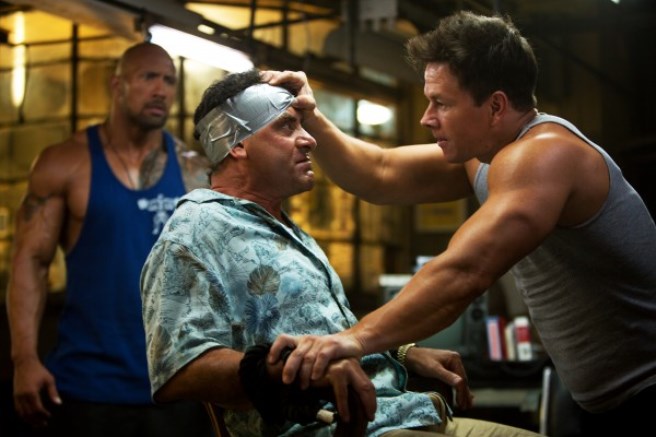 The results on screen are often entertaining in an over-the-top fashion, sustaining a rubbernecking captivation much like a horrendous car wreck. You just have to see how much crazier this thing gets, all the while muttering to yourself, “This was a true story?” It even gets to the point where the movie will remind you, via onscreen text as a man barbecues a batch of severed hands, that yes this is still a true story. Naturally there have been fictional inventions, character composites, and some details have been dropped to fit into the confines of a film narrative, but online research shows me that most of the larger plot beats are accurate, thus making the film even more compelling and disturbing. When the film is on, it feels manically alive with intrigue and absurdity. The problem is that it cannot keep this manic tone alive forever especially when actual innocent bodies start piling up (more on that later). There’s a certain uncomfortable tonal incongruity as the film develops and the comedy picks up a distasteful resonance. I love a well-executed dark comedy but just because something is macabre or unexpected does not automatically make it funny. Still, the movie has enough high-energy antisocial antics to keep you planted in your seat, laughing through bafflement.
Pain and Gain isn’t subtle in the slightest and yet it’s easily the most nuanced film of Bay’s career. Of course there are still the sleek cars, sexy babes, emphasis on style, and wanton destruction that are hallmarks of the man’s career, but the perspective is given a satirical prism, dropping us into the deluded, sub-American Psycho perspective of Lugo, a man with a very cracked view of the American Dream. The moral message reminds me of Marge Gunderson’s concluding musing in Fargo, telling a captured criminal, “There’s more to life than a little money, you know.” There’s some slight social commentary on wealth and the dirty tricks of capitalism, but really it’s the narcissistic delusions of a jacked-up criminal who believes he can succeed because he’s “seen a lot of movies.” You may even find yourself sympathizing with some of these knuckleheads, that is, until things get way out of hand. The screenplay by Christopher Markus and Stephen McFeely (Captain America: The First Avenger) is briskly paced and packed with bizarre details and even jumps into six different characters for voice over (Wahlberg, Johnson, Mackie, Shalhoub, Harris, and Bar Paly). For some characters it works as a great insight into their twisted logic but for others it’s just an easy set up for ridicule. The juvenile humor (did we really need a visual pubic hair joke?), candy-coated film palate, and sugar-rush, roid-rage plotting feel like a suitable match for the talents of the bombastic Bay.
The last thirty minutes of the movie will test your sensibilities of good taste. I’m all for having unlikable central characters just as long as the writer makes them interesting (what good is likeable but boring, the “friend zone” of characterization?). Some of movie history’s most fascinating characters have been scumbags and psychos. However, with that being said, I need my unlikeable characters to at least progress. When I’m stuck with a bad dude who keeps making the same bad mistakes, it can grow tiresome, and that’s where Pain and Gain ultimately lost me. Bay can’t quite keep up the charade of ironic bemusement forever, and a saggy second half starts to tread water, forcing the characters to act even more outlandish and inept. Did we need The Rock losing his big toe and then inexplicably giving it to a dog? It feels like the movie is filling time until the accidental murders come into being, raising the stakes. For a movie that’s 130 minutes, there should not be any need to fill time. During that long sad stretch, you start to feel disquiet, like the movie has lost its sense of perspective and the jokes have gotten too mean, too ugly, too outlandish. It doesn’t feel funny any more, and maybe that’s ultimately the point, but by the end Pain and Gain has soured. It overstays its welcome and then some.
 Its tone and connection to the real world raises an interesting and thorny question over whether something like this is appropriate. Should a story that involved the murders of innocent people end up becoming an over-the-top, stylized, lavishly glamorized Hollywood crime comedy? It has been over 15 years since the events of the Sun Gym gang, but is there a statue of limitations on good taste? Are we eventually destined for a vulgar film tackling the poor lives of the victims of 9/11? The answer is almost certain. What is off limits, or more pressingly, should anything be off limits to a comedic narrative? Is anyone really furious with Trey Parker and Matt Stone over their first film, Cannibal the Musical, transforming nineteenth century murder into song and dance? I doubt it, and yet there was something very off-putting about 2011’s 30 Minutes or Less, an unfunny comedy based around the true story of a pizza guy strapped with a bomb and ordered to rob a bank. The guy was blown to bits in real life (ha ha?). I guess I, as well as audiences, would have been more forgiving if the movie had been funny. I’m sure there would be fewer objections if Bay’s film had been more of a sober, contemplative drama on the sad acts of a bunch of desperate criminals, but with all the hyperbolic elements, machismo, and so-crazy-it-must-be-true plot turns, how could you turn this story into a serious drama? Not from the perspective of the nitwit criminals, at least. I don’t think the movie is ever positioning these guys as anti-heroes or excuses their excess.
Wahlberg (Ted) broke out as an actor thanks to a similar role as a wannabe star whose ambitions exceeded his grasp, and the man does dumb as good as just about anyone in Hollywood. It’s a specific kind of dumb, the angry, arrogant, pissy, self-involved kind of dumb that makes it acceptable to ridicule his character to no end. Johnson (G.I. Joe: Retaliation) gets to explore some interesting range as an actor, pacing around the demons of his character before just going hog-wild with the excess. Mackie (Gangster Squad) is arguable the most sympathetic of the group but also with the most to lose. Compared to his peers, he’s practically mild-mannered even though he takes injections into his penis. Shalhoub (TV’s Monk) is amusingly apoplectic and just enough of a jerk that you excuse his misfortune, at least for a little while. Ken Jeong (The Hangover) and Israeli model-turned-actor Bar Paly give the exact performances you would expect them to deliver. The best actor in the whole movie, though truth be told there isn’t a stinker in the bunch, is Emily Rutherford (Elizabethtown, TV’s The New Adventures of Old Christine) who plays Dubois’ wife. She has this calming, down-to-earth presence that seems to bring a small sense of peace to the madcap antics. She doesn’t have a lot of screen time but you’ll wish she had lots more.
Perhaps I’m being unfair to a movie that clearly isn’t intending to be anything but naughty, tacky, and gleefully excessive. In a way Pain and Gain reminds me of Tony Scott’s Domino, loosely based upon a true story but crushed to death by narrative kabuki and Scott’s characteristic excess. If I wanted to defend the much maligned Michael Bay, I’d argue what the real difference is between his excess and the excess of the more critically lauded Scott? Bay doesn’t have a slate of movies to his credit the likes of Top Gun, Crimson Tide, or True Romance. But isn’t flashy, artistic excess all the same when in the name of empty storytelling? Domino is also an apt comparison because it’s ultimately tiresome and far overstays its welcome, losing its audience with an endless array of odd sidesteps and moronic, deviant characters. While Pain and Gain has enough quirk and style to justify consideration, you may not respect yourself once it’s over.
Nate’s Grade: C+
Share this:

Trance (2013)
 Danny Boyle is a director that can make anything watchable. The man made an entire movie about a dude trapped under a rock and it was spellbinding. With that in mind, he does his very best to turn the trippy, Inception-like crime thriller Trance into a workable, watchable experience for the audience. The main issue is that the movie is so busy that once it slows down you realize there really isn’t anything going on. James McAvoy plays an art auctioneer who stashed a valuable painting during a heist. He undergoes hypnotherapy by Rosario Dawson so the crooks can determine where the loot resides. The premise allows for plenty of fake-outs, and you’ll be conditioned to doubt just about everything you see on screen. The film does a nice job of applying that doubt to the characters as well; the good guys may not be so good and the bad guys may not be so bad. With Boyle’s hyperkinetic visuals and some fast-paced editing, Trance is serviceable in the moment, but when the characters literally spell out everything you realize how shallow the movie is as well as these characters. The lone truly memorable moment is a scene where Dawson jets off to a bathroom, we hear an electronic buzzing, and she comes out fully nude, presenting herself as a shaven offering. The fact that this relates to an actual plot point is practically incidental. The movie isn’t as smart or as fun or as entertaining as it thinks it is, and I wish Boyle had taken advantage of dream/mind mechanics and gone crazier with his visuals. Still, if you’ve got a couple hours, some low expectations, it’s worth at least one watch.
Nate’s Grade: B-
Share this:

Spring Breakers (2013)
 Harmony Korine is the kind of filmmaker who I typically avoid. I haven’t liked a single one of the movies the man has written or directed. This list includes Kids, Julien Donkey-Boy, Trash Humpers, and the detestable 1997 film, Gummo, possibly one of my most hated films. The man has become an expert on depicting juvenile delinquents and the excesses of youthful folly, so I wasn’t surprised that his latest writing/directing effort, Spring Breakers, followed suit. I was surprised at the names he was able to attract to the film. Former Disney Channel starlets Selena Gomez and Vanessa Hudgens, as well as ABC Family’s Ashley Benson, join Rachel Korine as a foursome of gals who long for the pleasures of a spring break getaway. They scrimp and save for months, plus also rob a restaurant, and take their sojourn to the sunny beaches of Florida. The girls run afoul of the law and are bailed out by rapper and wannabe gangster Alien (James Franco). Living large, and with handy access to a plethora of weapons, the girls get involved in the crosshairs of a turf war, but they won’t let anything bring down their good times.
When you break it down to its trashy molecular core, Spring Breakers is like an exploitation film as directed by Terrence Malick. Allow me to explain, dear reader. Much like that hallowed art house filmmaker, the plot in Spring Breakers is really a wispy, abstract concept, and the film is prone to repetition and redundancy, a triptych for the senses. There’s plenty of overlapping dialogue that circles back and repeats itself, images that bleed into one another, and a plot that generally takes its cues from MC Skat Kat, namely moving two steps forward and then two steps back (is this reference too dated?). The rote dialogue, when not indifferently profane and nonsensical, is usually variations on, “Spring Break. Spring Break forever.” I’ve just given you about a fifth of the entire movie’s dialogue. It may have just been my theater’s sound system, but I found much of the dialogue hard to hear and decipher. Perhaps it was Korine admitting that the things his characters say weren’t worth straining to hear. As expected, this can get rather frustrating to sit through. It’s not so much a movie as an experience meant to wash over the audience. Hence the nonstop dubstep score, provided by Skrillex, and the crashing imagery of tawny exposed flesh, gyrating bodies, neon lighting, fellating gun barrels, and excessive inebriation, all meant to bring the spring break experience to the consumer, that is, if most people’s spring breaks involved lots of illegal activity. If Malick’s movies are meant to serve as religious experiences, then consider Spring Breakers to be the equivalent of ingesting GHB.
 Let’s talk about that paucity of characterization. Besides Faith (Gomez), a name a bit too on-the-nose for this sort of enterprise, there is zero I can say about ANY of the other three girls. They are completely interchangeable. They have no defining characteristics beyond their simple geographic placement within the camera frame. That’s it. When Faith ditches the movie at the halfway mark, having the good sense to realize her supposed friends might not be the best influence, I wanted to go with her. I didn’t want to be left with these vacuous and annoying characters. It’s pretty clear the contempt that Korine has for his own female characters, constantly serving them up for ridicule. It makes the whole movie even less appealing. We’re not supposed to like our heroines but it gets uncomfortable when the director seems to be constantly shaming them, rubbing our faces in how awful they are as people. With an absence of characters you care about, and a plot that feels like it keeps circling back, there’s precious little to hold onto before you become anesthetized to Korine’s exploitative navel-gazing.
After Oz the Great and Powerful I didn’t think I would utter these words, but thank God for the presence of James Franco. The man is so fully committed to his gonzo portrayal of a white trash wannabe gangster that you are downright thankful when he takes over the movie halfway in. At least we don’t have to spend as much time with our empty-headed trio of ladies. Franco, perfecting an ominous drawl, is a cartoon of misplaced machismo, living the “gangsta” life he’s seen parroted in pop culture (he has Scarface running on a constant loop on his TVs). He provides a jolt of energy to the movie, a second wind, and thankfully pushes the girls into greater conflict than part-to-party binges. He brings a real sense of danger to the film, and the descent into a criminal path couldn’t have come soon enough for me. It’s such an enjoyably whacked-out performance that I wouldn’t be surprised if Franco may even be considered for some Best Supporting Actor nominations.
There’s something just so tiring and depressing about watching people trying to chase a hedonistic high rather than, you know, live their lives. In this warped sense of thinking, the all-encompassing term of “partying” is meant to be the divine state of being and anything else falls by the wayside of significance. I understand the movie is exposing a shallow and empty way of life but it can still be tiring to watch nonstop. You become numb to the onscreen antics. You become numb to the free-flowing spirits, profanity, and gratuitous nudity (there were literally six topless ladies onscreen before a word was spoken). Watching Spring Breakers, you have two options: give yourself over to the trance-like, self-destructive youthful fever-dream or sit solemnly, objectively observing how the outrageous become routine, and become dead inside.
As much as it pains me to admit, being a non-fan of Korine’s movies, there are a few moments in the movie that are actually surprisingly effective. The first is a hasty robbery of a small restaurant. We stay in the passenger seat of the slow-moving car as it spins around the building, and in the background we see the escalation of events, the girls smashing breakables and terrorizing the few patrons. It’s one of the few visual decisions that felt, and here’s a word you won’t find anywhere else in relation to this movie, artistically restrained. There’s also plenty of forced irony in the movie where a character’s positive words will be counterbalanced by a visual contrast. Faith phones her grandmother and talks about her great time, even promising next year that she wants to take dear old granny along with her. Meanwhile, as the words play out, which will happen again at several redundant points, we see the girls engaging in behavior that would most likely not be granny-approved. Even if forced, and often redundant, it’s still effective, as is Korine’s hypnotic visual sensibilities. If nothing else, Spring Breakers is a good-looking movie with many pleasing visuals.
 I think I understand why my critical peers have lavished as much praise upon Korine’s bacchanalia. They see a satire of this empty, nihilistic, party-all-the-time, damn-the-consequences lifestyle, the idiocy of youthful hedonism. The problem is that there’s only a handful of moments in Spring Breakers where I felt that Korine actually achieved satire, one of them being a montage of robberies set to a Britney Spears song (beforehand we saw girls holding guns by the barrel and dancing in a circle). Those moments that struck me as satire were few and far between, because what I mostly left with was just another exploitation film. If this were meant to be satirical, the girls would not get away with it all in the end. Korine may intend to stand back in some ironic judgment of his own movie, providing himself an excuse for the lackluster plotting and characters. Here’s the point: even if it was done intentionally, it still makes for a lackluster plot and characters. Saying, “I meant that all along,” is not an excuse when the rest of the film fails to live up to your stated satirical intents.
Allow me a moment to talk about the somewhat disconcerting treatment of, for lack of a better description, the sluttiest of our gals, Cotty, played by Rachel Korine. When I saw the last name of Korine I thought, “Is that the director’s daughter?” Harmony Korine has been in the film industry for almost 20 years, so it was a possibility, and oh what a disturbing thought that was. Some cursory research proved that Rachel Korine was in fact Harmony’s wife; there’s a thirteen-year age difference. It’s still uncomfortable that Korine would slot his own wife to portray one of the titular spring breakers, the only one from our posse who goes nude onscreen too (sorry skeevy Disney Channel and ABC Family fans). So when he’s slut shaming these girls, mocking them with contempt, directing their gratuitous exploitation, he’s also including his own wife in this distasteful characterization, making sure the camera has multiple opportunities to take in her exposed flesh. It’s like he’s serving up his own wife to the gods of spring break (a.k.a. young male ticket-buyers), and it just seems icky.
When Spring Breakers came to a merciful close, the college-aged guy behind me remarked, “That’s the weirdest movie I’ve ever seen.” I replied, “Then you haven’t seen a lot of movies, have you?” Korine’s abstract, aimless salute to self-indulgence is a depressing experience that celebrates the worst in human beings, but weird it is not. I’m just tired of Korine’s schtick. He presents trashy characters, prods us to ridicule them, and then gives them a lot of empty space to do dumb things for an hour and half, ultimately going nowhere and accomplishing little. It just so happens that Spring Breakers, his most commercial and accessible film, has attractive, nominally famous actresses partaking in the nastiness this time. I suppose there will be some appeal to a small swath of filmgoers to see former squeaky-clean Disney Channel gals cutting loose, behaving badly, and playing against (manufactured) type. For me, the very casting of these ladies was another sign of Korine’s artistically bare ambitions. If he wanted to hold up the entire escapist spring break pleasure-seeking lifestyle for satire, then he needed to push harder. What’s on the screen is rarely satire. Instead, it’s just another careless exploitation film, replete with moronic characters we don’t care about and a plot that would be charitably described as, well, a plot. Even Franco’s calculated weirdness cannot save this film. Spring Breakers is a trip best avoided.
Nate’s Grade: C-
Share this:

West of Memphis (2012)
 The West Memphis Three murder case gained substantial notoriety thanks to an HBO documentary team, Joe Berlinger and Bruce Sinofsky, who were on hand in 1993 to document the trial in their film, Paradise Lost. Three eight-year-old boys (Michael Moore, Christopher Byers, Steven Branch) went missing one day in May in West Memphis, Arkansas. Their bodies were found the next day in a nearby creek. The boys had been hogtied and bore plenty of vicious marks, one of them having a severed penis. The horror shocked the small town and the blame landed on a trio of local teens (Jessie Miskelley, Jason Baldwin, Damien Echols). Miskelley had confessed under police interrogation and so was tried separately, but all three were found guilty. Miskelley and Baldwin were given life in jail and Echols, the supposed ringleader, a teen who disliked authority and read about magic and demons, was given the death penalty.
In the years that followed, thanks to the exposure of the Paradise Lost films (a second was released in 2000 and a third in 2011), advocates flocked to the cause, belied by the overwhelming belief that the three convicted had been unfairly railroaded. Celebrities spoke out and got involved, chief among them Lord of the Rings filmmakers Peter Jackson and Fran Walsh. They began communicating with Echols and his wife, Lori, and personally bankrolled a new team of forensic experts to amass new evidence that could allow for a potential appeal. Jackson even hired Oscar-nominated filmmaker Amy Berg (Deliver Us from Evil) to helm her own documentary, West of Memphis.
 Denied at most turns by the same flat-footed officials, the West Memphis Three struck a deal with the Arkansas attorney general in August 2011. The three would be granted freedom if they agreed to an Alford Plea, a rare legal circumstance where a defendant can plead guilty while still maintain their innocence. Eighteen years later the West Memphis Three are free but there are still many questions that need to be answered, mostly involving the conduct of officials involved in the case and the identity of the real killer.
As an ardent follower of the case, as well as the three previous documentaries by Berlinger and Sinofsky, I was concerned that West of Memphis would be more or less a rehash of what has already been covered in earlier, better movies, and to some degree it is. When you’re the fourth documentary to the table, there’s going to be some repetition. Berg’s film serves as a nice introduction to the case for newcomers and provides a diligent overview of the main facets of the murder case. There are a few finer points that Berg’s film spends more time illuminating that I think are worth mentioning. The first is extensively laying out why Miskelley’s confession was coerced. The teen, whose mental faculties are low, was locked away in police custody, without a parent or lawyer, for most of a day, with only a scant portion recorded. On these recordings, Berg clearly points out, with the assistance from some expert talking heads, how police officials guided Miskelley into the statement they wanted to hear. It’s pretty damming stuff to hear and a clear-cut case of a coerced confession.
What West of Memphis does best is narrow its focus to police and prosecutorial misconduct, picking apart the evidence that put two men away for life and one on death row. The fact that the prosecution used Damien’s own teenage poetry against him, evidence that might simultaneously doom and embarrass us all, should speak volumes. This was a case where the only thing tying the defendants to the crime scene was Miskelley’s false confession and the flimsy idea that the crime scene was a satanic ritual. Berg finds several of the prosecution witnesses who testified on the stand about how the three were involved in satanic practices, and in those new interviews each witness comes clean, admitting they were pressured by police or offered attractive deals to link the defendants to the satanic motive. Their recantations are satisfying to hear and, in journalistic lingo, a true get for Berg and her crew.
We expect our law enforcement officials to be just but mistakes will happen; however, in the event of those mistakes, we expect officials to try and correct them, to make things right. What West of Memphis shows is that the West Memphis officials dug down deeper in the face of compelling evidence, refusing to admit when they were so clearly wrong. In the years after the case and following the Berlinger and Sinofsky films, there have been renewed efforts to revisit the physical evidence of the case. To a fault, every professional profiler, including one guy who was there at the founding of the FBI, concluded that the crime had nothing to do with Satanism or the occult. They also concluded that most of the wounds, argued by prosecutors to be responsible by a serrated knife found in a lake behind Baldwin’s family mobile home (a knife the prosecution expressly knew Baldwin’s mother admitted to hurling in that lake a year prior to the case), were in fact made post-mortem by local scavenging animals, mainly large turtles with snapping jaws. There’s a reason that the wounds aren’t bloodier. It’s because the victims were already dead.
 But the most enlightening piece of evidence is what was found thanks to DNA, namely nothing. On not one single piece of evidence or anything relating to the victims was one scrap of DNA linked to Baldwin, Misskelley, or Echols. Seems rather open and shut, doesn’t it? Except Judge David Burnett, the same judge who presided over the original case, dismissed the reams of new physical evidence and rejected the motion for an appeal. It got to the point where, at the Arkansas Supreme Court, the state was arguing that the only new evidence that should be considered when granting appeals is evidence that points to guilt. The state argued, to the disbelief of the court justices, that new evidence that could overturn (wrongful) convictions should be disallowed. Fortunately, the Arkansas Supreme Court rejected this motion unanimously. It’s quite clear that law enforcement officials sought to save face rather than enact justice.
Another aspect that Berg’s film does better is illuminating another suspect the police have ignored for 18 years, Terry Hobbs, stepfather to Steven Branch. The movie devotes a solid 45 minutes on the subject, painting a convincing portrait of a suspect with long ties to abuse, anger, lies, and manipulation. A hair of Hobbs, matching his DNA exactly, was found tied into the knot of one of the bound boys. Weirdly enough, Terry Hobbs sued Dixie Chicks lead singer Natalie Maines for defamation, which fortuitously provided an opportunity to question Hobbs with the full penalty of the law behind them. Under oath, his story crumbles and his alibi at the time proves to have a sizable a gap, a period where the boys were killed according to medical reports.
Clearly Terry Hobbs is a compelling suspect though I wish the movie didn’t feel the need to resort to superficial assertions concerning how he “behaves guilty,” like his lack of emotion concerned the case. Questioning why he waited over two hours to tell his wife that their son was missing is a fair line of inquiry. Questioning his history of spousal abuse and violent run-ins is fair. Questioning why he isn’t more outwardly bereaved is not. It’s the same prejudicial judgments made against Damien when he was being tried, the idea that he just wasn’t acting like an innocent man (to be fair, Damien was also a moody teen at the time). Berlinger and Sinofsky are guilty of this as well, devoting a disproportionate amount of Paradise Lost 2 to pointing a suspicious eye toward John Mark Byers, stepfather of Christopher Byers, and a theatrical, larger-than-life figure. At least with Paradise Lost 3, the filmmakers make amends, and there’s a nice scene where Byers apologizes to Echols. This guilt-by-superficial-judgment is a dubious line of accusation that Berg and her film should rise above (just the facts, ma’am).
From there, though, I started feeling like West of Memphis is best served as a complimentary film to be paired with the altogether superior Paradise Lost documentaries. There is something to be said for Berlinger and Sinofsky being on the ground from the get-go, having unprecedented access to the victims’ families, the families of the accused, the attorneys on both sides, and the accused themselves. Naturally over three films you get a much stronger sense of the nuances of the case, but Berlinger and Sinofsky also gave you a much stronger sense of the community and the full context of the crimes. I was bothered at how often Berg’s film eschews direct on-camera interviews with Miskelley and Baldwin. Late in the film, as the movie explores Baldwin’s hesitancy to admit guilt for a chance at freedom, a friend recounts her phone conversations with Baldwin on the tricky subject. Why isn’t Baldwin himself on camera talking about this rather than a friend relaying her conversations with the man? Throughout the film, when it concerns the accused, the movie feels oddly removed from the source (Damien and his wife are credited as producers for the doc). It’s got plenty of talking heads and famous celebrities on camera but I’d rather hear from those directly involved. It’s just another reminder of the access and relationships that were formed through the Paradise Lost films. You’ll get a good overview of the fascinating and horrifying case with this movie, but to get a better understanding of the people involved, reference the meatier Berlinger and Sinofsky films.
 By the end, even after 18 years in prison, it’s remarkable and inspiring how free of bitterness the three men are. They still have to live with the guilty verdicts but they are free, and rather than dwell on what was taken from them, the men are thankful for their freedoms and thankful for the diligence of the people who believed in their innocence, who fought long and hard so the day would come when they three of them would be set free. Berg’s film even dedicates its last moments to those advocates and their efforts, saying that their involvement made all the difference. This is an example where a movie literally saved somebody’s life. Without the exposure of the Paradise Lost, it’s very likely Echols would have remained on death row and been executed. On a personal note, this was the final moment that got me to cry (there were a couple others that made me teary). It’s because of the shared happiness and accomplishments of helping, in whatever small way, three innocent men get their long overdue freedom. I won’t overstate my involvement, but I was there, writing letters, sending in donations, advocating, since 1999. I have never been happier to retire a T-shirt than with my “Free the West Memphis Three” shirt (I wore it one last time to watch this movie). The forward-thinking, gracious attitudes of Baldwin, Miskelley, and Echols are inspiring, and it even inspired me to seize the moment myself rather than remain passive in a personal relationship.
Coming in after a trilogy of other extensive documentaries, West of Memphis can’t help but feel a little late to the party. Its strengths lie in deconstructing the prosecution’s case and assembling new interviews where key witnesses have an opportunity to come clean and recant. Otherwise, it’s like listening to another singer perform a song you’re already familiar with. The case is so deeply troubling and morbidly fascinating that there’s definitely room for four movies on the topic and then some; Atom Egoyan has filmed a movie based upon journalist Mara Leveritt’s book on the case, Devil’s Knot (starring Reese Witherspoon and Colin Firth too). It’s easy to become immersed in this case; I know I have over the years. It all came down to a police force pressured to find a killer and three teens that were different in a small town. There are many tragedies tied to this case. The three boys who were gruesomely murdered. The three men who were wrongly convicted and lost 18 years of their lives. And since the West Memphis Three plead guilty, it means that the police can officially close the case, allowing the real killer to continue to walk free and unpunished. That should trouble every single person. West of Memphis is a gripping and thought-provoking documentary, though I think it’s best viewed as a supplement or introduction to the superior Berlinger and Sinofsky films.
Nate’s Grade: B+
Share this:

Gangster Squad (2013)
 It’s hard to mention the action thriller Gangster Squad without a passing reference to the Aurora, Colorado movie theater shooting in the summer of 2012, the reason for the film’s five-month delay and reshot action sequence. Gone is a shootout at the movies and now we have a confrontation in the streets of Chinatown. I wish they hadn’t stopped there. If given the opportunity, and remember they did have an additional five months, I would have scrapped Gangster Squad almost completely and started fresh.
In 1949, former boxer Mickey Cohen (Sean Penn) has seized control of Los Angeles organized crime. His influence extends even into a police, which forces Chief Parker (Nick Nolte) to go to desperate measures. He asks Sgt. John O’Mara (Josh Brolin) to assemble a team of enforcers to fight back. They won’t have badges but they will be pushed to use whatever means necessary to carry out their mission, which means blurring the line between what is considered lawful. O’Mara assembles a super group of former officers and one of them, Sgt. Jerry Wooters (Ryan Gosling) gets into even deeper danger when he starts seeing Mickey Cohen’s main squeeze, Grace Faraday (Emma Stone).
This movie is like if The Untouchables and L.A. Confidential had an illegitimate child and then abandoned it in a sewer where degenerate hobos raised it. Gangster Squad rips off other gangster movies with liberal abandon that I can’t even begin to list the lifts. I’d be less offended if I felt that the movie had more on its mind than just replicating the tone and look of noir cinema. Actually, it feels more like what they want to replicate is the tone or style of the video game L.A. Noir.
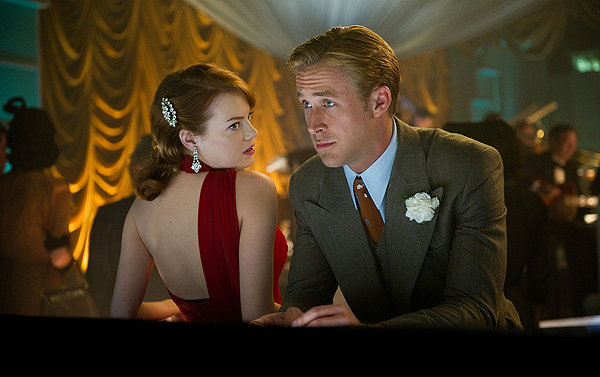 The main problem is that Gangster Squad really only has the skeletal outline of a plot. It’s missing any essential character and plot development. Here, I’ll summarize the barebones plot for you: Mickey Cohen is a bad guy. O’Mara forms a team. They have a montage taking out bad guys. Mickey takes out one of them. They have a showdown. That, ladies and gents, is it. There really aren’t any scenes that diverge from those scant descriptions. It felt like only five minutes passed from one of O’Mara’s guys getting killed (and just like The Untouchables, it’s the nerdy one) to them descending on Cohen’s headquarters and duking it out. Why does the film introduce the conflict of Wooters seeing Cohen’s girl if he never finds out? There isn’t even one scene presented to take advantage of this conflict. It just ends up being another half-baked plotline. It feels like the only development we get with Gangster Squad is through montages. What is also apparent is that O’Mara and his team really don’t have anything resembling the faintest notion of a plan. We watch them take out some bad guys via fights and shootouts but there’s no higher plotting to it. You get a sense that these former cops are just playing it by ear, looking for a fight every night. It’s hard to imagine that these people, even with their law enforcement and war experience, could be effective in the long term. Without any formative organization or greater planning, these guys just seem like dull bruisers bouncing from fight to fight with no sense of direction.
Then there’s the paucity of character work, relying solely on genre archetypes to do its work for the movie. O’Mara is the determined family man but his team can best be described by one-word classifications: The Black Guy (Anthony Mackie), The Nerdy Guy (Giovanni Ribisi), The Mexican Guy (Michael Pena), The Young Guy (Gosling), The Old Guy (Robert Patrick). That’s about it, though I suppose they do have different weapon preferences meant to supply all that missing characterization. Oh look, Officer Harris (Mackie) brings a knife to gunfights. That’s pretty much the beginning and end of his character. Wooters is so lackadaisical he feels like he’s on drugs, and Gosling’s soft-spoken, mealy-mouthed line delivery only adds to the effect. It feels like Gosling, in a stretch to find something interesting out of the mundane, said to himself, “I wonder if I could give a whole performance where I only speak under a certain vocal register.” Then there’s the woefully miscast Stone (The Amazing Spider-Man) as the femme fatale/mol to Mickey. I love Stone as an actress, but man-eater she is not and sultry seductress doesn’t fit her well either. Perhaps with the aid of a sharper script and a greater depth of character she could rise to the challenge. At no point does Gangster Squad really even attempt to make these people multi-dimensional. They never reflect on the moral turpitude of their own vigilante justice or the ramifications of their actions. There’s no room for ambiguity here.
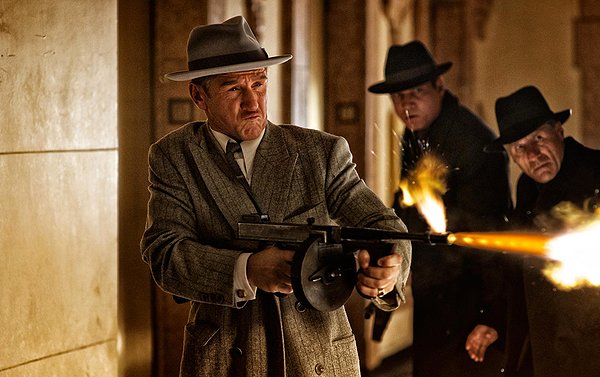 Finally, we must speak of Mr. Sean Penn (Milk). The man’s actorly gumbo goes into campy overdrive. In these rare circumstances, you aren’t watching Sean Penn Esteemed Actor so much as Sean Penn Human Vortex of Overacting. Normally I would criticize Penn for going over the top but over the course of 110 minutes, he single-handedly becomes the only entertaining thing in the movie. He’s chewing scenery up a storm, yes, but at least he’s channeling the pulpy silliness of the whole movie. I came to enjoy his antics and outbursts and thus became more empathetic of Mickey Cohen and his efforts than I did with O’Mara. Such is the danger screenwriters run when they spend more time crafting an interesting villain than a hero.
Gangster Squad is what happens when a movie is sold on title and genre elements. To be fair, it’s a bang-up title. The plot is half-baked at best, really only serving as a thin outline of a gangster movie, but instead of adding complexity and intrigue and characterization, they just ran with it. The actors are either camping it up or out of their element, the action and shootouts are pretty mundane, and the story is just uninvolving, even for fans of film noir like myself. It’s a good-looking film from a technical standpoint, but that’s as far as I’ll go in my recommendation (it could be an odd pairing with Milk considering the two shared actors). It feels like it just wants the setting elements of film noir, the atmosphere, and then figures just having good guys and bad guys shoot it out will suffice. That glossy, high-sheen period look just seems like a cool façade, and a cool façade seems like the only ambition of Gangster Squad. I can’t really recall any signature action sequence, snappy quote, plot development, or peculiarity worthy of remembering. It may be one of the most forgettable gangster movies Hollywood has produced.
Nate’s Grade: C
Share this:

Killing Them Softly (2012)
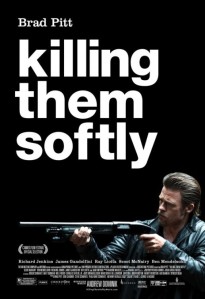 A funny thing happened while watching Killing Them Softly, the latest film from writer/director Andrew Dominik (The Assassination of Jesse James by the Coward Robert Ford). After an hour, I noticed a couple people stand up and leave, never to return. Then another and another like permission had been communally brokered. I counted ten walkouts at my showing, which was more than I had at Cloud Atlas, a film that I can at least understand the possible exodus. But this? It also got a rare F grade from CinemaScore, joining the ranks of The Devil Inside, Wolf Creek, and The Box. Before you put that much stock in what is essentially a movie going exit poll, Alex Cross was given an A grade from audiences. But why all the venomous hate? I can only theorize that the mainstream audience feels it was sold a bill of goods, a crime thriller with one of Hollywood’s biggest stars. The audience did not want to go on the lengthy talky detours. They wanted people to get dead. Whatever the reason, Killing Them Softly has killed its audience, who choose not to go softly in their disapproval.
Set amidst the economic meltdown of 2008, Frankie (Scoot McNairy) and Frankie (Ben Mendelsohn) are two lowlife thugs hired to rob a mob-affiliated card game. The trick is that local gangster Markie (Ray Liotta) had previously paid a group of guys to rob his own card game, fleecing his own customers. In his drunken revelry, Markie admitted as such to his pals. Now the situation is ripe for exploitation. Because any future robberies will have their suspicions pinned firmly on Markie, whether he had anything to do with them or not. As a result, no one is gambling, the public has lost confidence in the markets, and the mob needs to get things back to business. Jackie (Brad Pitt) is called in to make that happen. He’s a professional killer, who prefers to kill at a distance, without all those messy emotions. He has to trace the culprits responsible and give them the reckoning they have coming.
 From a plot standpoint, Killing Them Softly is pretty thin. It’s just about the ramifications of two nitwits robbing a card game. This lack of narrative depth will rankle most filmgoers, but I didn’t mind it so much because Dominik uses the crime thriller veneer to examine the sheer ugliness of a criminal lifestyle. This is a pretty character-driven crime flick, and it has to be when there’s a malnourished plot. It takes some lengthy sidesteps, notably with James Gandolfini’s (Zero Dark Thirty) character, Mickey. He’s supposed to be a professional, but the man is a complete wreck. He’s belligerent to those in service positions (waiters, prostitutes), chronically drunk, and weirdly empathetic for his struggling wife, yet seemingly powerless to change his life’s downward slide into self-medicated self-destruction. Mickey is the ghost of Christmas Future, the vision of what this lifestyle does to people who make a living out of it, who actually live into their retirement age. The two young crooks, Frankie and Russell, are idiots yes, but even when they have money their lives are so empty. Russell is so disgusting, sweating profusely, that you can practically taste his stank. Frankie is a little more cognizant of the danger he’s in, and yet the moron doesn’t leave town after his big score. I’d think that’s the first thing you do when you rip off the mob. The day-to-day anxiety of a life of crime is just not worth the effort. You constantly have to look over your shoulder, a life dominated in paranoia, where every stranger or furtive glance could have sinister meaning. Even when you make money, you’re theoretically taking money away from someone else’s profit, and these are the kind of people that don’t take kindly to friendly competition. This is no enviable, glamorous life.
I think Killing Me Softly would be a better, easily more satisfying movie had it eschewed the attempts at extra weight and commentary. It’s no surprise that the scenes that follow a more traditional crime thriller route are the best. There’s palpable tension when Frankie and Russell are in over their heads. The conflict is prevalent and the suspense is nicely stretched out, notably during the card game robbery. Being neophytes, you don’t know what they’re liable to do but you can bet it won’t be smart. This is when the movie is most alive, most engaging, and most entertaining. When it plays it straight, and explores the sliding power plays at stake in a world of cash and guns, it can be a nasty but taut little movie. I’m just sorry that Dominik took a functional crime thriller and gave it an extra sheen of Important Things to Say (”America’s not a country. It’s a business.”). The political parallels never feel more than tacked on attempts to grope for deeper meaning. Oh I get it, I understand the comparison of mob enforcers and corrupt Wall Street execs, hoodlums and crooks in different casual wear, but that doesn’t mean the parallel is that meaningful. It’s on-the-nose and a bit in your face (really, people are watching C-SPAN in dive bars?).
 Given Domink’s last film, I expected there to be some visual flourishes, though I’m unsure of whether they added much to the proceedings. Dominik sure can make violence entrancing, setting a slow motion slaying in the rain with stirring beauty to ironic Motown music. But he can also make the violence feel brutal, like a beat down on Markie that uses choice sound effects and editing to make you feel the punches. Even the opening seconds feel like an artistic assault to the senses, the loud static of noise interrupted by bursts of Obama’s sound bytes. The extreme camera angles, the visual felicities, the ironic music selections, they all seem to underscore the movie’s subtext-as-text approach.
Pitt (Moneyball) doesn’t come into the movie for the first thirty minutes. You’re welcome to see him, especially since he has such a coolly threatening demeanor, but also because here’s a character that will mix things up. I found myself rooting for the guy, partially because he was an accomplished professional but also because I wanted there to be consequences for idiots doing dumb to powerful enemies. I enjoyed the slow-burn intensity of Pitt when he was turning the screws on the screw-up. Richard Jenkins (Cabin in the Woods) is also enjoyable as a mob shill left to communicate the wishes of his higher-ups. McNairy (Argo) gives a performance that screams desperation, as he realizes the depth of trouble he finds himself into. And even Liotta (Charlie St. Cloud) does a fine job as a lout who misjudges the friends he keeps, discovering the costs of bragging.
In many ways, I feel like Killing Them Softly is akin to last year’s Drive, a more meditative crime thriller with bursts of gruesome yet beatific violence. Likewise, many filmgoers will be sore thinking they were catching straight crime thrillers and been given arty genre ruminations instead. And like my ambivalent feelings toward Drive, I can’t work up that much enthusiasm for Killing Them Softly either. It’s certainly got more ambition than most crime flicks but I’d rather it concentrate on telling a more engaging story. Dominik’s film is a bit too indulgent for its own good, given to visual flourishes and a narrative routinely sidetracked. And yet, I found it fairly interesting at just about every turn, well-acted, and intensely suspenseful and effective at different points. But it doesn’t add up to enough to recommend. The political allegory probably rubbed the walkouts the wrong way as well. The political allegory is too obvious, too pat with its “they’re all crooks” broadside. I wish the movie had abandoned the squalid, nihilistic art house ambitions and just kept things straight. When it has less on its mind, it works best. But for many, Killing Them Softly will be too tedious to see to the bloody end.
Nate’s Grade: B-


 nathanzoebl
You must be logged in to post a comment.