Blog Archives
West of Memphis (2012)
 The West Memphis Three murder case gained substantial notoriety thanks to an HBO documentary team, Joe Berlinger and Bruce Sinofsky, who were on hand in 1993 to document the trial in their film, Paradise Lost. Three eight-year-old boys (Michael Moore, Christopher Byers, Steven Branch) went missing one day in May in West Memphis, Arkansas. Their bodies were found the next day in a nearby creek. The boys had been hogtied and bore plenty of vicious marks, one of them having a severed penis. The horror shocked the small town and the blame landed on a trio of local teens (Jessie Miskelley, Jason Baldwin, Damien Echols). Miskelley had confessed under police interrogation and so was tried separately, but all three were found guilty. Miskelley and Baldwin were given life in jail and Echols, the supposed ringleader, a teen who disliked authority and read about magic and demons, was given the death penalty.
In the years that followed, thanks to the exposure of the Paradise Lost films (a second was released in 2000 and a third in 2011), advocates flocked to the cause, belied by the overwhelming belief that the three convicted had been unfairly railroaded. Celebrities spoke out and got involved, chief among them Lord of the Rings filmmakers Peter Jackson and Fran Walsh. They began communicating with Echols and his wife, Lori, and personally bankrolled a new team of forensic experts to amass new evidence that could allow for a potential appeal. Jackson even hired Oscar-nominated filmmaker Amy Berg (Deliver Us from Evil) to helm her own documentary, West of Memphis.
 Denied at most turns by the same flat-footed officials, the West Memphis Three struck a deal with the Arkansas attorney general in August 2011. The three would be granted freedom if they agreed to an Alford Plea, a rare legal circumstance where a defendant can plead guilty while still maintain their innocence. Eighteen years later the West Memphis Three are free but there are still many questions that need to be answered, mostly involving the conduct of officials involved in the case and the identity of the real killer.
As an ardent follower of the case, as well as the three previous documentaries by Berlinger and Sinofsky, I was concerned that West of Memphis would be more or less a rehash of what has already been covered in earlier, better movies, and to some degree it is. When you’re the fourth documentary to the table, there’s going to be some repetition. Berg’s film serves as a nice introduction to the case for newcomers and provides a diligent overview of the main facets of the murder case. There are a few finer points that Berg’s film spends more time illuminating that I think are worth mentioning. The first is extensively laying out why Miskelley’s confession was coerced. The teen, whose mental faculties are low, was locked away in police custody, without a parent or lawyer, for most of a day, with only a scant portion recorded. On these recordings, Berg clearly points out, with the assistance from some expert talking heads, how police officials guided Miskelley into the statement they wanted to hear. It’s pretty damming stuff to hear and a clear-cut case of a coerced confession.
What West of Memphis does best is narrow its focus to police and prosecutorial misconduct, picking apart the evidence that put two men away for life and one on death row. The fact that the prosecution used Damien’s own teenage poetry against him, evidence that might simultaneously doom and embarrass us all, should speak volumes. This was a case where the only thing tying the defendants to the crime scene was Miskelley’s false confession and the flimsy idea that the crime scene was a satanic ritual. Berg finds several of the prosecution witnesses who testified on the stand about how the three were involved in satanic practices, and in those new interviews each witness comes clean, admitting they were pressured by police or offered attractive deals to link the defendants to the satanic motive. Their recantations are satisfying to hear and, in journalistic lingo, a true get for Berg and her crew.
We expect our law enforcement officials to be just but mistakes will happen; however, in the event of those mistakes, we expect officials to try and correct them, to make things right. What West of Memphis shows is that the West Memphis officials dug down deeper in the face of compelling evidence, refusing to admit when they were so clearly wrong. In the years after the case and following the Berlinger and Sinofsky films, there have been renewed efforts to revisit the physical evidence of the case. To a fault, every professional profiler, including one guy who was there at the founding of the FBI, concluded that the crime had nothing to do with Satanism or the occult. They also concluded that most of the wounds, argued by prosecutors to be responsible by a serrated knife found in a lake behind Baldwin’s family mobile home (a knife the prosecution expressly knew Baldwin’s mother admitted to hurling in that lake a year prior to the case), were in fact made post-mortem by local scavenging animals, mainly large turtles with snapping jaws. There’s a reason that the wounds aren’t bloodier. It’s because the victims were already dead.
 But the most enlightening piece of evidence is what was found thanks to DNA, namely nothing. On not one single piece of evidence or anything relating to the victims was one scrap of DNA linked to Baldwin, Misskelley, or Echols. Seems rather open and shut, doesn’t it? Except Judge David Burnett, the same judge who presided over the original case, dismissed the reams of new physical evidence and rejected the motion for an appeal. It got to the point where, at the Arkansas Supreme Court, the state was arguing that the only new evidence that should be considered when granting appeals is evidence that points to guilt. The state argued, to the disbelief of the court justices, that new evidence that could overturn (wrongful) convictions should be disallowed. Fortunately, the Arkansas Supreme Court rejected this motion unanimously. It’s quite clear that law enforcement officials sought to save face rather than enact justice.
Another aspect that Berg’s film does better is illuminating another suspect the police have ignored for 18 years, Terry Hobbs, stepfather to Steven Branch. The movie devotes a solid 45 minutes on the subject, painting a convincing portrait of a suspect with long ties to abuse, anger, lies, and manipulation. A hair of Hobbs, matching his DNA exactly, was found tied into the knot of one of the bound boys. Weirdly enough, Terry Hobbs sued Dixie Chicks lead singer Natalie Maines for defamation, which fortuitously provided an opportunity to question Hobbs with the full penalty of the law behind them. Under oath, his story crumbles and his alibi at the time proves to have a sizable a gap, a period where the boys were killed according to medical reports.
Clearly Terry Hobbs is a compelling suspect though I wish the movie didn’t feel the need to resort to superficial assertions concerning how he “behaves guilty,” like his lack of emotion concerned the case. Questioning why he waited over two hours to tell his wife that their son was missing is a fair line of inquiry. Questioning his history of spousal abuse and violent run-ins is fair. Questioning why he isn’t more outwardly bereaved is not. It’s the same prejudicial judgments made against Damien when he was being tried, the idea that he just wasn’t acting like an innocent man (to be fair, Damien was also a moody teen at the time). Berlinger and Sinofsky are guilty of this as well, devoting a disproportionate amount of Paradise Lost 2 to pointing a suspicious eye toward John Mark Byers, stepfather of Christopher Byers, and a theatrical, larger-than-life figure. At least with Paradise Lost 3, the filmmakers make amends, and there’s a nice scene where Byers apologizes to Echols. This guilt-by-superficial-judgment is a dubious line of accusation that Berg and her film should rise above (just the facts, ma’am).
From there, though, I started feeling like West of Memphis is best served as a complimentary film to be paired with the altogether superior Paradise Lost documentaries. There is something to be said for Berlinger and Sinofsky being on the ground from the get-go, having unprecedented access to the victims’ families, the families of the accused, the attorneys on both sides, and the accused themselves. Naturally over three films you get a much stronger sense of the nuances of the case, but Berlinger and Sinofsky also gave you a much stronger sense of the community and the full context of the crimes. I was bothered at how often Berg’s film eschews direct on-camera interviews with Miskelley and Baldwin. Late in the film, as the movie explores Baldwin’s hesitancy to admit guilt for a chance at freedom, a friend recounts her phone conversations with Baldwin on the tricky subject. Why isn’t Baldwin himself on camera talking about this rather than a friend relaying her conversations with the man? Throughout the film, when it concerns the accused, the movie feels oddly removed from the source (Damien and his wife are credited as producers for the doc). It’s got plenty of talking heads and famous celebrities on camera but I’d rather hear from those directly involved. It’s just another reminder of the access and relationships that were formed through the Paradise Lost films. You’ll get a good overview of the fascinating and horrifying case with this movie, but to get a better understanding of the people involved, reference the meatier Berlinger and Sinofsky films.
 By the end, even after 18 years in prison, it’s remarkable and inspiring how free of bitterness the three men are. They still have to live with the guilty verdicts but they are free, and rather than dwell on what was taken from them, the men are thankful for their freedoms and thankful for the diligence of the people who believed in their innocence, who fought long and hard so the day would come when they three of them would be set free. Berg’s film even dedicates its last moments to those advocates and their efforts, saying that their involvement made all the difference. This is an example where a movie literally saved somebody’s life. Without the exposure of the Paradise Lost, it’s very likely Echols would have remained on death row and been executed. On a personal note, this was the final moment that got me to cry (there were a couple others that made me teary). It’s because of the shared happiness and accomplishments of helping, in whatever small way, three innocent men get their long overdue freedom. I won’t overstate my involvement, but I was there, writing letters, sending in donations, advocating, since 1999. I have never been happier to retire a T-shirt than with my “Free the West Memphis Three” shirt (I wore it one last time to watch this movie). The forward-thinking, gracious attitudes of Baldwin, Miskelley, and Echols are inspiring, and it even inspired me to seize the moment myself rather than remain passive in a personal relationship.
Coming in after a trilogy of other extensive documentaries, West of Memphis can’t help but feel a little late to the party. Its strengths lie in deconstructing the prosecution’s case and assembling new interviews where key witnesses have an opportunity to come clean and recant. Otherwise, it’s like listening to another singer perform a song you’re already familiar with. The case is so deeply troubling and morbidly fascinating that there’s definitely room for four movies on the topic and then some; Atom Egoyan has filmed a movie based upon journalist Mara Leveritt’s book on the case, Devil’s Knot (starring Reese Witherspoon and Colin Firth too). It’s easy to become immersed in this case; I know I have over the years. It all came down to a police force pressured to find a killer and three teens that were different in a small town. There are many tragedies tied to this case. The three boys who were gruesomely murdered. The three men who were wrongly convicted and lost 18 years of their lives. And since the West Memphis Three plead guilty, it means that the police can officially close the case, allowing the real killer to continue to walk free and unpunished. That should trouble every single person. West of Memphis is a gripping and thought-provoking documentary, though I think it’s best viewed as a supplement or introduction to the superior Berlinger and Sinofsky films.
Nate’s Grade: B+
Share this:

Gangster Squad (2013)
 It’s hard to mention the action thriller Gangster Squad without a passing reference to the Aurora, Colorado movie theater shooting in the summer of 2012, the reason for the film’s five-month delay and reshot action sequence. Gone is a shootout at the movies and now we have a confrontation in the streets of Chinatown. I wish they hadn’t stopped there. If given the opportunity, and remember they did have an additional five months, I would have scrapped Gangster Squad almost completely and started fresh.
In 1949, former boxer Mickey Cohen (Sean Penn) has seized control of Los Angeles organized crime. His influence extends even into a police, which forces Chief Parker (Nick Nolte) to go to desperate measures. He asks Sgt. John O’Mara (Josh Brolin) to assemble a team of enforcers to fight back. They won’t have badges but they will be pushed to use whatever means necessary to carry out their mission, which means blurring the line between what is considered lawful. O’Mara assembles a super group of former officers and one of them, Sgt. Jerry Wooters (Ryan Gosling) gets into even deeper danger when he starts seeing Mickey Cohen’s main squeeze, Grace Faraday (Emma Stone).
This movie is like if The Untouchables and L.A. Confidential had an illegitimate child and then abandoned it in a sewer where degenerate hobos raised it. Gangster Squad rips off other gangster movies with liberal abandon that I can’t even begin to list the lifts. I’d be less offended if I felt that the movie had more on its mind than just replicating the tone and look of noir cinema. Actually, it feels more like what they want to replicate is the tone or style of the video game L.A. Noir.
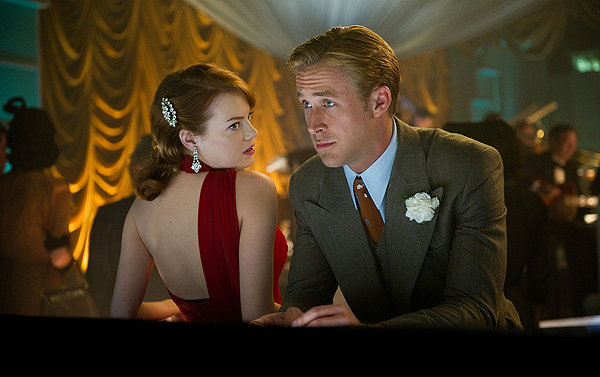 The main problem is that Gangster Squad really only has the skeletal outline of a plot. It’s missing any essential character and plot development. Here, I’ll summarize the barebones plot for you: Mickey Cohen is a bad guy. O’Mara forms a team. They have a montage taking out bad guys. Mickey takes out one of them. They have a showdown. That, ladies and gents, is it. There really aren’t any scenes that diverge from those scant descriptions. It felt like only five minutes passed from one of O’Mara’s guys getting killed (and just like The Untouchables, it’s the nerdy one) to them descending on Cohen’s headquarters and duking it out. Why does the film introduce the conflict of Wooters seeing Cohen’s girl if he never finds out? There isn’t even one scene presented to take advantage of this conflict. It just ends up being another half-baked plotline. It feels like the only development we get with Gangster Squad is through montages. What is also apparent is that O’Mara and his team really don’t have anything resembling the faintest notion of a plan. We watch them take out some bad guys via fights and shootouts but there’s no higher plotting to it. You get a sense that these former cops are just playing it by ear, looking for a fight every night. It’s hard to imagine that these people, even with their law enforcement and war experience, could be effective in the long term. Without any formative organization or greater planning, these guys just seem like dull bruisers bouncing from fight to fight with no sense of direction.
Then there’s the paucity of character work, relying solely on genre archetypes to do its work for the movie. O’Mara is the determined family man but his team can best be described by one-word classifications: The Black Guy (Anthony Mackie), The Nerdy Guy (Giovanni Ribisi), The Mexican Guy (Michael Pena), The Young Guy (Gosling), The Old Guy (Robert Patrick). That’s about it, though I suppose they do have different weapon preferences meant to supply all that missing characterization. Oh look, Officer Harris (Mackie) brings a knife to gunfights. That’s pretty much the beginning and end of his character. Wooters is so lackadaisical he feels like he’s on drugs, and Gosling’s soft-spoken, mealy-mouthed line delivery only adds to the effect. It feels like Gosling, in a stretch to find something interesting out of the mundane, said to himself, “I wonder if I could give a whole performance where I only speak under a certain vocal register.” Then there’s the woefully miscast Stone (The Amazing Spider-Man) as the femme fatale/mol to Mickey. I love Stone as an actress, but man-eater she is not and sultry seductress doesn’t fit her well either. Perhaps with the aid of a sharper script and a greater depth of character she could rise to the challenge. At no point does Gangster Squad really even attempt to make these people multi-dimensional. They never reflect on the moral turpitude of their own vigilante justice or the ramifications of their actions. There’s no room for ambiguity here.
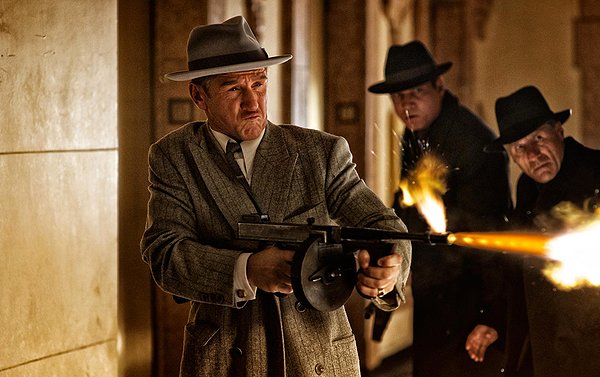 Finally, we must speak of Mr. Sean Penn (Milk). The man’s actorly gumbo goes into campy overdrive. In these rare circumstances, you aren’t watching Sean Penn Esteemed Actor so much as Sean Penn Human Vortex of Overacting. Normally I would criticize Penn for going over the top but over the course of 110 minutes, he single-handedly becomes the only entertaining thing in the movie. He’s chewing scenery up a storm, yes, but at least he’s channeling the pulpy silliness of the whole movie. I came to enjoy his antics and outbursts and thus became more empathetic of Mickey Cohen and his efforts than I did with O’Mara. Such is the danger screenwriters run when they spend more time crafting an interesting villain than a hero.
Gangster Squad is what happens when a movie is sold on title and genre elements. To be fair, it’s a bang-up title. The plot is half-baked at best, really only serving as a thin outline of a gangster movie, but instead of adding complexity and intrigue and characterization, they just ran with it. The actors are either camping it up or out of their element, the action and shootouts are pretty mundane, and the story is just uninvolving, even for fans of film noir like myself. It’s a good-looking film from a technical standpoint, but that’s as far as I’ll go in my recommendation (it could be an odd pairing with Milk considering the two shared actors). It feels like it just wants the setting elements of film noir, the atmosphere, and then figures just having good guys and bad guys shoot it out will suffice. That glossy, high-sheen period look just seems like a cool façade, and a cool façade seems like the only ambition of Gangster Squad. I can’t really recall any signature action sequence, snappy quote, plot development, or peculiarity worthy of remembering. It may be one of the most forgettable gangster movies Hollywood has produced.
Nate’s Grade: C
Share this:

Killing Them Softly (2012)
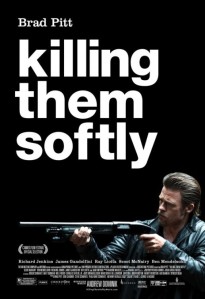 A funny thing happened while watching Killing Them Softly, the latest film from writer/director Andrew Dominik (The Assassination of Jesse James by the Coward Robert Ford). After an hour, I noticed a couple people stand up and leave, never to return. Then another and another like permission had been communally brokered. I counted ten walkouts at my showing, which was more than I had at Cloud Atlas, a film that I can at least understand the possible exodus. But this? It also got a rare F grade from CinemaScore, joining the ranks of The Devil Inside, Wolf Creek, and The Box. Before you put that much stock in what is essentially a movie going exit poll, Alex Cross was given an A grade from audiences. But why all the venomous hate? I can only theorize that the mainstream audience feels it was sold a bill of goods, a crime thriller with one of Hollywood’s biggest stars. The audience did not want to go on the lengthy talky detours. They wanted people to get dead. Whatever the reason, Killing Them Softly has killed its audience, who choose not to go softly in their disapproval.
Set amidst the economic meltdown of 2008, Frankie (Scoot McNairy) and Frankie (Ben Mendelsohn) are two lowlife thugs hired to rob a mob-affiliated card game. The trick is that local gangster Markie (Ray Liotta) had previously paid a group of guys to rob his own card game, fleecing his own customers. In his drunken revelry, Markie admitted as such to his pals. Now the situation is ripe for exploitation. Because any future robberies will have their suspicions pinned firmly on Markie, whether he had anything to do with them or not. As a result, no one is gambling, the public has lost confidence in the markets, and the mob needs to get things back to business. Jackie (Brad Pitt) is called in to make that happen. He’s a professional killer, who prefers to kill at a distance, without all those messy emotions. He has to trace the culprits responsible and give them the reckoning they have coming.
 From a plot standpoint, Killing Them Softly is pretty thin. It’s just about the ramifications of two nitwits robbing a card game. This lack of narrative depth will rankle most filmgoers, but I didn’t mind it so much because Dominik uses the crime thriller veneer to examine the sheer ugliness of a criminal lifestyle. This is a pretty character-driven crime flick, and it has to be when there’s a malnourished plot. It takes some lengthy sidesteps, notably with James Gandolfini’s (Zero Dark Thirty) character, Mickey. He’s supposed to be a professional, but the man is a complete wreck. He’s belligerent to those in service positions (waiters, prostitutes), chronically drunk, and weirdly empathetic for his struggling wife, yet seemingly powerless to change his life’s downward slide into self-medicated self-destruction. Mickey is the ghost of Christmas Future, the vision of what this lifestyle does to people who make a living out of it, who actually live into their retirement age. The two young crooks, Frankie and Russell, are idiots yes, but even when they have money their lives are so empty. Russell is so disgusting, sweating profusely, that you can practically taste his stank. Frankie is a little more cognizant of the danger he’s in, and yet the moron doesn’t leave town after his big score. I’d think that’s the first thing you do when you rip off the mob. The day-to-day anxiety of a life of crime is just not worth the effort. You constantly have to look over your shoulder, a life dominated in paranoia, where every stranger or furtive glance could have sinister meaning. Even when you make money, you’re theoretically taking money away from someone else’s profit, and these are the kind of people that don’t take kindly to friendly competition. This is no enviable, glamorous life.
I think Killing Me Softly would be a better, easily more satisfying movie had it eschewed the attempts at extra weight and commentary. It’s no surprise that the scenes that follow a more traditional crime thriller route are the best. There’s palpable tension when Frankie and Russell are in over their heads. The conflict is prevalent and the suspense is nicely stretched out, notably during the card game robbery. Being neophytes, you don’t know what they’re liable to do but you can bet it won’t be smart. This is when the movie is most alive, most engaging, and most entertaining. When it plays it straight, and explores the sliding power plays at stake in a world of cash and guns, it can be a nasty but taut little movie. I’m just sorry that Dominik took a functional crime thriller and gave it an extra sheen of Important Things to Say (”America’s not a country. It’s a business.”). The political parallels never feel more than tacked on attempts to grope for deeper meaning. Oh I get it, I understand the comparison of mob enforcers and corrupt Wall Street execs, hoodlums and crooks in different casual wear, but that doesn’t mean the parallel is that meaningful. It’s on-the-nose and a bit in your face (really, people are watching C-SPAN in dive bars?).
 Given Domink’s last film, I expected there to be some visual flourishes, though I’m unsure of whether they added much to the proceedings. Dominik sure can make violence entrancing, setting a slow motion slaying in the rain with stirring beauty to ironic Motown music. But he can also make the violence feel brutal, like a beat down on Markie that uses choice sound effects and editing to make you feel the punches. Even the opening seconds feel like an artistic assault to the senses, the loud static of noise interrupted by bursts of Obama’s sound bytes. The extreme camera angles, the visual felicities, the ironic music selections, they all seem to underscore the movie’s subtext-as-text approach.
Pitt (Moneyball) doesn’t come into the movie for the first thirty minutes. You’re welcome to see him, especially since he has such a coolly threatening demeanor, but also because here’s a character that will mix things up. I found myself rooting for the guy, partially because he was an accomplished professional but also because I wanted there to be consequences for idiots doing dumb to powerful enemies. I enjoyed the slow-burn intensity of Pitt when he was turning the screws on the screw-up. Richard Jenkins (Cabin in the Woods) is also enjoyable as a mob shill left to communicate the wishes of his higher-ups. McNairy (Argo) gives a performance that screams desperation, as he realizes the depth of trouble he finds himself into. And even Liotta (Charlie St. Cloud) does a fine job as a lout who misjudges the friends he keeps, discovering the costs of bragging.
In many ways, I feel like Killing Them Softly is akin to last year’s Drive, a more meditative crime thriller with bursts of gruesome yet beatific violence. Likewise, many filmgoers will be sore thinking they were catching straight crime thrillers and been given arty genre ruminations instead. And like my ambivalent feelings toward Drive, I can’t work up that much enthusiasm for Killing Them Softly either. It’s certainly got more ambition than most crime flicks but I’d rather it concentrate on telling a more engaging story. Dominik’s film is a bit too indulgent for its own good, given to visual flourishes and a narrative routinely sidetracked. And yet, I found it fairly interesting at just about every turn, well-acted, and intensely suspenseful and effective at different points. But it doesn’t add up to enough to recommend. The political allegory probably rubbed the walkouts the wrong way as well. The political allegory is too obvious, too pat with its “they’re all crooks” broadside. I wish the movie had abandoned the squalid, nihilistic art house ambitions and just kept things straight. When it has less on its mind, it works best. But for many, Killing Them Softly will be too tedious to see to the bloody end.
Nate’s Grade: B-
Share this:

Seven Psychopaths (2012)
 Writer/director Martin McDonagh only has one movie to his name but the man has already accrued legendary status in some circles. The 2008 dark comedy In Bruges didn’t create much of a blip at the box-office, but its blend of absurdist comedy, dark drama, shocking violence, and languid contemplation found a rabid cult following. I have several friends who regard In Bruges as the best film of 2008 (WALL-E still reigns supreme for me but I quite enjoyed In Bruges).McDonuagh’s latest, Seven Psychopaths, reminds me of Barton Fink: both are about struggling writers, both are satires of the film industry, and both have sudden splashes of violence and a serial killer who pushes the protagonist to artistic completion. In other words, Seven Psychopaths is a fun film and a great time at the movies.
Marty (Colin Farrell) is experiencing some killer writer’s block. He’s stuck on his new screenplay titled “Seven Psychopaths.” His buddy Billy (Sam Rockwell) is eager to help out. The guys run afoul of another psychopath, mob boss Charlie (Woody Harrelson), due to Billy’s side business. He kidnaps rich people’s dogs and then his partner, Hans (Christopher Walken), returns them and collects a reward. Billy and Hans have kidnapped the wrong shih tzu, and now Charlie and his muscle is going to make them pay.
 The refreshing thing about the bloody, wickedly entertaining Seven Psychopaths is that it constantly surprises you. This is such a rarity with modern movies, particularly Hollywood movies that attract as notable a cast as this one. McDonagh is wonderfully adept at throwing narrative curveballs. There were a few surprises where I literally jumped in my seat. You constantly think you have the movie figured out, and then it goes down a different alley and becomes more interesting. One of the pleasures of having psychopathic lead characters is that they are impulsive and do not have to follow the normal purview of logical decision making. They might just call the bad guys and divulge where they are hiding. They can do anything at any moment, and part of that unpredictability is what makes the movie feel so electric, so creatively alive. I must stress that McDonagh surprises in ways that feel satisfying and yet believable given the world he’s concocted. Part of the fun in the first half is just figuring out who the seven psychopaths will be. It’s not like it’s some laconic chamber piece mystery but the psychopaths are an eclectic mix from the real to the fictional to real characters doubling as inspiration for fictional ones. I think in the end there may only be six psychopaths, unless McDonagh is counting himself amongst the numbers.
McDonagh also has a blast deconstructing the very kind of movie that he’s providing. Marty bemoans writing another rote psychopathic killer movie where the violence is fetishized and the bad guys are mythologized into idols. You think the film is headed in one direction, in the Guy Ritchie-style standoffs and shootouts, and then it takes a less traveled path, one where it criticizes these sorts of movies and ponders existential questions about the nature of self-expression and death. It began as a care-free movie about thugs and writers and transformed into a movie that manages to have something to say about life, philosophy, and the cyclical nature of vengeance. Two of our three main protagonists are pacifists and remain so to their imperilment. At one point, a character narrates how this story as a proper movie would end, and it covers all the nihilistic clichés of vengeance and epic body counts. But then Marty, and McDonagh as well, wants to turn away from the expected, from violence for the sake of violence, from the exploitation of stylized suffering. McDonagh doesn’t forget to entertain while he’s making you think in between those handfuls of popcorn. The female characters in the movie (Abbie Cornish, Olga Kurylenko) are generally wasted, in different senses, but McDonagh uses this as another charge against this type of film (a boy’s night out of carnage). This is an accessible movie that can be enjoyed on a whole other meta level. I loved the various gear changes. For me it took the pulpy action material and elevated it to another level of genius.
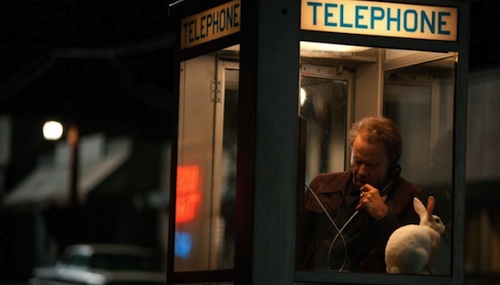 McDonagh still maintains his darkly sardonic streak of humor that made In Bruges such a riot. I was laughing throughout Seven Psychopaths; chortles, snorts, giggles, big belly laughs. With its heedless violence, obviously this will not be a film that runs on every person’s wavelength of funny. The very opening involves two mafia hitman debating whether shooting somebody in the eye takes actual precision or just dumb luck. It’s the sort of mundane conversation you’d see in a Quentin Tarantino movie, and also the precursor to something nasty and ironic. McDonagh’s sense of humor is similar to Ritchie or the Coen brothers, but the man establishes his own sense of wicked whimsy. The absurdist dialogue is always a hoot and can generate serious malice, especially when delivered by stern psychopaths. Rockwell (Moon) in particular is outstanding and delivers a virtuoso performance of the unhinged. The man just radiates energy. You’ll feel jacked up just watching him. I keep waiting for this underrated actor to break out with each star-making turn, and his comedic zing is played to perfection in Seven Psychopaths. In contrast, Walken (Hairspray) is rather reserved as he underplays his character, one of the saner men he’s played. It feels like the passing of the torch from the older generation of psychopath to the newer generation.
Being a colorful movie about colorful bad guys, and girls, you’d expect there to be some grade-A oddballs, and McDonagh does not disappoint. Some of the psychopaths in question have little bearing on the story plot-wise. There’s Zachariah played by the impeccable Tom Waits (The Imaginarium of Doctor Parnassus). He answers an ad that Billy set up for psychopaths to share their stories to Marty. His tale involves cross-country spree killing of serial killers, rabbit petting, and the love of his life, and partner in crime, leaving him. As far as plot, this little aside has little significance to the plot other than setting up a superb joke to end the movie with. But the character is so interesting, multidimensional, and played with equal parts aloofness and sincerity by Waits, that you can’t imagine the movie without him. Several of these psychopaths could have been the stars of their own movie, from the vigilante killing mob thugs to the tale of one father’s long path to vengeance. Even the fictional psychopath, the Vietnamese man (Long Nguyen) seeking vengeance against G.I.’s, could have enough weight to carry a feature film. The amazing part of the movie is that you don’t feel like any of these characters are shortchanged. McDonagh finds ways to emotionally ground his characters, allowing the audience to empathize amidst the bloodshed and loony characters. We care about Hans and his ailing wife; we care about the friendship between Marty and Billy. It’s real for these characters and so it feels real to us, despite the hyper-real flourishes of the movie.
If you’re a fan of In Bruges, or just dark comedies mixed with sudden violence, then you’ll probably find something to enjoy with Seven Psychopaths. You don’t have to be nuts but it helps. McDonagh has crafted another winner with sharp dialogue, a twisty plot full of surprises, incisive commentary on movies and movie expectations, as well as some sincere soul-searching and poignancy. This baby has it all, folks. Above all else, it’s just a blast of fun. the actors all seem to be having the times of their lives, notably Rockwell, and the morbid laughs and off-kilter thrills should cement another McDonaugh film for cult status. Seven Psychopaths is a palyful movie along the lines of Kiss Kiss Bang Bang and even Adaptation. It’s bursting with ideas and comments and jokes. when you leave the theater you almost want to get back in line and start the ride all over again.
Nate’s Grade: A-
Share this:

Lawless (2012)
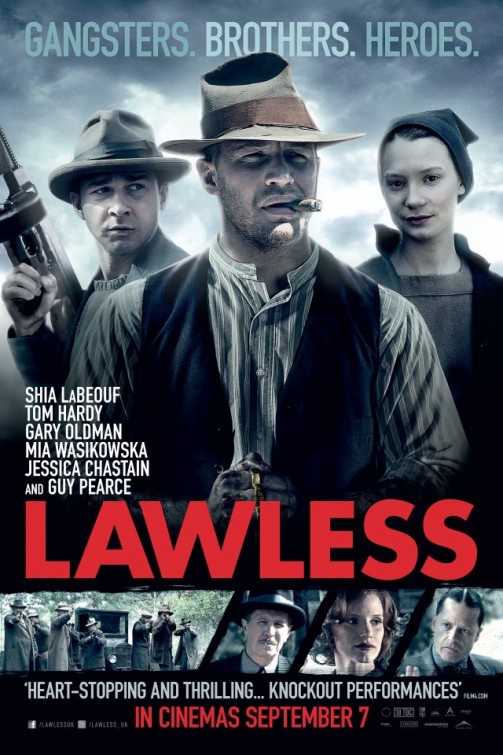 The bootlegging drama Lawless certainly has all the right elements to be an enjoyable movie. It’s by the men who gave us the great noir-Western The Proposition (director John Hillcoat, writer Nick Cave), it’s got a star-studded cast, plenty of bloody action, and a handsomely recreated production of the Prohibition era. But as I watched the Bondurant boys struggle against those who would like to put them in jail and/or murder them, I kept noticing something odd. I wasn’t that engaged. There was plenty of life-and-death drama, but why wasn’t I involved in the story more? Lawless feels like a series of scenes rather than a movie. Even when the plot changes it doesn’t feel like the movie is advancing. Even when things are more desperate it doesn’t feel like the momentum is building. The characters are somewhat sluggish as well, Shia LaBeouf as the scared youngest brother, Tom Hardy as the grumbly big brother who talks like his mouth is full of molasses. Jessica Chastain as the abused Good Woman who opens herself up to our Strong Hurting Man. Then you got a plot with a mobster (Gary Oldman) that weirdly climaxes with an hour left in the movie. He’s ignored for the remainder. Then there’s Guy Pearce as a colorfully fiendish and foppish special deputy that terrorizes the town. I am a Pearce fan but this guy is acting like he’s in his own weirder personal movie; it’s the kind of stuff Marlon Brando did. I appreciated that Lawless kept things gritty and bloody for realism, but I kept finding moments that ripped me out, namely the indestructible nature of Tom Hardy. Seriously, this guy has to be the Terminator. When he miraculously survives yet another seemingly fatal injury, all you can do is laugh. Lawless is passable entertainment but with its pedigree this should have been better.
Nate’s Grade: B-
Share this:

Killer Joe (2012)
 This is one nasty, alarming, but very involving movie that wallows in darkness and plays it up for laughs. Killer Joe is a dysfunctional family drama, a crime thriller, and a mesmerizing character study when it comes to the lessons of amorality. Based on the play by Tracy Letts (August: Osage County), Joe (Matthew McConaughey) is a crooked cop who works as an assassin on the side. A weasely loser (Emile Hirsch) and his family hire Joe to kill their mother for the insurance money. Things get out of hand in frequent measure, with splashes of brutal violence, healthy amounts of sex and full-frontal nudity, and a disturbing sexual act with chicken that more than earn this film its adults-only NC-17 rating. What makes the movie rise above base exploitation is its depraved, deep-fried sense of humor. There is plenty of uncomfortable laughter and guffaws. The end of the film, during a fever-pitch of violence, is so sudden, so kooky, so debauched, that my friend and I burst out laughing. Without its wicked sense of humor, and its sharp ear for working-class dialogue, the movie could be accused of wallowing in the muck. There’s also the terrific acting, chiefly from McConaughey. He gives a hypnotic performance, chilling, unpredictable, and deeply committed to retribution. When he zeroes his cold eyes on you, boy does the flesh crawl. It’s an intense performance and arguably the best of the man’s career. Directed by William Friedkin (who also directed the 2006 adaptation of Letts’ play, Bug) with brutish élan, Killer Joe is one nasty piece of work, but given the right audience, it could prove to be a perverse entertainment.
Nate’s Grade: B
Share this:

Savages (2012)
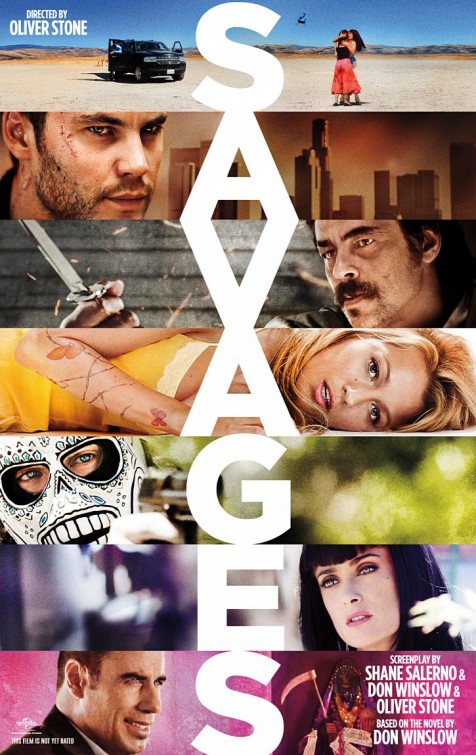 Savages has been described as a “return to form” from prolific director Oliver Stone, who has spent the last decade making straight biopics (W., Alexander) and safe feel-good movies (World Trade Center). The less said about Wall Street: Money Never Sleeps the better. You never thought one of the world’s edgiest filmmakers would follow such a square path. I can’t fault people for getting excited by Savages, hoping this drug-addled crime thriller can revive the gonzo sensibilities of the man. Well, Savages isn’t going to satisfy most people, especially those looking for a cohesive story, characters that grab your interest, and an ending that manages to stay true thematically with the rest of the movie. In short, Savages is a savage mess of a movie but not even an entertaining mess. It’s just a boring mess, and that is the film’s biggest sin.
Best friends Chon (Taylor Kitsch) and Ben (Aaron Johnson) are living the American dream. They began farming their own marijuana plants, using the best seeds form Afghanistan while Chon was on tour with the military. Together, the guys have produced a product high in THC that blows away the competition. They have flourished in California. Now a Mexican cartel, lead by Elena (Salma Hayek), wants in on their business, and they won’t take no for an answer. The cartel kidnaps the boys’ shared girlfriend, O (Blake Lively), and promises to hold her ransom for one year unless the boys agree to their terms. Chon and Ben decide to use their considerable resources to put the squeeze on Elena and her team of scumbags, all the while looking for a way to rescue their shared love of their life.
 It’s a lurid movie all right. Plenty of sex, drugs, and violence, but man oh man is it all just empty diversions because the movie cannot survive its trio of unlikable, uninteresting, and painfully dull characters. O, Chon, and Ben have a dearth of charisma; light cannot escape their black hole of charisma. What sinks Savages is the realization that it’s just a shoddy movie filled with a lot of skuzzy characters but hardly anyone that merits genuine interest. We’ve got skuzzy good guys, skuzzy bad guys, but where are the personalities? Where are the quirks or the hooks to drive our interest? Just having Benicio del Toro (The Wolfman) act weird and mumbly is not enough to cover the shortcomings of his character. I’ve read reviews where critics cite del Toro as “hypnotic.” I have no idea what they’re talking about. He’s just your average skuzzy bad guy you’d find in any mediocre crime picture; he just so happens to be played by Benicio del Toro. The DEA Agent John Travolta (From Paris with Love) plays is your typical skuzzy desk weasel; he just so happens to be played by John Travolta. And that’s where the movie falters. We have all these characters on all sides of the law but we couldn’t give a damn for any of them. O comes across like an annoying, privileged, faux intellectual. Chon is a meathead. Ben is an amorphous do-gooder. I don’t care about their problems and I especially don’t care about them retrieving O so they can return to their vague polyamorous lifestyle. She wasn’t worth all the effort, nor where these men worth dying over. At any point in the film, I wanted these characters to hastily die so that I might, just out of chance, come across a more interesting figure. I received no salvation.
Our trio of bland characters is made flesh by a trio of bad performances. First off, people have got to be realizing that the kind of lived-in, edgy, and compelling performance Lively pulled off in 2010’s The Town is more the exception than the rule. Stop casting her in gritty parts unless they are directed by Ben Affleck. As O, our zombie narrator, she does little to make us sympathize with her dumb plight. Then there’s Kitsch (Battleship) who is just having a record year of high-profile flops. He’s done fine acting work before, but as Chon he’s just another ramped-up hothead with little else on his mind. Johnson (Kick-Ass) has the most “flavor” of the trio, acting granola-y and with philanthropic ambitions, but he’s still just another meathead just in different clothes. All three of these characters are idiots and the young actors don’t find any way to redeem them.
Actually, I found Salma Hayerk’s character the most interesting and would have enjoyed a movie based around her dilemma. Elena’s husband was the head of a drug cartel. He was assassinated, so the duties would have fallen to her son, but in order to protect him she assumed power. She has an estranged relationship with her youngest daughter, Magda (Sandra Echeverria), who is ashamed of her mother. This, Elena tells us, makes her produ; she is proud that her daughter is ashamed. Now just look at all those contradictions and complexities inherent with this character. She’s assumed a duty she did not want, something she knows is morally wrong, but she does so in the interest of protecting her children, even if it means pushing them away and having them despise her. And because she’s a woman, any wrong move and her competitors would be ready to pounce. Plus you add the day-to-day anxieties of a life of crime, the threat of betrayal or some upstart wanting to make a name for himself, and you have the makings of a great character drama. But do we get even a little of this? No. Instead, Elena’s just portrayed as another colorful villain. The supporting cast is peopled with what should be seen as “colorful” characters, but really these people are just as skuzzy and boring and personality-free as our loser ménage a trois.
I suppose there is a certain pleasure seeing Stone return to his blood-soaked, violent, gonzo self. The man has a certain enviable madness when it comes to composing a movie, a mad fever of images and sensations. From that standpoint, Savages is at least watchable even though you would rather see most of the characters get hit by a car. I just wish if Stone was going to go nuts that he committed and went all the way, bathing this movie in his lurid predilections as we tumbled down the rabbit hole of the underground world of organized crime. If you’re going to assault my senses with excess then at least have the gall to be excessive. How can you make a lurid movie but EVERY woman onscreen engaging in sex is clothed? That seems unrealistic even for a movie this stupid. Stone seems to have no problem dragging out uncomfortable rape scenes, so who knows what the further implications of that are. There are several grisly torture scenes and some random brutality, so you’ll at least be kept awake in spurts by people screaming.
 Too much of this supposed crime picture is caught up in the oppressively irritating soap opera between O, Chon, and Ben (a little part of my soul dies every time I have to type “Chon” as a main character name). The script, based upon Dan Winslow’s novel, adapted by Shane Salerno, Stone and Winslow as well, is a mess but not even an enjoyable mess. Some of this dialogue is just laugh-out-loud bad. O opens the movie saying she has orgasms but Chon, you see, has… “wargasms.” Oh ye God, that one hurt. Every time we’re subjected to O’s protracted, monotone narration the movie loses whatever momentum it may have had.
She keeps saying, “Just because I’m telling this story, doesn’t mean I’m alive at the end.” Can you promise me that? Then there’s the very stupid ending, where the movie tries to have it both ways. It gets its bloody, operatic, tragic lovers ending…. and then in the next breath a happy ending as well, a ridiculously inappropriate happy ending. At least bloody and dead would have been satisfying. It’s a cop-out, a cheat, and a mystifying way to end a movie.
I wanted Savages to be a wild thrill ride. I never expected to be bored. Even when things go off the rails, the movie struggles to keep your interest. Blame the inane screenplay that eventually resorts to a cheap, cop-out of an ending, one that barely rises above the “it was all a dream” blunder. Blame the pathetic character and their lack of personality. Blame the strange feeling that Stone is holding back. Blame the bad performances. Blame the lack of fun. Blame the overwrought nature of the title the movie twists into knots trying to give some philosophical meaning. And finally, you might want to blame yourself for thinking that this movie would be any good in the first place. When movies are this mediocre, this lacking in intrigue, you almost wish they had tipped over completely into irredeemable garbage just so you’d at least have something worth watching. Savages is a strange crime thriller that manages to assemble all sorts of exploitation elements and then fumbles them all. If this is Stone in a “return to form,” I weep for what that entails.
Nate’s Grade: C
Share this:

Rampart (2012)
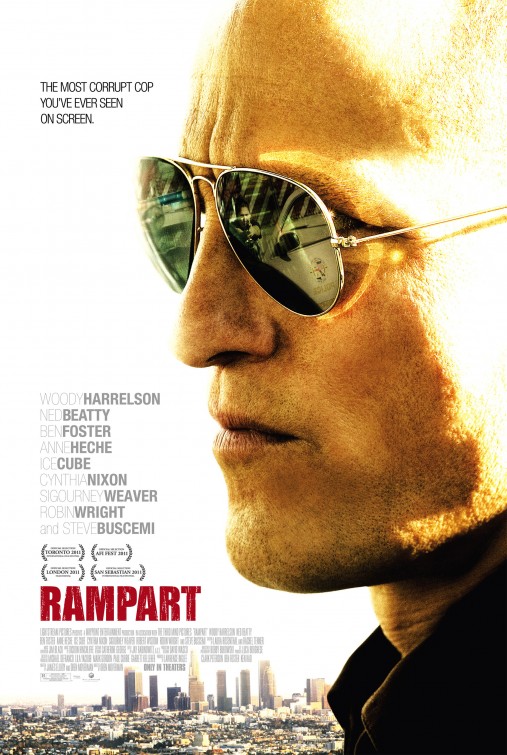 Stop me if you’ve heard this one before. A corrupt L.A. cop (Woody Harrelson) makes bad choices, alienated and frightens his family, and looks to be on the way out as a career of taking the law into his own hands is at long last catching up with him. Yeah, you probably stopped me after the third word in that sentence. This dour character-study showcases Harrelson nicely as a cocksure cop who’s so self-destructive and paranoid that he pushes everyone away. Co-written and directed by Oren Moverman, who made the terrific and searing drama The Messenger, this movie just about turns into high-gloss navel-gazing. The plot is quite loose and there’s very little traction. We get to see scene after scene of Harrelson behaving badly or violent, but what does it all add up to? We already know he’s a bad cop tortured by his own sins and the demands of the job. In a way, there’s an intriguing connection between law enforcement and soldiers who are often called to bear incredible burdens and just deal with it, forgotten by a public complacent with being safe. But really this movie is just one long trip with an angry man who keeps everyone, including the audience, pushed away. He’s complex but I can’t say we ever got to know him better. The film is well acted with plenty of recognizable stars, but why should I care? The central message about the prevailing influence of corruption is a bit heavy-handed as well; at one point Harreslon’s wife says, “You made us dirty.” Rampart is a disappointing venture for Moverman despite Harrelson’s best efforts. In the end, when you’re stuck with a dirty cop he better be worth the time.
Nate’s Grade: C
Share this:

Miss Bala (2011)
 Miss Bala (Mexico’s foreign film entry for 2011) is an unwavering, startling, and deeply tense movie about one woman’s tragic and unwilling association with a powerful drug cartel. Laura (Stephanie Sigman) wants to be the next Miss Baja California, but she’s unwittingly pulled into a life of crime after she witnesses a gang hit. The cartel ensures that Laura wins the beauty pageant and becomes a courier for them. The movie takes a Lars von Trier approach to storytelling, putting its heroine through a torture chamber of anxiety and terror. This woman only wants to escape the hell she has accidentally found herself a part of, but every attempt to escape, be it going to the police or confessing assassination plots to the intended targets, gets her corralled back into the fray. For Laura, there is no escape. The movie packs a near-constant surge of paranoia, as we fear that at any time something awful will happen. In fact it’s usually only a matter of time. Laura is more a symbol of the collateral damage of Mexico’s billion-dollar drug war than a character, and she kind of becomes a numb zombie by the movie’s latter half, perhaps accepting her doomed fate. Director Gerado Naranjo favors long unwinding takes and handheld cameras, which add a gritty realism and sense of compounding dread to the picture. The movie has an unflinching level of realism to it that makes it all the more haunting, stripping the romanticism from a life of crime. Much like Italy’s heralded crime film Gomorrah, this bleak but impassioned movie shows the inescapable tentacles of organized crime and gives a face to innocents caught in the middle. Miss Bala is a testament to the hidden toll of a nation at war with itself.
Nate’s Grade: B+
Share this:

Passion Play (2011)
 You would think that a movie where a jazz musician (Mickey Rourke) gets in trouble with a mobster (played by Bill Murray!) and while on the lam he discovers a girl (Megan Fox) with angel wings working in a circus sideshow would be interesting. How could you go wrong with all those interesting elements? Mobsters, circus freaks, angels, Mickey Rourke! Well Passion Play found a way, a triumph of failure. This would-be parable just sleepwalks from scene to scene, rarely making much of its fantastical sci-fi elements. Fox swears she’s no angel, just a girl born with bird wings, and people let this be a conversation ender. Rourke’s character is a pathetic coward who nets little empathy. Not reverent or weird enough, Passion Play was the passion project of writer/director Mitch Glazer but the movie feels devoid of anything approaching passion. The actors seem bored, the romance between Fox and Rourke is a non-starter, and the lame ending borrows a page from An Occurrence at Owl Creek as a last-ditch attempt to interject some meaning into this unholy mess. The only reason I can foresee (sober) people watching this is for the mistaken belief that they might glance upon some heavenly nudity from Fox. Sorry boys, the gal keeps her purity. The entire production is just so wrong-headed and listless; I can’t even work up a good dose of bile to proclaim its utter inanities. This is a terrible, silly, puzzling, dopey movie made even worse by its pseudo-intellectual twist ending.
Nate’s Grade: D


You must be logged in to post a comment.