Blog Archives
Marry Me (2022)
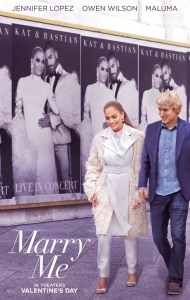 Marry Me has a premise that is so silly that it feels like it would be the setup of a fake movie within some other movie universe, something depicting the creative lunacy of Hollywood for easy satirical laughter. But no it’s real. Based upon a graphic novel by Bobby Crosby of the same name, Jennifer Lopez plays music superstar Kat. She’s a best-selling and provocative performer and her latest single, “Marry Me,” is ruling the charts. She co-wrote the track with her fiance, and the two plan to marry live during one of her stage shows. Then news leaks that her fiance has been cheating on her with her assistant. Kat is stunned and as she’s still processing her hurt feelings onstage she spots a “Marry Me” sign in the audience, held up by Charlie (Owen Wilson), an ordinary math teacher and single father. She agrees to marry him on the spot, and Charlie is rushed onstage and the two tie the knot. Now, what to do and can they make this actually work?
 Think of Marry Me as Notting Hill but where it starts at the level of international fame for romantic coupling. I found the premise to this movie, at first glance, to be absolutely preposterous. I was hoping that the movie wasn’t going to spend so much time worrying how to legitimize this silly impulsive marriage between two complete strangers. Fortunately, from their first “I do” onward the pair doesn’t really view their subsequent “relationship” as more than a publicity stunt. He’ll get more attention for his school and causes that are important to him. She’ll get a run of media attention and allow her to rebrand herself in the wake of her history of cheating louses. I was happy that the movie, at least early, doesn’t try to make this spontaneous union credible. Kat wonders, “Hey, maybe something so crazy just might work,” and of course we know it magically will, but at least they’re not panicking about how they just got married and how they are going to make this relationship work when they could as easily get annulled and got about their separate lives again. So from there, Marry Me follows the path of having these two fake lovebirds become real lovebirds over the course of their shared time.
We know it’s all going to work out, their romantic fate is sealed, but the process needs to still feel organic and earned, and that’s where I found Marry Me to be unsatisfying. Rom-coms will live and breathe depending upon their quotient of cute moments to swoon moments, ultimately winning you over and desiring the coupling. This movie already starts with the couple together, at least in a legal sense, but they don’t know one another and have no immediate feelings for one another, so the movie is like any other rom-com. They have to fall in love for real now, almost like an arranged marriage. However, I found the interactions between Kat and Charlie to be far chummier than passionate or romantic. Lopez and Wilson have zero chemistry together. There is no heat between these two. He’s too laconic and she’s too pressing. As the movie progressed, I could believe they were becoming friends. He got her to be more self-reliant, and she pushed him outside his moderate comfort zones with social media and self-promotion. They’re better friends but I felt nothing romantic between them and that’s a pretty big problem. In fact, that’s the biggest problem in a romantic comedy. If I walk away feeling like the leads would be better friends than lovers, then you haven’t put in the work, and that’s the case here.
 We associate fun and cute moments from rom-coms, amusing scenarios that force our couple to work together or wacky situations where they learn more about the other in a new setting, and Marry Me feels too unimaginative here as well. This is another vital area for the development of the relationship to feel genuine, and simply just for audience enjoyment. The three screenwriters are unable to take the Notting Hill-dynamic of an ordinary person thrust into an unwanted, elevated level of fame and scrutiny and do anything with it. Charlie’s life never feels too disrupted from before; his casual public walks with Kat do not have dozens of paparazzi hounding them, annoying fans inserting themselves into his personal life, envious family members and exes coming back into the picture for attention, or even Charlie’s past being litigated by the media. His new life feels strangely absent the surreal touches we would expect and want from this plucked-from-obscurity setup.
The script assembles the standard rom-com tropes without anything more personable to make it feel meaningful to this story and these characters and their conflicts. Charlie asks Kat to come to the school dance, and this sounds like it has potential to be fun, but it never goes further than the mere idea. She’s there, the kids are flummoxed and naturally starstruck, and she sings a song to them. That’s it. When the third act comes calling, we’re left impatiently for the resolutions to hit their predictable end points. We know that the bad ex will still be the bad ex, we know that the big decision about whether to go to the fancy music industry gig or the humble Mathlete championship is no struggle, and we know the valiant efforts to travel back in time will be crossed at the exact moment desired. Marry Me disappoints because it squanders its unique or alluring plot elements and too often settles for resuscitating stale genre tropes.
 Marry Me feels almost out of time, like an early 2000s rom-com star vehicle for Wilson (Loki) and Lopez (Hustlers). Both actors are in their 50s now, and ostensibly playing characters in their 40s, but the movie treats them like they might as well be in their late 20s. He’s divorced with a pre-teen daughter and she’s had multiple high-profile marriages, but so much more could have been articulated, especially about a 40-something woman trying to keep her perch in an industry always looking to replace aging superstars with the next young pretty thing available. This perspective gets the occasional mention, but that conflict feels mysteriously ignored, like even approaching the idea would be insulting rather than establishing an intriguing new level of self-reflection and potential connection for these two middle-aged characters. A big screen rom-com with characters in their 40s, or beyond, is such a rare find, let alone having one of those characters in the shallow field of entertainment. Ignoring this opportunity is confusing.
While the writing and chemistry is lacking in Marry Me, the two stars are still enjoyable to watch. I didn’t believe their romantic union but I believed that they genuinely enjoyed hanging around one another. So while Marry Me doesn’t work as the story of two people miraculously falling in love under contrived circumstances, it can work as the story of a burgeoning friendship of unlikely friends. If you think of it from that angle, the movie is a lot more agreeable and entertaining to watch over the course of its 110 minutes. Lopez and Wilson are still charming leads, and the movie never gets too serious or overwhelming to actively dislike. It’s ultimately a middle-of-the-road rom-com, low-key enough to coast on the appeal of its stars but absent anything to make the characters and their romance feel personable and meaningful. It’s no different than something you might see on cable in the middle of an afternoon. You can do worse than Marry Me as far as formulaic rom-coms go, but you could certainly do better, and I advise you dear reader, in your rom-coms as well as your relationships, not to settle for less.
Nate’s Grade: C
Share this:

They/Them/Us (2022)
 Jon Sherman has been a film professor at Kenyon College in Ohio since 2010. He has sought to build up the Columbus, Ohio film community and has often guest lectured at various film screenings held in central Ohio. Sherman has some personal experience with Hollywood, writing and directing his 1996 breakout indie rom-com Breathing Room (starring Dan Futterman!), and then given an even bigger stage with the 2002 rom-com I’m with Lucy (with Monica Potter!). He may be an academic but that filmmaking itch never really goes away, and so that brings us to another Sherman rom-com, 2022’s They/Them/Us, which is available to be viewed nationally through digital release. It’s a charming, offbeat romance with a sweet sensibility and an unexpected kink.
Charlie (Joey Slotnick) is a middle-aged man starting his life over. He’s re-entered the dating scene after a recent divorce, he splits custody of his two teenage children with their mother, and the only job he could find as a film professor is at a conservative Christian university. Lisa (Amy Hargreaves) is a woman in her forties, a successful artist with full custody of her two children, one of whom has recently identified as non-binary (preferring “they/them” pronouns, hence the title). They meet online, have their first date, and are immediately smitten, enough so that Lisa bends her rules about not getting too attached too soon. Charlie and Lisa decide to combine their clans into one modern blended family, and the reunification is a messy and awkward process.
 Given Sherman’s background as a film professor, you would hope that if anyone, when given the opportunity to make a feature film, could rise to the occasion, it should be somebody whose career rests upon the analysis of what makes movies work best. They/Them/Us succeeds as a relatively light-hearted rom-com and family drama with several nice moments. It’s hard to quantify, but you know better writing when you witness it, how characters interact and how witty the exchanges are and how much characterization they impart. Typically, a lesser writer will overstay their welcome or begin a scene before the importance. This can also be done to add unique character details, but often it’s a writer not knowing when to start and when to leave, a trait I’ve experienced so many times with Ohio-made indies. With Sherman’s scene writing, everything is to the point and moving, imparting the most important info or character detail, then chugging along. Early on, we establish Charlie as a man struggling to parent two surly teenagers and find someone special online. The fact that in the opening seconds he seems to be messaging two women who have BDSM kinks in their profile should be telling. After Charlie admonishes Danny for smoking pot in his house, he snatches the kid’s bong and runs upstairs, pacing and unsure of what to do next as his breathing calms and he focuses his attention to the bong in hand. Cut to Charlie smoking the bong to relax. It’s a quick, smart detail that demonstrates Charlie’s uncertainty on how to be the stable authority figure with his own dismissive children.
They/Them/Us is also a charming and sex positive romance between two middle-aged divorcees, a subject that rarely gets such big screen attention. The movie touches upon the challenges of modern dating when you’re not just dating a single individual but a person with attachments, about starting over later and finding a new life that will make appropriate space for you. Selecting a common dinner option can be its own minefield. It’s a perspective worthy of more attention by Hollywood. Beyond that angle, the movie is also surprisingly kinky for a “family comedy.” While unrated, They/Them/Us still exists in a more PG-13-friendly universe so it’s rather gentle when it explores the BDSM urges of Lisa. The movie is refreshingly free of judgements though has more than a few grand jokes drawn from Charlie’s squeamishness. He tries to throw himself into a more aggressive role, and Lisa asks him to pull her hair harder, and he says, “I’m sorry, I can’t. I’m a feminist.” I laughed out loud at that one. Another time, Charlie is attempting to spank Lisa and he keeps hesitating, finally admitting that it keeps bringing up unwanted and uncomfortable memories of spanking his unruly son as a child, something he still feels guilty over. In time, Charlie seeks out advice and instruction on how to be a better BDSM participant, and his educational process is a bit obvious, with more than a few easy gags (no pun intended), but it’s still one borne from a desire to better understand and fulfill his partner. It’s a sweet romance.
 Slotnick (Twister, The Marvelous Mrs. Maisel) has been a staple of TV and movies for decades, a reliable “that guy” with overly neurotic tendencies. He’s a terrific put-upon dad and his age has only added more authenticity to Charlie’s harried struggle. He’s got a warmth to him that is easily conveyed during his brighter, kinder moments, and he’s also got a wellspring of awkward, cringe-inducing comedy as a middle-aged dad trying too hard to connect with a brood of teenagers and often flailing. When he’s genuinely happy, Slotnick genuinely wins you over. I think the vague details about Charlie’s dismissal from his previous professor job are a mistake. We’re told by his ex-wife, who inexplicably is still trying to get him back for the sake of the children, that a coed sent Charlie inappropriate texts. That topic is way too big not to clarify, and it’s also strange that Sherman and co-writer and partner Melissa Vogley Woods never come back to this as a conflict with his new relationship. It also seems like a natural point of conflict for keeping his new position at the Christian college and yet it’s glossed over (the resolution over that is laughably too tidy and convenient but keeping with the low stakes).
Hargreaves (13 Reasons Why, Homeland) is very enjoyable as the more experienced and confident half of this blended relationship. Lisa knows what she likes and is not ashamed, and she’s patient with Charlie as he attempts to reach her on her level. Hargreaves has a fun spirit to her that doesn’t veer into exploitation. It would be easy for Sherman to just write her as a fetish object for Charlie, but Lisa comes across as a real woman with her own desires and doubts and questions. There’s a scene where Lisa and Charlie are talking after their less-than-stellar first date with the combined family unit, and Lisa’s children are impatiently waiting by the locked car. “Come one, mom,” they whine. “You have the keys.” In mid-sentence, Hargreaves just hurls the car keys to her children and then continues her conversation with Charlie without missing a beat. It’s a defiant, petulant, lovely moment that keys the audience into her devotion to Charlie and her own character. I adored it.
Lexie Bean, as Maddie, and Jack Steiner as Danny, are both acting breakthroughs. Both of the actors are so natural and with a great poise and presence. Steiner has minimal acting experience but could easily headline a movie with the sly charisma and comic timing he displays. He even finds a way to enliven one of the least funny segments in comedies, the drug trip. Bean has notable, obvious talent that I regret that They/Them/Us doesn’t draw more upon.
 There is one significant critique I do have with They/Them/Us and that’s that this all feels like a far better fit for a television series than as a single film. Rare do I come across a story engine that seems like it has the output to keep going, but that’s what we have here. There are three significant storylines that all would have benefited with far more time and development that a wider field of narrative writing would afford: 1) at its core, this is a story about a blended family and all the troubles and revelations and connections that come from two established families suddenly sharing spaces and lives, 2) Charlie working at a conservative Christian university and having to awkwardly pose as devout while hiding his true feelings, and 3) it’s a BDSM rom-com.
Taken as a whole, it’s easy to see how those storylines could form the backbone of a series-long narrative. Charlie’s facade at work could get more and more complex to carry on, and as his secret gets discovered, more desperate. He could also experiment more with wanting to become sexually adventurous for his partner. There could even be the question over whether he was having an affair when he was really just getting one-on-one instruction with a helpful dominatrix to educate himself. That might sound like a generic sitcom contrivance, but the script makes plenty of these kinds of conflicts and too-easy resolutions. When Maddie refuses to eat, Charlie sits with them, and within literal seconds Maddie is confessing a teacher is deliberately misgendering them and it hurts. Charlie’s solution is to get donuts, and it’s during his exchange with the drive-thru intercom that he makes a heartfelt stand about Maddie being non-binary and preferred pronouns, and then it’s like we’ve wrapped up that conflict in a bow. It’s so absurdly quick, and these characters have not had a conversation together before this, that we’ve seen, so its resolution feels so abrupt as to be arbitrary. That’s where a TV series would allow these characters and their inter-family drama to really take shape. An entire episode could be devoted to Charlie trying, and awkwardly failing, to bond with Maddie, finding a small triumph at the end that would feel better earned. This goes especially in the last twenty minutes when Danny’s drug problems get way too serious for the film’s tone. For most of its running time, They/Them/Her has such a low-stakes sense about all of its family drama, keeping things light and loose. It can’t quite make that leap to melodrama that encapsulates the end of the movie, a transition that doesn’t feel properly established.
 When you’re dealing with human relationships, and with the battleground that a blended family would present, then squeezing everything into a measly 90 minutes feels like a disservice. At one point, Charlie and Lisa ask if they’re rushing things, going too fast, and they agree to move in together at the twenty-minute mark, but it’s almost like an admission to the audience about the movie. Everything is moving just too fast. We need the time to slow down, to really luxuriate in the awkwardness and unexpected connections, and the kind of narrative berths where each character can feel more fleshed out and less defined by a single note of distinction (the Non-Binary child, the Drug Problem child, the Sarcastic child, the Blame Shifter, etc.). I still enjoyed these characters and their interactions, but I would have enjoyed them even more with a larger scope to appreciate the depth and eccentricities of each person.
They/Them/Us is a rather wholesome movie that doesn’t feel like it’s talking down to its audience, judging its characters punitively, or overly sugar-coating their personal dilemmas. It’s not a particularly challenging movie but Sherman and his cohorts know what kind of movie they want to make. It’s technically proficient, assuredly low-budget but still professional in presentation. I often enjoyed the musical score by David Carbonara (Mad Men – what a get this guy was). While some subplots and conflicts are so swiftly and conveniently handled, the core of this charming movie remains its fractious, funny, and all too human relationships. When my biggest complaint stems from wanting more, more of these people, more of their adjustments and misunderstandings and triumphs, and more comic possibilities from a larger time frame of stories, then you’ve done something right with your 90 minutes of movie and clearly not everyone can accomplish even that.
Nate’s Grade: B
Share this:

Youngstown (2021)
 Pete Ohs is an Ohio-born filmmaker who has met some level of success in the Hollywood indie scene. He’s mounted movies that got limited releases, including one starring multiple Emmy winner Julia Garner (Ozark, The Assistant). According to Ohs’ own admission, writing a script, finding the money, getting talent attached, and pitching to gatekeepers had somewhat drained the fun out of the creative process of being a filmmaker. He wanted to go back to the days of being kids, just rolling with an idea and chasing it wherever it may lead. So Ohs decided to turn a vacation into a possible movie. His childhood friend, producer Jesse Reed, begged him to come to Youngstown, Ohio and make a movie, so that’s what Ohs did. He would fly out with his two lead actors with no script, no crew, no permits, and film over the course of two weeks during the summer of 2019. For Ohs, it was an attempt to go back to something fun, the appeal of filmmaking before it got so complicated and pressure-packed, and even if things didn’t work out, they still got a two-week vacation. Youngstown is their finished result, a 75-minute trifle of a movie, light and meandering, and admittedly stretched thin.
The story revolves around “Sarah Jayne Reynolds” (Stephanie Hunt) who is in the witness protection program. She’s been relocated in Ohio but just can’t help herself and heads back to her hometown of Youngstown. Along the way, she meets a fast-talking grifter (Andy Faulkner) -literally credited as “Grifter”- who is happy to drive her to Youngstown and see the sights. She shows him her favorite restaurants and haunts, and he tries to teach her how to be a better liar for her own safety, while trying to keep his own low-level schemes going as well.
 All criticisms for Youngstown need to be blunted somewhat because this movie had obvious disadvantages, a limited ambition, and was possibly never intended to even exist. It needs to be graded on a curve not because it’s low-budget (I’ve seen movies made for less), or because it’s an indie (Ohs has enough experience as a filmmaker to not deem him a novice), or even that it began life without a finished script (it sure feels like many movies, even big-budget studio tentpoles, sadly follow this route). It’s because the movie is essentially a glorified vacation video and improv experiment. The people behind it just wanted to have fun and highlight the local hot spots and town history for a dilapidated former steel city. The movie is their souvenir. Did Ohs and company, and by that I mean his two actors, pull it all off? Well, yes and no.
It’s impressive that with as many reasons going against it, Ohms is able to pull off a narrative that mostly works. The premise of a woman in witness protection returning to her hometown seems like the dumbest idea a person could do being in reported relocation. The very premise invites you not to take things too seriously, because the character of Sarah never feels like she’s in any real danger. In fact, the impression she gives is either one of blithe ignorance or perhaps limited mental acuity. Then again the government seems to have set her up with a new identity in a neighboring Ohio city. I don’t think moving a vulnerable person just across the county line is the same thing as keeping them safe. Regardless, the movie doesn’t hold Sarah to account for these rash and foolhardy actions, and she’s never placed in any real danger, so it’s the movie’s way of telling you to relax and just go with it. The core is about two odd people who are trying to learn from one another. He’s learning about her wholesome take on life. She’s learning to be more duplicitous or at least less naive. This dynamic actually works well enough to produce comedic sparks of potential, like when Sarah is learning how to lie better by faking being on crutches and her reason for needing them. It’s kind of adorable to watch a person who is really bad at lying being sweetly oblivious. More could have been wrought from this creative combination, but the fact that they never go into a romantic direction and keep things strictly platonic is admirable although perhaps not the best choice.
 Another laudable aspect is that Ohs can even make up a movie on the spot without having to scout his locations. According to his account, they would find a space and come up with the scene in that space, with him studying the angles and already mentally putting together an edit in his head so he would know what angles were needed to tell the moment. The photography is crisp and the visual compositions are often well coordinated, with varied focus depth. For being made on the spot, it helps when you have somebody who knows how to shoot a movie, and considering he was the ENTIRE crew, that’s a lot riding on the talents of one man. Ohs has edited more movies than he’s directed (including 2019’s Olympic Dreams), so the editing is efficient and often smooth, evoking the same unhurried, gentle feeling of the story.
Where this movie could have been improved should be obvious to anyone who watches it, and that’s beefing up the story and scenarios to better effect. As the movie was improvised and created from scene-to-scene and day-to-day, it has a general loping quality to it; however, this feeling can become meandering quite often, and just about every conversation, even the comedic ones, feels creatively exhausted. Hunt (Friday Night Lights, The Get Together) and Faulkner (Spree) are agreeable performers, both are charismatic even in minimal, but they’re not gifted improvisers. Faulkner seems to fall back upon the “more is more” approach of Judd Apatow movies. He’ll riff on a bit for an extensive amount of time, conjuring dozens of details or phony names but not really transforming the moment. The best improvisers find new and unexpected avenues with what they’re given, making the transitions seamless. The overall effect of Youngstown is like slowly letting the air out of your patience. A scene will be established, and then it will just keep going, beating whatever joke was present into tiny particles of comedy dust.

Director/editor/co-writer Pete Ohs on location.
Take Sarah showing off her town’s main street and offering commentary about all the restaurants and different locales. Like many of the comedy bits, it starts amusing but then deteriorates. It becomes three minutes of Sarah saying something about every shop and eatery she sees, and few of these observations are even funny. It’s stuff like, “Best Chinese food in the city.” It starts to feel like you’re stuck with a passenger just narrating anything they see without much helpful commentary at all, and that’s precisely what is happening. Some scenes work, like Faulkner explaining how to be better at lying, but too many scenes follow the car narration formula: they keep going longer than the joke affords. It starts to remind me of those improv-heavy additional versions of comedies, like the Anchorman bonus DVD, and even those grow tiresome and they are professionals. The extension of these comedy bits is likely a result of trying to find enough useful material to reach 75 minutes for a feature running time. Otherwise, why include three minutes of a conversation best kept at 30 seconds? It’s a film necessity dragging subpar improv.
As an experiment, Youngstown deserves recognition for even mostly working and for its enjoyable actors and amiable spirit. As a movie, it even looks and sounds professional despite its limitations. Ohs is a real filmmaker who can be trusted to make his movies look like professional movies. As a story or as a comedy, Youngstown is too lacking. The improv seams show all too often and whatever comedy momentum gets diluted and lost. Your tolerance for middling improv will be a big indicator whether or not you find the movie to be charming. Congrats to Ohs and his two actors on being able to make a movie without any significant preparation. It’s a testament to all of their skills. Now only imagine what these folks could do with an actually honed script. As a fun distraction, it can pass the time agreeably but it’s little more than meandering filler. It makes me intrigued to follow Ohs and Hunt and Faulkner in other, more polished projects.
Nate’s Grade: C+
Share this:

Rumble (2021)
 No more and no less than exactly what you’re expecting, Rumble is a giant monsters wrestling movie that’s cute enough to entertain young kids and pass the time agreeably and not much more. The world isn’t exactly fleshed out and the characters are very archetypal and the plot is entirely predictable, but I found it mostly fun and low-level escapism. It’s nothing that will wrestle with the better animated films of the year, but if you have little ones that are fans of wrestling or giant monsters then that might be enough to keep their attention for 90 minutes.
Nate’s Grade: C+
Share this:

Ghostbusters: Afterlife (2021)
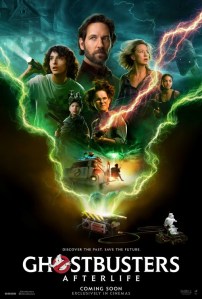
As I stated in my review for the 2016 Ghostbusters, allow me to wax nostalgic and explain my own private history with the franchise: “Growing up in the 80s, other kids had Transformers, or G.I. Joe, or He-Man, but I was a Ghostbusters kid. I fell in love with the 1984 original movie, slept below the poster for most of my childhood, and obsessively collected all of the action figures and toys, watched with glee the animated TV series, and hold the world and its characters in a special personal place.” This franchise means something to me. I think about the hours I spent playing in this world and my imagination and my own stories illustrated with marker and crayon, and it makes me extremely happy as well as reminds me how I fell in love with weird storytelling and macabre, ironic humor. I’ve been waiting for more Ghostbusters movies for my adult life. The 2016 movie was fine, I wasn’t enraged by it in the slightest, but it didn’t scratch that itch. While replicating some of the same plot beats, the 2016 movie was not reverent to its source material. Now the 2021 Ghostbusters, delayed over a year and a half from COVID, goes completely in the other direction. Ghostbusters: Afterlife is reverent to a fault, and while it has been met with mixed reviews and complaints of overdosing on slavish fan nostalgia, I found it to be a charming and fun family adventure that left me laughing, cheering, and even crying.
Egon Spangler (Harold Ramis, R.I.P.), original Ghostbuster, is dead, killed by a malevolent spirit. His estranged adult daughter, Callie (Carrie Coon), and her two teen children, Trevor (Finn Wolfhard) and Phoebe (Mackenna Grace), are shocked to learn of his death and their unexpected inheritance: a dirt farm in small-town nowheresville Oklahoma. They don’t know much about their grandfather and the kids are not exactly excited about relocating to a secluded mining town. Phoebe starts discovering weird pieces of technology hidden in the old house of her grandfather’s. A presence seems to be reaching out and trying to get the family to understand their real legacy. It appears that Gozer the Gozerian was not fully defeated on top of that New York City skyscraper in 1984, and Phoebe and her family must learn about the past in order to make sure we all have a future.

I can understand the charges of Afterlife being too nostalgic, but I don’t understand the charges of it being so enamored with its past that it poses a disservice to the movie standing on its own. This movie is intended at its very DNA to live within the shadow of the original films. The director and co-writer, Jason Reitman, is the son of the original films’ director, Ivan. It’s going to be reverent but that’s not an automatic bad thing. Whereas the 2016 reboot shrugged at past convention and went completely comedic, this edition takes the opposite approach, hugging onto the lore and past of Ghostbusters with heartfelt affection. If you’re a fan of the franchise, this adoring approach will likely be more favorable, not that the 2016 film is wrong for eschewing the established canon of the franchise and trying something new. If Afterlife had been a completely original story set in a Ghostbusters universe, I would have happily accepted that. However, just because something is outwardly nostalgic, or taps into fan service, does not mean it is destined to be an exclusive retread that only satisfies the hardcore base. I didn’t need the gratuitous Easter eggs of passing shots of a twinkie or Crunch bar, but they’re blink-and-you’ll-miss-them moments that don’t really relate to anything of consequence, so I can excuse them. Afterlife is similar to The Force Awakens in that it uses familiar plot beats to mirror events of its predecessors to ease back fans and new members to the fanclub, most especially in Act Three where Gozer’s demonic pooches are unleashed. I can understand many chaffing at this, but I feel that Afterlife does enough to justify its own creative existence even in facsimile rather than as some insular, facile, fan-stroking cash-grab.
This is, by far, the most dramatic of the Ghostbusters movies, a series that has existed in the realm of comedy. The prior movies were never spooky on adult terms, but they reached back into a primal, childlike curiosity and anxiousness over the unknown that made them creepy when they wanted to be. I don’t understand the umbrage some have expressed over Afterlife being more of a drama. First, the comedy is present throughout the movie with the characters making specific and wry observations that feel fitting for their situation. The humor is not as forced as the loping line-a-rama improv jazz riffs of Paul Feig’s 2016 film. I think this universe can sustain different kinds of stories being told, and I think that drama is perfectly acceptable as long as it’s earned, just like the comedy or horror elements. The central premise involves an estranged family coming to know the secret life of an absentee relative who abandoned them, so the more they learn about his Ghostbusting past and responsibilities, the closer they come to uncovering a clearer picture of who this man really was as well as their connections to him. Reitman and co-screenwriter Gil Kenan (Monster House) have smartly connected the investigation of the past into the development of personal relationships. We in the audience know the significance of the Ecto One and the ghost traps, but the new characters do not. We await them to understand the knowledge we already attain, but the movie doesn’t play this as characters dawdling. Each discovery unlocks new potential for the characters to shape who they choose to be, and each one gets them closer to their grandfather and reshaping their conception of the man who they wrongfully believed abandoned them for folly.
This all leads to a climax that had me genuinely in tears. I won’t exactly spoil it but Afterlife’s conclusion is less concerned with beating the Big Bad Gozer yet again and saving the universe. Reitman and company have smartly placed the real climax as an emotional catharsis; it’s more in keeping with Field of Dreams than some huge Marvel apocalyptic showdown. The ending is personal, emotional, and reaches into our universal desire for closure, for having that one last moment with a beloved who we no longer have any moments left to share, Reitman is clearly missing Ramis, a close family friend and inspiration who died in 2014, and this is his own way of processing his personal grief, offering an emotional output for the fans to share in, and allowing a grieving character/surrogate to find that needed release. It serves as a fitting conclusion and a special end note for any Ghostbusters fan who has held this franchise close to their heart for several decades, especially if shared with a paternal figure who may be gone.
The film also successfully channels a childhood perspective of awkward and awesome. It’s hard to create a story where a group of precocious adolescents discover strange things cooking in their sleepy small town without suggesting Stephen King and Stranger Things, but this isn’t necessarily a total negative. The earlier movies were always from a more cynical adult perspective. Yes, there were characters like Ray (Dan Ackroyd) and Egon who were true believers, but they were often set up for easy laughs. The tone of the series was mostly tied to the irony of the character of Peter Venkman (Bill Murray) that looked at the supernatural with droll detachment. This is the first Ghostbusters entry where the primary perspective is from children, and there’s something hopeful and heartfelt about a younger point of view with the supernatural material. These kids are excited and eager to learn more about the somethings strange in their neighborhood. It becomes endearing to ride along with them as they get to jump into the action. I loved the concept of a sidecar gunner seat for the Ecto One and how it felt like a childhood dream coming true. But it’s more than fan service because it serves as a point of progression for Phoebe’s sense of self, of embracing her scientific interests and roots, and taking charge in the face of unknown danger. It’s a coming out of sorts. When the kids are driving through (the always empty?) town and chasing a runaway ghost, wrecking storefronts from the boom of the proton pack, it’s a blast for them and us.

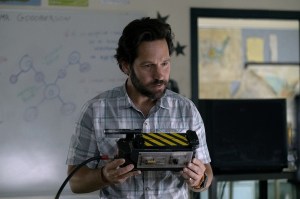
This is Reitman’s most commercial and mainstream film of his Oscar-nominated career. It’s interesting to me that this indie darling, who was on such a hot streak in the late 2000s, hit some speed bumps with the critical misfires of 2013’s Labor Day, 2014’s Men, Women, and Children, and 2018’s The Front Runner, so the next movie is a retreat to a big-budget franchise film. Reitman doesn’t necessarily have the best feel for large-scale spectacle, but he knows intimate character dramas and guides his actors well. Grace (Gifted, Haunting of Hill House) is wonderful as our plucky lead. Unfortunately for Wolfhard (It, Stranger Things), his dull character has nothing to do but pine for a local girl, scoff at his family, and then fix up the old ghostbustin’ mobile. Paul Rudd (Ant-Man) is as charming as ever as the school science teacher, especially as he nerds out over interacting with the Ghostbusters paraphernalia like an excitable fanboy living out his childhood dream. I wish Coon (The Leftovers) had more to do, but that’s my primary complaint in any movie where Carrie Coon is a supporting actress. Her chemistry with Rudd is strong and they could have done so much more together as adults trying to make sense of madness. They could have eliminated Wolfhard’s mopey older brother character entirely and given us more time with the goofy adults too. One feels like there is some secret contract where anything relating to 80s nostalgia requires the hiring of Wolfhard on hand.
Ghostbusters: Afterlife will not be the best movie of 2021. There are areas that could have been improved and streamlined and better developed. However, Ghostbusters: Afterlife will most assuredly be my favorite film experience of 2021. It’s a heart-warming continuation for fans with enough wit and whimsy to charm while owning its obvious and intended connections to the original. I may not be the most objective source on this particular matter, but I know what I like, and this movie had moments of pure happiness that just shot right through to my dopamine center. We’ll see if this movie can restart the dormant franchise, and strike more on its own, but even if this lone 2021 entry is all that we eventually get, I’m happy I got to experience this magic once again. I can’t wait to see it again with my dad.
Nate’s Grade: B+
Share this:

Clifford the Big Red Dog (2021)
 What can one expect from the 80-minute live-action feature film of a children’s book series that was about a giant red dog? While ostensibly made for little kids, like those strictly under ten, Clifford the Big Red Dog (not to be confused with the equally alarming Clifford) is banal entertainment that’s inoffensive as long as you don’t have a deep personal attachment to the best-selling source material. It’s your standard children’s fantasy come alive with a giant dog that needs to be cared for as well as kept a secret. There are rambunctious moments of quelling the dog, mischievous moments of chasing the dog, and frantic moments of running away from a gene-splicing tech guru (Tony Hale). And oh, you bet there is scatological humor. We got dog farts. We got dog butt humor. We got dog pee. We got dog poop, at least in reference though thankfully never seen. I don’t know why we needed an added story of a little girl struggling to fit in at middle school with preppy, mean girls. I guess because a big red dog is also struggling to fit in? For that matter, the movie never returns to the opening scene of Clifford’s dog family being taken from him (a baffling and sad opening). There’s a more charming, heartfelt movie somewhere in here, akin to a Paddington where the central character changes those around them for the better, but our little New York City neighborhood is strictly in a more plastic and safe world. There are a few jokes that slipped past and made me laugh, so it’s not all a loss. Clifford doesn’t pretend to be anything more or less than its meagerly stated goals, and it’s a serviceable family film as long as your little ones have a low threshold for realistic-looking CGI dogs.
Nate’s Grade: C, for Clifford
Share this:

The French Dispatch (2021)
 Wes Anderson’s latest quirk-fest is his usual cavalcade of straight-laced absurdity, exquisite dollhouse-level production design, famous faces popping in for droll deadpans, and the overall air of not fully getting it. The French Dispatch is structured like you’re watching the issue of a news magazine come to visual life, meaning that the two-hour movie is comprised of mainly three lengthy vignettes and a couple of short asides. This narrative decision limits the emotional involvement and I found myself growing restless with each of the three segments. I was amused throughout but each felt like a short film that had been pushed beyond its breaking point. Perhaps that is Anderson’s wry, subtle point considering the entire journalistic voice of the movie feels like somebody made a movie in the style of one of those esoteric, supposedly “funny” New Yorker cartoons. It’s occasionally so arch and droll that it feels too removed from actual comedy. This is not the most accessible Anderson movie for a newbie; it’s very bourgeois in the kinds of people it follows, the stories it pursues, and the intellectual and political conflicts it demonstrates. The first and best segment follows Tilda Swinton discussing a heralded but imprisoned experimental artist (Benicio del Toro) who is dealing with the pressure to produce. The second segment follows Frances McDormand as she investigates a Parisian student union revolting against the ignorant powers that be. The third segment follows Jeffrey Wright recounting an assignment where he investigated a master police chef (not “chief”) and gets in the middle of a wacky hostage negotiation. Each of them has the requisite charm and random asides we’ve come to expect from Anderson, including a leotard-wearing strongman that is called upon by the police to help during the hostage crisis, but it felt more like a collection of overlong short films than a cohesive whole. If you’re already a fan, by all means, step into The French Dispatch. If you’re new to the idiosyncratic world of indie film’s most precise curator, then I’d advise starting with a more digestible and earlier Anderson entry. I enjoyed myself during stretches, was getting frustrated during other stretches, and I hope Anderson focuses more on the big picture of his next picture.
Nate’s Grade: C+
Share this:

Everybody’s Talking About Jamie (2021)
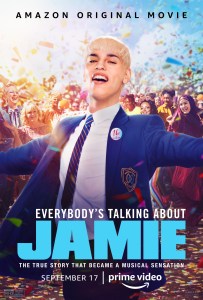 What a jubilant, heartwarming, and celebratory musical to lift up your spirits and evoke a few happy tears, especially in the wake of trying to comprehend the mystifying ongoing appeal of another high-profile musical, Dear Evan Hansen. I wish every person chose to watch this Amazon Prime original movie versus that other musical that made me deeply uncomfortable and angry. This is based on the London stage show, and adapted and directed by the original creators, we follow the true-story of a 16-year-old Jamie (Max Harwood) who dreams of embracing his inner drag queen. His conservative father (Ralph Ineson) doesn’t approve and has left him and his working-class mum (Sarah Lancashire) behind to start a new family. Jamie is working on finding his voice and confidence. He comes under the tutelage of an aging former drag queen (Richard E. Grant) who encouraged and educates Jamie in the ways of showbiz and style (“A boy in a dress is someone that can be laughed at, but a drag queen is someone to be feared!”). Right away, I felt like this was what The Prom was aiming for, a big LGBTQ+ musical bursting with empathetic feeling and anthemic empowerment. The musical numbers are fun and frothy when they want to be, taking playful advantage of the expanded visual space of film. However, when the film wants you to feel emotions, it can hit you hard, and I was tearing up as Grant’s character poignantly sings about the heyday of 80/90s drag scene with the AIDS crisis taking its tragic toll. I don’t mean to keep harping on this, but I felt more genuine emotion in that one moment than throughout the entirety of Dear Evan Hansen. The movie is more considerate with its supporting players and finds moments of grace and compassion for just about every player, and with thrumming harmonies and feel-good lyrics. It’s a charming, funny, and definitely worth remembering. Everybody should be talking about Everybody’s Talking About Jamie.
Nate’s Grade: B+
Share this:

Cinderella (2021)
 Do we need another rendition of good ole’ Cinderella, especially only a few years after the Disney live-action version? The new Cinderella starring pop star Camila Cabello is a surprise jukebox musical, and it’s irreverent where it should be and progressive where social critiques are warranted with the source and historical context. In short, it’s a fleeting but fun experience that’s a winning 100 minutes for families with young children and adults who enjoy a peppy, self-referential musical. Written and directed by Kay Cannon (Pitch Perfect), this movie is packed with singing and dancing to the point that the talking only makes up perhaps twenty percent of the movie. This choice proves to be a durable source of energy and keeps the pacing running smooth. It’s also convenient because we don’t need extra time explaining the setup and character dynamics that we’re all so familiar with at this point thanks to the umpteenth renditions. The mash-up of popular songs kept me amused and guessing what would appear next, and the original songs contributed by Cabello have a nice soaring uplift to them as well as memorable hooks. There’s a “What a Man”/”Seven Nation Army” mashup at a ball that gave me strong Moulin Rouge vibes, especially with all that chaotic sashaying petticoat editing. The movie is also funnier than I expected, with consistent wise-cracking and one-liners that had me laughing and critiques about the patriarchal system from a progressive, feminist perspective. The evil stepmother, played by Idina Menzel (Frozen), is even given her own song detailing her tragic history of being a musical prodigy who had to give it all up in a society that only valued her as marriage material. Even she gets consideration and empathy. The winking feminist criticisms won’t be new to anyone over the age of twelve, but it’s still welcomed even as the film skates over the discordant plot elements to keep things light. The film delivers some bon mots of political thought to go along with its sugary sweetness of a contemporary sing-a-long musical that is easy to digest. Cabello has a natural charisma to her and is surprisingly adept with comedy, able to turn on a dime and deliver a hilarious self-effacing remark. She’s far better at acting than you might believe. If you have no interest in another version of Cinderella, I understand the fatigue with the property. However, this Cinderella understands your fatigue, provides something light and airy, with actors who seem to be legitimately having fun, and it’s got a consistent feminist perspective that chides the prevalent problems with the source material. It works as a family film and even as a diverting jukebox musical for adults whose tastes run a little sweet and a little tart.
Nate’s Grade: B
Share this:

He’s All That (2021)
 I’m sure there aren’t too many who consider 1999’s She’s All That a great film, or even a great high school comedy film, but I know there are fans and I know nobody was clamoring for a Netflix gender-swap remake starring one of Tik Tok’s most famous users. We didn’t need the original but it was a mildly amusing version of My Fair Lady, or its older inspiration Pygmalion, set in the superficial class system of an American education system. It came out during the heyday of 90s teen cinema remaking older literary concepts (Ten Things I Hate About You) and made short-lived careers for stars Freddie Prinze Jr. and Rachel Leigh Cook. My amazement is Netflix rehiring the same writer, R. Lee Fleming Jr., now 50-something, and asking him to remake his twenty-year-old hit for the voice of Generation Z (It’s not even like “all that” has held up in slang parlance). This movie feels every bit the dismal corporate-sponsored, cash-grabbing, star vehicle that it is. Nobody in Generation Z cared about She’s All That, and now very few will really care about He’s All That.
This time we follow Padgett Sawyer played by Tik Tok star Addison Rae (83 million followers in real life!). Padgett is a high school senior who has millions of online followers who hang onto her every word of advice. She uses her position as an influencer to even help pay the bills at home to relieve her overworked mom (Rachel Leigh Cook, not the same character) and maybe pay for her college. She live streams catching her boyfriend cheating, loses her cool, and becomes a meme thanks to an unfortunately timed snot bubble. Now she has to earn back those lost followers and her respect or else she might not still maintain her ascendant social media standing and pay for school. Her catty friend challenges her to makeover a loser guy at school and the hopeless case ends up being Cameron Kweller (Tanner Buchanan), a sarcastic, arty loner who wears a beanie and has long hair (a wig) and rides horses and practices karate. What a loser. She buddies up to Cameron and through that friendship she starts to question her own sense of self and learns what’s really important as she physically changes this guy to be more acceptable to a mainstream opinion of people she’ll never meet in real life. Or something like that.
 The inordinate influence of social media is a very worthwhile avenue to explore for modern satire as a means of separating this He’s All That from its predecessor and making it relevant. The problem with He’s All That is that the movie refuses to go very deep or hard-hitting with this topic because it’s also meant to be a vehicle for fame to launch the feature acting career of Rae. I’ll fully admit, dear reader, that I had no idea who Rae was until watching this movie and I don’t really get the appeal (more on her acting ability later). In this movie, Padgett is obsessed with maintaining her carefully curated online image, a ruse that relies upon a fantasy that no human being could adequately maintain. She wakes up and goes through an entire routine of makeup and hair styling before she records herself “just waking up.” It reminded me of a joke from the fabulous TV series The Marvelous Mrs. Maisel where the title character makes sure her husband never fully sees her in the morning how she actually looks. It was funny then because it commented on the pressure of wives in the 1950s, let alone those from Jewish families, to live up to an impossible beauty standard to appeal to the man’s comforts and desires. With He’s All That, it really becomes the last joke at the expense of our main character. The movie is too afraid to delve any deeper for fear of directing negative attention toward its star and her influencer ilk. It even conveniently sets up the good of her position, what with her able to pay some bills. She can’t be all bad, you’ll say, because she’s helping her mom. I guess we like social media facades now.
Padgett’s plight really doesn’t make much sense in the context of the movie. She’s dropped perhaps a fifth of her many followers after the embarrassment of her public breakup with her louche of a boyfriend, a wannabe recording artist. First off, I don’t know why this personal incident would be so detrimental to her character. Her boyfriend was clearly bad, she stood up for herself, and I would think that would only make people like her more and draw more followers to her brand. The only reason she has to worry is because we’ve awkwardly included Kourtney Kardashian and an even bigger social media influencer. I don’t know why we have a Kardashian here, and I don’t know why she doesn’t merely play herself, unless that too would be another example of striking too close to home with the satirical depictions. Regardless, Padgett is worried she’ll have to, gasp, potentially take out student loans for college. She believes that picking someone to grant a makeover would get back lost followers, which makes some sense, but then her friend also elects to make a personal bet about selecting some campus schlub and turning them into a heartthrob. Why does our main character need two motivating forces for why she agrees to participate in this bet? It’s needlessly extra for a movie with so little else going on.
 Another fault is that there is no chemistry between our leads, which kills the investment in any romantic comedy. The two actors are not a good fit from the beginning, and this comes down to two factors, the underwritten characterization and the limited acting ability of Rae. It was a joke in Not Another Teen Movie, a not-so-great spoof over those popular 90s/early 2000s teen comedies, that the thing separating the obviously beautiful girl from “plain Jane” territory was merely glasses and a ponytail. Cameron is already an appealing guy so when he gets his big physical transformation it’s really just scrubbing off stubble dust and removing the beanie. His character, a self-described outsider, would be unlikely to be seduced by the wiles of popularity. There’s also precious little to be uncovered with the character of Padgett, so the movie can’t even have Cameron fall for Padgett as he realizes she isn’t like his preconceived notions. There’s no heat or sizzle or any point of intrigue between these two that would compel an audience to root for their eventual coupling. Cameron, we’re told, like “Kurosawa, Kubrick, and kung-fu movies,” and he’s basically the gender reverse of a shallow rendition of a manic pixie dream girl who is ultimately just there to get the protagonist to stop and appreciate life and then sublimate their own interests and desires to that of the protagonist. This is a romance where you root for irrevocable heartbreak.
Rae might be an overall pleasant presence but she’s not quite there in the acting department yet. Her limited range really dampers many of the dramatic moments. Her line readings are extremely monotone. There are moments where I thought she was just going to smile her way through a scene. There were several scenes where I was convinced they could only have filmed two takes because this had to be the best one by default. I don’t want to pile on Rae. I don’t know the woman and she’s only twenty years old and this is only one role. Except He’s All That has also clearly been tailored for her and she cannot live up to these standards at this time. There’s an egregiously long dance battle at the prom that goes on forever just to take advantage of Rae’s dance skills from her Tik Tok dances. It’s the same kind of contortion done to make room for Buchanan’s (Cobra Kai) martial arts skills with a silly fight with Padgett’s ex-boyfriend.
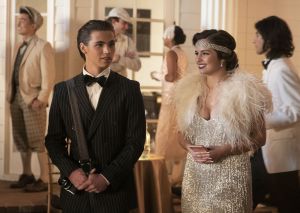 If I was overly cynical, I would estimate that the producers of He’s All That sought an older IP that might still have some pull with an older audience that could be stripped down to its parts and slapped together with a formula that could platform its young stars while also barely hitting that 80-minute feature running time requirement. Except that sounds exactly like what’s happened with He’s All That as well as the preponderance of product placement. This entire movie is a cynical enterprise. It’s not funny at all. It feels completely inauthentic with its portrayal of modern teenagers and social media lifestyles and even the appeal provided by a social media following of fans giving instant validation to every coordinated effort to be your phony best self. The director is Mark Waters, a man who helmed Mean Girls, the 2003 Freaky Friday, and the dark indie comedy The House of Yes. He has talent. He knows how to shoot a comedy. He knows that not every scene needs to be overly lit like night and shadow have no meaning and it all looks so cheap. While watching He’s All That, you’re left with the strong impression that everyone should know better, and you should know better than spending 80 tepid minutes of your time watching this cynical exercise.
Nate’s Grade: D


 nathanzoebl
You must be logged in to post a comment.