Blog Archives
Drive-Away Dolls (2024)
 Drive-Away Dolls is an interesting curiosity, not just for what it is but also for what it is not. It’s the first movie directed solo by Ethan Coen, best known as one half of the prolific filmmaking Coen Brothers, who have ushered in weird and vibrant masterpieces across several genres. After 2018’s The Ballad of Buster Scruggs, their last collaboration, the brothers decided to set out on their own for an unspecified amount of time. This led Joel Coen to direct 2021’s atmospheric adaptation of Macbeth, and now Ethan has decided that the fictional movie he really wants to make, unshackled by his brother, is a crass lesbian exploitation sex comedy. Well all right then.
Set in 1999 for some reason, Jamie (Margaret Qualley) is an out lesbian who unabashedly seeks out her own pleasures, even if it brings about the end of her personal relationships. Her friend, Marian (Geraldine Viswanathan), hasn’t had a lover in over three years and is much more prim and proper. Together, these gal pals decide to drive to Tallahassee, Florida using a drive-away service, where they will be paid to drive one way, transporting a used car. It just so happens that these women have mistakenly been given the wrong car, a vehicle intended for a group of criminals transporting contraband that they don’t want exposed. Jamie is determined to get laid and help Marian get laid all the while goons (Joey Slotnick, C.J. Wilson) are trailing behind to nab the ladies before they discover the valuable contents inside the trunk of their car.
 Drive-Away Dolls is clearly an homage to campy 1970s exploitation B-movies but without much more ambition than making a loosey-goosey vulgar comedy consumed by the primal pursuit of sexual pleasure. I was genuinely surprised just how radiantly horny this movie comes across, with every scene built in some way upon women kissing, women having sex, women talking about having sex, women pleasuring themselves, women talking about pleasuring themselves, and women talking about pleasuring other women. When I mean every scene I mean virtually every scene in this movie, as the thinnest wisp of a road trip plot is barely holding together these scenes. From a representational standpoint, why shouldn’t lesbians have a raunchy sex comedy that is so open about these topics and demonstrates them without shame? Except it feels like the crude subject matter is doing all the heavy lifting to make up for the creative shortcomings elsewhere in the movie, which, sadly there are many. The script is co-written by Coen and his wife of many years, Tricia Cooke, an out lesbian, so it feels like the intent is to normalize sex comedy tropes for queer women, but the whole movie still feels overwhelming in the male gaze in its depictions of feminine sexuality. I’m all for a sex-positive lesbian road trip adventure, but much of the script hinges upon the uptight one learning to love sex, which means much of the story is dependent upon the promiscuous one trying to then bed her longtime friend and get her off. Rather than feel like some inevitability, the natural conclusion of a friendship that always had a little something more under the surface, it feels more like a horny and calculated math equation (“If you have two gay female leads, you can get them both kissing women by having them kiss each other”).
I’m sad to report that Drive-Away Dolls is aggressively unfunny and yet it tries so hard. It’s the kind of manic, desperate energy of an improv performer following an impulse that was a mistake but you are now watching the careening descent into awkward cringe and helpless to stop. The movie is so committed to its hyper-sexual goofball cartoon of a world, but rarely does any of it come across as funny or diverting. When Jamie’s ex-girlfriend Suki (Beanie Feldstein) is trying to remove a dildo drilled onto her wall, she screams in tears, “I’m not keeping it if we both aren’t going to use it.” The visual alone, an ex in tears removing all the sexual accoutrements of her previous relationship, some of which can be widely over-the-top, could be funny itself. However, when her reasoning is that we both can’t use this any longer, then the line serves less as a joke and more a visual cue for the audience to think about both of them taking turns. It doesn’t so much work at being funny first and rather as a horny reminder of women being sexual together. The same with a college soccer team’s sleepover that literally involves a basement make-out party with a timer going off and swapping partners. It’s not ever funny but features plenty of women making out with one another to satisfy some audience urges. I will admit it serves a plot purpose of first aligning Jamie and Marian into awkwardly kissing one another, thus sparking carnal stirrings within them.
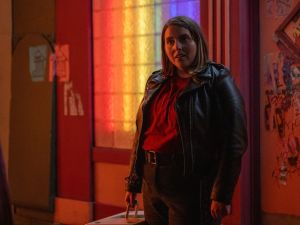 My nagging issue with the movie’s emphasis is not a puritanical response to vulgar comedy but that this movie lacks a necessary cleverness. It doesn’t really even work as dumb comedy, although there are moments that come close, like the absurd multiple-corkscrew murder that opens the movie. It’s just kind of exaggerated nonsense without having the finesse to steer this hyper-sexual world of comedy oddballs. The crime elements clash with the low-stakes comedy noodling of our leads bumbling their way through situation after situation that invariably leads to one of them undressing or inserting something somewhere. The brazen empowerment of women seeking out pleasure is a fine starting point for the movie, but the characters are too weakly written as an Odd Couple match that meets in the middle, the uptight one learning to loosen up and the irresponsible one learning to be less selfish. The goons chasing them are a pale imitation of other famous Coen tough guys; they lack funny personality quirks to broaden them out. There’s a conspiracy exposing political hypocrites condemning the “gay agenda,” and I wish more of this was satirized rather than a briefcase full of reportedly famous phalluses. If you got a briefcase full of famous appendages, I was expecting more jokes than blunt objects.
I feel for the actors, so eager to be part of a Coen movie, even if it’s only one of them and even if it’s something much much lesser. Qualley (Once Upon a Time… in Hollywood) is a typical Coen cartoon of a character, complete with peculiar accent and syntax. She’s going for broke with this performance but the material, time and again, requires so little other than being exaggerated and horny. There is one scene where her physical movements are so broad, so heightened to the point of strain, that I felt an outpouring of pity for her. It feels like a performance of sheer energetic force lacking proper direction. Viswanathan has been so good in other comedies and she’s given so little to do here other than playing the straight women (no pun intended) to Qualley’s twangy cartoon. Her portrayal of sexual coming of age and empowerment was better realized, and funnier, in 2018’s Blockers, a superior sex-positive sex comedy.
 As a solo filmmaker, Ethan Coen seems to confirm that his brother is more the visual stylist of the duo. The movie is awash in neon colors and tight closeups of bug eyes and twangy accents, but the most annoying stylistic feature, by far, is the repeated psychedelic transition shots, these trippy interstitials that don’t really jibe with anything on screen. It felt like padding for an already stretched-thin movie that can barely reach 75 minutes before the end credits kick in. That’s why the extended sequences where the intention seems exploitation elements first and comedy second, or third, or not at all, makes the whole enterprise feel like a pervy curiosity that has its empowering yet obvious message of “girls do it too” as cover. Agreed, but maybe do more with the material beyond showcasing it. Ethan Coen is a prolific writer who has written short story collections (I own his 1998 book Gates of Eden), poetry collections, and he even wrote five one-act plays before the pandemic struck in 2020. I’d love to see those plays. This man has true talent but it’s just not obviously present throughout this film.
Drive-Away Dolls is an irreverent sex comedy with good intentions and bad ideas, or good ideas and bad intentions, an exploitation picture meant to serve as empowerment but still presents its world as exploitation first and last. It’s just not a funny movie, and it’s barely enough to cover a full feature. I suppose one could celebrate its mere existence as an affront to those puritanical forces trying to oppress feminine sexuality, but then you could say the same thing about those 1970s women-in-prison exploitation pictures. It’s a strange movie experience, achingly unfunny, overly mannered, and makes you long for the day that the two Coens will reunite and prove that the two men are better as a united creative force; that’s right, two Coens are better than one.
Nate’s Grade: C-
Share this:

Argylle (2024)
 Knocked around by critics and tagged as the latest excuse for the Death of Filmmaking thanks to its overwhelming budget and general ironic indifference, Argylle is a goofy spy comedy that, while lesser, is an easy watch and would earn regular rotation as a TNT afternoon giant. It’s not trying to be more than a good time, and while its quippy attitude can feel forced and approaching irony overload, it’s also the kind of movie that entertains as breezy escapism. It’s fun. Enough.
Elly Conway (Bryce Dallas Howard) is a best-selling spy novelist with a dashing super spy Lothario lead character by the name of Argylle (Henry Cavill in the worst haircut of his career). She’s journeying with her pet cat, her closest relationship, when she’s stopped on a train by Aidan Wilde (Sam Rockwell). He tells her that he’s a real spy and that everything she’s written in her five novels has come true, and different covert agencies are taking notice. She’s got teams of assassins and spies coming for her, while Aidan tries his best to protect her and get her to remember key details that could save the world from nefarious forces.
 Argylle is too breezy and too predictable by half. It’s a spy thriller that I’m positive many will be able to predict the big twists miles before they occur. Why do all these spies want Elly Conway, and how could she know about the intricate world of international spy craft? The answer is exactly what you’d expect, if you’ve watched more than your share of twist-laden thrillers. Thankfully, director Matthew Vaughn (Kingsman, X-Men: First Class) and company dispatch with this central twist after an hour, providing more time to deal with the aftermath and build off of its story impact. Ah, dear reader, but there’s going to be another twist once you know the first, and again, if you can predict the first, you’re likely to predict the second, because stories about universally good people are often dull, and movies have provided a new medical maxim that characters use maladies to re-evaluate their prior life and choose to be better (oh how nimbly I’m dancing around these spoilers). What makes these predictions forgivable is that the movie seems to know you will anticipate them and has more to offer.
That’s because in this silly universe, very little seems to matter besides getting to the next scene. It’s not a satirical send-up of the genre like Vaughn’s Kingsman movies. Instead, it’s more of a generic distillation of spy thrillers, complete with bad guys walking through mission control banks of computers and barking impotent orders. The only added cleverness that sets the Argylle world apart is Elly’s writing, the fictional version of this far more bland spy universe. In the book parts, Vaughn takes note to raise the style as well as the tongue-in-cheek comedy. It’s supposed to be tone-deaf and dumb and ridiculous, because it’s the big screen version of bad genre writing. You can have fun with that, with characters so serious to the point of parody, with nonsensical technology and near escapes. But when you try to do the same thing in the so-called real world, then the movie starts to eradicate any sense of a baseline for credulity. I did like the practical advice of Aidan on how to crush the skulls of your downed enemy (“Just imagine you’re dancing The Twist.. twist and smash”). By the end of Argylle, Elly and Aidan can do just about anything because they’re practically superheroes. The entertainment of the fish-out-of-water aspect of Elly’s story is short-lived and unfulfilled because the movie becomes more of a tale of automatic self-actualization rather than growth.
 The direction feels rather drab at points, and many locations and scenes have a general sense of missing… something. Just watch any set and it appears so drastically empty that I questioned whether they cut back on the set dressers and props. Empty dance clubs. Empty streets. Empty hallways. Everything is too pristine, too sleek, and too empty and green screened (might be a result of COVID filmmaking). This carries over into the disappointing visual aesthetic, as Vaughn’s signature style feels dampened by the pesky CGI additions of many sequences, adding to the unreality rather than building out this minimalist world. If there had been an extra EXTRA twist that everything was also a story-within-a-spy-story, I would not have been that shocked, and it honestly would have explained the underwritten and underwhelming world of clandestine spy-making.
Vaughn errs in the core creative decision of having his main character mix reality and fantasy, not through the idea itself, which could be ripe, but through its confusing execution and editing. Having Elly hallucinate Agent Argylle in place of a real secret agent is fine, as we can contrast from her idealized version of a super spy, her James Bond, versus the actual grunts struggling to win the day. There are a couple problems with this execution though and firstly that the “reality” isn’t that far removed from the fantasy. This is still a world where Rockwell’s spy is able to commit amazing acts of dexterity and martial arts and balletic violence flying around rooms, but I guess he falls down more. The difference isn’t that fantastic when it’s already a hyper-stylized action world. The bigger issue is just how confusing it all plays out visually because we’re seeing Elly’s perspective and in rapid blinks Cavill will turn into Rockwell and vice versa. It makes for a jarring sequence that doesn’t fully capitalize on the comic potential while keeping the audience distant from fully engaging with the sheer simple pleasures of watching a fun fight. This happens throughout the first half of the movie and severely hampers the action scenes from being accessible. I think we needed a longer duration for this to work. We see Elly’s version for a period of time, and then we cut to the real world where Aidan is bouncing into walls, falling down, and flailing. By continuously jumping back and forth, not just in the scenes but in the same shots, Vaughn has made his movie harder to watch and harder to comprehend, and with a loud soundtrack blaring.
 There is one sequence of great filmmaking for Vaughn, but to explain such will require some spoilers, so beware, dear reader. There are three instances of the whirly-bird dance where a woman is lifted spread-eagle atop a man’s shoulders who then spins her around. The first time, it’s Agent Argylle and Legrange, played by Dua Lipa (Barbie) dripping with sexual energy. The second time is when Elly and Aidan are on a mission and he lifts her up, to her amusement and flirtation. She’s living out her fantasy version, with Rockwell standing in for Cavill and Howard standing in for Dua Lipa. We’ve gone from these stunningly attractive human specimens to people who look more ordinary, including a fuller figured woman engaging in the same sexy shenanigans as the conventional blonde bombshell. She can be her dream version of herself. Finally, the third occurrence happens during a climactic showdown where Elly and Aidan team up against an onslaught of faceless armed henchmen. With the aid of colorful smoke canisters, their offensive surge plays out like a couples’ dance routine, including holding one another for high kicks to incendiary devices. It’s all set to Leona Lewis’ cover of Snow Patrol’s “Run,” and as the music swells, it’s easy to get swept up too. Even the gunshots are set to the beats of the song, culminating in the final whirly-bird dance, except it’s not Elly being lifted, this time it’s Aidan. See, she’s not the Bond girl bombshell, she’s James Bond. It’s a silly moment but with the added setup, thematic underpinnings, and Vaughn’s virtuoso stylistic seizing of the moment, it plays out as empowerment and an expression of love. For real.
I can understand being generally disappointed with Argylle. It looks and feels like it’s been built on the parts of other better spy franchises and desperately lacks the charisma and personality of Vaughn’s Kingsman movies, themselves giddy and perverse satires. I wasn’t the biggest fan of 2017’s The Golden Circle sequel, but it’s got oodles of style to spare compared with Argylle. I wish Vaughn would push himself beyond the orbit of making cheeky, winky spy action comedies, the same genre he’s been playing in since 2015 and now for four movies. While the original Kingsman was a breath of fresh air with fun characters, a snarky attitude, and slick style, Argylle is all snark and minimal style. There’s so much comedy that feels like it should be funnier, from the travails of Elly’s CGI-enchanced cat to the floundering hand-to-hand combat. When recognizable names start showing up playing forgettable genre stock types, and then they start dabbling in accents as other genre stock types, it feels like the whole exercise is a miss. However, the central buddy relationship between Rockwell and Howard is where the movie works, and fortunately that’s the element that has the most foundational effort. This is a movie that, in the future, if it was on TV during a lazy day, you’d sit down and watch the rest and mostly be happy about it. Argylle isn’t anything new or fresh but it’s buoyed by its stars, and not the magazine cover models but its real stars, Rockwell and Howard. In their hands, even lesser spy comedies can still be fairly worthwhile escapist entertainment. Still, I must deduct some points for the movie missing a perfectly setup opportunity to have Henry Cavill and John Cena kiss onscreen at the end. It was right there, folks, and we all deserved it.
Nate’s Grade: C+
Share this:

Dream Scenario (2023)
 Imagine being the most famous person in the world for doing absolutely nothing, where every person can see you every night, each of them feeling like they own a little piece of you. Now imagine that person being a balding, middle-aged father and professor of evolutionary biology, a man so dull that nobody would likely remember him except that he keeps popping up in everyone’s dreams on a nightly basis. The man in question is Paul Matthews (Nicolas Cage), a man so boring that his literal dream is to publish a book on the evolutionary biology of ants. Dream Scenario begins as a sci-fi curiosity and then becomes an intriguing expose on sudden fame as well as the most cogent argument yet on the hazards of a “cancel culture” that too many comedians cling to as an excuse for not being funny. I kept thinking back more and more on the movie, rolling over sequences and choices, as it refused to leave my waking thoughts.
There’s an obvious and easy parallel between what Paul is experiencing and general celebrity, where members of the public have an individual relationship to a person but divorced from the reality of who that person may or may not be, as well as one-sided. These are strangers to Paul but so many feel like they know him, like a neighbor, or a lover, or a threat to someone’s mental stability. It’s an ongoing struggle of rationalizing different perceptions of a person, where so many project what they want onto this smiling bald man who has become a national figure of fascination. Given the premise, I completely understand. I can only fleetingly remember my own dreams maybe once every two weeks, but if a real person, who I’ve never met, continued to make strange cameo appearances, I would definitely investigate further. That’s a genuine mystery that could break through even our jaded media culture. The big question would be why is this happening but the more interesting question is why this guy? What makes him special? I was always engaged with the movie and impressed by the turns the screenplay made, providing insightful glimpses into human nature that felt relatable as well as realistic in response to this phenomenon. Of course there are certain people that view him as some angel, whereas others a devil needing to be stopped, and some an unknown being they’ve projected sexual feelings onto. There’s a very funny and also deeply uncomfortable sequence where a young woman tries to recreate her erotic dream with the real Paul, and of course the real Paul fails to measure up to the fantasy mystique. I was also intrigued by the question of why Paul does not appear in his wife’s dreams. The screenplay by director Kristoffer Borgli is consistently well-developed and full of changes and challenges that had me glued, though I should warn you, dear reader, that you will never be given a concrete reason why the dreams began.
 The first half of the movie is Paul’s ascension, enjoying his notoriety and the new access he has to getting published and achieving his dreams that felt stalled for too long. It’s the positivity of the fame and untapped desire of the general public, with the assorted weirdo from time to time. Then there is a significant turn, and the movie gives a clear theory as to why, and the dreams all of a sudden now become nightmares. Instead of Paul just being in the background of everyone’s dreams, acting as an observer rarely doing much of anything, now he’s become a malevolent force, a stalker, a killer, or worse. Now the general public fears this man and fears going to sleep with the certainty that Paul will be waiting for them to perform any manner of terrors. Paul is placed on sabbatical after his very presence on campus drives students away into hyperventilating. Paul is genuinely pained by this but also painfully annoyed, as he argues he cannot be responsible for the dreams of others and what happens inside every individual subconscious. He hasn’t really done anything in physical reality, and yet he’s kicked out of restaurants, shunned by his colleagues, and his endorsement deals are drying up with the exception of the alt-right.
The premise also allows for plenty of beguiling and funny and creative imagery. Since we’re dealing with a wealth of dreams, this allows the filmmakers a near limitless opportunity to hit whatever themes or oddities they desire under the pretense of retelling a dream. We get the mundane, we get the horrifying, which plays out with some effective jump scares, and we get plenty of surreal moments. This artistic choice allows for an ending that feels ambiguously bittersweet but also tragically fitting and satisfying. It felt exactly how it should have been. It reminded me of Being John Malkovich, and truthfully this movie feels like a lost Charlie Kaufman story. The consumerism satire is also right on target, from Paul’s initial agency meeting trying to get him to endorse Sprite in the dreams of millions, to the application of harnessing people’s dreams to sell products or further one’s social media branding. It feels topical while also a sadly logical extension.
For me, this is the most interesting satirical broadside yet exploring the concept of “cancel culture,” a term often so overblown to the point of being a nonsensical catch-all for consequences. Paul’s sense of grievance is real, but the movie doesn’t present him as a martyr and instead chooses to use this transition, from curiosity to pariah and national nightmare, to better satirize people’s attempts to manipulate their own flailing narratives (see: ukulele apology videos, self-imposed exile for “listening,” late-night Ambien usage, etc.). After Paul has a nightmare of his own, starring himself, he records a manic tear-filled self-pittying apology to appeal to his detractors saying he now too has those “lived experiences” with transparent insincerity, and of course it doesn’t appeal to anyone and he’s even more ridiculed and despised. I enjoy that the movie doesn’t want to dwell in the tragedy or general unfairness of this turn of events with Paul becoming the world’s most hated man. Paul also refuses to accommodate or acknowledge other people’s discomfort, overriding security concerns and repeatedly placing his family and children in uncomfortable if not humiliating positions because dear old dad just refuses to accept mollifying his behavior for their social benefit. Paul was riding high on the ego trips of the unexpected attention and adoration, and occasional starry-eyed groupie, and he’s fighting to regain that same level of credibility and status before he retreats back to being a punchline, an asterisk in history, a trivia answer on a game card.
 Dream Scenario tackles the rise-and-fall of overnight celebrity and sudden fame and adds an intriguing sci-fi spin as well as some arty yet accessible meditation and fun satirical social commentary. It asks us to contemplate the nature of our dreams and how we might behave under this extraordinary scenario, whether as one of the people befuddled by the dreams or the even larger befuddlement of the person appearing in all those millions of dreams. It asks us to reconsider perception, as well as how well others may know us, as well as what we look for with our own dreams. When Paul’s wife (Julianne Nicholson) admits her own fantasy and it involves him wearing an old 80s costume that she found to be surprisingly sexy, he’s a little let down that this is all she has for her dreams, and that to me seems like a fine central theme to ground this movie. It’s easy to go crazy with limitless possibilities, but we often return to what matters most, and that’s often idiosyncratic, personal, and perhaps underwhelming to an outsider who lacks the context and, sorry, lived experiences. Our dreams can help define us but not necessarily as extravagant escapism. It can also be the ordinary, the unusual, the moments and people we just want to revisit a little longer. Now imagine this hijacked, weaponized, and then hacked into ad space, and you have Dream Scenario, a peculiar yet arresting little movie that has lots of intriguing ideas to share.
Nate’s Grade: A-
Share this:

American Fiction (2023)
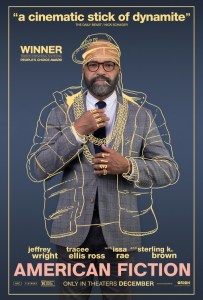
Cord Jefferson’s hilarious, inflammatory, and insightful comic fable can be boiled down to the question of what exactly does it mean to be a “black writer” in this day and age? According to the main character, English professor and middling writer Thelonious “Monk” Ellison (Jeffrey Wright), he would pointedly argue that he is a black writer and thus his novels, never ones to climb a best-seller chart, should qualify as black literature. The publishing industry seems to think differently. Their conception of a “Black story” is one defined through poverty, guns, drugs, gang violence, degradation, and all sorts of depressing stereotypes of socioeconomic disadvantage. If there are stories of triumph, they will usually be relegated to the same familiar settings of struggle: slavery, the Civil Rights era, and modern ghettos. A simple slice-of-life about a middle-class family isn’t necessarily seen with the same level of acceptance. With American Fiction, Jefferson and Monk push through, trying to exploit a system of exploitation at its own game, and the results are biting and hilarious and a condemnation of the low expectations that can govern the supposedly open-minded values of others when it comes to celebrating authentic minority stories.

The movie really takes off once Monk decides to, as a sarcastic lark, give the publishing world what it seems to crave, a novel (My Pafology) that plays into every urban stereotype. He adopts a nome de plume, “Stagg R. Leigh,” and riffs that he’s currently a fugitive from the law. The intention was to make fun of the limited black literary stories that he despises, and yet the incendiary manuscript becomes a hot commodity. They’re already talking about turning it into a movie. Monk is aghast but the money is very appealing, so he puts his moral superiority aside to see how far he’s willing to pander if the check is right. His alter ego is deemed more authentic and compelling when he doesn’t even exist and is only a combination of the same worn-out and destructive stereotypes. It becomes an ongoing game for Monk to see where exactly a line can be drawn. He actively tries to make his manuscript objectively worse, and at every step it only seems to have the opposite reaction among white editors and agents and producers salivating to celebrate it. There’s a very telling scene where Monk is part of a literary award body scouring through manuscripts for potential worthy award-winners. He and another prominent black author (Issa Rae), the best-selling author of We’s Lives in Da Ghetto, are critical of My Pafology and its adherence to harmful stereotypes, but the white liberals won’t hear it and want to reward it. “It’s really important that we listen and uplift black voices,” one of them says obliviously. Of course, if they knew the truth that the author was really an upper middle-class East Coast academic, there wouldn’t be the same rush to elevate this “brave and inspiring” story of the streets. To Monk’s ire and chagrin, there is no bottom when it comes to the appetite for degrading stories that neatly fit into a pre-existing mold.
Jefferson’s screenplay, based upon the 2001 novel Erasure by Percival Everett, is bristling with biting intelligence. This extends beyond the identity crisis of Monk in the world of publishing to his personal life, and the time spent with his fractured family is just as illuminating as the time spent in publishing. Monk’s need for money is driven less from his own desire to live large and more about caring for his ailing mother who needs to be placed in a costly assisted living home as she plunges further into dementia. His shared moments with his mother can be heartbreaking as well as informative. His relationship with his brother, Clifford (Sterling K. Brown), who is embracing his black sheep status as a now openly gay middle-aged man, is a regular point of reflection for both characters who feel their identities are in free fall. Their conversations about being accepted as you fully are help reinforce the major themes mirrored through Monk’s publishing odyssey with his alter ego. The Hollywood satire is best encapsulated by Adam Brody’s shallow movie producer, a good white liberal who is sold on the project after he perceives that Monk leaves their meeting after hearing police sirens. His every appearance is a gift. Not everything in Jefferson’s adaptation feels as exceptionally well integrated. I don’t think the romantic subplot quite works but Jefferson is smart enough to frame that as possibly the larger point, an offshoot that presents an alternative of happiness for our bitter protagonist that he will inevitably decline.

This is also a deserving showcase for Wright (Westworld, The Batman), one of our best character actors who rarely gets the plaudits he deserves. He’s a brilliant actor when it comes to consternation and exasperation, and his unexpected journey of discovery and success allows him to assess how much he’s willing to go along with a deceptive narrative in a ludicrous industry of perception. Wright’s performance is equal parts amusement, like a conman who can’t believe he keeps getting away with his ruse, and head-shaking anger at being marginalized unless he erases the complicated, unique parts of himself.
I also want to celebrate the very ending of American Fiction that goes even harder on industry satire. Jefferson gets extra meta and presents a series of possible endings for Monk’s story, from Monk’s preferred ending that leans more ambiguous and open-ended, to the Hollywood happy ending and other versions, each their own condemnation on the studio system and the larger demands of mass audiences for tidy endings. It’s a level of comic bravado that American Fiction hasn’t really fully channeled until that moment and its absence makes this conclusion, a choose your own adventure of bad endings, hit even harder. He’s been saving his full satirical might until the very end and it was worth it.
Who exactly gets to qualify what constitutes the black experience? Certainly not I, a 41-year-old white guy writing on the Internet. Even though the source material is over twenty years old, the struggles of identity and acceptance and the lens of which we subject others’ experiences through are still relevant in an increasingly hostile cultural environment for different attempts at diversity. American Fiction is hilarious and smart and produces as many thought-provoking questions as solid belly laughs. It’s a cutting satire but with characters that are compelling beyond their connection to larger satirical points. This is more than a message movie, and it’s a statement debut film for Jefferson as a filmmaker and primarily as a storyteller. Jefferson began as a journalist and has worked on several critically-acclaimed TV shows, winning an Emmy for an extraordinary episode of HBO’s Watchmen. He is a talent, and American Fiction is proof that he has a voice and the confidence to carry it through into one of the best films of 2023.
Nate’s Grade: A-
Share this:

Bottoms (2023)

I really wanted to like Bottoms, a sex comedy told from the perspective of a marginalized group literally learning how to defend themselves and develop a sisterhood of support and violence. It’s a high school comedy with two very winning leads, Rachel Sennot (also co-writer) and Ayo Edebiri, and it’s from the same director as Sennot’s breakout 2020 indie, Shiva Baby. It’s just that the comedy is working so hard, the energy level is cranked up so high, but the results tipped more into the realm of obnoxious characters overselling lackluster material. The two main characters create a school fight club under the guise of teaching their fellow female students how to defend themselves, though the real reason is to impress and then sleep with the hot cheerleaders that they’re crushing over. This also leads to them soaking up all the physical tumbles and sweaty wrestling contact with their crushes. The sleaze of the premise feels a little too easily excused in a misplaced “girls can do it too” sentiment. The explosions of real violence, including actual literal bloody deaths, doesn’t feel properly integrated into the tone of this heightened universe. There’s so much aggressive exaggeration that it’s hard to find a baseline here. It almost feels one or two jokes away from a spoof movie. There are no straight characters (not hetero-normative) characters to better play off the stilted silliness. I just don’t think the jokes and callbacks are there. The banter is occasionally amusing but it tapers off too often like an improv jag slowly running out of steam. It’s not a good sign during the end credit blooper reels when the outtakes prove that only one or two actors may actually be skilled at improv, one of them perplexingly retired NFL athlete Marshawn Lynch who is actually quite funny as a laid back teacher learning about feminism. The ensemble is filled with good actors having real fun playing such arch spins on high school movie stereotypes, and I applaud reclaiming the high school sex comedy from a modern lesbian perspective, but unfortunately Bottoms didn’t work up that many genuine laughs from me.
Nate’s Grade: C
Share this:

Fool’s Paradise (2023)
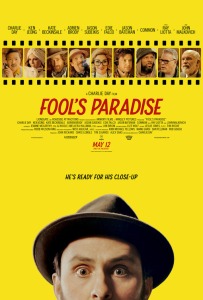 Charlie Day is a very funny guy who works with lots of funny people, so why isn’t his directorial debut, Fool’s Paradise, well, funnier? It’s about a mute simpleton (Day) with the intelligence of a five-year-old, or a Labrador retriever we’re told, who is mistaken for an acting savant. The intended joke is that this industry projects what it wants to see and is full of shallow, insecure, greedy idiots chasing anything that might be popular or career advancing. That’s a fine start but there is a shocking lack of jokes and funny scenarios to be had here, so the 93 minutes just creaks on by in protracted and pained awkward silence. It was a mistake to have Day, a comedian with such a distinct voice and often prone to hilarious outbursts, play a character who doesn’t talk at all. It’s not just that, he kind of shrugs or raises his eyebrows in response, and every time the camera cuts to him for a reaction shot, I was left wondering if this is all the movie had. This passive character, mistakenly named “Latte Pronto” by a director who finds him as a replacement for a prima donna Method actor (also Day), is just a miss. He’s not interesting, and what her reveals about the people around him is even less interesting and just as obvious and tiresome. It’s a movie about non-stop mugging to the camera and hoping to evoke some overly generous pity laughs. It’s attitude over wit. The jaunty score tries hard to make you feel the missing levity from scene to scene. It’s not convincing. The movie is chock full of stars, many of them friends and colleagues that Day has accumulated over a decade in comedy, but nobody has anything funny to do. It’s just all so confounding. Clearly the inspiration owes a debt to 1979’s Being There, a gentle political and social satire where everyone projects what they want to see on one middle-aged gardener raised on TV (I recently watched that movie and felt it was rather dated and quaint). At least that movie had a larger point. There’s just so little to hold onto with Fool’s Paradise, with a boring nothing of a character that never seems to uncover or reveal anything on a tour through Day’s many famous friends. Even the physical comedy is an afterthought. This is no charming Little Tramp. Do yourself a favor and watch any 90 minutes of 2022’s Babylon and you’ll see a funnier and more excoriating satire on Hollywood than the collective shrug that is Fool’s Paradise.
Nate’s Grade: C-
Share this:

Spencer + Penny, Forever (2023)

In the best way, Spencer + Penny feels like a Pixar short, something sweet and subtly profound that then suckerpunches you into a mess of feelings that you didn’t think were possible given the abbreviated length as well as the subject matter. You may ask yourself, “Am I really about to cry over some pencils?” and I’m here to tell you yes, and it’s okay to cry. In just a matter of seconds, this Ohio-made short film gets you to think from a different perspective, that of a mechanical pencil named Spencer (voiced by writer/director Eric Boso), and through that object we will feel all-too familiar human traits. There’s elation at aligning with one’s purpose, but also a melancholy that comes when we feel spent, empty, and rundown, needing to be replenished. Because of Spencer’s unique identity, his lead can be replaced, though this also causes him to feel hollow at times. Then one day he meets a friend, a traditional wooden pencil named Penny (voiced by Samantha Martin). She’s chipper and unflappable in her enthusiasm and optimism, lifting Spencer’s spirits. And then this relationship rapidly changes through a simple and elegant visual means of montage, and all at once this cute film about two pencils, and thematically about mental health, has transformed into one about mortality and legacy. It works so well that I was shocked to be feeling urgent emotions, begging a muted pencil to speak back. That’s quite a creative coup for Boso (Bong of the Living Dead). The short itself is visually lean and clean, given to presenting the story like it was a writing utensil catalog. The sparse visual arrangements further made Spencer + Penny, Forever feel like a children’s storybook come to whimsical life. I enjoyed the emphasis given to erasers and the disappointment we feel at making mistakes but the acknowledgement that mistakes are also a part of life, a big idea but made easily digestible for all ages through the carefully crafted writing style of a bittersweet child’s storybook.
I won’t delve into detailed spoilers but I think the ending concept is fitting but we needed a different path to finally wind up there. It’s sweet but feels like a different story starting, which may well be the point. I also think the metaphysical and eschatological implications are rather large to try and make this work, so I think something more practical with the in-universe setting and a direct connection would have felt like a more appropriate thematic conclusion. Still, it works, I just quibble with the means we reached this ending.

Spencer + Penny, Forever was produced for the 2023 Winterfilm Festival in Ohio and won several awards, including Best Writing, Audience Award, Best Music (the music does have a definite Jon Brion-esque quality of deceptive whimsy that blends into heartache), and Best Film. It’s easy to see the movie as a crowd-pleaser and an unassuming charmer, able to delicately hit weightier themes with cute observational quirk (a.k.a. The Hidden Life of Writing Utensils). It will be entering the festival circuit shortly and I’m sure I won’t be the last person walking away from Spencer and Penny and shaking my head and smiling that an eight-minute short made me think differently about my pen.
Nate’s Grade: B+
Share this:

Love Again (2023)/ Rye Lane (2023)
 Romantic comedies used to be a powerhouse of Hollywood and now it feels like they’ve all disappeared from your local multiplex. Rom-coms gave us industry stars, careers, and household names, the likes of modern rom-com royalty including Nora Ephron, Cameron Crowe, Nancy Myers, and Richard Curtis, and two of which have screenwriting Oscars. It’s a subgenre that is quite often dismissed, usually by condescending men, let’s be honest, as empty-headed maudlin wish-fulfillment. It’s no coincidence that rom-coms are looked at as more of a female-driven genre aimed at a more female-centric audience, so the contemptuous pile-ons from men can often seem like insights into masculine social allowances for empathy. I’ve long been a fan of romantic comedies, even written a few, because they’re just so damn likable. It’s a foundational principle of the genre, to get you to like the characters, their interactions, their courtships. The movie is romancing its audience at the same time the characters are romancing one another, and who doesn’t like to be swooned? Two 2023 rom-coms, Love Again and Rye Lane, showcase directly how appealing and heartwarming and swoon-worthy that excellent rom-coms can prove, and how middling when its genre is taken for granted.
With Love Again, we follow Mira (Priyanka Chopra Jonas) who is mourning the loss of her deceased boyfriend. She continues to send texts to his old phone number explaining the depth of her grief and confused feelings trying to get her life back on track. It just so happens that her dead boyfriend’s old number has been given to the work phone for Rob (Sam Heughan), a journalist who is getting over his own recent heartbreak. He takes a curiosity to this stranger sending him such heartfelt texts, and after meeting her from afar, decides to try to get to know her better, resulting in the two of them romancing but with the Big Awful Dreadful Secret always waiting to be discovered for the unfortunate Act Two break.
 I don’t understand Love Again, like at all. I understand what happened on screen in a literal sense but the reasoning behind it, the storytelling choices, are so bizarre and foreign to me that it feels like a group of aliens who only learned human behavior through the worst direct-to-streaming rom-coms tried their hand at recreating human interactions and falling in love. The very premise seems almost like an afterthought, so why even go through the trouble of this labored conceit? The fact that Rob has been receiving this sad woman’s grief texts could present a real ethical conundrum, beyond the fact that he knows her private thoughts and feelings and he doesn’t even know who she is. The natural angle would be for him to take it upon herself to do small things to make her feel better, maybe from the outside perspective of a secret admirer, a position he never intends to go beyond. The issue becomes when he starts to transition to romance, because now he has a head start that she didn’t even realize was happening. Also, he could make use of the information that she’s been unknowingly feeding him, about favorite foods or interests, to better sweep her off her feet, but that also places us in an ethically dubious scenario of emotional manipulation, akin to what Bill Murray tries to get away with the loops of Groundhog Day. It’s a borderline stalker situation that can easily go too far. The fact that Love Again doesn’t even cover these most obvious plot scenarios makes the entire premise feel perfunctory; it could have been anything that accidentally drew Rob to Mira because it’s so unimaginative and, simply, bad at its own inept storytelling. It’s so baffling and feels like it was made with contempt for its audience, believing that they would accept anything as long as the genre parts were covered, so Love Again’s story is the barest of pained efforts.
Love Again is bad in ways that are despairing while also being mind-numbing. You get a sense early on how little feel for the material the filmmakers have, at how poorly the scenes are at disguising their creaky plot mechanics from the viewer. It’s the kind of movie where a kindly bartender introduces himself and seconds later is all, “I sure feel bad about your dead boyfriend.” It’s that kind of movie, the kind with supportive friends and work colleagues who are only there to provide words of encouragement or set the scene in the most transparent and lazy way, “You know you haven’t been the same since…” to better tee up the audience as far as what is important. All movies do this but the exposition needs to be masked with character details or comedic exploits, and the better to visualize a person’s life.
 This is also the kind of comedy where the jokes amount to the first idea of every scene, where there is never a subversion or even an escalation or a comedic situation. In this world, Nick Jonas makes a cameo as a bad date who is vainly obsessed with bodybuilding and that is the only joke you’ll get with that appearance to the end. It’s the kind of movie where Mira’s “quirk” is asking dates would you rather scenarios that aren’t even raunchy or extreme or even that telling of her own personality. Her other personality trait is that she likes, get this, putting her French fries on her cheeseburger (what a crazy bohemian!). It’s the kind of movie that has Mira as a children’s book author and doesn’t even bother to provide a scene of her demonstrating her storytelling prowess and insight for creating metaphorical-heavy stories to impart important lessons for children. This technique could have been a greater insight into her emotional state without having to rely upon the character just spouting out her feelings. Even worse, the movie doesn’t use her texts to her beloved as a means of getting to know her better. It’s the very premise of this movie, supposedly. These details meant to give the movie its definition, what separates it from the rom-com pack, but what it produces feels so insufficient and haphazard that you wonder if this was a failed genre MadLibs.
It’s also bad that Chopra Jonas (The Citadel) and Heughan (Outlander) have a remarkable lack of chemistry. They’re both good-looking human beings who have previously shown to be quite capable and appealing actors. I do not blame them for the lack of feeling in this movie. They could only do so much with the poorly written characters and the clunky dialogue. Watching them attempt to flirt with this material is like watching two cats try and recreate the H.M.S. Titanic. It’s just not going to work well.
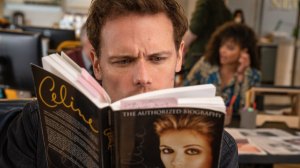 Here’s another example of how poor the filmmakers have developed the elements of their tale. Rob is still mending his broken heart from a fiance that left him a week before their wedding. He is a cynic, although like everything else in this movie, if you push too hard it’s only there as a shallow fixture for story. But if you’re going to make him the cynic, make him believe that love is impossible, it’s a chemical condition of the brain, some delusion, and that this drives his contempt for having to interview Celine Dion, a pop star best known for her soaring ballads about love and sunken ships and hearts going on. He thinks her songs are cheesy and silly, and over the course of the movie, of course he becomes a believer (at least this the movie understands the arc to follow). Again, the most obvious route would be to make him a music critic, someone who decries silly love songs and thinks of them as a destructive drug for the masses. This would make more sense why he’s so irritated at having to cover Dion, and why he would be covering Dion, and it would also make more sense then for his reconsideration. The movie, instead, makes Rob a big fan of… basketball. He loves to watch basketball. Why is this man covering Celine Dion then? If he was going to cover basketball, why not bring his passion for it more into focus, at least as something he can learn from and share with Mira? They share a quick game where she basically says, “I like this game too,” and that’s the rest of this completely underdeveloped characteristic that doesn’t tie back in thematically at all. Again, if you’re going to make this much of Dion’s multiple appearances, including devoting your end credits to having your cast and crew enthusiastically lip sync to her songs, then at least tie her better to your plot.
Ms. Dion doesn’t need me to defend her. She’s a grown woman and can make her own decisions, and I’m sure she was handsomely paid for her contributions in Love Again whose soundtrack features five new songs and six of her past tunes (why not go the jukebox musical route at that volume?), but I need to further explain the awfulness of Love Again’s choices. Late into the movie, Dion discusses her own personal loss, mourning her husband of twenty-plus years who died in 2016. The fact that this real woman is mining her own real tragedy to provide the emotional boost to our bad protagonist in a bad rom-com just feels morally queasy to me. It just feels wrong, especially in the name of such an undeserving character in an undeserving movie for her to have to rehash her own personal grief.
 On the other end of the quality spectrum is Rye Lane, a smaller British indie that follows Dom (David Johnsson) and Yas (Vivian Oparah) through a crazy day and night together across the bounds of South London. She discovers him crying in a toilet stall, a meet-cute so intentionally un-cute. They’re both nursing mixed feelings and unchecked anger over being dumped by their respective exes. Dom discovered his girlfriend cheating on him with his best mate and now he’s scheduled to meet with them both to better clear the air. Yas finally stood up to her neglectful and self-centered sculptor boyfriend but she wants to recollect her favorite record in his flat before she can bid goodbye to him forever. Together, they will help each other through their respective relationship detritus and plot their next steps forward.
What an immensely charming movie Rye Lane is and it’s one that reminds you about the innate pleasure of the rom-com genre when paired with characters we want to get to know better. Thank goodness the screenwriters keenly understand how to develop our protagonists but also make them imminently winning. By establishing both Dom and Yas as reeling from recent breakups, and from such awful people, it makes us want to root for them to regain their sense of composure, dignity, and personal joy. We want them to show up these people who have made them feel so low, and it just so happens that one another will serve as the ultimate and unexpected wingman. I loved it when Yas buddied up next to Dom and pretended to be his very doting and very sexual new paramour as well as press Dom’s former flame on her own cheating ways, shifting the power dynamic. It supercharges the growing friendship between the two of them as well as reconfirm their need to find a partner who can and will go out of their way for them. Watching each of them encourage and aid the other during a time of need and insecurity serves as a reliable provider of satisfaction and a clear path for us to also fall in love with these unique people.
 The writing is so quick-witted and charming that simply listening to these revealing and often hilarious conversations is a pleasure. I’m reminded of Richard Linklater’s famously talkative Before trilogy, another all-in-one-day whirlwind romance of two characters exploring a locale while also exploring one another under a limited period of time. It’s a natural structure because it provides a looming urgency but the drama also unfolds more or less in real time with the characters learning about one another at the same pace that the viewer is, and so our emotions feel better attuned as the characters change their perceptions of one another. This is the joy of rom-coms, finding characters you simply want to spend time with because they’re so charming, interesting, and deserving of finding happiness of their own making. Dom and Yas are wonderful characters separately but the right combination together. He’s more nerdy and awkward and she pushes him to be more assertive and confident. She’s less sure of her worth and sets herself up for sabotage in landing a job she might love, and he refuses to let her let herself down. It’s genuinely amusing and heartwarming to watch these two help one another in their time of need.
Rye Lane is also peppered with playful and, at times, chaotic visuals to goose up the talky proceedings. Debut director Raine Allen-Miller will often use quick inserts and playful visual framing to add more pizazz to the presentation, like when Yas and Dom present their recollection of events like narrators to a stage play of their own lives. It’s lively and fun but occasionally the visual inserts and sound design, or perhaps the score itself, felt like added distractions to the appealing core elements of the movie. It was the only annoyance I felt in such an otherwise funny and charming movie boasting such winning performances. It felt a little unnecessary at times and seemed like the filmmakers had doubts that the material and the performances themselves were enough to sell the entertainment of the movie.
 Romantic comedies remind me of the old saying, “it’s not the singer, it’s the song.” They’re like many other sub-genres of movies and storytelling itself, complete with expectations and formulas and rules and recognizable parts and pieces that add up to, hopefully, entertainment. In this regard, movies are like a meal, and two people can follow the same recipe with the same ingredients and concoct two totally different final creations. Fans of rom-coms are like fans of any other genre, looking for good storytellers to value their time and give them an escape. It’s not just that the familiar elements are included, it’s what is done with them, the care and affection from the storytellers, chiefly creating characters that you can fall in love with and root for their own happiness and fortuitous fortunes.
Love Again is based on the 2016 German film Text For You, itself based on a 2009 German novel (I watched the trailer on YouTube, and it’s weird having actors refer to text messages as “SMS-es”). It’s a reminder of how soulless the worst of these lazy rom-coms can feel when producers look to check boxes to fulfill some list of genre requirements that they think will satisfy the lowest expectations of a gullible fan base they can exploit. Rye Lane is the latest example of the real pleasures of a finely developed rom-com that understands the essential appeal of what makes these movies more than “chick flicks.” Skip Love Again and its ilk and instead feel the pitter-patter of your heart renewed with Rye Lane.
Nate’s Grades:
Love Again: D+
Rye Lane: A-
Share this:

Wonka (2023)
 Was there anyone out there wondering how a young Willy Wonka could have gotten his start as a cutting-edge candy maven? It’s an unnecessary back-story for a kooky character that most will just accept as is. The invented story of Wonka is one of an upstart entrepreneur (Timothee Chalamet) proving a danger to the established corporate oligarchy’s vice-grip on the local confectionery industry. They use the levels of corrupt power to scheme and block Wonka from getting started, but his charms and optimism are just too much, and he wins over the town with his candied delights that provide revelry to the people’s humdrum lives. As a candy-colored musical following an underdog triumphing from the power of friendship and integrity and imagination and good will, it mostly works on a fizzy cloud of its own manufactured whimsy. It’s all highly silly stuff and working very hard to be light-footed and whimsical. There are moments that made me smile and tohers that made me chuckle, like one rich man who gags whenever somebody ever says the word “poor.” The new songs are fairly forgettable except when they’re making you remember the dreamy 1971 numbers. I also think Chalamet (Bones and All) is painfully miscast as our young Wonka. I don’t think his broody-moody acting style works shifting over to manufactured quirk. His performance is just so off from the beginning. Wonka would have been exceedingly better as an original musical without trying to retrofit into the world of Willy Wonka, although that would mean losing Hugh Grant as our first specimen of Oompa Loompa, and he is a droll delight. It’s just weird for a movie to work this hard to tell us how Wonka got his start and to end on uplift when we know in the future he grows up to be a sad middle-aged loner who has to resort to a scam to find a successor, as well as the town becoming an impoverished slum to Wonka’s oppressive factory. My pal Ben Bailey reasoned it would be like a prequel to Death of a Salesman where a younger Willy Loman starts his career as a door-to-door salesman, so chipper and eager to make a name for himself. Wonka is a sugar rush designed as an origin story.
Nate’s Grade: B-
Share this:

Lady Ballers (2023)

Conservative commentator Ben “Debate me!” Shapiro is not the first name you would think of with comedy, at least not intentional humor. His outlet The Daily Wire has begun producing and releasing its own movies, starring the likes of Gina Carano and and Some White Lady as Snow White in their Snow White movie that exists solely because Disney had the temerity to hire a diverse woman to play a fairy tale character. I reviewed 2022’s Shut In, the Daily Wire’s low-budget-friendly contained thriller, and was surprised that much of it worked as a straightforward drama. It’s not enough to get me to watch their school shooting thriller, Run Hide Fight. Next up is one of the worst movies of 2023, Lady Ballers, a sports comedy built upon the idiotic premise that a washed-up high school basketball coach (writer/director Jeremy Boreing) can gather his former male athletes and compete on a newly accepted stage. They will disguise themselves, wearing dresses and wigs though not bothering to shave their beards, and call themselves trans women and waltz to money and glory.
The central joke of Lady Ballers is a mean-spirited perspective deeming trans rights to be little more than a calculated media sideshow of accruing social woke points. To say this movie is transphobic goes without saying and from people who don’t deserve any misspent assumptions of good faith about “starting a dialogue.” In this world, trans people are a confused liberal scam, something that can be solved by kicking a guy who says he thinks he’s a girl in the balls and telling him to get over it. The movie feels like a proverbial kick to the balls for all genders.

Just think about the nature of comedy being one of subversion, of zigging rather than zagging, and the failings of Lady Ballers become even more magnified and odious. The most obvious joke would be these out-of-shape former athletes thinking they could simply throw on dresses and trounce the competition only to find that these women aren’t just good, they’re far better. This would force the characters to reassess their wrong-headed beliefs and learn lessons about being humble, empathetic, and open-minded. But naturally that’s not the worldview that Lady Ballers and The Daily Wire want to reinforce (it’s sad that “empathy” is not a universal goal) because their audience isn’t coming to this movie with a desire to rethink transphobia or gender-based assumptions and general sexism levied against female athletes. They’re coming to have their “anti-woke” feelings coddled and sexist notions soothingly reconfirmed (“Turns out white male of non-exotic sexuality is the only group not being cast by Hollywood these days” – you sure about that?). Because of this starting point, the attempts at comedy don’t really work because it’s forgoing subversion and surprises of the status quo, and continuously punching down, making fun of even recognizing the humanity of trans people or that they simply even exist.
For the reported defenders of women’s sports, the entire premise of Lady Ballers is deeply sexist. The film posits that any man, no matter how out of shape, could competitively destroy a woman in sports. It’s a laughably misguided assertion, bringing to mind a 2019 survey that found 1-in-8 men thought they could win a point in tennis against Serena Williams. The idea that anyone with little experience could contend or even dominate against a female professional athlete who has devoted her life to improving her physical prowess is built on pure misogyny, the notion that men have to be superior to women no matter the context. “Soon all the best women will be men,” says the conniving and morally bankrupt journalist. The filmmakers, and numerous politicians who have become obsessed with policing the genitals of student athletes, style themselves as the defenders of women when they couldn’t care less about women’s sports, and Lady Ballers even makes this very observation as a bad joke, giving the phony advocacy game away. One character responds to the question of what makes a woman a woman with, “They’re just like men, only better. Just shave your legs, tell each other how brave you are for things that require absolutely no physical courage, and don’t be afraid to cry at work.” There’s a montage of the guys attempting all these other sports and instantly dominating all women. Are you sure you don’t actually really despise women, Lady Ballers? That’s what it looks like here. The film’s entire premise is built upon the dumb concept of male superiority regardless of circumstance. You can’t fashion yourself the protector of women while also thinking they must be inherently inferior.

There are so many scattered conservative straw man send-ups that Lady Ballers becomes an unintentionally fascinating profile of what agitates conservative media at the moment, or at least what agitates their easily agitated audience that they’re catering to, whether or not they genuinely believe in the horrors of what they’re stoking and selling. There are jokes about touchy-feely out-of-touch liberals just wanting to resolve matters with hugs. There are jokes about journalists being wholly untrustworthy and callously taking advantage of multiple abortions. There are jokes about evil school teachers indoctrinating students. There are jokes about black teens being untrustworthy criminals who will steal from you. There are jokes about space lasers followed by jokes about Jewish military. There are jokes about considering the MRNA vaccine as part of one’s regular diet, which doesn’t remotely make sense. There are several conservative cameos like Ted Cruz, Matt Walsh, Candace Owens, and even Shapiro himself that will go over most viewer’s heads, as will references to things like Dylan Mulvaney and Riley Gaines, the woman who tragically finished in fifth place in a swim meet instead of fourth because of a trans athlete. Late in the film, the coach comes to see women as being better caregivers and communicators, and while we’re meant to celebrate his widening perspective, it’s still a window into where the conservative audience easily stoked for this movie thinks that the real important values of women lie, namely putting up with men and making them better people.
And yet, despite myself, I could at least recognize a few passing jokes that kind of work on their own, if you can remove the morally repugnant context of the movie’s aims. Early in the movie, as we’re establishing the teammates as high school athletes, two players are fighting and one responds curtly with, “Your mom’s a catch!” to which the other player adds, “She’s your mom too!” In the same scene, the players plead for the coach to inspire them, and he shrugs and says, “I already threw three chairs on the sidelines, pal, I don’t know what else you want from me.” I think I actually chuckled at that line. The ongoing character definition of two players being twins from sharing fathers who shared the same mother at the same time is at least something outlandishly memorable at the expense of its dumb characters rather than a group of people. One character’s psychotic obsession against badgers based upon his high school mascot has some potential and makes for some weird asides that, at least, don’t make fun of trans people. I even kind of like the simplistic sports chant “winners are just losers who win” as a reflexive joke. When the evil yet sexually voracious journalist lady, who has been engaging in an affair with our coach, slaps him hard, she adds the helpful aside, “These are not sexy slaps.” The concluding game involves inviting little girls to take the place of our scheming men, and it’s played as a heartwarming act of valuing sportsmanship, and then the newscasters reveal the little girls lost by 400 points, not because they’re girls but because it was children versus grown adults. It’s as if someone who at least had a passing understanding of some comedy punched up some of these lines and situations, which makes the rest of Lady Ballers that much more embarrassing.

However, is finding tiny slivers of comedic merit a critical fool’s errand considering the despicable worldview and disingenuous intent of Lady Ballers? I’m reminded of all the film historians and academics that praised the technical merits and storytelling methods of Leni Riefenstahl’s anti-semitic “documentary” Triumph of the Will or D.W. Griffith’s Birth of a Nation. Maybe you can objectively analyze Griffith’s use of zooms and cross-cutting and modern storytelling techniques in his 1915 silent era blockbuster, or you could examine the deplorable racism and the fact that the movie served as a rebirth for the KKK’s membership and a new era in segregationist terrorism. It all depends on the individual viewer and their tolerance for overlooking offense, but it’s hard for me to venerate well-designed or executed pieces of a diseased whole. This is not to say Lady Ballers is on the same filmmaking wavelength as Griffith or Riefenstahl; it’s a dumb sports comedy that wishes it was a second-rate Zucker-Abrahams movie. The bar is considerably low, infinitesimally low for this movie considering its target audience and targets, and yet this movie trips over even the mildest of expectations. Lady Ballers only confirms that a comedy made by people who don’t understand comedy can only ever be limited in its funny, especially when its built upon a premise radiating seething ignorance.
Nate’s Grade: D


 nathanzoebl
You must be logged in to post a comment.