Blog Archives
Garden State (2004) [Review Re-View]
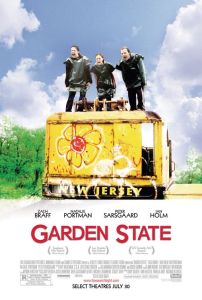 Originally released July 28, 2004:
Zack Braff is best known to most as the lead doc on NBC’s hilarious Scrubs. He has razor-sharp comic timing, a goofy charisma, and a deft gift for physical comedy. So who knew that behind those bushy eyebrows and bushier hair was an aspiring writer/director? Furthermore, who would have known that there was such a talented writer/director? Garden State, Braff’s ode to his home, boasts a big name cast, deafening buzz, and perhaps, the first great steps outward for a new Hollywood voice.
Andrew Large Largeman (Braff) is an out-of-work actor living in an anti-depressant haze in LA. He heads back to his old stomping grounds in New Jersey when he learns that his mother has recently died. Andrew has to reface his psychiatrist father (Ian Holm), the source of his guilt and prescribed numbness. He has forgotten his lithium for his trip, and the consequences allow Andrew to begin to awaken as a human being once more. He meets old friends, including Mark (Peter Sarsgaard), who now digs graves for a living and robs them when he can. He parties at the mansion of a friend made rich by the invention of silent Velcro. Things really get moving when Andrew meets Sam (Natalie Portman), a free spirit who has trouble telling the truth and staying still. Their budding relationship coalesces with Andrews re-connection to friends, family, and the joys life can offer.
 Braff has a natural director’s eye for visuals and how to properly use them to convey his characters’ feelings. A scene where Andrew wears a shirt and blends into the wall is a perfect visual note on the character’s sleep-walk through life. Braff’s writing is also familiar but satisfyingly unusual, like a repackaging of old stories told with a confident voice. His characters are interesting and memorable, but don’t feel uselessly quirky, unlike the creations of other first-time indie writers. The melancholy coming-out of Andrew from disconnected schlub to post-pharmaceutical hero really grabs the audience and gives them a rooting point. At times, though, it seems as though Braff may be caught up trying to craft a movie that speaks to a generation, and some will see Garden State as a generation’s voice of a yearning to feel connected.
Braff deserves a medal for finally coaxing out the actress in Portman. She herself has looked like an overly medicated, numb being in several of her recent films (Star Wars prequels, I’m looking in your direction), but with her plucky, whimsical role in Garden State, Portman proves that her careers acting apex wasn’t in 1994’s The Professional when she was 12. Her winsome performance gives Garden State its spark, and the sincere romance between Sam and Andrew gives it its heart.
Sarsgaard is fast becoming one of the best young character actors out there. After solid efforts in Boys Don’t Cry and Shattered Glass, he shines as a coarse but affectionate grave robber that serves as Andrew’s motivational elbow-in-the-ribs. Only the great Holm seems to disappoint with a rare stilted and vacant performance. This can be mostly blamed on Braff’s underdevelopment of the father role. Even Method Man pops up in a very amusing cameo.
The humor in Garden State truly blossoms. There are several outrageous moments and wonderfully peculiar characters, but their interaction and friction are what provide the biggest laughs. So while Braff may shoehorn in a frisky seeing-eye canine, a knight of the breakfast table, and a keeper of an ark, the audience gets its real chuckles from the characters and not the bizarre scenarios. Garden State has several wonderfully hilarious moments, and its sharp sense of humor directly attributes to its high entertainment value. The film also has some insightful looks at family life, guilt, romance, human connection, and acceptance. Garden State can cut close like a surgeon but it’s the surprisingly elegant tenderness that will resonate most with a crowd.
 Braff’s film has a careful selection of low-key, highly emotional tunes by artists like The Shins, Coldplay, Zero 7, and Paul Simon. The closing song, the airy Let Go by Frou Frou, has been a staple on my playlist after I heard it used in the commercials.
Garden State is not a flawless first entry for Braff. It really is more a string of amusing anecdotes than an actual plot. The film’s aloof charm seems to be intended to cover over the cracks in its narrative. Braff’s film never ceases to be amusing, and it does have a warm likeability to it; nevertheless, it also loses some of its visual and emotional insights by the second half. Braff spends too much time on less essential moments, like the all-day trip by Mark that ends in a heavy-handed metaphor with an abyss. The emotional confrontation between father and son feels more like a baby step than a climax. Braff’s characters also talk in a manner that less resembles reality and more resembles snappy, glib movie dialogue. It’s still fun and often funny, but the characters speak more like they’ve been saving up witty one-liners just for the occasion.
Garden State is a movie thats richly comic, sweetly post-adolescent, and defiantly different. Braff reveals himself to be a talent both behind the camera and in front of it, and possesses an every-man quality of humility, observation, and warmth that could soon shoot him to Hollywood’s A-list. His film will speak to many, and its message about experiencing lifes pleasures and pains, as long as you are experiencing life, is uplifting enough that you may leave the theater floating on air. Garden State is a breezy, heartwarming look at New York’s armpit and the spirited inhabitants that call it home. Braff delivers a blast of fresh air during the summer blahs.
Nate’s Grade: B
——————————————————
WRITER REFLECTIONS 20 YEARS LATER
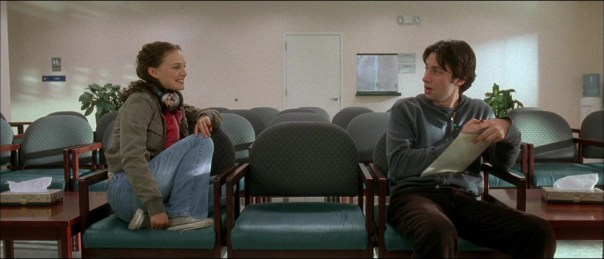
In the summer of 2024, there were two indie movies that defined the next years of your existence. If you were under 18, it was Napoleon Dynamite. If you were between 18 and 30, it was Garden State. Zack Braff’s debut as writer/director became a Millennial staple on DVD shelves, and I think at one time it might have been the law that everyone had to own the popular Grammy-winning soundtrack. It wasn’t just an indie hit, earning $35 million on a minimal budget of $2.5 million; it was a Real Big Deal, with big-hearted young people finding solace in its tale of self-discovery and shaking loose from jaded emotional malaise. If you had to determine a list of the most vital Millennial films, not necessarily on quality but on popularity and connection to the zeitgeist, then Garden State must be included. Twenty years later, it’s another artifact of its time, hard to fully square outside of that influential period. It’s a coming-of-age tale wrapped up in about every quirky indie trope of its era, including a chief example of the Manic Pixie Dream Girl, even though that term was first coined from the AV Club review of 2005’s Elizabethtown. Twenty years later, Garden State still has some warm fuzzies but loses its feels.
 Andrew Largeman (Braff) is a struggling actor in L.A. who returns to his hometown in New Jersey to attend the funeral of his mother. Right there we have the prodigal son formula mixed with the return-to-your-roots formula, wherein the cynical figure needs to learn about the important things they’ve forgotten from the good people they left behind for supposed bigger and better things in the big city. There’s a lot of familiarity with Garden State, both intentionally and unintentionally. It’s meant to evoke the loose, rougher-edged romantic comedies of Hal Ashby and older Woody Allen. It certainly feels more like a series of scenes than a united whole, and that can work in Braff’s favor. His character has gone off his meds for the first time since he was a child, and he’s experiencing a personal reawakening. He’s opening himself up more to the people and possibility of the world, so the movie works more on a thematic level to unify itself rather than strictly from a foundational plot with key turns. If you can connect on that relatable level, then you will likely be able to experience the same whimsy and enchantment that so many felt back in 2004. However, with twenty years of distance, I now see more seams than when I was but a wide-eyed 22-year-old romantic. Andrew is more a reactive symbol, more personified by his hardships or inability to chart a path for himself than by a personality. He’s easily eclipsed by the quirky characters dancing all around him, with Braff smiling ever so wryly at the sweet mysteries of life. This stop-and-smell-the-roses approach was also explored in 2014’s Wish I Was Here, Braff’s directing follow-up that placed him as a family man questioning himself amidst marital malaise. This movie was far less celebrated, I think, because of the thematic redundancy but also because Braff was playing an older character that needed to, kind of, grow up. It was more tolerable when Braff was playing a mid-20s melancholic experiencing his first brush with romantic love. Less so ten years later.
Natalie Portman had been an actress that I was more cool over until 2004 with the double-whammy of Garden State and her Oscar-nominated turn in Closer. She’s since become one of the most exciting actors who goes for broke in her performances whether they might work or not. In 2004, I thought her performance in Garden State was an awakening for her, and in 2024 it now feels so starkly pastiche. Bless her heart, but Portman is just calibrated for the wrong kind of movie. Her energy level is two to three times that of the rest of the movie, and while you can say she’s the spark plug of the film, the jolt meant to shake Andrew awake, her character comes across more as an overwritten cry for help. Sam is even more prototypical Manic Pixie Dream Girl (MPDG) than Kirsten Dunst’s bouncy character in Elizabethtown. Her entire existence is meant to provoke change upon our male character. This in itself is not an unreasonable fault; many characters in numerous stories are meant to represent a character’s emotional state. It’s just that there isn’t much to Sam besides a grab-bag of quirky characteristics: she’s a compulsive liar, though nothing is ever really done with this being a challenge to building lasting bonds; she’s incapable of keeping pets alive, and Andrew could be just another pet; she’s consumed with being unique to the point of having to stand up and blurt out nonsense words to convince herself that nobody in human history has duplicated her recent combination of sounds and body gestures, but she’s all archetype. She exists to push Andrew along on his reawakening, including introducing him and us to The Shins (“This song will change your life”). She’s entertaining, and Portman is charming, but it’s an example of trying so hard. I thought her cheeks must have hurt from holding a smile so long. I’m sure Braff would compare Sam to Annie Hall, as Diane Keaton was perhaps the mold for the MPDG, except she more than stood on her own and didn’t need a nebbish man to complete her.
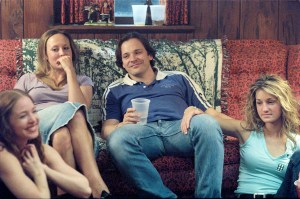 There are some enjoyable moments. It’s funny to watch a young Jim Parsons in a suit of armor eating breakfast cereal and expounding the romance language of Klingon. It’s funny to have a meet-cute in a doctor’s office while Andrew is repeatedly humped by a dog with personal boundary issues. It’s fun to go on a madcap journey around town with your former high school friend-turned-gravedigger that ends up in a sinkhole in a quarry, where characters can literally scream into the void. It’s darkly funny to run into a former classmate who became a cop who is still a screw-up except now he has authority. It’s poignant to listen to Andrew’s story about accidentally paralyzing his mother when he was an angry young child who, in a fit of rage, pushed her, and she hit her head on a faulty dishwasher latch. Given all these elements an overview, it feels like Garden State was Braff’s very loose collection of ideas and stories, jokes and bits collected over the years. It’s entertaining and quirky and silly and occasionally poignant, but it’s never more than the sum of its parts. Garden State wants to be about a man changing his life and perspective, but it’s really more a Wizard of Oz-style journey through the quirky indie backlot of kooky Jersey characters. The scenes with Andrew’s distant father (Ian Holm) feel too removed to have the catharsis desired. He feels like an absent character from the movie, so why should we overly value this father-son reconciliation?
Admittedly, that soundtrack is still a banger. It soars when it needs to, like Imogen Heep’s “Let Go” over the race-back-to-the-girl finale, and it’s deftly somber when it needs to, like Iron and Wine’s cover of “Such Great Heights” and “The Only Living Boy in New York” paired with our big movie kiss. It’s such a cohesive, thematic whole that lathers over the exposed seams of the movie’s scenic hodgepodge. Braff tried to find similar magic with his musical choices for 2006’s The Last Kiss, a movie he starred in but did not direct (he also provided un-credited rewrites to Paul Haggis’ adapted screenplay). That soundtrack is likewise packed with eclectic artists (he even snags Aimee Mann) but failed to resonate like Garden State. It’s probably because nobody saw the movie and Braff’s character was, as I described in my 2006 review, an overgrown man-child afraid his life lacks “surprises” now that he was going to be a father. Sheesh.
 Garden State is a movie that is winsome and amusing but also emblematic of its early 2000s era, of young people yearning to feel something in an era where we were afraid of feeling too much because of how painful the real world stood to be as an adult. Rejecting pain is rejecting the full human experience, which we even learned in Inside Out. There could have been a richer examination on parental desire to protect children from experiencing pain but creating more harm than good (kind of the theme of 2018’s God of War reboot). It’s just not there. My original review was far more smitten with the movie, doubled over by Portman’s performance and the effectiveness of Braff as a writer and a director. My criticisms at the end of my 2004 review are all shared with my present-day self, especially the dialogue: “Characters also talk in a manner that less resembles reality and more resembles snappy, glib movie dialogue. It’s still fun and often funny, but the characters speak more like they’ve been saving up witty one-liners just for the occasion.” I’d downgrade the movie ever so slightly, though there is still enough charm and whimsy to separate it from its twee indie brethren. In 2004, Garden State felt like a seminal movie for a breakthrough filmmaker. Now it feels like a fitfully amusing rom-com with slipshod plotting and a supporting character that needed re-calibration.
Re-View Grade: C+
Share this:

Inside Out 2 (2024)

Of all the Pixar hits, 2015’s Inside Out is one of the better movies to develop a sequel for, and thankfully Inside Out 2 is a solid extension from the original. The internal world of Riley’s burgeoning sense of self is so deeply imaginative and creatively rewarding, balancing slapstick and broad humor with a deeper examination of abstract concepts and human psychology (Freud would have loved this movie… or hated it… or just thought about his mother). The unique setting was made so accessible by the nimble screenplay that the viewer was able to learn the rules of this setting and how interconnected the various parts are. While not being as marvelously inventive as its predecessor, nor as poignant (R.I.P. Bing Bong), Inside Out 2 is a heartwarming and reaffirming animated movie that will work for all ages.
Riley is now turning thirteen years old and in the midst of puberty. That means new emotions, and Joy (voiced by Amy Poehler) has to learn to work well with her co-workers, such as Envy, Embarassment, and Ennui. The biggest new addition is Anxiety (voiced by Maya Hawke) who wants to prepare Riley for her life ahead, which seems especially rocky now that Riley knows her two best friends will be going to a different school. A weekend trip to hockey camp becomes Riley’s opportunity to test drive the “new Riley,” the one who impresses the cool older kids and gains their acceptance. This will force Riley to have to determine which set of friends to prioritize, the new or the old, and whether the goofy, kind version can survive to middle school or needs to be snuffed out.

With the sequel, there aren’t any dramatically new wrinkles to the world building already established. We don’t exactly discover any new portions of Riley’s mind, instead choosing to place most of the plot’s emphasis on another long journey back to home base. This time the other core emotions get to stick around with Joy, each of them proving useful during a key moment on the adventure. The externalization of the emotions invites the viewer to feel something toward feelings themselves. When Joy, at her lowest, laments that maybe a hard realization about growing up is that life will simply have less joy, it really hit me. Part of it was just the sad contemplation that accepting adulthood means accepting a life with less happiness, but a big part was teaching this concept to children and being unable to provide them the joy they deserve. Since the 2015 original, my life has gone through different changes and now I watch these movies not just as an individual viewer recalling life as a former adolescent figuring things out, but now I also come from the perspective of a parent with young children, including one turning thirteen. The development of the mind of this little growing person is a heavy responsibility given to people who are, hopefully, up to that very herculean task. We can all try our best, but recognizing limitations is also key. The kids have to have the freedom to be themselves and not pint-sized facsimiles of a parent.
The emotions inside Riley’s mind are featured like internal surrogate parents, tending to the development of Riley’s emotions, morals, and personality. They presumably want what’s best for her, there just happen to be opposing interpretations of what that exactly means, which leads to the majority of conflict with Anxiety. However, there’s also an understanding that Riley has to do things on her own and be able to make mistakes and learn from them. Inside Out 2 is ultimately about accepting the limitations of providing guidance. Joy and Anxiety are both trying to steer Riley down a deliberate path they think is best, but Riley needs to discover her own path rather than have it programmed for her. I appreciated that Anxiety is not treated as some dangerous one-dimensional villain hijacking Riley’s brain. Much like sadness, there is a real psychological purpose for anxiety, to keep us alert and prepared. Now that can certainly go into overdrive, as demonstrated throughout Inside Out 2, including a realistic depiction of a panic attack. It’s about finding balance, though one person’s balance will be inordinately different from another. The stakes may be intentionally low in this movie, all about making the hockey team and being welcomed by the popular girl she may or may not be crushing over (more on that later), but the focus is on the sense of who Riley chooses to be through her life’s inevitable ups and downs. It’s about our response to change as much as it is our response to the presence of anxiety.
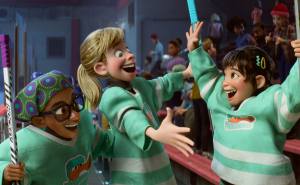
Inside Out 2 also answers a thorny world-building question that the original creators never thought to go into greater detail. It’s established in the 2015 original that even the adults have the same five core emotions manning their brain battle stations: Disgust, Fear, Sadness, Anger, and Joy. So if adults only see these same emotions, what happens to those new puberty emotions? Do they go away? As an adult, do we gradually work through anxiety and embarrassment to the point where they are no longer present (this is where every adult can wryly laugh)? There’s an emotion introduced as Nostalgia, depicted as a kindly grandmother so eager to remember the ways things were. Joy tells Nostalgia to leave, as it’s not time for her to be developed yet until Riley is older. This one moment clears up the world-building question; the emotions don’t leave, they just sit out for periods of time like bench players waiting to be called into the big game. And just like that, it all works and makes sense. I wonder what other new emotions make their appearances later in life. Resentment? Choosing to rather die in authority rather than give up an iota of power to a younger generation? Sorry, that last one was more directed at those stubborn folks clinging to Congressional offices.
There is some sight narrative and thematic redundancy here. The first movie was about learning the importance of accepting sadness as a vital part of the human condition and how we can process our emotional states. It was about Joy learning that not every moment in life can or should be dominated by joy, and that the other emotions are also necessary functions. With the sequel, we have a starting point where Joy is picking and choosing what memories are worthy of being remembered, banishing the “bad moments” to the back of Riley’s mind, forming a cavernous landfill of junked memories. It’s treading some pretty similar ground, prioritizing one set of memories or emotions over others wherein the ultimate lesson is that repression in all forms is unhealthy and robbing one of the necessary tools for self-acceptance and growth. This is further epitomized by a trip to one of these memory vaults where Riley’s Deep Dark Secret is willfully imprisoned. The movie proper never comes back to this self-loathing figure, and the revelation could have really supported the overall message of self-acceptance. Pixar could have done something really special here, like having Riley coming to terms with being bisexual/queer, and that perhaps something we may personally agonize over as a horrifying secret could, once shared, be far from the dreaded life-destroying culprit our minds make it out to be. This would have really worked with the perceived lower stakes of the movie, naturally elevating the ordinary to the profound, as life can often unexpectedly become. Alas, the Deep Dark Secret is just a setup to an underwhelming post-credits joke – womp womp. That’s it? Again, if you’re going to tread the familiar thematic grounds about the dangers of repression, at least give us something bigger to reach than the same lesson that all emotions have a place.

The first Inside Out was a masterpiece. That’s a hard act to follow. This sequel, of which we can all assume there will be more given its billion-dollar box-office, is a solid double to the original’s home run of entertainment. It’s not among their best but it’s one of their better non-Toy Story sequels. Inside Out 2 is a heartwarming winner.
Nate’s Grade: B
Share this:

Napoleon Dynamite (2004) [Review Re-View]
 Originally released June 11, 2004:
Napoleon Dynamite was an audience smash at the 2004 Sundance film festival. Fox Searchlight jumped at the chance to distribute a film written and directed by Mormons, starring a Mormon, and set in film-friendly Idaho. MTV Films, the people behind alternating good movies (Better Luck Tomorrow, Election) and atrocious movies (Crossroads, Joe’’s Apartment, an upcoming film actually based on Avril Lavigne’s “Sk8r Boi” song), came aboard and basically said, “Look, we really like the movie, and we want to help bring it to a wider, MTV-influenced audience.” And thus, Napoleon Dynamite seems to have become the summer biggest must-see film for sk8r bois and sk8r grrrls nationwide.
Napoleon Dynamite (John Heder) is an Idaho teen that marches to the beat of his own drum. He lives with his Dune Buggy riding grandmother and 31-year-old brother Kip (Aaron Ruell), who surfs the Web talking to women. When their grandma gets injured, Uncle Rico (John Gries), stuck in the 80s in fashion and mind, takes up shop in the Dynamite home and coerces Kip to hustle money from neighbors. Meanwhile, Napoleon befriends Deb (Tina Majorino), an otherwise normal girl with a sideways ponytail, and Pedro (Efren Ramirez, who was actually in Kazaam!), the new kid at school. Together, they try and get Pedro elected to class president, but standing in their way is the mighty shadow of Summer (Haylie Duff), the most popular girl in school. Oh yeah, there’’s also a llama.
 First time director, Jared Hess, and first time cinematographer, Munn Powell, orchestrate shots very statically, with little, simple camera movements and many centered angles. The style is reminiscent of the films of Todd Solondz (Welcome to the Dollhouse), or, more precisely, Wes Anderson. This shooting technique makes the characters stand out even more, almost popping out at you behind flat backgrounds like some Magic Eye picture. Hess easily communicates the tedium of Idaho with his direction. Can anyone name any other film that takes place entirely in Idaho? (Please note that My Own Private Idaho takes place in Portland and Seattle, mostly).
The star of the show is, of course, Heder. His wickedly funny deadpan delivery helps to create a truly memorable character. He achieves a geek Zen and, judging from the incredible amount of kids under-14 that appeared both times I saw this film, is most likely the greatest film realization of a dork. It’s grand dork cinema, a genre long ignored after the collapse of the mighty Revenge of the Nerds franchise. So while Napoleon isn’’t exactly relatable (llamas, Dune Buggy grannies and all), the right audience will see reflections of themselves. You’’ll be quoting from Napoleon all summer.
Napoleon Dynamite is going to be an acquired taste. It’s filled to the brim with stone-faced absurdities and doesn’’t let up. If you’’re not pulled in with the bizarre antics of bizarre characters in the first 10 minutes, then you may as well leave because otherwise it will feel like the film is wearing you down with its “indie weirdness.” Napoleon Dynamite seems to skirt the sublimely skewed world of Wes Anderson, but Napoleon lacks the deep humanity of Anderson’s films. What the audience is left with is a sugary, sticky icing but little substance beneath, and, depending on your sweet tooth, it’’ll either be overpowering and a colossal disappointment or it’’ll taste just right for the occasion. Alright, I’’m done with baking analogies for the year.
 Some will find a certain condescension against the characters. Napoleon Dynamite doesn’’t outright look down upon its characters, but it does give them enough room to paint themselves fools. Uncle Rico is really the film’s antagonist, yet he’s too buffoonish to be threatening. It’’s a fine line for a film to have condescension toward its characters, but Napoleon Dynamite ultimately leaves with a bemused appreciation for its characters. The film presents the “good” characters as unusual but lovable and ready for growth (Kip, Pedro, and of course Napoleon), but the “bad” characters (Summer, Uncle Rico) aren’’t demonized. In essence, Napoleon Dynamite is the best example of a film that makes an audience laugh at and with its characters simultaneously.
Napoleon Dynamite is assuredly an odd duck. Some will cheer; others will want to head out the door after a few minutes. It’’s hard to say which reaction an individual will have. If you have a geek-enriched history populated with unicorns, Dungeons and Dragons, and/or social ostracism, then you may be more inclined to admire Napoleon Dynamite. I laughed out loud throughout the film and found it to be an enjoyable diversion, and I went the whole review without one Jimmy Walker reference.
Nate’s Grade: B
——————————————————
WRITER REFLECTIONS 20 YEARS LATER

I feel like trying to explain the unexpected pop-culture success of Napoleon Dynamite is a fool’s errand, ultimately leaving one sputtering out and ending with the disappointing culmination, “Well, you just had to be there, I guess.” It was 2004, before the rise of YouTube and dominant social media outlets, and for whatever reason, if you were under 30, you probably fell in love with this Idaho nerd, or at least fell in love sounding like this Idaho nerd. I couldn’t travel more than a few blocks without overhearing some loitering Millennial uttering, “Gawsh” in mock exasperation, or mentioning llamas, tater tots, ligers, or catching a significant other a “delicious bass.” If you can recall how annoying and omnipresent the Borat impressions were after that 2006 movie’s mainstream splash, well the silver lining to every person, usually a smirking male member of the species, saying, “My wiiiiiiife,” was that it finally pushed aside everyone else endlessly imitating Napoleon Dynamite (John Heder). This movie was everywhere in 2004. It was meme-ified before meme culture became prevalent. Re-watching this movie twenty years later is like excavating a novelty from a different time and trying to better analyze why this silly and stupid little movie about weirdos living their weird lives became a zeitgeist breakout.

If I had to explain the appeal of Napoleon Dynamite, I think it serves as the next step in the evolution of comedy for younger adults. The Muppets are a deservedly celebrated comedy troupe for over 50 years, and beyond the iconic characters and their mirthful camaraderie, I think their ongoing appeal is that it’s an introduction to the forms of irony for younger children. It’s teaching that there can be more behind the silly, and Napoleon Dynamite takes that PG-comedy baton and pushes it forward, as its entire being is one of ironic comedy. The entire movie is built upon the viewer finding the behavior and banter of these characters hilarious for being so straight. There aren’t really jokes in the traditional sense of setups and payoffs; every line has the potential to be a joke because it’s a character saying something ridiculous without the awareness of being ridiculous. As I said back in 2004, “If you’’re not pulled in with the bizarre antics of bizarre characters in the first 10 minutes, then you may as well leave because otherwise it will feel like the film is wearing you down with its “indie weirdness.” Perhaps this style of comedy, a feature fully dedicated to ironic detachment, served as an awakening for others in my age-range, who championed the absurdity of the everyday and lionized the liger-loving man. This movie doesn’t achieve the larger artistic ambitions in a heightened tone of a Wes Anderson or a Yorgos Lanthimos, two masters of droll deadpans. It’s not deep. It’s not complicated. It’s always obvious, but that made the comedy all the more accessible to so many, especially for younger teens and kids.
As a movie, Napoleon Dynamite can be overwhelming. Seeing any clip of this movie serves the same comedy function as watching the entire 96-minute experience. It helps to structure the movie around a nerd’s quest to win over the girl and help his fellow outcasts. It has a recognizable us-versus-them formula where we can root for the weirdos to, if not prove their naysayers wrong, at least prove to one another that they have found acceptance from the ones who matter. It works on that familiar territory. Napoleon’s big dance at the talent show is his triumph, showcasing to the rest of the school his skills, though he runs away before the adulation can be felt, robbing his character of the perceived victory but giving it to the audience instead.

For most of the people involved in this movie, they had a brief burst of wider success before gradually coming back down to Earth. Heder was the obvious breakout and was given bigger supporting roles in studio comedies like Just Like Heaven, School for Scoundrels, Blades of Glory, and Surf’s Up, the other animated penguin movie from 2006. Heder has worked almost exclusively in the realm of voice acting in the last decade, including 2024’s Thelma the Unicorn, directed by Jared Hess and co-written by Jared and his wife Jerusha, the same creative team that gave us Napoleon Dynamite. I never really vibed with any other Hess comedy. I didn’t get the love for 2006’s Nacho Libre, and from there the movies just got worse to unwatchable, like Gentlemen Broncos and Don Verdean, each trying to chase that same combination of detached irony and quirk that proved so successful for them in 2004. I think the inability to follow-up Napoleon Dynamite with another breakout comedy of its ilk speaks to the unpredictable nature of assembling the right mixture of actors, tone, and material, as well as good timing. Would Napoleon Dynamite have been as big a success in 2009 as opposed to 2004? Maybe not. There was a six-episode animated TV series version in 2012, and the fact that I never remembered this probably answers the question over whether the filmmakers got lucky in 2004.
Napoleon Dynamite is the exact same movie it was back in 2004 as it now resides in 2024, and forever more. It’s flat, detached, silly, light-hearted and the same joke on repeat, and if you feel yourself gravitating toward that comedy wavelength, then hop on and enjoy. Re-watching it for me was like revisiting a fad from the past that was hard to put into context. What was it that made so many buy “Vote for Pedro” T-shirts and talk about throwing footballs over mountains? Comedies more than any other movie lend themselves to audience dissemination, to take the jokes and moments and characters and run with them. Nearly every successful comedy has experienced some form of this, so why should Napoleon Dynamite be any different? It’s perfectly understandable to watch this movie unfazed, unamused, and questioning what exactly people found so amusing about this guy and his extended family and friends back in 2004. It’s also understandable to smile and chuckle at the absurdities played so matter-of-factly. Gawsh.
Re-View Grade: B-
Share this:

Robot Dreams (2023)
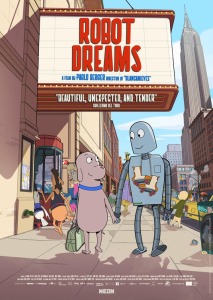 What a delightfully tender little movie Robot Dreams proves to be. It’s based on a picture book and its story is mostly about a lonely Dog who orders a build-your-own-robot for companionship and their friendship. Much of the movie hinges on the Robot being trapped on a Long Island beach closed for the season, so our intrepid Dog must go on living in his New York City apartment through the seasons while he waits to rescue his friend. The movie is wordless and based upon a picture book, but that doesn’t mean this is chiefly kid’s stuff. It touches upon the profound with such elegance and efficiency, brilliantly relatable and recognizably human. It’s all about our need for connections, and even when they are separated, both the Dog and Robot find other connections with other characters, and then it comes back to our worry that they won’t actually reunite after being apart for the majority of the movie. I was reading some gay coding between the two as well but maybe that was my own projection. My nine-year-old son was quite taken with the movie and could easily follow along, though he was also very much not a fan of the bittersweet ending, his first taste of providing the whole “what you need, not what you want” conclusion. Robot Dreams is lovingly realized, its animation so clean and crisp with wonderful characters populating an alternative 1980s NYC. It’s simple and sweet and irresistible.
Nate’s Grade: A-
Share this:

Hit Man (2024)
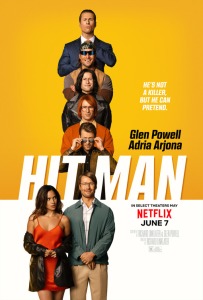
Hit Man is a movie that is wonderfully hard to describe. The premise has an easy-to-grasp hook that promises fun and hijinks, but where it goes from there takes on as many transformations as its protagonist, Gary Johnson (Glen Powell). It transforms from a fun game of undercover conning with wigs and silly accents into an unexpected rom-com hinging upon mistaken identity, maintaining assumed appearances, and secrets that then transforms into full film noir without losing its unique identity and the stakes of the character relationships. If you’d expect any filmmaker to pull off that trick, writer/director Richard Linklater has to be one of the best to keep things running smoothly, and that he does, as Hit Man is a crowd-pleasing comedy with some unexpected directions to keep everyone guessing until it lands on its own morally gray terms.
The movie is also, chiefly, a showcase of star and co-writer Powell, a handsome young actor hitting a new ascent of his career with last year’s Anyone But You and the upcoming Twisters. Powell is probably best known as the smirking guy you loved to hate in Top Gun: Maverick, but he’s also played memorable supporting roles in Scream Queens and three other Linklater film projects, notably 2016’s Everybody Wants Some!!, a pseudo-spiritual sequel to the seminal Dazed and Confused. This is Powell’s acting showcase and he’s utterly terrific. He has great infectious fun getting into the various hitman characters, which mostly exist in montages, and trying on different personas and voices. I cackled when he was doing his impression of Christian Bale’s Patrick Bateman, and I smiled throughout most of the other personas. It’s easy to see the network TV version of this premise, where every week Gary adopts a new persona and disguise to bust the next possible criminal from hiring a hitman, like an edgier Quantum Leap). The culprits are played like nitwits but then again the police are also played as nitwits (are there THIS many attempted hitman hirings in one city for the police to have a full-time unit?).

But before this acting experiment can get too broad or too redundant, Linklater and Powell switch things up. Around the Act One break is where Gary meets Madison (Adria Arjona), and that’s when everything changes for him and the audience. Now we have emotional stakes, because Gary intervenes to save Madison. While the circumstances of their first meeting involve her wanting to kill her husband and believing Gary as the professional to do such a job, the scene plays as a disarming first date you’d find in another charming romantic comedy, where it’s clear to anyone with a pulse that these two have something together. Instead of busting her for the solicitation, he pushes her to change her mind, take the money and leave her no-good husband rather than finding a questionable man to eliminate him. From there, they form a romantic relationship that fluctuates wildly. She thinks Gary is “Ron,” the suave and confidant persona Gary adopted for their sit-down. So the nerdy tech nerd who teaches philosophy must pretend to be the daring and dangerous man of mystery he wishes he could be. The script doesn’t get carried away with its farcical elements in play, juggling multiple identities for multiple specific audiences, but it asks the question, “Why can’t the milquetoast Gary simply be Ron? Is this an unexpected means of self-actualization for the nerd to win the girl?” Through this extreme exercise, Gary can mold himself into the man he would like to be. The rom-com is flirty, funny, and just as enjoyable as the earlier wacky comedy of being a versatile master of disguise.
It also really helps things when your two lead actors have such strong chemistry. Powell and Arjona (Father of the Bride, Andor) are smoldering together, like full on “get a room already” territory. This lends even more credence when Hit Man makes its next transformation into film noir thriller. I won’t divulge the specific plot elements but it all works with what Linklater has already established. There’s trouble for the both of them, and the question becomes how far is each participant willing to go to stay above the fray. The transition from silly costume comedy to sundry noir thriller is handled so naturally, as if the characters, already existing under such unique circumstances, found themselves in the elevated movie-movie version of their crazy relationship. Rather than feel contrived, Linklater and Powell have put in the work to make these twists and turns credible and exciting. The shifting nature of the movie is a wonderful reflection of its fake hitman hero. There’s a scene late in the film, where all of our principal players have come together, and you have characters saying one thing, intimating another, for different versions of different audiences, and it’s such a masterful tonal dance that feels satisfying as a climactic turning point as well as genuinely impressive for all the myriad subtext in play.

This is a clear-cut case of a movie being “inspired by” a true story rather than being “based on” a true story. Generally, we expect the “based on” stories to have some voracity to reality. We accept that there will be alterations for dramatic purposes, externalizing the internal, condensing timelines and characters into a more accessible structure, etc. If you go to a movie about Jackie Robinson, you don’t expect to see the famous baseball slugger fighting space monsters (“Racism was the real giant monster all along”). Hit Man is based upon a 2001 long-form news article by Texas Monthly journalist Skip Hollandsworth, the same author of the source material for Linklater’s fascinating true crime dark comedy gem, 2011’s Bernie, which I highly recommend (a career-best Jack Black). The real Gary Johnson really did pose as a fake hitman for the purposes of catching real criminals, but the rest of the movie exists in its own fictional universe of dramatic complications. Usually we want our film stories to have more fidelity with the truth and reality, but I’m glad Linklater and Powell recognized the sheer storytelling potential of this quirky premise. Sticking to the facts could have told an amusing story, but feeling confident to take bold leaps with well-worn genre motifs, when called for, is the right call for making the most of this tale.
The shame of Hit Man is how quickly it will likely be subsumed by Netflix’s suffocating tidal waves of content. Here is a fun, likable, and surprising indie comedy with definite mass appeal buoyed by great performances, clever writing, and a tonally shifting narrative to keep things fresh. Powell gets the breakout showcase he deserves and we get one of the most unexpected and amusing rom-coms of recent years. Hit Man is a movie that deserves to be seen, to be enjoyed with a crowd, but I worry it will get lost in the shuffle of streaming titles. I suppose this might just be the current reality for fans of mid-level adult dramas and comedies. At least they have a home on the streaming networks even if these movies would have been theatrical breakouts years ago. Regardless, Hit Man is a good time with good people pretending to be bad, or is it bad people pretending to be good, but whatever pretense, it’s a charming winner worth your two hours.
Nate’s Grade: B+
Share this:

The Idea of You/ Turtles All the Way Down (2024)

The Idea of You is the kind of movie that Hollywood used to crank out, a romantic drama star vehicle based upon a popular novel and with a skilled director, and now it forgoes any theatrical run and ends up as another option on a streaming channel. The Idea of You follows a 40-year-old divorced single mom played by Anne Hathaway who also happens to run an L.A. art gallery and has a meet-cute with a handsome boy band member (Nicholas Galitzine, Purple Hearts) at the Coachella music festival (oh the magic lives of people never having to worry about bills in rom-coms). they hit it off, and the rest of the movie is whether or not they can make a romance work. There’s a 15-year age gap that she feels very self-conscious about as an older woman (“older” by Hollywood standards). She’s this formerly normal woman who wants to date one of the most famous music stars in the world who isn’t always available, but most of the problems and conflicts stem from the perceived issues of the age gap. It’s a charming romance that’s more dramatic than it is comedic, and Hathaway is quite good as our lead plucked from obscurity. Though the many scenes of our smitten boy band member making googly eyes at Hathaway as he reminds her how attractive she is, and as she bashfully demurs, are a little much (it’s Anne Hathaway, notorious horrible-looking human specimen, right?). As a core romance, the movie works well under the guidance of director and co-writer Michael Showalter (The Big Sick), and it’s more adult than I was expecting. It’s rated R for language and it’s also more sensual, but it’s also more adult as in looking at the ramifications of this relationship in a mature perspective, from the terrors of paparazzi imposition to her daughter being harassed at school. The portrayal is thus more engaging and engrossing and feels above the more flippant and flimsy romances that would settle for far less. Though be warned: there are several sequences of singing and serenading which might cause you to shrink awkwardly inward on your couch. Surprisingly thoughtful, and relatively romantic, The Idea of You is a charming reminder of the appeal of comforting tales of love blossoming in unexpected places and pretty people allowing themselves the choice to be happy.
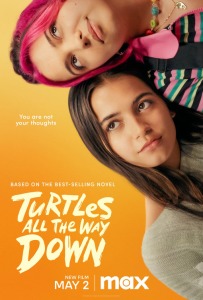
Based on best-selling YA author John Green’s 2017 novel, Turtles All the Way Down is a very accessible and very affecting glimpse at living with mental illness, obsessive compulsive disorder, and intrusive thoughts. Aza (Isabela Merced) has an overwhelming inner monologue that sabotages her daily life in high school and carries her along anxious thought diversions, constantly relating to some illness growing inside her that she needs to cleanse. This is the crux of the story, along with her relationship with her super eager best friend. There’s a romantic side plot where she helps out a rich classmate whose billionaire dad has gone missing, which feels like a plot device to necessitate the two characters spending time together. The standout aspect of this adaptation by writer/director Hannah Marks (Don’t Make Me Go) is its unsparing and honest yet hopeful depiction of mental health and intrusive thoughts. Merced (Dora and the Lost City of Gold, Madame Web) is excellent and deeply empathetic as this woman held hostage by her wayward thoughts and impulses. It’s a performance that goes beyond easy depictions of aloof detachment or exaggerated histrionics, shedding any acting techniques that are too mannered or attention-seeking. Marks’ direction helps reflect Aza’s troubled mind with rapid insert edits and voice over to communicate the intrusive thoughts and maelstrom of spiraling negative emotions. If you’re a fan of Green’s popular novels, or YA-themed literature, or even just honest attempts to empathize with teens in turmoil, then Turtles All the Way Down is worth battling through any negative thoughts to finish and relish the journey.
Nate’s Grades:
The Idea of You: B
Turtles All the Way Down: B+
Share this:

Unfrosted (2024)
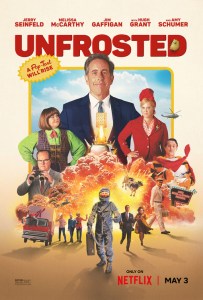 What to make of a movie like Netflix’s Unfrosted. It’s Jerry Seinfeld’s directorial debut, working off a screenplay he co-wrote, his first foray into film writing and acting since 2007’s Bee Movie. His eponymous sitcom “about nothing” was a 1990s mainstay and popularized an ironic meta form of comedy that still continues to dominate comedic tastes. Making a movie about the pseudo history of the invention of Pop Tarts, and the corporate rivalry between the major cereal brands, seems like a further exercise in that realm of humor, potentially satirizing a burgeoning sub-genre of late, the Biopic of Products (Air, Tetris, Flamin’ Hot, Blackberry). Except this supposed “biopic about nothing” is really a head-scratcher. Its humor feels pained and stale, the satire feels missing or glancing at best, and it seems like an expensive lark, wasting the nigh-infinite money of Netflix to purposely make a stupid comedy with all his friends.
Set in the mid 1960s, we follow two households, both alike in dignity, in fair Battle Creek, Michigan where we lay our scene. Kellogg’s has been the dominant cereal-brand for years but its chief rival, Post, is set to launch a new product that will revolutionize breakfast mornings. Bob (Seinfeld) is the head of development for Kellogg’s and reaches out to his old colleague, Donna (Melissa McCarthy), when it becomes evident that Post stole their unused research to develop a pastry treat designed to be cooked in one’s toaster. The warring CEOs, with Jim Gaffigan as Edsel Kellogg III and Amy Schumer as Marjorie Post, are desperate to one-up one another and be seen as more than an inheritor of their family’s wealth. It’s a race to see which company can get their treat to market first and capture the hearts, minds, and sweet teeth of America’s youth.
 I’d be lying if I said I didn’t laugh at points through Unfrosted, which operates like a spoof movie on a slower jokes-per-second pacing guide. There are zany sight gags amidst broadly drawn characters treating the silly straight, though occasionally you’ll have wisecrackers commenting on the inherent absurdity of moments, mostly confined to the stars making asides to the audience. Sometimes it’s lazy jokes that rely upon our foreknowledge, like when Bob coins a NASA beverage by saying it has a “real tang” (get it?). The movie frequently intensifies into goofy escalation when Kellogg’s impanels a team of mascots and inventors as a breakfast brain trust. Every one of these wacky characters is here to provide the exact same joke they will provide throughout the movie, and their inclusion is already suspect. Having the Schwinn bicycle guy (Jack McBrayer) comment on why he should be there is not enough. The hit-to-miss ratio will vary per everyone’s personal sense of humor, but overall I just felt mystified why this project would tempt Seinfeld from his comedy repose. What about this idea excited him? Was it just his lifelong love of cereal and Pop Tarts, a topic from his standup act decades ago? I ate a lot of cereal as a teenager too but I don’t want to make a movie about the Lucky Charms advertising campaign teaching children to beat and pillage the Irish (maybe Ken Loach could direct – to the three people on the Internet who appreciate this joke, I want you to know I appreciate you also).
It can be fun to simply watch dozens of famous people take their turns being silly in what is unquestionably a “dumb comedy.” When you have comedians of this quality in your movie, they’ll find ways to make even so-so jokes hit a little better, and that’s the case here. There’s an entertainment value in just wondering who will show up next, as many characters are only onscreen for a single scene or an abbreviated moment. Unfrosted becomes an example of Seinfeld’s industry power as he empties his Rolodex to fill even the tiniest of roles. Look, it’s James Marsden as Jack LaLanne. Look, it’s Bill Burr as JFK and Dean Norris as Kruschev (double Breaking Bad). Peter Dinklage as the head of the nefarious milkmen cartel? Why not? If you set your expectations low, maybe lower than what you were accounting for, there can be a mild amusement scene-to-scene just seeing who might show up next, almost like a modern-day version of those anarchic big ensemble comedies like It’s a Mad, Mad, Mad, Mad World.
 There is one segment that fell so flat for me that I was in utter amazement, and that was the unexpected January 6th insurrection parody. In a movie that has sustained a surreal and offbeat version of our universe, it evokes one of the most startling days of recent history. I think the humor is meant to derive from simply seeing a bunch of mascots in big colorful costumes as a mob running havoc, but there’s no jokes about like the challenges of a mascot costume in a fight, or say someone tipping over and being unable to get back up like a helpless turtle. There are jokes that can be had with this scenario, but instead Seinfeld is relying on the ironic juxtaposition of the ridiculous with the serious, and I don’t think it ever works as a joke. My sinking feeling began when Hugh Grant’s embittered mascot character wore a headdress resembling the QAnon shaman. It feels tacky and strange and the longer it persists the more I kept wondering what Seinfeld was doing with this. Why include this especially as the only form of relatively topical political humor, beyond, I guess, the depiction of business elites being complete morons? Why this? Again, it would be different if it was funny in execution, like the Saving Private Ryan D-Day parody from Sausage Party. This just isn’t funny, and its inclusion feels so odd compared to the stale nature of its other comedy.
As an admittedly silly enterprise, one that doesn’t even pretend to be accurate even as it flirts with the truth, Unfrosted is a successfully stupid comedy that feels a little too aimless, a little too edge-less and safe, and a little too dated and stale in its approach to comedy (lots of 1960s Boomer nostalgia ahoy). It’s hard to work up that much risible anger over a 90-minute movie that features a living ravioli creature. Clearly this movie wasn’t trying to be anything other than a gleefully stupid comedy, but I wanted more pep from its jokes and whimsy and general idiocy. I think the way to go may have been all the way in the other direction, treating the formation of a toaster pastry like international nuclear secrets and playing the corporate espionage completely straight while also making it patently ridiculous. Unfrosted did, however, make me want a Pop Tart that I ate afterwards, although it was my local grocery store’s generic brand, so I guess that doesn’t directly benefit Kellogg’s. This movie exists as a Seinfeld curiosity that ultimately left me hungry for more.
Nate’s Grade: C
Share this:

The Fall Guy (2024)
 The Fall Guy, loosely based upon the 1980s TV series starring Lee Majors, is not the best action movie, nor the best dedication to the efforts of Hollywood stunt performers, but walking away, I cannot help but think it’s perhaps the most summer blockbuster-y movie I’ve ever seen, a celebration of the magic of movies, the escapism of blockbusters, and the unsung heroes of the stunt community that deserve recognition and maybe even their own Oscar category. This is the kind of movie that reawakens feelings of cinematic elation, of what blockbuster cinema can accomplish with the right creatives in alignment, leaving a smile plastered across your face and a spring in your step leaving the theater. The Fall Guy is about our love of big stars, big explosions, big feelings, and the people responsible for making those big dreams a reality.
Colt Seavers (Ryan Gosling) is a professional movie stuntman who feels invincible until one stunt goes wrong, causing him to break his back. After a year of recovery, he’s parking cars when he gets a call that his ex-girlfriend Jody (Emily Blunt) is directing her first movie, a major sci-fi blockbuster called Metalstorm (which actually exists, it’s a 1983 movie directed by Charles Band and was the shares the same bombastic tagline: “It’s High Noon at the end of the universe”). They need a replacement stuntman and perhaps he can reconnect with her and start over. Also, Colt becomes entangled in searching for the missing star of the movie, Tom Ryder (Aaron Taylor-Johnson), a famous action star that Colt worked closely with, performing his stunts. Colt has to try and find this missing moron while keeping to the movie schedule, all the while hoping to win back Jody and make sure her movie finishes its costly production with its leading man.
 First of all, this is the Ryan Gosling show. If you’re a fan of the actor, especially his cavalier charisma that almost comes across as so cocksure to be enviably casual, then The Fall Guy is going to be a dream come true. It takes the Gosling of such comically committed, goofy, un-self-conscious performances from Barbie to The Nice Guys, and it builds a big Hollywood action movie around that persona, vaulting Gosling into his Big Movie Star phase with aplomb. He’s so effortlessly engaging as our hero, even when he’s being battered and bruised and exploded all over the screen. Colt is also immediately appealing as a capable man beset by challenges rediscovering his mojo. He’s been humbled by life and fights for his dignity while at the same time fighting to win back his girl, and it all plays on a breezy, light-hearted comedy wavelength that accepts the inherent and lasting appeal of movie stars being allowed to be movie stars. There might not be much to the characters of Colt and in particular Jody, but the movie just shimmers on their winning chemistry. You’ll yearn for them to be together again with quite little prompting. It’s a movie whose romantic force is front and center. It’s so unabashedly sincere too. When Colt is jamming to Taylor Swift’s “All Too Well,” it’s not an easy point of mockery, though some may take it as such seeing our strong hero in his feelings, but a point of reliability. It’s a movie unafraid of romance, of wearing its heart on its sleeve, and being a little square.
It’s also clearly a celebration of the unheralded stunt performers of Hollywood history filling in for the more dangerous derring-do of our big screen heroes and villains. Director David Leitch (Atomic Blonde, Bullet Train) came from the stunt world and stages his action set pieces to rely heavily upon real physical stunt work, practical effects, and giving extra time for the audience to understand various dangers and know-how, to learn about this often overlooked industry of professionals risking life and limb, and sometimes giving their own, to create the illusions. The action is varied and filmed in pleasing compositions to highlight the readability of the action. It’s big and propulsive and fun. That’s the key to all of Leitch’s moves here, making the fun infectious, extending the action into unexpected yet delightful directions for more payoffs. The climax involves branching out to an armada of movie stunt performers and technicians, and it feels like a communal effort to win the day, making the ending feel celebratory and satisfying.
 This goes along with the behind-the-scenes camaraderie of the found families of filmmaking, celebrating all the many collaborators that go into building these large-scale entertainment ventures. When they’re going through the steps of how to capture a big explosion or stunt, it’s educating the audience along to better anticipate and appreciate. The Fall Guy is clear about its sincere homages, recreating moods and style from action veterans like Michael Mann, James Cameron, and Michael Bay. It’s a movie celebrating movies, and if you’re a fan of the process like me, then you’ll easily join in on the revelry. I’m sure there are famous stunt performers littered throughout, getting Leitch’s favorite colleagues the platform they deserve. The movie’s insider satire is pretty glancing, without anything too vicious or specific about Hollywood stars, especially epitomized by Taylor-Johnson’s send-up of self-absorbed actors. The concept of Metalstorm, a sci-fi Western with elements of Dune and Mad Max, is a project where the silly mash-up of “cool” elements is the unspoken punchline, the sheer stupidity of this concept, magnified by Tom Ryder channeling his most laconic Matthew McConaughey impression.
There’s a special appeal about summer blockbuster movies and The Fall Guy understands that lasting appeal. It delivers a movie whose mission is to remind us why we love these kinds of movies, big and stylish and thrilling and romantic and enchantingly entertaining. It’s a movie that’s only interested in being two hours of excellent escapism, not setting up a cinematic universe or the next sequel leading to the next sequel and spin-off. It’s only concerned with telling its lone story, which is booed by the magnetic power of its leads and their buzzy chemistry together. Gosling is chiefly in the zone and supremely charming and funny. The Fall Guy is a treat for fans of action and the professionals that make all the action so incredible.
 As a personal side note, my lovely wife is almost five months pregnant and we were informed that our little baby boy would develop his sense of hearing around this time, and during the many action scenes roaring in the surround sound theater, the kiddo was moving around in utero. Either this kid was worried about the sudden shifts in volume and noise, or he was enjoying the experience and swimming along. Either way, I’ll consider this baby’s first movie, so thank you The Fall Guy for making this a personal landmark for me and my growing family.
Nate’s Grade: A-
Share this:

Jersey Girl (2004) [Review Re-View]

Originally released March 25, 2004:
Writer/director Kevin Smith (Dogma) takes a stab at family friendly territory with the story of Ollie Trinke (Ben Affleck), a music publicist who must give up the glamour of the big city to realize the realities of single fatherhood. Despite brief J. Lo involvement, Jersey Girl is by no means Gigli 2: Electric Boogaloo. Alternating between edgy humor and sweet family melodrama, Smith shows a growing sense of maturity. Liv Tyler stars as Maya, a liberated video store clerk and Ollie’’s real love interest. Tyler and Affleck have terrific chemistry and their scenes together are a playful highlight. The real star of Jersey Girl is nine-year-old Raquel Castro, who plays Ollie’’s daughter. Castro is delightful and her cherubic smile can light up the screen. Smith deals heavily with familiar clichés (how many films recently end with some parent rushing to their child’’s theatrical production?), but at least they seem to be clichés and elements that Smith feels are worth something. Much cute kiddie stuff can be expected, but the strength of Jersey Girl is the earnest appeal of the characters. Some sequences are laugh-out-loud funny (like Affleck discovering his daughter and a neighbor boy engaging in “the time-honored game of “doctor””), but there are just as many small character beats that could have you feeling some emotion. A late exchange between Ollie and his father (George Carlin) is heartwarming, as is the final image of the movie, a father and daughter embracing and swaying to music. Jersey Girl proves to be a sweetly enjoyable date movie from one of the most unlikely sources.
Nate’s Grade: B
——————————————————
WRITER REFLECTIONS 20 YEARS LATER

When I started putting together my list of 2004 movies to re-watch for this year’s slate, my wife was not pregnant. We had been trying for a year and experienced some heartbreaking setbacks, but now, as I write my review of Jersey Girl, my reality is that my wife is indeed pregnant, and we’re expecting a baby this October and very excited. As you can expect, I’m also nervous. Now this movie about the changes of fatherhood has significantly more meaning for me personally.
In 2004, I was but a 22-year-old soon-to-be college graduate but also a devotee of writer/director Kevin Smith since my teenage years of discovering movies in the oh-so-exciting go-go decade of 1990s independent film. This was supposed to be Smith’s career pivot, as he’d reportedly closed the book on his View Askew universe of crude comedies and stoner hi-jinks with 2001’s Jay and Silent Bob Strikes Back. Smith had become a parent in 1999 and, naturally, this altered the kinds of stories he wanted to tell. Although this didn’t last too long. In 2004, America was sick of Bennifer 1.0 and Jersey Girl was the second movie in less than a year pairing real-life couple Ben Affleck and Jennifer Lopez. The stink from 2003’s Gigli, and the tabloid overexposure, had tamped down the country’s demand for more Bennifer, so Miramax removed all publicity of Lopez from the movie, pushed the release date back half a year, and even publicly revealed that Lopez’s character dies in childbirth in the first ten minutes. Even with its relatively modest budget for a studio film, Jersey Girl under-performed, critics lambasted it, and Smith returned to his vulgar adult comedy playground with 2006’s Clerks II, the sequel to where it all began. With the occasional stop into horror, Smith has stayed in his own insular world and only gotten more insular with sequels to his early comedies for his ever-shrinking fandom.
 More so than any other movie, Jersey Girl is the outlier, the oddity, the path not taken. Watching it again in 2024, I’m more forgiving of this outlier even if it proves harder to love. Much of this is likely my own relatability with the main character’s plight, a New York City workaholic publicist Ollie Trinkie (Affleck) who loses everything in a short window of time, namely his high-profile city job and his wife Gertrude (Lopez). Now he’s back living with his father Bart (George Carlin) in New Jersey and raising a little girl Gertie (Raquel Castro) on his own. It’s not a revolutionary film concept, a selfish adult takes on the responsibility of another and changes their perception of themself and the world. In a way, it likely happens to every new parent, or I would hope, a paradigm shift of perspective. The insights that Jersey Girl offers about parenthood and priorities are nothing new but that doesn’t mean they are bad or not worthwhile. Without the context of Smith’s tonal pivot, Jersey Girl would likely be forgotten, more than it already has been to history. It’s Smith’s spin on the family movie cliches we’ve seen before, and that means there’s a limit to how much further he can take the overly familiar.
It’s a little deflating to watch an artist known for his imagination and vocabulary utilizing the building blocks of maudlin family movies for his new story. Even with a different storyteller, they are still the same recognizable pieces seen before in hundreds of other feel-good movies about parents learning that children are more important than that big meeting or promotion. Of course reducing everything down in life is reductive, and maybe that big meeting could allow the parent to be more present for their kid, provide a better life being neglected, but whenever you set up the climactic choice between family and career, family always wins. Maybe David Wain (They Came Together) is the kind of subversive genre artist who could send up these age-old cliches and end with the workaholic parent choosing their selfish career. Regardless, the movie’s strengths are its sincerity rather than ironic detachment. It would be hard to make this kind of movie from a cynical smart-alecky approach, and Jersey Girl reveals what any View Askew fan has long known, that deep down at heart Smith is a big softie. It’s more apparent nowadays with Smith’s recent output of increasingly sentimental movies about relationships, as well as Smith’s copious social media posts showcasing his torrent of tears in response to a movie or TV show (as a man who frequently cries from movies and TV, this is no affront to me). Smith wanted to tell a personal story of his own life changes through the familiar family movie vehicle, and while it doesn’t entirely stretch beyond its copious influences, it’s still singing true to Smith’s sincerity.
 This is far from the disaster many have made it out to be in the past twenty years. Lopez is really good in her brief opening appearance with a natural radiant charm that makes you mourn her absence just like Ollie. Liv Tyler (Armageddon reunion) shows up midway through as Maya, a sexually progressive video store clerk who becomes the next love interest for our widower. When she discovers, to Ollie’s embarrassment, that he hasn’t had sex for seven years, the entire time after his wife’s passing, she takes it upon herself to help the guy out with some charitable casual sex. The scene is funny and finally makes use of a setup Smith has taken time with prior, Gertie not flushing the toilet after use (something I can already regrettably relate to raising children). When his daughter comes home early, Ollie and Maya hide in the shower, and it appears they have gotten away with it, except Gertie finally remembers to flush the toilet, sending a burst of hot water that causes Maya to screech and reveal their half-naked tryst. From there, little Gertie sits them both down, reminiscent of what Ollie did with her and a friend when he caught them playing “doctor,” and she squares her gaze and intones, very maturely: “What are your intentions with my father?” Even the big climactic event, the children’s musical performance the parent can’t miss lest they break their child’s heart, gets a little edge when Gertie and her family perform the throat-slitting/pie-making number from Sweeney Todd. There’s a terrific exchange between Ollie and Will Smith all about the changing dynamic of fatherhood, what they do for their kids, and how rewarding it proves, and having Smith be your ace-in-the-hole is great.
It would be neglectful of me to forget the postscript that, nearly twenty years after the demise of their engagement, that Affleck and Lopez reunited and married in 2022. We’re in the current realm of Bennifer 2.0 (unless your version of Bennifer 2.0 was when he married Jennifer Garner, but I’ll let you decide if this era is 2.0 or 3.0) and Lopez has released a companion documentary to her 2024 visual album (a.k.a. collection of music videos) that features her relationship with Affleck, and it’s called The Greatest Love Story Never Told, and it’s gotten good reviews. Also of note, Castro grew up into a budding pop idol and appeared on The Voice and Empire.
 There are things that work here, enough that Jersey Girl might honestly age better than the majority of Smith’s rude and crude comedies (see: re-reviews for Dogma and Strike Back, and Reboot). It will never garner the love of Smith’s more successful movies, but it doesn’t deserve any reputation as a forgotten stepchild among Smith’s oeuvre, especially when you consider the man also has Yoga Hosiers on that resume. In 2004, I referred to Jersey Girl as a “sweetly enjoyable date movie,” and this still stands twenty years later. I’m a little softer in several ways and more forgiving as an adult cinephile, and more welcome to genuine acts of sincerity, so the winning moments of the movie still hit their mark for me. I write this as my wife is still in her first trimester, and while the due date seems so far away I know it will rush by, and then I, like Ollie, will be juggling my life as I knew it with my life as I now know it (you better believe the scene where he loses his spouse in childbirth hit me harder as a new intrusive nightmare to occupy my mind). Jersey Girl isn’t anything new or special, but it was special for Smith, and he finds ways to make you understand what that means for him, and what it might mean for you. I’ll take that.
Re-View Grade: B-
Share this:

Mean Girls (2024)
 Child: “I want Mean Girls [2024], mom.”
Parent: “We have Mean Girls [2004] at home.”
Consider this bouncy 2024 remake Mean Girls Plus, as the only additions from the popular high school comedy are the adaptations made to retrofit Tina Fey’s comedy for the Broadway stage. Twenty years later, the cast is more diverse, some of the jokes that have aged the worst have been removed (fewer fat jokes and no more teachers sleeping with underage Asian students), and the 97-minute original now becomes a 112-minute musical. The cast is winsome and charming but fail to disperse your memories of the original cast that featured future Oscar nominees Rachel McAdams and Amanda Seyfried or even Lindsay Lohan during the height of her career (Lohan cameos as the mathlete judge). Renee Rapp (The Sex Lives of College Girls) has got the most command as this next generation’s Regina George, a role she played during the Broadway run. Your overall impression is going to hinge entirely upon your evaluation of the pop-heavy songs, which to my ears were pleasant but unmemorable melodic pap. There is the occasional snarky line (“This is modern feminism talking/ Watch me as I run the world in shoes I cannot walk in”) but most of the lyrics and jokes are mild additions from what Fey’s movie already established. The standout musical moment might be a goofy throwaway number about all the different sexy Halloween costumes a woman should be able to dress in (“If you don’t dress slutty, that is slut shaming us”). The staging features lots of long takes and tracking shots to better appreciate the nimble dance choreography with the occasional visual addition (phone screen inserts make for modern backup singers). The memorable 2004 lines that have stuck as Millennial memes are included but treated like returning victors, but when elevated and given space for applause, it feels so strange and artificial. The 2004 movie didn’t do this. Regardless, you can do worse than a slightly updated version of Mean Girls with all-right songs, though you could also simply re-watch the original.
Nate’s Grade: B-


 nathanzoebl
You must be logged in to post a comment.