Blog Archives
A Minecraft Movie (2025)

I was fully prepared to dismiss A Minecraft Movie as junk for its target audience, and then a funny thing happened in fact pretty early in the movie: I was laughing. Then I laughed again. Genuine laughter. I’m here to say that the Minecraft movie is not the silly and stupid kid’s movie you may have dreaded. It’s actually a pretty pleasant fantasy adventure movie that, while aimed for kids, can still be enjoyable for like-minded adults looking for some colorful and silly escapism. It’s hip to be square, baby.
Steve (Jack Black) is a guy who loves to create, and mines for whatever reason, and finds a portal to another very cube-centrist world. In this new world, Steve finds friends and freedom, but this is ruined when a nefarious force comes through wanting to conquer this new world as well as Steve’s home world. He sends out help and seals off a portal. Years later, a pair of siblings, Henry (Sebastian Hansen) and Natalie (Emma Myers), move into Steve’s old home and discover his portal, along with an middle-aged arcade game champion and local legend, Garret (Jason Momoa), and realtor, Dawn (Danielle Brooks). These newcomers must adjust to this strange world and defend themselves against zombies, creepers, and other dangers. Fortunately, Steve serves as a valuable guide, but can they all defeat the evil forces?
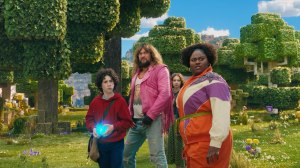
There’s a robust silliness to Minecraft that invites you to not ever take things too seriously and have fun with the vibes. Much like the Super Mario Brothers adaptation, there isn’t really a story to adapt here. There were several moments that felt like it was a satirical parody of the fantasy adventure movie while also working as examples of fantasy adventure tropes. Refreshingly, much of the humor is not derived from fish-out-of-water juxtaposition. This could have easily been a “Well, that happened” kind of nonchalant comedy, holding up the weirdness to scrutiny for easy yuks. It finds better jokes through pushing further than simple observational irony (“My dad says math has been debunked”). It’s good-natured humor that keeps things positive and goofy, channeling the open-sandbox creativity of the video game. Its “be yourself” message is easier to accept than more disingenuous kid’s movie junk like The Emoji Movie. The Minecraft world is presented less as a purchasable video game rather than a new world to explore that rewards exploration (during daylight hours). The very enemy of the movie is a sorceress (voiced by Rachel House) that hates creativity and sees it as a waste in her pursuit of always plundering and hoarding more gold. I might be reaching but there seems even like a possible A.I. reading there, with our giant pig sorceress standing in for tech bros who are trying to eliminate avenues of creativity because all they care about is wealth and cannot understand the appeal of creativity. The movie has several little comic asides that caused me to chuckle and laugh and smile, and I looked over at my adult friend beside me for my screening, and his response was the same. We both had been surprisingly taken by the genial silliness of this movie.
Black (Jumanji) has become a kids’ movie juggernaut thanks to his zany energy and willingness to go above and beyond no matter the request. He’s a charming and delightful performer by nature, whether he’s voicing an animated character or singing a sexually explicit song about all the positions he will execute. He dips out for the first half hour after the exposition dump that opens the movie, but once he’s back on screen, it’s easy to remember there just isn’t another actor like Black. He’s funny and completely bought-in with whatever the movie asks for, but every single line and every single gesture is at a ten. He is selling every second of this movie and I can completely understand why some people just might get overstimulated by Black’s histrionics. You can tell the filmmakers were like, “We want our own version of ‘Peaches’ to go viral,” and so we get three different moments of Black singing original songs. This aspect was the most transparent and contrived decision that felt based upon chasing after the success of another movie popular with the kids. The actor I enjoyed the most was Momoa (Fast X) who has lots of fun undercutting his own masculine image and his character’s over-inflated ego masking his insecurity.
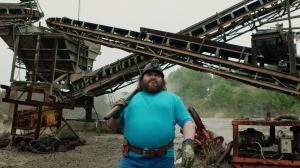
The visuals are bright and enjoyably retro. The Minecraft video game is famously low-grade with its pixelated graphics, more akin to the visual landscape of video games from the 1990s than 2011 when it was first published (it has since become the best-selling video game of all time). Starting with that visual scheme, it allows the movie to be good looking without having to be photo-realistic with its CGI. We have a stylized world to explore that’s full of vibrant colors and characters. This is easily the best looking movie of director Jared Hess’ (Napoleon Dynamite, Nacho Libre) career. His skewed sensibilities work as a nice fit with the comic direction of the movie, and there are some engaging visual arrangements.
Regrettably, this adventure is a bit of a boys-only club. The female half of our adventurers don’t really get the attention that the boys do. Both Natalie and Dawn sit out for long stretches of the movie that I forgot they were in the movie. Usually, these kinds of stories make it so each character has some kind of arc that can be fulfilled by the end, even if it’s minor. I suppose you might be able to argue that Natalie is learning to accept the responsibility of being a parental figure to her younger sibling, and Dawn getting the gumption to quit her job to pursue her dream of running a petting zoo. I’m not keen on bestowing credit for just having a scene at the end where the characters celebrate whatever their goals had been. If you don’t see the work and the development toward those goals, then you don’t get the credit. Why can’t these women have their own adventure that meaningfully connects to the larger plot? Or, even better, why can’t they also go along and contribute to the quest along with all the boys? It’s not like I think the movie is actively trying to downplay the role and importance of women, but it’s also disappointing that there are clear tiers of the characters as far as what kinds of fun and story integration they ultimately earn.
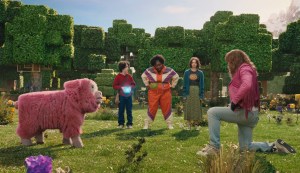
Behold, the Gen Alpha cultural epoch and its name is “chicken jockey.” By now you may have heard of this infamous scene that has caused some theaters to erupt in a calamity of noise, rowdy behavior, and throwing a live chicken at the screen. I even had a theater employee warn our audience before the movie began what is acceptable behavior and how people not abiding by these expectations would be removed from the theater. I’ve been watching movies my entire adult life and other than special screenings for movies intended for audience interaction, like Rocky Horror and The Room, I have never had a theater employee warn me about proper decorum, and this was before the Minecraft movie. It’s astounding. What’s also astounding is how ultimately meaningless this moment is. It’s a baby zombie that falls atop a chicken and rides it, and from what I’m told, this is a very rare occurrence in the game, but I guess it means something more to a generation of fans relishing a rare reference in their favorite game. While I was standing outside the restroom waiting for my own kid to return, a little girl was impatiently asking her father if he was done using the restroom, much to his growing annoyance. “Please hurry. I don’t want to miss the chicken jockey part,” she explained in desperation. I’m happy that this moment seems to be so highly anticipated for millions of fans, but as an outsider, this moment feels so incidental and flimsy that it would be like a generation excitedly waiting for Indiana Jones to lean against one particular wall.
This movie could have been so much worse, and the fact that it’s relatively breezy, funny, and entertaining for non-fans of Minecraft, such as myself, counts as a success in my book. It’s telling that the title is A Minecraft Movie and not The Minecraft Movie. It is but one story in this universe, and given the popularity, it will surely not be The Last Minecraft Movie. Its runaway success at the box-office means we’re probably headed for even more Gen Alpha-centered game adaptations, like some Roblox game you’ve never heard about if you’re over the age of twenty. Hey, it all might work somehow. This one did.
Nate’s Grade: B
Share this:

Y2K (2024)
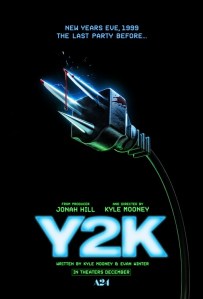
The premise for Y2K is ripe for fun. It’s a nostalgic retelling of that turn-of-the-millenium anxiety over computers getting confused, and the movie says what if technology had turned on humans at the stroke of midnight that fateful New Year? Add the lo-fi chintzy, quirky style of co-writer/director Kyle Mooney (Brigsby Bear) and it’s a setup for some strange and amusing techno-horror. It’s structured like a teen party movie with our group of high schoolers (Jaeden Martell, Julien Dennison, Rachel Zegler) trying to step out of their comfort zones and live their best lives… around machines trying to eviscerate them. The tonally messy movie lacks the heart and specific world-building weirdness of Brigsby Bear, instead relying upon the genre cliches of the high school movie, including the unrequited nerd crush and the pretty popular girl who’s more than what she seems. While watching Y2K, I kept getting the nagging feeling that this movie should be more: more funny, more imaginative, more weird. It’s quite uneven and veers wildly from set piece to set piece for fleeting entertainment. I chuckled occasionally but that was it. I enjoyed the villainous robot assembling itself with assorted junk available, and it’s hard not to see this as a general statement about the movie as a whole. It’s a bit lumbering, a bit underdeveloped, a bit formless, blindly swiping nostalgia and junk to build some form of an identity that never materializes beyond its parts. Y2K won’t make me bail on Mooney as a filmmaker but it’s a party worth missing.
Nate’s Grade: C
Share this:

Saturday Night (2024)/ September 5 (2024)
Recently two ensemble dramas were thought to have awards potential that never materialized, and I think I might know at least one reason why: they are both undone by decisions of scope to focus on either a single day or a 90-minute period to encapsulate their drama.
 With Saturday Night, we follow show creator Loren Michaels (Gabriel LaBelle) the night before the premiere episode of the iconic sketch TV series, Saturday Night Live. The story is told in relative real time covering the last 90 minutes before its initial 11:30 PM EST debut in 1975. We watch Michaels try and deal with squabbling cast members, striking union members, failing technology, his ex-wife (Rachel Sennot) who also happens to be a primary producer of the show, muppets, and studio bosses that are doubtful whether this project will ever make it to air. I understand in essence why the real-time setting is here to provide more pressure and urgency as Michaels is literally running out of time. The problem is that we know the show will be a success, so inventing doubtful older TV execs to add extra antagonists feels like maybe the framing by itself was lacking. Think about Air but you added a fictional exec whose only purpose was to say, “I don’t think this Michael Jordan guy will ever succeed.” There are interesting conflicts and subplots, especially with the different groups that Michaels has to manage, but when it’s all stuffed in such a tight time frame, rather than making the movie feel more chaotic and anxious, it makes those problems and subplots feel underdeveloped or arbitrary. I would relish a behind-the-scenes movie about SNL history but the best version of that would be season 11, the “lost season,” when Michaels came back to save the show and there were legitimate discussions over whether to cancel the show. Admittedly, we would already know the show survives, but does the public know what happened to people like Terry Sweeney and Danitra Vance? Does the public know what kind of sacrifices Michaels had to make? That’s the SNL movie we deserve. Alas, Saturday Night is an amiable movie with fun actors playing famous faces, but even the cast conflicts have to be consolidated to the confined time frame. This is a clear-cut example where the setting sabotages much of what this SNL movie could have offered for its fans.
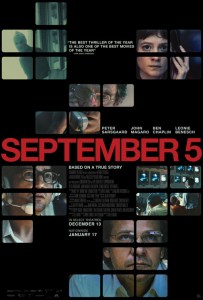 With September 5, we remain almost entirely in the control room of ABC Sports as they cover the fateful 1972 Munich Olympics after the Israeli athletes are taken hostage by terrorists. It’s a subject covered in plenty of other movies, including Steven Spielberg’s Munich and the 1999 Oscar-winning documentary One Day in September, but now we’re watching it from the perspective of the journalists thrust into the spotlight to try and cover an important and tragic incident as it plays out by the hour. It’s an interesting perspective and gives voice to several thorny ethical issues, like when the news team is live broadcasting an oncoming police assault, which the terrorists can watch and prepare for as well. The movie is filmed in a suitable docu-drama style and the pacing is as swift as the editing, and that’s ultimately what holds me back from celebrating the movie more. It’s an interesting anecdote about media history, but September 5 fails to feel like a truly insightful addition to the history and understanding of this tragedy. It’s so focused on the people in the studio and restrained to this one day that it doesn’t allow for us to really dwell or develop in the consequences of this day as well as the consequences of their choices on this fateful day. The movie feels like a dramatization of a select batch of interviews from a larger, more informative documentary on the same subject. It’s well-acted and generally well-written, though I challenge people to recall any significant detail of characters besides things like “German translator” and “Jewish guy.” It’s a worthy story but one that made me wish I could get a fuller picture of its impact and meaning. Instead, we get a procedural about a ragtag group of sports journalists thrust into a global political spotlight. There’s just larger things at stake, including the inherent drama of the lives at risk, than if they’ll get the shot.
Nate’s Grades:
Saturday Night: C+
September 5: B
Share this:

Dog Man (2025)
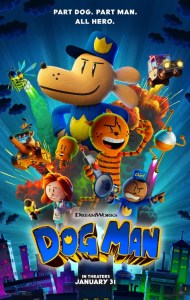 I probably wouldn’t have as much familiarity, and good feelings for the Dog Man series of books had I not become a father to a Dog Man-obsessed kiddo. The silly and imaginative comic books by Dav Pilkey, creator of Captain Underpants, are easy to enjoy with their upbeat tone, sly satire, and whimsical child-like art style. The movie is essentially all that you would want in a Dog Man movie, replaying some of the more famous stories and images and characters from some of the books. Dog Man is born when a police officer and his trusty canine sidekick get into an explosion and have their bodies surgically attached to one another becoming the ultimate crime fighter/man’s best friend. Dog Man has to battle villains like Petey (voiced by Pete Davidson), an evil cat genius, and Flippy (Ricky Gervais), a super intelligent fish with telekinetic powers as well as impress the always harried Chief (Lil Rel Howery). It’s a movie aimed squarely a children without any larger themes beyond life lessons about basic responsibility and empathy, important lessons but ones simplified and aimed at is target audience. The pacing and jokes are swift and the vocal cast is each well suited to the task, with Davidson being an inspired choice for the easily flummoxed and dastardly Petey. The material where Petey makes a child clone of himself and basically learns about parenthood is the best part of the books and could have been explored further in the movie. Still, it’s a low-stakes and goofy movie that mostly succeeds at channeling the appeal of the books. If you’re a Dog Man fan, or the parent to one, then the movie may be everything they wanted, though even at 80 minutes much longer than most bedtime reads.
Nate’s Grade: B-
Share this:

A Real Pain (2024)
 A funny, poignant, and surprisingly gentle movie about two cousins going on a journey to retrace their family history and honor that legacy while trying to reconcile their privileged connection to that past. Written and directed by Jesse Eisenberg, who also stars as David, a generally normal family man traveling with his much more jubilant and troubled cousin, Benji (Kieran Culkin). They’re on a tour through Poland and visiting infamous Holocaust historical sites, ultimately finding their grandmother’s home she fled so many decades ago. The cousins are dramatically different; David is timid and anxiety-ridden, and Benji is the life of any party, an impulsive yet charming people-person. The tour is meant to draw them closer together, to each other, to their shared historical roots, but it might also make them realize what cannot be reconciled. This is an unassuming little movie about a couple characters chafing and growing through their interactions, getting a better understanding of one another and what makes them tick. It’s really the Benji show, and Culkin is terrific, effortlessly charming and funny but with a real tinge of sadness underlying his garrulous energy. There’s real pain behind the surface of this character that he’s trying so hard to mask, though it appears in fleeting moments of vulnerability. Benji causes the various characters along the tour to think differently about their own situations, their own connections to the past, including his cousin, and ultimately makes the journey feel worthwhile. At a tight 90 minutes, A Real Pain is a small movie about big things, and Eisenberg has a nimble touch as writer/director to make he time spent with strangers feel insightful and rewarding.
Nate’s Grade: B+
Share this:

Snack Shack (2024)
 The coming-of-age sub-genre is a familiar and well-worn formula, but with the right filmmaker and voice, it can become refreshingly alive once again, like hearing your favorite song covered by an exciting different artist. Snack Shack is an exuberantly charming movie about one summer with 14-year-old best friends who are constantly running money making schemes and hustles. They overbid to run the concession stand at their community pool, but the best buds are entrepreneurial whizzes and turn the snack shack into a smashing success. There’s plenty of familiar genre elements, from bullies, parents they’ll have more appreciation and understanding from at summer’s end, parties and self-discovery, crushes and jealousies that will test their limits of loyalty; there might not be anything new during these 110 minutes, but it’s the nostalgic authenticity and verve from writer/director Adam Carter Rehmeier (Dinner in America) that makes the movie shine. The movie is practically bristling with details that feel so well-realized and genuine. You’ll enjoy spending time in this world and with these characters, reliving the summer of 1991 in Nebraska. Gabriel LaBelle (The Fabelmans) is fantastic as Moose, more the live-wire, always-smiling, charismatic smooth-talker of the two friends. Every second he’s onscreen makes you inch closer to the screen. I don’t think some of the downer plot turns late in the movie feel like a fit and are there to form the Hard Truths experiences meant to shake the innocence of youth. For a movie this jubilant and sunny, it feels like an abrupt tonal swerve that’s more deferential to genre expectations than the previous vibe of the movie. Despite some minor missteps, the good times cannot be thwarted and Snack Shack is a funny and refreshingly retro peon to being young.
Nate’s Grade: B+
Share this:

Hundreds of Beavers (2024)
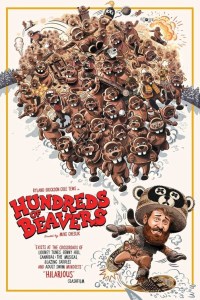 It’s become a cliche for film critics to say, “you’ve never seen a movie like this,” and that’s only partially true with the DIY indie comedy sensation, Hundreds of Beavers. You may have seen this before though decades ago in classic Looney Tunes cartoons, a clear inspiration for the inventive visual slapstick and antic comedy imagination on full display. The commitment of the cast and crew to make a modern-day Looney Tunes is so rare and the results so amazingly executed that when I questioned whether we needed a full movie of this rather than a short film, I cast aside the question and chose to simply enjoy the fullness of the movie. Why scrimp on imagination and ingenuity and divine wackiness for only fifteen minutes when we can have one hundred? If you’re a fan of inspired slapstick comedy, and especially the Golden Era of classic cartoons (1944-1964), then Hundreds of Beavers will be a celebratory experience that could boast hundreds of laughs.
Set amid the early 1800s in the Wisconsin winter, Jean Kayak (Ryland Brickson Cole Tews) is a frontiersman trying to make a name for himself. He wants to be the best fur trapper in the land, and if he nets enough furs, he’ll be granted the chance to marry the pretty daughter (Olivia Graves) of the local Merchant (Doug Mancheski). And with that, the rest of the movie is watching Jean try to outsmart the wildlife (portrayed as people in giant mascot costumes) and collect enough pelts.
 By the nature of its premise and intention, this is not going to be a movie for everyone, or even many, but if it’s for you, it will feel like comedy manna from heaven. The grand appeal of Hundreds of Beavers is the sheer surprise of it all, with the jokes coming fast. The pacing of this movie is at spoof-movie levels, with jokes hitting in weaves and often, complete setups and punchlines taken care of in under ten seconds. The joke-per-second ratio of this movie is off the charts, especially when the movie also begins building its own internal logic and foundation for running gags. That creates an even deeper and richer tableau for comedy, with jokes piling on top of one another and building escalations and extensions. I’m genuinely amazed at the creativity on display in every minute of this movie. The fantastical imagination of this movie could power an entire Hollywood studio slate of movies. I was in sheer awe of how many different joke scenarios it could devise with this scant premise, and I was happily surprised, no, elated, when the filmmakers kept this level of silliness and invention going until the very end of the movie. I was chuckling and guffawing throughout, and I strongly feel like this is the kind of movie that, if you watch it with a group of like-minded friends, can produce peals of infectious laughter.
I really want to celebrate just how whimsically silly this movie can be, with humor that ranges from clever to stupid to stupidly clever. Much of the humor resides around the death and mutilation of animals, which isn’t surprising considering our hero’s goal is to gain hundreds of pelts. It never stops being funny seeing people dressed in giant animal mascot costumes to represent the wildlife, and when they’re killed through the assortment of different means and accidents, the movie adopts classic cartoon visual communication and logic by giving them large X’s covering their eyes. Even when the creatures are losing heads and limbs and getting impaled or giant holes blown through them, the lightness of approach keeps the violence from feeling upsetting or realistic. It’s all just so silly, but that doesn’t mean that it’s not sneaky-smart from a comedy standpoint. There’s one scene where Jean is riding a log down a flume inside a giant wood-harvesting plant the beavers have constructed. A rival log with angry beavers chases him in parallel, and it looks like they’re just about to jump onto his log and grab him. However, they jump but seemingly stay in place, and that’s where the movie cuts to a different shot from a wide angle, to reveal that there are four or five of these flumes running parallel and not merely two. The joke itself is only a few careful seconds, like most of the jokes in Hundreds of Beavers, but it demonstrates the level of thought and ingenuity in the comedy construction, and that’s even before spaceships and beaver kaiju.
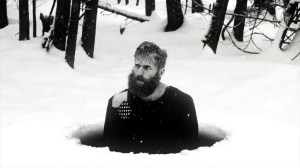 The acting is fully committed to the exaggerated and cartoonish tone of the proceedings. These actors are selling the jokes tremendously well, and since the movie is practically wordless, most of it comes from physicality and expression. It hearkens back to the early silent era of moviemaking by the likes of Buster Keaton and Charlie Chaplain making millions laugh. Even the smallest roles are filled with committed actors helping to make the jokes even funnier. The people in those mascot costumes can be riotous simply in how they slump their body, cock their head, choose their pauses and gesticulations. Watching the movie is a reminder at how universal comedy can be when you have the right people who understand the fundamentals of finding the funny. Tews, also serving as co-writer with director Mike Cheslike (L.I.P.S., The Get Down), is our human face for much of the mayhem, and he can play bedeviled and befuddled with flair. His facial expressions and exaggerations are a consistent key to framing and anchoring the tone of every moment.
While the budget is a relatively modest $150,000, it doesn’t mean the movie looks pedestrian. Choosing to film in black and white helps mask some possible limitations, and the creative choice to go with people in giant mascot costumes helps too, but much of the movie is elevated by its clever green screen effects work. Whether it’s augmenting the snowy outdoor wilderness with exaggerated elements, like traps and contraptions and holes in ice, or segments filmed entirely on green screen and utilizing heavy composites to magnify the number of animals on screen, it all better fulfills the vision and tone. The finale inside the beaver complex is a wild sequence reminiscent of Marvin the Martian landscapes and interior design. The look of the movie, while rough around the edges at points, leans into its lo-fi aesthetics to make it part of its charm, much like the goofy mascot costumes. The continued goofiness doesn’t cancel out the visual audaciousness, even when that audacity is in the guise of creating something so stupid for words.
 I would advise anyone to give Hundreds of Beavers a try, even if for only ten minutes. If you don’t connect with the film’s comedic wavelength or appreciate the ingenuity of the players, then so be it. But I think more than enough will be charmed and impressed by its energy and creativity. I said before that there was once or twice, during the first half, that I questioned whether we needed a feature-length version of this kind of movie. Then it occurred to me how rare such a movie like this is, how singular its vision can be, and how instead of questioning its duration, I then chose to celebrate its cheerful existence, and every new joke was a new opportunity to produce smiles and laughter, and I anxiously waited for the next and the next, my smile only broadening. Hundreds of Beavers is one of the craziest movies you will see but it’s also, at its core, a celebration of comedy and collaboration and the special appeal of moviemaking and those with a passion for being silly. In these trying times of uncertainty, I’ll take a feature-length dose of that, please and thank you.
Nate’s Grade: A
Share this:

Anora (2024)
 The critically-anointed Anora is the indie of the year, winning top prize at the Cannes Film Festival, the first for an English-speaking movie in over a dozen years, and poised to be a major awards player down the stretch, some might even say front-runner for top prizes. It starts like a deconstruction of Pretty Woman, with Mikey Madison (Scream 5) playing Anora, a stripper who recognizes the advantageous possibilities flirting with a young rich Russian scion, Vanya. He wants her to be his girlfriend, and over a sex-fueled week, he’s so smitten that he wants to make Anora his wife. This whirlwind relationship hits the wall, however, once Vanya’s family inserts themself into his life, determined to annul the hasty marriage at all costs.
The movie becomes infinitely better at the hour mark when the exasperated extended Russian family comes into the picture. You worry they might be menacing, as they don’t want this stranger with access to the family wealth, but they’re far more bumbling, and Anora transforms into an unexpected comedy. It certainly wasn’t an authentic romance. Clearly Vanya was a meal ticket more than a three-dimensional romantic interest. The kid is an immature, annoying dolt, so we know Anora isn’t legitimately falling in love with him. The scenes of them building a “relationship” could have been cut in half because we already understood the nature of the two of them using one another. The last hour makes for a greatly entertaining turn of events as the unlikely and bickering posse searches New York City for a runaway Vanya. The movie feels propulsive and chaotic and blissfully alive. Ultimately, I don’t know what it all adds up to. Anora isn’t really a sharply drawn character, but none of the characters are particularly well developed. The pseudo-romantic fantasy of its premise, becoming a “princess” of luxury, isn’t really deconstructed with precision. It’s an unexpectedly funny ensemble comedy at its best, but I’m left indifferent to what other value I can take away. It’s well-acted and surprising, but it’s a vacuous side excursion made into a full movie that somehow has bewitched movie critics into seeing more. Perhaps they too have become overly smitten with Anora’s surface-level charms.
Nate’s Grade: B-
Share this:

Harold and the Purple Crayon (2024)
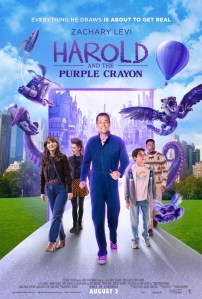 As an elder Millennial, I’ll try and ignore my rising bile for what they did to my boy Harold here, and I’ll simply ask who was this movie for? The big screen adaptation of the classic 1955 children’s book by Crockett Johnson that celebrates the power of imagination is a mishmash of mawkish feel-good family nonsense, fantasy power wish-fulfillment, and grating fish-out-of-water comedic antics. Increasingly missable actor Zachery Levi (Shazam!) plays yet another glorified man-baby, this time as an “adult” Harold who ventures into the Real World to search for his narrator, essentially the god of his purple-hued universe. He befriends a lonely boy with a big imagination and the kid’s single mom (poor Zooey Desceanel) and life lessons are learned while “adult” Harold makes a mess of just about everything as he leaves behind chaos and disaster. Eventually Harold has a full-on wizard duel against a villainous librarian and wannabe published fantasy author played by Jermaine Clement. That’s right, Harold and the Purple Crayon transforms into a magic battle over the fate of the all-powerful ring, I mean crayon. Making matters worse is Levi’s hyperactive schtick that has been growing stale for years and is tiresome and annoying throughout the movie. It’s also quite ironic, and phony, that a movie expressly proclaiming the power of individuality and imagination is so thoroughly and depressingly generic. This should have been animated or left alone, period.
Nate’s Grade: D+
Share this:

Beetlejuice Beetlejuice (2024)
 Usually sequels over thirty years later reek of desperation, trying to rekindle the past while usually only hoping to tickle people’s fading sense of nostalgia. Rare is the 30-year-plus sequel that excels by breaking free of its imitator and making us see the original in a new light. It helps to keep your expectations in check, especially for a project that is so miraculous as the original 1988 Beetlejuice. What a wild movie that was, an introduction to horror comedy for a generation, and a near-perfect balance of creepy, silly, and imaginative. From director Tim Burton’s career-launching sense of style, to Michael Keaton’s electric comedic performance, to Danny Elfman’s outstanding score, to the stop-motion visuals, fun and freaky makeup effects, and you had a madcap movie that felt like a unique discovery. Recreating that is near impossible, but if Beetlejuice Beetlejuice can recreate some of the elements and feelings that made the original what it was, then it can be considered a modestly successful late-stage sequel.
Lyrdia Deetz (Wynona Ryder) has become a long-running host of a paranormal TV talk show connecting people with messages from loved ones from beyond the grave. Her teenage daughter, Astrid (Jenna Ortega), is moody and embarrassed by her mother, feeling that she “sold out.” Mother and daughter return back to Connecticut to attend the funeral of Charles Deetz, Lyrdia’s father. Her pretentious and snippy stepmother, Delia (Catherine O’Hara), is trying to better commune with his spirit, and the entire town has become famous for its spooky seasonal history. Meanwhile, Beetlejuice (Keaton) is trying to avoid his former wife, Delores (Monica Bellucci), who naturally is seeking to obliterate him to ectoplasm. He’s still got his sights set on Lydia, who spurned his marriage hopes, and might be able to manipulate the Deetz family back into his control.
 Beetlejuice Beetlejuice gets the closest to rekindling that lightning-in-a-bottle alchemy from the 1988 original, serving as an appealing and enjoyable sequel. Nothing will ever be as original and wild and such a discovery as that first movie, which serves as a point of entry for many a Millennial fan who discovered that irresistible Tim Burton Neo-Gothic aesthetic. However, it recreates enough of the qualities that stood out about the original. The skewed sense of humor and surreal visuals, as well as goofy slapstick and vibrant imagination about life after death, it’s all such a fertile playground for Burton’s visual charms. The genius of the original was telling a ghost story from the ghost perspective as they learned about how to be better ghosts to try and scare their new living owners away. Given the world of the dead, there’s such tremendous storytelling and world-building possibilities here, explored richly in the animated 90s series for kids. Further stories in this universe have an automatically appealing power, and it’s just nice to watch Burton apply his specific aesthetic again, something fans haven’t really seen since 2007’s Sweeney Todd. I appreciated the weird morbid details and the practical production values; the Alice in Wonderland movies have shown that the “Burton look” isn’t best complimented by massive green screen sets. Having Burton, the “Burton look,” the original actors, with some exceptions (more on that later), and enough of that offbeat, chaotic, morbid tone return is a victory.
Beetlejuice Beetlejuice doesn’t so much alter our understanding of the world of the dead as established; it doesn’t radically rethink the landscape but it doesn’t repeat the same plot events either. I really liked the evolution of the adult Lydia as a jaded TV host. There’s a real dramatic punch to the reality that she sees the dead but has yet to see her deceased husband. She is incapable of reuniting with the man she misses the most, and she doesn’t know why. That yearning, paired with a lingering thematic mystery, can be a palpable storyline to explore. Pair that with some three generations of Deetz women trying to understand one another and work through personal resentments and we have fertile narrative ground. The three women were my favorite part of the movie, and their interactions and reflections on parenting and the challenges of trying to better understand one another are the foundation of the movie’s sense of heart. I really enjoyed the dynamic between the three, significantly upping Delia’s screen time and finding room to give her more dimension, an artist struggling in the wake of her grief. I’m a bit surprised that Ortega’s character isn’t more central to the drama. For all intents and purposes, she’s Lydia 2.0, so butting heads with Lydia 1.0 I guess feels redundant, so the story sends her off to find a cute boy in town and use that as an excuse for several unexpected needle-drop song use. There’s something inherently wrong watching a Tim Burton movie and hearing contemporary music. Imagine the Beetlejuice “Day-O” singalong but to, say, Sabrina Carpenter instead. No.
 Beetlejuice, as a character, is such an exciting agent of chaos, a horny ghost who operates on the same tonal wavelength as a Looney Tunes cartoon character. Even though the original movie is named after the guy, he’s only in the film for approximately twenty percent. Keaton was absolutely incredible in his comedic bravado, creating much of the character through his ad-libs and hair and makeup choices. Keaton is still fantastic in this go-for-broke sort of performance, a performance we’ve seen far less as he’s settled into a respectable dramatic acting career. It’s hard to remember, dear reader, but when Keaton was initially cast for Burton’s Batman, the fan base at the time was up in arms, considering Keaton more of an un-serious funnyman. It would have been easy to have Beetlejuice front and center for the movie, so it’s admirable that Burton and Keaton decided to keep his on-screen appearances short, leaving people wanting more. There’s a late turn of events that pairs Lydia and Beetlejuice together, and I wish this fractious pairing had been the bulk of the movie. The whole enemies-to-uneasy-allies would have put much more emphasis on their character dynamic and the comic combustibility. Still, seeing these characters come back and retain their appeal and personality without obnoxious pandering is welcomed.
The screenwriters find a clever solution for the Jeffrey Jones Dilemma. For those unaware, Jones, who portrayed Lydia’s father in the original, and best known for pugnacious supporting roles in movies like Ferris Bueller’s Day Off, Howard the Duck, and HBO’s Deadwood, was charged with soliciting a child for sexual exploitation. The movie continues with the character of Charles Deetz but without the involvement of Jones. The character gets his top eaten by a shark, so for the rest of the movie he’s a walking half of a corpse with a mumbly voice. It’s a clever way to include the character without the need for the actor.
With that decision to limit the Beetlejuice quotient of Beetlejuice Beetlejuice, it makes for a sloppier movie juggling a few underwritten subplots and side characters. The biggest non-factor is the return of Mrs. Beetlejuice. Here is a powerful antagonist who has the literal ability to suck out the souls of the recently dead and turn them into shriveled husks. She’s seeking vengeance against her ex and tracking him down through the netherworld. And yet, she could be completely eliminated from the movie without really affecting the other storylines. The whole Mrs. Beetlejuice/vengeful ex-wife character feels like a holdover from a different sequel script, clumsily grafted onto this other project, a vestigial artifact of another path not taken. There’s plenty of potential with the concept of the past victims of Beetlejuice coming back to seek retribution, and especially a trail of angry former lovers. It would explore the character’s history more meaningfully than an albeit amusing silent film interlude about how he married her during the era of the Bubonic Plague. We see how he died as a human, but there’s hundreds of years that can be illuminated from his failed schemes and odd jobs. Certainly there could be a whole club of ax-grinding malcontents sharing their mutual hatred of the Ghost with the Most. This character should better reflect Beetlejuice, and instead she’s just a monster on the prowl that eventually gets indifferently cast aside. It feels like Burton was looking for something for Bellucci to portray (Burton and Bellucci have officially been dating since 2023).
 She’s not alone as an antagonistic villain that pops up to provide momentary danger but is also hastily resolved to the point that it raises the question why they were even involved. There are three antagonists, not counting Beetlejuice, that appear throughout to threaten our Deetz family members in Act Three, each of them individually interesting and targeting a different member of the family for ill-gotten gain. Yet each one of these characters is conquered so easily that it nullifies their importance and overall threat. If Beetlejuice could, at any moment, just open a trapdoor to hellfire at a moment’s notice, what danger does any other character pose then? If a sand worm can just appear from nowhere and consume our pesky antagonist, then why can’t this be a convenient solution earlier? The defeats feel arbitrary, which make the antagonists feel arbitrary, which is disappointing considering that we have the full supernatural arsenal of undead possibilities to tap into. I enjoyed these characters for the most part, but it’s hard not to feel like they’re tacked-on and underwritten. The same can be said about Willem Dafoe’s police chief, a former actor who played a chief on TV and now tries to fill the role for real after death. I’m always glad to have more Dafoe in my movies (woefully underrepresented in rom-coms, you cowards!) but he’s just mugging in the corner, waiting for some greater significance or, at minimum, more memorably morbid oddity to perform.
Beetlejuice Beetlejuice is better than a desperate sequel cash-grab, though there are elements, ideas, characters, and jokes that could have been smoothed out, better incorporated, and developed to maximize the potential of the undead setting. It’s an enjoyable throwback for the fans of the original that does manage to tap into enough of those potent elements that made the original so memorable. It’s definitely less edgy and transgressive, maybe even a little too safe given the territory of spooky specters; the entire Soul Train bit felt like a bad Saturday Night Live sketch from the 1980. However, it’s still got enough of the charm and silliness to leave fans, old and new, smiling and wondering where it might go next in its wild world.
Nate’s Grade: B


 nathanzoebl
You must be logged in to post a comment.