Blog Archives
Be Kind, Rewind (2008)
 Be Kind, Rewind is a celebration of the love of movies and moviemaking, but it wants to shoot for a deeper message and stumbles. When the movie concentrates on remaking famous movies like Ghostbusters, Robocop, and Rush Hour 2, the movie has a ramshackle charm and great comedic spirit. When the film strays to tell a tale about community pride is when the movie gets dull and leaden. The concept of cheap, quick, homemade versions of Hollywood movies (the YouTube-ification if you will) is fun and Jack Black and Mos Def are definitely having fun in the process. But the movie has too many other elements that just don’t work together. The history of a local jazz legend feels awkward and bogs down the movie’s enjoyment. Director Michel Gondry can only do so much with his quirky visual sensibilities before you start to get bored. Be Kind, Rewind is occasionally entertaining and works best when it’s ripping off other movies than trying to stand on its own merits.
Nate’s Grade: C+
Share this:

Over Her Dead Body (2008)
 This is abysmal comedy from beginning to end. It peaks in the second minute when Eva Longoria’s shrewish character is killed by a large angelic ice sculpture. It’s all down hill from there, my friends. Longoria stars as a deceased bride who won’t let her still-living fiancé (Paul Rudd) find happiness. The bland comedy could have more accurately been retitled, “Cockblock from Beyond the Grave” (it was at one time titled Ghost Bitch). I have no idea why Rudd is apart of this travesty and seeing him do his trademark smirk and shoulder shrug just made me weep. The comedy is nails-on-the-chalkboard obvious. There is nothing smart, clever, or interesting within any of this movie’s 95 minutes. Writer Jeff Lowell (John Tucker Must Die) felt the need to direct as well because surely there was no one else on this planet that could handle this. Longoria is powerfully obnoxious and egotistical until her last-minute personal epiphany that others deserve to be happy too. What did Rudd ever see in this ghost bitch?
Nate’s Grade: D
Share this:

Disaster Movie (2008)
 Writers/directors Jason Friedberg and Aaron Seltzer couldn’t leave well enough alone. I had become accustomed to these two tainting the beginning of a new year with their deeply unfunny “spoof” movies. In February 2006, they released Date Movie, in January 2007, they released Epic Movie, and in January 2008, they released Meet the Spartans. One cinematic blight wasn’t enough for these two and so, on the third anniversary of Hurricane Katrina striking the Gulf Coast, these sultans of suck have unleashed the appropriately titled Disaster Movie.
I won’t even dignify this movie with a plot synopsis. To do so would acknowledge there was at any point a script. They even make fun of Oscar-winning Juno scribe Diablo Cody’s writing. That’s like George W. Bush mocking Barack Obama’s eloquence.
By pacing their horrible comedies a year apart, Friedberg and Seltzer at least have time to gauge what movies have become popular and what pop culture events have stuck in the public consciousness. But Disaster Movie was put on the fast track and was in production before many of the movies it deems worthy of attack were even released. As a result, it seems that the fail twins were watching trailers for upcoming movies and hedging their bets on what would be popular. This explains why they mention movies that made no cultural impact and flopped at the box-office, like Speed Racer and The Love Guru. Seriously, a “funny” reference to a bad Mike Myers movie months after it has opened and closed is, in itself, kind of humorous in how ridiculous and embarrassing this all is. Once again, Friedberg and Seltzer have assembled a highly disposable pop-culture yearbook except this time they took bets on what would be meaningful. Is anyone going to even get a reference to Jumper? How about in a few more months? Yet again Friedberg and Seltzer have assembled a movie that has a built-in expiration date.
 As expected, Friedberg and Seltzer apply their shallow level of comedy to the movies caught in their crosshairs. These guys simply don’t understand the difference between reference and parody, and once again they deluge an audience with cheap references to other movies and the reference is designed to be the joke. Just having a character appear as the Hulk isn’t funny. Having a character appear as the Amy Adams character from Enchanted isn’t funny. Friedberg and Seltzer don’t even mock the disaster movies befitting its title, like The Towering Inferno, The Poseidon Adventure, or the more recent Day After Tomorrow. The only partially relevant movie they make reference to is Twister because it affords them the opportunity to drop cows on characters (if it’s not funny once, it’s not funny the thousandth time). Disaster Movie cycles through a mix of movies from the fall of 2007 to last summer, including Juno, 10,000 B.C. (a film worthy of parody by smarter people), No Country for Old Men, Sex and the City, Superbad, Beowulf, Wanted, Indiana Jones and the Kingdom of the Crystal Skull, Prince Caspian (another movie that faded quickly), and others. Friedberg and Seltzer mix in attacks on pop culture figures like Jessica Simpson and Amy Winehouse, simplifying each to a one-joke premise (Amy Winehouse is drunk, never heard that one before). But wait; to prove how in touch they are, Friedberg and Seltzer have used their SECOND SPOOF MOVIE OF THIS YEAR to include jokes about Michael Jackson being a pedophile. Oh my good graces, how do these guys come up with such cutting-edge and timely material in the year 2008?
You want to know how truly terrible Friedberg and Seltzer are as filmmakers? Disaster Movie is the film debut of socialite and tabloid queen Kim Kardashian. This woman is known for one thing and that thing is her thang, namely her posterior. Friedberg and Seltzer fail to make even a single joke about Kardashian’s notable assets. Not only that, from a pure exploitation angle, they even fail to take advantage of Kardashian as a sex object.
 To honor Friedberg and Seltzer recycling the same garbage and calling it by a different name, I will stop writing about their newest example of cinematic ineptitude and simply copy and paste sections of my review for this year’s Meet the Spartans. Enjoy my attempt at Mad Libs style film criticism.
“Writer/directors Jason Friedberg and Aaron Seltzer are, and I do not say this lightly, the worst filmmakers of all time. They are worse than Ed Wood, they are worse than Uwe Boll, they are worse than Harold P. Warren, who wrote and directed the worst movie of all time, Manos: The Hands of Fate, because of a bet that he couldn’t make a movie (I’m fairly certain he still lost). Friedberg and Seltzer are the antithesis to funny. They mock funny, they spit at funny. [DISASTER MOVIE] is their [FOURTH] spoof in three years, or, as I see it, their [FOURTH] miscarriage of comedy.
[DISASTER MOVIE] would be hard-pressed to fit the definition of a movie, no matter how generous you are with the term. True, it is a collection of moving pictures, but surely we must have greater stipulations for our movie going entertainment. The actual flick is only [75] minutes long, barely a little over an hour, and then it’s crammed with 15 minutes of outtakes and needless extra scenes to be strewn over the credits [INCLUDING AN ALREADY PAINFULLY DATED PARODY OF SARAH SILVERMAN’S SONG “I’M F***ING MATT DMAON,” ALTERED TO PG-13 FRIENDLY LYRICS ABOUT “DATING” MATT DAMON]. I should be more upset by the total transparent laziness to even construct a film of suitable length, but every minute I was spared more of this junk was an act of divine mercy.
Friedberg and Seltzer are not filmmakers but regurgiatators, wildly lampooning anything that they feel approaches their young teen male demographic. [DISASTER MOVIE], like Epic Movie and Date Movie, cannot be classified as a “spoof” because all the film is doing is setting up references and the references are supposed to be the joke. The film is like a meaningless and random scrapbook for the year in pop culture; the film’s only function to pacify total idiots with attention-deprivation issues.
And yet, astoundingly, the movie still feels like it needs to set up its dumb, obvious gags. The film has one [PERSON] point off screen and say, “Look, it’s [HANNAH MONTANA],” and then we cut to [HANNAH MONTANA CRUSHED BY A ROCK]. Why did Friedberg and Seltzer feel the need to name check? It happens again when [A CHARACTER POINTS AND SAYS, “HEY, IT’S ALVIN AND THE CHIPMUNKS”]. I don’t need a handicap for non-obscure pop culture bon mots.
 From a production standpoint, this movie looks really cheap. The sets and costumes and props look horrible, like something a high school production would ditch. Just because it reuses the same camera setups as [ANY MOVIE] doesn’t mean it gets any closer to parody. For God’s sake, they couldn’t even come up with puns on character names.
The actors all seem mildly embarrassed and they do nothing with their roles. It’s not their fault the material sucks so deeply, however, it is Electra’s fault for appearing in her [FOURTH!] straight Friedberg-Seltzer spoof fest. The key to a good spoof is to play the damn thing straight. It’s annoying and redundant if the film keeps winking back at the audience.
[DISASTER MOVIE] is pop culture vomit. No, this is worse, this is cinematic diarrhea. It’s watery pop culture discharge masquerading as entertainment. This movie if offensive to anyone that appreciates laughter. This film and its ilk are offensive to mankind. And plus, it’s just not funny people, not in the slightest. There’s no wit here, no comedic payoffs, no running gags (besides gay jokes [AND COWS FALLING ON PEOPLE, HE HE HE]), no thought or upheaval of convention; instead, this movie is a lazy, cheap catalogue of pop culture events. Even at [90] minutes (really it’s [75]) this thing drags and feels exhausted long before it bows out. Just as I said in my review of Epic Movie, Friedberg and Seltzer must be stopped at all costs if comedy is to survive.”
In short, don’t see it and punch anyone in the face that ever thinks of seeing Disaster Movie.
Nate’s Grade: F
Share this:

Hamlet 2 (2008)
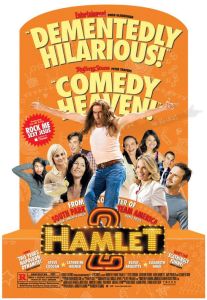 Believe it or not, there actually is a sequel out there about William Shakespeare’s most famous play concerning family dysfunction. Author David Bergantino surely doesn’t feel that he can improve upon the Bard’s classic Hamlet, but Bergantino is a writer who doesn’t cower from a challenge, like where to go next when all the main characters are dead. That’s why Bergantino took it upon himself to write Hamlet II: Ophelia’s Revenge (no joke). Apparently modern students at Globe University are playing out a family squabble very similar to anyone that has taken a high school literature class. The synopsis over at Amazon.com says it better than I could ever hope:
“When he unexpectedly inherits a creepy old castle in Denmark, Cameron tries to put his worries behind him, inviting his girlfriend and college buddies along on an overseas trip to check out the gloomy fortress. The plan is to get some serious partying done. Too bad nobody counted on the ghost of a drowned girl rising from her watery grave with vengeance on her mind! Now the only question is: to die or not to die?”
In the wake of Hamlet 2, a popular comedy at the Sundance Film Festival, I pity Bergantino. The man is going to be the Leif Ericson of pointless Shakespeare sequels: forgotten by history at the original pioneer. The film Hamlet 2 follows the miserable life of Dana Marschz (Steve Coogan). He teaches drama at a Tucson, Arizona public school and barely gets paid. His wife (Catherine Keener) is anxious to get pregnant and convinced Dana is shooting blanks. The couple is so poor that they have to rent out their home to a boarder (David Arquette). His drama class has two very WASP-y pupils (Phoebe Strole and Skyler Astin), but the rest are disinterested Hispanic students bused in from another school district. The school’s theater critic chides Dana’s laughable productions of Hollywood movies, like Mississippi Burning and Erin Brocovich. Then comes the news that drama has been slashed from the school budget. The pint-sized theater critic tells Dana to try something original to save the drama department. The answer? Hamlet 2. Thanks to a time machine, and Hamlet’s new best buddy Jesus Christ, the pair can go back and save everyone who previously perished.
 Hamlet 2 is Coogan’s show and the British comic makes his character endearing sad-sack. His character is pathetic and subject to all sorts of personal humiliations, and yet Dana is so earnest that it makes it hard not to empathize with his exploits. Coogan has a wild leer to him that gives the character a manic edge of desperation. He’s a gifted comic but he’s used to playing smug, droll characters, and Dana Marschz is the exact opposite of that mold. Coogan’s many breakdowns and bouncy spirit give the material an extra lift. He works hard for every laugh. It’s a shame, though, that he sort of disappears into the background during the staging of his infamous play.
So what is the comedic point of view with Hamlet 2? Are we to laugh at Dana and find him a buffoon? Well if that’s the case, then why serve up a musical finale that’s actually worthwhile and completely hilarious? The production values are pretty extravagant given the money limitations on the characters. Not only that, it’s so bonkers that I wanted to just watch Hamlet 2 on stage and not cut back to life outside. I wanted to luxuriate in the inspired craziness of a musical that involves time travel, Shakespeare, Albert Einstein, the song “Raped in the Face,” the devil, the Gay Men’s Chorus, lots of father issues, and Jesus moonwalking over water. That’s way more interesting than the ho-hum characters interacting backstage. In truth, the play’s the thing and it’s way too short for my liking. The performance serves as the film’s payoff, so I wanted to get every crazy kernel of shameless joy. The “Rock Me Sexy Jesus” song is irresistible and I haven’t been able to get it out of my head for days. It’s so bouncy and fun and melodic. I’ll be walking along and then I’ll start humming the damn thing. I doubt that I will come across a catchier original song in movie this year. Hopefully those bigwigs in the Academy will realize the tune’s musical merits and give it a nomination it rightfully deserves.
Then is Hamlet 2 a parody of all those treacly teacher inspiration movies, the kind that seem to always be populated by tough minority kids who just need someone to take the time and break through to them? Well Dana constantly refers to Hollywood movies like they’re documentaries, and even a whole class lecture concerns Dangerous Minds. When he accidentally injures a student, Dana jumps at his students being alert and offers in summation, “Yes it was stupid but it was theater.” The movie takes some shots against the likes of Dead Poet’s Society and Mr. Holland’s Opus, but ultimately Hamlet 2 becomes yet another inspirational teacher movie. Dana is able to rally his students to the cause of theater, prejudices are broken down, and certain students take charge of their young lives. It’s all so predictable, and predictability blunts edginess and can destroy comedy. The only true genre tweak seems to come when standoffish Octavio’s background comes to light. He’s not the underprivileged wannabe gangster but a bright kid whose been admitted to an Ivy League school early. And his parents don’t object to the play because of “ethnic narrow-mindness” but because they think it’s poorly written.
 Like Dana’s students, the film never seems to match its potential. The concept is great and so is having a main character who is inspired by theater but profoundly inept at teaching it. Dana lacks talent but can it be made up for with such big-hearted enthusiasm? There is plenty of ripe material there, but Hamlet 2 doesn’t seem to fully realize the comedic possibilities. Watching Dana fight administration officials in the name of the arts is worthwhile conflict but it’s rarely funny. Keener seems wasted as Dana’s passive-aggressive wife. An ACLU lawyer (Amy Poehler) is a great political target, especially as she fights in the name of bad art, but she appears too late in the film to be really capitalized. The climactic staging of Dana’s masterwork is another example of not fully thinking out the comic potential of a situation.
Here’s a perfect example: Elisabeth Shue appears in the film as herself, actress Elisabeth Shue. She’s quit the acting business and taken residence as a nurse in Tucson. What exactly is the joke here? Is it that Hollywood has the habit of spitting out aging actresses? Dana’s students have no idea who Shue is. Is it self-parody? If it was self-parody then the filmmakers needed to give Shue more of a personality. She’s appears infrequently and beams a nice smile but that seems like the only demand, though I must admit always in her nurse outfit, a nice visual gag. If Hamlet 2 had spent more time in revision it would utilize the comic possibilities of integrating a real-life actress playing herself in such a remote city.
Ultimately, I don’t know what to make out of Hamlet 2. It’s a marginally funny and entertaining venture that celebrates the power of the arts, which is a noble cause. Coogan straps the production on his back and carries it as far as he can go. There are some decent laughs and the closing 15 minutes is a giddy blast. However, the movie often feels flat and simply odd, missing potential punchlines and settling for second-rate comedic situations. The crafty premise afforded better material then what eventually comes across onscreen. The whole thing also feels like a mild retread of Waiting for Guffman. But take heart, because Bergantino is not about to lose the spotlight just yet. He also has written A Midsummer Night’s Scream: Hamlet II (I have no idea where the two stories connect but that’s the genius of it). It’s only a penny at Amazon.com. Get it while you can. Or don’t. Preferably, don’t.
Nate’s Grade: B-
Share this:

Hancock (2008)
 Hancock is perhaps the first movie that looks at the consequences of being a super-powered do-gooder. I’m not talking the self-doubt or placing your loved ones in danger. I’m talking about money. A super hero can rack up super amounts of damage to a city, and the titular character often causes millions of dollars in destruction as he sloppily combats crime. In some ways, the super hero is more costly than the criminals. As you can imagine, the public at large isn’t too taken with Hancock (the film misses the opportunity to have neighbors worry their property values will plummet if Hancock moves into town). It’s too bad that Hancock, the film, doesn’t stay as original.
John Hancock (Will Smith) is a disgruntled man. He likes to drink, sleep, and keep to himself. Unfortunately, people keep bugging him for help. This may have something to do with the fact that Hancock is a man with the abilities of a super hero. He can fly, has incredible strength, and appears to be physically impervious, but that doesn’t stop criminals from emptying their guns at him. One gang learns firsthand the anger of Hancock when they destroy his whisky bottle. The city doesn’t know what to do with the world’s lone super being because he causes so much destruction. Ray (Jason Bateman) is a PR man fighting a losing battle to convince major corporations to donate supplies to needy countries for free. Hancock saves his life one afternoon and Ray decides to use his skills to give the irritable super hero an image makeover. He’s going to use Hancock to help change the world for the better. The plan to reform Hancock involves sending him to prison and waiting until the city begs for his assistance with rising crime. Ray’s wife, Mary (Charlize Theron), is wary of her husband’s super hero project. She just wants to live a quiet life with regular meatball madness dinners with her family.
 I think I’m already starting to get sick of super heroes and there’s still more to come this summer. There are several good ideas rolling around inside Hancock, but at a scant 92 minutes there’s little time to develop them. The movie takes off in a mildly satisfying manner but then botches the landing.
Smith’s considerable charms at put at odds with a character that resembles an ornery bastard. It’s a bit of a wink to the audience because no Hollywood studio would let the most popular international movie star release a super expensive summer movie where he begins and ends as a total jackass. The film seems to be tailor-made to Smith’s strengths, which still include his ability to naturally command attention and likeability. The idea of a lone super hero who drinks heavily, destroys personal property, and whom the public vocally dislikes is a sound idea and allows Smith and the filmmakers to explore certain realities not seen in other super hero flicks. The public griping over the methods Hancock chooses to save the day seems rather believable, especially when those methods usually involve heavy-duty collateral damage consequences. I like the idea that every time Hancock lands from flying he takes chunks of concrete or tar with him. There are several interesting ideas that come from the conflict between society and a super hero who would rather sleep off a hangover. I think the idea of paring a disgruntled super hero with an idealistic PR man is a great concept, benefited by Bateman’s sterling comic abilities fine-tuned from Arrested Development (where he also romanced Theron). I really enjoyed the interaction between Hancock and Ray. For a decent 60 minutes, Hancock is a passable super hero excursion lifted by Smith and Bateman’s chemistry.
Hancock starts with some promise but then goes in a completely different direction for its third act (let me just say this: there’s a reason they’ve been hiding Theron from any advertisement). The film also overplays its hand early. When Hancock and Mary first meet they hang on to each other, then she looks at him suspiciously and continues to, then she says some very leading dialogue that is a bit on-the-nose. All an audience needs is one award, penetrating look to understand that something is up. Hancock ends up feeling pulled in too many directions. It begins as a sly satire on super heroes and is mostly confined to jaunty comedy, but then the movie gets dramatic and grim and a bit hard to follow. The film begins as a jokey riff and then gets gritty, finding room to fit in mythology, religious questions, age-old racism about interracial dating, and a terribly clunky villain (Eddie Marsan) who breaks out of jail so that he can seek improbable vengeance against an immortal. Hancock’s origin is muddled and as preposterous as most other super heroes. The third act shift seems to drain all the fun out of the movie and it gets too serious, too confusing, and too convoluted (what’s the distance rule here between super people?). Hancock ultimately has too many chefs in the kitchen and becomes a mess.
 I’m sad to say but director Peter Berg really whiffs with this movie. His visual style is a hindrance to the film. I recently re-watched his first action film, 2003’s The Rundown, and Berg was able to craft stylish, highly playful action sequences without shaking the camera all over the place. A tripod served the film’s best interest and Berg tailored his visual style to the material. I expressed worry with his previous film, 2007’s The Kingdom, that Berg has become locked in to his handheld docu-drama style that bobs and weaves around his actors and employs numerous quick cuts and odd angles. His erratic style can improve and assist narratives but it can also hamper the storytelling. Nothing is really gained by Berg filming his tender moments at obtuse angles, extreme asymmetrical close-ups, and a hovering camera. It feels like a style completely unsuited for the material. I would have liked to fully watch the action sequences and enjoy the clever tweaks on the genre. Berg is an imaginative and underrated director, but his jittery docu-drama style he has embraced can also make his films seem cobbled together and overly rushed and, potentially, half-assed.
Hancock is much like the title character. It means well and wants to help but an audience can’t help but grumble about its methods. The concept of a super hero that is rejected by the people he saves is a subject ripe with subtext that could explore meaningful and insightful glimpses about guilt, the weight of expectation, the desire for human affection and acceptance, the frustration to be understood, the questions of personal responsibility and loyalty, and rejecting or heeding the call to do better. Hancock does not delve into any of these potent psychological areas. That’s fine, as long as the film delivers top-notch popcorn thrills and makes me forget about its wasted potential. Sadly, Hancock fails to deliver. The special effects are generally sub-par, the story misfires, and the whole film begins with promise but ends up turning into a mundane mess. Berg’s aesthetic doesn’t square with the material. Smith is still as charming as ever and will always be a genial presence onscreen, but Hancock turns into a movie that feels like a super hero hangover itself.
Nate’s Grade: C+
Share this:

Get Smart (2008)
 Get Smart was a beloved spy satire that aired on television from 1965 to 1970. Don Adams starred as Agent 86 and he bungled his way through scene after scene, oblivious to his shortcomings. The show was created by Mel Brooks and Buck Henry and maintained a genial, goofball appeal as it satirized James Bond style spy movies and tweaked Cold War paranoia. And as is written in stone by Hollywood, anything that was ever once on television must eventually become a big screen theatrical version. Get Smart already produced one unfortunate movie, 1980’s The Nude Bomb (which doesn’t sound too different from the U.S. Air Force’s plan to create a Gay Bomb — true story). I’m pleased to report that the big-budget modern Get Smart retains enough of the show’s flavor even while producing something with little resemblance to the source.
The updated Get Smart exists in a world not too different from our own (the president is still a boob). CONTROL is still in operation but secretly underground. Agent Maxwell Smart (Steve Carell) is an expert analyst who specializes in knowing the enemy and compiling 400-page reports. He’s failed the field agent test several times and desperately wants to get out from behind a desk. The Chief (Alan Arkin) says that he needs more men like Max. He gets his chance when CONTROL is attacked by KAOS. Many of the Agents identities have been compromised. The only agents remaining are the dashing and hulky Agent 23 (Dwayne “The Rock” Johnson), the svelte and beautiful Agent 99 (Anne Hathaway), a group of science techs (including Heroes‘ Masi Oka), the Chief, and newly appointed Agent 86, Maxwell Smart. KAOS, perhaps thanks to the end of the Cold War, has become a group of shadowy men making ties to terrorist groups worldwide. Siegfried (Terence Stamp) and his henchmen are aiming to sell nuclear devices to terrorists. Agent 99 and Max must travel across the globe to ensure that KAOS does not fulfill its villainous schemes.
 The plot is fairly workmanlike and it doesn’t really establish much in the way of an ongoing threat. As a result, the movie feels like it lives in the moment, going from gag to gag, but it just so happens that a decent number of those gags are funny. Get Smart is mostly a chuckler of a movie, sure to bring smiles and giggles but rarely hard, gut-busting laughter. I never found myself laughing too hard but I did find myself enjoying the time. Get Smart is a very amiable experience that manages to maintain a healthy level of silliness without ever falling victim to stupidity. It’s pleasantly goofy without becoming farce. Sure there is crude slapstick but the film, and Carell in general, manage to give them a slight edge that elevates them beyond your typical juvenile behavior. There may be a pee joke or a quasi-homophobic joke but Carell manages to make it worth your time.
The relationship between Carell and Hathaway provides significantly more interest than the ho-hum plot. The filmmakers find a clever way around the potentially unsettling reality of the age difference between Carell and Hathaway, who is nearly 20 years younger. The two have a spunky chemistry and their combative interaction elicits some of the most amusing laughs. Hathaway, with her doe eyes and dewy features, is just as eager and up to the task as Carell, so watching them spar and tease gives the movie a bit more juice. Kudos to the casting director because the cast is packed with capable comic actors that know when to seize the moment, and Arkin seizes every one of them (it seems that with every new film, my man crush on The Rock only grows greater).
The film is a hybrid of comedy and ramped-up action set pieces, and surprisingly they aren’t that bad. Director Peter Segal, who has directed three Adam Sandler vehicles, stages some fairly exciting action sequences with a decent degree of visual flair but the film overindulges on action. The movie should focus more on its cast of characters instead of loud, brash action sequences. It’s a little weird watching Maxwell Smart expertly shoot people like he went to a John Woo camp. The tones never fully match up, and Get Smart begins to feel like a comedy that thinks it?s a James Bond movie or an action film that thinks its overly absurd. The tonal struggle means that the comedy is handicapped by all the action interrupting and stalling the pace of jokes. There are times when Carell and Hathaway are firing one-liners at one another and then -WHAM!- they have to dodge bullets and kick bad guys. The stunts are impressive but I kept feeling a sense of disappointment when the action would cut short the momentum of the comedy. The spurts of action shortchange the humor. Segal’s direction is also blunt at times, so whenever a character thinks reflectively we have to witness a mash-up of past clips to visualize what the character is reflecting upon, in case our memories of a two-hour movie fail us while it’s still ongoing.
 Get Smart is greatly benefited by the considerable comic charms of Carrell. His Agent 86 isn’t so much incompetent as he is bumbling, but best of all the man keeps a gloriously self-deprecating and deadpan sense of humor from beginning to end. He doesn’t lack self-awareness, and is not ignorant of the feminine charms of his partner, and as a result this new version of Maxwell Smart ends up being, well, kind of smart. Carrell shoulders the film and is able to save lackluster gags by his sheer comic ability and immense likeability. The film doesn’t push the envelope in any regard but it also doesn’t condescend or try and flirt with being too clever for its own good. Thanks to Carell, Get Smart manages to be much more entertaining than it has any right to be.
Fans of the Get Smart TV show, such as myself, will find it hard to recognize the source material inside the big screen transformation. The filmmakers have turned a goofy satire of Cold War paranoia into a full-fledged summer popcorn action cartoon. The movie moves at a brisk pace, despite pushing toward the two-hour mark, and its screenplay is packed with enough enjoyably silly and smartly stupid jokes to guarantee a string of smiles. Like Carell’s 2007 entry Dan in Real Life, the movie presents such a jovial, good-natured spirit that becomes mildly infectious. You may roll your eyes a few times but you forgive and forget. Carell proves he is fast becoming one of the most capable and leading comics, and he proves yet again that his force of personality can elevate material that doesn’t meet his same qualities. I just wish that Get Smart had focused more on the yuks and less on gunplay and explosions. I guess, to quote a certain agent, you could say they missed it by that much.
Nate’s Grade: B
Share this:

Sex and the City (2008)
 A lady told me that the Sex and the City movie is like “the Super Bowl for women,” and I couldn’t agree more, especially with the way box office receipts are already shaping up. The smash TV show seemed to become its own brand, launching designer duds and trinkets into the mainstream for single women. I willingly saw the Sex and the City movie on opening night, and I must say it’s an interesting experience to watch the film with a packed house of estrogen. The woman next to me was on a roller coaster ride of gasps and tears, at once passing out tissue to others that she had planned ahead to bring. I was never much of a fan of the show. I found the humor to be pretty lazy and the characters to be somewhat annoying after so many episodes; truth be told, I think I can only watch three before having to walk away. I open this review detailing my biases but with that said, four years after the TV show’s finale, the Sex and the City movie feels like a deflated after party.
Carrie Bradshaw (Sarah Jessica Parker) is planning her life with her beau, Mr. Big (Chris Noth). They find a swanky Fifth Avenue apartment and he buys it for her, then she feels jitters about what might happen if they break up and she’s homeless. Naturally, this causes them to get engaged. Of course something goes wrong before the “I do’s” and Carrie must pick up the pieces of her life.
She has her three friends to reach out to. Career girl Miranda (Cynthia Nixon) is living with her husband Steve (David Eigenberg) and their son. She and Steve have had quite a dry spell when it comes to sex, and one day he strays and cheats on her. She feels violated and she immediately moves out. She won’t listen to Steve’s apologies. Charlotte (Kristin Davis) is happy with her husband and adopted Asian daughter. That’s really about it for her. Samantha (Kim Cattrall) is living out in L.A. managing her boyfriend, the hot actor Smith (Jason Lewis). She feels isolated and misses New York City. She also feels somewhat like a cat without her claws, as her sexy neighbor presents quite the temptation.
 Writer/director Michael Patrick King seems to have condensed an entire season into a movie. It feels like eight episodes packed together but with little central momentum to provide some form of cohesion. There’s no larger scope, not meat to this story, but King feels like he has a checklist of female “events”. So we get weddings, canceled weddings, fashion shoots, pregnancies, and lots and lots of shopping. Sex and the City ends up transforming into hard-core consumerist, female wish fulfillment pornography. The film is heavy with subplots and many of them feel like retreads that the TV show would have already covered and recovered after six seasons. The movie feels overly melodramatic and it isn’t much fun. Carrie spends most of the film moping and heartbroken; she spends a Mexican vacation intended to be her honeymoon in bed. Samantha has to spoon-feed her in order to get her to finally eat something. For some this will come across as moving and heartwarming, but for me it came across as pathetic. King’s idea of comedy doesn’t help. The jokes are pun-heavy and corny, and most sound like they should be followed by someone saying, “Badum dum dum, yeah.” When a film has to resort to a dog humping things over and over you know it has issues.
The movie medium is not the ideal place for these ladies. In half hour doses they come across better, but when blown up to a gargantuan 145-minute length, they become self-absorbed and vapid stereotypes. I didn’t like any of the characters. Perhaps you will. The characters come across as whiny, insecure, and pretty myopic. Miranda holds onto her self-righteous vigor about refusing to forgive her insanely ingratiating husband’s one-time affair yet she holds onto the guilt that her spur-of-the-moment comment doomed Carrie’s wedding. She doesn’t tell her friend about what she said, encouraged by Charlotte to button up out of kindness. In turn, Carrie doesn’t tell Miranda what a mistake it was to make a clean break from Steve after he cheated once. Carrie does this out of kindness to their friendship. They are prolonging each other’s misery. And later Samantha returns with an extra 15 pounds in tow thanks to her constant eating to douse her impulses to cheat. The gals react with such shocked expressions it becomes uncomfortably mean.
 Jennifer Hudson shows up after the hour mark to become Carrie’s new assistant, and she serves as a saintly reminder of how optimistic and buoyant love can be. The character is a total waste and seems tacked on to a story desperately searching for fertile narrative ground. Apparently with oodles of free time Carrie needs someone to check her e-mail for her. I don’t understand why any one of the girls couldn’t have filled this role; it would draw the characters closer together and make the movie shorter. In fact, Charlotte is given shamefully little to do in the film. Her biggest concern is how perfect her life is. Her 4-year-old child (she’s overly meek and barely speaks a word, they might want to have that looked into) is nothing but a prop. She appears in scenes of the girls talking, or shopping, or talking about shopping, but rarely if ever do we see Charlotte dealing with motherhood. Her character’s biggest moment onscreen is crapping her pants. Yes, you read that right.
The rampant consumerism is depressing, especially at such a bloated running time. I’m not going to charge the film with setting back feminism or anything but why do the main characters have to be so shallow, brand-conscious, and live to splurge? The emphasis on buy, buy, buy to make yourself feel good is a rather sad and empty message. I get that the TV show and the movie are supposed to tap into a woman’s fantasy, and the film really panders to Carrie’s princess indulgences and demands. So of course we’re going to get several montages of fashion and shopping and gads of product placement overkill. Seriously, the Sex and the City folk must be pocketing some major dough from all the fawning recommendations they make over brand names (History fact: Louis Vuitton died in 1892). But here’s the thing — the clothes don’t even look good! The difference between designer fashion and complete clownish garbs is practically nonexistent. The outfits these women wear are horrendously garish and bizarrely impractical even for high-end New York career women (high heels on NYC streets?). I’m stunned by the idea that the fashion that these characters wear is deemed glamorous.
 The movie didn’t have to be this clunky. The men are all relegated to the sidelines for giant portions of the film, only to show up and act penitent or selfish. The film’s conclusion, where Carrie and Mr. Big reconcile, looks like it might take its own advice and “write its own rules” but then it ends blandly predictable. Sex and the City could have explored the interesting dynamic of four women well into their 40s and how they navigate the waters of relationships and carnal cravings. Samantha herself turns 50 during the course of the movie and, let’s face it, she has probably gone through or is about to experience menopause. Samantha was always the most promiscuous character, so wouldn’t that be an interesting conflict and feel a bit more realistic? Then again, realism isn’t exactly what Sex and the City is about. If it were there would be no way that Carrie’s terrible, platitude-riddled writing would spawn three best-selling books.
Fans of the Sex and the City TV show will likely enjoy the big screen version of their favorite gal pals. After six seasons, I suppose a 2 hour 25-minute movie won’t feel long enough for the diehards with their cosmos at hand. I am admittedly not a fan of the show, and the movie comes across as long, draggy, aggressively shallow and a tad disingenuous. The actors mug hard, which looks bad when it’s blown up to fit a movie screen. The jokes are pretty stale and the plot spirals into too many subplots. I don’t really want to spend another 145 minutes with these women, especially if this is how they’re aging and maturing. Don’t say I didn’t warn you.
Nate’s Grade: C
Share this:

Son of Rambow (2008)
 The film takes a few notes from 2005’s Millions and presents an amateurish tale of English schoolboys making their own amateurish sequel to a Rambo film. From a visual standpoint the film looks great, it has a slightly offbeat appeal, but there just isn’t any substance here beyond the imaginative visuals. The friendship between the two boys, one a bully and the other a lonely kid apart of a strict religious sect, doesn’t draw much out of the characters or the actors. The kooky stunts and homemade moviemaking made me smile and gives the film a fun, quirky energy. But then Son of Rambow seems to butt heads when it enters more serious dramatic territory like family loss and betrayal. The tone is uneven and the mixture of slapstick and whimsy and real pain and suffering never fully works. Certain subplots like a cool French foreign exchange student (who may not be so cool after all) feel grafted onto a story that needs direction and depth. They feel like distractions. Writer/director Garth Jennings (The Hitchhiker’s Guide to the Galaxy) tries to imbue the project with a childlike spirit but the story needs a whole lot more emotional focus and a whole lot more work. This ain’t no Millions.
Nate’s Grade: C+
Share this:

The Hottie and the Nottie (2008)
 Paris Hilton is certainly a polarizing figure. The hotel heiress and tabloid star inspires so much hatred from the public and yet others still fawn over her. She simultaneously inspires ire and interest, and filmmakers have been trying to give their movies a publicity boost by adding Hilton into the cast. It didn’t work wonders for 2005’s House of Wax, though audiences got to witness Hilton get nailed (tee hee). Most of her starring ventures have been straight for DVD, except for this year’s beauty-and-the-beast crude comedy, The Hottie and the Nottie. It was released just in time for Valentine’s Day (hooray!). According to the numbers-crunching website Box Office Mojo, The Hottie and the Nottie played at 111 theaters for a mere three days before being yanked for DVD. It made a total of $27,696, averaging a pitiful $250 per screen. That averages out to 28 people seeing it per screen for its entire theatrical run.
Nate Cooper (Joel Moore, Dodgeball) is a 26-year-old dude who is just dumped by his latest near psychotic girlfriend (Kathryn Fiore). His latest dustup in love makes him reflect fondly to his first experience with the L-word. It was first grade and Christabelle moved into town. Nate moved to Maine after the first grade and never saw her again (seriously, does anyone ever remember the first grade with such clarity and deep feelings?). He decides to track down the adult Christabelle (Paris Hilton) who is working in Los Angeles. But before he can woo the “hottie” he has to get around the “nottie,” said nottie being the hideous likeness of June Phigg (Christine Lakin, Georgia Rule, TV’s Step by Step). Christabelle and June have been friends since the first grade and Christabelle has sworn a vow of abstinence until she can find a guy for her friend. Nate goes to great lengths to find a man willing to plumb the depths of “nottie-tude,” including hypnotizing a man (Adam Kulbersh, the only funny actor in this mess) into associating the image of June with a space babe. Then along comes Johann (Johann Urb). He’s a chiseled hunk who works as a dentist and insists on helping June’s unorthodox chompers for free. He seems too good to be true and Nate is convinced that Johann is buttering up the “nottie” because he really has his eyes set on scoring with the “hottie.”
 The central premise is that Hilton is the pinnacle of beauty and that no man could resist her. The script is filled with all sorts of flattering compliments on how Hilton is the perfect specimen of desire. Early on she’s described as Nate’s “first real vision of beauty” and the one “all other girls will have to measure up to.” Men line up just to watch her pass by on her jogging route. She just doesn’t turn heads she makes men lose their minds, pour drinks in their laps, and force their wives to slap them in the face. She even has an albino stalker. Johann asks Christabelle, “Have you ever done any modeling? You have great bone structure.” The movie is a shallow 90-minute tribute to Hilton’s genetics.
The film tries to champion a misguided message but fails. There’s some lip service paid to inner beauty but Nate never sees the “nottie” as a “hottie” until she starts to physically transform and reconfigure her body. He remains shallow until the ugly girl meets the demands of others. No one seems to see her inner beauty until she focuses on the outer. Not only this, the film presents no rationale why Nate would start to fall for the “nottie.” There is no groundwork, they just all of a sudden talk more, make a few jokes, and then it’s straight to the longing looks and soft emo music. It makes no sense even for a cheap romantic comedy.
The dialogue is full of clunkers. Christabelle tells Nate, “I think a life without orgasms is like a world without flowers.” Um okay then. When she gets into the requisite third act fight with Nate, Christabelle says, “I am out of your league. You can’t sing, you can’t dance, you’re a terrible athlete and a really crappy liar.” Now what does that mean exactly? It’s meant to be dramatic but it ends up with a different meaning. Christabelle is inferring she can sing, dance, is an athlete, and… is a good liar? I would also like to know what the hell Nate does as far as a job, because it’s never mentioned and yet he has the time and money to buy lavish gifts like $2000 spa treatments.
 The comedy is excruciating. The Hottie and the Nottie is physically nauseating to watch. I’ve written before that there’s a difference between gross-out and just gross, and this movie doesn’t seem to understand this. I nearly vomited after seeing an infected toenail land in some guy’s mouth. Snot bubbles, varicose veins, gnarly teeth, extreme acne, and overgrown hair are not comedy without context. Presented alone, they compose a vile health department slide show. There’s nothing funny in just being gross. Beyond that, the film is fairly lazy and obvious with its setups and punch lines. There may have been one moment that genuinely made me laugh and that was because it was unexpected. There aren’t any memorable or even remotely clever comic set pieces.
It is difficult to describe Hilton as an “actress” because her whole public persona she’s built for herself something of an act. The film seems to cut around her limited acting skills because there’s never a shot that lasts longer than two or three sentences. If director Tom Putnam is honest with himself he will some day release a fascinating commentary about the pains of directing this movie.
But special mention must be made to a man that feels so audacious he must put the term “the” in front of his name. (The) Greg Wilson plays Nate’s only friend in this reality and oh God is he terrible. He does the word “terrible” an injustice. He seems to be shouting every line completely overboard as if he were on some glib VH1 pop culture show where every line feels like it should be followed by a rim shot. His jokes are groan worthy and his spastic line delivery is all over the place.

This is a vapid excuse for a movie and a waste of time. And yet, for my vast knowledge on the world of bad cinema, The Hottie and the Nottie is awful, unfunny, stomach-churning, and morally repulsive but it is still a better movie than Meet the Spartans. Hell, at least this flick even attempts a three-act story structure with something close to characters.
Nate’s Grade: D
Share this:

Forgetting Sarah Marshall (2008)
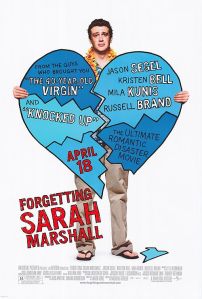 So much ink has been spilled on Jason Segel’s full-frontal nudity that you would think the public has never known that penises have appeared on film before. It seems that female nudity is used to titillate and male nudity is used for awkward laughs, and this is the case with Forgetting Sarah Marshall, which Segel stars in and wrote. His character Peter is humiliated by a breakup, even more so because the man is breaking down while in the buff. He even states at one point the naive belief that as long as he doesn’t put clothes on reality cannot hit. It’s funny and sad and he’s completely vulnerable, but Forgetting Sarah Marshall is much more than the story of one slightly doughy man and his penis. This is a story from producer Judd Apatow (The 40-Year-Old Virgin, Knocked Up) about heartache and mending and the struggle it takes to keep a relationship healthy. But it is also about a man and his penis.
Peter (Segel) is dating TV actress Sarah Marshall (Kristen Bell), star of the brilliantly reflexive title Crime Scene: Scene of the Crime. Peter provides the music for the TV show, which he laments is nothing more than “ominous tones.” Then one day she has some bad news. She’s breaking up with him (this is where Segel loses it, both emotionally and from a clothes perspective). Peter mopes and cries for days, goes out to clubs with his step-brother (Bill Hader), and tries to engage in meaningless sex but that too leads to crying and moping. Peter takes a vacation to Hawaii in order to forget his ex, but as chance would have it Sarah is already there with her new man, British rocker Aldous Snow (Russell Brand). Peter is stuck in the same hotel as his ex and her new lover. The hotel staff takes pity on Peter and they all seem to look out for him, setting him up in a $6,000 suite, involving him in hotel activities, and feeding him drinks. Rachel Jansen (Mila Kunis) works at the front desk and takes a special interest in Peter and his woes. She helps Peter get over Sarah and fin
 Forgetting Sarah Marshall is another hit from the Apatow brand. It features another leading man with an unorthodox physique and a healthy interest in geek culture. However, Peter doesn’t need to learn to be responsible, or outgoing, or to transition from boy to man. He’s actually fairly well adjusted and even has a job that suits his composing talents. His dilemma is heartbreak, a universal affliction if ever there was one. He’s a little frumpy and has a thing for puppets, but Peter is really a sweet guy who is working through the pain of a breakup. He was together with Sarah for over five years, so it feels strange when the characters keep harping on him to get over it in the span of a few weeks. He is awash in self-pity and wails so loudly that other guests complain about a woman crying in his room. He makes for a capable lead and his budding romance with Rachel allows him to heal. The romance is strongly felt and I was completely absorbed by wanting Peter and Rachel to have a happily ever after.
Segel is a charitable screenwriter. The could have easily become a vanity wish-fulfillment project, but instead he rounds out the main characters and builds a deep supporting cast that add delightful additions that enrich the narrative. I admire Segel’s decision making when it came to fleshing out his characters instead of writing them off as stock types. In an ordinary romantic comedy, the beautiful girl that dumps the lead is a bitch. It would have been extremely easy for Segel to demonize Sarah and keep her as an established antagonist, but instead he makes her feel real. She has real, solid reasons for her breakup with Peter, and she has several revealing moments that open her character up and humanize her. Aldous is another pristine example of Segel’s screenwriting skill. In an ordinary romantic comedy, the girl always dumps the nice guy for the douchebag, and Aldous starts in that territory. But a magical thing happens and as the film continues Aldous becomes very charming; he’s unpretentious and is the same transparent and genial man to everybody. He appreciates Peter’s music and gets him and Peter’s passions. Peter says at one point, “This would be so much easier if you weren’t so cool.” It would have been easy and even expected for Segel to cast both the ex-girlfriend and her new boyfriend as evil cretins. Instead, he broadens and rounds out all the central characters to the point that they feel like real people and not just comedy types.
 The movie is resolutely pleasant and amiable, lacking gut-busting laughs but offering plenty of cringe comedy. It’s not as outrageous as other Apatow comedies, or as good, but it is completely entertaining. There is one terrific sequence that stands out in my memory. It involves the two couples sitting at an awkward dinner. Then they comment on how awkward it is, then they comment on commenting how awkward it is. The dinner bathes in unease but then as it carries on you see the different tensions. Aldous and Peter hit it off discussing their dislike for a terrible horror script offered to Sarah that involved a killer cell phone (sounds like One Missed Call). They are genuinely bonding. Sarah hides her growing dissatisfaction with the decisions she’s made, but Rachel catches on. She kisses Peter long and hard and shoots Sarah a very knowing glance that all women know as “back off.” This dinner packs all of the different tensions of the movie into one well-written, expertly performed scene. The characters aren’t shouting their feelings point-blank but you can follow along to the conversations that are unsaid.
I love comedies that involve deep supporting casts, where a supporting player can enter at the right moment and deliver a perfect in-character addition. I was delighted at how wide Segel cast his net of characters and yet how well incorporated they are. There’s a newlywed couple (30 Rock‘s Jack McBrayer, Maria Thayler) that haven’t mastered the art of sexual intercourse. They’ve waited until marriage and know are wondering what all the fuss is about. Hearing McBrayer’s amped-up frustration is funny, but it’s even better when he solicits advice from Aldous on pleasing a woman. The tutorial between the two left me in stiches and made me like Aldous even more. I enjoyed spending time with all of these characters. Apatow regulars Jonah Hill and Paul Rudd pop up in hilarious cameos. Rudd is a super stoned surf instructor and Hill is an obsessed Aldous Snow fan who creepily doesn’t abide touching boundaries. The supporting players never outstay their welcome and add great splashes of variety to the story.
Forgetting Sarah Marhsall continues the Apatow tradition of mixing raunch with sentimentality. There’s plenty of dirty humor but it’s the little touches that won me over. I loved the title of Sarah Marshall’s TV show, perfect references to movies like The Buena Vista Social Club, Rachel reflecting Peter’s romantic advances only to initiate the first kiss, the brilliant music video for Aldous Snow where he carries an earnest sign that reads, “Sodomize Intolerance,” the flashbacks to Peter and Sarah’s relationship, the helpful advice of Dwayne the bartender and his great knowledge of fish native to Hawaii, and a vocally competitive dual of sexual intercourse. This is a comedy that works because even they details have been looked after with care.
 Segel easily conveys his character’s sweetness; the man can’t help but be sweet even in anger. Bell is given complexity with her role and nails bitchiness and tearful regret with the same skill she radiated on her defunct TV show, Veronica Mars. I never thought Kunis was capable of playing more than a shrill ditherhead thanks to her role on TV’s That 70s Show but she nicely handles the drama. She makes the romance more than believable but desirable. The actors all do a great job but it is Brand that steals every single scene he is in. His carefree demeanor and hysterical physical gyrations cast him early as one type of character, but his charisma rules the day and will win over audiences.
This is all familiar romantic ground covered by countless other movies. Boy loses girl, boy meets new girl, boy gets new girl, but Forgetting Sarah Marshall adds the Apatow touch. Another Freaks and Geeks alum writes another male-centric but hilarious comedy that deals with mature themes in untidy ways. The movie takes place in a world that resembles ours, where people are not cast in black and white, good or bad, victim and victimizer. Segel’s screenplay lets the audience empathize with a wealth of characters, and the humor is bittersweet but mostly on the sweet side. Any film that ends with a puppet musical about Dracula has to be seen as special.
Nate’s Grade: B+


 nathanzoebl
You must be logged in to post a comment.