Blog Archives
The House Bunny (2008)
 Anna Farris (Scary Movies) is proving herself to be one of the most adept physical comedians of today. This is formulaic fish-out-of-water comedy set in the familiar territory of collegiate coeds, so you’ll be excused for thinking you’ve seen this movie before in a dozen incarnations. The nerdy outcast sorority adopts Farris as their housemother, and through no shortage of makeover montages, the girls come out of their shells and embrace their outer midriffs. However, The House Bunny doesn’t just stoop to pandering a hypocritical “believe in yourself” message tied to beauty makeovers to win over the fellas, but it almost does. Farris is the true draw for the film and she goes for broke as the daffy Playboy Bunny. She’s sweet and effervescent even at her most dimwitted; this woman knows how to sell a joke. Her comedic timing and line readings are superb. The movie isn’t anything more than a pleasing diversion, but without Farris and her comic gifts it would be something much worse. The House Bunny does what it does well enough to be disposable entertainment. She’s got the dumb blonde routine down cold, now it’s time for filmmakers to allow Farris more opportunity to hone her other comedic chops.
Nate’s Grade: B-
Share this:

Land of the Lost (2009)
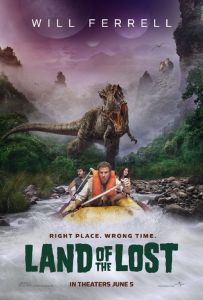 Does money make something funnier? I have always been hesitant about Hollywood comedies that overspend like crazy, running up staggering budgets. In 2007, Evan Almighty became the most expensive comedy of all time, toppling a $200 million budget thanks to costly special effects and animal wrangling (and those assorted Steve Carell beards couldn’t have been cheap either). Did all that spending make the movie any funnier? Comedy is a cost-friendly enterprise because it all truly starts at conception: the setup, the payoff, the buildup, the delivery. If an idea isn’t funny at its core conception, it’s usually not going to be funny no matter how expensive the window dressing. Here comes a big budget Land of the Lost movie with Will Ferrell in the lead, and I ask again, does more money make something funnier?
Dr. Rick Marshall (Ferrell) has devoted his life, and taxpayer dollars, to researching time portals that open dimensions that combine the past, present, and future. After an interview on the Today Show with a hostile Matt Lauer, Marshall becomes a laughingstock in the scientific community. Holly (Anna Friel) is a science grad student who believes in his crackpot theories. The two of them use Marshall’s tachyon device to find a cosmic hotpot. It just so happens to be in the middle of a low-rent attraction, “The Devil’s Canyon” run by hick opportunist, Will (Danny McBride). He takes Marshall and Holly along on a tour of the cheap attraction but then suddenly the earth shakes and the people fall off a waterfall into a time portal. They awake in a strange land filled with dinosaurs, primate people like the hairy sidekick Chaka (Jorma Taccone), hissing lizard creatures known as Sleestaks, and all sorts of prehistoric danger. The only way home is to find the tachyon device to open another portal. Too bad the device, too, is lost.
 The original Land of the Lost TV show was a dopey sci-fi show for kids that had silly plots, terrible special effects, and the unmistakable feeling that the creators and writers often indulged in psychotropic substances. But let’s face it folks, the Land of the Lost TV show was squarely aimed at kids and does not hold up well. You could seek the zippers on the back of the Sleestaks. I don’t intend to trample anyone’s good time nostalgic feelings, but this show was just not very good. However, the movie almost plays like a loving parody of the material. It doesn’t point out the flaws of the original TV show in a meta-critical manner like the Brady Bunch movies; Land of the Lost channels a childish, goofball tone and brazenly heads along at full-steam. This movie was marketed as a “family” film based on a children’s TV series. Warning to parents considering taking young children: this is not a family movie. This is a raunchy PG-13 comedy with plenty of kid-friendly gross out humor and parent-spooking sexual humor. There are masturbation gags, an F-bomb, an out-of-the-blue Jesus-on-the-cross comparison that could raise eyebrows, and all sorts of crude behavior, including two instances of self-imposed dinosaur golden showers.
The movie is completely juvenile, crude, surprisingly raunchy for a PG-13 movie, and yet it has an absurdist bemusement to be had. If you can catch on to its wonky wavelength that manages to satirize the original series, there are subversive, guilty pleasures to be had. There is a campy and irreverent spirit that I was able to latch onto and enjoy. I’m not saying Ferrell dousing himself in dinosaur urine is witty in any regard, but I laughed. When he does it a second time I laughed some more. This is like a gonzo update of a Saturday morning children’s series, like what would happen if Terry Gilliam took a crack at writing an adaptation (not to sully Gilliam’s creative integrity, the poop and pee jokes will be added by a screenwriting hack in a re-write). The jokes seem aimed at kids, like the bodily function stuff, but then there are jokes that will certainly go over the kids’ heads, like a drawn out sequence where the boys partake in a drug trip thanks to a local narcotic fruit. The TV series has been adapted into a big budget Will Ferrell comedy, a mixture of juvenile gags and goofball hijinks with a wink, which will alienate fans of the original series. It’s not sophisticated high comedy for adults but then the jokes can also be too wordy for small kids to understand why it should be funny. The opening scuffle between Marshall and Lauer is a good setup and also provides a satisfying payoff by the movie’s conclusion. Not all of the jokes work and there are too many scenes that drag on, long after the joke has already been given a burial ceremony. Many jokes are one-sceners and don’t build into something stronger and more satisfying than an in-the-moment chuckle. Land of the Lost is a somewhat muddled, somewhat confusing, somewhat chintzy, somewhat bizarre movie, which makes it an oddly fitting adaptation of its odd source.
 The plot is a thin strand to tie the comedic setup together, but the movie also has dashes of adventure and action. Marshall insults a T-rex by ridiculing its brain size, and the T-rex becomes an ongoing antagonist, chasing the trio all around this so-called land of the lost. Usually every action beat is tied into some form of a comic setting, like when Marshall has to rescue his special tachyon machine by singing and dancing to “I Hope I Get It” from the Broadway show, A Chorus Line. Director Brad Siberling (Lemony Snicket, City of Angels) and production designer Bo Welch (Batman) make this movie look downright gorgeous. The trippy production design is Oscar-worthy. I enjoyed the visual landscape of this cosmic dumping ground, where a desert could be strewn with odd fixtures like a Viking ship or a gas station sign or a motel pool. The special effects are fairly good as well, especially adding detail and personality to the T-rex. This is a high-gloss comedy that might appeal to Salvador Dali if Dali had a secret love for defecation humor and boobs (maybe not as much with the latter).
The actors make the material better; thanks to Ferrell and McBride I was able to laugh at churlish humor that I might otherwise have scoffed at. This movie had me laughing at the basest humor, jokes chronicling the assured comedic assets of the female mammary and, well, dino pee. But you know what, context and an appealing actor with good comedic command can make anything funny. Ferrell and McBride have great comedic chemistry and the two of them know how to take a semi-lame joke and give it life with just the right delivery. Granted, Ferrell is playing the same character he has been for years, the sweet-hearted idiot man-child, and McBride (Pineapple Express, TV’s Eastbound and Down) is playing a toned down version of his blustery insincere jerk, and Friel (TV’s Pushing Daisies) is there essentially to be a love interest/straight man/source for boob groping. At one point, Holly rips away her pant legs for no good reason other than it allows the camera to get some high-grade butt shots of Friel in her short shorts.
I had fun with Land of the Lost and I’m not too ashamed to admit it. I enjoyed most of this psychedelic adaptation and grooved to its absurd, antisocial, irreverent spirit. It’s loosely based on the 1970s TV show by Sid and Marty Krofft, but this is a positive given that the original series was dumb. Not that this movie is intellectually riveting. This isn’t a daring movie or a cleverly diverting comedy, and it has unnecessary moments where they cram six pages of scientific nonsense into a one-minute exposition dump, but Ferrell and his time-traveling companions kept me smiling more often than not thanks to their camaraderie, improvisation skills, and ability to transcend the sophomoric material. It’s a silly mess but Land of the Lost is an entertaining time as long as you lower expectations and know what you’re getting into, dino urine and boob groping and everything.
Nate’s Grade: B
Share this:

The Hangover (2009)
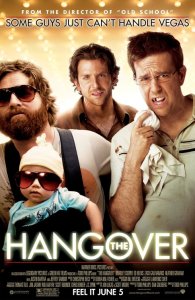 The Hangover is the breakout hit of the summer. It’s a simple concept that’s fully executed by Old School director Todd Phillips, the biggest name in the movie is Mike Tyson, and the people are lapping it up. It’s going to become the first comedy to pass the $200 million mark since 2005’s Wedding Crashers. Is it that good? The studio was already planning a sequel before The Hangover was ever released.
Doug (Justin Bartha) is getting married and thus must embark on that last passage of manhood — the bachelor party. Doug and his groomsmen are headed out to Las Vegas for a wild night. Phil (Bradley Cooper) is a handsome science teacher ready to cut loose. Stu (Ed Helms) is a nerdy dentist completely at the command of his icy, domineering girlfriend (Rachael Harris). And then there’s Alan (Zach Galifianakis), Doug’s prospective brother-in-law. Alan is clueless to the point that he asks a hotel clerk if Caesar’s Palace was at one point the emperor’s actual residence. He’s also desperate for some friends and he wants this Vegas trip to be unforgettable. Cut to the next morning and the boys awake to discover their hotel suite in shambles, a tiger in the bedroom, a crying baby on the floor, and Doug is nowhere. Phil, Stu, and Alan have to retrace their steps and fill in the holes of their collective memories.
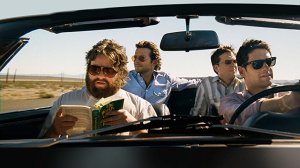
 The central mystery provides surprisingly intriguing glue for all the gags. The idea of Vegas-laden debauchery is practically a cliché of a cliché at this point, especially with how Vegas has been somewhat morphed into a family-friendly Disney Land theme park for adults compared to its mob origins. With that said, the movie hits all the regular Vegas bender exploits you would think it would, which includes, speedy marriage ceremonies, strippers, drugs, gambling. Several of the jokes themselves are somewhat on the cheap side; however, their laugh quotient is elevated by spontaneity and the comic abilities of the cast. The plot to The Hangover is cleverly constructed so that the audience is trying to figure out the latest clues just like the main characters. The movie trades heavily in raunch and crudeness, but this is a comedy that never gets too dark or too mean-spirited; there’s always a playful bemusement at the “What did we do last night?” revelations. Screenwriters Jon Lucas and Scott Moore (Ghosts of Girlfriends Past) are silly about their naughtiness. It doesn’t go to the limits of good taste like Peter Berg’s pitch-black bachelor party gone wrong comedy, Very Bad Things. That movie, which is a guilty pleasure heavy on the guilt, really looked at the hedonist philosophy about “whatever happens in Vegas, stays in Vegas” — including murdered hookers buried in the desert. The Hangover actually comes across like some absurdist film noir, and Phillips shoots the movie like it is a film noir. The cinematography even includes watching a car drive into the desert via the reflection of a man’s sunglasses. The movie looks like a serious film noir, a caper filmed in the rarely seen daylight of Vegas, which only makes everything that happens even funnier.
The Hangover is consistently funny once the boys get to Vegas. Beforehand it’s all setup, and generally setups are not that funny because they lay ground for the punchlines to come later. There are well-executed running gags and then there are also missed opportunities, like the baby and the surprise wedding. Certainly a newly discovered baby offers better gags than miming the little fella masturbating. The jokes themselves aren’t terribly sophisticated (hence: male nudity = laughs, taser to the balls = bigger laughs) and plot revelations, like how Stu lost his tooth, can be letdowns. The screenplay speeds through its comic setups too quickly, briskly running to the next and leaving little room to settle. A healthy dose of the adolescent humor is unmemorable from other crass-fests, but the setups allow the actors to bounce off each other for better jokes. The best laughs come from the threesome of dudes just ping-ponging back and forth in the moment. The end credits finally reveal what really happened that debased night, and the montage of pictures serves as a meaty, satisfying payoff to 90 minutes of sophomoric setup. It’s a terrific way to get the audience laughing all the way to the parking lot.
The humor is mostly situation based. The characters all fall under comedy archetypes (henpecked husband, loudmouth, socially inept doofus) but it’s the interaction and male camaraderie between the actors that made me smile the most. Cooper (He’s Just Not That Into You) is full of smarm but he comes across like a less manic, still self-absorbed and obnoxious version of his jerky character from Wedding Crashers. His main job is to center the other two actors. Galifianakis (The Comedians of Comedy) is the go-to source for the screenplay’s laughs and his role makes good use of his talents. He plays a buffoon without an ounce of self-awareness, which gives the character a touch of sweetness even as he bumbles in total social awkwardness. He plays the character straight and innocent, which makes his moony behavior more unnerving and yet acceptable at the same time. But for me, this is Helms’ movie. The supporting actor from TV’s The Office has honed comedic chops, which explains how he can find the perfect tone for an uptight, hopeless, delusional dentist to be sympathetic and not overly pathetic. He comes completely undone over the course of the film’s events and Helms bounces off the walls in hysterics.
 Like other Phillips movies, specifically Old School, the women not only get shortchanged as comedy characters but they are presented in an unflattering light. Essentially, the women are either vicious, soul-sucking shrews or exploitative whores. It’s not exactly an enlightened atmosphere but then again The Hangover is a vulgar comedy set in Sin City. The nicest female character is portrayed by Heather Graham (Boogie Nights) as a breastfeeding prostitute (“I’m a stripper. Well, I’m an escort but stripping is a great way to meet the clients.”). I’m not asking for every comedy to be written from a feminist standpoint, but it’s disconcerting when the women in a comedy only get to be the jokes instead of being in on the jokes. The extremely flamboyant, overripe gay Asian mobster (Ken Jeong of Role Models) ensures that women aren’t alone in getting marginalized for giggles.
Let’s face it; once you know the solution to the mystery and all the surprises, will this movie still play out as funny? I think perhaps Phillips has crafted a comedic version of The Game, David Fincher’s 1997 thriller that plucked Michael Douglas into a crazy “what the hell is going on?” trip down the rabbit hole. But once you knew who was behind what, and how the whole game was staged and operated, could you even watch the movie a second time? Would it still work now that a repeat viewer knew all the secrets? Does this comedy have a built-in expiration date? I think The Hangover will lose some of its appeal once the surprises are all out in the open, but I think the chemistry of the cast and some of the riffs on Vegas will still earn chuckles even on multiple viewings. This isn’t the instant classic that its rapid grosses and frothing word-of-mouth might have you believe, but The Hangover is an enjoyable guys-gone-wild trip down the empty road of Vegas hedonism.
Nate’s Grade: B
Share this:

Paul Blart: Mall Cop (2009)
 Cute but very dumb would be the best way of describing Paul Blart: Mall Cop, which is miraculously one of the highest grossing movies of 2009. Kevin James stars as the titular security man and he proves to be a capable physical comedian, throwing himself into the jokes. It’s too bad that some of these jokes don’t deserve James’ efforts. A group of extreme sport crooks (they ride around on BMX bikes and skateboards like they’d rather be at the X-Games) hold Blart’s mall hostage on Black Friday, and Blart is the only security officer of any kind left on the inside. It’s Die Hard in a mall, but, surprisingly, the movie has some decent jokes when it’s riffing on tired action movie tropes. Some of the comic setups have funny payoffs because they work against audience expectations (like a bottle of hot sauce you know will be key at some point). Mostly, this is a goofy, almost saccharin comedy, with James earnestly playing a man held back from his life’s pursuit by his diabolical blood sugar. The flick is a bit more character-based than most slapstick farces, so I’ll give it that. Blart is a lovable loser who eventually wins respect and the girl of his dreams (Jayma Mays). The film is also more leisurely than an 87-minute comedy should be. The bad guys don’t take over the mall until after 40 minutes in, leaving little room for the comic clashes with Blart. The movie also doesn’t maximize its potential, much like its title figure. This is Blart’s mall, and he has an innate knowledge of it, but he doesn’t use this to turn the tables on his opponents. Paul Blart: Mall Cop has plenty of dead moments but in the end I found the movie to be tolerable thanks to James.
Nate’s Grade: C
Share this:

Ghosts of Girlfriends Past (2009)
 I maintain that no story has been redone, recycled, re-purposed, and parodied more so than Charles Dickens’ classic holiday tale, A Christmas Carol. Dickens’ tale of redemption aided by supernatural ghosts and time travel has appeared in everything from Muppets to the Odd Couple. Statistically, the odds are good that right now as you read this very sentence television is airing some adaptation of this story right now. I suppose it was only a matter of time before Dickens got reduced to a romantic comedy setup. Ghosts of Girlfriends Past is a charmless and mostly empty movie that makes you pine for the comparative masterpiece of A Muppet Christmas Carol.
Connor Mead (Matthew McConaughey, playing himself for the thousandth time) is a hunky fashion photographer for Vanity Fair magazine and, boy, is he in-demand. Everyone wants his photo services and every woman wants to rip his clothes off. Connor is a notorious womanizer and he travels to the country to attend his younger brother Paul’s (Breckin Meyer) wedding. Connor is intent on dissuading his brother on the prospect of marriage, which Conner dubs archaic and he feels love is “comfort food for the uneducated and lonely.” It just so happens that Connor’s ex-girlfriend from way back, Jenny (Jennifer Garner), is the maid of honor at the wedding. She hasn’t seen her dubious ex for some time, but that doesn’t stop him from trying to make his move. Jenny and Connor were childhood pals, but an early bout of heartbreak led Connor to become the disciple of his Uncle Wayne (Michael Douglas), a boozy playboy who taught the kid everything he knew about bedding the babes. During Connor’s stay, the ghost of Uncle Wayne informs him that three spirits will visit to showcase Connor’s checkered past, present, and dodgy future, Dicken’s-style.
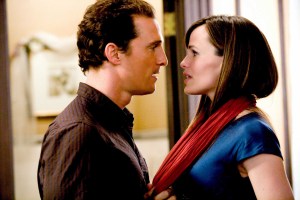 The movie is wholly unbelievable even for a contrived romantic comedy. The central romance between Connor and Jenny rests on the silly notion that after ten years apart, a lifelong selfish jerk can sweep his former girlfriend off her feet during a single crazy weekend. Connor’s redemptive arc is lackluster at best, and the movie just mimes the steps it feels that it needs to take to turn its lead insensitive jerk character into a sensitive jerk character. It doesn’t work. I refuse to believe for one second that a pretty, smart, confidant doctor such as Jenny would allow herself to get so completely suckered in by Connor’s “Baby I’ve changed” speech. It’s insulting and degrading. The compressed timeline reflects poorly on Jenny’s decision-making. The expedited timeline makes every human action seem far-fetched. There’s a scene where Connor opens a champagne bottle in the kitchen. The cork flies out and knocks one of the legs loose on the multi-tiered wedding cake. The cake is about to slip over when Connor slides in to stabilize it. Instead of redistributing the weight via the available legs, he tries reaching for the out of reach champagne bottle with his foot (the size of the bottle and the cake leg are not even close). A more believable situation would involve Connor trying to reach the fallen cake leg, not a champagne bottle, but alas. To make this example even worse, the filmmakers set up the disaster of a fallen wedding cake and then amazingly fail to show the goods. We only see the smashed aftermath. This is a comedy fundamental: set-up food disaster, let audience witness ensuing food-related disaster.
Ghosts of Girlfriends Past also doesn’t have one redeeming or marginally realistic female character. I would expect, given Garner’s star power and the natural importance of being the romantic lead, that Jenny would come across as a reasonable woman or someone worth fighting over. Sorry, Jenny is a powerfully underwritten character and Garner is left without much work other than serving as a reservoir of reaction shots. Seriously, that’s her main purpose in this movie; she is a cutaway image. Sandra (Lacey Chabert) is a shrieking high-maintenance shrew of a bride. The other female roles are largely one-note misogynistic fantasies (thanks male screenwriters Jon Lucas and Scott Moore). The trio of bridesmaids is gossipy chatterboxes and eager to get laid. Connor’s introduction to his future mother-in-law (Anne Archer) involves him casually groping her breasts, much to her prosaic approval. Connor has an irresistible way with the ladies, which makes everything without a Y chromosome want to sleep with the man. A young famous pop singer watches Connor dump three women simultaneously on an Internet conference call, insult them, and then she still strips off her clothes to bed the cad. She even states, “I don’t even know why I’m doing this,” and continues along. I’m just as confused what power Connor holds over the fairer sex because to me he’s just a twit.
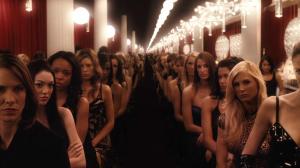 Here’s a telling example about how obvious this movie is written from an unenlightened male perspective: the central relationship dilemma is that Connor is afraid of cuddling. In the past, Jenny asked him to stay and cuddle but that was the breaking point, so he bolted. All of these women somehow manage to fall head over heels in love for a guy who willingly goes through women likes changes of underwear. It makes all the women comes across as emotionally needy, insecure, vapid bubbleheads who will sacrifice everything, including self-respect and dignity, to get a taste of McConaughey’s back sweat. Ghosts of Girlfriends Past is not a flattering movie for either sex.
The tone of this movie never finds an authentic and satisfying balance. Being a half-hearted tale of redemption during the period of a weekend, the movie crams in plenty of gooey sentimental claptrap. You’ll listen to characters talk about the true meaning of friendship, tear up over family memories, and then someone will make an inappropriate sex joke. There is a high level of semi-racy sex jokes that populate the world, appearing at odd moments, destroying any assembling emotions. Ghosts of Girlfriends Past will pretend like it’s building to something that actually matters and then it will throw it all away for a cheap sex gag — har har. There’s a moment where Douglas is illustrating how much ire Connor has wrought with visual metaphors. It begins to rain and he says that the downpour is made up of all the tears shed from ex-girlfriends and flings. Then it starts raining ripped pieces of confetti, and this we are told is all the tissues used. And then comes all the used condoms, and we watch Connor try and take cover before the aerial assault of used (and presumably “filled”) contraceptives annihilates him. It’s kind of gross and tonally disjointed from the rest of the sappy, happy PG-13 storyline.
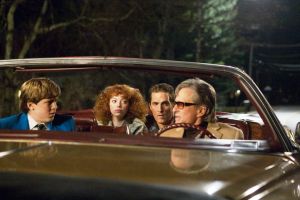 The movie is at its most amusing when it’s riffing on the expectations of following the Christmas Carol model. Connor is quite aware of the tried-and-true formula, so his comments along the way provide the movie’s only genuine laughs outside of Douglas. Really, Douglas’ character is the most entertaining character, and I kept wishing that the film would follow him even after death. Wouldn’t it be interesting to watch the life of a ghost involved in a Christmas Carol scenario? I imagine it would be a bit like a play rehearsal. I would enjoy seeing the behind-the-scenes work that goes into the scenario. I want to see ghostly foremen plot out unique scenarios for a list of real-life Scrooge cases, I want to see the ghost tryouts, I want to see the mechanics involved in the spiritual setup for this whole process. I enjoyed watching Uncle Wayne hit on his fellow spirits. But I suppose that approach would be too literary and break away from the cozy confines of the stillborn romantic comedy genre. And to prove that it is indeed a romantic comedy by the numbers, Ghosts of Girlfriends Past even includes the last minute dash to stop the romantic party from leaving via some method of transportation.
Ghosts of Girlfriends Past manages to squander every opportunity it has to be a better movie. The central idea could have worked but the execution is exceedingly lazy, charmless, and degrading to women in particular. The comic scenarios miss out on better laughs, and some of the better laughs are obvious and just around the corner, but the film routinely falls back on being a sexual farce. The characters don’t feel remotely like people and Connor is a terrible lead character with unfunny dialogue that reduces women to disposable pleasures. His transformation is contrived even for a romantic comedy. I’m not saying a cad character could not make for an entertaining lead here. Clearly Douglas is the best character, and his sleazy 1970s swinging sexpot has a fun Bob Evans vibe. Every moment he’s onscreen the movie comes alive in a new way, and Douglas is an actor that knows how to make lecherous appealing and appalling at the same time, like what Michael Caine pulled off in Alfie. This movie pales in comparison. Ghosts of Girlfriends Past should have been visited by the most important spirit of them all – the Spirit of Screenplay Rewrites.
Nate’s Grade: C-
Share this:

17 Again (2009)
 My introduction to tween sensation Zac Efron came last fall. After hearing about the dominance of the High School Musical franchise I decided to finally watch the first made-for-Disney Channel film and see why exactly tween girls were screaming themselves hoarse. And after watching the musical I felt, well, how can I put this diplomatically? It sucked. Hard. First off, the plot only covered auditioning for a musical, not the actual show. What the heck is up with that? How does a movie musical climax around callbacks? Amidst the bland vanilla pop tunes, goofy hoofing, and painfully simplistic life lessons about class-consciousness, there was the overall dreadful acting by the cast. Efron wasn’t the worst actor of the lot but he seemed to go on autopilot, beaming dreamily and leaving his mouth agape long enough to stockpile flies for a long winter. I could not understand why young girls and the media were making such a fuss over Efron. I am clearly not in Efron’s core flock of fawning fans, but after catching his fairly nimble work in 17 Again I think perhaps this guy might be able to break out from the clutches of Disney and grow into his own, unlike Miss Miley Cyrus, who I believe has an ankle bracelet that will detonate if she travels further than 100 feet from the Disney execs. They don’t want another Hilary Duff getting away and sticking a scorpion down her shorts (see: War, Inc.).
Mike O’Donnell (Matthew Perry) hates his life. He’s 37, just been passed over for a promotion at his job, is getting divorced from his wife Scarlett (Leslie Mann), and his two teenage children (Sterling Knight, Michelle Trachtenberg) think dear old dad is a doofus. Apparently, everything was better 20 years ago, in 1989 when Mike was a 17-year-old basketball phenom who had his whole life ahead of him, until he walked out on a climactic game to tend to Scarlett, who just revealed that she was pregnant. Mike wishes he had one last shot to be 17 and have his whole life ahead of him again. Thanks to a magic janitor (I believe it’s really the magic hobo from The Polar Express, except now he’s gone through a work program and become a respectable community custodian), Mike transforms into the visage of his 17-year-old self (Efron). Mike seeks help from his childhood pal Ned Gold (Thomas Lennon), who poses as Mike’s father and enrolls him in the same high school his children attend. This leads to many awkward family encounters.
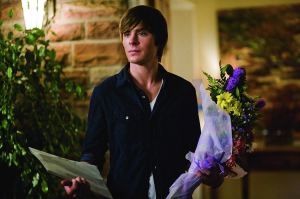 The body swap genre can be counted on for some decent fish-out-of-water laughs and some earned wisdom. Usually transporting young people into older bodies allows for more comedy because it leads to more socially awkward moments and the exaggerations of trying to be old before your time. 17 Again is consistently amusing enough and I was pleased that it found fun plot developments to explore from its body swap angle. So Mike is young once more but that doesn’t stop him from having, on the surface, inappropriate feelings for Scarlett. On top of that, teen Mike must beware the romantic advances of his own teenage daughter. Yes, the movie simultaneously explores robbing-the-cradle romance while dodging incestuous pratfalls al la Back to the Future. There is uncomfortable father-daughter sexual tension without getting too perverse. These two wrinkles nicely take advantage of the older person body swap premise and add some spice to an otherwise safe and sunny movie. Besides that, if you’ve seen any body swap movie from the past (and the 1980s were littered with body swap movies) then you’ll know exactly how everything will turn out with 17 Again. The movie is mostly silly, mostly the fun kind, but it doesn’t dip into being outrightly dumb. It’s derivative but it’s not fluff. I mean the essential premise revolves around a man regretting supporting his pregnant teen girlfriend/eventual wife. You won’t find that in the Hannah Montana Movie no matter how hard you try, perverts.
17 Again isn’t great art but it works as a showcase for its appealing star, the dewy-eyed, shaggy-coifed Efron. The filmmakers clearly know their target audience because Efron is shirtless and sweaty by minute one, displaying killer abs. By minute four, he’s dancing before his big basketball game (does this kid have a clause in his contract that he must play basketball in all his movies?). 17 Again asks little of Efron and he easily delivers on that mandate with a convincing performance that easily charms. He’s also adept at comic timing, particularly when he’s sparring with Lennon. Efron has a fabulous toothy grin and he’s a good-looking pup, but the jury’s still out on whether or not this kid can go the distance. He’s improved considerably since the first High School Musical launched his mug onto thousands of household products. He probably doesn’t have an Oscar in his future but he certainly will be headlining movies for years to come. He’s more movie star than actor, but let’s not mince words, the kid is a star (fun fact: Efron’s first acting credit is for an episode of Joss Whedon’s Firefly).
The supporting cast surrounding Efron greatly add to the film’s surprise enjoyment. The subplot involving adult dweeb Ned romancing the principal (Melora Hardin) is an amusing diversion that manages to make me like all of the characters more. Lennon (Reno 911!) steals every moment he’s onscreen and develops a kooky chemistry with Hardin (TV’s The Office). The more these two actors interacted the more I wanted the movie to ditch everyone else. Mann gets the thankless job as “upset wife” but brings a spark to the character without coming across as grating. Trachtenberg (Euro Trip, TV’s Gossip Girl) is actually 23 years old but her youthful looks seem to lock her into teenage girl roles. Look out for cameos by comedians like Jim Gaffigan and Margaret Cho. Perry must have enjoyed working for about a week and cashing his check. Also, Perry looks absolutely nothing like Efron and appears to be over a foot taller than his younger, more genetically blessed doppelganger.
 I feel sympathy for the editor of 17 Again, because clearly script supervisor Steve Gehrke must have been asleep for the entire film shoot. There are continuity gaps galore in this movie. Now, normally I don’t care so much about mild continuity errors in a movie because that’s just part of moviemaking. So if a character sits up in bed and the sheets are a few inches lower, or in a different ruffled state, well who cares? But when errors compile wildly and become flagrant distractions, then the movie has a problem and the script supervisor, the person in charge of catching those errors in progress, failed miserably. When teen Mike eats a hamburger in the school cafeteria it goes from being in his hands, out of his hands, having a bite out of it, and then magically reformed. Even worse is a moment when teen Mike is nursing a battle wound and his wedding ring keeps changing hands. Why would anyone even bother switching hands for a ring to begin with? That sounds like an easily avoidable hassle. To be fair, there are several factual errors that are not Gehrke’s total fault, though I’m dumfounded why no one else caught these. In 1989, the coach yells at Mike to quite dancing and refers to him as “Vanilla Ice,” but Vanilla Ice didn’t release his debut album until 1990 (apparently the coach knows his underground white hip-hop). What’s even more puzzling is that this pop culture reference is destined to sail over the heads of Efron’s target tween audience. All of this is easily verifiable. I won’t even get into Mike referring to “hippogriffs” 10 years before Harry Potter was published.
17 Again is a pleasant enough confection that is undemanding and yields some laughs and enough heart. The movie manages to be more mature than expected thanks to some kinky-for-PG-13 sexual tension and yet the movie is a harmless good time at the movies. Efron carries the movie ably but he’s got a great supporting cast to help carry the comedy load. Body swap movies are all invariably the same, and truly 17 Again must have been born with the sentence, “It’s reverse-Big.” It’s playful and light and cheery and pretty much an adept project for its star. It’s a small step in the right direction for Efron, and perhaps his fan base will start including more than squealing teenager girls primed to swoon at a moment’s notice. Swooning: it’s not just for the youngsters any more.
Nate’s Grade: B
Share this:

I Love You, Man (2009)
 A thoroughly genial comedy, I Love You, Man is an easily enjoyable flick that has fun upending romantic comedy tropes. The movie follows Peter (Paul Rudd) and his search for a “bromance,” a heterosexual male friendship that follows similar dating patterns seen in typical romantic comedies. Peter finds his match with Sydney (Jason Segel), a semi-sophisticated slob. Rudd has been a superb smartass in so many movies, which makes it all the more surprising at how incredible awkward he plays Peter. This man seems embarrassed with every breath he takes. It becomes moderately endearing to see him break out due to his male bonding with Sydney; the nice guy comes of age by becoming impolite and vulgar. The plot takes some predictable turns, like when Peter’s fiancé (Rashida Jones) is upset that her man wants to spend more time with his new pal than with her. Rudd is the most charming actor on the planet, which makes it somewhat wasteful to stick him as a straight man in a comedy. Segel takes great advantage of his character’s boorish behavior and is consistently funny. The supporting actors lift their underwritten roles, especially Jon Favreau as an altogether asshole. I Love You, Man banks on plenty of pleasant vibes and amusing performances. It may never be a gut-buster when it comes to laughs and it may not be fully lovable but it’s certainly easy to like.
Nate’s Grade: B
Share this:

RocknRolla (2008)
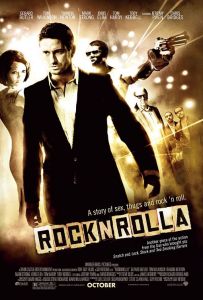 I’m a fan of Guy Ritchie’s convoluted cockney comedic crime capers (wow, check out that alliteration), but this movie is just plodding and dull. The trouble is that Ritchie works best when he has one foot in the fantastic, with comically over-the-top and menacing underworld personalities. A Ritchie movie usually involves a lot of crisscrossing characters, but this is his first film where I couldn’t keep the folks straight, I couldn’t understand much of the personal connections, I couldn’t understand the purpose of the various characters and their various interplay, and frankly, I never bothered to care. RocknRolla has maybe two colorful characters (all hail Tom Wilkinson as a sleazy real estate gangster), but the rest of the movie is overstuffed with bland and forgettable toughs. What the hell are Ludacris and Jeremy Piven doing here? You could eliminate half of the cast and the movie would barely be affected. This movie is just way too straight and square for its own good. Ritchie is still a top-notch visual stylist, and the movie has a terrific deep focus digital video cinematography, but there are very few moments or visual flourishes in this flick that prove to be remotely memorable. I hope Ritchie does not make good on his promise to continue telling more stories with these characters and in this style because this many needs to get back to what he does so well, and that is telling the darkly comic escapades of larger than life Dick Tracy-esque villains and scoundrels.
Nate’s Grade: C
Share this:

Confessions of a Shopaholic (2009)
 Releasing a romantic comedy about a woman plagued by credit woes in the middle of a global financial meltdown? Doesn’t sound like the best example of escapist entertainment, but Confessions of a Shopaholic is infectious fun, and it’s all thanks to the delightfully funny lead performance by Isla Fisher. She seems like she stepped out of one of the old Hollywood screwball comedies from the 1930s. There’s a terrific hunger in her eyes and the woman knows how to punctuate a joke. The movie itself isn’t too shabby either. As far as formulaic romantic comedies go, this is one of the better ones in recent years. It has a little dash of everything, from slapstick to farcical thriller to romance to even some mildly potent drama. Director P.J. Hogan (Muriel’s Wedding) keeps the movie light and fun and even spruces up the flick with some interesting visuals, like animated CGI mannequins that come alive to tempt Fisher. Even though the movie holds onto a sitcom level plot for too long (mistaken identity), Confessions of a Shopaholic is a far worthier piece of entertainment than typically found in the rom-com genre, and Fisher is a comedian to rival the best.
Nate’s Grade: B+
Share this:

Bride Wars (2009)
 In early 2007, it seemed like Eddie Murphy was destined to win a Best Supporting Actor Oscar for Dreamgirls. The funnyman was racking up honors for his fiery portrayal of a fallen Motown singer. Then came ads for the atrocious Norbit where Murphy played three roles, including a grotesquely overweight woman and a racist portrayal of an old Asian man. Was it much of a surprise then when Murphy lost out to Alan Arkin (Little Miss Sunshine) whose character died halfway into the film? I suppose Academy voters took long looks at those appalling Norbit ads and said, “Academy Award-winning star of Norbit? I don’t think so.” Earlier in 2008, Anne Hathaway starred in Rachel Getting Married and became a surefire Oscar contender with her bitterly funny portrayal of an ex-druggie released for her big sis’ wedding. Hopefully the Academy will ignore the awful comedy Bride Wars or Hathaway will be doomed to follow Murphy’s lead (personally I think this is Kate Winslet’s year).
Liv (Kate Hudson) and Emma (Hathaway) have been dreaming of getting married since they were little girls. Both girls were at New York City’s Plaza Hotel and witnessed a wedding reception. They both swore that day to get hitched at the luxurious hotel. The girls grow up and Liv works as a hotshot attorney and Emma is a schoolteacher. Both get proposed at the same time and the high-pitched squealing ensues. Emma wants Liv to be her maid of honor and vice versa. The ladies seek the services of Marion St. Claire (Candice Bergen), the greatest wedding planner in the city. She delights the duo by booking them for two June wedding dates at the illustrious Plaza Hotel. Then comes the bad news. The booking dates got mixed up and the weddings are booked on the same day. The next open date at the Plaza is in three years time. Both women refuse to budge. Then a bridal arms race begins. Each would-be bride tries to sabotage the other’s wedding preparations.
 Bride Wars is indulgent and tiring and occasionally obnoxious, much like the main characters. These characters are one-note and the movie drills that one note repeatedly; Liv is domineering and Emma is a pushover. I don’t care about these characters, and when the movie ramps up the sentiment in the final 20 minutes it doesn’t work because I feel no emotional attachment, and waning interest, in these people. Hudson’s Liv serves as the real antagonist for like half the movie’s running time. She comes across as brash, pushy, unlikable, narcissistic, and overbearing, and her unflagging desire to win is what pushes the conflict. Emma and Liv view their husbands-to-be more as accessories to their collective Big Days, and the movie seems to treat them the same way. The three bland male leads (Bryan Greenberg, Chris Pratt, Steve Howey) even look vaguely the same, and Bride Wars just allows them to slowly fade away. Like the Sex and the City movie, the women come across as deeply shallow and petty, people more worried about ceremony than every day after that fairy tale wedding. The film’s comedic focus is on uninspired slapstick and the pranks that the ladies play. Bride Wars practically excuses the bridezilla bedlam because it eventually makes Emma a stronger person who can stand up for her self after long last.
The initial conflict seems trite and readily negotiable. So the girls have their weddings scheduled on the same day, and they can’t work this out? Why such drama if they’re both lifelong best friends? They couldn’t just have a double wedding? Here’s what I don’t understand. Marion tells our ladies that the Plaza has three June openings, two on the 6th and one at the end of the month. Liv gets one date and Emma gets the other date, and then a third woman (co-writer and Saturday Night Live actress Casey Wilson) grabs the final June 6th slot. So when Marion announces that her assistant switched the dates, why wouldn’t the third woman want to swap back? She’s been planning for her wedding to be on June 6, so why wouldn’t she want to keep the date she already agreed upon? Likely this woman has begun to plan around the specific date and it would make much more sense to maintain continuity. And it is this contrived conflict that sets Bride Wars loose.
The script is lazy and the PG-rating all but neuters the bitch fest. This setup was begging for the claws to be unleashed but the filmmakers play it safe. It can’t get too messy because everything must be made nice and tidy by the conclusion. The acts of sabotage never get too out of hand. This is less a war and more of a scuffle. Bride Wars trades in nothing but stereotypes and stock characters (including the late addition of Liv’s brother who obviously has a decade-long crush on Emma), and I expect that from chick flick fluff, but the movie just misses so many obvious comedic opportunities. The girls have a group of friends that offer no commentary on the situation. One of their friends is unhappily newly married and could offer plenty of sarcastic quips. Liv has her hair dyed blue at a salon and nobody in the movie makes a single joke about the wedding staple of wearing something blue? How is this even possible for a movie about weddings? That’s just a glaring oversight.
 Hudson and Hathaway are far better than this material, though Hudson is credited as a producer. Perhaps she can explain why she chose a haircut that makes her head look humongous. Seriously, her head looks gigantic, especially when she stands beside the coltish Hathaway who has quite a cylindrical noggin. Hathaway comes across the better of the two. Hudson has proven adept at goofy comedy but she just comes across as a bully. Kristen Johnston (TV’s Third Rock from the Sun) looks alarmingly thin. Somebody should check up on her.
To dismiss Bride Wars as a chick flick is to miss the point. Women deserve better than this mediocre comedy that showcases women as harpies worshiping marital materialism. The characters are annoying and vapid, the conflict is boneheaded and contrived, the comedy is watered down, and the lead actresses are wasted. Because something is a chick flick does not excuse it for being poorly manufactured. Bride Wars does not reflect well upon anyone involved, from the actors, to the director, to the writers, to the people that got people coffee. The movie isn’t monstrously bad but it is a banal piece of entertainment. Women, men, and all people deserve better no matter the genre classification.
Nate’s Grade: C


 nathanzoebl
You must be logged in to post a comment.