Blog Archives
Spy (2015)
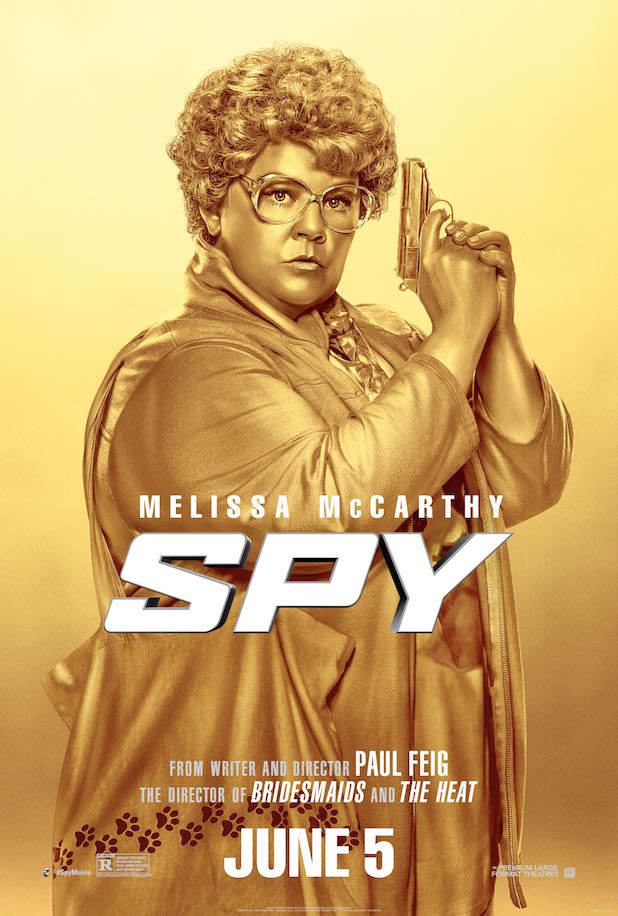 Melissa McCarthy’s meteoric comedic rise hasn’t been without its missteps, mainly the complaint that she seems stuck in a rut playing aggressively weird and foul-mouthed characters that are growing tiresome. McCarthy is never better than when teamed with her Bridesmaids’ director Paul Feig, and Spy is a welcomed return to form for a great comic actress who relishes being outlandish. The best part of the film is that it’s a character-centric comedy, with McCarthy as Susan Cooper, a CIA agent who works as a handler, the voice on the other end of the earpiece, guiding her partner the handsome Agent Bradley Fine (Jude Law). When Fine is compromised on a mission, Susan unexpectedly finds herself in the field to track down some very bad people. McCarthy does get to be vulgar, but fortunately it’s only one persona she adopts as a mask, and it’s cleverly utilized. Feig’s screenplay makes sure to find different comic beats as it goes, rarely repeating itself and, like any good action movie, finding twists to further develop conflicts. Part of what’s so enjoyable about Spy is how comic scenarios will evolve while staying true to the characters and the central conflict. Also, Feig acquits himself more than well with the film’s semi-slick action photography. The supporting cast is nicely tied into the story and matter and each actor has material to cut loose, none more than Jason Statham (The Expendables) as a hilariously boastful and incredulous agent. His boisterous chest-beating about his past deeds are some of the film’s funniest moments. Consistently funny, witty, and mildly progressive with its heroine, Spy is a vehicle that makes perfect use of McCarthy’s talents and then some.
Nate’s Grade: B+
Share this:

The Boxtrolls (2014)
 Another delightful film from the creators of ParaNorman, the whimsical Boxtrolls is another stop-motion treasure that plays just as well for children as it does adults. The fanciful world follows the industrious title creatures that have wrongly been demonized as villains. Snatcher (a tremendous Ben Kingsley) has much to gain by stirring up boxtroll fears, and if he captures them all he’ll finally be allowed to join the town’s inner circle of muckity mucks. We follow “Eggs” a boy who has been raised by the boxtrolls since he was a baby and his re-emergence with the world above ground, notably with the help of a morbid little girl, Winnie (Elle Fanning). The world building is confident and well developed, the storyline finds nuanced ways to be touching and deliver serious messages about peer pressure, assimilation, and the ways which we judge ourselves and whether those are even of merit. But the main draw is the glorious animation, so fluid, so lively, and a landscape that makes full use of color and light and shadow. It’s an immersive experience that your eyes don’t want to blink for fear of missing something. The plot is droll and expertly sequenced with its variety of character and comic asides. The vocal cast does a terrific job, notably Kingsley and a hilarious Tracy Morgan. The film can get a little spooky for young children but should still be comfortable viewing. The Boxtrolls is further proof that the animation house Laika is operating at near-Pixar peak levels of brilliance and deserve the benefit of the doubt with any future films.
Nate’s Grade: A
Share this:

Into the Woods (2014)
 Theater fans, take this review with a Broadway-sized grain of salt because I’m going to admit I’ve never seen Into the Woods prior to its film release. I consider myself a Stephen Sondheim fan, especially with Sweeney Todd. Now with all that established, I found Into the Woods to be a thoroughly uninvolving and middling musical without any memorable tunes and a series of annoying characters that just kept running in comic redundancies. Perhaps it’s my own ignorance to the original 1987 theater production, considering subversive and edgy and not the most natural fit for the Disney brand. Perhaps I’m just not hip enough to Sondheim’s academic use of melody. Or perhaps others out there will share my opinion that Into the Woods is a tuneless bore.
In a fantasy kingdom, a Baker (James Corden) and his wife (Emily Blunt) are trying to conceive a child but having difficulty. A witch (Meryl Streep) reveals that the only way to undo the infertility curse is to gather a series of magical items. The baker ventures into the aforementioned woods, desperate to find these items, often running into the likes of other fairy tale icons like Red Riding Hood (Lilla Crawford), Cinderella (Anna Kendrick), Prince Charming (Chris Pine), the Big Bad Wolf (Johnny Depp), Jack (Daniel Huttlestone) and his beanstalk, and the entrapped Rapunzel (Mackenzie Mauzy).
 It must have been more relevant back in 1987, but today we are awash in the darker side of fairy tales. Analyzing the implications of “happily ever after” in a more adult and pessimistic way is nothing new. We’re saturated with TV shows and movies that have explored these issues before, revealing the darker truths to some of our favorite fairy tale characters, so it’s hard for a Woods novice to approach the show without a sense of ”been there, done that.” It’s unfair for Sondheim but that’s the reality that greets an adaptation of a musical that’s almost thirty years old. Because of this context, the insights and subversions with the fairy tale characters never feel somewhat pat. The fact that Little Red Riding Hood might be featuring a sexual awakening related to the dangerous Big Bad Wolf is the only striking one that adds dimension to her character. Other “twists” given to the characters are either predictable or just underwhelming. Oh, Prince Charming isn’t so nice and marrying into royalty isn’t the fantasy it’s made out to be? Then there are character betrayals that come out of nowhere, without any proper setup, that feel like the musical is just flailing around in transparent shock value. Just because someone suddenly does something out of character does not mean it was a good plot choice. The guilty party even sings, “I’m in the wrong story,” admitting the identity crises. I wouldn’t have a problem with these wrinkles if they felt better setup or there was more commentary attached. Instead, as delivered in the film, it feels rushed and unearned.
Music is inherently subjective (then again so is film, I mean…), so I’m sure others will vociferously disagree with my stance that Into the Woods is mediocre. True to Sondheim’s works, he establishes character-based melodies that fold and cascade atop one another, weaving in and out. The problem is when none of those melodies captures your attention. These are not humable tunes. To my ears, the songs just collided into one another forming one long string of tonal mélange. The singing is more than adequate by the performers (though Pine’s crooning is a bit subpar) but the songs just flatline. I just took a break from writing and listened through Amazon.com’s soundtrack for the show, sampling every song one again, and they all just blend together. There isn’t one song that burrows its way inside your brain, taking residence beyond the immediate. Then again, if you’re one of the fans of the show who loves these songs then having a fresh coat of Hollywood production will make them sound even better for you, especially with Corden and Blunt and Streep as the top performers.
Another hindrance for me was that I found many of these characters to be insufferably annoying. I found Red Riding Hood and Jack to be irksome and thieves, and so I didn’t feel much sympathy when Jack’s breaking and entering and giant manslaughter lead to dire consequences in the last act. Does not the lady giant deserve her vengeance? Her home was broken into, pilfered for its valuables, a small portion of which would have been sufficient but Jack cannot help his felonious ways, and then the boy killed her husband in a hasty escape attempt. If anything, I would have preferred the lady giant picking her teeth with the plucky lad. I also wanted Little Red to remain in the belly of the wolf (spoiler alert?). Cinderella lost my interest with her wishy-washy behavior. I believe it’s meant to be funny that she keeps returning and running off for three days in a row of princely balls. Another way of looking at that behavior is frustration. The only characters I actively cared about were the Baker and his wife, and the calamitous plotting of the musical’s second half tested even those allegiances.
 The story gets to be rather redundant as well once the main characters are established and their plight is set in motion. I suppose I can now understand why Into the Woods is one of the most popular stage productions to perform at high schools and colleges: the scarcity of scene changes. Much like other aspects of the film, the setting just blends together and becomes tiresome. My pal Eric Muller remarked, “It’s called Into the Woods and not Into Multiple Sets.” I got sick of the woods. The plotting requires the various characters to keep running into one another again and again. It’s amusing at first but once it keeps going, and going, and going, the repetition loses its charm. You start to feel like the show is as lost as the characters and just going in circles to bide its time.
Acting-wise, I cannot fault the big-screen version. Blunt (Edge of Tomorrow) has a great singing voice and has shown great range as an actress in 2014. Streep improves upon her shaky start to musical theater from Mamma Mia. She’s still the great Meryl and seems to be one of the few people having fun. She enlivens every scene she’s in. Pine (Star Trek Into Darkness) is enjoyably self-involved as his caddish prince. Depp (Transcendence) is suitably lascivious though he only has about five minutes on screen. Corden (soon to be the new host of CBS’ Late Late Show in 2015) is the real standout. The man has a self-effacing likeability to him that serves as an anchor for the show. He’s funny and tender but he’s the heart of the story, and the film is at its best with Corden as its center.
If you’re a fan of the original Into the Woods, chances are you’ll likely find enough in this adaptation to enjoy. Director Rob Marshall (Chicago) and his crew re definitely fans and you can feel their appreciation for the source material. However, if this is your first exposure to the Broadway show, then you may too find the characters annoying, the commentary underdeveloped and dated, the songs tuneless and unmemorable, and the plotting to be redundant and tedious. The actors do what they can but it was ultimately a losing cause to my ears. I found the film more exhausting than transporting. I’m at a loss how people can work up such passions for a show that feels so thoroughly blah. I await the Sondheim crowd to tar and feather me as an ignorant heathen, but there you have it. Into the Woods is an underwhelming musical that made me want to turn on the radio.
Nate’s Grade: C
Share this:

The One I Love (2014)
 A simple yet high-concept sci-fi hook that’s nicely examined and developed for its duration, The One I Love is a relationship drama with a twist, one I won’t feel bad about spoiling considering it happens in the first 15 minutes. Mark Duplass and Elizabeth Moss play a married couple going through counseling to work out their trust issues. They head out to a resort home to spend a weekend getaway; however, whenever one of them enters the guesthouse, their spouse is magically there. Not just them but an idealized version of them, the best representation. The two explore what this means, establishing a series of rules of intimacy that of course will start to be ignored. The mystery of why this doppelganger honeymoon suite is happening is inconsequential. What matters is how our couple responds to it and the film thankfully allows this conflict to stew, maximizing its potential to explore the jealousies and insecurities of relationships. Duplass and Moss are terrific and have fun with their many iterations. The One I Love finds ways to continually surprise while still feeling grounded by its real-world application of its science fiction premise. The ending is a tad predictable but still satisfying, likely inspiring many conversations afterwards with would-be couples who watch the film. At its core, it’s an intriguing story that’s very well developed while never losing sight of its characters and their relatable nature. It’s smart, funny, and always interesting, and well worth exploring on your own when given the chance.
Nate’s Grade: B+
Share this:

Inherent Vice (2014)
 This is one of the most difficult reviews I’ve ever had to write. It’s not because I’m torn over the film; no, it’s because this review will also serve as my break-up letter. Paul Thomas Anderson (PTA), we’re just moving in two different directions. We met when we were both young and headstrong. I enjoyed your early works Paul, but then somewhere around There Will be Blood, things changed. You didn’t seem like the PTA I had known to love. You became someone else, and your films represented this change, becoming plotless and laborious centerpieces on self-destructive men. Others raved to the heavens over Blood but it left me cold. Maybe I’m missing something, I thought. Maybe the problem is me. Maybe it’s just a phase. Then in 2012 came The Master, a pretentious and ultimately futile exercise anchored by the wrong choice for a main character. When I saw the early advertisements for Inherent Vice I got my hopes up. It looked like a weird and silly throwback, a crime caper that didn’t take itself so seriously. At last, I thought, my PTA has returned to me. After watching Inherent Vice, I can no longer deny the reality I have been ducking. My PTA is gone and he’s not coming back. We’ll always have Boogie Nights, Paul. It will still be one of my favorite films no matter what.
 In the drug-fueled world of 1970 Los Angeles, stoner private eye Doc (Joaquin Phoenix) is visited by one of his ex-girlfriends, Shasta (Katherine Waterston). She’s in a bad place. The man she’s in love with, the wealthy real estate magnate Mickey Wolfmann (Eric Roberts) is going to be conned. Mickey’s wife, and her boyfriend, is going to commit the guy to a mental hospital ward and take control of his empire. Then Shasta and Mickey go missing. Doc asks around, from his police detective contact named Bigfoot (Josh Brolin), to an ex (Reese Witherspoon) who happens to be in the L.A. justice department, to a junkie (Jena Malone) with a fancy set of fake teeth thanks to a coked-out dentist (Martin Short) who may be a front for an Asian heroin cartel. Or maybe not. As more and more strange characters come into orbit, Doc’s life is placed in danger, and all he really wants to find out is whether his dear Shasta is safe or not.
Inherent Vice is a shaggy dog detective tale that is too long, too convoluted, too slow, too mumbly, too confusing, and not nearly funny or engaging enough. If it weren’t for the enduring pain that was The Master, this would qualify as Anderson’s worst picture.
One of my main complaints of Anderson’s last two movies has been the paucity of a strong narrative, especially with the plodding Master. It almost felt like Anderson was, subconsciously or consciously, evening the scales from his plot-heavy early works. Being plotless is not a charge one can levy against Inherent Vice. There is a story here with plenty of subplots and intrigue. The problem is that it’s almost never coherent, as if the audience is lost in the same pot haze as its loopy protagonist. The mystery barely develops before the movie starts heaping subplot upon subplot, each introducing more and more characters, before the audience has a chance to process. It’s difficult to keep all the characters and their relationships straight, and then just when you think you have everything settled, the film provides even more work. The characters just feel like they’re playing out in different movies (some I would prefer to be watching), with the occasional crossover. I literally gave up 45 minutes into the movie and accepted the fact that I’m not going to be able to follow it, so I might as well just watch and cope. This defeatist attitude did not enhance my viewing pleasure. The narrative is too cluttered with side characters and superfluous digressions.
The plot is overstuffed with characters, many of which will only appear for one sequence or even one scene, thus polluting a narrative already crammed to the seams with characters to keep track of. Did all of these characters need to be here and visited in such frequency? Doc makes for a fairly frustrating protagonist. He’s got little personality to him and few opportunities to flesh him out. Not having read Thomas Pynchon’s novel, I cannot say how complex the original character was that Anderson had to work with. Doc just seems like a placeholder for a character, a guy who bumbles about with a microphone, asking others questions and slowly unraveling a convoluted conspiracy. He’s more a figure to open other characters up than a character himself. The obvious comparison to the film and the protagonist is The Big Lebowski, a Coen brothers film I’m not even that fond over. However, with Lebowski, the Coens gave us memorable characters that separated themselves from the pack. The main character had a definite personality even if he was drunk or stoned for most of the film. Except for Short’s wonderfully debased and wily five minutes onscreen, every character just kind of washes in and out of your memory, only registering because of a famous face portraying him or her. Even in the closing minutes, the film is still introducing vital characters. The unnecessary narration by musician Joanna Newsome is also dripping with pretense.
 Another key factor that limits coherency is the fact that every damn character mumbles almost entirely through the entirety of the movie. And that entirety, by the way, is almost two and a half hours, a running time too long by at least 30 minutes, especially when Doc’s central mystery of what happened to Shasta is over before the two-hour mark. For whatever reason, it seems that Anderson has given an edict that no actor on set can talk above a certain decibel level or enunciate that clearly. This is a film that almost requires a subtitle feature. There are so many hushed or mumbled conversations, making it even harder to keep up with the convoluted narrative. Anderson’s camerawork can complicate the matter as well. Throughout the film, he’ll position his characters speaking and slowly, always so slowly, zoom in on them, as if we’re eavesdropping. David Fincher did something similar with his sound design on Social Network, amping up the ambient noise to force the audience to tune their ears and pay closer attention. However, he had Aaron Sorkin’s words to work with, which were quite worth our attention. With Inherent Vice, the characters talk in circles, tangents, and limp jokes. After a protracted setup, and listening to one superficially kooky character after another, you come to terms with the fact that while difficult to follow and hear, you’re probably not missing much.
Obviously, Inherent Vice is one detective mystery where the answers matter less than the journey and the various characters that emerge, but I just didn’t care, period. It started too slow, building a hazy atmosphere that just couldn’t sustain this amount of prolonged bloat and an overload of characters. Anderson needed to prune Pynchon’s novel further. What appears onscreen is just too difficult to follow along, and, more importantly, not engaging enough to justify the effort. The characters fall into this nether region between realism and broadly comic, which just makes them sort of unrealistic yet not funny enough. The story rambles and rambles, set to twee narration that feels like Newsome is just reading from the book, like Anderson could just not part with a handful of prose passages in his translation. Much like The Master, I know there will be champions of this movie, but I won’t be able to understand them. This isn’t a zany Chinatown meets Lewboswki. This isn’t some grand throwback to 1970s cinema. This isn’t even much in the way of a comedy, so be forewarned. Inherent Vice is the realization for me that the Paul Thomas Anderson I fell in love with is not coming back. And that’s okay. He’s allowed to peruse other movies just as I’m allowed to see other directors. I wish him well.
Nate’s Grade: C+
Share this:

Dear White People (2014)
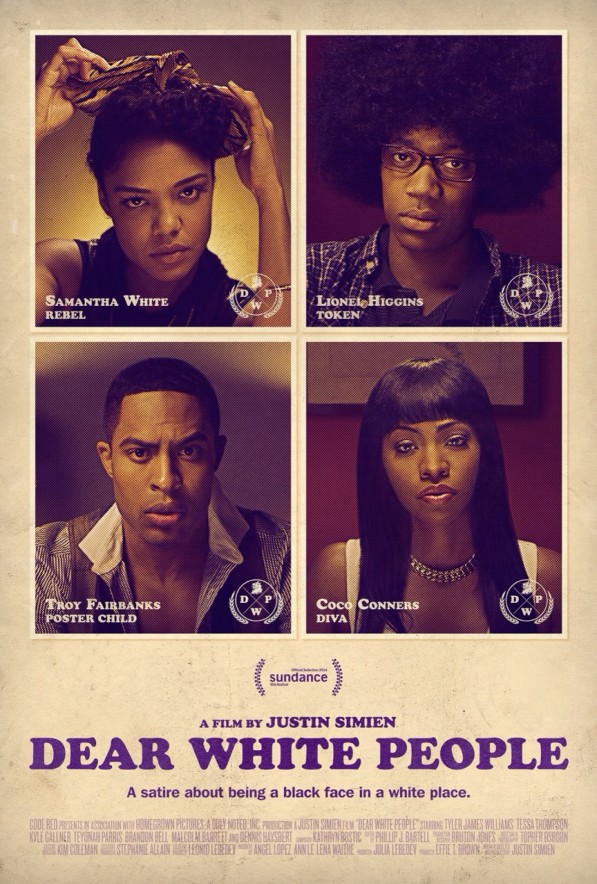 In an age where a vocal number of people believe racism died when Obama took office, or that the sins of the past are so old they have no more ramifications in today’s modern world, Dear White People is a blessed conversation-starter and a cogent argument to point to and enthusiastically say, “This!” Writer/director Justin Simien has put together a biting satire on modern race relations and the pressure to fit in where one can. This is more of a parable than a film, with some less than fully realized characters, but the commentary is rich and pointed enough that I was pinned to my seat. I wanted to hear what the characters would say next, and yes that’s also one of the film’s forgivable flaws, the fact that characters feel like they have speeches and political repartee rather than actual dialogue. In the fictional university of Winchester, every person is compromising who he or she is, pretending to be something they’re not, to fit an easily definable image. Everyone is using somebody for his or her own selfish gain. The storylines jostle around, relying on too many coincidences, but the actors are more than capable of drawing you in, especially the two leads played by Tessa Thompson (Selma, TV’s Copper) and Tyler James Williams (TV’s Everybody Hates Chris) as a gay journalist who doesn’t see himself fitting in with any of the established definitions of “black culture.” The commentary on reality TV and the media feels tacked on and undercooked, forgotten except that it lays a foundation to justify the film’s startling conclusion, a frat party where obnoxious white students dress up as grotesquely racist cartoons. Dear White People is a damning film that also plays it safe with its excoriating condemnations; it’s not as militantly ideological as some may fear or hope. This is no Bamboozled. And yet, it’s this middle approach that will make it more palatable for a mass audience. Oh, and did I mention it’s also funny? Whatever your color, take time to see this film.
Nate’s Grade: B+
Share this:

Guardians of the Galaxy (2014)
 Who would have guessed that a movie that featured a talking tree and an anthropomorphic raccoon would be one of the best films of the year and one of the top grossing films of the summer? At this point for audiences, the Marvel name can do no wrong, but really it’s the degree of latitude given to Guardians of the Galaxy, an admittedly weird movie with strange characters, that allows this unique film to shine. Attaching offbeat director James Gunn (Super, Slither) to be writer and director was a risk that paid off tremendously, as Guardians is the Marvel film most entrenched with the particular personality of its creative director. This is a gleefully imaginative film that enjoys wading deep into weirdness, dancing to its adventurous Star Wars throwback beat, always with its focus set on comedy but not at the expense of quality drama or character development. Really, the characters are the focus of this entry into the franchise, and Gunn and his actors do a bang-up job of gathering the team and getting you to care about each and every one of them. Each one of these characters has a goal, several payoffs, and each is given their proper attention. In an ordinary superhero film, the archetypes would be ironclad. With Guardians, the tough guy made of muscle can also be a source of unexpected comedy with his literal-minded speech patterns. With Guardians, the talking raccoon can also be an emotionally disturbed victim of genetic experimentation who doesn’t know how to play well with others. These are damaged characters and their formation of an unconventional family unit is deeply satisfying and rather touching. I have seen the film twice and gotten teary-eyed both times. The real star of the film is Chris Pratt (TV’s Parks and Recreation), and what a breakout role he is afforded; he’s like Han Solo’s more juvenile nephew. But like the others, the part is surprising in its depth, with a well of sadness and displacement he still hasn’t processed while he scavenges the galaxy. The plot can be a bit unwieldy at times but pays off better for repeat viewings. This is a world I want to spend far more time exploring and with these characters as my merry prankster guides. With a movie this action-packed, thoroughly entertaining, and gratifying, why come back to Earth?
Nate’s Grade: A
Share this:

22 Jump Street (2014)
 When 21 Jump Street was proposed as a movie, nobody thought it was a good idea. Even its stars and writers. They used that as an opportunity to craft one of the more charming, surprising, and hilarious films of 2012, a movie so good that it was also one of the best films of a relatively great year at the movies. Now that was something nobody expected with a 21 Jump Street movie. As often happens, Hollywood looks to keep the good times going, and 22 Jump Street is knocking at the door. In Hollywood tradition, sequels usually follow the “more of the same” format with a dash of “bigger is better,” a fact that 22 Jump Street takes to heart.
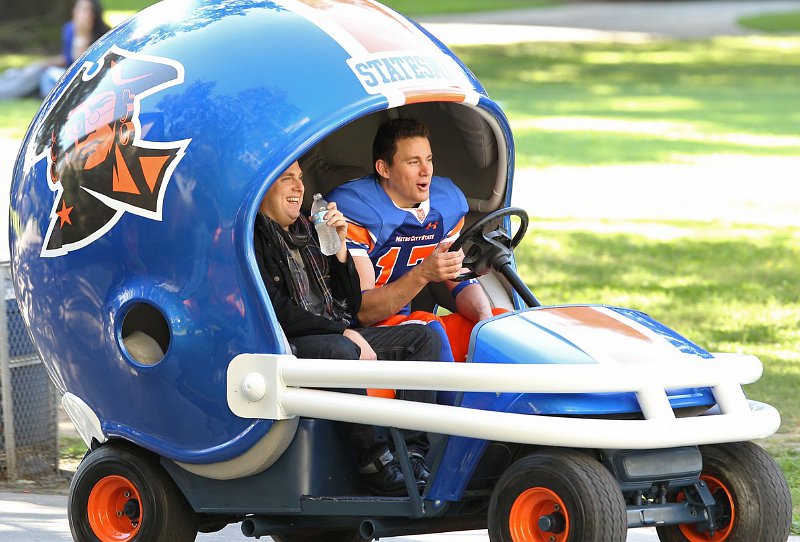
Having successfully busted a high school drug ring, Officers Schmidt (Jonah Hill) and Jenko (Channing Tatum) are the toast of their unit. That is until they let a dangerous criminal (Peter Stormare) get away with a shipment of drugs. It’s back to the Jump Street program, as their police chief (Nick Offerman) laments that everybody just needs to do the exact same thing that worked the last time. Captain Dickson (Ice Cube) has assigned Schmidt and Jenko to go undercover at the state university to sniff out where the student body is getting a powerful and deadly designer drug. Schmidt grows close to Maya (Amber Stevens), an art major who knew a girl who overdosed on the new drug. Likewise, Jenko is falling for team quarterback Zook (Wyatt Russell), or more accurately the bond they share as two athletes with a similar brain. The partnership of Schmidt and Jenko may be in trouble for the long haul if they can’t work together.
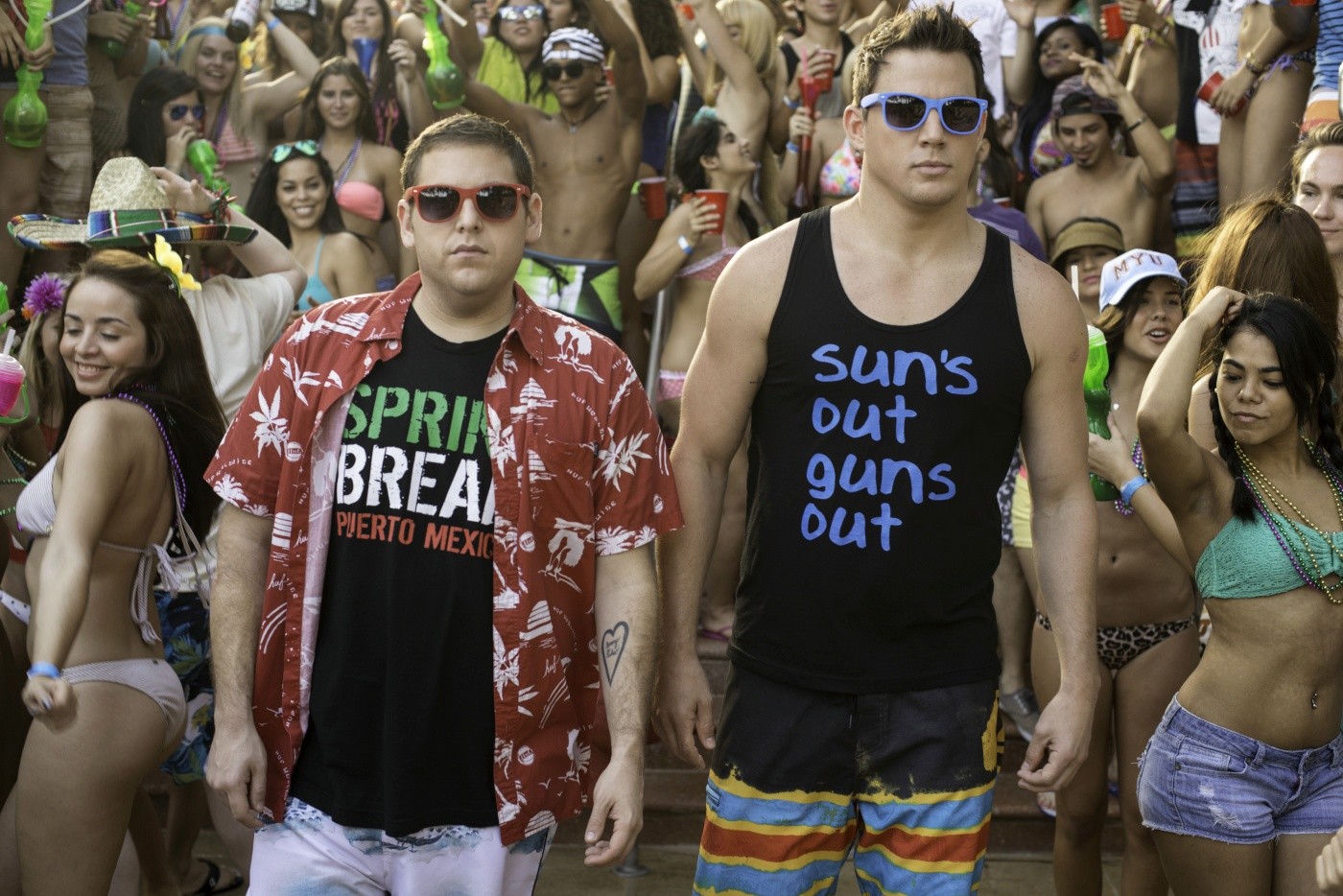 This may be one of the most meta movies of all time, existing outside itself in tandem to always provide a winking dose of commentary about its own silliness, excess, and corporate mentality about replicating success through the least creative means possible. There’s even a character with a literal red herring tattooed on his bicep. There are plenty of in-jokes without breaking down the fourth wall, and the meta cleverness is an entertaining way to pave over the general same-ness that goes along with the limited undercover premise. While cracking wise for its full running time, 22 Jump Street really is “more of the same.” For most, myself included, that is completely acceptable since the first 21 Jump Street was an unexpectedly witty and comically brash outing. Seeing another adventure with this same team is more than justifiable, especially with the kind of comic kinship that Hill (The Wolf of Wall Street) and Tatum (White House Down) share. Once again the guys go undercover to bust a drug operation, and once again they each get close to a different set of students, and once again their relationship takes a personal hit. It’s the same plot beats but with different jokes (like the R-rated version of Anchorman 2). The entire “going undercover as a school student” concept is so dated to begin with, and neither Hill nor Tatum can credibly pass at this point, so the entire enterprise feels like they’re squeezing the most they can while they can, enjoying the good times, the good chemistry, being silly on the studio dime, and counting their luck.
The end credits for 22 Jump Street deserve special praise just for the appearance of burning down its franchise. Throughout the film the guys are mocking the very notion of a sequel. By the end, they mock, without abandon, the idea of a franchise. We flash through an absurd array of new assignments, new sequels, and new school-setting undercover gigs, and it’s almost like a flash-forward into the timeline of the movie, like the finale of Six Feet Under. There are some amusing cameos and business satire to mock with as well as the general ludicrous nature of repeating this plot/formula (Magician school?). The end credits leave the audience feeling buzzy and giggly, a perfect comic high, and it’s the best end credit high since the original Hangover.
The real enjoyment is watching Hill and Tatum continue to mine what has become one of film’s best onscreen bromances of all time. I never would have pictured these two fitting together so smoothly, or Tatum being such an unexpectedly natural comedic talent. Thank goodness for the 21 Jump Street movies for offering us these untold comic gifts and for knowing what the main attraction is and how to properly develop it. The relationship between friends/colleagues/bros Schmidt and Jenko is the most consistently interesting, surprisingly emotional, and comically ripe subject in the film. We have two great actors and watching them butt heads is just as fun as watching them get along. In the sequel, the guys go through what serves as an analogue for a separation, wanting to see other partners. We know in our hearts these two are meant to be together, and so much of the fun is watching just how this odd coupling now seems so indispensable to one another, with Tatum’s zigs blending ever so delightfully with Hill’s zags. I could watch another movie of just these guys doing paperwork.
In the first film, Jenko and Schmidt were set up to fall back into stereotypical roles before the movie found a better solution. Jenko was going to be the jock with sports classes, and Schmidt the nerd with AP classes and drama. Then a mix-up, and they have each other’s identities, and the movie is that much better, forcing each out of their comfort zone and finding the better comic scenario. With 22 Jump Street, the movie falls back to the old social order. Jenko hangs with the football jocks and the frat brothers and gets to be the super popular student-athlete, while Schmidt is left to investigate the art majors who knew the dead coed. It has them falling back into their high school roles (popular vs. outsider) and it’s not nearly as interesting, especially after seemingly growing beyond these moments. The side characters aren’t as interesting either, many lacking material to develop beyond one-note joke machines, like Zook. I was mildly intrigued by H. Jon Benjamin (TV’s Archer, Bob’s Burgers) as a football coach obsessed with protecting the goalpost, but I wanted more. Twin stoners who talk at the same time are not enough.
 There is one supporting actor given enough material to shine and that is Workaholics’ actress Jillian Bell. She plays such a deadpan, biting, sarcastic, no-nonsense roommate who won’t entertain for one second that Schmidt is who he says he is, and she is wonderfully brutal with her insults. There’s a later scene where she keeps wrongly misinterpreting a fight with Schmidt into something else. It’s a highlight of the movie, a great example of her physical comedy skills and sense of timing, and it’s a plumb example of taking a topic that a situation that could be uncomfortable and finding the right balance to guide an audience along for the best laugh.
Like before, once the movie adapts to its action-filled climax, the jokes start taking a backseat to the action theatrics. Returning directors Phil Lord and Christopher Miller (The LEGO Movie) have kept their same brand of rambunctious spirited comedy alive and well, which keeps the movie’s pace brisk and always open to fresh weirdness. While some jokes don’t work as well the second time (Vietnamese Jesus, the drug freak-out fantasy sequence, though its use of Creed music almost makes up for that), this is still more sequel than retread. This is not an Austen Powers that repeats the exact same jokes with slightly different settings. Lord and Miller understand how to satiate an audience without overt pandering. They know how to build payoffs that are small and payoffs that are big, ones directly linked to character goals. There are strong comedic set pieces unrelated to any sort of meta commentary, Schmidt’s impromptu slam poem being one of them. It’s a manner of giving people what they want while still finding new ways to surprise, because otherwise comedy is dead without the subversion of expectations.
“More of the same” is the best and worst summary for 22 Jump Street, and despite 1500 words of film criticism, all you really need to ask yourself. Is more of the same good enough for you when it comes to another 21 Jump Street movie? Sure, we’d all wish for the same sort of unexpected cheeky revelation that was the first film, but then again no one had any expectations that a 21 Jump Street movie would be anything worth watching, let alone one of the best films of that year. 22 Jump Street is hilarious, witty, aggressive, irreverent, and even when it has to take on the role of action-comedy, it does so with a consistent wink, pointing toward all the sequel tropes and absurdity without rubbing your nose in every single reference and gag. The second time around Jump Street is, by definition, never going to be as fresh, but the company is still top-notch, the jokes are still layered and cracking, and the determination is high. It’s a sequel that delivers what it promises. I’m ready to take this franchise as far as it can conceivably go for two men well into their 30s-posing-as-high-schoolers. Magician school, here we come.
Nate’s Grade: B+
Share this:

A Million Ways to Die in the West (2014)
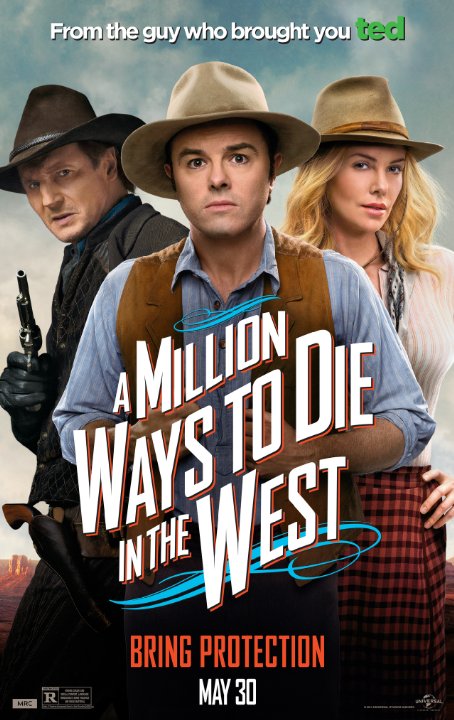 I was no fan of Seth MacFarlane’s first big-screen effort Ted, but I had my hopes up for his Western comedy after some genuinely funny trailers and the reported promise of a lack of anachronistic jokes. A Million Ways to Die in the West lands about half of its jokes, which is a definite improvement though still has enough dead spots that left me shifting around in my seat. The main conceit, a self-aware individual explaining all the myriad ways the Wild West is horrible and will kill you, is a fun operating principal that is also weirdly educational. And MacFarlane actually makes a pretty good comedic leading man, enough so that he could get gigs in other people’s movies. He plays a coward roped into fighting an outlaw (Liam Neeson) after unknowingly falling for the outlaw’s wife (Charlize Theron). The meta jokes critiquing the romanticized living conditions of the West have the highest percentage of laughs, and there are some great sequences like a trip at the local fair which turns deadly so easily. Theron and MacFaralane make a good pair and the supporting cast, with Giovanni Ribisi and Sarah Silverman, are funny and don’t overstay their welcome. Neil Patrick Harris is also amusing as ever and even gets a song-and-dance number about the virtues of mustaches that, honestly, should have been better. But every so often MacFarlane can’t help himself. There are some gross-out jokes that go a little too far. Then there’s the fact that the movie forgets to be a comedy for long stretches, morphing into an action thriller or budding romance. The scenery is nice but I would have liked more jokes. The movie is also far longer than it needs to be, dragging out the climax. I’m also somewhat disappointed that MacFaralne and his writers missed out on an obvious payoff, namely the myriad ways the West can kill you. It only seems natural for Neeson and his gang to be foiled by the West itself, which would present a fun guessing game for the audience to anticipate what deadly condition would strike next. Alas, a missed opportunity. A Million Ways to Die in the West is a hit-or-miss affair with just enough hits to warrant a casual viewing.
Nate’s Grade: B-
Share this:

Chef (2014)
 Chef must have been something of a needed break for its star, writer, and director, Jon Favreau. He’s directed three large-scale Hollywood sci-fi mega movies in a row, a long way from Favrieau’s first big break, Swingers, which he wrote for himself. It was time for something a little smaller, quieter, and more personal, and Chef is just the ticket, a familiar but still greatly satisfying slice-of-life movie about a frustrated chef finding his mojo. Favreau plays a famous chef who cracks under the pressure of delivering the same safe food day in and day out. He loses his job after an increasingly hostile Twitter war with a food critic who calls him out for his safety in blandness. This pushes Favreau out of his comfort zone; he starts an independent food truck, bonds with his son, and generally begins to embrace his new invigorating freedom. Don’t see this movie on an empty stomach because it will be torture. The food preparation shots are tantalizing as are the general discussions over the adoration of food, the heavenly feel of a good meal (an aspect that’s even utilized as foreplay in the film). The entire film is stoked by a laid back charm, an amiable camaraderie between Favreau and his cast, so much so that we don’t care when the film sort of stalls. It’s a far lengthier period between Favreau losing job and getting the food truck than necessary, and the ending is abrupt with an almost absurd amount of resolution tie-ups crammed together without additional progression. The characters are likeable enough, funny, and their passions have a way of enveloping the audience, so much so that a fairly predictable plot is excusable. Chef is a lovely little palate cleanser at the start of the summer movie season and an enjoyable excursion. Just fill up before seeing it or else.
Nate’s Grade: B+


 nathanzoebl
You must be logged in to post a comment.